All about dinosaurs, fossils and prehistoric animals by Everything Dinosaur team members.

Fossil finds, new dinosaur discoveries, news and views from the world of palaeontology and other Earth sciences.

12 02, 2012

Oldest Animal Fossils Discovered According to New Research

By |2024-04-22T14:22:16+01:00February 12th, 2012|Categories: Dinosaur and Prehistoric Animal News Stories, Palaeontological articles|0 Comments

Namibian Desert Discovery Dates First Animals to 700 million years ago (Approximately)

An international team of scientists think they may have discovered the microscopic fossils of the earliest known animal life form on Earth.   The researchers including geologists from St Andrews University (Scotland); have identified sponge-like fossils found in ancient Namibian rocks.  The strata, laid down at a time when the area now known as Etosha National Park, was a marine environment, preserve the delicate, minute calcium carbonate based skeletons of sponges pushing back the origins of the Animalia by tens of millions of years.

Oldest Animal Fossils

Sponges are classified into their own distinct phylum by scientists – the Porifera.  They are amongst the most simple of all multi-cellular life forms.  Water passes through pores at the surface of the organism, often to a central cavity which represents the sack-like body, the water is filtered and tiny organic particles trapped and absorbed by the sponge with the rest of the water being ejected out of a large hole out of the top (active or passive ejection).  Sponge fossils are known from around 600 million years ago, the rocks that the international team of scientists have been studying are known to be at least between 760 and 550 million years old.

Sponges are essentially organised colonies of cells.  Different cells have different functions, forming simple tissues and other structures.  Most sponges are marine, but some do live in freshwater.  All our sessile, living on the sea or lake bed, some have stalks for helping them to adhere to a rock or a piece of seaweed.

Sponge fossils start to become abundant in Cambrian aged strata (around 540 million years old), although some Protospongia (first types of sponge) fossils believed to be sponge spiricles have been dated to the end of the Ediacaran Period around 560 million years ago, however, these new discoveries could push the origins of the first animals back to the geological period before the Ediacaran, a time known as the Cryogenian Period – a time when planet Earth was plunged into a global Ice Age.

Dropstones (rounded boulders transported by glaciers and deposited) provide evidence of a global glaciation event around 700 million years ago.  Although, still controversial,  many scientists now believe that most of the planet was covered in ice for a significant part of the late Neoproterozoic.  This theory “Snowball Earth” was popularised by the likes of the British-Australian geologist Sir Douglas Mawson, who postulated that at sometime during Earth’s ancient past ice sheets covered almost all of the Earth’s surface, even at the equator.

University of St Andrews’ geologists Donald Herd, Stuart Allison and Dr Tony Prave played an important role in the discovery and analysis of these tiny structures.  The fossils described as “hollow globs”, could be classed as examples of Protospongia, essentially the ancestors of all animals, including our own species.

Electron Scanning Image of a Microscopic Structure

Meet our earliest ancestor.

Picture credit: University of St. Andrews

The picture reveals evidence of different sized holes, to pass sea water through and to expel it – evidence of a primitive sponge-like organism.

The Scottish based scientists worked closely with colleagues from the Ditsong Museum (South Africa) and Mr Karl-Heinz Hoffmann of the Namibian Geological Survey to study the sedimentary rock samples and classify the minute fossil remains.  The scientific paper, written by fellow researchers from the University of Witwatersrand (S. Africa), has been published in the South African Journal of Science.

Named Otavia antiqua, (the name translates as “old one from the Otavia Formation”) the sub-millimetre-sized fossils may have existed before the great glaciation of our planet.  If these organisms evolved before “Snowball Earth”, they survived its extremes, challenging contemporary scientific theory that suggests that complex life did not evolve until after the Earth thawed out.

This new research suggests that the Porifera (sponges) may have evolved as much as 100 million years earlier than previously thought.  A team of Australian and American scientists studying microscopic fossils from the Flinders Formation of Australia identified sponge-like fossils that may have been laid down between 650 and 640 million years ago.

To read more about the Australian discovery: South Australian Fossils indicate “Earliest Animals”.

Until the discovery, it was thought that the first animals emerged between 600 and 650 million years ago,  as calculated, in part by the study of rocks in the Flinders Formation of South Australia.   The international team’s findings echo the predictions of the key dates of early life forming by geneticists studying the ‘molecular clocks’ of other species.

The idea of a molecular clock is based on the concept the evolutionary advances occur at regular time intervals.  If it is assumed that the rate of mutation in an organism’s DNA has not changed over time, scientists can work out the “genetic distance” between two types of animal and then work backwards to calculate the approximate time when these two types of organism diverged from a common ancestor.

Commenting on the discovery, Dr Prave, a co-author of the research paper stated:

“The findings are a tribute to the labours of Bob Brain who has worked tirelessly for the better part of two decades hunting for such fossils.  It was deeply satisfying to hold them in the palm of your hand and realise that these could mark the advent of animals.”

The work of the ten-person team has led to the identification of tiny sessile, sea creatures pierced by different-sized openings that were probably used to pass nutrients into their bodies.  The scientists also found a “network of internal passageways”  believed  to be the remains of a primitive gut.

Dr Prave also stated:

“What is remarkable is that this organism appears to have evolved before, and survived through, the environmental extremes of snowball Earth.  This implies that the causes and conditions for the evolutionary leap from bacteria to animals have to be searched for much deeper in time than previously thought.”

A spokesperson from Everything Dinosaur commented:

“This new research could push back the origins of the Animalia into the Cryogenian Period, but the consequences of this study could have implications beyond our own planet and suggest the intriguing possibility of Metazoan-like organisms existing elsewhere in the solar systems such as on the frozen moon of Jupiter known as Europa.”

Everything Dinosaur acknowledges the University of St. Andrews material in helping to put together this article.

For models and replicas of early animals from the Palaeozoic (whilst stocks last): Safari Ltd. Palaeozoic Models and Prehistoric Animals.

10 02, 2012

Tokyo’s New Dinosaur Bridge to Open this Weekend

By |2023-03-09T07:53:27+00:00February 10th, 2012|Categories: Dinosaur and Prehistoric Animal News Stories|0 Comments

Japan’s Dinosaur Shaped Bridge

Tokyo’s new “Dinosaur Bridge” will open to vehicles this weekend.  The bridge, whose official name is the Tokyo Gate Bridge is a four-lane road bridge that links the city to a man-made island in Tokyo Bay that has become the location for a huge container port.  Government officials were spurred on to do something about the city’s traffic congestion problem after Tokyo lost out on the award of the Olympics (2016) and the existing road infrastructure was criticised by the International Olympic Committee.

Dinosaur Bridge

The bridge has got its unusual nickname due to the shape of its support structures, they resemble two large dinosaurs facing off at each other.  At more than one and a half miles long and weighing in excess of 36,000 Tonnes this ten-year man-made construction puts even the biggest dinosaurs in the shade.

Officials hope that the new bridge will cut driving time from the city to the container port by nearly half and the bridge is forecast to carry something like 32,000 vehicles a day.  This development is just one of a number of new construction projects the Japanese Government has planned to help tackle the congestion caused by Japan’s rising urban population.

The rather unconventional design for the bridge has come about as far as we at Everything Dinosaur can understand, because of three major considerations the architects had to take into account.

Firstly, a suspension bridge was ruled out as it would have been too high causing problems for planes coming in and out of the nearby Haneda airport.  Secondly, the bridge’s design had to be strong enough to withstand the shock waves and forces that occur during an earthquake.  Thirdly, the bridge has to permit the passage of large container ships underneath it.  This led to the final design described by observers as two dinosaurs facing off against each other.

The architects have certainly produced a radical looking bridge, one that incorporates the very latest in bridge design technology.  These metal monsters would not look out of place in a Godzilla movie.  A film franchise that originated in Japan and remains one of the country’s biggest film franchise successes to date.

Sauropod dinosaurs may not have been particularly fast but with their huge, column-like legs they were at least very stable, although just how “Earthquake proof” a sauropod such as Diplodocus or Apatosaurus was; is hard to judge given the fact that we have only their body and trace fossils to go on.

Ironically, sauropods have a second link with bridge construction.  A number of diplodocids have been described as having the “anatomy of a suspension bridge” with their long necks, long tails and bodies supported by four massive legs.  The new bridge built at a cost of something like 140 billion yen represents a considerable investment, although the improvements in travel times and the reduction in congestion will provide a welcome boost to the nation’s economy.

Local construction company Kawada Industries spent two years building the dinosaur-shaped supports for the Tokyo Gate Bridge.  According to a company spokesperson, three super-sized cranes were used to position the road sections onto the support structures – a nerve racking experience for the construction crews as one mistake could have led to whole portions of the new build being dropped into the bay.

The bridge also incorporates a walkway for pedestrians, and officials are hoping the unusual prehistoric animal shaped bridge will help to encourage tourism in the area.  Sight seeing cruise ships have reported that tickets for boat trips around the Tokyo Gate have been selling very well.  Whether or not this construction will become as well-known as some of the dinosaurs it is supposed to resemble remains to be seen.

One cruise ship operator seems to have got confused over the prehistoric animal connection.  In a press interview the president of Zeal Cruises stated:

“We want overseas tourists to come and see Japan’s new mammoth bridge.”

Now a bridge with large tusks, small ears and a long, shaggy coat – that would be a tourist attraction!

To view models and replicas of dinosaurs as well as prehistoric elephants: Prehistoric Animal and Dinosaur Models.

5 02, 2012

Tyrannosaurus rex versus Spinosaurus (A New Perspective)

By |2024-04-22T14:25:34+01:00February 5th, 2012|Categories: Dinosaur and Prehistoric Animal News Stories, Dinosaur Fans, Educational Activities, Everything Dinosaur News and Updates|12 Comments

Battle of the Killer Giants

This weekend saw Everything Dinosaur team members delivering a series of family themed dinosaur presentations at Liverpool World Museum.  One of the prehistoric animal topics covered was an update on the research and study into the spinosaurids.  Was for example, Spinosaurus aegyptiacus the biggest theropod known to science, indeed the biggest terrestrial carnivore known in the fossil record?

Tyrannosaurus rex and Spinosaurus

The audience are invited to make up their own minds, if an imaginary battle took place between a Tyrannosaurus and a Spinosaurus.  We collated all the votes from the many hundreds of visitors who took part in our workshops, the results from this weekend’s activities are summarised below:

Battle of the Killer Giants T. rex versus S. aegyptiacus

Two heavyweight theropods slug it out.

Picture credit: Everything Dinosaur

The audience votes were quite close but when all the information was compiled 54% of the theatre goers who voted thought that T. rex would win in  a fight with Spinosaurus compared to 46% who thought that Spinosaurus would come out on top.

To view other survey results from this Everything Dinosaur presentation: Museum Visitors Take Part in Dinosaur Study.

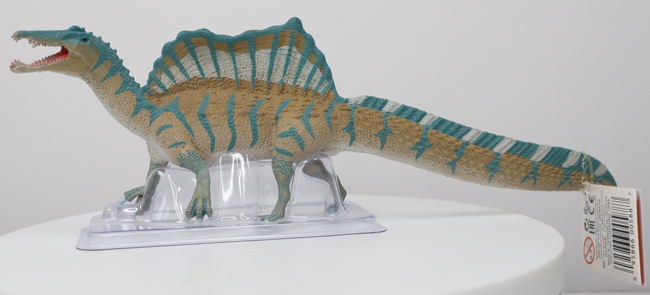
A Replica of a Spinosaurus – A More Modern Interpretation

Wild Safari Dinos Spinosaurus figure (2021).

The award-winning Wild Safari Dinos Spinosaurus figure. Picture credit: Everything Dinosaur.

Picture credit: Everything Dinosaur

The picture above shows a more interpretation of Spinosaurus by Safari Ltd.

To view the range of Safari Ltd models in stock at Everything Dinosaur: Wild Safari Prehistoric World Replicas.

4 02, 2012

Special Prehistoric Times Issue 100

By |2024-01-01T17:28:56+00:00February 4th, 2012|Categories: Dinosaur and Prehistoric Animal News Stories, Dinosaur Fans, Prehistoric Times|0 Comments

Prehistoric Times Reaches its Century

Prehistoric Times, the magazine for dinosaur fans and prehistoric animal merchandise collectors is celebrating its 100th edition.  Yes, in a feat not matched by any English batsman in the current Test series against Pakistan, Prehistoric Times (PT to its friends) has reached 100 not out.

Prehistoric Times

First of all we should congratulate all those dedicated people involved in producing such an excellent quarterly magazine.   Issue 100, in common with all the other editions of this magazine is absolutely jam-packed full of interesting articles, updates and Dinosauria related data.

Mike Fredericks, the dedicated editor of the magazine published the last issue with two different front covers, a boon for collectors, and in keeping with this very special publication, the 100th issue has also been produced with two front cover versions.  Spanish artist Raul Martin has provided the artwork for one of the covers.  His picture depicts an encounter between Deinosuchus and the tyrannosaur; Albertosaurus.  However, we received at Everything Dinosaur’s office the second front cover version.  A beautiful illustration done by our chum Fabio Pastori entitled “The Airbender”.  Fabio’s front cover picture features Albertosaurus, Gorgosaurus and a prehistoric bird known as Enantiornithes.   Super artwork – both pictures are worthy of gracing issue 100 of PT

 The Two Front Covers of Prehistoric Times

Celebrating 100th Issue with two front cover versions.

Picture credit: Raul Martin/Fabio Pastori

Inside this issue, palaeontologist Steve Brusatte provides a review of the last twelve months from a palaeontology perspective, there is a fascinating interview with the highly talented and entirely self-taught Australian artist Peter Schouten – some amazing prehistoric artwork indeed.

Another highlight is a thought provoking article by Tracy Lee Ford – asking the question “Could some Dinosaurs Perch?” For the answer, as to whether the likes of dromaeosaurs were arboreal – well, you will have to buy a copy and see for yourself what conclusions can be drawn.  Talking of drawings, lots of wonderful readers artwork in the features covering one of the front cover stars – Albertosaurus.  There is also a well-written article on our favourite pelycosaur – Dimetrodon, produced by Phil Hore.

Look out for the feature on the Royal Belgian Museum (iguanodontids a plenty) and an update on the Dinosaur discoveries of Portugal plus lots more (thanks for the Origin of the Series article to Anthony Beeson), and the Coelodonta replica masterclass by Steven B. DeMarco.

All in all, a super edition of PT, ten out of ten (or should that be 100 out of 100)?

For dinosaur toys and prehistoric animal themed gifts: Visit Everything Dinosaur.

1 02, 2012

Dinosaur Death Throes – Updated Research

By |2023-03-09T07:55:23+00:00February 1st, 2012|Categories: Dinosaur and Prehistoric Animal News Stories|1 Comment

An Explanation of Dinosaur “Death Postures”

Many theropod dinosaur fossils if they are discovered as a reasonably complete and articulated specimen depict the animal in a twisted posture, with the neck and tail arched over the spine.  In the past these unusual positions have been interpreted as the “death spasms” of the animal.  Such postures are not restricted to dinosaurs, fossils of birds and other reptiles, especially those with long tails and necks show a similar stance as it were.  New research suggests that these positions are a result of decomposition and bare no relation to the “death throes” of the animal concerned.

More or less complete and articulated skeletons of dinosaurs with a long neck and tail often exhibit a body posture in which the head and neck are recurved over the back of the animal. This posture, also known from Late Jurassic “proto-bird) Archaeopteryx (A. lithographica) , has been fascinating palaeontologists since the first theropod (mainly meat-eating), dinosaur fossils were discovered.  The pose is often referred to as the  “opisthotonic posture”.

To read an earlier article on dinosaur “death throes”: Death Throes – Not Quite What they Seem.

Death Postures

The opisthotonic posture relates to an accessory symptom of tetanus, well known to doctors and to veterinarians.  Usually, an “opisthotonic posture” like that is the result of vitamin deficiency, poisoning or damage to the cerebellum.

The cerebellum is a brain region that controls fine muscle movement, which includes the body’s antigravity muscles that keep the head and tail upright.  If the cerebellum ceases to function, the antigravity muscles will clench at full force, tipping the head and tail back, and contracting the limbs.

A syndrome like that as a petrified expression of death throes was discussed for the first time about 100 years ago for some vertebrate fossils, but the acceptance of this interpretation declined during the following decades.  In 2007, this “opisthotonus hypothesis” was newly posted by a veterinarian and a palaeontologist.

Five years later, two scientists from Switzerland and Germany have re-evaluated the revitalised “opisthotonus hypothesis” and examined one of its icons, the famous bipedal dinosaur Compsognathus longipes from the “Solnhofen Archipelago” (Germany).  An area of Upper Jurassic strata, laid down in what was an extensive lagoonal network.

 A Picture of a Compsognathus Dinosaur Fossil Showing the Death Posture

A result of Bio-mechanics not of “Death Throes”.

Picture credit: G. Janßen, O. Rauhut, Bayerische Staatssammlung für Paläontologie und Geologie)

Sedimentologist Achim Reisdorf from University of Basel’s Institute of Geology and Palaeontology comments:

“In our opinion, the most critical point in the newly discussed scenario of the preservation of an opisthotonic posture in a fossil is the requirement that terrestrial vertebrates must have been embedded immediately after death without substantial transport.  But consigning a carcass from land to sea and the following need of sinking through the water column for only a few centimetres or metres is nothing else.”

Postmortem Alterations of the Skeleton

Convinced that the back arching was generated, not by death throes, but by postmortem alterations of a decaying carcass, the researchers made experiments with plucked chicken necks and thoraxes, immersed in water.  Submersed in water, the necks spontaneously arched backwards for more than 90 degrees.  Ongoing decay for some months even increased the degree of the pose.

Thorough preparation and dissection combined with testing revealed that a special ligament connecting the vertebrae at their upper side was responsible for the re-curved necks in the chickens.  This ligament, the so-called Ligamentum elasticum, is pre-stressed in living chickens, but also in dead ones.

One of the scientists involved in carrying out this, somewhat unusual and macabre research, palaeontologist Michael Wuttke from the Section of Earth History in the General Department for the Conservation of Cultural History Rhineland Palatinate in Mainz (Germany) stated:

“Veterinarians may often have to deal with sick and dying animals, where they see the opisthotonic posture in many cases.  Vertebrate palaeontologists, however, who want to infer the environment in which the animals perished and finally were embedded have to elucidate postmortem processes and bio-mechanical constraints too”. 

It is this tensile, ligament, essential for the effective support of a theropod dinosaur’s long tail and neck that could be responsible for the classic – “dinosaur death pose”.

Michael went onto add:

“The preloaded ligament helped them [dinosaurs] saving energy in their terrestrial mode of life.  Following their death, at which they were immersed in water, the stored energy along the vertebra was strong enough to arch back the spine, increasingly so as more and more muscles and other soft parts were decaying.  It is a special highlight that, in the Compsognathus specimen, these gradual steps of re-curvature can be substantiated, too.  Therefore, bio-mechanics is ruling the postmortem weird posture of a carcass in a watery grave, not death throes.”

For replicas and figures of Compsognathus and other theropod dinosaurs: Papo Models of Prehistoric Animals.

27 01, 2012

Prehistoric People Built Social Networks just like Us

By |2023-03-09T07:56:33+00:00January 27th, 2012|Categories: Dinosaur and Prehistoric Animal News Stories|0 Comments

Study of Hazda People of Tanzania Provides Insight into our Earliest Social Networks

A team of Anglo/American scientists have concluded that early humans (H. sapiens) built similar social networks to their modern descendants.  A study of a tribe from Tanzania, that live off the land and act as a model for early human settlements reveals that despite our technology, the way we interact with each other has not changed much for the best part of 200,000 years.

Scientists have speculated that one of the reasons for our own species success when compared to the Neanderthals or indeed H.erectus may have been our ability to develop larger social networks and therefore be able to share information and exchange ideas.  A greater amount of social interaction would have helped ideas to catch on more quickly, thus contributing to our species survival in difficult times.

We carry out an experiment with school children where we split the class into two groups to represent two tribes, set them a problem involving the need to store water and then once one tribe has worked out what to do, we extend the session by getting the students to debate whether or not they would share the information with their neighbouring tribe.  Using an ostrich egg, a stick, ants and a handful of straw we can gain a fascinating insight into human psychology.

Earliest Human Social Networks

The Anglo/American study explores similar themes, permitting an insight to how H. sapiens could survive and eventually flourish despite the difficult climate conditions of the Pleistocene Epoch.  Avoiding extinction, the fate of the dinosaurs is the name of the game.

Writing in the scientific journal “Nature” the research team concludes that prehistoric humans built social networks that resemble those seen in modern societies.  The British and American scientists focused on a single tribe, known as the Hadza who make their living by foraging in the Lake Eyasi region in the Great Rift Valley (Tanzania).

Ironically, this part of Africa is often referred to as the “cradle of humanity” as it is believed, and the fossil record backs this up, that our species evolved in this part of Africa before migrating out of Africa (at least two migrations) and spreading worldwide.

In the study, several interesting patterns of human behaviour emerge.  Humans co-operate readily but also can be selfish.

Emerging Patterns

The patterns that emerged, in which both co-operation and selfishness seemed to be contagious, offer a rare perspective on the question of how the social psychology of early humans has shaped modern social life.  Several hundred Hadza tribes people were involved in the study.  They were given a series of tasks to complete, such as a survey of who their preferred camp-mates were, to whom would they offer food, such as precious sweet honey, the only sweet food item in their diet and highly prized as a result.

The research team also investigated how willing individuals were prepared to work for the good of community – how many would donate honey to a communal pool of the sweet, sticky substance.

Coren Apicella, a post PhD student at Harvard, who analysed the data from the study commented:

“The Hadza represent possibly one of the most extreme departures from life in industrialised societies, and they remain relatively isolated from modern cultural influences,” the authors write.  Yet all the examined properties of social networks seen in modernised societies also appear in the Hadza.”

In a society where the need to build social networks can make the difference between life and death certain common patterns were discovered, patterns that are reflected in modern human interactions.  Popular people befriend other popular people – a pattern of human behaviour reflected in on-line social networks such as Facebook.

People with similar backgrounds and interests are more likely to form a close social tie.  These networks can permit as well as constrain everything from coughs and colds, other diseases to important ideas.  Could this be why the wheel or early metal working caught on so quickly?

For a recent article highlighting a potential incident of human aggression preserved in the fossil record: Earliest Evidence of Human Aggression.

Friendship is something that is not preserved in the fossil record.  However, studying nomadic, hunter-gatherer peoples can provide an insight into how social ties and bonds helped our own species survive and then flourish.  Family ties are strong but social co-operation with non related people is a gamble.  The study identified a certain profile of tribe member who was prepared to take the benefits of social co-operation whilst remaining more selfish and self-interested.

The research team postulate that co-operation may be an evolved behaviour, otherwise unco-operative people would have out-competed co-operative groups long ago.  By working together, what we refer to as the “Sesame Street complex”, people can gain mutual benefit and society is strengthened as a whole.  The advantage gained, according to this study can be multiplied, catch and evolve on.

The authors of the paper suggest:

“Although natural selection is said to favour defection in unstructured populations where all individuals have an equal chance of interacting with one another, co-operation can evolve if population structure permits clustering.  This feature allows co-operators to increase in the population because they benefit from the public goods provided by fellow co-operators with whom they interact.”

The effect is for the co-operative and unco-operative to shun each other.  Among the Hadza, the researchers found that variation between groups was much greater than variation within groups.  In other words, co-operative people cluster together and boost their chances of success, while the unco-operative take their chances on their own, with the ultimate effect of making the human race more co-operative.

Technology may have moved on, but the basic human ability to build networks and develop social ties remains fundamental to our own species survival.  Certainly, with seven billion of us now on planet Earth, it is a good thing that most of us have a social nature “wired” into us.

For models and replicas of prehistoric animals and ancient hominids visit Everything Dinosaur’s award-winning website: Everything Dinosaur.

25 01, 2012

Archaeopteryx – Back in the Black

By |2023-03-08T14:13:18+00:00January 25th, 2012|Categories: Dinosaur and Prehistoric Animal News Stories|1 Comment

The World’s Oldest Blackbird Takes Flight

A new Archaeopteryx study suggests that this early bird could achieve powered flight and provides an indication of this Jurassic creature’s colouration.  Using an extremely powerful scanning electron microscope tell-tale melanosomes have been identified in a fossilised feather from the lithographic limestone deposits at Solnhofen.  This new research published in the scientific journal “Nature Communications” not only provides information on the colouration of Archaeopteryx wings – black, but also adds weight to the theory that this primitive bird was an accomplished flier.

New Archaeopteryx Study

The international team of researchers from Brown University (Rhode Island, USA), Yale University, the University of Akron (Ohio, USA) and the Carl Zeiss laboratory (Germany) using advanced microscopy were able to identify the pigment structures found on the fossilised tip of a single feather.  The feather was shed and ended up gently resting on the bottom of a shallow lagoon in what was to become southern Germany by a primitive bird approximately 150 million years ago.

The fine sediments being deposited in the still and anaerobic marine environment enabled the feather to be fossilised.  The unique conditions at Solnhofen, allowed the exquisite preservation of this feather and this fossil specimen is just one of ten ascribed to the prehistoric creature known as Archaeopteryx lithographica.

Black Feathers

The researchers identified the colour of the crow-sized creature’s fossilised wing feather, determining it was black at the tip.  The colour and the structures that supplied the pigment suggest that Archaeopteryx’s feathers were rigid and durable – just like a modern birds and this finding has important implications for the way scientists perceive Archaeopteryx.  It adds weight to the hypothesis that this transitional creature between dinosaurs and birds was actually quite a strong flier.

Archaeopteryx is perhaps one of the most famous of all the creatures known from the fossil record.  Identified and named just over 150 years ago, Archaeopteryx was about fifty centimetres long (most of the length being made up of its feathered covered tail).  It had large eyes, teeth in its jaws and the forelimbs had three greatly extended fingers, each ending in a small, curved claw.  The presence of feathers, so clearly seen in a number of specimens such as the “Berlin specimen” and the “London specimen”, helped scientists to interpret this creature as being a transitional fossil from the Dinosauria to birds – sometimes inaccurately called a “missing link”.

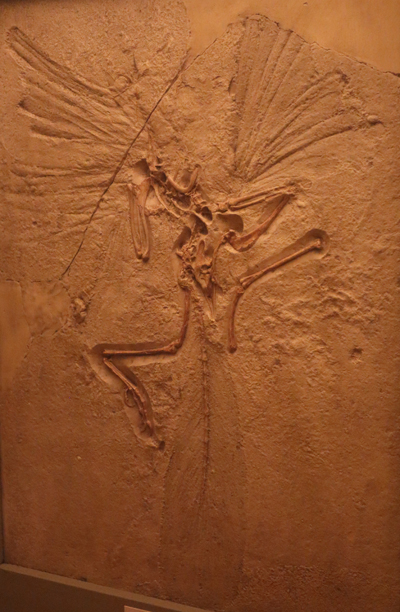
A Cast of a Famous Archaeopteryx Fossil

Archaeopteryx fossil cast

Archaeopteryx fossil cast. Picture credit: Everything Dinosaur.

Picture credit: Everything Dinosaur

Commenting on the research work, lead author Ryan Carney, an evolutionary biologist at Brown University stated:

“If Archaeopteryx was flapping or gliding, the presence of melanosomes [pigment-producing parts of a cell] would have given the feathers additional structural support.  This would have been advantageous during this early evolutionary stage of dinosaur flight.”

An Accomplished Aeronaut

Until recently, this single feather was regarded as the holotype for Archaeopteryx.  A holotype is the specimen from which the original description of the organism is based.  This is the fossil that is used to provide a scientific description of the organism, with which all other ascribed fossil material is compared to.  Last year the ICZN (International Commission on Zoological Nomenclature) ruled that the so-called “London” specimen the fossil of Archaeopteryx purchased by Sir Richard Owen for what was to become the London Natural History Museum should be regarded as the holotype.

To read more about this development for Archaeopteryx: Natural History Museum Getting the Bird.

The Fossilised Feather Used in the Study (compared to that of a Modern Bird)

Modern Feather (left), Archaeopteryx Feather (right).

Picture credit: Brown University

If Archaeopteryx was one of the first birds, then what did it look like?  This is a question that has intrigued scientists ever since the first fossils of this Jurassic “missing-link” were found back in the late 1850s.  The single feather was analysed and found to be a covert feather, so named because these feathers cover the primary and secondary wing feathers birds use in flight.  After two unsuccessful attempts to image the melanosomes, the group tried a more powerful type of scanning electron microscope at the Carl Zeiss laboratory, where the group located patches of hundreds of the indicative tube-shaped, pigment structures still encased and preserved in the fossilised feather.

The Electron Microscopy Revealing the Dense Pigment Structures

Pointing to the melanosomes in the fossil.

Image credit: Brown University

Graduate student, Ryan Carney added:

“The third time was the charm, and we finally found the keys to unlocking the feather’s original color, hidden in the rock for the past 150 million years.”

Melanosomes can provide scientists with an indication of the colouration of long extinct animals.  Professor Mike Benton (University of Bristol) and his colleagues have pioneered this melanosome finding technique.  Such structures had been found in fossils before, but they were interpreted as being bacteria, Professor Mike Benton and his team in conjunction with a number of other research institutes were able to identify pigment structures within the fossilised feathers of a dinosaur, providing the first evidence of the colours of a member of the Dinosauria.

To read more about this research: Melanosomes provide evidence of the Colour of Dinosaurs.

The team measured the length and width of the sausage-shaped melanosomes, roughly 1 micron long and 250 nanometers wide.  To determine the melanosomes’ color, Akron researchers Matthew Shawkey and Liliana D’Alba statistically compared Archaeopteryx’s melanosomes with those found in 87 species of living birds, representing four classes: black, grey, brown, and a type found in penguins.  Based on their findings the researchers were able to predict with 95% certainty that this part of the feathers on Archaeopteryx were black.

The scientific instruments and high powered microscopes at the Carl Zeiss laboratory gave the scientists an opportunity to examine the fossilised barbules preserved in the ancient feather.  The barbules are tiny, rib-like appendages that overlap and interlock like a zip to give a feather rigidity and strength.  The barbules and the alignment of melanosomes within them, are identical to those found in modern birds.  If the feather structure of Archaeopteryx is very similar to modern neornithes (modern birds), this implies that Archaeopteryx may have been a capable flier.

A Model of Archaeopteryx with Black Feathers

Wild Safari Dinos Archaeopteryx. New Archaeopteryx study suggests black feathers.

At Everything Dinosaur, the Wild Safari Prehistoric World Archaeopteryx figure.

Picture credit: Everything Dinosaur

The model shown above is the Wild Safari Prehistoric World Archaeopteryx model.

To see this range: Safari Ltd. Prehistoric Animal Models and Figures.

The black pigmentation and its significance is less obvious.  The black colour of the Archaeopteryx wing feather may have served to regulate body temperature, act as camouflage as this bird flew about in the understorey of the surrounding woodland or perhaps it was used  for display.

Carney concluded:

“We can’t say it’s proof that Archaeopteryx was a flier.  But what we can say is that in modern bird feathers, these melanosomes provide additional strength and resistance to abrasion from flight, which is why wing feathers and their tips are the most likely areas to be pigmented.  With Archaeopteryx, as with birds today, the melanosomes we found would have provided similar structural advantages, regardless of whether the pigmentation initially evolved for another purpose.”

What is intriguing from Everything Dinosaur’s perspective is that the single feather used in the study has no other fossil material related to it.  The feather is attributed to Archaeopteryx as other fossils which include bones have been found in the same strata at the same location – but there is no definitive proof that the feather actually came from A. lithographica.

If there was one bird-like creature fluttering over the Solnhofen lagoon then there could have been others.

21 01, 2012

Picking “Tulips” from the Burgess Shale (New Research Paper)

By |2024-04-22T14:04:08+01:00January 21st, 2012|Categories: Dinosaur and Prehistoric Animal News Stories, Palaeontological articles|0 Comments

Canadian Scientists Provide Insight into Bizarre New Filter Feeding Animal 

The Burgess Shale (British Columbia, Canada) is regarded as one of the world’s most important fossil locations.  This UNESCO World Heritage site, discovered over one hundred years ago has yielded thousands of Middle Cambrian marine fossils.  The beautifully preserved specimens have provided scientists with a fascinating glimpse into an marine ecosystem that existed approximately 505 million years ago.

The Burgess Shale

Although, these highly fossiliferous shales have been known about since 1909, they are still capable of providing surprises and this week, a team of Canadian researchers have published a paper on a strange, filter feeding animal, that resembled a tulip.

The strata which contains the remains of these “Tulip beds” was first explored more than twenty-five years ago and more than 1,000 actual fossil specimens are known but these strange creatures, a bizarre type of invertebrate that is difficult to place in taxonomic phyla has just been formally named and described.  The newest member of the Burgess Shale ecosystem is to be known as Siphusauctum gregarium.  The formal scientific name describes the filtering feeding mechanism with which this animal obtained nutrients as well as recognising the gregarious nature of this bizarre Cambrian beastie.

Siphusauctum gregarium

The name means (gregarious, large cup).  Although, not living in a colonial structure such as a sponge colony or a coral, these animals did congregate together, perhaps exploiting a particularly rich feeding area.  One slab of shale contains the remains of at least sixty-five individual animals.  It seems that the group (or should we refer to them as a “field”) was wiped out when that area of the seabed suffered some catastrophic event and was covered in a sudden deposit of sediment.

The fossils indicate that these creatures reached lengths in excess of 20 centimetres and a paper analysing these has been published online in the scientific journal “The Public Library of Science”.

Strange Filter Feeder of the Middle Cambrian – S. gregarium

Bizarre filter feeder of the Middle Cambrian.

Picture credit: M. Collins/Royal Ontario Museum/University of Toronto/PLoS One

The organism seems to be adapted to a benthic existence (living on the sea floor).  There is a single hold-fast structure which would have been partially submerged in the mud helping the organism to remain in one place.  A long stem, with an an internal tube, surrounded by a sheath supports the feeding mechanism and the gut above the sea floor.  This new type of stalked filter feeder had its gut, anus, other organs including a simple, straight digestive tract housed in an egg-shaped structure that was perched on top of the stalk.

This bulbous structure (known as a calyx)  resembles the head of a tulip flower.  A flexible sheath covers the calyx, there are six small, circular openings at the base of this structure and a central orifice at the top (believed to be the anus), surrounded by other smaller openings.  The creature seems to have a six-fold radial symmetry with each of its six segments having cilia (fine hair-like appendages), surrounding a body cavity that contained the stomach and other organs.

The Scientific Paper

The paper’s lead author Lorna O’Brien, a PhD student at the University of Toronto, postulates that S. gregarium was a filter feeder, with water passing through the openings and the fine hair-like appendages could “comb out” food particles.  These creatures probably were able to actively pump water through themselves rather than passively waiting for food to drift through their various openings.  Like many other strange creatures from the Burgess Shale, scientists are unsure what animals alive to day are the descendants of these creatures, or whether S. gregarium represents an evolution of a life-form that simply left no modern descendants – a sort of evolutionary experiment that failed to work.

Student Lorna stated:

“Most interesting is that this feeding system appears to be unique among animals.  Recent advances have linked many bizarre Burgess Shale animals as primitive members of many animal groups that are found today but Siphusauctum defies this trend.  We do not know where it fits in relation to other organisms.”

How these strange creatures relate to modern phyla remains unclear, Lorna and her PhD supervisor, Jean-Bernard Caron (Curator of Invertebrate Palaeontology at the Royal Ontario Museum (Toronto), suggest that another bizarre fossilised creature Dinomischus – a stalked Cambrian filter feeder may have a similar role in the ecosystem, but S. gregarium seems to have lived at much greater depths and formed an much larger proportion of the fauna. Dinomischus spp  seem to be solitary, but S. gregarium formed large beds.

Nearly all the specimens known are compressed and fragmented, just one specimen has been found so far that was compressed vertically to reveal the six-fold radial symmetry.  It is likely that these animals were soft-bodied, but their relationship to earlier fauna, such as the Ediacaran fauna also is unclear.

Some of the Best Preserved Fossils of Siphusauctum gregarium

Tip-toe through the “tulips”.

Picture credit: Royal Ontario Museum/University of Toronto/PLoS One

The Burgess Shale (and the Chengjiang – another important Cambrian fossil site, in Yunnan, China), provide an amazing insight into the diversity of life in the oceans around 500 million years ago.  Who knows what other bizarre fossils lie awaiting discovery and study in these extensive fossil beds.

To view replicas and models of iconic Palaeozoic animals: CollectA Prehistoric Life Models.

19 01, 2012

Ancient Permian Predator from Brazil Described in New Scientific Paper

By |2024-04-22T14:28:06+01:00January 19th, 2012|Categories: Dinosaur and Prehistoric Animal News Stories, Palaeontological articles|1 Comment

Fierce Brazilian Predator that Roamed Long Before the Dinosaurs

Long before the dinosaurs evolved, terrestrial habitats were dominated by different kinds of reptiles, some of which were fearsome hunters, larger than most of the land carnivores found today.  A team of South American scientists have published a paper on one such formidable creature – an animal with huge canine teeth like a modern day tiger, but weighing twice as much as the biggest “big cats” around.

Ancient Permian Predator

Named Pampaphoneus biccai this new genus of ancient reptile is believed to be the earliest, large predator discovered to date in South America.  The name means “Bicca’s Pampas Killer”, honouring the land owner (José Bicca), as the fossils were found on his farm.  Described as a Dinocephalian therapsid, a group of Late Permian to Triassic reptile-like synapsids that include the ancestors of mammals, this animal was probably the top predator in the region in the Late Permian.

Pampaphoneus biccai – Vicious Permian Predator

The “Pampas Killer” on the hunt.

Picture credit: Voltaire Neto/Wits

Known from just a single skull, the fossils were first unearthed back in 2008, but the scientific paper which has been published in the scientific journal Proceedings of the National Academy of Sciences, was delayed as it took many hundreds of hours to carefully piece the skull together from the many fragments that had been found at the fossil site.

Pampaphoneus biccai

The discovery will help scientists to understand how this type of therapsid reptile diversified towards the end of the Permian period – Guadalupian/Lopingian epochs (265-260 million years ago), as they gradually replaced the pelycosaurs (animals such as the sail-backed reptile Dimetrodon), as the dominant large vertebrates on land.

To discover exposed sediments on the extensive grasslands of Brazil, the scientists employed images from Google Earth to assist them in their search.  Satellite images helped the team identify potential fossil sites which were not covered by vegetation, thus permitting the rock layers to be explored more easily.  This is not the first time that satellite technology has been employed to search for fossils in this way, many dinosaur fossils have been found using this technique.

With much of the Earth’s surface comprehensively mapped, scientists are able to pin point with great accuracy potential fossil yielding dig sites.  In the past, such locations were often discovered by painstakingly walking over an area or relying on reports of unusual finds from locals.

The restored skull measures over 35 centimetres in length.  It indicates that with its over-sized canines and other saw-like teeth this predator had a powerful bite.

Using more complete fossil specimens found in the Karoo Basin region of South Africa, the Brazilian palaeontologists have been able to build up a picture of what this four-footed predator looked like.   They estimate that it would have been over 3 metres in length, weighing in excess of 300 kilograms.  This makes it larger and heavier than the largest species of “big cat” predator found today.  Consider the prospect of a Komodo Dragon with the power and strength of a Siberian Tiger, and you are beginning to get an impression of what “Pampas Killer” would have been like.

The Restored Skull of Pampaphoneus biccai

Fierce Permian predator.

Picture credit: Dr Juan Cisneros

The Brazilian scientists worked with other palaeontologists and experts from Turkey and South Africa as they studied the skull bones and began to piece them together.  South Africa, the region known as the Karoo Basin, is a particularly rich source of Late Permian reptile fossils.  During the Late Permian, most of the land masses were squeezed together to form a single super-sized continent known as Pangea.

The southernmost portion of Pangea consisted of South America, Africa, India, Antarctica and Australia.  Studies of fossil plants found in these regions indicate that Pampaphoneus biccai lived in a relatively cool, forested climate.  This suggests that during the Late Permian, Brazil was actually much closer to the South Pole than it is today.

For models and replicas of prehistoric creatures from the Permian: CollectA Prehistoric Life (Deluxe Models).

Scientists hope to use the fossil evidence from South America to help build up a picture of therapsid diversification and migration during the Late Permian.  P. biccai may have been a very formidable predator, but this type of reptile was doomed to extinction just a few million years later.  Changing sea levels, an asteroid/comet impact and extensive flood basalt eruptions in what was to become Siberia led to perhaps the most devastating mass extinction event identified to date in the fossil record.

Ninety-five percent of all types of life on Earth became extinct at the end of the Permian.  The therapsid group of reptiles were severely affected.  Some twenty-one families of therapsids (63 percent) died out.

18 01, 2012

Darwin’s Lost Fossils – A Cabinet of Curiosities

By |2023-03-08T14:21:45+00:00January 18th, 2012|Categories: Dinosaur and Prehistoric Animal News Stories|0 Comments

Dusty Cabinet Provides Insight into the Formative Years of Charles Darwin

Charles Darwin, was an English naturalist who significantly influenced modern scientific thinking when he published his theory concerning natural selection in 1859.  As a young man, Darwin travelled on the HMS Beagle as the resident naturalist and companion to the ship’s captain.  The five year voyage impressed upon the young Darwin a sense of the natural world’s beauty and subtlety.  He began to pose searching questions about the complex relationships between organisms, the Earth’s structure and anthropology that led him to question the accepted doctrine regarding the origins of life.

Charles Darwin

His observations and meticulous notes provided Darwin with the materials needed to develop a new theory that species evolved by a process of  natural selection.  Any materials, notes and specimens collected by Darwin on his epic journey are extremely precious.  To discover an entire cabinet of prepared fossil specimens collected by the great man himself and a number of Darwin’s peers is truly remarkable.

For one young research student, an examination of an old cabinet stored in a “gloomy corner” of the British Geological Survey, has provided an astonishing insight into the formative years of one of the most important scientists of the 19th century.

Howard Falcon-Lang, a palaeontologist at Royal Holloway (University of London), discovered a total of 314 prepared slides stored in an old wooden cabinet.  The slides represent fossil specimens, many of which were collected by Darwin during his voyage on the Beagle.

One of the Fossilised Slides and Darwin’s Label

A slide from the newly re-discovered collection.

Picture credit: British Geological Survey

Fossil Wood

This slide shows a piece of fossil wood that was collected from the Island of Chiloe, Chile in 1834, probably by Darwin himself.   Darwin’s label can also be seen.  The specimen dates from approximately 40 million years ago (Palaeogene Period).

The slides were discovered at the British Geological Survey’s storage site, located at Keyworth, Nottinghamshire (England).  The British Geological Survey is home to more than three million fossils collected over the 180 years or so since the organisation was founded.  Usually the specimens are catalogued with great care and precision, however, this collection, compiled by the Victorian botanist Joseph Hooker, a close friend of Darwin, was not catalogued correctly and had lain forgotten in a dark, and dusty corner.

Hooker had been given the job of sorting out this part of the collection when he worked for the British Geological Survey in 1846.  Unfortunately, before he could complete the task, he was offered the chance to join an exhibition to the Himalayas, so he simply stored all the slides in a cabinet.

Slides

The slides are of fossil wood and fungi.  The slides were made by cutting very thin sections through the fossils and then polishing them so that they can become almost transparent, revealing their internal structure.  This was one of only a few techniques known to the Victorian scientists for looking at the internal structure of fossils.  In those days, X-ray machines, CAT scans and the like had not been invented, so the only way that the internal structure of a piece of petrified wood could be studied was by cutting slices off the actual fossil material.

The highly polished specimens were then placed between two sheets of glass so they could be studied under a microscope.  These fascinating specimens provide an insight into the study of fossils in the 19th Century.  The cabinet contains material collected by Darwin, Hooker and a number of other notable scientists including William Nicol, a pioneer in the study of the internal structure of rocks.

Using a torch to illuminate the contents of the dark cabinet, the first slide that Dr Falcon-Long picked up had the label “C. Darwin Esq.”

Dr Falcon-Long commented:

“It took me a while just to convince myself that it was Darwin’s signature.”

He added:

“It was quite an important and overlooked specimen.  There are 100 million-year-old fossil trees from the latter age of the dinosaurs.  It’s real Jules Verne stuff, and scientists are only now starting to study it and understand its scientific importance.”

The cabinet was moved to the British Geological Survey’s offices in Charing Cross (London) in 1851.  It was transferred to the Geological Museum (South Kensington – London) in 1935 before being moved to the Nottinghamshire site.  However, in all that time, as far as anybody knows, the cabinet was never opened.

Dr John Ludden, of the Geological Survey, said:

‘This is quite a remarkable discovery.  It makes one wonder what else might be hiding in our collections.”

Who knows what else may lie, awaiting discovery amongst the vast number of specimens stored at the British Geological Survey’s various locations.

Go to Top