All about dinosaurs, fossils and prehistoric animals by Everything Dinosaur team members.

Fossil finds, new dinosaur discoveries, news and views from the world of palaeontology and other Earth sciences.

7 03, 2012

The Last Meal of a Velociraptor Described in New Paper

By |2024-04-23T06:57:41+01:00March 7th, 2012|Categories: Dinosaur and Prehistoric Animal News Stories, Dinosaur Fans, Palaeontological articles|0 Comments

Pterosaur Bone Found Lodged in Velociraptor Body Cavity Suggests a Scavenged Meal

Scientists have published a paper detailing their studies into a very well preserved skeleton of a Velociraptor (Velociraptor mongoliensis) which reveals evidence of one of the last meals of this little Cretaceous carnivore.  The fossil was unearthed in the Gobi desert back in 1994, but a detailed, formal study has only just been completed and published in the scientific journal “Palaeogeography, Palaeoclimatology, and Palaeoecology”.

Last Meal of a Velociraptor

The fossil find, the first discovery of a pterosaur bone in the body cavity of a dinosaur, suggests that dromaeosaurs such as Velociraptor (V. mongoliensis), although active hunters, would have resorted to scavenging any available carcase that they could find.

An Illustration of Velociraptor mongoliensis
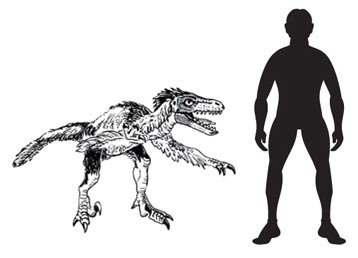
Did a juvenile Velociraptor have pterosaur as its last meal?

Picture credit: Everything Dinosaur

Velociraptor, made famous by its largely inaccurate portrayal in the Jurassic Park film trilogy, was a small, fast running, Late Cretaceous carnivore, perhaps as much as two metres long and standing a metre high.  It had a long, narrow snout, with jaws that were capable of opening very wide.  The jaws were lined with about eighty, small, sharp teeth.  Velociraptor had long, three-clawed hands but perhaps its most famous anatomical feature was the enlarged, sickle-shaped claw on the second toe.  Scientists remain unsure as to what this huge toe claw was used for.  It has been suggested that this claw, that could be held clear of the ground as the animal walked, may have acted like a grappling hook, helping this predator latch onto and cling to struggling prey.  Velociraptor mongoliensis is known from a number of superb fossil specimens including an amazing fossil of a Velociraptor preserved with a herbivorous Protoceratops apparently these dinosaurs perished whilst in combat.

The international research team included palaeontologists from University College (Dublin), the pterosaur bone inside the rib cage of the predator is an exciting discovery, this suggests that a flying reptile was one of the last things that this little dinosaur ate before it to met its demise.   The fossils suggest that this Velociraptor was a sub-adult, not yet fully grown perhaps weighing around 13 kilogrammes.  The bone fragment inside the body cavity, is highly pneumatised and the walls of the bone are very thin.  This suggests pterosaur, and given the fact that azhdarchid pterosaur remains have been found in strata dated to the same geological time period in that part of the Gobi desert, the research team have postulated that the bone is from a member of the Azhdarchidae group of flying reptiles.

The Rib Cage and the Pterosaur Bone

The last meal of a Velociraptor.

Picture credit: David Hone et al 2012

The black arrows in the picture point to the pterosaur remains found in the upper part of the rib cage, whilst the white arrow highlights evidence of a broken rib – evidence of a severe trauma in this dinosaur’s life.

The researchers have concluded that although Velociraptor was a fearsome predator, it would not have taken on a healthy full-sized pterosaur, an animal with a wingspan more than the length of the Velociraptor’s entire body.

David Hone, one of the co-authors of the scientific paper, based at University College Dublin’s School of Biology and Environmental Sciences stated:

“It would be difficult and probably even dangerous for the small theropod dinosaur to target a pterosaur with a wingspan of two metres or more, unless the pterosaur was already ill or injured.  So the pterosaur bone we’ve identified in the gut of the Velociraptor was most likely scavenged from a carcase rather than the result of a predatory kill.”

Velociraptor mongoliensis

A spokesperson from Everything Dinosaur commented:

“It is possible that this particular Velociraptor was part of a pack and given it’s sub-adult size, it may have been quite low in the pecking order.  Just like packs of hunting dogs in Africa today, low status animals may have had to wait their turn before being allowed to feast on a kill.  Perhaps the pterosaur had been attacked and killed by the pack and this individual had to be satisfied with a quickly gulped down bone as well as a few other scraps”.

Of course, such ideas can only be assertions, there is no evidence to suggest how the bone came to be in the body cavity of the Velociraptor, suffice to say it was ingested and using studies of the feeding behaviours of extant carnivores for comparison, it is likely that this Velociraptor was scavenging from the long, dead remains of a pterosaur.

To view articulated models of various dromaeosaurids: Beasts of the Mesozoic Articulated Dinosaurs.

A Close-Up of the Bone in the Rib Cage

The bone is highlighted in red

Picture credit: David Hone et al 2012 with additional annotation by Everything Dinosaur.

In the enlargement above we have highlighted the pterosaur bone in red, the scale bar provides a scale size for this illustration.

The discovery of such a large bone, approaching eight centimetres in length, nearly as long as the Velociraptor’s jaws, suggest that small dromaeosaurs were capable of consuming relatively large bones, something seen in crocodiles today.  Just like extant crocodilians, Velociraptor did not chew its food but swallowed it down as quick as it could – a good strategy for survival when at any minute a bigger predator may come along and bully you out of your meal.

The pterosaur bone, lodged in the rib cage, where the stomach would have been probably had not been swallowed for long, before the Velociraptor met its end.

Dr Hone added:

“The surface of the bone is smooth and in good condition, with no unusual traces of marks or deformation that could be attributed to digestive acids.  So it’s likely that the Velociraptor itself died not long after ingesting the bone”.

The rib cage itself provides an insight into the lives of Velociraptors.  The white arrow in the picture above points to a broken rib with signs of regrowth, suggesting that this dinosaur was injured or recovering from a traumatic injury at the time of its death.  Such evidence, known as pathology, shows that for this sub-adult Velociraptor, it must have taken a terrific knock at some point during its short life – but at least it lived to tell the tale – for a short while anyway.

To view a second article regarding evidence of Velociraptor scavenging behaviour: Velociraptors were Scavengers as well as Hunters.

2 03, 2012

Giant Fleas from the Jurassic Sucking the Blood of Dinosaurs (New Research)

By |2024-04-23T06:48:39+01:00March 2nd, 2012|Categories: Dinosaur and Prehistoric Animal News Stories, Palaeontological articles|2 Comments

Fossilised Fleas Ten Times the Size of a House Flea from the Jurassic

Warning, reading the current edition of “Nature” may lead to an outbreak of scratching as this scientific journal carries details of a new study into the evolution of fleas, with a focus on giant blood-sucking parasites from the Middle Jurassic.  Scientists have been studying prehistoric fleas that fed by sucking the blood of dinosaurs.

Dinosaurs

Chinese scientists have been slowly and surely piecing together the origins of the flea family using fossils found in two regions of China, famous for their dinosaur fossils.  Professor Huang Diying from Nanjing Institute of Geology and Palaeontology, (Chinese Academy of Sciences) and his colleagues have been “scratching” around in the sedimentary layers of Liaoning Province and in Ningcheng County collecting beautifully preserved, ancient, insect specimens that shed light on the origin and evolution of fleas.

The team have produced a scientific paper which details their studies.  It is entitled  “Diverse transitional giant fleas from the Mesozoic era of China”, not the catchiest of titles, but we know that many readers will be just “itching” to learn more about the team’s fossil discoveries.

Prehistoric Fleas

Fleas are one of the most dramatically specialised of all the families that make up the Order Insecta.  They have reduced wings, a laterally-flattened body and specialised mouth parts for feeding on the blood of mainly mammals (including our own species).  There are about 2,500 species or sub-species known and they are present throughout the world.  Most fleas are small, usually between 1-3 millimetres in length.  Fleas are ectoparasitic insects – insects that feed on other creatures (parasites).

Like most insects, fleas are seldom preserved as fossils.  Indeed, take away those fossils of insects preserved inside amber and you are left with a disproportionately sparse fossil record for such an important group of arthropods.  Definitive fossil evidence of fleas has been largely confined to fossils of fleas caught in tree sap and preserved as amber.

Dating from the Cenozoic

Most of these fossils date from the Cenozoic, from after the time of the dinosaurs, but in one or two exceptional locations fossils of fleas that once plagued the dinosaurs can be found.  The evidence suggesting the origin and early evolution of fleas has not been gathered together and studied, there simply were not enough fossils to study – until now.

One of the few records of a fossilised flea-like creature was unearthed in Australia a few years ago.  Found in sediments dated to around 120 million years ago (Early Cretaceous – Aptian faunal stage).  The genus was named Tarwinia, but it is difficult to work out the taxonomic relationship between this fossil and extant species.

Chinese Scientists Study Flea Fossils

Over the last few years, the Chinese scientists have  found several giant flea fossils dating from the Middle Jurassic (Bathonian faunal stage – Daohugou biota) in Ningcheng County, Inner Mongolia.  These insects lived around 165 million years ago.  The team have also uncovered the fossils of later specimens of the flea family near to Beipiao City, Liaoning Province.  This part of China is famous for its feathered dinosaur fossils and birds.  It seems that some of these blood-sucking insects may have adapted to a life living off the feathered dinosaurs.  These Early Cretaceous fossils relate to the famous Jehol biota (dated to around 125 million years ago).

This Chinese research provides new insights into the origin and early evolution of fleas and provides clues as to how these insects adapted as dinosaurs, birds and mammals evolved.  This new research pushes back in the fossil record the earliest occurrence of fleas (Order Siphonaptera) by about forty million years.

Mesozoic Fleas

The Mesozoic fleas like the sauropods these animals may have fed on; are huge.  Their bodies are many times bigger than extant fleas with many approximately 15 mm in length, and some longer than 20 mm, that’s ten times the size of a house flea.  As with flea species found today, the ancient females are larger than males.

For example, a flea species from Daohougou is 14 mm for female and only 8 mm for male.  They are wingless insects, but more or less dorso-ventrally flattened, their antennae are short and compact with more antennal segments (16-19 segments) than modern fleas (11 segments).  These prehistoric giants had a very long piercing siphonate mouthpart, elongate legs armed with various ctenidia (comb-like structures for securing themselves to their host).

Interestingly, these Mesozoic fleas show no signs of the modified back legs that permit these creatures to jump phenomenal distances.  It seems the ability to jump, is a Cenozoic development – at least based on the fossil evidence found so far.

Examining the Mouthparts

A close examination of the fossilised mouthparts of these ancient parasites show that many of the earliest forms have long, piercing mouthparts resembling those seen in the Mecoptera, an order of winged, graceful insects that include the scorpion flies.  Based on the fossil evidence it could be suggested that fleas should not be classified separately (Siphonaptera), but should be regarded as highly specialised members of the Mecoptera.

The fossils of the fleas when reviewed as a collection provides evidence that fleas readily adapted to take advantage of the food resources available from newly evolved, potential hosts such as the Dinosauria, early mammals and the Aves.

Fossils from Jehol, show fleas armed with various ctenidia on their legs and numerous posteriorly-directed setae (bristles) on their abdomens, indicating an adaption to hosts with hair or fur.  From the same strata, a number of mammal species have been described, the flea fossils show adaptations suited to feeding off animals covered in fur or hair.  The long siphon seen on some flea fossils dating from this period (120 million years ago) may have evolved so that they could be used to pierce the skin of feathered dinosaurs.

New Chinese Research

This new Chinese study may shed light on an amazingly fossilised insect found preserved in the soft mud of an ancient Mesozoic lake in Russia.  A 2.5-cm-long fossil of an insect was discovered in the Cretaceous aged rocks of Transbaikalia (eastern Russia).  This creature had no discernible wings, long legs with hooks on the end and a distended mouthpart, like a long proboscis.  The body was soft but could have expanded considerably in size, perhaps as a result of feeding on fluids such as blood.

The creature was named Saurophthirus longipes.  It has been suggested that this insect specialised in feeding upon the blood of pterosaurs (flying reptiles), a sort of ecological niche similar to that occupied by the bat fleas that feed on bats today.  Professor Huang Diying and his colleagues suggest that S. longipes may have been a specialised flea, highly adapted to a life feeding on reptile aviators.

For models and replicas of dinosaurs and pterosaurs: PNSO Age of Dinosaurs Models.

Dinosaurs

The Jurassic-aged fossils may be the earliest evidence of the flea family discovered to date and these fossils taken in context with the Cretaceous-aged finds show that Mesozoic fleas readily adapted to feeding on a number of vertebrate hosts, including in all likelihood the dinosaurs.

In recent years, there has been a number of studies published on fossils of other parasites that may have plagued the Dinosauria and the Pterosauria, blood-sucking lice for example.  To read an article on prehistoric lice that may have fed on both feathered and non-feathered dinosaurs: The Itchy and Scratchy Show.

29 02, 2012

New Research into Tyrannosaurus rex Bite Force

By |2023-01-28T17:32:15+00:00February 29th, 2012|Categories: Dinosaur and Prehistoric Animal News Stories, Dinosaur Fans|11 Comments

T. rex Bite More Powerful than Previously Thought and the Bite became more Powerful as they Grew

New research into the biting power of adult tyrannosaurs by UK based researchers indicates that the bite force of an adult Tyrannosaurus rex was higher than previously thought.  In addition, this new study, results of which appear in the scientific journal “Biology Letters”, suggests that the bite became disproportionately more powerful as this predator grew and matured.

Tyrannosaurus rex

The bite force generated by extinct predators such as Tyrannosaurus rex has been studied before, but this new study suggests that the bite force generated on the points of the back teeth of this dinosaur’s formidable jaws is much higher than previously thought, with T. rex having the strongest bite of any known terrestrial animal.

Dr Karl Bates, a researcher at the University of Liverpool’s biomechanics laboratory and his colleague, Peter Falkingham (Manchester University), used a life-size, computer generated copy of the STAN-BHI3033 specimen’s skull to carry out their research.  This T. rex specimen was discovered in 1992 by Stan Sacrison, hence the specimen name.

Dr Bates explained:

“We digitised the skull with a laser scanner, so we had a 3-D model of the skull on our computer.”

We at Everything Dinosaur, known this specimen very well and we have had the privilege to work with elements of the skull including the dentary, the skull of this particular T. rex is exceptionally well-preserved and almost complete.

The Reconstructed STAN-BHI 3033 Replica (Manchester Museum)

Strongest bite of any land animal?

Picture credit: Everything Dinosaur

 Three-dimensional Images

Once the three-dimensional image had been created, the muscles that articulated the jaws and the skull could be mapped onto the image.  The researchers could then reproduced the full force of a bite by activating the muscles to contract fully – snapping the digital jaws shut.  A number of extant animals were also mapped in this way, the bite force of an alligator was modelled using this technique and then compared to known data to test the validity of this methodology.

Dr Bates stated that this new research gives T. rex an even more powerful bite than previously thought, he declared:

“Those [simulated] muscles closed the jaw as they would in life and we measured the force when the teeth hit each other.  The maximum forces we found – up at the [back] teeth – were between 30,000 and 57,000 Newtons.”

At Everything Dinosaur, we have been working on some comparative data on the toothsome properties of large tyrannosaurids and spinosaurids.  Bite force estimates are difficult to calculate, especially in the absence of any extensive large spinosaur (S. aegyptiacus) fossil material, but in our studies the bite force of a large T. rex was estimated to be around 12-15,000 psi (pounds per square inch) comparable with the Liverpool research.

The Bite Force of a T. rex

As an approximate guide, to convert Newtons to lbs per square inch bite force divide by 4.45 (rounded).

When asked to give a “layman’s perspective” regarding the power of a T. rex bite, the scientist compared the bite force generated to the equivalent of a medium-sized elephant sitting on a person.

Computer Model Used to Estimate T. rex Bite Force

Bite down hard!

Picture credit: Biology Letters

Earlier studies had estimated that an adult T. rex had a bite force of perhaps 13,000 Newtons, still a powerful bite, but nowhere near the figure given by this new research.

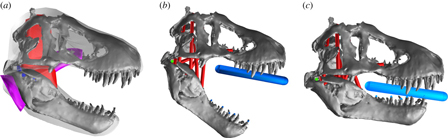
The picture above shows the computer generated model of the T. rex skull with the musculature involved in closing he jaws mapped onto the bone.  The first picture on the left  – (a) three-dimensional digitised skull with soft tissues reconstructed for mass and muscle properties (red, adductor mandibulae externus group; blue, adductor mandibulae posterior group; purple, pterygoideus group). The second image (b) shows the  model with joint centres (green circle), muscles (red cylinders), and ‘contact’ springs (blue spheres and cylinder) on the teeth in the initial simulation starting pose. The final picture shows the model in the “sustained biting” position.

The British scientists developed their work on the T. rex bite force.  As well as comparing their data with previous tyrannosaur studies, they mapped the bites of other large theropods including allosaurids such as Giganotosaurus carolini and other tyrannosaurs.  In addition, they looked at tyrannosaur ontogeny (how animals grow).  Their work suggests that as the head of T. rex got bigger there was an expected increase in bite force, but the jaws seem to have got disproportionately stronger the bigger the animal got.

Explaining the findings, Dr Bates stated:

“Obviously, as its head got a lot bigger, there’s an expected increase in bite force associated with that.  But for T. rex, the power behind its bite increased disproportionately – much more than would be expected from a straightforward linear increase.”

Although only speculation, the disproportionately stronger jaws in older individuals may suggest that this predator’s diet changed as it matured.  With perhaps only the biggest tyrannosaurs able to take on the largest contemporaneous animals, that co-existed with the “Tyrant Lizard King”.

A Table Showing the Bite Force Comparisons of Animals and Previous Research Figures

Open wide – bite down hard!

Picture credit: Biology Letters

The graph shows the results of the Manchester/Liverpool research (white bars) on animals such as adult T. rex, juvenile T. rex, Allosaurus, alligators et al.  The grey coloured bars show the results of previous research studies into those animals and their respective bite forces.

Dr Bill Sellers, (University of Manchester), a scientist who has carried out a lot of computer-based comparative research on dinosaurs commented:

“I think everyone expected T. rex to have a strong bite force, but it’s even stronger than we expected.  It gets stronger as it gets bigger, which is surprising.”

He explained that studying dinosaurs shed light on the limits that living things were capable of.

“These animals are extremes – one of the biggest carnivores that ever lived.  So it tells you a lot about the limitations of biology.  We want to know how organisms work, but living organisms are much smaller.  In terms of mechanics, size is really important.”

Bite force data can be interpreted in many ways, the lack of observed results and the limits placed on the research by the paucity of the fossil record are problematical, however, with the latest computer generated models, a more accurate measurement can be obtained. Whichever figure is taken, it is clear from only a cursory examination of the jaws and teeth of a tyrannosaur, that the front end of this particular dinosaur was to be avoided at all costs.

It is worth noting that the specimen adult T. rex studied was a gracile form, larger tyrannosaurs, more robust T. rex fossils are known and these animals may have had even stronger bites.

To view models and figures of Tyrannosaurus rex and other prehistoric animals: PNSO Dinosaur Models.

28 02, 2012

“Oetzi” The Iceman – New Insights Thanks to Study of Genome

By |2023-01-28T17:28:50+00:00February 28th, 2012|Categories: Dinosaur and Prehistoric Animal News Stories, Educational Activities|0 Comments

5,300-Year-Old Mummy Yields Further Secrets

Since the body of a middle-aged man was found in 1991 by a party of hikers in the Italian Alps, the corpse has been the centre of intensive research.  The body was that of a person who had lived some 5,300 years ago, at first the body, which had been beautifully preserved in its icy surroundings, was thought to be that of a climber who had got into difficulties and perished on the mountain, but close examination revealed that this was the corpse of a person who had lived in the New Stone Age.

“Oetzi” the Iceman

Italian scientists have published a more complete study of the genome of this Stone Age person, someone who may have been murdered as the body was discovered with an arrow head buried in the shoulder.  This new research, building upon an earlier study into the corpses’s genetic material published in 2008 reveals that “Oetzi” had brown eyes, “O” type blood, was very probably lactose intolerant and was predisposed to heart disease.  The report has been published in the scientific journal “Nature Communications”.

The findings have been published by the Institute for Mummies and the Iceman at the European Academy of Bolzano (EURAC), in conjunction with Tuebingen and Saarland universities in Germany, which were also involved in this study.

Albert Zink, an anthropologist,  at the EURAC Institute for Mummies and the Iceman, based in Bolzano, Italy, stated that this new study adds to the database of knowledge on this Neolithic individual.  For example, earlier studies had suggested that “Oetzi” had no living relatives, but the fuller genetic picture as laid out in the nuclei of Oetzi’s cells suggest a different story.

Based on an analysis of nuclear DNA, this Stone Age person probably was descended from people of the Middle East who migrated out of that part of the world into Europe with the advent of more advanced agricultural systems.  Study of a series of anomalies in the “Iceman’s” DNA reveal him to be more closely related to modern inhabitants of the islands of Sardinia and Corsica than to modern human populations living in the Alps today.

Genome Analysis

The genome analysis involving the study of cells taken from inside the hip joint  also show him to be the first documented case of infection by a Lyme disease bacterium.  Lyme disease is one of the most common bacterial infections found in the Northern Hemisphere, it is spread by tick bites and causes headaches, fatigue and in more extreme cases problems with joints and the nervous system.  It can be effectively treated by antibiotics, but for “Oetzi” there would have been no relief.

Interestingly, the “Tyrol Iceman”, as “Oetzi” is sometimes called, weighed about fifty kilogrammes when he died.  He was not overweight and had a very different diet to us today, but he was still predisposed to cardiovascular disease.  This may have implications for how scientists treat obesity in modern human populations.

Commenting on the findings, Professor Zink said:

“We’ve been studying the Iceman for 20 years.  We know so many things about him – where he lived, how he died – but very little was known about his genetics, the genetic information he was carrying around.”

The lactose intolerance, identified through this “whole genome sequencing process”, used in the study was probably very common in the New Stone Age.  Cows and other milk producing creatures were only just beginning to be domesticated on any large scale and much of the human population was very probably lactose intolerant.  Our ability to digest milk from other animals probably built up in the population over many thousands of years as humanity moved towards an agrarian society.

Professor Zink added:

“This was really exciting and I think it’s just the start for a longer study on this level.  We still would like to learn more from this data – we’ve only just started to analyse it.”

Certainly, the discovery of a beautifully preserved specimen of a New Stone Age person, was one of the most amazing archaeological discoveries of the 20th century.  Advances in genetics are permitting scientists in the 21st century to gain a further insight into the life of this ancient human being, who perished on a Tyrol mountainside more than 5,300 years ago.

For models and replicas of ancient hominins: Ancient Hominins and Prehistoric Animal Models.

An interesting paper was published on “Oetzi” in 2010, it suggested that this person may have been a Stone Age VIP and as a result given a much more formal burial.

To read this article: “Oetzi” – The Chieftan.

27 02, 2012

100,000 Year-Old Rock Star Revealed in New Research

By |2024-04-22T14:08:25+01:00February 27th, 2012|Categories: Dinosaur and Prehistoric Animal News Stories, Palaeontological articles|0 Comments

Pebble May Be the Oldest H. sapiens Artwork Ever Found

A small pebble made of ochre, discovered in South Africa may be the oldest example ever found of an engraving made by H. sapiens.  Researchers from the University of Witwatersrand Institute for Human Evolution (S. Africa) have dated this eight-centimetre-long fragment, part of what was believed to be a much larger object, to around 100,000 years ago, making this object a candidate for the oldest known abstract art.

The colourful pebble was found in the Klasies River Cave (Eastern Cape Province), it is associated with human remains and artefacts from the Middle Stone Age.  The Middle Stone Age, the Mesolithic is the period of geological time used by archaeologists to describe the period of human evolution from the ending of the Ice Age phases to the beginning of sedentary farming.  It is a “catch all” period with different dates ascribed to Mesolithic artefacts and human remains dependent on where in the world they were found.

Commenting on the research, co-author of the scientific paper, Riaan Rifkin (University of Witwatersrand’s Institute for Human Evolution) stated:

“Associated human remains indicate that the engraved piece was certainly made by Homo sapiens.”

Rifkin and colleagues Francesco d’Errico and Renata Garcia Moreno performed extensive non-invasive analyses of the object.  Methods like X-ray fluorescence and microscopic analysis enabled the researchers to examine every minute detail of the ochre pebble.  The scientists have concluded that humans or a human deliberately and intentionally made sub-parallel cuts on the pebble – for what purpose remains open to speculation.

The Ochre Pebble – Does is Show Early Human Symbolism?

The pebble with the scratches highlighted.

Picture credit: University of Witwatersrand

Riaan added:

“Upon engraving the piece with a sharp lithic implement [stone tool], it is likely to have produced a markedly bright and dark red-maroon powder.  The design may therefore have been strikingly visible shortly after it was produced.”

Ochre- is a naturally tinted clay that mainly consists of hydrated iron oxide.  It was amongst the earliest pigments used by humans and other hominids (Neanderthals for example).  It is often referred to as the “caveman’s crayon”.

The Klasies River object contains a series of seven deep cuts and several (sixteen or so), smaller and somewhat shallower linear features.  It is not known whether the cuts of different magnitude were made by the same person or by different stone tools or made by a second human engraver.

Riaan commented:

“The fragment is a remnant of a formerly semi-circular ochre pebble that likely contained a much more extensive engraved design on its surface.”

The research team are particularly interested in whether or not the engraver or engravers made the design with symbolic intent.  Excavations at Blombos Cave, on the southern Cape Coast of South Africa have revealed similar finds of red ochre engraved with geometric patterns.  These objects have been dated to approximately 73,000 years ago, but the Klasies River Cave object is much older.

Use of symbols and meaningful images are thought to have been a significant breakthrough in human development. Language, maths and countless other studies are tied to this basic skill, in addition to improved communication.  To this day, art permits communication of identity and other things among diverse cultures.

Linear and cross-hatch carved patterns may have been common in Mesolithic culture.  As well as the examples found in Blombos Cave, scientists found similar carvings on ostrich eggshell fragments found in the Diepkloof Rock Shelter in the Western Cape Province.  Some of these, and other, similar objects may even pre-date the Klasies River pebble, but studies on them are ongoing and research papers yet to be published.

Riaan Rifkin explained:

“The employment of red ochre for symbolic purposes likely played an important role in mediating increasingly complex social relations that emerged during the Middle Stone Age.”

Christopher Henshilwood, a researcher at the University of Witwatersrand, did not work on this study, but he has examined other very early probable engravings.  For example, he studied abstract markings of another piece of southern African ochre dating to around 70,000 years ago.

In that case, the engraving consisted of a more complex geometric pattern that looks like the letter “X” repeated in a connected series.  Scientists remain puzzled as to what meaning these symbols may have had.

Henshilwood stated:

“They are symbols that I think could have been interpreted by those people as having meaning that would have been understood by others.”

At present, Rifkin and his team are studying 30,000-year old cave art from Africa.  So far, they have determined that the abstract images depict a zebra, a rhino and a half human-half cat creature – perhaps a deity symbol or an animal that features in tribal stories.  The Klasies River Cave system was inhabited by humans for thousands of years.  Excavations have been on-going at this location since the 1960s.  The site is one of the most important in the world in terms of H. sapiens evolution and development.  The artefacts found have provided an unprecedented insight into early human behaviour, particularly hunting among groups of early humans.  Some of the remains and items found in the cave system are believed to date from more than 125,000 years ago.

Visit Everything Dinosaur’s website: Everything Dinosaur.

26 02, 2012

Dinosaurs at the Annual Oscars Event the Excitement Builds

By |2024-04-23T06:55:04+01:00February 26th, 2012|Categories: Dinosaur and Prehistoric Animal News Stories, Press Releases|0 Comments

Academy Awards for all things Dinosauria

As the 84th Annual Academy Awards, otherwise known as the Oscars is almost upon us, this is an opportune time to  have a short review the role of dinosaurs in movies that have received nominations or indeed won the Oscar accolade.  It is time to look at dinosaurs at the Oscars.  Dinosaurs have appeared in feature films almost since the beginning of the film genre.  The first film to show a dinosaur was the 1914 animated film staring “Gertie the Dinosaur”, a sauropod dinosaur cartoon; based on the skeleton of a prehistoric animal known then as Brontosaurus from the American Museum of Natural History (New York).

Dinosaurs at the Oscars

Dinosaurs and other prehistoric beasts have proved popular with film audiences ever since.  There have been a whole host of monster movies made from the Lost World (1925), based on the novel by Sir Arthur Conan Doyle to 10,000 B.C. from the Warner Bros studios, released in 2008.  The quality of these films, do in a large number of cases, leave a lot to be desired.

From a palaeontology perspective most of the films are indeed widely inaccurate portrayals of the Dinosauria and other extinct creatures. Science has never been allowed to get in the way of  a good movie plot and films like “One Million Years B.C.” released in 1966 by the UK based film company Hammer, proved to be very successful at the box office.  Unfortunately, this film, described by some critics as a “bad movie saved by a great film poster”, was overlooked at the 1967 Academy Awards.  That year, films such as “Bonnie and Clyde” and “The Graduate” were awarded the plaudits

Even the fur bikini worn by the film’s female star, Raquel Welch failed to be nominated for an Oscar for best costumes.  That Oscar went to the musical “Camelot”, so even the iconic, furry underwear of Stone Age women failed to impress the Oscar judges.

Ray Harryhausen

A word here for the wonderful and talented Ray Harryhausen and his masterful creation of what he termed “Dynamation”, advanced stop-motion film making that brought many prehistoric animals to our screens.  He worked on the dinosaur and other prehistoric animal effects for “One Million Years B.C.” as well as on other titles such as “Valley of the Gwangi” (1969) – a western/dinosaur fantasy that was shot in the Cuenca region of Spain, a location now famed for its real dinosaur fossil discoveries.

Mr Harryhausen never received an Oscar for any of his special effects seen in a particular movie, however, his contribution to the genre was recognised when he was awarded a special prize in 1992, marking his outstanding work in the science fiction genre and film-making in general.

One of the most important influences on the career of Ray Harryhausen and indeed, on the careers of a number of other famous film makers was the movie King Kong released in 1933.  Dinosaurs featured in this film, but they were very much the supporting cast to the  main attraction, the giant ape called Kong.  The film is regarded by many as one of the most influential films of all time, with Fay Wray playing the heroine of the picture “the beauty that killed the beast”, otherwise referred to as the “queen of scream” for all her shrieks that can be heard throughout most of the action sequences.

This film did not win an Oscar, the directors Merian C. Cooper et al could have felt a little hard done by, but the Oscars themselves (Academy of Motion Picture Arts and Sciences) had only been going for a few years and there was no award category yet for special movie effects.

King Kong, the original 1933 film, show cased a number of revolutionary film-making techniques and innovations such as the amazing stop-motion animation sequences (the work of chief technician, Willis O’Brien who has also worked on the picture “The Lost World” (1925).  Despite this, it failed to receive a single Academy Award nomination. However, amongst film critics and film fans, the original King Kong movie is often voted in the top one hundred most important and influential movies of all time.

The re-make of King Kong (1976) fared better.  The 1976 version won a Special Achievement Award Oscar for Visual Effects.  The most recent re-make of this movie, directed by Oscar winning director Peter Jackson, (King Kong 2005) did better still.  It won three Oscars – Sound Editing, Sound Mixing, and not surprisingly -Visual Effects.

Perhaps, the Dinosauria’s greatest success at the Oscars came at the sixty-sixth Academy Awards, honouring films released in 1993.  The movie “Jurassic Park” won three Oscars – Best Sound Editing, Best Sound Mixing and again, not surprisingly since the film featured ground-breaking CGI – Best Visual Effects.  The big winner on the night may have been the movie “Schindler’s List”, but with three awards films featuring dinosaurs were finally being acknowledged for their contribution to the industry.

The scene where dinosaurs are first encountered by the scientists sent to scrutinise the proposed theme park, a shot of an enormous Brachiosaurus (a sauropod dinosaur just like “Gertie” back in 1914), grazing on the top of a tree and rearing up to feed on the uppermost branches has become one of the best known dinosaur sequences ever created in a movie.

“The Lost World” released in 1997, the sequel to “Jurassic Park” was nominated in the special effects category but lost out to the big winner on the night – the movie Titanic.  The third film in the trilogy (a trilogy so far, as there are rumours of a fourth Jurassic Park movie being made), entitled, not surprisingly “Jurassic Park III), released in 2001 did not receive a single nomination at the seventy-fifth Academy Awards ceremony held the following year.

No doubt, the continued popularity of the Dinosauria and of other prehistoric creatures will motivate future film makers to include these spectacular animals in their film projects.  Dinosaurs tend to be visually stunning, their great size and ferocity making them a favourite amongst movie goers old and young alike.  Although the quality of some of the offerings can be questioned, the legacy of dinosaurs in films is set to continue and we can look forward to more Oscars for the Dinosauria and their on screen creators in the future.

Who knows, perhaps the Academy of Motion Picture Arts and Sciences may introduce a special “YouTube” category, given our own humble offerings a chance of success.

Visit Everything Dinosaur’s website: Everything Dinosaur.

24 02, 2012

Ichnologists Study Oldest Elephant Trackways (New Research)

By |2024-04-23T06:50:53+01:00February 24th, 2012|Categories: Dinosaur and Prehistoric Animal News Stories|0 Comments

Arabian Footprints Show Behaviour in Primitive Elephant Herd

Palaeontologists have been able to build up a good understanding of the evolution of the elephant family (Proboscidea – elephants and their close relatives), due to the extensive amount of body fossils associated with these tusked creatures.  Footprints and other trace fossils are extremely rare.  However, a remarkable set of primitive elephant trackways, dated to the Late Miocene Epoch, discovered on the Arabian desert are giving scientists new insights into primitive elephant behaviour.

Elephant Trackways

The paper, detailing the research work, on what are believed to be the oldest elephant trackway ever discovered has been published in the scientific journal “Biology Letters”.  The beautifully preserved tracks, have been left by thirteen primitive elephants, ancestors of the extant species found in Asia and Africa today.  These trace fossils dated to around seven million years ago are the earliest, direct evidence of how the ancestors of modern elephants interacted socially. These fossils are the oldest evidence of an elephant herd.

Vertebrate palaeontologist at the Museum for Natural History (Berlin), Faysal Bibi commented:

 “Basically, this is fossilised behaviour.  This is an absolutely unique site, a really rare opportunity in the fossil record that lets you see animal behaviour in a way you couldn’t otherwise do with bones or teeth [body fossils].“

Fossil Trackway

The fossil trackway is located in the UAE (United Arab Emirates), is is known as Mleisa 1.  During the Late Miocene, this area was not like the desert environment found today.  A large, slow flowing river, meandered across a lush, verdant plain and the area teemed with life.  As well as elephants there were ancient hippos, antelopes, giraffes, monkeys and ostriches.  Along the river bank, crocodiles and turtles basked in the sun, ready to enter the slow flowing river to feed on the many types of fish species that lived there.

This ecosystem shares affinities with fossil assemblies found further south in Africa, although scientists have also recorded similarities with Asian and Europe species known from the Late Miocene.

The tracks near to the city of Abu Dhabi, had been known to locals for many years.  Some had thought these were the tracks of dinosaurs or perhaps from mythical creatures, stories of which are passed down from one generation to another as folk tales.  However, although the site had been studied back in 2001, it was only when in January 2011, once the trackways were studied from the air, that their true nature was revealed.

Commenting on the importance of the aerial photography, Brian Kraatz a researcher at the Western University of Health and Sciences (Pomona, California) stated:

“Once we saw it aerially, it became a much different and clearer story.  Seeing the whole site in one shot meant we could finally understand what was happening.”

The fossilised tracks cover an area of approximately five hectares, an area of land a fraction bigger than London’s Wembley Football Stadium.  At first, due to the scale of the site, it was difficult for ichnologists (scientists who specialise in studying trace fossils such as trackways), to understand precisely what the footprints represented.

The study team noted that while these large animals were members of the Proboscidea – just like modern elephants, they did look very different.  Of the three kinds of prehistoric elephant known to roam that area in the Late Miocene, the one that most likely made the trackways was Stegotetrabelodon syrticus,the earliest known member of the elephant family.

An Artists Impression of the Herd of S. syrticus

Tracks show a single, large animal crossed the herds path.

Picture credit: Mauricio Anton

Stegotetrabelodon syrticus

The picture above shows a reconstruction of the Stegotetrabelodon syrticus herd that likely made the tracks in the Arabian desert.  These primitive elephants had a pair of tusks in the lower jaws as well as tusks in the upper jaw.

The trackways stretch up to about 260 metres long, making them, the most extensive and longest ever recorded for mammals known.

Actually mapping these footsteps proved challenging, since the individual tracks are each only about 15 inches (40 centimetres) wide, too small to show up in satellite imagery.  To do so, researchers mounted a pocket digital camera onto a kite, stitching the hundreds of pictures it took into a single large mosaic image that gave a broad overview of the site.

Analysis of the footsteps suggests they belonged to a herd of at least thirteen elephants of different sizes and ages that walked through mud, leaving behind tracks that hardened, were buried, and then re-exposed by erosion.

The researchers also discovered tracks from a solitary animal (believed to be a male) traveling in a different direction from the herd.  These suggest the extinct giants divided into solitary and social groups, just as modern African elephants do today.   Also, these ancient pachyderms might have structured themselves along lines of males and females just as their modern relatives do, with the males leaving the herd to live alone.

Scientists hope to return to the area in the future to continue their studies, and to also look for more body fossils, helping them to piece together more information about the diversity of mammals in this region during the Late Miocene, in a bid to understand how mega fauna from Africa spread into Asia and Europe.

A spokesperson from Everything Dinosaur, commented that it was fascinating to read about this new research into elephant behaviour, especially after the team had just finished reviewing new baby Mammoth models (Papo) so collectors could make up their own prehistoric elephant herds.

To view the Papo prehistoric animal model range: Papo Prehistoric Elephant Models and Dinosaurs.

22 02, 2012

A “Permian Pompeii” Described in New Study

By |2024-04-23T06:53:44+01:00February 22nd, 2012|Categories: Dinosaur and Prehistoric Animal News Stories, Palaeontological articles|0 Comments

Chinese Fossil Site Preserves Ancient Permian Ecosystem

A treasure trove of Permian aged plant fossils have been discovered in northern China by a team of U.S./Chinese scientists.  A volcanic eruption some 298 million years ago (Asselian faunal stage of the Early Permian), buried an entire ancient forest under many layers of fine ash, and this has led to the almost perfect preservation of a vast number of plant fossils – some preserved in situ with leaves, branches and even seed cones intact.  Described as a “Pompeii-like site in recognition of the remarkable Roman town’s preservation after a volcanic eruption (Mount Vesuvius ) in AD79.  This location, part of a Chinese coal-mine will provide palaeobotanists with a fascinating insight into the flora of our planet nearly 300 million years ago.  A “Permian Pompeii” is given palaeontologists a rare opportunity to study an ancient ecosystem.

Studying the Climate of the Permian

A study by University of Pennsylvania, palaeobotanist Professor Hermann Pfefferkorn and colleagues provides information on the ecology and climate during this early part of the geological period known as the Permian.  The paper has just been published in the scientific journal “The Proceedings of the National Academy of Sciences”.

The work has been conducted in collaboration with a number of Chinese scientists, with the study site, located in a remote part of northern China covering an area of more than 1,000 square metres.  It seems that a massive volcanic eruption blanketed the surrounding area in a fine layer of ash in just a few days.  This enabled the plants and tree-like structures in the forest to be preserved in a remarkably well-defined state.  The plants have been preserved as they fell, in many cases in the exact locations where they had been growing.  Relatively little transport of material has taken place.

Commenting on the significance of this location Professor Pfefferkorn stated:

“We can stand there and find a branch with the leaves attached, and then we find the next branch and the next branch and the next branch.  And then we find the stump from the same tree.  That’s really exciting.”

The researchers also found some smaller trees with leaves, branches, trunk and cones intact, preserved in their entirety.

“Permian Pompeii”

The scientists were able to date the ash layer to approximately 298 million years ago.  That falls at the beginning of the Permian, during which Earth’s continental plates were still moving toward each other to form the super-continent Pangea.

The Permian was a period of great change, both in climate and the diversity and abundance in fauna and flora.  The drying climate of the Permian led to the destruction of the huge coal swamps that had existed during the Carboniferous.  This part of China was still close to the equator and tropical conditions here ensured the survival of this eco-system into the Permian.

An Artist’s Impression of the Chinese Coal Forest

A “Pompeii of the Permian”.

Picture credit:University of Pennsylvania/Ren Yugao

In total, the U.S./Sino study team identified three locations where ash had preserved the remnants of an ancient forest, one that would have teemed with insects, amphibians and primitive reptiles.  In all three sites, Pfefferkorn and his colleagues counted and mapped the fossilised plants they encountered.   In all, they identified six groups of trees. Tree ferns formed a lower canopy while much taller trees — Sigillaria and Cordaites provided a canopy reaching heights in excess of twenty metres.

The researchers also found nearly complete specimens of a group of trees called Noeggerathiales.  These extinct spore-bearing trees, relatives of ferns, had been identified from sites in North America and Europe but appeared to be much more common in these Asian sites.

They also observed that the three sites were somewhat different from one another in plant composition and diversity.  For instance, in one site, for example, Noeggerathiales were fairly uncommon, while they made up the dominant plant type in another site.

Professor Pfefferkorn added:

“This is now the baseline.  Any other finds, which are normally much less complete, have to be evaluated based on what we determined here.”

This is a remarkable discovery, most plant fossils consist of fragments, perhaps individual leaves, or a seed cone.  This has led to the confusing situation of having several parts of the same plant – roots, truck, leaves etc. being classified as a separate taxonomic species – the Lepidodendron is a good example of this.

In a University of Pennsylvania press release it was noted that this location (near Wuda, northern China) was remarkable because it is the first such forest reconstruction in Asia for any time interval, it’s the first of a peat forest for this time interval and it’s the first with Noeggerathiales as a dominant group.

Because the site captures just one moment in Earth’s history, Pfefferkorn noted that it alone cannot explain how climate changes affected life on Earth, but it helps provide valuable context.

The Professor commented:

“It’s like Pompeii: Pompeii gives us deep insight into Roman culture, but it doesn’t say anything about Roman history in and of itself.  But on the other hand, it elucidates the time before and the time after.  This finding is similar.  It’s a time capsule and therefore it allows us now to interpret what happened before or after much better.”

The study was supported by the Chinese Academy of Science, the National Basic Research Program of China, the National Natural Science Foundation of China and the University of Pennsylvania and we are grateful to the University of Pennsylvania for this press release information.

To view models and replicas of Permian prehistoric animals: CollectA Deluxe Prehistoric Animal Models.

19 02, 2012

The Original “Mr Ed” – Rare Pliocene Aged Horse Skull Found in China

By |2024-04-22T14:31:09+01:00February 19th, 2012|Categories: Dinosaur and Prehistoric Animal News Stories|0 Comments

Chinese Scientists Study Hipparion Skull

Scientists from China’s Institute of Vertebrate Palaeontology and Palaeoanthropology (IVPP) have discovered a skull fossil of a Hipparion, a three-toed horse with a long nose that lived approximately 5 million years ago (Pliocene Epoch).  The very well preserved fossil skull was found in the north-western province of Gansu, at a location where many Pliocene aged mammal fossils have been discovered in recent years.

Prehistoric Horse Skull

The fossil, is the most intact and complete Hipparion skull found in China so far, it was unearthed in the city of Linxia a few weeks ago (late January), but it has taken a while to clean and prepare to permit the scientists from the Chinese Academy of Scientists (IVPP) to study it properly.

Deng Tao, a researcher with the IVPP commented that:

“The discovery provided vital clues for the study of structural features of the species, especially for the research of the “nasal notch”.”

The Hipparion Skull found in China

Beautifully preserved prehistoric horse skull.

Picture credit: Chinese Academy of Sciences (IVPP)

Hipparion

A spokesperson from Everything Dinosaur, stated that the Hipparion was a genus of prehistoric horse that evolved in the Miocene and survived right up until the Pleistocene Epoch.  Many species have been ascribed since this genus was first named back in the 1830’s.  This plains dweller thrived in the drier conditions of the Miocene which aided the spread of grasslands – fossils of horses ascribed to this genus have been found in Europe, Asia, North America and China.

Originating in North America, the Hipparion is believed to have spread to the Old World over the Bering land bridge, which used to connect present-day Alaska and eastern Siberia.  The five-million-year-old skull will help scientists to understand a little more about how the horses nasal passages became elongated.  The evolution of the relatively long front end of the horse’s skull is believed to be an adaptation to living on open grasslands where fast running to avoid predation became a necessity and the extended nasal openings may have made breathing more efficient.

The publishing of this new discovery coincides with the release of another study into prehistoric horses that postulates that mammals get smaller as world temperatures rise.  Researchers at the Florida Museum of Natural History (Florida University), have been studying the teeth of one of the first types of horses to evolve a genus known as Sifrhippus, a type of horse that lived 56 million years ago in North America at a time when the Earth’s average temperature was much higher than it is today.

In a relatively short period, geologically speaking, a rapid increase in carbon dioxide levels in Earth’s atmosphere and oceans sent global temperatures shooting upwards by about 5.5 degrees Celsius over a period of between 10,000-20,000 years.  Global temperatures rose to approximately 28 degrees Celsius – turning Earth into a “hot house” with rain forests covering many northern latitudes.

Looking at thousands of years-worth of preserved fossils that Sifrhippus left behind in the Bighorn Basin of Wyoming, researchers found that the horse shrunk 30 per cent over 130,000 years, from 5.4 kilogrammes to 3.8 kilogrammes on average.  The study that analysed the size of fossil teeth from these ancient, but tiny horses showed that during a period of cooling that followed in the next 45,000 years, this miniature “Mr Ed” grew to be about 6.8kg.

Researcher Jonathan Bloch (University of Florida) commented

“What’s surprising is that after they first appeared, they then became even smaller and then dramatically increased in size, and that exactly corresponds to the global warming event, followed by cooling.”

The scientists conclude that this evidence suggests that miniaturisation in mammals may occur as global temperatures increase.  With the current trend towards a warmer planet, this may lead to the evolution of miniature mammal species (perhaps even a mini H. sapiens) in the future.

What is unclear at this stage, is whether or not the fossil teeth of Sifrhippus or the skull of the Hipparion found in China are able to help explain how “Mr Ed” the horse from the 1950s television series was able to talk.

For replicas and models of prehistoric mammals: Safari Ltd. Prehistoric Mammal Models.

13 02, 2012

Explaining Papo Mammoth Model Dimensions (Helpful Advice)

By |2024-04-22T14:29:57+01:00February 13th, 2012|Categories: Dinosaur and Prehistoric Animal News Stories, Everything Dinosaur News and Updates, Everything Dinosaur Products|0 Comments

The Low Down on the Mammoth Model Family (Papo)

Whilst other mainstream model manufacturers may be retiring prehistoric mammal models from their range, it is always pleasing to report one figure and replica maker bucking the current trend.  Papo of France have added two new Woolly Mammoth replicas to their “Les Dinosaures” range.

Papo Mammoth Model Dimensions

In addition to the adult Woolly Mammoth, there is going to be a juvenile and a baby Mammoth added to the product line up, permitting collectors to make up their own Mammoth family group.  This is very apt as just like extant elephants today, scientists believe that Woolly Mammoths did move in herds made up of family members.

The  Mammoth Models

A “Memory” of Elephants.

Picture credit: Everything Dinosaur

As far as we know there are a number of terms for a group of elephants, the collective noun as it were.  There is a “parade” of elephants, a “herd” and our favourite a “memory” of elephants.

The Sizes of the Papo Models

A “Papo” of Mammoths?

Table credit: Everything Dinosaur

The measurements in the table above have been taken by Everything Dinosaur team members.  All models sold by the company are carefully measured and comments on potential scale and size relationships are available to customers on request.

The English language has many quirks, one of which is the myriad of terms used to describe of group of animals or objects.  We are not aware of a collective noun in use for a group of Woolly Mammoths – how about a “Papo” of Mammoths?

To view the substantial range of Papo prehistoric animal models including Woolly Mammoths: Papo “Les Dinosaures” Prehistoric Animal Models.

Go to Top