All about dinosaurs, fossils and prehistoric animals by Everything Dinosaur team members.

Fossil finds, new dinosaur discoveries, news and views from the world of palaeontology and other Earth sciences.

3 04, 2012

Aquatic Dinosaur Theory Rises to the Surface Once Again

By |2023-03-08T22:17:19+00:00April 3rd, 2012|Categories: Dinosaur and Prehistoric Animal News Stories, Dinosaur Fans, Palaeontological articles|8 Comments

Cell Biologist Challenges Theory of Largely Terrestrial Dinosaurs

In a paper published in the scientific journal “Laboratory News” Professor Brian J. Ford has put forward a theory to help explain how these very heavy animals were able to move around – they lived in water.  Using an assessment of the potential loadings on limbs in comparison with the largest land animals alive today; in combination with studies of dinosaur track-ways that show that their heavy tails were in most cases held off the ground, Professor Ford has concluded that as terrestrial animals – “Dinosaurs don’t work.”

Had this paper been published on Sunday April 1st – then Professor Ford’s hypothesis would have been in danger of being consigned to that taxonomic waste-basket where all April Fool’s get sent, but this is a legitimate and thought provoking piece that has even been discussed on the Radio 4 programme “Today”.

Professor Ford, a cell biologist writes:

“The immense size of the largest genera places impossible loadings on their extremities.  A single limb would have to support many tonnes – this would not be compatible with the agility we associate with dinosaurs.  We accept the remains of their footprints with demur, although for such gigantic creatures, the imprints that we observe in rocky strata make no sense.  The prints are roughly as deep in the layers of Liassic mud as ours might have been, although the high mass of an adult dinosaur would cause it to sink up to its knees.  The footprints seem to be those of an altogether lighter organism.”

Unless of course, these are the footprints made as huge creatures, waded across shallow lakes.  If this were the case, Professor Ford argues, then this would explain why the heavy tails do not drag on the ground, they would have been supported by water and held out behind the animal.

Dinosaurs

For Everything Dinosaur team members this is a case of “deja vu”, many of our team members can remember the theories that were still postulated by some scientists forty years ago, that the largest of the dinosaurs, the long-necked sauropods lived an aquatic lifestyle, with their great weight supported by the water column.

Many scientists in the 19th century and indeed into the later part of the 20th century believed that the very largest dinosaurs, the herbivorous, sauropods were aquatic.  Opening a child’s dinosaur book from the 1950s and 1960s would often reveal a scene of these huge leviathans happily munching water weeds in a shallow lake or swamp.

Over the last fifty years or so, new scientific methodologies and fossil discoveries has led to the idea that the largest dinosaurs such as the sauropods were suited to a life in water, being disregarded by most palaeontologists.  Anatomical studies, assessments of limb strength and other research has led to the conclusion that the vast majority of large dinosaur genera were very probably terrestrial.

Scientists set about examining other aspects of Dinosauria anatomy, for example how did the sauropods, dinosaurs like Brachiosaurus and Apatosaurus support their long-necks.

Sauropod Dinosaurs

To read more about the debate over the posture of sauropods: Swan-neck Posture of Sauropods.

Professor Ford, goes further than the early 20th century scientists who confined their water-based dinosaur theories to the super-heavy-weights of the Sauropodomorpha.  In the article published in Laboratory News, the professor discusses the suitability of Tyrannosaurus rex to a watery habitat.

When discussing the fore-shortened front limbs found in many Late Cretaceous theropods, professor Ford suggests:

“The diminished forelimbs are equally well accounted for… In land animals, like the elephant, hippo and rhinoceros, each of the four limbs is load-bearing and evolutionary pressure has been against the reduction in size that we observe in flesh-eating dinosaurs like Tyrannosaurus.”

Tyrannosaurus rex – A Predator of Lakes and Rivers?
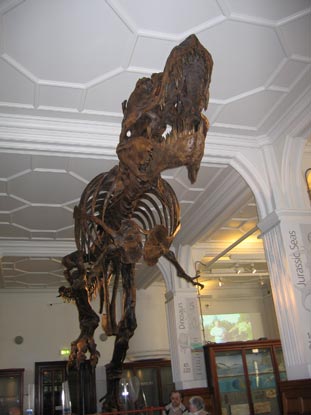
Splashing towards its next meal.

Picture credit: Everything Dinosaur

So if you are bipedal and a predator, perhaps you might have been at home in a shallow lake where the weight of the water could help support your body mass and make it more energy efficient for you to move around.

Concerning T. rex professor Ford states:

“If the large dinosaurs are conceived as primarily aquatic, however, then the specialisation of the forelimbs would be towards manipulative dexterity. The fact that the limbs became foreshortened is entirely reasonable.  Animals like to inspect their food as they eat, and holding it closer to the face is normal behaviour.  Conventionally, conceived the small forelimbs of T. rex make no sense – however, if we envision the animal as an aquatic, carnivorous species, this adaptation becomes entirely reasonable.”

This is certainly an interesting point of view. Ironically, many of the facultative bipeds that shared the Late Cretaceous with the tyrannosaurs – the hadrosaurs (duck-billed dinosaurs), for example, were thought by some scientists in the 19th and 20th centuries to be aquatic.  The bizarre looking hollow crests on some of these dinosaurs were thought to act as air reservoirs or snorkels, enabling these plant-eaters to run into deep water to escape the attentions of a predator such as Tyrannosaurus rex.

Old illustrations show two duck-billed dinosaurs (Corythosaurus and Parasaurolophus) swimming underwater to escape a predator. This picture is taken from a beautiful book about dinosaurs and other prehistoric animals first published in 1966, when the theory of some dinosaurs being aquatic was still propounded by a number of scientists and academics.

For models and replicas of sauropods, theropods and other dinosaurs: Dinosaur Models for Sale.

Interestingly, professor Ford does draw inspiration for this theory from recent studies of another theropod (meat-eating dinosaur) – Spinosaurus.  Chemical analysis of spinosaurid teeth by Romain Amiot and colleagues at the University of Lyon revealed that spinosaurs may have spent a large part of their lives near or in water.  Isotope analysis revealed a similar pattern as found in extant reptiles today that are aquatic – crocodiles and turtles.

To read an article suggesting a more aquatic life-style for Spinosaurids: Swimming Spinosaurs.

When asked to comment on the paper, a spokesperson from Everything Dinosaur stated:

“What goes around comes around, sometimes new evidence emerges that leads palaeontologists to question accepted scientific thinking.  However, there is a significant amount of research that suggests that the Dinosauria, even the largest genera, were very well adapted to a life on land”.

Time will tell, perhaps new fossil finds and further developments in research techniques will reveal more conclusive evidence, in the meantime, we at Everything Dinosaur, whilst acknowledging the contribution of Professor Ford to this debate, still believe that dinosaurs were largely terrestrial animals.

You could say, that, for the moment at least, the aquatic dinosaurs theory does not hold water.
1 04, 2012

Exploding Prehistoric Animal Carcasses as they Rot – New Evidence

By |2023-01-29T08:37:07+00:00April 1st, 2012|Categories: Dinosaur and Prehistoric Animal News Stories, Educational Activities, Palaeontological articles|0 Comments

Gas Build Up in Rotting Prehistoric Animal Remains did not Cause them to Explode

A new study by scientists from the University of Zurich (Switzerland) has dispelled the theory that putrefaction gases produced by decomposition caused some dinosaur and other prehistoric animal carcasses to explode before they were fossilised.

Prehistoric Animal Carcasses

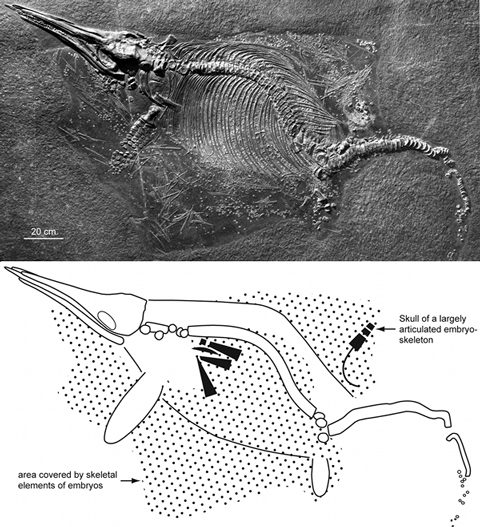
A number of animals preserved in the fossil record, their subsequent body fossils had puzzled scientists as to how the bones had come to be positioned in relation to other parts of the preserved skeleton or skeletons.  In particular, the fossilised remains of a pregnant ichthyosaur (marine reptile) found in the Lower Jurassic deposits of Holzmaden (southern Germany), has intrigued researchers.  The skeleton of the adult, is preserved with the majority of the bones in articulation, in the same relative positions as when the animal was swimming around in the Jurassic sea.

Ichthyosaur Embryos

The bones of the ichthyosaur embryos, preserved with this specimen however, are very different.  For the most part, they lie scattered outside the body of the mother.  Such peculiar bone arrangements are repeatedly found in ichthyosaur skeletons excavated from the finely, grained Holzmaden deposits.

Ichthyosaurs are believed to have evolved the ability to give birth to live young – viviparity.  These reptiles did not lay eggs like crocodiles and turtles, but they kept their embryos inside them, until they had reached a certain size before giving birth to independent young.

To read an article on a controversial fossil discovery that suggests that other marine reptiles such as plesiosaurs were also viviparous: Does Plesiosaur Fossil show Evidence of Viviparity?

Holzmaden “Exploded” Ichthyosaur Skeleton

Puzzling ichthyosaur fossil.

Picture credit: University of Zurich

The picture above shows a photograph of the ichthyosaur fossil and an interpretative line drawing of the fossil showing underneath it.  The beautifully preserved adult skeleton is articulated but the fossils of the embryos are scattered over a large area.  The scale bar in the photograph represents twenty centimetres.

Embryo Fossils

Most scientists thought that the position of the embryo fossils and their disarticulation was due to the carcase having exploded as gases caused through the process of putrefaction built up in the body cavity.  These gases, created as a body decomposes would cause the carcass to swell up and become bloated before finally bursting.  It had been thought that through such explosions, even the bones of embryos would have been ejected out of the body.  The Zurich based researchers have challenged this hypothesis by carrying out a series of  elaborate  measurements and an analysis of the physical-biological parameters.  The scientific team, which included sedimentologists, palaeontologists and forensic scientists has put forward new evidence that may dispel the myth of exploding prehistoric animal remains.

In order to gauge the pressure of the particular gases that can actually develop inside a putrefying remains of an Ichthyosaurus, the researchers sought comparative models and found one in a surprising area of science – the forensic study of human corpses.  Humans and many ichthyosaur are similar in size and as vertebrates we do have roughly the same body plan and digestive tract.  As a result, the formation of similar amounts of putrefaction gas can be expected during decomposition of the dead body.   At the Institute of Forensic Medicine in Frankfurt, Germany, a manometer (device used to measure pressure) was inserted into the abdominal cavity through the umbilicus in one hundred corpses.

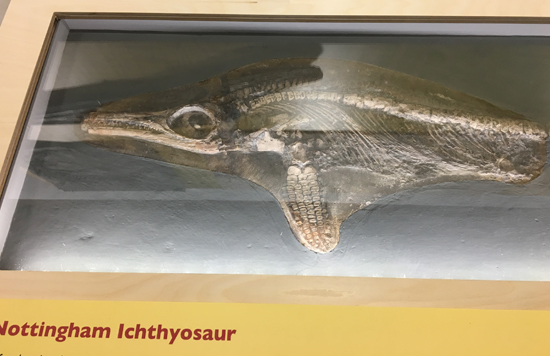
A Beautiful Ichthyosaur Fossil

Protoichthyosaurus applebyi

The Nottingham ichthyosaur (P. applebyi).

Picture credit: Everything Dinosaur.

The putrefaction gas pressures measured were only 0.035 bar.  In the case of the ichthyosaur remains that came to rest in depths between fifty and one hundred and fifty metres of water, however, putrefaction gas pressures of over five to fifteen bar would have been necessary to cause a body to explode.

Zurich based palaeontologist Christian King, one of the researchers involved in this macabre study believes that gas pressures strong enough to cause a carcase to explode in this depth of water are impossible to achieve.

He stated:

“Large vertebrates that decompose cannot act as natural explosive charges.  Our results can be extended to lung-breathing vertebrates in general.”

So what did cause the anomaly of the adult body remaining virtually intact whilst the remains of any embryos associated with the fossil specimen to be scattered?

According to the researchers, the fate of ichthyosaur bodies can be reconstructed, they have theorised as follows:

Normally, the bodies sank to the seabed immediately post mortem.  In very deep, hospitable waters, they were broken down completely through putrefaction, scavengers, bone-destroying organisms and dissolving processes, in exactly the same way that marine mammal carcases are broken up today.  In shallower water (up to fifty metres in depth) and a temperature of over four degrees Celsius, however, the corpses often rose back to the surface on account of the putrefaction gases accumulating inside the body.   As the gases built up, they made the corpse buoyant forcing the body to rise to the water surface,  just like a cork when placed in a bucket of water floats to the top.  At the surface, exposed to the waves and scavengers, such as fish, pterosaurs and other marine reptiles, the bodies decomposed within anything from a few days to weeks and the bones which were not eaten whole by the likes of a pliosaur were scattered over a wide area on the seabed as they sank.

However, the scientists believe that under very special conditions, ichthyosaur bodies would remain preserved more or less in their anatomical position.  A lack of oxygen, medium water depths and insignificant bottom water currents could lead to the fossils that we see today.  Because only under these conditions were the putrefaction gases compressed strongly enough through the high water pressure and dissolved in the bodily fluids, and the carcasses not completely broken down due to a lack of scavengers on the seabed.  The carcass of the ichthyosaur female from Holzmaden, dated to around 182 million years ago, probably sank to the bottom of the sea, which was up to 150 metres deep, where it decomposed.  It was the action of minor underwater currents on the sea floor that carried the decomposing bodies of the embryos out of the mother and scattered their remains around the larger body.  The bigger bones of the adult ichthyosaur were less affected by the sea currents and therefore remained in situ.

The Hozmaden deposits have yielded some of the world’s best fossils of marine reptiles, especially plesiosaurs and ichthyosaurs.  This new study provides further information on how to interpret fossil vertebrate remains and can help shed light on the potential water depths at which these fossils came to rest.

To read about the discovery of a new species of European ichthyosaur earlier this year: New Ichthyosaur Species Swims into View.

Everything Dinosaur acknowledges the assistance of a press release from the University of Zurich in the compilation of this article.

For models and replicas of marine reptiles including ichthyosaurs: Sea Monsters and Prehistoric Animal Models.

30 03, 2012

New York City Department of Education Discourages the Word “Dinosaur”

By |2023-03-08T22:19:23+00:00March 30th, 2012|Categories: Dinosaur and Prehistoric Animal News Stories|0 Comments

“Dinosaur” One of a Number of Words Restricted by New York City Dept. of Education

Companies preparing to submit assessment tests used in New York city’s public schools have been issued with guidelines from the Department of Education suggesting that they stay clear of dinosaurs when compiling their papers.  The word dinosaur is just one of a number of words and topics that the department have advised organisations preparing the assessment papers to avoid – other terms and subject areas that the compilers have been asked to steer away from include birthdays, aliens, vermin, terrorism and junk food.

Dinosaurs

“Dinosaurs” out of New York’s Assessment Papers

Examining dinosaur hands (Key Stage 2/3) but the word “dinosaur” is frowned upon by New York City Dept. of Education.

Picture credit: Everything Dinosaur

New Guidelines

Under these new guidelines, writing the assessment papers may prove to be as tricky at actually taking them.  These tests are used to assess the progress students are making in a number of subject areas including science, but in a move that seems to take political correctness to the extreme, a number of topic areas have been deemed off limits.

Whilst creating the test questions, companies are being advised to steer clear from certain subject areas, words and topics as they “could evoke unpleasant emotions in students that might hamper their ability to take the remainder of the test in the optimal frame of mind.”

Other reasons stated by the Department of Education for wanting to avoid such words as “dinosaur” include a desire to prevent bias against or towards certain parts of the population, or because “the topic has been done to death” – in textbooks and previous tests thus becoming over familiar and even boring to the students.

The word Halloween is not recommended because it could be linked with pagan rites, dinosaurs are on the extinction list for terms with the department, presumably as any reference to these prehistoric animals could upset those parts of the population who don’t believe or except the principles of evolution.  Firms have until the third week of April to submit their assessment plans and proposals.

A spokesperson for the Department of Education commented that the list suggests topics that ought to be avoided and this was not an outright ban and such language and guidance had been included in proposal requests for some time.

Spokeswoman Deidrea Miller said in a statement:

“This is standard language that has been used by test publishers for many years and is meant to ensure that tests contain no possible bias or distractions for students.”

With the American Museum of Natural History in the city and with its amazing display of dinosaurs and other prehistoric animal fossils, we at Everything Dinosaur would have thought that this museum would have provided tremendous support for the city’s students, teachers and educationalists.

A spokesperson for Everything Dinosaur commented:

“It is important that this news story is put into the proper context.  Whilst we can accept the difficult path that the Department has to follow at times, advising the removal of dinosaurs from the assessment papers does sound a little excessive.”

He went onto add:

“With such a fantastic and wonderful educational resource [the American Museum of Natural History] in New York, it seems such a shame that educational companies are being recommended not to use dinosaur related test questions.  After all, if you want to inspire the next generation of scientists, motivate children to learn more about the world around them or to give young people an insight into how the world is changing, dinosaurs would be a tremendously helpful subject area to explore.”

Commentating on the use of a restricted list in the city, New York University education professor Diane Ravitch said that such policies are not confined to America’s largest city.

She stated:

“This is something that testing companies have been doing for a long time”.

Professor Ravitch said the list of subjects to avoid comes from topics someone somewhere around the country, not necessarily in New York, may have objected to.

She added:

“Nobody in New York City is likely to object to any of these things.”

The guidelines issued by the Department of Education also covers other areas related to the testing of students such as how long test passages should be and what tenses should be used.  The guidelines also suggest that the subject material should be “familiar and common to the lives of New York city students.”

For dinosaurs and other educational, prehistoric animal themed toys and games: Dinosaur Games, Models and Toys.

25 03, 2012

Earliest Evidence of Viviparity from South America

By |2023-03-08T22:22:01+00:00March 25th, 2012|Categories: Dinosaur and Prehistoric Animal News Stories, Dinosaur Fans|0 Comments

Scientists Report Discoveries that Suggest Live Birth as Early as 280 Million Years Ago

Newly discovered fossils from Uruguay and Brazil may hold the key to resolving one of the great scientific debates associated with the early conquest of the land by vertebrates.  The fossils are embryos (unhatched young) of semi-aquatic reptiles known as mesosaurs and a specimen of a pregnant female. They may be the oldest examples of live birth in tetrapods, the earliest evidence of viviparity, an important step towards adapting to a much more terrestrial based life.

Earliest Evidence of Viviparity

Tetrapods include amphibians, reptiles, birds and mammals but there is an important distinction between amphibians and the other types of vertebrates that make up this group.  Amphibians breed in water.  Animals such as frogs, salamanders and newts lay unprotected eggs which are externally fertilised.  In contrast, reptiles, birds and mammals use internal fertilisation.  In reptiles and birds, the embryo develops in fluid surrounded by a protective, calcium based shell – an adaptation to a more terrestrial lifestyle, without the need to be close to a source of water for breeding.

In nearly all extant mammals (monotremes are the exception – echidna, platypus etc.), the developing young is surrounded by fluid and a protective membrane, but it is retained inside the mother’s body for some time before birth.  The presence of a protective membrane, known as the amnion, around the embryo allows the further classification of tetrapods into two distinct groups, amphibians in one group with the rest of the vertebrates in another – the Amniotes.

Amniotes

Amniotes are more independent of water than amphibians, but fossil evidence of this important evolutionary step has been very difficult to find – until now that is.  Early tetrapod fossils do not preserve evidence of reproductive habits, but in a paper published by palaeontologists studying at the University of the Republic (Uruguay), they report on the discovery of fossils that show that mesosaurs may have been capable of live birth, thus marking an important advance in tetrapod evolution.

The research team have studied two beautifully preserved fossils dating from the Cisuralian epoch of the Permian (280 million years ago). The fossils represent amniotic embryos and are the earliest found to date.  The embryos are young mesosaurs, semi-aquatic, primitive reptiles that are descended from terrestrial animals but returned to a marine environment.

The fossils are very small, the largest no bigger than a man’s thumb nail they were unearthed in Brazil and Uruguay.  Excavated from a gypsum laden matrix it suggests that these reptiles lived in salty, anaerobic water, which helped to preserve the embryos.  The mesosaurs lived alongside a wide range of invertebrates such as burrowing worms and crustaceans as fossils of these creatures have been found too.

The picture above is a composite with a partial skeleton of an adult mesosaur on the right compared to the embryo fossil on the left (scale bar 20 cm).

Researcher Graciela Piñeiro, a palaeontologist at the University of the Republic (Uruguay) commented:

“Despite their age and their delicate nature, they remained in the rocks all that long time almost perfectly preserved.

Intriguingly, the embryos lacked recognisable eggshells.  Moreover, one well-developed embryo was found within an adult presumed to be a pregnant female.  This suggests that these reptiles had evolved the ability to give birth to live young a strategy adopted by other later marine reptiles such as ichthyosaurs and seen in some extant members of the Order Squamata today like vipers.  The fossil indicates that mesosaurs may have been viviparous.

A Replica of a Mosasaurus

The PNSO Mosasaurus "Ron".

“Ron” the PNSO Mosasaurus replica.

To view the range of PNSO prehistoric animal models and replicas: PNSO Dinosaur Replicas and Prehistoric Animal Models.

One of the well-developed mesosaur embryos was discovered on its own, not inside an adult.  This might indicate that the mesosaurs laid eggs after embryos reached advanced stages of development. Alternatively, this specimen could represent a miscarried embryo.

Graciela went onto add:

“With the discovery of the mesosaur embryos, we may now have direct evidence that embryo retention or viviparity were strategies developed by early amniotes.”

This is not the first earliest fossil evidence indicating viviparity in the fossil record, an amazing fossil of a placoderm (armoured fish) was discovered a couple of years ago that suggested that at least some of the placoderms may have evolved this reproductive strategy.

To read an article on the placoderm fossil find: Placoderm Parents.

However, this is the earliest case known for a tetrapod.  In 2011, a fossil of a plesiosaur from the genus Polycotylus (marine reptile) that had been found many years earlier in Kansas was analysed and it revealed that these types of marine reptile may also have been viviparous.

To read more about this research: Insight into Plesiosaur Breeding.

This study of mesosaurs pushes back the known records of live birth and amniotic embryos by sixty and ninety million years respectively.  The paper on this mesosaur research has been published in the scientific journal “Historical Biology”.

21 03, 2012

New Croc on the Block

By |2023-01-29T07:20:38+00:00March 21st, 2012|Categories: Dinosaur and Prehistoric Animal News Stories, Dinosaur Fans|0 Comments

Dorset Crocodile Discovery is Named in Honour of Rudyard Kipling

The fossilised remains of a prehistoric crocodile, unearthed in 2009 on the Dorset coast, has been named in honour of Rudyard Kipling, the author of the Jungle Book and the Just So stories.  Amongst Rudyard Kipling’s many interests he was an enthusiastic supporter of Earth sciences so in recognition of his support, this new species of prehistoric crocodile has been named after him.

Prehistoric Crocodile

To read about the discovery of the crocodile: Ancient Crocodile Fossils Discovered on the Jurassic Coast.

The specimen has been dated to the Early Cretaceous (130 million years ago – Barremian faunal stage), a time when southern England was a lush, tropical, low-lying dinosaur paradise with animals such as Iguanodon and Hypsilophodon roaming the shorelines of a shallow sea.

Originally, thought to be an example of a Goniopholis crassidens, a prehistoric crocodile species named and described by Sir Richard Owen, a more detailed analysis has enabled scientists to declare this specimen as a new species and give it a unique scientific name.

The ancient crocodilian has been named Goniopholis kiplini.

Goniopholis kiplini

The analysis and study of the beautifully preserved fossil specimen of this broad-snouted crocodile was carried out by scientists at Bristol University.

The fossil skull was discovered by Richard Edmonds of the Jurassic Coast World Heritage site team, whilst inspecting a rock fall at Swanage.  With the help of local fossil hunters Steve Etches and Chris Moore (all pictured), the skull material was removed from the beach area so that it could be properly prepared and excavated.

Mr Edmonds commented:

“Despite more than 200 years of collecting, specimens new to science continue to be found on this eroding coastline.  The fossil record is far from complete although the chance of a creature like this being fossilised is slim”.

He went onto add:

“People will still be making new discoveries 200 years from now.”

This crocodile, believed to be a distant ancestor of modern crocodilians, lived alongside dinosaurs and it shared its estuarine environment with a number of other crocodile species as well as turtles and fish.

The skull has been donated to the Dorset County Museum by Swanage Town Council and Dorset County Council.  It is now on display alongside the larger Pliosaur (marine reptile) skull, that was also discovered recently.

Professor Mike Benton (Bristol University) commented:

“This stunning specimen shows there’s plenty of life in the Dorset Jurassic coast.  These must be some of the most heavily collected rocks in the world and yet it is wonderful to see a new species coming out.”

The naming of this new species of prehistoric crocodile coincides with the first publicity material being released for the sixth Fossil Festival at Lyme Regis, which is to take place in early May.

For models and replicas of prehistoric crocodilians and other creatures: Wild Safari Prehistoric Animal Figures.

20 03, 2012

Early Hominids Walked Upright so They Could Carry More Food

By |2023-01-29T07:17:34+00:00March 20th, 2012|Categories: Dinosaur and Prehistoric Animal News Stories, Palaeontological articles|0 Comments

Anglo/Japanese Scientific Team Conclude that Carrying More Food Improved Survival

For our ape-like ancestors being able to use your  hands to grab extra food and run away may have had an important evolutionary influence in early hominids adoption of an upright stance and bipedal walking habit.  That is one of the conclusions made by a joint British/Japanese research team who have been studying the behaviour of extant apes.

Early Hominids

The anthropologists carried out their research studying the complex social behaviours of perhaps our closest living relative – the chimpanzee.  The research team found that these apes, very adept at and more comfortable walking on all fours than walking upright, would adopt a bipedal stance when they needed to monopolise scarce food resources by grabbing more in a single attempt when facing stiff competition from other social group members.

The researchers from Cambridge University (England) and Kyoto University in Japan, concluded that the benefits of being selfish and grabbing as much as you could with both hands would lead to certain individuals getting more than others.  Over a long period of time, natural selection could have favoured those apes that had a better sense of balance and could adopt a bipedal pose to swipe as much food as they could.  This suggest that early hominids could have evolved bipedalism in response to gaining an advantage when competing for scarce food resources – leading to our ancestors becoming permanent bipeds with their hands freed from the role of locomotion for evermore.

There have been many theories postulated as to why a bipedal stance was adopted by our ancestors, those apes that would lead to the emergence of the hominids and eventually our own species H. sapiens.  Studies of Bonobo chimps (Pan paniscus), long-legged, slightly smaller members of the Pan genus of chimpanzee, found in central Africa, led to some scientists concluding that our ancestors became adept at walking upright when they inhabited ancient swamps and regularly had to wade through water.  Most palaeontologists believe that Africa became much drier and the forests gradually became grasslands during the time of the first hominids.  This dry climate and the loss of an arboreal habitat may have driven certain types of apes onto the savannahs and being able to stand tall to look out for danger could well have been a stimulus for a bipedal evolution.

Recent Scientific Papers

There have been a number of recent papers on ancient African hominids, one of the most exciting discoveries was made in southern Africa, the finding of one of the earliest known specimens of the “human family tree”.

To read more about this discovery: New Fossils May Help Redefine Human Ancestry.

Anthropologists studying chimpanzees found that the great apes, who usually walk on all fours, walk upright and free their hands for carrying when they need to monopolise hard-to-find resources by swiping more at a single attempt in the face of fierce competition.

The team from the University of Cambridge and Kyoto University in Japan believe the benefit of “first come, first served” and getting a bigger share of scarce food supplies could, over a long period of time, have led some of our earliest “hominin” ancestors to evolve into “bipedal” primates walking on two legs permanently instead of four.

Professor William McGrew, from Cambridge’s department of archaeology and anthropology, said:

“Bipedality as the key human adaptation may be an evolutionary product of this strategy persisting over time. Ultimately, it set our ancestors on a separate evolutionary path.”

Scientists believe that man’s ancestors changed how they moved at a time of climate upheaval which reduced the forested areas in which they lived and forced them out into the open more. But a lack of fossils means there is division over what specific factor it was that led to the development of walking on two feet.

The research by the team led by PhD student Susana Carvalho and Professor Tetsuro Matsuzawa, published in the journal Current Biology, suggests our earliest hominid ancestors may have lived in shifting environmental conditions in which certain resources were not always easy to come by.

Chimpanzees are one of several ape species able to walk on two legs for short periods of time.

The scientists conducted two studies of chimpanzees in Bossou Forest in Guinea, west Africa, finding that when supplies of highly prized coula nuts were scarce, the chimps were more likely to walk on two feet in an attempt to carry off more in a single trip.

They also found that when the chimpanzees went “crop raiding”, 35% of their activity involved some sort of bipedal movement, and “once again, this behaviour appeared to be linked to a clear attempt to carry as much as possible in one go”.

By studying the behaviour of chimpanzees, they believe that over time, intense bursts of bipedal activity in early hominins may have led to anatomical changes that in turn became the subject of natural selection where competition for food or other resources was strong.

Commenting on the research, Professor William McGrew (Cambridge University’s department of Archaeology and Anthropology) stated:

“Bipedality as the key human adaptation may be an evolutionary product of this strategy persisting over time. Ultimately, it set our ancestors on a separate evolutionary path.”

Walking on your hind legs in a grassland environment makes sense for a number of reasons.  For example, with the brain held slightly higher off the ground when compared to a four-footed form of locomotion it is effectively cooled by being that much further away from the ground.  Hands can be freed up to allow the carrying of food and even simple tools.  A lack of hominid fossils means that there is a lot of debate over what specific factor(s) led to the development of a human-like habit of walking on your back legs.

The work of PhD student Susana Carvalho and Professor Tetsuro Matsuzawa, has been published in the scientific  journal “Current Biology”.  Their work suggests our earliest hominid ancestors may have lived in shifting environmental conditions in which certain resources were not always easy to come by.  Using the observed behaviour of extant apes, such as chimpanzees in the wild, the team postulate that the ability to grab as much as you can could have been a stimulus for bipedalism in our ancestors.  Chimps are just one of several great apes that can walk on their hind legs for a short period, although the position of their hind legs  relative to their pelvic girdle prevents them from walking very efficiently – they tend to swagger using their arms to help balance themselves, whilst human locomotion is a much more bio-mechanically efficient affair.

As the scientists concluded:

“Once again, this behaviour appeared to be linked to a clear attempt to carry as much as possible in one go”.

The study of an extant ape, has led this joint Anglo/Japanese team to conclude that intense bursts of bipedalism in our ancient ancestors may have led to the evolution of anatomical adaptations that led to a more efficient and effective upright stance.  Becoming a biped so that you can use your hands to grab as much food as possible may have been the evolutionary spark that lit the touch-paper that over millions of years led to the emergence of our own branch of the hominid family tree.

To read another article on the evolution of bipedalism in early hominids, an article written about some of the fossil evidence in support of an upright walking stance in A. afarensis: Early Hominid Walking Tall.

The scientific paper: “Chimpanzee carrying behaviour and the origins of human bipedality” by Susana Carvalho et al published in Current Biology.

For models and replicas or early hominids and other creatures: Prehistoric Animal Figures and Models.

18 03, 2012

Mother’s Day – Maiasaura and Marsh (Happy Mother’s Day)

By |2024-04-23T06:55:44+01:00March 18th, 2012|Categories: Dinosaur and Prehistoric Animal News Stories, Famous Figures|0 Comments

Remembering “Good Mother Lizard” and Charles Othniel Marsh (1831 -1899)

Today is “Mother’s Day” a day celebrating mums around the world, otherwise known as “Mothering Sunday” not every country recognises this day as a special day for mums.  For example, in Australia, “Mothers Day” is celebrated sometime in May we think, but it gives us an excuse to write about one of our favourite ornithopods – Maiasaura.  Today also marks the anniversary of the death of one of the most influential palaeontologists of the 19th century – Charles Othniel Marsh.

Maiasaura

Maiasaura was a large, flat-headed duck-billed dinosaur that lived in North America.  It is a member of the Ornithopoda.  The first fossils of this dinosaur were discovered in the Badlands of  Montana thirty-four years ago by a team of American scientists led by palaeontologist Jack Horner.  The site the team uncovered consisted of a number of dinosaur nests, eggs, baby Maiasaura, adults and juveniles.  The location was renamed “Egg Mountain” and represents the fossilised remains of a Maiasaura nesting site.  More than two-hundred individual specimens have been excavated, providing scientists with evidence of the nesting behaviour of dinosaurs.  Maiasaura was formally named and described by Jack Horner and Robert Makela.  The name means “Good Mother Lizard” and in contrast with most of the Dinosauria, it takes the female form of the Latin term for lizard – saura.

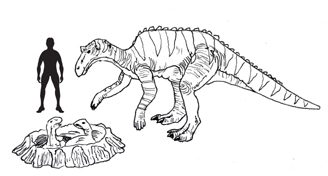
An Illustration of a Maiasaura and her Nest

“Good Mother Lizard”.

Picture credit: Everything Dinosaur

Careful study of the fossils found on “Egg Mountain” led to some intriguing insights into ornithopod nesting behaviour.  For example, many of the baby Maiasaura were clearly too large to be newly hatched, but they were evidently still living in the nest.  The conclusion made was that these dinosaurs stayed in the nest whilst the parents or a parent looked after them, bringing them food.  Some scientists have postulated that Maiasaura were strongly social creatures, living in large herds.

Charles Othniel. Marsh, no doubt would have been fascinated by the fossils of Maisaura.  This pioneer of palaeontology passed away on March 18th 1899.  This American palaeontologist; who organised and led many expeditions to the newly opened up western United States; named and described at least twenty-five dinosaur genera, famous dinosaurs such as Apatosaurus and Allosaurus as well as a huge number of other prehistoric animals.

Appointed professor of palaeontology at Yale University in 1860, he persuaded his uncle George Peabody to establish the Peabody Museum of Natural History at Yale and he helped build up an extensive fossil collection.

So on Mothers Day we remember “Good Mother Lizard” and one of the founding fathers of the modern science of palaeontology.

For models of Maiasaura and other ornithopods (whilst stocks last): Wild Safari Prehistoric World Figures.

15 03, 2012

Stone Age Remains from South China may be Entirely New Human Species

By |2023-01-28T18:40:29+00:00March 15th, 2012|Categories: Dinosaur and Prehistoric Animal News Stories, Palaeontological articles|0 Comments

Who were the Red Deer People?

A paper published in the online scientific journal PLoS One (public library of science) details the discovery and analysis of ancient human remains which may provide evidence that south-western China was once populated by an ancient species of hominids, a species that is entirely new to science.

The Red Deer People

An international team of researchers including scientists from the University of New South Wales (Australia) have been analysing the fragmentary fossil remains of ancient humans, their studies show that these humans have a mix of both modern and ancient traits.  They could be the last vestiges of a hominid that survived to the Pleistocene/Holocene transition or perhaps evidence that our own species interbreed with more ancient hominids on arrival in Asia.  Dating work including analysis of charcoal deposits left by the cave people as they cooked their food suggest that the fossils are between 14,300 and 11,500 years old – very recent in terms of the geological record.

Team co-leader Darren Curnoe, of the University of New South Wales, commented that the physical appearance of these extinct people was unique, like nothing seen in the Asian hominid record to date.

He stated:

”They look very different to all modern humans, whether alive today or in Africa 150,000 years ago.”

Skeletal Evidence

Skeletal evidence and the results of DNA analysis indicate that our species evolved in Africa before migrating and populating every continent.  It is thought that modern humans migrated into Asia across the Arabian peninsula something like 60,000 years ago.  Evidence from early H. sapiens and H. neanderthalensis  sites is open to a number of interpretations as the archaeological record suggests a complex migration pattern with groups of modern humans and Neanderthals moving in and out of the region in response to changing climate.  The Tibetan plateau may have acted as a natural barrier permitting an ancient hominid species that may have migrated through the Indian sub-continent and eventually present in south-west China to remain excluded from the incursions of more modern species.

Pleistocene aged human fossils are rare in East Asia.  Finds are very scarce but a number of discoveries in south-western China are helping to document the history of human migration into that part of the continent.  This international team, studied a partial skull which was carefully extracted from a block of sediment collected in 1979 from the Longlin Cave (Guangxi Province).  Although the fossil had been found nearly 35 years ago, it had not been properly studied.  This specimen was compared to other human remains found at a cave known as the “Red Deer Cave” due to the number of fossil deer bones found (Maludong, Yunnan Province), mostly fragmentary specimens but as yet undescribed human bones.  The bones found at these different locations suggest that they represent a single population, one type of people with a mixture of ancient and modern anatomical characteristics.

The Partial Human Skull (Longlin Cave)

The flattened facial features can be clearly made out.

Picture credit: PLoS One/Curnoe et al.

The prehistoric people had short, flat faces with ancient features reminiscent of H. heidelbergensis such as thick skull bones  and big teeth but brains with modern-looking frontal lobes.  Known as the “Red Deer People” due to their apparent reliance on an extinct species of deer for food, these humans are the youngest people in terms of geological age, found to date that do not resemble our own human species.

Two Possible Explanations

The research team have put forward two possible explanations for the existence of this unknown human species in this region.  Firstly, they could be modern humans (H. sapiens) that migrated out of Africa very early and reached China independently of other human migrations out of Africa.  Once in China these people did not contribute genetically to people living in East Asia today.

Secondly, the fossil material could represent an unknown species of hominid, deer hunting, venison eating people who lived at a time when our own species was adopting a more sedentary existence rather than the hunter/gatherer way of life, with the development of agriculture.

Although cautious, Professor Curnoe favours the new human species theory, he stated:

”While finely balanced, I think the evidence is slightly weighted towards the Red Deer Cave people representing a new evolutionary line.”

The find follows the discoveries of two new human species in Asia, dubbed “the Hobbit”, (H. floresiensis) due to their small size and the Denisovans, in the last decade or so.  The Indonesian island of Flores was home to a diminutive species of hominid up until approximately 13,000 years ago.

To read more about the Denisovans: X-woman Competing with Modern Humans and Neanderthals.

The discovery team, co-led by Professor Curnoe and Professor Ji Xueping, of Yunnan University in Kunming, includes researchers from five Australian and six Chinese institutions.  This work is invaluable in helping archaeologists and palaeontologists to piece together the human family tree.

The scientific paper: “Human Remains from the Pleistocene-Holocene Transition of Southwest China Suggest a Complex Evolutionary History for East Asians” by Curnoe et al published in PLoS One.

For models and replicas of Neanderthals: CollectA Prehistoric Life Models.

10 03, 2012

Rhamphorhynchus – Fishing can be a Dangerous Business

By |2023-01-28T18:24:05+00:00March 10th, 2012|Categories: Dinosaur and Prehistoric Animal News Stories, Dinosaur Fans, Palaeontological articles|0 Comments

Rhamphorhynchus Falls Victim to Ganoid Fish

Scientists have frequently speculated how the likes of Rhamphorhynchus, a Late Jurassic, long-tailed pterosaur hunted fish.  A remarkable fossil find from lithographic limestone deposits of Solnhofen (Germany) may add weight to the theory that these pterosaurs skimmed the surface of the water, snatching fish from the sea with their spiky-toothed jaws.  There is certainly evidence in the fossil record to suggest that Rhamphorhynchus genera were piscivores (fish-eaters), however, this amazing fossil discovery also suggests that certain types of fish lurking in the anoxic (depleted of oxygen, thus aiding fossil preservation), waters of the lagoon were prepared to attack these flying reptiles and drag them to their doom.

Rhamphorhynchus

It seems that after a successful hunt, one unlucky pterosaur was grabbed by a predatory fish, a ganoid fish known as Aspidorhynchus acutirostris.  These two fish-eaters became tangled up, the pterosaur drowned and unable to shake the Rhamphorhynchus out of its mouth, the Jurassic fish also met its demise.

Pterosaur versus Ganoid Fish Preserved in the Fossil Record

Accidental fatal encounter between two Jurassic piscivores.

Picture credit: PloS One/Frey, Tischlinger.

The picture above shows the flying reptile with its wing trapped in the fine teeth of the predatory fish.  A number of fossils are known from the Solnhofen deposits were skull elements of ganoid fish are found in association with the remains of members of the Rhamphorhynchidae.  Since the jaws of the fish could not open very wide, and since no pterosaur remains have been found in the stomachs of fossilised fish of this genus, it can be assumed that flying reptiles were not a normal prey item for this predator.  Perhaps the water disturbance of a pterosaur skimming the surface water fishing attracted the attention of the larger fish, who inadvertently grabbed the Rhamphorhynchus as it flew passed.

Rhamphorhynchus is one of the best known of all the long-tailed pterosaurs.  Several species have been identified, the largest of which had a wingspan about the size of the height of a man (nearly six feet).  Fossils of the pterosaur  have been found in strata associated with coastal areas.  The teeth in the narrow jaws were long, pointed and interlocked when the jaws were closed indicating that this pterosaur was probably a hunter of fish, this new fossil discovery indicates that sometimes, inadvertently at least, Rhamphorhynchus became the hunted.

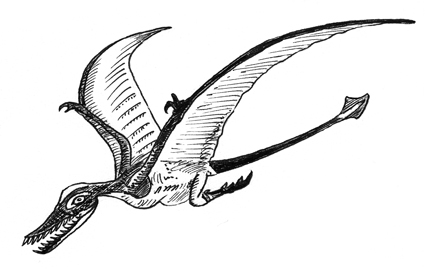
An Illustration of a Rhamphorhynchus

Flying low over the water – vulnerable to attack from below.  Picture credit: Everything Dinosaur.

Picture credit: Everything Dinosaur

For models and replicas of Rhamphorhynchus and other pterosaurs: Wild Safari Pterosaur and Dinosaur Models.

Evidently, the flight membrane of the reptile, jammed in the teeth of the fish.   Evidently, the fish could not swallow the pterosaur due to its size and bulky skeleton.  Furthermore, ganoid fishes like Aspidorhynchus have skulls with limited kinetic options such that they were not suitable to manipulate prey that exceeded the standard gape of the jaws.  So for the fish, it could not swallow its victim, nor could it free itself from the wing membrane.

The authors of the paper on this remarkable fossil find (paper published in the “Public Library of Science –  Biology”), suggest that the aktinofibrils of the tough and leathery wing membrane of the pterosaur got jammed between the densely packed teeth of the fish.  Like most extant fish Aspidorhynchus had no other possibility to get rid of its unwanted victim than trying to shake it loose or swimming rapidly and trying  spinning or twisting manoeuvres.   That the fish in fact tried to get rid of its unwanted meal by vigorous movements of its head is evidenced by the distortion of the left wing finger elements, while the remaining skeleton of the Rhamphorhynchus lies in natural articulation.  This is one Jurassic encounter that ended fatally for both participants.

Vertebrate skeletons from different creatures found together is exceedingly rare in the fossil record.  A number of fossils found at Solnhofen reveal this unfortunate relationship between Rhamphorhynchus and ganoid fish, but this specimen provides scientists with supporting evidence with regards to the feeding methods of the flying reptile.  Lodged in the throat of the pterosaur are the fossilised remains of a small Leptolepidid fish.  The pterosaur also has fish bones in its stomach.  The undigested state of the fish in the throat suggests that the Rhamphorhynchus was seized during or immediately after a successful hunt.

 Evidence of Rhamphorhynchus Hunting Fish

Rhamphorhynchus caught a fish.

Picture credit: PloS One/Frey, Tischlinger.

The picture shows a photograph (close up) of the jaws and throat of the Rhamphorhynchus (A), a line drawing showing the position of the small fish the pterosaur swallowed (B) and a close up of the tiny fish fossil viewed under filtered ultraviolet light which shows up greater detail than natural light (C).

In the PloS One journal the pictures are described, the straight vertebral column and the closed tail fin, which is orientated towards the mouth cavity suggests that the fish was not regurgitated during the agony of the pterosaur.  Furthermore the prey does not show any trace of digestion. A) photograph of the specimen WDC CSG 255 showing the position of the Leptolepides? in the throat of the flying reptile.  To the right hand side the skull of the ganoid fish predator visible.  B) line drawing of (A), C) close-up of Leptolepides? under filtered UV light: 1 caudal fin, 2 neural spines, 3 vertebral column.

To read more about the theory regarding how pterosaurs such as the Rhamphorhynchidae may have hunted: Pterosaur Feeding Habits – Could they Skim the Water for Fish?

Solnhofen deposits outcrop in an east-west belt north of Munich (Germany), they have produced some exquisite fossils, a record of the flora and fauna of a Jurassic lagoonal environment.  This remarkable fossil helps to add to our knowledge about vertebrate interactions that took place in that shallow water environment all those millions of years ago.

The scientific paper: “The Late Jurassic Pterosaur Rhamphorhynchus, a Frequent Victim of the Ganoid Fish Aspidorhynchus?” by Eberhard Frey and Helmut Tischlinger published in PLoS One.

9 03, 2012

A Slice through Deep Time at Lyme

By |2023-03-09T06:13:47+00:00March 9th, 2012|Categories: Dinosaur and Prehistoric Animal News Stories, Educational Activities, Everything Dinosaur News and Updates|0 Comments

Philpot Museum to Run More “Rock Cutting” Workshops

The Philpot Museum based in the historic seaside town of Lyme Regis is going to be running a series of workshops over the summer showcasing the skills of lapidary and fossil preparation.  Under the supervision of the museum’s dedicated staff and some of the professional fossil collectors at Lyme Regis, visitors will be able to test their own skills at preparing Jurassic aged fossils by having a go at polishing ammonites.

 2012 Workshop Dates at the Museum

Your chance to be a Rock Star!

Table credit: Everything Dinosaur

Lyme Regis

Building on the success of last year’s event the museum staff are expecting another high turnout with enthusiastic visitors observing how ammonites are carefully cut into sections using diamond bladed saws.

For a small fee, you can have a go at polishing your very own piece of the Jurassic coast.

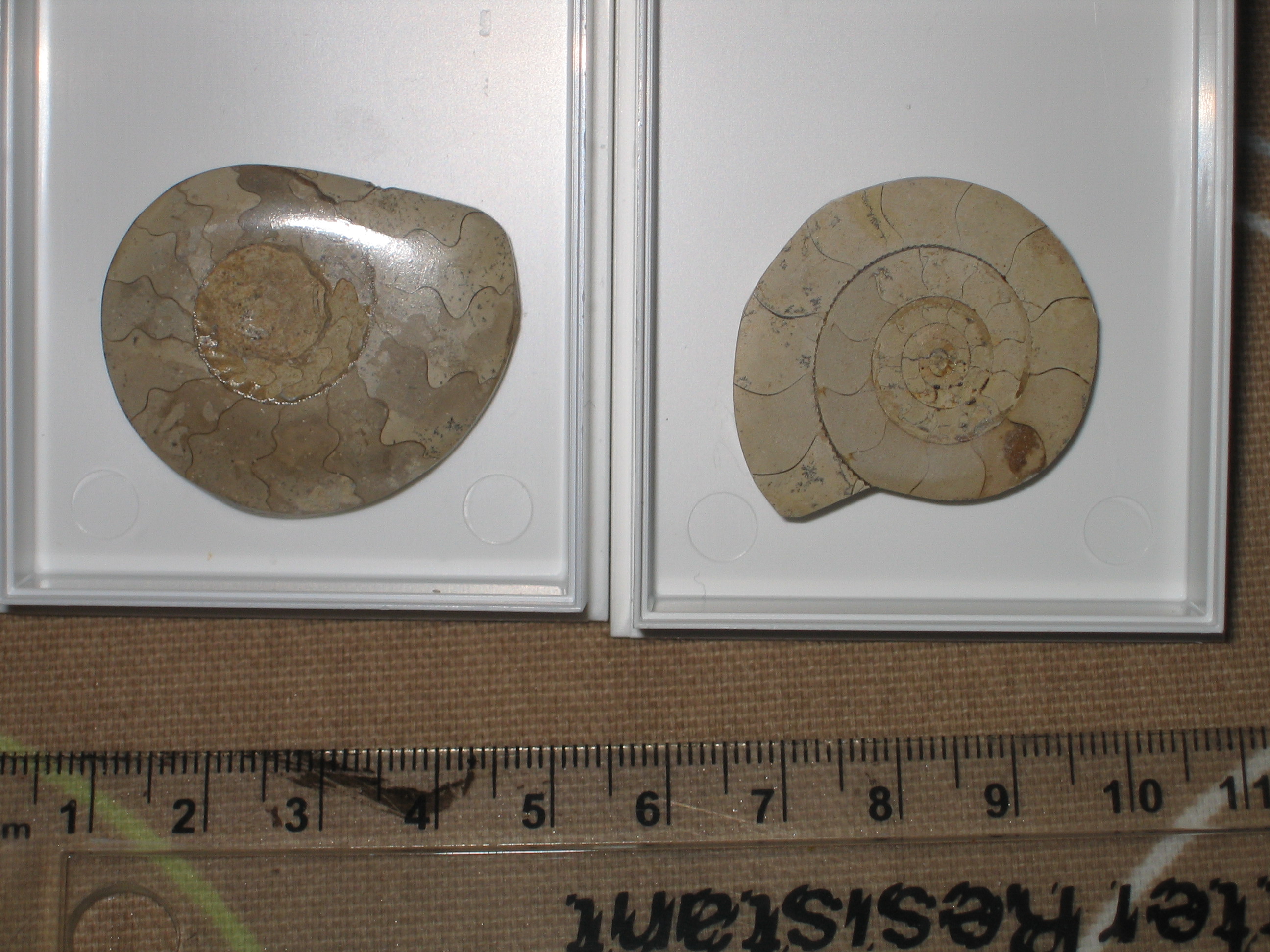
Ammonites are cephalopods (related to modern squid and cuttlefish).  They originated in the Devonian and survived right up to the end of the Mesozoic.  Most ammonites have planispiral shells consisting of a series of living chambers that increase  in size outwards from the centre of the spiral.  They are a particularly diverse group and by cutting a fossil specimen, an internal mould for example,  in cross section and then polishing it a lot of the internal structure can be clearly seen.

Elements of the structure, reviewed by these processes, the suture lines for example, help palaeontologists to recognise individual ammonite species.

Polished Ammonites Showing Internal Structure

Have a go at lapidary this summer. Picture credit: Everything Dinosaur.

Picture credit: Everything Dinosaur

Commenting on the museum’s plans, Brandon Lennon, a local fossil expert who takes Lyme Regis visitors on guided fossil walks along the Jurassic coast stated:

“Last year, hundreds of people attended the sessions, which lasted until 4.30pm each day, working on wonderful local specimens and gaining a real insight into the work of fossil preparation.”

This year, Brandon will once again be involved with the workshops.  He will be joined by Chris Andrews, a marine biologist and geologist who has been one of the main driving forces behind these events, helping to organise the museum’s outreach activities.

For Brandon, the spring tides and longer daylight hours will give him the chance to find more fossils along the beaches that surround Lyme Regis.  Experienced fossil hunter Brandon, conducts organised fossil walks along the Jurassic coast, giving visitors to the town an insight into the geological importance of this part of the Jurassic coast.

To learn more about Brandon’s fossil walks: Lyme Regis Fossil Walks with Brandon Lennon.

There will also be an opportunity to meet up with Brandon and Chris at this year’s Lyme Regis Fossil Festival (4th to the 6th of May), the pair intend to showcase some ammonite polishing skills over the festival weekend.

Go to Top