All about dinosaurs, fossils and prehistoric animals by Everything Dinosaur team members.

Fossil finds, new dinosaur discoveries, news and views from the world of palaeontology and other Earth sciences.

22 04, 2012

The Bird with a “Toothy Grin” that lived Alongside Tyranosaurus rex

By |2023-03-09T10:01:05+00:00April 22nd, 2012|Categories: Dinosaur and Prehistoric Animal News Stories|2 Comments

Scientists Identify a New Species of Late Cretaceous Bird

An international team of Russian, American and Canadian scientists have published details of their work on the fossilised toe bone of a toothed bird that hunted in fresh water, declaring it a new species.  Named Brodavis americanus, this Late Cretaceous fish-eater swam in rivers and probably watched herds of horned dinosaurs and maybe even Tyrannosaurus rex coming down to the river bank in order to drink.

Brodavis americanus

The fossilised fragments of bone that enabled the scientists to name a new species of prehistoric bird were found in the Canadian province of Saskatchewan (Frenchman Formation), a series of sedimentary deposits that date from the very end of the Cretaceous period (Maastrichtian faunal stage).  This is just one species that has been assigned to a newly named family of primitive birds known as the Brodavidae.  In total, four species, part of one genus have been ascribed to this ancient, bird family.

Other fossils of this type of bird have been found in South Dakota (United States) and in Upper Cretaceous rock formations in Mongolia.

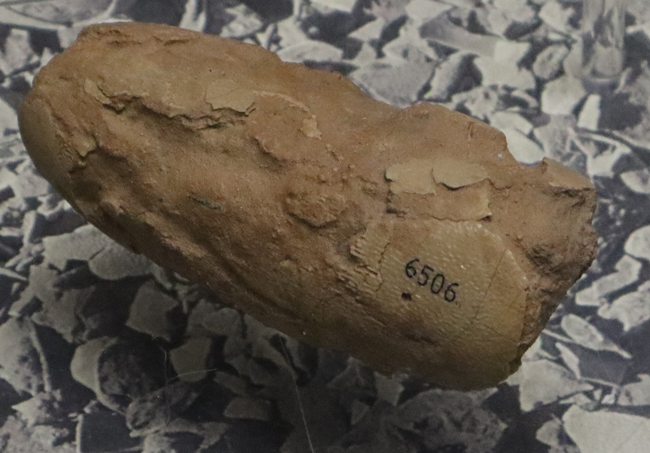
Brodavidae Fused Metatarsal Fossil Bones

Toe bones point towards new bird species.

Picture credit: Royal Saskatchewan Museum

Late Cretaceous Birds

The evolution of Late Cretaceous birds is now much better understand, thanks mainly to new fossil discoveries over the last twenty years or so, in conjunction with detailed study of existing, known fossil material held in museum collections.  The Brodavidae family have been classified as belonging to the Order Hesperornithiforms, primitive birds that are now extinct.  Everything Dinosaur, team members are not entirely sure, but we think one of the characteristics of later forms of primitive birds is that the elongated foot bones called the metatarsals became fused to form a structure known as the tarsometatarsus.

These bones were not fused in earlier Cretaceous bird species such as those found in the Liaoning Province of China which date from the Early Cretaceous.  The picture above shows the fused metatarsal toe bones, the discovery providing evidence that the fossils represent a new family of primitive Cretaceous birds.

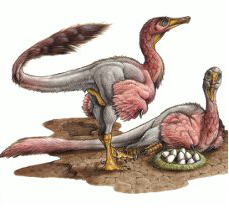
 An Illustration of a Primitive Bird (Brodavidae)

The bird with a “toothy” grin.

The species referred to as Brodavis americanus was described by Larry Martin of Kansas University (USA), the late Evgeny Kurochkin of the Russian Academy of Sciences and Tim Tokaryk of the Royal Saskatchewan Museum.  Whilst a number of Hesperornithiform birds were flightless, living in coastal areas and hunting fish underwater.  This particular species is associated with inland, freshwater environments.

The scientists have speculated that the lack of pachyostosis in the fossil bones (thickening of bones to make them denser to counteract buoyancy in water), might mean that unlike other Hesperornithiforms such as Hesperonis from the Western Interior Seaway, Brodavis americanus may have retained the power of flight.

On this “Earth Day”, so lovely to hear about a number of new species added to the fossil record, helping to improve our understanding of the evolution of modern birds.

For models of Late Cretaceous prehistoric animals: Wild Safari Dinosaur Models.

20 04, 2012

World’s Largest Dinosaur Eggs – The Facts are Scrambled

By |2023-01-29T10:53:08+00:00April 20th, 2012|Categories: Dinosaur and Prehistoric Animal News Stories, Palaeontological articles|0 Comments

Chechnya’s Giant Dinosaur Egg Discovery – Doubts Raised

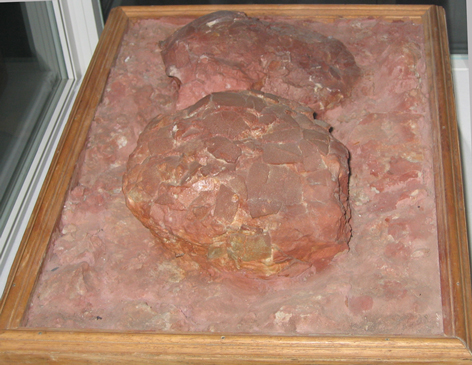
Earlier this week we were sent some pictures taken by a team of scientists who were examining what was thought by a number of observers to be the fossilised remains of dinosaur eggs.  Construction workers undertaking the building of a new road were blasting their way through a hillside near the Chechen border with Georgia when the discovery of more than forty, strange, spherical objects embedded in the hillside was made.  The strange objects, ranging in size from a few centimetres across to a whopping 1.02 metres were described as being dinosaur eggs and their discovery led to a “scramble” amongst scientists to learn more.

Dinosaur Eggs

The Chechnya region has suffered in the past twenty years or so as separatist movements fought with Russia in a bid to form an independent state.  The war torn region has had millions of pounds of state aid poured into it in a bid to improve the living conditions for the local population, the road building project was one such regional development measure, however, the planners did not “eggspect” to have a dinosaur egg hunt on their hands.

Keen to take advantage of the find, a number of local businessmen have expressed an interest in developing guided tours to the remote hillside to view the “dinosaur eggs”.  The discovery has certainly attracted the attention of the local population with many of the curious venturing up the hillside to take a closer look at the objects.

Commenting on the strange phenomena a senior geologist at the Chechen State University stated:

“We’ve found about forty eggs so far, the exact number has not been established and there could be many more under the ground.”

Some scientists are claiming that the eggs were laid by a huge long-necked dinosaur known as a sauropod, the largest, land living animals known to science.   A number of samples and specimens have been sent to palaeontologists based in the city of Yessentuki in southern Russia’s Stavropol Region for a more thorough examination.

Other scientists have cast doubt about whether these are dinosaur eggs.  Chechyna is located in the south-eastern corner of Europe and the geology of the area is extremely complicated.  The northern Caucasus mountain range runs throughout this region, the result of extensive tectonic activity between the Eurasian and the Arabian plates.  The scientists claim that the strata within which the eggs were found dates to around sixty million years ago.  The  dinosaurs are believed to have died out many millions of years before.  The extensive seismic and volcanic activity may have led to a considerable amount of re-distribution and re-deposition but palaeontologists and geologists are sceptical whether such “fossils” such as massive eggs would have survived these physical processes.

Although once underwater, part of the massive Tethys Ocean, the region has been mountainous for much of the Cretaceous, leading scientists to question how such large animals such as sauropods, (titanosaurs) could have roamed a mountainous region and laid eggs on the sides of steep slopes.

Scientists Question Claims

The size of the objects have also led scientists to question the validity of the claim.  Contrary to popular believe, dinosaur eggs were not enormous, in fact given the size of some of the adults that laid the eggs, dinosaur eggs were not disproportionately any bigger than the eggs of many birds.  Egg size is limited by a number of factors.  It is not merely due to the ability of an egg to pass through the oviduct of the adult attempting to lay, but also if the eggs of the largest dinosaurs were more than one metre in diameter, their weight would mean that the egg shell would have to be very thick.  The thickened egg shell would interrupt gaseous exchange and any dinosaur attempting to hatch would have had an extremely difficult job.

Some of the largest dinosaur eggs known, do come from Europe, but not the Caucasus mountains, they were found in France.  A number of football-sized eggs were discovered in France in the 19th Century.  They are believed to have been laid by a Late Cretaceous (Maastrichtian faunal stage) titanosaur known as Hypselosaurus.

To read more about Hypselosaurus and to see a picture of the dinosaur eggs that some scientists ascribe to this genus: The Big Eggs of a Dinosaur.

However, the largest of the French eggs, some thirty centimetres in diameter are dwarfed by the strange eggs of Chechyna.  The objects are simply too big to be regarded as eggs.

Yuri Gubin from the Moscow Museum of Palaeontology has cast doubt about the authenticity of the find, he stated:

“The boundary between the shell and inner structure are clearly seen on the dinosaur eggs.  I haven’t mentioned it on the discovery of the Chechen specialists, I think it’s a kind of sphere-like rocks.  You can’t imagine how many such “eggs” were brought to our museum by Moscow residents”.

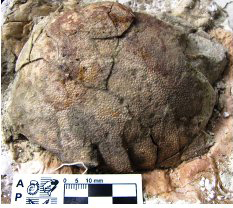
Photographs show a close up of some of the giant “dinosaur eggs”, however if you look closely a number of interesting points, challenging the validity of the dinosaur egg theory can be made.  Firstly one of the arrows points to an exposed area that shows the internal structure of the so-called egg.  Although it is difficult to see all the detail clearly, the  internal structure is not typical of what would be expected inside a fossilised egg, for example there is no evidence of a fossilised embryo.  The shape of the object is very nearly round, most dinosaur eggs are not that spherical in shape.  In addition, one of the arrows points at another object which seems to have been squeezed between two of the “eggs”.  The shape of the object arrowed could have been due to physical processes that occurred during fossilisation but it is more likely that these strange structures may be caused by gaseous intrusions into the layers of sedimentary rock as they were being formed.  These would create bubble-like structures and it is probably natural, geological process that has formed the unusual pattern seen in this particular rock strata.  It is unlikely that this is evidence of a giant dinosaur’s nest.

A Fossilised Dinosaur Egg

Chinese dinosaur fossils. A fossilised dinosaur egg.

A fossilised dinosaur egg (Theropoda). Picture credit: Everything Dinosaur.

Picture credit: Everything Dinosaur

Whilst it remains very likely that these egg-shaped objects are the result of natural , geological processes this has not dampened the enthusiasm or excitement of the locals, who have flocked to the area to take videos and photos of Chechnya’s very own dinosaur discovery.

For dinosaur toys and games including models of prehistoric animals visit: Everything Dinosaur.

19 04, 2012

Scientists “Lay” Claim to New Dinosaur Extinction Theory

By |2023-01-29T10:47:18+00:00April 19th, 2012|Categories: Dinosaur and Prehistoric Animal News Stories, Palaeontological articles|0 Comments

Egg-Laying Dinosaurs Doomed Whilst Mammals Live-Birth Reproduction Strategy Triumphed

A team of scientists based in Switzerland have used computer models comparing how dinosaurs grew from a hatchling into an adult with the growth rate of mammals to suggest that the dependence on egg-laying was a factor in the demise of the Dinosauria.  They have added a new twist to the dinosaur extinction theory.

Dinosaur Extinction Theory

Given the physical limitations imposed on the size of hatchlings, dictated by the physical limits of the eggs they hatch from, many dinosaur species had to grow from babies just a few tens of centimetres long into thirty metre and forty tonne giants.  Small, baby dinosaurs having to grow quickly could not compete against mammals that gave birth to much better developed mammalian offspring who could benefit from being suckled by their mothers.

The dinosaurs became extinct approximately sixty-six million years ago, the exact reasons for the extinction of the Dinosauria along with about seventy percent of all terrestrial life at the end of the Cretaceous are still debated, however, within a few million years, life on Earth had recovered and the mammals were rapidly diversifying to fill many of the niches in the ecosystem that were once occupied by dinosaurs.  A team of researchers from the University of Zurich (Switzerland), have used a complex, mathematical model to plot how mammals with their different strategy over reproduction may have gained the ascendancy over those type of dinosaur that survived until the very end of the Mesozoic.

Did the Dinosauria’s Reliance on Eggs Lead to their Demise?

Did a reliance on egg-laying Lead to the extinction of the dinosaurs?

Picture credit: Everything Dinosaur

To view models and figures of extinct non-avian dinosaurs and other prehistoric animals: Safari Ltd Dinosaur Models.

In press releases concerning this new research, detailed in the scientific journal “Biology Letters”, it has been suggested that the mammals won a sort of evolutionary victory over the egg-laying dinosaurs but this does very probably, over simplify the complex environmental factors that were influencing evolution at this crucial time in our own species’s history.  Had the dinosaurs not died out, it is unlikely that there would be the diversity of mammal types around today and it could be argued that the primates, including our own species – Homo sapiens may not have evolved at all.

Ontogenic Studies

The Zurich based scientists looked at how the two sorts of animals (mammals and dinosaurs) grew, they studied the ontogenic properties of typical dinosaurs and mammals that were alive around sixty-six million years ago.  As dinosaurs hatched, they would have had to compete for food with other dinosaurs as well as mammals, whilst the offspring of mammals had their mother’s milk to sustain them.  In addition, dinosaurs had to grow very quickly, for example a baby titanosaur (long-necked dinosaur), may have had to put on more than one kilogramme of body weight a day – a rate of weight gain not seen in the much smaller mammal genera around at the time.

As baby dinosaurs grew, the young animals would have had to compete in several size categories for food, including adults of other animal groups.  This, the scientists claim put the Dinosauria at a distinct advantage and this may help explain why they died out but the majority of mammals did not.

Those niches in the food chain for small and medium-sized animals were already “occupied”, with the intense competition for depleted food reserves after an extraterrestrial impact, volcanism and climate change leaving no room for the dinosaurs.

Being relatively small, as in the case of the Mammalia at the end of the Cretaceous may have been key to their survival, the fossil record suggests that immediately after the extinction event there were very few terrestrial animals larger than a Labrador dog (around 25 kilogrammes).  Some mammals also lived in burrows and bred very rapidly, these factors too could have assisted in the Order’s ultimate survival.

A Fossilised Dinosaur Nest showing Eggs

Dinosaur eggs.

Two dinosaur eggs. Picture credit: Everything Dinosaur.

Picture credit: Everything Dinosaur

The Swiss team claim that smaller mammals were able to cope with the post-extinction environment much more effectively than their egg-laying competitors and this led them to evolve and diversify very rapidly in the Cenozoic, rapidly occupying all the niches once held by the dinosaurs.

The team aimed to answer the question using their mathematical model as to why the Dinosauria died out yet the Mammalia survived?  Could adult body mass, and an egg-laying reproduction strategy hold the answer?

Contrary to popular belief, compared to their eventual adult size, many dinosaurs hatched from comparatively small eggs.  The largest dinosaur eggs known in the fossil record are believed to have been laid by titanosaurs (long-necked dinosaurs), these eggs are roughly football-sized and from a hatchling, perhaps less than one metre long and weighing a few kilogrammes, these animals would grow to become a forty metre long, forty thousand kilogramme adult animal.

The discovery of some bizarre, egg-shaped structures by construction workers in Chechyna has recently been featured in a number of media outlets.  The egg-shaped objects, some more than a metre in circumference were believed by some observers and academics to be the fossilised remains of a dinosaur nesting site.  However, palaeontologists have cast doubt over the authenticity of these claims as the structures are simply “too big” to be dinosaur eggs.

To read more about this story: World’s Largest Dinosaur Eggs – The Facts are Scrambled.

The size of an animal that can hatch from an egg is governed by a number of factors.  Firstly, the egg shell has to be thin enough to allow gaseous exchange between the external environment and the embryo inside the egg.  The egg shell has to be thin enough to allow a baby to hatch, to break out of the egg.  If dinosaur eggs were much bigger, then the egg shell surrounding them would have to be much thicker to support the weight of the liquid and the embryo inside.  The egg shell would have to be many times thicker to accommodate this extra weight and therefore, too thick for a baby to break out of.  If the egg shell remained thin as egg size increased then a great many eggs would never hatch as the eggs would crack and split long before the embryo had developed enough to be able to hatch.  Egg size is also limited by the ability of the female to store eggs, to divert enough calcium to permit the formation of egg shell in her body and to allow the passing of eggs via the oviduct so they can be physically laid.

The scientists compared the growth rate of the largest land mammal today, the African elephant (Loxodonta africana) to that of a typical Late Cretaceous titanosaur, the largest type of dinosaur around at the very end of the age of reptiles.  The Swiss team suggested that a titanosaur hatchling was 2,500 times lighter than an adult titanosaur, whilst the African elephant calf was only twenty-two times lighter than its mother.

Cretaceous Mass Extinction Event

Many papers have been written on the Cretaceous mass extinction event.  Egg-laying animals may have been more vulnerable to climate change and this could have been a factor in the demise of the Dinosauria.  However, monotreme mammals (mammals that lay eggs and give birth to very underdeveloped young), did survive the extinction event.  Birds too, survived and they all lay eggs (classified technically as avian dinosaurs).   Body size and the amount of resources needed to sustain a viable breeding population may be a more significant factor in the lottery of life that occurs during an extinction event.  The scientific paper does not help to explain how the pterosaurs or the marine reptiles died out.  Some marine reptiles were viviparous, able to give birth to live young, yet these animals too, went the way of the dinosaurs.

The dinosaurs reliance on an egg-laying reproduction strategy may well have played a role in their eventual demise, but during the Late Cretaceous extinction event all sorts of terrestrial animals became extinct – reptiles, mammals, amphibians and birds.   Thanks to a few types of mammals surviving into the Cenozoic we have the great diversity of mammals seen today.  Within ten million years or so, the main groups of modern mammals had evolved including those prosimians that were to lead eventually to our own species.

Visit Everything Dinosaur’s award-winning website: Visit Everything Dinosaur.

15 04, 2012

Giant Jurassic Dinosaur Discovered In China Thanks to Mapping of New Fossil Sites

By |2024-04-23T13:50:33+01:00April 15th, 2012|Categories: Dinosaur and Prehistoric Animal News Stories, Dinosaur Fans|1 Comment

China’s Biggest Ever Jurassic Dinosaur Discovered

The discovery of  partially articulated fossilised bones of the largest Jurassic dinosaur from China has been announced by a team of Chinese and German scientists.  The fossils represent a potentially new genus of long-necked, herbivorous dinosaur similar to the likes of Diplodocus and Apatosaurus, whose fossil remains have been found in Upper Jurassic deposits of the United States.  A giant Jurassic dinosaur has been discovered in China.

Giant Jurassic Dinosaur

Although, far from complete and with much of the fossil material still embedded in its sandstone matrix, scientists have estimated that the bones belonged to a giant dinosaur; approximately thirty-five metres in length and weighing perhaps as much as six African elephants.   The fossils were found by a palaeontological expedition exploring Jurassic aged sediments in the remote Shanshan county in the northwestern region of Xinjiang Province, a part of the world that has recently provided Chinese scientists with a number of new dig sites for the excavation of dinosaur bones.

A spokesperson for the Chinese Research Society of Palaeontology commented that the fossils were found in strata that dates to around 165 million years ago, the Middle Jurassic, more specifically (Bajocian faunal stage).  A number of large Middle Jurassic, long-necked dinosaurs (called sauropods) are known from China.  The most complete discoveries have been made in Sichuan Province (central China) and include dinosaurs such as the fifteen-metre-long Datousaurus and the smaller Shunosaurus, noted for its long tail with a club on the end.

The Latest Fossil Discovery

This latest fossil discovery provides evidence of a much larger, sauropod dinosaur, one that would rival the biggest sauropods that have been found elsewhere in the world for the title of the largest dinosaur specimen known from the Middle Jurassic.

The scientists are confident that they will be able to excavate all the fossilised bones out of the sandstone ridge where they are buried, included a row of articulated vertebrae (back bones).  Close to these fossils, the field team discovered a single, broken tooth from a large meat-eating dinosaur.

It has been speculated that a meat-eating dinosaur may have fed on the carcase before it was buried.  The tooth is slightly re-curved and suggests that it came from an allosaurid, a group of carnivorous dinosaurs that roamed the Northern Hemisphere for much of the Jurassic.  The single tooth may have belonged to a dinosaur similar to the eight metre long predator Sinraptor, whose fossilised remains have been found in similar aged rocks in Sichuan Province.

An Illustration of the Carnivorous Dinosaur Sinraptor (Theropoda)

PNSO Sinraptor dinosaur model

The stunning PNSO Xinchuan the Sinraptor dinosaur model.

To view models of Chinese dinosaurs including Sinraptor (whilst stocks last): PNSO Models and Figures (Dinosaurs).

Mapping Fossil Locations

The expedition team is composed of experts from Jilin University, Shenyang Normal University and Xinjiangg Geological Survey Institute with support from the Humboldt University (Berlin).  Over a six month period the expedition team mapped more than twenty fossil locations and recovered a wide variety of vertebrate fossils, providing scientists with a much better understanding of the climate in this part of the world during the Middle Jurassic.

An Artist’s Illustration of the Giant Jurassic Sauropod

China’s largest known fossil specimen from Jurassic strata.

Picture credit: Everything Dinosaur from an original drawing by Mike Fredericks

The north-western part of China, known as the Turpan Basin was once believed to be very arid, but the discovery of this giant herbivore along with fossils of other reptiles such as terrapins indicate that this low lying region had a number of large lakes within it during the Jurassic and the vegetation must have been very lush to permit such a large, herbivorous dinosaur to live there.

Scientists from the Chinese Academy of Sciences are hoping that these new fossil finds will provide them with more information on the climatic conditions in this part of the world 165 million years ago.  It may help geologists to pinpoint new reserves of fossil fuels such as gas and oil.

Once the bones have been completely excavated and prepared in a laboratory the palaeontologists will have a better idea as to whether this specimen represents a new species of herbivorous dinosaur.  The research team hope to find more evidence of the large theropod that may have scavenged the carcase of this huge Jurassic monster.

11 04, 2012

Royal Tyrrell Museum’s Phil Currie is Honoured with Special Award

By |2024-04-23T13:39:37+01:00April 11th, 2012|Categories: Dinosaur and Prehistoric Animal News Stories, Dinosaur Fans, Palaeontological articles|0 Comments

Explorers Club Honours World Famous Palaeontologist

Globe trotting palaeontologist Phil Currie, one of the driving forces behind the establishment of the Royal Tyrrell Museum (Alberta, Canada), has been honoured by being awarded the prestigious Explorers Club Medal in recognition of his contribution to palaeontology through his extensive field work.

Professor Phil Currie

Being placed alongside the likes of Neil Armstrong, Sir Edmund Hillary and Sir Ranulph Fiennes OBE has come as a surprise to the proud Canadian palaeontologist who commented:

“It’s shocking and overwhelming; to even be considered is amazing.”

As someone whose work takes him all over the world it is fitting that he should be awarded this accolade.  Professor Currie received his medal at a lavish ceremony held at the Club’s annual gala in New York last month.  It is not known whether Phil had time to visit the American Museum of Natural History whilst he was in the city.

The Explorers Club has been in existence for over a hundred years.  Originally founded to honour polar explorers, this select organisation now counts scientists from many fields, astronauts and of course, explorers of other parts of the world amongst its members.  One of the members of the Canadian Chapter nominated Professor Currie, recognising his work in places such as Antarctica, Argentina as well as in Canada.  We at Everything Dinosaur would like to add our congratulations to him and long may the 63-year-old keep exploring.

Numerous Expeditions

Currie’s work now takes him on regular expeditions to Mongolia’s Nemegt formation where he recent uncovered Tyrannosaur fossils that may indicate pack hunting behaviour and to the foothills of Argentina, to find more new dinosaur species.

Professor Currie stated:

“If you look at my habits, unless it’s work related and I can find a dinosaur there, I probably haven’t been there.  It’s definitely my science and the inquisitive mind about where dinosaurs have been.  What’s the significance of the dinosaurs of Argentina to the dinosaurs of Alberta, for instance.  On the face you’d think nothing, but basically right before dinosaurs went extinct, Alberta-style dinosaurs started showing up in South America.  Why was it so late?  We can learn a lot from asking questions like that.”

When asked where else in the world he would like to work, Professor Currie said that he would like to go to Africa, one part of the world he has not worked in extensively as yet.  Certainly, with a number of new and amazing dinosaur discoveries from countries such as Angola, Botswana and Niger there are probably a lot of prehistoric animal fossil remains on that continent for Professor Currie and his colleagues to explore.

To view models and replicas of prehistoric animals including dinosaurs that Professor Currie has studied: CollectA Prehistoric Life Replicas.

7 04, 2012

Rare Alvarezsaurid Dinosaur Eggs Uncovered in Patagonia

By |2024-04-22T14:12:56+01:00April 7th, 2012|Categories: Dinosaur and Prehistoric Animal News Stories, Dinosaur Fans, Geology|1 Comment

Joint Swedish/Argentinian Research Team Report on Dinosaur Egg Discovery

A team of Swedish and Argentinian scientists have reported discovering the fossilised remains of a type of bird-like dinosaur in southern Argentina (Patagonia).  In a first for South America, the fossilised hindlimb has been found in association with the pair of eggs, indicating that these eggs had not yet been laid when the female dinosaur which carried them met her end.

The eggs, with their pimple-like texture have been associated with the fossilised hindlimb and identified as being the eggs of a new type of bird-like dinosaur known as Bonapartenykus ultimus – classified as a type of alvarezsaurid.

Bonapartenykus ultimus

A Picture of the Fossilised Egg

Dinosaur eggs laid in pairs – apt for Easter a story about eggs.

Picture credit: Fernando Novas

The alvarezsaurids are one of the most bizarre groups of dinosaurs known to science.  These fleet-footed, bipedal dinosaurs had compact bodies, long legs, long slender tails and narrow skulls.  The arms and claws of these relatively small dinosaurs are unique amongst the Order Dinosauria.  The humerus is relatively short but the ulna (one of the bones in humans between the elbow and wrist) is massive.  The claw bone of the single digit is almost as big as the ulna.  The fact that in most alvarezsaurids the enormous ulna projects well back from the elbow joint suggests very powerful leverage.

Scientists remain unsure as to what these strong, single-clawed arms were used for but it has been suggested that these dinosaurs could have broken into the nests of termites and other social insects just as the ant-eaters in South America do today.

Of all the known types of dinosaur, the alvarezsaurids have the most bird-like skeletons of all.  The bird-like anatomical features include the specialised forelimbs, fused ankle bones, a prominent furcula (breast bone) and narrow skulls.

Fossils of these strange, cursorial dinosaurs are known from Argentina and from eastern Asia, indicating that this particular group of prehistoric animals had a wide geographic distribution.  The earliest alvarezsaurid fossils date from the Late Cretaceous (90 million years ago), as these early alvarezsaurid fossils have been found in South America, it suggest that this group evolved in the Southern Hemisphere before radiating out northwards.

Bonapartenykus ultimus has been named and described based on the post-cranial fossil remains found at the dig site.  The fossils come from the Allen Formation of the Río Negro in north-western Patagonia (Argentina).  The fossils include dorsal vertebrae (back bones), pelvic bones and the hind limbs.

B. ultimus has been further classified into a new clade of alvarezsaurid termed the Patagonykinae – a family of South American alvarezsaurids that show anatomical characteristics mid-way between more primitive forms known from South America and advanced alvarezsaurids such as Mononykus olecranus known from Upper Cretaceous strata of Mongolia.

An Artist’s Illustration of Bonapartenykus ultimus

Dinosaur nest found in Patagonia.

Picture credit: Gabriel Lio

Dinosaur Eggs

Commenting on this discovery, regarded as unique, Dr Martin Kundrát of Uppsala University (Sweden) stated:

“What makes the discovery unique are the two eggs preserved near articulated bones of the hindlimb.  This is the first time the eggs are found in a close proximity to the skeletal remains of an alvarezsaurid dinosaur.”

The eggs were discovered in a joint Swedish/Argentinian expedition to the region in search of dinosaur fossils back in December 2010. The field team consisted of scientists from Sweden’s Uppsala University and the Museo Argentino de Ciencias Naturales.

At an estimated 2.6 metres long, B. ultimus is one of the largest dinosaurs of this type found to date.  The fossilised remains also indicate that basal forms of the alvarezsaurid clade survived in Argentina to at least seventy million years ago, towards the end of the Cretaceous geological period.

Bonapartenykus ultimus represents the latest survivor of its kind known from landmass called Gondwanaland, the southern landmass in the Mesozoic Era, the researchers state.  Despite the absence of skull material to help give the scientists a more accurate impression of what this dinosaur looked like, reconstructions have been made based on those fossils found and by comparing the remains to Patagonykus puertai – a closely related Alvarezsaurid from the Nequen Province of Argentina.

In a paper published in the scientific journal “Cretaceous Research” the scientists propose that the two eggs may have been inside the oviducts of the female when this animal died.  Other finds of eggshells in the vicinity indicate that some eggs were incubated and contained embryos at a later stage of development.  This find adds weight to the theory that unlike birds, which have just one oviduct, dinosaurs had two oviducts.

However, just like many birds, dinosaurs would have probably laid a clutch of eggs over several days.   The eggs seem to be larger than hens eggs, with an estimated circumference of around twenty centimetres.

The eggs had a relatively rough, outer texture, a sort of pimple-like outer surface.  A microscopic analysis of the fossilised eggs found in association with the hindlimb indicate that the eggs had been contaminated by fungi.  This is the first instance recorded in the fossil record of fungal contamination of dinosaur eggs.  It is likely that this contamination occurred after the female had died and the corpse had begun to rot out on the Cretaceous plain where this mother-to-be met her death.

For articulated models of dinosaurs including small theropods: Beasts of the Mesozoic Articulated Dinosaur Models.

6 04, 2012

Woolly Mammoth Colour Variations Exploring the Science

By |2024-04-23T07:26:19+01:00April 6th, 2012|Categories: Dinosaur and Prehistoric Animal News Stories, Everything Dinosaur News and Updates, Everything Dinosaur Products|1 Comment

Research into Woolly Mammoth Genome Provides Understanding of Hair Colour

For many years, scientists believed that Woolly Mammoths were brown in colour but recent studies using frozen Woolly Mammoth remains discovered in Siberia has provided a better understanding of the colour variations of these Ice Age creatures.  Thanks to the discovery of some beautifully preserved specimens many of them babies or juveniles (Dima, Lyuba and Yuka for example), palaeontologists have a much better idea of the genome of these prehistoric mammals.

Woolly Mammoth Colour Variations

It is from this better understanding of the DNA of Woolly Mammoths (M. primigenius), that scientists have begun to piece together evidence to suggest that Mammoths could have almost the same hair colouration variances as modern humans, with ginger, brunettes and even a potential blonde Mammoth.

The coat of Woolly Mammoths was adapted to the harsh climate of the northern Steppe.  It consisted of two distinct layers.  The first layer was composed of long, coarse guard hairs, six times thicker than human hair.  This coat grew to almost a metre long in adult animals.  This coat served to trap air helping to keep the animal warm and also effectively to waterproof and snowproof the animal in a similar way to the long, shaggy coat of an extant Musk Ox.

The second, inner layer which made up the undercoat  had hairs that were much thinner, shorter and softer.  This coat would have trapped air too, helping to insulate the animal from the cold.  Columbian Mammoths (Mammuthus columbi), which lived in North America; were less hairy than their Siberian cousins.  It is possible that Mammoths moulted in the spring, producing a lighter summer coat.

The Coat of a Woolly Mammoth

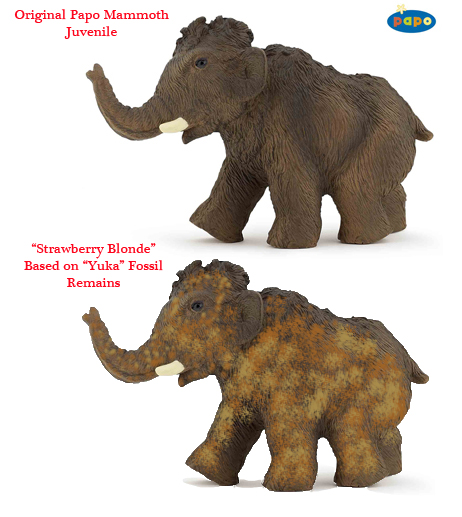
The colour of the hairy coat of a Woolly Mammoth, according the genome research could vary.  There were indeed brown Woolly Mammoths, but also those which were a reddish/orange in colour.  Some Mammoths were also a strawberry blonde hue.  It seems that if you were to travel back in time to Siberia 25,000 years ago and observed several family groups of Woolly Mammoths you would probably have seen a surprising amount of coat colour variation.

Ironically, a number of cave paintings show Woolly Mammoths.  These creatures were obviously very important to our ancestors as sources of meat, hide and ivory for tools.  These large herbivores would have been a formidable opponent for human hunters armed with nothing more than sharpened stakes and stone tipped spears.  The cave paintings depict Mammoths in a variety of colours, more than 350 caves with paintings have been discovered in Europe alone.  Some of these cave have paintings of Mammoths on their walls.  It was thought that the cave artists using natural pigments such as ochre, haematite and charcoal, showed the Mammoths in a variety of colours for perhaps symbolic affect or to portray deeper meaning.   However, a 21st Century understanding of the Mammoth genome demonstrates that Woolly Mammoths did come in a variety a colours.

A Reddish/Brown Woolly Mammoth Model

Woolly Mammoth model without the usual brown coat.

Picture credit: Everything Dinosaur

For model makers, there is a tendency to produce Woolly Mammoth models and other Ice Age toys that are brown in colour.  The Natural History Museum produced a reddish/brown Mammoth some years ago, (see picture above), around the same time that Everything Dinosaur team members were working on a Woolly Rhino model (Coelodonta).  However, with this increased knowledge regarding the coats of these Ice Age creatures perhaps it is merely a question of time as to when a manufacturer will break rank and produce a “strawberry blonde” Woolly Mammoth like “Yuka”.

To view Prehistoric Mammal models including Woolly Mammoths: Papo Prehistoric Mammal Models and Dinosaurs.

Strawberry Blonde Woolly Mammoths – Papo’s Next Innovation?

Strawberry Blonde Mammoth from Everything Dinosaur.

Picture credit: Everything Dinosaur

The recently introduced, Papo Woolly Mammoth juvenile has been given a lighter coloured coat similar to the coat found on the carcase of the recently discovered Siberian Mammoth juvenile known as “Yuka”.

6 04, 2012

Baby Mammoth Killed by Lions and then Butchered by Humans

By |2023-01-29T09:49:39+00:00April 6th, 2012|Categories: Dinosaur and Prehistoric Animal News Stories, Educational Activities|0 Comments

Yuka – The Siberian Baby Mammoth Killed by Steppe Lion and then Butchered by Humans

A number of television documentaries have aired recently concerning the discovery and the initial research on a baby Woolly Mammoth (Mammuthus primigenius) whose frozen carcase was recovered from Siberia.  Each spring, as the winter snows thaw, a number of Pleistocene animal remains are discovered as they are eroded out of the thawing ground by the action of rivers in spate.  These fossils, some of them beautifully preserved with internal organs and fur intact reveal that this part of the world during the Pleistocene Epoch was inhabited by some spectacular prehistoric mammals.

The habitat known as the Russian Mammoth steppe was a huge expanse of grassland that existed between the northern ice sheets and more wooded, mainly conifer forest that was to be found further south.  A number of large herbivores grazed on the plains.  As well as Mammoths, there were Woolly Rhinos (Coelodonta spp.), giant deer, several other types of now extinct antelope and horses.  Living alongside these herbivores there were several types of predator, a number of species of bear, plus Sabre-toothed cats and other members of the Felidae (cat family) such as Cave Lions and the slightly smaller Steppe Lion.

Baby Woolly Mammoth

Recently, the body of a baby Mammoth was discovered and scientists from the International Mammuthus organisation have been studying this carcase in a bid to find out more about Mammoths in general and to identify how this particular young animal met its end.  The baby Mammoth has been given the name Yuka, and as well as being remarkably well-preserved, this corpse reveals evidence with other inhabitants of the Mammoth steppe, including the possibility of human hunters.

The skull and pelvis have been removed from the corpse, they were found close to the body but most of the ribs and much of the spine is missing.  There is a long, straight cut along the top of the animal’s back, this was made by people, but whether it is evidence of the body being butchered as the remains rested on the steppe thousands of years ago or more recent human activity is difficult to determine.

The scientists are fairly certain that this young Mammoth was not actually killed by people.  Yuka shows signs of being attacked by an apex predator possibly a Cave Lion or a Steppe Lion, certainly a member of the Felidae (cat family).  It is very likely that this predator killed the Mammoth calf, human hunters may have discovered the carcase and removed some of the bones and meat, or perhaps they chased the lion(s) off the kill and took over the body, robbing the big cats of their meal.

Poor Yuka

Poor Yuka, seems to have had a very unfortunate and brief life.  Healed scratches on the preserved skin shows that this Mammoth survived another attack by a cat – possibly an Eurasian Cave Lion, but much deeper wounds and a broken leg which had not healed imply that a second attack was either fatal or severely weakened the young animal.

The carcase provides evidence of potential ancient human interaction.  Radio carbon dating indicates that this Mammoth lived right at the end of the Pleistocene epoch, perhaps it was one of the last Mammoths to live in this part of Siberia.  The corpse is estimated to be around 10,000 years old.  The long, straight cut along the back, in conjunction with other cut marks that show a distinctive pattern as if they were created by a saw-bladed cutting tool of some kind, provide evidence that humans have interfered with the body.

If the liver had been removed, then this could be further evidence that the carcase had been butchered for its meat.  The liver is regarded as one of the most nutritious parts of any mammal carcase.  Nomadic hunters today, when killing and butchering large mammals such as antelope often remove the liver first.  If the liver is missing and the body cavity shows signs of intrusion then this could confirm the hypothesis that some human hunters 10,000 years ago grabbed an opportunity to get some food from the young Mammoth’s remains.

International Mammuthus Organisation

The researchers from the International Mammuthus Organisation suggest that Yuka was about 30 months old at the time of death.  In Africa, lions are known to attack young elephants (African elephants – genus Loxodonta), but this is the first time that evidence has been found of a Woolly Mammoth being attacked by members of the Felidae.

Tackling an elephant is a substantial task, even for a pride of lions.  Often the elephants are aware of the big cats, but during daylight they can fend off any attacks.  The lions tend to wait until dark, their better night vision gives them an advantage over their much heavier intended victims.  It can only be speculated, but perhaps a Steppe Lion attacked a weakened Yuka at night, finally bring the young animal down.

Much of the soft tissue is still connected to the bones, and there is a substantial amount of Mammoth fur on the remains.  Fur is still on the flanks, on the rump and the feet, it is as strawberry blond colour, bearing out predictions made a few years ago on the potential colour of Mammoth fur after a detailed genetic analysis on another frozen baby Mammoth known as Lyuba.

Finding such beautifully, well-preserved remains of these ancient herbivores will help scientists to better understand Mammoth DNA and traits such as eye and hair colour.  Although, many Mammoths were a reddish-brown colour, the gene that contains fur/hair colour is very similar to the gene that controls the colour of human hair.  This means that Woolly Mammoths could be as varied in colour as human hair – Mammoths could be blond, ginger or even brunettes.

To view Woolly Mammoth soft toys and other prehistoric animal soft toys: Prehistoric Plush – Prehistoric Animal Soft Toys.

5 04, 2012

Europe’s Biggest Dinosaur Skull Goes on Display at Special Exhibition

By |2024-04-23T07:26:58+01:00April 5th, 2012|Categories: Dinosaur and Prehistoric Animal News Stories|1 Comment

Skull of Huge Dinosaur on Show at Dinosaur Exhibition

The prepared skull of a huge, herbivorous dinosaur that once roamed the land that was to eventually become Spain has gone on display at the Dinopolis Foundation in the town of Teruel, in the province of Aragon (eastern Spain).  During the Late Jurassic, this part of Europe was a lush tropical paradise, criss-crossed with rivers and this habitat supported an extensive and diverse range of dinosaurs including large sauropods, one of which is the largest European dinosaur known to science.  A dinosaur skull goes on display.

Turiasaurus riodevensis

The dinosaur is Turiasaurus riodevensis (the name means “Teruel lizard”, as Turia is the Latin word for Teruel) and although far from complete, the fossils ascribed to this specimen including the skull which has now been carefully prepared and pieced together suggest that this dinosaur could have reached lengths in excess of thirty metres and perhaps weighed as much as forty tonnes.

Formally named and described in 2006, the thirty-five separate bones that make up the skull, plus seven peg-like teeth were presented this week at the Dinopolis Foundation, the name of the town’s dinosaur exhibit.  These bones helped scientists to recognise T. riodevensis as a separate species when the bones were discovered in 2005 during excavations at the Barrihonda-El Humero, fossiliferous strata, which dates from the Upper Jurassic/Lower Cretaceous boundary.

From measurements taken from a 1.79-metre-long humerus (upper arm bone), the scientists have concluded that this dinosaur was one of the biggest animals on Earth approximately 145 million years ago, bigger than the better known sauropods of the United States whose fossil also date from the end of the Jurassic, dinosaurs such as Apatosaurus and Camarasaurus.

Dinosaur Skull

The skull will go onto form a centre piece for the site’s, dinosaurs of the Iberian Peninsula exhibition.  Ironically, the skulls of sauropods are extremely rare in the fossil record.  The heads of these huge herbivores do not seem to get fossilised very often.  Compared to the rest of the animal the heads are relatively small.  For example, the head of another sauropod, Diplodocus is only about the same size as that of a horse, but the Diplodocus weighed as much as fifteen tonnes and would have measured in excess of thirty metres in length.

The heads seem to have fallen away from the caudal vertebrae as the carcase deteriorated, once detached they are rarely preserved as fossils to be found by palaeontologists millions of years later.  Most of the sauropod dinosaurs seen in Natural History Museums do not have the correct head on their bodies, rather than display a head-less skeleton, curators model a composite skull or provide a replica skull from a close dinosaur relative.

To read more about Europes’ Largest Dinosaur: Which is the Biggest Dinosaur Known from Europe?

Only a handful of sauropods have skull material assigned to their genera, these animals include Giraffatitan from Africa, Mamenchisaurus from China, Turiasaurus from Spain and Apatosaurus from the United States.

For figures and models of sauropod dinosaurs and other prehistoric creatures: Safari Ltd. Dinosaur Models.

4 04, 2012

One Tonne Basal Tyrannosauroid Described in New Scientific Paper

By |2024-04-23T07:28:16+01:00April 4th, 2012|Categories: Dinosaur and Prehistoric Animal News Stories|6 Comments

Meet your Tyrannosaur Feathered Friend – Yutyrannus

Palaeontologists  from the Institute of Vertebrate Palaeontology and Palaeoanthropology (Beijing, China) have published a scientific paper on a newly described feathered dinosaur.  Over recent years, there have been many discoveries of  new types of feathered dinosaur fossils in the Liaoning Province of northern China.  However, this new dinosaur find, named Yutyrannus huali stands out for a number of reasons. Firstly, the specimens are very well-preserved and nearly complete, secondly, different sized individuals have been found, an adult and two juveniles, helping scientists to determine how these animals grew and developed and thirdly – Y. huali was huge.   At something like nine metres in length and weighing over a tonne (estimated 1,400 kilogrammes), this dinosaur is one of the largest feathered creatures known to science.  As if this wasn’t enough to get dinosaur fans swishing their tails and roaring with excitement it seems that this new feathered giant may have been a primitive member of the Tyrannosauroidea, that famous clade of theropods that include Albertosaurus, Daspletosaurus and of course T. rex.

Yutyrannus huali

A number of websites have reported on this discovery, some have claimed that this new species is the largest feathered creature known to science.  True, when compared to the likes of the therizinosaur Beipiaosaurus (Beipiaosaurus inexpectus), a feathered dinosaur also from the Liaoning Province, it is very big.  Beipiaosaurus is estimated to have measured around 2.5 metres in length and weighed as much as eighty kilogrammes, but commentators are forgetting the enormous, oviraptorid – Gigantorapotor erlianensis, discovered in 2005 by an expedition to Mongolia by scientists from the Beijing based institute.  Indeed, some of the team that studied the eight-metre-long Gigantoraptor have also been working on this new giant feathered dinosaur.  Gigantoraptor is estimated to have been taller than a giraffe.

To read more about the discovery of the oviraptorid Gigantoraptor: New Chinese Dinosaur Discovery – Gigantoraptor.

Analysis of the skull material suggests that Yutyrannnus was a member of the tyrannosaur family, a tyrannosauroid, although it is not a direct ancestor of the famous Tyrannosaurus rex, it was carnivorous and most probably an apex predator in its environment.  The name Yutyrannus huali means “beautiful feathered tyrant”, in recognition of the evidence of long, filamentous feathers that have been found in association with the fossil remains and the classification of this new dinosaur species as a tyrannosaur.

An Artist’s Impression of a Flock of Yutyrannus on the Prowl
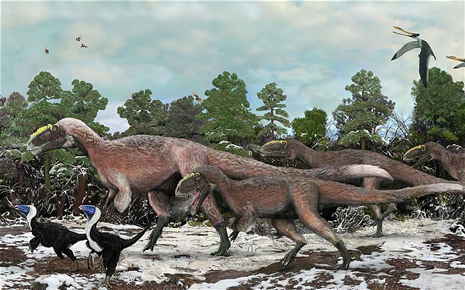
Giant theropod withfFeathers from Liaoning Province.

Picture credit: Brian Choo

Yutyrannus huali roamed what was to become northern China approximately 125 million years ago (Barremian faunal stage of the Early Cretaceous).  The tyrannosaur family and its direct ancestors can be traced back into the Late Jurassic, Xu Xing one of the Chinese palaeontologists involved in the study of Yutyrannus was responsible for naming and describing Guanlong (Guanlong wucaii), a basal member of the tyrannosaurs that lived something like thirty million years earlier.

The adult skeleton measures about nine metres in length and indicates that this new dinosaur would have rivalled Gigantoraptor for the title of the biggest feathered creature known to science.  The other two individuals are believed to represent immature individuals and not a second species.  This has been determined by the Chinese researchers who noticed that a number of vertebrae (back bones) had not fully fused indicating that these fossils represent creatures that had not reached adulthood.  Even so, these youngsters were already hefty.  Each one would have weighed almost as much as a fully grown dairy cow.

Three Fossil Specimens

All three fossil specimens show evidence that these dinosaurs had feather-like filaments adorning their bodies.  Some of the feathers were at least fifteen centimetres in length.  In the adult, traces of feathers have been found along the tail, with the immature animals, the feathers appeared to have been along the neck and down the humerus (upper arm) in one specimen and near the pelvis and foot in the other.  Taken together it can be speculated that a single Yutyrannus may have been entirely feathered.  Certainly, younger animals may have been completely feathered, the feathers helping to insulate this warm-blooded dinosaur.  Older animals, with larger bodies, which can retain heat better (surface area to volume assessments), may not have been completely feathered.  It is possible that as the animals grew the feathers become important not for insulation against the chilly conditions in northern China but for display or to show status in the “flock”.

This new discovery, reported in the academic journal “Nature”, suggests what a number of palaeontologists have thought for sometime, that even the biggest theropods could have been feathered.  Certainly, due to the size of these individuals these dinosaurs could not fly, but the feathers served another purpose – signalling amongst other members of the species or perhaps to insulate the animal against the cold.

One of the Skulls of this new Tyrannosaur (Yutyrannus huali)

Basal tyrannosaur – Yutyrannus.

Picture credit: Zang Hailong

The picture shows a close up the skull of Yutyrannus, the teeth can be clearly seen.  This dinosaur may have had a thin crest running from the tip of the snout to the back of the skull.  What purpose this crest may have served is unknown.

Commenting on the Chinese research, Richard Prum, an evolutionary ornithologist at Yale University (USA) stated:

“The new finding shows for the first time that even giant theropods could be plumaged, and likely fully plumaged.”

The Chinese team are using microscopy and other techniques to try to determine the colours of the feathers, this may give the scientists more data on just what purpose the feathers served.  Their discovery has re-ignited the debate whether other Cretaceous tyrannosaurs such as T. rex  were feathered too.

Although, extensive coal deposits found in the Northern Hemisphere (Canada and Siberia), which date from the Early Cretaceous suggest that the climate was warmer than today, the high latitude with which these fossils are associated with indicates that the environment in which these giant theropods roamed could be decidedly chilly.  Analysis of oxygen isotope ratios recovered from the teeth of Yutyrannus suggests that the climate in this part of China was remarkably similar to northern China today.  It has been estimated that the average annual temperature was around ten degrees Celsius – much colder than in other parts of the world where dinosaur remains have been discovered.  This finding adds weight to the speculation that the feathers helped to keep these creatures warm, insulating their bodies against the cold.

Irrespective of the feather’s function, the research team have concluded that Yutyrannus shows that a drastic reduction in plumage was not an inevitable consequence of having a large body size.

Thomas Holtz Junior, a vertebrate palaeontologist specialising in the Dinosauria, based at the University of Maryland (USA), commented on the new discovery.  He stated that this new fossil find was:

“Another good example of evolution being a predictive science.”

The Liaoning Province had provided a lot of evidence of small, feathered dinosaurs, so many scientists had suggested that it was only a matter of time before evidence of a big dinosaur with feathers would be found.

Yutyrannus huali provides direct evidence that large, feathered dinosaurs did exist.  It offers new insights into the origins and evolution of feathers, which are in themselves highly modified reptilian scales.  The fact that two juveniles have been discovered permits scientists to examine how these animals changed as they grew (helping with ontogenic studies).  Described as a basal tyrannosauroid, Yutyrannus is similar to other primitive tyrannosaurs found in northern China, although unlike the later T. rex it had three fingers on its hands, and the arms were proportionately much bigger than the arms of later tyrannosaurs.

This discovery represents one of the most significant finds from the Lower Cretaceous Yixian Formation of Liaoning Province.

For models and replicas of Yutyranus huali and other theropod dinosaurs: PNSO Dinosaur Replicas.

Go to Top