All about dinosaurs, fossils and prehistoric animals by Everything Dinosaur team members.

Fossil finds, new dinosaur discoveries, news and views from the world of palaeontology and other Earth sciences.

12 05, 2012

The Winds of Change – Methane Produced by Dinosaurs May have led to Rapid Global Warming According to New Study

By |2024-04-23T13:55:22+01:00May 12th, 2012|Categories: Dinosaur and Prehistoric Animal News Stories, Dinosaur Fans|0 Comments

Study Suggests Sauropods May have Contributed to Global Warming in the Mesozoic

A team of British scientists have put the wind up palaeontologists by creating a mathematical model that attempts to predict the impact on global warming that the gases produced by large plant-eating dinosaurs might have had.  The researchers, David Wilkinson (Liverpool John Moores University), Euan Nisbet (University of London) and Graeme Ruxton (University of Glasgow) have calculated that sauropods could have produced 520 million tonnes of methane each year.  At this level of output, the methane would have probably had a significant impact on the climate of the Mesozoic, contributing to global warming.

Scientists Calculate that Sauropods Contributed to Mesozoic “Global Warming”
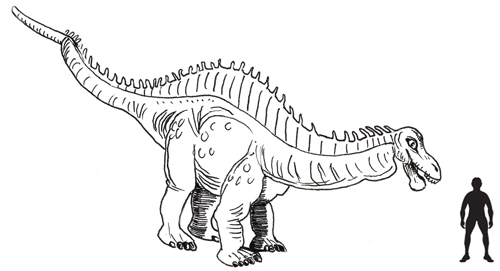
Rebbachisaurus scale drawing.

Scale drawing of Rebbachisaurus.  Did sauropods contribute to global warming?

Picture credit: Everything Dinosaur

Herbivorous mega fauna of the Mesozoic, would have had large quantities of microbes inside their enormous digestive tracts.  These microbial agents would have had a symbiotic relationship with their reptilian hosts, with the micro-organisms acting as methanogenic symbionts for the fermentation of the plant material ingested by mega herbivores such as the Sauropoda.

Methane Produced by Dinosaurs

Sauropods are the long-necked dinosaurs.  Well-known sauropods include Diplodocus, Brachiosaurus and Apatosaurus, which was formerly known as Brontosaurus*.  Such creatures had a small head, a long neck, a massive, elephantine body and long tails.  The sauropods evolved into a myriad of forms, some of which represent the largest land animals known to science with body weights in excess of 20,000 kilogrammes.  The scientists published their research in the scientific journal “Current Biology”, using studies of Apatosaurus bones found in the western United States.  The team made a number of assumptions regarding the global population of sauropods in the Late Jurassic and based on these calculations they estimate that these large herbivores and the microbes that lived inside their massive digestive tracts would have produced more than half a billion tonnes of methane per annum.  Such large scale methane production would have had an impact on the gaseous content of the atmosphere and with methane being a significant “greenhouse gas”, it is likely that the Mesozoic climate was influenced by this gas production.

Herbivorous Dinosaurs

Methane would have also been produced by other herbivorous dinosaurs, most notably members of the Thyreophora (shield bearers), such as Stegosaurus.  However, the huge sauropods would have contributed the most and according to the British researchers their combined wind production, the gas created and emitted as a result of microbial action breaking down the plant material the creatures consumed, would have been many times what cows produce today.

Ruminants such as cows are being blamed by many global climate researchers for making a large contribution to the production of methane.  Methane is a more harmful “greenhouse gas” than carbon dioxide.  Methane in the upper atmosphere would trap heat very effectively and therefore this would make a significant contribution to the heating up of the planet.  However, cows tend to be a lot smaller than sauropods and the research team calculated the potential density of these large sauropods during the Late Jurassic and as a result, the long-necked dinosaurs could be regarded as “super-contributors” to the organic methane output of the Mesozoic.

Scientists have long regarded the Late Jurassic as a time when the Earth’s climate was much more humid and warmer than today.  Very little evidence has been put forward to suggest permanent icecaps at the poles during the Late Jurassic.  Although there was very probably ice and snow at the poles (both North and South – very high latitudes and very low latitudes), this was likely to be seasonal.  Plant fossils discovered in Alaska and Siberia suggest that even land close to the poles had relatively warm climates in the Late Jurassic (155 million to 144 million years ago).  The British research team proposed that there would have been a greater amount of land area available to the Jurassic browsers and grazers than the modern, mammalian mega herbivores that produce methane today.  This and calculations of herbivore density suggest that the dinosaurs such as Apatosaurus would have contributed more than five times the amount of methane than ruminants such as cows do today.

Commenting on the study, Dr Wilkinson of Liverpool John Moores University, at the department of natural science and psychology stated that it was not the dinosaurs that produced the methane, it would have been the microbes that lived inside their guts that were responsible for the gas production.

Dr Wilkinson went onto add:

“We used modern zoology to make informed guesses and estimated methane levels of dinosaurs.  This research does not propose that climate changed was responsible for the wiping out of the dinosaurs – in fact warm conditions would have been a benefit.”

Comparing the Methane Production from a Number of Sources

“Wind Power” from dinosaurs.

Table credit: Current Biology/Wilkinson et al.

Warm Conditions Suited Reptiles

The warm conditions would have suited the reptilian dinosaurs, especially if they were cold-blooded (ectothermic) animals.  This may provide one of the reasons for the success of the Dinosauria Order, which palaeontologists suggest may have contained more than two thousand genera.  Today’s average global temperature is approximately 14 degrees Celsius, although scientists predict that “greenhouse gases” in the Earth’s atmosphere may increase global temperatures by as much as three degrees over the next fifty years or so.  The global temperature on Earth during the Late Jurassic, the time in Earth’s history that was used as the basis for this study, is estimated to be at least ten degrees higher than average temperatures today.

Ironically, after the demise of the Dinosauria some sixty-six million years ago, global temperatures are believed to have rocketed reaching a peak of an average of twenty-eight degrees Celsius by the mid Paleogene geological period.

The study team used a variety of assumptions to calculate the methane production of sauropods, their mathematical model involved parameters such as potential sauropod density, the amount of land area that was suitable for mega herbivore habitat and the average size of sauropods, specifically the Apatosaurus genus and species such as A. louisae.  This data was then compared to known data on the methane production from modern day ruminants.

Study Based on the Sauropod Apatosaurus louisae

Study based around sauropods – Apatosaurus.

Methane production today, is estimated to be around five hundred million tonnes, or to put it another way, equivalent to the estimated output of the Sauropoda in the Late Jurassic.  Methane is being added to the atmosphere from a variety of sources such as the digestion of plant material by wild animals and by human enterprises such as dairying and extensive meat production.

Dr Wilkinson  did state that there were other sources of methane during the Mesozoic he commented that the dinosaurs were not the sole producers of methane at the time.  Overall, the British team estimate that the atmospheric methane levels in the Jurassic were much higher than they are today.

One thing is for certain, if you were to visit the area that was to become the Morrison Formation of the western United States during the Late Jurassic, you would be well-advised to stay upwind of any herd of sauropods you came across as the gas these animals would have produced would have been most unpleasant.

Please Note *Brontosaurus is now regarded as a valid genus.

The scientific paper: “Could methane produced by sauropod dinosaurs have helped drive Mesozoic climate warmth?” by David M. Wilkinson, Euan G. Nisbet and Graeme D. Ruxton published in Current Biology.

For models and replicas of sauropods and other dinosaurs: CollectA Deluxe Prehistoric Animal Scale Models.

9 05, 2012

The Smallest Mammoth of them All – Dwarfism Exhibited on Crete

By |2023-03-09T08:03:04+00:00May 9th, 2012|Categories: Dinosaur and Prehistoric Animal News Stories|0 Comments

Scientists Report on Evidence of the Smallest Mammoth Species Discovered to Date

When Woolly Mammoths are depicted in films, television documentaries and books they are usually shown as large, shaggy-coated beasts roaming a snow covered landscape.  This may be the popular perception of the Mammoths but the subfamily to which Mammoths belong, the Elephantidae and even the Mammoth genus (Mammuthus) contains a very wide variety of creatures.

For instance, a team of scientists have just published a paper in the journal “Proceedings of the Royal Society Biology” detailing the fossil evidence that supports the theory that tiny elephants once lived on the Greek island of Crete.  In fact, based on the study of a recently excavated front leg bone (humerus), it has been suggested that these fossils may represent the smallest type of Mammoth discovered to date.  Standing around 1.1 metres tall at the shoulder, these miniature Mammoths inhabited Crete around 3.5 million years ago (Pliocene epoch – Placenzian faunal stage).

These animals would have grown to be about the size of a baby African elephant (Loxodonta africana), but would have weighed around three hundred kilogrammes, roughly the same as a Guernsey dairy cow.

Dwarf Mammoths

The species which has been named Mammuthus creticus (Crete’s Mammoth) has been described as being “probably quite cute” by a spokesperson for the research team, however, it is very likely that this animal had tusks and was quite capable of looking after itself should it have been threatened.

Evidence of Insular Dwarfism on Crete

Miniature mammoths.

Picture credit: Journal of Proceedings of the Royal Society

The picture above shows the location of the main fossil discoveries, on the coast on the western side of the island (a) at Cape Malekas.  The picture also shows a tooth (the lectotype from which the species was named), (b), with a smaller photograph showing another fossilised tooth element preserved in the rock (in situ), (c).

Mammuthus creticus

Victoria Herridge, one of the authors of the paper, along with her Natural History Museum (London) colleague Adrian Lister; commented that:

“If you were to reconstruct it, I would say OK, make it look a bit like a baby elephant but probably chunkier…with sort of thicker limbs, stockier, as an adult it would have had curly tusks.”

She went onto add:

“The nearest image you’re going to get is a baby Asian elephant, but with tusks.”

Dwarfism in some species is not unknown, especially in habitats were resources such as food are scarce.  Small islands have limited resources and many instances are known whereby larger, mainland animals on reaching an island chain or archipelago have evolved into miniaturised versions.  In biology this is termed insular dwarfism and can be seen in animals as distinct as cormorants, seals and even dinosaurs (Hateg Island – Late Cretaceous).

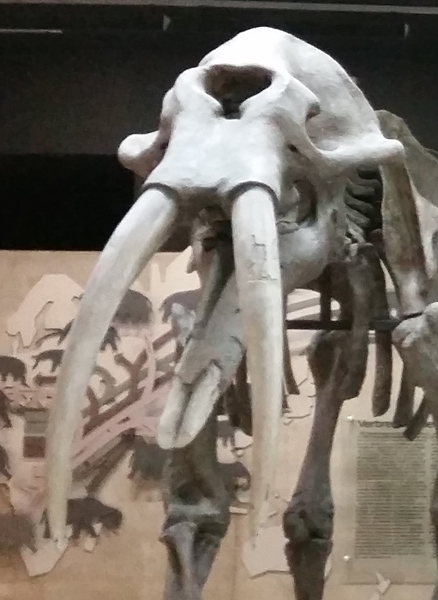
A number of Mediterranean islands had a variety or elephants living on them during the Pliocene and the more recent Pleistocene epochs, some scientists believe the the legend of the giant, one-eyed man – the cyclops arose when the skulls of such creatures were found.

The Origins of the Cyclops Legend?

Proboscidian skull.

When viewed from the front the idea of a one-eyed man (cyclops) can be postulated. Picture credit: Everything Dinosaur.

Picture credit: Everything Dinosaur.

To read more about recent elephant fossil discoveries from Greece, including an article on giant elephant fossil remains: Greek Giant Elephant Fossils Discovered.

The researchers are not sure from which mainland Mammoth the island species is descended from.  Two candidates have been suggested Mammuthus meridionalis known from the Early Pleistocene epoch or from the older (Late Pliocene) or Mammuthus rumanus, the two earliest European mammoths, Herridge said.  Although the exact palaeo-climatic conditions on Crete are difficult to determine, it is likely that this elephant lacked a shaggy, long coat as the weather was much warmer than at higher latitudes.

Determining the Taxonomic Relationship

The lack of fossil evidence has made it difficult for scientists to determine the taxonomic relationship between the various types of known Mediterranean elephant.  It had been suggested that a number of forms were descended from a non-Mammoth ancestor, a straight-tusked elephant, however, the evidence presented in this paper suggests that Elephantidae from the Mammoth lineage also evolved into dwarf forms.  These findings confirm earlier scientific work that stated that the prehistoric elephant known as Palaeoloxodon creticus, which also lived on the island of Crete, was a member of the Mammoth family.

The scientific paper: “Extreme insular dwarfism evolved in a mammoth” by Victoria L. Herridge and Adrian M. Lister published in the Proceedings of the Royal Society B.

For models and replicas of prehistoric mammals including ancient elephants: Eofauna Scientific Research Prehistoric Animal Figures.

7 05, 2012

Australia a “Melting Pot” of Dinosaur Diversity – New Evidence of Ceratosaurs

By |2024-04-23T14:07:45+01:00May 7th, 2012|Categories: Dinosaur and Prehistoric Animal News Stories|0 Comments

Evidence of Ceratosauria – Ankle bone suggests that Ceratosaurs lived in Australia Too

A team of scientists led by researchers from the Museums Victoria (Melbourne, Australia) have announced the discovery of an ankle bone (tarsus) that suggests that a group of meat-eating dinosaurs not thought to have existed on the continent, may have been present after all.  The ankle bone represents the first evidence in Australia of a group of  theropods known as the ceratosaurs – it suggests that during the Early Cretaceous, Australia was a “melting pot” of Dinosauria diversity.  The fossil bone, which measures just six centimetres wide was discovered near to the seaside town of San Remo, south-east of Melbourne back in 2006.

Dr Fitzgerald Examines the Ankle Bone

Dr Fitzgerald examines the fossil bone – “ankle bone connected to the toe bones”.

Picture credit: Museum Photographer Ben Healley

Dr Erich Fitzgerald, a palaeontologist at Museum Victoria, lead author on the scientific paper published in the journal “Naturwissenschaften” commented:

“Until now, this group of dinosaurs has been strangely absent from Australia, but now at last we know they were here – confirming their global distribution.”

Ceratosaurs

Ceratosaurs are a group of predatory theropods, mostly known from Jurassic aged strata from North and South America, Europe and Africa.   As a group, the majority of genera are poorly known with only a few fragmentary fossil specimens representing  a number of specimens.  They shared the status of apex predators in many ecosystems with the much more common, and in most cases larger allosaurids.  The taxonomic relationship between this group and other types of theropod is uncertain, it is likely that these creatures survived into the Late Cretaceous but this new Australian fossil find confirms that these creatures were present in Australia to at least around 125 million years ago.

An Artist’s Impression of the Ceratosaur

Fearsome, agile predator from Australia.

Picture credit: Brian Choo

Dr Fitzgerald stated:

“This discovery joins other widespread carnivorous dinosaurs now known to have lived in Australia – tyrannosaurs, spinosaurids and allosaurs.”

Dinosaur Ankle Bone

The discovery of an ankle bone, ascribed to the Ceratosauria improves the understanding of the distribution and evolution of dinosaurs in the eastern part of the super-continent known as Gondwanaland.

Dr Fitzgerald explained:

“It had been thought that isolation played a lead role in the formation of Australia’s dinosaur fauna.  But the ceratosaur and other new discoveries show that several dinosaur groups were here.  These dinosaur lineages date back to the Jurassic, 170 million years ago, when dinosaurs could walk between any two continents.”

This is not the first time an ankle bone has led scientists to re-think the predatory dinosaur population of Australia.  A controversial interpretation of a fossil bone found in the Otway Range, near Melbourne Australia led some scientists to suggest that a type of allosaur had survived in Australia and was present hunting other polar dinosaurs around 106 million years ago.  At just over five metres in length, this Allosaur was much smaller than its better known North American cousins who hunted the plains of the western United States in the Late Jurassic.  This dinosaur, regarded as a “dwarf allosaurid” was scientifically named and described Allosaurus astragalus.  This carnivore appeared in the “Walking with Dinosaurs” television series, it was featured in episode five – “Spirits of the Silent Forest”, that explored the fauna and flora of the polar forests of the Cretaceous.

A Close up of the Dinosaur Fossil Bone

The 10-cm-long dinosaur bone provides evidence of Ceratosauria.

Picture credit: Museum Photographer Ben Healley

With a focus on how the new ankle bone discovery helps shape current thinking on dinosaur geographical distribution, Dr Fitzgerald stated:

“So perhaps Australia’s dinosaurs represent those groups that achieved global distributions early in their history, before the continents split up.  It’s the old age of their lineages – not continental isolation – which explains these dinosaurs’ presence in Australia.  Apart from Antarctica, Australia has the world’s most poorly known dinosaur record – one of the last frontiers for dinosaur hunters.  Although discovery rates are accelerating, we’re still in the early days of exploring which dinosaurs actually lived here.  Each discovery has the potential to change what we know.”

Thanks to Karen Meehan of Museums Victoria for her assistance in helping to compile this article.

For models and replicas of ceratosaurs and other theropod dinosaurs: CollectA Age of Dinosaurs Popular Replicas and Figures.

5 05, 2012

Frenchman Finds Dinosaur Bone in his Garden

By |2023-01-30T07:13:57+00:00May 5th, 2012|Categories: Dinosaur and Prehistoric Animal News Stories|0 Comments

Gardener Digs up Dinosaur Surprise

Keen gardener Bruno Lebie  got more than he bargained for when he was digging in his garden.  He unearthed a ten centimetre bone from a dinosaur’s foot.  The discovery was made on his property, located in Louplande, Pays de la Loire (north-western France), an area that has provided four other similar discoveries in the last two hundred years or so.  Residents in the area need to take care when digging over their flower beds, they might find a dinosaur bone.

Speaking about his fossil find to a local newspaper, Monsieur Lebie stated:

“The bone could have stayed in there, [the garden] it really wasn’t bothering me.  But I said to myself, ‘could that be a dinosaur bone?’  It’s not really my niche.”

Dinosaur Bone

A neighbour showed the bone to a friend who knew a little about the local geology of the area and although they were unable to confirm it was a dinosaur bone, they were convinced it was a rare discovery.  Museum officials based at the nearby town of Le Mans, were later able to confirm that the bone was from a dinosaur, identifying it as part of the foot of an ornithopod.  A photograph of the find was forwarded to Eric Buffetaut, a vertebrate palaeontologist based at the National Centre for Scientific Research, who was able to provide more details as to the object’s identity.

Dinosaur bones do turn up in some odd places, recently team members at Everything Dinosaur reported on the bizarre discovery of another ornithopod fossil bone, this time in a garden in Sunderland (north-eastern England).

To read more about this story: Strange Place to find a Dinosaur Bone – Sunderland.

How a dinosaur bone ended up in Sunderland remains a mystery, as the underlying geology of the area is Permian aged strata, too old for dinosaur bones to be found.  Palaeontologists have speculated that the Sunderland specimen could have resulted from natural re-distribution of material or perhaps it was a “souvenir” taken from southern England and put into the garden by a keen collector.

The bone is estimated to be around 100 million years old.  Ornithopods were a highly diverse clade of dinosaurs, with bird-like hips and a herbivorous diet.  Early ornithopods were fleet-footed, small bipedal creatures but during the Jurassic and Cretaceous this group rapidly diversified and gave rise to the hadrosaurs and iguanodontids, two of the most successful types of dinosaur known.

Ornithopoda Diversity

Mesozoic marvels – the Ornithopoda.

Picture credit: Everything Dinosaur

For models and replicas of ornithopods and other dinosaurs: Prehistoric Animal and Dinosaur Models.

3 05, 2012

“Oetzi” the Iceman Reveals More Secrets

By |2023-03-09T10:46:01+00:00May 3rd, 2012|Categories: Dinosaur and Prehistoric Animal News Stories|0 Comments

Italian Researchers Claim to Have Found the Oldest Human Blood

One of the world’s best known and most ancient of murder mysteries took yet another twist when scientists studying “Oetzi”, the mummified body of a 5,300-year-old man found frozen in the Italian Alps by hikers back in 1991 found red blood cells around his wounds.  The researcher’s work published in the scientific journal of the Royal Society Interface show that the corpse had remarkable preservation, with even traces of blood, which normally degrades very quickly, being found.  The discovery represents the oldest red blood cells ever observed.

“Oetzi” the Iceman

Earlier this year, scientists published details of the genome of this ancient person, part of an intensive study of the “Iceman of the Alps”.

To read more about the genome of “Oetzi”: Genome of “Oetzi” is Published.

Although the body of this 45-year-old man, an inhabitant of Earth when stone tools were beginning to be replaced with ones forged from metal (copper), has provided scientists with a great deal of data, how he died remains a mystery.  Analysis of pollen grains found in association with the corpse indicate that “Oetzi” died in the spring, even his last meal (the contents of his stomach having been analysed), is known.  However, whether he was murdered or whether he was given a ceremonial burial remains a mystery.

The discovery of an arrow head embedded in this man’s back sparked intense media interest.  Could this be the world’s oldest “whodunnit”?

Scans in the late 1990s failed to reveal substantial traces of blood, as scientists from the Eurac Institute in Bolzano, Italy strived to find out as much about this person as they could.  A detailed examination of a wound on the man’s hand showed evidence for haemoglobin, a protein found in blood.  Haemoglobin carries oxygen, transporting it round the body and delivering it to muscles and tissue.  However, a more advanced, sophisticated and sensitive technique referred to as atomic force microscopy has led to the discovery of red blood cells.  It had been thought that delicate blood cells would not have survived for 5,000 years.

Professor Zink and his colleagues, who had published the genome back in February, collaborated with researchers at the Centre for Smart Interfaces at the University of Darmstadt in Germany to apply what is known the atomic force microscopy to thin slices of tissue taken from an area surrounding the arrow wound in “Oetzi’s” back.

This technique uses a minute metal tip with a needle-like point just a few atoms across, being dragged across the surface of a sample.  As the tip interacts with the surface material, data is fed into a computer and a detailed three-dimensional image of the surface can be built up.

The team found that the samples contained structures with a “doughnut” shape, just as red blood cells have.

To ensure the structures were preserved cells and not contamination of some kind, the European research team confirmed the find using a laser-based technique called Raman spectroscopy, the subsequent results also indicated the presence of haemoglobin and the clot-associated protein fibrin.

The evidence of fibrin in association with a wound would prove helpful to a modern forensic scientist investigating a homicide today.  Fibrin usually degrades very rapidly and it is normally associated with fresh wounds so it seems less likely that poor “Oetzi” died some days before he ended up buried on top of a mountain.

Professor Zink outlined what the presence of detected fibrin means:

“Because fibrin is present in fresh wounds and then degrades, the theory that “Oetzi” died some days after he had been injured by the arrow, as had once been mooted, can no longer be upheld”.

Based on this evidence, it suggests that “Oetzi” met a violent end in the Italian Alps being killed relatively near to where his body was found.

It is not just palaeoanthropologists that are benefiting from this scientific research.  The methodologies employed to examine this New Stone Age potential murder victim are helping modern-day forensic specialists to establish the exact age of blood samples found in association with modern murder victims.

Visit Everything Dinosaur’s website: Prehistoric Animal Models and Toys.

2 05, 2012

Dinosaurs Already on “their way out” before Mass Extinction Event

By |2023-03-09T09:42:57+00:00May 2nd, 2012|Categories: Dinosaur and Prehistoric Animal News Stories, Palaeontological articles|2 Comments

New Research Suggests some Types of Dinosaur already Facing Extinction before the end of the Cretaceous

A new study suggests that some types of dinosaur were already facing extinction before all the Dinosauria were wiped out in the Cretaceous mass extinction event that ended the Mesozoic.

Cretaceous Mass Extinction

For many years, scientists have speculated on what finally caused the dinosaurs to die out, in what has been termed the Cretaceous mass extinction event, one of five major extinctions preserved in the fossil record.  Sixty-six million years ago, a number of global climatic events – including sea level change, extensive volcanic eruptions and the impact of a huge extra-terrestrial object saw the demise of the dinosaurs – a group of reptiles that had dominated life on Earth for the previous one hundred and fifty million years.

It was not just the dinosaurs that became extinct, their archosaur relatives the pterosaurs (flying reptiles) also perished, along with the marine reptiles and many types of invertebrate.  Palaeontologists have estimated that no major Order of life was entirely unaffected by the Cretaceous extinction.  For example, some palaeobotanists have calculated that something like fifty percent of all land plant genera died out at this time in Earth’s history.

New Scientific Study

However, a study led by researcher Steve Brusatte, from Columbia University (New York, United States) indicates that some types of dinosaur were already in decline before the end of the Cretaceous.  It may not have been a serious of cataclysmic incidents that saw off the Dinosauria, but some groups of these reptiles were already endangered and highly vulnerable to climatic and environmental change.

Steve Brusatte, is a highly respected academic and author with degrees in geophysical sciences from the University of Chicago and palaeobiology from the University of Bristol (England).  A researcher based at the palaeontology department at Columbia University with strong connections to New York’s American Museum of Natural History, Steve has written extensively about the anatomy and the evolution of the Dinosauria.

This new study, adds to the huge volume of work done by scientists trying to understand the dynamics of extinction event.  The question as to whether the dinosaurs went out with a bang or with a whimper has intrigued scientists for over one hundred and fifty years.  A study of the fossilised remains of vertebrates, including dinosaurs found in the Maastrichtian age deposits of the famous Hell’s Creek formation of the western United States, showed that at the very end of the Cretaceous only a few types of dinosaur seem to have been present.

This research carried out in the 1980s showed that there were fewer different types of dinosaur around – dinosaur diversity was in decline, providing evidence that the Dinosauria were under considerable stress prior to any asteroid impact.

Now this new study, which also analysed the fossil record found in Upper Cretaceous deposits of the United States, also suggests that dinosaurs were in decline and that some groups were faring worse than others before the advent of a mass extinction.

Dinosaur Diversity – Under Threat in the Late Cretaceous

Not all the dinosaurs were thriving in the Late Cretaceous.

Picture credit: Everything Dinosaur

The picture above shows several Schleich prehistoric animal models.  To view the Schleich range of dinosaurs: Schleich Prehistoric Animal Models.

Large, herbivorous dinosaurs such as the hadrosaurs (duck-billed dinosaurs) and the ceratopsians (horned dinosaurs such as Triceratops) were already beginning to disappear in North America over the last twelve million years or so of the Cretaceous Period.  The mega predators such as the tyrannosaurids, including the famous dinosaur known as T. rex, smaller herbivores and the gigantic titanosaurs seem to have remained as relatively stable populations, or indeed diversified further.

Steve stated, that whilst most members of the public perceive the dinosaurs suddenly and dramatically coming to an end and that the Late Cretaceous was some sort of “Lost World that was violently interrupted by an asteroid impact”, this new study reveals a different picture.

He added:

“Some dinosaurs were undergoing dramatic changes during this time, and the large herbivores seem to have been mired in a long-term decline, at least in North  America.”

A paper published in a scientific journal, summarises the work undertaken by the research team.  It remains uncertain as to whether the mass extinction event was the final straw for the Dinosauria, or whether they would have survived without the intervention of a global catastrophe.  The study team looked at the biodiversity in seven major dinosaur groups.  They concluded that a number of types of dinosaur were already very vulnerable to extinction, certainly those in North America were under a great deal of population pressure.

Were Dinosaurs Already Facing Extinction?

This view contrasts with the popular belief that the non-avian Dinosaurs were thriving in the world of sixty-six million years ago.  As an Order, it is certainly true that there were more different groups of dinosaurs in the Cretaceous than in the Jurassic.  Avian dinosaurs (otherwise known as the birds) seem to have been thriving, although a number of families of birds did not survive into the Cenozoic.  Titanosaurs, believed to have been absent from North America for much of the Late Cretaceous, seem to have been making something of a comeback in the Campanian and Maastrichtian faunal stages (76 million years ago to 66 million years ago approximately).

A number of titanosaur genera seem to have migrated up from South America across land bridges and re-populated the United States.  Although many palaeontologists have speculated that these huge, long-necked creatures were limited in the geographical spread by the harsher and colder climate of more northern latitudes, the titanosaurs may have been able to increase their range in response to the demise of ornithischian herbivores such as the horned dinosaurs and the duck-bills who may have been declining in number.

It is likely that the debate as to how fast the dinosaurs became extinct is going to continue.  Similar studies of Late Cretaceous European dinosaurs for example, show a different picture with a very dynamic ecosystem with large hypsilophodontid dinosaurs sharing their environment with many other types of mega fauna, including other dinosaurs, giant birds and large mammals.

1 05, 2012

Giant Fleas “Bugged” the Dinosaurs According to New Research

By |2024-04-23T14:09:28+01:00May 1st, 2012|Categories: Dinosaur and Prehistoric Animal News Stories|0 Comments

Chinese Palaeontologists Identify Mesozoic Parasites that Plagued the Dinosaurs

A team of scientists have been busy studying the remains of ancient pseudo-fleas preserved in amber that would have made dinosaur lives a misery back in the Cretaceous.  Giant fleas may have pestered dinosaurs. Amber is fossilised tree resin.  It is produced by certain types of trees to help seal wounds on the tree and to protect against disease, the sticky substance traps organisms which when the resin hardens into amber are preserved as fossils.

Giant Fleas

Researchers in China have named and described two primitive flea-like insects that probably fed on the blood of dinosaurs, their large size, several times the size of extant fleas that plague mammals today, indicates that even the biggest dinosaur may have been pestered by these Cretaceous critters.  The two types of blood sucker, assigned to the same genus have been named Pseudopulex jurassicus and Pseudopulex magnus.

Commenting on the recent discoveries of large parasites that fed on dinosaurs and other reptiles, zoologist George Poinar Junior of Oregon State University stated:

“They have this large beak.  Oh, it looks horrible.  It looks like a syringe when you go to the doctor to get a shot or something.”

Emeritus professor Poinar, specialises in analysing and examining the preserved remains of insects that have been preserved in amber.  He regards these insects as pseudo-fleas, they are similar to modern-day fleas but sufficiently different to be distinguished from extant genera.  The legs for example are much longer, they are not designed for jumping, but perhaps these large bugs were able to use their long legs to latch onto and secure themselves to the hides of passing dinosaurs.  The long, beak-like proboscis could then be used to probe between the scales to tap into blood running just underneath the skin.

Giant Mesozoic Parasites of Dinosaurs

Blood-sucking insects plagued the Dinosauria.

Picture credit: Wang Cheng/Journal of Current Biology

A number of dinosaur parasites have been discovered and described over the last couple of months.   In March, Everything Dinosaur team members reported on some further Chinese research concerning the fossilised remains of huge insects that had probably “bugged” dinosaurs.

To read more about the recent Chinese discoveries: Giant Fleas from the Age of Dinosaurs.

With work published in the scientific journal “Current Biology”, Poinar went onto to speculate how the evolution of many different types of insect during the Mesozoic changed the world in which the dinosaurs lived.  He went onto explain that insects from the Late Jurassic onwards probably had a huge impact in at least two ways.  Firstly, insects such as beetles were pollinators, and they encouraged the evolution of Angiosperms (flowering plants).  This may have affected dinosaur evolution with the ornithischians emerging as the dominant plant-eating dinosaurs in the latter part of the Mesozoic.  Other types of dinosaur, ones that could not adapt to the changing fauna would have become vulnerable to extinction.

To view models and figures of prehistoric animals including dinosaurs: Prehistoric Animal and Dinosaur Models.

Secondly, as Poinar points out, dinosaurs had diseases, parasites and intestinal worms.  They probably got some of these conditions from insects such as these primitive flea-like creatures.  The evolution of many new types of parasite could have weakened the dinosaur genetic pool, thus adding to the woes of the Dinosauria.

Poinar went onto add:

“To a lot of them [the dinosaurs], this was something brand new they hadn’t been exposed to before and it would have decimated the population.  And it wasn’t just one disease but a combination of diseases.”

Parasites of the Dinosaurs

Parasites such as these super-sized fleas could have played a role in the extinction of the dinosaurs.

A number of studies have been carried out recently looking into how the Order Insecta diversified during the Age of Reptiles.  In one recent study, scientists looked at how biting lice that today “bug” birds became more diverse, probably as a result of feeding on feathered and non-feathered members of the Dinosauria.  It seems that one of the drawbacks of the short arms on theropod dinosaurs was that they could not scratch themselves very effectively.  How these animals coped with the irritation caused by these parasites can only be speculated upon – T. rex having a favourite scratching post perhaps?

To read more about other parasites affecting the dinosaurs: The Tree of “Lice” – parasites of the dinosaurs.

25 04, 2012

Disney-Pixar Announce Dinosaur Movie to be Released in 2014

By |2023-03-09T09:59:01+00:00April 25th, 2012|Categories: Dinosaur and Prehistoric Animal News Stories, Dinosaur Fans|1 Comment

The “Good Dinosaur” Movie (Disney-Pixar)

Disney-Pixar have announced that amongst the next three animated movies they will be making, dinosaurs are going to be featured prominently.  Disney-Pixar, the makers of the Toy Story films which feature a green, plastic dinosaur called “rex” have enjoyed huge success with their previous animated features.  For example, on its day of release in the USA, (18th June 2010), Toy Story 3 took $41 million USD at 4,028 locations, becoming the highest box office gross for an animated film on opening day.

“The Good Dinosaur”

The organisation intends to release a film in 2014 entitled “The Good Dinosaur”.  A film which sees humans and dinosaurs co-existing on Earth.  Such a scenario is likely to attract some criticism from evolutionists.  If the “Flintstones” in the 1960s are anything to go by, the concept is going to be a sure fire success.  A successful film will drive tremendous merchandising sales.

The Flintstones cartoon series was created in the 1960s.  It spawned a number of live-action feature films that were made in the mid 1990s.  It seems that dinosaurs are going to have a high media profile for a very long time to come.  Everybody is going “Everything Dinosaur” at the moment.

“Gertie the Dinosaur”

From the first dinosaur animated feature “Gertie the Dinosaur”, prehistoric animals such as Tyrannosaurus rex have always proved very popular with movie goers. With the advent of CGI and improved visual effects stunning images of dinosaurs and prehistoric animals can now be created.  It will be interesting to see how the animators at Disney-Pixar depict their characters – perhaps a feathered “rex”?

Disney might add ancient crocodilians, or even pterosaurs.  We wonder what dinosaur will be depicted as the villain in the movie?

Will a Tyrannosaur Play the Role of “Bad Dinosaur”

Rebor GrabNGo 02 T. rex Type A (Anterior View). T. rex named by Henry Fairfield Osborn.

The Rebor GrabNGo 02 T. rex Type A in anterior view. Picture credit: Everything Dinosaur.

Picture credit: Everything Dinosaur

Visit Everything Dinosaur’s user-friendly website: Everything Dinosaur.

24 04, 2012

Fortieth Anniversary of the First Paper on Computerised Tomography

By |2023-03-09T09:59:57+00:00April 24th, 2012|Categories: Dinosaur and Prehistoric Animal News Stories, Educational Activities, Palaeontological articles|0 Comments

Remembering Sir Godfrey Hounsfield (1919 – 2004)

Today, the 24th April, marks the fortieth anniversary of the publication of a scientific paper by Godfrey Hounsfield (knighted in 1981), which described his new invention – the C.T. scanner.  C.T. scanners (computerised tomography), are used throughout the world and images and data they provide has revolutionised the diagnosis of internal health problems as well as finding applications in all sorts of other fields including palaeontology.

Sir Godfrey Hounsfield

Sir Godfrey, an electrical engineer and scientist, was not regarded as a particularly intelligent or gifted pupil when he was at school, indeed, he was held back a year to enable him to progress with his studies.  However, with the outbreak of the second World War, he joined the RAF and soon his interest in electronics and mathematics was noticed.  He was assigned to work on RADAR projects and after the war he was recommended to pursue his education by attending a prestigious electrical engineering establishment based in London.  He joined EMI and worked on a number of projects, eventually becoming a senior researcher to the company.

Computers and X-rays

In the early 1970s he combined a fascination with computers and X-rays to devise a method of being able to identify the what was inside boxes by focusing X-rays on the object from multiple angles and using a computer to generate an image from the data recording the level and degree of X-ray penetration.

The multi-layered use of X-ray imagery and the analysis of absorption values using a computer has changed the way that many medical conditions are diagnosed.  Godfrey was awarded the Nobel Prize (in conjunction with Allan MacLeod Cormack) for his work on the development of computer X-ray tomography.

It is not just human beings that can be scanned, all sorts of objects can now be examined in a non-destructive manner to see what lies inside.  In palaeontology, whole body scanners can provide an in-depth picture of what exactly lies inside a block of stone (matrix).  This technique can also be used to analyse internal structures of fossils to provide palaeontologists with new insights into the anatomy and physiology of prehistoric animals.

To read about the application of C.T. scans in palaeontology: Birth of a Dynasty – Earliest Ancestor of T. rex Described.

Thanks to Sir Godfrey, palaeontology as well as a number of other scientific fields have an important tool to help further our knowledge.

To view Everything Dinosaur’s website: Everything Dinosaur.

23 04, 2012

NASA Scientists Demonstrate Evidence of Substantial Extra-terrestrial Impacts During the Archean (New Research is Published)

By |2024-04-23T13:44:18+01:00April 23rd, 2012|Categories: Dinosaur and Prehistoric Animal News Stories, Palaeontological articles|0 Comments

History of Extra-terrestrial Impacts Revealed in Ancient Sediments

Research by NASA and international scientists concludes giant asteroids, similar or larger than the one believed to have killed the dinosaurs, hit Earth billions of years ago with more frequency than previously thought.

Extra-terrestrial Impacts

To cause the dinosaur extinction, the killer asteroid that impacted Earth 66 million years ago would have been almost 6 miles (10 kilometres) in diameter.  By studying ancient rocks in Australia and using computer models, researchers estimate that approximately seventy asteroids the same size or larger impacted Earth 1.8 to 3.8 billion years ago.  During the same period, approximately four similarly-sized objects hit the moon.

The Archean Eon represents a period in the Earth’s history from approximately four billion to 2.5 billion years ago.  The Archean, in relation to other Eons assigned to the modern geological time-scale is the largest Eon in terms of the period of time covered.  It is also the most difficult to define, essentially the beginning of the Eon being set by geologists to mark the end of the so-called “Great Extra-terrestrial Bombardment, otherwise known as the Late Heavy Bombardment” and the end to coincide with the change in the fundamental nature of the planet’s atmosphere with the increase in oxygen levels.

Late Heavy Bombardment

NASA scientists collaborating with a number of other international research bodies have concluded that the “Great Extra-terrestrial Bombardment” may have been more intense than previously thought.

Commenting on the study, the paper having been published in the scientific journal “Nature”, Yvonne Pendleton, Director of NASA’s Lunar Science Institute based in California stated:

“This work demonstrates the power of combining sophisticated computer models with physical evidence from the past, further opening an important window to Earth’s history.”

Evidence for these impacts on Earth comes from thin rock layers that contain debris of nearly spherical, sand-sized droplets called spherules.  These millimeter-scale clues were formerly molten droplets ejected into space within the huge plumes created by mega-impacts on Earth.  The hardened droplets then fell back to Earth, creating thin but widespread sedimentary layers known as spherule beds.

William Bottke of the Southwest Research Institute, in the aptly named Boulder (Colorado), said:

“The beds speak of an intense period of bombardment of Earth.  Their source long has been a mystery.”

The team’s findings support the theory Jupiter, Saturn, Uranus and Neptune formed in different orbits nearly 4.5 billion years ago, migrating to their current orbits about 4 billion years ago from the interplay of gravitational forces in the young solar system.  This event triggered a solar system-wide bombardment of comets and asteroids, the young planet Earth and its recently formed satellite we now call the moon were not spared and suffered from this barrage as space rocks were sent hurtling towards the inner solar system.

In the paper, the team created a model of the ancient main asteroid belt and tracked what would have happened when the orbits of the huge, gas-giant planets changed.  They discovered the innermost portion of the belt became destabilised and could have delivered numerous big impacts to Earth and the moon over long time periods.

Twelve Mega-impacts

The team has concluded that at least twelve mega-impacts produced spherule beds during the so-called Archean period 2.5 to 3.7 billion years ago, a formative time for life on Earth.  Ancient spherule beds are rare finds, rarer than rocks of any other age.  Most of the beds have been preserved amid mud deposited on the sea floor below the reach of waves.

The impact believed to have killed the dinosaurs was the only known collision over the past half-billion years that made a spherule layer as deep as those of the Archean period.  The relative abundance of the beds supports the hypothesis for many giant asteroid impacts during Earth’s early history.

The frequency of the impacts indicated in the computer models matches the number of spherule beds found in terrains with ages that are well understood.  The data also hint at the possibility that the last impacts of the Late Heavy Bombardment on Earth made South Africa’s Vredefort crater and Canada’s Sudbury crater, both of which formed about two billion years ago.

Bruce Simonson, a geologist from Oberlin College (Ohio) stated:

“The Archean beds contain enough extraterrestrial material to rule out alternative sources for the spherules, such as volcanoes.”

The impact study team also included scientists from Purdue University in West Lafayette, Indiana.; Charles University in Prague, (Czech Republic); Observatorie de la Cote d’Azur in Nice, France; and Academia Sinica in Taipei, Taiwan.

Sourced from a Press Release – NASA

Visit Everything Dinosaur’s award-winning website: Everything Dinosaur.

Go to Top