All about dinosaurs, fossils and prehistoric animals by Everything Dinosaur team members.

Fossil finds, new dinosaur discoveries, news and views from the world of palaeontology and other Earth sciences.

6 06, 2012

Dinosaurs Lighter Than Previously Thought According to New Research

By |2024-04-23T14:29:35+01:00June 6th, 2012|Categories: Dinosaur and Prehistoric Animal News Stories, Dinosaur Fans|0 Comments

University of Manchester Scientists “Slim down the Dinosaurs”

How big were the dinosaurs?  This is a question that has vexed palaeontologists ever since the first fossil bones of these prehistoric animals were studied in detail.  The size of extinct animals can be calculated by measuring the length of individual bones but the calculation of mass is much more difficult.  Scientists at the University of Manchester have developed a new technique that “slims down” the Dinosauria.  Some of the largest leviathans may not have weighed upwards of eighty metric tonnes as previously thought, around twenty-three tonnes may actually be nearer the mark.

How Big were the Dinosaurs?

Just how big were the dinosaurs has sparked lively debate for many years, to read an article on the possible size and weight of Brachiosaurus (published in 2009): Just how big was Brachiosaurus?

Palaeobiologists at the University have developed a new technique to accurately measure the weight and size of dinosaurs and discovered they are not as heavy as previously thought.  University of Manchester biologists used lasers to measure the minimum amount of skin required to wrap around the skeletons of modern-day mammals, including reindeer, polar bears, giraffes and elephants.  Using animals alive today, that can be weighed allows the researchers to test their calculations against the actual  recorded weight of the animal.

What the laser mapping technique shows, is that the dinosaurs may not have been as heavy as earlier estimates.  This has implications for the study of their behaviour and locomotion, even whether some of the biggest dinosaurs of all – the long-necked sauropods may have been capable of rearing up onto their hind legs.

Research from Manchester University

The Manchester based team discovered that the animals they measured had almost exactly 21% more body mass than the minimum skeletal “skin and bone” wrap volume.  They then applied this to a giant brachiosaur skeleton in Berlin’s Museum für Naturkunde, (Humboldt Museum).  This skeleton stands over forty feet tall, and is made up of the fossilised bones of several individuals.  It represents a brachiosaur from Africa and it is the largest mounted dinosaur skeleton on display in Europe.

Estimating the Weight of Brachiosaurus

Papo Brachiosaurus Model

Estimating the weight of dinosaurs.

Picture credit: Everything Dinosaur.

Estimating the Weight of Brachiosaurus

Previous estimates of this brachiosaur’s weight have varied, with estimates as high as 80 tonnes.  The Manchester team’s calculations – published in the journal Biology Letters – reduced that figure to just 23 tonnes.   Still a substantial weight, but intriguingly establishing the giant mammals known as the Indricotheres as potentially the heaviest land living animals known to science.  The team says the new technique will apply to all dinosaur weight measurements and thus the mass of all the known dinosaurs can be calculated.

Commenting on the research, lead author Dr Bill Sellers said:

“One of the most important things palaeobiologists need to know about fossilised animals is how much they weighed.  This is surprisingly difficult, so we have been testing a new approach.  We laser scanned various large mammal skeletons, including polar bear, giraffe and elephant, and calculated the minimum wrapping volume of the main skeletal sections”.

Arguments Put Forward

One of the arguments put forward against depicting the dinosaurs as more agile, active creatures was their great size and weight.  Despite a number of evolutionary adaptations to lighten their skeletons such as the evolution of pneumatised bones.  Many scientists had argued that predators such as Tyrannosaurus rex would have been just too heavy and slow to be effective hunters.  It has been proposed that these heavy carnivores probably scavenged carcases.

Dr Sellers went onto state:

“We showed that the actual volume is reliably 21% more than this value, so we then laser scanned the Berlin brachiosaur, Giraffatitan brancai, calculating the skin and bone wrapping volume and added 21%.  We found that the giant herbivore weighed 23 tonnes, supporting the view that these animals were much lighter than traditionally thought.”

Dr Sellers, based in Manchester’s Faculty of Life Sciences, explained that body mass was a critical parameter used to constrain biomechanical and physiological traits of organisms.

He added:

“Volumetric methods are becoming more common as techniques for estimating the body masses of fossil vertebrates but they are often accused of excessive subjective input when estimating the thickness of missing soft tissue. Here, we demonstrate an alternative approach where a minimum convex hull is derived mathematically from the point cloud generated by laser-scanning mounted skeletons.  This has the advantage of requiring minimal user intervention and is therefore more objective and far quicker.”

Brachiosaurus or Giraffatitan

Interestingly, as scientists debate the body weights of brachiosaurs, it is worth noting that until recently the brachiosaur in the Berlin museum was described as belonging to the genus Brachiosaurus.  However, studies of the fossil material ascribed to this genus that had been found in East Africa and the Western United States indicate that the African material is sufficient different to be put into its own, separate genus – Giraffatitan.

To read an article on the scientific debate between Brachiosaurus and Giraffatitan genera: Brachiosaurus versus Giraffatitan.

Explaining how the research team estimated the weight of the Berlin specimen, Dr Sellers stated:

“We tested this method on 14 large-bodied mammalian skeletons and demonstrated that it consistently underestimated body mass by 21%.  We suggest that this is a robust method of estimating body mass where a mounted skeletal reconstruction is available and demonstrate its usage to predict the body mass of one of the largest, relatively complete sauropod dinosaurs, Giraffatitan brancai, as 23,200 kilogrammes.”

Dinosaurs

When asked to put this new research into the context of earlier studies that had produced much higher weights for dinosaurs, Dr Sellers commented:

“The value we got for Giraffatitan is at the low range of previous estimates; although it is still huge, some of the enormous estimates of the past – 80 tonnes in 1962 – are exaggerated.  Our method provides a much more accurate measure and shows dinosaurs, while still huge, are not as big as previously thought.”

The Weight of the Dinosauria

The debate over the weight of the Dinosauria, especially the really big sauropods is likely to rumble on.  Still at twenty-three metric tonnes, this makes one particular Late Jurassic sauropod much heavier than any land living animal alive today.  This dinosaur would be many times the weight of the biggest elephants.

We are grateful to the University of Manchester for supplying information in a press release for use in this article.

For scale models of giant sauropods and other dinosaurs: Papo Sauropods and Prehistoric Animal Models.

4 06, 2012

New Species of Abelisaurid Described

By |2023-03-09T10:33:53+00:00June 4th, 2012|Categories: Dinosaur and Prehistoric Animal News Stories, Dinosaur Fans|1 Comment

Eoabelisaurus – Ancient Abelisaurid but with Advanced Anatomical Characteristics

A team of scientists from the Edigio Feruglio Museum of Palaeontology in Chubut (southern Argentina), have unveiled the near complete fossil skeleton of a Jurassic-aged abelisaurid theropod dinosaur.  A new abelisaurid dinosaur species has been described.  The fossils of this fearsome, meat-eating dinosaur were discovered in Middle Jurassic aged strata.

Basal abelisaurids are known from the Jurassic, but most of the fossils found of this type of predator in South America, are associated with much younger rocks laid down towards the end of the Cretaceous some ninety million years after this new dinosaur genus roamed what was to become Argentina.  The fossils reveal that this ancient creature, a dinosaur that lived before iconic dinosaurs of the Jurassic such as Brachiosaurus, Diplodocus and Allosaurus evolved, had a number of anatomical features associated with the last of the abelisaurs, creatures that roamed the Earth at the very end of the Cretaceous geological period.

New Abelisaurid Dinosaur Species

The abelisaurs are a very distinctive group of meat-eating dinosaurs, known almost exclusively  from fossils found in the Southern Hemisphere.  Palaeontologists believe that they evolved from a primitive line of theropod dinosaurs known as the ceratosaurids.  It seems that towards the end of the Cretaceous, whilst the tyrannosaurs became the dominant, apex predator in northern latitudes, in the south, the top predators were the abelisaurids.

An Illustration of a Typical Abelisaur (Rugops primus)

Fearsome predators of the Southern Hemisphere.

Picture credit: Everything Dinosaur

Abelisaurids are noted for their deep, blunt but narrow skulls, the top of which were often adorned with crests or horns.   These bipeds had large pelvises and very tiny, much reduced, stubby arms with four fingered hands.  A number of abelisaur fossils have been found mainly in India, Madagascar and South America.  Scientists have speculated that more primitive members of this group, earlier forms, referred to as basal abelisaurids, probably had longer arms, similar in proportion to their ceratosaur ancestors, but this new specimen, scientifically named as Eoabelisaurus mefi (Early Abel’s Lizard), although dating from 170-million-year-old strata, it too has the tiny arms of its relatives that lived much later in the Age of Dinosaurs.

Abelisaurs

As a group, the abelisaurs were virtually unknown until the mid-1980s when scientists exploring the geology of South America discovered the skull of a new type of huge, meat-eating dinosaur.  Argentinean palaeontologists Jose Bonaparte and Fernando Novas were responsible for the scientific study of this specimen and they named this new dinosaur Abelisaurus (A. comahuensis), the name honours Roberto Abel, the director of the Argentinean Museum of Natural Sciences at the time.

A paper describing this new dinosaur genus has been published in the leading London-based, scientific journal “the Proceedings of the Royal Society”.

The animal has been described as a scaled-down version of Tyrannosaurus rex, another dinosaur known for its tiny, stunted arms.  However, the tyrannosaurs and the abelisaurids were not closely related.   The forelimbs of these two types of predatory dinosaur may have been similar, but the resemblance was only superficial.

In tyrannosaurs, the bones of the lower arm (the ulna and radius), were smaller than the bone found in the upper arm (the humerus), but they were still substantial bones, the hand had two functional fingers (first and second digits), tyrannosaurs being descended from meat-eating dinosaurs that had three-fingered hands.  In later abelisaurids, the ulna and the radius were very much smaller than in similar sized tyrannosaurs, these bones in abelisaurs were little bigger than some of the bones that made up the wrist portion of the forelimb.

The Fossil Material Ascribed to the new Abelisaur Genus (Eoabelisaurus mefi)

New type of South American meat-eating dinosaur discovered.

Picture credit: AFP

Remarkable Fossil Discovery

This fossil discovery, is remarkable for two reasons.  Firstly, the fossils found make up an almost complete specimen, finding such a near complete specimen of a dinosaur, especially a theropod is exceptionally rare.  Secondly, this discovery helps confirm that primitive albelisaurs, albeit with some advanced anatomical features such as the reduced arms, were present in the Middle Jurassic.

This new species E. mefi, is one of the earliest known members of this group, and it predates most of the other Argentinean abelisaur material by tens of millions of years.  The only other basal abelisaurid known from this part of the Jurassic, is a species known as Berberosaurus liassicus, fossils of which were found in Morocco.

Scientists have estimated that this new South American dinosaur would have been at least six metres long, not the largest abelisaurid known to science; but a sizeable beast none the less, and probably the apex predator in the region during this part of the Jurassic geological period.  It is difficult to estimate the weight of such a creature, but the robust femur (thigh bone) and strong looking legs give an indication that this dinosaur could have weighed more than one tonne.

A spokes person for the scientists responsible for producing the academic paper on this creature stated that unlike other types of abelisaurid from the Early Cretaceous, Eoabelisaurus mefi had completely reduced arms and tiny claws.  The arm bones resemble those associated with much later types of abelisaurid, fearsome creatures such as Rajasaurus (India), Majungasaurus from Madagascar and Carnotaurus (also from Southern Argentina).  The fossils of these abelisaurids date from at least seventy million years ago, a time towards the end of the Age of Dinosaurs, at the very end of the Cretaceous.

An Illustration of Eoabelisaurus mefi

Fearsome Middle Jurassic predator.

Picture credit: AFP/Pol and Rauhut.

The reduced arms in this Middoe Jurassic dinosaur may be an example of convergent evolution, where two organisms evolve the same adaptations but are not necessarily that closely related.  For example, Eoabelisaurus could have evolved the same hunting technique and style of biting of its much later abelisaurid cousins such as Carnotaurus and Rajasaurus.  The arms being so small, would have been virtually vestigial and unable to grasp and hold prey.  It is likely that these types of dinosaurs evolved a technique of hunting that only required the use of their teeth.

The fossil evidence suggests that these dinosaurs had very powerful bites and strong, sharp teeth that would have made them very effective hunters of other large dinosaurs that shared their habitat.

The first fossilised remains of this dinosaur, consisting of part of the skull and backbone were found by a scientific expedition back in 2009, but as the weather closed in, the dig site, at a location known as Condor Hill, had to be abandoned until the following year.  Once the fossil material had been carefully excavated from the site, it was transported in large plaster-jacketed blocks for further preparation at the Edigio Feruglio Museum of Palaeontology in Chubut Province.  Palaeontologists hope that the near complete and articulated dinosaur fossils will form part of a new exhibition which will highlight the evolution of theropod dinosaurs in Argentina.

An Illustration of the Abelisaurid Majungatholus (Majungasaurus)

Fearsome abelisaurid predator.

Picture credit: Everything Dinosaur

To view replicas of abelisaurids and other theropod dinosaurs: Abelisaurids, Theropods and Other Dinosaur Models (CollectA Prehistoric Life Models).

1 06, 2012

Unravelling the Mystery of an “Unravelling Ammonite”

By |2023-03-09T10:39:03+00:00June 1st, 2012|Categories: Dinosaur and Prehistoric Animal News Stories, Palaeontological articles|1 Comment

Scientists from the Natural History Museum (Vienna) – Describe New Ammonite Species

Scientists at the Naturhistorisches Museum (Natural History Museum – Vienna) are helping to unravel the story of a bizarre new ammonite species that swam in the Early Cretaceous sea that covered what was to become the South Tyrol of Austria.  Using advanced computerised tomography to create a three-dimensional image of the strange cephalopod, the researchers have been able to create a video showing how this animal swam.  They have even discovered that this strange looking beast had a shell that was covered with sharp spikes, a deterrent against being eaten by the large marine reptiles that shared its underwater world.

New Ammonite Species

Ammonites are a group of  marine, nektonic, cephalopod molluscs that lived in chambered shells.  They were an extremely successful group with a huge number of different types and forms.  The last of the ammonites died out at the same time as the dinosaurs (end of the Cretaceous).

Ammonite shell shapes varied considerably, shell shape often providing palaeontologists with an idea of how these animals lived, with each type of ammonite being adapted to a particular niche in a marine ecosystem.  Most lay people would expect all ammonite shells to be coiled, this is not the case.  During the Cretaceous, a number of ammonite families evolved bizarre shaped shells.

Some types of ammonite partially or nearly completely uncoiled, others uncoiled as they grew and then coiled up again as they reached maturity, others evolved screw-like spirals, superficially resembling the shell of a gastropod (snail).

Not All Ammonites had a Coiled Shell

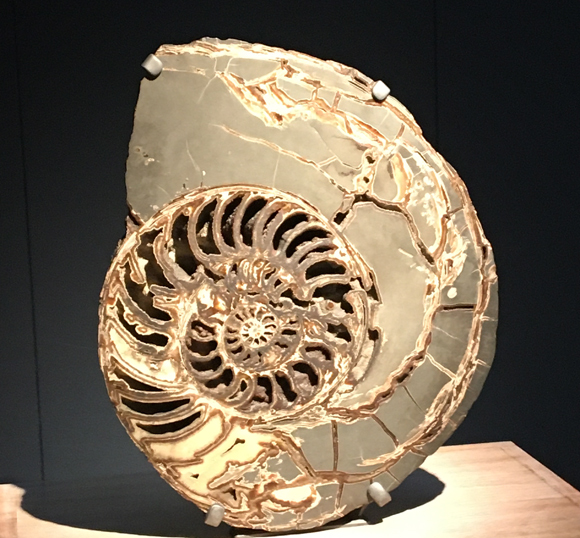
A beautiful ammonite fossil on display.

A stunning fossil of a Jurassic ammonite on display at the London Natural History Museum.

Picture credit: Everything Dinosaur

A section of fossiliferous sedimentary strata high up on the Dolomites of the South Tyrol has yielded a number of beautifully preserved ammonite and other invertebrate fossils that researchers at the Natural History Museum (Vienna) have been able to study in fine detail.  One particular specimen, a bizarre, uncoiled Ammonite, which represents a species unknown to science was subjected to intense examination using computerised tomography.

A three-dimensional image of the creature was built up by the scientists, layer by layer and this gave the team, led by Alexander Luke Eder (Department of Geology and Palaeontology), the chance to create a video depicting how this animal swam.

Fossil Slab

The fossil (slab and counter slab) was found at approximately 2,600 metres above sea-level in the Puez Park.  The ammonite has been named Dissimilites intermedius and it lived in a warm, tropical sea that covered the South Tyrol approximately 128 million years ago.  During the early Tertiary, plate movements in the Earth’s crust forced what was to become southern Europe to collide with the larger  land mass that was to become northern Europe.

As the rocks crumpled and were pushed up due to the immense forces acting upon them, the Alps began to be formed.  Sediment laid down at the bottom of a sea millions of years before, started to be elevated, and today Cretaceous-aged marine sediments can be found high up in the Dolomites mountain range.

 Dissimilites intermedius Material Studied by the Scientists

Unravelling the secrets of an ammonite.

Picture credit: Natural History Museum (Vienna)/CEN/APA

The image above shows one of the slabs of rock with the uncoiled ammonite shell preserved, in the middle are images from the CT scans showing the composite structure of the ammonite.  The specimen which is approximately thirteen centimetres in length, has provided scientists with the chance to study the fossils of this type of bizarrely-shelled cephalopod in great detail.  The computerised tomography enabled the research team to build up a picture of the fossil in a non-destructive or intrusive manner.

The results of the Austrian team’s work have been published in the highly respected scientific publication  – Acta Palaeontologica Polonica.

The X-ray analysis revealed a surprise for the scientists.  This particular ammonite seemed to have been a very spiky customer, armed with a series of three to four millimetre long spikes running almost the entire length of its shell.  The animal would have lived in the last chamber of the shell to be formed, a the front of the shell (body chamber).  The spikes probably served to protect this relatively small ammonite from being eaten.  There were many types of marine reptiles – pliosaurs, ichthyosaurs, and plesiosaurs in the marine environment, most of these animals would have been capable of attacking and eating an ammonite of this size.

Dissimilites intermedius Brought Back to Life by the Austrian Scientists

Spiky ammonite of the Cretaceous.

Picture credit: APA/Natural History Museum (Vienna)/Alexander Luke Eder.

The research team were able to pinpoint how the organism fitted inside its body chamber.  They were then able to speculate how it might have used its ten tentacles (presumed to have possessed ten tentacles, like other ammonites), to propel itself through the water with the aid of a directional water jet produced by a siphon positioned under the head.

As the creature would have only occupied the largest, last segment of the shell (body chamber), the scientists have pictured the smaller, walled-off shell chambers as being above the animal.  This is because ammonites could manage their buoyancy by filling these chambers with gas. The smaller coil sections would therefore have been lighter and would have floated above the animal’s actual body.

The discovery of spikes on the specimen, may provide palaeontologists with a clue as to why so many uncoiled variants of ammonite shells evolved.  Although some types of ammonite were strong swimmers, it is unlikely that they would have been able to swim faster than predatory fish, or even marine reptiles.  With the evolution of Teleost fishes and the abundance of other marine predators, some types of ammonite may have evolved uncoiled shells as this permitted them to evolve more placement areas for spikes.

A coiled up shell has no opportunity to have spikes forming on the inner whorls as they are strongly attached to larger, outer whorls.  An uncoiled shell, permits each whorl to have its own defences.  Since fossil evidence shows coiled ammonites being attacked from behind (bite marks left in fossilised shells), having all round protective spikes makes evolutionary sense.

Using the information obtained from the three-dimensional scans, the Austrians were able to create a computer programme that modelled how this type of ammonite may have propelled itself about. From this, the team developed a short video reconstructing a scene from the Early Cretaceous of Austria showing a group of these floating molluscs at various growth stages, from juveniles to mature adults.

This video along with the fossil specimens of Dissimilites intermedius are on display at the Natural History Museum (Vienna, Austria).

To view a range of genuine ammonite fossils and replicas: Ammonite Replicas and Fossil Replicas.

30 05, 2012

Rare T. bataar Bites Back!

By |2024-04-23T15:02:13+01:00May 30th, 2012|Categories: Dinosaur and Prehistoric Animal News Stories|0 Comments

Auction House to Help Trace the Origins of T. bataar Fossil Skeleton that was Sold

An almost complete, mounted skeleton of the tyrannosaurid Tarbosaurus bataar, otherwise known as Tyrannosaurus bataar that had been probably collected from Mongolia and sold at auction has run into a legal wrangle.  Plans are in place to impose a restraining order on the Tarbosaurus bataar fossil.

Tarbosaurus bataar Fossil

The eight-metre-long skeleton was sold at an auction held in New York by Heritage Auctions on Sunday, May 20th.  The winning bid was approximately £630,000 GBP ($1.05 million USD), the buyer has not been disclosed.

To read more about the sale: Tyrannosaurid Fossil Up for Sale.

When the auction was announced, team members at Everything Dinosaur decided to take action.  Knowing that it had been illegal to export fossils out of China and Mongolia since 1949, it was assumed that this specimen had been smuggled out of the country without the approval of the appropriate authorities.  Everything Dinosaur team members were some of the first people to raise this issue and to sign an online petition that had been organised to try and prevent the sale.

Heritage Auctions

Yesterday, Heritage Auctions, the auction house responsible for the sale, agreed to help the Mongolian Government investigate the ownership and provenance of this Late Cretaceous dinosaur skeleton.

Tarbosaurus (Tarbosaurus bataar, sometimes also referred to as Tyrannosaurus bataar), was an apex predator, measuring in excess of twelve metres in length.  The name means “Alarming Reptile” and it is frequently referred to as the “Asian T. rex“, however, how closely related it was to the North American T. rex remains disputed.

Tarbosaurus was formally named and described in 1955.  The eminent Russian palaeontologist Evgeny Aleksandrovich Maleev noted how similar fossils found approximately ten years earlier were to Tyrannosaurus rex, accordingly he named this new dinosaur Tyrannosaurus bataar.  However, in the mid 1960’s a review of Tyrannosaur skull material and body fossils from Mongolia and China was undertaken and in the light of this new study the name Tarbosaurus bataar was established.

An Illustration of Tarbosaurus

“Alarming Reptile” – mounted skeleton sold at auction leads to legal dispute.

Picture credit: Everything Dinosaur

A Restraining Order

A restraining order had been organised prior to the auction and despite the intercession of the Mongolian President, the auction went ahead ten days ago.  However, a state district judge in Texas has granted the Mongolian Government the opportunity to delay the transfer of ownership to the buyer until the provenance of the fossil material has been determined.

Jim Halperin, co-chairman of Heritage Auctions, commented:

“Heritage will enthusiastically strive to arrive at a mutually agreeable outcome, once the President of Mongolia has had a reasonable opportunity to investigate the circumstances.”

The Mongolian President Elbegdorj Tsakhia released a statement yesterday:

“I commend Heritage Auctions and its consignor for assisting with my investigation into the origin and legal ownership of this Tyrannosaurus bataar skeleton.”

A team of inspectors will examine the fossil, which is being stored at a secret location in New York, next month.  They will attempt to trace how this fossil came to be at auction, Everything Dinosaur has been led to believe that the fossil was put up for sale by a Dorset based (southern England), private collector.  It is likely that this fossil did originate from the Gobi Desert region of Asia.  This desert covers northern China and southern Mongolia, although Heritage Auction officials stated that it had not been determined from which country the fossil actually came from.

Mark Norell of the American Museum of Natural History (New York) and a leading palaeontologist stated:

“Since ninety percent of the Gobi Desert is in Mongolia, it was likely found there.  Either way, Mongolia and China have the same laws regarding the sovereign ownership of dinosaur skeletons and other artefacts.”

Since both Mongolia and China have prohibited the export of fossil material since 1949, it is likely that this specimen was collected illegally and moved out of the country without permission.

The Tyrannosaurid Skeleton at the Centre of the Dispute

Was this specimen collected illegally?

Picture credit: Heritage Auctions

We at Everything Dinosaur hope that this matter is resolved quickly and if any punitive action is taken, let us hope that it acts as a deterrent to help prevent other rare prehistoric animal specimens from being collected illegally.

To view figures and models of tyrannosaurids and other dinosaurs: CollectA Prehistoric Life Figures and Models.

29 05, 2012

Aves – The “Peter Pans” of the Dinosauria

By |2023-03-09T10:45:19+00:00May 29th, 2012|Categories: Dinosaur and Prehistoric Animal News Stories, Palaeontological articles|0 Comments

New Study Suggests Birds are Dinosaurs that Never “Grew Up”

A new research paper, published in the scientific journal “Nature” suggests that modern birds (Neornithines) are essentially dinosaurs; as their skulls resemble the skulls found of juvenile dinosaurs in the fossil record.  Descendants resembling the juveniles of their ancestors is not unknown amongst vertebrates, this process, known as paedomorphosis has been identified as having an involvement in a number of evolutionary transitions amongst animals with back-bones.

Birds are Dinosaurs

Birds, (Aves) are very closely related to the dinosaurs.  Birds are the closest living relatives of the Order known as the Dinosauria and in this new study by Harvard scientists,  the development of large brain size and the huge variety in beaks which has led to such a radiation in bird species has been traced back to paedomorphic tendencies that led to adult birds having similar shaped heads as their reptilian ancestors – theropod dinosaurs.

One of the two fundamental aspects of paedomorphosis is the acceleration of sexual maturity relative to the rest of an organism’s development.  This is termed progenesis and in the Northern Hemisphere spring, right now, thousands of bird species are proving this point by raising young that rapidly grow up.  Some modern birds can reach sexual maturation in under three months, thus our feathered friends are able to retain the features of a juvenile dinosaur into their adulthood.

The Cenozoic may be regarded as the “Age of Mammals” due to the large amount of Mammalian mega-fauna found in eco-systems but there are more species of birds on our planet today than species of mammals, thousands more.  The success of the Aves, it could be argued could be related to their rapid development from a hatchling to a mature bird.  To put it another way, birds grow up so fast that they retain in their adult forms the skull characteristics of the Dinosaurian ancestors – they are akin to the  “Peter Pans” of the archosaurs, as one commentator put it.

The “Peter Pans” of the Archosauria

Bhart-Anjan Bhullar, Fernando Racimo and other colleagues from Harvard University, in conjunction with other scientific institutions including palaeontologists from the American Museum of Natural History (New York), compared three dimensional images of skulls of extant and extinct birds with fossilised skulls of dinosaurs.  The team discovered that compared to their dinosaurian ancestors, the faces of birds became flattened and the brain cavity grew larger.  A larger brain cavity was a pre-requisite for developing a bigger brain enabling birds to exploit a variety of ecological niches.  In short, the skulls of Neornithines resemble those of baby dinosaurs.

Skull Morphology in Birds – Gives Hint of Dinosaurian Ancestry

Dinosaurs the original “Bird Brains”.

Picture credit: Everything Dinosaur

The team used advanced computerised tomography (CT scans) to build up an inventory of archosaur skull shapes and characteristics and compared this data to the scanned skulls of extinct birds from the fossil record along with scans from animals around to day – modern birds and those rather more distant relatives of the Dinosauria, the crocodiles.

Associate Professor of Organismic & Evolutionary Biology, Harvard University Arkhat Abzhanov, one of the research paper’s authors commented:

“We examined skulls from the entire lineage that gave rise to modern birds.  We looked back approximately 250 million years, to the archosaurs, the group which gave rise to crocodiles and alligators as well as modern birds.  Our goal was to look at these skulls to see how they changed, and try to understand what actually happened during the evolution of the bird skull.”

The scientists examined such animals as confuciusornithids (primitive Birds from the Liaoning Formation of China), modern emus, alligators and the basal archosaur from the Early Triassic – Euparkeria; as well as the skull of Scipionyx (Early Cretaceous dinosaur, fossils of which have been found in Italy).

What the team found was intriguing.  Dinosaurs, even those very closely related to Aves, undergo vast morphological changes as they grow and mature, however, the skulls of juvenile and adult birds remain remarkably similar.

Associate Harvard professor, Arkhat went onto add:

“By changing the developmental biology in early species, nature has produced the modern bird – an entirely new creature – and one that, with approximately 10,000 species, is today the most successful group of land vertebrates on the planet.”

Some major evolutionary changes rely on changes to development, because it’s relatively easy to change the pace of an animal’s development, producing adults that may look very different to their ancestors.  For the modern birds, having baby-dinosaur shaped skulls may have contributed to the development of their relatively larger brains, when compared to reptiles of the same body size.  This in turn, may go some way to explaining the success of the bird clade.

For models and figures of theropods including some prehistoric birds: PNSO Age of Dinosaurs Figures and Replicas.

23 05, 2012

Giant Freshwater Turtle Fossil from Colombian Coal Mine on (New Taxon is Described)

By |2024-04-23T15:17:20+01:00May 23rd, 2012|Categories: Dinosaur and Prehistoric Animal News Stories|0 Comments

Giant Palaeogene Turtle – Predator of Crocodiles

Today, is World Turtle Day, a day to that is marked by a number of conservation organisations worldwide to increase our knowledge of, and respect for all things chelonian.  These ancient creatures evolved before the dinosaurs and there are something like 250 species alive today.  Most are threatened and vulnerable to extinction.  One of the aims of World Turtle Day is to raise awareness about these reptiles and to highlight the ways in which mankind and our activity is affecting these creature’s and their chances of survival.  In today’s blog post we discuss the discovery of a giant freshwater turtle fossil from a Columbian coal mine.

Chelonia are Parareptiles

Turtles are classed as Parareptiles, they are not closely related to the dinosaurs, or indeed marine reptiles such as ichthyosaurs and plesiosaurs.  The shell, an armoured covering that protects the body of these creatures is a highly modified ribcage covered by armour plating.  Palaeontologists believe that the first turtles and tortoises evolved around 220 million years ago (Triassic), a time when the dinosaurs themselves were evolving into a myriad of different forms.

The exact ancestry of the Chelonia is disputed, some scientists have postulated that they evolved from a group of Permian reptiles known as the pareiasaurs, these animals also possessed body armour and some pareiasaurs grew into giant forms like the car-sized Scutosaurus.  It had been thought that the largest members of the Chelonia lived during the Cretaceous period, giant marine reptiles like the four-metre-long Archelon, but researchers and field workers exploring a remarkable Palaeogene-aged deposit have uncovered the fossilised remains of giant freshwater turtle – the largest freshwater member of the turtle family discovered so far.

Giant Freshwater Turtle

Scientists from North Carolina State University have been exploring a remarkable sixty-million-year-old, highly fossiliferous deposit in Colombia that has given palaeontologists a remarkable insight into a world recovering from the Cretaceous mass extinction event.  The vertebrates that survived the events that saw the demise of the dinosaurs were able to slowly recover and to diversify.  In a world with few large animals and in a very warm, global climate the reptiles once again began to thrive and the fossil record in a Colombian coal mine has revealed giant crocodiles, huge snakes and now the fossils of a freshwater turtle that was the size of a dining table.

After the Cretaceous extinction event, global temperatures soared and for many millions of years, certainly for the majority of the geological period known as the Palaeogene, these high temperatures led to the development of widespread, tropical rainforests.  It has been estimated that the average global temperatures were around two times as high as they are today.  Rainforests covered most of North and South America, Europe, Africa and Asia.  Reptiles thrived in these conditions and the coal measures in the Colombian mine are providing scientists with evidence of some of the giant forms of reptiles that evolved to fill the ecological niches left by the extinction of the dinosaurs.

Carbonemys cofrinii

The new genus of giant freshwater turtle has been formally named Carbonemys cofrinii.  The name means “coal turtle”.  It belongs to a group of turtles that are still around today, although none of C. cofrinii’s modern counterparts are as big.  Details of this new reptile discovery have just been published in the highly respected scientific publication “The Journal of Systematic Palaeontology”.

An Artist’s Impression of the Crocodile-eating Turtle

PhD student Edwin A. Cadena poses next to the shell of Carbonemys.

Picture credit: North Carolina State

Giant Freshwater Turtle

This giant, freshwater turtle has been classified as member of the Suborder Pleurodira, a group of turtles that pull their necks into their shells side-ways. Until this new discovery, another member of this Suborder, species known as Stupendemys geographicus was believed to be the largest freshwater turtle that ever existed.  In fact, some scientists have estimated that based on the fossil evidence found so far, S. geographicus is larger than the Colombian fossil find.

Carbonemys cofrinii had a skull over ten inches long.  The first fossil evidence of this creature was found at the coal mine site back in 2005, elements of the carapace was found in close proximity to the fossilised bones.  The shell measures 172 centimetres in length, about the size of a family dining table.

All extant turtles and tortoises have a highly adaptable beak.  Although modern forms eat a variety of foods – from plants to jellyfish, the palaeontologists have suggested that the strong beak of Carbonemys cofrinii indicate that this creature was a carnivore – capable of catching fish, crushing shellfish in its beak and even preying on crocodiles that shared its freshwater environment.

Studying the Columbian Deposits

The Colombian deposits have revealed a remarkable Palaeogene ecosystem that was dominated by giant reptiles.  The apex predator may well have been Titanoboa – at over fifty feet in length the largest snake known in the fossil record.  C. cofrinii may have evolved large size and a super strong shell to protect itself from attacks from other giant reptiles such as Titanoboa (Titanoboa cerrejonensis).

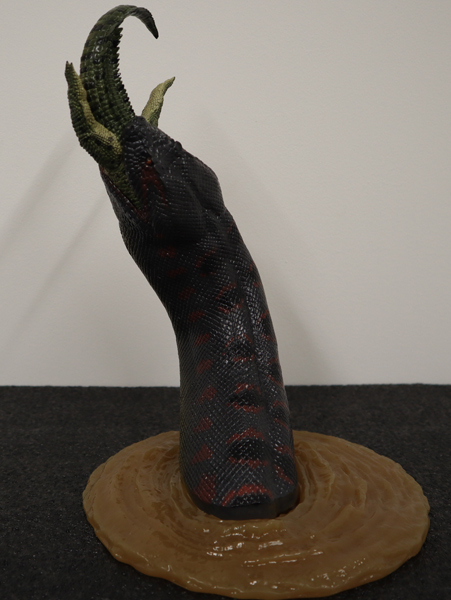
A Replica of the Giant Snake Titanoboa

Rebor Titanoboa Museum Class Maquette Brian Diccus prehistoric animal model.
The assembled Rebor Titanoboa Museum Class Maquette Brian Diccus prehistoric animal model. Picture credit: Everything Dinosaur.

Picture credit: Everything Dinosaur

The image above shows a Rebor Museum Class Titanoboa figure.

To view the Rebor range of models and figures: Rebor Prehistoric Animal Models.

To read more about the discovery of Titanoboa: Titanoboa – Huge Prehistoric Snake.

The fossils were first found by North Carolina PhD student Edwin Cadena who commented:

“We had recovered smaller turtle specimens from the site.  But after spending about four days working on uncovering the shell, I realized that this particular turtle was the biggest anyone had found in this area for this time period – and it gave us the first evidence of gigantism in freshwater turtles.”

Turtles and tortoises co-existed with the dinosaurs for millions of  years, but when the dinosaurs became extinct a whole range of new ecological niches were opened up and some of these niches were filled by the likes of Carbonemys cofrinii.

Scientists have put forward a number of explanations as to why giant reptiles evolved in this part of South America.  Firstly, the environment was warm and wet, ideal for reptiles.  There were few large predators, plenty of food and a relatively stable climate that permitted these giant genera to evolve and thrive.

So far, only one fossil specimen of this huge size has been discovered.  Research Associate at the North Carolina Museum of Natural Sciences and the State’s palaeontologist Dr Dan Ksepka believes that this type of creature, an apex predator would have been relatively rare.  Creatures this size would need a large territory to sustain them, even though their cold-blooded metabolism meant that they would not have needed to consume as much food as a warm-blooded mammal of similar size.

Dr Ksepka, co-author of the paper that describes this discovery, stated:

“It’s like having one big snapping turtle living in the middle of a lake.  That turtle survives because it has eaten all of the major competitors for resources.  We found many bite-marked shells at this site that show crocodilians preyed on side-necked turtles.  None would have bothered an adult Carbonemys, though – in fact smaller crocodiles would have been easy prey for this behemoth.”

The Colombian coal mine may not be a viable source of fossil fuel any more but it is provided scientists with a remarkable insight into life on Earth shortly after the dinosaurs became extinct.

The scientific paper: “New pelomedusoid turtles from the late Palaeocene Cerrejón Formation of Colombia and their implications for phylogeny and body size evolution” by Edwin A. Cadena, Daniel T. Ksepka, Carlos A. Jaramillo and Jonathan I. Bloch published in the Journal of Systematic Palaeontology.

Visit Everything Dinosaur’s award-winning website: Everything Dinosaur.

21 05, 2012

Scientists Announce New Dromaeosaur Discoveries from Utah

By |2023-02-01T13:19:30+00:00May 21st, 2012|Categories: Dinosaur and Prehistoric Animal News Stories|0 Comments

New Lower Cretaceous Theropods Announced

A team of palaeontologists and researchers have announced the discovery of a number new meat-eating dinosaurs that roamed the Early Cretaceous in what was to become Utah’s Arches National Park.  The three new dinosaurs, include a new raptor (dromaeosaur) that has been scientifically described as a basal dromaeosaur, perhaps an ancestor of Utahraptor, the largest dromaeosaur discovered so far.  This new raptor has been formally named Yurgovuchia doellingi.  Scientists have speculated that there may be as many six new species of dinosaur described from this rich fossil bed, which is part of the Cedar Mountain Formation.

State palaeontologist for Utah’s Geological Survey, Jim Kirkland stated:

“All we are finding are new species.  I think there are places where what we are seeing is evolving populations.”

The State of Utah in western North America (United States), is one of the best locations to find Mesozoic-aged vertebrate fossils in the Americas.  The state has already got a number of unique dinosaur genera associated with it.  The three new dromaeosaurid specimens, including the newly named Y. doellingi are associated with the Yellow Cat Member of the Cedar Mountain Formation.  Specifically, Y. doellingi and one other specimen are associated with the earlier strata, known as the Lower Yellow Cat, whilst a beautifully preserved fossilised dromaeosaur tail, which also may represent a new genus or raptor is associated with the Upper Yellow Cat.

Dromaeosaur Dinosaur Discoveries

The fossil site, described as “one of the richest in the entire United States”, is helping palaeontologists to piece together the diverse dinosaur fauna that inhabited this part of the world during the Early Cretaceous.

A Scale Drawing of Yurgovuchia doellingi showing Fossil Bones Found

Lion-sized dromaeosaur from the Early Cretaceous.

Picture credit: PLoS One/Senter et al.

The new dinosaur is believed to be an ancestral relative of the much larger Utahraptor, based on similarities in pieces of fossilized vertebrae recovered.  In both species, the bundles of rods that jut out from the vertebrae to form the raptor’s tail are shortened, the State geologist commented.  Although only fragmentary remains have been found so far, the bones are sufficiently different from other dromaeosaurs to be described as a new genus.  The cat in the drawing gives a scale for Y. doellingi.  This dinosaur was about the size of a mountain lion, and it would have been a formidable predator, especially if it was a pack hunter.

The Ute Indian Word for Coyote

The new dinosaur’s name was based on the Ute Indian word for coyote, “yurgovuch,” and for the location where it was found, itself named after Utah palaeontologist Helmut Doelling, whose geological mapping of the Arches region in this part of Utah led to the discovery of this extensive bone bed.

A Model of the Largest Dromaeosaur Known to Science – Utahraptor

Speedy, dinosaur hunters.

Picture credit: Everything Dinosaur

To view models of dinosaurs including “raptor” figures: CollectA Prehistoric Life Models and Figures.

Dromaeosaurs were light, agile predators with a raised second toe on each foot that had a large , sickle-like claw, described as a “killing claw”.

Field workers first came across the fossils that make up the Yurgovuchia doellingi specimen back in 2005 when exploring the fossil bone bed.

A scientific paper which describes this new Utah discovery, a collaboration between Utah Geological Survey palaeontologists and dromaeosaurid expert Phil Senter of the University of North Carolina, was published this week in the scientific journal known as the Public Library of Science (PLoS One).

The two other sets of fossilised bones attributed to dromaeosaurs are most probably from new species as well.  One of the fossils is that of a broken but distinctive skeleton of a raptor’s tail.  Scientists used ultra violet light to scan the fossil matrix in the laboratory so that the bone material could be picked out more clearly.

The Fossilised Dinosaur Tail (Fossil Material and UV Scan)

UV light highlights dinosaur tail fossil.

Picture credit: PLoS One/Senter et al.

Both the fossilised tail and the other dromaeosaur material needs more study and the Utah Geological Survey plans additional excavation work.

Palaeontologists and field workers had also identified the partial remains of a sauropod dinosaur (long-necked dinosaur) at the same location.  This too, may represent a new species, providing scientists with an intriguing insight into the fauna of the Early Cretaceous.

The scientific paper: “New Dromaeosaurids (Dinosauria: Theropoda) from the Lower Cretaceous of Utah, and the Evolution of the Dromaeosaurid Tail” by Phil Senter, James I. Kirkland, Donald D. De Blieux, Scott Madsen and Natalie Toth published in PLoS One.

21 05, 2012

Rare Tyrannosaurid Skeleton Sold at Auction Despite Controversy

By |2024-04-23T14:13:53+01:00May 21st, 2012|Categories: Dinosaur and Prehistoric Animal News Stories, Dinosaur Fans, Everything Dinosaur News and Updates|0 Comments

Tarbosaurus bataar sold for £630,000 Despite Restraining Order

The tyrannosaurid skeleton, representing a animal known as Tarbosaurus bataar (also known as Tyrannosaurus bataar) has been sold at an auction in New York despite the best efforts of Mongolian officials to prevent the sale.  The mounted skeleton, representing a nearly complete, sub-adult specimen was sold for the sum of $1,052,500 USD, a little more than the pre-auction estimate.  The identity of the purchaser is not being publicised but it is believed to be a private individual.

The sale of the fossil material has attracted a great deal of controversy, as the specimen is believed to have been collected in the Gobi desert (Mongolia), a part of the world where the export and sale of such fossil material has been illegal for fifty years or so.  A restraining order was organised through a Texas court, but despite protests from the judge concerned the auction went ahead.

Tyrannosaurid Skeleton

The auction took place on Sunday, despite the protests from the Mongolian president.  Elbegdorj Tsakhia stated that the skeleton, unearthed in the Gobi Desert, came from Mongolia and that exporting fossils found in the country is illegal.  Team members at Everything Dinosaur signed a petition to try to prevent the sale, but it looks like the specimen sale will now go ahead.  Legal advisers for the auction house – Heritage Auctions, based in New York, stated that the sale did not break any U.S. laws, but the lawyers will not confirm the sale until it has been approved by a U.S. court and the matter regarding the restraining order is dealt with.

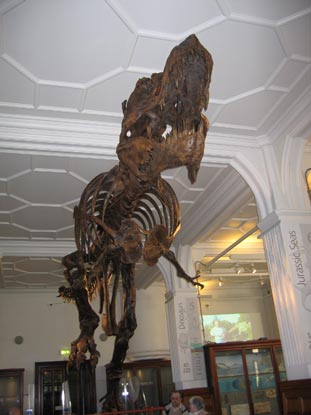
A Typical Tyrannosaur Skeleton

Controversial tyrannosaur auction.

Picture credit: Everything Dinosaur

A spokesperson from Everything Dinosaur commented:

“We always feel a sense of loss when we see such fossil material auctioned off.  Most public bodies are not able to compete with wealthy, private individuals and the sale of such rare fossils deprives the public from viewing these specimens as well as preventing scientists from being able to study them in most cases.”

The sale of this particular meat-eating dinosaur is controversial because doubts have been raised as to how this specimen could have left Mongolia when such activities have been banned for the best part of half a century.   The auction house will make about 15% commission on the sale, and the seller will of course pocket the balance remaining. With a sale value in excess of £630,000, there are large sums of money involved.

For models and figures of tyrannosaurids and other prehistoric animals: Dinosaur and Prehistoric Animal Models.

18 05, 2012

Rare Tyrannosaurid Up for Auction

By |2024-04-23T14:13:21+01:00May 18th, 2012|Categories: Dinosaur and Prehistoric Animal News Stories|3 Comments

Fossil Skeleton of Cretaceous Predator Likely to Fetch 1 Million USD at Auction

The trend for important scientific specimens to go under the hammer continues with the auction of a nearly complete tyrannosaur (T. bataar) in New York.   A Tarbosaurus dinosaur skeleton will be sold to the highest bidder.  The eight-metre-long, fully mounted specimen of this Late Cretaceous terror is likely to sell for more than one million USD at auction.  This may be a far cry from the huge sums paid in the mid 1990s prior to the global downturn, but it still puts such a specimen beyond the reach of most public institutions with their restricted budgets.

Tarbosaurus Dinosaur Skeleton

The specimen represents a seventy-five percent complete skeleton of a Tarbosaurus (T. bataar), closely related to the iconic Tyrannosaurus rex.  Whilst T. rex stomped across western North America, Tarbosaurus was the apex predator in eastern Asia – Mongolia.

The first fossils of this meat-eating dinosaur, consisting of skull material and some back-bones were unearthed by a joint Soviet/Mongolian scientific expedition to the Gobi desert in 1946, but it was not until 1955 that this dinosaur was formally named and described.  The eminent Russian palaeontologist Evgeny Aleksandrovich Maleev noted how similar these fossils were to Tyrannosaurus rex from North America and accordingly he named this new dinosaur Tyrannosaurus bataar.  However, in the mid 1960s a review of tyrannosaur skull material and body fossils from Mongolia and China was undertaken and in the light of this new study the name Tarbosaurus bataar was established.  The exact taxonomic relationship between these two prehistoric animals is hotly debated, but team members at Everything Dinosaur note that in official press releases and auction notices the lot is described as Tyrannosaurus bataar.  We suspect this is a bid to raise the potential price for this particular fossil specimen.  After all, T. rex is likely to sell much better than the lesser known Tarbosaurus bataar.

The Auction Date

The auction is scheduled for Sunday May 20th and it will be held at the New York auction company, Heritage Auctions.

The Mounted Tarbosaurus Skeleton under the Hammer

Dinosaur under the hammer.

Picture credit: Heritage Auctions

There have been a number of high profile dinosaur and other prehistoric animal auctions held over the last few years.  The price of dinosaur fossils have rocketed as wealthy individuals, even some film stars have become involved, keen to purchase their very own piece of palaeontology.  However, not all the auction lots get snapped up faster than a T. rex biting into a Triceratops.

Tyrannosaurus rex Under the Hammer

Back in 2009, a large, nearly complete of an adult Tyrannosaurus rex went under the hammer.  The mounted skeleton, nicknamed “Samson” at first could not find a buyer, but eventually the story ended happily when this particular predator was purchased by a public body and the skeleton is now on permanent public display.

To read more about “Samson”: T. rex Specimen up for Auction.

The Tarbosaurus, once the property of a private collector based in the UK, is certainly a fine specimen and it has been mounted in what we at Everything Dinosaur call an “active mount”, with the carnivore posed in a realistic running position.

David Herskowitz, Heritage Auction’s Director of Natural History wrote in a statement:

“This beautiful Tyrannosaurus skeleton is one of the most complete, most spectacular specimens that we’ve ever seen.  They’re incredibly rare to come across in any condition, let alone one as pristine as this.”

The exhibit measures nearly 8 metres long and represents a sub-adult specimen.  Palaeontologists believe that this Late Cretaceous carnivore could have reached lengths in excess of 12 metres.  The specimen is believed to have come from the Gobi desert region, although the exact location and provenance of the fossil material is not known.  The British collector began assembling the fossils, before shipping them to the United States for final preparation and mounting.

The auction house has expressed a wish to have the specimen retained for scientific study and public display.  However, with a sale such as this, it is just as likely that the exhibit will end up in the collection of a private individual with no desire to allow public or scientific access.

The Auction House Director commented:

“We’re hoping it’s going to be a museum to give this specimen a proper home.”

We shall have to wait and see, but with an auction price likely to be in excess of $1 million USD, it is very probable  that this fossil collection will prove to be beyond the budget of most public institutions.

This article represents a personal landmark for Everything Dinosaur. It is the 1800th article published on our web log, roll on number 2,000.

To view replicas of tyrannosaurids and other prehistoric animals: PNSO Age of Dinosaurs Figures and Models.

16 05, 2012

The Amazing Westbury Pliosaur – 8-metre Long Beast with Arthritis

By |2024-04-22T14:10:57+01:00May 16th, 2012|Categories: Dinosaur and Prehistoric Animal News Stories, Dinosaur Fans|0 Comments

Evidence of Arthritis in Pliosaur’s Lower Jaw

A team of researchers studying the fossilised jawbones of a huge Jurassic marine predator known as the Westbury pliosaur, have found evidence that the monster (believed to be an elderly female), suffered from arthritis in its lower jaw.

A new study by scientists based at the University of Bristol (England) and published in the scientific journal “Palaeontology” has found evidence of a degenerative condition similar to human arthritis in the jaw of a pliosaur, a huge predator that lived 150 million years ago.

Westbury Pliosaur

The two-metre lower jaw, with some of its twenty-centimetre-long  teeth still in-situ, shows signs of an arthritic condition, such pathology is extremely rare in fossilised marine reptiles from the mid-Mesozoic.   The pliosaur remains, were found in Westbury, Wiltshire and is now part of the vertebrate fossil collection kept at the Bristol City Museum and Art Gallery.

Pliosaurs, otherwise known as short-necked plesiosaurs; are believed to have evolved from the Triassic nothosaurs.  These marine reptiles had long, narrow jaws, two pairs of broad flippers and some of these creatures evolved into the largest known predators in the fossil record.  Lengths in excess of fifteen metres have been suggested for some genera.  The Westbury monster was more than eight metres long and was top of the food chain in the warm, shallow tropical sea that this leviathan patrolled.  However, as this animal grew older it suffered from a painful lower jaw showing signs of deterioration that is similar to arthritis in our own species.

A Drawing of a Marine Reptile – Liopleurodon ferox?

Apex predator of the Jurassic.

Picture credit: Everything Dinosaur

To view models and replicas of pliosaurs and other prehistoric creatures: CollectA Deluxe Prehistoric Life Models.

University of Bristol scientist, Dr Judyth Sassoon, became fascinated by the specimen when she saw it in the museum’s collections and studied it for her MSc research project.  During her studies, she noticed that it had the signs of a degenerative condition similar to human arthritis, that had eroded its left jaw joint, displacing the lower jaw to one side.   The condition may have been painful, but evidently this marine reptile lived with a crooked jaw for many years, as indicated by marks on the lower jaw bone where the teeth from the upper jaw impacted with the lower jaw as the creature bit down.  Modern day crocodiles and alligators can suffer from similar conditions, their elongated jaws can also be damaged as these creatures hunt, however these reptiles can survive for many years so long as they are able to catch prey.

An Old Female Pliosaur

There are several signs on the skeleton to suggest that the animal could have been an old female who had developed the condition as part of the aging process.  The pliosaur’s large size, and the fused skull bones, suggest maturity.  It is identified, very tentatively, as possibly female because its skull crest is quite low, some scientists believe that male pliosaurs had larger, more pronounced crests on their heads, but spotting the girl pliosaurs amongst the boy pliosaurs is still a topic that is hotly debated amongst palaeontologists.

Commenting on the pathology, Dr Sassoon stated:

“In the same way that aging humans develop arthritic hips, this old lady developed an arthritic jaw, and survived with her disability for some time.  But an unhealed fracture on the jaw indicates that at some time the jaw weakened and eventually broke.  With a broken jaw, the pliosaur would not have been able to feed and that final accident probably led to her demise.”

Professor Mike Benton, a collaborator on the project, added:

“You can see these kinds of deformities in living animals, such as crocodiles or sperm whales and these animals can survive for years as long as they are still able to feed.  But it must be painful.  Remember that the fictional whale, Moby Dick from Herman Melville’s novel, was supposed to have had a crooked jaw!”

The Westbury Pliosaur (Lower Jaw with teeth fragments)

Painful pliosaur jaws.

Picture credit: Bristol University

The picture above shows the pliosaur jaws, with Dr Judyth Sassoon.  The jawbone deformity can be seen on the left lower jaw in the area opposite the Doctor’s wrist.

A spokesperson from Everything Dinosaur commented that they had seen similar bone deformities in the fossils of many dinosaurs, for example the toe bones of a hadrosaur from Upper Cretaceous deposits of Alberta (Canada) that showed signs of a painful joint condition, however, they were not aware of any other example of this sort of pathology being found in the fossils of a Jurassic marine reptile.

The spokesperson went onto speculate how the condition may have arisen in the pliosaur in the first place:

“Pliosaurs are believed to have been ambush predators, using their huge paddles to propel themselves at their intended victims at great speed, before grasping their unfortunate prey with their immensely strong jaws.  Enormous forces would have been involved and it is possible that the lower jaw may have been damaged at some time in the creature’s life which enabled the arthritic condition to take hold.”

The pliosaur from Westbury is an amazing example of how the study of disease (palaeopathologies) in fossil animals can help us to reconstruct an extinct animal’s life history and behaviour and to show that even a Jurassic killer could succumb to the diseases of old age.

Everything Dinosaur would like to thank Bristol University for the information contained in this article.

Go to Top