All about dinosaurs, fossils and prehistoric animals by Everything Dinosaur team members.

Fossil finds, new dinosaur discoveries, news and views from the world of palaeontology and other Earth sciences.

30 06, 2012

Evidence of Dinosaurs Being Warm-Blooded

By |2023-02-02T07:40:48+00:00June 30th, 2012|Categories: Dinosaur and Prehistoric Animal News Stories|0 Comments

Endothermic Dinosaurs with a High Metabolic Rate (Except Sauropods)

Scientists have debated whether the Dinosauria were warm-blooded like mammals and birds (endothermic) or cold-blooded (ectothermic) like extant reptiles for over one hundred and thirty years.  A number of papers have been published recently which have added to the immense amount of data compiled as palaeontologists strive to determine just how the dinosaurs dominated life on Earth for much of the Mesozoic.  A team of international scientists have completed a study into the histology (growth) of the thigh bones of modern mammals and their results suggest that some of the dinosaurs may well have been endothermic.

The Dinosauria

The idea of dinosaurs being slow, ponderous, dim-witted beasts has largely been refuted.  The debate over cold-bloodedness versus warm-bloodedness, started by the likes of Huxley and Seeley in the 19th Century was ignited once again with gusto by the American palaeontologist John Ostrom who published a description of the theropod Deinonychus in 1969.  Ostrom depicted Deinonychus as an agile, fast-running predator, a new interpretation of the Dinosaurs as animals which were as active as birds and mammals.

Deinonychus – Surely Not Cold-Blooded?
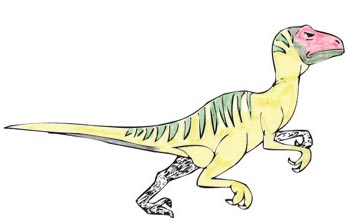
Fast-running, active, warm-blooded dinosaurs.

Picture credit: Everything Dinosaur

Adding to this debate, a team of scientists from Spain and Norway analysed the thigh bones (femurs) of over one hundred mammals from various habitats in a bid to see if the histology (growth) of these bones provided any indication as to whether the dinosaurs may have been warm-blooded just like the mammals.  Large ruminants were chosen for the study and the research team examined the internal structure of animal’s bones from northern latitudes as well as from temperate climatic zones and the tropics.  Ruminants such as the Muntjac deer, a native of South East Asia and reindeer from northern Svalbard (the most northerly part of Norwegian territory) were included in the extensive study.

The researchers were looking for patterns in the internal structure of the bone that indicated rapid growth as opposed to no growth or very slow growth.  Just like growth rings in trees, the internal structure of a bone can indicate the rate of growth of the bone and consequently the animal to which the bone belonged.  The scientists examined the bones looking for “lines of arrested growth”, otherwise known by the acronym of LAGs.

LAGs are seen in bone sections as dark rings, similar to those seen in tree trunks by dendrochronologists.  The rings are formed, both in the studied mammals and in trees, during the unfavourable seasons (winter or dry season) when the growth of the organism is arrested as a result of a lack of resources.  The presence of LAGs in bones was, until now, considered to be the clearest indicator of ectothermy (cold-bloodedness) since the seasonal arrest of growth was related to the animal’s inability to maintain a more or less constant body temperature (endothermy) during the season of scarce resources.

The Internal Structure of a Mammal’s Bone Showing LAGs

Dark Bands indicate LAGs.

Picture credit: Meike Köhler

The picture above is a slide showing a cross-section of Alpine Red Deer bone.  The two dark bands represent lines of arrested growth.  These patterns in the bones of mammals are similar to those found in many fossilised bones of dinosaurs.  This suggests that if warm-blooded mammals have these bone patterns and many dinosaurs show the same histology, then the dinosaurs may have been endothermic too.

One of the authors of the paper, Meike Köhler (Catalan Institute of Palaeontology, Spain) stated:

“The argument we are giving in our paper, rather in favour of endothermy in dinosaurs, is that between the growth and rest lines, there’s always a big region of highly vascularised (infiltrated with blood vessels) tissue that indicates very high growth rates.  This is typical in dinosaurs and very different from reptiles, which have slow growth between the rest lines.”

LAGs have been found in the bones of extant reptiles and amphibians and it had been assumed that this was evidence of being cold-blooded, organisms not able to control the body temperatures internally but relying on external factors such as the sun to warm them up and keep them active.  Animals that are ectothermic are  more likely to be less able to cope with harsh, cold climates.  However, dinosaur fossil discoveries in such extreme environments as Alaska and near to the South Pole, which although much warmer at the time of the Dinosauria then they are today, would still have been very cold, does suggest that at least some types of dinosaurs were endothermic.

The research team, whose work has been published in the journal “Nature” suggest that such LAGs have been found in many different types of dinosaur.  The only ones without such evidence of warm-bloodedness are the super-sized Sauropoda, animals such as Diplodocus and Jobaria.

In June of last year, Everything Dinosaur reported on research carried out by a team of American scientists who after a study of the teeth of sauropods, suggested that these animals too may well have had a high, internal body temperature, that they were able to regulate themselves without the assistance of external heat sources.  This particular research may not be definitive proof that animals such as Camarasaurus (a North American sauropod), were endothermic as the sheer bulk of these animals with their high volume to skin surface area ratios may have enabled them to maintain a high body temperature.

Contrasting her team’s work with the American study, Meike stated that the sauropods  might have been big enough for their own body mass to generate heat, what the researchers call a “gigantotherm.”

To read more about the American study: Warm-blooded Sauropods?

Researchers don’t know what their growth lines would have looked like, since no animals alive today are gigantotherms. As with most matters relating to sauropod physiology and anatomy, there are no living animals resembling anything like these huge animals alive today, so direct comparisons with extant organisms is very difficult.

The Spanish and Norwegian researchers did not originally set out to provide evidence for support of endothermy in the Dinosauria, this was one of the first times such a systematic study of large mammals had been carried out and the link with the dinosaurs was not the team’s first scientific objective.  Their research is helping scientists to understand how large mammals can cope with extreme climate conditions and how climate change may affect large animal populations.

For examples of very cuddly soft toy dinosaurs: Prehistoric Plush – Soft Toy Dinosaurs.

Dr Köhler went onto add:

“These lines of arrested growth have been used a lot in dinosaurs, but nobody has ever had a really deep look at mammals.”

The debate over whether or not dinosaurs were warm-blooded or not is set to continue.  There is certainly substantial evidence to suggest that dinosaurs were indeed very active and most likely warm-blooded, but animals with high metabolic rates need strong lungs to provide muscles with oxygen to fuel muscles, with no dinosaurs around today understanding their physiology becomes much more difficult.

For another article highlighting this debate: “Clumped Isotopes” provide evidence of Endothermy in the Dinosauria.
27 06, 2012

Giant “Toothed” Birds Once Soared over Australia According to New Study

By |2024-04-23T14:30:09+01:00June 27th, 2012|Categories: Dinosaur and Prehistoric Animal News Stories|0 Comments

Melbourne Fossil Discovery Hints at Rich and Diverse Ecosystem in Australia’s Past

Museum Victoria palaeontologist Dr Erich Fitzgerald has discovered the first Australian fossils of bizarre bony-toothed birds – extinct giants with five metre wingspans.  The five-million-year-old bone of Pelagornis is a new element in an extraordinary fossil fauna uncovered in Melbourne.

Giant “Toothed” Birds

Published today in the Journal of Vertebrate Palaeontology, this important discovery is the first evidence that these gigantic prehistoric birds once soared the skies of coastal Australia.  The Pelagornithidae family, commonly known as bony-toothed birds due to their tooth-like projections on their beak, had wingspans of over five metres.  The species discovered in Australia, Pelagornis, was one of the largest flying animals to exist on Earth after the extinction of pterosaurs 66 million years ago.

Senior Curator of Vertebrate Palaeontology at the Museum Victoria, Dr Erich Fitzgerald stated:

“Bony-toothed birds are enigmatic extinct seabirds with a long history spanning over 50 million years.  They were previously known from all continents except Australia.  The fact that they existed in Australia not that long ago changes our understanding of the evolution of seabirds in this part of the world.”

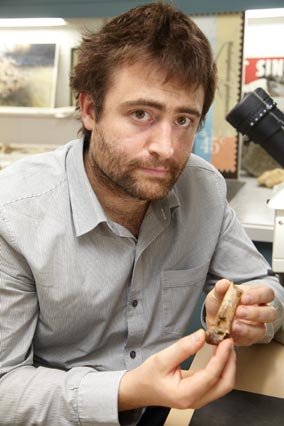
Dr Fitzgerald and the Fossilised Pelagornis Bone

Five-million-year-old giant bird fossil.

Picture credit: Museum Victoria / Photographer: Jon Augier

The fossil leg bone found in Beaumaris Bay (South Australia) not only provides evidence that these bony-toothed birds were globally distributed, but also offers new insight into the diverse marine life in our seas at the time.  The tooth-like structures in the jaws are not true teeth, but serrations of the beak itself that permitted these birds to catch and hold fish and cephalopods such as squid in their beaks.

Dr Fitzgerald went onto explain:

“We knew next to nothing about the evolution of seabirds in Australia.  This finding shows us that there has been a significant change in seabird diversity between five million years ago and now.  Pelagornis is just one of Victoria’s long-lost marine megafauna, which included bus-sized sharks, giant penguins, killer sperm whales and dugongs.  Life was larger back then!”

According to the co-author on the paper, Mr Travis Park, Honours student at Museum Victoria and Deakin University, “the extinction of these diverse large sea creatures was perhaps linked to long-term changes in their environment.”

Pliocene Terror

Pliocene Terror – Giant “Toothed” Sea Birds

Pelagornis in flight.

Picture credit: Museum Victoria / Artist: Peter Trusler

Travis added:

“The current coastal seas off southeast Australia are less nutrient-rich than previously, and therefore no longer support as many large marine animals.”

Although this fossil discovery shows how much there is still to learn about the evolution and extinction, of these strange giant birds, this research gives us a glimpse into a time when southern Australian sea life was more spectacular than at present.

To read about the discovery of more giant Pelagornis fossils from the Southern Hemisphere (Chile) click the link below:

More Pelagornis fossils discovered: Bird with a “Toothy Grin”.

A Close up of the Vicious “Toothed Beak” of Pelagornis

A very toothy beak.

Picture credit: Museum Victoria / Artist: Peter Trusler

Scale bar in picture = 10 cm

Everything Dinosaur is grateful to Museums Victoria for their help in compiling this article.

Visit Everything Dinosaur’s website to purchase models of prehistoric animals: Prehistoric Animal Figures and Scale Models of Dinosaurs.

25 06, 2012

Dinosaur Tracks Provide Clues to Alaska’s Rich Cretaceous Ecosystem

By |2023-02-02T07:23:17+00:00June 25th, 2012|Categories: Dinosaur and Prehistoric Animal News Stories|0 Comments

Trackways Provide Palaeontologists with an Insight into Alaskan Dinosaurs

The remote Wrangell mountain range of eastern Alaska is proving to be a happy hunting ground for palaeontologists as they strive to find out about the dinosaurs that once roamed these high latitudes.   During the Late Cretaceous, this part of Alaska, which is now an area of rugged mountains built up as a result of extensive vulcanism, was much warmer than it is today, although it was much nearer to the North Pole.  The habitat consisted of dense conifer forests with an understorey of hardy flowering plants and ferns.  These forests were home to a number of dinosaur species as well as many seasonal migrants that came north to graze on the vegetation during the long summer days.  With nearly four months of near total darkness and temperatures dropping to well below zero degrees Celsius, scientists had thought that the onset of winter would have led to conditions that the dinosaurs, as reptiles, could not tolerate.  However, thanks to the discovery of extensive dinosaur tracks, palaeontologists are beginning to build up a picture of a vibrant ecosystem which featured both indigenous and dinosaur seasonal migrants.

Dinosaur Tracks

Tony Fiorillo, a dinosaur expert with the Museum of Nature and Science (Dallas, Texas), has visited these mountains on numerous occasions and during these field trips he has been able to find a number of exciting vertebrate fossil specimens.  His latest catalogued discoveries include fossilised footprints of two different types of dinosaur, the fossils being discovered near the small town of Chisana in the Wrangell mountain range.

Whilst exploring a fossiliferous stream bed in the St. Elias National Park, with Thomas Adams of San Antonio College, Yoshitsugu Kobayashi of Hokkaido University and Linda Stromquist of the National Park Service back in 2008, Mr Fiorillo found a plate-sized rock that contained the clearly visible imprint of the middle toe of a large three-toed dinosaur.  By squinting at the rock and holding it at different angles, he was able to make out the rest of the footprint.  Nearby he found a second dinosaur track, this time the footprint of a much smaller, lighter animal.  The tracks have been identified as belonging to a duck-billed dinosaur, otherwise known as a hadrosaur.  The smaller track would have have been made by a theropod (likely to be meat-eating dinosaur or possibly an ornithomimid).

These prints are the first evidence of dinosaur tracks to have been found in this part of the Wrangell Mountains.

Pictures and Line Drawings of the Dinosaur Prints

Seventy-million-year-old dinosaur footprints.

Picture credit: Tony Fiorillo

Hadrosaur Tracks

The hadrosaur tracks are similar to those discovered in other parts of Alaska.  Palaeontologists have postulated that large herds of these plant-eating dinosaurs migrated northwards each year to take advantage of the lush vegetation and the almost 24-hours of daylight in the summer months, permitting rapid plant growth.

Following the herds would have been predatory dinosaurs, such as tyrannosaurs.  The smaller track-way may represent that of an indigenous carnivore, an animal that lived in the Alaskan region all year round but relied on the bounty of scavenging the kills of bigger dinosaurs to see it through the harder winter months.

Mr Fiorillo, described the smaller dinosaur:

“This little guy ran around on two legs, might have been six feet from snout to tail and had a bunch of little pointy teeth and sharp claws.  He was eating meat, but there was a lot of this ecosystem we didn’t pick up (fossils that would indicate what the dinosaur as tall as a small child was eating).”

Palaeontologists know that troodontids lived in this part of the world during the Late Cretaceous, these small, light predators grew to lengths in excess of four metres and weighed perhaps as much as 100 kilogrammes, but the tracks are not representative of a troodontid.  Troodontids run on only two toes and these prints definitely show a three-toed animal walking on all of its toes.

Mr. Fiorillo and his co-dinosaur hunters are looking forward to returning to the location in future, so they can find more evidence of the region’s Late Cretaceous inhabitants.

For models and scale replicas of theropod dinosaurs and hadrosaurs: Theropod and Hadrosaur Models (CollectA Deluxe Figures).

23 06, 2012

Seizing a Tyrannosaur – U.S. Authorities Seize Tarbosaurus Fossil

By |2023-02-02T06:52:10+00:00June 23rd, 2012|Categories: Dinosaur and Prehistoric Animal News Stories|2 Comments

U.S. Government Steps In to Seize Tyrannosaur Fossil in New York

As reported by Everything Dinosaur in previous blog posts, U.S. customs officials have seized the Tarbosaurus fossil that had been controversially sold at auction last month.  Yesterday, representatives of the U.S. government seized the fossils of the tyrannosaur, removing the crates in which they were stored to a secret location.  This is probably the first step in what will be a fairly drawn out process that will end with the fossil material being returned to Mongolia, where the fossils originated from.

Tarbosaurus Fossil

Palaeontologists having examined the Tarbosaurus bataar fossils have declared that the specimen was probably collected illegally between the years 1995 and 2005 and then smuggled out of Mongolia.  The eight-metre-long, mounted specimen was sold at auction last month for a sum over one million USD.

The seizure was ordered by a federal judge in Manhattan earlier this week, and on Friday wooden crates holding pieces of the fossil were loaded onto a truck at a Queens storage centre and driven away to an undisclosed location where the remains of this Late Cretaceous predator will be held pending further developments.

In a written statement, the President of Mongolia, Elbegdorj Tsakhia, who had personally intervened to try to prevent the auction back on May 20th commented:

“We are one step closer to bringing this rare tyrannosaur skeleton back home to the people of Mongolia.”

The fossil had been stored at the Cadogan Tate Fine Art gallery, photographs of the removal by U.S. officials were taken by Houston lawyer, Robert Painter, who had been acting on behalf of the Mongolian government in this case.

In a written statement, those responsible for challenging the original auction sale commented:

“Today we send a message to looters all over the world, we will not turn a blind eye to the market place of looted fossils.”

Bolortsetseg Minjin, Director of the Institute for the Study of Mongolian Dinosaurs, took pictures of the removal of the crates as well, saying:

“It’s a very exciting event.  It’s just unbelievable.  I never expected it would be this fast.”

Illegal Removal from Mongolia

Although team members at Everything Dinosaur, signed a petition to prevent the actual auction, the sale itself is not at the centre of this dispute.  It has been illegal to remove fossils from Mongolia for more than fifty years and the arguments concerned whether the fossil had been smuggled out of Mongolia.  The United States had requested the seizure in a lawsuit, stating that the relics had been brought into the USA with documents that disguised the potentially valuable dinosaur skeleton and misrepresented what was actually being imported.

Eric Prokopi, 37, of Gainesville, Florida, the person responsible for bringing the fossils into the States, defended his handling of the skeleton in a written statement on Thursday, saying that he was not an international smuggler and that he had worked since bringing the bones into the country in March 2010 to turn chunks of rocks and broken bones “into an impressive skeleton”.

Mr Prokopi said in a statement:

“I can wholeheartedly say the import documents are not fraudulent, a truth I am confident will be brought to light in the coming weeks.”

When asked to explain the discrepancy between the stated value on the import documentation when compared to the auction sale price, Mr Prokopi added:

“The value was declared much lower than the auction value because, quite simply, it was loose, mostly broken bones and rocks with embedded bones.  It was not what you see today, a virtually complete, mounted skeleton.”

The bones were valued on the importation documents at only $15,000 USD, but the skeleton Prokopi prepared and put together that was sold at the New York auction last month fetched $1.052 million USD.  The sale is contingent on the outcome of  litigation involving the dinosaur fossil material.

Although the buyer has not been officially disclosed, Painter said he had been informed that a New York based private gallery owner had made the winning bid at the auction.

We at Everything Dinosaur, hope that this situation is soon resolved.  With luck, the fossils will be returned to Mongolia where they can be studied by scientists from the Institute for the Study of Mongolian Dinosaurs, alongside other Tarbosaurus material.  Once a more formal study has been made, it might be possible to put the fossils of this Late Cretaceous predator on display so that the people of  Mongolia can view an example of their very own tyrannosaur.

For models and replicas of Tarbosaurus and other tyrannosaurids: Tyrannosaurs and Dinosaur Models (PNSO).

22 06, 2012

Dairy Farmers from Seven Thousand Years Ago

By |2023-03-09T10:21:24+00:00June 22nd, 2012|Categories: Dinosaur and Prehistoric Animal News Stories|0 Comments

Evidence of Dairy Farmers from Prehistoric Libya

A team of international researchers have published a paper in the scientific journal “Nature” detailing the evidence suggesting that humans were domesticating cattle and using their milk as early as seven thousand years ago.  The scientists, led by researchers from the University of Bristol (United Kingdom), analysed fatty acids that had been extracted from fragments of unglazed pottery from an archaeological dig site in Libya.  The study showed that dairy fats were processed in the containers.

Prehistoric Libya

This research is strong evidence that dairying practices were being carried out by Neolithic people living in the Saharan area of Africa as early as the fifth millennium B.C.  Ten thousand years ago, the Sahara Desert area was a lush paradise with abundant game.  Early hunter-gatherer peoples living in the area had a semi-sedentary lifestyle, making pottery, hunting wild animals and collecting wild plants such as cereals.  As the area became more arid, in the period of time between 7,000 and 5,000 years ago the inhabitants of the region adopted a more nomadic way of life, as indicated by the discovery of many cattle bones in cave deposits and by sites of Neolithic camps.

Domesticated animals were clearly significant to these people: the engraved and painted rock art found widely across the region includes many vivid representations of animals, particularly cattle.  However, no direct proof that these cattle were milked existed – until this new research.

Researchers at the Organic Geochemistry Unit in Bristol’s School of Chemistry, with colleagues at Sapienza, University of Rome, (Italy) studied unglazed pottery dating from around 7,000 years ago, found at the Takarkori rock shelter in the Tadrart Acacus Mountains, Libya.

Using lipid biomarker and stable carbon isotope analysis, they examined preserved fatty acids held within the fabric of the pottery and found that half of the vessels had been used for processing dairy fats.  This confirms for the first time the early presence of domesticated cattle in the region and the importance of milk to its prehistoric pastoral people.

Ancient Dairy Farmers

One of the authors of the paper, PhD student at Bristol’s School of Chemistry, Julie Dunne commented:

“We already know how important dairy products such as milk, cheese, yoghurt and butter, which can be repeatedly extracted from an animal throughout its lifetime, were to the people of Neolithic Europe, so it’s exciting to find proof that they were also significant in the lives of the prehistoric people of Africa.”

The student went on to add:

“As well as identifying the early adoption of dairying practices in Saharan Africa, these results also provide a background for our understanding of the evolution of the lactase persistence gene which seems to have arisen once prehistoric people started consuming milk products.”

Not all Neolithic or indeed Bronze Age people were lactose tolerant, able to consume dairy products.  A new analysis of the genome of “Oetzi” – The Iceman, a frozen 5,300 year-old mummy found in the Alps suggests that this particular European was lactose intolerant.

To read more about this new genetic study of the ice mummy: “Oetzi” – The Iceman – New Genome Study Reveals More Secrets.

Commenting on the presence or absence of a lactose tolerant gene within early human populations a spokesperson for the research team stated:

“The gene is found in Europeans and across some Central African groups, thus supporting arguments for the movement of people, together with their cattle, from the Near East into eastern African in the early to middle Holocene, around 8,000 years ago.”

Explaining the problems that had been encountered when trying to accurately calculate when dairying was first practiced, Co-author Professor Richard Evershed (Bristol University’s School of Chemistry) added:

“While the remarkable rock art of Saharan Africa contains many representations of cattle – including, in a few cases, depictions of the actual milking of a cow – it can rarely be reliably dated.  Also, the scarcity of cattle bones in archaeological sites makes it impossible to ascertain herd structures, thereby preventing interpretations of whether dairying was practiced.”

Isotope Analysis

However, molecular and isotopic analysis of absorbed food residues in pottery is a reliable way to investigate the diet of and agricultural practices of early humans.  Scientists have used similar methods to determine the adoption of other farming methods in the Near East and their spread westwards into Europe.

It seems that as far back as seven thousand years ago, in the area that was to become the country of Libya, some people were milking cows.  It is not sure whether this work would have been carried out by the menfolk or left to the women.  The cave art that depicts milking scenes does not provide strong evidence either way.

Visit Everything Dinosaur’s website for dinosaur toys and prehistoric animal themed gifts: Prehistoric Animal Figures and Models.

21 06, 2012

U.S. Authorities Set to Seize Rare T. bataar Fossil at Centre of Auction Row

By |2024-04-23T14:27:23+01:00June 21st, 2012|Categories: Dinosaur and Prehistoric Animal News Stories|0 Comments

U.S. Immigration and Customs Expected to Act on Friday (22nd June)

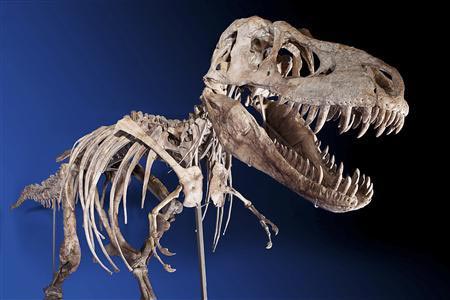
The mounted skeleton of an Asian cousin of Tyrannosaurus rex is expected to be seized by U.S. Custom officials tomorrow as the international legal dispute over the rightful ownership of this fossil specimen continues.  The eight-metre-long, mounted skeleton of a Tarbosaurus bataar was auctioned in New York last month, it fetched over £630,000 GBP when it went under the hammer, but from the day the auction lot was announced it has attracted controversy.

Tarbosaurus bataar

To read about the T. bataar fossil coming up for auction: Tyrannosaurid Up for Auction.

A team of palaeontologists from North America and Mongolia examined the specimen after the sale, once a court order had been put in place to prevent the movement of the specimen to the private individual who had bid the highest at the New York based auction.  These experts declared that the fossils had originated from Mongolia, most probably the Nemegt Formation where a number of Tarbosaurus fossils have been discovered.  It has been illegal for more than fifty years to excavate and take fossils out of Mongolia and it is suspected that this particular specimen was collected by poachers and smuggled out of the country.

To read more about the palaeontologist’s study of the Tarbosaurus remains: Experts state that Tarbosaurus fossils definitely smuggled out of Mongolia.

The Tarbosaurus Specimen Under Investigation

Going nowhere- Mounted skeleton set to be seized by customs officials.

Picture credit: Reuters/Heritage Auctions

When team members at Everything Dinosaur were first informed about the intended auction, they signed an on-line petition to help stop the sale taking place, as they were aware that it had been against the law in Mongolia to export such specimens.  Now a warrant that allows U.S. officials to seize the fossil has been signed by a New York based federal judge.

Commenting on the case, Luis Martinez, a spokes person for the U.S. Immigration and Customs stated:

“We should have it by the end of the week.”

The government of Mongolia will no doubt, welcome this move, prior to the auction the Mongolian President personally intervened to try to stop the sale.  Mongolia is claiming sovereign ownership of the T. bataar specimen and wanting the fossils returned to Mongolia.

Mongolian Government Request

At the request of the Mongolian government, a U.S. District judge in Dallas (Texas) issued a restraining order preventing the skeleton from being moved or the ownership transferred while the dispute continued.  Manhattan U.S. Attorney Preet Bharara filed a lawsuit on Monday seeking the forfeiture of the nearly intact skeleton and its return to the Mongolian government.

In New York, U.S. District Judge Kevin Castel on Tuesday issued an order to seize the fossil, ruling there was probable cause it was subject to forfeiture under federal laws due to false claims made regarding the value of the imported item into the USA from the United Kingdom and other infringements concerning the customs paperwork.

A spokesperson stated:

“From a legal standpoint, the U.S. government’s lawsuit shifts the burden of proof from Mongolia to Heritage [Heritage Auctions who organised the original sale in New York] and others who might make a claim to its ownership.”

Heritage Auction officials have stressed from the beginning that they would cooperate with authorities, keen to avoid any adverse publicity and any legal ramifications for their part in the sale.  The company maintains that the fossil was legally obtained and brought to auction by a reputable consignor.

Jim Halperin, Co-chairman of Heritage Auctions said in a statement:

“We believe our consignor purchased fossils in good faith, then spent a year of his life and considerable expense identifying, restoring, mounting and preparing what had previously been a much less valuable matrix of unassembled, underlying bones and bone fragments.  We sincerely hope there is a just and fair outcome for all parties.”

U.S. federal officials claim that the smugglers made false statements about the skeleton when it was imported into the United States from the UK in 2010.  The skeleton did not originate in Britain nor was its value only $15,000  (£10,000) as claimed, the officials assert.

Mongolia has has strict laws in place for five decades regarding the excavation, removal and shipment of fossils and other rare artefacts from the country.  Such items are considered property of the Mongolian government.  It is likely that this fossil specimen was removed from Mongolia between 1995 and 2005 according to the palaeontologists who examined the Tarbosaurus.

We expect this dispute to rumble on, but hopefully action taken by the U.S. authorities will serve as a deterrent and prevent the smuggling of other specimens out of Asia for sale in the West.

To view models of Tarbosaurus (whilst stocks last): Theropods and Dinosaur Figures (PNSO).

15 06, 2012

Ancient Amphibians Possessed Bites as Strong as a Crocodiles

By |2023-02-01T20:34:15+00:00June 15th, 2012|Categories: Dinosaur and Prehistoric Animal News Stories, Palaeontological articles|0 Comments

Research suggest that Capitosaurs were the “Crocodiles” of the Permian and the Triassic

Long before the reptilian ancestors of crocodiles evolved, ancient lakes and swamps had there own set of aquatic ambush predators – amphibians, members of a group known as the Temnospondyls.  Fossils of ancient amphibians have been found world-wide and it is believed these animals evolved in the Carboniferous, evolving into a myriad of terrestrial and aquatic predators.

Ancient Amphibians

A study by researchers at the Catalan Institute of Palaeontology in association with their colleagues at the University of Catalonia has assessed the bite force capabilities of number of these animals and challenged a hypothesis regarding the strength of these animal’s bites that had been put forward more than forty years ago.  It seems that both basal and more advanced forms of Temnospondyls were capable of biting down onto prey with considerable force. In contrast to the earlier theory, that postulated that the shape and size of the bones that supported the muscles were responsible for generating a strong bite force, it seems that muzzle shape and dimensions are more significant when it comes to assessing how strong a bite force one of these predators could generate.

Temnospondyls were a large and diverse group of amphibians with stout limbs, strong bodies and big, wide mouths.  Some of these creatures could grow to lengths in excess of three metres and many of them occupied environmental niches similar to modern-day crocodiles.

An Illustration of a Typical Aquatic Predator (Temnospondyl)

Amphibians that thought they were crocodiles.

Picture credit: Mauricio Anton (Catalan Institute of Palaeontology)

Temnospondyls

It had been thought that the last of the Temnospondyls died out at the end of the Triassic but Australian fossils suggest that some of these amphibians survived into the Jurassic and into the Early Cretaceous, living in parts of the world that were too cold for the crocodylomorphs to survive in.  The study focused on members of the capitosaur taxon, advanced active, predatory members of the Temnospondyls.  Seventeen taxa were studied and the research suggests that many of these animals could generate bite forces similar to those of modern crocodiles.

Extant species of amphibian such as the salamanders, although they possess wide mouths, do not have strong bites.  They suck prey items into their mouths.  This research suggests that at least some of the capitosaurs had masticatory capabilities similar to crocodylians, an article detailing the research has been published in the scientific journal “The Anatomical Record”.

Josep Fortuny (Catalan Institute of Palaeontology), along with colleagues has shown that changes to the shape of these animal’s skulls influenced the way that they fed.  These large, carnivores had a wide range of different bite strengths.

The Catalan-based researchers studied the evolution of different morphological features in the capitosaurs’ skulls using computer models and careful scans of the actual fossil material to determine the stress distribution across the skull bones for different types of bite.

Commenting on their research, Josep stated:

“Apart from explaining how capitosaurs fed, we also wanted to validate the theory by palaeontologist A. Howie from the 1970s, and here are results were somewhat surprising.”

Primitive capitosaurs  had posteriorly directed tabular horns, (bony struts associated with the back of the skull that pointed rearwards), these are the bones that anchor the muscles responsible for opening and closing the mouth.  In more derived, advanced forms, however, they moved laterally to create a small island in the back of the skull, known as the otic notch.  Howie argued that this evolution facilitated a more optimal bite, at the biomechanical level.  However, the Spanish research refutes this demonstrating that the most primitive tabular horns were also optimal for the opening of the mouth.  Therefore, the evolutionary mechanisms that led to the closure of the otic notch do not have much to do with improved biomechanics of this movement, but the scientists state that more studies are needed to better understand these morphological changes.

Illustration of Capitsosaur Skull Types

Snout size and skull widths better determinants of bite force.

Picture credit: Catalan Institute of Palaeontology

In the images of these two capitosaur skulls shown above, Parotosuchus left and Eocyclotosaurus right, tabular horns (A) and the Otic Notch (B) are observed.

In its most basal, primitive forms, as is the case of Wetlugasaurus, skulls are weaker.  As forms radiate, capitosaurs seem better able to generate a more powerful bite, perhaps in response to the evolution of their prey and increased competition from the rapidly evolving reptiles.

Computer Generated Images Indicate Bite Strengths of Various Capitosaurs

Different shaped snouts and skulls equals different bite force capabilities.

In the images deformations (top) and stresses (bottom) are observed from simulations of a bilateral bite for several capitosaur species.  The more primitive, basal form such as Wetlugasaurus (far left) had a weak bite, but Parotosuchus with its large tabulate horns had a powerful bite, challenging the theory first put forward by Howie.

The elongation of the tabular horns, with the consequent closure of the otic notch, was taken for years as an indicator of a more powerful bite.  This study shows, however, that Paratosuchus had one of the most powerful bites of the study group, along with Cyclotosaurus, although the otic notch is open and the tabular horns are not particularly long.  From the computer generated data, it seems that other factors such as the width of the skull and the snout length are equally or perhaps more important factors in generating bite force as opposed to the tabular horns or the otic notch closure.

This research suggests that these predators evolved to take advantage of a number of ecological niches as land vertebrate food chains became more complex.

For not-to-scale models of prehistoric animals including ancient amphibians (whilst stocks last): Models of Permian and Triassic Animals (CollectA).

11 06, 2012

The Evolution of Birds Ended the Chances of Flying Insects Growing Big

By |2023-02-01T18:12:08+00:00June 11th, 2012|Categories: Dinosaur and Prehistoric Animal News Stories|0 Comments

The Aves Prevented the Evolution of Giant Flying Insects during the Mesozoic

Scientists at the University of California (Santa Cruz) have set about analysing the fossil record of flying insects in a bid to determine the affect on insect size as a result of the evolution of other flying creatures such as the birds and the pterosaurs.  The largest flying insects in the fossil record are found in Carboniferous aged strata, they include examples of the giant dragonfly Meganeura which had a wingspan of seventy-five centimetres.

The Evolution of Birds

Many palaeontologists believe that large flying insects could evolve during the Carboniferous because the atmospheric levels of oxygen were very high.  Scientists have suggested that the oxygen levels reached around 28-30% in the atmosphere, much higher than today’s figure of approximately 21%.  The denser air would have made powered flight easier and the high concentration of oxygen would have permitted giant flying insects to get enough oxygen to their flight muscles through their spiracles.  Oxygen concentration level is a key physiological factor in the control of insect body size, particularly in groups that have high oxygen demands, such as those that undertake powered flight.

Fossil Dragonfly Wingspan Compared to Extant Species

Giant flying insects of the Palaeozoic.

Picture credit: Wolfgang Zessin

The picture shows the fossilised impression of a Carboniferous-aged dragonfly (Stephanotypus schneideri) compared to the wing of the largest type of dragonfly alive in more recent times.

However, in this study, the research team postulate that the relationship between insect body size and atmospheric oxygen levels is disrupted in part, and that during the Mesozoic and the later Cenozoic, despite fluctuations in oxygen levels and an increase in atmospheric O2 concentration, large flying insects did not evolve.

To read more about the research identifying the relationship between oxygen levels and insect body size: High O2 levels led to Super-sized Flying Insects.

Matthew Clapham, an assistant professor of Earth and planetary sciences at the University of California (Santa Cruz) and Jered Karr, a graduate student compiled a huge database of fossilised insect wing measurements.  They were then able to use this data, in conjunction with information about prehistoric atmospheric oxygen levels to plot insect size and O2 concentrations.  Their paper has been published this week in the scientific journal “The Proceedings of the National Academy of Sciences”.

Commenting on the results of the study, assistant professor Matthew Clapham stated:

“Maximum insect size does track oxygen surprisingly well as it goes up and down for about 200 million years.  Then right around the end of the Jurassic and beginning of the Cretaceous period, about 150 million years ago, all of a sudden oxygen goes up but insect size goes down.  And this coincides really strikingly with the evolution of birds.”

The analysis shows that insect body size becomes less dependent on atmospheric oxygen concentration, it seems that other factors begin to impact on this relationship.  With the evolution of the birds, insects were no longer aerial masters and the need for maneuverability or the need to be small may have taken over as the driving force of insect evolution with oxygen levels becoming less pivotal.

Evolution of the Pterosauria

Interestingly, the analysis provided only weak support for an effect on insect size with the evolution of the pterosaurs in the Triassic.  The first pterosaurs are believed to have evolved around 225 million years ago.  The fossil record shows that there were larger flying insects in the Triassic than in the Jurassic but the lack of Early Jurassic aged insect fossils prevents the scientists from making any firmer conclusions about the impact of pterosaur predation on flying insects.  A drop in global oxygen levels during this Triassic/Jurassic part of the Mesozoic further complicates the analysis.

For flying reptile models, pterosaurs and other prehistoric creatures: Pterosaur Models and Prehistoric Animal Figures (CollectA).

Another transition in insect size occurred more recently at the end of the Cretaceous period, between 90 and 65 million years ago. Again, a shortage of fossils makes it hard to track the decrease in insect sizes during this period, and several factors could be responsible.  These include the continued specialisation and rapid diversification of neornithes (modern birds) the evolution of bats, and the mass extinction event at the end of the Cretaceous.

When asked to provide an explanation for the decline in insect size towards the end of the Mesozoic, Clapham said:

“I suspect it’s from the continuing specialisation of birds.  The early birds were not very good at flying but by the end of the Cretaceous, birds did look quite a lot like modern birds.”

The researchers stressed that this study focused on changes to the maximum size of insects over time.  The average insect size in any geological period was much more difficult to calculate due to a bias for larger insect remains to be preserved in the fossil record.  Larger insects are more likely to be preserved as fossils and found by fossil hunters than smaller insects.

Commenting on this aspect of the research, Matthew added:

“There have always been small insects.  Even in the Permian when you had these giant insects, there were lots with wings a couple of millimetres long.  It’s always a combination of ecological and environmental factors that determines body size, and there are plenty of ecological reasons why insects are small.”

This study that suggests a decoupling of insect size and atmospheric O2 concentrations in favour of other factors such as the emergence of vertebrates capable of powered flight has implications for scientists trying to predict the consequences of extinction rates in our own time.

If the competition from the Aves (birds) was removed due to extinction then if the Earth’s oxygen levels were to rise, those organisms left could well face the possibility of sizeable flying insects evolving once again.  The insects could once again become the masters of the air.

The scientific paper: “Environmental and biotic controls on the evolutionary history of insect body size” by Matthew E. Clapham and Jered A. Karr published in the Proceedings of the National Academy of Sciences.

10 06, 2012

Time to Re-think the Origin of Apes – New Evidence suggests Asian Lineage

By |2024-04-23T16:05:08+01:00June 10th, 2012|Categories: Dinosaur and Prehistoric Animal News Stories, Palaeontological articles|0 Comments

Are we all Asian Migrants?

For many years, one specialist branch of the science of palaeontology, those scientists who have been studying the origin of apes and the evolution of the primates (palaeoprimatologists), have puzzled over the exact origins of these creatures, a branch of which gave rise to the hominins and ultimately our own species H. sapiens.

The Origin of Apes

Although the fossil record of Early Cenozoic (Palaeogene) primates is exceptionally poor, a number of hypotheses had been put forward that supported an African origin for what is termed the anthropoids (monkeys, apes and ultimately hominins).  However, recent fossil finds, most notably in China had began to challenge these theories.  The discovery of four very primitive teeth in Myanmar (Burma), lends support to the notion that the anthropoids originated in the Far East and not from Africa as previously thought.  A paper has been published in the scientific journal (the Proceedings of the National Academy of Sciences), that suggests that this group of mammals originated in Asia and migrated westwards into Africa.

The anthropoids were almost all entirely arboreal (tree dwelling).  During the Palaeogene, the geological period that immediately followed the demise of the Dinosauria (Cretaceous), average annual temperatures seem to have been relatively stable, with the world being approximately six degrees warmer than today.  High humidity and rainfall led to extensive forestation.  Global temperatures began to rise and by around fifty million years ago the average, annual global temperature was somewhere in the region of twenty-eight degrees Celsius.  Earth became a lush, tropical paradise with rainforests extending from Canada down to the tip of Chile in the western hemisphere and from the southern tip of Norway to the south of Australia in the eastern hemisphere.  Even the British Isles, those bits that were above sea level; was a tropical paradise, with crocodiles basking on the banks of a river system that resembled the Congo river seen in western Africa today.

Eosimias centennicus

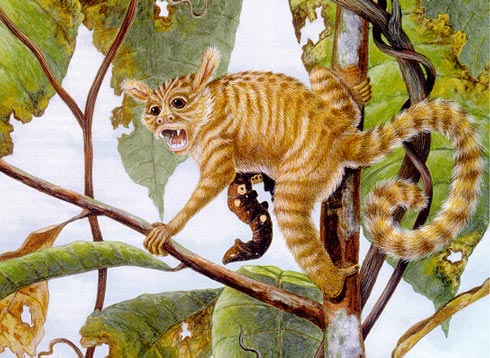
Expeditions jointly organised by the Carnegie Museum of Natural History (Pittsburgh)  and the Institute of Vertebrate Palaeontology and Palaeoanthropology (Beijing) to the Shanxi Province of China in the mid 1990s uncovered evidence of some of the earliest anthropoids known.  Specimens such as the tarsier-like Eosimias centennicus, fossils of which were found in sediments along the Yellow River show that primitive anthropoids inhabited eastern Asia millions of years before they are represented by such nearly complete fossils in the African fossil record.  Because the nearest living relative of anthropoid primates occurs only in southeast Asia and because some of the earliest and most primitive fossil Anthropoids are known from Asia, it seems likely that the anthropoid clade actually originated on the Asian landmass.  Now new fossils from Burma add weight to this hypothesis and provide a timeline for the Anthropoids migration out of Asia and into Africa.

 An Artist’s Impression of a Primitive Anthropoid (E. centennicus)

Does this mean that all humans are ultimately “Chinese Takeaways”?

Picture credit: Nancy Perkins.

Prosimians, including our early ancestors thrived and rapidly diversified.  However, animals living in forests have a poor potential for fossilisation.  Any remains are usually scavenged or rot away leaving nothing available for any type of fossilisation processes.  Occasionally, small fragments of fossil material are found, often individual teeth or part of a jawbone that had been transported by a river system, depositing the bone  and enamel material many miles from where the animal may have actually lived.

To read about a recent fossil primate discovery: New Fossil Primate Discovered – Deep in the Heart of Texas.

Building up a more complete picture of the origin and early evolution of the anthropoid apes has occupied a number of academics for many years.  Most scientists agree that our hominin branch of the ape family tree, did originate in Africa, but the discovery of just four teeth in Burma, dating from 37 million years ago, suggest that the apes themselves may have evolved in the east before migrating westwards into Africa sometime during the Middle Eocene.

An Ancient Swamp

An international team of scientists, examining the strata laid down in an ancient Eocene swampland that covered what was to become Myanmar (Burma) have found amongst the fossil remains of fish, ancient turtles and primitive hippos four fossilised molars that belong to a new species of small primate.  The teeth resemble those of an already described African species, yet they show some more primitive, basal traits.  These fossil teeth suggest that the African apes could be descended from an Asian ancestral clade that migrated westwards, skirting around and across the rapidly shrinking Tethys Ocean to Africa.

The first tooth was found in 2005, a further six years of field work only yielded three other teeth, emphasising how rare anthropoid fossils are, but these are enough for the research team to describe and name a new species.

Palaeontologist K. Christopher Beard of the Carnegie Museum of Natural History in Pittsburgh, Pennsylvania (United States) and the research team leader, Jean-Jacques Jaeger of the University of Poitiers, France, in association with colleagues were able to name and describe a new species of anthropoid based on the shape and size of the molars they had found.  The new species has been named Afrasia djijidae.

Eocene Teeth from Myanmar (Burma) indicate Asian Origin of Anthropoids

“Out of Asia” – Origins of Primates.

Picture credit: K. Christopher Beard/PNAS.

Primate fossil teeth from fossil beds in Myanmar suggest our deep primate ancestors arose in Asia.

Commenting on the difficulties of finding fossil evidence of early primates, Dr Beard, curator of Vertebrate Paleontology at Carnegie Museum of Natural History, stated:

“It’s a difficult place to work, in six years we found just four teeth.”

The teeth are extremely significant.  Scientists had postulated that early anthropoids hailed from Asia, but lacked the fossil evidence to provide an indication of the timing of a migration westwards into Africa.  The research work on the fossil beds, part of the Pondaung Formation (Mid-Upper Eocene), near to the village of Nyaungpinle in Myanmar have revealed evidence that 37-38 million years ago there was living in Asia an anthropoid that seems very closely related to, but slightly more primitive than, a genus of fossil African anthropoids.

Finding fossils of early primates is a very rare event, to read about the discovery of a new species of Tarsier from the Miocene of Thailand: The remains of an Eagle’s dinner helps scientists to identify new species of Miocene Tarsier.

These teeth, small though they are, were enough to demonstrate that the Burmese Afrasia djijidae, was closely related to another early, primitive anthropoid that lived roughly around the same time, but whose fossils have been found in North Africa (Libya) – Afrotarsius libycus.

Microscopic analysis of the teeth showed that the teeth from Burma and Libya were extremely similar, such an affinity between Asian and African anthropoid fossils has not been demonstrated before. Subtle differences, such as a tiny bulge at the back of what would have been the last, lower molar in the jaw of the Burmese anthropoid suggest that the Pondaung discoveries represent a more primitive, basal member of the anthropoid clade.

These primitive traits suggest that this group of mammals evolved in Asia and migrated to Africa somewhere between 39-37 million years ago.  Writing in the Proceedings of the National Academy of Sciences, the research team postulate that the “Out-of-Asia” migration was most likely not a single event but a complex migration of a number of genera westwards.  However, once in Africa, these primitive tarsier-like creatures thrived, perhaps the tropical conditions were ideal for them or perhaps they were fewer predators.  This particular group of the primate family tree, underwent rapid evolution and diversification and a number of species have been recorded in the fossil record of Africa just shortly after the proposed “Out-of-Asia” migration event.

Dr Beard described the rapid diversification as a “starburst of evolution.”

Others agree that if both the new species of primates from Myanmar and Libya are indeed early anthropoids, they would greatly strengthen the case for the Asian origins of this type of animal.  Vertebrate palaeontologist, Richard Kay of Duke University (North Carolina), stated:

“If proven, the biogeographical significance of these results is profound.”

Ultimately, if the apes evolved in Asia, then our own human origins can be traced back to this part of the world.  Human-like creatures (hominins) evolved in Africa but their ancestors may have originated in the East.

Dr Beard added:

“We’ve all heard about Out-of-Africa for human origins.  Now we think there was an Out-of-Asia migration into Africa first.”

For replicas and figures of prehistoric mamals and other creatures: Papo Prehistoric Animals (Les Dinosaures).

9 06, 2012

Rare Tarbosaurus (Tyrannosaur Skeleton) Definitely Smuggled Illegally out of Mongolia say Experts in New Report

By |2024-04-23T16:07:32+01:00June 9th, 2012|Categories: Dinosaur and Prehistoric Animal News Stories|0 Comments

Dinosaur Skeleton sold at Auction was Obtained Illegally

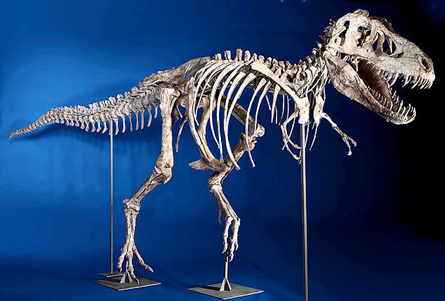
The tyrannosaur skeleton sold at an auction in New York on Sunday May 20th was obtained illegally from Mongolia, experts claim.  The tyrannosaur specimen, an eight-metre-long, mounted fossil skeleton of a Tarbosaurus bataar (otherwise known as Tyrannosaurus bataar due to its close affinity to the North American super predator), was sold for the sum of $1,052,500 USD (£630,000), but the sale has proved controversial as the unauthorised excavation and removal of fossil material from Mongolia, where the fossil was assumed to have originated from, has been illegal for fifty years.

Tyrannosaur Skeleton

To read about the specimen up for auction: Tyrannosaur fossil goes under the hammer in New York.

A team of North American and Mongolian palaeontologists who were given access to the fossils, safely secure in storage after the sale, have pronounced that this dinosaur was taken out of Mongolia, most likely within the last decade.

Mark Norell, a palaeontologist at the American Museum of Natural History, who was one of the first to speculate on the validity of the sale commented:

“We have pulled a lot of them out of the ground [Tyrannosaur fossils] and seen a lot of others come out of the ground, and in our professional opinion it is from Mongolia.”

As well as American Museum of Natural History staff, Phil Currie, from the University of Alberta and an authority on tyrannosaur remains from China and Mongolia was called in to study the fossil bones.  The two Mongolian palaeontologists agreed with their North American colleagues, this particular tyrannosaur came from, most probably, the Nemegt Formation, of Upper Cretaceous aged strata, found in the Mongolian portion of the vast Gobi desert.

The Controversial Tyrannosaur Specimen

Out of Mongolia – probably in the last ten years or so.

Picture credit: Heritage Auctions

To read more about the controversial auction: Tyrannosaur Bites Back!

Team members at Everything Dinosaur, signed a petition to try to prevent the sale of the specimen in the first place back in May, a spokesperson for the UK dinosaur company stated:

“We were confident that the specimen had come from Asia and if that was the case then we concluded that in all likelihood this specimen had been obtained illegally.  It should not be sold but returned to the Mongolian Government as it is the property of the  Mongolian people”.

The specimen was put up for auction by a UK-based private collector, it is not clear how this finding will affect the sale of the mounted specimen.  An anonymous bidder paid more than $1 million USD for the tyrannosaur, but this was on condition that the sale was approved by a U.S. court.  Earlier on in the proceedings, the Mongolian President intervened and tried, unsuccessfully to prevent the auction going ahead.

An advisor to the President stated that following this investigation:

“I have no doubt that the Tarbosaurus bataar will be returned to Mongolia.”

This would be the outcome that staff at Everything Dinosaur would like to see. The fossil specimen being returned to Mongolia where it, and others like it can be studied by that country’s scientists.  Hopefully, this development will send a strong message to fossil poachers about excavating and selling specimens on the black market.

The New York auction house that handled the original sale, Heritage Auctions; has co-operated with the investigation and has been keen to distance itself from any alleged illegal practices.

Co-Chair, and Co-Founder of the auction house, Jim Halperin said in a statement:

“It would be premature for us to comment on a palaeontological opinion we have neither seen nor had time to study.  Heritage will continue to assist the on-going efforts to achieve a fair and amicable resolution.”

Just how do palaeontologists determine the origins of a specimen when it has been prepared and removed?  There are a number of tell-tale clues that experts can follow to help them identify the origins of a particular dinosaur fossil, or indeed  any fossil vertebrate and to a large extent fossilised invertebrates too.

Permineralisation

When bone fossilises, especially in a fossilisation process called permineralisation, the organic bone is replaced by inorganic minerals from the surrounding sediment.  The white to beige colour of the fossils match those of other tyrannosaur specimens taken from the Nemegt Formation.  Whilst scientists can not pinpoint the exact location, the colour and hue of the bones can indicate a general location.

The palaeontologist identified twelve specific characteristics of the fossilised bones that confirmed their initial thoughts that this was a Mongolian Tarbosaurus bataar.  Subtle anatomical differences and slight differences in bone shape (morphology) help scientists to distinguish between genera and species.

The “clincher” for the scientists was the discovery of tiny fragments of reddish sediment material in the cracks and fissures of the bones.  These are particles from the surrounding matrix from the excavation site.  The unique chemical “thumb print” of this sediment can help palaeontologists to provide a more exact guide as to the original fossil location.  Scientists are working on a “sediment map” that would allow all dinosaur specimens to be “tagged” by the mineral composition of their matrix, steps have already been taken to build up a database so that palaeontologists can confirm the authenticity and origins of dinosaur fossils.

As Professor Currie pointed out, the stubby arm length made it clear to him that this specimen was definitely a Tarbosaurus.  Tyrannosaurus rex, regarded as a close cousin of Tarbosaurus may be famous for having short arms, but Tarbosaurus bataar had proportionally shorter forelimbs.

The poaching of fossils out of Mongolia and neighbouring China is a growing problem, especially when the price paid for dinosaur fossils is considered.  There are strong regulations in place with fines and prison sentences for those smugglers who are caught, but when dinosaur fossils sell for hundreds of thousands of pounds, the rewards for the illegal traders can be very high.

Fossil Hunting in Mongolia

Professor Currie went on to explain that based on his own experiences of fossil hunting in Mongolia, the T. bataar specimen was most probably subjected to two rounds of poaching.  He stated that unskilled poachers often will take the teeth and the claws off a specimen, leaving or destroying the rest.  The teeth and claws are the most valuable and portable parts of a specimen such as this, they can be sold on to collectors or even can find their way into traditional Chinese medicine cabinets.  This Tarbosaurus  bataar was missing most of its claws and teeth.

Professor Currie then added that in his opinion, the remainder of the specimen was removed by excavators with more skill, but even so, the job was not well done with a lot of damage evident on the fossil bones.

He commented:

“There is a lot of restoration done on the bones to make them look good, but when you look closely at it you can see there is a lot of plaster restoration towards the ends of the bone, a lot of the processes [protrusions] are broken or chipped off and gone.”

Most palaeontologists would like the fossil skeleton returned to Mongolia, permitting this specimen to be studied along with other Tarbosaurus remains.  However, the fate of this particular Late Cretaceous predator remains uncertain.  With the high prices paid for dinosaur fossils and the relative poverty of these who live close to the Nemegt Formation, the problem of illegal excavation and smuggling of fossil material is likely to persist for some time.

For dinosaur themed toys and games including excavation kits: Prehistoric Animal Gifts and Toys.

Go to Top