All about dinosaurs, fossils and prehistoric animals by Everything Dinosaur team members.

Fossil finds, new dinosaur discoveries, news and views from the world of palaeontology and other Earth sciences.

22 07, 2012

Palaeontologists Take Steps to Preserve Important Dig Sites

By |2024-04-24T15:29:31+01:00July 22nd, 2012|Categories: Dinosaur and Prehistoric Animal News Stories, Dinosaur Fans, Geology|Comments Off on Palaeontologists Take Steps to Preserve Important Dig Sites

Field Workers Intend to Increase Security at Dinosaur Dig Sites

Following a number of incidents of fossil thefts and deliberate vandalism from Canadian vertebrate fossil sites, scientists are taking steps to try to protect the precious fossils that they find. Dinosaur fossils can take many months or even years to be excavated and removed from a dig site. In many cases, each fragment of bone or piece of a tooth has to be carefully excavated and then protected with glues and resins before they can be taken from the location.

This painstaking process can take many hundreds of man hours to complete and as a result many fossils are only partially mapped and prepared in each season. The site is often carefully covered over so that palaeontologists can return to the area to complete their work later on that year or even in subsequent years.

Take Steps to Preserve Dig Sites

These locations, although very often to be found in remote areas attract trophy hunters and smugglers who are keen to remove fossils so that they can be sold illegally. However, some fossils have been deliberately vandalised as they lie in the ground awaiting further excavation work.

A Dinosaur Excavation in Alberta
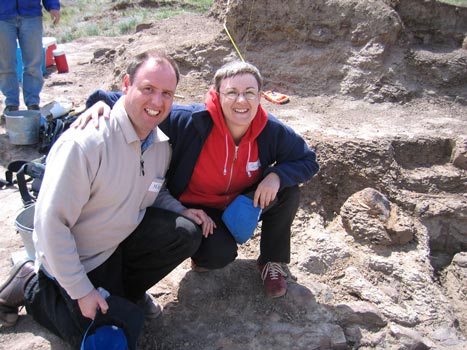
Digging for Dinosaurs.  Palaeontologists take steps to preserve dig sites.

Pause for a pic next to a digs station.  Palaeontologists take steps to preserve dig sites.

Picture credit: Everything Dinosaur

Hadrosaurus Specimen Destroyed

It was reported that an eight-metre-long, duck-billed dinosaur specimen found in the Pipestone Creek area near Grande Prairie in north-western Alberta, Canada was smashed up and virtually destroyed a couple of months ago. This follows on from a number incidents reported to the Royal Canadian Mounted Police about dinosaur fossil thefts and damage to vertebrate fossils as they lie in their fossil locations.

To read more about the Pipestone Creek incident: Vandals in Alberta damage Duck-Billed Dinosaur Fossils.

Palaeontologists and field teams are now trying to work together to help protect their rare and delicate fossil finds. The problem is most palaeontology is carried out on a small budget, usually money allocated to a dig site from the bursar of a Natural History Museum. Often there are simply not the resources available to mount video security, infra-red cameras or to employ security staff twenty-four hours a day.

Scientists have requested that the land owners where fossils have been found, keep a close look out for trespassers or suspicious activity in the area. Their vigilance can help prevent attacks on the fossil finds. Volunteers have been called for in some areas to help deter thefts and acts of vandalism by getting people to camp out close to the site. Although, museum staff try their best to protect a location, the presence of local volunteers camping nearby would deter all but the most determined attacker.

Palaeontologists Keep Dig Sites Secret

One of the best ways to protect a new fossil discovery is to keep it a secret. By limiting the number of people who are informed of a dinosaur fossil discovery, scientists hope to minimise the risk that this information might fall into the wrong hands and lead to site damage or theft.

Public education can help to reduce the problem. In many countries, including Canada, the taking of fossil material or other artefacts is illegal and fines in excess of $40,000 Canadian dollars may be levied or even a term in prison. Palaeontologists believe that the vandalism may not be a deliberate attempt to destroy the fossils but the botched efforts of amateurs trying to steal the fossils either as souvenirs or to sell on.

For models of hadrosaurs and other North American dinosaurs: Models of North American Dinosaurs and Other Prehistoric Animals (Safari Ltd).

21 07, 2012

More Prehistoric Turtle Remains from a Columbian Coal Mine

By |2023-02-03T08:35:15+00:00July 21st, 2012|Categories: Dinosaur and Prehistoric Animal News Stories|0 Comments

Giant Turtle with a Rounded Shell – Reptiles Ruled When Dinosaurs Died Out

Palaeontologists and field workers have been marvelling at the latest discovery of huge reptile fossils from Columbia’s Cerrejon coal mine.  After the dinosaurs died out, there were many gaps in ecosystems, these were rapidly filled by animals that had survived the Cretaceous mass extinction event that saw the demise of the Dinosauria.  In the geological time period that followed the Cretaceous, known as the Palaeogene, global temperatures soared and planet Earth became a paradise for those reptile genera that survived.  Scientists have published more details on recently found prehistoric turtle remains.

Prehistoric Turtle Remains

The research team have uncovered the carapace of another enormous freshwater turtle from the coal mine.  This sixty-million-year-old fossil was found in a section of the open cast mine known as La Puente pit.  Scientists have already built up a picture of the reptile dominated swampland and rain-forest that made up this part of South America, just a few million years after the dinosaurs became extinct.  Giant crocodiles took over the predatory role of dinosaurs such as the abelisaurids and huge turtles swam in the lakes and rivers of the area.  The apex predator of the region, the stuff of nightmares was a huge constrictor snake, possibly the largest snake that has ever lived.  This animal has been named Titanoboa and the fossils found of this animal indicate a snake with a length in excess of fifteen metres, twice the size of any species of snake alive today.

To read an article about the discovery of Titanoboa: Titanoboa – Huge Snake of the Palaeogene.

This new giant, freshwater turtle has been formally described and named Puentemys mushaisaensis.  It measured over 1.5 metres in length and it was named after the part of the coal mine where the carapace (top part of the turtle’s shell was found).   The palaeontologists have classified P. mushaisaensis as a turtle belonging to the Bothremydid family of the Chelonia (turtles and tortoises).  Although many types of turtle have been discovered at the Cerrejon mine, this is the first Bothremydid turtle to be found in Palaeogene deposits in South America.

For replicas and models of prehistoric animals: Prehistoric Animal Models and Replicas.

The palaeontologists responsible for the scientific description of this table-sized turtle have suggested that its nearest relative known in the fossil record is a genus of turtles whose fossils have been found in Upper Cretaceous strata in Europe.  This has perplexed palaeontologists as during the Late Cretaceous the Atlantic Ocean was already vast and it is difficult to imagine how even a large turtle could have made its way from Europe to South America.  A number of theories have been put forward to explain this distribution.  Perhaps turtles of this type lived in estuaries and spread across the planet by moving along coastlines to exploit new habitats.  Or perhaps individuals were washed out to sea and survived the long crossing between Europe and the east coast of South America.  Alternatively, turtles may have reached South America by “island hopping”, slowly making their way across the Atlantic over millions of years by colonising islands of the coast of Africa and then it was from these that some individuals got washed westwards to the Americas.

Puentemys mushaisaensis

Puentemys mushaisaensis had a very rounded shell, described by field workers when they first excavated the fossils as being “rounded like a car tyre”.  Round shelled turtles had existed during the reign of the dinosaurs.  Columbian scientists have proposed that a very round shell would have had two advantages.  Firstly, with huge crocodiles and the enormous Titanoboa about, the round shell would have offered considerable protection.  Crocodiles would have found it difficult to get a purchase on the carapace with their teeth.  The constrictor snake Titanoboa would have had difficulty swallowing a turtle with such a rounded shell.  So the strange shape to the carapace could have evolved as an adaptation to the large predators that P. mushaisaensis shared its habitat with.  Secondly, the shell being so round would have enabled a large surface area to be presented to the sun, permitting a cold-blooded turtle to be warmed quickly by the sun’s rays.  Being sluggish when surrounded by such formidable predators would not have been a good idea.

Scientists from the various museums and institutes who have been working in the area are confident that the coal mine will yield more spectacular reptile fossils from a time in the Earth’s history immediately after the dinosaur extinction.

To read an earlier article about Cerrejon turtle fossil discoveries: Giant Freshwater Turtle from a Columbian Coal Mine.

19 07, 2012

Diplodocus Feeding Frenzy – A Biter or a Comber

By |2023-03-09T10:14:17+00:00July 19th, 2012|Categories: Dinosaur and Prehistoric Animal News Stories, Dinosaur Fans|0 Comments

New Research into Diplodocus Feeding Habits

A team of British scientists have published research that re-affirms the theory that diplodocid dinosaurs such as Diplodocus combed leaves into their mouths rather than biting leaves off branches.  Using sophisticated computer based modelling techniques more at home in the aeronautical industry, the research team assessed the stresses on a Diplodocus skull as the animal ate.

New Diplodocid Research

Diplodocus was typical of the diplodocid sauropods.  It had a small head, on a long, slender neck and large body supported by four column-like legs.  The tails of these giant animals were also very long and slender.  Some of the dinosaurs described as diplodocids may have been the longest land animals of all time.  The Upper Jurassic strata of the Morrison Formation (western United States), has revealed the fossilised remains of a number of giant, plant-eating dinosaur species, some of which may have exceeded thirty metres in length.

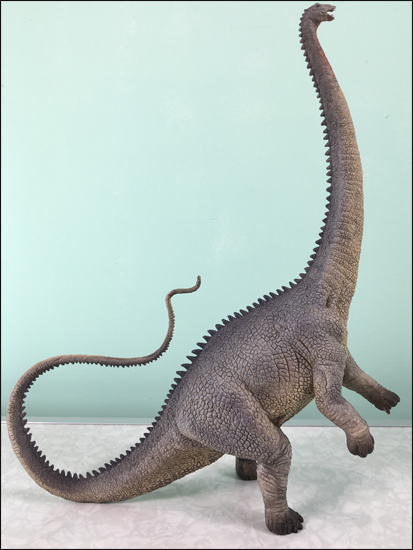
A Typical Model of Diplodocus

A typical diplodocid dinosaur.

Picture credit: Everything Dinosaur

The research team, including members from the Natural History Museum and the School of Earth Sciences at Bristol University, studied the biomechanical stresses imposed on a typical diplodocid skull when different methods of feeding were examined.  These large animals were able to consume and process huge amounts of plant matter and very probably spent most of their time eating.  Everything Dinosaur team members have calculated that some large individual sauropods may have had to consume plant material equivalent to many thousands of breakfast wheat biscuits per day.

Diplodocus Feeding Habits

The study, reported this week in the scientific publication “Naturwissenschaften” supports an earlier hypothesis that was put forward in the 1990s, that these dinosaurs fed by combing leaves and other plant material off branches and twigs straight into their mouths.  The biomechanical tests show that the skull of diplodocids were adapted to strip leaves from trees.

During the Late Jurassic the flora was dominated by ferns, bennettitales, seed ferns (pteridosperms) and cycads.  The largest trees tended to be conifers.  Flowering plants (the angiosperms), had not evolved and did not evolve until the Early Cretaceous.  Palaeontologists have debated which type of plant material these large creatures favoured.  Analysis of fossilised dinosaur poo (coprolite) reveals that unsurprisingly, these long-necked dinosaurs were not fussy eaters.

Diplodocids were very efficient “feeding platforms”.  An animal could stand in one position and with its long neck it could reach a huge amount of vegetation without moving, a very efficient and energy saving method of gathering food.  In addition, dinosaurs like Diplodocus could probably have rocked back onto their hind legs and balanced on their tails (a tripod stance), to enable it to reach up high and feed on the tops of trees.  The diplodocids were therefore able to reach parts of the plant canopy that other herbivores did not have access to.

Some of the largest fossils found of dinosaurs relate to the diplodocid clade.  Scientists have estimated, for example, that some species of Diplodocus could exceed lengths in excess of twenty-seven metres and weigh more than twenty tonnes.

Diplodocus only had a few, small, peg-like teeth in its jaws.  What teeth Diplodocus had were at the front of its jaws and some of these teeth protruded forward.  Using a computerised model of a Diplodocus skull, that had been constructed by scanning in three-dimensions Diplodocus skull material, the team were able to build up a picture of the stresses imposed on the skull as the animal ate.

The biomechanical analysis assessed three types of potential feeding behaviour in diplodocids.  The model was used to push the skull material to its physical limit helping to determine how much stress the teeth could withstand along with the bones that make up the animal’s head.

One of the problems associated with studying sauropods is that there are no animals alive today that are remotely like them.  This complicates any study being made into the feeding habits of these sort of animals.  Using finite element analysis (FEA), a methodology used extensively in the design of aeroplanes and orthopaedic devices, the British team concluded that diplodocids probably combed food into the mouths rather than biting off branches.

New Study into the Eating Habits of Diplodocus

Many different types of sauropod.

Long necks for different feeding envelopes.  Different types of sauropod probably fed on differing parts of the canopy.  An example of niche partitioning.

Picture credit: Everything Dinosaur

Finite element analysis is just one of a number of techniques  being used by palaeontologists to find out more about long extinct creatures.  Technology more at home in an engineering plant or a hospital is being used to discover more about dinosaurs and other extinct vertebrates.

The research will furnish one student with a doctorate paper and it provides fresh evidence to support the “leaf-combing” theory postulated by palaeontologists.   Some other theories regarding how these animals ate and what food they consumed have been put forward in the past.  In the 19th Century and into the early 20th century, many scientists believed that dinosaurs like Diplodocus were almost entirely aquatic, living in lakes and swamps.

These scientists believed that the weak teeth were only suitable for feeding on soft aquatic vegetation such as pond weed.  Most palaeontologists now accept that sauropods were almost entirely terrestrial and that they fed exclusively on land plants.

One of the more bizarre theories put forward; postulated that the long necks, small heads in relation to their bodies and peg-like teeth could have been ideal for snatching up shellfish from amongst rocks and off the bottom of lakes and rivers. This theory has largely been discounted, most palaeontologists are comfortable with the hypothesis that these animals were entirely herbivorous.

The research team discovered that whilst the stripping of bark from trees was too stressful for the teeth and likely to result in tooth breakage, combing and raking food into the mouth was no more stressful on the skull as standard biting.  This research may help to answer the question how did sauropods feed?

A Diplodocus Dinosaur Model

CollectA rearing Diplodocus (grey). Research into Diplodocus feeding habits.

A rearing Diplodocus dinosaur model in the elephantine colour scheme. Picture credit: Everything Dinosaur.

Picture credit: Everything Dinosaur

The picture (above) shows a CollectA rearing Diplodocus model.

To view the CollectA range of not-to-scale models and figures in stock at Everything Dinosaur: Dinosaur Models (CollectA Age of Dinosaurs – Popular).

An examination of the structure of ferns and indeed extant cycads, suggests that raking food into the mouth would have resulted in a very efficient feeding behaviour.  To prove this yourself, take a fork and a fern frond, pull the fork from the base of the frond up to the tip with the prongs of the fork between the rachis (mid-rib).  One sharp pull should result in the majority of the vegetation being pulled from the rachis. Everything Dinosaur conduct a similar small group exercise when working with Key Stage 1 children as part of Everything Dinosaur’s school workshops.   By doing this you are mimicking the feeding behaviour of one of the largest animals ever to walk the Earth.

15 07, 2012

Scientists Discover Amazing Early Human Fossil in Laboratory

By |2023-02-02T09:59:57+00:00July 15th, 2012|Categories: Dinosaur and Prehistoric Animal News Stories, Palaeontological articles|3 Comments

South African Scientists Intend not to Leave Australopithecus sediba “On the Shelf”

An innocuous looking slab of rock, simply known as Block 051 lay in a storage area of a South African laboratory for three years as scientists went about their daily business.  By chance a technician took a closer look at the one-metre wide rock and spotted a small, whitish object sticking out from it – on closer examination it turned out to be a fossilised tooth of a two-million-year-old hominid.  This was only the start, as palaeoanthropologists believe that this greyish rock nodule may contain the most complete fossilised skeleton yet discovered of Australopithecus sediba.  An amazing early human fossil found in a laboratory.

Rock May Reveal Evidence of Human Evolution

Scientist points to the tooth and shows replica skull of hominid.

Picture credit: AFP

Early Human Fossil

Scientists from the Wits Institute for Human Evolution based at the University of the Witwatersrand in Johannesburg (South Africa) have announced the discovery of a significant amount of a skeleton of a potential early human ancestor.  The skeleton is believed to be the remains of ‘Karabo’, the type skeleton of Australopithecus sediba, discovered at the Malapa Site in the Cradle of Humankind in 2009.

The remains, embedded in the rock may consist of elements of the skull plus ribs and parts of the limbs from a hominid that lived two million years ago.  Scientists are unsure as to whether the fossils represent a male or a female but a preliminary examination suggests that the bones may belong to a juvenile, aged between nine and thirteen years when they died.

Professor Lee Berger, a Reader in Palaeoanthropology and the Public Understanding of Science at the Wits Institute for Human Evolution made the announcement.  Professor Berger and his team at the University of Witwatersrand have been at the centre of the research into A. sediba fossil specimens and have excavated a number of highly significant finds of South African hominid fossils in recent years.

To read an early article on the University’s research: Fossil Find may Help to Determine how Humans Evolved.

Professor Berger commented:

“We have discovered parts of a jaw and critical aspects of the body including what appear to be a complete femur (thigh bone), ribs, vertebrae and other important limb elements, some never before seen in such completeness in the human fossil record.”

The Professor went on to add:

“This discovery will almost certainly make Karabo the most complete early human ancestor skeleton ever discovered. We are obviously quite excited as it appears that we now have some of the most critical and complete remains of the skeleton, albeit encased in solid rock.  It’s a big day for us as a team and for our field as a whole.”

The fossils are not visible on the surface of the rock, but encased within it.  Although the rock had been brought back to the laboratory three years ago it lay unnoticed in the Wits laboratories until early June.  With the tooth spotted, Professor Berger and his wife Jackie Smilg, a radiologist at the Charlotte Maxeke Hospital, who is conducting her PhD on the CT scanning of fossil material embedded in rock, scanned the large rock in a state of the art CT scanner.

A Preliminary Scan Reveals Substantial Fossil Material in the Matrix

Initial scan of the matrix proves promising.

Picture credit: University of Witswatersrand (Johannesburg)

The picture shows a probable hominin fibula (circled), in the rock known as block 051.   Note the shaft of a probable femur just above and to the left.

The scans reveal tantalising glimpses of the fossil material that lies within the rock.  In an unprecedented gesture of open access to science and public participation, the University of the Witwatersrand, the Gauteng Provincial Government and the South African national government have announced that for the first time in history, the process of exploring and uncovering these fossil remains would be conducted live, captured on video, and conveyed to the world in real time. This will allow members of the public and the scientific community to share in the unfolding discovery in an unprecedented way.

A spokesperson for Everything Dinosaur commentated:

“This is a very exciting development, giving members of the public open access to palaeoanthropology as it happens, people will get to see the fossils at the same time as the scientists”.

For replicas and models of early hominins and prehistoric animals: (Safari Ltd) – Replicas of Early Humans and Prehistoric Animals.

A laboratory studio, designed in collaboration with the National Geographic Society, will be built at the Maropeng Visitor Centre in the heart of the Cradle of Humankind World Heritage Site.  It will allow the public to view the preparation of this skeleton live if they visit Maropeng, or live on the internet.

Access to the laboratory studio will not be limited only to visitors to the Cradle of Humankind and the internet as Professor Berger explained:

“We intend to create virtual ‘outposts’ in major partner museums around the world.  These outposts will allow visitors to these partner museums the chance to interact with scientists in real time in a way we simply could not conceive of a few years ago.  It is anticipated that the laboratory and virtual infrastructure will be built within a year, expanding our ambitious tourism and smart province infrastructure programme.”

Berger added that negotiations have begun with the Shanghai Science and Technology Museum, the Natural History Museum in the United Kingdom and the Smithsonian in Washington.

Pointing out the Evidence – The Tooth

Pointing out the tooth… “the whole tooth and nothing but the tooth”.

Picture credit: University of Witswatersrand (Johannesburg) with additional annotation by Everything Dinosaur.

The photograph above shows  the tooth of a hominid embedded in a rock containing significant parts of a skeleton of an early human ancestor.  The skeleton is believed to be the remains of “Karabo”, the type skeleton of Australopithecus sediba, discovered at the Malapa Site in the Cradle of Humankind in 2009.  Team members at Everything Dinosaur have highlighted the tooth with a red circle.

Looks like it is going to be an exciting time for some of the candidate hominids involved in the search for the direct ancestry of our own species.

Everything Dinosaur is grateful to the University of Witwatersrand for the compilation of this article.

12 07, 2012

Vandals In Alberta Damage Duck-Billed Dinosaur Skeleton

By |2023-02-02T09:41:53+00:00July 12th, 2012|Categories: Dinosaur and Prehistoric Animal News Stories, Dinosaur Fans|0 Comments

Hadrosaur Skeleton Badly Damaged in Attack by Vandals

Over the last six months or so officials in Canada have reported a number of deliberate acts of vandalism carried out against dinosaur fossils being excavated in the province of Alberta.  In this latest attack, the fossilised remains of a Late Cretaceous herbivorous dinosaur were smashed by a person or persons unknown. Vandals have damaged a duck-billed dinosaur skeleton.

Duck-billed Dinosaur Skeleton

The remains of large dinosaurs often take months to extract out of the ground, indeed as great care is needed to protect the fossilised remains and preserve scientific data, some excavations can take years.  This means that many sites once identified may be left after only a partial excavation.  Field workers would deliberately bury bones, having taken precautions to preserve them so that the site can be re-visited at a later date and a more thorough investigation carried out.

This is exactly what happened when Dr Philip Bell and his colleagues of the Pipestone Creek Dinosaur Initiative came across the partially exposed remains of an eight-metre-long hadrosaur.  The site was mapped on June 15th and there were several days of excavation, then Dr Bell and his team had to return to their other projects so the scientists carefully covered the site so that they could return a few weeks later and continue their work.  To Dr Bell’s dismay, when he returned to the site, near Grande Prairie (north-western Alberta), he discovered that  much of the site had been attacked by vandals and many of the fossil bones smashed.

A Typical Hadrosaur Skeleton in a Canadian Museum

After much careful fieldwork and preparation a fossil skeleton is ready for display.

Picture credit: Everything Dinosaur

The palaeontologists are concerned that the hadrosaur specimen may have been irreparably damaged.  This is just one of a number of acts of vandalism against dinosaurs that have been reported in the Canadian press this year.

Commenting on the demise of his duck-billed dinosaur, Dr Bell stated:

“This was destined to become a major exhibit in the new museum [new dinosaur museum, located north of the Canadian town of Wembley].  Of course, now it’s really compromised.  It’s not really a skeleton any more.  It’s more of a jumble of bones… Maybe there’s a few things that are still complete in there, but as far as the exhibit was concerned, that’s no longer feasible.”

Dinosaur fossils are exceptionally rare.  Each new discovery helps palaeontologists to learn more about these prehistoric creatures, Dr Bell went on to add:

“Each bone is irreplaceable.  We still know very little about the dinosaurs that existed up here [northern Alberta], so every skeleton is crucial.”

Most of the bones were still in situ, so the site had not been raided by souvenir hunters or illegal collectors keen to sell specimens outside of the law.  The fossil remains seem to have been broken deliberately in a wanton act of violence.

Although dinosaur fossils can fetch high prices if sold at auction, it is illegal to poach or even damage any fossil material in Canada.  Such transgressions can be punished by hefty fines of up to $40,000 CDN or even twelve months imprisonment.

Despite the best efforts of the authorities, the incident of the damaged hadrosaur is not the only recent fossil crime that has been reported from Canada.  A number of such attacks have been recorded this year.  In Pipestone Creek Park (Alberta), near to where the hadrosaur remains had been located, a substantial bone bed containing the fossilised remains of a number of dinosaurs was damaged in May.  There have also been a number of dinosaur fossil thefts reported from dig sites and museums over the last few months or so.

The Royal Canadian Mounted Police in an official statement said that they were investigating the incidents, but as yet do not have any suspects.

Let us hope that the individuals are soon caught and this indiscriminate damage to Canada’s fossil heritage is soon stopped.

For models and figure of duck-billed dinosaurs and other ornithischian dinosaurs: Museum Quality Figures of Ornithischian Dinosaurs (PNSO Dinosaurs).

9 07, 2012

Dangerous Rivers, Hazardous Cliffs at Lyme Regis

By |2023-02-02T09:19:34+00:00July 9th, 2012|Categories: Dinosaur and Prehistoric Animal News Stories, Geology, Palaeontological articles|1 Comment

Torrential Rain Causes Flooding Threat and Makes Cliffs Dangerous

Heavy rainfall has led to a number of swollen rivers and subsequent flooding in many parts of the UK.  For the Dorset town of Lyme Regis, famous for its beaches and the fossils that can be found along the shore, the recent rain could make the cliffs even more unstable.  There have already been a number of rockfalls, particularly on Monmouth Beach.  A video shot by our chum Brandon Lennon of the river Lym in spate gives an impression as to just how much rain has fallen in the area over recent days.

The video can be found on Brandon’s YouTube channel.

Hazardous Cliffs at Lyme Regis

Brandon very kindly sent us some pictures of landslides and rock falls that occurred on the beaches of Lyme Regis and we wrote a short article about the dangers of fossil hunting in the area in the present conditions.

To read this article warning of the dangers: Bad Weather at Lyme Regis leads to Dangerous Cliffs.

Brandon reports that the torrential rain led to another substantial land slip on Monmouth Beach on Saturday.

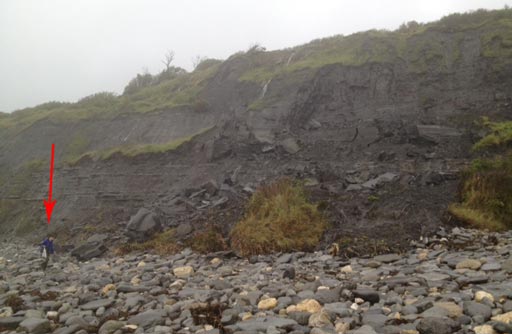
Frequent Rock Falls at Lyme Regis

Dangerous conditions for beachcombers.

Picture credit: Brandon Lennon

We have put an arrow on the picture so that the person in the photograph can be seen.  This gives an idea of the scale of the rock fall.

The current weather is making fossil collecting on the beaches around Lyme Regis very hazardous.  At Everything Dinosaur we would urge visitors to keep away from the cliffs and perhaps the best way to enjoy a fossil hunting trip is to take advantage of a guided tour with a professional fossil collector who knows the tides and the beaches in the area very well.

Brandon Lennon provides guided fossil hunting walks, to read more about this activity: Lyme Regis Fossil Walks.

Parts of the UK have already experienced the wettest June on record, July looks to be continuing the trend with the weather forecast for much of the country indicating that further periods of prolonged downpours are to be expected.

For replicas of ammonites and belemnites and other iconic creatures from the fossil record: Iconic Creatures from the Fossil Record (Models and Figures).

6 07, 2012

Bad Weather Making Fossil Collecting at Lyme Regis Hazardous

By |2023-02-02T09:08:08+00:00July 6th, 2012|Categories: Dinosaur and Prehistoric Animal News Stories, Educational Activities, Palaeontological articles|0 Comments

Rock Falls on Monmouth Beach

The heavy rainfall that has occurred along the south coast of England over the last few weeks has led to dangerous conditions for fossil collectors as they search along the beaches of Lyme Regis on England’s “Jurassic Coast”.  The cliffs at Lyme Regis are inherently unstable and rock falls are an ever present hazard for beachcombers as they search for ammonites and belemnites.  However, with the dreadful summer weather set to continue the cliffs are becoming saturated and rock falls and slides are more likely to occur. Fossil collecting at Lyme Regis can be dangerous in this weather.

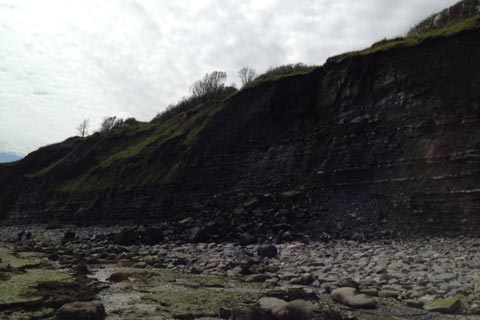
A Recent Rock Fall on Monmouth Beach

Unstable cliffs pose a threat to beachcombers.

Picture credit: Brandon Lennon

Fossil Collecting at Lyme Regis

Local fossil expert Brandon Lennon reports that there have been several small rock falls in the Lyme Regis area over the last few days.  Brandon, who leads fossil collecting walks at Lyme Regis, commented that the cliffs at Monmouth beach were particularly unstable at the moment and yesterday (July 5th), there was a substantial rock fall with a number of sizeable boulders hurtling down onto the beach.

Brandon stated:

“The beach areas are particularly dangerous at the moment and I am concerned for the safety of visitors who come to Lyme Regis to explore this part of the Jurassic coast.  The bad weather has made the cliffs very unstable and I have already observed one large landslide that resulted in many tonnes of boulders and debris smashing onto Monmouth beach.”

The last major landslide in the area took place in May 2008, with over one hundred yards of cliff face collapsing.  Fortunately, this rock fall took place late in the evening at high tide so there were no casualties, but with thousands of would-be fossil hunters likely to hit the beaches at Lyme Regis with the onset of the Summer holidays, conditions exist for there to be a very serious incident.

A spokesperson from Everything Dinosaur commented:

“Whilst looking for fossils along the beaches of Lyme Regis can be tremendous fun, on no account should visitors stand directly under the cliffs and day trippers would be well advised to heed the warning signs and take advice from local experts who know all too well the hazards in the area”.

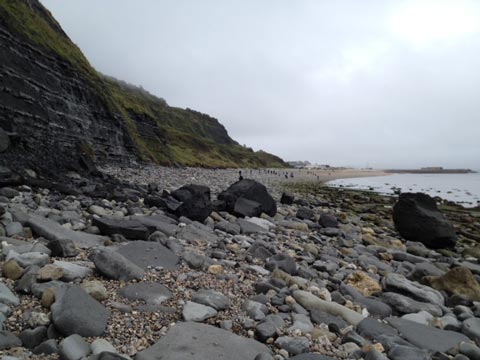
A Large Rock Fall on Monmouth Beach

Dangerous cliffs at Lyme Regis.

Picture credit: Brandon Lennon

One of the best ways to enjoy this part of the Jurassic Coast, a UNESCO World Heritage site, is to take advantage of a guided fossil walk where a professional fossil collector takes parties of visitors out to explore the beaches.  The guide can supervise the fossil hunting and take participants to less dangerous areas whilst still guaranteeing some exciting fossil finds.

To learn more about the fossil walks provided by Brandon Lennon (particularly suitable for families): Lyme Regis Fossil Walks.

4 07, 2012

Theropod Eggs Correlate Directly with Modern Bird Eggs According to New Study

By |2024-04-23T16:10:32+01:00July 4th, 2012|Categories: Dinosaur and Prehistoric Animal News Stories, Educational Activities, Palaeontological articles|0 Comments

Spanish Fossilised Eggs show Strong Link between Theropoda and Aves

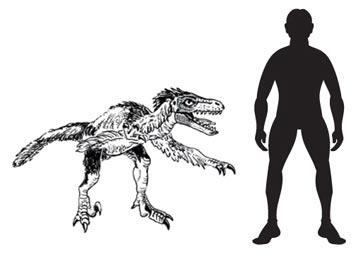
Palaeontologists have been aware for some time, of the close anatomical links between certain members of the lizard-hipped dinosaurs known as the Theropoda and modern birds.  A great deal of evidence has been compiled to show that certain types of dinosaur such as the Dromaeosauridae, the raptors, were closely related to Aves (birds).  Scientists know for example, that many small, meat-eating theropods such as members of the Dromaeosauridae, dinosaurs such as Microraptor and Sinornithosaurus were covered in feathers, but there are also striking similarities between the skeletons of birds and the fossilised bones of these types of dinosaur. New research suggests that theropod eggs were extremely similar to modern bird eggs.

Some Types of Dinosaur were Feathered

Feathered dinosaurs.

Picture credit: Everything Dinosaur

Dinosaurs and Birds

The link between dinosaurs and birds is not a new theory in palaeontology.  Granted, there have been a number of startling discoveries made of feathered dinosaurs, most notably in the Lower Cretaceous strata of Liaoning Province (northern China).  It was the likes of Thomas Henry Huxley who first proposed the dinosaur/bird link.

Thomas Henry Huxley was an English biologist and an ardent supporter of Darwinism.  When Sir Richard Owen purchased a nearly complete specimen of Archaeopteryx (A. lithographica) in the 1860s, Huxley used this fossil to support Darwin’s theory of natural selection and declared the Archaeopteryx specimen as a “transitional fossil” between reptiles and the evolution of birds.

However, one of the gaps in our knowledge regarding the relationship between certain members of the Dinosauria and the Order Aves, concerned the shape and composition of the eggs that these types of creatures laid.  A number of different shapes and sizes of dinosaur egg are known from the fossil record, but those fossil eggs ascribed to theropods do not closely resemble the shape of a modern bird’s egg such as the type of egg that a chicken would lay.  Typically, a small-meat eating dinosaur might produce relatively elongated eggs, not the ovoid shape that we are used to when we see a bird’s egg.

The discovery of the remains of dinosaur eggs in north-eastern Spain may change all that, as these eggs do resemble those of a modern bird.

Theropod Eggs

Nieves Lopez Martinez, a palaeontologist at the Complutense University of Madrid (Spain), with a doctorate in geology and biology, had been researching into the strange, ovoid and asymmetrical fossil eggs that had been found in the Montsec area of Lleida in north-eastern Spain.  Sadly, she passed away in December 2010.  Her work and that of her colleague Enric Vicens, a palaeontologist at the Universitat Autonoma de Barcelona (Spain), has just been published.  Their extensive research provides strong evidence linking theropod dinosaurs to modern birds, as the eggs found in Spain are very similar in shape and composition to those of extant birds.

The eggs were excavated from two dig sites, located on either side of the Terradets pass.  The strata in this part of Spain represents sediments laid down at the very end of the Cretaceous (Campanian and Maastrichtian faunal stages).  A number of different types of dinosaur are known from this strata – ornithopods, theropods and titanosaurs.  The geological record in this part of Spain is very important, as it is providing scientists with an insight into the flora and fauna that existed in Europe at the very end of the Age of Dinosaurs.

To read an article about “giant dinosaur eggs” being discovered: World’s Largest Dinosaur Eggs – The Facts are Scrambled.

Although, the scientists cannot determine exactly what sort of dinosaur laid the eggs, they have postulated that they were produced by a troodontid a type of dinosaur, closely related to birds.  Troodonts were small, agile, bipedal predators.  The egg fossils, which consist of many fragments plus some complete eggs have been given the scientific name of Sankofa pyrenaica.  The genus name relates to an ancient bird symbol which shows a bird looking over its back with an egg that has just dropped from its mouth.  The species name relates to the fact that the fossils were found in a part of the southern Pyrenees mountain chain.

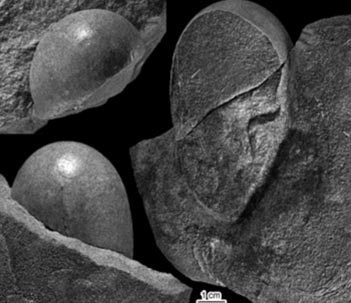
Some of the Fossilised Dinosaur Eggs (S. pyrenaica)

Oval-shaped and asymmetrical like a chicken’s egg.

Approximately seventy million years ago, this part of Spain was a low-lying coastal zone with many shallow lagoons that were bordered by lush, dense forests.  A number of fossils of dinosaur eggs have been found in this area, it seems that a number of different types of dinosaur laid eggs on the raised beaches that made up this coastal zone, but most of the fossil eggs found to date are large, rounded Titanosaur eggs.  These eggs are very different, measuring just seven centimetres high and with a diameter of approximately four centimetres.  The eggshell is roughly the same thickness of that of a hen’s egg.  The scientists measured the fossilised eggshell and found it to be around 0.27 mm thick.

Sectional Analysis of Theropod Eggs

Sectional analysis of those eggs that had been preserved intact showed that at the wider end of the egg there was a substantial air pocket.  Such air pockets are found in modern bird eggs.  If you take a hen’s egg and place it in water, a fresh egg will sink but it will have a degree of buoyancy.  The buoyancy is provided by a small air space contained within the egg.  The pocket of air allows the organism inside the egg to breathe during the last phases of its development prior to hatching.

Such oval-shaped, asymmetrical eggs are extremely rare in the Cretaceous fossil record.  The Spanish researchers related the shape of their eggs to that of a Late Cretaceous bird whose fossils have been found in South America.  The research team postulated that this bird and their dinosaur both laid eggs that were intermediate between modern bird eggs and those eggs laid by extinct non-avian theropods.

A microscopic analysis of the fossil eggshell of Sankofa pyrenaica did reveal significant differences in the shell structure when compared to that of a modern bird’s egg.   Bird and most reptile eggshell is composed almost entirely of calcium carbonate, the structure of the crystals and how they are organised in a bird’s egg differs from that seen in the internal structure of the eggshell ascribed to S. pyrnenaica.

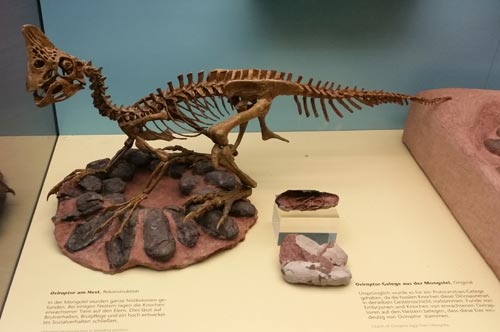
The shape of an egg is dictated largely by the physiology of the organism that lays those eggs.  Asymmetry in bird eggs relates to the fact that birds only have one oviduct, they can only form one egg at a time as a result.  Most dinosaur nests show that eggs were laid in pairs, indicating that these animals had two oviducts.  Scientists believe that modern birds lost the second oviduct as an evolutionary response to the need to lighten their bodies so as to make powered flight more efficient.  The asymmetrical shape of the Spanish dinosaur eggs suggest that Sankofa pyrenaica also possessed just a single oviduct.

A Dinosaur Nest (Eggs Laid in Pairs)

An Oviraptor and dinosaur eggs exhibit.

An Oviraptor and its nest.

Picture credit: Everything Dinosaur.

This fossil evidence strongly supports the theory that certain clades of dinosaur were indeed very closely related to birds.  Parts of the Dinosauria and Aves are very closely phylogenetically related.

Extrapolating this evidence, the next time you eat a boiled egg you are technically eating the egg of a creature very closely related to a dinosaur – or given the location where these fossil eggs were found, would you prefer a Spanish omelette?

Visit Everything Dinosaur: Our Award-winning Website.

3 07, 2012

Megalosaurs join the Dinosaur “Tufty” Club

By |2023-02-02T08:03:00+00:00July 3rd, 2012|Categories: Dinosaur and Prehistoric Animal News Stories, Palaeontological articles|0 Comments

German Fossil Discovery Suggests all Meat-Eating Dinosaurs May have been Feathered

The discovery of a beautifully preserved and very nearly complete fossil of a baby meat-eating dinosaur in Germany has ruffled a few feathers in the field of palaeontology.  An analysis of this baby member of the theropod group known as the Megalosauridae, shows that this youngster had bristle-like feathers covering its body.  This is the first time evidence of a feathered dinosaur from the megalosaur clade has been detected and the first time a fossil of a feathered dinosaur has been found in Europe.

Megalosauridae

Most scientists accept that a number of dinosaurs were indeed feathered.  The feathers were not for flight, but the main function seems to have been to help insulate these active animals, to help keep them warm.  However, most feathered theropod fossils had been up to now associated with the Liaoning deposits of northern China.  This strata represents sediments laid down in the Early Cretaceous.  In addition, feathered theropods known to date are ascribed mostly to the Coelurosauria, this new discovery suggests that other types of theropod, a megalosaur, also might have possessed feathers.

To read about the recent discovery of a dinosaur related to T. rex that also may have been feathered: The One Tonne Basal Tyrannosaur.

Dr Oliver Rauhut, conservator at the Bavarian Collection for Palaeontology and Geology studied the 98% complete fossil along with colleagues and their findings have just been published in the American scientific journal “The Proceedings of the National Academy of Sciences”.

A spokesperson from Everything Dinosaur stated:

“This is an amazing fossil, it looks too good to be true, as if it has been carved into the rock, but detailed tests have proved that this is indeed the fossilised remains of a baby dinosaur from the Late Jurassic”.

The Beautifully Preserved German Dinosaur

Baby dinosaur covered in feathers?

Picture credit: Dr Helmet Tischlinger

The seventy-two-centimetre-long baby shows typical juvenile traits such as the disproportionately large head and the presence of large orbits (eye-sockets) in the skull.  The fossil represents a new species of Tetanuran (stiff-tailed) theropod dinosaur, it has been ascribed to the megalosaurs and given the scientific name Sciurumimus albersdoerferi.  The genus name is derived from “Sciurus” – for squirrel;  a reference to the filamentous structures seen around the long tail under ultra-violet light.  It seems that this little dinosaur may have had a bushy tail just like a squirrel.  The specific name honours the private collector who helped bring this fossil discovery to light.

Very few of the bones are missing so the research team had the opportunity to study an almost complete dinosaur skeleton, perhaps one of the most complete ever found and certainly the most complete specimen of a theropod dinosaur found in Europe to date.

The actual fossils were recovered from a limestone quarry in Southern Germany, (Bavaria).  Although the research team can’t be sure how this baby dinosaur met its end, but its near perfect preservation and discovery in marine deposits suggest that this youngster drowned.

Once subjected to ultra-violet light, the remains of skin and the fibrous filaments that covered this animal’s body can be picked out.

Exposing the Fossil of Sciurumimus albersdoerferi to UV Light

A feathered baby megalosaur.

Picture credit: Dr Helmet Tischlinger

Dr Tischlinger, one of the authors of the study commented:

“Under ultraviolet light, one can see the remains of skin and the plumage as luminous spots and fibres on the skeleton.”

The scientists are unable to calculate just how big S. albersdoerferi would have been when an adult, although other types of megalosaur dinosaur were apex predators in Europe during the Late Jurassic and some members of this clade reached lengths in excess of six metres and weighed more than a 1,000 kilogrammes.   The German team have been able to write a paper on an exceptionally preserved baby dinosaur skeleton, a noncoelurosaurian theropod that had filamentous plumage at the base of its slender tail and elsewhere on its body.

Sciurumimus albersdoerferi

The filaments are similar in structure to the bristle-like structures found on the ornithischian dinosaur Psittacosaurus,(from Mongolia and China), as well as being similar to the primitive tyrannosaur Dilong and the therizinosaur Beipiaosaurus (both also Chinese dinosaurs).  As a European dinosaur, this new fossil find, will help scientists to piece together the relationship between different types of dinosaur and the different types of integumentary structures found in the Dinosauria.

For Everything Dinosaur team members, there are a number of other important elements to this particular fossil, not just the presence of feathers.  For example, this is a baby dinosaur fossil and such fossils are extremely rare.  The small bones of baby dinosaurs are seldom preserved in the fossil record and to have the chance to study such a complete specimen was described by one team member as “simply astonishing”.  We are not sure what the Reverend William Buckland, who was given the task of naming and describing the first dinosaur, ironically another megalosaur (Meglosaurus bucklandii), would have made of this new discovery, however, it is helping to clear up some of the issues relating to megalosaur classification.  The complete absence of a fourth digit on the hand is assisting scientists as they clarify the anatomical details that pertain to the megalosaurs as members of the Tetanurans.

The jaws show the teeth in such detail that the research team have been able to see that the teeth of this baby megalosaur are remarkably similar to the teeth of basal coelurosaurs.  This suggests that a number of dinosaur discoveries may have been misidentified in the past, with isolated fossilised teeth being ascribed to the coelurosaurs when they could actually have belonged to a megalosaur.

A fascinating discovery, one that will yield more secrets no doubt, but for the moment we at Everything Dinosaur are just happy to see a member of the Megalosauridae in the dinosaur “tufty” club.

To view Megalosaurus models and other dinosaur figures: Megalosaurs and Theropod Dinosaur Models (CollectA Age of Dinosaurs).

2 07, 2012

Observation is Important in Palaeontology

By |2024-04-23T16:15:03+01:00July 2nd, 2012|Categories: Dinosaur and Prehistoric Animal News Stories, Educational Activities|0 Comments

Can you spot a Fossilised Hominid Tooth?

Observation is very important in science, whether you are looking for the Higgs Boson or simply conducting an experiment with Primary school children to see what happens when you deny some germinating cress seeds access to sunlight.  It is important that appropriate observations are made and that these are recorded properly. Observation is key in palaeontology.

When taking a group of young, enthusiastic palaeontologists fossil hunting we demonstrate to them the two main advantages over us “grown ups” when it comes to finding fossils.  Firstly, the children being smaller than us are closer to the ground and this is where the fossils can be found.  Secondly, as they are younger than us, there us are generally better able to focus on small objects, therefore they can spot fossils better than we can.

Observation is Key in Palaeontology

Most fossils are still found by people who are not palaeontologists, we make a point to emphasis the important discoveries made by children as we enthuse them about the Earth sciences.  Observation for a fossil hunter is extremely important.  It is not just a case of knowing where to look but also knowing what to look for.

To illustrate this point, let us recall an event that took place recently in a laboratory at the Witwatersrand University in South Africa.  The University is a world-leader in early hominid research and has led the way in helping to unravel the evolution of a two million year old hominid species known as Australopithecus sediba.

To read an article on the early hominin A. sediba: New Fossils May Help Define Human Ancestry.

Revision of the Hominin Family

The hominin family tree is constantly being revised as more fossil material is discovered.  The Australopithecines were an early group of hominins that evolved around 4.2 million years ago and went extinct around 1.8 million years ago.  A number of species have been described, their exact taxonomic relationship to our own species is debated.  Researchers at the Witwatersrand University (Johannesburg) had brought back to their preparation laboratory a number of rocks and fossils from a site where A. sediba fossils had been found.

However, for three years a large, one-metre wide rock lay undisturbed in the laboratory until a technician observed a tiny, whitish object sticking out of the matrix.  The turned out to be a fossil tooth of Australopithecus sediba and computerised tomography (CT) scans of the rock revealed that hidden inside were a number of fossilised bones of this early hominin.  Observation had resulted in the discovery of very rare and important fossil material, in a rock that had been in the laboratory and under people’s noses as it were for years.

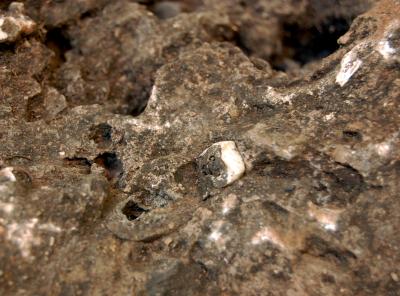
Can you spot the tooth in the rock?

Can you spot the Fossilised Tooth in the Rock?

Observation is very important in palaeontology.

Picture credit: University of Witwatersrand (Johannesburg)

Tooth Spotted in Rock

If the tooth had not been spotted the rock may not have been studied and the chance to learn more about one of the Australopithecines may have been missed.  As we say when we are teaching primary school children, the most important tool that a palaeontologist has are his or her eyes.  Careful observation can help us to uncover a lot of fascinating information as well as enabling us to spot fossils, even a fossil tooth from a 2-million-year-old, potential ancestor of our own species.

The Tooth Highlighted – Did you Spot It?

The tooth fragment i is circled in red.

Picture credit: University of Witwatersrand with additional input from Everything Dinosaur

For creative palaeontology themed crafts: Educational Dinosaur Themed Crafts and Toys.

Next time you are walking along a beach or wandering past a cutting in the road, take a good look you never know what you might find.

To read the article on the discovery of the fossil material inside the rock: Scientists Discover Amazing Early Human Fossil in Laboratory.

Go to Top