All about dinosaurs, fossils and prehistoric animals by Everything Dinosaur team members.

Fossil finds, new dinosaur discoveries, news and views from the world of palaeontology and other Earth sciences.

3 08, 2012

A Surge in Mountain Building Led to Dinosaur Diversification

By |2023-03-08T13:32:17+00:00August 3rd, 2012|Categories: Dinosaur and Prehistoric Animal News Stories, Palaeontological articles|0 Comments

Geological Processes Led to the Huge Variety of Horned and Duck-Billed Dinosaurs in North America

Over the last twenty years or so, palaeontologists studying the Late Cretaceous fauna of North America have discovered an amazing variety of ornithischian dinosaurs in strata laid down between 80 million and 70 million years ago.  A number of horned dinosaurs such as Vagaceratops, Utahceratops and Kosmoceratops as well as a number of new genera of hadrosaurs (duck-billed dinosaurs) have been described from western North America.

Most palaeontologists have been focused on mapping the faunal distribution and studying the myriad of new plant-eating dinosaur species that have been found, but a number of scientists are now turning to the mystery of why so many different types of dinosaur evolved in this part of the world during the last few million years of the Cretaceous.

Utahceratops – Part of Dinosaur Diversification

Late Cretaceous dinosaur diversification in North America.

Picture credit: Everything Dinosaur

Late Cretaceous Fauna

For one team of researchers based at Ohio University, the explanation as to dinosaur diversity lies in the geology.  The rise of the Rocky Mountain range and the appearance and then disappearance of a huge, inland seaway that split North America into a series of islands, may have been the catalysts for an explosion in megafauna diversity.  The research team from the University’s Heritage College of Osteopathic Medicine have had their paper published in the on line scientific journal PloS One (public library of science).   They state that the rapid changing geology led to populations of animals being isolated which may explain the patterns of evolution, migration and rapid dinosaur diversification.

The presence of different dinosaur faunas in different parts of North America is referred to as provinciality by Everything Dinosaur team members.

Terry Gates, the lead author of the paper and a post-doctoral student at the University commented:

“Over the past century, palaeontologists have found a wide variety of dinosaurs in rocks dating to around 75 million years ago, but right before the asteroid hit at the end of the Cretaceous, there appeared to be fewer species in North America.  The reason for this discrepancy in dinosaur diversity has never been adequately explained.”

The research team set out to examine the geological record of what was to become the continent of North America, focusing on the United States and Canada.  During the Campanian faunal stage of the Cretaceous, a time in the Earth’s history that roughly relates to 83 million years ago to 74 million years ago there was extensive plate tectonic activity that led to mountain ranges being pushed up and the sinking of much of the continental landmass under an inland sea (known as the Western Interior Seaway).  At its most extensive, this seaway covered much of North America from Canada to the Gulf of Mexico.

Dinosaur Diversification

In the later Maastrichtian faunal stage, that lasted from 74 million years ago up until the mass extinction event 66 million years ago, there was less extensive plate activity.  This coincided with a decline in the number of genera of dinosaur known from the fossil record.  Palaeontologists have interpreted this as evidence as a fall in the number of dinosaur species living in North America towards the very end of the Cretaceous – dinosaur genera became less diverse.

Ornithischian Dinosaur Diversity (Horned and Duck-Billed Dinosaurs)

Rapid diversification of ornithischian dinosaurs in the Late Cretaceous.

Diagram credit: Lindsay Zanno/Ohio University

The diagram above illustrates the diversification of the horned and duck-billed dinosaurs during the Late Cretaceous.  Scientists postulate that this rapid speciation occurred as a result of high sea levels and mountain formation.  The geologic time scale is to the left of the diagram, with horizontal green divisions representing the Campanian (lower) and Maastrichtian (upper) time periods.  Silhouettes of North America demonstrating areas covered by ocean water during each of the time periods are to the right along with triangles designating the relative size of both the Western Interior Seaway and the Laramida mountain range.

Finally, the fork within the duck-billed (black) and horned (grey) dinosaur family trees show the coinciding time (yellow bar) of a major split within each group of dinosaurs.

To read a related article on dinosaur diversification in North America: Ethnicity in North American Dinosaurs.

Geologists have calculated that during the Early Cretaceous there was a substantial amount of geological activity in the western United States.  A number of processes involving subduction, the movement of ocean crust down into the Earth’s mantle occurred along what was to become the western coast of North America.  These immense geological forces caused the western part of the Americas to be lifted up and this led to the formation of an enormous mountain range that extended from Alberta (Canada) in a south-western direction to as far south as the southern United States.

The region to the east of this newly formed mountain range (the Sevier Mountains), flexed downwards and this coincided with a rise in global sea levels, flooding much of the continent and splitting what land remained above sea level into a series of large islands.  This sea (Western Interior Seaway), teemed with life and the marine deposits left behind in places as far apart as Alberta and Kansas have provided palaeontologists with an amazing variety of marine reptile fossils to study – Dolichorhynchops, elasmosaurs and huge mosasaurs such as Tylosaurus.

The Ohio based research team have focused on the dinosaur fossils that have been found in association with the islands.  At its most extensive, the Western Interior Seaway split the North American land mass into three large islands.  These islands each had a substantial and diverse population of ornithischian dinosaurs.

For replicas and models of Late Cretaceous ornithischians and other dinosaurs: Ornithischian and Other Dinosaur Figures.

Geographic and Ecological Barriers

The most western of the islands, known as Laramidia consisted of land that was to form Alberta in the north with the American states of Dakota and Montana in the middle with the land that was to become Utah forming the southern part of the island.  Formations laid down in the north of this island, the famous Dinosaur Provincial Park for example, have provided palaeontologists  with a huge range of horned and duck-billed, ornithischian dinosaurs.  Fossils found in Utah, animals such as the horned dinosaurs Kosmoceratops and Utahceratops from rocks of roughly the same age, indicate that different types of plant-eating dinosaur evolved in the south.

The Ohio University scientists have postulated that mountain building and the rising sea levels caused the available habitat for dinosaurs to shrink on Laramidia.  Populations became isolated and this was further compounded by later plate tectonic movements that led to the nascent development of what was to become the North American Rockies.

Prieto-Márquez, a Munich based palaeontologist who collaborated on the scientific paper states:

“At that time [Campanian faunal stage], it appears that geographic, as well as probably also ecological, barriers created by the rise of mountain ranges and the seaway caused isolation of the northern and southern populations of the crested duck-billed and horned plant-eating dinosaurs.  We hypothesise that such isolation facilitated rapid speciation and increased diversity in these animals.”

The team postulate that a new species of large, ornithischian dinosaur evolved every few hundred thousand years during the time that the mountain ranges and the Western Interior Seaway isolated populations.  These geological processes led to a rapid burst of dinosaur evolution in these cut-off populations, in the same way that the isolated populations of animals in the Galapagos archipelago rapidly diversified into new species.

The Changing Face of North America During the Late Cretaceous

North America 75 million years ago and 66 million years ago.

Picture credit: Dr Ron Blakey of Colorado Plateau Geosystems, Inc

The maps above show North America 75 million years ago, with the Western Interior Seaway cutting the land mass into a series of islands (A).  This is compared to the continental land mass approximately 66 million years ago with the seaway having retreated.

However, this extensive speciation of mega-herbivores was brought to an end with the continued rise of the embryonic Rocky Mountains which eventually forced the Western Interior Seaway to contract.  This opened up a large, open territory for the ornithischian dinosaurs to exploit.  This reduced the turnover in species with new species evolving at a much slower rate.  New species taking more than a million years to evolve.

The research team warn that their work on the major, herbivorous dinosaur faunas of North America cannot be used as a template to explain the rise and then the decline in dinosaur diversity on a global scale.  However, the rapidly changing geology caused by plate movements would have had an influence over the migration of dinosaurs from the Americas into Asia and into South America.

The rise of the Rocky Mountains for example, would have created a barrier that the dinosaurs could not cross.  Only dinosaur species resident north of this barrier could have migrated into Asia and only those species living in the southern part of Laramidia would have had a migration route open to them to South America.

It is also worth noting that a long, thin island such as Laramidia would have had different climates.  The most northerly part of the island was at a much higher latitude than the southern parts.  This may have encouraged different vegetation to flourish and this too, might help to explain the diversity of herbivorous dinosaurs in the region, with each species adapting to exploit a particular niche in the eco-system.

Everything Dinosaur acknowledges the help of Ohio University in creating this article.

2 08, 2012

Japanese Scientists Identify Rare Dinosaur Skin Impression

By |2024-04-24T16:29:37+01:00August 2nd, 2012|Categories: Dinosaur and Prehistoric Animal News Stories, Dinosaur Fans|0 Comments

Dinosaur Skin with Fine Scales or Is it a Dinosaur Fossil at All?

Japanese scientists have published a description of a dinosaur skin impression found in Kumamato Prefecture (Japan).

The country of Japan is not well-known for its dinosaur fossils.  Situated on the notorious “ring of fire” in the Pacific, the islands that make up Japan are subjected to considerable seismic forces.  However, a number of important dinosaur discoveries have been made by geologists and palaeontologists as they study sedimentary rocks laid down in the Mesozoic Era.  Isolated teeth representing a yet unknown genus of  large theropod (meat-eating) dinosaur have been found in Hakusan, Ishikawa Prefecture on the northern coast of Japan’s main island.

The teeth have been dated to the Early Cretaceous and they suggest that if there were apex predators living in the area that was to form the islands of Japan then there would have been a substantial and thriving dinosaur-based eco-system with many more types of plant-eating dinosaur for the large carnivores to prey upon.  Fossils of giant plant-eating dinosaurs known as sauropods have also been found, most notably a fragmentary fossil of a leg bone from a huge, long-necked dinosaur.   Representatives from the Palaeontological Society of Japan reported on the finding of a huge sauropod femur (the thigh bone of a sauropod).  This single fossil represents the largest type of dinosaur found in the country to date.

To read about the discovery of the giant dinosaur femur: Sauropod Femur Discovered in Japan.

Dinosaur Skin Impression

Japanese scientists have just published the description of a remarkably well-preserved fossil which shows the imprint of a dinosaur’s skin.  The fossil measures a little under twenty centimetres in length and eleven centimetres wide at its widest part.  Although the discovery of a dinosaur skin impression has yet to be confirmed, if the find is validated then this is only the second time that an impression of a dinosaur’s skin has been found in the country.

The fossil was found in 2001 by an amateur fossil hunter, exploring a series of ninety-eight-million-year-old, fine sandstone deposits in Amakusa, Kumamato Prefecture.  It actually consists of two pieces, as the fossil had been broken up as a result of weathering at the site. The first section the forms the top, right portion of the fossil was found and then a few months later the second part of the fossil, representing the larger, lower portion of the fossil material was found.

For much of the Mesozoic Era the series of islands that make up the country we now know as Japan lay underwater, however, what land that remained above sea level was part of the eastern coast of Laurasia, a huge, super-continental land mass that covered much of the Northern Hemisphere since its formation in the Ordovician geological period.  It was only during the Tertiary period that the string of volcanoes that make up the Japanese islands was pushed away from the Asian mainland; eastward by tectonic plate movements.  Since their formation, the Japanese islands have been moved back and forth from the Asian mainland as the landmass is pushed and pulled by the plate movements.

The Fossil of a Reptile’s Skin (possible Dinosauria)

Possibly an impression of dinosaur skin?

Picture credit: Goshonoura Cretaceous Museum

The skin impression shows fine detail.  The impression of individual, polygonal shaped scales can be clearly seen. The scales are approximately two millimetres in diameter.  Palaeontologists have speculated that since the fine strata in which the fossil was found represents a tidal flat deposit, a dinosaur may have rested on the tidal flats and left a skin impression which was eventually fossilised.

What Sort of Dinosaur?

It is not known what sort of dinosaur may have left this skin impression.  Experts at the Fukui Prefectural Dinosaur Museum have examined the fossil skin imprint and they have suggested that this impression may have been made by a hadrosaur (duck-billed dinosaur) or the skin impression may not represent dinosaur fossil material at all.  A number of duck-billed dinosaur fossils have been found in Japan and palaeontologist know from fossils found elsewhere in Asia from rocks of the same age that hadrosaurs were abundant.

It is possible the fossil could represent evidence of a duck-billed dinosaur resting on a sandbank, however, it is perhaps more likely that this is the skin impression left behind by another reptile, not a dinosaur at all.

Crocodiles are often seen today basking on sand banks.  During the Cretaceous there were many crocodile-like creatures that probably had similar habits.  Palaeontologists have proposed that it is more likely that the skin impression was made by a member of the Choristodera such as a champsosaur.

Typical Champsosaur-like Models

An Impression of Champsosaurs – perhaps the skin impression belongs to one of these reptiles.

Picture credit: Everything Dinosaur

Whether the fossil represents dinosaur material or not, it is the best preserved skin impression yet found in Japanese Cretaceous strata.  The Chief Researcher at the Fukui Dinosaur Museum has heralded the find as significant stating that this is the first fossil in Japan that shows reptilian scales clearly.

It is likely that once the examination has been completed the specimen will be put on display in a museum close to where the two fossil pieces were actually discovered.

To view models of dinosaurs and other prehistoric animals: Safari Limited Models – Prehistoric World.

30 07, 2012

Australian Palaeontologists Excited About Potential Queensland Discoveries

By |2023-02-03T13:08:55+00:00July 30th, 2012|Categories: Dinosaur and Prehistoric Animal News Stories, Dinosaur Fans|0 Comments

Palaeontologists Announce New Fossil Finds

The small town of Winton in western Queensland (Australia) is buzzing with excitement as a team of Australian palaeontologists have announced the discovery of about fifteen dinosaur bones that may represent a new species.  Over the last twenty years or so, Winton has become the centre of Australia’s very own “dinosaur gold rush” with a number of exciting dinosaur discoveries being made as fossils weather out of the Cretaceous-aged strata.

The Winton Formation (named after the town) has provided palaeontologists with a whole host of exciting dinosaur discoveries including Australia’s very own super-predator the vicious and agile Australovenator (Australovenator wintonensis) which is believed to be a type of allosaur.

An Illustration of the “Aussie” Super-Predator (A. wintonensis)

Vicious dinosaur from “Down Under”.

Picture credit: Everything Dinosaur

Already a “Hot Spot” for Cretaceous dinosaur discoveries, the latest fossil finds from the Winton area are fifteen dinosaur bones, including a beautifully preserved but very fragile femur (thigh bone) that has already been partially excavated by the scientists.

As Australia is in the Southern Hemisphere, it is winter time.  The temperatures in and around the Winton area are much lower than they would be in high summer, so this is the time of year when a lot of field work takes place.  A number of research groups are currently working in the area and a spokesperson from Everything Dinosaur said in a statement:

“The fossil discoveries that have been made in western Queensland are providing palaeontologists with a better understanding of the diversity of the Dinosauria on southern continents around 100 million years ago.  It is very likely that new dinosaur species will be unearthed as the field teams continue their work.  When you consider the size of the potential fossil field, then you could say that so far the palaeontologists have only just scratched the surface and there is probably a lot more exciting fossils awaiting discovery.”

To read an article about the discovery of dinosaur fossils in the Winton area: A Trio of Dinosaurs from Down Under.

Everything Dinosaur stocks an extensive range of prehistoric animal figures based on fossil discoveries in Australia.

To view this range: CollectA Deluxe Theropod and Dinosaur Models (Scale Models).

28 07, 2012

Dinosaurs at the Olympics – Celebrating a Special Occasion

By |2024-04-24T15:24:40+01:00July 28th, 2012|Categories: Dinosaur and Prehistoric Animal News Stories, Dinosaur Fans, Everything Dinosaur News and Updates|2 Comments

How Would Dinosaurs Cope in Olympic Events?

With the London Olympics starting, the thirtieth running of the modern Olympiad and the third time that London has hosted the games, we can expect to see a number of records broken over the next sixteen days or so.  Team Great Britain has the most number of athletes taking part but what would happen if we allowed dinosaurs to compete in certain events.  How would the medal table look if there were dinosaurs at the Olympics?

Dinosaurs at the Olympics

Take for example gymnastics.  Although most of the general public would not think of dinosaurs as natural gymnasts some species may have been very at home on gymnastics apparatus. An agile dromaeosaur such as a Velociraptor, the tiny Bambiraptor, or even a flying Microraptor could excel at a number of gymnastic disciplines.  Granted the floor exercises may prove a little difficult, but as palaeontologists believe that one of the roles of feathers on these animals was for visual display, we could be treated to a “dromaeosaur dance” featuring lots of leaping, flapping of arms and bobbing about.

Forward rolls and hand springs would most likely be beyond even the most agile of these small, lightweight dinosaurs but from studies of their leg bones, they could certainly run faster than a human gymnast and they could probably jump very high.  These dinosaurs had an excellent sense of balance and some of them were probably capable climbers at home in the trees, so the parallel bars would prove no obstacle.

Giganotosaurus would have made an excellent super-heavyweight weight lifter.  Its arms were more powerful, longer and stronger than most other meat-eating dinosaurs except the spinosaurids.  Palaeontologists estimate that its jaws were so strong and its neck muscles so powerful that it could pick up and carry a medium sized dinosaur in its mouth.

According to the Guinness Book of World Records (2012 edition), the world record for the snatch in the 105 plus kilogrammes weight category for men is an incredible 213 kilogrammes achieved by Hossein Rezazadeh (Iran).  Although Giganotosaurus is much heavier (about 75 times as heavy), scientists have estimated that it could have picked up more than a tonne with its super-strong  jaws.

Dinosaurs Compared with Athletes – Gold Medal Winner for Weightlifting?

Spinosaurus - a gold medal winner.

The strong arms of spinosaurids might give them an advantage in the Olympic weightlifting.

Picture credit: Everything Dinosaur

Turning to track and field, one of the most keenly anticipated Olympic events is the men’s one hundred metres.  The Olympic champion and current world record holder is Usain Bolt of Jamaica.  The Jamaican sprinter covered one hundred metres in an astonishing time of 9.58 seconds in Berlin on the 16th of August 2009.  This means that he would have averaged something like 23.35 miles per hour over the course of that race.  Compared to most dinosaurs this is pretty quick.  For example, an adult T. rex running in a straight line with a running start would probably complete a one hundred metres race in approximately 13.5 seconds.

A Diplodocus, a huge, plant-eating dinosaur, despite having an enormous neck with which it could break the tape at the finishing line would have probably taken more than fifty seconds to cover the distance, not withstanding the fact that it would probably have stopped to graze on the infield area along the way.

The real speed kings of the Dinosauria were the ornithomimids.  Ornithomimids (known as “bird mimics”) were theropod dinosaurs related to the likes of T. rex but anatomically similar to modern, ground-dwelling birds.  With a light, compact skeleton and long hind legs these animals were very fast runners.  Estimates of how fast these dinosaurs were vary.

However, based on ornithomimid tracks found in the United States, palaeontologists estimate that these reptiles may have been capable of bursts of speed up to sixty kilometres an hour, that is race horse speed.   An ornithomimid could therefore complete the one hundred metres in something like six to eight seconds, given the time it would have taken for this animal to get into top gear.

To read an article about how fast dinosaurs could run compared with humans and other animals: T. rex could run faster than a footballer.

Competing in the swimming events may have proved more difficult for the Dinosauria.  Dinosaurs could swim just like most vertebrates, but whether or not they liked getting out of their depth is  a different matter.  They would have been limited to a single stroke – their form of doggy paddle and a several tonne dinosaur would not have been very streamlined in the water but thanks to one remarkable trace fossil discovered in Spain we do know that some dinosaurs did take to the water.

A fossilised track-way discovered in Spain records the moment in Jurassic history when a large, carnivorous dinosaur (possibly an allosaurid) swam across a body of water.  Every now and then this huge, bipedal dinosaur put a foot on the bottom and pushed itself off again.  The likes of Rebecca Adlington, Michael Phelps and Ryan Lochte may be faster, but would you fancy going into the pool with a two tonne Allosaurus in the next lane?

To read more about the remarkable Spanish trace fossils: Swimming Dinosaurs.

With thirty-six sports and something like a total of three hundred and four medal events it is likely that the Dinosauria might well have found one or two to excel in.  After all, if they were warm-blooded just as we mammals they were probably far more active and agile than previously thought.

Visit Everything Dinosaur’s medal-winning website for dinosaur models, gifts and toys: Prehistoric Animal Figures, Gifts and Toys.

27 07, 2012

Ancient Snake Slithers into View (New Research is Published)

By |2024-04-24T15:25:17+01:00July 27th, 2012|Categories: Dinosaur and Prehistoric Animal News Stories|0 Comments

Cretaceous Snake Fossil Hints at Serpentes Origins

The evolution of the true snakes (Serpentes) from lizards as part of the Order Squamata (snakes, lizards and their most immediate, common ancestors) is a hotly debated area of vertebrate palaeontology.  There are something like seven thousand extant (living) species of snakes and lizards today.  These animals make up by far the largest proportion of reptiles on Earth, there are more members of the Squamata than all the other types of reptile combined.  Snakes and lizards can be found all over the planet with the exception of the most northerly and southerly latitudes and one or two other locations which owe their lack of native reptile species to a hang over from the most recent Ice Age – Ireland for example.

In the United Kingdom, there are three native species of lizard plus three species of snake, all of which have conservation/protected status.  However, how and when the Serpentes (snakes) evolved as a separate sub-order of the Squamata are questions that a number of vertebrate palaeontologists from around the world are trying to find answers to.

An Ancient Snake

One of the problems faced by the researchers is the lack of fossil material of snakes and their potential ancestors.  Something like one thousand known fossil species of lizards and snakes are known.  These fossils have been found in Africa, the Americas and Asia but in relation to the number of Squamata genera that there must have been in the past, the amount of fossil material found is tiny.  In addition, most of the fossils are fragmentary and as a result it is difficult to establish a phylogenetic relationship – to build a family tree of prehistoric snakes and lizards.  It is likely that compared to lizards, snakes only made up a small proportion of the terrestrial vertebrate fauna during the time of the dinosaurs.

Another problem that is faced by palaeontologists is that despite there being very few fossils to study, it is clear from the fossil remains available that prehistoric members of the Squamata represent a much more diverse group of reptiles than their modern relatives.  Prehistoric Squamata were much more morphologically diverse than their modern representatives.  Take one example, the mosasaurs a group of entirely marine lizards that evolved into a myriad of forms during the Cretaceous geological period.  Whilst dinosaurs dominated the land during the Late Cretaceous, many mosasaur families become the apex predators in marine environments.

One of the most primitive snakes known from the fossil record is Coniophis. This genus of snake was first described and studied by the great 19th Century, American, palaeontologist Othniel Charles Marsh.  The genus was established in 1892.  This primitive snake is known for its small, squarish vertebrae and although fossils ascribed to this genus have been found in North and South America scientists still knew very little about it.

O. C. Marsh was a graduate of Yale University, ironically the research of another Yale University student is helping to shed more light on the Coniophis genus and the origin of the true snakes.  Yale University Postgraduate Fellow and vertebrate palaeontologist Nicholas Longrich, has helped to identify fossil material which has been ascribed to Coniophis (Coniophis precedens), this research helps to shed further light onto the origin of true snakes.

Discovered in a Collection of Fossils

Whilst carrying out some academic research in the process of writing a paper related to lizard extinction at Berkeley University (California, United States), Nicholas came across in the collection some fossils from a primitive snake, including top and bottom jaw material that had never been properly classified.  Until this discovery, found ironically not in the field, but within an existing specimen collection Coniophis precedens had been named based on a study of a single, distinctive backbone (squarish vertebra).

In a paper published in the scientific journal “Nature”, the Yale-based researcher and his colleagues describe Coniophis precedens from the maxilla (upper jaw),  the dentary (lower jaw) and additional vertebrae.  They see this species as a transitional form between lizards and true snakes.  It had a lizard’s head on a snake’s body and it also provides evidence that snakes evolved from burrowing lizards, not from marine lizards as had previously been thought.

The fossils of the “Proto-snake” Coniophis precedens

Piecing together the evolution of modern snakes.

Picture credit: Nicholas Longrich

The picture compares the skulls of extant members of the Squamata with the fossils associated with C. precedens.  The top image is of a Gila Monster, a venomous lizard that can be found in the Americas today. The middle image shows the maxilla and dentary of Coniophis precedens and the picture at the bottom shows the skull and kinetic jaws of a modern Pipe Snake.

Coniophis precedens was very small and unobtrusive in a Late Cretaceous fauna dominated by the dinosaurs.  It did slither with the unique snake locomotion common to all Serpentes today, but it could not unhinge its jaws to feed on animals larger than its jaws are wide.  Study of the jaw bones found in the Californian collection suggest that there was some opportunity for expansion of the mouth as the lower jaw flexed a little, but this “proto-snake” could not unhinge its jaws to feed like modern snakes.  It lacked the hinges in its jaws that allow the jawbones to dis-articulate, this probably limited the snake in terms of what it could actually eat.  The Yale researches speculate that it was the evolution of the ability to unhinge their jaws that led to the radiation of snake species throughout the Late Mesozoic and into the Cenozoic.

Although the snake fossils in the Berkeley collection had been found many years ago, they had not been properly studied and their significance not recognised.  These fossils were found in Wyoming and Montana, from strata that represented a flood-plain.  Finding primitive snake fossils in terrestrial sediments questions the long-held theory that true snakes evolved from marine ancestors.

Commenting on the research work, Nicholas stated:

“Snake fossils are exceptionally rare.  They tend to be very small and very delicate.”

The research team describe the finding of these snake fossils as “significant” but warn against assuming that C. precedens was a direct ancestors of extant Serpentes.  These sixty-five-million-year-old fossil remains date from a time when more evolved types of snake, including constrictors who could unhinge their jaws lived.  The researchers have concluded that the small, burrowing C. precedens shared its flood-plain habitat with more advanced types of snake, it was a “living fossil in its own time”, comment the research team.

With a skull described as intermediate between lizards and snakes, hooked teeth and an inability to open its jaws very wide, the scientists have speculated as to what this creature may actually have fed on.  It has been suggested that it probably ate soft-bodied animals such as worms and grubs that it found as it went through the leaf litter, although it could have tackled small amphibians.

Based on these findings the Yale scientists postulate that it was the development of the hinged, kinetic skull of snakes that enabled them to exploit a much wider range of food sources and this helped the Serpentes to diversify and radiate to create the thousands of species we see today.  The rapid radiation occurred in the Cretaceous (Cenomanian faunal stage?), a time when the dinosaurs still dominated terrestrial habitats but new types of small mammal were evolving.

Interestingly, one of the best known prehistoric faunas during the Late Cretaceous is that which has been established from fossil material found in the Dinosaur Park Formation (Alberta, Canada).  However, snake fossils are virtually absent from this Formation.  Coniophis fossils are known from similar aged strata but have yet to be found in the Dinosaur Provincial Park Formation – another snake-based puzzle for the palaeontologists to ponder.

To view models of ancient squamates including Titanoboa and mosasaurs (whilst stocks last): Rebor Models and Figures – Scale Replicas.

26 07, 2012

Plans to Exhibit Vandalised Hadrosaur Bones at Special Event

By |2024-04-24T15:25:52+01:00July 26th, 2012|Categories: Dinosaur and Prehistoric Animal News Stories, Dinosaur Fans|0 Comments

Shattered Dinosaur Fossils to be Put on Display to Educate the Public

Canadian palaeontologists still angry and upset after the fossilised bones of a dinosaur were deliberately smashed by vandals plan to put the specimen on display so that the public can be educated about the theft and destruction of fossils.  Plans are in place to exhibit the vandalised hadrosaur bones.

Vandalised Hadrosaur Bones

Earlier this month, team members at Everything Dinosaur reported that a duck-billed dinosaur fossilised skeleton discovered near Grande Prairie (north-western Alberta) had been deliberately vandalised with bones smashed and pieces of the specimen scattered.  Unfortunately, there have been a number of incidents reported from Canada over the last few months.

To read more about the attack on the hadrosaur fossils: Vandals in Alberta Smash Dinosaur Skeleton.

Dr Phil Bell, the curator of the new palaeontology museum that is scheduled to open in the town of Grande Prairie had wanted to excavate and prepare the eight-metre-long hadrosaur specimen and have it displayed in the museum,  however, after the attack, plans have been proposed to display the fossils still within their fossil matrix.  This would serve as a reminder of the increasing theft and destruction that palaeontologists have to contend with.

Damaged Ribs and Other Bones

Photographs show a close up view of some fossilised ribs of the hadrosaur specimen, these have been deliberately smashed and broken.  A receipt for a local liquor store may provide a clue to the cluprits identity.  The vandalism incident is currently being investigated by the Royal Canadian Mounted Police.

The site had been mapped on June 15th and several days of excavation and digging followed permitting elements of the arms, vertebrae and ribs to be exposed.  These fossils were carefully covered to protect them whilst the palaeontologists and field workers left the site.  On their return a few days later the team discovered that  much of the site had been attacked by vandals and many of the fossil bones smashed.

A spokesperson from Everything Dinosaur commented:

“This is a terrible incident, unfortunately there have been a number of such attacks reported over recent months.  Let us hope that if the fossil bones are put on display in their shattered state then this exhibit can serve to help educate members of the public and alert them to this very serious problem.”

To view replicas of hadrosaurs and other scale models of dinosaurs: Ornithischian Dinosaur Models (CollectA Deluxe).

Researchers are trying to take what steps they can to safeguard dig sites, but they are hampered in their efforts due to lack of funds.  A few days ago we published an article which explained some of the measures being taken by palaeontologists.

To read more about these measures: Palaeontologists Take Steps to Protect Dig Sites.

25 07, 2012

Woman’s Body Found under Landslide

By |2023-03-09T10:51:28+00:00July 25th, 2012|Categories: Dinosaur and Prehistoric Animal News Stories, Everything Dinosaur News and Updates|0 Comments

Body Found after Dorset Landslide

It has been reported that a body has been found after approximately four hundred tonnes of rocks fell in a series of massive landslides from cliffs above a Dorset beach (southern England).  Over the last few weeks, team members at Everything Dinosaur have been raising awareness about the potential dangers of rock falls from unstable cliffs along England’s Jurassic Coast after the prolonged, heavy rains.

Landslides

The landslides took place at approximately 12.30pm BST yesterday afternoon at Hive Beach (Bridport) near to a holiday camp, the beach was packed with holiday makers at the time.  A spokesperson for Dorset Police has stated that the body is believed to be that of a twenty-two year old woman who had been reported missing after the rock falls.  The body was found at 21.40pm BST last night as rescue teams searched the ten metre high pile of debris.

Next of kin [of the missing woman] have been informed and family liaison officers are with them.

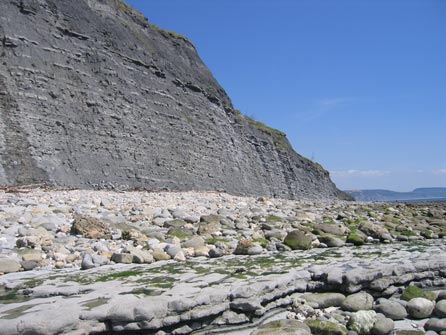
Cliffs Along the Dorset Coast are Notoriously Dangerous

Lyme Regis (Dorset) landslide
Good idea to go fossil collecting on a falling tide and to keep away from the steep cliffs as landslides are common. Picture credit: Everything Dinosaur.

Picture credit: Everything Dinosaur

Dorset

This is a terrible tragedy that highlights the potential dangers from rock falls and mudslips along the Dorset coast. The rescue teams have been stood down as it is believed that no one else is missing. On behalf of everyone at Everything Dinosaur we would like to express our deepest sympathy to the family and our thoughts are with them at this very difficult time.

24 07, 2012

One Person Trapped after Dorset Landslide

By |2023-02-03T12:26:31+00:00July 24th, 2012|Categories: Dinosaur and Prehistoric Animal News Stories, Everything Dinosaur News and Updates, Palaeontological articles|0 Comments

Series of Landslides at Hive Beach (Dorset) traps Walker

A woman is believed trapped on Hive Beach after being caught in a series of landslides it has been reported.  The incident took place east of Seatown on the Dorset coast.  A significant portion of the sandstone cliff, estimated at around four hundred tonnes of rock has crashed down onto the beach in what is believed to be two landslides, one following seconds after the first.  A major search and rescue effort has been taking place since the incident occurred at around 12.30pm BST today.

Helicopters have been used to search the area around Freshwater Beach Holiday Park, near Bridport.

A person thought to be a 22-year-old woman is trapped in the landslide, a Dorset fire service spokesman said.

At Everything Dinosaur, we were aware of the potential dangers and earlier this morning we wrote a short blog article on the threat of landslides and mudslips on the Jurassic coast.  This article was posted up on the Everything Dinosaur Facebook page and it follows an article written about concerns over beach safety on the 6th of July.

Our thoughts are with the family of the victim.

24 07, 2012

Council Officials Warn Walkers and Fossil Collectors About Dangerous Cliffs

By |2023-03-09T10:22:46+00:00July 24th, 2012|Categories: Dinosaur and Prehistoric Animal News Stories, Dinosaur Fans, Educational Activities|0 Comments

Jurassic Coast “Unusually Unstable”

On July 6th team members at Everything Dinosaur published an article warning of the dangers of approaching to close to the unstable cliffs on the Jurassic coast.  A number of landslides had already been reported, the recent heavy rains saturating the cliff areas and making them particularly prone to landslips.

The Jurassic Coast

With the start of the school holidays for most of the UK and the onset of some sunny, warm weather in the country (at last), the beaches on the Dorset and Devon coasts are likely to get very crowded.  Council officials have warned fossil collectors and walkers to avoid the cliffs and there is also the added threat of invisible quicksand, areas of dangerous beach that has been created as a result of the recent flooding.

The county of Dorset  is still reeling from the landslide caused by the recent heavy rainfall that took place on July 7th in the area around  the Beaminster Tunnel.  Two people were killed when their car was crushed by hundreds of tonnes of mud.  The bodies were only discovered ten days later when the tunnel was finally cleared of debris.

Dorset council has stated that much of the World Heritage coastline poses a grave danger.

A spokesperson for the council warned of a risk of a landslip “anywhere and at any time along the coast”.

The person went on to add:

“Landslides have also delivered thick mudflows and quicksands to the beaches in many places.  One of the hidden hazards is that the sea can wash sand and shingle over the mud and quicksand, giving the appearance of a solid beach.  The advice is to stay well away from the cliffs at all times and to beware of mudflows and quicksand, especially when the tide is coming in as it is possible to become cut off from the normal exit points from the beaches.”

Risk of Landslides

The council has highlighted a number of known hazard areas between Lyme Regis and the Axmouth Undercliffs.

The list  includes: A massive mudslide at Seven Rock Point on Monmouth Beach, and a landslide at the start of the beach; several mudslides between Lyme Regis and Charmouth; the base of Stonebarrow Cliff east of Charmouth, said to be “shrouded in mudflows” with increased risk of rock fall and a “very real possibility of becoming trapped by the incoming tide.”;

Another substantial landslide has completely blocked the beach between Eype and West Bay to the east of Charmouth.  Temporary signs have been put up to warn tourists, but the council spokesperson stated that the situation was in constant flux.

To view models and replicas of iconic animals, fossils of which are found at Lyme Regis: Replicas of Ammonites and Belemnites.

A spokesperson for Everything Dinosaur, urged visitors to the area to heed the warning signs and to check the local information as well as staying well away from the cliffs.

To read the July 6th Everything Dinosaur article: Dangerous Cliffs in the Lyme Regis Area.

23 07, 2012

Important Palaeogene Fossil Site in British Columbia gets Protection

By |2023-03-09T10:59:23+00:00July 23rd, 2012|Categories: Dinosaur and Prehistoric Animal News Stories, Palaeontological articles|0 Comments

Canadian Government Officials Take Steps to Protect Fossil Location

With the current spate of vandalism to important fossil sites being reported from Canada it is very reassuring to note that  for one location in British Columbia; Government officials have stepped in to help protect it and the areas valuable fossils.  An important Palaeogene fossil site in British Columbia is to get legal protection.

Palaeogene Fossil Site

A series of highly fossiliferous strata described as a “fossil gold mine” by palaeontologists near to the small town of  Cache Creek located on the junction between the Trans Canada Highway and Highway 97 has  been granted full conservation status by the Canadian Government.  The site known as the McAbee Fossil Beds are a set of shallow lake sediments laid down between fifty and fifty-five million years ago (Palaeogene geological period).  These beds have provided a large number of plant, invertebrate and fossil fish specimens, many of which are new to science.

Impressions of feathers have even been found, preserved in the fine sediment.  The land owners had run fossil excavation trips to permit amateur fossil hunters the chance to obtain their own fossil specimen, however, although these excursions were carefully planned and supervised, the provincial government has put an end to them by declaring the location as a heritage site.

Commenting on the decision, which was formalised this spring, Forests and Lands Minister Steve Thomson stated that the declaration will secure the future of the McAbee fossil beds.  The decision has been taken so that the fossils can be properly studied by palaeontologists and to prevent important finds not reaching the scientific community.

To view prehistoric animal models and replicas of extinct creatures: Models and Replicas of Prehistoric Animals.

However, the decision does not please everyone, a number of trips had already been booked to the quarry site, (the fossils are to be found in a cliff face), these have now been cancelled.  The land owners are not happy with the compensation they have been offered, stating that the figure quoted by the provincial government covers the mineral rights but not the value of the potential fossil finds.  The decision has forced the landowners to close down their commercial fossil hunting enterprise for good.

Go to Top