All about dinosaurs, fossils and prehistoric animals by Everything Dinosaur team members.

Fossil finds, new dinosaur discoveries, news and views from the world of palaeontology and other Earth sciences.

21 08, 2012

Laos Man – Rare Fossil Skull Suggests Humans Spread Rapidly into South East Asia

By |2024-04-23T15:06:36+01:00August 21st, 2012|Categories: Dinosaur and Prehistoric Animal News Stories, Palaeontological articles|1 Comment

Laos Fossil Skull Indicates Rapid Human Migration

Most palaeontologists believe that hominids (that group of upright apes to which our own species H. sapiens belongs) evolved in Africa.  This is why that continent is often referred to as the “cradle of mankind”.  However, there is still debate as to how our species came to be so widespread.  Did modern humans evolve in Africa and then migrate across the world, or did more primitive hominids living elsewhere in the world evolve into more modern humans independently?

Human Skull Fossil

The discovery of a modern human skull (Homo sapiens), found in a mountainous region of northern Laos (south-east Asia), suggests that modern people were living in this part of the world 20,000 years earlier than previously thought.  This discovery, suggests that if modern humans evolved in Africa and then spread across the world, their migration was either much more rapid than previously thought, or the spread of modern humans began earlier than the current fossil evidence from Africa and the Arabian peninsula proposes.

Ancient Human Skull from Laos

Oldest Asian back-packer known to date.

Picture credit: PNAS (USA)

The two theories of modern human evolution are known as the “multi-regional hypothesis” and the  “out of Africa theory”.  The multi-regional hypothesis, supported by a minority of palaeoanthropologists argues that modern humans evolved gradually from different populations of an earlier hominid species Homo erectus.  Constant contact and interbreeding between these populations led to the evolution of similar traits and characteristics that came to define our species, H. sapiens.

The second theory, the “out of Africa” theory proposes that the origin of our species can be traced back to Africa.  Modern humans evolved in Africa and then they spread out and displaced other indigenous hominid populations around the world.  Genetic evidence supports this theory and most palaeoanthropologists tend to support this hypothesis over the “multi-regional” concept.

Modern Humans in Asia

However, this new discovery provides evidence that modern humans had reached south-east Asia around 63,000 years ago, much earlier than other human fossil finds have indicated.  If H. sapiens fossil discoveries are plotted onto a map of the world with their estimated ages, it reveals a fascinating pattern.  Generally, the earliest dated fossils are found in locations close to Africa.  The earliest modern human fossils found outside of Africa have been found at coastal locations such as Ksar Akil (Lebanon) and in Israel at Qafzeh and Skhul.  The further away from eastern Africa you travel, the more recent the fossils of modern humans.  For example, there is fossil evidence to indicate that modern humans crossed the Beringia Land Bridge from Siberia into North America as recently as 15,000 years ago.  This Laos skull, throws the timing of human migration into south-east Asia and into Australia out, with perhaps some populations reaching Australia earlier than the currently thought 45,000 years ago.

The skull was found in the Annamite Mountains, three years ago, but the scientific paper describing the find and detailing the methods used to estimate the age of the fossil has just been published in the academic journal “The Proceedings of the National Academy of Sciences – United States”.

Laura Shackelford (University of Illinois), one of the authors of the scientific paper commented that:

“There are other modern human fossils in China or in Island Southeast Asia that may be around the same age but they either are not well dated or they do not show definitively modern human features.  This skull is very well dated and shows very conclusive modern human features.”

Although there is an amount of archaeological and genetic data to suggest a rapid migration out of Africa for modern humans this skull provides the earliest evidence known of modern people living in south-east Asia.  The location of the fossil find also suggests that these human settlers did not migrate along coasts to the islands of the Pacific, inhabiting environments which were familiar to them.  This is evidence that some of the first settlers in Asia were prepared to explore and inhabit environments that were very alien to them.

Dr Shackelford went on to add:

“This fossil find indicates that the migration out of Africa and into east and Southeast Asia occurred at a relatively rapid rate, and that, once there, modern humans weren’t limited to environments that they had previously experienced.  We now have the fossil evidence to prove that they were there long before we thought they were there.”

No other remains or artefacts such as stone tools were found in association with the skull material so the scientists believe that the bone was probably washed into the cave.  The cave site was probably not inhabited or used as a burial chamber.  The fossil was excavated from a layer of strata located 2.5 metres below the floor of the cave, radiocarbon tests and luminescence techniques indicate that the sediment is between 46,000 and 51,000 years old, but uranium/thorium degredation studies place the date of the skull at around 63,000 years.

For models and replicas of hominins and prehistoric creatures: Hominins and Prehistoric Animal Models (Wild Safari).

This modern human probably came across a much more primitive hominid, very different in appearance to modern people – “Upright Man” –Homo erectus.  It is very likely that H. erectus evolved in Africa and that in the 2 million years or so that this species has existed, it too migrated “out of Africa”, spreading as far as south-east Asia.  H. erectus may have been established in Asia for many hundreds of thousands of years before the arrival of modern humans.

The story of human evolution is very complicated, fossil evidence is fragmentary and the relationships between the various species of hominids that lived in Africa is difficult to interpret.  Recently, scientists uncovered evidence to suggest that as recently as two million years ago at least three species of hominid lived together in eastern Africa.

To read more about these fossil discoveries: Three of a Kind from Lake Turkana.

19 08, 2012

Dinosaur Age Meets Space Age – Rare Fossil Footprints Discovered

By |2024-04-24T16:27:00+01:00August 19th, 2012|Categories: Dinosaur and Prehistoric Animal News Stories, Dinosaur Fans|0 Comments

Dinosaur Footprint Discovered at NASA Campus

Scientists at the NASA complex located at Greenbelt, Maryland have a more down to Earth scientific distraction to study as it has been revealed that a fossilised dinosaur footprint has been discovered in the grounds.  For the scientists and support teams that work at the Goddard Space Flight Centre the elephant foot-sized trace fossil has afforded them a glimpse into the environment approximately 112 million years ago (Aptian/Albian  faunal stage of the Cretaceous) when huge, heavily armoured, herbivorous dinosaurs roamed the area.

Fossilised Dinosaur Footprint

The trace fossil, a single footprint is slightly eroded, the back of the foot, the heel area is crumbling away but a careful examination reveals four distinct toe marks at the front, a print of a dinosaur walking over soft mud back in the Cretaceous geological period.   It is not just natural processes that have caused the print to become less than pristine, palaeontologists and ichnologists (scientists who specialise in studying fossil tracks and track-ways), have remarked that parts of the footprint seem to show damage from a recent encounter from a grass strimmer.  It seems one of the gardeners may have clipped the thirty-five centimetre wide trace fossil when they were cutting down weeds.

The fossil was found by Ray Stanford, an expert in finding dinosaur tracks on the eastern side of the United States.  For Ray, finding this particular specimen came after a hunch to explore a part of the Goddard site, where previously he had found tantalising evidence of a dinosaur footprint.  The fragment of a print he had found a few years ago, represented an unknown type of fast-running but small meat-eating dinosaur.  That fossil indicated to Ray that the conditions had been right for permitting footprint preservation, so it was simply a question of returning to the area to explore the site a little more carefully to see what might turn up.  His chance came when he and his wife were at the Goddard Centre’s cafe enjoying lunch back on June 25th, when Ray made his excuses and set out to examine the grassy, overgrown bank where the previous fossil discovery had occurred.

Nodosaurid Print

The print is believed to have been made by the back left foot of a nodosaurid, a member of the dinosaur clade known as the Thyreophora – armoured dinosaurs.  Nodosaurids are generally similar to the better known ankylosaurs.  However, they were more primitive and lacked the club-like projection on the end of their tails.  Most of these types of dinosaurs had body armour that consisted of spines and spikes and their narrow snouts indicate that nodosaurs were specialised low browsers.  Fossils of this type of dinosaur have been found in Europe (including England) and North America.

An Illustration of a Typical Nodosaurid Dinosaur

An armoured “Tank” of a dinosaur.

Picture credit: Everything Dinosaur

Ray Stanford has made a specialism out of studying dinosaur track-ways on the eastern side of the United States, however, he has a special affinity for finding nodosaur remains.  This type of plant-eating dinosaur was not known from the strata of Maryland, however, Stanford has found a number of nodosaur tracks indicating that these elephant-sized animals were present in the region and he and colleagues from Johns Hopkins University (Baltimore, Maryland) discovered the fossilised remains of a baby nodosaurid near to the University of Maryland Campus.  This baby, the first juvenile nodosaur fossil to be found, represented a new species and it was named Propanoplosaurus marylandicus.  This unique dinosaur fossil is now part of the fossil vertebrate collection at the Smithsonian National Museum of Natural History (Washington D.C.).

To read more about the dinosaur tracks and footprints found in Maryland: Dinosaur Tracks Found Close To Washington D.C.

A team of NASA officials and representatives of the media were taken to the see the single footprint on Friday by Stanford.  It has been speculated that from the shape and deformation of the print the dinosaur was moving relatively quickly when it left the impression of its back left foot in the soft sediment.  Ray speculated that this dinosaur could have been running away from a meat-eating dinosaur.

For Alan Binstock, the Goddard site’s Architect and Facility Manager, the print might cause him something of a headache.  As far as he could recall no dinosaur fossils had ever been found on any of the other nationwide NASA locations but plans would be put in place to ensure that no trophy hunters or curious amateur palaeontologists could remove the print from the location.

Jennifer Groman, NASA’s federal preservation officer, more used to dealing with space age issues was part of the inspection team last Friday.  It is going to be her responsibility to safeguard the footprint whilst it remains on NASA property.

She commented:

“It’s not something I want to make a tourist attraction at this point.  We don’t want people barreling down there with shovels.  We can’t have anyone pick it up and take it off property.”

The site will remain secure for the time being.  Officials at NASA are working with a team of palaeontologists who intend to undertake a more thorough and protracted examination of the location to see what else might be found there.  Who knows, as NASA’s mission to Mars searches for signs of life on the amongst the Martian rocks, on a grassy bank at Goddard Flight Centre, a team of palaeontologists assisted by NASA’s space scientists might be shedding light on the exotic yet long extinct life forms that once roamed the eastern coast of America.

For models and replicas of nodosaurids and other armoured dinosaurs: CollectA Deluxe Scale Dinosaur Models.

17 08, 2012

T. rex Makes Excellent Scarecrow

By |2023-02-04T11:01:52+00:00August 17th, 2012|Categories: Dinosaur and Prehistoric Animal News Stories, Everything Dinosaur News and Updates, Press Releases|0 Comments

Tyrannosaurus rex Rules the Vegetable Patch

After one of the wettest summers on record, many gardeners and growers have seen their vegetable patches decimated by all the pests that the wet weather has encouraged.  However, for one group of enterprising dinosaur enthusiasts hungry birds have been put off their greens thanks to the employment of a Tyrannnosaurus rex model that has turned out to be a highly effective scarecrow.

Tyrannosaurus rex Model

The gardener-friendly T. rex stands nearly three feet tall and once team members at Cheshire-based Everything Dinosaur placed the fearsome predator in their vegetable plot, attacks from pigeons stopped and the staff were able to enjoy growing crops of lettuce as well as peas.

T. rex on Garden Patrol

Dinosaur “scarecrow” defeats pigeons.

Picture credit: Everything Dinosaur

The large, plastic dinosaur model, nicknamed “goggle eyes” as his eyes move; was placed in the middle of the vegetable patch in desperation after repeated attacks from pigeons had wiped out all the lettuce seedlings that team members had planted.  The pigeons seem to have taken an instant dislike to the dinosaur and have kept away ever since.

A spokesperson for Everything Dinosaur commented:

“We thought it was worth giving T. rex a try as everything else had failed.  If palaeontologists are correct, then birds and Tyrannosaurus rex are related but pigeons certainly aren’t keen to get acquainted.”

Team members move the model dinosaur around the vegetable beds every few days, just to keep the pigeons “on their toes” and this unusual tyrannosaur tactic seems to have worked as staff at the Cheshire based company tuck into lettuces, peas and beetroot with a bumper crop of onions and courgettes likely to follow.

Mike Walley, one of the team members at Everything Dinosaur commented:

“We are not really sure why goggle eyes has had such a big effect, it could be his fearsome look with his jaws wide open, or perhaps it is the smell of the plastic model the birds can detect.  As the wind blows so the eyes on our dinosaur wobble and this may frighten the birds away.”

Tyrant Lizard King

For one group of vegetable growers thanks to the intervention of the Tyrant Lizard King it seems that their crop of lettuces will not be going extinct.

Tyrannosaurus rex Makes Effective Bird Scarer

“Goggle Eyes” on patrol.

Picture credit: Everything Dinosaur

For models of tyrannosaurs and other dinosaurs: Tyrannosaur and Dinosaur Models.

16 08, 2012

BBC Test New Dinosaur Programmes in 3-D

By |2024-04-24T16:28:11+01:00August 16th, 2012|Categories: Dinosaur and Prehistoric Animal News Stories, TV Reviews|0 Comments

“Ultimate Killers” Documentary to air in 3-D

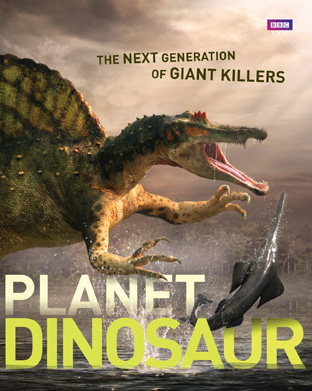
Technicians at the BBC are preparing to test a number of 3-D viewing platforms by showing a dinosaur themed documentary entitled “Ultimate Killers”.  This hour long programme has been compiled using footage from the six-part BBC television series “Planet Dinosaur” that aired last autumn.  The broadcast will take place on Sunday the 19th of August with the programme starting at 5.35pm BST.

To view the original trailer for the BBC television series “Planet Dinosaur” check out YouTube.

Planet Dinosaur

The programme being shown on Sunday evening is only going to be available in 3-D so the technicians at the BBC will be testing the “Watch in 2-D” applications on the Freeview and Freesat platforms.  Andy Quested, the Head of BBC’s 3-D and high definition projects is asking for feedback from viewers with regards to the “Watch in 2-D” option.

Dinosaurs – TV Programme Helps Out the BBC

Dinosaurs help out with BBC research.

Picture credit: Ebury Publishing

This documentary will also be available on the BBCiPlayer format.  A number of different encoded versions will be available for download depending on which platform the viewer is on.  Not all the devices used to show the programme will be able to accommodate the 3-D images, but the idea at this stage is to gauge people’s reactions to the different formats and platforms and gather opinions.

Specifically the BBC technicians need to obtain information about the platform used to view the programme, Freeview, via PC or via the iplayer function, as well as the approximate speed of your broadband connection and the make/model of your TV or set top box.

3-D Television Projects

Sources close to Everything Dinosaur have been informed that  the BBC is currently working on a number of 3-D projects including a new, feature length adaptation of the “Walking with Dinosaurs” franchise that is due to be aired in 2013.

Suggest you log onto the BBC Internet Blog for more information.  Team members at Everything Dinosaur worked on a cast of characters for the original BBC television series and advised CGI staff on some of the dinosaurs featured as well as writing a review of the book that accompanied the television programmes.

Who would have though it – dinosaurs such as  Mapusaurus, Allosaurus, Daspletosaurus and Carcharodontosaurus helping the BBC with their research into 3-D technology.

For models and scale figures of Mapusaurus, Allosaurus and Daspletosaurus (whilst stocks last): Dinosaur Theropods and Prehistoric Animals (CollectA Models).

15 08, 2012

Rare Triceratops Fossil Unearthed in Drumheller (Alberta, Canada)

By |2024-04-24T16:28:36+01:00August 15th, 2012|Categories: Dinosaur and Prehistoric Animal News Stories, Dinosaur Fans|0 Comments

Palaeontologists Excited by Triceratops Discovery

Scientists from the world-famous Royal Tyrrell museum based in the province of Alberta have been expressing their excitement at the discovery of a partial Triceratops fossil skeleton, found just thirty minutes drive from the museum’s doors.

Triceratops Fossil

Triceratops is perhaps one of the most famous of all the dinosaurs.  The name means “three-horned face” as this enormous, Late Cretaceous herbivore had two large horns, one over each eye and a third, smaller horn located above the naris.  Although there have been a number of Triceratops fossils found in North America, particularly in the American state of Montana (the famous Hell Creek Formation) and in the Canadian province of Saskatchewan, fossils of this particular genus of ceratopsian are extremely rare in Alberta.

Most of the exposed Cretaceous strata in Alberta relate to sediments laid down between 76 million and 70 million years ago (including  material from the Campanian faunal stage).  Triceratops fossils are found in strata laid down at the very end of the Cretaceous period (Maastrichtian faunal stage).  The fossilised bones of this herbivore were first spotted by a former Royal Tyrrell Museum employee whilst exploring a part of the Drumheller Badlands not known for its vertebrate fossils.  A team of field workers under the supervision of the Museum’s curator of dinosaur palaeontology Dr Francois Therrien was despatched and after about a fortnights excavation about 30% of the entire fossil skeleton was recovered.

Jumbled Up Bones

The bones of this dinosaur were jumbled up, a result of the remains of this animal being washed into a river and deposited in a slack part of water.  When buried, the strata preserved what has been described by scientists as a “log jam of Triceratops bones”.  Some of the dorsal vertebrae are an impressive sixty centimetres tall with rib bones although cracked and broken in places, approaching two metres in length.  Much of the specimen has already been transported back to the Royal Tyrrell Museum’s preparation laboratories, the fossil bones protected by field jackets made up of burlap and plaster.  The largest piece to transport was a single jacket measuring 2.5 metres by 1.3 metres and weighing more than two metric tonnes.

Although the fossil specimen is yet to be formally declared as Triceratops material, Dr Therrien believes that based on the shape and size of the bones and the geological layer in which the fossils were found, it is very likely that what they have discovered relates to this famous genus of horned dinosaur.  The Royal Tyrrell Museum may be world-famous for its vast collection of Cretaceous vertebrate fossils, but surprisingly it only has fragmentary Triceratops remains in its collection.  With the newly discovered fossil material, the Royal Tyrrell Museum now has the opportunity to study associated bones from a single individual.

A Triceratops Specimen on Display at the Naturmuseum Senckenberg

Triceratops on Display

A cast of a Triceratops skeleton on display at the Naturmuseum Senckenberg (Natural History Museum – Frankfurt). On the left a wall mounted example of a Plateosaurus can be seen.

Picture credit: Everything Dinosaur

Museum staff are keen to start work preparing the fossils in readiness for display.  Some of this work can be viewed by visitors to the museum as part of the preparation area of the museum is behind a huge glass fronted viewing area, which allows observers to see the care and dedication required to prepare fossil material for use in exhibits.

For models and replicas of Triceratops and other horned dinosaur figures: Horned Dinosaurs and Other Models (CollectA Deluxe).

11 08, 2012

Three of a Kind from Lake Turkana

By |2023-02-04T10:08:57+00:00August 11th, 2012|Categories: Dinosaur and Prehistoric Animal News Stories, Palaeontological articles|0 Comments

At Least Three species of Hominid Co-Existed in Kenya Two Million Years Ago

Palaeoanthropologists have identified fossil hominid material in eastern Africa (Lake Turkana), that indicates that around two million years ago there were at least three types of human-like creature co-existing.  In new research published this week in the academic journal “Nature”, the research team have declared that at least three species from the mankind family tree lived in the same part of the world during the Late Pliocene Epoch.  One of these species, Homo erectus was probably part of that branch of the hominid family tree that would eventually lead to the evolution of our own species, H. sapiens.  The other two species are believed not to be direct ancestors of more modern humans and they may have become extinct, effectively ending their role in hominid evolution and development.

Scientists Explore the Extensive Sediments around Lake Turkana

Tracing human origins.

Picture credit: Mike Hettwer

Homo erectus

H. erectus, known as “upright man” due to his more human posture and gait was the first widespread human species.  For many years, palaeontologists thought that this particular species of early hominid evolved in Asia.  Scientists such as Eugene Dubois, a Dutch anatomist and anthropologist, believed that our ancestors evolved in Asia not Africa.  In 1889 he led an expedition to what is now known as Indonesia to search for fossil evidence to support his theory.  He found elements from a skull and some limb bones and named a new species of hominid Pithecanthropus erectus.  Scientists now believe that these bones represent Homo erectus and this hominid, with perhaps a brain size about three quarters the size of our own species, evolved in Africa before migrating eastwards across the Straits of Arabia into Asia and eventually into the islands of the Pacific.  With tool making skills and a mastery of fire; this human species was incredibly successful and not only have fossils been found in places many thousands of miles apart, the dates of these fossils show that this species has also persisted the longest in the human evolutionary story.  Having evolved approximately 2.2 million years ago, H. erectus survived until at least 250,000 years ago and some scientists believe that the last of this type of human actually went extinct in the very Late Pleistocene Epoch, around 50,000 years ago.

Although the fossil record is far from complete, it seems that H. erectus may have given rise to later types of hominid including the direct, common ancestor of both the Neanderthals (H. neanderthalensis) and our own species.

Lake Turkana

The other two species of early hominid found in the same layers of Lake Turkana sediment represent “evolutionary dead ends” according to the scientists.  The fossil discoveries may help to solve a forty year mystery concerning skull material found in the same part of Kenya that has caused considerable debate amongst palaeoanthropologists.  The fossil beds around Lake Turkana are  referred to as the “cradle of mankind” due to the amount of early Homo fossil specimens that have been found.

Three new hominid fossils, bones that make up part of the face, a near complete upper jaw with cheek teeth and fragments from a lower jaw excavated from a dig site to the east of Lake Turkana, appear to confirm that skull material found in the same area forty years earlier is indeed a separate species of early human.

In 1972, parts of a strange, human-like skull with a flat face was unearthed.  Calculations made regarding the size of the brain suggested that this creature had a brain size of around 750 cubic centimetres, much larger than Australopithecines and this evidence convinced many scientists that this was definitely an early member of the human family tree.  It was assigned to the species Homo habilis.  Scientists had no real idea what the skull of H. habilis looked like, as at the time very little skull material had not been discovered, so here was a convenient way of putting a “face” to an early member of the hominid family.  The skull material (KNM-ER 1470, referred to as 1470 for short), caused a great deal of debate amongst researchers.  Subsequent fossil finds showed that this skull was different from other material assigned to H. habilis and it was proposed that this skull was a male of the species and the other material represented females.  If this was the case, then the size difference between males and females of the species H. habilis was the greatest in all the primates including the modern gorilla.  Other scientists assigned this fossil to another species of early human – Homo rudolfensis.

Computer Image Showing Skull 1470 and the New Fossil Discoveries Combined

Say hello to H. rudolfensis.

Picture credit: Fred Spoor

A photographic reconstruction shows the KNM-ER 1470 cranium, discovered in 1972, combined with a new lower jaw KNM-ER 60000; both are thought to belong to the same species.  The lower jaw is shown as a photographic reconstruction, and the cranium is based on a computed tomography scan.  This is the first image of its kind taken of the “third” Lake Turkana hominid – Homo rudolfensis.

Skull 1470

Working out what the skull known as 1470 represented was proving controversial, no flat-faced skull material from the same sediments had been found and the lack of teeth and jaw bones made identification and placement in the human family tree extremely difficult.  However, these three new fossils, excavated in the area between 2007 and 2009 confirm the existence of a third, large-brained hominid that lived alongside H. erectus and H. habilis.  All these fossils were found within seven miles of each other and have been dated between 1.78 and 1.95 million years.

The Famous Lake Turkana Skull (KNM-ER 1470)

An early human face – skull 1470.

Commenting on the significance of the new fossil finds, Dr Meave Leakey, co-leader of the Koobi Fora Research Project in Kenya stated:

“For the past 40 years we have looked long and hard in the vast expanse of sediments around Lake Turkana for fossils that confirm the unique features of 1470’s face and show us what its teeth and lower jaw would have looked like.  At last we have some answers.”

The bones that make up a flat face (KNM-ER 62000) are very similar to those of KNM-ER 1470, proving that the 1972 fossil discovery was not an over-sized example of a male H. habilis.  The beautifully preserved upper jaw with most of its cheek teeth still in situ has made it possible for the research team to infer the type of lower jaw that would have fitted the skull known as 1470.

Co-author of the academic paper and leader of the scientific analysis, Professor Fred Spoor, from University College London (United Kingdom), stated: “Combined, the three new fossils give a much clearer picture of what 1470 looked like.  As a result, it is now clear that two species of early Homo lived alongside Homo erectus.  The new fossils will greatly help in unravelling how our branch of human evolution first emerged and flourished almost two million years ago.”

These fossil finds indicate that the evolution of our own species was not just a straight forward, linear progression.  On the plains of eastern Africa around two million years ago, there seems to have been a number of hominid evolutionary experiments going on with a number of different species co-existing and probably competing with each other for food and other resources.  Intense competition may well have acted as an “evolutionary accelerator”, providing a kick start to the evolution and development of our own part of the human family tree.  At least three species of hominid lived in this part of the world, H. habilis, H. erectus and H. rudolfensis.

For models and replicas of ancient hominids including H. erectus (whilst stocks last): Wild Safari Ancient Figures and Models.

8 08, 2012

New Highly Manoeuvrable Pterosaur Genus Described

By |2024-04-24T16:32:17+01:00August 8th, 2012|Categories: Dinosaur and Prehistoric Animal News Stories, Palaeontological articles|0 Comments

Aerial Acrobat of the Jurassic

The  lithographic limestone beds of Solnhofen in southern Germany are famous for their Jurassic vertebrate fossils.  Scientists have studied these  quarries for more than two hundred years and as the limestone is no longer commercially quarried so palaeontologists are usually left to themselves to search amongst the finely grained limestone layers, separately the layers like opening the pages of a book in the hope of finding new fossil material.  Every once in a while, one of the fossils found, beautifully preserved in the fine limestone beds, provides scientists with an intriguing mystery.  A little fossil of a pterosaur, a flying reptile, once thought to represent a juvenile Rhamphorhynchus has been re-examined and a research team have discovered that this specimen represents an entirely new genus and it might have been a spectacular aerial acrobat as well!

The Solnhofen deposits were laid down in a shallow, still lagoon.  They have provided palaeontologists with evidence of over fifty fish species, numerous plant fossils and many different types of invertebrate.  The most famous fossils found in these strata are those of the early bird Archaeopteryx (A. lithographica).  However, this area has also provided many hundreds of pterosaur specimens.  Pterosaurs are not closely related to birds and they are not dinosaurs, although they are members of the reptilian clade known as the Archosauria, something which they do have in common with the dinosaurs.

Two type of pterosaur are known from these Upper Jurassic deposits, short-tailed pterodactyloids and long-tailed rhamphorhynchoids.  These fossils of flying reptiles from Germany have formed the foundation as to how palaeontologists classify the Pterosauria.  However, very few actual species of flying reptile have been described from the Solnhofen material, despite the hundreds of pterosaur fossils found.  It seems that Rhamphorhynchus spp. and the short-tailed Pterodactylus spp. were the dominant types, but a closer examination of what was thought to be a juvenile Rhamphorhynchus has led to scientists identifying a new species.

Manoeuvrable Pterosaur Genus

A fossil specimen, nearly complete and like many of the flying reptiles from these deposits, beautifully preserved, has been identified as a new type of Late Jurassic pterosaur.  Although clearly closely related to Rhamphorhynchus and definitely a member of the rhamphorhynchoids, this new species has fewer teeth and a more flexible tail than the long-tailed pterosaur genus known as Rhamphorhynchus.  Even more remarkably, the fourth bone of the finger that supports the skin membrane that makes up the wing was  curved.  The distal wing finger phalanges of both wings curved outwards. This distinguishes this type of pterosaur from all the others previously described, a new genus has been assigned – Bellubrunnus and a formal scientific name for this flying reptile has been established as Bellubrunnus rothgaenger.  The genus name translates as Brunn beauty, to honour the German quarry where the fossil was found, the species name acknowledges the amateur fossil collector who first unearthed this specimen.

Aerial Master?  An Illustration of Bellubrunnus rothgaenger

A highly manoeuvrable pterosaur.

Picture credit: Matt Van Rooijen

Bellubrunnus rothgaenger

Although the skull is quite badly crushed, the international team of palaeontologists who studied this fossil are convinced that the curved wing finger phalanges are not the result of distortion or compression. Both of the distal wing bones (one in each wing) are curved to the same degree.  This means that the aerodynamic properties of the leading edge of the wings of this creature would have been different from all other pterosaurs known to science.

At just fourteen centimetres long, the fossil material looked relatively unimpressive and indistinct from so many other Rhamphorhynchus fossils that had been found in the area before.  It was the fossilised remains of a juvenile flying reptile but it has always been assumed it was an example of a Rhamphorhynchus species.  However, once the prepared specimen had been viewed under ultra-violet light a lot more detail in the fossil material could be observed.

Right distal wing of the Specimen under UV Light Showing the Pronounced Curvature 

Curved wing pterosaur.

Picture credit: PLoS One

The scale bar in the picture represents 2 cm, the key is as follows: wpx refer to the wing phalanx bones, the fourth being clearly curved in this photograph.  The initials fb refer to the fibula (leg bone) and cdv indicate caudal vertebrae (tail bones).

The strange wings of this reptile, distinguish it from any other flying vertebrate.  The shape of the wings would have made powered flight somewhat more difficult but the shape would have allowed this animal to turn and dart about very quickly.  It was perhaps, the pterosaur equivalent of a stunt aeroplane.  Being more manoeuvrable may have assisted this flying reptile which probably grew to be the size of a Magpie.  It would have helped it to twist and turn in the air and snatch up insects as it flew.

To view models and replicas of flying reptiles and other prehistoric creatures: Flying Reptiles and Other Prehistoric Creatures.

The actual fossil was found in strata that is older than the main Solnhofen deposits, this site is still being explored and the research team are optimistic that more fossils of strange pterosaurs may be discovered.

The scientific paper: “A New Non-Pterodactyloid Pterosaur from the Late Jurassic of Southern Germany” by David W. E. Hone, Helmut Tischlinger, Eberhard Frey and Martin Röper published in PLoS One.

7 08, 2012

Fossil Dealer Files Claim to Get Back Disputed Tarbosaurus

By |2023-03-09T10:53:41+00:00August 7th, 2012|Categories: Dinosaur and Prehistoric Animal News Stories|0 Comments

Tale of the Tarbosaurus Takes a Twist Dispute over Tyrannosaur Skeleton

The legal dispute over the ownership of a tyrannosaur skeleton that had been auctioned in May of this year for the sum of $1.052,500 USD has taken another twist with the Florida fossil dealer who had originally put the specimen up for sale making it clear that he wants the skeleton back.

Tyrannosaur Skeleton

Heritage Auctions, based in New York, had conducted the sale of an eight-metre-long, mounted specimen of the Asian tyrannosaur Tarbosaurus bataar.  The sale did go ahead despite a petition from palaeontologists and the attempted intervention of the Mongolian Government.  The Mongolian President Elbegdorj Tsakhia himself intervened claiming that the fossil material was the property of his country.

Most Tarbosaurus fossil material has been excavated from the Nemegt Formation of Upper Cretaceous strata of Mongolia.  It has been illegal to take such fossil material out of the country for at least fifty years.  The Mongolian Government attempted to stop the auction, claiming that the material had been obtained illegally, probably as a result of smuggling.  The fossils were seized and are now in the custody of United States customs officials.

The Tarbosaurus Skeleton at the Centre of the Dispute

Heading for court.

Picture credit: Heritage Auctions

A team of North American palaeontologists assisted by Mongolian scientists examined the fossils and they declared that in all likelihood the fossil bones had come from Mongolia. The fossil is now the subject of a federal lawsuit which has been filed in order to resolve the ownership issue and to have the specimen returned to Mongolia, where it can join other Tarbosaurus specimens and become part of a study of this particular tyrannosaur genus.

To read the original article about the fossil auction: Tyrannosaurid Up for Auction.

Objecting by Petition

At Everything Dinosaur, when the auction was first announced, our team members petitioned against the sale taking place, at least to delay the auction so that rightful ownership could be established.  In a separate development, the fossil dealer responsible for preparing and mounting the specimen has filed his own proceedings in an attempt to fight the authorities and their attempt to have the material shipped to Mongolia.  The Florida-based fossil dealer, Eric Prokopi states in his claim that he:

“Purchased components of the tyrannosaur on the international market and then spent a year of his life and considerable expense, identifying, restoring, mounting and preparing it.”

This terminology reflects the work Prokopi put into preparing the mounted dinosaur, Prokopi’s attorney Michael McCullough said in a statement:

“We are just trying to create a factual distinction between a fossil which is imported and a finished piece which is what was being sold at the auction.”

Filing Documentation

The documentation filed to enable the material to enter the United States has also been questioned.  A reason for the official seizure of the specimen by the U. S. authorities through the process of  submitting a lawsuit was that the import documents did not attest to the true value of what was being brought into the United States.  The U. S. authorities have claimed that the relics had been brought into the country with documents that disguised the potentially valuable dinosaur skeleton and misrepresented what was actually being imported.

To read more about the actual seizure of the fossil material: U.S. Authorities Seize Tarbosaurus.

Mr Prokopi has disputed that the dinosaur fossils came from Mongolia, in a statement released earlier he challenged the assumptions made by the palaeontologists who had examined the bones saying that the fossils could have come from elsewhere, he stated:

“Other than from the diggers, there is no way for anyone to know for certain when or where the specimen was collected.”

Refuting Allegations

Strongly refuting the accusations and allegations that he had been involved in fossil smuggling, the Florida fossil dealer went onto add:

“I’m just a guy in Gainesville, Florida, trying to support my family, not some international bone smuggler.”

Had no counter claim been filed, then the U. S. authorities would have taken legal possession of the fossils, but now it looks like this dispute is heading for court.  Tarbosaurus is going to have to go on trial.  Anyone else with a legal interest in the dinosaur has until August 26th to file a claim.

When the original customs documents are examined it can be seen that the fossils were shipped to America from a Dorset based, professional fossil collector and dealer.  Sources state that in the contract with Heritage Auctions, this English fossil dealer would have split the proceeds of the auction with Mr Prokopi.  The Dorset fossil dealer has not been named in the federal lawsuit and the Englishman’s lawyer in a statement, took steps to distance his client from the proceedings.

For information and advice about fossil collecting: Contact Everything Dinosaur by Email.

6 08, 2012

Is Usain Bolt the Fastest Man on the Planet of All Time?

By |2023-02-04T07:32:31+00:00August 6th, 2012|Categories: Dinosaur and Prehistoric Animal News Stories, Press Releases|10 Comments

Ancient Humans Were Fast Runners Too

Last night in the Olympic stadium (London), Usain Bolt the Jamaican sprinter, retained the Olympic 100 metres title in a winning time of 9.63 seconds.  He took just forty-one strides to complete the course, breaking the Olympic record for the distance as he did so.  The twenty-five-year-old crossed the finish line at something in excess of 23 mph, his training partner and fellow Jamaican Yohan Blake came in second in a phenomenal 9.75 seconds.  Over one million people had applied for tickets to see what is regarded by many as the blue-ribbon event of the entire Games and to witness the great Jamaican sprinters in action.  However, one scientist thinks that some ancient humans could give Usain Bolt and company a run for their money.

Ancient Humans

Anthropologist Peter McAllister thinks that a set of preserved footprints of aborigines in Australia suggests that some early settlers on that continent would have been right up there with the likes of Bolt if they were asked to run the 100 metres final. Mr McAllister’s analysis of the footprints suggests that this group of humans were capable of running at up to 23 mph, bare foot and over soft mud in their pursuit of prey.  Or perhaps they were being pursued themselves, trying to avoid becoming a meal for one of the many super-predators that they shared their Australian home with.

The prints of six men chasing prey and Mr McAllister’s analysis leads him to believe these men if trained and provided with modern running shoes could beat Usain Bolt in a sprint.  Peter claims that these ancient ancestors of ours could theoretically reach sprinting speeds of up to 28 mph.  It is not known what speeds the likes of Usain Bolt, Yohan Blake or Tyson Gay could reach if they were being chased and in fear of their lives.

There has been a lot of debate about just how fast this group of humans were running.  The tracks are located at Willandra Lakes (south-east Australia), one individual, known as T8, changes he stride length from 1.8 metres to 1.9 metres over a distance of approximately 11 metres.  This suggests acceleration, in other words this person began to run faster, however estimates of the speed of these bare-footed people running across soft mud does vary.  Some scientists have calculated that this runner was moving at around thirteen miles an hour, a lot slower than an Olympic sprinter.  However, Mr McAllister states that with training, on the right track and with running shoes T8 could run perhaps as fast as 28 mph.

To read a more complete article regarding the abilities of ancient hominids: Could Ancient Humans Kick Butt?

We’re not taking anything away from Usain Bolt in terms of his achievements, he is a truly remarkable athlete, but our ancestors were much more used to hard physical work when compared to their modern counterparts.  Perhaps given the right training, nutrition and equipment; a New Stone Age Man or Woman could compete with today’s Olympians.

Comments have been made in the Australian media about the relatively poor showing of Australian competitors at these Games, perhaps our chums down under can take comfort in the fact that an anthropologist believes that at least some ancient Australians would have been medal contenders.

For replicas and models of ancient humans and hominids: Prehistoric Animal Models and Ancient Human Replicas (Safari Ltd).

4 08, 2012

Monster Prehistoric Crocodile from Queensland

By |2023-02-04T06:54:45+00:00August 4th, 2012|Categories: Dinosaur and Prehistoric Animal News Stories|2 Comments

Huge “Super-Croc” May be Biggest Crocodile of All Time

Scientists in Queensland (Australia) have uncovered part of a fossilised jawbone that suggests the rivers and lakes of ancient Australia may have been home to a super-sized, monster prehistoric crocodile that would not have looked out of place if it had lived at the time of the dinosaurs.  The island of Australia has been isolated from other land masses for millions of years, this has permitted the fauna and flora to evolve without competition from other genera migrating into the country.  Marsupial mammals still dominate today and in the past Australia had its own, unique mega-fauna including cow-sized wombats, a giant monitor lizard called megalania and fearsome predators such as marsupial lions.  The megafaunal assemblage of Australia survived into the Pleistocene but the arrival of human settlers and climate change led to the extinction of most of these animals.

Monster Prehistoric Crocodile

Scientists were aware that crocodiles had diversified and evolved into a myriad of different species.  The discovery of a partial jawbone suggests that at least one type of crocodile evolved into a giant, perhaps a contender for the biggest crocodylian known from the fossil record.  Australia is home to the Saltwater crocodile, otherwise known as the Estuarine crocodile (Crocodylus porosus), it is the largest species of reptile on the planet, with males reaching lengths in excess of seven metres and weighing more than a tonne.  It is often referred to as “Australia’s own dinosaur”, but like all crocodylians, it is only very distantly related to the Dinosauria.  University of New South Wales palaeontologists who found the fragment of crocodile jaw state that this individual was at least eight metres long and there may have been others of its kind that were even larger, perhaps reaching the size of Sarcosuchus, a twelve-metre-long crocodylian that lived during the Late Cretaceous geological period and preyed on dinosaurs.

The fossil was found at a dig site at Floraville Station, on the Liechardt River, between the towns of Normanton and Burketown in the Gulf of Carpentaria (Queensland).  This location has provided scientists with a number of Pleistocene and older Pliocene fossils including the remains of giant wombats (diprotodontids).

Australian Scientists Report on Giant Fossil Crocodile

King of the Outback!

Picture credit: Adapted from the Sunday Mail (Queensland)

The fossil was discovered by undergraduate Bok Khoo from the University of New South Wales on July 10th, it is part of the lower jaw (dentary).  The fossil bearing strata consists of several layers which represent ancient river deposits.  The dig site is close to the current course of the Liechardt River and the sediment is disturbed when the water levels rise and this helps to expose new fossil finds.  The river may help reveal fossil material but being close to the river does have its drawbacks.  The location is known for its Saltwater and Freshwater crocodiles as well as sharks and sting rays.  The field team have to be wary of attacks from extant crocodiles as they search for the fossilised remains of extinct ones.

Gilbert Price, a palaeontologist with Queensland University has commented that the jaw bone represents a substantial individual, one crocodile that was very probably an apex predator in the region.  The fossil has yet to be accurately dated, it belongs to either the Pleistocene or the earlier Pliocene Epoch.  The Pliocene ended approximately  1.6 million years ago, the Pleistocene Epoch followed and lasted until approximately 10,000 years ago.  The climate around the Gulf of Carpentaria today has two distinct seasons, a wet season and a long dry season.  For most of the Pliocene and Pleistocene Epochs, this part of Australia was much more humid and wetter.  Scientists have speculated that this huge crocodile could have lived as far south as the State of Victoria.  The research team hope to subject the specimen to radiocarbon dating, this will give them a better idea as to whether the fossil represents a known species of crocodile or whether it is  new to science.

Student Bok Khoo with the Crocodile Fossil

Huge fossil of crocodile jaw found.

Picture credit: Laurie Beirne

The fossil is eroded, a result of the river action and the teeth have been lost but the tooth sockets which measure up to four centimetres in diameter indicate that this predator had very large, conical-shaped teeth.  Professor Mike Archer of the University of New South Wales described the fossil as “weird” and he could not rule out that this fossil find could represent a new species.

He jokingly added:

“It it is not a crocodile, it is a bunyip [aboriginal mythical monster], or something equally as weird.  Something very, very big that we have never seen before.”

Although the scientists are hopeful that they may be able to find more fossils of this unusually large crocodylian they have postulated that it could represent a member of the crocodile genus known as Pallimnarchus, perhaps being a specimen of Palimnarchus pollens, the largest species in the genus.  The Pallimnarchus crocodiles belong to an extinct family of crocodiles known as the Mekosuchinae.  These crocodiles evolved in the Palaeogene geological period, following the extinction of the dinosaurs and spread across the south Pacific evolving into a number of diverse forms.  Some Mekosuchinae crocodiles were water-based ambush predators just like today’s “Salties”, but other types evolved entirely differently.  A number of these types of crocodile became fleet-footed, land based predators, some even adapted to an arboreal existence becoming apex predators in forested habitats.

The Australian scientists are keen to continue their fieldwork in the hope of finding more skull material from this ancient giant.

Go to Top