All about dinosaurs, fossils and prehistoric animals by Everything Dinosaur team members.

Fossil finds, new dinosaur discoveries, news and views from the world of palaeontology and other Earth sciences.

30 09, 2012

Potential Therizinosaur Track Discovered in Alaska

By |2023-02-04T21:08:03+00:00September 30th, 2012|Categories: Dinosaur and Prehistoric Animal News Stories, Dinosaur Fans|2 Comments

Footprint Suggests Therizinosaurs may have Roamed Northern Latitudes

Located approximately 240 miles north of the Alaskan state’s largest city of Anchorage, the vast Denali National Park, has provided palaeontologists with a tantalising clue as to what strange beasts may have wandered this area in the Late Cretaceous, something like seventy million years ago.

The National Park, home to Mount McKinley,  with a summit at 6,193 metres above sea level, the highest peak in North America, may also have been home to a bizarre group of theropod dinosaurs that converted from a meat-eating diet to a herbivorous one – the bizarre therizinosaurs.  A single four-toed footprint suggests that these Cretaceous dinosaurs, otherwise known as “Scythe Lizards” may have roamed the Alaskan landscape.

Potential Therizinosaur Track

David Tomeo, the programme director for the Murie Science and Learning Centre located at Denali Park was wandering along a dried up river bed in the summer of 2010, when he spotted a strange raised impression.  His mind was on all things Dinosauria as he was up there preparing a student field trip to explore the Park’s dinosaur discoveries, however, he did not expect to be confronted by what turned out to be a single dinosaur footprint.  He was confident that the footprint did represent a dinosaur, but what sort of dinosaur could have made that track?  The difficulty for David, was that he thought he could make out four toe impressions, most theropods (other than dromaeosaurs) walked on three toes and as a result left three-toed fossilised prints.  Several photographs of the strange footprint, preserved in the mudstone were taken and these were sent to Tony Fiorillo, the curator of palaeontology at the Museum of Nature and Science in Dallas (Texas) who has studied the dinosaur fossils found in northern Alaska.

Strange Dinosaur Footprint Preserved in the Mudstone

Therizinosaur track discovered?

Picture credit: David Tomeo

A battery (AA) has been put in the picture to provide a scale.

Dr Fiorillo and his colleagues, after a careful of examination of the evidence and a visit to the Park to view the specimen in situ, have identified the print as having been made by a therizinosaur.  This is the first time fossils from this sort of dinosaur have been found at such a northerly latitude.   Therizinosaurs are a rare and exclusively Cretaceous clade of the Order Theropoda.  These creatures had short legs, stocky bodies with long necks and small heads.  Scientists still debate whether these animals were entirely vegetarian.  The arms were relatively long and the three-fingered hands had enormous, flattened claws.  Importantly they walked on four toes and they were bipedal.  Most of the therizinosaur fossils found to date have come from Asia, where they are believed to have first evolved, but one of the most complete specimens ever found was discovered in North America (western United States), this therizinosaur was named and described in 2001, it is known as Nothronychus mckinleyi.

An Illustration of a Typical Therizinosaur (Nothronychus mckinleyi)
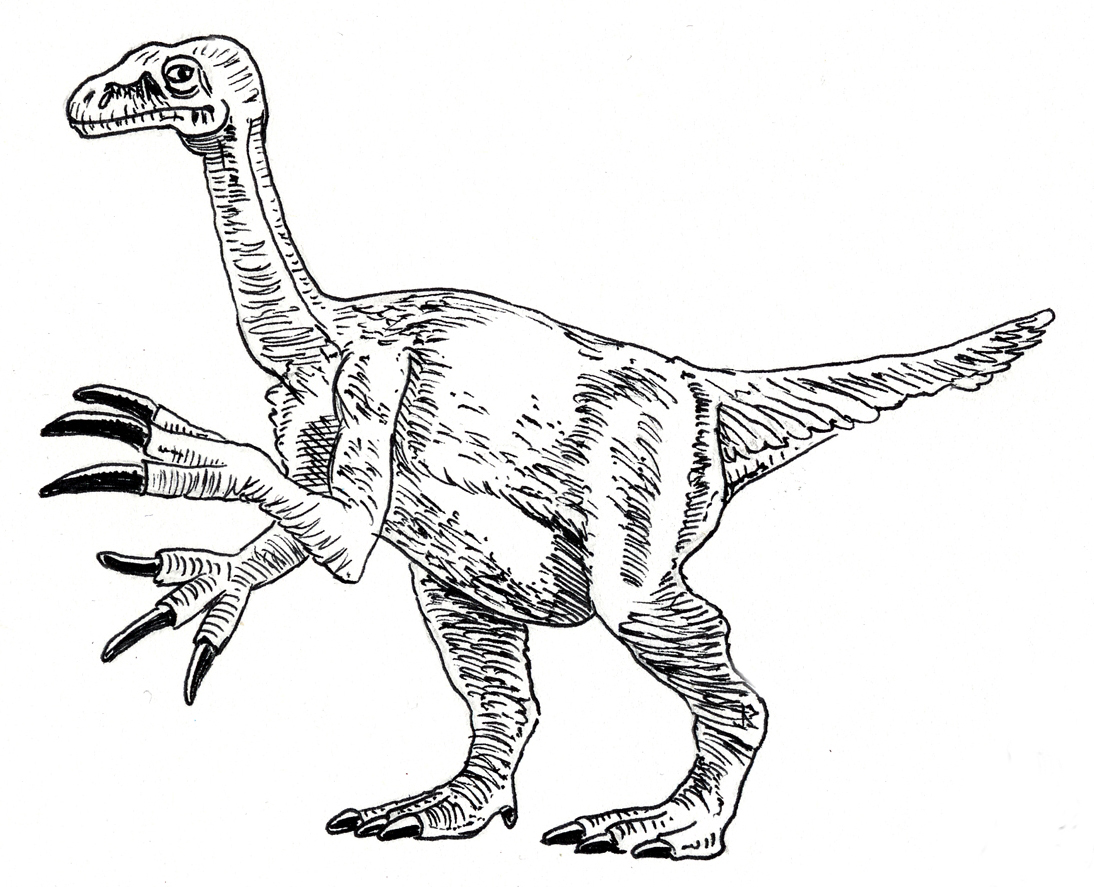
Nothronychus illustrated.

Picture credit: Everything Dinosaur

It seems sometime in the Cretaceous, these types of dinosaur migrated across a land bridge linking Asia to North America, probably where the Bering Strait can be found today.  Intriguingly, the Alaskan footprint is something like twenty million years older than the fossils ascribed to Nothronychus.  Does this indicate several migrations taking place between the Americas and Asia during the Late Cretaceous, or is the Alaskan trace fossil evidence of a population of therizinosaurs being resident in northern latitudes?

The Alaskan Therizinosaur Trackway (Print Outlined)

The print is highlighted in red.

Picture credit: David Tomeo/Everything Dinosaur

To help readers discern the footprint, team members at Everything Dinosaur have highlighted the approximate outline in red.

During the Late Cretaceous, Alaska was actually nearer to the North Pole than it is today.   Although the climate would have been warmer, it would still have been a tough, harsh environment for animals to live in.  There was no permanent snow covering, although it probably did snow from time to time.  The landscape would have been dominated by dense conifer forests with an understorey of flowering plants and ferns.  For four months of the year, the region would have been plunged into darkness as the sun dipped below the horizon.  There would have been a short summer season with 24-hours of daylight with the sun never setting, but even with this permanent daylight, climatologists estimate that the maximum day time temperature was rarely above 13 degrees Celsius.  There is fossil evidence to suggest that there were permanent dinosaur residents in this part of the world during the Late Cretaceous.  Palaeontologists can only speculate whether the bizarre therizinosaurs were part of this permanent fauna or whether they were seasonal migrants, moving north to take advantage of the rich summer plant growth.

Dr Fiorillo and his colleagues have recently published a scientific paper on the recording of the first evidence to suggest that therizinosaurs roamed Alaska.  A number of other dinosaurs are known from this part of North America.  Fossils of the duck-billed dinosaur Edmontosaurus have been found, there is also evidence that horned dinosaurs may have been present .  It is likely that there were many predatory dinosaurs as well, perhaps following the herds of herbivores on their seasonal migrations just as packs of wolves follow the caribou today.  Palaeontologists have found fossils of a giant troodontid (dromaeosaur dinosaur), in Alaska.  The fossils indicate that this particular theropod was perhaps four metres long, much bigger than troodontids that lived further south.  This type of carnivorous dinosaur could have become specially adapted to living in the extreme climate of northern North America and it may have been a permanent resident in Alaska.

Ironically, in contrast to the relatively rich dinosaur fossil assemblage found in the strata of the Denali National Park, there are no species of reptile living in the Park today, the climate is just too severe and too cold for today’s cold-blooded reptiles.

For models of therizinosaurs and other theropods: Prehistoric Animal Replicas (CollectA Age of Dinosaurs).

23 09, 2012

Neolithic Dentists Described in New Study

By |2024-04-24T16:37:00+01:00September 23rd, 2012|Categories: Dinosaur and Prehistoric Animal News Stories|0 Comments

Stone Age Toothache Eased by Beeswax Filling

A trip to the dentist may be regarded by many as one of the perils of modern-day living but surprisingly there is a considerable amount of fossil evidence to suggest that Stone Age people may have practised some rudimentary dentistry.  Scientists using a partial human jawbone that had been found in Slovenia more than one hundred years ago, got a surprise when they used this specimen to test a new X-ray imaging machine.  The researchers discovered something remarkable in a canine tooth, the tooth had a long, vertical crack down it and an area of the crown, the enamel, had been worn away to reveal a large cavity.  A broken and worn tooth of an ancient human is not a surprise, after all, teeth were worn down by the harsh and abrasive diet endured by our ancestors.  However, this particular tooth, showed signs that somebody had attempted to give the tooth a filling.  Could this be evidence of Neolithic dentists?

Neolithic Dentists

A plug of material had been carefully applied to the hole, covering the sensitive dentine and filling the cavity.  The material, once analysed using infrared spectroscopy was identified as beeswax and remarkably the filling was over six and a half thousand years old.  This suggests that either the owner of the tooth or another member of the tribe has plugged the worn tooth either whilst the owner was still alive or shortly after the person died.  If the tooth was repaired when the person was alive, then this is one of the oldest examples of Stone Age dentistry found to date.

A Picture Showing Various Images of the Tooth and the Human Jawbone

Evidence of Neolithic Dentistry.

Picture credit: Journal PLoS One

This example of Neolithic dentistry is not an isolated case, American researchers reported back in 2001 of evidence of flint drills being used to make holes in teeth from people that lived between 9,000 and 7,500 years ago in Pakistan.  However, none of these drilled teeth showed any signs of having received a filling – but why beeswax?

Beeswax and Propolis

Beeswax and a substance called Propolis are used extensively in herbal medicines today.  Propolis is a natural, brown, sticky substance that is collected by honey bees from trees and other plants.  It contains a mixture of plant resin, waxes and essential oils.  Just like that other product of the honey bee – honey, these substances have anti-bacterial and anti-inflammatory properties.  Beeswax crammed into a tooth cavity might have eased any toothache to some degree and helped to prevent infections.  Beeswax also has the added advantage of having a low melting point so it can be easily worked.  At body temperature the waxy esters and other long chain molecules solidify and make a strong, stable bond, effectively providing a strong cap for the hole in the tooth.

It seems our ancient ancestors may have known a thing or too about dental hygiene.  The fossil human jawbone was found in a cave system, near the town of Lonche in what is now Slovenia today.  It is believed the jawbone is from an adult male who was aged between 24 and 30 years old when he died.

A Remarkable Discovery

The scientists who made this remarkable discovery, Claudio Tuniz and his colleague Federico Bernardini at the International Centre for Theoretical Physics based in Trieste, cannot be certain that the tooth filling was not applied post mortem. There is some evidence in the fossil record of human teeth have been treated as part of burial ceremonies as corpses are prepared for the afterlife.  If this is an example of early dentistry, helping a patient overcome the pain from a toothache then this practice did not die out at the end of the Stone Age.  Beeswax and other materials were used in ancient Egypt to help with a variety of ailments, these substances also had important roles to play in the Egyptian mummification process – helping to preserve soft tissue.

What is intriguing is that other teeth in the ancient human jaw bone used to test the X-ray machine had cavities as well, but only the canine tooth was filled.  Perhaps this tooth was particularly troublesome, or perhaps if the prices paid today for dental work reflect the price paid in the Neolithic for such treatment our Stone Age patient could not afford any more  dental work.  Of course this is pure speculation, one other point to note is that was the treatment self administered or was there a special person in the tribe, perhaps a shaman or wise elder who was tasked with looking after the health and well-being of other tribe members?

21 09, 2012

Homo heidelbergensis – A Skilled Craftsman and Hunter

By |2023-02-04T18:38:39+00:00September 21st, 2012|Categories: Dinosaur and Prehistoric Animal News Stories, Palaeontological articles|0 Comments

Ancient Spears show Early Humans were Highly Skilled

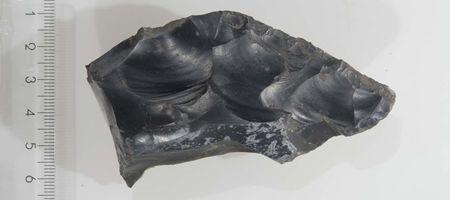
Researchers from the University of Tubingen in the southern German state of Baden-Württemberg have reported on their analysis of the animal remains, flora and evidence of skilled human craftsmen and hunters.  This study indicates that hominids that once roamed southern Germany 400,000 years ago were capable of making strong, sturdy spears tipped with finely knapped flints.  The scientists have concluded that these spears are evidence of skilled hunters, who would have used careful planning and foresight to ensure a successful hunt.  These weapons are believed to be some of the oldest ever discovered and they have been ascribed to a hominid known as Homo heidelbergensis.  The use of such sophisticated technology as early as the Middle Pleistocene epoch suggests many accepted theories on primitive human behaviour and capabilities may have to be re-written.

A Close up of One of the Flint Spearheads

Crafted with considerable skill.

Picture credit: Dr Nicholas Conrad/University of Tübingen

Homo heidelbergensis

In 1907, a workman found a human jawbone in a sand quarry near the small village of Mauer, to the south-east of the German town of Heidelberg.  Otto Shoetensack, a renowned German palaeontologist, had been convinced that early human remains would be found in the ancient layers of sand at this site and the jawbone was evidence of a primitive Neanderthal-like hominid having once lived in that area.  Subsequent skull discoveries, this time in Africa led to this jawbone and the skulls being ascribed to a new species of early human – H. heidelbergensis.  Although known from only a few fragmentary fossil bones, including a massive shin bone found in West Sussex, this hominid is believed to have been the direct ancestor of both the Neanderthals and modern humans.  H. heidelbergensis may have evolved from Homo ergaster and it was the first hominid to colonise the colder parts of northern Europe.   The flint spearheads and beautifully well-preserved wooden spear shafts have been found at an opencast coalmine just one hundred kilometres away from the site of the original H. heidelbergensis jawbone discovery.

Eight Spears Found

A total of eight spears were found at the coalmine location.  A team of researchers from the University of Tubingen’s Institute of Prehistory led by Dr Jordi Serangeli and Dr Nicholas Conrad are continuing to study the site and the remarkable information it is providing about life in the Pleistocene epoch.  The human artefacts have been found amongst the remains of butchered horses, water buffalo and aurochs (ancient cattle).  It seems that these early hunters were capable of tackling and bringing down large prey.  The site has also provided the scientists with information about the flora in Germany at the time, leaves of alder and the pine cones of fir trees have been preserved, along with pollen from many types of plants.  The weapons have been ascribed to Homo heidelbergensis, although no human remains have been found at this site, amongst the bones of elephants, rhinos and even lions.

One of the Wooden Spear Shafts Found at the Site

Ascribed to H. heidelbergensis.

Picture credit: Dr Nicholas Conrad/University of Tübingen

The strata that contains the preserved Pleistocene evidence had been under the water table and this watery environment may have helped preserve the remains, permitting the scientists to learn so much about life in northern Europe for some of our ancient ancestors.   The wooden spears do not seem designed for throwing. They were most likely used as thrusting weapons at close quarters.  The flint spearheads show considerable skill in their construction and they would have been carefully joined onto the thick, wooden spear shaft using animal sinews.  Based on the fossil evidence and these spears, it seems clear that H. heidelbergensis was physically bigger and stronger than modern people. Palaeoanthropologists have estimated that both males and females may have stood over six feet tall and that the males would have weighed around eighty kilogrammes with the females slightly lighter.  These eight spears, so carefully crafted by our ancestors may prove to be the oldest weapons ever found in Europe.

For replicas and models of ancient hominins and prehistoric animals: Models of Prehistoric Animals, Dinosaurs and Hominins.

16 09, 2012

A Dinosaur Named “Martha” is Scientifically Described

By |2024-04-24T16:39:28+01:00September 16th, 2012|Categories: Dinosaur and Prehistoric Animal News Stories, Dinosaur Fans|0 Comments

Martharaptor Named in Honour of Dedicated Employee of Utah’s Geological Survey Team

The exposed Early Cretaceous strata of Eastern Utah (United States), may not be quite as famous as the Upper Jurassic Morrison Formation when it comes to dinosaur fossil finds but recent work by state palaeontologists and the Geological Survey Team of Utah is beginning to reveal an extensive and rich, ancient fauna which was dominated by the Dinosauria.

This part of eastern Utah, with its dry, arid and harsh environment, has already provided palaeontologists with a number of unique dinosaur fossil discoveries and now a new theropod dinosaur has been named and described from the area.  The dinosaur, known as Martharaptor greenriverensis has been named to honour the contribution made by Martha Hayden who for more than twenty years has worked to uncover the rich array of vertebrate fossils to be found in the area.

Cedar Mountain Formation

The Cedar Mountain Formation that is exposed around the Green River region of eastern Utah lies on top of the Upper Jurassic Morrison Formation.  The layers of sedimentary rock that make up this part of the geological record of the western United states is divided into stratigraphic levels known as members.  A primitive example of the therizinosaur dinosaur clade (Scythe Lizards) has already been named and described from some of the oldest rocks laid down at the very beginning of the Cretaceous.

Falcarius utahensis

This dinosaur is known as Falcarius utahensis, recent field work has identified the fragmentary fossilised remains of another possible member of the therizinosaurid clade, but this time from younger rocks at a higher stratigraphic level in the Cedar Mountain Formation.   Although palaeontologists would like to find more skeletal material to be absolutely sure that they have found another herbivorous therizinosaur, the dinosaur has been described as the holotype for a new genus of therizinosaur known  as Martharaptor greenriverensis.

An Illustration of a Typical Therizinosaur

Bizarre theropods.

Picture credit: Everything Dinosaur

Therizinosaurid Dinosaurs

The therizinosaurids represent a bizarre group of theropod dinosaurs that seem to have given up their meat-eating ways and taken up an almost entirely herbivorous diet.  Although classified as members of the Coelurosauria, a clade of theropod dinosaurs that also includes the likes of Tyrannosaurus rex, the therizinosaurs seem to have adapted to a browsing and grazing habit.  Fossils of therizinosaurs have been found in Asia and North America.

The fossils almost exclusively date from the Cretaceous geological period, with the exception of  one, controversial Chinese fossil find that places therizinosaurids in the Early Jurassic.   A single fossil lower jaw has been tentatively described as therizinosaur material, this dinosaur has been named Eshanosaurus deguchiianus.  This specimen has been dated to around 195 million years ago, pre-dating any other known therizinosaur fossil material by more than sixty million years.  This dinosaur was named to honour the Chinese county where it was found (Eshan county) and an influential Chinese scientist called Hikaru Deguchi who helped inspire a number of palaeontologists at the Institute of Vertebrate Palaeontology and Palaeoanthropology in Beijing.

A New Therizinosaur

This latest potential addition to the therizinosaur clade has been named to honour Martha Hayden, an assistant to a number of state palaeontologists and an archivist at the Utah Geological Survey.  Unlike the Chinese Early Jurassic fossil find where the genus name cites the location of the discovery whilst the species name honours an influential person in palaeontology, in the Utah discovery’s case; it is the genus that honours a person (Martha Hayden) whilst the species name of this holotype cites the  location of this fossil discovery (Green River area of Utah).

Martha has worked for more than two decades assisting a number of palaeontologists and geologists and is a keen field worker, happy to get involved with digs and dinosaur excavations.  Her contribution has been recognised by having her own dinosaur genus named after her.

Martharaptor greenriverensis

When asked about her dinosaur, Martha is reported to have said that she is a “little bit embarrassed” by all the fuss but she did concede that her mum was very pleased and proud, after all, not many people get a dinosaur named after them.  Martha greenriverensis is known from a disarticulated and jumbled collection of bones that were found within two metres of each other in a mudstone block.  The bones probably represent a single individual.

The fossil material collected represents fragments of vertebrae, a scapula (shoulder bone), elements of the limb bones and an ischium (hip bone).  Amongst the fossilised remains, some of which were too badly eroded and fragmentary to identify, were several fossils of the claws on the hands (manual unguals) and elements of the feet (pedal unguals).  It is from an analysis of the morphology and characteristics of the hand claws that has led scientists to place this dinosaur amongst the therizinosaurids.

Taxonomic Relationships between the Theropoda

Martharaptor classification.

Picture credit: PLoS One

Field teams from the State Geological Survey hope to find further remains at the quarry where the first fossils of this new dinosaur were excavated.  Hopefully, with the discovery of more fossil material, a better understanding of the taxonomic relationship between Martharaptor and other Early Cretaceous (Barremian faunal stage) theropods can be established.

To view models and replicas of Early  Cretaceous theropods including therizinosaurs: CollectA Deluxe Scale Models of Dinosaurs.

11 09, 2012

Australian Scientists Excited by Baby Ichthyosaurus Find

By |2023-02-04T16:56:15+00:00September 11th, 2012|Categories: Dinosaur and Prehistoric Animal News Stories|0 Comments

Fossil of Baby Ichthyosaur may be Most Complete Specimen Found to Date in Australia

Discovered in an area of Australia known as the “dinosaur trail” due to the number of dinosaur and marine reptile fossils found in that region, an infant ichthyosaur fossil has got palaeontologists waving their geological hammers in excitement.  The fossil, which was actually found in 2011 may represent the most complete specimen of an infant ichthyosaur ever found on the continent.

Infant Ichthyosaur Fossil

Ichthyosaurs are an Order of fast swimming, nektonic, predatory marine reptiles with dolphin-shaped bodies.  They evolved in the Early Triassic and finally became extinct during the Late Cretaceous.  The fossil was found near the town of Richmond, a location famous for its marine reptile fossils.  Scientists examining the fossil believe that they might have ninety-nine percent of the bones of the animal – a rare find indeed as the corpses of small animals such as this creature would have been  quickly eaten by larger predators in the Early Cretaceous sea that covered this part of Australia.

A number of ichthyosaur specimens have been found in the Richmond area over the years, they turn up in some surprising places, such as in a school’s vegetable patch that was being dug over.

To read more about the fossil discovery amongst the vegetables: Ichthyosaurs Amongst the Vegetables.

One of the researchers currently examining the fossil material stated:

“There’s so much material that’s never been found, so we’ve never had a really good understanding of what’s happening with ichthyosaurs, because quite often they’ve all broken up, eaten by other animals, and disintegrated when they’ve been preserved.  So for a palaeontologist to find any complete creature, especially a vertebrate creature, that is really special.”

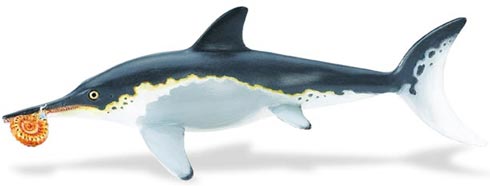
A Model of an Ichthyosaur – Fish Lizard

“Fish Lizard” found in Australia.

Picture credit: Everything Dinosaur

One puzzle is why the specimen is so complete?  Scientists believe that parts of the seabed of the shallow ocean that covered much of Australia must have been anoxic (no oxygen present).  Very still and calm segments of the water column could have led to tracts of the seabed becoming devoid of oxygen, thus preventing bottom dwelling animals that would have fed on the carcase from being present.  The remains of the Ichthyosaur are as they would have been laid out shortly after the animal died, the backbone (made up of vertebrae) is virtually intact as is most of one front paddle.  The fossil is slowly being cut out of its limestone block and it is hoped that this specimen will soon be put on display at the nearby Kronosaurus Korner Museum.

Small Ichthyosaur Fossil Specimen

Pictures show the less than one-metre-long specimen.  Important parts of the skeleton are labelled (coracoids – shoulder bones), the backbone, ribs etc.  The hand brush provides scale to the photograph.

There may also be the fossilised remains of a much larger ichthyosaurus nearby.  Palaeontologists are optimistic that this specimen too may be in an excellent state of preservation.

To view an extensive range of marine prehistoric animal models take a look at the: PNSO Age of Dinosaurs Model Range.

9 09, 2012

One of our Dinosaurs is Found! India’s First Dinosaur Fossil Re-discovered

By |2023-02-04T16:44:59+00:00September 9th, 2012|Categories: Dinosaur and Prehistoric Animal News Stories|4 Comments

Geological Survey of India Re-Discovers First Indian Dinosaur Fossil 

In quieter moments when palaeontologists are given the chance to reflect on the current hot-spots for dinosaur discoveries thoughts may turn to the exciting fossil finds coming out of Angola, or the work being undertaken to research into the bizarre Dinosauria fauna that once roamed the prehistoric island of Hateg in southern Europe.   Other scientists may comment on the amazing Early Cretaceous dinosaur discoveries that are being made around the town of Winton in Queensland (Australia), however, it is important that the fossil discoveries being made in India are not overlooked. Today, we look at India’s first dinosaur fossil to be scientifically described.

To read about the discovery of a dinosaur nesting site in India: “Treasure Trove” of Dinosaur Eggs found in India.

First Dinosaur Fossil

India is a huge country with extensive Mesozoic-aged formations that are just beginning to reveal evidence of the amazing creatures that roamed what was to become the Asian sub-continent.  The history of dinosaur discovery in India actually goes back a very long way.  The first recorded dinosaur find was made in that country more than one hundred and eighty years ago, even before the term Dinosauria was coined and the Dinosauria established as a suborder of the Reptilia.  After one hundred and thirty four years the very first dinosaur fossil described from India has been re-discovered, ironically amongst the collection of the Geological Survey of India at their Kolkata head-office.

In the days of the British Empire, when India was regarded as the “jewel in the crown”, the country was being mapped and explored by her colonial masters.    In 1828, Lieutenant-Colonel W. H. Sleeman of the Bengal Army (later knighted and to become a Major-General, after a long and distinguished career in India), led a small expedition to Jabalpur in Madhya Pradesh (central India).  This military expedition with its accompanying geologists and cartographers mapped the strata in the area.  This strata is now known as the Lameta Formation and it consists of Upper Cretaceous aged rocks (Maastrichtian faunal stage).  The Lameta Formation is famous for its Late Cretaceous dinosaur fossils, most of them unique to this region.  The fossils found include long-necked dinosaurs (Titanosauria) as well as many theropods including large abelisaurids that rivalled the tyrannosaurs in terms of size.  It was this military expedition that found the first evidence of dinosaurs in India.  W. H. Sleeman is credited with finding a twenty centimetre long, isolated bone from what was later to be termed a dinosaur.

Newly Re-Discovered World’s First Described Titanosaur Bone

India’s lost and found titanosaur fossil.

Picture credit: Geological Survey of India

Discovered in 1828

The discovery, made in 1828 was only four years after the Reverend William Buckland had described the very first dinosaur (Megalosaurus bucklandii) and many years before the eminent English anatomist Sir Richard Own established the Dinosauria as the term used to describe these “terrible, fearfully great lizards”.  Sir Richard Owen established the term Dinosauria – the dinosaurs in April 1842, although he later alluded to the fact that he had come up with the term earlier (August 1841).

The Indian specimen was actually a single, caudal vertebra (part of the tail), of a large, herbivorous dinosaur.  It was passed amongst a number of distinguished Victorian scientists until 1877 when no record of where it was could be found.  This dinosaur fossil, which had lain undiscovered for millions of years was lost to science from 1877 until April 2012 when it was discovered by members of the Geological Survey of India who were re-assessing the fossil heritage of the sub-continent.  It was a chance discovery, the specimen having resided in the collection of the Geological Society of India at their Kolkata head-office.

India’s First Dinosaur Fossil

India’s first dinosaur fossil to be described was discovered by Dr D. M. Mohabey and Dr Subhasis Sen of the Geological Survey team.  The dinner-plate sized specimen was amongst a collection of fossils that had been studied by the English naturalist and geologist Richard Lydekker, who had joined the organisation that was to become the Geological Survey of India back in 1874.  It was Lydekker who formally named and described the specimen in 1877, establishing a new genus of dinosaur – Titanosaurus indicus.  The newly, re-discovered tail bone is a holotype, a specimen upon which the original description of an organism is based.  The specimen still has the original labels – 2193 and 2194 on it which are clearly visible, the classification given to this fossil by Lydekker.  The fossil was located amongst the vertebrate fossils in the catalogued collection made by Lydekker and stored on the first floor at the headquarters of the Geological Survey of India.

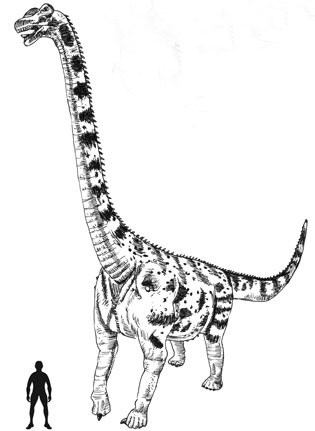
Titanosaurs are a Cretaceous sub-branch of the long-necked dinosaurs known as sauropods.  They lived mostly in the southern continents and survived up until the very end of the Cretaceous.  Some titanosaurs did migrate into northern lands and a number of these herbivores evolved into huge animals, bigger than the diplodocids and brachiosaurids of the Late Jurassic.  Titanosaurs such as Paralititan, Andesaurus, Bruhathkayosaurus, Alamosaurus  and Argentinosaurus represent the largest land animals known to science.

An Illustration of a Typical Giant Titanosaur (Argentinosaurus)

Huge dinosaurs – titanosaurids.

Picture credit: Everything Dinosaur

The Indian team are hoping to find more fossils that were presumed lost and to help to solve a puzzle which involves the Natural History Museum in London.  A number of British expeditions explored the fossil beds of the Lameta Formation in the early part of the 20th century.  Many specimens were subsequently removed from India to the then British Museum (now the Natural History Museum), in London.  As part of a continuing international research programme to map India’s vertebrate fossils, scientists are hoping to be able to identify Indian dinosaurs amongst the collection at the Natural History Museum.

To view models and replicas of titanosaurs and other dinosaurs: Titanosaur Replicas and Dinosaur Models (CollectA).

The Geological Survey of India team are optimistic that any dinosaur specimens that they are able to trace to the Natural History Museum collection will be returned to India for further study and to be united with other Indian dinosaur specimens.  Like the fossil found by Lieutenant-Colonel W. H. Sleeman, one hundred and eight four years ago, many of these fossils are holotypes and the only known fossil evidence for a number of dinosaur species that seem to be unique to the sub-continent.

The caudal vertebra, now back in the catalogued collection of the Indian survey team represents the very first titanosaur fossil to be scientifically studied and as such it is regarded as a critical specimen for the global research into the evolutionary history of these sauropod dinosaurs.

Perhaps more importantly, as the Indian economy strengthens and the country emerges as a global super-power there is a strong demand for improved educational resources and an emphasis on India’s place and role in the scientific community.  It is likely that Indian museums will step up their efforts to have important artifacts such as dinosaur fossils returned to their country as interest in dinosaurs and other prehistoric animals grows.

3 09, 2012

Disputed Dinosaur Fossil An Amalgam of Different Specimens

By |2023-02-04T14:50:26+00:00September 3rd, 2012|Categories: Dinosaur and Prehistoric Animal News Stories|0 Comments

United States District Judge Notes that Tarbosaurus bataar is a “Frankenstein Model”

In a surprise twist to the long running saga concerning the right to auction a mounted, twenty-four-foot- long Tarbosaurus bataar dinosaur fossil specimen which was seized by federal authorities,  it seems that the disputed Tarbosaurus fossil exhibit may contain the bones from more than one individual animal.

Disputed Tarbosaurus Fossil

The claim, which has been challenged by United States prosecutors and refuted by palaeontologists may complicate the U.S. and Mongolian Government’s attempt to return the fossils back to Mongolia.

To read about the auction of this dinosaur exhibit: Tyrannosaurid Specimen Sold at Auction despite Controversy.

The fossils were originally sold in May at Heritage Auctions in New York, the buyer, believed to be a private individual paid over £1 million USD for the mounted skeleton.  The lot had been described as the bones from a single animal in the auction sale literature.  In June, U.S. Government officials seized the exhibit after the Mongolian Government demanded its return on the suspicion that the fossils had originally been smuggled out of Mongolia illegally.

Michael McCullough, an attorney representing Florida commercial palaeontologist Eric Prokopi, who had offered the specimen for sale stated that about half the reconstruction – fossilised bones welded onto a metal frame,came from one creature and the other half from “at least two, most likely many” dinosaurs.

At Everything Dinosaur we call such specimens composites, almost all of the exhibits in museums are made up of the fossilised bones of several individuals.  Often the remainder of the specimen is completed using plastic re-constructions of the bones that were not found at the original dig site.  It is extremely rare for the fossils of a large dinosaur such as a Tarbosaurus to be found in an articulated state with most of the bone material in situ.

“Frankenstein Model”

The district judge hearing the case described the dinosaur as a “kind of Frankenstein model of a dinosaur”.  Earlier in the case Mongolian scientists and North American Theropod experts examined the remains and deemed the reconstruction to have been created from a single specimen.

Judge Castel enquired:

“They did not pick up that this was from several sources?”

Assistant U.S. Attorney Martin Bell replied on behalf of the prosecution team stating:

“Their opinion is that it is largely from one dinosaur.  It was marketed as one dinosaur. A seventy-five percent complete, but one dinosaur.”

The Mongolian Government’s claim to the fossil is based on the specimen (or specimens) being smuggled out of their country, where it has been illegal to send such items abroad for more than fifty years.  This case is also complicated by the fact that Mr. Prokopi is alleged to have provided mis-leading customs documents to allow the fossils to be imported in the United States.  On the customs documents the remains are valued at $19,000 USD, but the specimen went on to fetch more than fifty times that amount after it had been prepared, mounted and put up for auction in New York.

Attorney McCullough said that the $19,000 shipment only constituted part of the reconstruction, and that Prokopi had collected other parts of the skeleton from multiple sources in at least three separate shipments imported to America between the years 2007 and 2009.

Mr. Prokopi has not said where or from whom he acquired the skeleton.  He said that he constructed the specimen from a collection of loose, mostly broken bones and rocks with embedded bones.  Although it has been reported that this specimen or at least part of it was supplied by a fossil dealer based in Dorset (England).

Mr. Prokopi has filed a case to allow him to have the specimen back.  He has said he and his wife spent thousands of hours preparing and mounting the skeleton, which increased its value, over the original customs valuation before it was auctioned.

A spokesperson for the U.S. Government stated that the authorities remain confident based on expert testimony, that the fossils all originated from within Mongolia’s Gobi desert. Prosecutors have previously said those experts believe the fossils were removed from the region between 1995 and 2005.

The case will  continue when it is reconvened in December.

In the meantime, for legitimate Tarbosaurus models and prehistoric animal replicas: Age of Dinosaurs Popular Models (CollectA).

Update

Judge Castel has given the U.S. Government until September 21st to provide further evidence in support of the application to retain the Tarbosaurus bataar skeleton with a view to returning the specimen to Mongolia.  This ruling has occurred as we understand the current situation, as it was revealed that the disputed exhibit may actually contain the fossilised bones of more than one individual dinosaur.

30 08, 2012

Dinosaur Stomach Contents – Small Theropod Ate Birds According to New Research

By |2024-04-23T15:03:26+01:00August 30th, 2012|Categories: Dinosaur and Prehistoric Animal News Stories|2 Comments

Sinocalliopteryx – Stealthy Hunter or Fortunate Scavenger

Research by a joint Canadian/Chinese team of scientists has shed light on the dietary habits of a small theropod dinosaur that roamed the forests of what was to become the Liaoning Province of China back in the Early Cretaceous.  Analysis of the stomach-acid etched bones found in the abdominal cavity of two specimens of the large compsognathid predator Sinocalliopteryx gigas shows that these ground-dwelling predators ate a variety of prey including primitive birds.

Small Theropod Dinosaur

The fossilised remains of two Early Cretaceous birds has led some scientists to speculate that this cursorial, big-eyed hunter used stealth and guile to enable it to stalk and catch flying creatures.  Other palaeontologists don’t quite go so far, stating that the stomach contents show that these 2.5-metre-long dinosaurs did indeed eat birds but how they caught them cannot be determined from the fossil evidence.

Two Fossils of Sinocalliopteryx

The two fossils of Sinocalliopteryx were both excavated from the  Jianshangou Beds of the lower Yixian Formation, Liaoning, China.   The fossils are approximately 135 million years old and date from a time when lush, tropical forest covered the area.  There were active volcanoes nearby and several large lakes.  The holotype fossil material of S. gigas preserves a partial dromaeosaurid leg in the abdominal cavity.  This indicates that dinosaurs were also on the menu for these hunters.  The unfortunate victim may have been a Sinornithosaurus, a feathered dinosaur that may have reached lengths in excess of a metre.  It looks like one predatory dinosaur was eaten by a bigger predator.

Sinocalliopteryx gigas

A second, newly-discovered specimen preserves the remains of at least two individuals of the primitive avian, Confuciusornis sanctus, in addition to acid-etched bones including a scapula (shoulder blade) from a possible Ornithischian dinosaur which has yet to be described.  The presence of two bird skeletons inside the stomach has led some scientists to propose that Sinocalliopteryx was an active hunter, able to catch birds, perhaps by leaping up and plucking them out of the air.

For figures and replicas of theropods and other dinosaurs: Dinosaur Models and Figures (CollectA Figures).

A dinosaur preying on birds is not a new concept.  The great Charles R. Knight, in an illustration of the small theropod Ornitholestes (Late Jurassic of the Western United States) depicted a dinosaur attempting to catch birds.  However, since no avian fossil material has been found in the same strata as Ornitholestes fossil material, this predator/prey relationship could only be speculated, now thanks to these Chinese fossils there is certainly evidence to suggest that dinosaurs did eat birds.

To read more about the Charles Knight illustration of Ornitholestes: Ornitholestes – Bird Stealer.

Although it cannot be stated whether such prey items were scavenged or actively hunted, the presence of the remains of two Confuciusornis  in a similar state of digestion suggests they were consumed in rapid succession.  This makes the idea of scavenging two carcases of the same species in quick succession less likely, although  a group of birds dying together is not unheard of.  Perhaps a methane gas escape from a nearby lake suffocated a lot of small animals and birds as they roosted.

The dead creatures would have fallen out of the trees and provided the ground dwelling Sinocalliopteryx with a feast.  Given the lack of clear arboreal adaptations in Sinocalliopteryx, indeed, given the adaptations this small dinosaur had for a cursorial life-style, some of the scientists who have written the research paper have suggested that this dinosaur may have hunted birds in a similar way to a modern domestic cat.  It does not seem well suited to climbing trees, but may have been one of the top ground-dwelling predators in the lush forests of Liaoning Province.

An Illustration of the Agile Hunter – Sinocalliopteryx gigas

A fast and speedy hunter.

Picture credit: Cheung Chungtat

27 08, 2012

Identifying the Origin of Mollusca by the Mouthparts

By |2023-03-08T22:20:48+00:00August 27th, 2012|Categories: Dinosaur and Prehistoric Animal News Stories, Palaeontological articles|0 Comments

Burgess Shale Fossils Provide Evidence of the Origins of the Mollusca

The next time you come across a slug or a snail in your garden, or perhaps if you sit down to a plate of mussels in a white wine sauce with cream nod you head in approval towards one of the most successful animal phylum known on planet Earth – Mollusca.  Now thanks to the use of a non-destructive research technique being applied by a Canadian researcher on fossil specimens from the famous Burgess Shale deposits, it seems that palaeontologists have finally begun to unravel the mystery as to how these animals first evolved.

Burgess Shale

The phylum known as Mollusca is one of the most diverse of all the animal phyla and thanks to most of its members having hard body parts and living in a marine environment, the Mollusca are perhaps the most abundant large invertebrates recorded as fossils.  There are shelled and unshelled forms of mollusc.  Although the six taxonomic classes that make up this phylum may seem very different, they all share the same basic body plan.  There are the gastropods (slugs and snails), bivalves such as oysters, cockles and mussels and of course, the cephalopods, perhaps the most advanced of all the members of the Mollusca.

The cephalopods consist of a number of extant forms, such as squid, cuttlefish and octopi, plus some very important forms that are extinct but have proved so invaluable to palaeontologists as they develop biostratigraphical profiles of rock strata – long-dead groups such as the ammonites and the belemnites.

Ammonites and Belemnites- Extinct Members of the Phylum Mollusca

Diverse Mollusca.

Picture credit: Everything Dinosaur

The picture (above) shows three invertebrate models in stock (whilst stocks last) at Everything Dinosaur.

To view models of iconic invertebrates from the fossil record: Replicas of Fossil Invertebrates.

Palaeontologists Studying Cambrian Strata

However, debate has gone on between palaeontologists studying the beautifully preserved Burgess Shale specimens (British Columbia, Canada), as to which of the many animal fossils dating from over 500 million years ago, represent the ancestors of the molluscs.  Now thanks to the work of a University of Toronto PhD student, scientists are beginning to get a better understanding of how the molluscs evolved and which of the bizarre animal fossils from the Burgess Shale represent early forms of this important phylum.

Most molluscs possess a radula, rows of tiny, interlocking teeth that can rasp away drawing food into a primitive mouth which is then passed through a one-way digestive system.  Only the filter feeding bivalves don’t have this “rasping tongue”.  Using advanced electron microscopy to produce images that could then be modelled in three-dimensions, University of Toronto student Martin Smith was able to demonstrate that two bizarre types of Burgess Shale creature from the Middle Cambrian, Odontogriphus omalus and the heavily armoured Wiwaxia corrugata were forerunners of the Mollusca.

Odontogriphus omalus specimens are extremely rare in the Burgess Shale.  This organism seems to have been a flat-bodied animal with mid-line symmetry (bilateral symmetry), a single muscular foot for locomotion and a toothed feeding structure with a simple stomach and intestine.  Some fossils from the Burgess Shale strata indicate animals that grew to lengths in excess of ten centimetres.

Wiwaxia, on the other hand is a much more common member of the Burgess Shale assemblage.  This might suggest that Wiwaxia spp. were more abundant in the warm, shallow tropical sea represented by this British Columbian strata, or it might simply reflect that greater preservation potential of Wiwaxia over Odontogriphus.  Wiwaxia was certainly a striking animal.  It had a body plan that was symmetrical around its mid-line, roughly elliptical in shape, toothed mouth-parts that were broadly conical and a primitive mouth and digestive tract.  This thimble-sized organism probably pulled itself along using a muscular foot, the sides and the upper surface of this organism was covered by rows of overlapping protective plates called sclerites.

Shooting upwards from the dorsal area were two rows of parallel spikes.  These spikes probably acted as a deterrent against attack from nektonic predators.

A Reconstruction of Wiwaxia corrugata

Spiky, basal member of the Mollusca.

Picture credit: Everything Dinosaur

Previous studies had suggested that both Odontogriphus and Wiwaxia were basal forms of either the Mollusca or the Annelid worms, or perhaps they represented evolutionary dead-ends, types of creature that died out leaving no descendants.

This new research shows that the teeth of these animals sat on a grooved, primitive tongue and the shape, number and articulation of the individual teeth components and the way these structures grew puts these particular Burgess Shale members firmly into the mollusc camp.  The ancestral molluscan radula is shorter and more squat than in similarly sized extant molluscs today.  The mouthparts were made up of two or three rows of similarly, shaped teeth (shaped like miniature shoe horns); with a symmetrical central tooth and smaller denticles along the edges.  The teeth would have moved round the end of a muscular tongue-like structure in a conveyor-belt-like fashion, scooping food and seabed detritus into the mouths of these primitive creatures.

They were not the sophisticated lettuce-munching radula of the common garden snail, but this new study by the Canadian PhD student does indicate that organisms like Odontogriphus and Wiwaxia are basal to the Mollusca.

Martin Smith, a student at the University of Torontos’s Dept. of Ecology and Evolutionary Biology and the author of the scientific paper published in the academic journal “Proceedings of the Royal Society B – Biology” utilised highly sophisticated electron microscopy to reveal new details of the mouthparts and structures in the fossil specimens.  He examined over three hundred different Burgess Shale fossils and from the images produced by his study he was able to re-create three-dimensional models of feeding systems of these 5oo million year old invertebrates.  Not only could the structure of these mouthparts be made out, the young scientist could also assess how these structures grew.

Commenting on his work, the student stated:

“I put the fossils in the microscope, and the mouth parts just leaped out.  You could see details you’d never guess were there if you just had a normal microscope.”

Martin went onto add:

“The fossils are squashed completely flat, which makes them really hard to reconstruct in 3-D.  “I surrounded myself with micrographs of the mouth parts and lumps of plasticine, and spent weeks trying to come up with a model that made sense of the fossils.  When I set out, I just hoped to be a bit closer to knowing what these mysterious fossils were.  Now, with this picture of the earliest radula, we are one step closer to understanding where the molluscs came from and how they became so successful today.”

 An Illustration of the Short and Squat Radula-like Structure of Basal Molluscs

The start of something big – the Mollusca.

Picture credit: Marianne Collins

The teeth are arranged in rows and resemble miniature shoe horns.  The Canadian research suggests that organisms like Wiwaxia and Odontogriphus used this structures to comb detritus or algae into their mouths.   Over millions of  years the radula of the molluscs has evolved and become a highly efficient feeding organ. Whether it is the rasp-like radula of a land snail that can tear up plants or the powerful mouthparts of a nektonic, active predator such as a giant squid the radula has had over 500 million years of evolution to refine it.  Under a high powered electron microscope the formidable structure of the radula can be clearly made out.

The Fearsome Radula (High Magnifcation) of a Modern Mollusc

“Jaws”?

As can be seen in the above photograph, one of the reasons for the evolutionary success of the Molluscs might be their very specialised and highly refined, effective feeding structure – the radula.  Some of the teeth in the image appear to be the same shape as those of a Great White shark (Carcharodon carcharias).

25 08, 2012

Dinosaur Footprints Stolen from the Vale of Glamorgan

By |2023-03-08T22:23:17+00:00August 25th, 2012|Categories: Dinosaur and Prehistoric Animal News Stories, Dinosaur Fans, Palaeontological articles|0 Comments

Dinosaur Tracks Stolen from South Wales

On the northern side of the Bristol Channel close to the harbour area of the town of Barry lies a stretch of coastline that provides a fascinating glimpse into life in the Triassic.  The area known as Bendricks rocks consists of Carboniferous limestone overlaid by Triassic siltstones and sands that date from both the Lower and Upper Triassic.  A number of the Triassic sediments mark the location of the shoreline of a shallow lake, which dinosaurs used to skirt around on their travels.  Unfortunately, Everything Dinosaur has received reports of stolen dinosaur footprints.

Stolen Dinosaur Footprints

Fossilised footprints are known from the Upper Triassic strata providing palaeontologists with important trace fossils showing archosaurs and those other members of the Archosauria – tracks made by dinosaurs.  Unfortunately, reports from local fossil hunters suggest that some of the footprints have been cut out and removed, most likely by unscrupulous fossil dealers wanting to sell these fossils on the black market.  Sadly, there have been a number of instances of areas of important scientific value being attacked by such individuals eager to grab any fossil material they can so that they can sell them on.

A number of three-toed prints can be seen on this part of the Welsh coast, indeed, there are several trackways; some of the best preserved prints have been removed and are on display at the University of Cardiff Museum.  The location which has SSSI (Site of Special Scientific Interest) status and is under the protection of the Countryside Council for Wales has been raided before, when a number of prints were removed by a local collector and offered for sale via online auction sites.  Fortunately, the police were able to recover a number of the fossil specimens.

It seems that thieves have struck again and there is evidence of stone cutting tools having been used to remove blocks which contained the dinosaur prints.  These tracks are some of the best preserved dinosaur tracks to be found anywhere in the whole of the British Isles.  However, rather than preserve them in situ for the enjoyment of all, it seems that thieves have once again targeted this location and removed fossils.

Local expert on the fossilised prints Karl-James Langford commented:

“We were horrified that in an area where we had previously examined several footprints, they have since been taken.  As readers can see from the pictures circulated, cutting instruments have been used on the 200 million-year-old Triassic rock, in an area where footprints and the fossilised remains of wave ridges had existed a few weeks ago.”

Increasing Number of Thefts

There have been an increasing number of thefts of this kind reported over recent months.   The high prices paid for dinosaur fossils by private collectors and dealers has fuelled this illegal activity.  Last year team members at Everything Dinosaur reported on the dreadful destruction of Jurassic-aged sediments as specimen hunters smashed up strata on the Isle of Skye as they searched for marine reptile remains.

To read more about this incident: Jurassic site is Ransacked.

A spokesperson from Everything Dinosaur stated:

“This is a terrible incident, sadly, this is all too common these days.  The dinosaur trackways were beautifully preserved and there for the enjoyment of everybody.  We sincerely hope that the people responsible for this vandalism are brought to justice very swiftly.”

Readers are urged to monitor on-line auction sites and anyone contacted in regards to the purchase of dinosaur footprints should, if they are suspicious, contact South Wales police: South Wales Police Website.

Update

The stolen fossilised dinosaur footprints were recovered at the end of the month (August 2012), when it was discovered that suspicious dinosaur footprints that resembled those stolen from the protected site were being offered for sale on Ebay and in a shop at Lyme Regis.  A tip off led the police to the prints, which are now likely to be kept in a museum, rather than put back in situ.  Sergeant Ian Guildford of South Wales Police said a man from the Cardiff area, whom he described as a local amateur geologist, had been cautioned for criminal damage and theft from a protected site.

Fossils can be legally collected and sold, but not if they come from a protected or restricted site.  The fossil dealers involved in this case claimed that they had received the fossils from legal sources.

To report any concerns about the sale of fossils: Email Everything Dinosaur About Fossils.

Go to Top