All about dinosaurs, fossils and prehistoric animals by Everything Dinosaur team members.

Fossil finds, new dinosaur discoveries, news and views from the world of palaeontology and other Earth sciences.

20 10, 2012

Tarbosaurus bataar Skeleton Dispute – Man Arrested

By |2023-02-06T12:43:08+00:00October 20th, 2012|Categories: Dinosaur and Prehistoric Animal News Stories|0 Comments

U.S. Citizen Arrested over Suspected Dinosaur Bone Smuggling

The complicated story of the auctioned Tarbosaurus bataar skeleton took a dramatic turn this week with American officials confirming that a Florida resident had been arrested over the suspected smuggling of dinosaur fossils into the United States.

Tarbosaurus bataar Skeleton

Back in May of this year, team members reported on the auction of an eight-metre-long tyrannosaurid fossil skeleton (Tarbosaurus bataar) that has been sold at Heritage Auctions in New York for more than one million USD.  The ownership of the fossil was disputed and the Mongolian government accused the sellers of the seventy million year old fossil material of smuggling the fossil material illegally out of their country.

To read the original article on the dinosaur fossil auction: T. bataar Bites Back.

Mr Eric Prokopi, of Florida was charged this week with conspiracy to smuggle illegal items into the United States and for selling stolen goods.  If found guilty, Mr Prokopi could be facing a possible jail sentence of twenty years.

New York chief federal prosecutor Preet Bharara called Prokopi a “one-man black market in prehistoric fossils” and claimed the earlier seizure of a Tyrannosaurus bataar skeleton from the Florida dealer was “merely the tip of the iceberg.”

A Six-month-long Dispute

The mounted tyrannosaurid specimen has been at the centre of a six-month-long dispute as the Mongolian government claim that the bones were illegally removed from the Central Asian country and could not be sold.  U.S. customs officials impounded the remains shortly after.

The Mounted Tarbosaurus Fossil Specimen at the Centre of the Dispute

Prokopi, who has denied trafficking, spent a year restoring and remounting what had been a loose collection of bones to recreate the skeleton, the fossils were originally supplied to Mr Prokopi from a fossil dealer based in southern England.

The Florida dealer is also accused of illegally importing a Saurolophus angustirostris  (duck-billed dinosaur) skeleton from Mongolia and a Microraptor (Microraptor gui) skeleton from China.

According to state officials the defendant is likely to appear in a New York Federal Court next week (October 22nd)

Bharara told the presiding Florida judge that strict conditions should be put on Mr Prokopi’s bail, because “the allegations against the defendant are unusual.  Among other things, the Complaint sets forth a pattern of frequent international travel and manipulation of United States customs forms.”

Preet Bharara concluded by stating:

“Overall, there is a significant risk of flight.”

For dinosaur toys, prehistoric animal games and models: Dinosaur Toys, Prehistoric Animal Games and Models.

19 10, 2012

Rare Diprotodon Fossil Discovered North of Adelaide

By |2024-04-24T17:10:59+01:00October 19th, 2012|Categories: Dinosaur and Prehistoric Animal News Stories|0 Comments

Ancient Marsupial Fossil Suggests Climate Change A Cause of the demise of Megafauna

Scientists at the South Australian museum (Adelaide, Australia) are hoping the discovery of a Diprotodon fossil, the remains of a giant marsupial might be able to provide them with further insights as to what led to the demise of Australia’s megafauna. In the recent past, animals as diverse as hippo-sized wombats, predatory Thylacines, giant koala bears and monitor lizards twice as big as Komodo dragons roamed the Australian landscape.

Diprotodon Fossil

The giant marsupial in question is a Diprotodon, a strange and diverse group of mammals unique to Australia.  Diprotodontids are an extinct family of marsupials, the majority of which were plant-eaters and some evolved into giant forms becoming the largest mammalian herbivores the continent has ever seen.  The first diprotodontid fossils are known from Eocene deposits and they may have persisted until around 45,000 years ago.

Palaeontologists have puzzled over why the Australian megafauna died out.  It has been proposed that hunting and the burning of forests by the first human settlers on the continent hastened the demise of these large animals, however, rapid climate change may also have played a prominent role.

Found at a Remote Sheep Farm

The fossils of the three-metre-long Diprotodon were found at the remote Collinsville Merino Stud, a substantial sheep and cropping station approximately eighty miles north of Adelaide.  The fossils were discovered in mid 2010 when Paul Cousins, a sheep station worker, came across the fossils eroding out of a riverbank whilst on a camping trip with his family.   He took some of the exposed fossilised bones to a local museum knowing that they represented the remains of a prehistoric animal but he was unsure whether or not they had discovered a dinosaur.  Museum staff identified the specimens as diprotodontid fossils and a team from the South Australian museum was dispatched to excavate the rest of the fossil material still embedded in the ground.

Associate Professor Rod Wells of the South Australia museum commented that over 500 man hours had already been spent excavating and preparing this specimen and he asked for more field volunteers to help with the excavation.  The fossils have been dated to around 120,000 years ago, a time when people had yet to reach Australia, according to most palaeoanthropologists.  The fossil matrix, the sediment in which the material was found, may provide clues to the extinction of Australia’s unique megafauna.

Finely Grained Sediment

The sediment in which the bones of this large, plant-eater were deposited are very finely grained.  The fossils were discovered by the Cousins family in a creek bed that was eroded by seasonal flooding and exposed.  The strata in the immediate vicinity of the fossil material, as it is so fine suggests a hot, dry and windy environment.  The Australian scientists have speculated that this large animal may have died in a prolonged drought or fallen into a dried up river channel, the carcase would have been washed down to its final resting place in later, seasonal flooding.

This suggests that the climate may have been more extreme 120,000 years ago with very dry periods followed by intense, seasonal rains which may have caused extensive flooding.  The location of this fossil material adds to the debate as to whether climate change played a significant role in the extinction of a lot of Australia’s unique, native fauna.

Harsh environments and rapidly changing climatic conditions would have affected large animals at the top of the food chain to a greater degree than smaller animals.  The larger species of diprotodontids may have been struggling to survive and then with the advent of the first human settlers, they were finally driven to extinction.

Rod Wells has suggested that the more fossil sites such as the Collinsville location that the scientists explore so they will be able to build up a more complete picture regarding the climate of Australia during the Pleistocene Epoch.  Such data will help them to understand why these huge animals perished along with the other amazing megafauna that once roamed the outback.

To purchase replicas and models of prehistoric animals: Dinosaur and Prehistoric Animal Models and Figures.

15 10, 2012

Maastricht Mosasaur – Preparation of Rare Fossil Material

By |2024-04-24T16:46:05+01:00October 15th, 2012|Categories: Dinosaur and Prehistoric Animal News Stories|0 Comments

Giant Marine Reptile from the Netherlands

Palaeontologists have now recovered parts of the skull, the upper jaw and vertebrae from a thirteen-metre-long mosasaur discovered on the 20th September by cement factory workers.  An extinct part of the Order Squamata (lizards and snakes), these large sea lizards were apex predators in the shallow Late Cretaceous seas that covered much of Europe and North America towards the end of the Mesozoic Era.  Some of these marine reptiles evolved into huge, fifteen-metre-long giants which fed upon fish, turtles, cephalopods and other marine reptiles such as plesiosaurs.  The partial skeleton uncovered in chalk strata at the cement works is the fourth such discovery to be found in the Maastricht area.

A Model of a Mosasaurus

The PNSO Mosasaurus "Ron".

“Ron” the PNSO Mosasaurus replica.  A model of a mossaur.

Mosasaurus Fossils

The skeleton is believed to represent a Mosasaurus hoffmani, the first type of mosasaur to be named and scientifically described.  At least twenty different mosasaur genera and something like seventy species are recognised today.

The chalk deposits in and around the historic Dutch city of Masstricht have been quarried for centuries.  At first the chalk was ignored and flints were mined from the strata, but with the advent of the chemical industry the chalk itself has been excavated for use in lime making and other chemical processes.  Whilst working on a new part of the chalk seam, an excavator uncovered part of a fossilised jawbone.  Work was stopped and experts from the Masstricht Natural History Museum were called in.  Carefully the scientists uncovered parts of the skull, the upper jaws and some back bones, including vertebrae from the animal’s long tail.

Once the specimen has been prepared and cleaned at the museum’s laboratory the palaeontologists hope to be able to put the mosasaur remains on display.

The Masstricht Mosasaur

In the 1770s quarry workers uncovered the disarticulated jawbones of a huge animal in Maastricht.  At the time this discovery caused a sensation as the extinction of species and the concept of deep, geological time was not understood.  The Dutch naturalist Pieter Camper was given the task of identifying the creature and he concluded that it was a whale.

The French scholar Faujas de Saint-Fond disagreed and stated that the fossil bones represented a reptile and he named the animal as an unknown species of crocodile.  In 1800, Pieter Camper’s son (Adriaan), studied the fossils once again and he concluded that this was a sort of giant lizard.  Georges Cuvier, the eminent French palaeontologist was contacted, Cuvier was regarded as the world’s leading expert on such finds and it was Cuvier who named the specimen as a Mosasaurus.  He agreed with Adriaan Camper, the animal was indeed a form of giant lizard.  Cuvier had the opportunity to study the fossils in person as the fossil had been removed to Paris by French troops in 1795.  The tableau of fossil material was nicknamed the “Beast of Maastricht” and Mosasaurus means “Lizard of the River Meuse”.

For many years afterwards, a number of prominent 19th century scientists remained convinced that a living specimen of a mosasaur would soon be caught and brought to the attention of the scientific community.

To view models of mosasaurs and other prehistoric marine reptiles: PNSO Age of Dinosaurs.

12 10, 2012

Russian Scientists Begin Study of Mammoth Remains

By |2023-02-06T11:38:54+00:00October 12th, 2012|Categories: Dinosaur and Prehistoric Animal News Stories|0 Comments

“Mammoth of the Century” in Moscow for Study

The fossilised remains of a teenage Woolly Mammoth (Mammuthus primigenius) has begun to be examined by Moscow-based scientists after it was transported from the remote Siberian location where the fossilised carcase was discovered.  The late Summer months of August and early September are when a number of Woolly Mammoth and other Ice Age fossils are found in the northernmost parts of Russia.  The spring and summer rains coupled with the seasonally high temperatures permit parts of the permafrost to be thawed out or washed away by the erosion of river banks and this can expose the preserved remains of a number of long-dead prehistoric animals.

Woolly Mammoth Fossil

Some of the Woolly Mammoths have soft tissue preserved and with the publishing of the recent, controversial research into the half-life of DNA, talk inevitably turns to the possibility of obtaining genetic material from these extinct animals with the long-term aim of producing clones and resurrecting a species.

The Mammuthus genus (Mammoths) were members of the Elephantidae sub-family, taxonomically classified with extant elephants.  They were highly successful herbivores that lived across northern latitudes (Asia, Europe and North America) as well as Africa.  A number of species have been identified including the famous Woolly Mammoth (M. primigenius) and the larger species, associated with milder climates, the Columbian Mammoth (M. columbi).

The latest Woolly Mammoth fossil to emerge from the permafrost of northern Siberia was found by a young boy called Yevgeny Salinder, whilst he was walking along the banks of the Yenisei river about six weeks ago.  Mammoth fossils including tusks had been found in this area before, but it was not the sight of an over-sized, curved tusk that indicated to Yevgeny that he had found the remains of a Woolly Mammoth, but rather the smell the carcase gave off.  As the long-dead animal’s corpse is exposed to the air with the erosion of the matrix in which the fossil was buried, so the flesh begins to decompose once again.  It was the smell of putrefying flesh that alerted eleven-year old Yevgeny that a Mammoth’s body was lying nearby.

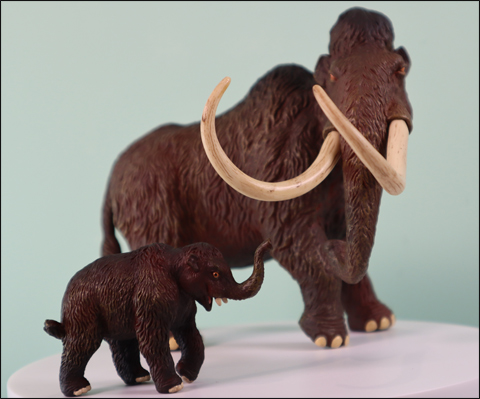
Models of Woolly Mammoths (CollectA Age of Dinosaurs Popular Models and Deluxe)

CollectA Woolly Mammoth models.

The CollectA Deluxe Woolly Mammoth model in 1:20 scale and the CollectA Prehistoric Life Woolly Mammoth calf. Picture credit: Everything Dinosaur.

Picture credit: Everything Dinosaur

To view models and figures of Woolly Mammoths and other extinct animals: CollectA Deluxe – Figures and Models (Prehistoric Animals).

Exposing the Carcase

The back quarters and the legs were the parts of the carcase first exposed, local officials were contacted and the International Mammoth Committee alerted so that an excavation could begin to remove the Woolly Mammoth.  Scientists rushed out to the remote location and began the work of digging out the Mammoth remains.  Alexei Tikhonov, of the St. Petersburg-based Zoological Museum, and an expert of Siberian Mammoths was one of the scientists dispatched to excavate the carcase.  He has described this particular specimen as the best preserved and most complete Mammoth found in Russia for more than 100 years.

Nicknamed the “Mammoth of the Century”, the specimen is that of a teenage Woolly Mammoth, a male that died around 30,000 years ago.  Although the elephant’s trunk has rotted away, scientists have found samples of fur intact and one 1.5 metre long tusk, along with the remains of an eye and a small, Mammoth ear.  Mammoths had much smaller ear flaps than their modern elephant counterparts.  Small ears would not have lost as much heat as a large ear flap and there was no need for large ears to help cool the animal down, temperatures in this part of the world during the Pleistocene Epoch when this animal lived, would have rarely climbed into double figures (Celsius).

With the aid of local volunteers the Mammoth fossil was carefully excavated out of its Siberian grave, the process taking more than a week to complete.  Once the remains had been stabilised (kept at a constant, low temperature to preserve soft tissue), the fossil has been transported back to Moscow for detailed study.  Parts of the specimen will also be examined by Russian palaeontologists in St. Petersburg.

Preserving an Ancient Elephant

Weighing over 1,000 kilogrammes; the carefully packed and preserved ancient elephant may provide researchers with Mammoth DNA.  Viable genetic material could still be preserved deep in the large teeth of the animal or within the larger limb bones such as the femur.  With a team of international scientists recently concluding that DNA might be able to survive for much longer than previously thought in the fossil record (based on evidence from New Zealand Moa fossils), there is a strong possibility that this 30,000 year old carcase might yield genetic material.

To read an article on the research into a DNA half-life: Research into the Half-life of DNA.

Russian scientists are keen to start work, although they will have to be properly protected and wear face masks to ensure exposure to ancient bacteria and other pathogens does not occur.  They will also be keen to avoid any potential DNA contamination.  The skeleton is virtually intact and the body cavity has not been punctured which may have permitted the gut and the other internal organs such as the heart to be preserved.

Like many Woolly Mammoth fossil finds, this teenage Mammoth that was probably around sixteen years of age when it died, has been given a name as well as a formal scientific classification code.  The Mammoth has been named Zhenya, a pet name used by the friends and family of Yevgeny, the boy who sniffed out the fossil discovery in the first place.

10 10, 2012

Controversial Research Proposes a Half-Life for DNA

By |2023-02-06T08:44:28+00:00October 10th, 2012|Categories: Dinosaur and Prehistoric Animal News Stories, Palaeontological articles|0 Comments

Scientists Calculate the Half-Life of DNA using Moa Fossils

A team of international researchers have used the fossilised bones of three species of extinct giant birds from New Zealand to calculate the half-life of DNA.  This study suggests that the double helix can persist in the fossil record under optimum conditions for a lot longer than previously thought with traces of genetic material being detectable in fossils as old as 6.8 million years.  The work, which is controversial, if proved valid, rules out DNA from a dinosaur surviving so there would be no chance of cloning a member of the Dinosauria from genetic material recovered from their bones or from biting insects trapped in amber.

Sorry Michael Crichton fans, but his wonderful idea about a dinosaur populated “Jurassic Park” is simply not on.

A half-life measurement records the time required for a substance to fall to half its measured value at the beginning of a time period.  One of this term’s most common applications is in the measurement of radioactive decay.  Within palaeontology for example, once a half-life of a substance such as elements from an igneous rock deposited in association with sedimentary strata is calculated, since the rate of decay is exponential, this methodology can permit scientists to accurately date rocks and potentially any fossil material associated with adjacent strata.  However, a team of scientists have worked out a half-life for DNA itself.  If this measuring technique proves valid then the dating of fossils could become a lot easier and the search for DNA samples within the fossil record can become more targeted.

Half-life of DNA

There have been a number of papers published recently that claim to have isolated extremely old, fragmentary DNA, even elements of organic material from dinosaur bones.  The need for a reliable model for DNA degradation over the passage of time has been well established.  The international team of palaeontologists took core samples from the leg bones of 158 specimens of New Zealand Moas which were very likely to have preserved in them mitochondrial DNA.  Radiocarbon dating allowed the team to accurate work out the ages of the fossil material and based on this analysis they were able to demonstrate that DNA decays at a exponential rate over time.  The half life of DNA was calculated to be 521 years, much longer than had been demonstrated in other experiments.

Fossilised Leg Bones Used in the Study

Large Moa bones used in the DNA study.

Picture credit: Morten Allentoft

After an animal dies, the cells begin to degrade.  Enzymes start to dissolve the bonds between the nucleotides that form the structure of the DNA material contained within the cell.  Micro-organisms can speed up the decay process, but it is thought that the presence of ground water and the chemical reactions brought about by its presence, is mostly responsible for the degradation of the genetic material.  As groundwater is abundant and found in most strata, so DNA buried in bone undergoing a fossilisation process should, in theory at least, degrade at a set, measurable rate.

The Rate of DNA Decay

Calculating the rate of DNA decay has been fraught with difficulties because of the problems of finding enough fossil material with large amounts of DNA with which to use in any scientific study.  Compounding this problem is the fact that variable environmental conditions such as temperature, the amount of oxygen present and the level of microbial activity all have a significant impact on the decay of organic material.

The research team led by Morten Allentoft (University of Cophenhagen, Denmark) and Michael Bunce (Murdoch University, Perth, Australia) focused their efforts on analysing the DNA from 158 leg bones that belonged to three species of extinct Moa.  Moas were giant, flightless birds (nine species) that were native to New Zealand (Dinornithiformes), some species were over 3.5 metres tall.  These birds, closely related to Australian Emus, became extinct around 1400 AD.  These creatures were once abundant on both North and South Island and the bones used in the study came from three locations all within a few miles of each other.  The close proximity of the specimens studied enabled the scientists to nullify the effect of environmental differences between locations as the fossils had been forming in almost identical preservation conditions.

All the bones have been dated between 8,000 and 600 years old, the strata in which they were being preserved had a temperature of around thirteen degrees Celsius, helping to keep the results of any DNA half-life measurement consistent over the entire sample.

By comparing the specimens’ ages and degrees of DNA degradation, the researchers calculated that DNA has a half-life of 521 years. That means that after 521 years, half of the bonds between nucleotides in the DNA would have broken; after another 521 years half of the remaining bonds would have degraded leaving only a quarter of the original material left; and so on.   Using their research, the team have postulated that detectable DNA could be found in fossils as old as 6.8 million years, but this material would be too fragmented to be used in any cloning work.  DNA’s ability to survive in the fossil record, or so it seems, has been seriously underestimated.

Post doctoral researcher, Morten Allentoft commented:

“DNA degrades at a certain rate, and it therefore makes sense to talk about a half-life.”

These results may provide a baseline for predicting long-term DNA survival in fossil bone, helping palaeontologists to assess the most likely fossils to have sustainable amounts of DNA within them.  In sub-zero conditions, such as those found in Siberia, DNA may have a half-life that it much longer, perhaps as much as 158,000 years.  This would potentially permit scientists to extract viable DNA from Ice Age mammals such as Woolly Rhinos and Mammoths.

A number of scientists have yet to be convinced by these findings.  Eva-Maria Geigl at the Jacques Monod Institute (Paris, France), remains sceptical.  She is concerned that the analysis rests on statistically weak evidence, pointing out that the correlation relies heavily on the Moa bones older than 6000 years – when fewer than 10 of the 158 bones are actually as old as this.

Michael Bunce defended his work by explaining:

“Old fossils are rare and hence there will be less data in this part of the analysis.  There is nothing we can do about it other than present what we have at hand – and clearly, the signal is present.  The correlation is highly significant.”

If genetic material has a predictable time-frame for decay, then palaeontologists may have an opportunity to obtain DNA from important fossil discoveries that reveal life on Earth in the relatively recent geological past.

Ever since the Indonesian island of Flores yielded remains of a pygmy-like hominid (Homo floresiensis), nick-named the “hobbit” speculation has been rife that some specimens might contain DNA that would help pin down its position in the human family tree.   Scientist remain uncertain whether these little people were descendants from modern humans or the much older H. erectus.

Unfortunately, exogenous factors would “cloud” the DNA half-life calculations.  The conditions in which the fossils were preserved, the degree of groundwater, the amount of oxygen, the level of microbial activity  and the ground temperature would all affect the rate of genetic decomposition.  The research scientists conclude that “a host of other factors would come into play“, including the time of year when the organism died.  Although the Moa bones used in the study had all been retrieved from very similar environments, the age of the specimens could only account for about 40% of the variation in DNA preservation.  The research team admits that the “half-life signal is very noisy“.

How a corpse rots and a whole host of other factors would influence the rate of decline of any genetic material once present, based on this work retrievable and workable DNA could potentially be recovered from a fossil that was 1.8 million years old – but beyond this time-frame sufficient DNA recovery to permit effective study would be virtually impossible.

Looks like the non-avian dinosaurs are really extinct after all.

For models and replicas of prehistoric animals and ancient creatures: Prehistoric Animal Models (Mojo Fun).

9 10, 2012

100-million-year-old Spider Preserved In Amber as it Approached its Victim

By |2023-03-07T10:16:39+00:00October 9th, 2012|Categories: Dinosaur and Prehistoric Animal News Stories|0 Comments

Spider Attack Preserved in Amber

Researchers from Oregon State University (College of Science) have discovered a remarkable, 100-million-year-old spider fossil showing the moment when an orb spider approached its victim ensnared in its web.  The fossil consists of the remains of the spider and a parasitic wasp, preserved in amber just as the spider was about to pounce upon the insect, as it was held fast by the silken threads of the spider’s web.  Amber is the hardened remains of sticky, often scented resin that is produced by certain types of trees as protection against damage to bark and in order to help protect against disease and fungal attacks.  Insects and other organisms can become trapped in the sticky resin as it flows down the trunk or branches and when fossilised and preserved as amber, these organic remains can be studied by scientists.

Trees first evolved the ability to produce resin of this nature in the Jurassic, but this piece of amber, discovered in the Hukawng Valley (also known as the Hukaung Valley), in northern Burma dates from the later Cretaceous geological period.

100-million-year-old Spider Fossil

The Hukaung Valley has been mined for amber and gold for many years, it has already produced a number of amber fossils containing insect remains.   About ten years ago, the fossilised remains of the world’s oldest bee was discovered in an amber nodule from a mine in the Hukaung Valley.  However, this is the first discovery of a predator/prey interaction concerning a spider and an insect trapped in a web.  The amber nodule containing the fossilised remains has been dated to approximately 97-100 million years ago (Albian faunal stage of the Cretaceous) – a time when the dinosaurs ruled the Earth.

In addition to the first spider, the silk and the remains of the spider’s attempted meal, the wasp, the amber nodule also contained the remains of a second male spider.  Scientists at the Oregon State University have interpreted this as evidence of social behaviour amongst arachnids.  Most extant species of spider are solitary hunters, often they are cannibalistic towards their own kind, mature males and females will attack immature members of their own species.  A number of species today show signs of social behaviour, living in colonies or aggregations.

The Oregon based team postulate that this fossil is evidence of such social, colonial activity in spiders back in the Cretaceous, the first evidence found of tolerance of other members of their own species by a spider.

The Spider About to Attack the Parasitic Wasp

100-million-year-old spider fossil

100-million-year-old spider and wasp fossil.

Picture credit: Oregon State University.

Professor Emeritus of Zoology at Oregon State University, George Poiner Junior, a recognised authority on invertebrate fossils stated that:

“This juvenile spider was going to make a meal out of a tiny parasitic wasp, but never quite got to it.  This was a male wasp that suddenly found itself trapped in a spider web.  This was the wasp’s worst nightmare, and it never ended. The wasp was watching the spider just as it was about to be attacked, when tree resin flowed over and captured both of them.”

Over recent years, palaeontologists have discovered some amazing fossil specimens preserved in amber, from ancient Arthropods, to numerous types of insect, pollen, plant debris, even a frog, hairs from mammal and feathers from either an ancient bird or a dinosaur.  Such fossils provide an insight into deep time, a micro world which helps scientists to understand more about ecosystems and habitats.

To read about the discovery of ancient spider silk: World’s Oldest Spiders Web Discovered Entombed in Amber.

To read an article about feathers preserved in amber: Canadian Palaeontologists in a Flap over Feathers.

The wasp has been identified as an ancestor of today’s parasitic wasps that attack and disable spiders and insects and lay their own eggs into the paralysed body of their victim or instead, parasitise the eggs of such creatures.  The kind of spider preserved in the amber, a relative of today’s tropical orb spiders, but a member of an extinct genus would probably have been the sort of creature the wasp would have liked to attack.

As the research team members have stated in their press conferences, this fossil preserves the moment when a spider was able to turn the tables on a parasitic wasp.  There were at least fifteen silken threads preserved in the amber nodule, evidence of the spider’s web.  Some of these threads had trapped the wasp.

Both the spider and the wasp are scientifically described in an academic paper published in the journal “Historical Biology”.

For models and replicas of ancient invertebrates: CollectA Age of Dinosaurs Models (Popular).

7 10, 2012

Late Jurassic Marine Crocodiles – More Like Killer Whales than Crocs.

By |2023-02-06T08:23:43+00:00October 7th, 2012|Categories: Dinosaur and Prehistoric Animal News Stories, Palaeontological articles|0 Comments

Research Suggests Marine Crocodiles Were Very Different from Todays

Scientists at the University of Edinburgh have concluded that Late Jurassic marine crocodiles may have fed more like Killer Whales than extant crocodiles and one genus could have sucked prey into its mouth or simply attacked and torn other large marine creatures apart with its strong jaws and teeth.

Marine Crocodile Research

Marine crocodiles (crocodylomorphs) represent a branch of the crocodile family tree that radiated out from land base forms during the Mesozoic and evolved into a variety of families and genera.  There is an extensive fossil record with numerous skulls and other fossilised bones as well a large numbers of individual teeth for palaeontologists to study.

Marine crocodiles shared similar characteristics, unlike their land-based ancestors these reptiles adapted to a nektonic (actively swimming) life by slowly losing their body armour (scutes/osteoderms) and becoming more streamlined.  Their limbs evolved into paddles and most species had broad tails which ended in a hypocercal tail fin.  A hypocercal tail fin is a fin which is not symmetrical along the horizontal axis in line with the caudal vertebrae (in the case of vertebrates).  The lower tail lobe is enlarged and bigger than the upper tail lobe.  It is very likely that these crocodiles propelled themselves through the water in the same way that crocodiles do today.  The tail was the source of propulsion, the limbs (paddles) may have been used to make changes in direction and small adjustments in the water column.   However, these evolutionary adaptations made these creatures much more efficient swimmers than land based crocodylomorphs.

An Illustration of a Typical Marine Crocodile

Marine crocodile model Dakosaurus.

A close-up view of the head of the PNSO marine crocodile model Dakosaurus.

The picture (above) shows the package art for the PNSO Dakosaurus replica.

To view the PNSO range of prehistoric animals including marine reptiles: PNSO Marine Crocodiles and Prehistoric Animal Models.

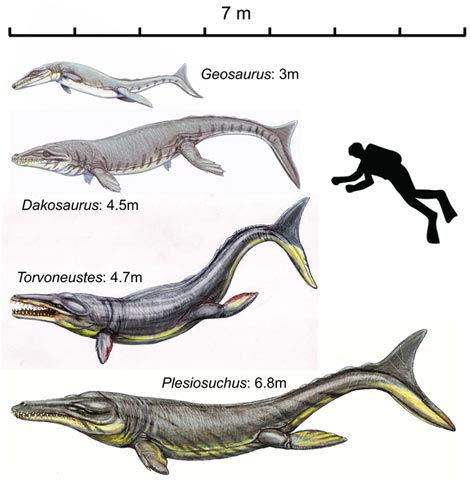
One super-family of the marine crocodiles, the Metriorhynchidae seems to have had a particularly large geographical distribution, with fossils being found in England, France, Switzerland, Italy and Germany as well as the Americas including Chile and Argentina.  As a group, these carnivorous reptiles seemed to have their heyday in the Late Jurassic but fewer fossils have been found in Lower Cretaceous strata.  The research team, led by Dr Mark Young of the School of Geosciences (University of Edinburgh) studied two types of marine crocodile Dakosaurus and the larger Plesiosuchus.  They have concluded that these large, contemporaneous predators probably predated on different types of prey.

To read about the discovery of Jurassic crocodile fossils in Switzerland: Marine Crocodile Fossils Found in the Land of Chocolate, Pen Knives and Cuckoo Clocks.

Dakosaurus

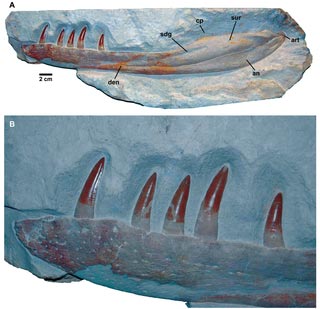
Dakosaurus spp. grew to lengths approaching five metres, they were not the largest types of marine crocodile but they did have the most robust lower jaws and in proportion to their body size, much larger teeth.  The teeth of Dakosaurus spp were designed for slicing, the Edinburgh researchers conclude that this type of marine crocodile evolved a specialism for tackling large prey.  The teeth and strong jaws being capable of dismembering large-bodied prey and crushing bones.  In addition, the research team have concluded that one species of Dakosaurus (Dakosaurus maximus) may have been capable of creating a pressure differential inside its strong jaws that permitted it to suck in prey.  Many of the teeth found in the fossilised jaws of Dakosaurus are broken and show extensive wear.  The scientists have concluded that these pathologies are indicative of the tougher, larger body parts that these animals were consuming.  Teeth may also have been broken as these crocodylomorphs tore their victims apart.

The Lower Jaw of a Dakosaurus (Dakosaurus maximus)

Robust and powerful jaws and teeth.

Picture credit: PLoS One

The Plesiosuchus genera also had strong jaws, large fenestrae  (openings in the skull) would have anchored strong muscles to give these crocodiles a powerful bite.  They could also gape their jaws very wide enabling them to tackle large prey items, but probably animals no bigger than their mouths could gape.  The teeth of Plesiosuchus spp. are proportionally smaller and more conical than the teeth of Dakosaurus.  Fossilised teeth ascribed to Plesiosuchus lack the crown breakage seen with Dakosaurus teeth.  This suggests that Plesiosuchus did not eat the same animals as the smaller Dakosaurus.  They may have killed their victims with a single bite before swallowing their meal whole.

The relationship between Dakosaurus and Plesiosuchus is very similar to that seen with North Atlantic Killer Whales today.  There is a larger type of Killer Whale that lacks broken teeth, whilst there is a smaller type of Killer Whale that tends to have extensive crown breakage.  Marine biologists have proposed that these differences in teeth wear are associated with diet.  Each type of Killer Whale specialising in different types of prey.  Plesiosuchus may have been a specialist piscivore (fish-eater) tackling prey no more than a metre in length perhaps, whereas Dakosaurus may have hunted ichthyosaurs, other marine reptiles and larger types of fish.

Size Comparisons between Different Types of Marine Crocodile

Frogman in picture is 1.8 metres tall.

Picture credit: PLoS One

Different Types of Feeding Behaviour

The research team have concluded that this different feeding behaviour helps to explain why so many apex predators were able to live together in the Late Jurassic marine environments.

Commenting on the research, one of the authors of the scientific paper that has been published on this subject, Dr Lorna Steel stated:

“The skull and tooth morphology show that they all ate different prey, and fed in different ways.”

6 10, 2012

Hadrosaurs – Tough Teeth for Top Chewing According to New Research

By |2024-04-24T16:46:43+01:00October 6th, 2012|Categories: Dinosaur and Prehistoric Animal News Stories|0 Comments

Research into Hadrosaur Dentition Provides Clue to the Group’s Success

One of the most successful groups of large, land animals known to science are the Hadrosauridae, a group of ornithischian (bird-hipped), plant-eating dinosaurs that evolved from the iguanodontids during the Cretaceous geological period.  These animals evolved into many families and genera, some species grew up to twelve metres in length or more and they dominated terrestrial ecosystems across the Northern Hemisphere up until the demise of the Dinosauria 66 million years ago.  A new study examining the dentition of hadrosaurs, suggests their teeth were one of the reasons for their evolutionary success.

Dentition of Hadrosaurs

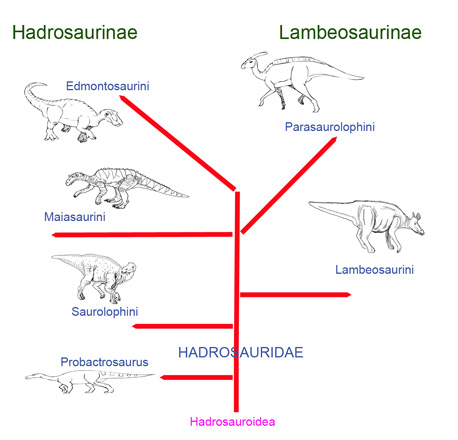
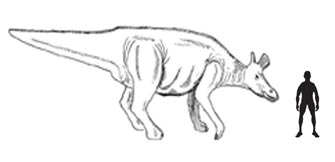
This type of dinosaur, commonly called “duck-billed” dinosaurs as they all had horny beaks is classified into two major taxons – the Lambeosaurinae and the Hadrosaurinae.  Lambeosaurs, dinosaurs such as Parasaurolophus, Corythosaurus and Olorotitan had hollow, ornate head crests.  The Hadrosaurinae, animals such as Gryposaurus, Maiasaura and Edmontosaurus lacked the often flamboyant crest.  Instead, these dinosaurs had flat, crestless heads or their snouts were ornamented with bony lumps or solid crests.

Taxonomic Relationships in the Hadrosauridae

Diversifying ornithischian dinosaurs.

Picture credit: Everything Dinosaur

Differences Between the Clades

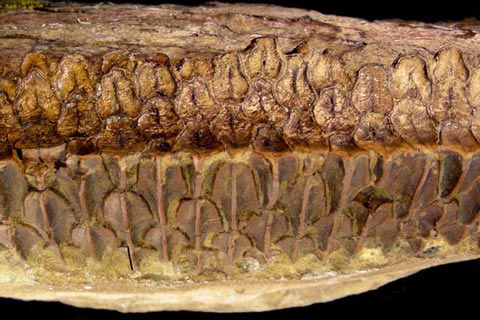
There are other differences between these two clades of dinosaurs.  For example, the Hadrosaurinae generally had broader jaws and wider beaks than their Lambeosaurinae cousins.  This suggests different feeding habits with the narrow-beaked lambeosaurs being more selective feeders.  Both types of hadrosaur had many hundreds of closely packed, diamond shaped teeth in their jaws, some specimens had over 1,400 individual teeth in their mouths.  These teeth formed a “dental battery”, interlocked teeth to form a very efficient grinding surface to help these animals tackle tough plant material.  The upper and lower tooth batteries were angled so that when the mouth was closed the teeth formed a natural grinding surface.   For many years palaeontologists had known that these animals were very efficient processors of plant food, perhaps a clue to this groups’s success but new research proposes that the structure of the teeth themselves made these dinosaurs much more effective consumers of plants than most of today’s grazers.

To view models and replicas of hadrosaurs (lambeosaurines and Saurolophinae): Ornithischian Dinosaur Models (Safari Ltd).

Super Efficient Plant-Eaters

A typical crested hadrosaur (Lambeosaurinae).

Picture credit: Everything Dinosaur

A team of American scientists led by biologist Gregory Erickson of Florida State University (Tallahassee), have been testing the grinding capabilities of eighty-five-million-year-old duck-billed dinosaur teeth and examining their internal structure.  Their research shows that the hadrosaurs evolved extremely sophisticated teeth, more sophisticated than modern mammalian herbivores such as bison, horses and elephants.

Using teeth supplied by the American Museum of Natural History (New York), the research team created models of the jaws of these types of dinosaurs and subjected the teeth to diamond abrasion to simulate wear on the tooth surface as a result of grinding up plant material.  The teeth were then examined under light and electron microscopes and the degree of wear calculated.

Hadrosaur Dentition

These teeth were made for grinding.

Picture credit: D. Gregory Erickson

The study demonstrates that unlike most mammalian molars and pre-molars which are composed of four major tissues that wear at different rates, creating coarse, roughened surfaces to help break down tough plants, the duck-bills evolved a six tissue dental composition which improved the teeth’s ability to grind up food.

Tough, strong teeth designed to tackle plants has evolved repeatedly in the ungulates and other mammal groups.  However, a similar innovation in dental complexity occurred much earlier in the history of life on Earth, with the hadrosaurs.  Most reptilian teeth are not as complex, it seems that as the iguanodontids gave rise to the hadrosaurs so the teeth of these animals evolved into extremely efficient grinders.  The external layer of enamel being supported by layers of other tissue such as dentine.  Importantly, the researchers also discovered that the way tissues were distributed varied substantially within each individual tooth.   Each tooth in the dental battery would assume a different function as the morphology and the grinding surface of the tooth changed as it became worn.   Different surfaces would be exposed as the teeth migrated across the grinding and chewing surface of the jaw, before eventually falling out to be replaced with new teeth that emerged from the jawline.

The morphology and structure of the teeth would have enabled these herbivores to grind up tough plants such as horsetails, ferns, conifer needles and the newly evolved flowering plants.  Most reptiles have much more simple teeth structures and the scientists are not sure how such dentition evolved.  The lack of transitional fossils between iguanodontids and hadrosaurs is hindering the team’s progress as they search for answers in the fossil record.

Referring to hadrosaurs as “walking pulp mills“, Gregory Erickson and his research colleagues have declared the duck-billed teeth lined jaws as one of the most sophisticated grazing and grinding mechanisms ever to evolve in terrestrial mega herbivores.  Their teeth are more complex and better adapted to grinding than most of the large plant-eating mammals found today.

4 10, 2012

Pegomastax – A New Dinosaur with Fangs and Bristles

By |2023-02-06T08:06:18+00:00October 4th, 2012|Categories: Dinosaur and Prehistoric Animal News Stories|0 Comments

New Dinosaur Fossil Provides Evidence of the Evolution of Bird-hipped Dinosaurs

A new type of primitive, bird-hipped dinosaur has been scientifically described nearly thirty years after the fossils were first examined.  The tiny biped, perhaps no bigger than a domestic cat was a fleet-footed herbivore that roamed what was South Africa approximately 190 million years ago.  Named as Pegomastax africanus (the name means thick jaw from Africa), this new genus of dinosaur has been described as a cross between a bird, a porcupine and Dracula as this little reptile had a light skeleton, bristles running along its neck and back and fang-like teeth.  Despite its sharp teeth, located at the front of the jaw, Pegomastax has been placed amongst the Heterodontidae, a group of primitive ornithopods (bird-hipped dinosaurs), whose fossils have been found in southern Africa, the United States and Asia.

Pegomastax africanus

A Reconstruction of Pegomastax africanus

A dinosaur with fangs!

Picture credit: Tyler Keillor

The fossils of this dinosaur were recovered from sandstone deposits that were laid down in a desert environment.  Note the large orbit (eye-socket) which indicates that this little herbivore had large eyes.  Perhaps this animal was nocturnal.

Professor Paul Sereno of the University of Chicago and an acknowledged expert on African dinosaurs, published details of this new dinosaur in the on line journal “ZooKeys”, which also contains a review of other heterodontosaurid dinosaurs including discoveries made in southern England in the 19th Century.  Paul first came across the fossil specimens back in 1983 when he was a graduate student doing research at Harvard University.  The fossils had originally been discovered after an expedition to the Elliott Formation of Cape Province (South Africa) in the mid 1960s.  Recalling the moment when he first saw the fossils, Professor Sereno stated:

“I said, whoa!  I realised it was a new species from the moment I set eyes on it.”

However, Paul was distracted by other projects and he did not have the time to describe the specimen scientifically until very recently.

Professor Sereno went on to add:

“I describe it as a bird, a vampire and a porcupine.  It had the weight of a small house cat and stood less than a foot off of the ground.”

Heterodontosaurid Dinosaur

The heterodontosaurids are an important group of herbivores which first evolved in the Triassic and persisted into the Cretaceous.  Unlike most other dinosaurs, heterodontosaurids had different shaped teeth in their jaws.  Some of the teeth at the front of the jaws were sharp and pointed like fangs.  The teeth towards the back of the jaw were more square in shape and adapted to crushing plant material.  At the front of the jaw there was a thick, blunt beak.  The fang-like teeth may have been used to help dig up roots and tubers or perhaps they were used in displays to deter attacks from predators or to settle dispute amongst pack members.  Most of the heterodontosaurids discovered to date were relatively small, measuring no more than a metre in length and most of this length being made up by a  long tail.

However, this group is related to much larger, herbivorous dinosaurs that evolved later – the iguanodontids, hadrosaurs and the hypsilophodontids.

To view models and replicas of ornithischian dinosaurs such as hypsilophodonts, hadrosaurs and iguanodontids: CollectA Age of Dinosaurs (Popular Models).

An Illustration of Pegomastax africanus

A line drawing of Pegomastax.

Picture credit: Todd Marshall

This new dinosaur discovery represents one of the smallest genera of dinosaur known, to read about a relative of Pegomastax, Fruitadens discovered in the United States: Fruitadens, a tiny Ornithischian dinosaur.

3 10, 2012

Giant Salamanders Terrestrial Hunters of the Palaeogene

By |2023-02-06T08:02:13+00:00October 3rd, 2012|Categories: Animal News Stories, Dinosaur and Prehistoric Animal News Stories|0 Comments

Research Shows that Giant Salamanders Were Once Land Dwelling Hunters

There are several species of giant Salamander living today, the largest Megalobatrachus japonicus grows up to 1.5 metres in length.  Like all giant Salamanders this species prefers fast running, well-oxygenated streams and they are all very much aquatic creatures.  However, a team of scientists studying ancestral giant Salamander fossils found in the Gobi desert; suggest that during the Palaeogene, these amphibians were very much at home on the land.  Not only were these giant Salamanders terrestrial, but studies of the skull fossils and teeth indicate that these animals probably hunted on land too.

Giant Salamanders

Giant Salamanders are found today in Asia, with one species known from the United States.  The heads and bodies of these creatures are flattened, the tail is laterally flattened and the paired limbs are relatively small and weak when compared to the rest of the body.  Modern giant Salamanders lack eyelids and the larval teeth are retained into adulthood.  In fact these amphibians only undergo a partial metamorphosis from the larval stage and retain larval characteristics as mature animals (a form of neoteny – when traits of juveniles are seen in adults).

Scientists studying the fossilised remains of the oldest known member of the Giant Salamander group (Cryptobranchidae), fossils found in Mongolia and dated to around fifty-five million years ago, have proposed that these animals were adapted to a life on land.

Four specimens of the Palaeogene species Aviturus exsecratus located at the Moscow Palaeontological Institute reveal that these amphibians had robust limbs, strong backbones and powerful jaws that suggest adaptations to a terrestrial environment.

Vertebrate palaeontologist Davit Vasilyan of the University of Tübingen (Germany) who helped write the scientific paper on this study states that Aviturus exsecratus had the strongest head muscles of any giant Salamander, suggesting it went on land to hunt.  Supporting this idea is the fact that fossil remains of this salamander were found in rock typically formed from water’s-edge sediments.  Unlike their modern descendants, these early Cenozoic amphibians went through extra stages of metamorphosis and lost some of the juvenile traits that are retained in adults today.  The teeth for example, were much more developed than the teeth found in the large, wide mouths of their modern counterparts.

The evolution of terrestrial giant Salamanders coincides with a period of dramatic global warming (Palaeocene-Eocene Thermal Maximum), a time when much of the Earth became covered in tropical rain-forest and global temperatures rose to an average of around 26 degrees Celsius (compared to an average today of just 14 degrees Celsius).

Dr Vasilyan proposes that giant Salamanders first appeared as land based carnivores during this warm era, perhaps exploiting niches in the ecosystems that had yet to be properly filled after the mass extinction event that ended the Mesozoic some ten million years earlier.  When global temperatures began to drop, these amphibians abandoned their more complete adult forms adapting to an entirely aquatic existence which still persists today.

Giant Salamanders Once Hunted on Land

Terrestrial predators.

Picture credit: Davit Vasilyan

It seems that these rare, aquatic creatures that we know today, were once powerful, land-based hunters.

For models and replicas of prehistoric creatures: Models of Prehistoric Creatures (CollectA Age of Dinosaurs Popular).

Go to Top