All about dinosaurs, fossils and prehistoric animals by Everything Dinosaur team members.

Fossil finds, new dinosaur discoveries, news and views from the world of palaeontology and other Earth sciences.

15 11, 2012

Getting our Teeth into the Origins of the Great White Shark

By |2023-02-07T08:52:05+00:00November 15th, 2012|Categories: Dinosaur and Prehistoric Animal News Stories|2 Comments

Trying to Unravel the Carcharodon Family Tree

The ancestry of the famous shark that starred in “Jaws” is better understood after the publication of a scientific paper by American researchers that provides details of a transitional fossil between prehistoric Mako sharks and extant Great Whites.

Great White Sharks

Carcharodon carcharias (Great White Shark), was believed by many scientists to be a direct descendant of the huge Megalodon shark (Carcharodon megalodon), one of the largest fish to have existed in the last twenty million years or so.    Fossil teeth of the Megalodon have been found in Europe, Asia, the Americas and in Australasia, this large predatory shark that could have reached lengths in excess of sixteen metres seems to have been very widely distributed.  However, scientists were uncertain as to the exact phylogenetic relationship between this giant shark that became extinct approximately 1.6 million years ago and extant species such as the Great White.

The problem with Lamniformes, the Order to which sharks belong is that they have skeletons made of cartilage.  This is rarely preserved in the fossil record, so there are few body fossils (other than the teeth) for palaeontologists to study.  However, the discovery of a remarkably well-preserved set of jaws, some articulated bones and numerous teeth, a number still “in situ” with the jaws, from a remote location in Peru has provided scientists with an important clue as to the origins of today’s Great Whites.  This fossil suggests that Great Whites, although having a similar body plan and lifestyle to the Megalodon, probably did not evolve from the same shark lineage.  It seems that Great White Sharks may share a common ancestor with the nektonic Mako shark.

The phylogenetic relationship between those shark species that make up the Carcharodon genus remains somewhat muddled.  Megalodon itself, may turn out to be more closely related to Tiger sharks (Galeocerdo cuvier) than to today’s Great Whites.

It is true that modern-day Great White Sharks have similar teeth to the extinct Megalodon.  The shape of the serrations along the teeth edge are very similar, but when examined under a microscope it can be seen that the denticles (the scientific term for these serrations) are very different.  Extinct Megalodon teeth show very fine serrations whilst the denticles on Great Whites are very coarse and much larger in comparison.

Transitional Fossil

Professor Dana Ehret, of Monmouth University (New Jersey, United States), the lead author of the research paper suggested that one of the reasons why Megalodon was believed to be the ancestor of Carcharodon carcharias was that Great Whites were used by anatomists and palaeontologists to make mounted exhibits of Megalodon for museums and other institutions.  If a modern shark had been used as the basis to put together Megalodon then it is not surprising that reconstructions of Megalodon resemble a Great White.

Professor Dana Ehret Examines the Shark Specimen

Fossil provides insight into the ancestry of Great White Sharks.

Picture credit: Florida Museum photograph by Jeff Gage.

Since both Carcharodon carcharias and Carcharodon megalodon have serrations (denticles) on the cutting edge of their teeth, this was thought to be an indication that these species were very closely related.  However, when examined under a microscope differences can be seen.  Today’s Great Whites have very coarse serrations whilst those on the extinct Megalodon are much finer.

Serrations on the cutting edge of shark teeth can be found in many species of extant and extinct shark.  Some indeed, do indicate phylogenetic relationships, whilst other examples are probably as a result of convergent evolution.  Convergent evolution occurs when two organisms, not necessarily closely related evolve in similar ways as they adapt to particular circumstances and environmental pressures.  For instance, both bats and most birds can fly, both have evolved wings but the structure of these wings is very different; birds and bats are not closely related.

Carcharodon hubbelli

The newly described species, known as Carcharodon hubbelli has been named from a beautifully preserved shark specimen that was found at a fossil dig site, part of the Pisco Formation of south-western Peru.  The very dry atmosphere has enabled fossils to be preserved in exceptional condition even when eroded out of the sedimentary rock.  Carcharodon hubbelli material consisted of the jaws, teeth, some of which were still in situ in the jaws and other elements of the fossil including part of the backbone of the animal.  The Pisco Formation has already provided scientists with some amazing fossils that give an insight into Pliocene marine fauna with the discovery of a gigantic predatory whale (Leviathan melvillei), that probably fed on Megalodons.

To read more about L. melvillei: Nightmare Whale from Prehistory.

A Replica of the “Nightmare Whale from Prehistory”

PNSO Requena the Livyatan model

PNSO Requena the Livyatan prehistoric whale model anterior view.

The new shark species provides evidence that Great Whites are descended from ancient Mako (mackerel) sharks.  Described as a “transitional species”, C. hubbelli, named after Gordon Hubbell, the scientist who first found the fossil, suggests that Great Whites are not the descendants of Carcharodon megalodon.

The blend of Mako and Great White anatomical characteristics include the curving outwards of the third anterior tooth in the jaws of the Peruvian specimen.  This is very similar to the dentition seen in modern Mako sharks today.  Initially, the fossil had been dated to around five million years ago, but this presented a problem to the palaeontologists who suspected that this specimen represented an ancestor of today’s Great Whites.  Five million years ago, the Great White lineage was already around so how could C. hubbelli be ancestral to this part of the Carcharodon family?

A biostratigraphical study of invertebrate fossils found in the strata established that this fossil was actually much older, around 6.5 million years old, making it more likely that this specimen does represent an ancestral or intermediate from of Great White.

The American based research team have concluded that “Jaws” is essentially a highly modified Mako shark (Isurus genus).  Mako sharks are predators of open water and very streamlined.  They are primarily fish-eaters (piscivores), but they have been known to become aggressive and attack people.  The Great White lineage adapted to eating larger prey such as dolphins, turtles and seals.  Mako sharks are occasionally caught by fishermen off the coast of Cornwall.  These sharks having followed the Gulf Stream eastwards, but Makos are more normally associated with warmer water.

Everything Dinosaur acknowledges the assistance of a media release from Florida Museum in the compilation of this article.

Please note

The taxonomic classification of Megalodon has been revised, it is now known as Otodus megalodon.

To purchase a replica of the giant, prehistoric whale L. melvillei and models of prehistoric fish: PNSO Age of Dinosaurs Models and Figures.

12 11, 2012

Xenoceratops – Alien Headgear on a Dinosaur

By |2023-02-07T08:38:39+00:00November 12th, 2012|Categories: Dinosaur and Prehistoric Animal News Stories, Dinosaur Fans|0 Comments

Adding to Alberta’s Ceratopsian Diversity – Xenoceratops

When the ceratopsians (horned dinosaurs) are considered one point (or should that be a series of points) that comes to mind is the amazing bony neck frills of these ornithischians.  Whether its the centrosaurines or the Chasmosaurinae (two main clades of ceratopsian), there seems to be no end to the strange crests, ornamentations and horns that these animals possessed.  Some of these dinosaurs do indeed look almost alien in appearance.  This brings us nicely to Canada’s newest centrosaurine dinosaur – Xenoceratops, as the name actually means “alien horned face”. A new horned dinosaur has been described from fossils found in Canada.

New Horned Dinosaur

Fossils found in south-western Alberta, close to the little community of Foremost just forty miles or so from the border with the United States, have proved to belong to a new species of horned dinosaur.  The fossils were originally collected from the Foremost Formation of early Campanian aged sediments back in 1958 by an American palaeontologist called Dr Wann Langston Junior.  These specimens remained in storage at the Canadian Museum of Nature’s research and collections facility in Gatineau, Quebec.  Scientists Dr Michael Ryan (Curator of Vertebrate Palaeontology at the Cleveland Museum of Natural History) and Dr David Evans of the Royal Ontario Museum came across the fossil material over a decade ago and after examining the fragments they concluded that these were the remains of a new type of horned dinosaur.

Dr Evans went onto locate a fifty-year old burlap and plaster wrapped parcel that had been collected from the same site at the same time.  These fossils were in storage at the Canadian Museum of Nature.  Examining the old plaster field jacket more skull bones from the same fossil locality were identified and from the resulting study a new genus of horned dinosaur came to be named.

An Artists Illustration of Xenoceratops in Late Cretaceous Alberta

“Alien” dinosaur with bizarre head gear.

Picture credit: Julius Csotonyi

Xenoceratops foremostensis

Xenoceratops foremostensis (pronounced zee-no-sera-tops for-mose-ten-sis) was up to six metres long and would have weighed over 1,500 kilogrammes.  This newly identified herbivorous dinosaur represents the oldest known large, ceratopsian dinosaur found in Canada to date.  The academic paper that describes this discovery has just been published in the Canadian Journal of Earth Sciences.  Authors Ryan and Evans go onto highlight the importance of this dinosaur discovery.  Compared to other Late Cretaceous formations of Alberta (such as Dinosaur Provincial Park for example), the Foremost Formation has offered very little vertebrate fossil material.  Microfossils and isolated teeth have been found but very few dinosaurs are known from this strata.  The discovery of Xenoceratops marks a “high water mark” in terms of dinosaur discoveries from the south-western part of the province.

Some of the Fossilised Bone Fragments being Pieced Together

Piecing together skull material.

Picture credit: Canadian Museum of Natural History 

The Foremost Formation is dated to around 80 million years ago, it is much older than the likes of the main fossil bearing sites of the Dinosaur Provincial Park, fossils found in the Foremost Formation can help palaeontologists to understand how groups of dinosaurs such as ceratopsians radiated and became more diverse.

Dr Ryan commented:

“Starting 80 million years ago, the large-bodied horned dinosaurs in North America underwent an evolutionary explosion.  Xenoceratops shows us that even the geologically oldest ceratopsids had massive spikes on their head shields and that their cranial ornamentation would only become more elaborate as new species evolved.”

Bizarre Pattern of Horns

The bizarre pattern of horns on this dinosaur’s head certainly make it look like a concept from a sci-fi illustrator.  A large, bony frill protruded from the back of the skull and this had two substantial horns sticking upwards.  There were horns over each eye and perhaps a small nose horn as well.

An Artistic Rendering of the Face of Xenoceratops

Formidable dinosaur from Late Cretaceous Alberta.

Picture credit: Mark Schultz

Dr David Evans went onto add:

“Xenoceratops provides new information on the early evolution of ceratopsids, the group of large-bodied horned dinosaurs that includes Triceratops.  The early fossil record of ceratopsids remains scant, and this discovery highlights just how much more there is to learn about the origin of this diverse group.”

This dinosaur is just the latest in a series of new finds being made by Ryan and Evans as part of their Southern Alberta Dinosaur Project, which is designed to fill in gaps in our knowledge of Late Cretaceous dinosaurs and how such diverse dinosaurs evolved.  This project focuses on the palaeontology of some of the oldest dinosaur-bearing rocks in Alberta, which is less intensely studied than that of the famous badlands of Dinosaur Provincial Park and Drumheller.

Few replicas and models of Xenoceratops have been made, but recently a new range of articulated horned dinosaurs has been created that does feature a Xenoceratops.

To view this range: Beasts of the Mesozoic Articulated Dinosaur Models and Figures.

Everything Dinosaur acknowledges the contribution of the Canadian Museum of Nature (Ottowa) in the compilation of this article.

11 11, 2012

Flight Dynamics of Giant Pterosaurs Explained by New Research

By |2024-04-24T17:26:25+01:00November 11th, 2012|Categories: Dinosaur and Prehistoric Animal News Stories, Palaeontological articles|1 Comment

Researchers Propose that Quetzalcoatlus Used Cretaceous Runways to Take Off and Land

Scientists from the Museum of Texas Tech University have used computer modelling to assess how the last of the giant pterosaurs (flying reptiles) took to the air.  Pterosaurs, evolved during the Triassic and they went onto dominate the skies for much of the Mesozoic, until the emergence of the Aves (birds).  The very last types of flying reptile were giants, creatures like Hatzegopteryx thambema from Europe and Quetzalcoatlus northropi whose fossils have been found in the Big Bend National Park of Texas.  These pterosaurs were members of the Azhdarchidae family and some of these animals were the largest flying creatures known to science with wingspans in excess of ten metres reported.  Quetzalcoatlus, for example, had a wingspan greater than that of an American F-16 jet fighter.  Seeing this huge animal, many times bigger than the largest birds today, soaring overhead would have been a truly memorable sight.  However, how such large and heavy creatures took to the air has puzzled palaeontologists ever since the first fossils of these giant pterosaurs were discovered.

An Illustration of the Giant Texan Pterosaur Quetzalcoatlus (Q. northropi)

Taking to the air in Texas 66 million years ago.

Picture credit: Everything Dinosaur

Giant Pterosaurs

One University of Texas academic, Sankar Chatterjee (Horn Professor of Geosciences and Curator of the Palaeontology Department at the University’s Museum), has suggested that these enormous creatures needed down-sloping runways to enable them to take off.    The scientist presented a paper detailing his work on the aerodynamics of  the Azhdarchidae pterosaurs at the recent annual meeting of the Geological Society of America in Charlotte (North Carolina).

After a careful, three-dimensional study of azhdarchid fossils, Professor Chatterjee and his colleagues developed a computer simulation that showed how such an ungainly looking animal would have used a run up in order to gain momentum before finally being able to achieve lift off.  Landing would also have been very tricky for these animals, which some palaeontologists estimate may have weighed more than two hundred kilogrammes.  When coming into land, the large wings would have acted like giant air brakes, and the pterosaur would effectively “stall” before touchdown with its hind legs contacting the ground first and then the front of the body and the large head would pitch forward and a quadrupedal stance would be adopted as the flying reptile came to a halt.

Quetzalcoatlus Compared to Modern Birds and a F-16 Jet Fighter

Wingspan bigger than a jet fighter, but likely to be less noisy.

Picture credit: Museum of Texas Tech University

Commenting on his research, Professor Chatterjee stated:

“This animal probably flew like an albatross or a frigate bird in that it could soar and glide very well.  It spent most of its time in the air.  But when it comes to take off and landing, they’re so awkward that they had to run.  If it were taking off from a cliff, then it was OK.  But if Quetzalcoatlus were on the ground, it probably had to find a sloping area like a river bank, and then run quickly on four feet, then two to pick up enough power to get into the air.  It needed an area to taxi.”

How Large Pterosaurs Took to the Air

In 2010, a study published in the open access and on line journal “Public Library of Science” proposed that the largest of the pterosaurs launched themselves into the air by using their strong leg and arm muscles to “vault” upwards.  This work was conducted by researchers based at the University of Portsmouth (England).  Professor Chatterjee and his colleagues do not agree with these earlier findings.  They postulate that such a method of taking to the air may be proven in small bats, but when it comes to a two hundred kilogramme pterosaur with a wingspan in excess of ten metres; this method of becoming airborne is simply not viable.

The Texas based team report that once animals got to a certain size they would not have had the strength and power required to vault into the air.  They contend that the only way these large flying reptiles could get airborne would be by taking a long run up, preferably into the wind along a downward sloping bank or similar stretch of ground.  Starting on all fours, the animal would quickly switch to a bipedal stance and build up running speed, then just like a modern-day hang glider, it would launch itself into the air, pick up a thermal and rapidly gain height.

Computer Models

The computer model suggests that these animals could not beat their wings very rapidly.  With a high-aspect-ratio wing, similar to that observed today with modern petrels and albatrosses, the azhdarchid pterosaurs would rely on thermals and air currents to keep them aloft with the minimum of effort.  The animals would have been vulnerable and ungainly on the ground but once in the air they could soar for hours.  Professor Chatterjee and his team have suggested that such creatures could attain air speeds in excess of 36 mph (58 kmh).

These enormous creatures, some of which stood taller than a giraffe, were aerial masters, the very last of their kind.  Pterosaurs died out at the end of the Cretaceous some sixty-six million years ago.  All we have now are their amazing fossils that can be studied so that we can understand how these creatures were able to fly.

For models and replicas of azhdarchid pterosaurs and other flying reptiles as well as dinosaurs and other prehistoric animal figures: Pterosaur Models, Dinosaur Figures and Prehistoric Animal Models (Safari Ltd).

8 11, 2012

Predator/Prey Relationships in Miocene Spain

By |2023-02-06T16:11:23+00:00November 8th, 2012|Categories: Dinosaur and Prehistoric Animal News Stories, Palaeontological articles|0 Comments

Joint American and Spanish Team Study Teeth to find out what Sabre-toothed Cats Ate

A ratio of Carbon 12 to Carbon 13 isotopes preserved in the fossilised teeth of apex predators and herbivores that lived over nine million years ago has provided a joint American and Spanish research team with an insight into how food chains worked in the latter part of the Miocene epoch.  The study, the academic paper having been published in the scientific journal  “The Proceedings of the Royal Society of Biology”, focused on the diets of the top, predatory mammals and attempted to establish how large carnivores such as Sabre-toothed cats and Bear Dogs (amphicyonids) were able to live in the same habitats in the Late Miocene of Spain without necessarily competing for the same food resources.

The Late Miocene of Spain

Palaeontologists from the Museo Nacional de Ciencias Naturales (Madrid) and the University of Michigan (United States) studied the fossilised teeth of  specimens of animals that had been found at a number of fossil dig sites at Cerro de los Batallones, just 25 miles south-west of Madrid.  A substantial number of vertebrate skeletons have been discovered in this area, two dig sites are particularly rich in predator fossil bones.  Scientists suspect these sites represent “natural predator traps”, a herbivore may have become stuck fast in mud and this then attracted a number of carnivores and scavengers to the location hoping to feed on the hapless plant-eater.  The meat-eaters soon became stuck too, and the rising pile of corpses would have attracted more and more predators, thus the number of carnivore fossil specimens found at such sites are far in excess of the number of herbivore fossil specimens found.  Fossils found include those of hyenas, martens and skunks.

Two Species of Sabre-toothed Cat

The researchers studied two species of Sabre-toothed cat, Promegantereon ogygia, about the size of an African Leopard (Panthero pardus pardus) and the much larger and heavier Machairodus aphanistus, which was about the size of an extant African Lion (Panthero leo).  It is quite common to hear people describe Sabre-toothed cats as “Sabre-toothed tigers”, this is an inaccurate description, as although Sabre-tooths do belong to the same taxonomic family as today’s “Big Cats” – Felidae, Sabre-toothed cats are not  closely related to tigers.

Identifying the Role of Sabre-toothed Cats in Ancient Food Webs

Ambush predators, animals of woodlands and dense scrub?

Picture credit: Everything Dinosaur

Bear Dogs

The other type of apex predator the research team studied was the Bear Dog known as Magericyon anceps.  Bear Dogs are neither Bears or Dogs but seem to be distantly related to both types of carnivore, sharing a common vulpavine ancestor.  M. anceps was a particularly large and powerful example of the Middle to Late Miocene Bear Dogs, large specimens could weigh over 200 kilogrammes and would have stood over a metre high at the shoulder.

The study of the teeth isotopes revealed that the Sabre-toothed cats shared the same woodland habitat.  The smaller Sabre-toothed cat species probably used the abundant cover to avoid encounters with M. aphanistus.  Sabre-toothed cats have a different build when compared to modern cats.  They are not built for speed but have immensely strong front legs and shoulders.  Scientists have speculated that Sabre-toothed cats specialised in being ambush predators rather than pursuit predators, chasing after their prey.  The woodland habitat would have been ideal for ambushing herbivores.

Stable Carbon Isotope Analysis

To arrive at their findings, the researchers conducted what’s called a stable carbon isotope analysis on the animals’ teeth. Using a dentist’s drill with a diamond bit, they sampled teeth from 69 specimens, including 27 Sabre-toothed cats and Bear Dogs.  The rest were plant-eaters.  They isolated the carbon from the tooth enamel.  Using a mass spectrometer, which you could think of as a type of scale, they measured the ratio of the more massive carbon 13 molecules to the less-massive carbon 12.  An isotope is a version of an element that contains a different number of neutrons in its nucleus.

Carbon 12 and 13 are both present in the carbon dioxide that plants take in during photosynthesis.  Different plants make use of the isotopes in different ways, and so they retain different amounts of them in their fibres.  When a herbivore eats a plant, that plant leaves an isotopic signature in the animal’s bones and teeth.  The signature travels through the food chain and can be found in carnivores as well.

One of the research paper’s authors stated:

“This would be the same in your tooth enamel today.  If we sampled them, we could have an idea of what you eat.  It’s a signature that remains through time.”

Cerro de los Batallones in the Late Miocene

The Late Miocene of Spain.

Predator/prey relationships studied in the Late Miocene of Spain.

Picture credit: Mauricio Antón

Late Miocene of Spain

This illustration depicts how the region of Cerro de los Batallones in central Spain likely looked 9 million years ago.  A superb scene created by Mauricio Antón and we acknowledge the University of Michigan press information which provided this image.

Both species of Sabre-toothed cat showed no statistical differences in the ratio of Carbon 12 to Carbon 13 in their teeth samples.  This means that they probably fed on similar prey animals that lived in the woodlands, but their body sizes probably meant that they targeted different sized prey.  They may also have avoided direct competition by hunting at different times of the day.  It has been speculated that Promegantereon ogygia may have hunted after dusk, or spent more time in the trees, so as to avoid the attentions of larger types of Sabre-toothed cat in the area.  It seems that the members of the Machairodontinae living in the area that was to become central Spain preferred to eat primitive horses, animals that were not yet the highly efficient runners seen on race tracks today.

Tests on Bear Dog Teeth

The tests on the Bear Dog teeth showed a different ratio, indicating that an alternative type of prey was preferred by these carnivores.  The Bear Dogs hunted animals that lived in more open, grassland habitats, they seem to have been better suited to pursuit predation, tackling herbivores that lived in open areas such as antelopes.

It seems that nine million years ago, a number of mammalian apex predators were able to co-exist in this part of Europe as they seem to have specialised in hunting different types of prey animal.

Commenting on the study, one of the researchers stated that such investigations using isotope analysis of fossil teeth provided an insight into the diets of long extinct creatures.  This in turn gave the palaeontologists an understanding of an ancient, long extinct ecosystem.

For models and replicas of prehistoric mammals including apex predators: Wild Safari Prehistoric Animal Figures and Models.

5 11, 2012

French Scientists Puzzle over “Helmut” the Marne Mammoth

By |2023-02-06T15:06:59+00:00November 5th, 2012|Categories: Dinosaur and Prehistoric Animal News Stories|2 Comments

Fossilised Mammoth shows Evidence of Neanderthal/Mammoth Interaction

A team of French scientists from the public institute responsible for protecting the archaeological heritage of France have been busy excavating an almost complete fossil of a Woolly Mammoth (Mammuthus primigenius) that has been found near to the river Marne.  A spokesperson for the National Institute for Preventative Archaeological Research (INRAP) stated that such a discovery was extremely rare in France as only three such near complete specimens had been discovered in the country since 1859.

Woolly Mammoth

The adult Mammoth has been nick-named “Helmut” by the research team.

Isolated Mammoth bones and teeth have been found in France, the remains of prehistoric elephants that once roamed this part of Europe, a small fragment of their extensive range across the northern hemisphere, but the discovery at Changis-sur-Marne in the  Île-de-France region in north-central France represents a single, almost entire individual skeleton.  Initial examination of the fossil material revealed shards and chips of flint amongst the bones.  The French team have speculated that these flakes were most probably from the stone tools of Neanderthals.  Although at this stage it is uncertain whether the Mammoth was killed by a hunting party or whether a group of Neanderthals took meat from the carcase.

“Prehistoric Battle” Circa 200,000 Years Ago?

Pleistocene Mammoth fossil found at Changis-sur-Marne.

Picture credit: Everything Dinosaur

Analysis of Shards of Flint

Analysis of the shards of flint may provide clues as to how the stone chips got there and the bones themselves may reveal evidence of injury caused by flint spears or perhaps distinct cut marks where the meat would have been taken off the bone.  Researchers hope to be able to date the specimen accurately.  At the moment it is suggested that the bones may be up to 200,000 years old, or perhaps from an animal that lived just 50,000 years ago.

The circumstances of the animal’s death will also be investigated.  It remains unclear as to whether this animal drowned, whether it was trapped in mud, or the victim of a successful hunt by Neanderthals.

An Important Discovery

This French discovery is making vertebrate palaeontologists who specialise in the study of Pleistocene Epoch mammals very excited.  The flint flakes indicate interaction between the Mammoth and a human species, such finds in palaeontology are extremely rare.  In the Calvados region of Lower Normandy (Basse Normandie), scientists excavated the partial remains of an ancient, straight-tusked elephant (Elephas antiquus), the fossilised bones of this extremely large elephant, distantly related to the modern, extant Asian elephant (Elephas maximus), showed signs of having been cut by stone tools.  Evidently, a party of human hunters scavenged this carcase.  Scientists suspect that here to, as with the Woolly Mammoth of Changis-sur-Marne, the butchery was carried out by Neanderthals.

A Replica of a Woolly Mammoth and Calf

Mojo Fun Woolly Mammoth models.
Woolly Mammoth adult and juvenile models (Mojo Fun).

Two other sites are known from the Middle Palaeolithic of western Europe (the second sub-division of the Old Stone Age), both in Germany, where evidence of a human species have interacted with prehistoric elephants.  In both the German cases the elephant species concerned was a Woolly Mammoth.  The French team in collaboration with German researchers are hopeful that their River Marne discovery will help to build up a picture regarding the hunting and survival skills of Neanderthals.

Studying the Flint Flakes

Our species being responsible for the flint flakes found in association with the Changis-sur-Marne Mammoth has not been completely ruled out.  Homo sapiens may have reached western Europe around 50,000 years ago so it remains possible that modern humans could have interacted with this particular Woolly Mammoth if it had lived around 50,000 years ago.  The French research team hope to use radiometric dating in combination with a stratigraphic analysis of the surrounding matrix to accurately date the fossil material.

Changis-sur-Marne

The quarry site at Changis-sur-Marne may look like the surface of a strange alien planet with the mounds of excavated material and bare rock exposed at the site but the research team are determined to extract as much information about the Mammoth and the environment in which it lived as possible.  The fossilised bones of the Mammoth were originally found by chance as archaeologists excavated the remains of a settlement dating back to the Roman occupation of Gaul.  Once it had been determined that the bones found did not represent those of livestock the Regional Directorate of Cultural Affairs (DRAC) was alerted and a specialist team from INRAP was dispatched to investigate the site.

Once the excavation at the quarry has been completed, the fossilised bones will be sent to a museum laboratory for further preparation and it is hoped this specimen will form part of a museum exhibit, perhaps in the Natural History Museum of Paris.

To view the range of prehistoric animal models including Woolly Mammoth replicas in the Mojo Fun series: Mojo Fun Prehistoric and Extinct.

3 11, 2012

New Super Predator Emerges out of the Kem Kem Formation

By |2023-02-06T14:59:09+00:00November 3rd, 2012|Categories: Dinosaur and Prehistoric Animal News Stories|2 Comments

Sauroniops pachytholus – Palaeontologists turn to Tolkien to Name a New Dinosaur

A new species of theropod dinosaur has been named by a team of scientists after the evil Eye of Sauron from the Lord of the Rings books written by J.R. R. Tolkien.  The inspiration for naming a new genus of organism can come from many things, but since this new predatory dinosaur is only known from a fragment of skull bone that was positioned directly above the eye socket (orbit) the name Sauroniops pachytholus seems entirely appropriate.

The name means “thick domed eye of Sauron”, in reference to the bump and thickened portion of the skull fragment studied.

New Species of Theropod

The Fossilised Element from the Skull

Views of the portion of the skull accompanied by scientific illustrations.

Picture credit: Andrea Cau

The Kem Kem Formation

The Kem Kem Formation of Morocco and Algeria represents a series of strata laid down in the Cretaceous (Albian to Cenomanian faunal stages), approximately 95 to 100 million years ago.  The majority of the deposits represent an inter-tidal, estuarine environment, with wide lagoons, and broad, flat flood plains crossed by many rivers further inland.  The environment supported and extensive and diverse flora and fauna.  This area probably supported the largest number of giant predators in any known Mesozoic habitat.

A number of meat-eating dinosaurs have been associated with the Kem Kem Formation, most named from fragmentary fossil material just like Sauroniops.  The list of predators reads like a “who’s who” of theropod dinosaurs – Carcharodontosaurus, Deltadromeus, Spinosaurus, Rugops and now the 13-metre-long Sauroniops joins their ranks.

Sauroniops Illustrated (Feeding on a Young Spinosaurus)

Sauroniops feeds on a Spinosaurus (background), whilst a pair of Spinosaurs flee the scene.

Picture credit: Emiliano Troco

New Dinosaurs Awaiting Discovery

Palaeontologists had long suspected that there were other theropod dinosaurs awaiting discovery from the rocks of this region.  The strata from south-west Morocco for example, had yielded a large number of fossilised theropod teeth.  These had yet to be assigned to any particular genus.  One of the problems with the strata in this part of the world is that the fossils found within them are extremely fragmentary in nature.

The action of river water and the tides has jumbled up and dis-articulated any fossil bones and teeth that have survived.  The fossiliferous deposits have been described by palaeontologists as if all the fossils had been put into a blender, the blender turned on and the resulting mix re-deposited.

Fragments of Fossil Material Typical of the Kem Kem Formation

Typical fossils from the Kem Kem Formation.

Picture credit: Everything Dinosaur

The Skull Fragment Superimposed on a Carcharodontid Skull with Human Skull for Comparison

Sauroniops compared to a human skull.

Picture credit: Andrea Cau

The Age of the Formation

The age of the fossil bearing rocks of south-eastern Morocco is disputed.  In the case of this new dinosaur genus, the exact age of the fossils appertaining to Sauroniops is further complicated as it is difficult to pinpoint exactly where this fossil material was found.

A private collector purchased the fossil bone from a local fossil trader in Morocco.  The trader stated that the fossil was purchased himself from local fossil hunters near to the small village of Taouz.  This village is located in a mountainous region close to the border with Algeria.  The private collector later donated this specimen to a Museum located at Montevarchi in central Italy (Tuscany).

With just an isolated fragment of skull material measuring 18.5 centimetres in length to work with, a team of Italian scientists compared the shape and structure of this part of the skull (left frontal bone) with those of other meat-eating dinosaurs known from the Kem Kem Formation.  They concluded that this fragment (assigned the identification code of MPM 2594) was indeed attributable to a new type of carnivorous dinosaur.

An Academic Paper

An academic paper has just been published in the scientific journal Acta Palaeontologica Polonica.  It has been published some five years after the fossil was acquired by the private collector.

For models of African theropod dinosaurs and other prehistoric creatures: Scale Models of Theropod Dinosaurs (CollectA Deluxe).

Based on comparisons with the skulls of other theropods, the palaeontologists have estimated that Sauroniops may have been up to thirteen metres in length.  Sauroniops – “the eye of Sauron” would have been an apex predators.  One of the lead authors of the scientific paper, Andrea Cau commented that with the frontal bone to study, the only part of this dinosaur known, it seemed appropriate to name the fearsome creature after the evil eye of Sauron from the J. R. R. Tolkien novels.

Given the paucity of the fossil material, it is extremely difficult to assign any further characteristics to this new dinosaur species.  However, S. pachytholus has been tentatively assigned to the Carcharodontosauridae and placed close to Eocarcharia, which itself has been described from a maxilla and a parietal bone (skull bones found in the Sahara).

Phylogenetic Assessment of S. pachytholus

Assigning a place for S. pachytholus in the theropod family tree.

Diagram credit: Andrea Cau

The orange arrow in the cladogram indicates the potential position of S. pachytholus amongst the carcharodontosaurids.

A New Theropod Species – S. pachytholus

The bump and raised portion of the skull has been seen in other carcharodontosaurids as well as abelisaurids.  The scientists have speculated that these animals had crests over their eyes which indicated that they were mature, breeding adults.  These bumps and crests may have been brightly coloured and acted as signalling devices in non-verbal communication between members of the same species.  It has even been suggested that these thickened portions of the skull evolved as a result of intra-specific competition.

Animals of the same species competing with each other to win mates, social status, fight over the carcases of other dinosaurs and so on.  Perhaps the Carcharodontosaurids and their relatives were “head bumpers”.

Particularly Favourable for Herbivorous Dinosaurs

The palaeontologists have concluded that the environment in this part of northern Africa during the Cretaceous must have been particularly favourable to herbivorous dinosaurs.  It would have needed to be to support the number of large, predatory dinosaurs now known from this part of the world.

The Kem Kem Formation may yet yield more theropod dinosaurs as these sediments are explored, the number of different carnivores found to date suggests that there must have been an abundance of food.

The scientific paper: “Evidence of a new carcharodontosaurid from the Upper Cretaceous of Morocco” by Andrea Cau, Fabio Marco Dalla Vecchia, and Matteo Fabbri published in Acta Palaeontologica Polonica.

29 10, 2012

Theory on How T. rex tackled Triceratops for Dinner

By |2023-02-06T14:10:37+00:00October 29th, 2012|Categories: Dinosaur and Prehistoric Animal News Stories, Palaeontological articles|0 Comments

Scientists Publish Theory of T. rex Feeding Behaviour on Triceratops

It seems that most dinosaur films and television programmes feature a battle between meat-eating and plant-eating dinosaurs.  Viewers can’t get enough of these huge, extinct reptiles battling one another and now a team of researchers at the Museum of the Rockies (Montana, United States) have published a rather gory paper explaining how Tyrannosaurus rex may have fed on Triceratops.  The scientists postulate that this tyrannosaur ripped the head off its victim so that it could feast on the large neck muscles that were in place immediately behind the Triceratops bony neck frill.

Tyrannosaurus rex

Denver Fowler at the Museum of the Rockies and  his colleagues studied a total of eighteen Triceratops specimens from Montana’s Hell Creek Formation, some of which showed the characteristic Tyrannosaurus bite marks.   There are a number of Triceratops skulls in the fossil record that show signs of tooth marks and punctures made by the characteristic “D-shaped” teeth of a tyrannosaurid.  In a paper presented at the recent annual meeting of the Society of Vertebrate Palaeontology, the team graphically illustrated how a dead Triceratops may have been decapitated by a feeding Tyrannosaurus rex.

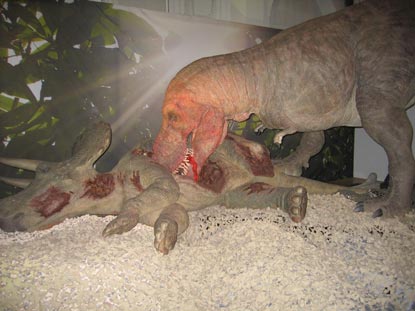
Gruesome Theory Concerning Tyrannosaurid Feeding Behaviour

Eating Triceratops one chunk at a time.

Picture credit: Mike Fredericks

Signs of injuries and disease in fossils is known as pathology.  Palaeontologists have studied the fossilised bones of both the plant-eating Triceratops and the meat-eating tyrannosaurids and there is a lot evidence to support the theory that T. rex attacked and fed upon this particular horned dinosaur.   However, in this new study the researchers were interested in working out what the marks and scars on the bones of this particular horned dinosaur said about the way in which a tyrannosaur may have fed upon a Triceratops carcase.

The Museum of the Rockies

The Museum of the Rockies team were intrigued to discover that many of the puncture and pull marks were on the bony neck frill of the fossil specimens they studied.  Triceratops had a very large skull, it was protected by three horns on its face, (the name Triceratops means “three horned face”).  It had a short nose horn and two further, much larger horns over the eyes. These horns could grow to be more than a metre long in mature adults.  Scientists have long speculated that the horns and frills of ceratopsians performed many functions.  They may have been brightly coloured, an aid to visual communication amongst herd members.  The horns and frills may have also been used in intraspecific combats, for example, two Triceratops fighting together over mates or social status.   These facial ornaments were also defensive structures, very useful when you share the same environment as thirteen-metre-long tyrannosaurs with an ability to swallow up to seventy kilogrammes of meat in one mouthful.

T. rex Feeding – A Scenario

Tyrannosaurus rex feeding habits.

The Inspiration behind the Collecta Dino Prey – Dead Triceratops?  Tyrannosaurus rex feeding habits.

Picture credit: Everything Dinosaur

The skull of Triceratops was very heavy and in comparison to the rest of the body it did not have a lot of meat on it.  The neck frill would not have offered a lot of nutrition, so why the bite and pull marks?

A Study of Ceratopsian Skulls

An analysis of the fossilised Triceratops skull material revealed deep, parallel groves on the neck frill, suggesting that a feeding Tyrannosaurus rex may have used its immensely strong jaws and neck muscles to pull on the frill in order to reposition the carcase for feeding or indeed to move the corpse.  Many predators today; after they have made a kill attempt to drag the corpse of their victim to a concealed place so that they can feast in peace without being disturbed by scavengers or worse still, a bigger predator coming along and chasing them away from their dinner.  Leopards for example have been known to drag the body of a gazelle up into a tree so they can feed without being disturbed by lions.  Perhaps T. rex attempted to move their victims so that they could eat without the risk of being attacked by other tyrannosaurs.  However, the prospect of dragging a seven tonne “dead weight” any distance would have been quite daunting and it would have wasted a lot of energy, perhaps the pull marks indicate where the body was torn apart – a sort of how to eat a Triceratops – one chunk at a time scenario.

Tyrannosaurus rex Feeding Habits

If T. rex was attempting to reposition its prey then the scientists speculate that the bony neck frill would have prevented the carnivore from accessing the large muscles on the neck of Triceratops.  The team have proposed that this nasty predator probably used its teeth and jaws to pull on the frill in an effort to get at the meat behind the frill.

The gruesome conclusion made by the palaeontologists is that the easiest way to get to the large neck muscles is to pull the head right away from the body.  In this academic paper, it is postulated that T. rex ripped the heads of its Triceratops victims.

Further evidence to support the “heads-ripped-off-Triceratops” theory was found by the scientists when they examined the joint that attaches the neck to the skull.  This ball and socket joint, known as the occipital condyles showed signs of bite marks on the anterior surface.  The scientists concluded that such marks could only have been made if the head had been removed from the body.

The problem with this rather gruesome area of research is that we cannot rely on observations using extant animals (animals alive today) to support this theory.  The Tyrannosaurus rex versus Triceratops predator prey relationship involves a biped attacking a quadruped.  As we humans (H. sapiens) are the only true biped amongst the Mammalia alive today finding evidence to support this theory in the natural world is very difficult.  Wolves attack horned bison but observations of a wolf pack’s behaviour suggests that they avoid attacking the head and neck region and prefer to try to bring down their quarry by attacking the hind legs.  A wolf weighs fifty times less than a large bison, whereas an adult T. rex and an adult Triceratops were much more evenly matched in terms of body mass.  Scientists do not know whether tyrannosaurs were solitary hunters or pack animals, if they were pack animals then this would suggest differences in hunting and feeding strategies.

Moreover, there are a number of Triceratops skulls preserved in the fossil record for palaeontologists to study.  Other parts of the Triceratops anatomy, the front legs for example are rarely found in the fossil record.  It has been speculated that the front legs rarely fossilised as this part of the body of a Triceratops was readily consumed as the carcase was broken up.

Bite Marks on Neck Frills

The Museum of the Rockies team point to the fact that the bite marks on many of the neck frills show no signs of healing. This, they suggest indicates that these injuries occurred after the Triceratops had expired and provide evidence of feeding behaviour.  Unfortunately, an attack by a tyrannosaurid as it attempted to bring down its prey, would have resulted in extensive bite marks too.  If the attack proved fatal then these wounds which were inflicted during the fight between these two protagonists could be easily confused with those pathologies caused as a result of feeding.

For models and replicas of Tyrannosaurus rex, Triceratops and other famous dinosaurs: Nanmu Studio Jurassic Series Dinosaurs.

It seems that we may never know the exact methods used by tyrannosaurs to maximise their feeding with the minimum of effort when it came to eating a Triceratops, however, this new research “heads” us in an interesting direction.

The scientific paper: “How to eat a Triceratops: large sample of toothmarks provides new insight into the feeding behavior of Tyrannosaurus” by D. Fowler, J. Scannell, M. Goodwin and J. Horner published in the Journal of Vertebrate Paleontology.

26 10, 2012

Canadian Researchers Find Evidence of Feathered Ornithomimids According to New Study

By |2024-04-24T17:09:14+01:00October 26th, 2012|Categories: Dinosaur and Prehistoric Animal News Stories, Palaeontological articles|1 Comment

Scientists Suggest “Wing Feathers” Evolved for Courtship

A new study into the fossilised bones of “bird mimic” dinosaurs, a clade of the Dinosauria known as the ornithomimids, by a team of scientists based in Canada has revealed that these dinosaurs too were covered in feathers, just like their maniraptoran cousins.  However, the study which examined the fossils of juveniles as well as adults has concluded that wing feather-like structures are only to be found in older, more mature specimens.  This suggests that wing feathers may have evolved in some types of dinosaur to assist in courtship displays to find a mate.

Feathers on Ornithomimid Dinosaurs

The ornithomimids (bird mimics) are a group of Cretaceous theropod dinosaurs known from the Northern Hemisphere (North America and Asia).  They were named ornithomimids, not because scientists first thought that these reptiles were feathered, but from anatomical studies of their fossilised bones it was clear that these dinosaurs shared a lot of common features with modern ground dwelling birds.  They had lightly built skeletons, light bones and as a group they tended to have small skulls, beaks but with jaws mostly lacking teeth, long legs and long tails.

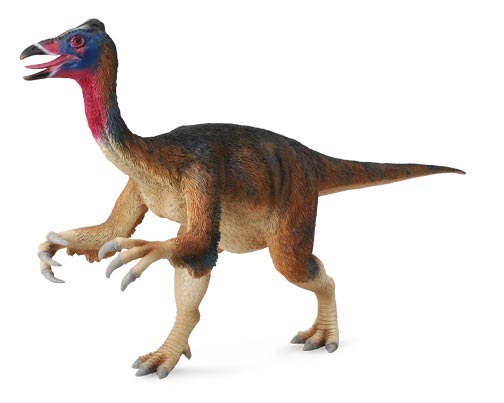
Although ornithomimids had similar body plans individual genera are distinguished by differences in their beaks, the size of the arms and hands and their body proportions.  Deinocheirus (Deinocheirus mirificus) is believed to have been a member of the ornithomimids – the largest discovered to date with some palaeontologists estimating this animal to have been about the size of a Tyrannnosaurus rex.

Feathered Ornithomimid – Deinocheirus

Giant, winged theropod.

Picture credit: Everything Dinosaur

A Collaboration Between Scientists

The study, a collaboration between scientists at the University of Calgary and the Royal Tyrrell Museum, both in Alberta, Canada, suggests that feathers associated with dinosaur fossils may actually be found in strata that was previously thought to be too coarse grained to preserve delicate structures such as the filaments from primitive feather-like structures.

Palaeontologists François Therrien (curator at the Royal Tyrrell Museum) and Darla Zelenitsky (University of Calgary) studied a series of Ornithomimus fossils that had been found in Upper Cretaceous strata exposed in the Canadian Province.  Ornithomimus was first named and described by the American palaeontologist Othniel Charles Marsh in 1890.

A number of species are associated with this genus and Ornithomimus seems to have been a particularly widespread ornithomimid with fossils having been discovered all over the western part of North America, from Alberta in the North to Texas in the south.  The particular Ornithomimus fossils studied by the Canadian scientists come from the Badlands of Alberta and date from approximately 75 million years ago (Campanian faunal stage).

The specimens studied included a juvenile and two adult skeletons preserved in a sandstone deposit.  Although the fossils had been known for many years, it was only recently the evidence of feathers was found after the fossil material was subjected to intense analysis using ultra violet light scans and computerised tomography.

It had long been suspected that ornithomimids were covered in downy, insulating feathers but this is the first time that feathered dinosaur specimens have been found in the western hemisphere.  The discovery of the feathers re-affirms earlier research that suggested that most if not all ornithomimids were covered in a coat of feathers.

Assistant Professor Darla Zelenitsky commented that this was “a really exciting discovery”.  Although many different types of “bird-mimic” dinosaur are known these Canadian specimens are the first to reveal that ornithomimids were covered in feathers, just like other types of theropod dinosaur such as the Dromaeosaurs.

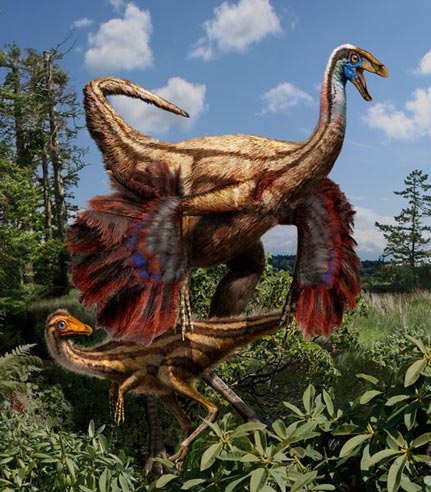
Parents with Wing-like Forearms in the Ornithomimidae

Mums and dads with wings in the Ornithomimidae.

Picture credit: Press Association (illustration by Julius Csotonyi)

Interestingly, the research team noted differences in the feathers between the juvenile and the adult animals.  The mature, older individuals had developed larger feathers on their arms, these formed a wing-like structure but clearly adult Ornithomimus were too big to fly, with some specimens reaching over four metres in length.

Associate Professor Zelenitsky explained the significance of this finding by stating:

“This pattern differs from that seen in birds, where the wings generally develop very young, soon after hatching.”

The development of primordial wing structures in adult animals suggests that juveniles and sub-adults did not have these feathered structures on their arms until they had grown up and become old enough to mate and reproduce.

Therrien postulated that:

 “The fact that wing-like forelimbs developed in more mature individuals suggests they were used only later in life, perhaps associated with reproductive behaviours like display or egg-brooding.”

The finding of evidence of fossilised feathers in sandstone rocks has potential implications for future discoveries of feathered dinosaurs in North America.  Feathered dinosaurs are known from fine grained formations such as those from the Liaoning Province of China.  The discovery of traces of feathers on dinosaurs excavated from sandstone, a very common fossil bearing sedimentary substrate suggests that a more detailed examination of existing fossil dinosaurs from sandstone deposits may reveal more signs of dinosaur plumage.

For models and replicas of ornithomimids and other theropod dinosaurs: CollectA Prehistoric Animals (Age of Dinosaurs Popular).

The ornithomimid specimens used in this study will be put on display as part of a larger exhibition on theropods at the Royal Tyrrell Museum.  These fossils also indicate that primordial wing-like structures on the arms of dinosaurs evolved earlier than previously thought amongst non-maniraptoran theropods.

Although such structures were never intended for flight, a set of feathery arms would have helped an adult to brood a clutch of eggs, sheltering them and keeping them warm whilst the adult sat on the nest.  Once the eggs had hatched than the feathery structures could act as a shade for the youngsters in the nest as well as providing warmth and shelter.  If the family went on the move then the adult could use the feathered arms to signal to their offspring, part of the non-verbal communication between a parent and young.

The scientific paper: “Feathered Non-Avian Dinosaurs from North America Provide Insight into Wing Origins” by Darla K. Zelenitsky, François Therrien, Gregory M. Erickson, Christopher L. Debuhr, Yoshitsugu Kobayashi, David A. Eberth and Frank Hadfield published in Science.

23 10, 2012

The Jaws of Placoderms The Origins of Teeth

By |2023-02-06T13:16:00+00:00October 23rd, 2012|Categories: Dinosaur and Prehistoric Animal News Stories|0 Comments

The First Jaws with Teeth – Scientists Identify The Toothy Grin of the Placoderms

An international team of researchers have used high powered X-rays to look inside the mouths of an ancient group of fishes and discovered that some of these marine creatures had teeth, whose structure was very similar to our own teeth.  With the development of teeth, these fish had an evolutionary advantage over other marine animals and teeth capable of biting would have upped the evolutionary arms race between hunter and the hunted accelerating other evolutionary adaptations and developments.

Fish Fossils

Fish fossils from a rock formation, known as the Go Go Formation (Kimberley region, Western Australia) had been collected by scientists ever since this fossil rich area was discovered more than seventy years ago.  The strata represents a reef environment in a warm, shallow tropical sea that existed in the Late Devonian geological period (approximately 380 million years ago – Frasnian faunal stage).

A wide variety of Devonian fish specimens have been collected from this location, including many placoderms.  Placoderms were a highly successful and diverse clade of fish that had primitive jaws.  The name “placoderm” means plated skins as these nektonic animals had broad, flat bony plates over the head and the front of their bodies, protection against attack from other predatory fish and eurypterids (sea scorpions).

Palaeontologists have classified the Placodermi into seven main groups, it is fish fossils from one such group that show signs of modern teeth in this new study.

An Illustration of a Typical Placoderm

Evidence that arthrodires had the first teeth.

Picture credit: Everything Dinosaur

The Jaws of Placoderms

It has long been believed that teeth are highly modified fish scales, although it has been hotly debated how teeth with a pulp canal, dentine and an outer surface made of enamel like our teeth first evolved.  Placoderms had jaws but until now it was not thought that they had teeth-like structures.  This particular group of fish probably had a skeleton made of cartilage, indicating that they may share a common ancestor with sharks and rays.

The jaws of most placoderms had self-sharpening bony plates that served as teeth.  Placoderms evolved a pair of sharp bony plates that hung from the top jaw, whilst the edges of the lower jaw were also bony and razor sharp.  These jaws could be closed together like a pair of self-sharpening shears.

A team of scientists led by researchers from Bristol University, in collaboration with Australian colleagues studied the fossilised remains of a particular type of placoderm, a member of one of the largest families that make up the placoderm clade, (Arthrodira), a species known as Compagopiscis croucheri using powerful X-ray tomographic microscopy.  The X-rays are produced by a huge circular device known as a synchrotron.  This machine, located in Switzerland, fires electrons round a circuit which is encased  in powerful magnets.

Powerful X-rays are emitted and this permits scientists to see internal structures of fossil material without damaging the fossil material itself.  The images generated showed teeth inside the jaws that consisted of dentine and bone with a distinct pulp cavity.

The scientists have concluded that teeth and jaws may have evolved simultaneously in the Arthrodira.  The researchers suggest that more complicated teeth evolved within the gnathostomes (vertebrates with jaws) very soon after jaws themselves evolved.

Dr Kate Trinajstic, from Western Australia’s Curtin University, one of the scientists involved in the study explained that to determine whether teeth were present in the jaws of placoderms would have meant the destruction of the fossil material so that the internal structure could be studied, if conventional methods had been used.

She stated:

The problem has been that to look at teeth you have to look at internally and museum directors aren’t too fussed on the idea of cutting up their specimens.”

Professor Philip Donoghue (University of Bristol’s School of Earth Sciences) went onto add:

“This is solid evidence for the presence of teeth in these first jawed vertebrates and solves the debate on the origin of teeth.”

The Placodermi

The placoderms themselves were a very successful and diverse group of fishes during the Late Devonian, perhaps their success can be put down in part to their sophisticated jaws and nascent teeth.  Some of the Arthrodires were apex predators, such as the giant Dunkleosteus that grew up to six metres in length.

Many placoderms adapted to freshwater environments and this group of fish were some of the first animals with backbones to adapt to living in freshwater.  However, despite their adaptations, it seems that the toothy placoderms were doomed to extinction.

Very few fossils of these creatures are found in rocks dating from the very end of the Devonian geological period and it seems that by around 360 million years ago (beginning of the Carboniferous), these fish had become extinct.

In June 2008, scientists published remarkable evidence indicating that some types of placoderm my have given birth to live young (viviparous behaviour), to read more about this: Placoderm Parents.

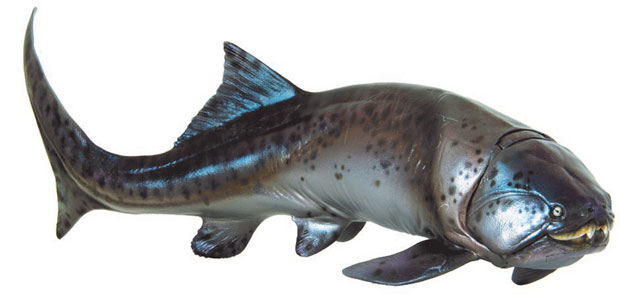
A Model of Dunkleosteus

Zaha the Dunkleosteus (PNSO)

A stunning model of a placoderm – the PNSO Dunkleosteus model.

The model (above) is from the Age of Dinosaurs replica range from PNSO, to view this excellent range of prehistoric animal models: PNSO Age of Dinosaurs Models and Figures.

21 10, 2012

Pachycephalosaurs – New Study Suggests Bone-heads Bashed Each Other in Different Ways

By |2023-02-06T12:48:57+00:00October 21st, 2012|Categories: Dinosaur and Prehistoric Animal News Stories|0 Comments

Study of Pachycephalosaur Skulls Sheds Light on Dinosaur Behaviour

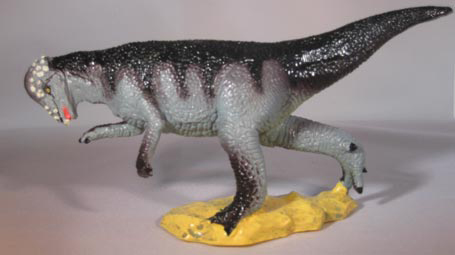
The “Bone-headed” dinosaurs, otherwise known as pachycephalosaurids were a group of Cretaceous ornithischian dinosaurs related to the horned dinosaurs (members of the Marginocephalia).  Most of what palaeontologists know about these dinosaurs has come from fossils of these animal’s thickened, and in some cases domed skulls.  In a paper presented at the Society of Vertebrate Palaeontology (United States), in a conference held in North Carolina,  a research team have suggested that the pathology found on the skulls of these dinosaurs indicate that these animals did indeed butt each other.  In addition, the scientists propose that lesions and scars on different parts of the skull indicate that different types of Pachycephalosaur may have used butting contests in different ways.

Pachycephalosaurs – Skull Study Sheds Light on Potential Intraspecific Combat

Charging pachycephalosaurs – Did they butt heads?

Picture credit: Everything Dinosaur

Although examples of pachycephalosaurs such as Dracorex and the largest known – Pachycephalosaurus are often featured in children’s dinosaur books, the remains of these dinosaurs are extremely rare in the fossil record.  Apart from elements of the skull, only a few other body fossils ascribed to this type of dinosaur have been found.  One of the most complete fossil specimens was that of a pachycephalosaur named as Stegoceras (Stegoceras validum).  Fossils of this bone-headed dinosaur have been found in the Dinosaur Provincial Park Formation (Alberta, Canada), indeed most of the illustrations of all pachycephalosaurs are based on interpretations of Stegoceras fossil material.

Pachycephalosaurid Skull Study

These bipeds are characterised by a thickening of the dermal skull roof, particularly the frontal and parietal bones.  These bones are to be found at the top and towards the back of the head.  In a number of genera this thickening is accompanied by distinctive bumps and ridges that are found on the postorbital, squamosal and other facial bones.  Palaeontologists have speculated for many years as to what these bizarre skull structures were used for.

Dr Joseph Peterson (University of Wisconsin) and his colleague Collin Dischler, who has researched pathology on dinosaur skulls, presented the paper at the Society of Vertebrate Palaeontology’s annual meeting held in Raleigh.  After examining one pachycephalosaur skull, the team went onto compare the pathology found on this specimen with those of other pachycephalosaurs.  They also studied the skulls of extant animals such as birds, crocodiles and mammals looking for similar types of injury and signs of damage.

The research team looked at the over one hundred pachycephalosaur specimens from North America and Asia.  Of these twenty-three had signs of injury.  A three-dimensional computer generated model of the skulls were made and the lesions and injuries mapped onto them.  From this model, the team noticed that the placement of the injuries depended on the morphology, the shape of the skull.  Fossilised skulls with low domes tended to have injuries towards their front, whilst skulls with higher domed structures tended to show an even spread of injuries from the front to around the back.

Using the Skulls in Different Ways

The team’s findings indicate that pachycephalosaurs with different shaped skulls may have used their heads in butting contests in different ways.  Commenting on the scientific paper, Dr Peterson stated:

“The lesions we were seeing were strikingly similar to those that we often see on the skulls of modern mammals that ram heads.”

Earlier studies had concluded that some skulls of pachycephalosaurs were not suited to direct head-butting combat.  It had been speculated that some types of pachycephalosaurs may have indulged in flank-butting contests to settle disputes amongst herd members.  Most scientists believe that it was only the males that indulged in such behaviours, after all, such contests seen today amongst bovines and ovines (cattle and sheep) tend to be limited to only the males of the species.

To read an article on an earlier study into the skulls of pachycephalosaurs: Striking a Blow for Head-Butting Pachycephalosaurs.

When the behaviour of modern animals in intraspecific combat (competition between animals of the same species) was studied, in seems that certain animals such as the North American Bison (B. bison) wrestle with their horns in direct head-to-head battles, whereas other animals such as the North American Mountain Goat (Oreamos americanus) resolve disputes by bumping one another along the flanks.  Dr Peterson and his co-researchers have concluded that the high-domed  pachycephalosaurs with signs of injury in the parietal area of their skulls were bumping the flanks of their rivals.  The team suggests that a dinosaur such as Pachycephalosaurus wyomingenis with its twenty-five centimetre thick skull may have been a “flank bumper”.  Other types of pachycephalosaur whose skulls show injury to the bones slightly forward of the parietal bone were probably animals that conducted front-on wrestling matches with each other, in a similar fashion to modern North American Bison.

Did Different Types of Pachycephalosaurid Butt in Different Ways?

Boneheads settled disputes in different ways according to new study.

Picture credit: Everything Dinosaur

Lack of Fossils to Study

The lack of extensive pachycephalosaur fossil material to study weakens the arguments put forward to some degree.  Andrew Farke, a vertebrate palaeontologist at the Raymond Alf Museum (Claremont, California), commented that the different species resolving intraspecific disputes in different ways could actual be a single species with adult and juvenile skulls showing different pathologies.

He stated:

“It could be that we are seeing two different species bashing in different ways, but it could also be a single dinosaur species where juveniles and adults exhibit different bashing behaviours.”

One of the problems scientists face when studying the fossils of this particular group of dinosaurs is that the skulls may have been transported and deposited a long way from where the animal actually lived.  A number of specimens show signs of having been eroded as a result of the action of being bumped along a river bed.  It has been speculated that these herbivorous dinosaurs lived in dry, mountainous regions.

The lack of fossils could be explained by such areas having a poor preservation potential for fossil material.  Occasionally the remains of a pachycephalosaur would be washed downstream as a result of a flood or similar event.  The tough, thick skull bones being more robust than the other parts of the skeleton were the only bones to survive this physical process.  As the skulls were subjected to erosion the skull bones would have been bashed and chipped.  Other palaeontologists who have read the paper associated with this study have concluded that some of the injuries attributed to butting contests could have been made after the animal’s death (post mortem).  The skulls may have been chipped and damaged whilst being transported to their final resting place downstream.

Dr Farke has concluded that evidence as to whether these lesions were caused post mortem can be gathered when the skull bone microstructure is examined using high magnification CT scans.  Such analysis would provide evidence of some of the injuries beginning to heal, indicating that the lesions occurred when the dinosaur was very much alive.

It is likely that the debate over the pachycephalosaurs and their bizarre skulls is likely to go on, with palaeontologists “locking horns” as they argue over the evidence.

For models and figures of pachycephalosaurid dinosaurs and other prehistoric animals: Wild Dinos Figures (Safari Ltd).

Go to Top