All about dinosaurs, fossils and prehistoric animals by Everything Dinosaur team members.

Fossil finds, new dinosaur discoveries, news and views from the world of palaeontology and other Earth sciences.

22 12, 2012

A New Addition to the Iguanodontid Family

By |2023-02-11T07:57:33+00:00December 22nd, 2012|Categories: Dinosaur and Prehistoric Animal News Stories|0 Comments

Proa valdearinnoensis – The Latest Addition to the Iguanodon Family

The Iguanodon taxon has been much revised over recent years.  Palaeontologists have made new fossil discoveries and a number of new genera of these large ornithopods have been erected.  Material held within museum collections, particularly in Europe and North America, has been re-examined in the light of recent fossil discoveries and as a result, a number of new genera have been established.

New Iguanodontid Dinosaur

A number of species assigned to the the Iguanodon taxon have been re-assigned and set up as separate genera.  An example would be the establishment of Mantellisaurus after a reassessment of iguanodontid material.  This genus honours Dr Gideon Mantell, the Victorian scientist who first named and scientifically described Iguanodon (1825).

A Typical Iguanodontid Dinosaur
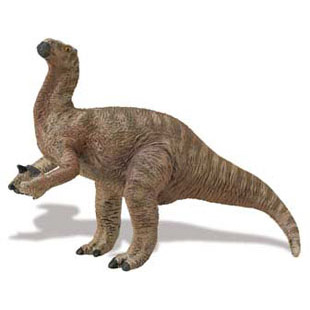
A typical iguanodontid dinosaur.

Picture credit: Everything Dinosaur

The picture (above) shows a model of an Iguanodon, for models and replicas of iguanodontids and other prehistoric animals: Dinosaurs and Prehistoric Animal Figures (Safari Ltd).

Regarded as a taxonomic “waste basket” for a number of years, this reassessment of Iguanodon fossil material has led to the setting up of a number of new genera.  The iguanodontid family in Europe has just got a little bigger with the addition of a new, basal iguanodontid from the Teruel Province of eastern Spain.  Iguanodonts are a group of “bird-hipped”, ornithischian dinosaurs that first evolved during the Jurassic and went onto become one of the most important and most common groups of herbivorous dinosaurs in the Cretaceous geological period.  The name means “Iguana tooth”, after Dr Gideon Mantell noticed the resemblance of some fossil teeth he had found in Sussex (southern England) to the teeth of an extant Iguana lizard.

These facultative bipeds had large bodies, long, stiffened tails, jaws packed with hundreds of blocky shaped teeth and beaks made of horn.  Their five fingered hands were quite dexterous for a dinosaur and they are famous for having a “thumb spike” which was probably used in intraspecific conflicts or to defend these herbivores against theropod predators.

Proa valdearinnoensis

Excavations carried out by a team of palaeontologists at a coal mine in Ariño (Teruel Province), led to the discovery of iguanodontid fossil material that represents at least six individual dinosaurs.  It total more than 340 dinosaur bones have been found so far, most importantly a number of elements from the skull, including a beautifully preserved and nearly complete specimen of a skull from an adult animal.  Studies carried out on the fossils have provided enough evidence for the scientists to establish a new genus of European Iguanodon.  The new dinosaur has been named Proa valdearinnoensis.  The genus name reflects the shape of the predentary bone, as it reminded the scientists of the shape of a bow on a boat.

Honouring Val de Ariño

The species name honours the location where the fossils were found Val de Ariño, the traditional name for this part of the Teruel region.  This particular iguanodontid is distinguished by a very distinctive anatomical feature (autapomorphy), the predentary comes to a point at its tip (the rostral margin).  The predentary bone also has upward pointing projections (divergent lateral processes).  It is these characteristics that has led to the establishment of a new iguanodontid genus.

A number of specimens, including the best preserved skull material will be put on display at a regional natural history museum.  The fossil material was excavated from the Escucha Formation of Teruel Province (eastern Spain).

Fossil Material on Display (Proa valdearinnoensis skull material)

The skull fossils of Proa valdearinnoensis shown in lateral view.

The skull fossils of Proa valdearinnoensis shown in lateral view.

Picture credit: Museo Aragonés de Paleontología

The fossilised bones have been dated to approximately 112 – 110 million years ago (Lower Albian faunal stage of the Cretaceous) and palaeontologists estimate that P. valdearinnoensis would have been about seven to eight metres in length as a fully grown, mature adult.

20 12, 2012

Freshwater Mosasaur from a Hungarian Bauxite Mine

By |2023-02-11T07:12:39+00:00December 20th, 2012|Categories: Dinosaur and Prehistoric Animal News Stories, Palaeontological articles|0 Comments

Pannoniasaurus inexpectatus – The Unexpected Mosasaur

A joint team of Hungarian and Canadian scientists have unearthed a new species of mosasaur, one that as far as the known fossil record goes, was unique amongst the Mosasauridae – it lived in freshwater.  It seems that just like some species of extant cetacean (whales and dolphins), one group of mosasaurs adapted to living in a freshwater environment.  There are river dolphins that live in the Amazon and other riverine habitats such as, until recently, the Yangtze river (Yangtze river dolphin believed to be extinct).  Now scientists have the fossilised remains of several freshwater mosasaurs to study, a number of individuals, all of which have been assigned to a new species – Pannoniasaurus inexpectatus.

Freshwater Mosasaur

Mosasaurs are members of the Order Squamata (lizards and snakes), they evolved from terrestrial reptiles but they adapted to marine environments and rapidly diversified with many different genera and something approaching eighty different species being recognised.  Mosasaurs were typically streamlined, with long, narrow jaws, four paddles and possibly a fish like tail, (new evidence suggests that some mosasaurs had tail fins like those found on extinct ichthyosaurs and extant dolphins).  As vertebrates; their backbones became specially adapted to undulate in an up and down motion to aid propulsion through water.  Some of these marine lizards evolved into giant forms such as Tylosaurus and Hainosaurus which could have been as much as fifteen metres in length.

It seems that these reptiles, whose closest living relatives today are thought to be the monitor lizards (Varanus), evolved around ninety million years ago and spread throughout the world’s oceans before dying out approximately around 25 million years later.

Pannoniasaurus inexpectatus

The holotype fossil material, plus over one hundred Pannoniasaurus fossils so far collected from the location come from alluvial (floodplain and channel) deposits which form a section of the  Csehbánya Formation of Cretaceous aged strata.  The fossils which include juveniles and bones from specimens which may have exceeded six metres in length come from various exposures at the Iharkút open-pit bauxite mine in Hungary.

An Illustration of the Skeleton of P. inexpectatus

The mosasaur that lived in freshwater.

Picture credit: PLoS One/Makádi et al

It is thought that this river mosasaur had a similar body shape to other mosasaurs as well as long, narrow, crocodile-like jaws.  Palaeontologists believe that this genus represents a basal member of the Mosasauridae, it may have retained feet with clawed toes that were capable of moving the animal about on land.  However, no lower limb bones have been found to date.  The flattened skull, may have been a useful adaptation for water-level hunting and the ambushing of terrestrial animals such as small dinosaurs that came close to water’s edge.

The research team speculate that more robust limbs with claws may have been retained by these mosasaurs as they could have used their feet and claws to clamber over the bottom of the river just as extant crocodiles do today.  At six metres in length [about the size of a modern-day Nile crocodile (Crocodylus niloticus)], these mosasaurs were the largest predators within this Late Cretaceous river environment.

Virtually all the other known mosasaur fossils have been found in strata which was laid down in marine environments.  Previously, the only exception to this was some fragmentary fossils of the marine, nektonic mosasaur known as Plioplatecarpus which was discovered in non-marine rocks in Western Canada (Alberta).  The Plioplatecarpus remains include teeth and a partial vertebra collected from the a mudstone unit in the middle of the Lethbridge Coal Zone.

These bones could have been re-deposited there after a tsunami or other flood event, or perhaps they represent individuals who went upstream from estuaries in a similar way to modern Bull sharks.

The genus name for this new mosasaur comes from the ancient Roman province of “Pannonia”, which contained this part of Hungary, the specific name “inexpectatus” means unexpected in Latin, a reference to the surprising occurrence of  mosasaur fossils in a non-marine palaeoenvironment.

A More Typical Mosasaur (Marine Reptile Museum Exhibit)

Pannoniasaurus inexpectatus fossils.

Fossil material from the freshwater mosasaur Pannoniasaurus inexpectatus.

Picture credit: PLoS One/Makádi et al

The size of the individual fossil bones collected so far indicate that these bones represent a number of differently-sized creatures.  The smallest seem to have been less than a metre in length, the average overall length would have been around three to four metres.  This suggests that many animals of various sizes and ages were present together living in these prehistoric rivers.

Everything Dinosaur supplies a wide variety of marine reptiles including replicas of mosasaurs: Papo Marine Reptiles, Dinosaurs and Prehistoric Animal Figures.

In the paper, published in the on line scientific journal PLoS One (Public Library of Science), the research team state that their studies suggest no fossilisation bias and that the Pannoniasaurus fossils probably represent the population quite accurately.  This suggests that a population of these reptiles was living in the river system, it is unlikely that the fossils ended up in non-marine strata as mosasaurs migrated upstream to take advantage of seasonal food opportunities or in order to give birth in freshwater rather than in the open sea.

This part of Europe during the Late Cretaceous consisted of a series of tropical islands, other fossils found in the Csehbánya Formation include fish, amphibians, crocodiles, turtles, several dinosaur genera, pterosaurs and birds.

The scientific paper: “The First Freshwater Mosasauroid (Upper Cretaceous, Hungary) and a New Clade of Basal Mosasauroids” by László Makádi, Michael W. Caldwell and Attila Ősi published in PLoS One.

18 12, 2012

Famous Swiss Palaeontologist is Honoured by Having Rare “Little Diplodocus” Named After Him

By |2024-04-24T19:56:58+01:00December 18th, 2012|Categories: Dinosaur and Prehistoric Animal News Stories, Dinosaur Fans|0 Comments

Dinosaur Discovery from Wyoming Honours Hans-Jakob Siber

A long-necked sauropod, believed to be closely related to the famous long-necked dinosaur Diplodocus has been named after a Swiss-based researcher who has made a substantial contribution to the study of dinosaur fossils.  The new dinosaur species has been named Kaatedocus siberi to honour Hans-Jakob Siber, widely regarded as one of Switzerland’s most influential dinosaur experts.  Dr Hans-Jakob Siber, is the founder and director of the Dinosaur Museum at Aathal, close to Zurich.  The name means “Siber’s small diplodocid” and it has been described from a partial skeleton excavated from a sequence of Upper Jurassic strata which forms part of the famous Morrison Formation in the western United States.

An exhibit featuring this new sauropod species is due to open at the Aathal museum, a chance for the Swiss public to gain an appreciation of the research work carried out by Dr Hans-Jakob Siber and his colleagues.

New Dinosaur Species

For the last twenty years or so, the Swiss research team have visited a number of locations within the Morrison Formation of the United States to carry out excavations and other field work.  The new discovery comes from the Big Horn Basin area of Wyoming.  Over the years, the Swiss team have explored a number of fossil bearing sites, areas such as the Dana Quarry (Ten Sleep) and the Howe Ranch in central Wyoming.   They have found a number of specimens, including Apatosaurus, Allosaurus and Stegosaurus, but this is the first dinosaur from the Wyoming site to be named in honour of one of the team.

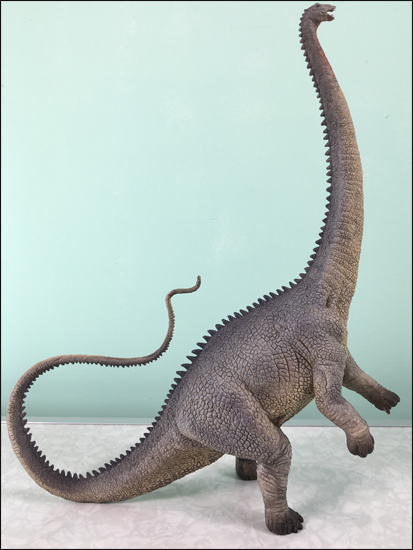
New Member of the Diplodocid Clade – Kaatedocus siberi – Honours a Swiss Palaeontologist

CollectA rearing Diplodocus (grey).

A newly described diplodocid dinosaur honours a Swiss palaeontologist.  A typical diplodocid dinosaur is illustrated.

Picture credit: Everything Dinosaur

Cervical (Neck Bones)

Importantly, the fossil material ascribed to this new dinosaur genus includes a number of beautifully preserved cervical vertebrae (neck-bones), these well-preserved bones will help palaeontologists to explore the subtle differences between this type of long-necked, plant-eating dinosaur and those that evolved slightly later in the Jurassic, dinosaurs such as the famous Diplodocus.

Like Diplodocus, Kaatedocus, had a small head on a long neck, a huge body, supported by pillar-like legs and a whip-like tail.  Kaatedocus lived around 153-150 million years ago, making this fossil specimen an earlier example of a diplodocid dinosaur when compared to Diplodocus genera.  The fossils were also found further north than the majority of other Upper Jurassic diplodocid remains associated with this part of the Morrison Formation.  It could be speculated that the diplodocids, gradually moved south, adapting to new environments and climatic conditions as this particular type of dinosaur evolved.

Kaatedocus siberi

The specimen was first excavated by the Swiss team nearly twenty years ago, it was one of the first significant dinosaur bone assemblages they discovered, but the researchers opted to focus on working on more complete specimens so the importance of their fossil find was overlooked.  They were not aware that they had actually discovered an entirely new species of Late Jurassic dinosaur.

For models and replicas of diplodocids and other Late Jurassic dinosaurs: Late Jurassic Dinosaur Models and Prehistoric Animal Figures (CollectA).

Fellow Swiss palaeontologist Emanuel Tschopp was responsible for the formal study of the specimen, including the analysis of a partial skull.  His paper has been published in the academic journal “The Journal of Systematic Palaeontology”.  In naming this new sauropod, it was an opportunity to honour the work and contribution of Dr Hans-Jakob Siber.

Kaatedocus was actually smaller than the likes of Diplodocus longus, however, the single individual known was a sub-adult.  The fact that this dinosaur was not fully grown and has left some very well preserved cervical vertebrae has provided palaeontologists with an opportunity to study how these type of dinosaurs grew (ontogeny).

To read an article on previous studies related to diplodocid ontogeny: Baby Faced Dinosaurs.

Diplodocid dinosaurs include Late Jurassic giants such as Apatosaurus and Barosaurus.   This clade survived into the Early Cretaceous, evolving into some bizarre forms such as the South American  Amargasaurus and the dinosaur that thought it was a “lawn mower” the African diplodocid Nigersaurus (Nigersaurus taqueti).

15 12, 2012

Ancient Ostracod from Herefordshire – Reconstructing the Silurian

By |2023-02-09T07:42:03+00:00December 15th, 2012|Categories: Dinosaur and Prehistoric Animal News Stories, Palaeontological articles|0 Comments

Pauline avibella – A new Species of Silurian Ostracod named after Professor’s Wife

It may be difficult to believe, especially after the sub-zero temperatures endured by many people in the United Kingdom over recent days, but once the landmass that was to form England sat much closer to the equator than it does today.  Back in the Silurian, much of the land that we now know as the UK was underwater, part of an extensive, shallow sub-tropical sea that marked the boundary between two landmasses, Laurentia in the west and Baltica in the north.  Scientists from the University of Leicester (East Midlands), have identified a new species of crustacean, an animal that lived in this warm, shallow sea something like 425 million years ago.

Silurian Ostracod

The one centimetre long shelled creature had been found in rocks in Herefordshire, from a site that University of Leicester researchers describe as a “treasure trove” of fossil material.  It seems that part of the sea bed had been covered by a fine layer of volcanic ash as a volcano to the west erupted.  This ash layer buried much of the lifeforms that existed in the area at the time, preserving their bodies and hard shells in exquisite detail.  The fossils have soft tissue and even components such as eyes and mouth parts have been preserved.

Pauline avibella

Professor David Siveter, who led the research, has named the new species Pauline avilbella in honour of his late wife who supported him throughout his career.  Ostracods are relatively abundant in the fossil record.  These primitive shelled arthropods of the Order Crustacea are related to crabs, lobsters, barnacles and shrimps.  The fossils of these tiny creatures first appear in Cambrian rocks and although these creatures first evolved in a marine environment, many modern species can be found in freshwater.  Like all Arthropoda, these animals have bilateral symmetry and their paired body parts are usually enclosed in a hinged, bivalve-like shell made of magnesium calcite.  One piece of the shell structure is normally bigger than the second part of the shell and these shells are commonly preserved in the fossil record, however, being able to identify soft tissue parts in Silurian aged fossils is extremely rare.

A Computer Generated Image of the New Ostracod Species

425 million year old Ostracod with a shell shaped like a “bird’s wing”.

Picture credit: Press Association/University of Leicester

An Important Discovery

Commenting on the new species, Professor Siveter, the lead author of the scientific paper, stated that this was a very important discovery as it represented one of only a handful of fossil Ostracods with the soft-tissues preserved.  The species name “avibella” was chosen as the two piece shell resembles the shape of a bird’s wing.  Most Ostracod shells are kidney or bean shaped, but this particular shallow water species had a shell that was swept back, similar to the shape of the wing of a bird.  The name “avibella” means “beautiful bird”.

The process of extracting the tiny microfossils from the surrounding limestone matrix involves slowly grinding the specimen down, micron by micron with scanning photographs taken at each stage.  When the mechanical process is completed the data is fed into a powerful computer which can produce a detailed three-dimensional image of the organism, including its delicate soft body parts.  With each specimen more than five hundred images were produced, resulting in an extremely detailed picture of the organism – a sort of “virtual fossil”.

Diversity of Marine Fauna During the Silurian

The work of the Leicester University based team is helping scientists to understand the diversity of benthic (animals and plants that live on the sea floor), marine fauna during the Silurian period, an important period in the evolution and diversity of marine organisms as rising sea levels created a number of warm, shallow sea environments and fauna was almost entirely restricted to marine habitats.

For figures and replicas of iconic animals from the fossil record such as famous invertebrates like ammonites and trilobites: Ammonites, Belemnites, Trilobites and Other Prehistoric Animal Models (CollectA).

13 12, 2012

Mass Extinction Event Not Just the Dinosaurs but Lizards and Snakes as Well According to New Study

By |2024-04-24T17:41:09+01:00December 13th, 2012|Categories: Dinosaur and Prehistoric Animal News Stories|0 Comments

Asteroid Strike Squashed the Squamata!

Most people now accept that there was a huge extra-terrestrial impact around sixty-six million years ago that contributed to the extinction of the dinosaurs.  However, it was not just the Dinosauria that died out, many other types of animal and plant were also wiped out at around this time in our planet’s history.  A new study by a team of American scientists has revealed that some groups of reptile, lizards and snakes for example, suffered extensive extinction amongst species and genera.  More than eighty percent of all the Squamata (lizards and snakes), became extinct according to the researchers.  Catastrophic climate change, rising sea levels and volcanic activity on a huge scale may have wiped out the likes of Triceratops and T. rex but all sorts of fauna and flora suffered including other types of reptile such as snakes and lizards.

The research team, lead by Nicholas Longrich a postdoctoral palaeontologist with the department of Geology and Geophysics at Yale University, reviewed the Squamata fossil assemblage from western North America (Maastrichtian faunal stage).  They examined the diversity of lizard and snake fauna immediately before the Cretaceous mass extinction event that marked the end of the dinosaurs and the ending of the Mesozoic.

Cretaceous Mass Extinction

The team studied lizard and snake fossils from New Mexico in the south right up to Alberta (Canada) and they discovered  a total of nine new species as a result of their research.  During the course of the team’s research; fossils ascribed to the genera Leptochamops (L. denticulatus) were re-assigned to a new genera and a new species was established.  This new species of insect-eating lizard, required a new scientific name and in honour of the President of the United States the lizard has been named Obamadon gracilis.

Cretaceous Lizard and Snake Fauna of Western North America

Lizards and Snakes were very diverse in the Late Cretaceous.

Picture credit: Carl Buell

The picture above shows the carnivorous lizard Palaeosaniwa stalking  a pair of hatchling  hadrosaurs (Edmontosaurus) as the snake Cerberophis  basks on a tree branch and the agile  lizard Obamadon looks on.  In the background a Tyrannosaurus rex confronts a herd of ceratopsians (Triceratops), whilst the sky is lit up by a falling asteroid spelling doom for much of life on Earth.

“Obama’s Slender Teeth”

O. gracilis means “Obama’s slender teeth”, this little lizard, had tall, straight teeth and so the research team thought it a good idea to honour the President of the United States Barack Obama, as he to has a big, toothy smile.  It is just one of nine new species that have been erected as a result of this research.

The study, the findings of which have been published in the academic journal “The Proceedings of the National Academy of Sciences”, suggests that as much as eighty-three percent of all Squamata species became extinct at the end of the Cretaceous geological period.  This time may be known as the “Age of Dinosaurs”, but according to the researchers, a more appropriate term to describe the fauna might be the “Age of Lizards and Snakes”.  The study shows that there were a large number of genera living in the shadow of the dinosaurs towards the end of the Cretaceous in western North America.

Snakes such as constrictors, large two-metre long predatory lizards that probably ate baby dinosaurs as well as a myriad of small, lithe lizards that scuttled in the undergrowth shared the Late Cretaceous world with the dinosaurs.  Many of these animals, assigned to archaic Squamata genera became extinct, leaving the way for other types of lizard and snake to evolve in the Cenozoic.

Cretaceous Extinction

It seems that one fundamental Cretaceous extinction rule of thumb still applies, the larger the organism, the more likely it was to become extinct.  Those lizards and snakes that did survive seem to have been very small, the bigger the snake or lizard the more likely it was to die out.  One interesting and thought provoking outcome of this Squamata extinction is that if this pattern occurred across the planet, then the small mammals that survived into the Cenozoic would have found that there were very few reptile predators around to predate on them.  Could the extinction of much of the Squamata have been a lucky break for the Mammalia?

For replicas and models of Late Cretaceous prehistoric reptiles including dinosaurs: Dinosaur Figures and Prehistoric Animal Replicas.

With the warming of the Earth during the early Palaeogene which gave rise to the establishment of extensive rain forests across much of the globe, lizard and snake populations gradually recovered and rapid speciation did occur, leading to the species that are found today.  However, one previously common sub-family of lizards the Polyglyphanodontia were particularly hard it by the Cretaceous extinction event.  The Yale based researchers have concluded that this clade of lizards were totally wiped out, leaving no descendants into the Cenozoic.

It seems that the dinosaurs were not the only losers at the end of the Mesozoic.  At least the President of the United States can reflect on the honour of having a toothy lizard named after him.

5 12, 2012

Putting Back the Date of Dinosaur Evolution – The Oldest Dinosaur?

By |2023-02-08T18:07:15+00:00December 5th, 2012|Categories: Dinosaur and Prehistoric Animal News Stories|0 Comments

Nyasasaurus parringtoni – A Contender for the Earliest Dinosaur Known to Science

Very little fossil evidence has been found to suggest when the first dinosaurs evolved.  Palaeontologists have unearthed a number of dinosaur specimens from the southern continents, most notably South America, these date from the Late Triassic (Carnian faunal stage).  However, by the Late Triassic some 225 million years ago, there is evidence to suggest that the three great lineages of the Dinosauria – Theropoda, Sauropoda and the Ornithischia (bird-hipped dinosaurs) were already evolving.  This suggests that the Dinosauria may have undergone rapid diversification during the Late Triassic, or these groups of dinosaurs may share a common ancestor that existed much earlier, the Dinosauria having evolved sometime in the Middle Triassic.

The fossil evidence for a much earlier evolution of the Dinosauria  has yet to be unearthed, but a team of international scientists have reported on the analysis of some fragmentary bones that intriguingly, may suggest that the first dinosaurs evolved some 240 million years ago, much earlier than many palaeontologists previously thought.

The Earliest Dinosaur

Published in the scientific journal “Biology Letters”, a research team consisting of scientists from the Natural History Museum (London), the University of California and the University of Washington describe the fragmentary fossils of a small, bipedal reptile that show anatomical characteristics ascribed to the Dinosauria.  These fossils could represent the oldest known dinosaur discovered to date, or it could be a fossil from another Archosauria clade, closely related to the true dinosaurs.

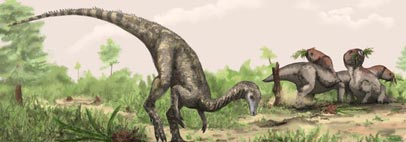
An Illustration of Nyasasaurus (Tanzania 240 million years ago)

Tanzania in the Middle Triassic.

Picture credit: M Witton/NHM

Lifua Member of the Manda Beds

The fossils were found in the layer of rocks known as the Lifua Member of the Manda Beds, Ruhuhu Basin, southern Tanzania by Francis Rex Parrington in the mid 1930s and donated to the Natural History Museum (London) about twenty years later.  Using biostratigraphic analysis, (studying fossils of other animals found in the same layer of rock), this part of the Manda Beds formation of Tanzania has been dated to approximately 242 – 240 million years ago (Anisian faunal stage of the Middle Triassic).   The material had laid in storage, but the Anglo/American research team analysed the fossils, which consist of an upper arm bone from the right arm (humerus), three partial pre sacral vertebrae (back bones from in front of the hip region) and three sacral vertebrae, fused back bones over the hip joints.  These fossils do show anatomical and morphological traits that have been recognised in known dinosaur genera.  This could suggest that the fossils represent a basal form of the dinosaurs, referred to as a dinosauriform.

Fossils Provide Evidence of a Dinosaur?

Fossil material and close up of cross section of humerus showing signs of rapid bone growth.

Picture credit: Biology Letters

The picture above shows the fossil bones and scientific drawings made.  Also included are close ups of dyed section of slide material taken from the cross section analysis of the humerus.  This revealed rapid bone growth associated with an active animal, similar histology has been recorded in dinosaur bone studies.

Nyasasaurus parringtoni

The animal has been named Nyasasaurus parringtoni, as the fossils were discovered close to Lake Nyasa (also known as Lake Malawi), whilst the species name honours F. R. Parrington who found the holotype material.  Living amongst other types of reptiles such as the rhynchosaurs, cynodonts and dicynodonts N. parringtoni was probably around 2-3 metres long, with most of its length being made up of a long, thin tail.  It was most probably bipedal and highly cursorial.  It is not known whether this reptile was carnivorous.

Following the Permian mass extinction event that marked the end of the Palaeozoic, there were a number of different types of reptile that diversified to fill the niches left by the huge number of terrestrial genera that had became extinct.  Scientists have speculated that the ancestors of the Dinosauria were just one such group, part of a larger grouping of reptiles known as the archosaurs.  The anatomy of the ankle bones of dinosaurs are different from most other archosaurs, they have a straight-hinge joint  between the ankle and the metatarsals of the foot.  This is known as a “mesotarsal ankle”.

For models and replicas of Triassic archosaurs and other prehistoric animals: Prehistoric Animal Figures (CollectA Deluxe Scale Models).

It is this arrangement of bones that may have given the Dinosauria an advantage over other Triassic reptiles as it seems to provide a basis for faster locomotion on land.  It could be suggested that the earliest true dinosaurs were fleet footed, agile runners and gradually, being slightly better adapted to move rapidly on land, these animals with their “specific ankle bone arrangement” diversified and evolved into a myriad of forms – giving rise to the Theropoda, the sauropods and the bird-hipped ornithischians.

The humerus (upper arm bone), has a flange of bone which served as an anchor point for strong pectoral (chest) muscles.  This feature known as a deltopectoral crest; extends down the side of the bone for nearly a third of the humerus’s length.  This is an anatomical characteristic seen in phylogenies related to the Dinosauria.  The front tip of this crest is pushed out sideways a feature of the humerus bone seen only in certain dinosaurs such as the Late Triassic Heterodontosaurus.

Based on this evidence, N. parringtoni may represent the earliest known dinosaur discovered to date.  However, the scientists responsible for this research stop short at declaring this material as definitively belonging to an early member of the Dinosauria.  The fossil material is fragmentary and more fossils from the Nyasasaurus genera will need to be found before this specimen can be ascribed to a basal member of the dinosaurs.

The paucity of the vertebrate fossil record from the Middle Triassic prevents palaeontologists from building up a more complete picture of the evolutionary development of the Dinosauria.  From the evidence discovered to date, it does seem that the dinosaurs evolved in the Southern Hemisphere but which of the various forms of archosaur are the direct ancestors of the Dinosauria is very difficult to assess.  A closely related, sister taxon to the Dinosauria known as the Silesauridae share a number of anatomical characteristics with true dinosaurs and these animals may have had a common ancestor.  Examples of Silesaurids have been found in the same region of Tanzania as the fossils of N. parringtoni, indeed, given the fragmentary nature of the holotype material; palaeontologists cannot rule out the possibility that N. parringtoni may be a member of the Silesauridae and not a basal member of the Dinosauria.

It is also possible that cursorial reptiles living in the same environment could have evolved characteristics that we now associate with the Dinosauria, independently.  This would be an example of convergent evolution.  Clearly, more fossil evidence is required before palaeontologists can confidently back date the Dinosauria to the Middle Triassic of southern Africa.

To read a blog article on silesaurid discoveries in Tanzania: Possible Evidence of the Earliest Dinosaurs.

4 12, 2012

Rare Dinosaur Skull Seized by U.S. Officials

By |2024-04-24T20:18:39+01:00December 4th, 2012|Categories: Dinosaur and Prehistoric Animal News Stories|0 Comments

House in Wyoming Raided and Dinosaur Skull Seized

A tyrannosaur skull known as a Tarbosaurus (Tarbosaurus bataar) has been seized by agents of the federal Homeland Security Department (United States), as part of an on-going investigation into the smuggling of dinosaur fossils out of Asia.

Tyrannosaur Skull

The fossil is estimated to be worth around £250,000 and it has been seized as part of a wider investigation into the illegal trade in fossils and other materials which are taken from Mongolia.  Speaking on behalf of the U.S. Immigration and Customs Enforcement’s Homeland Security Investigation Team, Louis Martinez was unable to release further details as enquiries were still continuing.

A Large Tyrannosaur

Tarbosaurus was a large tyrannosaur, closely related to Tyrannosaurus rex.  It lived during the Late Cretaceous around seventy million years ago and its fossils have been found in Mongolia.  In May, an eight-metre-long, mounted specimen of a Tarbosaurus was sold at auction.  It fetched over £600,000 but this exhibit was later seized by Government officials who suspected that this specimen had been smuggled out of Mongolia, where it has been illegal to ship fossils for over fifty years.

An Illustration of the Late Cretaceous Theropod Tarbosaurus

Federal officials seize dinosaur skull.

Picture credit: Everything Dinosaur

For models and replicas of Tarbosaurus (whilst stocks last) and other tyrannosaurs: CollectA Models – Age of Dinosaurs Popular.

It is not known at this stage what the skull seizure has to do with the Tarbosaurus fossils sold at auction but it is likely that this seizure is linked to the Tarbosaurus sold at auction in New York.  A spokesperson from Everything Dinosaur commented that such actions can only help to highlight the illegal trade of fossils from countries such as Mongolia.  A more prominent role by U.S. Customs could help deter would-be smugglers in future.

To read an article about the Tarbosaurus specimen sold at auction in New  York (May 2012): Dinosaur Fossil Sold at Auction.

24 11, 2012

Diatryma was Herbivorous Suggest Researchers

By |2023-02-08T14:52:48+00:00November 24th, 2012|Categories: Dinosaur and Prehistoric Animal News Stories|0 Comments

Palaeogene Diatryma a Vegetarian

With the extinction of the Dinosauria at the end of the Cretaceous there were a huge number of ecological niches vacated by the likes of the ornithopods and the theropods.  For example, with the demise of the dromaeosaurs, abelisaurids and the tyrannosaurids there were no large, entirely terrestrial predators left on Earth.  Many scientists have accepted the theory that flightless birds evolved into apex predators, replacing the meat-eating dinosaurs.  One such flightless bird, was the giant Gastornis (sometimes referred to as Diatryma).

Standing over 1.75 metres tall, (some scientists suggest that some specimens were over 2.2 metres high), this heavily built bird was believed to be a predator, specialising in ambushing small mammals and other creatures despatching them with its massively powerful beak.  However, a team of Washington based scientists have proposed that these giant birds were actually gentle herbivores.

An Illustration of Diatryma/Gastornis

Diatryma, not a meat-eater but vegetarian?

Picture credit: Everything Dinosaur

An examination of three-toed footprints uncovered after a landslide in 2009, that are believed to have been made by a Diatryma-like flightless bird, show that this huge bird did not possess raptor-like claws.  The lack of sharp claws could mean that the the huge beak of these birds may not have been the bone-crunching, mammal eating weapon thought of previously, but the sturdy beaks could simply have evolved to crush nuts and fruit.  The American scientists propose that these bipeds may have been entirely vegetarian.

Bird Footprints

The bird footprints, were found in sandstone strata of the Chuckanut Formation of Whatcom County (north-western Washington).  The tracks were uncovered after a landslide and the strata in this formation dates to the Palaeogene geological period (Lower Eocene around fifty million years ago).  The environment was a sub-tropical, flood plain, criss-crossed by many large rivers.  The footprints were made by a large, flightless bird as it walked along a riverbank.  There were crocodiles and many different types of turtles as well as other species of birds and many small mammals in this environment.

Researchers from Western Washington University, (Bellingham, Washington State), examined the tridactyl prints (three-toed) and have ascribed them to the ichnogenus Rivavipes giganteus, placed in the family of Gastornithidae.  An ichnogenus is a genus which is established after the study of fossilised footprints or tracks.

Footprints show no Trace of Talons

No signs of talons on the feet.

Picture credit: D. Tucker/Western Washington University

Giant Birds

Fossils of giant birds dating from the Palaeocene and Eocene Epochs have been found in Europe and the United States.  The shape of the beak and the sturdy, muscular body led palaeontologists in the 19th Century to describe these birds as predators, the first of the “Terror Birds”.  However, researchers at the American Museum of Natural History (New York), at the end of the 20th century proposed that creatures such as Gastornis and Diatryma may have lunched on fruit and seeds.

This theory was based on the shape of the beak, which they interpreted as being well suited to crushing nuts and other tough plant matter rather than for the tearing of meat.  Unlike many predatory birds of today, the beak did not have a curved downward pointing tip.  Although the beak was very strong, it did not have the same morphology as those of meat-eating, extant birds such as eagles and ospreys.  This contradicted an earlier paper, published in 1991 by American palaeontologists Lawrence Witmer and Kenneth Rose which focused on the biomechanics of the bill of Diatyrma.  Witmer and Rose postulated that the powerful jaw muscles and thick bill could only have evolved to crush bone.

One of the authors of the scientific paper describing the footprints, that has just been published in the academic journal “Palaeontology”, George Mustoe stated:

“Let’s be honest, scary, fierce meat-eaters attract a lot more attention than gentle herbivores”.

Studying the Tracks

The tracks show that the bird that made these prints did not have long talons.  Such short claws do not seem suited to catching and subduing prey.  Carnivorous birds all have sharp, pointed long talons.  The short leg bones of Diatryma/Gastornis suggest that this heavy creature, that could have weighed in excess of 400 kilogrammes, would not have been a fast runner.  It had been thought that it was a specialist ambush predator, but perhaps it did not need to move very quickly, simply browsing on the plentiful fruit and nuts to be found in the forest.

Washington State around Fifty Million Years Ago – Grazing Giant Birds

Not such a terrible “Terror Bird”.

Picture credit: Marlin Peterson

The lack of sharp claws on the feet adds to the theory that flightless birds such as Diatryma may have been entirely herbivorous and not the “Terror Birds” as previously thought.   According to the Western Washington University scientists, the assumption that Gastornis/Diatryma was a meat-eater, relates to anatomical similarities seen in the later phorusrhacids from South America.

There have been a number of “Terror Bird” models made in recent years, perhaps the most famous is the Bullyland Diatryma/Gastornis, but Safari Ltd will be bringing out a Gastornis replica in 2013, a new addition to their “Prehistoric Life” model series.

New Gastornis Replica Available in 2013

A peaceful herbivore?

Picture credit: Everything Dinosaur

To view Everything Dinosaur’s range of prehistoric animal models including replicas of Kelenken and Diatryma: CollectA Deluxe/Supreme Prehistoric Animal Replicas.

If the likes of Diatryma/Gastornis were not carnivorous, then this leads us to an interesting conundrum – what type of creatures were the apex predators during the Palaeogene?

23 11, 2012

Picking up a Rare Prehistoric Penguin

By |2024-04-24T17:23:30+01:00November 23rd, 2012|Categories: Dinosaur and Prehistoric Animal News Stories|1 Comment

Researchers Discover Fossils of Giant Penguin in Antarctica

A team of researchers from the Natural Sciences Museum of La Plata Province (Argentina), have uncovered the fossilised remains of a giant penguin at the start of a summer expedition to Antarctica.  The fossils indicate that this particular type of flightless bird stood around 6 feet 5 inches tall (nearly two metres high), making it the largest penguin known to science.

Giant Penguin Fossils

Researcher Carolina Acosta, compared this new fossil find to the largest extant penguin species, the Emperor Penguin (Aptenodytes forsteri) which can weigh up to forty-five kilogrammes and stands around four feet (1.2 metres) high.

She stated:

“This is the largest penguin known to date in terms of height and body mass.”

Earlier this year, scientists from the Ashoro Museum of Palaeontology (Japan) uncovered the fossils of two new species of prehistoric penguin from the Waitaki region of New Zealand.  One of these species Kairuku grebneffi, was estimated to have stood nearly five feet tall (1.5 metres) and may have weighed as much as 130 lbs (60 kilogrammes).  At the time of this discovery, this species was declared the largest known in the fossil record, but this new discovery from Antarctica indicates an even larger prehistoric flightless bird.

Fossil Discovery in Antarctica

Giant penguin fossil discovery.

Picture credit: Natural Sciences Museum of La Plata Province

A More Intensive and Complex Study of Modern Penguins

Head of Collections at the Natural Sciences Museum of La Plata, Dr Marcelo Reguero, when asked to comment on the new fossil discovery stated that the work of the research team:

“will allow for a more intensive and complex study of the ancestors of modern penguins”.

There are plans to re-visit the location next summer when the weather in Antarctica would be more conducive to a scientific expedition.  The fossils date to around thirty-four million years ago (Oligocene Epoch), at this time the world was warmer than it is today, however, changes were occurring in the Southern Ocean.  The continent of Antarctica had finally split away from other landmasses that once made up the super-continent known as Gondwanaland.  Antarctica was now roughly in the position it occupies today, sitting on the southern pole of the planet.

Surrounded by water and with sun for little over half a year, the continent began to undergo a transformation and for the first time in hundreds of millions of years, ice sheets began to form and permanent ice could be found at the South Pole.

Looking for More Fossil Evidence

In its next expedition to Antarctica, during the region’s summer, the team will seek additional fossils of the newly discovered species, as well as information about its anatomy and how the giant penguin might have moved.  The palaeontologists are confident that this species had a similar diet to that of modern penguins, spearing fish and cephalopods with its seven inch long (18 centimetre) sharp beak.

Previous finds from prehistoric penguins indicated they did not sport the iconic black and white feathers the birds are known for today, but had reddish-brown and grey plumage.

For models and replicas of prehistoric animals including theropod dinosaurs: Prehistoric Animal Models and Replicas (PNSO).

22 11, 2012

In a Flap over Dinosaurs, Feathers and Flight

By |2023-02-08T14:36:53+00:00November 22nd, 2012|Categories: Dinosaur and Prehistoric Animal News Stories|0 Comments

Archaeopteryx – Mainly a Glider say Research Team

A team of international researchers, scientists from the University of Bristol, the United States and the Beijing Museum of Natural History (China), have concluded that Archaeopteryx (A. lithographica) was more of a glider than a flapping flier, able to take-off from the ground.  An analysis of the structure and composition of the wings of this Late Jurassic animal suggests that the wings although covered in feathers, were very different when compared to the modern wing of an extant bird, a member of the Neornithes.

Archaeopteryx

This new research, published in the academic journal “Current Biology”, proposes that the earliest forms of creature, evolving towards the Aves (birds) had layers of rigid feathers on their wings that made up an aerofoil surface which provided lift.  In the past, palaeontologists had assumed that the composition of the wing of Archaeopteryx was the same as modern birds, that wings were essentially modified forelimbs that were covered in a single layer of long, asymmetrical flight feathers with shorter, covert feathers on top.  Modern birds are able to use their wings to obtain lift, thrust and to manoeuvre by separating their feathers and rotating them.  This new study suggests that primitive, transitional birds such as Archaeopteryx may have been effective gliders, rather than creatures capable of true, powered flight.

Archaeopteryx fossils must be some of the most closely studied objects known to science.  Recently, there have been a number of exciting, scientific papers published about this enigmatic creature, for example, palaeontologists have been able to work out what this animal may actually have looked like.

To read an article about the colour of Archaeopteryx:  sets: Archaeopteryx – The World’s Oldest Black Bird?

Named and Described in 1861

The crow-sized Archaeopteryx was named and described by the German palaeontologist Hermann von Meyer in 1861.  The first fossil evidence of Archaeopteryx that came to the attention of science was a single, fossilised feather that was found in 1860.  A second fossil showing much of the skeleton and the fossilised impressions of feathers around the wings and tail was uncovered in 1861.  This specimen was purchased by Sir Richard Owen (the founder of the Natural History Museum in London); he paid £700 for it – a huge sum of money in those days.  This fossil has become known as the London specimen.  In total only a handful of Archaeopteryx fossils have been found (seven specimens and one fossil feather).  The first Archaeopteryx fossil was found in 1855, but at the time it was wrongly classified as a pterodactyl (flying reptile), it was finally classified as a fossil of Archaeopteryx in 1970.  In 1859, Darwin published his theory of evolution “The Origin of Species”, he argued that species gradually evolved and changed in response to their environments and other factors and that this led to new speciation.  The discovery of a feathered creature with wings like a bird but teeth and a tail like a reptile, was taken as evidence to support Darwin’s theory of natural selection.

Fossils of Archaeopteryx Provide Vital Clues to the Evolution of Powered Flight in Vertebrates

Left wing of Archaeopteryx with accompanying line drawings.

The left wing of Archaeopteryx with accompanying line drawings.

Picture credit: Longrich et al Current Biology.

Studying Archaeopteryx Specimens

The research team studied a number of Archaeopteryx specimens, including the famous “Berlin” specimen.  These fossils were compared and contrasted with the remains of a feathered, ground-dwelling, cursorial dinosaur known as Anchiornis (A. huxleyi).  Anchiornis was a crow-sized dinosaur that lived in north-eastern China approximately 160 million years ago, a few million years before Archaeopteryx evolved.  A number of specimens are known, all of which have come from the famous Liaoning Province of China.  This little reptile was covered in feathers.  It had long feathers on its arms and legs making a sort of fore and hind wing arrangement similar to that seen in another Chinese dinosaur Microraptor (Microraptor gui).  The research team conclude that feathers first evolved for insulation, thus supporting the theory that many dinosaurs were warm-blooded (endothermic).  Some feathers became display structures for courtship and other purposes and only later, around 130 million years ago did the modern wing structure evolve.

An Illustration of Archaeopteryx (Museum Exhibit)

Archaeopteryx in a museum exhibit.

An Archaeopteryx (A. lithographica) model on display.

Picture credit: Everything Dinosaur

To view replicas of Archaeopteryx and other types of theropod dinosaur: PNSO Dinosaur and Theropod Models.

The wing function of Archaeopteryx may represent a transition from a cursorial lifestyle to that of a modern flying bird, the layers of feathers being a sort of early evolutionary experiment in wing design.  Although the individual feathers of Archaeopteryx may have been quite weak (indicated by the thin rachis (feather shaft)), the layered effect of the wing would have provided a relatively efficient aerofoil structure for the animal to use when gliding from tree to tree.  Not being able to separate feathers as birds can do today, would have limited Archaeopteryx’s flying skills.  Taking off from the ground and flapping vigorously at low speeds may have proved very difficult for this little creature.

Dr Jakob Vinther, of the University of Bristol (School of Biological and Earth Sciences), commented:

“We are starting to get an intricate picture of how feathers and birds evolved from within the dinosaurs.  We now seem to see that feathers evolved initially for insulation.  Later in evolution, more complex vaned or pinnate feathers evolved for display.

“These display feathers turned out to be excellent membranes that could have been utilised for aerial locomotion, which only very late in bird evolution became what we consider flapping flight.  This new research is shedding light not just on how birds came to fly, but more specifically on how feathers came to be the way they are today – one of the most amazing and highly specialised structures in nature.”

Early Birds

One of the authors of the research paper, Dr Nicholas Longrich of Yale University added that as a result of carefully studying these Middle and Upper Jurassic fossils, scientists are able to conclude that early birds had more primitive wings than their modern counterparts.  Over the next thirty million years or so, the wing structure gradually evolved and become a more efficient organ of flight.  The wings of birds from sediments deposited 130 million years ago are essentially identical to those of modern, extant Aves.

To read an article about the discovery of Anchiornis: Is Archaeopteryx about to be Knocked off its Perch?

Although, the wings of early, transitional creatures such as Archaeopteryx may have lacked the range of functions seen in Neornithes today, it is interesting to note that there is one type of bird today that has a similar, layered structure of feathers on its wing – the Penguin.  Penguins, originally descended from birds that could fly, but they have lost their ability to take to the air, and the layers of feathers are used to insulate their bodies from the cold.  Thus the feathers found on extant Penguins perform a very similar function to those seen on the Middle Jurassic dinosaur Anchiornis, they are primarily used for insulation.

Everything Dinosaur acknowledges the assistance of a media release from the University of Bristol in the compilation of this article.

The scientific paper: “Primitive Wing Feather Arrangement in Archaeopteryx lithographica and Anchiornis huxleyi” by Nicholas R. Longrich, Jakob Vinther, Qingjin Meng, Quangguo Li and Anthony P. Russell published in Current Biology.

Go to Top