All about dinosaurs, fossils and prehistoric animals by Everything Dinosaur team members.

Fossil finds, new dinosaur discoveries, news and views from the world of palaeontology and other Earth sciences.

13 01, 2013

Thalattoarchon saurophagis – Apex Predator of the Middle Triassic

By |2023-02-11T22:05:53+00:00January 13th, 2013|Categories: Dinosaur and Prehistoric Animal News Stories|0 Comments

Lizard-Eating Sovereign of the Sea – Thalattoarchon saurophagis

Discovered back in the late 1990s and finally collected in 2010 but with a scientific description just published; the ichthyosaur family of marine reptiles has a new member.  It might have been appropriate to describe a number of ichthyosaur genera as dolphin-like but this newly erected genus has a closer affinity to the likes of the Orca (Killer Whale) in terms of where it would have been placed on the food chain.  The newly described Thalattoarchon saurophagis (the name means lizard eating sovereign of the sea), would have been an apex predator in the tropical MiddleTriassic sea that this prehistoric monster swam in.

Thalattoarchon saurophagis

The fossils were found in Triassic aged deposits (approximately 244 million years old) from the Favret Canyon region in the arid Augusta Mountains in the state of Nevada (western United States).  Much of Nevada today may be covered by dry scrub and desert but back in the Early Triassic this part of North America formed the eastern part of the vast Panthallassic ocean that covered most of the western hemisphere.  Within just eight million years or so of the Permian mass extinction event that may have wiped out as much as ninety-five percent of all life in the seas, it seems that marine environments and ecosystems had recovered sufficiently to permit the evolution of what is termed a “macro-predator”, a predator of other large creatures.  The discovery of these ichthyosaur fossils not only has important implications for the understanding of ichthyosaur evolution but perhaps more importantly, it suggests that marine ecosystems may have recovered more quickly from the Permian mass extinction than terrestrial ecosystems.

Fearsome Triassic Predator Thalattoarchon saurophagis

Sea monster of the Middle Triassic.

Picture credit: Raul Martin/National Geographic

One Individual Specimen

The fossils representing one individual specimen have been found to date, amongst strata that is rich in vertebrate fossil remains including several types of ichthyosaur.  The fossils of this predatory reptile include part of the back of the skull and the rear most portion of the jaws, much of the vertebrae, many of which were in articulation with each other, parts of the hips and some of the bones from the rear fins.  Using this material and comparisons with other better-known Triassic ichthyosaurs, the research team have estimated that this ichthyosaur may have reached over eight and a half metres in length.  Interestingly, living alongside Thalattoarchon was another, perhaps even bigger ichthyosaur – Cymbospondylus which may have reached lengths of ten metres or more.

Fossils of  T. saurophagis (Top predator)

The formidable skull and jaws of T. saurophagis.

Picture credit:  Fröbisch et al

The picture above shows the top of the skull (dorsal view) with a side view of the fossil material (lateral view).

The teeth of Cymbospondylus are typical of many other ichthyosaurs, the are conical and pointed, ideal for grabbing slippery prey such as cephalopds and fish.  In contrast, the teeth of T. saurophagis are very different.  The teeth are proportionately larger, some are up to 7 centimetres in length and they are  wider with anterior and posterior cutting edges.  The teeth are very blade like, and resemble the teeth of terrestrial theropod predators such as the allosaurids, although they do lack any serrations along the cutting edges (denticles).  These teeth are those of a macro-predator, an animal that specialised in catching, killing and eating other marine reptiles.

Along with Cymbospondylus, the shallow sea that would have covered much of the western United States was home to a genus of much smaller ichthyosaur known as Phalarodon.  It has been speculated that T. saurophagis hunted these smaller ichthyosaurs.

For models and figures of ichthyosaurs and other marine reptiles: Wild Safari Prehistoric World Figures.

Blade-like Teeth of this Frightening Ichthyosaur

The teeth of an apex predator.

Picture credit: Fröbisch et al

Similar to Cymbospondylus

Thalattoarchon may have resembled Cymbospondylus in having a long, streamlined body ending in a flexible tail with a rudimentary caudal fin but the head is much bigger when compared to the body proportions of the known fossil material of Cymbospondylus.  The head of Thalattoarchon is approximately twice the size of the head of Cymbospondylus in relation to the rest of the animal’s body.  The scientists responsible for the study including Dr Nadia Fröbisch of the Museum für Naturkunde (Berlin, Germany), have been able to create a model of the food chain that existed in this part of the Panthallassic ocean, placing Thalattoarchon in the apex position, at the top of the food chain.

A Model of the Mid Triassic Marine Ecosystem (Food Chain)

A Triassic marine food chain.

Picture credit: PNAS

The paper detailing the research carried out on these ichthyosaur fossils and the scientific description has been published in the academic journal “The Proceedings of the National Academy of Sciences”.

12 01, 2013

New Three Dimensional Printing Proving Beneficial to Palaeontologists

By |2024-04-29T06:05:14+01:00January 12th, 2013|Categories: Dinosaur and Prehistoric Animal News Stories, Palaeontological articles|0 Comments

Producing Three-Dimensional Fossils Using Resin

Palaeontology may still be very much a case of using your eyes to spot fossils and such fossil prospecting is always going to be an important part of this Earth science but more and more technology is being employed to give palaeontologists an insight into the fossil specimens that they find.  The advent of affordable three-dimensional printers that can produce an object from scanned images is helping scientists to produce copies of the fossils they discover and allowing them to share their discoveries with other museums without having to go to the expense of using conventional casting techniques.

Palaeontology

Palaeontologists working at the museum of Natural History in Rio de Janeiro (Brazil), have invested in a portable CT scanner to help them determine what fossil material may be contained in an individual block of stone that they excavate.  Even locating fossils, has become much easier with ground penetrating radar providing field teams with information about the orientation of any fossil specimen in the ground.  The images this radar can produce thus guides the excavation team and helps with the safe removal of any matrix material, after all, one careless blow with a geological hammer could damage a precious and rare fossil beyond repair.

Once the location and position of a fossil has been calculated, circular saws can cut out a section of rock, the block, which may represent Cretaceous sediments from the famous Santana Formation of eastern Brazil is then subjected to a further aspect of 21st Century technology – three-dimensional CT scans.  Portable CT scans (computerised tomography), permit the block to be penetrated by powerful X-rays which can be analysed by computer to produce information about what fossils are present in the individual block.  This work is usually carried out in the safety and relative comfort of the museum’s preparation lab.

Data from Scans

This data from the 3-D scan can be analysed by one of the new three-dimensional printers and within hours a replica of the object can be printed out using resin.  The scientists can have their own fossil replica to help them study the delicate structures of any fossil that they find.

The combination of CT scans and three-dimensional printers is helping to change the study of ancient animals.  Already the Brazilian team have used this combination of technologies to gain a better understanding of a fossilised snake and a crocodile skull dating from the Late Cretaceous.

Examining the Structures of a Crocodile Skull in Three Dimensions

New technology meets Cretaceous crocodile.

Picture credit: Sergio Azevedo

Commenting on the use of these new techniques, Sergio Azevedo of the Natural History Museum of Rio de Janeiro stated:

“We are developing several research lines in palaeontology using CT and surface 3-D scanning.  These include the nervous system and biomechanics of crocodiles, dinosaurs and other vertebrate fossils.”

This is a non-destructive technique and with prices of three-dimensional printers likely to come down over the next twelve months or so, more museums, universities and even schools can gain access to this technology.  The 21st century is seeing a cross-over of technology from different scientific disciplines providing palaeontologists with the opportunity to create accurate, highly detailed replicas of the fossils they discover.

Visit Everything Dinosaur’s award-winning website: The Website of Everything Dinosaur.

10 01, 2013

Dinosaurs not Stampeding but Swimming According to New Study

By |2024-04-29T06:05:47+01:00January 10th, 2013|Categories: Dinosaur and Prehistoric Animal News Stories|4 Comments

New Study into the Lark Quarry Dinosaur Footprints

The Lark Quarry located near the town of Winton in Queensland (Australia) is the site of one of the most important collection of dinosaur tracks discovered to date.  When these tracks were first studied by Dr Tony Thulborn and his colleague Mary Wade and their work published in 1984, the footprints caused a sensation as the various trackways were interpreted as herd of smaller ornithopod dinosaurs in the company of some coelurosaurs stampeding after they were cornered by a lumbering giant theropod dinosaur.

Lark Quarry Dinosaur Footprints

Ichnologists (scientists who study trace fossils, especially footprints), assigned the name Wintonopus to the small, ornithopods, Skartopus to the larger coelurosaurs and the eleven prints believed to describe the large, predatory theropod attempting the ambush were assigned to Tyrannosauropus.  However, a new paper published in the academic publication “The Journal of Vertebrate Palaeontology” interprets the tracks in a very different way.

Lead author, Queensland palaeontologist Anthony Romilio presents evidence to suggest that these footprints are not evidence of a dinosaur ambush with a resulting stampede but the tracks made by dinosaurs as they forded a river.  Instead of “Walking with Dinosaurs”, this new research suggests a scenario of “Swimming or even Wading with Dinosaurs”!

Tri-dactyl Prints at the Lark Quarry Site (Queensland)

Evidence for swimming dinosaurs?

Picture credit: Dr Steve Salisbury

Upper Cretaceous Fossil Tracks

The footprints are believed to date from around 95 million years ago approximately (Albian to Cenomanian faunal stages of the Cretaceous), the strata that the footprints were discovered in does represent fluvial deposits (river sediments), however, this new interpretation proposes that the tracks were made by dinosaurs whilst in the water and not on the river bank.   Walking along a river bed, especially one where the water may have been no more than forty centimetres deep would have made sense if the banks were heavily vegetated, progress through dense scrub and forests would have been much slower if the dinosaurs had chosen a land route.

The Queensland palaeontologist stated:

“Many of the tracks are nothing more than elongated grooves, and probably formed when the claws of swimming dinosaurs scratched the river bottom.  Some of the more unusual tracks include ‘tippy-toe’ traces – this is where fully buoyed dinosaurs made deep, near vertical scratch marks with their toes as they propelled themselves through the water.”

The smaller dinosaurs, those referred to as Wintonopus may have swum, whilst the larger dinosaurs were able to wade across the water.

Swimming Ornithopods at the Lark Quarry Site

Dinosaurs going for a dip!

Picture credit: Anthony Romilio

In the paper, the scientist argues that it is difficult to see how the tracks could have been made by an animal walking or running on land, even one panicked by a ambush from a predator.  If the tracks had been made on land the impressions made would have been much flatter.

Fossilised Footprints

Fossilised footprints of a swimming dinosaur have been found in the past.  There is a very important single dinosaur trackway discovered in Spain that seems to show a tri-dactyl, theropod dinosaur touching the bottom of a lake occasionally as it swam across it.  The sediments preserve the claw marks and impressions made by the dinosaur at it touched the lake bed and pushed itself off again to continue its journey.

To read an article on the Spanish discovery: Swimming Dinosaurs.

The Lark Quarry site represents one of the most important sets of dinosaur footprints known to science.  More than 3,000 individual prints have been identified so far.  A number of the tracks, including the “dinosaur stampede/river crossing site” are on public display.

Using three-dimensional footprint mapping techniques, the University of Queensland scientist has already provided a number of new insights into the dinosaur tracks of Lark Quarry.  In 2010, Anthony Romilio published a scientific paper that suggested that the footprints assigned to the meat-eater Tyrannosauropus were actually made by a large, herbivorous ornithopod, a dinosaur similar to Muttaburrasaurus for example.

To read about the research into the Tyrannosauropus tracks: Lark Quarry Dinosaur Tracks Re-assessed.

Commenting on the newly published research and reflecting on the earlier work suggesting that the large dinosaur tracks were not made by a predator, Anthony stated that taken all together, the research suggested that the Lark Quarry sediments did not portray a dinosaur stampede.

For models and replicas of Australian prehistoric animals: Australian Dinosaurs and Prehistoric Animal Figures (CollectA).

7 01, 2013

Dinosaurs Shaking Their Tail Feathers – Strutting and Displaying Dinosaurs

By |2023-02-11T17:03:53+00:00January 7th, 2013|Categories: Dinosaur and Prehistoric Animal News Stories|0 Comments

New Study Suggests that Oviraptorids Were Show-Offs with their Tail Feathers

Over the last thirty years or so, palaeontologists have built up a large amount of data to suggest that at least some types of dinosaur were feathered.  These feathers performed different functions, for example, some dinosaurs sported coats of fine, downy feathers that would have helped to keep these animals insulated and warm.  Other types of feather arrangement, particularly longer feathers may have had a display function.

Oviraptorids were Show Offs

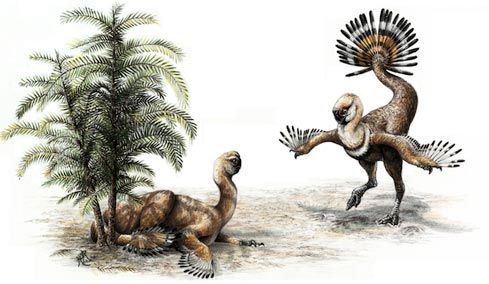
A new research paper, published by a scientist based at the University of Alberta (Canada), has suggested that at least one type of dinosaur, the bird-like Oviraptors had a pygostyle structure, compressed tail vertebrae that was sheathed in muscle.  This anatomical arrangement, commonly seen in modern birds would have allowed this oviraptorid to shake its tail and use any feathers on the end of it as a visual display device, perhaps to attract a mate or to intimidate a rival or even a predatory dinosaur.

Oviraptors are a group of theropod dinosaurs, distantly related to the likes of Tyrannosaurus rex and Velociraptor that are known from Upper Cretaceous strata of the Northern Hemisphere.  These dinosaurs were bipedal with small heads, as a result of their short, compact skulls.  They had beaks like birds and a collarbone to strengthen the shoulders as seen in extant birds today.

Shaking Their Tails – Oviraptorids (Ingenia spp.) Displaying

Dinosaur Courtship?

Picture credit: Sydney Mohr, University of Alberta

Oviraptor Fossils

For University of Alberta scientist Scott Persons, the opportunity to study some very fine and near-complete fossil specimens of Oviraptors that had been found in Mongolia gave him the chance to theorise on the structures of these dinosaur’s long tails.  He suggests that the tail could have ended in a fan of feathers that could have been extended and “flashed” just like a male peacocks.  He refers to these dinosaurs as being natural flirts able to flaunt their colourful feathers in extravagant displays.  They may have been able to shake their tails quite vigorously if this new research is correct.

The traditional view of cold-blooded, slow-witted, lumbering giants is gradually being replaced by a picture of very active animals with high-metabolic rates and complex social behaviours.  Using extant reptiles such as lizards and crocodiles as metaphors for the Dinosauria (Terrible Lizards), does not stack up to scientific scrutiny.

The Canadian-based scientist examined the fossils of a number of Oviraptor specimens that had been found in Mongolia.  He realised that all the dinosaurs in his study would have had long, nimble tails with attachments for strong muscles so that they could be moved back and forth.  The last caudal vertebrae of the tail (tail bones), may have been fused together to form a pygostyle, an anatomical feature seen in just one other type of animal – modern birds.

Birds more advanced than the likes of Archaeopteryx (A. lithographica), have their last five tail bones very much reduced and fused into a plate of bone, this is the pygostyle.  It seems very early on in bird evolution the long tail associated with theropod dinosaurs began to be shortened and reduced, an adaptation permitting these flying creatures to lose weight from their skeletons and to make movements in flight easier.  The pygostyle in the Oviraptors served as a support structure and anchor point for fans of tail-feathers that could have been used for display purposes.

Although no impressions of fossilised feathers are associated with the specimens Persons studied, he concludes that since feather impressions have been associated with other, earlier fossil specimens of oviraptorids, they were most likely present, just not preserved during the fossilisation process.

Oviraptor Fossil Study

The Oviraptor study is for the University of Alberta student’s Master’s thesis.  He examined the tail structure of an oviraptorid known as Khaan mckennai.  At least three specimens of this four foot long dinosaur are known, all found in the Ukhaa Tolgod region of Mongolia.  Persons noted that the tail had many vertebrae squashed together, forming a compact yet flexible structure.  Bony spines running along the tail would have provided anchor points for the attachment of large muscles.  In addition, other oviraptorid specimens showed a fused tail bone structure, the pygostyle, one example of a member of the oviraptorid group with a pygostyle is the dinosaur known as Similicaudipteryx yixianensis.

Describing his academic work, Persons went onto state:

“You stick a feather fan on the end of a highly dextrous and muscular tail and you’ve got what I think is a tail built for flaunting, that could shake a tail feather side to side, raise it up, strike a pose.  Probably to an extent that’s greater than a modern-day peacock or a turkey.”

Tail bones are easily lost when an animal dies, so the evidence for pygostyles in all Oviraptor-like dinosaurs is simply not available for scientists to study but this research raises the intriguing possibility that back in the Late Cretaceous of Mongolia there was a bunch of dinosaur show-offs, displaying and signalling to each other.

The implications of this study are that, it may be possible to identify males and females of a species if the tail bones are found.  The logic behind this idea, goes something like this; in modern birds, a number of species go through elaborate courtship displays in order to win and keep a mate.  Males of many species, Birds of Paradise, Peacocks, Black Grouse for example, possess elaborate tail fans that they use in visual courtship displays.  The caudal vertebrae (tail bones) may therefore be slightly different between males and females of the same species as these bones had to support muscles and tendons to allow the tail fans to be displayed.  Tail bones could help palaeontologists to work out which dinosaurs were boys and which were the girls.

A number of model makers have depicted Oviraptors with tail fans, an example of this is the Oviraptor from Safari Ltd, a model that was introduced a few years ago now, replacing an older version of this Asian dinosaur.

The Oviraptor Model from Safari Ltd

Part of the Carnegie Collectibles Range from Safari Ltd.

Picture credit: Everything Dinosaur

The Oviraptor model is part of the company’s Carnegie Collectibles range of scale models from Safari Ltd.

To view this range of prehistoric animal figures: Dinosaur Figures and Replicas (Safari Ltd).

The study concludes that there were sophisticated and specialised feather appendages in other dinosaur clades not just the ones that evolved into Aves (birds).

6 01, 2013

Hunting for a Tarbosaurus – in the United Kingdom

By |2023-02-11T16:59:18+00:00January 6th, 2013|Categories: Dinosaur and Prehistoric Animal News Stories|0 Comments

U.S. Authorities Set Out to Track Down Tarbosaurus Fossils

It may seem like a plot from Primeval or Jurassic Park but American customs officials are on the hunt for a missing dinosaur in the aftermath of a guilty plea from a Florida based, commercial fossil dealer.  Last week, Floridian Eric Prokopi pleaded guilty to falsifying importation documents and making misleading statements concerning the contents of crates of fossils imported into the United States.

Hunt for Tarbosaurus

The trail of the Tarbosaurus fossils began when an eight metre long, mounted specimen was offered for sale at Heritage Auctions in New York last May.  The exhibit fetched over $1 million USD when sold, but the lot was seized by U.S. officials as the fossils were alleged to have been illegally shipped out of Mongolia, the only place in the world where Tarbosaurus fossils have been found (Nemegt Formation).  It has been illegal for such artefacts to be shipped out of Mongolia for more than fifty years.

Tarbosaurus (Tarbosaurus bataar), was an apex predator of the Late Cretaceous.  Closely related to the more famous Tyrannosaurus rex, this dinosaur is sometimes called Tyrannosaurus bataar, indeed this is how the lot was described when first put up for auction in New York.

An Illustration of a Tarbosaurus Dinosaur

Fossils hopefully being repatriated back to Mongolia.

Picture credit: Everything Dinosaur

The image (above) is a Tarbosaurus dinosaur model from CollectA.

To view this range: Tarbosaurus Models and Theropod Figures (CollectA Age of Dinosaurs).

Last week, Eric Prokopi the seller of the Tarbosaurus fossil pleaded guilty to a number of charges referring to making false claims concerning the import of fossil material into the United States.  He is due to be sentenced in April and such charges can lead to up to seventeen years in prison however, in a plea bargain Mr Prokopi is helping the American authorities with the recovery of other fossils that may have been illegally imported into the United States.

Court Papers

Court papers reveal that one Tarbosaurus specimen, part of a set of six of these dinosaur fossils is still not accounted for, it is believed to be somewhere in Britain.  The other five specimens were in Mr Prokopi’s possession and these have been seized by U.S. officials, however, the Tarbosaurus which, according to the court documents may be in the United Kingdom, remains unaccounted for.  Sources have revealed that the plea agreement refers to “one nearly complete Tyrannosaurus bataar specimen purchased from a Mongolian individual and located in Great Britain.”

The hunt is on to see if the Tarbosaurus fossils can be found and U.S. Customs will be interested in trying to understand more about how these rare Asian dinosaur fossils came to be shipped into America in the first place.  They are keen to trace the movements of the fossils from Asia into America via the United Kingdom.  The Mongolian government is believed to be keen to unite all the known Tarbosaurus fossil material together to make an exhibit at their own dinosaur museum in Mongolia.  A request from the Mongolian government has been sent to London asking for assistance in the return of such artefacts should they be located in the Britain.

The Tarbosaurus Mounted Skeleton Offered for Sale in New York

The skeleton offered for sale at an auction in New York.

Picture credit: Reuters/Heritage Auctions

The hunt for the fossil, follows a lengthy investigation into a global trade in dinosaur bones ranging from a New York auction to southern England’s Jurassic coast.  Legal documents seen by a national newspaper suggest that a consignment of fossils was sent from the UK to Mr Prokopi in Florida.  It seems that the guilty plea may not be the end of this investigation,  American officials are keen to understand more about the logistics behind the movement of such fossils around the world.

To read about the seizure of the Tarbosaurus auction material: Seizing a Tyrannosaur.

In June 2010, the London International Art Fair had a strange item up for sale amongst the fine art and ceramics, it was the prepared skull of a Tarbosaurus.  It has been reported that this item was on sale for £125,000.  The skull came from a Dorset coast fossil dealer, British newspapers have enquired about this specimens’s whereabouts.

Scotland Yard have confirmed that its art and antiques unit had been contacted by the U.S. Department of Justice but insisted it was not currently investigating the case.

A spokeswoman commented:

“At this time no request for assistance has been made and there is no Metropolitan Police Service investigation.”

Investigations into alleged dinosaur fossil smuggling are likely to  continue with the Mongolian government seeking to have repatriated any Tarbosaurus fossil material that is found.

It is suspected that there is a substantial black market for fossil material, especially dinosaur fossils with very high prices, sometimes in excess of £500,000 being paid for rare specimens.  Fossils are smuggled out of countries and offered for sale via a network of dealers to wealthy private individuals.  Hopefully, the stiff sentence likely to be handed down to Mr Prokopi and the on-going investigation into fossil shipments from Mongolia will help deter others from such activities.

28 12, 2012

Tarbosaurus bataar Case – Florida Man Pleads Guilty

By |2023-02-11T13:15:14+00:00December 28th, 2012|Categories: Dinosaur and Prehistoric Animal News Stories|0 Comments

Guilty Plea in Dinosaur Smuggling Case

A Florida resident, at the centre of a dinosaur skeleton row has pleaded guilty to charges regarding the making of false statements on customs forms.  He is due to face sentencing in the spring of 2013.

The federal court case centred around the auction of an eight-metre-long, mounted skeleton exhibit of a theropod dinosaur known as Tarbosaurus (Tarbosaurus bataar).  The auction took place at Heritage Auctions in New York on Sunday May 20th of this year, despite a number of palaeontologists and other lobby groups attempting to block the sale. The lot was sold for approximately £630,000 GBP (over $1 million USD), a little more than the estimated value.  The skeleton, which represents a sub-adult dinosaur and is believed to be around seventy-five percent complete was purchased by an unnamed individual.

To read an article about the seizure of the dinosaur fossil: The Seizing of a Tyrannosaur.

Tarbosaurus bataar

Tarbosaurus is a member of the tyrannosaurid dinosaur family.  It was a large, apex predator that roamed Mongolia around seventy million years ago in the Late Cretaceous (Maastrichtian faunal stage).  First named and described back in 1955 by the Russian palaeontologist Evgeny Aleksandrovich Maleev.

Tarbosaurus is closely related to the most famous dinosaur of all – Tyrannosaurus rex.  Maleev did not that the Mongolian dinosaur was very similar to the North American T. rex, they shared a number of common anatomical features (autapomorphies).  For a time, this dinosaur was known as Tyrannosaurus bataar, but in the mid 1960s following a review of the fossil material from both tyrannosaurid species, the name Tarbosaurus was established for this genus.   The name Tarbosaurus means “alarming reptile” and with a maximum length in excess of twelve metres and weighing perhaps as much as five tonnes, this theropod dinosaur was a formidable predator.

An Illustration of Tarbosaurus (Tarbosaurus bataar)

Florida man pleading guilty.

Picture credit: Everything Dinosaur

The picture (above) shows a Tarbosaurus figure from the CollectA model range.

To view this range: Tyrannosaur Models and Prehistoric Animals (CollectA).

For the New York auction, the mounted specimen was described as Tyrannosaurus bataar.  Cynics might state that this term was used to help make the lot more valuable and to fetch a higher prices as Tyrannosaurus would have had a wider commercial appeal than the relatively less known Tarbosaurus.  However, the specimen, if it did come from Mongolia would pose a problem for the seller as it has been illegal to remove from Mongolia fossils or any other artefacts of “cultural significance” for more than fifty years.  This law had been in place even before the formal scientific description and review of the fossil material associated with of Tarbosaurus.

A number of interested parties tried to intervene, either to stop the auction or to have the lot impounded until the provenance of the fossil could be established.   The Mongolian President, Elbegdorj Tsakhia became involved, insisting that this fossil was the property of the Mongolian people and that it had been illegally smuggled out of his country.

At a federal court hearing yesterday, thirty-eight year old Eric Prokopi from the town of Gainesville, Florida (United States), pleaded guilty to making “vague and misleading” statements concerning the importing of the crates containing the dinosaur fossils into America.  The plea covers the statements made on the U.S. customs paperwork provided in connection with the import of the Tarbosaurus fossil material, allegedly smuggled out of Mongolia.

The Tarbosaurus exhibit was examined by leading palaeontologists after the auction, when the lot had been seized by federal agents.  They declared that the fossil material had, most likely, originated in Mongolia and therefore the fossils had been obtained illegally.  Mr Prokopi, had tried to claim back the Tarbosaurus skeleton in October.  He claimed that he imported a set of jumbled bones and it was his skill at preparing the fossils and making them into a single specimen that had added the value to the dinosaur exhibit.

In what is believed to be a plea bargain, Mr Prokopi pleaded guilty to the charges of conspiracy to make false statements on customs forms, misrepresenting imported goods and the interstate transport of stolen property.  The plea bargain may have been part of an agreement reached between the parties involved as Mr Prokopi had been accused of importing (allegedly,  a number of other dinosaur fossils from Mongolia, including fossils of the duck-billed dinosaur Saurolophus and an oviraptorid.  The Tarbosaurus specimen may have been just one of a number of illegal transactions concerning dinosaur fossils carried out.

People pleading guilty to such charges can find themselves facing up to ten years in prison.  Sentencing is set for 25th April, just under a year after the Tarbosaurus auction in New York.

A number of governments and other national authorities have promised to clamp down on the huge, black market for fossils, especially dinosaur fossils.  Individual specimens, such as this Tarbosaurus can sell for enormous sums of money and although no official figures are available, customs officials state the smuggling and illegal sale of such items is very widespread.

27 12, 2012

University of Manchester Scientists Searching for “Ghosts” in Fossils

By |2023-02-11T13:10:33+00:00December 27th, 2012|Categories: Dinosaur and Prehistoric Animal News Stories|0 Comments

Advanced Synchrotron Light Rays – Shed “Light” on Long Dead Lizards

A joint Anglo/American team of researchers led by scientists from the University of Manchester are using an extremely powerful light source to pick up tiny traces of chemical signatures and by doing so they are “shedding light” on fossils and  making some exciting new discoveries.

University of Manchester

Many of the fossils held in museum and university collections were found in the 19th and 20th Centuries, these fossils may have been scientifically described and carefully studied, but scientists are now able to use technologies beyond the imaginations of their academic predecessors to explore fossil material and tease out new information from the ancient rocks.  A team of scientists from the Palaeontology Research Group at Manchester University were able to collaborate with the engineers based at the Stanford University  Synchrotron Radiation Lightsource (based in California, United States), and reveal new information on the fifty million year old fossil of a lizard.

The Stanford Synchrotron Radiation Lightsource

The Stanford Synchrotron Radiation Lightsource is one of the most sophisticated and powerful synchrotrons in the western world.  The technology, enabling strong beams of electromagnetic radiation, produced by particle accelerators to bombard an object with intense light has been around for fifty years or so.  This technology has a wide range of applications, from providing engineers with an ability to assess structural issues in new materials, to being used in medicine, physics and now to scan fossils looking for tiny traces of otherwise invisible elements.

This non-invasive and non-destructive technique has been used on a Palaeogene fossil of a lizard, which was originally thought to be just a moulted skin.  However, the electromagnetic radiation scans found tiny traces of phosphorous where the teeth in the miniature jaws would have been.  This proved that teeth had been present in the fossil and since no member of the Squamata (lizards and snakes) sheds their teeth as well as their skin when they moult, the fossil was re-described as a more complete specimen.

Fifty-million-year-old Lizard Fossil Used in the Study

Shedding light onto ancient creatures.

Picture credit: University of Manchester/Applied Physics

The Manchester University team of scientists, a collaboration from various faculties includes Dr Roy Wogelius and Dr Phil Manning, who has recently been in the United States working on the excavation of a number of Triceratops (dinosaur fossils).  One application of this new technology could be the analysis of dinosaur fossils, preserved in coarse sandstone to detect the chemical signatures of feathers which otherwise would not have shown up under more conventional light studies and X-rays.  This could help palaeontologists to understand more about the evolution of feathers and ultimately the relationship between Aves (birds) and the Dinosauria.

Detecting the Presence of Chemicals

Not only was the powerful synchrotron able to detect the presence of chemicals related to the teeth of the tiny lizard, but their chemical signatures and placement in the jaw corresponding to other general features such as the lizard’s relatively elongated snout enabled the scientists to establish more information about the family and genus this fifty million year old specimen might be related to.

Based on this study, the team have concluded that the fossil specimen has a close resemblance to shinisaurids (Chinese Crocodile Lizards), these are small, semi-aquatic lizards that can be found today in south-east Asia.   The fossil specimen has been proposed as being an example of Bahndwivici ammoskius an extinct shinisaurid that lived in Wyoming during the Eocene Epoch.

For prehistoric animal themed merchandise including dinosaur toys and games: Everything Dinosaur.

Commenting on the research work carried out by the team, palaeontologist Dr Phil Manning stated that the finding of teeth residues changed almost everything that the palaeontologist’s thought they knew about this particular specimen.  Thanks to the Stanford Synchrotron Radiation Lightsource, the species could be identified, the technology allows scientists to see the “ghosts” of original biological structures that only remain in association with the fossil as minute chemical concentrations.  The results of this study have been published in the academic journal “Applied Physics”.

Dr Manning and his team hope to be able to use this technology to study more fossils, including dinosaur fossils.  The scientists are excited about the prospect of discovering more about previously very well studied fossil specimens using the Stanford-based synchrotron.  The electromagnetic radiation will truly be shedding new light on long extinct creatures.

Our thanks to Manchester University for helping to compile this article.

26 12, 2012

The Strongest Bite of All – not T. rex but Piranhas According to New Research

By |2024-04-24T20:05:56+01:00December 26th, 2012|Categories: Animal News Stories, Dinosaur and Prehistoric Animal News Stories|1 Comment

Black Piranha and Extinct Relative Had Strongest Bites of All

The debate about which of all the predators known to science was the most ferocious is a subject area often visited by nature documentary programme makers.  We seem to be obsessed with dangerous animals whether it is the extinct Tyrannosaurus rex of the Jurassic Park movies or indeed the Great White Shark (Carcharodon carcharias).  However, one when it comes to which animal had the strongest bite there is one small fish found throughout the Amazon basin that could give these two film icons a run for their money.  As a proportion of its body size, the extant Black Piranha is believed to have one of the strongest bites of any animal. So fish of the genus Serrasalmus can lay claim to the title of having the most powerful bite pound for pound of their body weight.

Bite Forces

Piranha have been depicted in a number of movies, not as many as the dinosaurs, but just like those extinct reptiles, the piranhas reputation has been enhanced by its cinematic ability to strip flesh from people in a matter of seconds.  Black piranhas in the wild can be aggressive but they rarely attack humans.  They can grow up to about forty centimetres in length and they are an important predator of other fish species in the river channels and tributaries of the Amazon basin.

A Skeleton of the Extant Black Piranha with the Fossilised Teeth of M. paranensis (inset)

Fearsome predators with a strong bite.

Picture credit: Grubich JR et al/Grey Taxidermy/Karen Carr

Studying Piranhas and Other Vertebrates

A team of researchers from George Washington University (Washington, District of Columbia, United States) visited the Amazon to study piranhas and other fish vertebrates, the bite force of the Black Piranha (Serrasalmus rhombeus) was calculated to be approximately 320 Newtons.  These fish feed by darting in and snatching bite-sized mouthfuls from other fish, attacking the bony fins and softer parts of the victim.  The data calculated by measuring the bite force was then used to assess the potential chomping power of a much larger, extinct species of piranha, fossils of which were found in Argentina.

The extinct piranha, known as Megapiranha paranensis is known from just one fragmentary fossil, part of the premaxilla (upper jaw).  M. paranensis was a freshwater predator that inhabited Argentinian river systems during the Late Miocene Epoch (approximately 8 million years ago).  Reaching lengths in excess of one metre, this ancestor of today’s Serralsalmus genus most likely had a scaled-up bite force.  The extinct super-predator shared its world with enormous crocodiles and turtles, being quite large with a very strong bite was an important adaptation for survival.

The Bite Force of T. rex

To read an article on the potential bite force of Tyrannosaurus rex: New Research into T. rex Bite Force.

When body size is taken into account, the scientists working in conjunction colleagues from the Museum of La Plata (Argentina) and the Columbian College of Arts and Sciences, calculated that the bite forces generated by the Black Piranha and the extinct Megapiranha would have been bigger than those forces generated by Tyrannosaurus rex as well as the extinct Megalodon giant shark (Carcharodon megalodon).  Palaeontologists have used studies of extinct animal’s  jaws and teeth to try and calculate the bite forces that these creatures could generate.  It seems that a fish often kept by aquarium enthusiasts could have had the most devastating bite of all.

The bite force of M. paranensis was calculated by creating a bronze-alloy model of the jaw and using a computer programme to assess the power of the bite force generated when biting into vertebrate bone, turtle carapace or into the scales of catfish, organisms that this extinct fish could have attacked.  The strength of the fish bite was due to a combination of factors according to the scientists, the shape and size of the teeth, the amount of muscle associated with the jaws and the ability of the jawbones to conduct huge forces through them as a result of their anatomical configuration.  It seems even the jaws of the most formidable predator of the Late Cretaceous – Tyrannosaurus rex may not have been a match for these freshwater predators.

The Fossilised Premaxilla of Megapiranha paranensis

Strong bite from the Late Miocene.

Picture credit: Mark Sabaj-Perez

The teeth of the extinct piranha are serrated and they remind team members at Everything Dinosaur of teeth from extant sharks such as the Tiger shark (Galeocerdo cuvier).

The research team went onto compare the bite forces generated against a series of other fishy predators, not only the colossal  Megalodon but also the Devonian giant placoderm Dunkleosteus.  Pound for pound the piranha species came out on top.

A Bite Force Comparison between Extinct and Extant Species of Fish

Piranhas come out on top.

Despite the number of cameo roles piranhas have played in films, where they have been seen to strip their victim of flesh in a matter of seconds, the research team claim that this is the first time that the actual bite force of piranha has been studied in this way.

For models and replicas of ancient fish such as Otodus megalodon, Cretoxyrhina and Dunkleosteus: PNSO Prehistoric Animal Figures.

24 12, 2012

Those Smart Therizinosaurs with their Super Senses

By |2024-04-24T20:05:13+01:00December 24th, 2012|Categories: Dinosaur and Prehistoric Animal News Stories|0 Comments

New Study Suggests that Therizinosaurids Had Highly Developed Senses

They may look like a dinosaur that has been designed by a committee, but a new study by a team of international researchers into the sensory abilities of therizinosaurs suggests that these feathered theropods had highly developed senses.  Using sophisticated computerised tomography (CT scans) to analyse a therizinosaur skull discovered in Mongolia, the palaeontologists found that these bizarre-looking members of the Dinosauria had a well developed sense of smell, most likely excellent eyesight and a strong sense of balance.

Sensory Abilities of Therizinosaurs

The therizinosaurids are a rare clade of the Dinosauria whose fossils have been found in North America and Asia.  Almost exclusively known from Cretaceous material, these dinosaurs are members of the Theropoda but they seem to have adapted to a more sedentary, herbivorous lifestyle, despite being distantly related to fearsome dinosaurs such as Tyrannosaurus rex and Giganotosaurus carolini.

The therizinosauroids are such unusual dinosaurs that until sufficient fossil material was found to prove their affinities with the Dinosauria they were thought by many palaeontologists not to be dinosaurs at all.  The first member of the therizinosaur family to be formally named and described was Therizinosaurus (Therizinosaurus cheloniformis).  It was named and described in 1954 by the eminent Soviet scientist Evgeny Aleksandrovich Maleev, following an intensive study of some limb bones, strange claws and flattened ribs found by a joint Soviet/Mongolian expedition to a remote area of Mongolia in 1948.

This genus is also the largest known for the therizinosauroids, with some scientists estimating that this creature was more than ten metres in length and weighed as much as five metric tonnes.

A Typical Therizinosaur – Beipiaosaurus

A dinosaur designed by a committee – the term we use to describe therizinosaurs.

Picture credit: Everything Dinosaur

The picture (above) shows a drawing of a typical therizinosaur, it is based on a model of a Beipiaosaurus produced by Safari Ltd.

To view this model range: Therizinosaurs and Prehistoric Animal Figures (Safari Ltd).

Taxonomic Relationships

The exact taxonomic relationships between different genera of therizinosaur is debated by palaeontologists; as is the groups affinities with the rest of the Theropoda.  Therizinosaurs seemed to share some general characteristics, they had small heads, perched on long necks, round, tubby bodies that gave them an almost pot-bellied look, short stocky legs and relatively long arms.  The hands ended in three-fingered claws, the most famous of the therizinosaur autapomorphies (distinctive anatomical features), the claws of therizinosaurs were exceptionally long.  The claws of  T. cheloniformis,  for example could have been up to a metre in length.   These claws were not strongly curved but rather flattened.  When first studied these claws reminded the scientists of scythes, so with more fossil finds, the clade of “scythe” lizards or the therizinosaurs was established.

A number of therizinosaurs such as Beipiaosaurus (B. inexpectus), are believed to have been covered in coats of simple, downy feathers.  These feathers were not like the flight feathers of modern birds but helped to insulate these animals and keep them warm.  This is evidence to suggest that these dinosaurs were endothermic (warm-blooded).

What these animals ate is also debated by palaeontologists, some believe that these dinosaurs were omnivores, feeding on vegetation but also catching small lizards, birds and mammals.  Others think that the long, flattened blade like claws and their strong arms were used to break open termite nests and feed on the insects inside.  Many palaeontologists have concluded that with their extended bellies, blunt beaks and small, leaf-shaped, non-serrated teeth coupled with the presence of prominent cheeks, these dinosaurs were largely herbivorous if not entirely vegetarian.

Finding an Ecological Niche

It has been speculated that these animals lived mainly in arboreal environments and filled a ecological niche similar to that filled by the later chalicotheres and the giant sloths.  Well developed senses are not usually associated with animals that occupy these niches in an ecosystem, so a team of international researchers from the Earth Sciences Department of the University of Bristol (England), two American Universities assisted by an associate at the University of Ulaanbaatar (Mongolia) set about exploring the brains of therizinosaurs.

It is not possible to study the brain tissue of dinosaurs, such soft tissue is very rarely fossilised and quickly rots when an organism dies, however, by assembling a skull and examining the spaces that would have been occupied by soft tissues such as brains and nerves, palaeontologists can build up a detailed picture of the shape and function of extinct animal’s brains.  By studying the morphology and size of nerve openings into the skull from the orbit and olfactory areas, scientists can deduce how well developed certain senses were.  If the inner ear is available for study then an understanding of the animal’s sense of balance can be achieved.

Elikosaurus andrewsi

Using a superbly preserved and virtually complete skull of the Late Cretaceous therizinosaur known as Elikosaurus andrewsi, a typical Mongolian therizinosaur that lived around 90 million years ago (Turonian faunal stage of the Cretaceous), the team were able to build up a picture of the senses of this dinosaur.  Sophisticated computer programmes interpreted the data from numerous CT scans of the fossil skull and this enabled the team to build up a three-dimensional picture of the internal structure of the dinosaur’s head.

The Skull of the Therizinosaur used in the Study (Elikosaurus andrewsi)

The large orbit (eye socket) of a therizinosaur. Study suggests these creatures had highly developed senses.

Picture credit: Emily Rayfield, University of Bristol

The study, the results of which have been published in the online scientific journal “The Public Library of Science” reveal that therizinosaurs had a remarkably well developed sense of smell, excellent eyesight and a strong sense of balance. When the skull of a therizinosaur is examined the large orbit (eye socket) can be clearly seen, and the long muzzle provides an extended naris which may have helped improve the animal’s ability to smell.  All this data was interpreted and managed by what turns out to be an enlarged forebrain. It seems that these slow-moving, herbivores with their over-sized bellies and strange claws may have had keen senses and a very well developed sense of balance.  It is likely that these attributes are a carry over from when the ancestors of the therizinosaurs were active predators.

The work of this international team of researchers has important implications for our understanding of how sensory functions evolved and changed in the Dinosauria.  It also sheds a little light on how the sensory organs of birds (closely related to theropod dinosaurs), evolved.

It is difficult to think of these dinosaurs as “smart”, their brains were small in proportion to their body size, but this latest sophisticated study further assuages the old fashioned theory that these reptiles were extremely slow witted, with dull reactions and in comparison to modern mammals, the dinosaurs were very poorly adapted to their environments being doomed to ultimate extinction.  In reality, the Dinosauria, were extremely well adapted to their environments and they evolved into a myriad of forms so that they could exploit a whole range of opportunities in the Mesozoic world.

Everything Dinosaur acknowledges the help of the University of  Bristol with this article.  Inside the head of a dinosaur: Research reveals new information on the evolution of dinosaur senses.

23 12, 2012

Rare Giant Titanosaur Tooth Hints at Even Bigger Titanosaurs

By |2024-04-24T20:04:28+01:00December 23rd, 2012|Categories: Dinosaur and Prehistoric Animal News Stories|0 Comments

Single Giant Tooth Tantalises Scientists with Prospect of “Enormosaurus“

A distinguished palaeontologist from the National University of Rio Negro in Argentina has published a scientific paper on the discovery of a single tooth, a fossil which may have serious implications on the estimated size of the largest land animals known to science.

Huge Titanosaur Tooth

Rodolfo Garcia, a specialist in the study of South American dinosaurs that lived during the Cretaceous geological period, writing in the academic journal “Cretaceous Research” states that a tooth found in strata of the Allen Formation at Salitral  de Santa Rosa, Rio Negro (Argentina) is thirty-two percent bigger than any other tooth from the same type of dinosaur found to date.  The tooth is believed to have belonged to a titanosaur, a plant-eating, long-necked type of dinosaur.   The chisel shaped tooth measures in excess of seven and a half centimetres in length (including the crown and the root), this is nearly as third as big again as the largest titanosaur tooth previously known.

The Super-sized Tooth of Perhaps a Super-sized Titanosaur?

Big tooth does not necessarily mean a big dinosaur.

Picture credit: National University of Rio Negro/Journal of Cretaceous Research

Note the scale bar in the picture.

The Titanosaurids

The titanosaurids were the last group of sauropods (long-necked dinosaurs examples of which include the Jurassic Diplodocus and Brachiosaurus), to evolve.  The exact taxonomic relationship between the titanosaurs of the Late Jurassic and the Cretaceous and the earlier Jurassic Sauropoda remains unclear.  The titanosaurids are the only type of sauropod to have survived until the very end of the Age of Dinosaurs (sixty-five million years ago).  Fossils of these animals have been found in the Americas, Africa, Europe, Australia, New Zealand, India and Asia.

The lack of titanosaur fossils from Antarctica was thought due to the lack of sampling and not a reason to exclude this fauna from that part of the super-continent of Gondwanaland that we now know as Antarctica.  In 2011, a single fragmentary vertebrae discovered in Antarctica did indeed, suggest that these large, herbivores had roamed all off the southern continents in the Late Cretaceous.

A number of titanosaurs were believed to have been armoured, perhaps an adaptation to the evolution of large, super-predators such as the abelisaurids and the tyrannosaurs.  Several genera of titanosaur can lay claim to the title of the largest, land living creatures known to science.  Paralititan from North Africa may have measured in excess of thirty metres, Andesaurus, fossils of which have been found in Argentina may have been bigger still and a recent discovery of cervical vertebrae in the southern United States suggests that Alamosaurus may have reached lengths well in excess of thirty metres too.

The dinosaur regarded as the largest of the titanosaurs at the moment is the colossal Argentinosaurus huinculensis, which as the name suggests was also discovered in Argentina (western Argentina, Huincul).  It may have measured more than thirty-five metres in length and weighed as much as one hundred tonnes.

A Scale Drawing of Argentinosaurus (A. huinculensis)

Currently, the biggest land living animal ever?

Picture credit: Everything Dinosaur

The picture (above) shows a scale drawing of Argentinosaurus.  The drawing is base on the CollectA Argentinosaurus figure.  To view this range: CollectA Dinosaur Figures (Age of Dinosaurs Popular).

The trouble is, most large titanosaurs are only known from a few fragmentary fossils.  Their true size can only be estimated based on the scant fossil evidence palaeontologists have to study.  The finding of an enormous tooth in strata from the Allen formation (fossil reference: MML-Pv 1030), leads to the intriguing prospect of even bigger dinosaurs awaiting discovery.

The tooth, the biggest titanosaur tooth to be described comes from Upper Cretaceous aged strata (mid Campanian to lower Maastrichtian faunal stage), it has been tentatively dated to around 77 to 73 million years ago.  The single tooth is thirty-two percent larger than the previously largest titanosaur tooth described.  The former record holder came from a titanosaur genus known as Nemegtosaurus whose fossils have been found in the famous Nemegt Formation of Mongolia. Like many titanosaurs Nemegtosaurus is poorly known with one single incomplete specimen including a partial skull for the scientists to study.  The teeth of this Late Cretaceous titanosaur were chisel-like, large and limited to the very front of the jaws.

For Rodolfo Garcia, the discovery of this single, shed tooth may mean that there is another genus of titanosaur awaiting discovery in the Allen Formation, one that will become known as the biggest terrestrial animal known in the fossil record.  Perhaps, the dinosaur who lost this tooth was not that big but had unusually large teeth for its size, or indeed the tooth could actually turn out to belong to an already described, but poorly known genus of South American titanosaur.

The wear and tiny scratches on the tooth are being studied by the research team as they hope to infer feeding behaviour and dietary information from this fossil find.

If a new genus is erected based on this single specimen, this would not be the first time that this has happened in the study of the Dinosauria.  In 1825, when Gideon Mantell described Iguanodon he did so largely based on the finding of teeth that reminded him of the teeth of extant iguana lizard.  The marine reptile Liopleurodon was established as a genus after the describing of some large teeth found in France, it does not take much to erect a new genus.  However, there is one little “fly in the ointment” when it comes to trying to estimate the size of dinosaurs.  It seems that unlike mammals, dinosaurs grew a little bit each year as long as they lived – what scientists term indeterminate growth.  A very old Argentinosaurus for example, would grow a little bit more each year it lived.  It would not have the rapid growth or growth spurts that occurred when it was young, but even a one percent increase in size each year for a dinosaur already in excess of thirty metres long would add another foot or so to its overall length.

At the moment this single tooth raises the possibility that scientists may have to come up with another superlative to appropriately describe a new, huge genus of long-necked dinosaur.  The likes of Supersaurus and Seismosaurus have already been used, so how about “Enormosaurus” being established to describe the genus of titanosaur associated with this enormous tooth.

Go to Top