All about dinosaurs, fossils and prehistoric animals by Everything Dinosaur team members.

Fossil finds, new dinosaur discoveries, news and views from the world of palaeontology and other Earth sciences.

13 02, 2013

New Jurassic Park 4 Cinema Release – June 13th 2014

By |2024-04-29T10:48:54+01:00February 13th, 2013|Categories: Dinosaur and Prehistoric Animal News Stories, Dinosaur Fans|0 Comments

Date of Release of Jurassic Park 4 Confirmed

The fourth instalment of the Jurassic Park franchise is due to be released on June 13th 2014.  The current licence holders working in a partnership with Universal Studios merchandising operations for toys and figures – Hasbro, have been retained and we can expect a range of models and other merchandise to be released to coincide with this Summer blockbuster, cinema release.

Jurassic Park

The first “Jurassic Park” which was released in 1993, remains Universal’s highest grossing film ever, with over $921 million of revenue generated at the box office worldwide.  Expect this figure to be boosted by a considerable amount when the 20th anniversary edition of the original movie now with 3-D added is released in April.

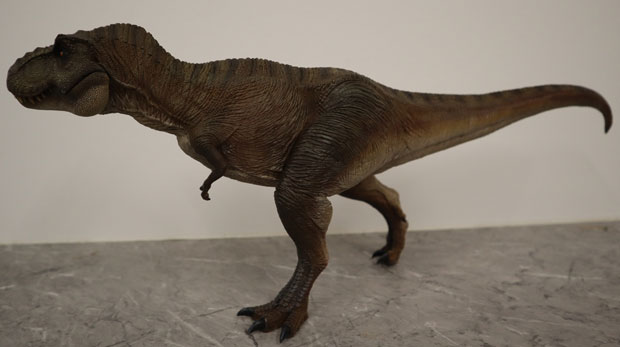
A Tyrannosaurus rex Replica Inspired by “Jurassic Park”

Nanmu Studio T. rex dinosaur model (Alpha) in the brown colouration (lateral view).

The Nanmu Studio Jurassic Series T. rex dinosaur model (Alpha) in the brown colouration (lateral view). A dinosaur figure inspired by the Jurassic Park movie franchise.  Picture credit: Everything Dinosaur.

Picture credit: Everything Dinosaur

The T. rex figure (above) is from the Nanmu Studio Jurassic Series range.

To view this series of prehistoric animal models: Nanmu Studio Jurassic Series Prehistoric Animal Models.

Correction, as of early 2014 the release date was altered to June 12th 2015.

9 02, 2013

Cretaceous Mass Extinction Event Most Accurate Date Established in New Research

By |2024-04-29T06:12:17+01:00February 9th, 2013|Categories: Dinosaur and Prehistoric Animal News Stories, Geology, Palaeontological articles|1 Comment

International Team Establish Most Accurate Date Yet for Extraterrestrial Impact

If you were able to travel back in time, one part of Earth’s history that would be best avoided would be 66,038,000 years ago plus or minus 11,000 years, as this period has been identified by a team of international researchers as being the time of the impact of a huge object from space that aided the extinction of the Dinosauria and the demise of about seventy percent of all land animals.

Cretaceous Mass Extinction

Scientists from the Berkeley Geochronology Centre (University of California), in co-operation with colleagues from Glasgow University and Vrije University (Amsterdam, Holland), have concluded that an asteroid, meteorite or possibly even an object such as a comet collided with the Earth approximately 66.038 million years ago.  Although this single event may not have been the cause of the mass extinction, the scientists conclude that if the extraterrestrial impact was not wholly responsible, it would have contributed significantly to the global extinction event.

Based on the dateline evidence that the team established, the impact of a large extraterrestrial object in the Gulf of Mexico area could have proved to have been the final blow that saw off the Dinosauria, marine reptiles and pterosaurs.

Published Research

Commenting on the research, which has just been published in the academic journal “Science”, one of the Californian based authors of the paper stated that the extinction and the impact are synchronous to each other and therefore it is highly probable that the impact played a major role in the mass extinction.  In essence, the impact from outer space and the subsequent environmental and climatic chaos that followed, may have been the “tipping point” for the dinosaurs, finally leading to their extinction.

It was father and son Luis and Walter Alvarez who first published a theory (1980), stating that a thin layer of clay enriched with the rare Earth element iridium found at the boundary between Uppermost Cretaceous strata and younger Cenozoic deposits marked the impact of a large, extraterrestrial object.  It was these two American scientists who first claimed that this was evidence of a meteorite or some other object from outer space colliding with the Earth.

Although the American scientists did not know where the impact actually occurred.  This was resolved when the Chicxulub crater, a geological feature that had been first identified in the 1970s, was more thoroughly examined in the 1990s and it was established that this feature had been created around the time of the end of the Cretaceous.  The object, measuring around ten kilometres in diameter and travelling at around thirty kilometres a second smashed into the Gulf of Mexico, close to what is now the village of Chicxulub on the coast of Mexico’s Yucatan peninsula.

The impact was cataclysmic, some scientists estimate that the collision released energy equivalent to 100 million hydrogen bombs.  A crater was blasted into the Earth more than 100 kilometres wide and up to 12 kilometres deep.  Virtually all life within thousands of miles of the impact zone would have been annihilated almost immediately.  Some 50,000 tonnes of rock was thrown up into the Earth’s atmosphere and huge quantities of sulphur was released, which when mixed with water droplets then fell to Earth as vast amounts of dilute sulphuric acid (acid rain), destroying what vegetation had survived the earthquakes, tsunamis and wildfires.

Dating the Catastrophe

This new research helps to clarify any potential concerns over the timing of this catastrophic event in the history of life on Earth.  This event seems to have taken place at around the time of the mass extinction, not a long time before or indeed after the extinction event.  The impact and the mass extinction seem to be contemporaneous with each other.

Some scientists have argued that there may have been two extraterrestrial impacts at or around 65-66 million years ago, whilst others have provided evidence to suggest that the dinosaurs and other large, land vertebrates lived for approximately 300,000 years after the impact event.  This new research may not end the debate on the Cretaceous mass extinction event but at least it allows scientists an opportunity to build up a more accurate timeline of events at the very end of the Age of Dinosaurs.

Tektites, glassy spheres of molten rock that had been created at the moment of impact and hurled up into the atmosphere to later fall to Earth formed an important element in this new dating study.  If this material along with other elements that make up the famous K-T boundary between Mesozoic aged and Cenozoic aged deposits could be dated accurately then a more precise date for the actual impact could be established.

Part of the scientific team travelled to Haiti to collect tektites whilst other researchers explored the Upper Cretaceous sediments such as volcanic ash laid down in the famous Hell Creek Formation of Montana (United States).  Samples were gathered and analysed in laboratories using a dating technique called “argon to argon dating”.

“Argon to Argon Dating”

The samples were analysed in laboratories in the United States, “argon-argon dating” was used to determine their ages more precisely.  Argon-argon dating is a form of radiometric dating.  Radioactive elements decay and have isotopes which allows scientists to date the formation of certain elements within igneous rocks, thereby making it possibly to establish a chronology of the Earth’s history.  This dating technology uses the fact that naturally radioactive potassium decays into argon at a very regular rate.  Determining the ratio of these two elements in a sample provides a geophysicist with a method of calculating the age of the sample material.

For models and replicas of Upper Cretaceous dinosaurs and other prehistoric creatures: Bullyland Prehistoric Life Models.

University of Glasgow researchers conducted their own independent analysis of the samples and they confirmed the results of the American research team, thus the researchers were able to establish a new, more accurate date for the Yucatan impact.

The team are keen to point out that this single, terrible impact event was not the sole cause of the mass extinction.  Towards the end of the geological period known as the Cretaceous there seems to have been a number of other factors in play all contributing to climate change.  The sustained and immense volcanism which occurred in what was to become India would have had a major impact on the Earth’s climate.  The enormous basaltic lava flows of western and central India – known as the Deccan Traps, indicate that the most violent and devastating eruptions are dated very closely to the mass extinction event.  This geological activity would have had a significant impact on the Earth’s climate and this activity could have been a causal factor in the mass extinction.  The international research team hope to be able to use the argon-argon dating techniques to accurately map and date the Deccan Traps.  In doing this, the team will be helping to build up a more complete picture of the series of events that led to the demise of the dinosaurs.

To read an article that explores the possible range of contributory factors involved in the Cretaceous mass extinction event: Exploring the Cretaceous Mass Extinction.


8 02, 2013

New Species of European Pterosaur Named

By |2023-02-12T09:12:12+00:00February 8th, 2013|Categories: Dinosaur and Prehistoric Animal News Stories|2 Comments

New Late Cretaceous Pterosaur – Eurazhdarcho langendorfensis

An international team of scientists have named and described a new species of Late Cretaceous flying reptile which had a wingspan approximately the same as a Wandering Albatross, but unlike the extant Albatross, this pterosaur lived inland.

Researchers from the University of Southampton (England), in association with the Transylvanian Museum Society in Romania and the Museau Nacional in Rio de Janeiro (Brazil), have identified a new species of azhdarchid pterosaur with a wingspan of around three metres.  The fossils were found in Romania (Sebeş-Glod – Transylvanian Basin of north-western, central Romania), they have been dated to approximately sixty-eight million years ago (Maastrichtian faunal stage of the Late Cretaceous).

European Azhdarchid Pterosaur

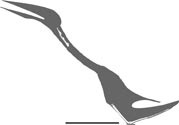
Scientists were able to excavate a number of associated cervical vertebrae (neck bones) plus elements from the long digit that acted as a support for the pterosaur’s wing.  The strata of the Sebeş-Glod region have provided palaeontologists with a wealth of vertebrate fossils including crocodilians, turtles, lizards plus a number of primitive mammals.  Some of these small creatures may well have been the prey of this new flying reptile species which has been named as Eurazhdarcho langendorfensis, the genus name comes from a combination of Europe and the azhdarchid pterosaur group.  The specific name relates to Langendorf, the name of the town of Lancrǎm in the native dialect of the ethnic German minority population of Romania.

A Diagram showing the Fossil Bones Found of Eurazhdarcho langendorfensis

Eurazhdarcho Pterosaur diagram showing fossil finds.

Eurazhdarcho pterosaur diagram showing fossil finds. Scale bar = 50 cm.

Illustration credit: Mark Witton (University of Southampton)

Eurazhdarcho langendorfensis

Although the bones have been heavily eroded and show signs of having been scavenged by crocodiles and further damaged by insect activity after burial, the fossils represent one of the most complete azhdarchid pterosaurs found in Europe to date.

Analysis of the finger bones that supported the long wing indicate that this flying reptile could fold its wings up and walk on all fours.  It has been speculated that these inland pterosaurs may not have been fish-eaters like coastal pterosaurs but they may have stalked prey rather like extant Marabou Storks.  The absence of any skull material prevents the research team from being able to gain a more complete understanding of the diet of these animals, however, it is very likely that E. langendorfensis had a large, toothless beak.

Dr Darren Naish (University of Southampton), one of the research team members responsible for the study which has been published in the academic journal Public Library of Science (PloS One) commented:

“With a three-metre wingspan, Eurazhdarcho would have been large, but not gigantic.  This is true of many of the animals so far discovered in Romania; they were often unusually small compared to their relatives elsewhere.”

During the Late Cretaceous, much of this part of southern Europe was covered by a warm, shallow sea.  There were a number of small islands, an archipelago or island chain and the strata in Transylvania formed one such island.  The dinosaur fauna seemed to have adapted to the limited resources on these islands and many species show a degree of dwarfism, including the tiny, pony-sized titanosaur known as Magyarosaurus.

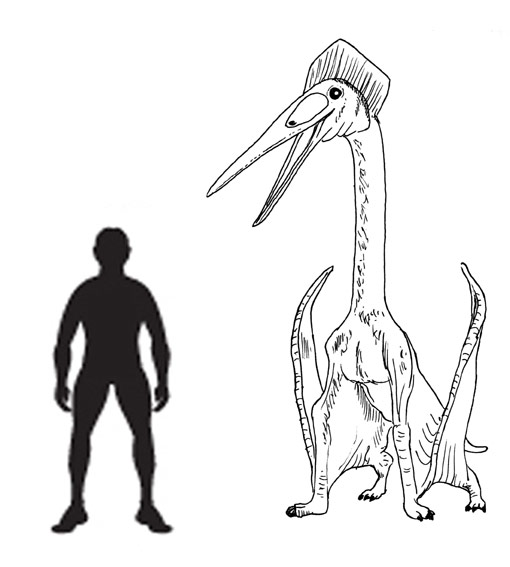
As pterosaurs could fly, they were not effectively marooned on the small islands and some azhdarchid fossils discovered in the late 1990s indicate that some species were giants with wingspans in excess of ten metres.

The discovery of this new genus of pterosaur, much smaller than the giants such as Hatzegopteryx thambema, suggest that as with other azhdarchid pterosaur discoveries elsewhere in the world, large pterosaurs co-existed with smaller species sharing the same environment.  This suggests that even on these poorly resourced island chains, different types of pterosaur were hunting different types of prey in the same region at the same time, indicating that the food chain in this part of the world during the Late Cretaceous was more complicated than previously thought.

A Scale Drawing of the Giant Hateg Pterosaur H. thambema

Hatzegopteryx - giant Pterosaur from southern Europe.

Hatzegopteryx – giant pterosaur from southern Europe.

Picture credit: Everything Dinosaur

For models and figures of pterosaurs: Pterosaur Models and Dinosaurs (CollectA Prehistoric Life).

Senior Lecturer in Vertebrate Palaeontology at the University of Southampton, Dr Gareth Dyke reflected on the potential feeding habits of these types of flying reptiles.

He stated:

“Experts have argued for years over the lifestyle and behaviour of azhdarchids.  It has been suggested that they grabbed prey from the water while in flight, that they patrolled wetlands and hunted in a heron or stork-like fashion, or that they were like gigantic sandpipers, hunting by pushing their long bills into mud.”

The research team are hopeful that more pterosaur remains will be found in the Transylvanian Basin, including skull material which might yield further evidence regarding the dietary behaviour of the Late Cretaceous reptiles.

The scientific paper: “A New Azhdarchid Pterosaur from the Late Cretaceous of the Transylvanian Basin, Romania: Implications for Azhdarchid Diversity and Distribution” by Mátyás Vremir, Alexander W. A. Kellner, Darren Naish and Gareth J. Dyke published in PLoS One.

7 02, 2013

Lyme Regis to Have Fossil Festival in 2013

By |2023-02-12T09:08:26+00:00February 7th, 2013|Categories: Dinosaur and Prehistoric Animal News Stories, Everything Dinosaur News and Updates|0 Comments

Lyme Regis Fossil Festival – the “Curious Coast” Goes Ahead

It has been announced that the Lyme Regis Fossil Festival is to go ahead and the event is scheduled for the 3rd to the 5th of May.  Local fossil collectors, schools and scientists are already preparing for the weekend of hectic fossil themed activities and we are sure that the event will be a big success.

Lyme Regis Fossil Festival

This years Festival is entitled the “Curious Coast” and after all the recent flooding, landslides and mudslips that have occurred, the Festival will give geologists the opportunity to help members of the public understand a little more about the geology of this part of the Jurassic coast.

Brandon Lennon sent us a hand-written note which outlined some of the plans for this years festivities, a sort of hand-written press release.  No doubt Brandon and his team will be in the thick of the action, providing expert advice, showcasing some of their fossil discoveries and conducting fossil walks out onto the beaches at Lyme Regis and towards Charmouth.

Being Informed about the 2013 Fossil Festival

A hand-written press release from Brandon.

A hand-written press release from Brandon.

Picture credit: Brandon Lennon/Everything Dinosaur

Exciting Fossil Finds

The very wet Summer and the Autumn storms will have exposed a number of exciting fossil finds and we are sure that a number of new discoveries will be on display over the weekend.

As Brandon stated:

“Hello from windswept Lyme Regis!  There will be a fossil festival this year 2013 !  So lots of fossil collectors are preparing their winter finds for displaying at this years show!”

We look forward to hearing more about this years event and Brandon’s plans.  To read about going on an organised fossil hunting trip in the Lyme Regis area: Fossil Walks with Brandon Lennon.

A View of the Lyme Regis Coast (towards Charmouth)

A view of Lyme Regis (looking eastwards).

A view of Lyme Regis (looking eastwards).

Picture credit: Everything Dinosaur

For replicas of iconic animals associated with Lyme Regis such as ammonites, belemnites and ichthyosaurs: CollectA Age of Dinosaurs Popular Prehistoric Animal Models.

6 02, 2013

Google Doodle Honours Famous and Pioneering Mary Leakey

By |2024-04-29T06:12:50+01:00February 6th, 2013|Categories: Dinosaur and Prehistoric Animal News Stories, Famous Figures|0 Comments

Mary Leakey Has Google Doodle

The Google Doodle for February 6th honours Mary Leakey, an English palaeoanthropologist who with her husband Louis Leakey made important fossil discoveries helping to piece together the evolution of hominids.  Together, this husband and wife team proved that the cradle of human evolution was centred around eastern Africa and that the human family tree was much older than had been previously thought.

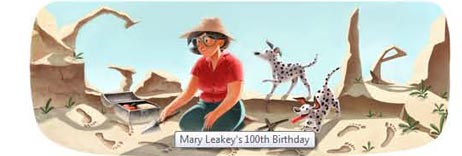
Google Commemorates what would have been Mary Leakey’s 100th Birthday

100th anniversary of the birth of Mary Leakey.

100th anniversary of the birth of Mary Leakey.

Picture credit: Google

Google Doodle

The image marks the 100th anniversary of the birth of Mary Leakey.  It is always gratifying to see such organisations honour the contribution made by scientists and we at Everything Dinosaur, keen to promote the role of women in science are delighted to see Mary honoured in this way.  The picture shows Mary working on hominid footprints (trace fossils) with her faithful dalmation dogs which she often had as company on her excavations.  These trace fossils, we suspect are the famous Laetoli footprints.  These hominid footprints (two adults and a juvenile) were discovered in 1978 by Mary Leakey.

In 1959, Mary discovered a 1.7 million year old fossil hominid, a type of Australopithecine.  Mary along with her husband Louis (Mary was Louis’s second wife), discovered fossils of Homo habilis and went on to help re-write the evolutionary story of our own species.

The Leakey family are still very much involved in early hominid fossils.  Mary died in 1998, but Richard Leakey her son, and Richard’s wife Dr Meave Leakey have made important discoveries in their own right and have helped to support the development of a number of scientific research projects in eastern Africa.

To read an article on the continuing work of the Leakey family: More Discoveries from Lake Turkana.

Mary Leakey

It is important that the contribution of scientists such as Mary Leakey are honoured.  Mary was a pioneer in Africa, a woman working alongside her male colleagues to help increase our understanding of the evolution of hominids and their radiation out from east Africa across the rest of the continent.  It is thanks in part to the work of the Leakey family that we today have a much better understanding of the evolution and development of our own species.

Mary’s work in places such as the famous Olduvai Gorge region of Tanzania provided inspiration for other women who wished to pursue an academic career in the sciences.  Fossils found by Mary and her husband have formed the basis of a number of extensive research programmes with the aim of plotting and clarifying the evolutionary path that led to the eventual evolution of our own hominid species – Homo sapiens.

Happy anniversary Mary!

Visit Everything Dinosaur’s award-winning website: Everything Dinosaur.

28 01, 2013

Marine Crocodile Super Predator From Leeds that Resided in Peterborough

By |2023-02-12T06:42:45+00:00January 28th, 2013|Categories: Dinosaur and Prehistoric Animal News Stories|0 Comments

Oldest Known Metriorhynchid Super Predator from the Middle Jurassic

Some fragmentary bones, including jaw material and teeth unearthed when a Peterborough clay pit (Peterborough in Cambridgeshire, England) was explored by the famous amateur palaeontologist Alfred Leeds, have been identified as a new genus of marine crocodile super predator.  The fossils which include isolated teeth, elements of the mandible and some post cranial material, first excavated by Leeds as he examined Oxford Clay strata exposed at the Fletton clay brick pits close to Peterborough have been assigned to the species Tyrannoneustes lythrodectikos representing the oldest, large metriorhynchid crocodilian known to date.

Tyrannoneustes lythrodectikos

Although the actual size of this prehistoric, marine predator is hard to calculate accurately, studies of the teeth and estimates of the gape of the mouth indicate that this reptile was probably an apex predator and the fossil material helps palaeontologists to better understand the evolutionary path taken by marine crocodiles as they competed with other types of marine reptiles in the warm, tropical seas that covered much of England during the Jurassic geological period.

The fossils were discovered around the turn of the 20th century, they were first formally listed in 1919 forming part of the vertebrate fossil collection at the Hunterian Museum at the University of Glasgow.  The material remained relatively undisturbed until a team of palaeontologists led by researchers from the Department of Geosciences at the University of Edinburgh had the opportunity to examine the fossil specimens in detail.  The team concluded that the fossils represented a new species of giant, marine crocodile that swam in the Middle Jurassic seas around 165 – 163 million years ago.

An Artist’s Impression of the New Genus of Marine Crocodile

Fearsome marine crocodile Tyrannoneustes.

Picture credit: Press Association/University of Edinburgh

Middle Jurassic Marine Crocodile

The newly assigned species, helps scientists to piece together a picture of the marine ecosystem during the Middle Jurassic, a time when ichthyosaurs and plesiosaurs shared this environment with the crocodilians.

The Metriorhynchidae are a large family of marine crocodiles that seem to have had their hey day in the Late Jurassic.  Fossils of these predatory reptiles have been found in Switzerland, France, England, Germany and also in South America.   These animals ranged in size from around two metres in length to apex predators that may have reached lengths in excess of seven metres or more.  Dr Mark Young of the School of Geosciences at the University of Edinburgh has studied a number of apex Metriorhynchidae crocodilians, monsters like Dakosaurus and the much larger Plesiosuchus for example.  However, such large members of the Metriorhynchidae are associated with more recent Upper Jurassic strata whereas, the fossils ascribed to Tyrannoneustes date from earlier Middle Jurassic deposits.

To view replicas and models of Jurassic prehistoric animals: PNSO Age of Dinosaurs Figures.

This new research, which has just been published in the academic publication “The Journal of Systematic Palaeontology” allows scientists to partially fill a gap in the evolution and radiation of the Metriorhynchidae as these creatures evolved into top predators from smaller genera that specialised in catching fish and cephalopods.

A Formidable Hunter

The wide gape of the mouth and the teeth capable of shearing flesh and bone would have made this marine crocodile a formidable hunter, the fearsome nature of this beast is reflected in the scientific name Tyrannoneustes lythrodectikos, which means “blood-biting tyrant swimmer”.

Dr Mark Young, one of the authors of this study commented that:

“It was satisfying to be able to classify a specimen that has been unexamined for more than one hundred years, and doubly so to find that this discovery improves our understanding of the evolution of marine reptiles.”

The research team are confident that this fossil material represents a transitional stage in metriorhynchid evolution between smaller crocodiles feeding on small prey and other, later forms that filled an ecological niche in a similar way to modern-day Orcas.

To read an earlier article into the research work on marine crocodiles carried out by scientists at the University of Edinburgh: Marine Crocodiles More Like Killer Whales Than Crocodiles.

Intriguingly, other isolated teeth and a partial humerus found in Oxford Clay deposits suggest that at least one other genus of large, marine crocodile may have been present in the tropical seas around 165 million years ago.

26 01, 2013

Bird Evolution Not as Easy as Eosinopteryx

By |2023-02-12T06:35:53+00:00January 26th, 2013|Categories: Dinosaur and Prehistoric Animal News Stories|0 Comments

New Dinosaur Discovery Challenges the Theory of Bird Evolution

A single, thirty-centimetre-long fossil of a dinosaur from China is helping palaeontologists to understand a little more about the complex evolutionary path between the  Dinosauria and Aves (birds), the fossil, representing a new genus of basal troodontid has been named Eosinopteryx brevipenna.  This dinosaur lived in a swampy environment with plenty of tree cover.  The discovery of this fossil increases the known diversity of small-bodied, feathered dinosaurs that lived during the Middle to Late Jurassic and shows that a number of different taxa of feathered, mainly cursorial dinosaurs occupied different niches in dinosaur dominated ecosystems suggesting that the evolution of flight and ultimately the Class Aves is much more complex than was thought some twenty years ago.

Eosinopteryx brevipenna

Archaeopteryx (A. lithographica) may be regarded as a transitional fossil between the Dinosauria and true birds, but it seems that the Late Jurassic feathered dinosaur from finely grained limestone deposits of Solnhofen in Germany may only represent one of a number of dinosaur lineages that had feathers.

This new fossil discovery comes from the Tiaojishan Formation of western Liaoning, a Province in China.  The strata of the Tiaojishan Formation has been dated to around 165 -155 million years ago (Early Bathonian to Mid Oxfordian faunal stage).   The specimen represents an adult or possibly a sub-adult specimen and an analysis of the well-preserved fossil shows that this little dinosaur had a short snout, quite large eyes, small arms covered in short feathers and toes suited to running (cursorial lifestyle).

E. brevipenna had fewer feathers on its tail and lower legs, these adaptations would have made it easier to run.  It can be speculated that this feathered dinosaur probably hunted insects, lizards and small mammals in the undergrowth.  An anatomical study of the bone structure of the arms of this reptile suggest that it could not fly, the feathers may have aided the animal jumping from logs and other obstacles, perhaps acting as mini air brakes to help control landing.  The genus name Eosinopteryx means “Early Chinese Feather”.

The Fossil Specimen (Eosinopteryx brevipenna)

Helping to unravel the evolution of flight.

Picture credit: Macmillan Publishing

One of the co-authors of the scientific paper (published in the academic journal “Nature Communications”), Dr Gareth Dyke from the University of Southampton commented that:

“This discovery sheds further doubt on the theory that the famous fossil Archaeopteryx – or “first bird” as it is sometimes referred to – was pivotal in the evolution of modern bird.”

Bird Evolution

The team’s findings suggest that the origin of flight was much more complex than was thought twenty years ago, with there being a lot of evidence to suggest that there were a number of feathered, cursorial dinosaur genera present in the Middle to Late Jurassic.  Interestingly, the rocks of the western part of Liaoning Province have provided a substantial number of pterosaur fossils. In this part of China towards the end of the Jurassic there were a lot of reptiles that were very accomplished fliers – members of the Pterosauria.

One such genus is Darwinopterus (named after the naturalist Charles Darwin).  Known from around forty fossil specimens including one that showed an egg about to be laid but still present in the animal’s body, this pterosaur genus shows important anatomical characteristics that suggests it may be a transitional form from the primitive rhamphorhynchoid pterosaurs to the more advanced, shorter-tailed pterodactyloid pterosaurs.

To read an article on Darwinopterus: Pterosaur Transitional Fossil – Darwinopterus.

An Illustration of Eosinopteryx brevipenna

On the way to flight

Picture credit: Royal Belgian Institute of Natural Sciences

Liaoning Province may be famous for its feathered fossils representing creatures from the Early Cretaceous but it also seems that the older strata of this part of China can lay claim to a number of feathered dinosaur fossils too.

To view models and replicas of early birds and feathered dinosaurs: PNSO Age of Dinosaurs Models and Replicas.

17 01, 2013

Ichthyostega Gets a Re-think Thanks to New Research

By |2024-04-29T06:03:12+01:00January 17th, 2013|Categories: Dinosaur and Prehistoric Animal News Stories, Palaeontological articles|1 Comment

New Research Suggests Earlier Reconstructions had the Backbones “Back to Front”

The fossils of the early tetrapod Ichthyostega, the first Devonian tetrapod to be discovered, have always puzzled scientists. This one and a half metres long transitional creature between a fish and a land-dwelling amphibian has always courted controversy and a new study suggests previous attempts to model the vertebrae may have been inaccurate.  In effect, the backbone in skeletal reconstructions of this creature may have formerly been “back to front.”

Tetrapods

Tetrapods (the name means “four feet”), are in essence, the limb-bearing vertebrates with four limbs and distinct digits.  Human beings (H.sapiens), are members of the tetrapod group.  Scientists agree that the tetrapods evolved from fish and the first of these creatures evolved during the Devonian geological period but exactly what group of fishes gave rise to the tetrapods and when remains open to some debate.

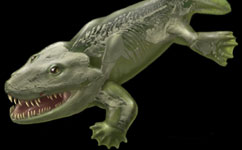
Ichthyostega had four limbs, in earlier models this animal was pictured as being well suited to life on land with its robust limbs holding the front portion of the body clear of the ground.  It is now thought that the first tetrapods were not so well adapted to a life out of the water and it is likely that if these animals did venture out onto land they would not have been capable of lifting their body weight up, most probably just dragging their bodies along rather than lifting them clear of the land surface.

An Early Interpretation of Ichthyostega

An older interpretation of Ichthyostega.

Picture credit: Everything Dinosaur

Professor Jenny Clack (University of Cambridge), a world-authority on early tetrapods in conjunction with her colleague Dr Stephanie Pierce (Royal Veterinary College (London), has published new evidence that provides a fresh insight into the Ichthyostega genus.  These distinguished scientists reaffirm that these animals may not have been that well adapted to terrestrial life after all.  It is known that Ichthyostega and its near relative Acanthostega had large teeth and that they were predators, what is unclear however, is whether these animals hunted on land or in the water.

The European Synchrotron Radiation Facility in Grenoble (France) was employed by the researchers to bombard three fossil specimens of Ichthyostega with very powerful X-rays.  These X-rays once interpreted by sophisticated computer software were able to reveal more details regarding the structure of this tetrapod’s skeleton.  The three-dimensional images of the fossil material the research team was able to produce revealed something very surprising.  It had been thought that the back bones of early tetrapods were comprised of four separate bones arranged with one at the front, one just behind the first one and a pair towards the rear of each element of the vertebrae.  The images, that the team produced showed that in the case of the Ichthyostega fossils, the bones at the back had become fused to the one at the front.  This discovery revealed that the first “anterior ” bone at the front of the four bone series was actually the posterior one (at the back).  The change in the orientation and the relationship between the bones in the spine would change the way in which this early tetrapod could move

Writing in the academic journal “Nature”, Dr Pierce explained:

 “Ichthyostega made us open our minds, stand back and reassess the anatomy of other early tetrapod fossils.  When we did this, it was obvious that the bones of their spines were also in the reverse order than what had previously been described.”

Ichthyostega

In addition, the application of new research techniques has enabled the scientists to spot evidence of a primitive sternum in this Devonian animal.  The sternum consists of a series of bones that are aligned together and run down the centre of Ichthyostega’s chest.  This suggests that the animal’s body weight was supported by the sternum and that the limbs did not hold the body clear of the ground as shown in much earlier illustrations of Ichthyostega, but instead this animal probably moved on land by dragging its body along by moving its front limbs.  This method of locomotion is seen today with the Mudskippers (fish from the family Gobiidae).  These Gobies are able to haul themselves around on land using their sturdy pectoral fins as simple, efficient forelimbs.

The Latest Interpretation of Ichthyostega

Ichthyostega interpreted dragging its body across the ground.

Picture credit: Julia Molner

The research team hope to be able to analyse the vertebrae of other Devonian tetrapods using the European Synchrotron Radiation Facility so that a more detailed understanding of the evolution of terrestrial locomotion can be obtained.

Everything Dinosaur stocks a wide range of models of early tetrapods: Models of Early Tetrapods and Prehistoric Animal Figures.

15 01, 2013

New Jurassic Park 4 – June 2014?

By |2024-04-29T06:04:19+01:00January 15th, 2013|Categories: Dinosaur and Prehistoric Animal News Stories, Dinosaur Fans, Everything Dinosaur News and Updates|2 Comments

Speilberg to Produce New Jurassic Park Movie

With the 20th anniversary special edition of the original Jurassic Park movie due to hit our cinema screens in April of this year, there had been rumours that the “JP” franchise was going to have a fourth instalment if the re-release of the original film in 3-D format proved to be a big success.

Jurassic Park

Word has reached us from the United States that Jurassic Park 4 is scheduled for release in the summer of 2014, aiming at the big screen holiday, blockbuster market.  Filming should start any time now and we know of several “scripts” that have been doing the rounds, all of which feature lots of CGI dinosaurs and pterosaurs.  Steven Speilberg is not going to direct the new film, but rather he is to have a producer or executive producer role.

Expect Jurassic Park fever to start all over again…

Visit Everything Dinosaur’s user-friendly website: Everything Dinosaur.

14 01, 2013

Isle of Wight the “Dinosaur Capital” of the British Isles

By |2023-02-11T22:09:25+00:00January 14th, 2013|Categories: Dinosaur and Prehistoric Animal News Stories|2 Comments

Isle of Wight Where Dinosaurs Roamed

With the release of a map showing dinosaur discoveries made in the United Kingdom, the Isle of Wight, an island off Britain’s south coast has been declared the “dinosaur capital of Great Britain”.  It is true that there have been some remarkable dinosaur fossil discoveries made on this island which is separated from the English mainland by a stretch of water called the Solent. The island has long since been known as “Dinosaur Isle” amongst palaeontologists and geologists who happen to frequent the southern part of the island exploring the Purbeck and Wealden strata of what is termed the Wessex Basin.

Dinosaur Capital

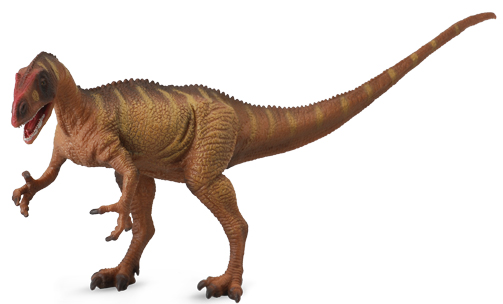
Iguanodontids, hypsilophodonts, sauropods, armoured dinosaurs and theropod meat-eating dinosaur fossils have all been found on the Isle of Wight.  There are also numerous dinosaur footprints and tracks that can be seen on the foreshore at Chilton Chine and other parts of the coastline.  Much has been made of the discovery of the fierce, meat-eating dinosaur known as Neovenator (Neovenator salerii).  This theropod dinosaur is known from a single specimen discovered nearly thirty-five years ago.  Neovenator means “New Hunter” and this dinosaur, tentatively assigned to the Carcharodontosauridae, may have measured more than 8 metres in length.  It would have been dwarfed by some of the sauropods that shared its Early Cretaceous environment.  Fossil discoveries made on the Isle of Wight indicate that there were brachiosaurids present and some of these long-necked herbivores could have weighed in excess of fifty tonnes.

A Model of the Fearsome Neovenator Dinosaur

“New Hunter” from the Isle of Wight.

Picture credit: Everything Dinosaur

Cretaceous Strata

The Cretaceous strata that makes up the southern part of the Isle of Wight is indeed important.  It is not just dinosaur fossils that make this a significant location, palaeontologists have been able to painstakingly build up a picture of an palaeo-environment.  In 2009 Doctor Steven Sweetman of the University of Portsmouth published a new, scientific paper outlining nearly fifty newly identified prehistoric vertebrates, whose fossils had been found eroding out of cliffs on the island.  Amongst the new genera erected there were six new mammals, eight dinosaurs, including large, predatory dromaeosaurs (raptors) and fifteen new members of the Order Squamata (lizards and snakes).

During the Early Cretaceous (135 million years to 130 million years ago), the land we now know as the Isle of Wight formed part of an extensive flood plain that linked the continents of the Americas, Africa and Europe.  More fossils are being found each year and palaeontologists are able to build up quite a detailed picture of the Cretaceous fauna and flora.

Not wishing to diminish the importance of the Isle of Wight, it is also worth remembering that a number of significant dinosaur finds have been made elsewhere in the British Isles.  A considerable amount of Jurassic-aged dinosaur fossils have been found in North Yorkshire, the Isle of Skye has some amazing dinosaur tracks and fragmentary dinosaur bones, then there is the county of Surrey with its Baryonyx fossil discovery and our own personal favourite, the city of Bristol, with its Thecodontosaurus.  The first fossils of Thecodontosaurus were found at a site just to the north of the city’s bustling centre, these fossils were found in 1834.

To read an article about Bristol honouring its very own dinosaur: Bristol Remembers its Very Own Triassic Dinosaur.

The Importance of the Isle of Wight

Then there are the megalosaurs and other dinosaurs from Oxfordshire, the Dorset Scelidosaurus, iguanodonts from the Wealden Formation outcrops of Kent and Sussex.   In fact, there are a number of important locations in the UK in terms of the dinosaur fossils found at these sites.  After all, the first dinosaurs to be ascribed to the newly erected Order Dinosauria were all species, whose fossils had been found in southern England.

For models and replicas of dinosaurs, including many dinosaurs associated with the Isle of Wight: Prehistoric Life Models (CollectA Age of Dinosaurs).

The Dinosaur Map of Britain

Dinosaur “Hot Spots” as we at Everything Dinosaur call them.

The research compiled by palaeontologists at the London Natural History Museum who tracked dinosaur fossil finds recorded over the last 336 years, was carried out as part of the publicity material for the television series “Primeval New World”, a spin-off from the earlier ITV programmes about a team of adventurers battling against worm holes that keep bringing prehistoric creatures back to the present day.

Go to Top