All about dinosaurs, fossils and prehistoric animals by Everything Dinosaur team members.

Fossil finds, new dinosaur discoveries, news and views from the world of palaeontology and other Earth sciences.

3 03, 2013

Digging out a Dunkleosteus – Gently Does It

By |2023-02-13T11:20:44+00:00March 3rd, 2013|Categories: Dinosaur and Prehistoric Animal News Stories|0 Comments

North-western Pennsylvania Yields Up a Prehistoric Secret

Patience is one thing that geologists and palaeontologists need plenty of and when it comes to excavating and putting together one of the most ferocious marine predators known from the Palaeozoic fossil record, the patience of even the most dedicated scientist can be tried.

Dunkleosteus Fossil

In a secret location in Erie County (north-western Pennsylvania, United States), Scott McKenzie, assistant professor of geology at Mercyhurst University (Erie County), is returning to a site where the fossilised dermal armour plating of a giant placoderm is slowly eroding out of a stream bed gully.

The landowners are reluctant to permit a full excavation in the heavily wooded area so the assistant professor and his team have to wait for nature to do its job and slowly erode the fossilised pieces of dermal head shield from out of the sandy shale matrix.  For Scott, visiting the site at regular intervals to inspect the fossil bearing rock can be quite a depressing business.  Sometimes he finds no new fossil material.  With luck, he might be able to obtain enough material within a decade or so to make a presentable exhibit within the University’s Sincak Natural History Collection, where assistant professor McKenzie is the curator.

Primitive Jawed Fish

Placoderms were primitive jawed fish.  They are named placoderms “plated skins” after the wide, flat bony plates that covered the head and the anterior portions of the body.  They share a number of anatomical features with sharks and rays, for example, they had a body skeleton made of cartilage.  Most forms were relatively small, growing to less than sixty centimetres in length, but others were giants and the Erie County specimen represents a specimen of one of the most ferocious of all marine animals known to science – Dunkleosteus.

Dunkleosteus Specimen on Display

The placoderm Dunkleosteus.  A Dunkleosteus fossil.

A Dunkleosteus cast on display. Picture credit: Everything Dinosaur.

Picture credit: Everything Dinosaur

An Enormous Prehistoric Fish

Dunkleosteus was an enormous, prehistoric fish with an armoured head made up of several interlocking bony plates that covered up to thirty percent of this predator’s total length.  The placoderms (armoured fish); evolved in the Silurian geological period from ancestors that had no true teeth.  Instead this group of fish developed a pair of sharp bony plates that hung from the top jaw, whilst the edges of the lower jaw were also bony and extremely sharp.

The jaws could be closed together like a pair of self-sharpening shears and were powerful enough to cut a two metre long, primitive shark in half.  Most specimens of Dunkleosteus (D. terrelli) come from Ohio, so the discovery of a specimen in Pennsylvania might lead to the establishment of a brand new species of this type of armoured fishy carnivore.

An Illustration of the Fearsome Devonian Predator Dunkleosteus
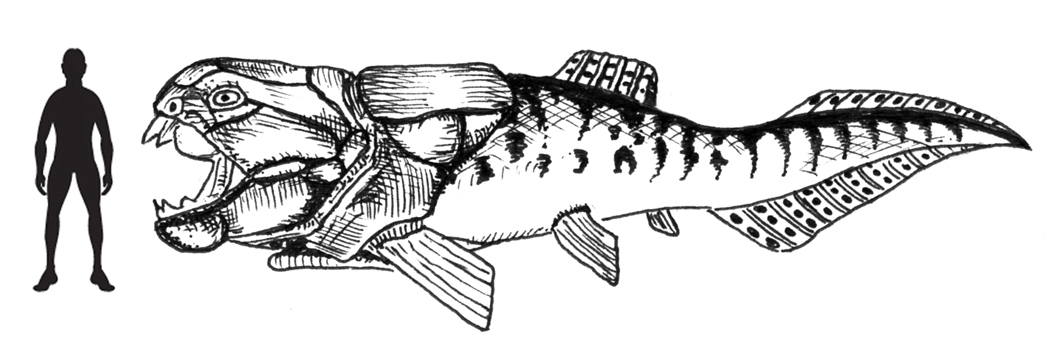
Fearsome marine predator of the Late Devonian.

Fearsome marine predator of the Late Devonian.

Picture credit: Everything Dinosaur

Late Devonian

The strata from which the dermal armour of this fossilised fish is being eroded from has been estimated to be around 365 million years old (Late Devonian).   During this period in Earth’s History much of the eastern part of the United States was underwater, this marine environment would have been a dangerous place to visit with the likes of Dunkleosteus in the water, an apex predator of the Late Devonian.

With the spring thaw Scott and his team are hopeful that more pieces of the body armour will have been revealed.  It is very unlikely that elements of the cartilaginous skeleton will have been preserved, but with the jaws and armoured head potentially being the size of a small car, the specimen once prepared and assembled will make a fine addition to the University’s natural history collection.

Scott commented that:

“Arguably, Dunkleosteus was the most terrifying creature during the Devonian, its huge jaws opened so fast they created a suction force that pulled prey into its mouth.  We’re restricted to surface collection, as the landowners do not want a significant excavation on their land and digging could actually damage the missing pieces.”

The Erie County Specimen

Although, the Erie County specimen is not as big as some of the fossils of Dunkleosteus found in Ohio, it is no tiddler.  The geologist calculates that the fossils represent an individual between five and eight metres in length and it probably weighed more than 1,000 kilogrammes.  He remains unsure whether this fossil material represents a specimen of D. terrelli or a new species.   This does represent the largest fish of its kind found in the Erie County area and an animal that could have given the legendary beast of Lake Erie, affectionately known as “Bessie” by locals a run for its money.

A Close up of the Huge Jaws of a Dunkleosteus
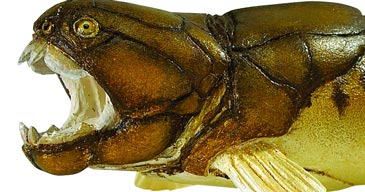
Fish with a powerful bite.

Fish with a powerful bite.

Picture credit: Everything Dinosaur

The picture above shows a close up a Dunkleosteus, with its dermal armour and huge jaws.  Safari Ltd have produced a superb model of a Dunkleosteus, it is part of the company’s Wild Safari Dinos and Prehistoric Life model collection.  Measuring a little under 19 centimetres in length the beautifully painted model is in approximately 1:50 scale.

To view the Safari Ltd range of prehistoric animal models: Safari Ltd. Prehistoric World Models.

The assistant professor and his team, kindly put on display at the University a number of pieces of the fossil specimen that they had already found, the bony plates although fragmented are an exciting discovery and the team are eager to see what the winter weather has managed to erode out of the matrix so that they can add to their collection.  At the moment the disarticulated and disassociated fossil pieces represent a 365-million-year-old jigsaw puzzle.

A true inspiration to students and other scientists, the dedication of Scott and his team as they try to piece together the county’s very own prehistoric monster is to be admired.  Fingers crossed for them, let’s hope that the wintry weather and the spring thaw provides them with yet more fossils for them to study as they continue their quest to prepare and mount their very own Dunkleosteus museum exhibit.

2 03, 2013

Japan’s First Horned Dinosaur – A Remarkable Discovery

By |2024-04-29T10:32:31+01:00March 2nd, 2013|Categories: Dinosaur and Prehistoric Animal News Stories|0 Comments

Fossil Tooth Provides Link Between Ceratopsians and Japan

Several Japanese news agencies have reported the discovery of a single, fossilised tooth of an ornithischian dinosaur in Japan.  The fossil tooth which comprises of a dental root joint is very distinctive. It has been identified as the tooth of a member of the Ceratopsia more specifically, it bares a close resemblance to a member of the Ceratopsidae (horned dinosaurs), a later and more advanced group of horned dinosaurs that include the likes of Triceratops, Styracosaurus and Chasmosaurus.

Did Japan Have its Own Version of Triceratops?

Evidence of Late Cretaceous Ceratopsians from Japanese strata.

Evidence of Late Cretaceous ceratopsians from Japanese strata.

Picture credit: Everything Dinosaur

For models and replicas of articulated horned dinosaurs, take a look at the Beasts of the Mesozoic range of figures: Beasts of the Mesozoic Figures and Models.

Horned Dinosaurs

It is thought that the horned dinosaurs, part of the ornithischian group of the Dinosauria, evolved in Asia during the Cretaceous geological period.  For much of the Cretaceous, the land that we now know as Japan was underwater, that which was above sea level was not part of an island chain, but attached to the landmass that was to become Asia.  The numerous known genera of Japanese Cretaceous dinosaurs therefore have a strong affinity with Asian dinosaurs.  Evidence of hadrosaurs, sauropods and meat-eating theropod dinosaurs have been found in Japan, but this is only the second time fossils of a member of the Ceratopsia have been found and this new discovery represents a more advanced and later type of horned dinosaur.

To read about the discovery of a huge dinosaur thigh bone in Japan: Huge Sauropod Femur Discovered in Japan.

Japan’s Second Dinosaur Fossil Find

A spokesperson from the National Museum of Nature and Science in Tokyo commented that this was only Japan’s second fossil find that represents a member of the Ceratopsia.  The first fossil discovery, that of a dinosaur regarded as a member of the Neoceratopsia was found in the Hyogo Prefecture region of Japan (Honshu island).  Fossils of neoceratopsian dinosaurs have been found in China and Mongolia.

The fossil measures 1.21 centimetres in length and is 0.37 centimetres wide. It was found back in November 2011 during a geological survey of Campanian faunal strata on Shimo-koshiki Island (western tip of the main Japanese island chain).  The fossil is believed to be around 80 million years old (Late Cretaceous), a time when the giant horned dinosaurs roamed North America.  A detailed paper on this tooth discovery and its implications in terms of ceratopsian evolution and radiation will be presented at the June meeting of the Palaeontological Society of Japan to be held in Kumamoto Prefecture.

Late Cretaceous Ceratopsians

The jaws of Late Cretaceous ceratopsians, dinosaurs such as the famous Triceratops, Pachyrhinosaurus and Styracosaurus were lined with many hundreds of teeth. These teeth were strongly anchored to the jawbone by a “Y” shaped root structure.  The ceratopsians are the only dinosaurs to have this “Y” shaped dental root structure, in essence, to have two dental roots per tooth.  The actual crown of the tooth (the part of the tooth that sticks up from the jawline), was a square and blocky shape, ideal for crushing and grinding up tough vegetation.  It is likely that at the front of the mouth of this new Japanese ceratopsian there was a strong beak.  The beak was used to break off plant material before the strong and muscular tongue pushed the plant material further back into the jaws where the teeth could do their work, reducing the plant debris to pulp before it was swallowed.

An Illustration of a Tooth of a Typical Late Cretaceous Horned Dinosaur (Triceratops)

A typical tooth of a Ceratopsian with its two distinct dental roots.

A typical tooth of a ceratopsian with its two distinct dental roots.

Picture credit: Everything Dinosaur

The tooth has been described as closely matching that of the Late Cretaceous North American member of the Chasmosaurinae ceratopsians – Triceratops (T. horridus).  Although, an adult Triceratops was estimated to have reached lengths in excess of nine metres, the Japanese tooth specimen indicates a much smaller animal, a cow-sized horned dinosaur between two to three metres in length.

Experts judged the length of the dinosaur’s body to be two to three meters or more, based on the size of the dental root.  The size estimate was based on the length of the tooth root and comparing this fossil specimen with other ceratopsian tooth fossils from better known Late Cretaceous genera.

28 02, 2013

Small Crocodyliforms Feeding on Small Dinosaurs According to New Scientific Papers

By |2024-04-29T10:40:41+01:00February 28th, 2013|Categories: Dinosaur and Prehistoric Animal News Stories|2 Comments

An Insight on the Feeding Behaviour of Small Crocodyliforms – Watch out Hypsilophodonts You are on the Menu!

There have been a number of scientific papers published recently that provide information on the feeding habits of apex crocodyliform predators of the Late Cretaceous such as Deinosuchus.  Since modern day crocodiles and alligators attack and kill large mammalian vertebrates and are regarded as apex predators in their environments, it has long been thought that extinct crocodiles such as the twelve-metre-long Deinosuchus were also apex predators.  Instead of ambushing mammals when they came to a water source for a drink, (there are no large mammal species known from the Campanian/Maastrichtian fossil record), fearsome reptiles such as Deinosuchus are thought to have tackled dinosaurs.

Even a tyrannosaurid would have had to watch its step close to water with the possibility of being grabbed by a Deinosuchus, a type of crocodile getting on for twice the size of a Nile crocodile.

A Model of the Fearsome Late Cretaceous Predator Deinosuchus

The Carnegie Collectibles Deinosuchus crocodile model.

The Carnegie Collectibles Deinosuchus crocodile model.

However, very little is known about interactions between predator and prey species when it comes to smaller types of Mesozoic crocodile and smaller types of potential prey.  Thanks to some new research by a team of American scientists evidence of a slightly smaller scale predator/prey relationship has been discovered.  It looks like small crocodyliform genera or indeed immature specimens of larger taxa may have fed on small types of dinosaur, or possible juveniles and babies of larger species.

Crocodyliforms Feeding on Small Dinosaurs

Writing in the Public Library of Science (Biology) publication Dr Clint Boyd (Department of Geology and Geological Engineering, South Dakota School of Mines and Technology, South Dakota, USA) and his colleagues have outlined research into a number of fragmentary dinosaur bones that show evidence of bite marks from crocodyliforms.  Moreover the jumbled and broken bones collected seem to represent a single ornithischian genus and an as yet, unknown genus to boot.  It looks like man-sized Cretaceous crocodiles fed on small dinosaurs and the remains of their dinner could well result in the erection of a new genus of hypsilophodontid dinosaur genus.

The Tiny and Fragmentary Dinosaur Bones – Ornithischian Dinosaur

Tiny dinosaur bones show evidence of Crocodyliform bite marks.

Tiny dinosaur bones show evidence of crocodyliform bite marks.

Picture credit: South Dakota School of Mines and Technology

The fragmentary fossils were found in the Upper Cretaceous Kaiparowits Formation at four separate locations along the Grand Staircase Escalante-National Monument in southern Utah, an area famous for its dinosaur fossil finds.  The fossils are believed to date from the Campanian faunal stage of the Cretaceous and they are estimated to be around 75 million years old.

During this time in the Late Cretaceous, this region was a lowland plain, criss-crossed by many rivers.  The warm, humid climate created ideal conditions for lush plant growth and there was a rich and diverse dinosaur dominated ecosystem, with many types of crocodyliform also present.

Crocodyliforms Feeding

The broken dinosaur bones show bite marks and puncture wounds similar to those found on the bones of mammals that have been fed upon by extant American alligators.  The fossil are broken, many have been snapped off at the joints.  This could be characteristic of the damage to bones caused by the “crocodile roll” method of feeding, whereby extant crocodiles tear their victims to pieces by grabbing onto the corpse with their strong jaws and then rapidly rotating their bodies.

Studying the Fossil Material

The fossil material represents the bodies of several individual dinosaurs, all roughly 1.2 metres in length.  The fossils include elements of the limb bones and vertebrae, along with parts of the skull and the lower jaw.  As well as bite marks on the bones, the American research team discovered a broken Crocodyliform tooth embedded in a thigh bone (femur).

It can be speculated that baby ornithopod dinosaurs stayed together in groups when young to give themselves some protection, the nesting site may have been nearby and the two-metre-long crocodyliform predators lay in wait ready to ambush any unwary young herbivore that came too close.  The abundance and the close proximity of the fossil finds suggests that these relatively small crocodiles were actively targeting the hypsilophodonts, deliberately congregating close to areas where there were lots of dinosaur juveniles and actively selecting to feed upon these animals.

Although, only very small in size and hardly likely to feature in a major dinosaur exhibit in a museum, these fragments of bone are very significant as they are helping palaeontologists to piece together the complex food chain and diverse ecosystem in this Campanian faunal age environment.  It seems that life for a young hypsilophodontid in the Late Cretaceous was particularly hazardous, they would have had to look out for tyrannosaurs and dromaeosaurs as well as having to contend with predatory crocodiles.

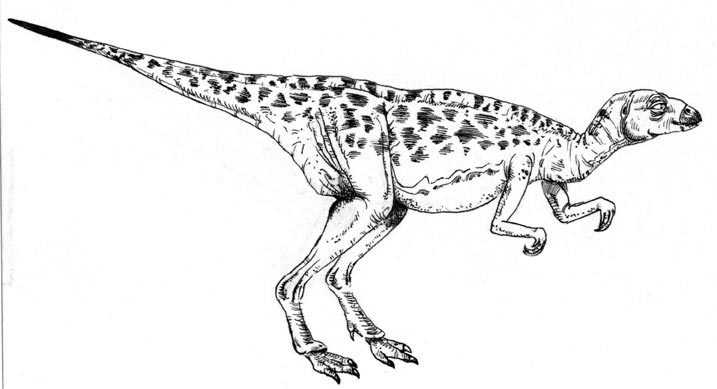
A Drawing of What the Hypsilophodontid Dinosaur May Have Looked Like

Was this a meal for a Late Cretaceous crocodile?

Was this a meal for a Late Cretaceous crocodile?

Picture credit: Everything Dinosaur

The researchers have concluded that the chewed up bones are not the work of a much larger crocodile species.  If that had been the case, the bones would simply have been swallowed whole, leaving behind much fewer traces of the dinosaurs that it preyed upon.

Dr Boyd commented:

“It’s not often that you get events from the fossil record that are action-related. While you generally assume there was probably a lot more interaction going on, we didn’t have any of that preserved in the fossil record yet.  This is the first time that we have definitive evidence that you had this kind of partitioning, of your smaller crocodyliforms attacking the smaller herbivorous dinosaurs.”

Recently, Rebor have introduced a range of Deinosuchus figures.  To view this range of crocodyliforms (whilst stocks last): Rebor Models and Replicas.

27 02, 2013

Solving the Mystery of the Spiral-Toothed Shark

By |2023-02-12T10:32:37+00:00February 27th, 2013|Categories: Dinosaur and Prehistoric Animal News Stories|0 Comments

Idaho State University Scientists Solve Spiral-Toothed Shark Puzzle

A team of researchers have got to the bottom of a fishy puzzle that had palaeontologists previously in a spin.  Fossils of an ancient cartilaginous fish known as Helicoprion show a whorl of spiral, saw-like teeth but up until now scientists were unsure where on this prehistoric fish the teeth whorl was located.  Was this strange toothed structure inside the jaw or outside, did it actually belong in the mouth at all, perhaps it formed part of a defensive structure located on the dorsal fin?  After all, the fossil record does contain some remarkable fossils of sharks, for example, Stethacanthus from the Late Devonian with a large projection known as the “ironing board” on its back.

Prehistoric Fish

Using their unrestricted access to the Helicoprion spiral-toothed fossils at the Idaho State Museum of  Natural History the research team were able to examine a number of beautifully preserved fossils.  This museum has the largest public collection of Helicoprion teeth fossils in the world and a number of these specimens have been collected from Early Permian strata exposed in Idaho.  The actual body shape of this large, prehistoric predator is open to speculation as since the skeleton of this animal was made of cartilage, very few fossils other than those of the strange teeth have been found.  It had been thought that Helicoprion was a nektonic and very active predator, patrolling the water column in a similar way to a lot of extant shark genera.

Previously, scientists had thought that this creature was a type of shark, however, this new research links this 270-million-year-old fish to another group of fish with cartilaginous skeletons.

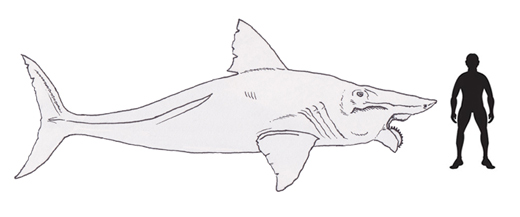
A Scale Drawing of Heliocoprion

Helicoprion scale drawing

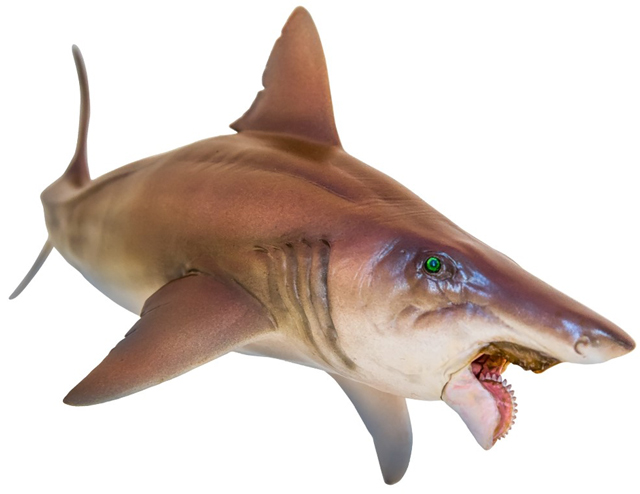
As Everything Dinosaur prepares for the arrival of Haylee the Helioprion model from PNSO a scale drawing of this Permian fish has been commissioned. Picture credit: Everything Dinosaur.

Picture credit Everything Dinosaur

Helicoprion

A large number of Helicoprion fossils were subjected to intense examination and analysis including computerised tomography – a process whereby high-powered X-rays bombard a fossil and provide non-destructive, three-dimensional images that reveal hidden aspects of anatomical structure.  One such fossil studied, measured over twenty-three centimetres in length and contained the remains of one hundred and seventeen individual, triangular teeth.  However, unlike most of the other known Helicoprion fossil material, this specimen had preserved impressions which showed the placement of parts of the cartilage skeleton.

Using the detailed computer images that the CT scans produced the team were able to deduce that the spiral teeth were located at the back of the jaw, the teeth did not project forwards from the lower part of the mouth, nor was this structure located on another part of the fish.  Dr Leif Tapanila of the department of Geosciences at Idaho State University and his colleagues have been able to clear up this mystery surrounding the whorl of teeth.

Tooth Whorl Analysis in Helicoprion

Helicoprion Tooth Fossil Analysis

Helicoprion specimen IMNH 37899, preserving cartilages of the mandibular arch and tooth whorl. (a) Photograph and (b) surface scan of fossil. Picture credit: Tapanila et al in Biology Letters.

Picture credit: Tapanila et al

He stated:

“We were able to answer where the set of teeth fit in the animal.  They fit in the back of the mouth, right next to the back joint of the jaw.  We were able to refute that it might have been located at the front of the jaw.”

Studying the Wear Pattern

Analysis of the wear pattern on the teeth also provided the researchers with an insight into what this predator may have eaten as it swam in the Permian seas.  It is unlikely that these teeth were used to crush hard bodied creatures such as shellfish or marine snails.  It is more likely that Helicoprion tackled soft bodied members of the Phylum Mollusca such as cephalopods (squid and octopi).

A Scientific Paper

The paper, published in the prestigious academic journal “Biology Letters” provides further information on how the scientists think the jaws actually worked.  The jaw was able to produce a rolling-back and slicing action, ideally suited to tackling soft and slippery prey.  The research has also suggested that Helicoprion was not a type of shark, but that it is more likely closely related to the extant rat fish, making it a basal, but very specialised member of the Holocephalan group called the Euchondrocephali.

Dr Tapanila added:

“New CT scans of a unique specimen from Idaho show the spiral of teeth within the jaws of the animal, giving new information on what the animal looked like and how it ate.”

The teeth may be very shark-like with their triangular shape and serrated edges, but evidence from the CT scans indicates that Helicoprion should be classified as a Holocephalan.

The Idaho Fossil Specimen

The Idaho fossil specimen suggests an animal around 4.2 metres in length but other Helicoprion teeth fossils indicate fish that could have reached lengths in excess of 7 metres.  The work of the scientists will form the basis of a new Helicoprion exhibit that is to open shortly at the Idaho Museum of Natural History.

It seems that this creature was a specialised predator from the end of the Permian onwards the top predator niches in the world’s oceans were to be mainly occupied by sharks, before the evolution of the larger Teleost fish challenged the shark’s dominant position.

Helicoprion and Prehistoric Fish Models

Those clever people at Safari Ltd introduced a Toob (a tube containing models), called “Prehistoric Sharks” a couple of years ago now.  The models show different types of ancient cartilaginous fish including the likes of Stethacanthus and a model of Helicoprion.   This set of ten prehistoric fish has proved popular and it is fascinating to see how the interpretation of Helicoprion by the design team at Safari Ltd matches up against the latest scientific data.

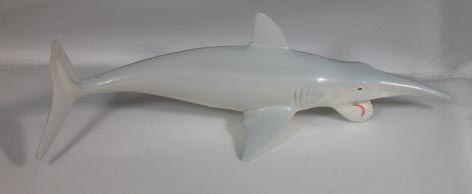
The Helicoprion Model from the “Prehistoric Sharks” Toob

Model play set includes Helicoprion replica

Model play set includes Helicoprion replica.

Picture credit: Everything Dinosaur

The snout may be somewhat elongated and the body perhaps a touch more streamlined, that of an active predator in the mid water column but the front jaw does resemble quite closely the latest scientific interpretation.

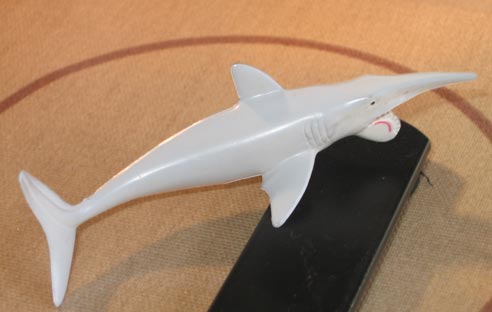
Helicoprion Up Close

A whorl of triangular teeth in this model's lower jaw.

A whorl of triangular teeth in this model’s lower jaw.

Picture credit: Everything Dinosaur

The morphology of this Early Permian predator may not be known but credit must be given to the design team at Safari Ltd for creating a replica that does have some similarities to the illustrations provided in the scientific paper.  It remains uncertain whether this shark was an active, fast swimming hunter or whether it lived close to the sea floor and had a more sedentary habit, but at least the mystery regarding its remarkable dentition (teeth) seems to have been solved.

PNSO Helicoprion Replica

PNSO Haylee the Helicoprion anterior view

PNSO Haylee the Helicoprion replica. The stunning emerald eye on the model is reminiscent of the eye of a Chimaera such as the deep water Rabbit Fish (Chimaera monstrosa) to which Helicorprion is distantly related.

PNSO have released a superb replica of this iconic prehistoric fish. To view the range of PNSO prehistoric animal models and figures available from Everything Dinosaur: PNSO Age of Dinosaurs Models.

Everything Dinosaur acknowledges the assistance of a press release from Idaho State University in the compilation of this article.

The scientific paper: “Jaws for a spiral-tooth whorl: CT images reveal novel adaptation and phylogeny in fossil Helicoprion” by Leif Tapanila, Jesse Pruitt, Alan Pradel, Cheryl D. Wilga, Jason B. Ramsay, Robert Schlader and Dominique A. Didier published in Biology Letters.

26 02, 2013

Searching for a Prehistoric “Lost Continent”

By |2023-02-12T10:27:18+00:00February 26th, 2013|Categories: Dinosaur and Prehistoric Animal News Stories, Geology|0 Comments

Looking for a “Lost Continent” Under the Indian Ocean

Madagascar, may not be the largest island in the world (official estimates place it fourth), but it is regarded as the oldest.  Such has been the long period of isolation between Madagascar and Africa/India that something like 85% of the indigenous fauna and flora of the island are found nowhere else on Earth.  There are the famous lemurs of course, but something like half of the island’s bird species are exclusive to Madagascar and more than sixty percent of all the plant life.  This island was once part of a huge southern super-continent called Gondwana, but the history of this landmass goes back a lot further – into the Cryptozoic.

A Planet in Constant Motion

Our planet is a world in constant motion when one considers the geological time-scale.  A patchwork of interlocking crustal plates carry the continents  and these are in motion with each other.  These movements throughout deep time have changed the position of landmasses in relation to each other, great oceans have opened up and then become closed again.  Scientists have identified a sliver of ancient land that once joined India and Madagascar together.

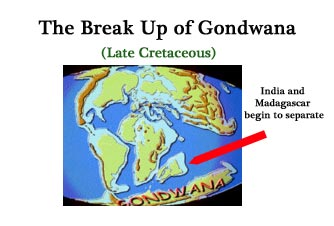
During the Cretaceous period, this landmass (Gondwana), which consisted of Africa, South America, Antarctica, Australia, India and of course the land that was to become Madagascar, began to break up.  From a vertebrate palaeontology perspective this break up of the super-continent may have led to the increased diversification amongst many terrestrial vertebrates as communities of animals and ecosystems became separated and new habitats formed.

Madagascar Isolated

Sometime towards the end of the Mesozoic (the end of the Cretaceous – Turonian to Coniacian faunal stages),  Madagascar started to split away from the continental landmass that was to move northwards, collide with the southern flank of the Asian continental plate and become India, Madagascar was finally isolated and all alone.

The Break Up of Gondwana (southern Super-continent)

The breaking up of a super-continent.

The breaking up of a super-continent.

However, a team of international scientists, including researchers from the United Kingdom claim to have identified remains of the ancient landmass that once linked India and Madagascar together, quite a feat when one considers this research involved examining tiny sand grains on a Mauritian beach as well as exploring hundreds of thousands of tonnes of igneous rock on the floor of the Indian Ocean.

Lost Continent

This continental fragment, once part of Gondwana is referred to as Mauritia, it detached some sixty million years ago (Palaeogene), becoming buried under vast quantities of volcanic rock.

The theory of plate tectonics suggests that rising plumes of hot, molten material from deep within the Earth’s mantle under what was to become Madagascar began to stretch and weaken the planet’s crust.  Eventually, the crust rifted apart and molten material filled in this rift.  This led to the separation between India and the land we now know as Madagascar.

Writing in the academic journal “Nature Geoscience”, the international team of geoscientists suggest that such continental fragments may occur more frequently than previously estimated.  Hot-spots in the Earth’s crust being caused by mantle plumes situated underneath the volcanic islands of Reunion and Marion in the Indian Ocean seem to have played a role in the break up of the final remnants of Gondwana and the formation of the Indian Ocean.

If this rifting apart due to the affect of mantle plumes lies at the frontier of a continental landmass, in this instance the land that was once India and Madagascar joined together, fragments of this land may be broken off and trapped within the expanding area of molten rock.

Scientists from South Africa, Norway, Germany and the United Kingdom examined in microscopic detail samples of sand taken from the volcanic beaches of the island of Mauritius.  The sand grains could be dated back to a volcanic eruption some nine million years ago but some of the minerals they contained proved to be very much older.

Dating the Crust

Semi-precious minerals known as zircons indicate an origin in continental crust and they are extremely old, being dated between 1.97 billion years and 600 million years old.  The researchers concluded that these grains were the remnants of an ancient area of land that had been dragged up to surface of the island during the relatively recent (in geological time), volcanic activity.  Professor Torsvik, one of the authors of the research stated that he believed that parts of the landmass called Mauritia could be found about ten thousand metres down beneath the island of Mauritius and under the Indian Ocean.

Extensive dating techniques were applied to the zircon samples in order to establish the age of this material.  What was once thought to be geology representing the trail taken by the Reunion hot-spot as the crust moved, is now being interpreted as ancient pieces of a continent that long since perished and ended up being covered by igneous rocks as a result of the activity of the Reunion mantle plume.

Dating techniques such as radio-carbon dating and magnetostratigraphy are helping geologists to understand more about the age of rocks.  Plate movements have had a huge impact on the evolution and distribution of life.  Landmasses converging brings different communities together in competition, whilst diverging landmasses such as that which took place with the break up of Gondwana separates organisms.

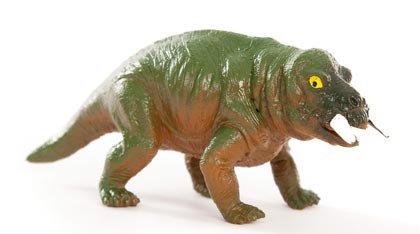
Fossils of Lystrosaurus, a synapsid reptile known from Late Permian to Early Triassic strata have been found in Antarctica, India, Madagascar and Africa indicating that these land masses were joined together in the past.  Lystrosaurs were a very successful group of terrestrial reptiles, one of the most numerous animals on Earth for much of the Early Triassic.

For replicas and models of early synapsids and other prehistoric animals: Prehistoric Animal Figures – CollectA Deluxe.

A Very Numerous and Widespread Resident of a Gondwana – Lystrosaurs

Placerias model.

A Placerias model a typical dicynodont.  Picture credit: Everything Dinosaur.

We suspect that holiday makers, sunning themselves on the beautiful beaches of Mauritius are unaware that the sand they are sitting on provides evidence of an ancient landmass, other remnants of which lie buried under the vast Indian Ocean.

24 02, 2013

American Researchers Uncover Rare Oligocene Fossils in Libya

By |2024-04-29T10:46:22+01:00February 24th, 2013|Categories: Dinosaur and Prehistoric Animal News Stories, Everything Dinosaur News and Updates|1 Comment

Scientists Benefit from the Arab Spring

The political changes in north Africa, the movement for political change known as the “Arab Spring” is providing palaeontologists and geologists with the opportunity to explore parts of the continent that hitherto they had been denied access to.

Oligocene Fossils

Although much of this region is still experiencing turmoil, new fossil discoveries are now being made.  For example, a team of scientists from the Carnegie Museum of Natural History (Pittsburgh, Pennsylvania) working closely with a team from the University of Tripoli (Libya), have uncovered the fossilised remains of a number of prehistoric mammals including an ancient member of the Felidae, an example of one of the prehistoric lion genera that existed in Africa during the Oligocene Epoch.  The fossils may represent the oldest example of an ancestor of today’s lions discovered to date.

At the turn of the year, team members at Everything Dinosaur were asked to come up with some palaeontology based predictions for 2013.  One of the things they predicted was that there would be some exciting fossil discoveries as a result of the greater freedoms being afforded to scientists as a result of the Arab Spring.

To read more about our New Year predictions: Palaeontology Predictions for 2013.

The fossil site, located at Zallah Oasis in the Sirt Basin (central Libya), is approximately 300 miles south-east of Tripoli.  The strata represents a marine/continental transitional zone and rodent fossils discovered during an earlier expedition have helped date the site to the Early Oligocene, approximately 32 to 28 million years ago.  At this location the scattered columns of petrified trees lie on the surface of the sand, unusual and striking sights in the Sahara desert.

An Ancient River Basin

Evidence suggests that this area thirty million years ago represented a river basin, an area that was very swampy, hot and humid, an environment similar to the Floridian Everglades today.

Along with turtle and crocodile fossils, the joint U.S and Libyan team have found fossils that represent the oldest member of the cat family found in North Africa, it could be the oldest mammalian carnivore discovered in this part of the world to date.

Commenting on the fossil finds, Christopher Beard, a palaeontologist at the Carnegie Museum of Natural History stated:

“We have found a wonderful new location, unknown to scholars, that offers a unique window on the past.”

However, working in such an environment is not without its trials and tribulations.  Not only does the research team have to endure the harsh field conditions with the inherent risks of sun stroke and scorpion stings but due to the difficulties relating to security, a heavily armed escort is required to keep the scientists safe.

Working in Libya

The American research team chose to ignore the current advice of the United States Government which warned against all but essential travel to Libya.  Indeed, the United Kingdom Foreign and Commonwealth Office has issued similar advice suggesting that all but essential travel to Libya be suspended due to the threat of violence, terrorism and kidnapping.  Ignoring these warnings the scientists from the Carnegie Museum organised the field work with the support and assistance of Mustafa Salem from the University of Tripoli.

Mammal Fossils

This joint Libyan/American team have been rewarded with the discovery of a new fossil location at Zallah Oasis which may well prove to be one of the most important Cenozoic fossil sites in the whole of Africa.

Described as a location that offers “a spectacular place to look at evolution”, the team are hoping to find more vertebrate fossils including those of primates that may help to flesh out the evolutionary branch that ultimately led to the emergence of our own species.

Dr Beard stated that in Libya there was a tremendous interest in organising further collaborative projects of this nature.  The rich and diverse geological history of this part of the world still has a lot of information to yield up to field teams and hopefully working in conjunction with oil companies and other organisations looking for fossil fuels and mineral resources, more expeditions such as this will be allowed to take place.

Put on Display at a Local Museum

Hopefully, the fossils discovered in this remote part of the Sahara desert could be brought back to Tripoli or perhaps to Benghazi and put on display so that the Libyan people could be given the chance to learn about their country’s prehistoric past.  Although, the mounting of such expeditions remains extremely difficult, restrictions have eased somewhat.  For instance, when Dr Beard organised an expedition to Libya in 2010 it took nearly three years to arrange a visa.  However, this time all it took was one letter of invitation and kind permission from the Libyan oil company Zueitina to work close to one of their desert facilities.

Whilst the American team have been successful with their request to work in Libya, other scientists from Italy and the United Kingdom are still waiting for security clearance and permission so that they can return to Libya to carry out field work.

For replicas and models of ancient mammals and other prehistoric creatures: Safari Ltd – Prehistoric Animal Figures.

23 02, 2013

Adding to Colorado’s Rich Jurassic Heritage

By |2023-02-12T10:09:38+00:00February 23rd, 2013|Categories: Dinosaur and Prehistoric Animal News Stories, Dinosaur Fans|0 Comments

“Tossed Salad” of Dinosaur Bones  Being Excavated by Volunteers

Local volunteers, palaeontologists and State Rangers are working together to excavate and preserve a “treasure trove” of Upper Jurassic vertebrate fossils in a series of quarries located within the borders of the Comanche National Grassland preserve in south-eastern Colorado (United States of America).  The area within the designated boundaries of the Comanche National Grassland consists of pristine prairie land interspersed with canyons and ranch lands.

There are a number of such locations in the United States, afforded the same protection and security as the country’s State Forests.

Trace and Body Fossils

Dinosaur tracks and body fossils have been known from this part of Colorado, approximately 200 miles south-east of the city of Denver, for many years.  For example, in the 150 metres deep Picket Wire Canyon, a set of sauropod footprints can be followed, running alongside the Purgatoire river.  These dustbin lid sized impressions preserved in the rock are some of the best preserved dinosaur footprints in the whole of the Morrison Formation.

Last autumn a tooth of a ceratosaur was discovered at this locality.  The dagger-like tooth was approximately 150 million years old and would have belonged to one of the apex predators of the Morrison Formation strata.  A quarry located close to the bottom of one of the canyons has yielded a large number of rather jumbled dinosaur bones.

To date, palaeontologists have identified bones from sauropods such as the diplodocid Apatosaurus, a relative of Brachiosaurus called Camarasaurus along with the bones of theropod, meat-eating dinosaurs such as ceratosaurs and the much larger Allosaurus.  There has also been a report of the discovery of a limb bone that may represent a genus of Stegosaurus.

An Illustration of a Typical Ceratosaurus

A meat-eating dinosaur with a horn on its nose.

A meat-eating dinosaur with a horn on its nose.

Picture credit: Everything Dinosaur

The picture (above) shows a Wild Safari Dinos Ceratosaurus dinosaur model.

To view the Safari Ltd range: Wild Safari Prehistoric World Figures.

Rich Fossil Heritage

The jumbled up bones seemed to have formed on a sand and gravel bank in the middle of a Late Jurassic river system.  The bodies of dinosaurs were washed up against this natural obstacle during times of flooding.  The water slowing down and gradually giving up its load of dead animal and plant remains.  The rotting carcases attracted a number of scavenging dinosaurs, pterosaurs and crocodiles and many of the bones have traces of bite marks preserved on them.  The scavenging animals would have scattered the bones further as they ripped open the carcases and disturbed the remains, (the phrase dinoturbation comes to mind).

Volunteers chosen by the scientific staff from the Denver Museum of Nature and Science have been busy working to help excavate, stabilise and preserve the fossil material.  So much fossil material has been discovered that dozens of volunteers have been kept busy at the quarry location, mapping the site as well as excavating and preserving the fossils.

Working on the Fossils at the Dig Site

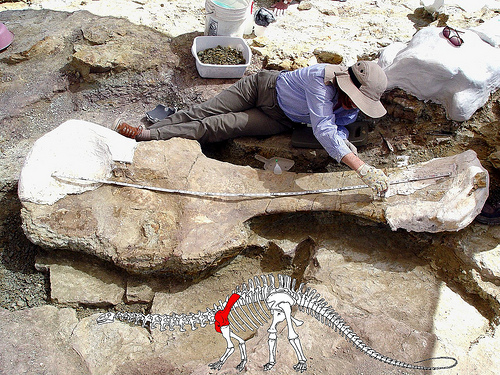
A scapula from a diplodocid

A scapula from a diplodocid with a skeletal drawing showing bone placement. Picture credit: Denver Museum of Nature and Science.

Picture credit: Denver Museum of Nature and Science

The picture above shows a scapula (shoulder blade) of a large diplodocid dinosaur at the dig site.  It has been speculated that his fossilised bone is from an Apatosaurus.

The teams have been working in conjunction with the country’s Forest State service.  A palaeontologist for the Forest Service, Bruce Schumacher commented on the importance of the Comanche National Grassland location.

He stated:

“Discoveries such as this allow scientists to better reconstruct ancient ecosystems of the past. In learning about these past worlds, we are able to reflect better on our present world and  understand what impact man is having on the present ecosystem.”

Groups of Volunteers

Working with groups of volunteers under the guidance of experts from the Denver Museum of Nature and Science, something like fifty fossil bearing sites have been explored so far.  The Forest State service are confident that the fossils that are unearthed within the boundary of the Comanche National Grassland will help palaeontologists to piece together more information about life for these large reptiles during the Late Jurassic.  They are also hopeful that the abundance of fossil material may even yield a new species of dinosaur, one that when scientifically named and described may forever link the Comanche National Grasslands with the science of vertebrate palaeontology.

This article has been compiled using information from the United States Department of Agriculture.

21 02, 2013

Juvenile Oviraptorids (Chicken-sized Dinosaurs) and a New Species

By |2024-04-29T12:13:57+01:00February 21st, 2013|Categories: Dinosaur and Prehistoric Animal News Stories|0 Comments

Fossils Provide Evidence of How Oviraptorids Grew Up

The bird-like oviraptorids which are known mainly from Upper Cretaceous strata from Mongolia and China are a very specialised group of dinosaurs that belong to the Suborder theropoda.  Despite a number of recent fossil discoveries, palaeontologists have still much to learn about these dinosaurs.  However, the discovery of a large number of oviraptorid specimens including five juveniles has helped scientists to erect a new genus and to learn a little about how these dinosaurs grew from babies into adults.

New Oviraptorid Dinosaur

The newest member of the Oviraptoridae is represented by the smallest specimens of Oviraptors discovered to date, the five individual specimens measure between 25 cm and 50 cm in length.  This newly discovered dinosaur has been named Yulong mini, the fossils were excavated from the Qiupa Formation of Upper Cretaceous strata from the Henan Province (eastern China).  The geological age of the Qiupa Formation is debated.  However, the presence of a number of dinosaur fossils including oviraptorids, dromaeosaurs and ornithomimids indicate that this strata was most probably laid down towards the very end of the Cretaceous period.

The name of this new dinosaur, is derived from the Chinese name for Henan Province coupled with the Chinese word for dragon and the specific name refers to the tiny size of these reptiles, so the name translates as “tiny dragon from Henan”.

Fossils of the New Oviraptorid Y. mini

New dinosaur genus - Yulong mini.

New dinosaur genus – Yulong mini.

Picture credit: Junchang Lu (lead author)

Yulong mini

The baby dinosaurs are the subject of a scientific paper published in the journal “Naturwissenschaften”.  Chinese researchers from the Henan Geological Museum and the Chinese Academy of Sciences wrote this paper in conjunction with the Canadian palaeontologist Phil Currie, who has worked extensively on Late Cretaceous Theropod dinosaurs from this part of the world.

Writing about the discovery, lead author Junchang Lu commented that:

“These dinosaurs looked like chickens with a tail.  Their behaviour was probably very similar to that of a modern bird.  When compared to primitive Oviraptorids such as Caudipteryx, Yulong should be feathered, although no evidence of feathers were found due to the poor preservation condition of the fossil material and the coarse characteristics of the surrounding matrix.”

Several dinosaur specimens were found at this location, but these juvenile dinosaurs perhaps represent the most important vertebrate fossils found to date as they permit palaeontologists to piece together information about how these dinosaurs grew.  A number of ontogenetic characteristics have been identified helping scientists to understand how these creatures matured into adult animals.  The skulls are not yet fully fused and the babies do show different body proportions in comparison with adult oviraptorids.

Limb Proportions

Intriguingly, the hind limb proportions (ratio of upper leg bones to lower leg bones) femur: tibia/fibia remain constant in oviraptorids.  The younger dinosaurs have the same hind limb proportions as older animals.  This suggest that these dinosaurs were not particularly fast runners and may have a had a much more sedentary habit.  It is unlikely that these types of dinosaur pursued and fed upon animals roughly equal in size to themselves.

A number of adult specimens were also found at this site, although they were not found in close association with the chicken-sized juveniles.  It can be speculated that as the babies were found apart from the adults, the youngsters may have been very independent from birth – perhaps an indication of precocial behaviour.  Precocial offspring are born or hatched as relatively well-developed animals that show a high degree of independence from the adult animals.  Many types of modern bird show this type of behaviour.

To view models and replicas of oviraptorids and other feathered theropods: Wild Safari Wild Dinos Models and Figures.

The diet of these creatures remains uncertain.  Studies of the skull and jaws of Y. mini when related to the hind limb proportions which indicate a more sedentary lifestyle, suggest that these oviraptorids may have been herbivorous feeding on leaves, ferns and even flowers and fruit.  However, the bite force calculated from measurements of the jaw size and muscle area of the juveniles is still considerable and it is not possible to rule out that these dinosaurs may have also eaten small animals such as lizards, mammals and even younger members of their own species.

Perhaps this is another reason why the babies tended to keep out of the way of the adults.

The scientific paper: “Chicken-sized oviraptorid dinosaurs from central China and their ontogenetic implications” by Junchang Lü, Philip J. Currie, Li Xu, Xingliao Zhang, Hanyong Pu and Songhai Jia published in Naturwissenschaften.

19 02, 2013

Carboniferous Crinoids Provide Evidence of Oldest Biomolecules Directly Isolated from Fossil Material in New Study

By |2024-04-29T12:23:07+01:00February 19th, 2013|Categories: Dinosaur and Prehistoric Animal News Stories, Palaeontological articles|3 Comments

Study into 350 Million Year Old Echinoderms Reveals Presence of Biomolecules

America some 350  million years ago looked very different than it does today.  For starters, much of the land mass which we now know as the United States formed part of a super-continent called Laurentia, but a considerable portion of the USA was covered by a warm, shallow tropical sea.

Scientists from Ohio State University have been studying an unusual phenomena associated with crinoid fossils from strata deposited in an ancient marine environment in the American Midwest and their research reveals that complex organic molecules may have been preserved.  It had been thought that organic molecules could not survive the fossilisation process and remain present in fossil material after immense periods of time, but a number of recent studies using the most sophisticated analysis techniques ever to be employed in palaeontology are challenging  this assumption.

Ancient Crinoid Fossils

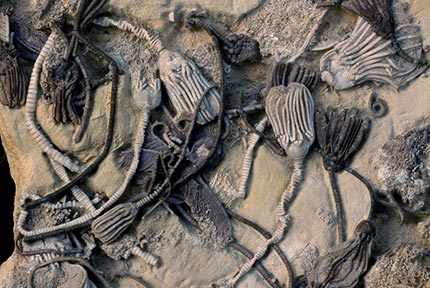
Crinoid fossils preserved in rocks from the American Midwest (specifically Indiana, Ohio and Iowa), the remains of animals that lived during the Mississippian Epoch (Carboniferous), can be preserved in different colours depending on the species.  Different species of crinoid, preserved in the same matrix, the same fossil slab, can be blueish grey, creamy white or even dark grey when observed under natural light.  Scientists had commented on this bizarre phenomenon over a hundred years ago, the fact that the crinoid fossils found in some parts of the Midwest seemed to be colour coded, but it took a team of geologists and scientists from the Ohio State University to get to the bottom of this mystery.

An Example of the Different Coloured Crinoid Fossils Used in this Study

Revealing 350 million year old organic compounds.

Revealing 350 million year old organic compounds.

Picture credit: Professor William Ausich, courtesy of Ohio State University.

Crinoids are members of the ancient Phylum known as Echinodermata (Echinoderms) – starfish, brittle stars, sea urchins and crinoids (sea-lilies).  Their fossil record dates back to the Cambrian.  Crinoids are often referred to as sea-lilies, as they superficially look like plants.  The fossil record for crinoids dates back to the Early Ordovician and there are a number of genera living today, including forms with stems that live attached to the sea-bed filling an ecological niche once filled by the Carboniferous crinoids.

Crinoids Described

Most prehistoric crinoids were attached to the sea-bed by a stem or a stalk, with a root-like holdfast at the bottom.  The mouth and the digestive tract was located in an enclosed cup at the top of the stem.  A series of feathery appendages which were covered in tiny, thin plates (pinnules) acted as a food gathering mechanism.  The sea current brought particles of food which were caught by the pinnules on the arm-like appendages and these food items were than wafted into the mouth.

The hard parts of the animal were formed of calcium carbonate (calcite), extracted from the surrounding sea water.  This calcite was porous and a thin skin of living tissue covered these hard parts.  Calcite is often very well preserved in the fossil record and the calcite plates that make up the flexible stem of these sea creatures are common fossils in Palaeozoic and Mesozoic aged marine, sedimentary deposits.

Dramatic Storms

A series of dramatic storms seem to have devastated the sea-bed where vast colonies of these sea-lilies thrived.  The sea-floor became choked in finely grained mud.  Once these crinoids were buried they were no longer able to feed and vast numbers of them were wiped out.  Being rapidly buried, quickly isolated from scavengers and oxygen to speed up the degradation process the calcite skeletons were preserved in beautiful detail, many of which remain articulated.

The porous calcium carbonate elements of the animal gradually became filled with minerals and preserved as fossils, however it seems that some of the pores that once contained living tissue were sealed so completely that traces of the molecules that made up the living tissue of the organism may have been preserved.

The University based research team were able to extract organic molecules from the individual sea-lily fossils.  They discovered that different species contained different organic molecules.   Some of these ancient sea creatures, that had died during these storm events, although they lay next to other species of crinoid  and had become preserved in the same slab of sedimentary rock: the different species were preserved in different colours – the greys, creams and blue-greys.

The organic molecules, referred to as biomarkers were extracted using a gas chromatograph mass spectrometer.  Tiny samples were taken from the individual fossils, these were then dissolved into a solution.  This liquid and its contents was analysed by the gas chromatograph mass spectrometer and individual molecules were identified based on their mass and their electric charge.  A computer programme was used to sort the data and to find a match in living crinoid species for the organic molecules recovered.

To view models and replicas of iconic invertebrates from the fossil record: CollectA Age of Dinosaurs Models.

The software identified these biomarkers as being similar to quinones found in Echinodermata.  These quinones are aromatic, organic compounds that are found in a number of organisms, they are associated with pigmentation (the colour of an animal) or in the production of toxins and other unpalatable substances that deter predators from attacking.

Professor William Ausich, of the School of Earth Sciences (Ohio State University) and  a co-author of the academic paper that has just been published in the scientific journal “Geology” stated:

“There are lots of fragmented biological molecules—we call them biomarkers—scattered in the rock everywhere.  They’re the remains of ancient plant and animal life, all broken up and mixed together.  But this is the oldest example where anyone has found biomarkers inside a particular complete fossil.  We can say with confidence that these organic molecules came from the individual animals whose remains we tested.”

Christina O’Malley in conjunction with the Ohio State geochemist Yu-Ping Chin, confirmed that the quinone-like molecules occur in fossil crinoids as well as in their extant descendants.  Although different coloured fossils do contain different quinones, the research team stressed that there was no definitive evidence to suggest that the preserved molecules were directly associated with the extinct creatures colouration.

The researchers hope to be able to extract more organic material from the fossils in a bid to find out as much as they can about each individual species.

Explaining that these molecules did not represent genetic material such as DNA, Professor Ausich commented:

“We suspect that there’s some kind of biological signal there, we just need to figure out how specific it is before we can use it as a means to track different species.”

It is truly astonishing that these gregarious, benthic (living on the sea-floor), animals from the Palaeozoic can reveal traces of organic compounds when their fossilised remains are analysed.

The scientific paper: “Isolation and characterization of the earliest taxon-specific organic molecules (Mississippian, Crinoidea)” by Christina E. O’Malley; William I. Ausich and Yu-Ping Chin published in Geology.

18 02, 2013

Dinosaur Statue in America – A “Hidden Gem”

By |2023-02-12T09:24:03+00:00February 18th, 2013|Categories: Dinosaur and Prehistoric Animal News Stories, Dinosaur Fans|0 Comments

Celebrating America’s First Dinosaur – Hadrosaurus foulkii

When discussing dinosaur discoveries made in the United States it conjures up thoughts about long treks into the western United States to explore the strata of states such as Utah, South Dakota, Colorado or the “Bad Lands” of Montana.  These parts of America have indeed proved to be a rich hunting ground for palaeontologists.  The rivalry between Cope and Marsh leading to the discovery of a great many dinosaur genera from the western part of that vast country during the 19th century has been very well documented.

American Dinosaur Discoveries

Many of these genera are household names, known to every school child and represent some of the most famous dinosaurs of all – Stegosaurus, Allosaurus and Diplodocus for example.  However, the very first United States dinosaur discovery did not take place in the west, the small town of Haddonfield in New Jersey on the eastern seaboard can lay claim to be the location where the first scientific excavation of a dinosaur fossil took place.

The small town of Haddonfield, which stands a couple of miles east of the Delaware River and just a few miles from the centre of Philadelphia, celebrated back in 2008, the 150th anniversary of the discovery, excavation and scientific description of the first major dinosaur find in the United States of America.  Amateur naturalist William Parker Foulke had discovered some very large fossilised bones in a marl pit the location of which is now in the centre of the town (Maple Avenue) and commemorated by a plaque and a civic bench.  There had been dinosaur fossils found in America prior to this, however, this was the first time that a large portion of the fossilised bones from a single specimen had been found.

Hadrosaurus foulkii

Dr Joseph Leidy (University of Pennsylvania), an eminent anatomist, was given the task of working out what the bones represented.  The Order Dinosauria had been erected some sixteen years previously and Dr Leidy announced that the fossilised material represented the preserved remains of a giant, herbivorous dinosaur.  He named this new genus of dinosaur Hadrosaurus foulkii to honour William Parker Foulke who had discovered the fossils.  Thus, H. foulkii became the first member of the Order Dinosauria to be described in the United States, the town of Haddonfield, New Jersey, can lay claim to be being the birth place of dinosaur studies in America.

Unfortunately, the specimen excavated from the marl pit in Haddonfield, lacked a skull and the lack of any cranial material partially explains why this specimen has been omitted from a number of academic texts.

Dinosaur Statue

A two and quarter metre tall statue of a Hadrosaurus was erected in 2003 to commemorate the discovery.  This statue, designed by artist John Giannotti stands at 2 Kings Court in the centre of Haddonfield and the statue of the dinosaur is known affectionately by locals as “Haddy the Hadrosaurus”.  The magazine “USA Today” has declared this little homage to American palaeontology a hidden gem, a real honour when one considers the historical importance of the American eastern seaboard.   At just under six metres in length, it might be thought that this dinosaur statue could be seen as menacing passers-by, but as every school child in the town will tell you, Hadrosaurus was a peaceful, plant-eating giant.

A Model of Hadrosaurus foulkii

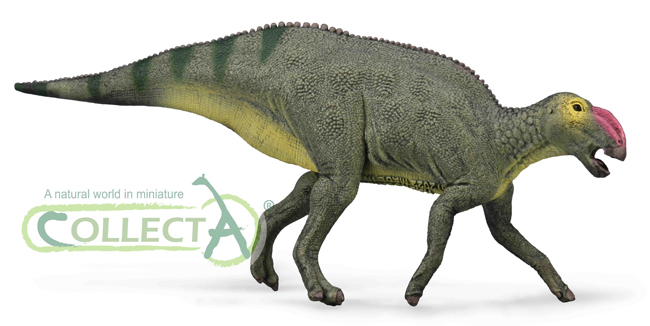
New CollectA Models 2023 Hadrosaurus.

The new for 2023 CollectA Age of Dinosaurs Hadrosaurus dinosaur model.

To view the not-to-scale CollectA model range: CollectA Age of Dinosaurs Figures.

The bronze statue of the dinosaur with its commemorative plaque and story board explaining which bits of the duck-billed dinosaur were actually found, is a tourist attraction and local landmark.  It is pleasing to see a statue erected ten  years ago to mark an event that took place more than one hundred and fifty years back has been awarded such an accolade by such a prestigious organisation as “USA Today”.

Commenting on the award, the artist Mr Giannotti declared:

“I think it is wonderful.  It’s a nice tribute, I like the idea of it being considered a hidden gem.”

Go to Top