All about dinosaurs, fossils and prehistoric animals by Everything Dinosaur team members.

Fossil finds, new dinosaur discoveries, news and views from the world of palaeontology and other Earth sciences.

1 04, 2013

Russian Scientists Name new Ichthyosaur Genus in Honour of Lenin

By |2023-02-15T06:28:23+00:00April 1st, 2013|Categories: Dinosaur and Prehistoric Animal News Stories|2 Comments

Lenin Honoured by Marine Reptile

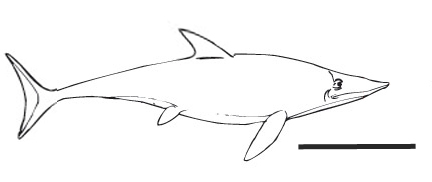
A team of Russian scientists have honoured the leader of the Bolshevik 1917 revolution which led to the establishment of the Soviet Union by naming a new genus of marine reptile after Lenin.  Vladimir Ilyich Lenin, who died in 1924, now has a genus of ichthyosaur named in his honour.  This prehistoric creature, a marine reptile that superficially resembled a modern-day, extant dolphin lived approximately 125 million years ago (Barremian faunal stage of the Cretaceous).  The scientific name for this new marine reptile is Leninia stellans.  The name means “starry or brilliant Lenin”.

New Genus of Ichthyosaur

Having an organism new to science named after you is an honour, although Lenin is not the first political leader to have his name immortalised in the fossil record.  For example,  a team of researchers studied a number of Late Cretaceous lizard and snake fossils (Squamata), in the southern part of Americas and in the course of their research they named a new genus of toothy lizard after the current president of the United States.  The prehistoric lizard was named Obamadon gracilis.  The name translates to mean “Obama’s graceful tooth”.

Speaking about the new marine reptile fossil, Gleb Uspensky, the Head of the Natural History Museum at Ulyanovsk State University, where the specimen is currently being stored commented:

“The name Leninia stellans was agreed collegially.  There is nothing strange about the name, many new discoveries are named after famous people.”

Ichthyosaurs (Typical Ichthyosaurs Illustrated)

Palvennia hoybergeti illustrated

An illustration of a typical ichthyosaur. Picture credit: Everything Dinosaur.

Marine Reptiles

Ichthyosaurs were marine reptiles and not members of the Dinosauria Order.  Ichthyosaurs are a separate Order, the majority of ichthyosaurs were nektonic, fast-swimming predators.  The first ichthyosaurs evolved in the Early Triassic and persisted into the Cretaceous geological period, before finally becoming extinct approximately eighty million years ago.

Palaeontologists excavated elements of the skull a few years ago, on the outskirts of the city of Ulyanovsk on the banks of the Volga river.  The actual fossil material was discovered near the small village of Kriushi in the Sengileevsk region of this part of the former Soviet Union.  The skull material provided the scientists with an estimate of the size of the entire head and jaws of the animal, it measures over one metre in length and indicates an entire body length in excess of four metres.

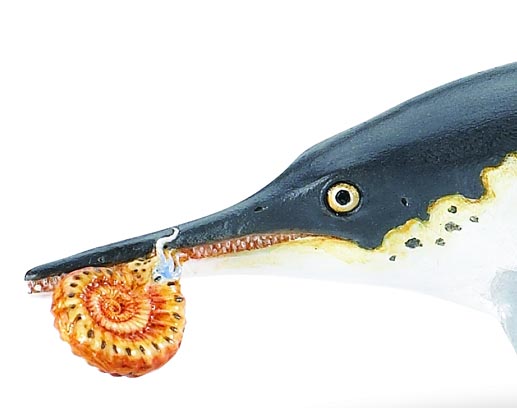
It is likely that this marine reptile fed on fish and cephalopods such as squid, octopi and ammonites.  Recently, other elements of the ichthyosaur fossil have been excavated from this area.  Palaeontologists have assigned this new genus to a sub-family of ichthyosaurs known as the Ophthalmosaurinae.  Phylogenetically related to the Jurassic Ophthalmosaurus-type ichthyosaurs, the scientists hope to be able to learn more about the evolution and radiation of the ichthyosaurs during the Early Cretaceous geological period.

A Model of an Ichthyosaur with an Ammonite (Cephalopod) that it Has Caught

An Icththyosaurus with an Ammonite that it has caught.

An Icththyosaurus with an ammonite that it has caught.

Picture credit: Everything Dinosaur

It is appropriate that this type of marine reptile should be named after the Founder of the Soviet Union (Lenin), for Lenin was born in this part of the Russian Empire, (as was), in fact the city of Ulyanovsk was renamed in 1924 (previously known as Simbirsk), to honour the Communist leader.

To view replicas and models of marine reptiles and other prehistoric creatures: Dinosaur Models, Pterosaurs and Marine Reptiles (PNSO).

28 03, 2013

Cretaceous Mass Extinction – New Study Provides Evidence of Global Firestorm

By |2024-04-29T13:14:15+01:00March 28th, 2013|Categories: Dinosaur and Prehistoric Animal News Stories|0 Comments

Intense Heat in Earth’s Atmosphere Led to Global Forest Fires

There has been much discussion in recent weeks regarding the extraterrestrial impact that occurred approximately 66 million years ago, a probable causal factor in the demise of the dinosaurs, their ultimate extinction and the loss of something like seventy-five percent of all land based organisms.  A new study by a team of scientists based at Colorado University – Boulder has concluded that one of the immediate consequences of the impact of an object from outer space on planet Earth, was a global fire-storm.

Chicxulub Impact

Fires would have devastated all the terrestrial vegetation, the smoke and ash from such an immense conflagration would have contributed to a contamination of the Earth’s atmosphere and probably blocked out the sun’s light for a very long period.  Any plants that were not burnt to a crisp, or any seeds that germinated after the initial fires would have had very little light with which to photosynthesis.   The collapse of the land-based food chains would have followed, once there were no plants, the plant-eaters including herbivorous dinosaurs were doomed.

After a brief period of bounty where the surviving predators could feast on the carcasses of the dead, the meat-eaters too would all be ultimately doomed.

Extinction of the Dinosaurs

Such an apocalyptic picture is presented by researchers from the Co-operative Institute for Research in Environmental Sciences (CIRES) who used sophisticated computer modelling techniques to synthesise the amount of debris that would have been ejected into the atmosphere after the extraterrestrial impact.  Scientists remain uncertain as to what exactly collided with the Earth and led to the extinction of the dinosaurs.

In a recent paper, published by a team of researchers from New Hampshire (United States), it was suggested that the actual object that smacked into the Yucatan peninsula of Mexico was a comet and not an asteroid/meteor at all.

To read more about the “Dinosaur Comet Theory”: American Researchers Suggest the Chicxulub Impact Caused by Comet.

Douglas Robertson (CIRES), and his co-authors propose that the ejected material that would have been blown up into and almost beyond the atmosphere by the impact blast would have been heated in the upper atmosphere as it re-entered.  The skies would have glowed red for many hours after the impact at temperatures possibly exceeding 2,700 degrees Fahrenheit – cooking any organism that was not able to seek shelter underground.  Vegetation would have spontaneously combusted and a global fire-storm resulted.

One of the drawbacks proposed previously for the extensive forest fires theory was the lack of charcoal to be found at the famous K-T boundary, the geological feature that marks the end of the Cretaceous and the beginning of the Palaeogene.  If there had been such a fiery inferno created, the vegetation consumed by the flames would have left extensive geological deposits of ash and charcoal.  The Colorado University team corrected their data to take into account changing sedimentation rates and when the charcoal data from the K-T boundary was adjusted to take into account these same changing sedimentation rates, the figures showed an excess of charcoal not a deficiency.

A “Smoking Gun”

In essence, this new assessment of the charcoal evidence, sometimes referred to as the “smoking gun” in relation to forest fires, supports the theory of a global fire-storm rather than detracting from it.

Speaking about the scientific paper, which has just been published in the American academic journal the “Journal of Geophysical Research-Biogeosciences”, Douglas Robertson stated:

“Our data show the conditions back then are consistent with widespread fires across the planet.  Those conditions resulted in 100 percent extinction rates for about 80 percent of all life on Earth.”

Studies of the 170 kilometre wide Chicxulub crater on the Yucatan peninsula of Mexico have led the majority of scientists to believe that this global catastrophe had an enormous impact on the fauna and flora around at the time.  Along with the dinosaurs, marine reptiles, flying reptiles, ammonites, as well as many types of marine plankton, brachiopods, bivalves and sea-urchins became extinct.  In terms of plant life, the angiosperms (flowering plants) as a group suffered also but most of the species affected and ultimately caused to become extinct were associated with land masses to be found in the northern hemisphere.

Recently, an analysis of the geophysical evidence at the Yucatan site enabled scientists to come up with the most accurate date yet for the extraterrestrial impact.  A team of international researchers, including scientists from Holland, the United States and Great Britain established the date of the impact event to be around 66,038,000 years ago, plus or minus 11,000 years for a margin of error.

Immediately following the impact, the explosion would have sent up millions of tonnes of vaporised rock.  This would then have condensed into sand-grain-sized spheres as they rose up into the upper atmosphere.  As the ejected material began to fall back down to Earth under the influence of gravity, enough heat energy was retained in the atmosphere to create an infrared “heat pulse”, so hot that the sky would have glowed red for many hours, not that there was much alive bigger than a small dog on the land to see it.

Radiated Heat Energy

Part of the radiated heat energy would have been blocked, firstly by the falling material in the atmosphere and secondly from the ash and smoke that would have been ascending from the fires.  Even with some of the “heat pulse” effectively being blocked out and not reaching the surface of the Earth, there was enough heat energy getting to ground level to cause dry materials such as leaves and pine needles to explode into flames.

To read more about the latest impact dating research: Most Accurate Date for Extraterrestrial Impact.

The American team then set out to calculate  just how much energy would have been generated by the infrared radiation.  They calculate that the total amount of infrared heat was equal to a one megaton hydrogen bomb exploding every four miles over the entire surface of the planet.  A one megaton hydrogen bomb has the explosive power of about eighty Hiroshima-type nuclear devices.  The scientists postulated that the extraterrestrial impact generated about one hundred million megatons of energy.

The layer of soot, which can be found at the K-T boundary (the geological feature that marks the end of the Cretaceous), is thought by some scientists, to be evidence of the actual impact.  However, this new research paper suggests that the sooty layer is too deep to have been created solely by the impact event.  The thickness of the sooty layer, according to the researchers, is consistent with great fires that would have engulfed much of the Earth in the aftermath of the collision.

For models and figures of Late Cretaceous dinosaurs and pterosaurs, take a look at the models section of Everything Dinosaur’s award-winning website: Dinosaur, Pterosaur and Prehistoric Animal Models.

27 03, 2013

Japanese Schoolboy Finds Rare Dinosaur Toe Bone

By |2024-04-29T13:20:42+01:00March 27th, 2013|Categories: Dinosaur and Prehistoric Animal News Stories|0 Comments

Keen-eyed Pupil Spots Tiny Dinosaur Bone

A Japanese schoolboy on an outing with his family to a mining museum has discovered the toe-bone of a dinosaur, most likely a member of the theropod group of dinosaurs and the bone may represent a species that is new to science.  The tiny fossil, it measures just three centimetres in length, was found by Takato Sasaki, who was on a visit to the Kuji Amber Museum in Kuji, Iwate Prefecture, the north-eastern part of Honshu island (Japan).

Kuji Amber Museum

The Kuji Amber Museum is the only museum of its kind in Japan, amber can be collected in this area, the fossilised tree resin dates from approximately fifty million years ago (Palaeogene geological period) to as old as approximately one hundred million years ago (Cretaceous geological period).  The fossil, although very small and representing just a single toe bone has been tentatively dated to around eighty-five million years ago (Santonian faunal stage of the Late Cretaceous).  The fossil was found last May, it has been identified as a pedal phalange, a toe bone from a bipedal, fast-running dinosaur that may have been between one and two metres tall.  The height of the dinosaur can be estimated by comparing the size of this toe bone with the pedal phalanges of more complete specimens of bipedal dinosaur where more of the skeleton has been excavated.

Dinosaur Toe Bone

Researchers such as Professor Ren Hirayama (Waseda University), have stated that the bone came from the left hind foot of a member of the Coelurosauria dinosaur family.  The Coelurosauria clade of dinosaurs is an exceptionally diverse group of theropod dinosaurs. It includes the ornithomimids, the tyrannosaurs, Compsognathidae and the raptors such as the dromaeosaurs.  Dinosaur fossils are extremely rare in Japan.  Those that are found tend to be very fragmentary, for example, a distinctive, tooth root found earlier this year suggests evidence of horned dinosaurs living on the land mass that we now know as Japan in the Late Cretaceous.

To read more about the fossil evidence suggesting horned dinosaurs once lived on the land we now know as Japan: Japan’s First Horned Dinosaur.

A couple of years ago, Japanese scientists found a huge thigh bone (femur) of a dinosaur.  This suggests that there may have been dinosaurs very similar to titanosaurs living in this part of the world back in the latter stages of the Mesozoic.

To read an article on the discovery of the huge femur: Huge Femur Fossil Found in Japan.

Professor Ren Hirahama commented:

“It is uncommon that a toe bone, which is easily worn away, was found in such good condition.”

The bone is not much bigger than the schoolboy’s little finger, it measures just three centimetres in length and just about one centimetre in diameter at its widest part.  Given that the scientists have only a single bone to study, they can’t say much more about this dinosaur, it is not possible to identify the genus, but it does show that there were fleet-footed relatives of Tyrannosaurus rex living in Japan during the Late Cretaceous.

Eroded Out of Older Sediments

The bone may have been re-deposited having been eroded out of older sediments and become mixed up with the amber bearing strata, although if it had been transported a significant distance, the palaeontologists would have expected the tiny fossil bone to show more signs of erosion than it actually does.

High school student Takato Saski, is said to be very excited about his discovery, the tiny specimen was found at an amber mine site on the museum’s premises.  Describing the moment when he first saw the object, Takato stated:

“At first I thought it was just a small branch, but it was more amazing than that”.

Young people have two major advantages when it comes to finding fossils.  Firstly, they tend to be shorter than adults, this means that they are closer to ground and since fossils tend to be found on the ground, they are closer to where the action is – from a palaeontological perspective.  In addition, their young eyes generally tend to be more acute and a better sense of vision can help young people spot small objects, even tiny dinosaur toe bones.

For further information about fossil hunting and dinosaurs: Contact Everything Dinosaur.

Scientists are hopeful that news about this rare find will encourage more sharp-eyed visitors to the museum.  Perhaps more fossilised fragments will come to light and these fossils can help palaeontologists to understand the diversity of the Dinosauria in this part of the world towards the end of the Cretaceous.

23 03, 2013

American Researchers Suggest Chicxulub Crater Made by Comet

By |2023-02-14T06:22:18+00:00March 23rd, 2013|Categories: Dinosaur and Prehistoric Animal News Stories|0 Comments

Factor in Extinction of the Dinosaurs – Potentially a Comet Impact

A team of scientists based in the eastern part of the United States have published details of a paper that suggests that the extraterrestrial object that struck the Earth and marked the end of the dinosaurs may have been a comet.  The New Hampshire based research team outlined their theory at the forty-fourth Lunar and Planetary Science Conference which was being held in Texas.

Chicxulub Impact

It was father and son team Luis and Walter Alvarez and their study of the iridium-rich clay layer that marked the Cretaceous/Tertiary geological boundary across so many parts of the world, that first led to the theory that there had been a meteorite or asteroid object collision that had led to the deposition of iridium – a rare Earth element.

It was the discovery of the almost 190 kilometre wide Chicxulub crater in the Yucatan peninsula of Mexico that provided the “smoking gun” evidence that there had been an extraterrestrial impact some 65 million years ago that led to the demise of the Dinosauria and around seventy percent of all terrestrial life.  The theory that such a catastrophic event might have been a causal factor in the mass extinction that followed has now been largely accepted by the majority of the scientific community.

The actual date of the impact has even been calculated to around 66 million years ago, plus or minus either way a few thousands of years for margin of error.

To read more about the dating evidence: Dating the Cretaceous Mass Extinction.

Cretaceous Comet

However, this new paper proposes that a smaller, faster travelling comet collided with our planet and the culprit was not a larger, slower moving asteroid or meteorite.  The New Hampshire team (from Dartmouth College), studied the sediments and rock strata at the Yucatan site and concluded that the crater might have been caused by the impact of a much smaller object, but one that was travelling at immense speed.

The smaller mass of the colliding object would have reduced the kinetic energy released but the devastation caused could have been amplified by the much greater speed that a body like a comet would be travelling compared to a rocky meteorite or asteroid.

In an analysis of a second rare Earth element deposited  – osmium the team were able to hypothesise that the impact object deposited much less debris than previously thought.

Higher Levels of Iridium

The research team also concluded that the widely reported higher levels of iridium had been previously overstated.  This data was then examined in conjunction with the known geo-physical nature of the Chicxulub impact crater and the team deduced that to deposit on Earth that much iridium and osmium a meteor or asteroid of over five kilometres wide would be needed, but if a rocky object of that size smacked into the geology of the Gulf of Mexico a much larger crater would have resulted.

To read more about scientific studies of the Chicxulub crater: Getting to the Bottom of the Chicxulub crater.

The End of the Dinosauria

For a smaller object to have created the Chicxulub crater on impact it would have had to have had a greater terminal velocity and the research team point to a long-period comet as being  a more likely candidate for the harbinger of dinosaur doom.  Long period comets are believed to be remnants left over from the formation of our solar system.  They consist of rocks, dust and ice and they orbit the sun, often in very eccentric trajectories, with some comets taking millions of years to complete one circuit.  Other comets such as the famous Halley’s comet are known as a short-period comets – having an orbit of less than 200 years.

Other scientists challenge the Cretaceous comet impact idea, suggesting that a lot of debris may have been ejected up into and beyond our atmosphere.  If a lot of the impact object material was ejected into space and left our atmosphere then the evidence tips in favour of a larger rocky object such as an asteroid.

Whatever it was, the devastation caused was certainly terrific with earthquakes, fire storms, enormous tidal waves and acid rain.  It is likely that much of the light and heat from the sun was obscured by dust in the atmosphere, shrouding the Earth in what has been termed a “nuclear winter”.

Dinosaurs, marine reptiles, the last of the pterosaurs along with many types of invertebrate, plants and marine plankton became extinct.  Flowering plants including the hardwood trees, along with mammals also suffered but it was from the end of the Age of Reptiles that flowering plants and mammals rapidly diversified becoming the dominant and most prominent floras and faunas in most ecosystems today.

Visit Everything Dinosaur’s user-friendly website: Everything Dinosaur.

21 03, 2013

A New Azhdarchoidea Pterosaur from the Isle of Wight

By |2023-02-14T06:15:21+00:00March 21st, 2013|Categories: Dinosaur and Prehistoric Animal News Stories, Everything Dinosaur News and Updates|0 Comments

New Flying Reptile Named after Girl who Found the Fossils

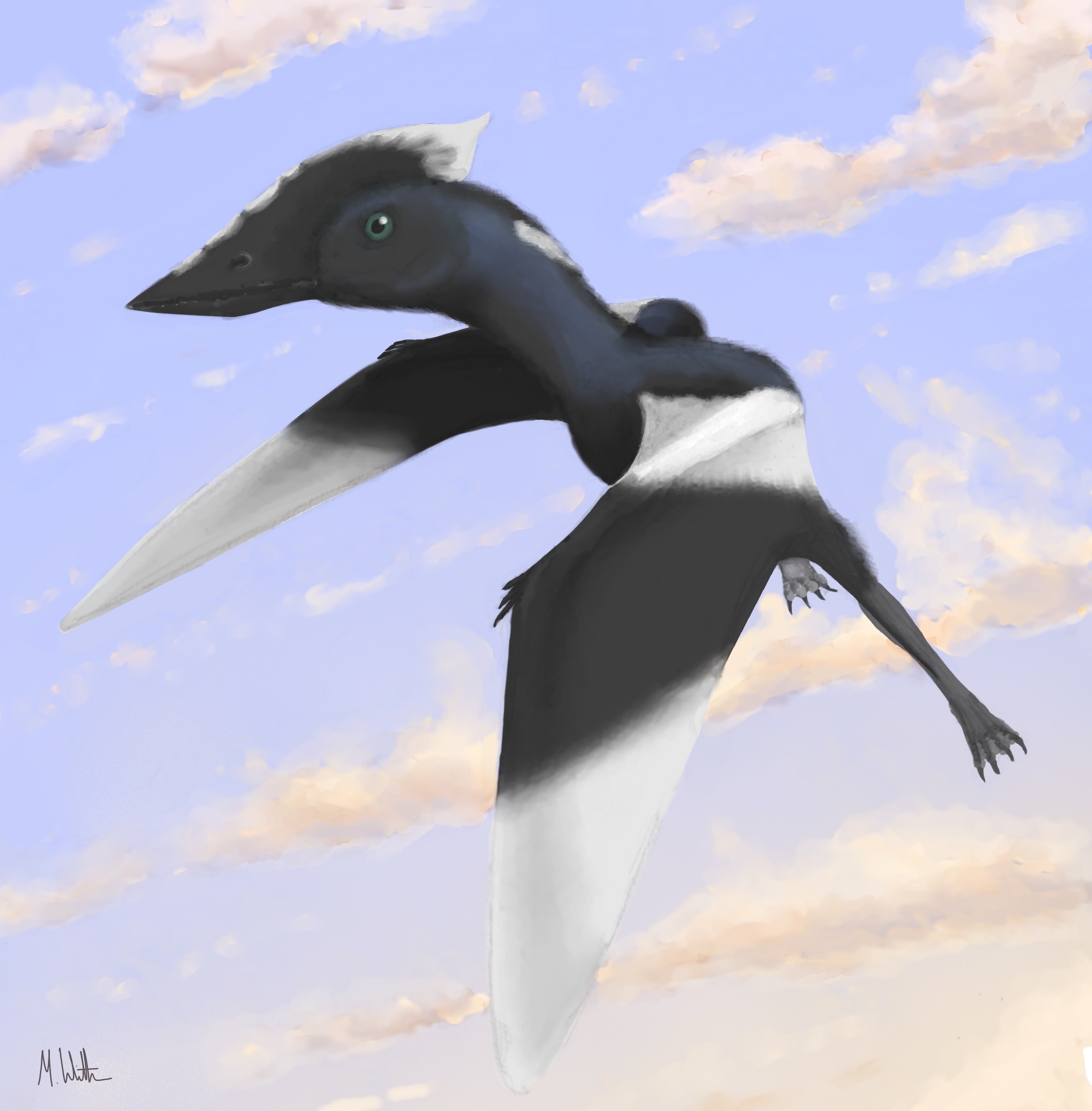
For Daisy Morris and her parents a walk along the beach on a winter’s day was going to turn out to be a rather special event, for the family spotted some fossils that represent a new species of flying reptile.  The discovery made back in November 2008 has led to young Daisy, who was nearly five years old at the time of the fossil find, having the honour of having a prehistoric animal named after her.  The new pterosaur is called Vectidraco daisymorrisae.  The name means dragon from the Isle of Wight (after Vectis – the old name for the island), the specific name honours Daisy.

Pterosaur

An Illustration of Vectidraco daisymorrisae

Pterosaur named after school girl.

Pterosaur named after school girl.

Picture credit: Mark Witton

The Morris family spotted a collection of small bones that had weathered out of a block of rock and now lay on a scree slope near the foot of the cliff immediately west of Atherfield Point (Isle of Wight), if the family had not discovered the fossils, this precious prehistoric material would have most likely have been lost for ever being washed away at the next high tide.

Daisy Morris – A New Pterosaur Named

Excited about her fossil find.

Excited about her fossil find.

Identified as a specimen from the basal part of the marine Atherfield Clay Formation of the Lower Greensand Group, this new pterosaur was probably about the size of a large crow and its discovery has helped palaeontologists to understand a little better the diversity of European pterosaurs from the Early Cretaceous.  The fossil material has been dated to the Aptian faunal stage of the Cretaceous and it has been estimated that this thirty-five centimetre long flying reptile lived some 115 million years ago.

Vectidraco daisymorrisae

The Lower Cretaceous strata of western Europe has provided scientists with a number of different types of Pterosaur fossils.  On the Isle of Wight itself, the first flying reptile fossil material was found in 1870 and although such discoveries are exceptionally rare, a number of different families of pterosaur are known from western Europe.  However, finding pterosaur fossils from strata dated to the Aptian faunal stage of the Cretaceous is a really exceptional event.

For models of pterosaurs and other flying reptiles: Pterosaurs, Dinosaurs and Prehistoric Animal Replicas (CollectA Deluxe).

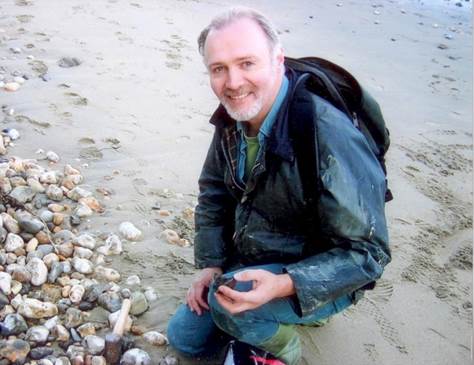
For Martin Simpson (University of Southampton) and a highly regarded vertebrate fossil expert on the island, that April day in the following spring when the fossils were brought in to show him, must have been a very memorable day indeed.  Realising their significance, the fossils were taken to the Natural History Museum (London).  The study of the fossils led to the erection of this new pterosaur genus and the holotype has now been accessioned, (become part of the museum’s vertebrate fossil collection).  The academic paper written by the highly talented Darren Naish (Ocean and Earth Sciences, University of Southampton) along with Martin and Gareth Dyke of the University’s Institute of Life Sciences has just been published.

“Fossil Man” – Martin Simpson

Looking for fossils, perhaps another Pterosaur?

Looking for fossils, perhaps another pterosaur?

This just goes to illustrate the importance of amateur fossil hunters when it comes to discovering significant new finds, a point we often make when we visit schools as the school children being closer to the ground and with their generally keener eyesight than us “oldies” have two big advantages over the grown-ups.

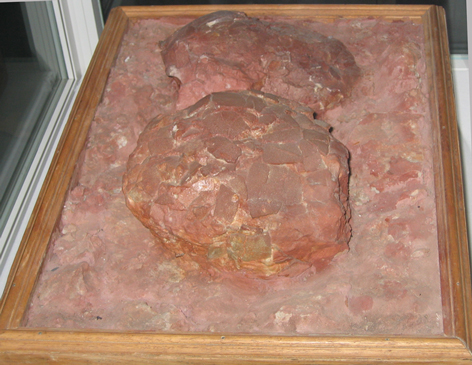
The actual fossil material represents the animal’s pelvic girdle and associated vertebrae (back bones), although no other fossil material has been retrieved, the research team have concluded that this was a small-bodied pterosaur that had a wingspan of around seventy-five centimetres. It was probably crested and an expert flier in its arboreal dominated habitat.  These deductions have been made by comparing the fossils of V. daisymorrisae to better known azhdarchid pterosaur fossil material.

The Fossilised Bones (Pelvic Girdle)

The fossilised bones.

The fossilised bones.

The types of pterosaurs known from the Lower Cretaceous of western Europe, large pterosaurs such as the ornithocheirids and the istiodactylids, such as Istiodactylus latidens, fossils of which have also been found at Atherfield Point on the island and the generally smaller azhdarchoids are very similar to the pterosaur faunas associated with the Liaoning Province of eastern China.  Although still very rare, the Lioaning assemblage represents a greater diversity and number of different pterosaurs when compared to western Europe.

Most of the European pterosaur fossils found to date come from fluvial environments and the fossils are usually substantially fragmented.  In contrast, the fossil material associated with the Lioaning Province is exquisitely preserved.  The Yixian and Jiufotang Formations of Lioaning are dominated by finely-grained sediment, an aid in fossil detail preservation.  In addition, there are substantial deposits of volcanic ash, it seems that this part of Asia was subjected to occasional volcanic eruptions which buried the landscape and resulted in the mass die-off of a number of organisms at a time, including numerous pterosaurs.    The rapid burial in the ash deposits also prevented the carcasses from being scavenged, another reason for the more complete fossil remains.

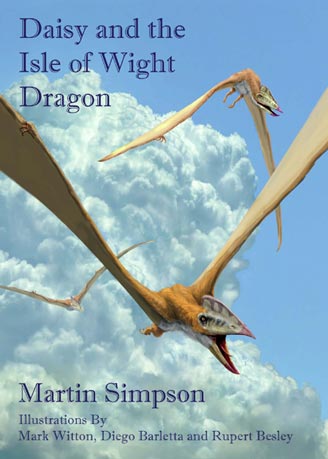
The story of this amazing fossil discovery has inspired Martin to write a book.  The book is entitled “Daisy and the Isle of Wight Dragon” and it is aimed at 7-12 year olds (as well as their mums and dads).  The story is based on the actual discovery made by young Daisy.  Not a bad start in life for a child under ten, her name honoured by science and a book published all about her adventures.

The Front Cover of the Book

Read all about the Pterosaur discovery.

Read all about the pterosaur discovery.

Well done to everybody involved in helping to preserve the 4-cm-long pelvis and associated bones.  It seems that the Isle of Wight has still many prehistoric animal secrets awaiting discovery – even by a sharp-eyed five year old.

19 03, 2013

We have Frogspawn in the Office Pond

By |2023-02-13T17:40:10+00:00March 19th, 2013|Categories: Dinosaur and Prehistoric Animal News Stories|0 Comments

First Batch of Frogspawn is Spotted

The first frogspawn has been spotted in our office pond.  This is approximately eight days later than last year and rather on a par with 2011 spawning records.  The frogspawn produced so far is from a single pair, we have not seen the number of frogs in the pond that we saw last year (a record ten), there have been as many as six individuals counted but so far we have not observed the frenetic activity that accompanied last year’s spawning.

Frogspawn

The spawn was laid in an extremely shallow part of the pond, so shallow in fact that only about one third of the mass of eggs was covered in water.  We were concerned about the eggs drying out should there be a period of prolonged sunny weather (some hope)!

Ensuring the Safety of the Eggs

To ensure the safety of this spawn we have carefully  made sure that the egg mass has been fully submerged.  It now resides in a slightly deeper, adjacent part of the pond.  The spawning probably took place in the early hours of this morning, according to the old folk tale, if frogspawn is found in shallow parts of a pond, that means we are in for a wet spring.  This is bound to please the farmers – not.

16 03, 2013

Scientists on the Isle of Wight Announce New Dinosaur Fossil Find

By |2023-02-13T17:32:11+00:00March 16th, 2013|Categories: Dinosaur and Prehistoric Animal News Stories, Dinosaur Fans|2 Comments

Fossil Location Kept Secret as Palaeontologists Plan to Excavate

Palaeontologists on the Isle of Wight (off the coast of southern England), are hoping that the discovery of an almost perfectly preserved set of fossilised dinosaur bones will help them to solve a mystery that is itself more than 100 years old.

The fossil material has been tentatively described to a genus of ornithopod (bird-hipped) dinosaur called Valdosaurus.  Up until now most of the fossil specimens, including the holotype material from which this plant-eating dinosaur was named, have been disarticulated and fragmentary.  These new fossils described by Isle of Wight palaeontologists as “absolutely amazing” represent a single individual but the fossils are articulated and much more of the skeleton has been preserved.

Dinosaur Fossil

The fossils were found last Autumn by a walker who observed a series of bones slowly eroding out of a block of rock on a cliff face on the island’s south-west coast.  The exact location is being kept a closely guarded secret as scientists hope to be able to return to the site to look for further fossil evidence.  The land is owned by the National Trust and permission was granted for the palaeontologists to remove several large blocks of sandstone from the site so that the fossils could be carefully extracted from their surrounding matrix under laboratory conditions.   The seven sandstone blocks contained much of the rear end of the skeleton including articulated caudal vertebrae (tail bones), elements from the pelvis, hind limbs and parts of the backbone.

Not a Cretaceous Crocodile

At first the scientists thought that the fossils represented a prehistoric, Early Cretaceous crocodile, but as the bones were revealed with the removal of the surrounding sandstone it soon became clear that they had an exceptionally well-preserved example of a Valdosaurus, perhaps the most complete specimen of this type of dinosaur discovered to date.

Scientists have remained uncertain as to the size of Valdosaurus and how closely it was related to other ornithopods.  It is hoped that these fossils will help to answer the many questions surrounding this herbivore from the Early Cretaceous.  Fossils ascribed to Valdosaurus have been found on the Isle of Wight and also from Weald Clay material located in West Sussex (southern England).  This new specimen suggests a body length of around 3.6 metres (12 feet), although some fragmentary remains now housed at the Natural History Museum in London suggest that a fully grown Valdosaurus could have reached a length in excess of five metres.

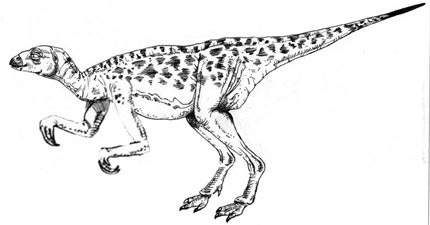
Everything Dinosaur’s Interpretation of Valdosaurus

Everything Dinosaur's interpretation of Valdosaurus.

Everything Dinosaur’s interpretation of Valdosaurus.

Picture credit: Everything Dinosaur

Once thought to be a type of theropod (meat-eating) dinosaur, Valdosaurus has been described as being a light, fast running, medium-sized browser feeding from the ground level to up to around two metres.

In Everything Dinosaur’s illustration we have given our Valdosaurus slightly longer arms than in representations of other dryosaurids.  It is thought that this dinosaur was a facultative quadruped.

Although it will take some months to complete the preparation of the fossil material, palaeontologists are hopeful that this specimen will be able to go on display at a dinosaur museum on the island, forming part of a new exhibit about the plant-eating dinosaurs that once roamed this part of the world.

To read an article highlighting the importance of the Isle of Wight to palaeontologists: Isle of Wight Declared the “Dinosaur Capital” of the British Isles.

The fossil material has been dated to approximately 128 million years ago (Barremian faunal stage of the Early Cretaceous).  Valdosaurus has been classified as a dryosaurid, although it remains uncertain as to the exact taxonomic relationship this dinosaur genus has to Dryosaurus (best known from Upper Jurassic strata of the western United States) and to Camptosaurus.

It is not known whether this specimen represents a new species of Valdosaurus.  The name of this dinosaur means “Weald lizard”, reflecting the fact that much of the material ascribed to this genus has come from the Weald Clay of West Sussex.

For figures and repilicas of iguanodontids and other ornithopods: CollectA Prehistoric Life (Popular) Models.

13 03, 2013

The Large Eyes of the Neanderthals May Have Helped See Them Off According to New Research

By |2024-04-29T13:08:07+01:00March 13th, 2013|Categories: Dinosaur and Prehistoric Animal News Stories|0 Comments

Large Orbits = Large Eyes = Less Brain Space Dedicated to Higher Functions Therefore Neanderthal Extinction

Adapted to living “up north” when compared to their close relatives the Homo sapiens may have led to the demise of the Neanderthals according to a new study published in the academic journal “The Proceedings of the Royal Society B (Biology)”.

Neanderthals

A study of the size of the orbit (eye socket) in Neanderthal skulls indicates that these hominids had larger eyes than our own species, perhaps an adaptation to the shorter day length of northern latitudes where Neanderthals lived.  The long, dark European and near eastern Asian nights may have inadvertently led to the eventual extinction of the Neanderthals, a species of hominid believed to be most closely related to ourselves.

Looking at the Demise of the Neanderthals

Seeing off the Neanderthals.

Seeing off the Neanderthals.

Most palaeoanthropologists believe that H. sapiens and H. neanderthalensis shared a common ancestor (Homo heidelbergensis).  The Neanderthals thrived in Europe and they are the best known of all the fossil hominids, with fossils having been found in much of Europe and into the near east.  The Neanderthals are believed to have evolved around 350,000 years ago and are thought to have persisted until around 28,000 years ago (although recent studies have suggested that Neanderthals may not have survived until as recently as 30,000 years ago).

Highly Intelligent Hominids

If these sophisticated and highly intelligent hominids had large eyes, than more of their brain space would have been dedicated to processing optical information and therefore, perhaps, less of their brain volume could be dedicated to higher functions such as social interaction, communication, thinking and planning.

In contrast, the larger frontal brain portions of our own species allowed us to create clothing sewn together through the use of cleverly fashioned bone needles, better than the clothing and simple fur wraps worn by Neanderthals (we think).  Larger anterior portions of our brain may have helped us to develop wider social networks, a bigger circle of friends to help us when times were hard.

The British research team considered the idea that as the ancestors of Neanderthals left Africa and moved into higher latitudes, so they had to adapt to longer, darker nights and much shorter day lengths so typical of living in the United Kingdom today.  This resulted in a greater portion of the posterior part of the brain being dedicated to processing visual data.

The Latitude is Significant

For those hominids that remained in Africa (the ancestors of our own species), they lived in a much brighter environment with long, sunny days with a rapid deterioration of daylight and a brief dusk period, so typical of living in parts of the world much closer to the Equator.

PhD student Eiluned Pearce of the Institute of Cognitive and Evolutionary Anthropology (Oxford University) examined the skulls of thirty-two specimens of H. sapiens and thirteen specimens of H. neanderthalensis.  She found that the Neanderthal skulls had significantly larger orbits.  The eye sockets were larger by an average of 0.6cm when measured from top to the bottom.  In evolutionary terms, this difference, not recognised until now as a morphological difference between type specimens of these two species of humans, may have been enough for the Neanderthals to dedicate more of the brain’s processing power to analyse, interpret and process visual data.

Commenting on the significance of her research, Ms Pearce stated:

“Since Neanderthals evolved at higher latitudes, more of the Neanderthal brain would have been dedicated to vision and body control, leaving less brain to deal with other functions like social networking.”

The Neanderthals were very well adapted to living in a cold, harsh climate, much better than our own species.  However, scientists have puzzled over the reasons for the demise of the Neanderthals.  They seem to have co-existed with modern humans in some parts of their habitat for a few thousand years, but the Neanderthals did eventually become extinct, leaving modern humans to ponder over the reasons for their decline and eventual extinction.

The more visually-focused brain structure might have affected the Neanderthal’s ability to innovate and to adapt to changing climatic conditions.

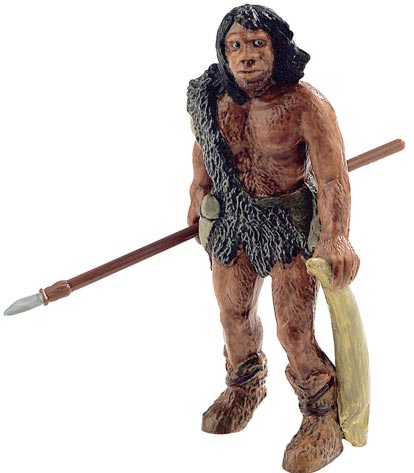
Neanderthals – Extremely Well Adapted to their Environment

Did the large eyes of Neanderthals eventually lead to their extinction?

Did the large eyes of Neanderthals eventually lead to their extinction?

Picture credit: Everything Dinosaur

The picture (above) shows a Bullyland Neanderthal model.  To view the range of Bullyland hominid figures (whilst stocks last): Bullyland Prehistoric World Models.

Theories to Explain Neanderthal Extinction

A spokesperson from Everything Dinosaur stated that a number of theories had been advanced over recent years to help explain the extinction of the Neanderthals and the survival of H. sapiens.  Although, Neanderthals may have had a slightly larger cranial capacity when compared to our own species, their brains may have been “wired” differently.  Smaller family groups, shorter childhoods and a greater reliance on hunting megaherbivores may have all been contributory factors that led to the decline and eventual extinction of this species of hominid.

The scientific paper: “New insights into differences in brain organization between Neanderthals and anatomically modern humans” by Eiluned Pearce, Chris Stringer and R. I. M. Dunbar published in the Proceedings of the Royal Society B.

12 03, 2013

Scientists Uncover Exciting Link Between Spanish and French Dinosaurs in New Research

By |2024-04-29T13:12:55+01:00March 12th, 2013|Categories: Dinosaur and Prehistoric Animal News Stories|0 Comments

Sauropods Nesting in the Same Location for Millions of Years

A team of palaeontologists have documented a remarkable Upper Cretaceous fossil site in Catalonia (Spain) and have discovered that this location was a nesting ground for many types of Late Cretaceous sauropods,  At least four types of long-necked dinosaur eggs have been identified and from the study, published as an academic paper, it seems that the herbivorous megafauna of this part of Catalonia some 70 million years ago was very similar to the megafauna to be found in southern France during the Late Cretaceous.

Dinosaur Eggs

Scientists from the Miquel Crusafont Catalan Palaeontology Institute mapped the exposed Upper Cretaceous sediments in the Coll de Nargó palaeontological site (close to the village of the same name), in the western Catalonian province of Lleida.  Up until this new study, only one type of sauropod egg, that of a titanosaur had been recorded in this region.  This dinosaur is known as Megaloolithus siruguei, eggs attributed to this titanosaur species have been found in at least nine horizons in the Tremp geological formation in this part of the world.  Average number of eggs laid per nest seems to be around 25 but a number of locations have been extensively eroded and Cenozoic plate movements has distorted a number of egg fossil bearing locations so pinning down the average size of a clutch of dinosaur eggs is very difficult.

A Typical Late Cretaceous Titanosaur from Europe (Ampelosaurus)

A typical European Titanosaur from the Late Cretaceous

A typical European titanosaur from the Late Cretaceous.

Picture credit: Everything Dinosaur

The picture above shows an illustration of a typical European titanosaurid dinosaur from the Late Cretaceous – Ampelosaurus.  CollectA have made a figure of this titanosaur, it resides within the CollectA Age of Dinosaurs – Popular model range.

CollectA Age of Dinosaurs – Popular: CollectA Popular Models (Age of Dinosaurs).

A Detailed Analysis

After completing a detailed analysis of more than 25 different fossil bearing horizons in the Tremp Formation, the palaeontologists were able to conclude that there is evidence to support that at least four other types of sauropod used this area as a nesting site.  Scientists have speculated that these large herbivores probably lived in herds and moved around extensively in search of food resources to satisfy their enormous appetites.  It is likely that these reptiles migrated annually to favourite nesting grounds just like many birds and turtles do today.

Lead author of this new research, Albert García Sellés (Miquel Crusafont Catalan Palaeontology Institute) stated that:

“Eggshells eggs and nests were found in abundance and they all belong to dinosaurs, sauropods in particular.  Up until now, only one type of dinosaur egg had been documented at this location, but now we have evidence to suggest four different types of dinosaur.”

Identifying Species

Identifying species of prehistoric animals from just remains of eggshells (and possibly embryos within the fossilised eggs), is referred to as analysing oospecies (working out the phylogenetic relationships between species – a study of ootaxa).  Scientists are attempting to set up the evolutionary relationships between the animals that produced the eggs.  Their work is complicated due to the seismic shifts in the sediments that once were deposited in a sequence of strata linking southern France and northern Spain, before the uplifting of the Pyrenees distorted the geological formations.

The additional oospecies named so far are Megaloolithus aureliensis, Megaloolithus baghensis and in the sister taxa Cairanoolithus roussetensis.

A Museum Exhibit Showing Titanosaur Eggs (Hypselosaurus)

An example of Titanosaur fossil eggs.

An example of titanosaur fossil eggs.

Picture credit: Everything Dinosaur

The Tremp Formation

The strata that make up the Tremp Formation and other adjacent fossil bearing sediments were laid down in terrestrial environments. Although the team can estimate the relative age of the various fossil bearing horizons based on their stratigraphic sequence, the lack of zone fossils, otherwise known as guide fossils, is hampering their efforts to determine the absolute age of the strata and thus, the age of the fossils deposited therein.   In marine sediments for example, small creatures with hard shells such as gastropods, or ammonites can act as biozone markers.  These fossils are relatively abundant, distinct in appearance and they represent relatively rapidly evolving groups – ideal for acting as characteristic zone fossils to help identify the age of rock strata.

Different Types of Eggs

However, it has been noted that the different types of eggs (the oospecies) are located at very specific horizons.  This has permitted the palaeontologists to develop a better understanding of the chronological age of each of the fossil bearing layers of rock.  As a result, the scientists have determined that the rocks in this region represent a period in Earth’s history from 71 million years ago to approximately 66 million years ago (Maastrichtian faunal stage).

The fossilised eggs could contain clues to environmental changes that may have had a bearing on the mass extinction event that took place around 65-66 million years ago.  This location is very significant to European palaeontologists as it provides a window into the very last days of the dinosaurs.  It also shows that the megafauna in northern Spain was very similar to that of southern France during this time in the Late Cretaceous of Europe.

Nesting Colonies

In addition, the great volume of fossilised eggs and their spread across different stratigraphic horizons provides the scientists with very strong evidence to suggest that titanosaurs used this area of Spain as a nesting site for millions of years.  The presence of various oospecies at the same horizon also suggests that different species of titanosaur shared the same nesting area, perhaps in a similar way to many extant sea-birds sharing nesting colonies today.

Fossil strata containing evidence of dinosaur eggs and nests within the Tremp Formation were once part of a continuous low-lying basin that extended for hundreds of miles.  However, the collision of the Iberian and the European plates which began at the end of the Cretaceous and extended into the Oligocene Epoch led to extensive uplifting and the creation of the mountain range that now divides Spain and France – the Pyrenees.

6 03, 2013

Camels of the Arctic

By |2023-02-13T15:47:14+00:00March 6th, 2013|Categories: Dinosaur and Prehistoric Animal News Stories|0 Comments

University of Manchester Team Helps Identify Pliocene Camel Bones from the High Arctic

They may be known as “ships of the desert” and very well adapted to extremely arid environments but the evolutionary history of camels and their close relatives may have their origins in anything but desert habitats.   A University of Manchester team has been assisting a group of Canadian scientists helping to identify a series of fossilised bone fragments found in the High Arctic region of Canada.  The pieces of bone are from a species of giant camel, one that was quite at home in a habitat that was over 79 degrees latitude north, although during the past, when this ruminant roamed, the climate was generally a little warmer than the High Arctic of today.

Giant Camel

The fossilised remains of the camel were discovered in a Pliocene aged deposit located near Strathcona Fiord on Ellesmere Island.  The fossil site known as the Fyles Leaf Bed site has provided palaeontologists with an insight into life in this part of the world around 3.5 million years ago.  Although there may be only one type of woody tree native to Ellesmere Island today (a type of willow),  Ellesmere Island during the Piazencian faunal stage of the Pliocene, in the periods when ice sheets retreated, was a largely arboreal environment dominated by alder, birch and larches.  Sharing this woodland world with the camels were bears, beavers, badgers, rabbits, deer and rodents.

Members of the Research Team Hiking up to the Fossil Site

Team members trek up the slopes on Ellesmere Island to the fossil site.

Team members trek up the slopes on Ellesmere Island to the fossil site.

Picture credit: University of Manchester

An Artiodactyl

Camels belong to a group of mammals known as the Artiodactyls (even-toed hooves).  The first camels are believed to have evolved in the Eocene Epoch, around 55 million years ago and over one hundred fossil species have been identified and named, although the Ellesmere Island discovery represents the furthest north any camel fossils have been discovered to date.

Dr Natalia Rybczynski Carefully Removes a Bone Fragment from the Scree Slope

Carefully removing a fragment of bone.

Carefully removing a fragment of bone.

Picture credit: University of Manchester

Although extant camels are strongly associated with desert environments, these ruminants were much more abundant in grassland and woodland habitats.  Two groups of Artiodactyls (camels and bovoids such as cows) evolved a special way of digesting tough, fibrous plant material – rumination.  Once swallowed, food enters the first of three or four stomachs in the animal.  It is regurgitated and chewed a second time, this is known as chewing the cud.  Thus the plant material is subjected to two physical breakdown processes and these physical/mechanical processes are aided by micro-organisms that inhabit the digestive tract of the ruminant and assist in the chemical breakdown of the plant material, including the cellulose.  The micro-organisms live in a symbiotic relationship with their hosts.

Efficient Processors of Plant Material

Importantly, ruminants such as camels recycle urea, one of the body’s waste products, this is used to help nourish the micro-organisms living in the gut.  As a result of this urea recycling less urine is produced and less water wasted.  This adaptation has enabled animals such as camels to survive in very dry environments such as deserts.  However, as efficient processors of plant material with an ability not to waste too much water, these adaptations gave camels an ability to survive in other habitats that were arid and dry, such as those to be found a high latitudes.

Spotting the Remains of a Prehistoric Camel Can be Quite Difficult

Camel bone fragment in situ.

Camel bone fragment in situ.

Picture credit: University of Manchester

“Collagen Fingerprinting”

The Canadian research team were unsure of the identity of the fossilised bone, which is believed to represent a portion of a tibia (limb bone).  They approached Dr Mike Buckley from the Institute of Biotechnology at Manchester University for assistance as Dr Buckley and his colleagues have developed a new way of pinning down the type of animal from bone evidence.  The technique is called “collagen fingerprinting”, minute amounts of collagen, the main protein constituent of bone had been preserved in the fossils.

By extracting a portion of the preserved collagen, the Manchester University team were able to identify unique chemical markers in the peptides (chains of amino acids) that are present in collagen.  These markers provided the researchers with the unique “fingerprint” that identified the bone pieces as being from an extinct type of camel.

Dr Mike Buckley Carries out the Test for Peptides in the Collagen Samples

Collagen testing.

Collagen testing.

Picture credit: University of Manchester

Once the data had been established, it was simply a case of using results on tests from extant and known extinct animals to find the closest match.  Thirty-seven extant mammal profiles were examined as well as data from the study of an extinct type of giant camel, whose fossilised remains had been found in the Yukon.  The analysis showed that the 3.5 million year old specimen closely matched the data from a modern Dromedary camel, as well as the Ice Age camel remains found in the Yukon.  Using this information, the Canadian team were able to report that the fragments of bone represented a species of giant camel that lived as far north as Ellesmere Island.

A Large Species of Camel

The scientists know that this is a very large species, much bigger than today’s extant Dromedaries as the bone fragments represent a tibia that is nearly a third bigger in the fossil specimen when compared to the tibia in modern-day Dromedaries.  These delicate fragments are currently being stored at the Canadian Museum of Nature’s research and collections facility in Gatineau (Quebec Province).

Dr Natalia Rybczynski of the Department of Palaeobiology (Canadian Museum of Nature), stated that this was an important fossil discovery:

“These bones represent the first evidence of camels living in the High Arctic region.  It extends the previous range of camels in North America northward by about 1,200 kilometres, and suggests that the lineage that gave rise to modern camels may have been originally adapted to living in an Arctic forest environment.”

Conducting an Analysis

The University of Manchester’s Dr Roy Wogelius (School of Earth, Atmospheric and Environmental Sciences) was able to conduct an analysis on the mineral content of the fossilised bone fragments.  His research suggests that it was a combination of the way in which the fossils were permineralised along with the very cold temperatures in that region that permitted the ancient organic remains to be preserved for over three million years.  This is a remarkable discovery, finding bone from the Mid Pliocene that can still yield protein data.

There has been much debate recently over the ability of organic traces to remain viable in the fossil record.  For example, recent research on extinct Moas from New Zealand provided an insight into the proposed half-life of DNA.

To read more about this research: Controversial Research Proposed Half-Life of DNA.

Dr Buckley commented that this was the first time that collagen had been extracted from such extremely old animal remains.  Exclaiming that the project had been a particularly exciting one to work on he was delighted that the type of animal had been identified from the “collagen fingerprinting” technique.

The  Fossilised Camel Bone Fragments (Tibia)

The fragments of fossilised camel bone.

The fragments of fossilised camel bone.

Picture credit: University of Manchester

This research has implications for our understanding of the evolution of the camel clade.  Dr Rybczynski stated that this discovery sheds new light on the evolution of extant camels, perhaps suggesting that primitive camels first evolved in North America.  Specialisations seen in today’s camels such as an ability to store fat, to survive arid conditions and their broad, two-toed feet may be adaptations for living in a dry, polar habitat.


Go to Top