All about dinosaurs, fossils and prehistoric animals by Everything Dinosaur team members.

Fossil finds, new dinosaur discoveries, news and views from the world of palaeontology and other Earth sciences.

19 04, 2013

The First New Dinosaur Discovery in Madagascar for a Decade

By |2023-02-15T18:23:56+00:00April 19th, 2013|Categories: Dinosaur and Prehistoric Animal News Stories, Palaeontological articles|1 Comment

“Lonely Small Bandit” Confirms Hypothesis that Abelisaurid Fossils were Awaiting Discovery

The United States, Canada and possibly Mexico may be able to lay claim as being the home of Tyrannosaurus rex but the island of Madagascar can take ownership of another short-armed Cretaceous terror, with the announcement of the discovery of a new genus of abelisaurid.  Although, very fragmentary and consisting of a handful of vertebrae and bone fragments the fossils are distinct enough for palaeontologists to assign them to a brand new genus of abelisaur, the first new species/genus to be described from Madagascar in almost ten years.

New Dinosaur Discovery

The fossils were found in Upper Cretaceous strata and have been dated to the Cenomanian faunal stage, approximately 90 million years ago.  They were found near to the city of Antsiranana (formerly known as Diego-Suarez), in the Diana region of northern Madagascar.  First evidence of the fossils was discovered in 2007 and a second expedition to extract more fossil material took place in 2010.  It was Dr Joseph Sertich, curator of Vertebrate palaeontology at the Denver Museum of Nature & Science who discovered the dinosaur in a collaborative venture with the Raymond M. Alf Museum of Palaeontology (California, United States).

This new theropod has been named Dahalokely tokana (pronounced Dah-hah-loo-kah-nah), it means “lonely small bandit” in the local dialect, a reference to the size of this dinosaur relative to other known abelisaurids from the Southern Hemisphere and from the fact that when this dinosaur roamed, Madagascar had separated from the landmass of Africa.

An Illustration Showing the Estimated Size of D. tokana

The bones depicted indicate the actual fossil material found.

The bones depicted indicate the actual fossil material found.

Picture credit: Denver Museum of Nature and Science

“World’s Oldest Island”

Madagascar, is regarded by many scientists as the “world’s oldest island”, its isolation for millions of years explains the unique fauna and flora to be found, on what is today the world’s fourth largest island with a total area of more than 2.25 times the size of the United Kingdom.  The researchers have declared this discovery as providing a link between older abelisaurid fossil material and younger fossils dated to near the end of the Cretaceous geological period.  They describe the fossils as helping to plug an important gap in knowledge regarding the evolution of the abelisaurids.

Estimated to have measured between three and four and half metres in length, this bipedal predator may have stood something like one and a half metres high at the hips.  D. tokana is known from a handful of cervical vertebrae (neck bones), dorsal vertebrae, (back bones) and fragments of rib.  Distinct and unique features on the vertebrae led the scientists to assign the fossil material to a new species, representing the first dinosaur to be described from rocks laid down when Madagascar and India were joined together (Indo-Malagasy landmass).

Up to the discovery of D. tokana, no dinosaur fossils from between 165 million years old to around 70 million years of age could be identified and classified down to species level.  This significant gap has been reduced to 165 – 90 million years approximately.

A Student Working on the Dinosaur Excavation in 2010

University of Antananarivo student Liva Ratsimbaholison excavates Dahalokely in 2010

University of Antananarivo student Liva Ratsimbaholison excavates Dahalokely in 2010.

Picture credit: Denver Museum of Nature and Science

New Species of Abelisaurid

Something like two million years after this dinosaur existed, Madagascar split from India.  A rising plume of extremely hot, molten rock began to force its way up into the crust from the mantle under the Indo-Malagasy landmass and this began to stretch the crust forcing it to rift apart.  This rifting led to the separation of India and Madagascar.  The fact that this new species of abelisaurid lived before the split has led to speculation that this type of dinosaur may have been ancestral to the later abelisaurs of India, large super-predators such as Rajasaurus (R. narmadensis) and Late Cretaceous abelisaurs from Madagascar, dinosaurs such as Majungatholus also known as Majungasaurus.

The research team hope to find more fossils of Dahalokely so that they can determine the taxonomic relationships between these different types of carnivores.

A Typical Abelisaurid Dinosaur – Illustrated by Everything Dinosaur

A typical Abelisaurid dinosaur.

A typical abelisaurid dinosaur.

Picture credit: Everything Dinosaur

Cretaceous Theropod Models

CollectA have created a range of Late Cretaceous theropod dinosaur models including several abelisaurids.

To view the range: Age of Dinosaurs Models (CollectA Popular Figures).

Commenting on the significance of this dinosaur discovery Dr Sertich stated:

“This dinosaur was closely related to other famous dinosaurs from the southern continents.  This just reinforces the importance of exploring new areas around the world where undiscovered dinosaur species are still waiting to be found”.

Project leader, Andrew Farke, (Augustyn Family Curator of Palaeontology at the Raymond M. Alf Museum of Palaeontology) said:

“We had always suspected that abelisauroids were in Madagascar ninety million years ago, because they were also found in younger rocks on the island.  Dahalokely nicely confirms this hypothesis.  The fossils of Dahalokely are tantalisingly incomplete, there is so much more we want to know.  Was this dinosaur closely related to the later abelisauroids of Madagascar, or did it die out without descendants?”

Dr Andrew Farke at the Site of the Fossil Discovery (2007)

Dr. Andrew Farke, pointing out the first traces of the dinosaur fossil.

Dr Andrew Farke, pointing out the first traces of the dinosaur fossil.

Picture credit: Denver Museum of Nature and Science

As with many dinosaur discoveries, this fragmentary specimen leaves more questions unanswered than answered but it has potentially provided important evidence linking Indian abelisaurids and Madagascan abelisaurids to a common ancestral form.

Everything Dinosaur is grateful to the Denver Museum of Nature and Science  for their help in the compilation of this article.
18 04, 2013

Coelacanth Gets Its Genome Unravelled

By |2023-02-15T18:16:06+00:00April 18th, 2013|Categories: Animal News Stories, Dinosaur and Prehistoric Animal News Stories, Educational Activities, Teaching|0 Comments

Genome Analysis Shows that the Coelacanth May Not be Too Closely Related to Tetrapods

The genome of one of the most bizarre and enigmatic of all the vertebrates known to science, the coelacanth, has been decoded revealing how this animal may have remained virtually unchanged as a species for millions of years.  The data collected is also helping marine biologists and palaeontologists to understand how closely related the coelacanth group may be to the first land living animals with backbones.

Termed a “living fossil” by many lay people, two extant species are known, one from the waters around Indonesia and a second from the Indian Ocean.  The coelacanth is a member of the actinistian group of fishes, the first of these fleshy-finned fish with their distinctive tails with three lobes probably evolved in the Devonian geological period.  The last of the coelacanths were believed to have become extinct at the end of the Cretaceous period, that is until one was caught by a trawler fishing off the eastern coast of South Africa in 1938.

A Coelacanth Model

Ancient fish model – coelacanth.

Occasionally, specimens of these deep-water fish are caught, although marine biologists have expressed concern about the fate of this strange creature as overfishing and the development of industrial port facilities along the fringes of the Indian Ocean threatens their survival.

Coelacanth

With the genome having been sequenced, scientists are able to understand a little more about how this fish relates to other more advanced teleost fish and to also gain an insight into the evolution of land-living vertebrates, a significant moment in evolution of life on Earth as this led ultimately to the evolution of amphibians, reptiles, birds, mammals and of course, our own species.

The international team of researchers including some from the Broad Institute of the MIT (Harvard, USA), from the Uppsala University (Sweden) and Washington University (United States) were able to sequence and analyse the near 3 billion protein letter combinations from the DNA of the coelacanth as well as examining the RNA from both the African and the Indonesian species.  They then compared this data to the genomes of twenty other species of vertebrate as well as with typical representatives of the lungfish family.  The lungfish comparison would hopefully shed light on the evolutionary origins of tetrapods – were they more closely related to actinistians (coelacanths) or dipnoans (lungfishes)?

Published in the Journal “Nature”

This study, published in the academic journal “Nature” suggests that the lungfish has more genes in common with tetrapods than the coelacanth. It can be inferred from these results that the actinistians, assuming extant coelacanths are representative of this group, are not that closely related to the first animals that dragged themselves up onto the land.

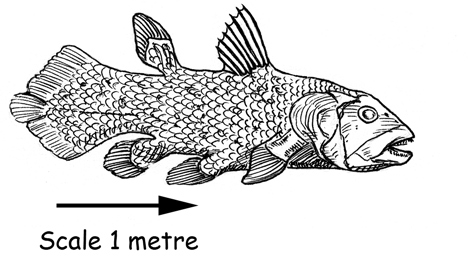
An Illustration of the Coelacanth (Latimeria genus)
Genome of the Coelacanth is Decoded.

Picture credit: Everything Dinosaur

Coelacanth Genome

The genome of the coelacanth is also providing scientists with additional data on how gene sequences may change over time.    The study suggests that some genes may evolve very slowly, this in part would help explain this prehistoric fish’s appearance, it having remained virtually unchanged for millions of years.  Such a stable gene assembly may be attributed to the coelacanth’s habitat and lifestyle.  It lives in relatively deep offshore waters, usually at depths of more than 300 metres.  It may live in sea caves, and it is largely nocturnal moving little during the day and then hunting at night.  The very uniform environment and an absence of other fish species competing for this particular niche in the offshore ecosystem may explain why the coelacanth has had little need to change and evolve over vast periods of time.

The international team of scientists admit there is much more to learn about the transition of vertebrates from water onto the land.  However, the lungfish genome represents more of a challenge than that of the coelacanth.  Although collecting specimens of lungfish is easier, after all, extant lungfish are all freshwater fishes, making them theoretically easier to collect, the lungfish genome is much larger, estimated to exceed 100 billion letters (C G A T), in length.  The more modestly sized genome of the extant coelacanth is permitting scientists to study changes that may have helped the first tetrapods to adapt to a terrestrial habitat.  Comparisons with tetrapods had led the researchers to isolate chains of genes that regulate and control other portions of the sequence, these studied in conjunction with an analysis of what genes are present in the coelacanth but absent in tetrapods has enabled some startling insights to be made.

Identifyin Differences Between the Coelacanth and Tetrapods

A number of immune-related regulatory differences have been identified between coelacanths and land-living animals.  The scientists have postulated that these changes reflect adaptations as a result to new pathogens the first tetrapods encountered as semi-aquatic vertebrates.  Other differences in the genomes provide clues to sensory development, senses such as a lateral line in a fish is not much use to a creature that lives on land.  Genes involved in smell perception and detecting airborne odours have been identified as a result of this research.

Similarities in genetic material have also been found between the marine coelacanth and animals that live entirely on land.  the HoxD strand of genetic material is common between coelacanths and tetrapods.  It is likely that this particular strand of genetic material was a prerequisite to enable the first land animals to develop hands and feet, to assist with locomotion, but as tetrapods evolved and became more specialised, this region of genetic material played a role in the evolution of our own dexterous, tool wielding hands.

Coelacanth Model

Safari Ltd have produced a model of a coelacanth, it forms part of the company’s Wild Safari Dinos & Prehistoric Life model series.  The model measures fifteen centimetres in length approximately and is a fine example of a replica of a lobe-finned fish.  Not only has this model been popular with collectors but it has also proved to be very useful for schools and home educators who have used this model in teaching topics on evolution and life on Earth.

A Useful Teaching Aid – Coelacanth Model
Ancient fish model - Coelacanth

To view the range of prehistoric animal figures: Safari Ltd. Models of Prehistoric Creatures.

One of the more unusual puzzles concerning the move to a terrestrial existence was the way in which waste products from the body were excreted.  Fish excrete ammonia into the water, this gets rid of waste nitrogen.  Land animals evolved a method of converting ammonia into the less toxic urea – the urea cycle, whereby ammonia is converted to the more inert urea, or uric acid.  If ammonia is allowed to build up in cells it will prove toxic to the cell, the researchers found that the most important gene involved in the regulation and control of urea or uric acid production had been modified and was present in tetrapods.

Commenting on the study, Chris Amemiya (Professor at the University of Washington), stated:

“This is just the beginning of many analyses on what the coelacanth can teach us about the emergence of land vertebrates, including humans, and, combined with modern empirical approaches, can lend insights into the mechanisms that have contributed to major evolutionary innovations.”

An International Research Project

This research project brought together a number of institutes and universities, it was a truly international effort, and it is hoped that the publishing of the genome will help to raise the profile of conservation efforts to help ensure the survival of the coelacanth.  A second team of scientists, a joint expedition from the South African Institute for Aquatic Biodiversity and the French National Museum of Natural History set out earlier this month to explore the sea cave home of a population of coelacanths living in the Sodwana Bay area (off the coast of South Africa).  By studying the coelacanth in its natural habitat, the scientists hope to learn more about how these strange creatures use their fleshy fins for locomotion and how they hunt and what prey animals are their preferred food.

To read more about this expedition: Scientists Set Off in Search of the Lair of the Coelacanth.

The scientists responsible for the genome research, acknowledge the importance of their work but also recognise that there is a lot more to learn when it comes to this “living fossil”.  Future studies will help to shed further light on that very significant period in the history of life on Earth when vertebrates first moved onto land.

14 04, 2013

A Chinese Dinosaur that Went for a Swim – Rare Tracks in New Research

By |2024-04-29T13:38:12+01:00April 14th, 2013|Categories: Dinosaur and Prehistoric Animal News Stories|0 Comments

Trackways Preserve Evidence of a Theropod Dinosaur Going for a Swim

A team of scientists from China supported by colleagues from the University of Alberta (Canada), have published a report on a series of dinosaur tracks, one of which indicates that a small theropod dinosaur swam across a river, a rare incidence of dinosaur swimming behaviour preserved as a trace fossil.  The fossilised track is  just one of a series of dinosaur trackways preserved in the Lower Cretaceous strata of the Feitianshan Formation of Sichuan Province (China).

Swimming Theropod Dinosaur

The area has been extensively quarried and unfortunately, many of the footprints have been destroyed but the international team of ichnologists (scientists who specialise in studying footprints and tracks), have been able to identify a series of ornithopod tracks plus the large footprints of a titanosaur (long-necked dinosaur).

It seems that the titanosaur crossed the river at around the same time as the small, meat-eating dinosaur.  The water depth at the time has been estimated to have been about ninety centimetres deep.  For the theropod, that meant a swim, but for the much larger titanosaur, it was able to wade across.

Swimming Trackway

The swimming trackway has been assigned to the ichnogenus Characichnos.  An ichnogenus is a scientific name given to an organism that is only known from trace fossils such as footprints.  Interestingly, similar sized, tridactyl (three-toed) prints have been found preserved on the sandstone substrate that indicate a small theropod dinosaur also walked across the site.  The swimming and walking tracks being found in close proximity has been interpreted as the water depth fluctuating over a short time period.  Additionally, the ornithopod tracks are made up of a series of footprints all moving in the same direction and parallel to each other.  This suggests that a herd or a family group of these plant-eating dinosaurs made their way over the sand.

Evidence of a Swimming Theropod Dinosaur

Evidence of a dinosaur going for a dip.

Evidence of a dinosaur going for a dip.

Picture credit: Chinese Science Bulletin

The picture above shows photographs of the tridactyl claw marks with line drawings showing how these trace fossils have been interpreted by the scientific team.

“Chinese Science Bulletin”

The paper detailing the work on the dinosaur footprints has been published in the academic journal the “Chinese Science Bulletin”.  Unlike the footprints left by the theropod when it walked on land, the swimming tracks just show three scratch marks and the marks left by each foot as it touched the bottom are not equidistant from each other.  This suggests that the dinosaur, estimated to be around two metres in length was swimming, occasionally touching the sandy bottom of the body of water that it was crossing, leaving claw marks where its talons dug into the sand.  Such trackways are very rare, although palaeontologists in Spain have studied a similar set of swimming tracks made by a much larger theropod dinosaur.

To read about the Spanish dinosaur tracks: Dinosaurs Going for a Swim.

Fifteen Metres Long

University of Alberta palaeontologist Scott Persons commented that the swimming trackway was approximately fifteen metres in length, analysis of the claw marks suggested that this little dinosaur was a strong swimmer, using a “doggy paddle” type stroke to propel itself through the water.  The PhD student stated that these trace fossils suggested that this type of dinosaur was a strong swimmer capable of swimming considerable distances, although the water would have been a dangerous place to be as there was the threat of attack from predators such as prehistoric crocodiles.

An Illustration of the Ichnogenus Characichnos

Tell-tale claw marks left in a sandy substrate.

Tell-tale claw marks left in a sandy substrate.

Illustration credit: Nathan E. Rogers

He stated:

“The dinosaur’s claw marks show it was swimming along in this river and just its tiptoes were touching bottom.”

Scott went on to comment that although there was some amazing fossil discoveries being made in China at the moment, Alberta with its extensive exposures of Upper Cretaceous strata such as the Dinosaur Provincial Park Formation, was a great place for a vertebrate palaeontologist to be.  He made the point that there was no need to travel all the way to China to study Cretaceous dinosaurs when within a couple of hours drive of his home he could be right in prime dinosaur bone finding territory.

Dinosaur Models and Figures

Everything Dinosaur stocks a huge range of dinosaur and prehistoric animal models including titanosaurs and small theropod dinosaurs: Everything Dinosaur Models and Figures.

The Chinese research team hope that with the co-operation of the quarry owners they will be able to study more of the tracks and perhaps be able to remove some of them so that they can be put on display at a local natural history museum.

13 04, 2013

Oldest Dinosaur Embryos Discovered in China (New Scientific Research)

By |2024-04-29T13:37:14+01:00April 13th, 2013|Categories: Dinosaur and Prehistoric Animal News Stories, Palaeontological articles|0 Comments

Dinosaur Nesting Site May Have Yielded Ancient Organic Material

A dinosaur nesting site that has been dated to the Early Jurassic is providing a team of international scientists with an unprecedented insight into the growth and development of baby dinosaurs.  A scientific paper, published in the academic journal “Nature” and the cover story of this publication’s latest edition, also states that the research team may have discovered traces of organic remains.  If this is the case and the fossils have not been contaminated by more recent organic material, then this discovery marks the earliest known organic remains of a terrestrial vertebrate.

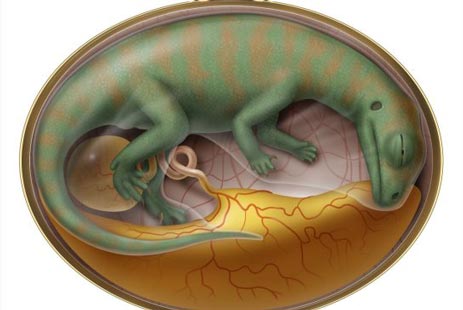
New Research into Baby Dinosaurs

New research into 190 million year old baby dinosaurs.

New research into 190-million-year-old baby dinosaurs.

Picture credit: D Mazierski

The fossil site was discovered by Timothy Huang of the National Chung Hsing University (China) when he was exploring an area of Lower Jurassic aged strata in Yunnan Province (south-western China).  His preliminary investigations led to the discovery of a monotaxic bone bed (an extensive amount of fossil material all assigned to the same species).  The fossils consist of the remains of dinosaur embryos at various stages of development along with the remains of dinosaur egg shell.  The strata represents a dinosaur nesting site.

Fossilised Dinosaur Embryos

Fossilised dinosaur embryos are extremely rare in the fossil record.  The oldest known until the Chinese discovery, are believed to represent the Early Jurassic sauropodomorph of the genus Massospondylus, these fossils were discovered in South Africa, back in 1976.  The South African fossil material was kept in storage for many decades and detailed research into these embryos and their ontogeny (growth rates) was published in 2010.

To read the Massospondylus article: Cracking the Mysteries of the Dinosaur Egg.

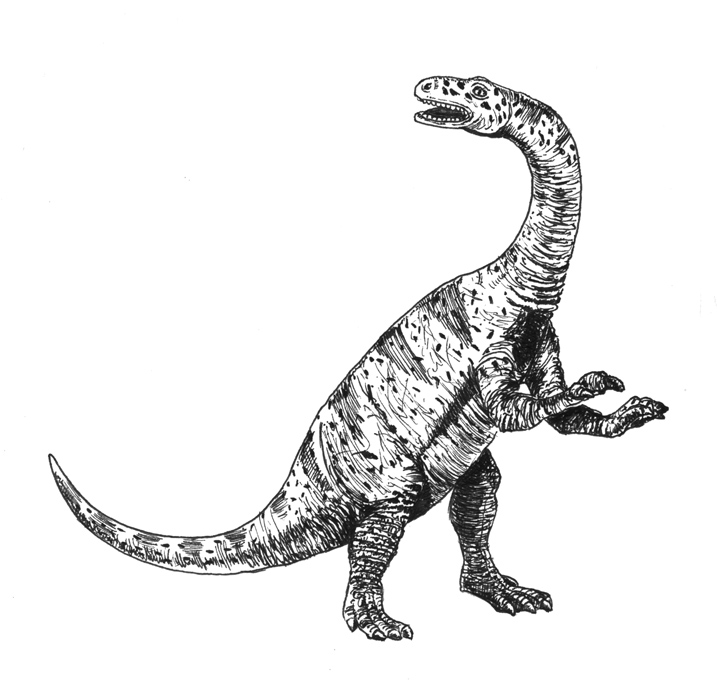
The Chinese embryos represent another type of sauropodomorph.  The joint Canadian/Chinese scientific team have assigned these beautifully preserved fossil remains to the genus Lufengosaurus.  This Early Jurassic dinosaur, closely related to the European Plateosaurus of the earlier Triassic Period, is known from more than twenty fossils of individuals. All these fossils have been found in the same geological formation as the newly discovered nesting site (Lufeng Formation).  Lufengosaurus, was a herbivorous dinosaur which may have reached lengths in excess of eight metres.  It was probably one of the largest dinosaurs living in this part of the world in the Early Jurassic (190-197 million years ago).

An Illustration of an Adult Lufengosaurus

Early Jurassic Sauropodomorph

Early Jurassic sauropodomorph.

Picture credit: Everything Dinosaur

Studying Two Hundred Embryonic Fossil Bones

The initial investigation of the bone bed by Timothy, yielded more than two hundred embryonic fossil bones.  Realising the significance of his discovery he invited Dr Robert Reisz who had worked on the South African embryo fossils to investigate.  Dr Reisz and his team (University of Toronto), working with Chinese colleagues quickly identified that the fossils did not represent a single nest but a number of broods of young, with many at different stages of embryonic development.  This has permitted the team to study the growth and development of a single dinosaur species in great detail.

By comparing the femurs (thigh bones) of baby dinosaurs of different ages the team were able to suggest that these dinosaurs maintained a consistent and rapid rate of growth and development.  For example, the thigh bones of these dinosaurs more than doubled in size whilst still in the egg.  The team’s findings also indicate that sauropodomorphs  had very short incubation times – the embryos grew quickly and hatched fast.

A Stained Cross Section of Embryonic Thigh Bone with Large Pore Spaces Indicating Rapid Growth

This stained sample of a thin cross section of femur suggests rapid growth.

This stained sample of a thin cross section of femur suggests rapid growth.

Picture credit: A. Leblanc

Archosaur Hatching Data

Chickens hatch in about three weeks, whereas crocodile eggs hatch after approximately one hundred days.  The largest living lizard today, the Komodo dragon (Varanus komodoensis) has a much longer incubation period – over eight months.  In addition, tiny muscle scars on the miniature bones indicate that the muscles of these herbivorous dinosaurs were well developed.  This suggests that just like modern birds, baby dinosaurs moved around a lot inside their eggs.  Highly active muscles before hatching suggests that these dinosaurs were far from helpless when they hatched.

It is not known whether these Sauropodomorphs had a precocial habit, the babies being virtually independent from their parents at birth and able to fend for themselves.  Well developed muscles would have helped these young dinosaurs to escape from the nest, to avoid many potential predators and to start to find their own food.

The presence of such large numbers of fossil bones, free from the eggs in which they were formerly contained gave the researchers the opportunity to assess the growth rates of this type of dinosaur from a clade known for its gigantism.  However, the scientists also detected traces of organic remains in the fossil material, astonishing to think that such matter could have possibly survived for 190 million years or so.

Studying Arctic Camels

Back in March, we reported on a joint Canadian and British research project which examined the fossilised remains of prehistoric camels in the High Arctic, although the bone found was extremely fragmentary and represented a tibia (lower leg bone), the research team discovered evidence of collagen present in the fossil.  By extracting a portion of the preserved organic material, scientists from Manchester University were able to prepare a “collagen fingerprint” and when this data was compared to the collagen from extant mammals it was found that the fossil specimen most closely matched the collagen found in camels.  This test helped to confirm that the 3.5 million year old tibia bone was from a prehistoric camel that once roamed high latitudes.

To read about the camel research: Camels of the Arctic.

Dr Reisz and his co-workers claim to have discovered locked deep inside the fossilised bones, evidence of collagen fibres, the main protein constituent of bone.  Organic material usually decomposes very quickly and to find potential evidence of organic material in Early Jurassic vertebrate remains is simply “astonishing” according to some commentators.

The research team hope that they may be able to collect some of this organic material.

He stated:

“We are opening a new window into the lives of dinosaurs.  This is the first time we’ve been able to track the growth of embryonic dinosaurs as they have developed.  The bones of ancient animals are transformed to rock during the fossilisation process, so to find remnants of proteins in the embryos is really remarkable.  If we can extract the collagen, then we can compare it to collagen in living organisms for further studies.  Comparisons can be very valuable in evolutionary studies.”

The potential discovery of such ancient organic material in tiny, delicate fossilised bones of embryos, especially when one considers the porosity of bone material has been described by Dr. Reisz as “mind boggling”.

A “Collagen Fingerprint”

The team hope that if they are able to extract a sample, other researchers such as the University of Manchester research team who analysed the collagen sample from the prehistoric camel, might be able to create a “collagen fingerprint”.  This would allow the prehistoric protein to be compared to the collagen of living vertebrates, perhaps once and for all cementing a link between the Dinosauria and Aves (birds).

The implications for this discovery may indeed be far reaching.  If the remnants of collagen can be found in such an unusual fossil sample, then it might be more common in the fossil record than previously thought.  If small bones could have preserved 190 million year old organic material then much more collagen could be lurking inside other fossil specimens.  This could revolutionise our understanding of the taxonomy of extinct species.

As Dr Reisz commented:

“I suspect that if we start using this methodology elsewhere, we will find it [collagen] more frequently than we think.”

To view models and replicas of prehistoric animals: Prehistoric Animals and Dinosaur Models.

10 04, 2013

New Study Suggest Human Ancestor Had Human and Chimp Characteristics

By |2023-02-15T08:03:19+00:00April 10th, 2013|Categories: Dinosaur and Prehistoric Animal News Stories|0 Comments

South African Scientists Making a Family Portrait of Ancient Hominid Australopithecus sediba

A series of ancient hominid fossilised bones have been at the centre of an intensive research programme as scientists attempt to piece together a better understanding of the evolution of hominids and ultimately the rise of our own species H. sapiens.  Several academic papers have been produced that suggest that the Australopithecine known as Australopithecus sediba had a combination of early human traits and those anatomical characteristics more closely associated with other apes such as chimpanzees.

To read about the discovery of A. sediba: New Fossils May Help Define Human Ancestry.

Australopithecus sediba

One of the 1.95-million-year-old fossils, believed to represent a young male, was nick-named “Karabo” after a competition amongst South African school children to find an appropriate moniker for this important South African fossil discovery.  A seventeen year old student was declared the winner with the “Karabo” name, which means “answer” in the local dialect of the region where the fossils were found. It seems that this specimen and that of a female in conjunction with studies of a single leg bone (tibia) found at the same collapsed cave site are going to help palaeoanthropologists come up with “answers” as to how closely A. sediba is to the line on the hominid family tree that ultimately led to us.

A Reconstruction of A. sediba (Actual Fossil Material is shown in Brown)

Reconstructing the skeleton

Reconstructing the skeleton.

Picture credit: Professor Berger/University of Witwatersrand

Cradle of Humankind World Heritage Site

The fossils were found at Malapa, part of the famous Cradle of Humankind World Heritage Site, which lies just to the north-west of the city of Johannesburg.  The fossils were found back in 2008.  Since then they have been the subject of intense scientific study, with much of the work being carried  out by researchers based at the University of Witwatersrand, which has built up a substantial reputation for research into early hominid fossils.

The fossils were discovered by a University of Witwatersrand field team as they explored the fissures and pits left in the ground after the collapse of the roof of an ancient limestone cave system.  The more complete fossil specimens, a more mature female and a sub-adult male may have died together and it has been speculated that they were mother and son.  They could have stumbled into the pit by accident or become trapped in some other way.  When they died their bodies were washed into a pool and became deposited amongst a large amount of other animal remains including Sabre-Toothed Cats, antelope, hyenas and even birds.

Six Separate Reports

The research teams have produced six separate reports, with each report focusing on a specific area of anatomical research.   This new analysis, summarised in the journal “Science” suggests that A. sediba had a human-like pelvis, very human-like hands and teeth but a foot much more like an extant chimpanzee.

The fossilised skeletal material (juvenile male = MH1), adult female (MH2) and the isolated tibia bone (MH4) was studied so that palaeoanthropologists could establish where in the Australopithecines (southern apes), A. sediba should be placed and in addition, whether or not this particular hominid played a direct role in the evolution of more advanced hominids such as Homo et al or whether this was effectively a sub-branch that led to an evolutionary dead end.

Scientists from Boston University (United States) examined the leg and pelvic bones and assessed A sediba’s locomotion.  This team concluded that this South African species walked in a unique way.   The small heel of the foot, more chimpanzee-like than human, suggests that  Australopithecus sediba walked with an inward rotation of the knee and hip, upright walking but not an efficient form of locomotion.

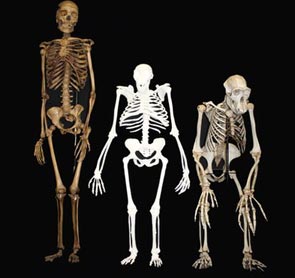
Comparing A. sediba with a Modern Human and a Chimpanzee Skeleton

A. sediba is in the middle, the human to the left of the picture with the chimp skeleton on the right.

A. sediba is in the middle, the human to the left of the picture with the chimp skeleton on the right.

Picture credit: University of Witwatersrand

Primitive Way of Walking

This primitive way of walking might represent a transitional phase from tree climbing limb development to lower limbs more suited to a bipedal form of movement.  Other anatomical features such as the long, strong arms suggest that this species of Australopithecine was at home in the trees and would have been well suited to an arboreal life style but also capable of walking upright.  When compared to other Australopithecine fossils from southern and eastern Africa it seems that some of these ape-men lived in trees, some walked on the ground and some did both.

A team of researchers based at Liverpool John Moores University (Liverpool, England), led by Joel Irish has been studying the dentition (teeth) of this hominid.  Just like other parts of the skeleton, the teeth show both human and ape-like characteristics.  The teeth are similar to another South African Australopithecine, known as A. africanus.  It has been proposed that these two species form a sub-group of southern Australopithecines, distinct from other early hominids that have been found in East Africa.

Wonderful Preservation

Such is the state of preservation of the specimens that Professor Lee Berger (University of Witwatersrand) has been investigating a thin layer of potential organic material found in association with the specimens.  It has been suggested that this represents fossilised skin from these ancient creatures.  Other scientists examined the shape of the ribcage and suggested that the thorax of these creatures was very similar to large simians today.  The proposed shape of the rib cage probably limited these animal’s arm movement when walking or running upright and this would have further hampered their ability to move efficiently as bipeds.

Visit Everything Dinosaur’s website: Everything Dinosaur.

9 04, 2013

Bowhead Whales Reveal Link to the Last Ice Age

By |2023-02-15T07:57:15+00:00April 9th, 2013|Categories: Animal News Stories, Dinosaur and Prehistoric Animal News Stories|0 Comments

Scientists Use  Computer Model to Assess the Future of the Bowhead Whale

The extinction of the large mammalian megafauna that roamed much of western Europe and North America around 11,000 years ago is well documented.  There have been extensive scientific studies undertaken into the extinction of iconic Ice Age mammals such as the Woolly Mammoth (M. primigenius), as the world suddenly warmed at the end of the last glacial period that marked the beginning of the geological Epoch referred to as the Holocene.  However, in comparison, little research had been carried out into how marine megafauna fared with the transition from a cold climate to a much more temperate one.

Studying Ancient DNA

A team of European scientists have attempted to address this imbalance by studying the ancient DNA and extant populations of Arctic Bowhead whales (Balaena mysticetus).  It seems these giant Cetaceans not only survived the end of the last Ice Age but the retreating ice sheets opened up extensive new habitats for these large mammals and their population subsequently boomed.

The Arctic Bowhead whale is the only whale species alive today that spends its entire life in Arctic waters.  Known also as the Russian whale these creatures, some of whom can weigh more than seventy metric tonnes are believed to be the longest lived of all the mammals.  It has been estimated that some individuals can reach the age of two hundred years or more.  These cold-adapted mammals have the thickest blubber of any extant whale species, given their adaptations, the warming of the Earth at the beginning of the Holocene should have spelled trouble for these krill-feeding giants but the research team discovered that those whales that had once swum off the coast of the United Kingdom had a population boom.

The Modern Day Arctic Bowhead Whale

Once swimming in British waters.

Once swimming in British waters.

Picture credit: Dr Andy Foote

Arctic Bowhead Whales

Dr Andy Foote, (Natural History Museum of Denmark) and his co-authors set out to discover how these whales coped with the climate change.  The scientific paper which details their research has just been published in the academic journal “Nature Communications”.

Using DNA from extant whale populations, the team compared this data with DNA extracted from partially fossilised material found in the North Sea.  To the team’s surprise, the fossils found indicate that these mammals lived in the southern North Sea during the last Ice Age.  In total fossil remains from the North Sea and from the waters around Denmark and Sweden were studied.  From this work, a computer model could be created, one that predicted the change in sea ice levels and the subsequent movement of whale populations over thousands of years.

Dr Foote, who is based at the University of Copenhagen (Denmark) commented:

“Based on all previous studies using ancient DNA to estimate the population size it seems the trend was for cold-adapted species either [to] go extinct or decline in numbers at the end of the Ice Age as the temperature increased.”

Prehistoric Mammals

However, whilst the likes of Megaloceros (giant elk), the Woolly Rhino and the Mammoths declined and became extinct it seems that some species of whale actually thrived as the Pleistocene gave way to the Holocene Epoch.  The researchers were able to demonstrate that the Bowhead whales essentially moved their range, migrating northwards to follow the retreating ice.  It is why these creatures are found in the Arctic today, but their numbers are threatened due to hunting and of course the changing climate of our modern world.

To read an article about Woolly Mammoth blood included in a museum exhibition: Canadian Museum to Display Woolly Mammoth Blood.

Dr Kristin Kaschner, a research affiliate at the University of Freiburg (southern Germany), stated that:

“The retreat of the ice in that particular case actually opened up very large areas where you all of a sudden had these ideal habitat conditions for these Arctic species.”

Long Distance Migrations

Marine animals such as members of the whale family are used to migrating very long distances, in this instance the ability to travel great distances probably worked in the mammal’s favour, they were simply able to move to more suitable habitats.  The retreating ice very probably opened up extensive new habitats for them and the population increased as a result.

The scientific data shows that today’s Arctic Bowhead whales can be genetically linked to the same population identified in the fossil material.  These cetaceans have a direct link to whale populations that once swam around the British coast during the last glacial period.

This study does not just reflect on past populations, the model can be used to predict whale populations as climate change threatens the Arctic.  This research proposes that this whale’s “core habitat” will be greatly reduced in the next fifty years or so.  The environment that these whales have to live in could be halved by the end of the 21st century.  If whale populations boomed when the habitat got bigger in the past, then the model predicts with shrinking habitat extinction would be a real possibility.

Loss of suitable core habitat in conjunction with the continued whaling could see the end of the Arctic Bowhead whale.

8 04, 2013

Australia’s First Seal – A Pliocene Pinniped

By |2023-02-15T07:53:32+00:00April 8th, 2013|Categories: Dinosaur and Prehistoric Animal News Stories|1 Comment

Fossil Donation to Museum Helps to Identify Australia’s First Seal

Many museums receive donations from fossil collectors and geologists.  These collections can prove to be invaluable and provide scientists with new material to study as well as providing a safe and secure home for much loved collections that can represent many years of fossil hunting.  One such collection donated to the Museum Victoria (Melbourne, Victoria, Australia), by a keen fossil and mineral collector has helped palaeontologists to identify the first fossil evidence of a seal (Pinniped) on the continent.

Australia’s First Seal

Ross Wilkie of Tooradin, a small town to the south-east of Melbourne, donated the mineral and fossil collection, the majority of which were found in Victoria in the Beaumaris cliffs, an area of Pliocene aged strata located approximately twenty miles from Melbourne.  The seal bone, part of an upper arm (humerus) has been dated to around five million years ago (Pliocene Epoch) and it is very similar in appearance to the equivalent bone in an extant Mediterranean Monk Seal (Monachus monachus).  The Mediterranean Monks Seal is one of the rarest large mammals in the world.

It has been estimated that there are only about five hundred individuals left in the eastern Mediterranean, however, it is remarkable to think that Australia’s first seal fossil should resemble a genus found on the other side of the world and not one from the Southern Hemisphere.

Pliocene Fauna

Dr Erich Fitzgerald, the Senior Curator of Vertebrate Palaeontology at the Melbourne based museum commented that fur seals and seal lions of the Otariidae family live in the waters around southern Australia.  Back in the Pliocene the situation was different, the area was inhabited by a completely different clade of seals, these now are found in the Old World.

Dr Fitzgerald went on to explain that the humerus specimen was very important as it provided evidence of unexpected biodiversity in the Pliocene of southern Australia.

The fossil bone, is just part of a large collection built up over forty years by amateur fossil collector Ross Wilkie.  The collection also consists of fossils of prehistoric dolphins, sharks, whales and even penguins.  The collection will provide scientists with more material to study and it will help them to understand more about the marine fauna that existed in this part of the world approximately five million years ago.  For Mr Wilkie, he was prompted to donate his collection after reading a newspaper article about the importance of fossil finds in the Beaumaris cliffs area.

Amateur Fossil Hunter

Mr Wilkie explained that he has always had an interest in rocks, minerals and fossils, his fascination starting in his childhood, when he came across a fossilised shark’s tooth whilst skin-diving in Beaumaris Bay.  The museum staff are always delighted to receive such donations and they are the first to acknowledge the contribution made to geology and palaeontology by amateurs, after all, if the material was not collected from Beaumaris, it could easily be destroyed by erosion and lost to science forever.

Dr Fitzgerald, praised Ross Wilkie for his kind gesture and stated:

“Palaeontology is one of the few branches of science where literally anyone can make a big impact by finding just one fossil.  By donating his remarkable fossils to a public museum collection, Mr Wilkie ensured they will be studied, which will shed light on their broader significance and preserve them for future generations.”

Prehistoric Animal Models

Everything Dinosuar stocks a wide range of prehistoric animal models.  To view the prehistoric animal model section of the company’s award-winning website: Dinosaur and Prehistoric Animal Models and Figures.

6 04, 2013

Extinction Theory of the Woolly Rhino – Big and Too Heavy for Deep Snow

By |2023-02-15T07:29:21+00:00April 6th, 2013|Categories: Dinosaur and Prehistoric Animal News Stories|1 Comment

Female Woolly Rhino from Late Pleistocene Gives up Her Secrets

The fossilised remains of a female Woolly Rhino which was discovered as a Russian gold mine was extended, is providing scientists with a unique insight into the anatomy of these large prehistoric mammals.  The carcase is so complete that the stomach contents have been studied and a team of scientists from the Russian Academy of Sciences (Yakutsk), have proposed an interesting theory as to why these herbivores from the Ice Age became extinct.

Woolly Rhino

The corpse, preserved in the frozen permafrost, was found during excavations at a gold mine, the fossilised remains of the Woolly Rhino (Ceolodonta) was found at a depth of between five and nine metres.  The fossil was first discovered in 2007 and since then it has been moved from the lower reaches of the Kolyma River were the corpse had laid for the best part of 39,000 years back to a laboratory so that the large specimen could be studied in detail.

Lead researcher, Gennady Boeskorov (Russian Academy of Sciences) stated that the fossil consisted of the head, the two characteristic horns of Coelodonta antiquitatis, much of the body and all four stubbly legs.  The stomach contents had been preserved but most of the other internal organs were absent.  The Russian team have also postulated a new theory to explain the extinction of the Woolly Rhino at the end of the last Ice Age.

Climate Change

The team suggest in a detailed paper published in the academic journal the “Biology Bulletin” that the sudden warming of the atmosphere led to more moisture in the air which subsequently fell as snow or rain.  Heavy snow falls would have made the stubby-legged, heavy footed Woolly Rhino very uncomfortable as they probably could not move very effectively in snow more than thirty centimetres deep.  These animals would have become immobile and the snowfall  may have led to their demise.

An Illustration of a Woolly Rhinoceros

Doomed by deep snow?

Doomed by deep snow?

Picture credit: Everything Dinosaur

Studies of the load bearing properties of the female rhinoceros show that these heavy animals placed a pressure on the ground of 1.8 kilogrammes per square centimetre of the three-toed hooves of this Perissodactyl ungulate.  This is three times higher than a modern-day moose.  This suggests that in snow these animals would have sunk and struggled to make progress in particularly deep snow.

Inability to Adapt

Scientists have thought for sometime that the extinction of Coelodonta was due to their inability to adapt to rapid climate change.  This large, stocky rhino is believed to have been an animal of grasslands or open woodland, where snow would lie on the ground for only a few weeks per year.  Heavy snowfalls due to the rapidly warming atmosphere would have seriously hampered these animals and when the snow thawed, the Woolly Rhinos were probably cut off from other populations by flooding.  Such heavy, short-legged creatures would have become stuck in hollows caused by melting ice and many of them could have died from starvation, drowned in the rising ground water or simply been picked off by predators once they were trapped.

Scientists from the Russian Academy of Sciences studied the anatomy of extant large mammals of the High Arctic, grazers such as the Saiga and the Musk Ox.  They discovered that once snow levels got up to these animals stomachs, they found it very difficult to move.  This suggests that the Woolly Rhino would have had similar problems.

Female Woolly Rhino Carcase

The carcase of this female Woolly Rhino has also given the Russian team a good idea of how this extinct species is related to those rhinos alive today.  They propose that Coelodonta was similar to the very rare Javan Rhinoceros (Rhinoceros sondaicus).  The female probably weighed around 1,500 kilogrammes and as she had two mammary glands it is likely that these large animals gave birth to one calf or very rarely twins.  Their slow breeding could also have led to their demise.

The ears have been preserved on this Woolly Rhino.  They are shaped differently from the ears of modern rhinos.  They are more narrow and lancet shaped, an adaptation to a cold environment where narrow ears would have reduced heat loss from the body.  This is why Woolly Mammoths (Mammuthus primigenius) had smaller ears than today’s living elephants.  A number of western European cave paintings depict Woolly Rhinos and the ears of this Russian specimen are just like those in the cave art.  It seems that these early artists had an eye for detail, especially when it came to depicting these large herbivores.

A Typical Woolly Rhinoceros Replica

Ice Age Rhinoceros. Picture credit: Everything Dinosaur.

Picture credit: Everything Dinosaur

Dr Boeskorov commented that as the Late Pleistocene gave way to the early Holocene, climate change and the threat of increased snow fall would have led to prolonged “white overs” and this may have hastened the demise of this animal.

It was stated:

“It is quite likely [this] factor played an important role in the extinction of the Woolly Rhinoceros.”

With the ice and snow melting, the landscape would have become increasingly saturated with water and pitted with deep hollows and bogs, these would have formed natural traps that the short-legged rhinos could not have got out of.

“In addition, the natural traps presented certain danger for such a short-legged and heavy creature.”

For models of Woolly Rhinos and other prehistoric animals: Papo Prehistoric Animal Models and Figures.

5 04, 2013

Scientists Set Off In Search of Coelacanths

By |2023-02-15T07:23:31+00:00April 5th, 2013|Categories: Dinosaur and Prehistoric Animal News Stories|0 Comments

Sea Caves to be Explored – The Lair of the Coelacanth

A joint French and South African expedition is setting out today to attempt to learn more about the elusive Coelacanth, a fish once believed to have died out with the demise of the dinosaurs and is often referred to as a “living fossil”.  Whilst the term “living fossil”, a phrase once popular with academics during the 19th and 20th centuries, may be out of favour with many scientists today, after all, it implies that some species stop evolving and remain unchanged for millions of years, the Coelacanth remains a truly remarkable fish.  However, very little is known about the habits and behaviour of this relatively deep water predator.

Coelacanth Hunting

The team, a joint expedition of the French National Museum of Natural History (Paris) and the South African Institute for Aquatic Biodiversity intend to explore a series of deep water caves off the east coast of South Africa (Sodwana Bay) which is where a population of these ancient types of fish are believed to live.  Just like a military operation, the expedition has been given a code name – “Gombessa”, the local name for the Coelacanth in fishing communities of the Comoros Islands and the KwaZula Natal coast.

Coelacanths belong to a group of lobe-finned fish known as the Actinistians, part of the larger Sarcopterygian clade, which includes lobe-finned as well as lung-fish.  These fish originated during the Devonian geological period and some of the earliest Coelacanth specimens from the fossil record date to around 375 million years ago.

1938 Sensation

The Coelacanths were thought to have become extinct with the last known fossil genus Macropoma at the end of the Cretaceous period some 65 million years ago.  A Coelacanth was caught off the coast of eastern South Africa in 1938, this caused a sensation.  A trawler boat fishing off the Chalumna river estuary caught a bizarre looking fish in its nets and once the vessel had returned to port, the curator of a nearby museum was notified and it was from her notes and sketches that led to this specimen being identified as a Coelacanth.

Occasionally, these fish are caught by fishermen, catches have been made off the Comoros Islands and other deep water channels off the coast of east Africa.  A second species has been discovered in the waters surrounding Indonesia.  It has been speculated that other populations and species may exist but as these fish live in depths of more than one hundred metres and seem to be mostly active at night, very little exploration of likely habitats has actually been undertaken.

The “Gombessa” Expedition

The “Gombessa” expedition intend to dive around the Jesser Canyon, a relatively deep, sea-water trench in Sodwana Bay.  There are  caves in this area and it is thought that these fish, some of which can grow to more than 1.5 metres in length may lurk in the caves, using them as lairs to hold up during the daytime before venturing out to hunt at night.

The first Coelcanth caught on film was one that was filmed by a BBC Natural History Unit, which happened to be in the Comoros filming for the ground breaking BBC television series, narrated by David Attenborough called “Life on Earth”.  The camera crew were alerted that a Coelacanth had been caught and it was still alive.  The team were able to get some footage of the creature the following morning,  but it was very weak and near death.  More recently some footage of Coelacanths has been shot during deep water dives.

This new expedition aiming to go Coelacanth hunting will attempt to film these animals in their natural habitat using low intensity light cameras.  They plan to take three dimensional moving images of the strange fins of these creatures, perhaps proving or disproving once and for all whether or not these fish actually “walk on their fins”.  The team will also attach harmless acoustic tracking devices so that they can track their movements and learn about where these prehistoric fish go.

A “Lazarus Taxon”

The Coelacanth is an example of a “Lazarus taxon”, an organism once thought to have died out only to be found living in modern times.  Recently, Coelacanth numbers have been causing concern, extensive dredging and pollution in the waters of eastern Africa as the area is developed for commercial shipping in conjunction with increased fishing may have led to a reduction in the Coelacanth population.  The expedition will be working over the next few weeks to try to learn as much as they can about this peculiar fish, in the hope that the knowledge gained may help with their conservation.

Commenting on the scientific importance of the Coelacanth (Latimeria), John F. Graf, a palaeontologist at the Southern Methodist University (Dallas, United States), stated:

“What makes the Coelacanth interesting is that they are literally the closest living fish to all the vertebrates that are living on land.  They share the most recent common ancestor with all of terrestrial vertebrates.”

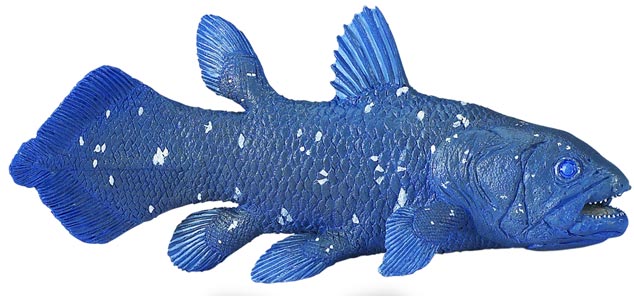
In 2010, those clever people at Safari Ltd introduced a wonderful Coelacanth replica into their Wild Safari Dinos model series.  The model measures a little over sixteen centimetres in length and it is painted a vivid blue.

The Wild Safari Dinos Coelacanth Replica

Ancient fish model – Coelacanth.

Picture credit: Everything Dinosaur

The model is a very accurate depiction of a Coelacanth, the white dots on the model are typical of those seen on extant Latimeria.

To view a Coelacanth model and other prehistoric animal figures (whilst stocks last): Wild Safari Prehistoric World Models.

One of the things the expedition hope to find out is what the dots are for, as all the specimens caught to date have their own unique white markings.  The model depicts the bizarre fringed tail, made up of three distinct lobes perfectly and it is a super detailed replica of a creature which we can trace its origins back to the Devonian.

A spokesperson from Everything Dinosaur stated:

“Diving to depths in excess of one hundred metres can be very hazardous, but the research is desperately needed if we are to understand more about these very ancient creatures.  Data obtained during this expedition could help to protect the existing population and prevent the Coelacanths from becoming effectively extinct for a second time.”

3 04, 2013

Rare Fossilised Feathers Helping to Identify the Colour of Dinosaurs – It’s a Bit of a Blur

By |2024-04-29T06:52:28+01:00April 3rd, 2013|Categories: Dinosaur and Prehistoric Animal News Stories, Palaeontological articles|0 Comments

Shape of Melanosomes and Hence Plumage of Dinosaurs Questioned 

Over the last couple of years or so, a number of scientific institutions have published academic papers revealing evidence of melanosomes preserved in fossil specimens.   As the shape and structure of these microscopic fossil features can provide evidence of the pigmentation and colour of an organism, the geometry of these melanin-loaded specialised elements within a cell, effectively acts as a colour chart for the animal the fossils represent.

Feathered Microraptors – Still Uncertain Regarding Colouration

New research casts doubt over previous colour claims.

New research casts doubt over previous colour claims.

Picture credit: Everything Dinosaur

The Colour of Dinosaurs

Perhaps one of the most famous fossils of all, material ascribed to the Late Jurassic transitional bird/reptile fossil known as Archaeopteryx (Archaeopteryx lithographica) has had melanosome evidence presented.  In this case, a single feather preserved in the fine grained lithographic limestone of the area suggested that the tip of the feather may have been coloured black.  The research was carried out in 2012 and undertaken by a team from Yale University, Brown University, the Carl Zeiss Laboratory (Germany) and the University of Akron (Ohio, United States).

Using extremely high-powered microscopy, the international research team identified the colour of a single fossilised feather, very likely from an Archaeopteryx.  They concluded that the feather, most probably a wing feather was black at the tip.  Their conclusions were based on the geometry (shape) of the remains of melanosome structures that they had observed.

To read more about the Archaeopteryx research: Archaeopteryx – Back in the Black

The Colour of Archaeopteryx Feathers

However, the colour of Archaeopteryx or any other animal in the fossil record with preserved evidence of melanosomes is not quite as “black and white” as it seems.  A new paper, published in the scientific journal “Biology Letters” suggests that over millions of years, the shape and structure of the melanosomes can be distorted under heat and pressure and the fossilised shape may not have much of a resemblance to the structure of these pigmentation organelles when the organism was alive, and in the case of Archaeopteryx, flapping around.

Debate Likely to Continue over the Colour of Archaeopteryx

Wild Safari Dinos Archaeopteryx.

Debate likely to continue over the colour of Archaeopteryx.

To view models and replicas of Archaeopteryx and other prehistoric animals: Wild Safari Prehistoric World Replicas.

Melanosomes Providing a Guide

The theory about melanosomes providing a guide to the colour of an extinct animal is on the surface very simple, but the trick, as with most aspects of palaeontology is the analysis of the data.  Melanosomes contain melanin and these specialised cell structures are present in skin, hair and feather cells.  The colour of the melanosome relates to a specific pigment.

Although the fossilisation process may have degraded all signs of actual colour, the ghostly shapes of the melanosomes themselves are often visible using specific lighting and optical devices such as high powered electron microscopes.  The preserved size, layout and shape can give palaeontologists some suggestions about the original colour in the organism.

Maria McNamara et al (University of Bristol), have published a study which suggests that the properties of melanosomes preserved in such fossils as the remains of dinosaur feathers, could become distorted and therefore provide scientists with misleading clues as to the original colour.  Under Professor Mike Benton (University of Bristol), some of the initial research into the colour of feathered dinosaurs was undertaken.  Professor Benton, in collaboration with Chinese colleagues provided evidence of the first colouration of a member of the Dinosauria back in 2010, when it was announced that the cursorial Chinese Theropod Sinosauropteryx may have been ginger.

To read more about the potential colouration of dinosaurs: Ginger Dinosaurs?

Simulating the Fossilisation Process

Maria and her fellow researchers mimicked the fossilisation process of feathers by simulating burial by placing modern-day bird feathers into an autoclave and then subjecting them to temperatures in excess of 250 degrees Celsius.  The chamber which held the experiment, was pressurised to 250 atmospheres, the intense heat and extreme pressures would be similar to the forces applied to strata and the fossils within them over millions of years.

When the melanosomes were studied under high magnifcation, the structure and shape of many of them had changed.  In effect, they had become distorted and withered.  This could lead to misinterpretations of fossil material if the melanosomes found preserved were taken at face value.

Black Feathers?

Ryan Carney, a research scientist based at Brown University, one of the team members who worked on the Archaeopteryx case study, black feathers and all, commented that shrinkage had been taken into account when he and his co-workers prepared their Archaeopteryx paper.  Their black feather conclusion was based on observations made using hundreds of melanosome structures that the team studied under very high magnification.  Although, the melanosomes may shrink a little during the fossilisation process, their original shape can still be determined by examining an imprint left in the matrix by the organelle (organelle – specialised area of a cell with specific functions).

Referring to the Archaeopteryx study he stated:

“We found that the length and width of melanosomes were significantly smaller compared to those of the imprints, the shrinkage was actually quite similar to that of the McNamara et al experiment”.

McNamara and her team remain confident in the validity of their data and they have provided intriguing evidence which requires careful analysis in the light of the current research.  For example, another important conclusion from this research is that melanosomes survive the heat and pressure of fossilisation even after the destruction of other non-melanin colour traces such as carotenoids (organic pigments, responsible for example for the colour of carrots and apricots).  Carotenoids can create vivid shades of orange, green, yellow, red and blue in feathers, however, in the University of Bristol experiments the multi-coloured feathers tested gave results indicating that they were just black.  This was because their non-melanin organic pigments had been destroyed and only the melanosomes survived to give the false reading of black.

With this conclusion in mind, the discovery of melanosomes in a fossilised feather such as that from a 150 million year old specimen such as Archaeopteryx might not necessarily mean that the original feathers were coloured black, reddish or brown.

McNamara commented:

“The bottom line is that until we understand how the fossilisation process affects these colour-producing chemicals and structures, and until we know how to look for evidence of these in fossils, there’s really no point in attempting to reconstruct colour of feathers based on melanosomes alone.”

Being able to determine the colour of an extinct animal would be very helpful in trying to work out its behaviour or how it reacted to its environment.  Knowing the true colour of a Velociraptor for instance, would enable palaeontologists to assess how it camouflaged itself or used visual signals to communicate with other members of its kind.  If a number of fossil specimens of different aged individuals could be studied, scientists might be able to see how the colouration changed as the animal grew, what differences there may have been between males and females etc.

Examining a Highly Magnified Image Showing Melanosome Structures

Interpretation of melanosomes.

Interpretation of melanosomes.

Picture Credit: Brown University

The Archaeopteryx study also led to some conclusions related to the development of avian flight.  The melanin in the wing feathers may not only have provided colouration but also helped to increased the strength of the feather, very helpful to have strong feathers with core strength if you are trying to evolve into a more active and efficient flier.

There is still so much to learn about fossils, new techniques and new areas of research are providing some astonishing data but we still have a long way to go before we can say definitively what colour a feathered dinosaur may have been.

Go to Top