All about dinosaurs, fossils and prehistoric animals by Everything Dinosaur team members.

Fossil finds, new dinosaur discoveries, news and views from the world of palaeontology and other Earth sciences.

17 01, 2012

Oriental Ornithopods – Enter the Dragons

By |2023-01-25T17:55:09+00:00January 17th, 2012|Categories: Dinosaur and Prehistoric Animal News Stories, Dinosaur Fans|1 Comment

New Species of Plant-Eating Dinosaur From China

The Chinese New Year, the Year of the Dragon, is rapidly approaching and true to form a new dinosaur species is discovered in China.  The newly described species is a plant-eating dinosaur.This part of Asia could lay claim to being the most prolific location on the planet for new dinosaur discoveries at the moment.  Over the last twenty or so years, more new types of dinosaur have been discovered and named than in the proceeding two hundred years.  This new dinosaur, described as a member of the Ornithopoda (bird-hipped dinosaurs – ornithischians) adds greatly to the current knowledge of this type of Chinese dinosaur, as up until now only a handful of Chinese ornithopods have been scientifically described.

Oriental Ornithopods

The dinosaur jointly researched by a team of Chinese and Japanese scientists has been named Yueosaurus tiantaiensis.  A paper detailing the  research work has been published in the scientific journal “Cretaceous Research”.

Known from just a single, well-preserved but incomplete specimen Y. tiantaiensis is believed to have been less than a metre tall, and little more than 1.5 metres long.  It has been described as a basal ornithopod.  The fossils of these types of dinosaur have been found on all continents but fossil specimens from China are rare.  These animals possessed beaks, were probably mainly vegetarian but some species may have eaten insects and small vertebrates.  They had hind legs longer than their front legs, and were probably facultative bipeds, (running on hind legs usually, but moving around on all fours if required).  Most basal ornithopods were gracile and small although their descendants were to become the most widespread and common large plant-eating dinosaurs by the Late Cretaceous.

An Illustration of a Typical Basal Ornithopod

Fast running, new species of Chinese dinosaur.

Picture credit: Everything Dinosaur

Plant-eating Dinosaur

The original fossil material was found in 1998 when construction workers uncovered the remains of this small dinosaur during a road building project in Tiantai county,  in the eastern province of Zhejiang.  The location where this prehistoric herbivore’s remains were found was the inspiration behind the specific name of this dinosaur.  The fossils were intensively studied at the Zhejiang Museum of Natural History and it was from this analysis that the joint Sino/Japanese team were able to ascribe the remains to an entirely new species.

Yueosaurus Tiantaiensis lived during the Cretaceous geological period.  The fossils associated with this dinosaur were removed from strata approximately 100 million years old (Albian faunal stage).  The full name of this new dinosaur, one of half a dozen new species described from Zhejiang province in the last twelve months; means “Tiantai Yue Dinosaur” in Chinese, as it was discovered in the present-day Tiantai county and the region used to be the territory of the ancient state of Yue.  So the name reflects both modern and ancient China.

The new species represents the southernmost basal ornithopod dinosaur discovered to date on the continent of Asia.  It is surprising how few of this type of dinosaur is known from China, especially given the extensive fossil record of animals such as the related hypsilophodontids from North America and Europe.  It could be that small ornithopods are rare in Asia when compared to the Northern Hemisphere for example, or there could be a bias in the fossil record with these small dinosaurs, perhaps being under-represented in the fossil record.

The closest living analogs to dinosaurs such as  Y. tiantaiensis are wallabies, deer and small antelope.  Fossilised burrows found in North America and what would have been the polar regions of Australia suggest that some types of small ornithopods may have lived underground.

For replicas and models of plant-eating dinosaurs and other prehistoric animals: PNSO Dinosaur Models.

12 01, 2012

Dimensions of the New Papo Brachiosaurus Model

By |2023-01-25T15:22:48+00:00January 12th, 2012|Categories: Dinosaur and Prehistoric Animal News Stories, Dinosaur Fans, Everything Dinosaur News and Updates|1 Comment

Brachiosaurus Model Measurements from Papo of France

With the introduction of a new Brachiosaurus replica from Papo of France questions have been asked regarding the actual size of this model.  The Papo Brachiosaurus dinosaur model is due to be released in June/July this year, it is the first sauropod model to be made by Papo for their “Les Dinosaures” range.  This range includes models of small dinosaurs such as Oviraptor and Velociraptor as well as more sizeable ones such as Stegosaurus, Triceratops and T. rex.

The New Papo Brachiosaurus Model

Large size model of a Brachiosaurus (Papo Brachiosaurus).

Picture credit: Everything Dinosaur/Papo

Papo Brachiosaurus Dinosaur Model

The model measures 40 cm in length, it stands 31.5 cm tall and it is 11.5 cm wide.  We estimate that this gives this particular model an approximate scale of 1:55 if the East African brachiosaur material is regarded as representative.   Although there has been a great deal of scientific research carried out on brachiosaur fossil material over the last few years (remembering the Giraffatitan/Brachiosaurus debate), species such as B. altithorax are estimated to be up to 22-25 metres in length.  Based on this data, this would give the new Papo model an approximate scale of 1:55, for example, one centimetre on the model equals 55 centimetres on the actual dinosaur.

To view the sauropod models and other plant-eating dinosaur figures in the Papo “Les Dinosaures” model range, we suggest you visit Everything Dinosaur’s user-friendly and award-winning website: Papo Dinosaur Models.

11 01, 2012

New Google Doodle Commemorates Nicolas Steno

By |2024-04-22T14:02:54+01:00January 11th, 2012|Categories: Dinosaur and Prehistoric Animal News Stories, Educational Activities|0 Comments

Remembering One of the “Fathers of Modern Geology”

Google has commemorated the date regarded by many academics as the birthday of one of the “fathers of modern geology” Nicolas Steno by creating a stratigraphic “google doodle” which is being displayed as the main icon on the google home page.  It may have been the likes of Charles Darwin and Georges-Louis de Buffon that are better known when it comes to Europeans that have influenced the nascent sciences of palaeontology and geology but the contribution made by this Danish academic and member of the Catholic church in the 17th century cannot be underestimated.

Nicolaus Steno, referred to in Denmark as  Niels Stensen, was born 374 years ago today (based on accepted data regarding his actual date of birth).  He lived by the principle that a person should try to investigate the world around them and not simply accept what was written down by others.  His, at the time, controversial views were to lead to disagreements and conflict amongst other scientists and the church.  The conclusions made by Stenos in the course of his life were to challenge the accepted religious doctrine.

Nicolas Steno

Born in Copenhagen (Denmark) in 1638, as a  young man he had the opportunity to travel widely throughout Europe.  His inquiring mind and meticulous observations led him to investigate a very broad range of scientific subjects.  For example, he studied human anatomy and helped to improve medical knowledge.  However, he is perhaps best remembered for his written texts on how layers of sedimentary rock are formed.  He openly challenged the established religious doctrine regarding how old the Earth was and how it was formed.  His published work helped to lay the foundation for the modern science of geology and he is often referred to as “one of the founders of modern geology”.

The Google Doodle – Celebrating the Birth of Nicolas Steno

Remembering the contribution of Nicolas Stenos.

Picture credit: Google

Layers of Rock

The clever doodle is split into the six google letters with each letter being made up of layers of rock.  The different colours of the layers and the fossils in them hint at one of the main tenets of the work of Steno, that layers are laid down in sequence and bizarre objects found in some of these layers such as “tongue stones” are actually the remains of long-dead animals that have been turned to stone (fossilised).

Other scientists in the 17th century, thought that these strange objects we now identify as fossils, simply grew in rock formations.  Nicolaus Steno was not the first academic to consider fossil material but he made an  invaluable contribution to the foundation of geology and established a fundamental principle of stratigraphy (study of rock layers) – that in most cases younger rocks can be found on top of older rocks.

Younger rocks on top of older rocks is the abiding principle of the Law of Superposition, it was Nicolaus Steno who first formulated this law of geology and it is great to see google remembering this important European scientist.

To purchase highly-accurate models of iconic animals from the fossil record like ammonites and trilobites: Toys and Models to Help Learn About Prehistoric Life.

10 01, 2012

A Hidden Benefit of High Speed Rail – Exposing Mesozoic Sediments

By |2023-03-08T14:24:11+00:00January 10th, 2012|Categories: Dinosaur and Prehistoric Animal News Stories, Dinosaur Fans, Press Releases|3 Comments

London to Birmingham High Speed Rail Link Could Lead to new Fossil Discoveries

The first phase of a new high speed rail route linking London to the West Midlands of the UK is likely to be given the go ahead by the Government today (January 10th).  The controversial plan to build a new 100-mile-long, high speed rail link from north-west London through the home counties, up to Birmingham has divided opinion, with supporters keen to see improvements in Britain’s rail infrastructure whilst opponents protest over the cost and the environmental damage the construction may cause.  However, the construction work could expose Mesozoic sediments and lead to new fossil discoveries.

Mesozoic Sediments

The Government’s Transport Secretary, Justine Greening will announce that the first phase of this £32 billion project is to go ahead, a second high speed rail plan linking Birmingham to Leeds and Manchester has been proposed and it has been indicated that by 2033 the UK will boast a super fast rail network connecting London with the north of England, enabling trains to travel in excess of 200 mph.

 An Illustration of the Proposed Rail Route

The geology of the route.

Picture credit: Everything Dinosaur

The proposed route takes trains out of north-west London, through the home counties, north of Oxford and on to Birmingham.  Supporters say that the new link will alleviate overcrowding, improve the UK’s rail infrastructure and boost the economy by a huge amount.  However, opponents are considering legal action in a bid to delay the scheme or to have it postponed altogether.

Cutting Through Cretaceous and Jurassic Strata

The planned rail link will mean that engineers will be cutting through extensive Mesozoic strata, including Jurassic and Cretaceous marine deposits.  Just as with the first railways and before them the construction of the canals, this will expose fossiliferous strata, some of it as yet not fully explored and this could lead to scientists making a number of important discoveries.

Following the rail route from London the rocks get older and older.  Soon the Tertiary deposits of London and much of the south-east are replaced by a belt of Cretaceous aged rocks, and this gives way to Jurassic aged sediments as the rail link extends northwards.  The final part of the first phase of the rail link, the approach to Birmingham will see construction workers creating cuttings and such like through Triassic aged rocks.

If the plans are given the go ahead, an indirect benefit might be the opening up of cuttings and other types of excavation associated with the rail line construction, that could lead to a number of new, exciting fossil discoveries.  Perhaps the fossils of marine reptiles might be exposed, or even a dinosaur’s remains, the last resting place of a carcase that was washed out to sea and settled on the seabed more than one hundred million years ago.

We shall wait to see what develops.

In the meantime, for models and replicas of prehistoric animals from the Mesozoic and elsewhere in deep geological time: Prehistoric Animal Models and Dinosaur Replicas.

7 01, 2012

Stella the Dinosaur Expert

By |2023-01-25T14:59:43+00:00January 7th, 2012|Categories: Dinosaur and Prehistoric Animal News Stories, Everything Dinosaur News and Updates, Press Releases|0 Comments

Children Know their Dinosaurs – Manufacturers Beware!

One of the most frustrating aspects of our jobs is when we come across an item that contains grossly inaccurate or misleading information about prehistoric animals on a product designed for young children.

 As we can all attest to, young dinosaur fans really know their stuff and to find on sale a dinosaur themed toy that confuses and provides inaccurate information is extremely disappointing especially when we spend a considerable proportion of our time offering advice (usually free) to help correct some of the more obvious mistakes.  When we visit schools to teach about dinosaurs we are amazed at the children’s prior knowledge.

Dinosaur Expert

One of the viral phenomena doing the rounds on YouTube and other social network platforms is this short video of a young girl called Stella, pointing out the inaccuracies on a horned dinosaur described on the product packaging as a Triceratops.

It saddens us when we come across instances such as this, young Stella knows her horned dinosaurs and in this short video she points out the dinosaur image on the front of the box does not represent a Triceratops.  She suggests that the picture is more representative of another horned dinosaur, one that is only distantly related to Triceratops, a dinosaur known as Styracosaurus.

As a company made up of teachers and prehistoric animal enthusiasts we marvel at how much knowledge some children acquire when it comes to these extinct creatures.  They seem to be able to absorb information like a sponge absorbs water and we are often corrected when we are working in a school or at a museum if we are seen to get something slightly wrong.  Only yesterday, I was discussing the Jurassic stegosaur Tuojiangosaurus (T. multispinus) with the mother of a five-year-old who had insisted on a model of this dinosaur and had refused a Kentrosaurus replica, because in his words “he knew the difference“.

Selecting a Stegosaur

Good luck to him we say.  A fascination for dinosaurs can open up a whole world of learning for young children.  We have observed reception aged students  reluctant to read any other material but absolutely enthralled with a reference book on dinosaurs, happy to point out to us, which dinosaurs were meat-eaters and where they lived.  It is astonishing how many facts and snippets of dinosaur information they can pick up and woe betide us if we should venture to say something that does not entirely agree with an aspect of the Dinosauria that  they may have read about in one of their many dinosaur books.

An Excellent and Very Informative Dinosaur Book

Children know their dinosaurs.
Aimed at young readers as well as older, general readers. Children known their dinosaurs and excellent books such as “The Great Dinosaur Discoveries” help to feed their desire for knowledge. Picture credit: Everything Dinosaur.

Picture credit: Everything Dinosaur

One of the worst cases we have come across, was discovered whilst visiting a trade show a couple of years ago.  On a colourful exhibitors stand, there was a range of melamine plates, bowls and cups all with a dinosaur theme.   There were pictures of prehistoric animals, plus some brief information, one or two “facts” as it were.  The designers had obviously taken care over their bright and attractive children’s dinner service, I am sure many parents of young dinosaur fans would have been keen to purchase these items for their young, budding palaeontologists.  However, a cursory examination of the “factual”  information revealed some distressing oversights.  For example, the word “Corythosaurus” (a well-known hadrosaur and a dinosaur that is featured in many children’s books and games), was not spelled correctly. In addition, printed around one of the pieces in the set ( we can’t remember whether it was the bowl or the plate), was  a statement that “Brachiosaurus was the biggest dinosaur of all time”.  These inaccuracies distress us.  We did have a quiet word with the sales representative on the trade stand, pointing out these errors, we even offered to help fix the problems, but this was all to no avail.

Children Know Their Dinosaurs

Children deserve better than this.  A love of dinosaurs from an early age can help young children to develop the habit of life-long learning, it is such a shame that a growing number of manufacturers wish to exploit a child’s fascination with all things prehistoric by producing goods that carry misleading images, spelling mistakes and other dinosaur inaccuracies.

We at Everything Dinosaur will continue our efforts and to try to help where we can.  We take care when delivering a dinosaur workshop in school to get our facts straight.  If we don’t then some budding young palaeontologist is bound to point out our error.

To read more about Everything Dinosaur’s dinosaur themed toys and gifts: Visit Everything Dinosaur.

5 01, 2012

New Ichthyosaur Species Swims into View

By |2023-03-08T14:32:14+00:00January 5th, 2012|Categories: Dinosaur and Prehistoric Animal News Stories, Dinosaur Fans, Palaeontological articles|3 Comments

German Discovery – Challenges Ichthyosaur Extinction Theory

The partial remains of an ichthyosaur discovered by a fossil collector whilst exploring cuttings made by a road construction crew in Germany, may hold the key to shedding light on one of the mysteries surrounding the evolution of ichthyosaurs.  After a careful comparison with other known ichthyosaur specimens from Germany, England and the USA, this new creature has been regarded as a new ichthyosaur species and given the name Acamptonectus densus.   The name means “rigid swimmer”.

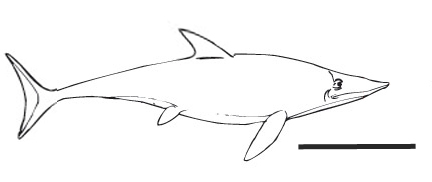
New Ichthyosaur Species

Ichthyosaurs, otherwise known as “fish-lizards” are an Order of reptiles that evolved in the Early Triassic and survived right up to near the end of the Cretaceous.  Ichthyosaurs were fast-swimming, nektonic and predatory marine reptiles.  With their dolphin-like bodies and with the ability to give birth to live young (viviparous), these creatures seemed to have been one of the most successful of all the marine reptile types.

A Model of a Typical Ichthyosaur

Affected by at least 3 major extinction events.

Picture credit: Everything Dinosaur

The picture (above) shows a Safari Ltd Ichthyosaurus replica, to view the rest of the models in this prehistoric animal model range: Prehistoric World Models.

Acamptonectus densus

However, scientists have identified at least three major extinctions that have affected the ichthyosaur Order.  Although the fossil record is far from complete, it is believed that the ichthyosaurs were subjected to the first mass extinction around 200 million years ago as the Triassic gave way to the Jurassic.  The second mass extinction took place as the Jurassic gave way to the Cretaceous around 145 million years ago, where factors such as climate change reduced the number of highly specialised ichthyosaurs surviving into the latter part of the Mesozoic.  The third major extinction event for the ichthyosaur Order took place around 90 million years ago during the Late Cretaceous.  The ichthyosaurs did not survive to the very end of the Mesozoic.

A Table Showing the Approximate Dates of Ichthyosaur Major Extinction Events

Showing the major ichthyosaur extinction events.

Table credit: Everything Dinosaur

It had been thought that the more specialised clade of ichthyosaurs known as the ophthalmosaurs, which had thrived in the Jurassic did not survive the second mass extinction event at the onset of the Cretaceous.  Ichthyosaur fossils found in Cretaceous-aged strata have tended to be representative of a second clade of these “fish-lizards”, known as the platypterygians.

There had been a number of fossil finds recorded from sediments laid down in the Cretaceous that have been ascribed to the ophthalmosaur clade, but these remains have been very fragmentary, so most scientists who had studied the ichthyosaur fossil record did believe that only the platypterygians survived into the Cretaceous geological period.  What caused these extinction events is still debated, but a number of other nektonic marine creatures, including other types of marine reptile also suffered major extinction events around these dates – especially at the Jurassic/Cretaceous boundary.

An Illustration of a Typical Ophthalmosaur Ichthyosaur

Palvennia hoybergeti illustrated
An illustration of the ophthalmosaurid Ichthyosaur Palvennia hoybergeti.

Picture credit: Everything Dinosaur.

The discovery of a much more complete ophthalmosaur ichthyosaur in Germany, provides the best evidence yet that this type of dolphin-like, marine reptile did survive well into the Cretaceous. The specimen, which represents an animal around three metres long has been studied by a number of ichthyosaur specialists. It is believed this marine reptile fed on fish and cephalopods.

A Race Against Time

Private fossil collector Hans-Dieter Macht discovered the specimen whilst collecting fossils at the construction site of a new main road in the Cremlingen area, (Lower Saxony, Northern Germany), in the late spring of 2005. After finding some isolated vertebrae the collector informed the director of the State Natural History Museum at Braunschweig and a formal excavation began. As the need to complete the roadway was pressing, the field team had just three days to study the site and remove any more fossilised bones.

Despite the extreme time pressure the scientists were able to find fragmentary skull material, parts of the jaws, elements from the scapular girdle, pieces of rib, vertebrae and a complete right humerus (upper arm bone).

Ichthyosaur Fossils Provide Evidence of Ophthalmosaurs Surviving into the Cretaceous

The crushed skull of a new species of ichthyosaur.

Picture credit: PLoS One/Fischer et al.

Commenting on the find, the director of the State Natural History Museum (Braunschweig), Ulrich Joger stated:

“With this, an entire extinction theory will be questioned.”

Since the discovery of these bones almost seven years ago, palaeontologists from Germany, Scotland, England and Belgium have compared the skeleton with a similar one found back in 1958 on the north-east coast of England and determined that there is fossil evidence to suggest ophthalmosaurus did indeed survive into the Cretaceous.

The scientific paper: “New Ophthalmosaurid Ichthyosaurs from the European Lower Cretaceous Demonstrate Extensive Ichthyosaur Survival across the Jurassic–Cretaceous Boundary” by Valentin Fischer, Michael W. Maisch, Darren Naish, Ralf Kosma, Jeff Liston, Ulrich Joger, Fritz J. Krüger, Judith Pardo Pérez, Jessica Tainsh and Robert M. Appleby published in PLoS One.

2 01, 2012

Palaeontology Predictions for the Year Ahead

By |2023-01-25T11:11:04+00:00January 2nd, 2012|Categories: Dinosaur and Prehistoric Animal News Stories, Dinosaur Fans, Everything Dinosaur News and Updates, Press Releases|0 Comments

Predictions for 2012

With 2012 already upon us it is time for those brave team members at Everything Dinosaur to stick their heads above the parapet and have a go at predicting some of the news stories and articles we will feature on this web log in the coming twelve months.  Time for us to make some palaeontology predictions for the year ahead.

Palaeontology Predictions

At the start of each year since the Everything Blog began, we have had a go at trying to predict what might happen in palaeontology and other Earth Science fields in the year ahead.  We have to admit to very mixed results when we review what we said at the end of the year.  However, fortune favours the brave as they say, so having put our heads together this is what we have come up with.

1).  New Tyrannosaurid to be Discovered in China

With the amount of field work going on in China at the moment, it is almost certain that a number of new dinosaur species will be discovered, however, we have suggested that a new member of the tyrannosaur family will come to light, perhaps  a Chinese version of the large Late Cretaceous theropods that roamed North America.  Perhaps another huge Tyrannosaurus from somewhere such as the Shandong Province.

2).  Fossil Found in an Unusual Place

With Iguanodon fossils turning up in Sunderland, museum fossil material regarded as “rubbish” turning out to be a new species of dinosaur it is amazing where fossils can be found.  We predict that there will be a news story on such an unusual discovery.  An Allosaurus in an allotment, that would be unlikely, but perhaps somewhere, a strange-shaped stone in a rockery or on a garden path might turn out to be something rather special.

3).  Dinosaurs and the Olympics

With the London Games due to start in a little over 200 days or so, we expect there to be lots of media outlets piggy-backing news and press releases around the Olympics.  Natural History Museums and such like we not be exempt from all this as we get closer and closer to the start of the Summer games.

4).  A High Profile Trial and Conviction for Damage to an SSSI

Incidents where important fossil locations have been damaged due to the activities of unscrupulous collectors will no doubt increase again in 2012, but we predict that the authorities will fight back and there will be news of a conviction in the UK resulting from vandalism from a SSSI (Site of Special Scientific Interest).

5).  Landslip at Lyme

With the cliffs at Lyme Regis becoming more and more dangerous we predict that 2012 will see another major land slip on the Dorset coast.  High tides and high winds will combine to further weaken the rock strata and a significant land slip will result.

6). Up, Up and Away with the Discovery of  a New Pterosaur Genus

2012 is the year of the Dragon in the Chinese calendar, and we suspect that another winged creature will hit the headlines over the coming year.  We suspect that a new species of pterosaur will come to light, perhaps from the Santana Formation of Brazil, or from the South East of Asia, or even Australia.

7).  Advancing Techniques Yield New Data Concerning Dinosaur Skin

Increased use of high tech. facilities once the sole property of NASA will permit palaeontologists to make more amazing discoveries.  High resolution electron microscopy or advanced tomographic systems linked to advanced computer imagery software will reveal more secrets about ancient animals, perhaps even some further information about dinosaur skin and its potential colour.

8).  Land of the Giants – New Titanosaur Discovery in Gondwanaland

Last but not least, our eighth and final prediction deals with the largest terrestrial animals that ever lived.  We predict that in a part of the world that once made up the southern continent of Gondwanaland, scientists will unearth the fragmentary fossilised bones of a new type of titanosaur (long-necked dinosaur).  May be something to rival the “super-heavyweights” of Argentina and Africa.

Well that’s it, it only remains to review what we have said in twelve months time or so, to see how right (or how wrong) we were.

Happy New Year to all our readers.

For dinosaur models, toys and games: Dinosaur Models, Toys and Games.

29 12, 2011

New Papo Prehistoric Animal Models

By |2023-03-08T09:24:23+00:00December 29th, 2011|Categories: Dinosaur and Prehistoric Animal News Stories, Dinosaur Fans, Everything Dinosaur Products|5 Comments

Papo Introduces a Number of New Replicas and One Re-paint (Time to form your Own T. rex Family Group)

The French based figure and model manufacturer Papo have announced their new prehistoric animal models for 2012.  Papo market their prehistoric animals under the “Les Dinosaures” brand, with the introduction of a total of seven new replicas, three of which are not dinosaurs, it may be time for Papo to extend this umbrella branding to include “animaux préhistoriques”. Everything Dinosaur updates customers on new for 2012 Papo prehistoric animal models.

Papo Prehistoric Animal Models

The high standards that collectors have come to expect from Papo have been maintained, and the new introductions brings the total model range to twenty-five (including the two cavemen figures).  There are a couple of retirements. Firstly, the camp fire that we at Everything Dinosaur sold along with the two cavemen figures, this is being retired and we don’t think any more will be available.  In addition, the award winning T. rex with its moving lower jaw is being replaced by a re-painted version – a sort of T. rex with a makeover, the colour scheme will be predominately light brown.

The Re-painted T. rex Model

Award-winning T. rex dinosaur model with a new look.

Picture credit: Papo/Everything Dinosaur

It is fascinating to see how Papo’s designers are modifying their range of prehistoric animal models.  This T. rex has been one of the company’s “flag ship” replicas, and it has proved to be a top selling sculpt over the years.  The re-paint is interesting, with its subtle stripes and dusky colours, perhaps a homage to the origins of the really big Late Cretaceous tyrannosaurs which are believed to have originated from the dry and dusky interior of China, before they migrated into North America.  This model will be available from Everything Dinosaur in February.

Tyrannosaurs have certainly been at the centre of Papo’s design efforts over the last few months, as hot on the heels of the re-paint, comes a brand new sculpt of an adult Tyrannosaurus rex and what a monster it is!

The Green Running T. rex from Papo

Hot on your heels – a running T. rex from Papo of France.

Picture credit: Papo/Everything Dinosaur

A Running Tyrannosaurus rex Model

There are some subtle differences between this new interpretation and the previous model of this iconic dinosaur.  The forelimbs have been slightly re-positioned to reflect the latest thinking regarding their position and the lack of pronation that big theropods had; (the ability to twist their arms and to hold their fingers parallel to the ground).   The eye crests are retained but these are joined by a small, raised ridge that runs from the skull down the neck and the dentition (layout of the teeth) has been altered.  The model is very well balanced and gives the appearance of movement, with T. rex being depicted as a lean and muscular predator.

The first T. rex replica produced by Papo was heavily influenced by the Tyrannosaurus rex that featured in the Jurassic Park film trilogy, our experts at Everything Dinosaur have noticed the influence of another tyrannosaur seen in recent films, in this new replica – the prominent premaxilla and the large teeth resemble the tyrannosaur known as Vastatosaurus rex seen in the Peter Jackson re-make of King Kong that came out in 2005.  The Vastatosaurus rex was interpreted as being a descendant from the North American tyrannosaurs, it was the top predator on Skull Island and the only dinosaur brave and strong enough to tackle the giant ape.  This new model will be available in February 2012.

A Close Up of the Head of the New Papo T. rex

A homage to recent dinosaur movies?

Picture credit: Papo/Everything Dinosaur

The tyrannosaur theme continues with the introduction of two juvenile Tyrannosaurus replicas.  The design team at Papo must have been reading up on recently published scientific papers which postulated that tyrannnosaurs may have been pack hunters, living in small family groups.  The recently refurbished and re-opened dinosaur halls at the Los Angeles County Natural History Museum, features an exhibit of three skeletons of T. rex, an adult, a teenager and a juvenile all feeding off the carcase of a dead Edmontosaurus. This is the first time, that tyrannosaurs have been depicted in a family group.  We think that Luis Chiappe, the Director of the Museum’s Dinosaur Halls would be intrigued to see how Papo have interpreted the young T. rexes.

Baby Dinosaur Models

To view an article on the T. rex exhibition at the Los Angeles County Natural History Museum: Grand Opening of New Dinosaur Halls at Museum.

The Juvenile T, rex (Baby T. rex – Green)

Young T. rex from Papo.

Picture credit: Papo/Everything Dinosaur

The Baby T. rex (Brown Replica) from Papo

A nasty nipper!

Picture credit: Papo/Everything Dinosaur

Our experts at Everything Dinosaur, think the green T. rex represents a slightly older animal, whereas the brown T. rex is a replica of a much younger animal, perhaps less than a year old, if current ontogeny theory (growth rate) associated with Late Cretaceous tyrannosaurs is correct.  The age of the animal can be estimated by looking at the body proportions, note the size of the head in comparison with the rest of the creature.  In both models, the head is raised as if the young creature is looking up at one of its parents, perhaps begging for food or seeking the assurance and protection of an older member of the tyrannosaur family group.

Papo is to be commended for taking the time and trouble to research some of the latest theories regarding tyrannosaurs and then incorporate this research into their figures.

We suspect that just like at the Los Angeles County Museum of Natural History, these T. rex models can be posed so that collectors and dinosaur fans alike can form their own T. rex family group.  All the tyrannosaur models are scheduled to be available from February.

Joining the large Woolly Mammoth available from Papo, comes not one but two baby Mammoths.  The trend to feature prehistoric animals in family groups seems to extend from the tyrannosaurs of the Late Cretaceous right up to last Ice Age with these new Papo models.

The Baby Woolly Mammoth (Standing)
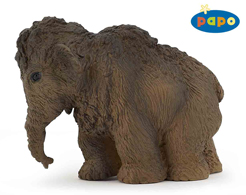
Baby Woolly Mammoth – the new Lyuba?

Picture credit: Papo/Everything Dinosaur

When team members at Everything Dinosaur first saw this picture, we thought “cute” the vulnerability of a young creature in a harsh environment has really been captured by the Papo model makers. This sculpt reminded us of “Lyuba” the remarkable fossilised Mammoth baby found just a few years ago in Siberia.  With the retirement of other hand-painted Mammoth models, these two replicas are very welcome.

Baby Woolly Mammoth (Walking)

Mammoth on the move.

Picture credit: Papo/Everything Dinosaur

Note the humps on the back of these young animals.  Scientists studying the extremely well-preserved remains of “Lyuba” the youngest Mammoth fossil ever found, discovered that these babies did indeed have a hump on the back.  It has been suggested that young Mammoths were able to lay down fat and store it in their bodies, in a similar way to creatures like camels – an adaptation to living in a cold, harsh environment when food supplies were never guaranteed.

To read more about the baby Mammoth known as “Lyuba” and how palaeontologists are finding about the diet of young Mammoths: Baby Mammoth Stomach Contents Under Scrutiny.

Marine reptiles are not left out from the new Papo 2012 collection.  We had known about the introduction of a replica of the fearsome marine reptile Tylosaurus for some time, now we can put up a picture of this model, which will be available from February.

The New Tylosaurus Model from Papo

“Protuberance Lizard” a new replica from Papo.

Picture credit: Papo/Everything Dinosaur

A number of genera of this type of marine reptile are known from the fossil record.  The scaly skin on this replica could be Papo’s way of highlighting the affinity this group of predators have with the Squamata (lizards and snakes).  Tylosaurs are believed to be closely related to modern monitor lizards, although at over fourteen metres long (some species), these extinct creatures are much larger.  It is apt for Papo to introduce a model of a Tylosaurus in 2012, as next year marks the 140th anniversary of the naming of this marine reptile.  This model will work well with the existing Papo marine reptile model (plesiosaurus) that was introduced to the range in 2009.  It will be available in February.

Last but by no means least, comes the largest model that Papo have made in their “Les Dinosaures” range.  In fact, this will be one of the largest models ever made by Papo, and indeed one of the biggest dinosaur models around.  Papo are introducing their first ever sauropod figure, and what an excellent model it looks to be.

Coming out in July 2012, Papo are introducing a model of Brachiosaurus.

The New Brachiosaurus Model from Papo (July 2012)

The new heavyweight champion!

Picture credit: Papo/Everything Dinosaur

The more traditional, elephantine colouring will contrast well with other Macronaria models due to be introduced next year.  The Brachiosaurus is depicted as a very heavy-set, powerful creature and this replica will make an excellent centrepiece for many a collector.  It is due to be released in Summer 2012, just in time for the London Games, looks like we are going to need an Olympic-sized warehouse to store all these new models from Papo.

To view the range of “Les Dinosaures” available from Everything Dinosaur: Papo Prehistoric Animal and Dinosaur Models (Les Dinosaures).

28 12, 2011

A New Theory Regarding our Next of “Fin”

By |2023-03-08T09:25:45+00:00December 28th, 2011|Categories: Dinosaur and Prehistoric Animal News Stories|0 Comments

Early Tetrapods Thrived in Woodlands

In a study published in the most recent edition of the scientific publication “The Journal of Geology”, University of Oregon based researchers are claiming that the first land dwelling, early tetrapods originated in humid, forested habitats.  The scientists claim that they have evidence to suggest that the first types of fish to move around on land lived on wooded flood plains.

Early Tetrapods

Up until the early 1980s, most palaeontologists accepted the hypothesis that fish such as the panderichthyids, from which tetrapods are believed to be descended, made the move out of water onto land as a result of many water courses drying up.  This theory stated that as inland sea, lakes and rivers gradually shrank and eventually dried up, as the climate warmed, the fish that lived in these habitats evolved terrestrial habits and adapted to a life in which greater and greater amounts of time were spent out of the water.

Evidence for the hot Devonian climate can still be seen in many places today.  As water evaporated mineral deposits such as salt were left behind.  These were readily oxidised in contact with the air and this led to the formation of great, red sandstone belts that can be seen in many parts of the world.  The sandstone sea stack, known as the “Old Man of Hoy” is an example of Devonian aged sandstone.

Alfred Romer

One of the most prominent exponents of this “fish onto dry land” theory was Alfred Romer, who died in 1973 after a long and distinguished academic career which saw him serve in the faculties of both Harvard University and the University of Chicago.

However, there have been a number of challenges to this theory.  Many scientists now believe that the first early tetrapods evolved in much more humid and wetter habitats.   According to Gregory J. Retallack (University of Oregon), his discoveries at numerous sites in Maryland, New York and Pennsylvania suggests that Romer and his supporters got it wrong when they postulated on fish adapting to a drier climate.

Professor Retallack, believes that his own studies show that the first land-dwelling tetrapods evolved in much more wet and humid environments – wooded floodplains.

He stated:

“Such a plucky hypothetical ancestor of ours probably could not have survived the overwhelming odds of perishing in a trek to another shrinking pond.”

During the Late Devonian, there was no immense struggle to escape drying water courses in order to ensure survival, according to the Professor.  In this new study, he argues for a very different explanation.  The Professor examined numerous buried soils in rocks yielding footprints and bones of early transitional fossils between fish and amphibians of Devonian and Carboniferous geological age.

What he found raises a major challenge to Romer’s theory and supports later theories put forward over the last thirty years or so that suggest that limbs did not develop from the paired fins of the Panderichthyids to help creatures walk on land, but they probably evolved to help these animals crawl over plant stems and logs in clogged up water courses.

The Professor commented:

“These transitional fossils were not associated with drying ponds or deserts, but consistently were found with humid woodland soils.  Remains of drying ponds and desert soils also are known and are littered with fossil fish, but none of our distant ancestors.  Judging from where their fossils were found, transitional forms between fish and amphibians lived in wooded floodplains.  Our distant ancestors were not so much foolhardy, as opportunistic, taking advantage of floodplains and lakes choked with roots and logs for the first time in geological history.”

During the Late Devonian and Early Carboniferous, extensive swamps and lowland forests evolved.  It is the preserved remains of these huge areas that have helped form the immense coal deposits found in Europe and elsewhere in the world.

The Professor’s study supports the theory of a wet, watery world from which the first tetrapods evolved to exploit these forested habitats.  Limbs would prove “handy” (no pun intended), for negotiating fallen logs and other obstacles, whilst flexible necks allowed for feeding in shallow water.  By this new woodland hypothesis, the limbs and necks, which distinguish salamanders from fish, did not arise from “reckless” adventure in deserts, but rather were nurtured by a newly evolved habitat of humid, wooded floodplains.

The findings, Retallack said, dampen both the old desert hypothesis of Romer and a newer inter-tidal theory put forth by Grzegorz Niedbwiedzki and colleagues at the University of Warsaw, after the discovery of some remarkable Late Devonian trace fossils of early tetrapods found in ancient, preserved, lagoonal mud found in southeastern Poland.

To read about the Polish discovery: From the Water and Onto the Land – Thirty-Five Million Years Earlier.

In 2010, the Polish team published their discovery of evidence suggesting the existence of 2.5-metre-long, 395-million-year-old tetrapods in Late Devonian strata.   The track-ways they uncovered suggest that some types of animal may have been capable of venturing out onto land many tens of millions of years earlier than previously thought.

As with the desert pond theory, postulated by Romer,  this new hypothesis also proposes that fish gradually developed an adaptation of their existing swim bladder into a rudimentary lung that allowed them to survive for longer periods out of water.  That happened about the same time as paired fins were developing into true limbs.

Another advantage that the new tetrapods had was a lack of any land-based predators to discourage their early perambulations.   Given that these were no “small fry” but in some cases, creatures almost a metre long, they faced no danger from bigger fish in the sheltered inlets and oxbows of a flooded woodland.

Fish in woodland habitats, whatever next?

For models and replicas of prehistoric animals: Models and Replicas of Prehistoric Animals (CollectA).

27 12, 2011

Made in China – The Evolutionary Origins of Multi-cellular Life Forms

By |2023-03-08T13:58:26+00:00December 27th, 2011|Categories: Dinosaur and Prehistoric Animal News Stories, Palaeontological articles|2 Comments

Chinese Fossils shed Light on Single-celled Ancestry of Animals

An international team of scientists have published a remarkable paper detailing their research into an amazing, microscopic fossil that provides evidence of the single-celled ancestor of all complex animal life forms.

The fossil shows an amoeba-like organism dividing in asexual cycles, first to produce two cells, then four, eight, sixteen, thirty-two and so on.  The pattern of cell division is very similar to that found in animal embryos, including our own human embryo – but the fossil dates from approximately 570 million years ago, from a geological period known as the Ediacaran (Proterozoic Eon).

The term Proterozoic means “earlier life” in Greek, and this eon covers the time between 2.5 billion years ago up to the beginning of the Cambrian geological period around 542 million years ago.  Scientists know that over this immense period of time, life on Earth slowly became more diverse and complex – although all life remained on the microscopic scale up until almost the end of this eon, a time referred to as Neoproterozoic era.

The activity of photosynthetic microbes, transformed our planet providing it with an oxygenated atmosphere, this had first begun in the Archean Eon, but this process continued and in conjunction with climatic changes, simple life forms started to become more abundant.  Although, Natural History museums, focus on vertebrate life forms such as dinosaurs and Woolly Mammoths for example, the evolutionary events taking place during the Proterozoic era had a much more significant impact on life on Earth.

During the Proterozoic, cells gradually became larger, more diverse and specialised.  Eukaryotes (cells with a nucleus) began to dominate and feeding by ingestion that would eventually lead to the evolution of a gut and digestive system took place for the first time.  The transformation of simple cells into these more advanced, specialised cells was probably the longest and hardest step in evolution – demonstrated by the fact that as the Proterozoic gave way to the Phanerozoic (visible life) Eon, there was to be a huge acceleration in evolution – known as the Cambrian explosion.

Fossil evidence of the single-celled ancestors of animals are extremely rare. However, an international team of scientists have discovered such a set of fossils in rocks dating to around 570 million years ago – Middle Ediacaran Period.  The fossils were unearthed in southern China.  The paper on this discovery has just been published in the journal “Science”.  The research team was made up of scientists from the Paul Scherrer Institute, the Chinese Academy of Geological Sciences, Bristol University and the Swedish Museum of Natural History.

Computer Generated Image of Micro-Fossil Undergoing Division

Meet your earliest Ancestor?

Picture credit: University of Bristol Press Release

The computer generated and enhanced image shows 570-million-year-old multi-cellular spore body undergoing vegetative nuclear and cell division (foreground) based on synchrotron x-ray tomographic microscopy of fossils recovered from rocks in South China.  The background shows a cut surface through the rock – every grain (about 1 mm diameter) is an exceptionally preserved gooey ball of dividing cells turned to stone.

Single-celled Ancestry

One theory as to the origins of complex life on our planet, proposes that sophisticated eukaryotic cells evolved by the symbiotic fusing of different kinds of bacteria.  For example,  bacteria capable of fermenting substances merged with swimming, mobile bacteria and the resultant life forms, over hundreds of millions of years merged with oxygenating bacteria and some of these life forms were to become the ancestors of the Animal Kingdom.

However, fossil evidence of these major evolutionary transitions is extremely rare.

The fossils, studied by the international team show in remarkable detail the stages the life cycle of an amoeba-like organism dividing in asexual cycles.  Ultimately resulting in hundreds of thousands of spore-like cells that were then released to start the cycle over again.   The pattern of cell division is so similar to the early stages of animal (including human) embryology that until now they were thought to represent the embryos of the earliest animals.

Using advanced sophisticated X-ray scanning techniques the scientists were able to view the organisation of cell structures within their protective cell walls.  These delicate structures should not have been fossilised but within their marine environment, they became buried in sediments rich in phosphates and it was these phosphates that impregnated the cell membranes, turning them into stone.

Imagine a 570-million-year-old tomb, within which can be found microscopic evidence of cell division.

Lead author on the subsequent research paper Therese Huldtgren, a doctoral student at the Department of Palaeozoology, at the Swedish Museum of Natural History, Stockholm, Sweden commented:

“The fossils are so amazing that even their nuclei have been preserved.”

The powerful X-ray microscopy methodology used by the team revealed that the fossils had features that multi-cellular embryos did not  This led the researchers to the conclusion that the fossils were neither animals nor embryos but rather the reproductive spore bodies of single-celled ancestors of animals.

The team used a gigantic microscope in Switzerland to see inside the fossils.  This machine is called the Synchrotron, and it is housed in a building the size of a football stadium.  It is the one of only a handful of machines of its kind that can produce X-ray images of the magnification and clarity to permit scientists to study micro-fossils in great detail.

Powerful generators fire high-energy electrons around a circular tube, at phenomenal speeds (close to the speed of light).   As they travel, they emit X-rays that are so strong that they can penetrate solid rock, and the tiny microscopic fossils, allowing scientists to build up a three-dimensional image of the primitive organism represented by the fossil material.

Professor Philip Donoghue, Professor of Palaeobiology at the School of Earth Sciences, (University of Bristol), stated:

“We were very surprised by our results.   We have been convinced for so long that these fossils represented the embryos of the earliest animals, much of what has been written about the fossils for the last ten years is flat wrong.   Our colleagues are not going to like the result.”

Professor Stefen Bengtson,  Professor of Palaeozoology, at the Swedish Museum of Natural History, Stockholm added:

“These fossils force us to rethink our ideas of how animals learned to make large bodies out of cells.”

Prior to this research such images were interpreted as being the embryos of early animals, sponges or perhaps even the cells of sulphur-oxidising bacteria.  Looking at and interpreting the preserved remains of organisms more than 550 million years old which measure just a few microns across is at the cutting edge of palaeobiology, but the team are confident about their findings.

Which Kingdom are You?

Animalia, Plantae, Fungi etc.

Image credit: S. A. Museum

The picture above shows another example of a micro-fossil from China.  This too dates from the Late Proterozoic Eon.  Prior to this new research such fossil images were thought to represent a number of organisms, including embryos of animals that can be found in the Ediacaran fauna, but now some images produced by high-powered X-ray tomography are being interpreted as evidence of the evolutionary origins of multi-cellular life forms.

For models and replicas of prehistoric animals including ancient invertebrates: CollectA Prehistoric Life/Age of Dinosaurs Models.

Go to Top