All about dinosaurs, fossils and prehistoric animals by Everything Dinosaur team members.

Fossil finds, new dinosaur discoveries, news and views from the world of palaeontology and other Earth sciences.

22 12, 2011

Winton Dinosaur Museum gets $100,000 Australian Dollars in Special Grant

By |2024-04-22T14:02:14+01:00December 22nd, 2011|Categories: Dinosaur and Prehistoric Animal News Stories|0 Comments

Dinosaur Museum gets Big Financial Boost

Winton in Queensland (Australia) is at the very centre of some important dinosaur research with a number of new dinosaur species having been discovered in recent years.  Now the town is one step closer to getting a world-class dinosaur themed visitor attraction after the Queensland State Government granted an additional $100,000 Australian dollars in funding towards the Winton Dinosaur Museum.

Winton Dinosaur Museum

The Member for Mount Isa, Betty Kiernan, made the announcement yesterday in Winton, north-west of Longreach.  Before the many dinosaur discoveries, Winton’s chief claim to fame was that it was the town where the famous Australian song “Waltzing Matilda” was written.

For models and replicas of Australian dinosaurs and other prehistoric creatures: CollectA Age of Dinosaurs and Prehistoric Life Models.

The Australian Age of Dinosaurs has been planning and constructing the museum east of Winton for several years and is hoping to open stage two by April 2012.

Spokesman David Elliott says the funding will pay for an operations manager to oversee the project for another year.

He stated:

“It is in a bit of a critical stage at the moment with stage two just opening its doors and we’ve put all our resources into that and we have cut ourselves to the bone to do it.  We’ve just got to get back on top now so we can start consolidating, so I am really, really happy about it”.

Commenting on the additional $100.000 dollar contribution David added:

“It is just good to be able to get this support at a time when we’ve put so much money out to pay for variations on the building.”

Although, Winton is relatively remote, it has become a centre for dinosaur research due to the extensive Cretaceous strata that is exposed in the region, leading to the discovery of a number of new dinosaur genera.

To read about some of the dinosaur discoveries found in the Winton area: A Trio of Dinosaurs from Down Under.

21 12, 2011

All the Better to See You – The Superb Vision of Anomalocaris

By |2023-03-08T14:11:47+00:00December 21st, 2011|Categories: Dinosaur and Prehistoric Animal News Stories|0 Comments

Analysis of Compound Eye Fossil Indicates that Apex Predator had Fantastic Vision

Back in June, team members at Everything Dinosaur wrote a brief article on the remarkable research being undertaken by South Australian Museum and University of Adelaide scientists working on fossils of compound eyes dating from more than 500 million years ago.  The fossils from the Emu Bay area of Kangaroo Island show that by the Middle Cambrian some invertebrates had evolved very sophisticated vision, much better than many types of extant insects and crustaceans and perhaps at least as good as those aerial masters the dragonflies.

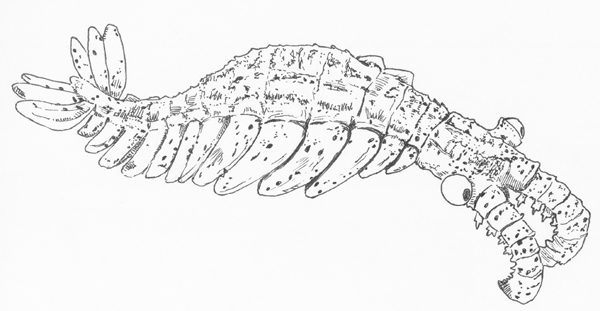
An Illustration of Anomalocaris

Anomalocaris
Anomalocaris drawing. Picture credit: Everything Dinosaur.

Picture credit: Everything Dinosaur

This months edition of the scientific journal “Nature” will contain a feature on the work of the research team and the front cover will consist of an artist’s impression of the super predator that the compound eyes probably belonged to – the world’s first apex predator – Anomalocaris.

To read the earlier article on the Kangaroo Island fossils: World’s Oldest Fossil Eye Discovered in Australia.

The international team behind this study includes two Adelaide researchers Associate Professor Michael Lee (South Australia Museum and University of Adelaide) and Dr Jim Jago (South Australia Museum).  From our understanding of the fossil evidence, the advanced compound eye probably belonged to the largest predator known from strata dating from the same geological period – Anomalocaris.  This invertebrate, a member of the Arthropoda, the largest phylum of animals is distantly related to crustaceans such as lobsters and shrimps.

At up to a metre in length, this is the largest animal known from Cambrian strata.  Fossils ascribed to  Anomalocaris have been found in Southern China as well as these from Australia that the scientists studied, but perhaps most famously, this fierce predator is associated with the Burgess Shale deposits of British Columbia (Canada).

Anomalocaris

Anomalocaris is the stuff of nightmares and sci-fi movies.  It is considered to be at the top of the earliest food chains because of its large body size, formidable grasping claws armed with sharp spikes and a circular mouth positioned under the head with its razor-sharp serrations.

Fossils of trilobites contemporaneous to Anomalocaris fossil material are testament to this formidable predator.   Some of the trilobite fossils show signs of severe damage and there has even been some five hundred million year old fossilised poo (coprolite) containing crushed and smashed pieces of trilobite exoskeleton – the remains of an Amomalocaris meal perhaps?

The discovery of superbly preserved eye fossils, the remains of the calcite based compound eyes that were supported on the end of a stiff stalk each side of the head, show astonishing detail of the optical design.  Having excellent vision, far better than its prey would have given animals like Anomalocaris a huge advantage when hunting.  Bio-mechanical studies have shown that Anomalocaris was nektonic (free swimming), but not a very fast swimmer.  However, with much more advanced eyesight than most of its prey, this armoured giant of the Cambrian seas would have been a very effective hunter.

Compound Eyes

The fossils represent compound eyes – the multi-faceted variety seen in arthropods such as flies, crabs and such like.  However, the fossils represent compound eyes that are up to three centimetres in diameter.  They are amongst the largest to have compound eyes ever to have evolved.  Each eye contains up to 16,000 individual lenses, that is like having two 16-kilo pixel cameras perched on stalks either side of the head.  This would have given this predator excellent almost 300 degree vision.

The number of lenses and other aspects of their optical design suggest that Anomalocaris would have seen its world with exceptional clarity whilst hunting in well-lit waters.  Only a few arthropods, such as modern predatory dragonflies, have similar resolution.

The international research team conclude that the existence of highly sophisticated, visual hunters within Cambrian communities would have accelerated the predator/prey “arms race” that began during this important phase in early animal evolution over half a billion years ago.  Such a predator/prey relationship would have helped to speed up evolution, perhaps helping to explain the rapid diversification of marine animal forms during this geological period.

Powerful Compound Eyes

The discovery of powerful compound eyes in Anomalocaris confirms it is a close relative of arthropods, and has other far-reaching evolutionary implications. It demonstrates that this particular type of visual organ appeared and was elaborated upon very early during arthropod evolution, originating before other characteristic anatomical structures of this group, such as a hardened exoskeleton and walking legs.

The superb artwork, that is featured on the front cover of “Nature” was painted by Adelaide based artist Katrina Kenny.  Katrina has a passion for fossils and her love of the subject plus her skills in biological illustration have helped bring back this fearsome predator of the Cambrian.  The painting was commissioned by the University of Adelaide.

The South Australia Museum and the University of Adelaide have summarised the research in a short video.

To view models and replicas of ancient arthropods, including Anomalocaris (whilst stocks last): CollectA Age of Dinosaurs Popular Figures.


19 12, 2011

Titanosaurs of the Antarctic

By |2023-01-25T09:50:18+00:00December 19th, 2011|Categories: Dinosaur and Prehistoric Animal News Stories|0 Comments

Research Team Reveals Evidence of Titanosaurs Having lived in Antarctica

The discovery of a single, fossilised bone could help scientists solve a puzzle concerning the largest land animals of all time – the sauropods.  Fossils of these giant, long-necked dinosaurs have been found on every continent, except one, the land mass of Antarctica.  However, a team of Argentinian scientists have unearthed evidence that one group of sauropods – the titanosaurs may have roamed the southernmost continent after all.  A newly published study suggests Antarctic titanosaurs.

Antarctic Titanosaurs

The fossil, believed to represent a portion of the dinosaur’s tail (caudal vertebra), was discovered on James Ross Island by an Argentinian-led team.  The bone measures almost twenty centimetres in length and is believed to have come from the middle third of the dinosaur’s long tail.  Although, it is not possible to identify the dinosaur genus from such a fragment of the skeleton, the scientists have stated that the bone probably belongs to a “lithostrotian titanosaur”.  The Lithostrotia are a clade of titanosaurs (a group of anatomically and probably closely related, similar titanosaurs), which are associated with Upper Cretaceous strata from South America and Madagascar.

The discovery was first presented at a recent palaeontological conference held in Nevada, but it has just been published in the German scientific journal -Naturwissenschaften  (translates as “The Science of Nature”).

Authors Dr Ignacio Alejandro Cerda, from the Conicet research institute in Argentina, and colleagues wrote:

“Our finding indicates that advanced titanosaurs achieved a global distribution at least by the Late Cretaceous.”  

During the Cretaceous the super-continent of Gondwanaland in the Southern Hemisphere continued to break up, Antarctica had once formed part of this huge landmass along with India, Australia, South America and Africa but by about ninety million years ago, only Australia remained joined to Antarctica.  As the break up continued, the land bridges that connected Antarctica to Australia became more and more tenuous until by the end of the Cretaceous, Antarctica was isolated.  For much of the Cretaceous Antarctica was covered by lush, conifer and fern forests and it was much, much warmer than it is today, for this remaining part of Gondwanaland was heated as a result of ocean currents sweeping down from the equator.  However, by the Late Cretaceous the climate on Antarctica had begun to change dramatically and this landmass became much colder.

An Illustration of a Typical Titanosaur (Saltasaurus)

Scientists don’t know whether the Antarctica titanosaur had dermal armour.

Picture credit: Everything Dinosaur

A Single Fossil Vertebra

The discovery of this single vertebra raises intriguing questions.  For example, if there was a large, herbivorous dinosaur living on what was to become Antarctica as late as seventy million years ago (Campanian faunal stage), then the flora must have been rich enough to support such large animals.  If there was a large herbivore in the ecosystem, could there have been a large, theropod predator?  Perhaps a “living fossil” such as an allosaurid, a type of meat-eating dinosaur that had become extinct elsewhere in the world by the end of the Cretaceous but may have hung on in isolated pockets where other theropods such as abelisaurids or tyrannosaurs could not reach due to the lack of land bridges.  This is further prove that dinosaurs lived in Antarctica.

There have been fossils of other long-necked dinosaurs found on Antarctica before, but as far as we at Everything Dinosaur know, these fossilised bones represent very primitive, early members of the Sauropoda family, know as Sauropodomorpha.  An example would be the Early Jurassic Glacialisaurus which was discovered in 2007.

To read more about the discovery of this early, long-necked dinosaur: Primitive Long-necked dinosaurs from Antarctica.

The authors conclude in their paper:

“Our discovery, and subsequent report, of these sauropod dinosaur remains from Antarctica improves our current knowledge of the dinosaurian faunas during the Late Cretaceous on this continent.”

The Fossilised Bone and Illustrations showing the Complete Vertebra

Twenty centimetre long fossil bone reveals presence of advanced Titanosaurs in Late Cretaceous Antarctica.

Picture credit: Cerda/Naturwissenschaften

The picture above shows the fossil bone (pictures a-c) with illustrations (d-f) showing the fossil fragments in association to the rest of the single tail bone.  The fossil is actually a centrum (central, cylindrical component of a vertebra).  It is the concave/convex shape of the anterior and posterior portions of the centrum that have enabled scientists to identify this fossil bone as belonging to an advanced titanosaur from the lithostrotian clade.

The picture shows the caudal vertebra centrum viewed from the front (anterior view) in “a” and “d”; viewed from the right side (right lateral view) in “b” and “e” and finally from the rear (posterior view) in “c” and “f”.

To view prehistoric animal figures including titanosaur dinosaurs: Wild Safari Prehistoric World Replicas.

18 12, 2011

Strange Place to Find an Iguanodon Bone – Sunderland

By |2023-01-25T09:40:05+00:00December 18th, 2011|Categories: Dinosaur and Prehistoric Animal News Stories|0 Comments

Pensioner Unearths Iguanodontid Bone in Sunderland Garden

Iguanodon fossils, although rare, do sometimes get found in southern England, places such as East Sussex and the Isle of Wight for example, but to have an iguanodontid vertebra turn up in a garden 300 miles further north from where most of the UK iguanodontid fossils come from is bizarre.

The fossilised bone about the size of a football, has been identified as belonging to an Early Cretaceous ornithopod dinosaur – an iguanodontid, but the single bone and its unusual location makes it very difficult to tie down to a specific genus.

Palaeontologists remain puzzled as to how a bone from a Cretaceous dinosaur ended up in a pensioner’s back garden in Sunderland.  Team members at Everything Dinosaur has been informed of this remarkable discovery several weeks ago and a spokesperson for the company commented:

“When we were first told about the fossil find, we could not believe our ears.  We asked for clarification and it was only when we saw the pictures that we believed this story.”

The pensioner, who wishes to remain anonymous took the specimen to a local museum, where experts confirmed it was a dinosaur bone.  Staff at the Natural History Museum (London) have confirmed this and concluded that the bone probably came from a large Iguanodon, a herbivorous dinosaur from the Early Cretaceous.

Iguanodontid Bone

How the bone came to be in Sunderland remains a mystery.  The underlying strata is much older than rocks which contain dinosaur bones this means the bone must have been deposited there later on.

Many of the iguanodontid fossils unearthed in the UK were found in the East Sussex area, more than 300 miles to the south of Sunderland.  They lived 130-115 million years ago, at a time when southern England was a warm, lush tropical paradise in which dinosaurs and pterosaurs flourished.  Experts will never know how the bone made it to Wearside , but glacial disturbance or human interference were considered most likely.  Rocks could have been transported by glacial action and re-deposited or perhaps this specimen was found in southern England and brought up north by an amateur fossil hunter.

An Illustration of an Iguanodon

A drawing of Iguanodon.

Picture credit: Everything Dinosaur

Jo Cunningham, manager of Sunderland Museums, stated:

“We’re very grateful to our museum visitor for bringing this amazing find in to us; it will always remain a mystery as to how it found its way there, and if they hadn’t been digging up their garden it could have lain undiscovered.”

She went onto add:

“The person who found it wishes to remain anonymous, but has kindly agreed to loan it to Sunderland Museum and Winter Gardens so that the people of the region can enjoy this unusual find.”

Most of the underlying strata in the Wearside area dates from the Late Palaeozoic era, being composed of mainly limestones, mudstones and sandstones dating from the Permian period.  There is a small band of Permian rocks which run roughly in a line from Nottingham in the East Midlands, northwards to the city of Sunderland before disappearing out under the North Sea, these rocks are largely devoid of fossils.

Dr Angela Milner, from the Palaeontology Department at the Natural History Museum, London, said:

“The bone is the solid part (the centrum) of vertebra from the tail of an Iguanodon-like dinosaur.  It is not complete enough to identify it more precisely.  The rocks around Sunderland are much too old to contain dinosaur bones so there are only two explanations as to how it got there – either by glacial transport or a one-time souvenir from the south coast of England where Iguanodon bones are not infrequently found by fossil hunters.”

Team members at Everything Dinosaur have heard of dinosaur bones turning up in some very unusual places, one staff member literally tripped over a number of caudal vertebrae belonging to an Edmontosaurus when inspecting a motocross trackway in Alberta – you just never know what might turn up.  However, to find a dinosaur fossil bone in a garden in Sunderland must go down as one of the more bizarre locations to find the remains of a dinosaur.

To view models and replicas of ornithopods including iguanodontids: PNSO Age of Dinosaurs Figures and Models.

15 12, 2011

Spiked Dinosaur Proved “Thorny” Problem for Famous Museum Geologist

By |2024-04-22T13:58:37+01:00December 15th, 2011|Categories: Dinosaur and Prehistoric Animal News Stories, Dinosaur Fans|3 Comments

New Species of Horned Dinosaur Announced – After Geologist thought Fossils Too Fragmentary to Exhibit

With the vast amount of dinosaur fossil material not on public display there are bound to be one or two surprises in store for those scientists who explore museum collections.  A number of museums contain a vast depository of fossil material, including dinosaur fossils, some of this material may yet to be studied, whilst other specimens may be wrongly labelled.  So, if you want to find a new dinosaur species, you might want to explore in the field, or you could go through the museum’s existing collection to see what wonders you can unearth.

New Dinosaur Species

This is exactly what a team of palaeontologists did, exploring the fossil collection of the Natural History Museum (London) and, as a result, a new species of horned dinosaur (ceratopsian) has been named and described – Spinops sternbergorum.

Part of the skulls from at least two individuals were discovered in 1916 by Charles and Levi Sternberg, whilst exploring the fossil rich sediments of Alberta (Canada).

Led by their father, Charles, the Sternberg family made a number of spectacular dinosaur discoveries in the late 19th and early 20th Centuries as they explored Canada.  Charles Sternberg, for example was responsible for naming and describing the hadrosaur Edmontosaurus, as well as a number of other dinosaurs and several other vertebrates.

As with a number of fossil bones excavated from the Canadian provinces, the elements of the dinosaur skulls were dispatched to London for preparation and further study at the Natural History Museum.

Spinops sternbergorum

However, so fragmentary were the fossils that a geologist at the museum at the time, Arthur Smith Woodward, declared them unfit to exhibit and doomed the seventy-six million-year-old specimens to remain locked away.  It took a team of scientists to recognise the importance of the specimens, to have them cleaned and finally studied.

Spinops sternbergorum (the name honours the Sternberg family and means “Old Spine Face”), was a member of the Centrosaurinae – horned dinosaurs with relatively short neck frills.  Perhaps closely related to Centrosaurus and the likes of Styracosaurus, this 2,000 kilogramme herbivore had a single large horn projecting from the top of the nose and a bony neck frill that sported at least two long, backward pointing spikes as well as two forward-curving bony hooks.   There were also two smaller horns, projecting upwards on the top of the orbit (eye socket).

An Illustration of Spinops sternbergorum

PNSO Duke the Spinops dinosaur model.

An illustration of a Spinops (horned dinosaur model). The PNSO Duke the Spinops dinosaur model.

The picture (above) shows a PNSO Spinops dinosaur model.

To view the PNSO range of prehistoric animal models and figures: PNSO Dinosaur Models.

Andrew Farke of the Raymond M. Alf Museum of Palaeontology, in Claremont, California (United States) and lead author on the study naming and describing this newest member of the Centrosaurinae stated:

“My colleagues and I were pleasantly surprised to find these fossils on the museum shelf, and even more astonished when we determined that they were a previously unknown species of dinosaur.”

This is not the first time a new dinosaur species has been discovered in this manner, nor do we think that it will be the last. To read about the discovery of a new type of long-necked dinosaur (sauropod) found in the Natural History Museum: Where’s the best place to find a new Dinosaur species? In a Dinosaur museum of course!

The fossil fragments that compose the holotype material for this new plant-eating dinosaur may be fragmentary, but they were discovered in close proximity to each other in  a single deposit and from this material the Sternbergs were sure they had found something unique and exciting.

Ironically, these fragmentary specimens dismissed as “rubbish” more than ninety years ago, may prove to be extremely important to palaeontologists.  Not only do these fossils represent a new species, but they may provide an insight into the evolution of the bizarre horns and head crests of the ceratopsians.  Spinops sternbergorum may be closely related to the likes of Centrosaurus and Styracosaurus, but the unique anatomy and morphology of the bony neck frill may give scientists a better understanding of how such structures evolved.

Specifically, these fossils clarify the identification of the long frill spikes common in some horned dinosaurs. – such as Styracosaurus spp.

Prior to the careful study of the Spinops material, palaeontologists had thought that spikes on the neck frill had evolved only once in the ceratopsian group.  However, these fossils of Spinops show that the bases of the spikes are located in different positions compared to the likes of Styracosaurus, implying that these structures evolved independently.

13 12, 2011

Remember the Amazing Alamosaurus – North America’s Biggest Dinosaur

By |2024-04-22T13:59:32+01:00December 13th, 2011|Categories: Dinosaur and Prehistoric Animal News Stories, Dinosaur Fans, Palaeontological articles|9 Comments

Alamosaurus Rivals Largest Titanosaurs after Recent Fossil Discovery

For a long time, this Late Cretaceous titanosaur called Alamosaurus sanjuanensis was the only known representative of the titanosaur group in North America.  Recent discoveries have revealed that other types of long-necked dinosaur may have migrated north from South America towards the end of the Age of Reptiles.  At an estimated twenty-one metres in length, scientists already knew that this particular dinosaur was a giant, but they had suggested that it was relatively lightly built and when compared to the leviathans of the titanosaur group such as Andesaurus, Antarctosaurus, Paralititan and Argentinosaurus, it remained only a “middle-weight” amongst some super-heavy-weight dinosaurs.

However, the discovery of some more fossilised bones ascribed to A. sanjuanensis may lead scientists to re-think their estimates for the size of this particular beastie, putting the Alamosaurus up there with some of the biggest land animals of all time.

New research from Montana State University’s Museum of the Rockies and the State Museum of Pennsylvania has unveiled enormous bones from North America’s biggest dinosaur.  Trust the Americans to find a dinosaur potentially as big as some of the gigantic sauropods known from South America.

In a paper published in the scientific journal –  “Acta Palaeontologica Polonica”, Montana State University researcher Denver W. Fowler and co-author Robert M. Sullivan from Harrisburg, Pa., describe two enormous vertebrae and a femur (thigh bone) that the team collected in New Mexico during expeditions that ran sporadically from 2003 to 2006.

Alamosaurus

The fossilised bones have been assigned to the  species  A. sanjuanensis a dinosaur that shared the Late Cretaceous habitat of the south-western United States with the formidable predator T. rex.

An Illustration of a Typical Giant Sauropod

Is the USA the number one spot for giant dinosaurs?

Picture credit: Everything Dinosaur

Commenting on the new fossil bones, Fowler stated:

“Alamosaurus has been known for some time; its remains were first described in 1922 from the Naashoibito beds of New Mexico.  Since then, more bones have been discovered in New Mexico, Utah, some really nice material from Texas, and Mexico, including a few partial skeletons.”

The size and scale of the newly discovered specimens indicates that Alamosaurus may have to be put up there with some of the dinosaur super-heavy-weights, perhaps rivalling the South American giants for the title of the largest land-living animal known to science.

Montana State University researcher Dr Holly Woodward, had shown in an earlier study that the femur thought to have come from an adult was still growing.  Previous height and weight estimates based on the femur and the vertebrae are going to have to be revised and scaled upwards.

Just how big?  That is the question, a spokesperson from Everything Dinosaur commented:

“Ontogeny in Dinosauria is not a precise science.  Dinosaurs for example, may have been subject to indeterminant growth, that is they kept growing throughout their lives.  The longer a sauropod lived the bigger it got – this makes determining maximum size for such creatures rather difficult.”

Fowler, postulated:

“Over the past 20 years, Argentinian and Brazilian palaeontologists have been unearthing bigger and bigger dinosaurs, putting the rest of the world in the shade.  However, our new finds not only show that Alamosaurus is newly recognised as the biggest dinosaur from North America, but also that it was right up there with the biggest South American species: the U.S. is back in the fight for the No.1 spot.”

Although comparison of the new Alamosaurus bones with the South American species gave the researchers an idea of size, giant specimens of sauropods like Alamosaurus and Argentinosaurus are only known from very fragmentary remains offering only a tantalising glimpse of what a complete Alamosaurus might look like.

Images show Nate Carroll, left, and Liz Freedman, a doctoral student in Jack Horner’s palaeontology laboratory, posing with the complete reconstruction of the neck vertebra of an Alamosaurus. Carroll, a Montana State University student majoring in Earth Sciences, made the sculpture.  Behind it is a sauropod model being attacked by a pair of dromaeosaurs in Montana States University’s Museum of the Rockies.

Fowler continued:

“We’d love to find more complete material.  Fortunately, Alamosaurus bones are quite common in the Naashoibito of New Mexico, so we have a good chance of going back and finding more, but in order to dig up one of the world’s biggest dinosaurs you need one of the world’s biggest dinosaur digging teams and large digging equipment.”

The World’s Largest Dinosaur?

With the title of the “World’s Largest Dinosaur” up for grabs perhaps some new sponsors will be happy to come forward to assist the scientists with their research – the race just might be on.

Which is the Biggest Dinosaur Known to Science?

Which country has the biggest dinosaur?

Picture credit: Montana State University/Denver Fowler

Large Titanosaur specimens are not the only fossils the scientists have found as they explore the Alamosaurus beds.  For example, the team unearthed a broken Tyrannosaurus tooth, perhaps belonging to a T. rex that broke a tooth when feeding on the Alamosaurus carcase.

The Tyrannosaur Tooth found in Association with Titanosaur Material

Did T. rex scavenge the carcase of Alamosaurus?

Picture credit: Montana State University

The discovery of the broken tooth indicates that large tyrannosaurs (potentially T. rex) co-existed with large titanosaurs.  They shared the same ecosystem.  Some scientists have suggested that in the north of its range T. rex specialised in hunting hadrosaurs and ceratopsians whilst in the south they were mainly predators of titanosaurs such as Alamosaurus.

The Alamosaurus discovery goes beyond just “size” bragging-rights, and may have important implications for other dinosaurs.  Recent discoveries by American palaeontologist Jack Horner’s and his paleo lab at the Museum of the Rockies have highlighted the importance of understanding growth and ontogeny in interpreting dinosaur evolution.

Fowler concluded by stating:

“Increasingly, we’re finding that very large or small individuals often look very different, and are often described as different species.  Our findings show that Alamosaurus was originally described based on immature material, and this is a problem as characteristics that define a species are typically only fully gained at adult size.  This means that we might be misinterpreting the relationships of Alamosaurus and possibly other sauropod dinosaurs too.”

A Model of an Alamosaurus (CollectA Prehistoric Life)

Alamosaurus
Alamosaurus dinosaur model (CollectA)

Picture credit: Everything Dinosaur

The picture (above) shows a CollectA Alamosaurus dinosaur model.

To view the range of CollectA not-to-scale models and figures: CollectA Age of Dinosaurs/Prehistoric Life Figures.

12 12, 2011

Lyme Regis Fossil Expert Shows Off Plesiosaur Discovery

By |2023-01-25T09:13:43+00:00December 12th, 2011|Categories: Dinosaur and Prehistoric Animal News Stories, Dinosaur Fans, Everything Dinosaur News and Updates|0 Comments

190-Million-Year-Old Plesiosaurus Slowly Being Revealed

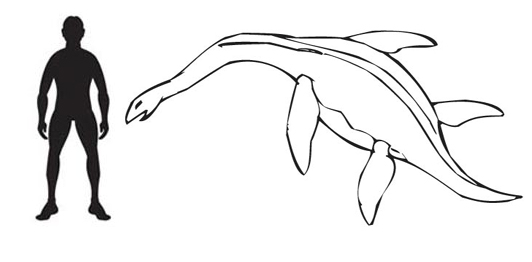
Monmouth beach, just west of the small Dorset town of Lyme Regis is slowly but surely giving up the fossilised remains of a marine reptile that once swam in a warm, shallow sea.  The fossils are that of a Plesiosaurus; a long-necked reptile, a member of a group of animals that had their origins in the Late Triassic and survived right up to the end of the Age of Reptiles, around 66 million years ago.

Lyme Regis

The fossils were found by Brandon Lennon, local Lyme Regis professional fossil collector with over twenty years fossil hunting experience.  Articulated plesiosaur remains are very rare, even in the fossil rich strata to be found in the Lyme Bay area.

Brandon with some of the Plesiosaur Remains

Brandon with his plesiosaur fossils.

Picture credit: Brandon Lennon

The bones look like cervical vertebrae with a fragment of rib (black, pencil-like object at the top of the larger block in Brandon’s left hand.  The first plesiosaur fossil discovered and brought to the attention of scientists was found by Mary Anning, so Brandon is in good company.

If visiting Lyme Regis with the intention of hunting for fossils we can recommend Brandon, who regularly takes members of the public on fossil hunting expeditions.  To read more about Brandon’s work and to book a fossil walk: Lyme Regis Fossil Hunting Trips.

 Professional Fossil Hunter Brandon commented:

“The bones of a plesiosaur have been washing out of a mud slip at one particular spot.  Big seas are revealing more of this potentially whole specimen all of the time.”

Just like the plesiosaur discovered by Mary Anning almost 200 years ago, this new specimen could represent an entirely new species.  Brandon, went onto add that the only trouble was that it may take another two decades for the whole creature to be exposed.

He stated:

“Every big tide that occurs in Lyme Bay, leads to us visiting this location to see if more fossil containing rocks have been revealed.”

A spokesperson for Everything Dinosaur commented:

“This is potentially a very exciting discovery, although we would advise members of the public to take care when looking for fossils themselves in Lyme Bay.  The cliffs are extremely dangerous and mud slips/rockfalls can take place at any time and we would only advise looking for fossils at low tide”.

An Illustration of a Member of the Plesiosauria

Plesiosaurus drawing.

Plesiosaurus – a drawing. Picture credit: Everything Dinosaur.

Picture credit: Everything Dinosaur

For replicas and models of marine reptiles including a Plesiosaurus (whilst stocks last): Papo Dinosaurs and Prehistoric Animal Figures.

6 12, 2011

Killer Claws and Flapping Wings

By |2023-03-08T14:06:28+00:00December 6th, 2011|Categories: Dinosaur and Prehistoric Animal News Stories, Palaeontological articles|0 Comments

Dromaeosaurs with their Killer Claws Yield New Theory on the Origin of Flight

Scenes from the trilogy of Jurassic Park movies where large dromaeosaurs allegedly Velociraptors, attack people with their sickle-like, second toe claws will have to be re-shot as new research from Montana State University’s Museum of the Rockies provides a new angle on the use of those killer claws.

Claws to Hold Prey

The research team have postulated that the use of the claws to hold prey rather than kill prey, led to these meat-eaters evolving a flapping motion with their arms to help keep them stable as they struggled with their victims.  This could have led to the evolution of powered flight.

In a paper published this month, in the on line scientific journal PLoS ONE (public library of science) researchers Denver W. Fowler, Elizabeth A. Freedman and John B. Scannella along with Robert E. Kambic (Brown University in Rhode Island), describe how comparing modern raptors helped develop a new behaviour model for dromaeosaurs.

A Model of a Typical Dromaeosaurid (Schleich Velociraptor)

How did dromaeosaurs use their wings?  A model of a Velociraptor.

Velociraptor dinosaur model from Schleich. New research changes perceptions about dromaeosaurids. Picture credit: Everything Dinosaur.

Picture credit: Everything Dinosaur

Lead author Fowler commented:

“This study is a real game-changer.  It completely overhauls our perception of these little predatory dinosaurs, changing the way we think about their ecology and evolution.”

The study focuses on dromaeosaurids; a group of small predatory dinosaurs that include the famous Velociraptor and its larger relative, the man-sized Deinonychus.  The Jurassic Park movie “raptors” supposedly Velociraptors were far too large when depicted on the screen to represent the likes of Velociraptor mongoliensis.  Instead, the animals in the film were a better representation of Deinonychus antirrhopus.  Dromaeosaurids are closely related to birds, and are most famous for possessing an enlarged sickle-claw on digit two (inside toe) of the foot.

Previous researchers suggested that this claw was used to slash at prey, or help climb up their hides, to gain a purchase on large prey but the new study proposes a different type of behaviour.

Fowler said:

“Modern hawks and eagles possess a similar enlarged claw on their digit 2’s, something that hadn’t been noted before we published on it back in 2009.  We showed that the enlarged D-2 claws are used as anchors, latching into the prey, preventing their escape.  We interpret the sickle claw of dromaeosaurids as having evolved to do the same thing – latching in, and holding on.”

As in modern birds of prey, precise use of the claw is related to relative prey size.

Fowler went onto add:

“This strategy is only really needed for prey that are about the same size as the predator; large enough that they might struggle and escape from the feet.  Smaller prey are just squeezed to death, but with large prey all the predator can do is hold on and stop it from escaping, then basically just eat it alive.  Dromaeosaurs lack any obvious adaptations for dispatching their victims, so just like hawks and eagles, they probably ate their prey alive too.”

Dromaeosaurids

A spokesperson from Everything Dinosaur, stated that watching carnivorous dinosaurs attacking and killing prey would have been a horrific experience, these predators probably started to eat their victims when the prey was still alive.  If this is stomach churning, then it has to placed in context, that cuddly labrador that shares many people’s homes is in fact descended from wolves which when attacking large animals do start to eat their fill before the animal has expired in many cases.

“Flapping First” Velociraptors may shed New Light on Origins of Flight

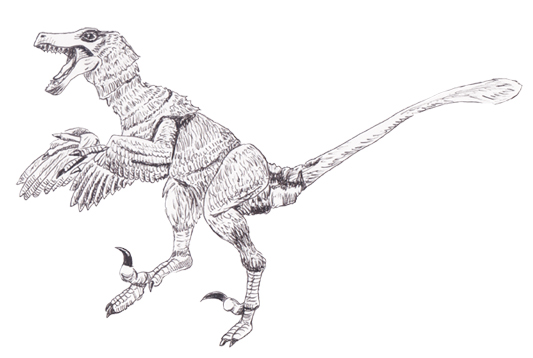
Drawing of Velociraptor osmolskae.

A drawing of Velociraptor osmolskae.  Dromaeosaurids with their “killing-claws” shed light on the origins of powered flight amongst the Theropoda.

Picture credit: Everything Dinosaur.

The picture (above) is an illustration of a dromaeosaurid from the Beasts of the Mesozoic range of articulated dinosaur figures.

To view this range: Beasts of the Mesozoic Articulated Dinosaur Figures.

Other features of bird of prey feet gave the research team clues as to the functional anatomy of their ancient relatives, toe proportions of dromaeosaurids seemed more suited for grasping than running, and the metatarsus (bones between the ankles and the toes) shows adaptations for strength rather than speed.

Fowler stated:

“Unlike humans, most dinosaurs and birds only walk on their toes, so the metatarsus forms part of the leg itself.  A long metatarsus lets you take bigger strides to run faster; but in dromaeosaurids, the metatarsus is very short, which is odd.”

Fowler thinks that this indicates that Velociraptor and its kin were adapted for a strategy other than simply running after prey.

He continued:

“When we look at modern birds of prey, a relatively short metatarsus is one feature that gives the bird additional strength in its feet.  Velociraptor and Deinonychus also have a very short, stout metatarsus, suggesting that they had great strength but wouldn’t have been very fast runners.”

The ecological implications become especially interesting when dromaeosaurids are contrasted with their closest relatives: a very similar group of small carnivorous dinosaurs called troodontids.

“Troodontids and dromaeosaurids started out looking very similar, but over about 60 million years they evolved in opposite directions, adapting to different niches.  Dromaeosaurids evolved towards stronger, slower feet; suggesting a stealthy ambush predatory strategy, adapted for relatively large prey.  By contrast, troodontids evolved a longer metatarsus for speed and a more precise, but weaker grip, suggesting they were swift but probably took relatively smaller prey.”

The study also has implications for the next closest relatives of troodontids and dromaeosaurids – the birds (Aves).   An important step in the origin of modern birds was the evolution of the perching foot.

Fowler said:

“A grasping foot is present in the closest relatives of birds, but also in the earliest birds like Archaeopteryx.  We suggest that this originally evolved for predation, but would also have been available for use in perching.  This is what we call ‘exaptation:’ a structure evolved originally for one purpose that can later be appropriated for a different use.”

The new study proposes that a similar mechanism may be responsible for the evolution of flight.

Fowler went onto state:

“When a modern hawk has latched its enlarged claws into its prey, it can no longer use the feet for stabilization and positioning.  Instead the predator flaps its wings so that the prey stays underneath its feet, where it can be pinned down by the predator’s body-weight.”

The researchers suggest that this “stability flapping” uses less energy than flight, making it an intermediate flapping behaviour that may be key to understanding how flight evolved.

The research team stated:

“The predator’s flapping just maintains its position, and does not need to be as powerful or vigorous as full flight would require.  Get on top, stay on top; it’s not trying to fly away.  We see fully formed wings in exquisitely preserved dromaeosaurid fossils, and from biomechanical studies we can show that they were also able to perform a rudimentary flapping stroke.  Most researchers think that they weren’t powerful enough to fly; we propose that the less demanding stability flapping would be a viable use for such a wing, and this behaviour would be consistent with the unusual adaptations of the feet.”

Flapping Behaviours

Another group of researchers has proposed that understanding flapping behaviours is key to understanding the evolution of flight, a view with which Fowler agrees:

“If we look at modern birds, we see flapping being used for all sorts of behaviours outside of flight.  In our paper, we are formally proposing the ‘flapping first’ model: where flapping evolved for other behaviours first, and was only later exapted for flight by birds.”

The researchers believe their new ideas will open multiple new lines of investigation into dinosaur paleobiology, and the evolution of novel anatomical structures.

Everything Dinosaur acknowledges the press release from Montana State University which has been most helpful in compiling this article.


5 12, 2011

Knocking T. rex of its Perch

By |2023-01-25T07:56:21+00:00December 5th, 2011|Categories: Dinosaur and Prehistoric Animal News Stories, Everything Dinosaur News and Updates|0 Comments

Is Spinosaurus the Largest Land Carnivore Known to Science?

With renewed enthusiasm we have once again entered into the debate over the size of Cretaceous theropods.  Is Spinosaurus the largest carnivore known to science?  Was Spinosaurus bigger than Tyrannosaurus rex?  Team members at Everything Dinosaur put together a fun presentation for a regional museum in support of the BBC “Planet Dinosaur” touring exhibition where visitors could have a go at building their own Spinosaurus skeleton.  We set out to explain the fossil evidence and how it has been interpreted and got visitors to vote for which dinosaur (T. rex or Spinosaurus) would have won in a fight if these two theropods ever met.

Spinosaurus

To view the results of our experiments: Museum Visitors Take Part in Dinosaur Study.

Having reviewed the fossil evidence from Stromer to Russell and beyond our staff then compiled a brief article outlining what is currently known about North African spinosaurs and this was published on the E-zine website.

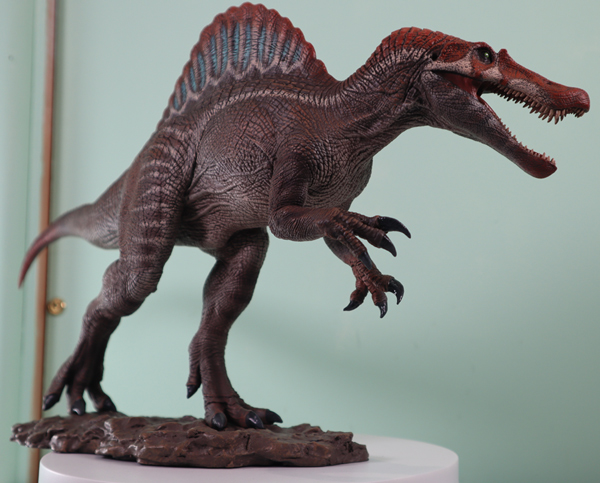
A Replica of Spinosaurus (W-Dragon Spinosaurus)

W-Dragon Spinosaurus dinosaur model.

The W-Dragon Spinosaurus dinosaur model on its display base.  Was Spinosaurus bigger than Tyrannosaurus rex?  Picture credit: Everything Dinosaur.

Picture credit: Everything Dinosaur

For models and replicas of Spinosaurus and other prehistoric animals: W-Dragon Models and Replicas.

To read this article: Has T. rex been Knocked off its Perch?

This informative article provides more information on Spinosaurus, this dinosaur’s discovery and updates readers on the Moroccan fossil finds.

3 12, 2011

New Late Cretaceous Ornithopod Species Named

By |2023-11-09T12:47:32+00:00December 3rd, 2011|Categories: Dinosaur and Prehistoric Animal News Stories, Dinosaur Fans|0 Comments

Thescelosaurus assiniboiensis –Scampering Saskatchewan Resident

Canadian scientists have announced the discovery of a new dinosaur species, a relatively fast running, Late Cretaceous member of the ornithopods (a group of bird-hipped dinosaurs).  The Maastrichtian stage fossil (66 million years old approximately), consists of parts of the skull, the pelvis and other portions of the skeleton.  The new species has been named Thescelosaurus assiniboiensis after the region and the native Indians of that part of Canada.

Commenting on the discovery, Tim Tokaryk, head of Palaeontology for the Royal Saskatchewan Museum stated:

“It is small, but there are features in the cranium, the back end of the skull, and a few features in the pelvis that are quite distinct amongst all other known species of Thescelosaurus.  So based on those central features, that’s what made it a new species.”

Thescelosaurus assiniboiensis

Perhaps no more than three metres in length, this biped had to have sharp senses and a turn of speed if it was to avoid becoming a meal for the large theropods that shared its Late Cretaceous home.  With no obvious defences, running away may have been the best survival strategy for this relatively small dinosaur.

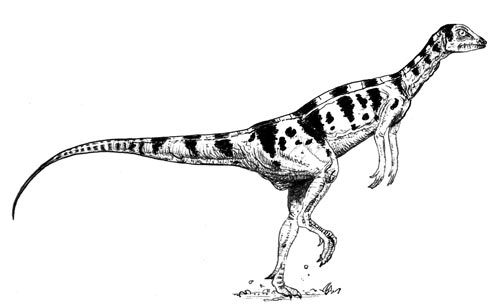
An Illustration of Thescelosaurus

Late Cretaceous Canadian dinosaur.  Picture credit: Everything Dinosaur.

Picture credit: Everything Dinosaur

Tokaryk who has also worked on Tyrannosaurus rex excavations for the museum added:

“We know there were small dinosaurs around at that time because we found fragments, we find teeth and such like that.  But to find a partial skeleton of one individual, that makes it interesting and also makes it more useful to be able to identify it as a new species or a species in general.”

The specimen was collected from the Frenchman River Valley near Eastend in 1968 but was only identified recently when Caleb Brown, a master’s student from the University of Calgary, studied the bones for his thesis.  This seems about par for the course as the specific name for the first Thescelosaurus specimen assigned to this genus is T. neglectus  a reference to the fact that these fossils were not studied until twenty-two years after they were first discovered.

The formal study and naming of this new type of dinosaur helps scientists to piece together more information about specific ecosystems and how dinosaurs adapted to different habitats.  Although, not as spectacular as some of its prehistoric cousins, animals such as the horned dinosaur Triceratops, or the giant duck-billed dinosaur Parasaurolophus, the research on T. assiniboiensis is helping scientists to understand more about the diversity of Late Cretaceous Dinosauria.

For models and replicas of prehistoric animals including Late Cretaceous ornithopods: Prehistoric Animal Models (Everything Dinosaur).

Go to Top