Long-time fan of dinosaurs and prehistoric animals, Marc, who is also a long-time customer of Everything Dinosaur offered to write a short testimonial about his experiences purchasing from us.
What a kind thought especially in these difficult and challenging times.
Everything Dinosaur Receives Feedback
Marc wrote:
“I’ve been an Everything Dinosaur customer for a number of years, and they’ve never once let me down. They’ve always had an excellent range of models, which has only improved with time with the addition of lines from Creative Beast (Beasts of the Mesozoic) and PNSO, among others. Service has always been personable and friendly but professional, and every package has arrived on time. I also (as a dinosaur nerd) really appreciate the effort they put into the educational side. Overall, ED is a business well worth supporting, and I hope they’re around for a long while yet.”
Signage at Everything Dinosaur’s offices and warehouse. The UK-based mail order company has recently moved into larger premises incorporating more warehouse storage and offices. Picture credit: Everything Dinosaur.
Picture credit: Everything Dinosaur
A spokesperson from Everything Dinosaur thanked Marc for their kind gesture and stated:
“Our thanks to Marc and to every single one of our customers who support our company. These are exceptionally difficult times and we are doing all we can to maintain our high standards of customer service and to offer an even wider range of prehistoric animal models and figures.”
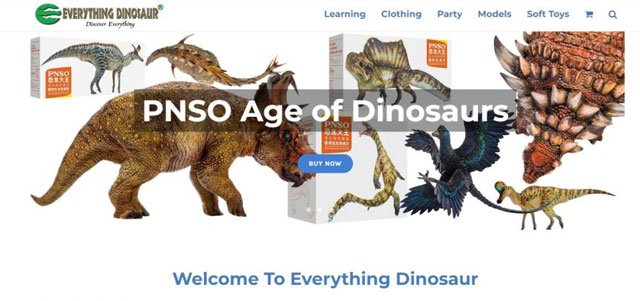
The PNSO Fusion Slider on the Everything Dinosaur website. A typical example showing the huge range of prehistoric animal models and figures available from the UK-based mail order company. Picture credit: Everything Dinosaur.
Picture credit: Everything Dinosaur
The spokesperson from Everything Dinosaur continued:
“We remain committed to bringing into stock even more models of prehistoric animals as we support our customers and fans of dinosaurs and other extinct creatures.”
Once again, our thanks to Marc for writing a testimonial for Everything Dinosaur.
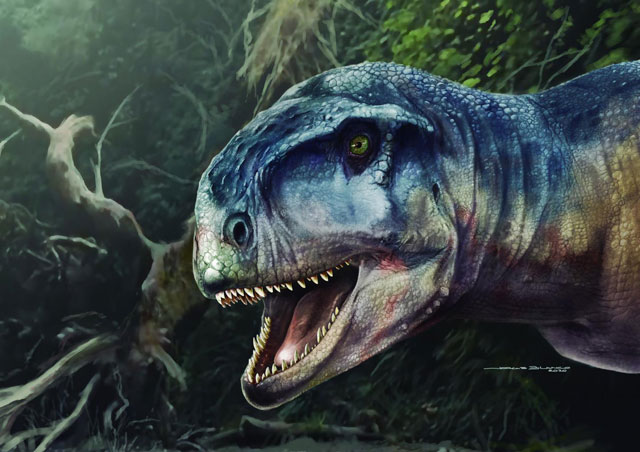
A team of international researchers have named and described a new species of fearsome, meat-eating dinosaur based on a partial skull found in 2015 in Neuquén Province (northern Patagonia). The dinosaur is a member of the Abelisauridae family and it has been named Llukalkan aliocranianus. The genus name is from the local Mapuche dialect and translates as “one who causes fear”. Not only was Llukalkan a likely apex predator, its discovery helps to confirm that the abelisaurs were one of the most important and significant predators in South America during the Late Cretaceous.
A life reconstruction of the newly described abelisaurid from Argentina Llukalkan aliocranianus. Picture credit: Jorge Blanco and the Journal of Vertebrate Paleontology.
Found in Close Proximity to Viavenator exxoni
The well-preserved skull was found in outcrops of the Bajo De La Carpa Formation at the La Invernada fossil site. The strata at this location were laid down approximately 85 million years ago (Santonian faunal stage of the Late Cretaceous) and the bones were found close to the location of an earlier abelisaurid discovery (Viavenator exxoni), which had been found by some of the scientists that also participated in the Llukalkan study.
Assessment of the lacrimal bone suggest that this skull material represents a sub-adult animal and comparison with other abelisaurids such as Carnotaurus indicates that Llukalkan may have been around five metres in length, making it slightly smaller than Viavenator which is estimated to have been around six metres long.
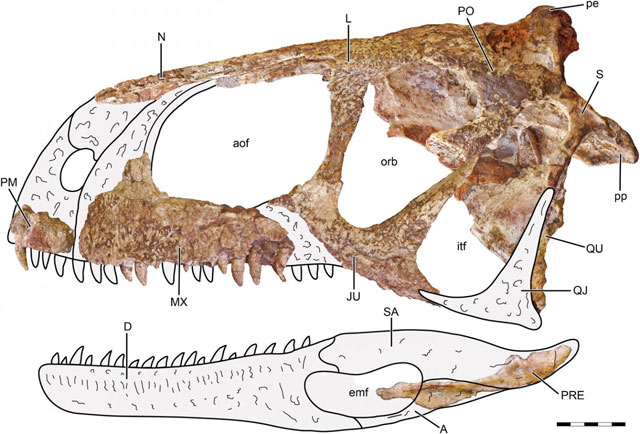
A view of the cranial material of the holotype (Llukalkan aliocranianus) – view in left lateral view with line drawing showing where the bones fit with the rest of the skull. Unique rugose and roughened patches on the skull bones confirmed that the scientists were dealing with a new species.
Writing in the peer reviewed academic publication the “Journal of Vertebrate Paleontology”, the researchers which included Federico A. Gianechini, Leonardo S. Filippi and Ariana Paulina-Carabajal identified a number of autapomorphies within the skull material that led them to confidently assign a new species. The trivial name is derived from the Latin for “different skull”.
Abelisaurids “Top Dogs”
Something like ten different genera of abelisaurid dinosaur have been discovered in Patagonia to date. The scientists state that Llukalkan and Viavenator were probably contemporaneous and they help to demonstrate the dominance of this type of theropod dinosaur in the Late Cretaceous of Argentina. Both Viavenator and the newly described Llukalkan were closely related, both have been assigned to the Abelisauridae clade – the Furileusauria which includes the geologically much younger and much larger Pycnonemosaurus (P. nevesi), fossils of which come from Brazil.
Megaraptors for Company
It is likely that these two furileusaurian abelisaurids probably shared their environment with another type of large theropod hypercarnivore. Fossils of the megaraptor Tratayenia rosalesi, which was described in 2018, are also associated with the Santonian-aged strata of the Bajo de la Carpa Formation, albeit the Tratayenia material was found at a different location.
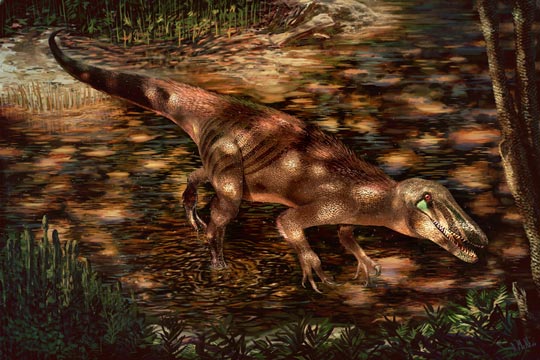
An illustration of the new Late Cretaceous megaraptoran dinosaur Tratayenia. Picture credit: Andrea McAfee (Carnegie Museum of Natural History).
At around eight metres in length (possibly even bigger), T. rosalesi was a formidable predator. Whether the abelisaurids were the “top dogs” when it came to the food chain remains uncertain. However, with the discovery of Llukalkan so close to the fossils of Viavenator, it does suggest that these types of theropods were extremely successful predators.
The scientific paper: “A New Furileusaurian Abelisaurid from La Invernada (Upper Cretaceous, Santonian, Bajo De La Carpa Formation), Northern Patagonia, Argentina” by Federico A. Gianechini, Ariel H. Méndez, Leonardo S. Filippi, Ariana Paulina-Carabajal, Rubén D. Juárez-Valieri and Alberto C. Garrido published in the Journal of Vertebrate Paleontology.
Team members at Everything Dinosaur as fans of prehistoric animals themselves don’t mind helping out fellow collectors. For example, we often receive emails from prehistoric animal model enthusiasts asking us to select a particular replica for them. We are happy to take some photographs of the figure that we have chosen and then email the images to the potential buyer for their approval.
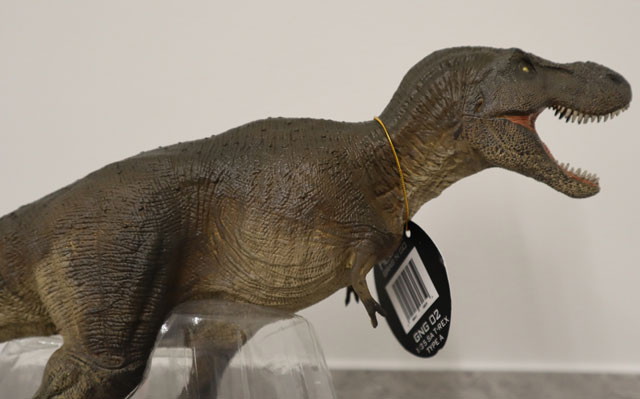
The Rebor GrabNGo 02 T. rex Type A in anterior view. An Everything Dinosaur customer wanted us to select a dinosaur model. Picture credit: Everything Dinosaur.
Picture credit: Everything Dinosaur
Rebor GrabNGo 02 T. rex Model
Recently, we received a request from one of our customers based in Europe to select a Rebor GrabNGo 02 T. rex dinosaur model. These vinyl figures are very popular and the first two versions of the Tyrannosaurus rex (02 and 03) have been retired and production has been discontinued. Our customer was keen to obtain the figure and asked us to check over the seams and the paintwork.
Rebor GrabNGo 02 T. rex Type A dinosaur model in right lateral view.A selection of T. rex pictures taken by Everything Dinosaur team members. Picture credit: Everything Dinosaur.
Picture credit: Everything Dinosaur
We were happy to take photographs of a Rebor T. rex model in one of our packing rooms. We made sure that we emailed over several images, each showing the dinosaur figure from a different angle. It was just like photographing a fossil specimen for a collection. When documenting a fossil, a number of photographs are taken, each one is carefully labelled identifying the specimen number and the angle of view.
The Rebor GrabNGo 02 T. rex Type A in left lateral view.The Rebor GrabNGo range of figures are very photogenic. Team members had fun selecting a Tyrannosaurus rex figure and then photographing it in one of our packing rooms. Picture credit: Everything Dinosaur.
When taking photos of dinosaur models, we tend to provide several shots of the head of the model, so that the potential customer can see the detailing around the mouth and any seams between the head and the body.
The Rebor GrabNGo 02 T. rex Type A in right lateral view.We like to take lots of photographs of the model to show our customers. Picture credit: Everything Dinosaur.
Picture credit: Everything Dinosaur
The customer was happy with the figure we had selected for them. This particular Rebor GrabNGo 02 T. rex dinosaur model is now safely stored on our reserve shelf in our warehouse so that when the customer places their order, the figure we chose can be despatched to them.
A study of the fossilised remains of an as yet unnamed species of ankylosaurid suggests that these dinosaurs were adapted for digging. Whilst it seems unlikely that these large herbivores could have lived in burrows, they may have been able to dig for roots and tubers, excavate wells in dried up rivers to reach subsurface water and dig into sediments to obtain supplementary minerals in a similar way that extant elephants do today.
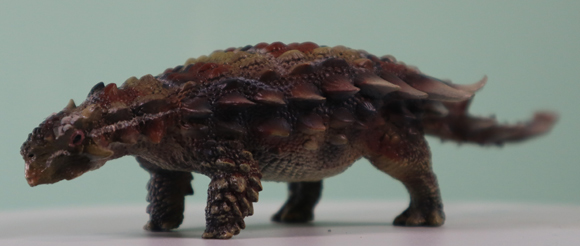
A compact and low-slung body shape with powerful limbs could be adaptations for digging. The low profile of the PNSO Pinacosaurus ankylosaurid model. A newly published scientific paper suggests that these types of dinosaurs may have dug shallow pits in which they could protect themselves from attack. Picture credit: Everything Dinosaur.
Picture credit: Everything Dinosaur
The model (above) is a Pinacosaurus armoured dinosaur from PNSO.
Furthermore, many palaeontologists have postulated that these armoured herbivores might have been able to hunker down to defend their limbs and undersides from theropod predators. If these animals dug shallow pits they might have been able to protect themselves from attack and make it difficult for carnivorous dinosaurs to spot them when they were partially buried. Horned lizards (Phrynosoma) have a similar flat body and lateral fringe scales as seen in some types of ankylosaurid, these extant reptiles adopt these types of defensive strategies.
Discovered in the Early 1970s
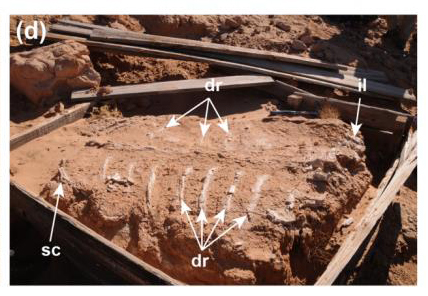
Remains of an armoured dinosaur was first reported by a joint Soviet-Mongolian expedition to the southern Gobi Desert of Mongolia in the early 1970s. The skeleton consisting of dorsal vertebrae, elements from the limbs, ribs parts of the pelvis and the pectoral girdle along with several armoured scutes, was partially prepared for removal, but the excavation was not completed. The fossil specimen remained uncollected but crated up until 2008 when it was taken away for preparation by members of a Korean/Mongolian research team.
A close view of the crate containing the postcranial remains in a dorsal orientation. The fossil specimen was partially crated up but not removed from the site at Hermiin Tsav in the southern Gobi Desert (Mongolia). Abbreviations sc = scapula, dr = dorsal ribs, il = ilium.
Probably a New Species of Armoured Dinosaur
The sandstone sediments of the Upper Cretaceous (Middle to Late Campanian stage), Baruungoyot Formation have yielded the remains of three ankylosaurid taxa, namely Saichania chulsanensis, Tarchia kielanae and Zaraapelta nomadis. Writing in the journal “Scientific Reports” the researchers which include such luminaries as Phil Currie and Eva Koppelhus (University of Alberta), Michael Ryan (Canadian Museum of Nature) and corresponding author Yuong-Nam Lee (Seoul National University, South Korea), state the unnamed ankylosaurid has some similarities to S. chulsanensis, but there are anatomical differences. Unfortunately, very little postcranial fossils of Tarchia kielanae and Zaraapelta nomadis have been found making it impossible to undertake a direct comparison with this specimen (MPC-D 100/1359).
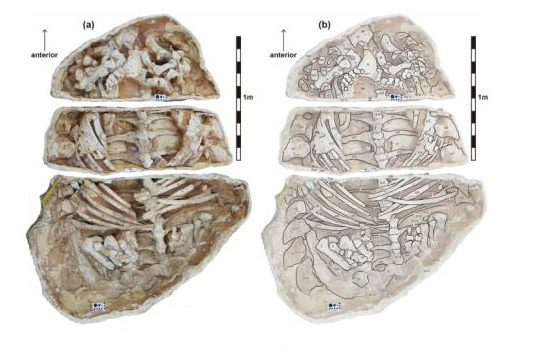
The new ankylosaurid postcranial specimen (MPC-D 100/1359). Photograph (a) and line drawing (b) of the specimen in ventral view.Note scale bar equals 1 metre.
Adapted for Digging
The scientists speculate that several anatomical features identified in MPC-D 100/1359 could indicate that this ankylosaurid was adapted for digging. The bones in its front feet are arranged in a shallow arc, which could have enabled it to dig soft earth. The fused vertebrae and the reduced number of bones in its hind feet, compared to other dinosaurs, may have helped anchor the ankylosaurid when digging or moving its tail. The body shape of MPC-D 100/1359, which is wider in the middle and narrower at the front and rear, may have helped its body to remain straight when digging. These traits such as the narrow-wide-narrow body shape and the manus (hand) and pes (foot) bone configuration are also known in other ankylosaurids.
Dig Those Ankylosaurs
Digging for resources out of reach from other animals and excavating shallow pits as part of a defensive strategy might have been prevalent amongst these armoured dinosaurs.
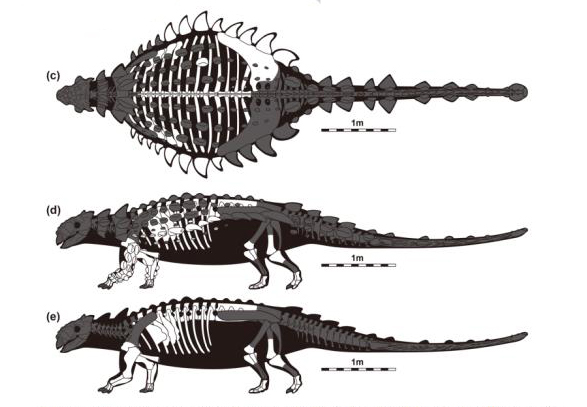
Line drawing of the ankylosaurid skeleton, known elements in white (c) dorsal view, (d) left lateral view with armour shown, (e) left lateral view with armour removed. Note scale bar = 1 metre.
The scientific paper: “A new ankylosaurid skeleton from the Upper Cretaceous Baruungoyot Formation of Mongolia: its implications for ankylosaurid postcranial evolution” by Jin-Young Park, Yuong-Nam Lee, Philip J. Currie, Michael J. Ryan, Phil Bell, Robin Sissons, Eva B. Koppelhus, Rinchen Barsbold, Sungjin Lee and Su-Hwan Kim published in Scientific Reports.
New research published this week shows that smaller amphibians may be more vulnerable to extinction than larger amphibian species.
A study led by Queen’s University Belfast has found that the risk of extinction among amphibians, the most endangered vertebrates on the planet, increases for species of smaller body size as their females produce fewer babies per birth.
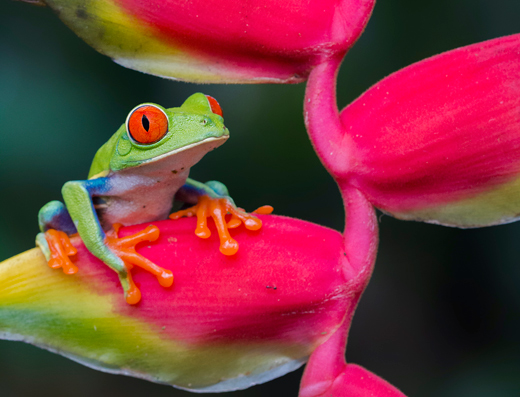
The red-eyed tree frog (scientific name: Agalychnis callidryas). This tropical frog species produces on average about 40 eggs per clutch. Small numbers of offspring can lead to concern over the extinction threat. Picture Credit: Roberto García-Roa.
Scientists had thought that animals of larger body size, be they hypercarnivores, or megaherbivores were more vulnerable to extinction. In popular culture, most people are aware of the threat of extinction to animals such as whales, pandas, big cats and polar bears. These large-bodied animals are certainly in danger. It has been postulated that we are currently experiencing a mass extinction event, brought on mainly due to the behaviour of Homo sapiens.
This newly published research in the journal Global Ecology and Biogeography, which represents a collaboration between Tel Aviv University, the University of Lincoln, Exeter University, Queen’s University (Belfast) and Nottingham Trent University, is the first to suggest amending the theory to focus on reproduction levels of animals rather than on body size when assessing extinction risk.
A Global Challenge
Regarded as one of the most pressing challenges facing our world, scientists are determined to better understand the factors that drive extinction.
Amphibians, such as frogs, toads, newts and salamanders, in particular, have become the iconic example of human-induced extinctions. Amphibian species are dying out faster than any other group of vertebrates on Earth. It has been calculated that something like forty per cent of all known species of amphibians currently face the threat of extinction.
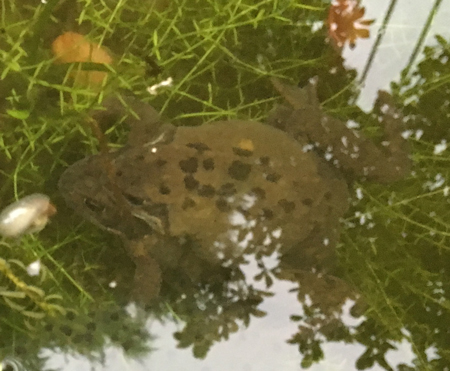
A pair of mating frogs (2017) Rana temporaria (European Common Frog). Picture credit: Everything Dinosaur.
Picture credit: Everything Dinosaur
Not Focusing Just on Mammals
One of the most accepted theories regarding extinction risk is that larger body size significantly increases the extinction threat. This hypothesis has been mainly driven via research into the Mammalia. This research is the first to investigate the causes behind extinction in amphibians based on the theory that it is not body size, but the number of babies a female produces per clutch that determines extinction risk.
Thousands of species from around the world were studied, irrespective of their conservation status. The researchers then mapped their level of endangerment against body size and their number of babies produced per batch of eggs.
The Fewer the Offspring the Greater the Risk
Strong evidence was found indicating that extinction risk increases towards species that produce fewer offspring, such as the “rain frogs” (Eleutherodactylus), whereas extinction risk decreases towards species that produce more, such as different species of American water frogs (Lithobates) or the large-bodied ‘bufonid’ toads.
Lead author, Dr Daniel Pincheira-Donoso (Queen’s University), explained:
“More babies per clutch or birth means more variety among the babies. To some extent, it is like playing the lottery, the more tickets you play the higher your chances to win. In this case, more numerous and diverse babies increase the chances that at least some can survive the stress of environmental alterations, such as progressive climatic changes.”
Focusing on the number of offspring rather than looking solely at body size, may permit a more effective approach to amphibian conservation.
Everything Dinosaur acknowledges the assistance of a media release from Queen’s University Belfast in the compilation of this article.
The scientific paper: “The global macroecology of brood size in amphibians reveals a predisposition of low‐fecundity species to extinction” by Daniel Pincheira‐Donoso, Lilly P. Harvey, Sheena C. Cotter, Gavin Stark, Shai Meiri and Dave J. Hodgson published in Global Ecology and Biogeography.
Fans of the Papo prehistoric animal model range “Les Dinosaures”, will know that in 2021 there will be just two new figures added to this range. Like many model manufacturers the production plans of our chums at Papo have been affected by the global COVID-19 pandemic.
Papo are always keen to hear from model collectors, they know how enthusiastic and passionate you are about Papo, so Everything Dinosaur has created a short, ten minute video that explores how Papo could expand its prehistoric animal model range. Once we have discussed our suggestions, it’s over to you! Your chance to comment on the type of figures you want to see added to the Papo range!
Suggestions for Papo Figures
Everything Dinosaur has a close working relationship with Papo, in our short YouTube video (the video is 10 minutes long), we reveal what product options we have suggested to the French manufacturer. For example, we suggested that Papo might want to reintroduce a long retired figure such as the iconic green, standing T. rex replica.
Could Papo reintroduce a classic model such as the original green, standing T. rex figure (product code 55001)?
In addition, Everything Dinosaur has proposed that Papo could introduce a colour variant of an existing figure such as the Papo Pteranodon or the Papo Triceratops. We note that a number of Papo fans have suggested other colour variants such as a new version of the huge Papo Brachiosaurus figure.
Perhaps Papo could add a colour variant of the Papo Pteranodon figure. The new colour variant could be the male whilst the original figure could be the female.
A Juvenile Giganotosaurus?
One further suggestion Everything Dinosaur has made is to introduce a juvenile Giganotosaurus dinosaur model as a companion piece to the 2020 Papo Giganotosaurus figure.
The 2020 Giganotosaurus model attracted a lot of attention due to its posture, a smaller, juvenile figure could have a more scientifically accurate pose.
Should Papo introduce a juvenile Giganotosaurus to accompany the adult model that was introduced in 2020?
A spokesperson from Everything Dinosaur commented:
“Papo are aware how passionate fans of their figures are when it comes to new replicas. The number of new models that can be introduced in 2021 has been limited due to the consequences of COVID-19. Our new YouTube video gives dinosaur model fans the opportunity to learn more about the Papo range and to propose novel ways in which this range can be expanded.”
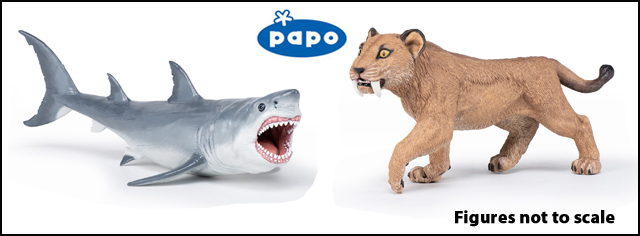
Two new models to be introduced by Papo in 2021 the young Smilodon (55081) and a Megalodon shark model (55087).
Team members at Everything Dinosaur have commissioned a scale drawing of the Japanese duck-billed dinosaur Kamuysaurus (K. japonicus) as they await the arrival of the first batch of new for 2021 prehistoric animal models from CollectA.
A scale drawing of the hadrosaurid Kamuysaurus (K. japonicus) that was formally named and described in 2019. This Late Cretaceous duck-billed dinosaur is estimated to have measured around 8 metres in length and weighed 4 tonnes. Picture credit: Everything Dinosaur.
Picture credit: Everything Dinosaur
The scale drawing is being prepared to coincide with the arrival of CollectA models.
Kamuysaurus japonicus – A Kamuysaurus Scale Drawing
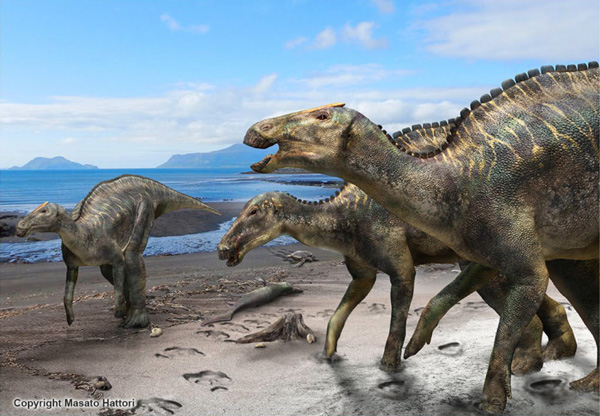
Described as Japan’s best-known dinosaur by a number of media sources. This dinosaur was officially named and described back in 2019. CollectA have been planning a model of this Japanese dinosaur for some time, they have expressed an interest in expanding their replicas of Japanese dinosaurs since the introduction of Fukuiraptor and Fukuisaurus.
A herd of Kamuysaurus wander along a beach. Picture credit: Masato Hattori. The fossilised remains of a single individual dinosaur were found in marine sediments. These fossils were formally assigned to a new dinosaur species in 2019 (Kamuysaurus japonicus).
How Big was Kamuysaurus?
Although only known from a single specimen, the skeleton represents the most complete dinosaur fossil found in Japan. Scientists were able to assign Kamuysaurus to the Edmontosaurini clade within the hadrosaur subfamily the Saurolophinae.
Kamuysaurus is estimated to have reached a body length of around 8 metres and to have weighed 4 tonnes.
Palaeontologists who have studied the fossil material have suggested that Kamuysaurus is closely related to Kerberosaurus which was unearthed in Russia and Laiyangosaurus which is known from China. Kamuysaurus was named after the indigenous people of the island of Hokkaido, the trivial or species name refers to Japan. It translates as “the deity of Japanese dinosaurs”.
The PNSO Domingo the Carnotaurus dinosaur model has already attracted rave reviews from collectors and fans of dinosaur models. This 5-star rated figure has been described as “a beautiful model, at this moment the most accurate depiction of Carnotaurus” and “an amazing model, both colour and sculpt are stunning” by reviewers on Everything Dinosaur’s website.
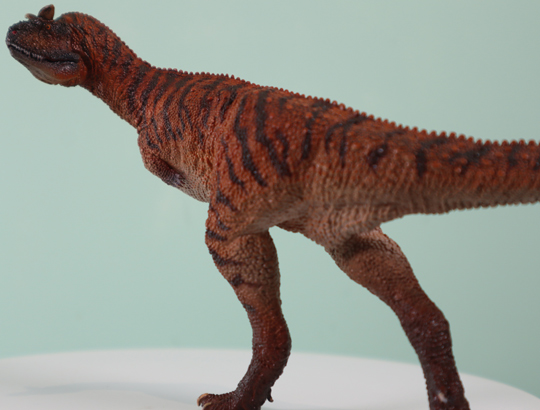
The PNSO Carnotaurus model stands perfectly stable without the use of the transparent stand which is supplied with the figure. However, Everything Dinosaur recommends that the support stand is used when the model is put on display. Picture credit: Everything Dinosaur.
Picture credit: Everything Dinosaur
Carnotaurus sastrei
This replica of a Late Cretaceous South American abelisaurid has certainly turned heads. The model is exquisitely detailed and so well made that the figure stands perfectly on a flat, level service without the aid of the transparent support stand that is supplied with this dinosaur model.
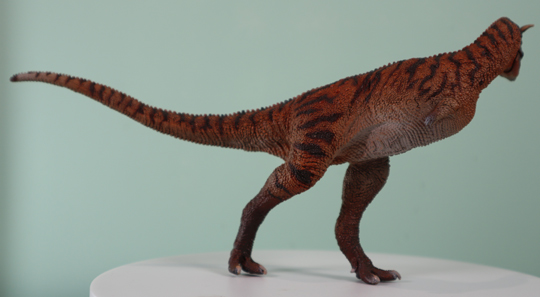
A lateral view of the PNSO Domingo the Carnotaurus. This new for 2021 dinosaur model has been highly praised by fans of dinosaurs. Picture credit: Everything Dinosaur.
Picture credit: Everything Dinosaur
An Articulated Lower Jaw
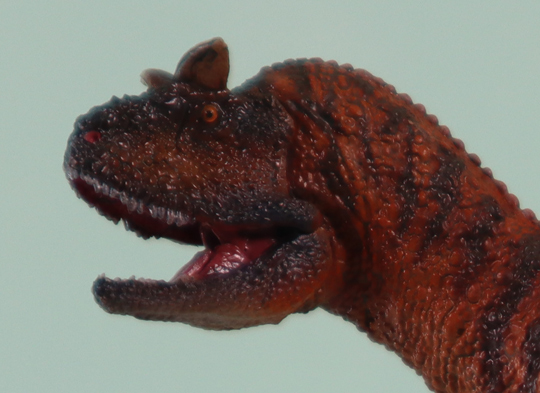
Like a lot of the new theropod figures from PNSO, Domingo the Carnotaurus has an articulated lower jaw. The model designers have been careful to depict those famous horns over the eyes (from which this dinosaur’s name is derived, due to their superficial similarity to the horns of a bull). The colouration chosen shows evidence of countershading and the use of black stripes gives this figure real presence. Although the jaw of Carnotaurus is relatively small and delicate, the designers have taken heed of the fossil evidence and equipped their model with a narrow jaw, located in a disproportionately deep skull.
A close view of the head of the PNSO Carnotaurus model showing the delicate lower jaw, the deep skull and those famous horns over the orbits. Picture credit: Everything Dinosaur.
Picture credit: Everything Dinosaur
A spokesperson from Everything Dinosaur commented:
“Fans of dinosaur models and figure collectors have really been looking forward to the arrival of the PNSO Domingo the Carnotaurus replica. It had a lot of hyperbole to live up with some collectors stating that PNSO was the most improved model manufacturer on the market. With the first reviews for this new for 2021 figure posted up on our website, it seems that collectors have not been disappointed.”
The PNSO Domingo the Carnotaurus dinosaur model has an articulated lower jaw. Picture credit: Everything Dinosaur.
Picture credit: Everything Dinosaur
A Range of New PNSO Dinosaurs
Domingo the Carnotaurus is one of a range of new dinosaur figures which also includes a replica of the theropod from China called Qianzhousaurus.
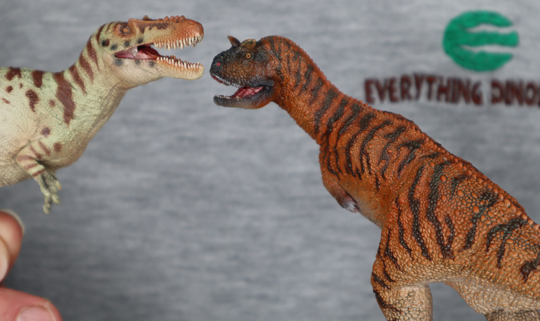
The PNSO A-Shu the Qianzhousaurus dinosaur model faces off against the PNSO Domingo the Carnotaurus. These two models both have articulated lower jaws and are part of a range of new model introductions from PNSO. Picture credit: Everything Dinosaur.
Picture credit: Everything Dinosaur
To view the PNSO Domingo the Carnotaurus model and the rest of the prehistoric animals in the PNSO range: PNSO Age of Dinosaurs.
Stunning fossil plants preserved within a volcanic ash fall in China have shed light on an evolutionary race 300 million years ago, which was eventually won by the seed-bearing plants that dominate the flora of our planet today.
New research into fossils found at the “Pompeii of prehistoric plants”, in Wuda, Inner Mongolia, reveals that the plants, called Noeggerathiales, were highly-evolved members of the lineage from which came seed plants.
A reconstruction of the crown of Paratingia wuhaia. A newly described prehistoric plant from the Early Permian.
The Importance of Noeggerathiales
Noeggerathiales were important peat-forming plants that lived around 325 to 251 million years ago (Late Carboniferous to the end of the Permian). Understanding their relationships to other plant groups has been limited by poorly preserved examples until now. The beautiful fossils found in China have allowed experts to work out that Noeggerathiales are more closely related to seed plants than to other fern groups.
No Evolutionary Dead-end
No longer considered an evolutionary cul-de-sac, they are now recognised as advanced tree-ferns that evolved complex cone-like structures from modified leaves. Despite their sophistication, Noeggerathiales fell victim to the profound environmental and climate changes of 251 million years ago that destroyed swamp ecosystems globally (End Permian mass extinction event).
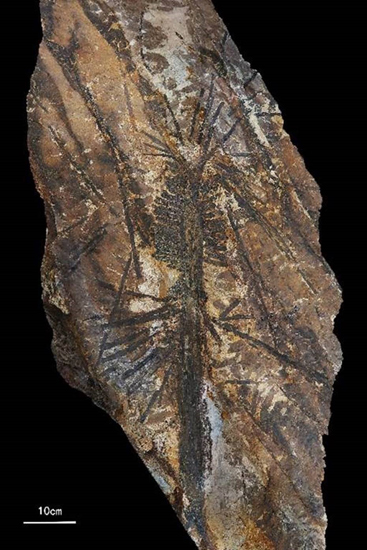
Fossil specimen of the new species (Paratingia wuhaia) preserving the crown of the tree with leaves and its fertile organs attached to the stem.
Co-author of the scientific paper, published this month in the Proceedings of the National Academy of Sciences (PNAS), Dr Jason Hilton, Reader in Palaeobiology at the University of Birmingham’s Institute of Forest Research, commented:
“Noeggerathiales were recognised as early as the 1930s, but scientists have treated them as a ‘taxonomic football’, endlessly kicked around without anyone identifying their place in the story of life. The spectacular fossil plants found in China are becoming renowned as the plant equivalent of Pompeii. Thanks to this slice of life preserved in volcanic ash, we were able to reconstruct a new species of Noeggerathiales that finally settles the group’s affinity and evolutionary importance.”
A Stark Warning for Us
The researchers comment that the fate of advanced Noeggerathiales is a stark reminder of what can occur when a sophisticated and seemingly well-adapted form of life is faced with rapid, dramatic environmental change.
The scientists studied complete Noeggerathiales preserved in a bed of volcanic ash 66 cm thick formed 298 million years ago (Early Permian), smothering all the plants growing in a nearby swamp. The ash stopped the fossils from rotting or being consumed and preserved many complete individuals in microscopic detail.
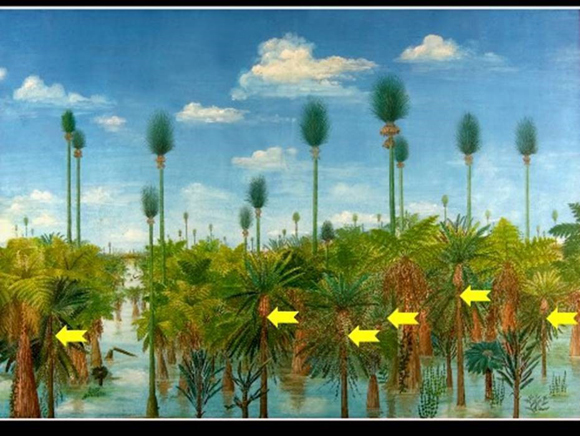
A life reconstruction of the swamp (yellow arrows indicate the newly named plant species (Paratingia wuhaia).
Lead-Author Jun Wang, (Nanjing Institute of Geology and Palaeontology), added:
“Many specimens were identified in excavations in 2006-2007 when a few leaves were visible on the surface of the ash. It looked they might be connected to each other and a stem below – we revealed the crown on site, but then extracted the specimens complete to take them back to the lab. It has taken many years to study these fully and the additional specimens we have found more recently. The complete trees are the most impressive fossil plants I have seen and because of our careful work they are also some of the most important to science.”
An Extensive Ancestral Lineage
The research team postulate that that the ancestral lineage from which seed plants evolved diversified alongside the earliest seed plant radiation during the Devonian, Carboniferous and Permian periods, and did not rapidly die out as previously thought.
Everything Dinosaur acknowledges the assistance of a press release from the University of Birmingham in the compilation of this article.
The scientific paper: “Ancient noeggerathialean reveals the seed plant sister group diversified alongside the primary seed plant radiation” by Jun Wang, Jason Hilton, Hermann W. Pfefferkorn, Shijun Wang, Yi Zhang, Jiri Bek, Josef Pšenička, Leyla J. Seyfullah and David Dilcher published in the Proceedings of the National Academy of Sciences.
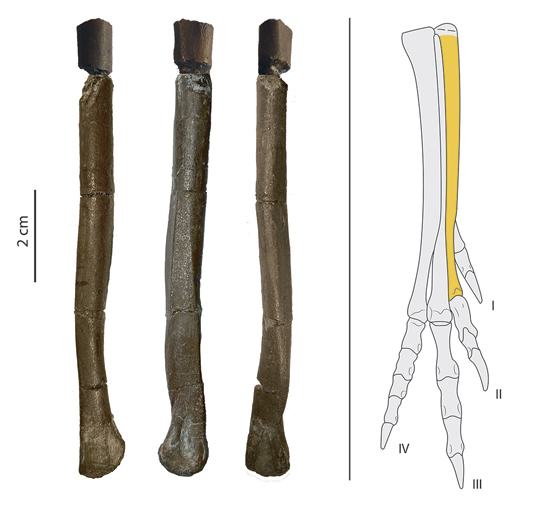
A team of international scientists including Steve Brusatte (University of Edinburgh), have confirmed the presence of troodontids in the Late Cretaceous of Europe. A new species of troodontid has been erected based on the discovery of a single metatarsal bone (the second metatarsal bone from the right foot), from Late Cretaceous strata in the Talarn Formation exposed at the Sant Romà d’Abella site in the southern Pyrenean region of Spain. This new dinosaur has been named Tamarro insperatus.
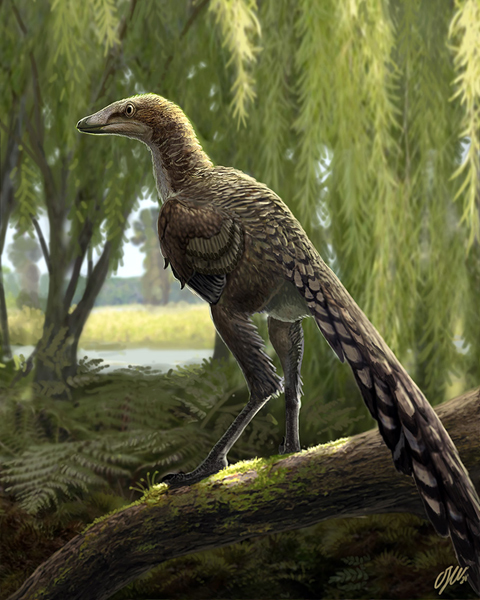
A life reconstruction of the first troodontid confirmed from the Late Cretaceous of Europe Tamarro insperatus.
Picture credit: Oscar Sanisidro
Found in 2003
The single fossil bone indicating the presence of troodontids in Europe was found in September 2003 by a team of palaeontologists from the Museu de la Conca Dellà (Lleida, Isona, Spain) at the Sant Romà d’Abella site (Spain). It was found in fluvial floodplain deposits believed to have been laid down just 200,000 years or so before the K-Pg mass extinction event.
The fossil bone was found in the same horizon as plant fossils and the type specimen of the lambeosaurine Pararhabdodon isonensis, the metatarsal was found in close proximity to the Pararhabdodon type specimen, these are the only two vertebrates known from this site.
The Dinosaurs from the Late Cretaceous of Europe
During the Late Cretaceous, high sea levels ensured that much of the European landmass we know today was underwater. Numerous islands existed, creating an extensive archipelago and several dinosaurs associated with these islands exhibit dwarfism or other unusual features associated with isolated ecosystems. Very little is known about the Theropoda that inhabited these islands. For example, the presence of troodontids in Europe has been debated for a long time. Several troodontid-like and Paronychodon teeth (a nomen dubium taxa referred by some to the Troodontidae), were recovered from the Campanian and Maastrichtian deposits of the ancient Hateg (Romania) and Ibero-Armorican (Portugal, France and Spain) islands, but this fossil bone provides definitive, unequivocal proof of these theropods being present in the Late Cretaceous of Europe.
Views of the second metatarsal (metatarsal II from the right foot), plus line drawing showing the skeletal position of the bone.
Picture credit: Albert G. Sellés (Institut Català de Paleontologia Miquel Crusafon/Museu de la Conca Dellà)
A Basal Troodontid with Asian Origins
An analysis of the bone and a phylogenetic assessment suggests that Tamarro is a basal member of the Troodontidae family and most likely a representative of the Asian subfamily the Jinfengopteryginae. The research team speculate on how a dinosaur with relatives in Asia could have become established in Europe. Maastrichtian troodontids like Tamarro could have reached Europe during the Cenomanian faunal stage and persisted on these islands until the K-Pg extinction event.
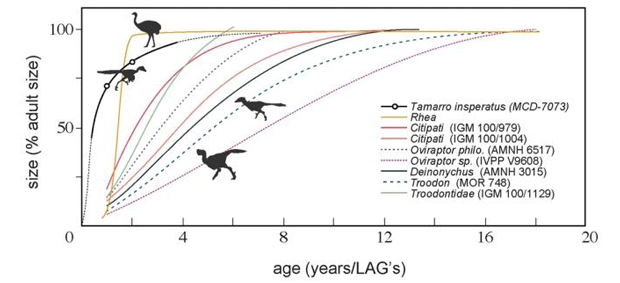
Estimated at around two metres in length Tamarro is around twice the size of other related troodontids. A close examination of the bone (cross-sectional histology), reveals that the metatarsal came from a subadult animal that was growing rapidly. Although troodontids are known to have fast growth rates, Tamarro seemed to be growing much quicker than other members of the Troodontidae, perhaps reaching full maturity in around two years.
Growth rate of Tamarro insperatus compared to other members of the Maniraptora. When compared to other taxa from the group of dinosaurs most closely related to birds (including Aves), Tamarro has a rapid growth rate reaching a subadult state in around one year.
The genus name is derived from the Catalan word “Tamarro” which refers to a small, mythical creature from local folklore. The species or trivial name “insperatus” is from the Latin for unexpected, a reference to the unexpected discovery of the fossil bone.
The scientific paper: “A fast-growing basal troodontid (Dinosauria: Theropoda) from the latest Cretaceous of Europe” by Albert G. Sellés, Bernat Vila, Stephen L. Brusatte, Philip J. Currie and Àngel Galobart published in Scientific Reports.