All about dinosaurs, fossils and prehistoric animals by Everything Dinosaur team members.

Everything Dinosaur’s work with photoshop and other platforms.

4 03, 2021

A Dinosaur Book Recommendation for World Book Day

By |2024-05-21T06:36:01+01:00March 4th, 2021|Categories: Adobe CS5, Book Reviews, Dinosaur Fans, Main Page|0 Comments

As today (4th March 2021), is recognised in many countries as World Book Day, team members at Everything Dinosaur have been busy posting up on social media book recommendations for those readers interested in the Dinosauria and other archosaurs.

“The Encyclopedia of Dinosaurs – The Sauropods”

The Encyclopedia of Dinosaurs - The Sauropods
The Encyclopedia of Dinosaurs – The Sauropods front cover. A superb book all about the Sauropodomorpha and their near relatives by Rubén Molina-Pérez and Asier Larramendi.  Picture credit: Everything Dinosaur.

Picture credit: Everything Dinosaur

Crammed with Fascinating Dinosaur Facts

The Encyclopedia of Dinosaurs, the sauropod edition, is packed full of fascinating information and it has been laid out in an easy to follow format with copious illustrations and lots of diagrams to help elucidate the text.

Packed with Super Sauropod Facts and Figures

The Encyclopedia of Dinosaurs - The Sauropods is crammed full of facts.
Lots of fascinating facts about the sauropods inside the book.  Picture credit: Everything Dinosaur.

Picture credit: Everything Dinosaur

Written by Rubén Molina-Pérez and Asier Larramendi, the book documents the rise of the long-necked giants from their much smaller ancestral forms, classifies and characterises them and even examines their impact on modern culture. From viewing them as slow and sluggish reptiles inevitably doomed to extinction, the authors document the fossil evidence that shows how well-adapted these dinosaurs were to their environment.

How we View Sauropods Has Changed

The History and Cultural Significance of Sauropods
How society views the sauropods has changed. From viewing them as amphibious, living in lakes and rivers, to recognising them as land animals no longer considered slow, clumsy creatures that were doomed to extinction.  Picture credit: Everything Dinosaur.

Picture credit: Everything Dinosaur

A spokesperson from Everything Dinosaur commented:

“This is a stunning and comprehensive guide to the Sauropodomorpha aimed at dinosaur enthusiasts. Expect lots of information about famous dinosaurs such as Brachiosaurus, Apatosaurus and Mamenchisaurus plus lots of insights into their lives and behaviours.”

Amazing Dinosaur Illustrations

Pampadromeus - perhaps the smallest known Sauropodomorpha
Pampadromaeus – perhaps the smallest known sauropodomorph. The book provides plenty of information on some of the less well-known dinosaurs such as the basal sauropodomorph Pampadromaeus barberenai – regarded as one of the smallest members sub-order of the Dinosauria.  Picture credit: Everything Dinosaur.

Picture credit: Everything Dinosaur

Documenting the Dinosauria

Authors Rubén Molina-Pérez and Asier Larramendi demonstrate their extensive knowledge by providing information often omitted from other books about long-necked dinosaurs. For example, as well as looking at dinosaur diets, the writers examine related facets such as sauropod bite forces.

The Book Examines the Bite Forces of Sauropods such as Diplodocus

Diplodocus Bite Force
The book provides lots of fascinating information on the sauropods such as details of estimated bite force by genera.  Picture credit: Everything Dinosaur.

Picture credit: Everything Dinosaur

Highly Recommended

This is a one-of-a-kind compendium that covers all the known sauropod species at the time of publication, plus it provides details on one or two that have yet to be formally described.

For dinosaur fans, this book is highly recommended.

To read our comprehensive review of the sister volume that documents the Theropoda: The Encyclopedia of Dinosaurs – the Theropods.

The award-winning Everything Dinosaur website: Dinosaur Toys and Models.

1 03, 2021

Pre-order the New Rebor Carnotaurus and Rebor Ekrixinatosaurus Models

By |2024-05-21T06:25:09+01:00March 1st, 2021|Categories: Adobe CS5, Dinosaur Fans, Everything Dinosaur News and Updates, Everything Dinosaur Products, Main Page, Photos of Everything Dinosaur Products, Press Releases|0 Comments

Pre-order Rebor Carnotaurus and Rebor Ekrixinatosaurus

The Rebor Ekrixinatosaurus “Epitaph” museum class dinosaur model and the Rebor Carnotaurus rex “Crimson King Requiem” plain variant museum class replica are available to pre-order from Everything Dinosaur.  Two fantastic models of Late Cretaceous, South American abelisaurid dinosaurs are available for pre-order.  Both figures are in approximately 1/35th scale and each wonderful replica measures around forty-one centimetres in length.

The Rebor “Crimson King Requiem” Carnotaurus Model is Available for Pre-order

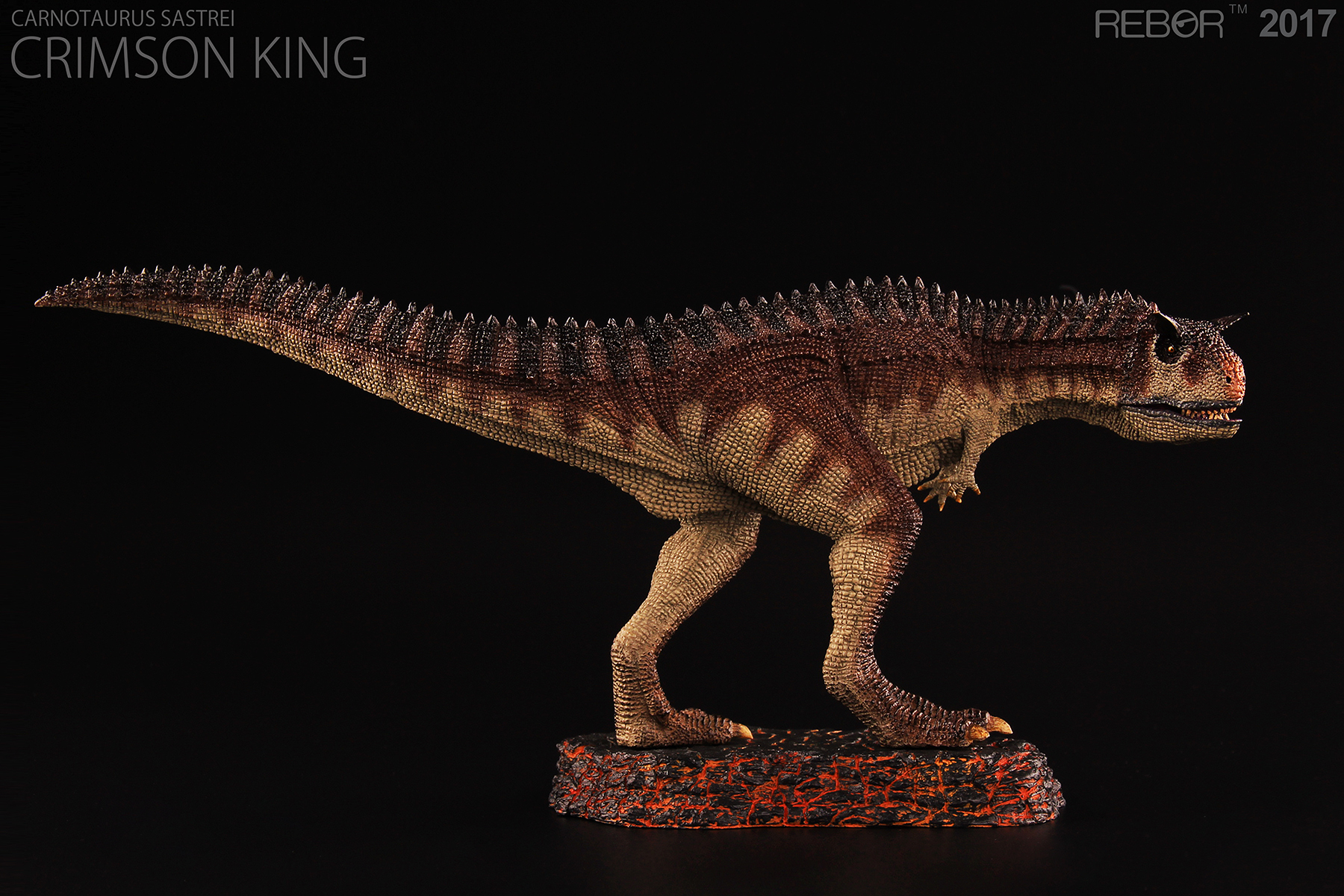
The Rebor Carnotaurus rex "Crimson King Requiem".

The Rebor Carnotaurus rex “Crimson King Requiem” plain variant museum class dinosaur model (right lateral view).

A Requiem for the “Crimson King”

When Everything Dinosaur announced that the original Rebor Carnotaurus model had been withdrawn and was out of production, we promised all those fans of the Rebor range who had joined our waitlist for this replica that we would contact them and offer them an alternative.  This is the figure we had in mind, a magnificent 1:35 scale model of Carnotaurus with such a striking, vibrant colour scheme.  This figure is viewed by Rebor as a replacement for the original Rebor Carnotaurus, hence the name “Crimson King Requiem”.

For prehistoric animal models: Everything Dinosaur.

The Original Rebor “Crimson King” Carnotaurus (C. sastrei)

Rebor Carnotaurus dinosaur model.

The original Rebor “Crimson King” Carnotaurus dinosaur model, this figure has been retired for some time and it has been effectively replaced by “Crimson King Requiem”.

This figure is expected to be in stock at Everything Dinosaur in the summer, around late June or perhaps July (2021).

A Close-up View of the New for 2021 Rebor Carnotaurus Dinosaur Model

Rebor Carnotaurus rex "Crimson King Requiem".

Carnotaurus rex “Crimson King Requiem” plain variant museum class dinosaur model.  This figure has an articulated lower jaw.

The beautifully detailed head can be seen in the photograph (above) and we can confirm that this model will have an articulated lower jaw.

A Requiem for a Carnotaurus

Rebor Carnotaurus rex "Crimson King Requiem" plain variant museum class model.

The Rebor Carnotaurus rex “Crimson King Requiem” plain variant museum class replica.

Rebor Ekrixinatosaurus “Epitaph” Museum Class Dinosaur Model

The second abelisaurid from Rebor that we have made available for pre-order is the Rebor Ekrixinatosaurus “Epitaph” museum class dinosaur model.  It is ironic that these two figures are available to pre-order today, as March 1st is Saint David’s Day.  Saint David is the patron saint of Wales and the dragon is one of the national symbols of this country.

Stomping into View A Rebor 1:35 Scale Ekrixinatosaurus “Epitaph” Dinosaur Model

The Rebor 1:35 scale Ekrixinatosaurus “Epitaph” dinosaur figure.

The Rebor 1:35 scale Ekrixinatosaurus “Epitaph” dinosaur model.  This model also has an articulated jaw.

Contact Everything Dinosaur: Contact Everything Dinosaur.

Ekrixinatosaurus

Named and formally described in 2004, the fossilised remains of Ekrixinatosaurus helped palaeontologists to better understand the enigmatic Abelisauridae.  Ekrixinatosaurus (pronounced Ek-riks-in-at-oh-sore-us), is estimated to have measured around 6.5 to perhaps 7.5 metres in length.  It was approximately the same size as Carnotaurus sastrei, hence the models are both in 1/35 th scale and the same size.

The Rebor Ekrixinatosaurus Dinosaur Model

ebor Ekrixinatosaurus “Epitaph” museum class dinosaur model.

The Rebor Ekrixinatosaurus “Epitaph” museum class dinosaur model (right lateral view).

A spokesperson from Everything Dinosaur commented:

“These two South American theropod dinosaurs look fantastic!  We congratulate Rebor for introducing some really exciting dinosaur models.”

Rebor Carnotaurus and Ekrixinatosaurus Available for Pre-order

Both museum quality models are available for pre-order.  Customers can choose which figure they want and then add it to their shopping cart and go through the checkout process as per usual.  However, with Everything Dinosaur, there are no fees to pay, no upfront costs, no surcharges, no deposit required.

That’s right:

  • No fees to pay
  • Zero deposit
  • No upfront costs
  • No surcharges

Just pre-order your model and when they become available (estimated 1st July 2021), you will be contacted and asked to complete your purchase or if you have selected to pay by credit/debit card, only when the figure is in stock will the transaction be completed.

To order these two wonderful new Rebor models: Rebor Dinosaur Models.
26 02, 2021

Concentrated Levels of Iridium Found at Chicxulub Impact Site

By |2024-05-19T12:06:38+01:00February 26th, 2021|Categories: Adobe CS5, Dinosaur Fans, Geology, Main Page, Palaeontological articles|0 Comments

High levels of the rare Earth element iridium have been found in drill cores taken from the peak-ring sequence of the Chicxulub impact site located on the Yucatan peninsula (Mexico). This evidence further supports the theory that the extra-terrestrial space object that smashed into our planet some 66 million years ago is linked to the Cretaceous-Palaeogene (K-Pg) mass extinction event.

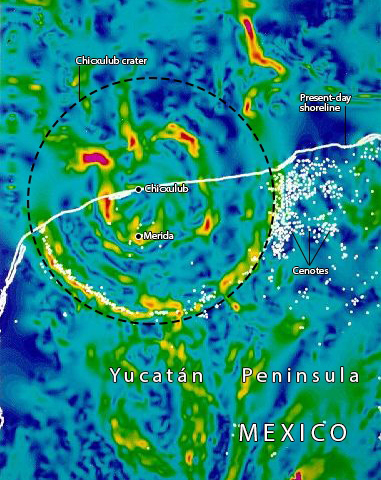
The day that everything changed. Scientists have found more evidence linking the Chicxulub impact event to the K-Pg mass extinction.

Picture credit: Map from Nature Geoscience / illustration courtesy of NASA

In 2016, IODP-ICDP* Expedition 364 drilled into the Chicxulub crater’s peak ring, an irregular ring of hills that surrounds the crater’s centre bringing around 835 metres of rock to the surface for detailed laboratory analysis.

* IODP (International Ocean Discovery Program) and the ICDP (International Continental Scientific Drilling Program).

The Chicxulub Impact Site

Iridium is extremely rare on Earth. However, a spike in levels has been recorded at numerous sites around the world that represent deposits laid down around 66 million years ago. The researchers state that the iridium levels found in the drill cores are four times more concentrated than elsewhere. The scientists found iridium levels were highest across the transition into early Paleogene sediments (Danian faunal stage).

Geophysical Map of the Chicxulub Impact Crater
A geophysical map of the impact crater and the Chicxulub crater peaks from which the drill cores were taken.

Picture credit: NASA

A Vapourised Bolide

Writing in the academic journal “Science Advances” the researchers conclude that this evidence combined with the spike in worldwide iridium deposits at the time of the mass extinction event, constitutes indisputable evidence that the suspected dinosaur-killing bolide that created the Chicxulub crater was indeed the culprit.

Commenting on the significance of this research, co-author Professor Joanna Morgan (Imperial College London) stated:

“This asteroid was vaporised and ejected from the impact site at high speed. Iridium, and other asteroidal material, then circled the Earth above the stratosphere within a fast-moving dust cloud and may have taken up to two decades to settle through the atmosphere and ocean before being deposited at the impact site.”

Lead author of the study, Professor Steven Goderis of the Free University of Brussels-VUB added:

“It’s quite remarkable that we found concentrations this high within the impact structure itself. In the first hours to months after the impact, the crater was a highly turbulent environment affected by tsunamis and earthquakes. Luckily, the iridium layer was preserved. This unquestionably ties the formation of the crater to the mass extinction event that marked the end of the Cretaceous and confirms that the asteroid impact and dinosaur extinction are indisputably linked.”

Identifying the K-T Boundary (Iridium Clay Layer)
Identifying concentrations of the rare Earth element iridium in a clay layer. At various locations around the world geologists have identified an iridium rich clay layer that marks the end of the Cretaceous and the beginning of the Palaeogene (K-T boundary).

Picture credit: The Open University/Everything Dinosaur

Everything Dinosaur acknowledges the contribution of a media release from Imperial College London in the compilation of this article.

To read a related article looking at how palaeontologists interpret fossil evidence of a global impact event: Quarry Site Might Reveal Evidence of Cretaceous Mass Extinction Event.

The scientific paper: “Globally distributed iridium layer preserved within the Chicxulub impact structure” by Steven Goderis, Honami Sato, Ludovic Ferrière, Birger Schmitz, David Burney, Pim Kaskes, Johan Vellekoop, Axel Wittmann, Toni Schulz, Stepan M. Chernonozhkin, Philippe Claeys, Sietze J. de Graaff, Thomas Déhais, Niels J. de Winter, Mikael Elfman, Jean-Guillaume Feignon, Akira Ishikawa, Christian Koeberl, Per Kristiansson, Clive R. Neal, Jeremy D. Owens, Martin Schmieder, Matthias Sinnesael, Frank Vanhaecke, Stijn J. M. Van Malderen, Timothy J. Bralower, Sean P. S. Gulick, David A. Kring, Christopher M. Lowery, Joanna V. Morgan, Jan Smit, Michael T. Whalen and the IODP-ICDP Expedition 364 Scientists published in Science Advances.

Visit the Everything Dinosaur website: Everything Dinosaur.

25 02, 2021

New Coins Commemorate Mary Anning

By |2024-05-19T12:02:02+01:00February 25th, 2021|Categories: Adobe CS5, Dinosaur and Prehistoric Animal News Stories, Dinosaur Fans, Famous Figures, Main Page|0 Comments

Coin Collection Celebrates the Contribution of Mary Anning

The Royal Mint in collaboration with the London Natural History Museum has launched a commemorative coin collection honouring the celebrated palaeontology pioneer Mary Anning.  From selling seashells on the seashore to a coin collection which includes a gold proof coin valued at over £1,100.00 ($1,540.00 USD) featuring an image of an ichthyosaur, the contribution to science of the most famous former resident of Lyme Regis in Dorset is being honoured in a very special way.

Celebrating Mary Anning

One of the Commemorative Coins Features an Ichthyosaur

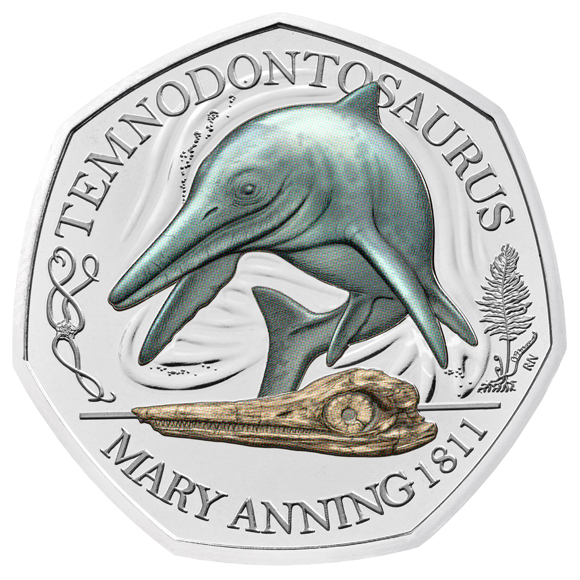
A coin features an ichthyosaur (Temnodontosaurus).

One of the coins that commemorates Mary Anning features an illustration of an ichthyosaur (Temnodontosaurus).

Picture credit: The Royal Mint

The “Tales of the Earth” Series

This is the second coin collection in The Royal Mint’s “Tales of the Earth” series, celebrating the remarkable fossil record of the British Isles. Whilst the original series featured the first dinosaurs to be named and described (Iguanodon, Megalosaurus and the armoured dinosaur Hylaeosaurus), there are no dinosaurs on these three coins, after all, dinosaur fossil remains from the “Jurassic Coast” are exceptionally rare.

The marine shales explored by the Anning family in Georgian times revealed the remains of huge sea monsters and occasionally pterosaurs, such as Dimorphodon which features on another of the coins that make up this set.

Honouring Mary Anning – The First Fossil Remains of Dimorphodon Were Found in 1828

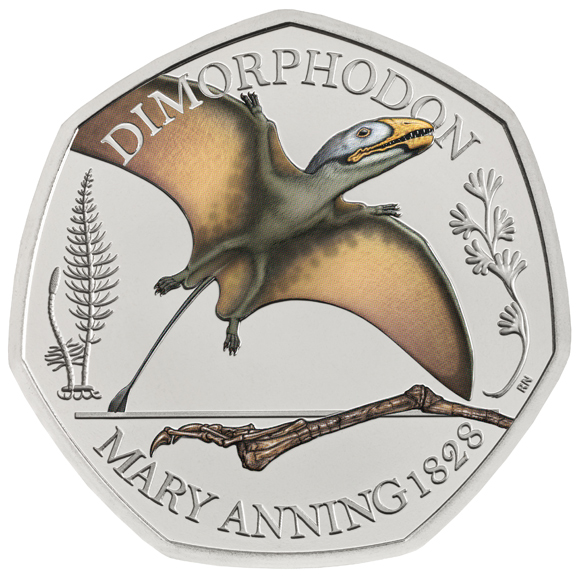
Coin honours Mary Anning.

From the Royal Mint, a coin has been issued which honours the discovery of the first pterosaur fossil in England by Mary Anning.

Picture credit: The Royal Mint

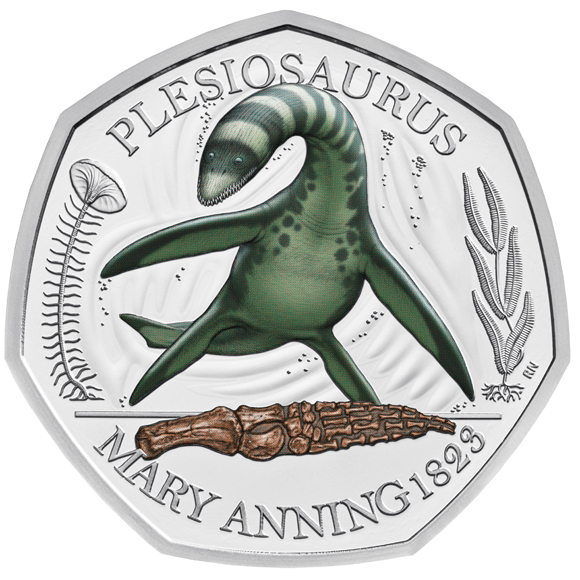
The renowned British palaeo-artist Bob Nicholls who designed the trio of dinosaurs that featured on the first set of “Tales of the Earth” commemorative coins, returns to bring back to life three prehistoric creatures that reflect the contribution to palaeontology made by Mary Anning.  The third coin features a beautiful illustration of a Plesiosaurus.

A Plesiosaurus Features on One of the Commemorative Fifty Pence Coins

Honouring Mary Anning (Plesiosaurus 1823).

Picture credit: The Royal Mint

Coins Designed by Bob Nicholls

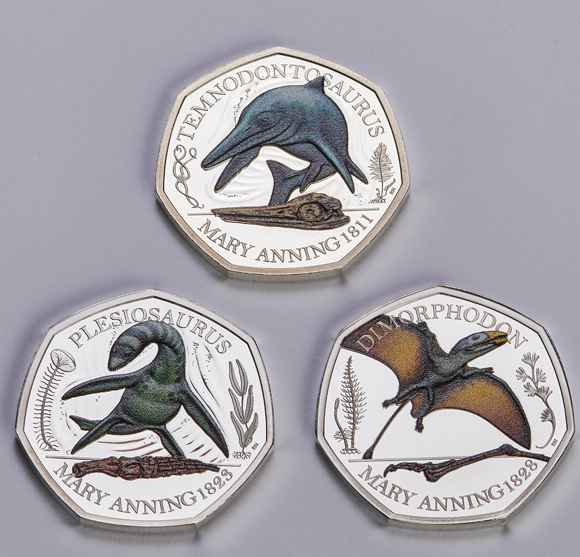
With the assistance of Sandra Chapman of the Earth Sciences Department at the Natural History Museum, each of the coin design’s created by Bob Nicholls are a scientifically accurate reconstruction of the creatures and their ancient Early Jurassic environment.  By using the latest colour printing techniques, the intricate characteristics of each of the prehistoric marine reptiles have been captured to illustrate accurately how these creatures looked like on Earth millions of years ago, making them appear dynamic and adding a new level of visual fidelity to the coins.

Commemorative Coins to Celebrate the Contribution of Mary Anning

Coins minted to honour Mary Anning.

A trio of coins that have been minted to honour the contribution to science of Mary Anning.

Picture credit: The Royal Mint

Commenting on the addition of this coin collection, the Divisional Director of Commemorative Coin at The Royal Mint, Clare Maclennan stated:

“It is an absolute pleasure to continue the popular Tales of the Earth commemorative 50p coin series in conjunction with the Natural History Museum.  The next collection in the series celebrates fossil hunter and pioneering palaeontologist Mary Anning, with three coin’s featuring Anning’s astonishing discoveries of Temnodontosaurus, Plesiosaurus and Dimorphodon.”

The coins each with a face value of fifty pence are available in a number of formats at various price points permitting coin collectors and dinosaur fans the opportunity to acquire them.  For the record, the gold coin valued at over £1,000 is a limited edition piece, just 250 have been produced.

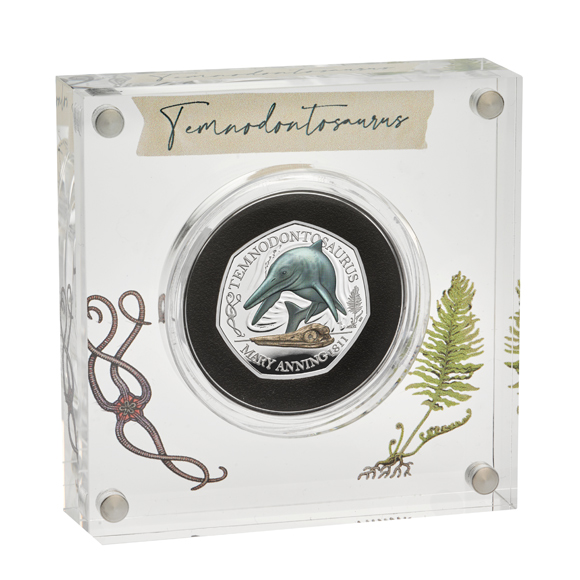
The Temnodontosaurus Coin in a Presentation Acrylic Block

Acrylic block containing one of the Mary Anning commemorative coins.

An acrylic block which features the 50p commemorative Temnodontosaurus image honouring Mary Anning.

Picture credit: The Royal Mint

For models and replicas of prehistoric animals: Prehistoric Animal Figures.

A Mysterious Coin Found at Lyme Regis

Back in 2015 Everything Dinosaur reported on the discovery of a mysterious metal token that was found by a metal detectorist at Lyme Regis.  It was speculated that this coin-like object could have been the property of Mary Anning.  We wonder what Mary would have made of the coin collection created by The Royal Mint commemorating her contribution.

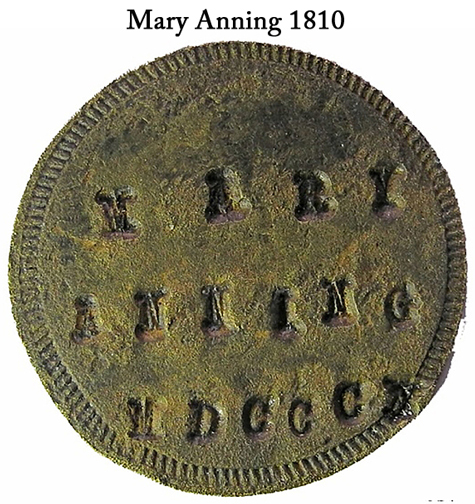
Did This Metal Token Once Belong to Mary Anning?

The Mary Anning Disc

Stamped on the disc are the words “Mary Anning and the year 1810 marked in Roman numerals.

Picture credit: Lyme Regis Museum with additional annotation by Everything Dinosaur

To read more about the Mary Anning disc: Mysterious Token Linked to Mary Anning.

Visit the Everything Dinosaur website: Everything Dinosaur.

24 02, 2021

Selecting a Special Rebor T. rex for a Customer

By |2024-05-19T12:00:32+01:00February 24th, 2021|Categories: Adobe CS5, Dinosaur Fans, Everything Dinosaur News and Updates, Everything Dinosaur Products, Main Page, Photos of Everything Dinosaur Products, Press Releases, Product Reviews|Tags: |0 Comments

Recently we were contacted by a collector in Russia who wanted to add to his Rebor figure collection by acquiring a Rebor GrabNGo T. rex dinosaur model.

The Rebor GrabNGo range was launched in 2019 with the introduction of the amazing Komodo dragon replica, a stunning half metre long model of the largest living lizard in the world. Our Russian customer wanted one of the Tyrannosaurus rex figures that were introduced into this range last year, specifically the Rebor GrabNGo T. rex dinosaur model – type A.

Rebor GrabNGo Komodo dragon model.

Rebor Komodo dragon 1:6 scale replica. Picture credit: Everything Dinosaur.


The Rebor GrabNGo T. rex (Type A)

The Rebor GrabNGo T. rex Type A dinosaur model.

Choosing the Model Rebor T. rex Model

Our customer asked whether we could help him by taking photographs of the model before he made his purchase on-line. Our dedicated team members were happy to do this. We would pick out a Tyrannosaurus rex model for him, photograph it and set it aside on our reserve shelf in our warehouse. The customer could then place his order and we would than marry up his order with the model reserved for him and send it out.

The stunning Rebor GrabNGo T. rex dinosaur model

Lateral view of the Rebor GrabNGo T. rex dinosaur model (Type A). Picture credit: Everything Dinosaur.

The customer wanted a Rebor GrabNGo T. rex replica (type A), but one with lots of detail on the head and tight seams between the head and the rest of the body. We carefully chose a model from our extensive inventory, photographed it and emailed the images for the customer’s approval.

A close view of the head of the Rebor GrabNGo T. rex model (Type A)

Close view of the head of the Rebor GrabNGo T. rex model (Type A). Picture credit: Everything Dinosaur.

Customer Approved

Team members sent plenty of photographs so that the client could get a good look at the figures and select the one they liked the best. We used our studio to take lots of detailed pictures of the head and the front of the body to assist our customer in their selection.

Rebor GrabNGo T. rex Type A (ventral view)

Showing the underside of the Rebor GrabNGo T. rex (Type A) the seam on the head. Picture credit: Everything Dinosaur.

“It [the Rebor GrabNGo T. rex model] suits me and I am ready to place an order. Thank you for your patience and understanding. Thank you very much. I am very grateful to you for your help and as promised I will leave all the stars and positive feedback.”

We were happy to help out.

To view the Rebor GrabNGo T. rex models (Type A and Type B) plus the rest of the Rebor replicas and figures in stock at Everything Dinosaur: Rebor Dinosaur and Prehistoric Animal Models.
Visit the Everything Dinosaur website: Dinosaur Models and Toys.

22 02, 2021

A Unique Jurassic Park Inspired Dinosaur Diorama

By |2024-05-19T11:22:37+01:00February 22nd, 2021|Categories: Adobe CS5, Dinosaur Fans, Everything Dinosaur Products, Main Page, Photos of Everything Dinosaur Products|0 Comments

A Jurassic Park Inspired Dinosaur Diorama

Our thanks to James who sent into Everything Dinosaur some photos of his Jurassic Park inspired dinosaur diorama.  James has used many of the prehistoric animal models he purchased from Everything Dinosaur to recreate some of his favourite scenes from the Jurassic Park/Jurassic World movie franchise.  There are lots of different dinosaur models and replicas featured in the photographs.

Can you identify all the prehistoric animal replicas and toys?

A Pack of Papo Velociraptors Confront a Dilophosaurus

Four against one! Velociraptor pack versus a Dilophosaurus.

Four Velociraptors confront a Dilophosaurus.  Four Papo Velociraptors confront a single Dilophosaurus.  The Dilophosaurus replica is the ITOY Studio Dilophosaurus figure.  A splendid and very colourful frill has been added to the Dilophosaurus making it very reminiscent to the Dilophosaurus “spitters” that were first seen in the original 1993 film Jurassic Park.

Picture credit: James

A Tyrannosaurus rex About to Eat a Goat

A goat meets a T. rex

A goat about to have an unfortunate encounter with a Tyrannosaurus rex.

Picture credit: James

The photograph (above), shows a T. rex about to consume a goat, a recreation of a famous scene from the film Jurassic Park, when the Tyrannosaurus rex makes its debut in the movie franchise.  The goat model is a PNSO Animals of Asia replica, can you work out which T. rex model is in the picture?

Tyrannosaurus rex Battles a Carnotaurus

T. rex defeats a Carnotaurus.

Tyrannosaurus rex fights a Carnotaurus.  In a dramatic recreation of a famous scene from the most recent film in the movie franchise, a Carnotaurus is attacked by a T. rex.

Picture credit: James

For dinosaur and prehistoric animal models: Dinosaur and Prehistoric Animal Models.
A Dinosaur Diorama

In the latest film to be released in this franchise (Jurassic World: Fallen Kingdom), that came out in 2018, there is a scene in which the hero Owen Grady (played by Chris Pratt) is saved from a Carnotaurus by the island’s T. rex.  James has recreated this scene and (below), he has depicted the scene that precedes the T. rex attack when the Carnotaurus does battle with a horned dinosaur.

A Carnotaurus Battles Sinoceratops

Carnotaurus battles Sinoceratops.

A Carnotaurus does battle with a Sinoceratops.

Picture credit: James

The Carnotaurus is the Wild Safari Prehistoric World replica that was introduced in 2019.  The horned dinosaur is the excellent Nanmu Studio Sinoceratops dinosaur replica.

A Pair of Horned Dinosaurs in the Jurassic Park Paddock

Horned dinosaurs at Jurassic Park.

Pachyrhinosaurus and Sinoceratops roaming around Jurassic Park.  Horned dinosaurs at home in Jurassic Park.  The PNSO Pachyrhinosaurus can be seen in the foreground.

Picture credit: James

Everything Dinosaur Comments

A spokesperson from Everything Dinosaur commented:

“Our thanks to James for sending in such a fantastic collection of images.  We think we can guess what his favourite film franchise is.”

A Close-up View of the ITOY Studio Dilophosaurus 

ITOY Studio Dilophosaurus in a Jurassic Park diorama.

The ITOY Studio Dilophosaurus dinosaur model features in the Jurassic Park diorama.  James has added small rocks, pieces of bark and made his own plant models.
Picture credit: James

Visit the Everything Dinosaur website: Everything Dinosaur.

11 02, 2021

Elasmosaurs Lived In Rivers According to New Research

By |2024-05-19T07:14:56+01:00February 11th, 2021|Categories: Adobe CS5, Dinosaur and Prehistoric Animal News Stories, Dinosaur Fans, Main Page, Photos/Pictures of Fossils|0 Comments

Fluvionectes sloanae – Late Cretaceous Freshwater Elasmosaurid

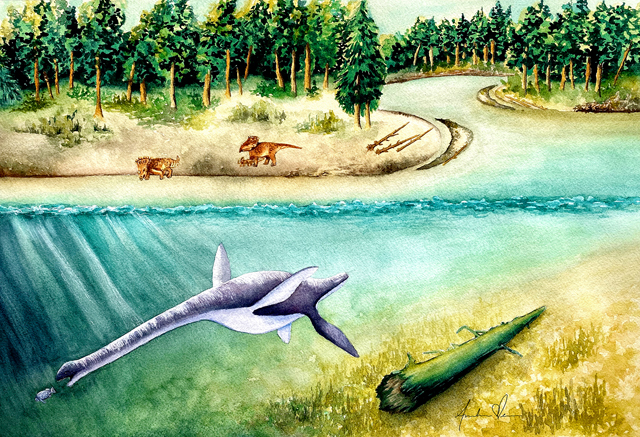
Researchers based in Canada have identified the remains of a Late Cretaceous elasmosaur from fossil remains found in Alberta.  Fossils of these large, long-necked plesiosaurs are not unknown from North America, but significantly these fossils were found in rocks laid down in a non-marine environment.  This suggests that this elasmosaur named Fluvionectes sloanae, spent at least some of its time in freshwater.

An Artist’s Reconstruction of Fluvionectes sloanae Hunting Fish in a Freshwater Environment

Fluvionectes sloanae life reconstruction.

Fluvionectes sloanae hunting fish in a river.

Picture credit: Andrea Elena Noriega

“River Swimmer”

Fossils of plesiosaurs occur throughout the Dinosaur Park Formation but they are generally rare, fragmentary and poorly preserved.  As a result, these fossils have attracted little scientific attention although they were first documented by Lawrence Lambe back in 1902.

This specimen is different, it consists of a partial disarticulated skeleton made up of a single tooth, numerous vertebrae, ribs, parts of the pectoral and pelvic girdles and elements from the left forelimb and left hindlimb.  The bones and the tooth were collected from a stratum immediately overlying the basal most coal bed of the Lethbridge Coal Zone in the Dinosaur Park Formation with the first material discovered in 1990.

Fluvionectes sloanae

It is the most complete example of an elasmosaurid found to date in the Dinosaur Park Formation and as such, the researchers have been able to formally describe the specimen and assign it a scientific name – Fluvionectes sloanae. The genus name translates as “river swimmer”, a reference to the fact that the fossils come from alluvial deposits believed to have been laid down at least 100 kilometres inland from the Western Interior Seaway.  The species name honours Donna Sloan who discovered the holotype, and in recognition of her service to palaeontology, both in the field and as the scientific illustrator at the Royal Tyrrell Museum of Palaeontology (Drumheller, Alberta).

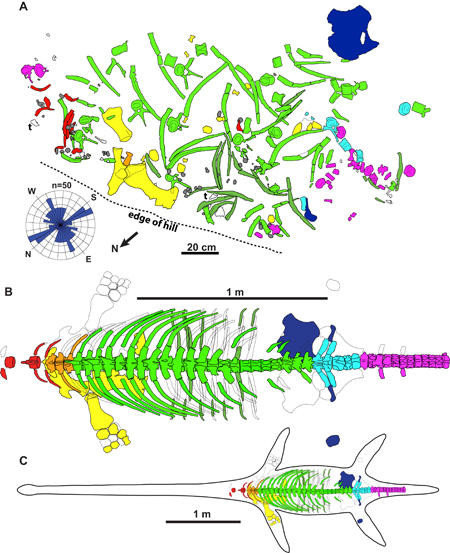
Quarry Map and Skeletal Reconstruction of F. sloanae

Colour coded quarry map showing location of F. sloanae fossil material.

Quarry map and skeletal reconstruction of F. sloanae.  The fossil material was found scattered over an area of around 2.5 square metres.

Picture credit: Campbell et al (PeerJ)

A Freshwater Predator (Fluvionectes sloanae)

A taxonomic analysis conducted by the scientists which included Dr James Campbell of the University of Calgary and Mark Mitchell, a technician at the Royal Tyrrell Museum of Palaeontology, failed to resolve definitively the exact taxonomic relationship of Fluvionectes within the Elasmosauridae.  However, the team were able to conclude that the fossil remains probably represent a young adult.  The specimen indicates an animal approximately 5.6 metres long when it died.

Fragmentary fossils of potentially larger elasmosaurids, representing animals around seven metres in length have been found in the Dinosaur Park Formation.  Some of these specimens might represent the Fluvionectes genus.  The scientists conclude that further study is needed to identify specimens at the genus level.

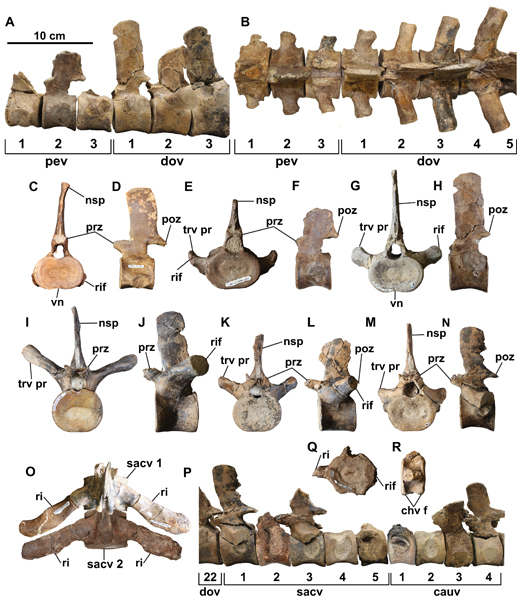
Views of the Vertebrae Associated with Fluvionectes sloanae

Vertebrae associated with the elasmosaurid Fluvionectes sloanae.

Fluvionectes sloanae – examples of vertebrae.

Picture credit: campbell et al (PeerJ)

Everything Dinosaur stocks a wide range of marine reptile models.  Models of elasmosaurs, plesiosaurs and mosasaurs are in stock.

To view a selection of marine reptile figures: Wild Safari Prehistoric World Models and Figures.

Did Some Juvenile Elasmosaurs Live in Freshwater?

Intriguingly, the elasmosaurid fossils found in the Dinosaur Park Formation (non-marine deposition), are relatively small when compared to elasmosaurid fossils found in offshore, marine deposits such as the Pierre Shale or Bearpaw formations.  Large elasmosaur fossil bones have not been found in the Dinosaur Park Formation.  It could be speculated that juvenile elasmosaurs ventured into estuarine environments and freshwater river systems before relocating to marine environments when they reached maturity.

This is not the first example of a marine reptile, normally associated with marine environments been found in freshwater.  To read Everything Dinosaur’s 2013 article about the discovery of a freshwater pliosaur in Australia: Freshwater Pliosaur from Cretaceous Australia.

To read our article about a freshwater Mosasaur: Freshwater Mosasaur from a Hungarian Bauxite Mine.

The scientific paper: “A new elasmosaurid (Sauropterygia: Plesiosauria) from the non-marine to paralic Dinosaur Park Formation of southern Alberta, Canada” by James A. Campbell, Mark T. Mitchell, Michael J. Ryan and Jason S. Anderson published in PeerJ.

Visit the Everything Dinosaur website: Everything Dinosaur.

10 02, 2021

The Beasts of the Mesozoic Triceratops (sub-adult) Model

By |2024-05-19T07:13:09+01:00February 10th, 2021|Categories: Adobe CS5, Dinosaur Fans, Everything Dinosaur Products, Main Page, Photos of Everything Dinosaur Products|0 Comments

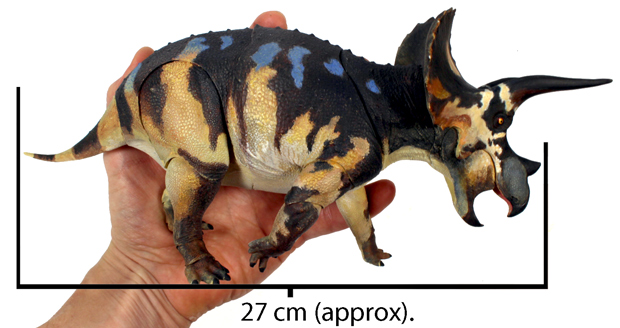
The Beasts of the Mesozoic Triceratops (sub-adult) Model

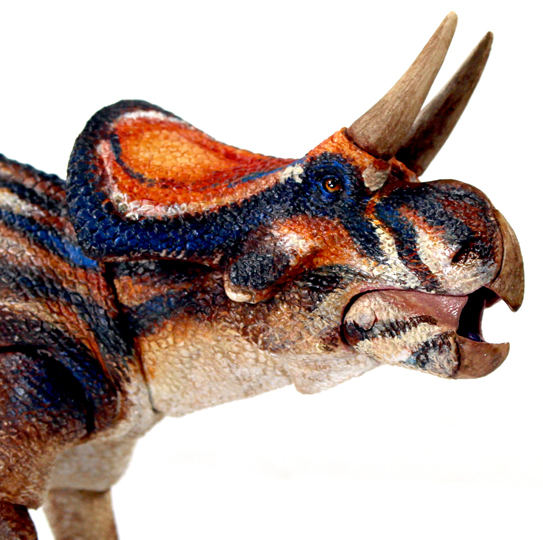
We have received some requests to post up more photographs of the popular Beasts of the Mesozoic sub-adult Triceratops dinosaur model.  Our team members are always willing to oblige so we produced a short blog post that features some more pictures of the Beasts of the Mesozoic Triceratops horridus.

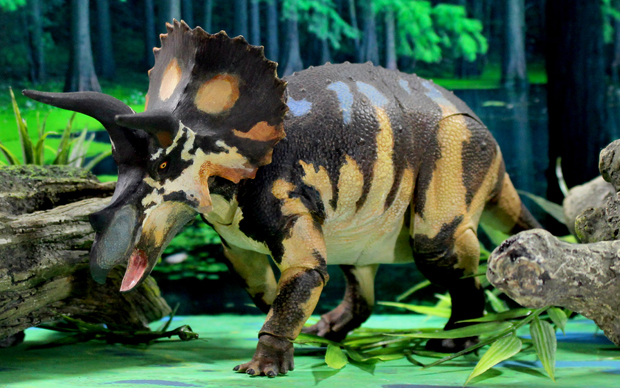
The Beasts of the Mesozoic Articulated Triceratops Dinosaur Model (sub-adult Triceratops horridus)

The Beasts of the Mesozoic Triceratops (sub-adult) articulated figure.

The beautiful Beasts of the Mesozoic Triceratops (sub-adult) articulated figure.  This is one of nine members of the Ceratopsia in the first wave of the popular Beasts of the Mesozoic series.

This one of the largest of the first wave of ceratopsian models created, this is appropriate as T. horridus is regarded as one of the biggest of all the horned dinosaurs described to date.

The Beasts of the Mesozoic Triceratops Model is Around 27 cm in Length

Beasts of the Mesozoic sub-adult Triceratops dinosaur model is approximately 27 cm long.

The Beasts of the Mesozoic sub-adult Triceratops dinosaur model is approximately 27 cm long.  The model has twenty points of articulation and the manufacturer declares a scale of 1:18.

Beasts of the Mesozoic Triceratops (1:18 Scale)

A replica of one of the most popular of all the dinosaurs, the Beasts of the Mesozoic Triceratops is a very colourful figure with twenty points of articulation.  Measuring a fraction under 27 cm in length it is also one of the largest of the first wave of ceratopsian figures created by this company, even though the figure represents a sub-adult.  The model has a declared scale of 1:18 and it represents a dinosaur that lived towards the very end of the Cretaceous.

Palaeontologists have estimated that the temporal range of Triceratops horridus was from 66.8 to 66.4 million years ago (Maastrichtian faunal stage of the Late Cretaceous).  It was superseded by Triceratops prorsus which it is believed it was an ancestor of.  Hell Creek Formation fossils also suggest an as yet, unnamed intermediate species between T. horridus and the younger T. prorsus.

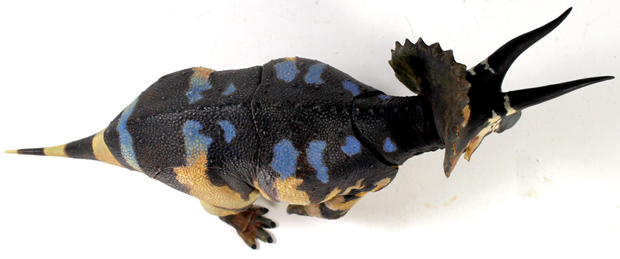
A Dorsal View of the Beasts of the Mesozoic Triceratops Dinosaur Model

The Beasts of the Mesozoic Triceratops sub-adult model (dorsal view).

A dorsal (top down) view of the Beasts of the Mesozoic Triceratops (sub-adult) dinosaur model.

To view the gorgeous Beasts of the Mesozoic sub-adult T. horridus and the rest of the articulated figures in the Beasts of the Mesozoic range: Beasts of the Mesozoic Models.

For other types of dinosaur and prehistoric animal themed merchandise visit: Everything Dinosaur.

8 02, 2021

Beasts of the Mesozoic Zuniceratops Dinosaur Model

By |2024-05-18T22:14:02+01:00February 8th, 2021|Categories: Adobe CS5, Dinosaur Fans, Everything Dinosaur Products, Main Page, Photos of Everything Dinosaur Products, Product Reviews|0 Comments

Beasts of the Mesozoic Zuniceratops Dinosaur Model

One of the first wave of horned dinosaur figures to be introduced under the Beasts of the Mesozoic banner, Zuniceratops is one of those dinosaur models that since its introduction it has helped inform and educate model collectors about the huge diversity now associated with the Ceratopsia.  Models of this Late Cretaceous horned dinosaur are few and far between and the inclusion of this figure, a replica of a member of the Ceratopsidae which was about the size of a cow, helped broaden the understanding of dinosaur fans and model collectors.

Zuniceratops represents a “transitional form”, a dinosaur with a combination of primitive traits and more derived characteristics.  Roaming around the southern United States approximately 90 million years ago (Turonian faunal stage), it is one of just a handful of dinosaurs known to science from this time, some twenty-four million years prior to the evolution of more famous horned dinosaurs such as Triceratops.

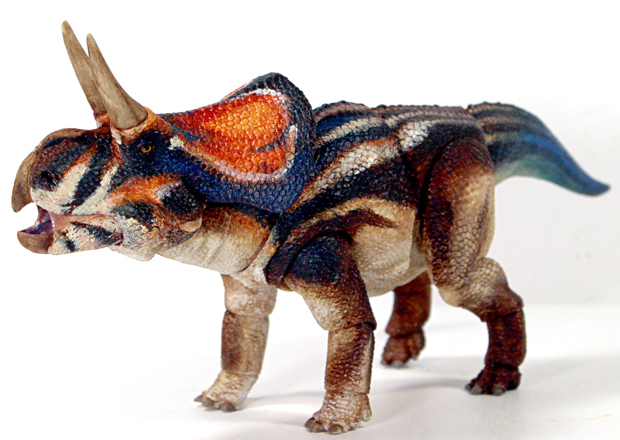
The Beasts of the Mesozoic Zuniceratops (Z. christopheri) Dinosaur Model

The beautiful markings on the Beasts of the Mesozoic Zuniceratops model.

Beasts of the Mesozoic Zuniceratops (lateral view).  Showing the colourful markings on this articulated dinosaur model.

Zuni Horned Face

Measuring a fraction under 22 cm in length, this is one of the smallest of the horned dinosaurs in the Beasts of the Mesozoic series.  In order for it to be given the standard scale for this range (1/18th scale), a small replica was required as this dinosaur measured around three metres long and weighed approximately 200 kilograms, making it considerably smaller and lighter than its much more famous horned dinosaur distant relatives such as Styracosaurus, Triceratops and Pachyrhinosaurus.  The figure might measure just under 22 cm long but it does have 19 points of articulation crammed into its small but sturdy frame.

A Close-up View of the Horns Possessed by Zuniceratops

Beasts of the Mesozoic Zuniceratops christopheri dinosaur model.

The Beasts of the Mesozoic Zuniceratops christopheri dinosaur model.  Despite its formidable appearance, Zuniceratops was actually quite small for a member of the North American ceratopsids.

A Fantastic Paint Scheme

The colours chosen for this articulated dinosaur model are certainly bold and striking.  The body shows signs of counter shading which then give way to contrasting orange flashes which blend with the deep blue to be found at the top of the front legs, around the eyes and framing the long neck shield.   The two brow horns are beautifully painted.  These horns may have played a role in visual communication or as defensive weapons to deter the advances of theropod predators.  Ironically, as far as Everything Dinosaur team members know, there have been no large carnivorous dinosaurs from the Moreno Hill Formation of New Mexico formally described.  Fossils of Zuniceratops are associated with this geological formation and nowhere else.

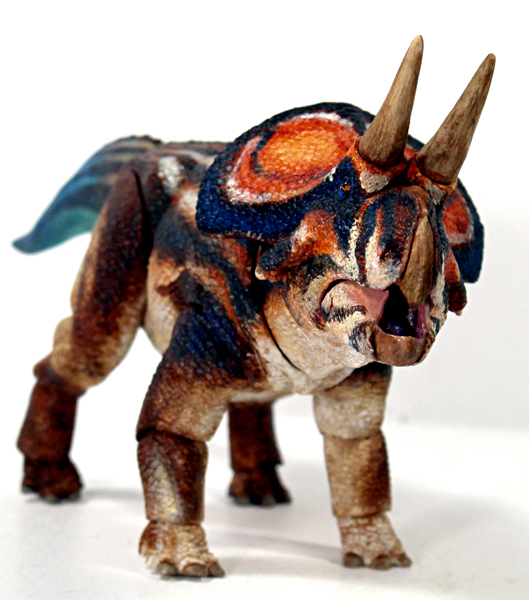
The Beautiful and Very Colourful Head of the Zuniceratops Model

Beasts of the Mesozoic Zuniceratops (anterior view).

The beautiful, detailed head of the Beasts of the Mesozoic Zuniceratops articulated dinosaur model.

The Everything Dinosaur website: Models of Dinosaurs.

A spokesperson from Everything Dinosaur commented:

“Because it represents one of the smaller Late Cretaceous ceratopsians from North America, this Beasts of the Mesozoic figure is a little smaller than the rest of the first wave of these dinosaur models.  We have subsequently priced it a little cheaper so it has become the ideal entry point for model collectors who wish to familiarise themselves with this exciting dinosaur model series.”

To view the Beasts of the Mesozoic ceratopsians and the rest of the models in this series: Beast of the Mesozoic Models.

1 02, 2021

Rare Rebor Oddities Compsognathus longipes Preserved Dissection Specimens Delayed

By |2024-05-18T21:45:29+01:00February 1st, 2021|Categories: Adobe CS5, Dinosaur Fans, Everything Dinosaur News and Updates, Everything Dinosaur Products, Main Page, Photos of Everything Dinosaur Products, Press Releases|0 Comments

Rebor Oddities Compsognathus longipes Preserved Dissection Specimens Delayed

The two eagerly awaited Rebor Oddities Compsognathus longipes preserved dissection specimens have been delayed and they are not going to arrive on the 2nd of February as earlier stated.  Both the Rebor Oddities C. longipes replicas (preserved dissection specimen and the limited edition Victorian Goth version), have been despatched and they are currently on the water heading for the UK.  However, delays and difficulties with shipping and other global logistics related matters led to hold-ups prior to them leaving the factory and they are not likely to arrive before the end of the month (February 2021) or possibly into March.

Rebor Oddities Compsognathus longipes

The Rebor Oddities Compsognathus longipes Dissection Specimens

The Rebor Oddities Compsognathus longipes preserved dissection specimens.

The Rebor Oddities Compsognathus longipes preserved dissection specimens (standard on the left and the limited edition Victorian Goth version is shown on the right).

A spokesperson from Everything Dinosaur commented:

“This is disappointing news but there is virtually no air freight available so these items, like many items at the moment are having to be sent by sea freight.  We apologise for this delay, but we have all the pre-orders for these two replicas safely stored on our database and the delay will only be for a few weeks.”

Visit the Everything Dinosaur website: Everything Dinosaur.

Rebor Models Available for Pre-Order

These two models were originally launched and made available for pre-order in November 2020.  As Everything Dinosaur does not ask for payment upfront, there was no deposit to pay or any additional fees, those customers on the company’s pre-order lists merely have to wait a little longer for these two replicas.  There are huge delays and a lot of disruption in global distribution networks at the moment.

Everything Dinosaur notes that some companies insist on deposits or an upfront payment (sometimes even 100% of the order value), as part of the pre-order terms and conditions.  Customers may have spent or committed funds but will have longer to wait to receive their goods.  With Everything Dinosaur, this is not the case, we just ask our customers on our pre-order lists to be patient at this difficult time.

The spokesperson from Everything Dinosaur added:

“We have emailed all those customers who took up our offer of pre-ordering, informing them of the current situation.  We explained why the delay has occurred and they can rest assured that we are doing all we can to bring models and figures into stock as quickly as possible.”

Both Rebor Oddities Compsognathus longipes Preserved Dissection Specimens Featured in Everything Dinosaur’s November Newsletter

Rebor Compsognathus longipes preserved dissection specimens.

The Rebor Compsognathus longipes preserved dissection specimens featured in the Everything Dinosaur November 2020 newsletter.

Both the Rebor Oddities Compsognathus longipes preserved dissection specimens have been given a new availability date of Tuesday 2nd March.  The expected arrival date for these figures has been put back by four weeks.

Ironically, although stocks are quite low, both these figures are still available for pre-order and they can be found in this section: Rebor Models and Figures.

Go to Top