The Titus T. rex is King exhibition at Wollaton Hall (Nottinghamshire) has been wowing visitors since it opened in early July (2021). After all, this is the first time in more than a century that the fossilised bones of a Tyrannosaurus rex have been exhibited in England.
Team members at Everything Dinosaur were lucky enough to visit Titus during the summer and it is a most spectacular dinosaur with the festive season approaching, why not gift your friends and family an unforgettable experience – the chance to get up close and personal to the “King of the Tyrant Lizards”.
For a limited period (November until 24th December), exclusive festive-themed ticket vouchers will be available to purchase from the Wollaton Hall website. The opportunity to see a fossils of a real T. rex exhibited in England for the first time in over 100 years. Picture credit: Wollaton Hall.
Have Yourself a Roarsome Christmas!
To ensure delivery in time for Christmas, the last chance to purchase the vouchers will be 12th December.
Tyrannosaurus rex is a theropod dinosaur, birds evolved from small theropod dinosaurs, so technically, if you tuck into turkey or gobble up a goose over the festive season you are actually eating a dinosaur!
Take time out over the holiday season to meet a relative of your Christmas dinner that could have happily eaten you for lunch!
Titus T. rex is King” Exhibition
The “Titus T. rex is King” exhibition covers 4,000 square feet, exploring the legend of the Tyrannosaurus rex and also sets out to dispel some myths about this immense predator – one of the largest carnivorous dinosaurs to have existed.
Tickets for this exhibition are on sale now, set at £12 for an adult, £8 for a child (under 16 years), students and concessions, £32 for a family ticket (two adults and two children under 16 years) and under 3s and carers have no entry fees to pay. Excludes booking fee.
Please note this event (Titus the T. rex exhibition) is now closed.
In the meantime, visit the award-winning Everything Dinosaur website: Toy Dinosaurs.
Today, we introduce the first batch of new for 2022 CollectA prehistoric animals. The last eighteen months or so have been extremely challenging, it is great to be able to introduce to you the first of the new for 2022 prehistoric animal figures and replicas from this highly respected manufacturer.
CollectA Deluxe Pteranodon sternbergi with an articulated jaw (1:20 scale).
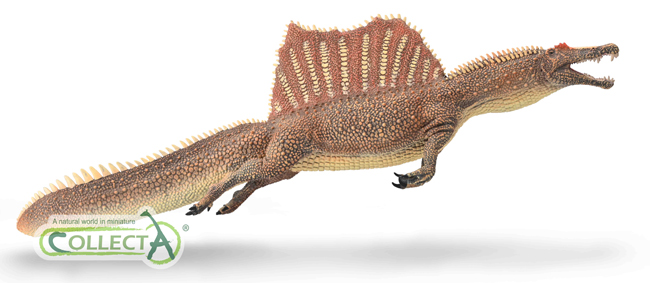
The CollectA Deluxe Spinosaurus swimming with an articulated jaw (1:40 scale).
CollectA Deluxe Paraceratherium.
Scheduled for delivery in early 2022, Everything Dinosaur will keep model collectors informed about shipments.
The new for 2022 CollectA Pteranodon sternbergi model. A very colourful replica of a Late Cretaceous pterosaur sometimes referred to as Geosternbergia.
CollectA Deluxe Pteranodon sternbergi in 1:20 Scale
The stunning CollectA Deluxe P. sternbergi figure is a replica of a pterosaur that was formally described in 1966, following the discovery of fragmentary fossil material in 1952. A broad crest suggests that this figure represents a male. The Pteranodon genus has been subject to much revision over recent years. Although, Pteranodon sternbergi fossils tend to be associated with older strata than Pteranodon longiceps material, their taxonomic relationship remains controversial. Some palaeontologists have proposed that P. sternbergi is sufficiently different from P. longiceps to warrant it being placed in it own genus – Geosternbergia. Whatever the phylogeny, this new for 2022 pterosaur figure with its articulated jaw is a welcome addition to the CollectA Deluxe range.
The CollectA Deluxe swimming Spinosaurus in 1:40 scale (approximately).
CollectA Deluxe Swimming Spinosaurus in 1:40 Scale
The first batch of new CollectA models includes a dinosaur. The CollectA Deluxe swimming Spinosaurus is an updated version of the Prehistoric Life swimming Spinosaurus figure introduced in 2015 (100 years after Spinosaurus aegyptiacus was named and described) and recently retired.
In 2015, CollectA was the first toy company to make a model of S. aegyptiacus based on the comprehensive reassessment undertaken the previous year in a scientific paper entitled “Semiaquatic adaptations in a giant predatorydinosaur” (Ibrahim et al). In 2020, some of the research team behind this earlier paper examined Spinosaurus tail bones (caudal vertebrae) and concluded that this huge theropod had a tail well-adapted for propelling it through water. The new for CollectA 2022 Spinosaurus reflects this research. The model has been given a broad and very fin-like tail.
Commenting on the introduction of this new figure, model designer Anthony Beeson stated:
“In order to keep up with the science, we have now produced an updated deluxe model that incorporates the new information showing the deep, amphibian-style, tail that powered the animal while swimming. The Spinosaurus has a new colour scheme and an articulated jaw. I have retained the 2015 shape of the sail although some have cast doubts on it.”
The new for 2022 CollectA Deluxe Paraceratherium model.
CollectA Deluxe Paraceratherium
The third model to be announced is an updated Paraceratherium replica, which replaces the original figure that was retired in 2019. The CollectA Deluxe Paraceratherium represents a male and it reflects recent research that suggests that it possessed a short, muscular proboscis, reminiscent to that of a modern tapir – to which it was very distantly related (member of the Perissodactyla – odd-toed ungulates).
The new for 2022 CollectA Paraceratherium model has been given a short trunk (proboscis).
One of the largest land mammals known to science, analysis of cranial material suggests that this herbivore might have had a short trunk or a prehensile upper lip. The design team at CollectA have opted for the former. They have also given it patches of coarse hair a characteristic seen in some extant ungulates.
Although a giant (some specimens suggest a body weight of around 20 tonnes), the CollectA figure is quite lightly built and designer Anthony Beeson speculates that it probably wallowed in mud or indulged in dust baths to help control its body temperature.
When discussing the figure’s size, Anthony stated:
“The model’s size has had to be a compromise between what is suitable for display in shops and for manufacturing.”
Model Measurements
CollectA Deluxe 1:20 scale Pteranodon sternbergi with an articulated jaw – length 15 cm, height 13.5 cm.
The CollectA Deluxe 1:40 scale swimming Spinosaurus – length 37 cm, height of sail 11 cm.
CollectA Deluxe Paraceratherium – length 22 cm, height 14.7 cm.
These three figures are scheduled to be in stock at Everything Dinosaur in the early part of 2022. Given the current difficulties with logistics and global shipping, we are not able to give a precise date as to when these figures will be available. Team members will do all they can to update customers with regards to availability.
The latest Everything Dinosaur YouTube video updates viewers on the product safety tests the company commissioned on the ITOY Studio Dilophosaurus sinensis dinosaur model. The video also explains why product testing is important and explains the steps Everything Dinosaur takes in order to legally import prehistoric animal figures.
Video credit: Everything Dinosaur
ITOY Studio Dilophosaurus sinensis
The ITOY Studio Dilophosaurus (D. sinensis) figure has had a limited production run. It is going to be more expensive to purchase than dinosaur toys that are predominately aimed at children. Furthermore, it is only going to be available from a specialist retailer such as Everything Dinosaur. These are all arguments to suggest that this is an adult collectable figure and not a toy. As such, it falls outside the UK Toy Safety Regulations 2011 and the EU Toy Safety Directive (2009/48/EC). Product tests are still required and this is why Everything Dinosaur acquired a sample and had this figure tested by Eurofins under the General Product Safety Assessment protocol.
ITOY Studio Dilophosaurus sinensis model. A new for 2021 dinosaur model coming into stock very shortly at Everything Dinosaur. Tests results have come in and Everything Dinosaur can sell this model, so long as they abide by the conditions and recommendations made in the product safety assessment.
Coming into Stock at Everything Dinosaur
The video narrator explains that the company responsible for printing the product packaging has incorrectly labelled the box with a CE mark. As far as we at Everything Dinosaur know, this model has not been tested under the EU Toy Safety Directive and no certificate stating conformity has been produced (Declaration of Conformity).
If this item was to be offered for sale with the CE mark clearly visible, this would be illegal. Fortunately, thanks to the independent product testing commissioned by Everything Dinosaur, team members know what they have to do to overcome this problem.
Working with Eurofins and their recommendations, Everything Dinosaur has been able to bring into stock this exciting dinosaur model.
Confirming that this dinosaur collectable was heading for the company’s UK warehouse, a spokesperson from Everything Dinosaur stated:
“The ITOY Studio shipment has been delayed. Many vessels are encountering delays at the moment and there are long waits for ships to be unloaded at ports. However, we hope to have this Dilophosaurus collectable in stock at Everything Dinosaur before Christmas.”
Everything Dinosaur on YouTube
The Everything Dinosaur YouTube channel features hundreds of dinosaur and prehistoric animal themed videos, including production updates, model news, new figures and free to enter competitions.
Fossilised dinosaur footprints dating from the Late Triassic that were once thought to represent a large, predatory dinosaur have been re-examined and are now thought to have been made by a mainly vegetarian sauropodomorph. A series of fossilised footprints preserved on the ceiling of a gallery in a coal mine close to the suburb of Dinmore (Queensland, Australia), had been assigned to the ichnogenus Eubrontes. The three-toed tracks, discovered in 1964, were thought to represent a track made by a large theropod dinosaur. They were regarded as the earliest known evidence for the presence of big meat-eating dinosaurs, however, the tracks have been reassessed and are now thought to represent a basal sauropodomorph.
A life reconstruction of a basal sauropodomorph. Picture credit: Anthony Romilio and Kamil Porembinski, CC by-SA2.0.
Walking on the Ceiling?
University of Queensland palaeontologist, Dr Anthony Romilio, lead author of the scientific paper published in the journal “Historical Biology”, commented:
“It must have been quite a sight for the first miners in the 1960s to see big bird-like footprints jutting down from the ceiling”.
Around 220 million years ago, dinosaurs walked across water-sodden layers of plant debris and these tracks were later filled in by fine silt and sand. Over millions of years the plant material turned into coal and this was removed by the miners, leaving a ceiling of siltstone and sandstone in the excavated galleries complete with the preserved natural casts of the dinosaur tracks.
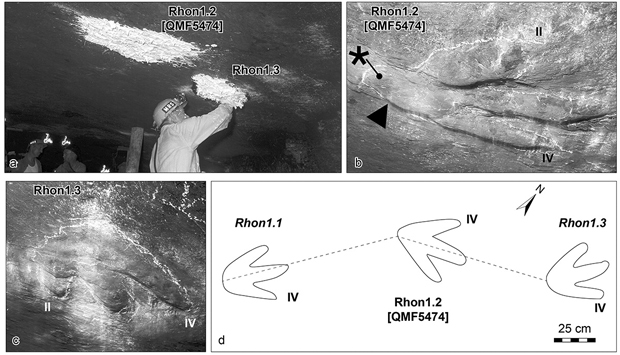
Historical photographs of dinosaur footprints from the Striped Bacon coal seam mine ceiling, Rhondda colliery, Dinmore, Upper Triassic (Norian) Blackstone Formation. Taking plaster casts of the fossils in situ (A). Close-up view of track Rhon1.2 (B) and close-up view of track Rhon1.3 (C). Schematic drawing of the coalmine ceiling trackway (D). Picture credit: Queensland Museum.
The First and Only Evidence of an Australian Basal Sauropodomorph
The coalmine has been closed down, but the original photographs, drawings and plaster casts made in the 1960’s were available for study and under close scrutiny, the research team recognised that the tracks shared characteristics with the sauropodomorph ichnogenus Evazoum.
The Sauropodomorpha is a sister clade to the Theropoda within the lizard-hipped dinosaurs (Saurischia), the first sauropodomorphs evolved around 230 million years ago and these, large-bodied, long-necked herbivores were the ancestors of the huge sauropods that were to dominate many terrestrial ecosystems in the Jurassic. If the research team’s interpretation of the ceiling tracks is correct, these prints provide the first and only evidence of basal sauropodomorph dinosaurs from Australia.
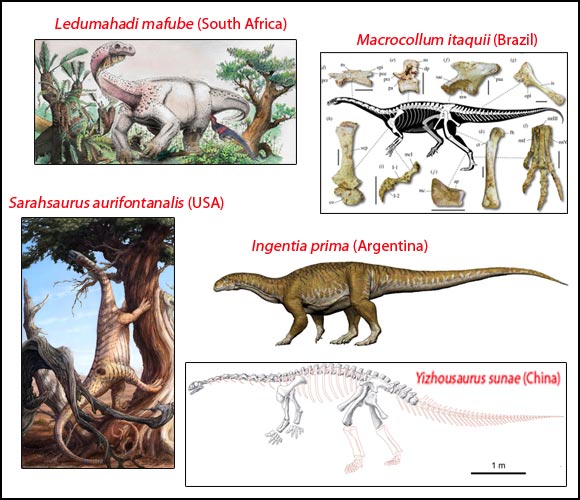
Over recent years, a number of Late Triassic/Early Jurassic sauropodomorph dinosaurs from around the world have been scientifically described.
The coalmine ceiling tracks suggest that the sauropodomorph that made them was around six metres long.
Analysis of a track from the coalmine ceiling (Rhon1.2) and scale drawing of the hypothetical trackmaker. Plaster cast of Rhon1.2 (specimen number QMF5474), with (A) orthographic image, (B) ambient occlusion view, (C) elevation map and (D) contour map. Life reconstruction compared with a person for scale (E). Picture credit: Romilio et al.
Everything Dinosaur acknowledges the assistance of a media release from the University of Queensland in the compilation of this article.
The scientific paper: “Saurischian dinosaur tracks from the Upper Triassic of southern Queensland: possible evidence for Australia’s earliest sauropodomorph trackmaker” by Anthony Romilio, Hendrik Klein, Andréas Jannel and Steven W. Salisbury published in Historical Biology.
Everything Dinosaur has received the product safety report on the ITOY Studio Dilophosaurus model that was conducted by independent testing company Eurofins. The next video to be posted up on Everything Dinosaur’s YouTube channel will explain what the report says and the consequences for transporting this excellent collectable dinosaur model out of China.
This video will be published in the next few days (November 2021).
The next Everything Dinosaur YouTube video will feature the ITOY Studio Dilophosaurus sinensis figure and explain the independent product test results. Picture credit: Everything Dinosaur.
Picture credit: Everything Dinosaur
General Product Safety Assessment
As a limited number of the ITOY Studio Dilophosaurus sinensis figure have been produced, it will carry a 14+ age restriction and as this model will only be available through a specialist retailer such as Everything Dinosaur, it falls outside the scope of both the UK and European Union Toy Safety Directives. However, it is important to us that product testing should still take place, which is why we sent a sample to the independent, globally respected, testing company Eurofins for analysis under the General Product Safety Assessment (GPSA).
One of the photographs of the ITOY Studio Dilophosaurus sinensis model taken by Eurofins as part of their product testing. Picture credit: Eurofins.
ITOY Studio Prehistoric Animal Models
ITOY Studio has developed a formidable reputation for the production of high-quality, beautiful prehistoric animal collectables. The range contains several exciting figures including Tyrannosaurus rex, Ceratosaurus, Velociraptor and a much admired, enormous model of the prehistoric mammal Paraceratherium, which has already been featured on Everything Dinosaur’s YouTube channel.
The ITOY Paraceratherium model (Deluxe) is supplied with a polystone display base.This exciting model was also the subject of a recent Everything Dinosaur YouTube video. Picture credit: Everything Dinosaur.
The next Everything Dinosaur YouTube video will explain what the General Product Safety Assessment says and we will outline the steps required in order to permit us to bring this collectable figure into stock.
The packaging for the model was also reviewed by Eurofins as part of the General Product Safety Assessment.Picture credit: Eurofins.
A spokesperson from Everything Dinosaur commented that they hoped to have their video posted up on the company’s YouTube channel in the next few days (November 2021).
The Everything Dinosaur YouTube channel contains hundreds of videos dedicated to prehistoric animal model collected. In line with the company’s aims to educate and inform, as well as providing product updates, model reviews and information about new figures, many of the videos also contain some information about the prehistoric animals the models represent. For example, in Everything Dinosaur’s previous video about the ITOY Studio Dilophosaurus sinensis information was included about the debate between palaeontologists as to whether D. sinensis is a valid species.
To read our earlier blog post that includes the first YouTube video we produced featuring the ITOY Studio Dilophosaurus sinensis figure: ITOY Studio Dilophosaurus Video.
The autumn edition of “Prehistoric Times” magazine has arrived (issue 139). It features a close-up view of the head of a Suchomimus, artwork created by the talented American palaeoartist Chuck Egnaczak on the front cover and inside Phil Hore profiles this enigmatic African spinosaurid.
The front cover of the next issue of “Prehistoric Times” magazine (issue 139) features a close-up view of the head of the spinosaurid Suchomimus. The artwork is by talented palaeoartist Chuck Egnaczak.
Drawing Feathers
Tracy Lee Ford has dedicated the next few installments of his “how to draw dinosaurs” feature on how to draw feathers and other fancy integumentary coverings associated with the Dinosauria. In part 1, he covers different feather types and explains the differences between them. This is a handy technical guide which will aid illustrators as well as providing assistance when it comes to deciphering scientific papers which focus on feathered theropods.
Mike Howgate weighs in with not one, but two articles in this issue. He examines the fossil fish models created by 20th century model maker Vernon Edwards and in a separate piece, discusses the contribution of sculptor Alfred Lyndhurst Pocock who took up the reins for Gregory, Bottley and Co. after the sudden death of Edwards.
Jon Lavas continues his long-running series highlighting the work of the influential Czech artist Zdeněk Burian. In this issue the focus is on one of the most famous dinosaurs of all – Stegosaurus.
The classic depiction of a Late Jurassic scene by Burian (1950). In issue 139 (autumn/fall 2021), Jon Lavas looks at how Burian depicted Stegosaurus.
Remembering the Contribution to Palaeontology by José Bonaparte
José Bonaparte regarded as the “Father of Argentinian Palaeontology” passed away last year. His long and distinguished career is remembered in a special article written by CONICET staff members Agustin G. Martinelli and Analia M. Forasiepi. These two scientists along with colleague Guillermo W. Rougier (University of Louisville, Kentucky), contribute a second article looking at some of the early mammals of the Mesozoic.
José Bonaparte (1928-2020) the “father of Argentinian palaeontology”. A tribute is paid to his decades of work in the Earth Sciences in the latest edition of the magazine Picture credit: Télam.
Placodonts, Palaeontology News and Book Reviews
Issue 139 is crammed full of news, book reviews and features. There is more on the Marx collector models, editor Mike Fredericks provides an article and Randy Knol looks at new prehistoric animal model releases. Placodonts, specifically the bizarre Henodus are coverred by Phil Hore and look out for the article on the film “Quest for Fire”, which examines some of the perils of making films with prehistoric themes.
There is a lot to be admired in the latest issue of “Prehistoric Times”.
Everything Dinosaur will be stocking the PNSO Aidan the Cretoxyrhina model. This fantastic model of a Late Cretaceous prehistoric shark is already on a shipment of PNSO models and figures heading into Everything Dinosaur and the UK-based company hope to have this model in stock in early December (2021).
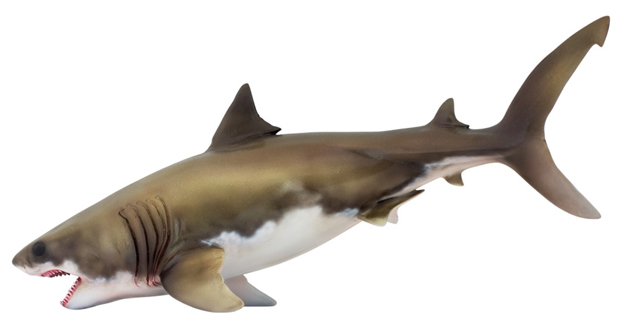
The PNSO Aidan the Cretoxyrhina prehistoric shark model.
Cretoxyrhina mantelli
The type species, Cretoxyrhina mantelli honours the English dentist and palaeontologist Gideon Mantell who first coined the genus name when describing eight fossil shark teeth found in East Sussex. The genus name translates from the Latin as “Cretaceous sharp-nose”.
Mantell thought that the teeth from East Sussex were analogous with living species of shark such as the Common Smooth-hound shark (Mustelus mustelus), which is found around British coasts. The Common Smooth-hound has a pointed nose, so it was surmised that the fossil shark possessed a similar anatomy. Most palaeontologists believe that this large predator had a relatively blunt snout similar to that of the modern Great White (Carcharodon carcharias). The new PNSO Cretoxyrhina model, the first mainstream replica of Cretoxyrhina to be produced, has been given a blunt snout reminiscent to an extant Great White.
The PNSO Cretoxyrhina shark model is reminiscent of the extant Great White. It is thought that Cretoxyrhina occupied a similar ecological niche in the Late Cretaceous marine ecosystem.
PNSO Cretoxyrhina Model Measurements
Although the PNSO mid-size model range does not have a declared scale, team members from Everything Dinosaur estimate that the model, when considered in relation to an 8-metre-long C. mantelli specimen, would be in approximately 1:40 scale.
The PNSO Aidan the Cretoxyrhina figure measures 20 cm in length, although the curve of the model makes it slightly longer.
In Stock at Everything Dinosaur December 2021?
A spokesperson from Everything Dinosaur confirmed that they had known about this new PNSO prehistoric shark model for some time and that, as a result, they had been able to ensure that this figure was shipped over on a vessel that had already left China by the time of the formal product announcement. With the huge problems with global logistics, the ship had been delayed and more problems are to be expected, but with luck, this exciting new PNSO figure should be in stock at Everything Dinosaur in early December (2021).
The PNSO Cretoxyrhina is supplied with a poster and a booklet showcasing the art of Zhao Chuang.
Supplied with a Poster and a Booklet
The PNSO Aidan the Cretoxyrhina figure is supplied with a poster featuring the shark attacking a mosasaur and a 64-page booklet that highlights the artwork of Zhao Chuang.
The PNSO Aidan the Cretoxyrhina prehistoric shark model is supplied with a sci-art poster and a 64-page booklet.
Team members at Everything Dinosaur have managed to obtain some rare and out of production CollectA prehistoric life animal models. The officially retired CollectA Olorotitan and the CollectA Eustreptospondylus are back in stock at Everything Dinosaur. The CollectA Thylacine female is also available whilst stocks last.
CollectA Models
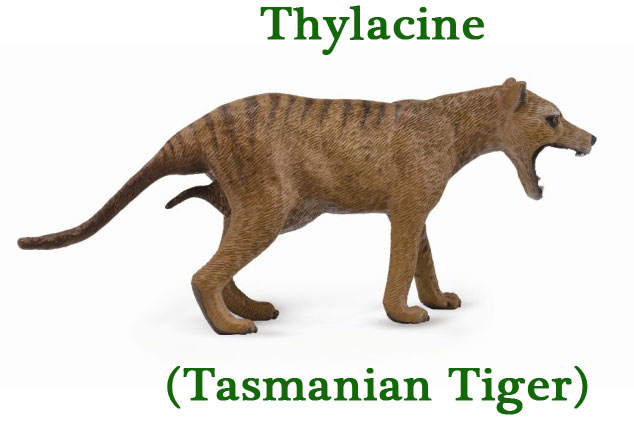
The CollectA Thylacine model was retired and is officially out of production. However, Everything Dinosaur as been able to obtain a limited stock of this extremely rare figure from the factory. It is available whilst stocks last (autumn 2021).
CollectA Thylacine (Tasmanian Tiger) Female
The CollectA Thylacine was introduced back in 2016. It proved popular with model collectors, biologists and cryptozoologists. Sadly, just like the real animal, the figure became extinct when it was retired and withdrawn from production a couple of years ago.
Fortunately, team members at Everything Dinosaur were able to use their considerable influence with the factory to secure a small supply of this exceptionally rare figure.
The CollectA Eustreptospondylus model. A replica of the British theropod dinosaur Eustreptospondylus. This dinosaur figure was officially retired some time ago, but Everything Dinosaur has been able to obtain a limited stock of this rare figure (autumn 2021).
The CollectA Eustreptospondylus Dinosaur Model
This replica of a British theropod dinosaur was part of the second batch of CollectA/Procon models to be released back in 2008. It was withdrawn from production some time ago and it is hoped that the design team at CollectA might introduce an updated figure. However, for a limited time Everything Dinosaur is able to offer this dinosaur model once again.
The CollectA Olorotitan dinosaur model. A fabulous model of this Late Cretaceous hadrosaur.
CollectA Olorotitan
CollectA added a replica of the duck-billed dinosaur Olorotitan to their Prehistoric Life range in 2009, not long after the CollectA Eustreptospondylus was introduced. Known from the Amur region of far eastern Russia, Olorotitan was one of the very last of the non-avian members of the Dinosauria to go extinct. The model was retired some years ago and some collectors, who may have missed it first time around, now have the opportunity to add this hadrosaur model to their prehistoric animal model collection.
A spokesperson from Everything Dinosaur explained:
“Sometimes we get lucky! We are able to find rare and out of production figures in a factory or warehouse somewhere that might have been overlooked. We don’t have many of these figures, after all, they were all retired a while ago, but at least we can give collectors the opportunity to pick up these replicas and we don’t increase our prices just because a figure is rare.”
To view the range of CollectA Prehistoric Life figures available from Everything Dinosaur: CollectA Prehistoric Life.
Paul Barrett of the Department of Earth Sciences at the University of Oregon, has put the prehistoric “cats” amongst the prehistoric pigeons with the publishing of a new scientific paper that reassesses the evolution of the “false-sabre tooths”, the Nimravidae. Previous studies had focused on the remarkable, over-sized canines of these placental predators. The paper, published in the journal “Scientific Research”, examined non-sabre-tooth anatomical features and as a result, a different hypothesis on the evolution of nimravids has been proposed.
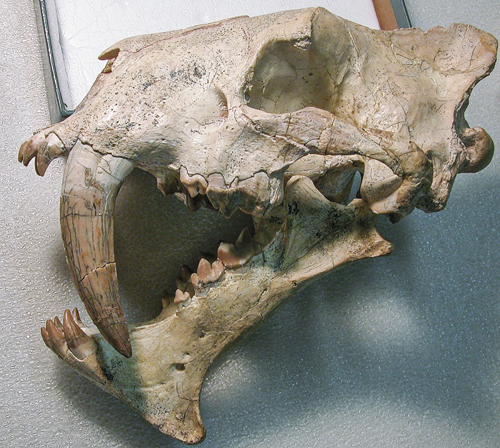
A view of the skull of the “false Sabre-tooth” Hoplophoneus (a member of the Nimravidae). Nimravids such as Hoplophoneus and Eusmilus adelos (which is the subject of the scientific paper published this week), are not true cats (felids) they are not closely related to members of the Felidae such as Smilodon, but they did evolve large, scimitar-like canines – an example of convergent evolution. Picture credit: R. Prothero.
An Over Emphasis on the Teeth and Skulls
Previous studies attempting to map the evolutionary history of the Nimravidae from their origins in the Middle Eocene Epoch to their extinction in the Late Miocene, had focused on examining the shape of the skull and the dentition (teeth). This over reliance on anatomical characters associated with the teeth and the necessary cranial adaptations to wield the enlarged canines led to palaeontologists thinking that these predators evolved in a relatively narrow, restricted way – that there was a gradual evolution of more specialised sabre-tooth features.
This new research based on sophisticated Bayesian analysis looking at a much broader suite of characters and traits suggests that the Nimravidae split, relatively early on in their evolution, into two distinct clusters. One branch (Hopliphoninae) became sabre-toothed hunters, whilst the second branch (Nimravinae) evolved traits reminiscent of extant big cats.
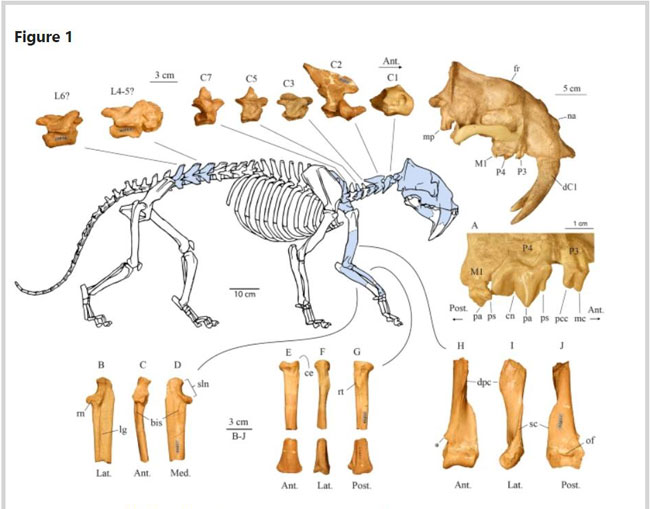
The partial skeleton of Eusmilus adelos (USNM 12820) with known fossil elements shaded light blue. E. adelos is estimated to around the same size as an African lion (P. leo). Skeletal reconstruction by Dhruv Franklin, picture credit: Paul Barrett (University of Oregon).
Eusmilus adelos
In addition to the reassessment of the evolutionary direction of the nimravids, PhD student Paul also examined the fossilised remains of a lion-sized specimen found in Wyoming (White River Formation). This has led to the erection of a new species Eusmilus adelos. Regarded as the biggest member of the Hopliphoninae described to date, it is suggested that a large predator such as E. adelos specialised in hunting prey bigger than itself. Eusmilus adelos may have tackled tapirs, rhinoceratids and large anthracotheriids (an extinct family of hooved, even-toed ungulates distantly related to hippos).
Studying False Sabre-tooths
Coeval hoplophonines were smaller and the author suggests these predators specialised in tackling much smaller prey. This niche partitioning (avoiding of competition by focusing on different resources), would have reflected what is seen on the plains of Africa today amongst extant felids. Large predators such as lions specialising in prey bigger than themselves, whilst smaller felids such as the caracal (Caracal caracal) and the leopard (Panthera pardus) tend to hunt prey smaller than themselves.
To read a related article from Everything Dinosaur that focuses on a study into the evolution of sabre-toothed predators across deep geological time, that suggests that these superficially similar animals evolved very different hunting strategies: Sabre-toothed Predators Evolved Different Hunting Styles.
The scientific paper: “The largest hoplophonine and a complex new hypothesis of nimravid evolution” by Paul Zachary Barrett published in Scientific Reports.
Team members at Everything Dinosaur are busy preparing for arrival of the latest batch of PNSO prehistoric animals including the PNSO Requena the Livyatan model. With production delays and difficulties with logistics, many companies have struggled to receive stock but plans at Everything Dinosaur are well advanced and a shipment of new PNSO models including the Livyatan figure along with Tucson the Himalayasaurus, Evan the Tylosaurus and the eagerly anticipated Aidan the Cretoxyrhina shark model should be in stock at the end of next month (November 2021).
The PNSO Requena the Livyatan prehistoric whale model. This prehistoric whale model should be in stock at Everything Dinosaur in November 2021.
Livyatan melvillei – Leviathan
Formally named and described in 2010 (Lambert et al), from a partial skull discovered in southern Peru (Pisco Formation) two years earlier, the exact size of this prehistoric whale remains unknown. Based on scaling up the 3-metre-long fossil skull with those of extant Sperm whales (Physeter macrocephalus), palaeontologists have estimated that Livyatan could have been between 13.5 and 18 metres in length.
Not knowing the size of this ancient cetacean has made creating a scale drawing challenging for Everything Dinosaur team members. Male Livyatans were probably considerably larger than females, as seen in Sperm whales today. Bull Sperm whales can be up to 20 metres in length, whilst females rarely exceed 12 metres and these bulls can be up to 3 times heavier.
Livyatan Scale Drawing
After having reviewed the scientific literature, Everything Dinosaur team members have given their illustration of Livyatan melvillei a length of approximately 15 metres.
As only the skull and some teeth are known, the size of this predatory whale remains uncertain. Size estimates vary from between 13.5 to 18 metres, males may have been larger than females as seen in the largest extant toothed whale, the Sperm whale (Physeter macrocephalus). Picture credit: Everything Dinosaur.
Originally named Leviathan melvillei, with the genus name reflecting the biblical sea monster and the species name honouring Herman Melville, the author of Moby Dick, it was discovered that the word “Leviathan” was a junior synonym for a Mastodon, so under the rules of scientific nomenclature the genus name was changed. Livyatan is derived from the Hebrew word for the biblical sea monster.