Everything Dinosaur has created an Instagram account so that team members can post up photographs and images related to the company and share some of the amazing pictures and illustrations sent into our offices by our customers. Instagram is a social media platform created to help share photos and videos and Instagram is now owned by Facebook.
Everything Dinosaur is Now on Instagram
Everything Dinosaur has opened an Instagram account.
Picture credit: Instagram
@everythingdinosaur1
Everything Dinosaur’s Instagram username for our site is entitled @everythingdinosaur1 and we will be posting up various images and videos and looking up all our thousands of Facebook chums. In addition, team members are looking forward to liking and commenting on all the amazing dinosaur and prehistoric animal images that have already been posted up onto the platform.
A spokesperson from Everything Dinosaur commented:
“We had been planning to get ourselves on the Instagram platform for quite a while, however, our work commitments, teaching and other projects kept getting in the way. Just before we run into our Christmas sales period and the teaching programme becomes very congested, we thought that this month was a good time to launch our presence on this social media networking site.”
Blogs, Google Plus, Facebook, Twitter, YouTube and Instagram
The UK-based dinosaur and prehistoric animal company has already built up a substantial presence on social media, with Twitter, Google Plus, YouTube and Facebook accounts. Everything Dinosaur’s Facebook page has built up over 5,000 “likes” and thousands of followers since it was initiated. The company’s blog site remains one of the most comprehensive web logs dedicated to palaeontology, fossils, dinosaurs as well as prehistoric animals and figures. The blog was set up over eleven years ago and now boasts in excess of 4,000 separate articles (a total of 4,231 articles including this one).
Team Members at Everything Dinosaur Are Looking Forward to Posting on Instagram (@everythingdinosaur1)
Everything Dinosaur on Instagram @everythingdinosaur1. Picture credit: Everything Dinosaur.
Picture credit: Everything Dinosaur
Shortly, Everything Dinosaur staff will be inviting friends and Facebook followers to link with the company’s Instagram page. It will be exciting to post up information about all our adventures on this interactive, social networking and sharing platform.
It never ceases to amaze us how clever and creative Everything Dinosaur’s customers are. We get lots of photographs sent into our offices by collectors and fans of prehistoric animal models showcasing their collections and dinosaur themed dioramas. Take for example, these pictures sent into us by Luke, after he recently received the rare Kaiyodo Sofubi Toy Box T. rex figure from us.
Posing Against a Backdrop of Prehistoric Scenery the Kaiyodo Sofubi Toy Box T. rex Figure (Smoke Green Colour Scheme)
Kaiyodo Sofubi Toy Box T. rex (smoke green).
Picture credit: Luke
Dioramas Featuring Prehistoric Animals
Lots of collectors like to build their own prehistoric scenes and the Kaiyodo Sofubi Toy Box T. rex looks very much at home against a background of tropical vegetation. The smoke green colour variant looks quite well camouflaged against this backdrop. Luke must have quite a sizeable model and figure collection as he included a couple of pictures of this rare Tyrannosaurus rex figure being displayed next to other dinosaurs from his collection.
Kaiyodo Sofubi Toy Box T. rex Confronts a Papo Triceratops
Kaiyodo Sofubi Toy Box T. rex attacks a Papo Triceratops.
Picture credit: Luke
The Papo Running T. rex Challenges the Kaiyodo Sofubi Toy Box T. rex Figure
Kaiyodo Sofubi Toy Box confronts a Papo Running T. rex.
Picture credit: Luke
Papo Dinosaur Models
The Papo figure (left) is the colour variant version of the Running Tyrannosaurus rex figure, that was introduced in 2016. In the photograph sent into Everything Dinosaur’s offices by Luke, it is compared to the Kaiyodo Sofubi Toy Box T. rex figure (left). The pair of models are quite well-matched, although with ten articulated joints the Kaiyodo figure has many more areas of articulation than the Papo model. The Papo Tyrannosaurus rex has only one area of movement – an articulated lower jaw.
Luke dropped a line to Everything Dinosaur stating:
“Hi guys. Just wanted to put finger to keyboard to say a massive thank you for the Kaiyodo Sofubi smoke green T. rex which I have just received. The model itself is absolutely superb and I have sent some pics. Also, to say thank you I’m also sent a little recreation of an iconic scene from a certain classic 1930s movie. Once again I cannot thank you guys enough and look forward to ordering from you again. Kindest regards.”
The movie Luke is referring to is the famous film “King Kong” that was released in 1933 and stars Fray Wray, Bruce Cabot and of course, a stop motion giant ape that was animated by Willis O’Brien. Skull Island, Kong’s home has also a number of dinosaurs in residence, including fearsome meat-eaters. In one classic scene, Kong battles a dinosaur.
Recreating a Classic Scene from “King Kong” (1933)
Kong fights the Kaiyodo Sofubi Toy Box T. rex.
Picture credit: Luke
Two Articulated Models from Luke’s Collection Battle
King Kong versus the Kaiyodo Sofubi Toy Box T. rex (smoke green).
Picture credit: Luke
Striking the Final Blow
King Kong fights the Kaiyodo Sofubi Toy Box T. rex.
Picture credit: Luke
Prehistoric Animal Models
Our thanks to Luke for taking the time and trouble to send to us these fabulous photographs and we really appreciate the careful way in which he has arranged these shots. We spotted the Safari Ltd Prehistoric World tree fern and a base from the Rebor Ceratosaurus replica “Savage” that had also been incorporated into the diorama. The Kaiyodo Sofubi Toy Box T. rex is fantastic piece of dinosaur figure design and with all its points of articulation collectors can create all sorts of action poses. Thanks Luke for sharing these wonderful pictures.
Subscribers to Everything Dinosaur’s newsletter received their latest instalment a few days ago and what a jam-packed newsletter it was. The headlines were dominated by the arrival of the amazing Kaiyodo Sofubi Toy Box Tyrannosaurus rex figures. These three, articulated T. rex figures have been eagerly anticipated by collectors and they are very rare, so it was great to see all three models featuring (018A, 018B and the “classic” 018C).
Announcing the Arrival of the Kaiyodo Sofubi Toy Box T. rex Figures
The Kaiyodo Sofubi Toy Box T. rex dinosaur figures are in stock at Everything Dinosaur.Picture credit: Everything Dinosaur.
Picture credit: Everything Dinosaur
Kaiyodo Sofubi Toy Box T. rex Dinosaurs
The three tyrannosaurs with a total of ten points of articulation each, make wonderful pieces for any serious dinosaur figure collector. It is very difficult to obtain these figures from outside Japan and newsletter readers have been contacting us over the last few days to congratulate us and to express their delight over these detailed models.
To view the limited edition Kaiyodo Sofubi Toy Box T. rex dinosaurs including the “smoke green” and the “classic” colour variants: Kaiyodo Prehistoric Animal Models.
Get Your Hands on a Kaiyodo Sofubi Toy Box T. rex
The Kaiyodo Sofubi Toy Box T. rex dinosaur figures are in stock at Everything Dinosaur.Picture credit: Everything Dinosaur.
Picture credit: Everything Dinosaur
With prices from £32.99 plus postage, these models are already proving to be extremely popular with collectors. Prices stated as correct at the time of publishing.
Rebor Vanilla Ice “Jungle” and “Mountain”
The Kaiyodo “Smoke Green” T. rex and Rebor Vanilla Ice “Jungle”
The Kaiyodo Sofubi Toy Box T. rex dinosaur figure (smoke green) and a Rebor “Vanilla Ice” in the jungle colouration.
Picture credit: Everything Dinosaur
Everything Dinosaur will be stocking the amazing pair of 1/35th scale Rebor tyrannosaurs which will be sold under the name Vanilla Ice. There are two colour variants available, the one pictured above, is the Vanilla Ice “Jungle” tyrannosaur, a beautiful, green-coloured theropod. This model will be available at the end of October or thereabouts and Everything Dinosaur has opened a priority reserve list for this dinosaur model.
The Rebor Vanilla Ice 1:35 Scale Tyrannosaur Figure “Mountain” and a Dinomites T. rex Soft Toy
Rebor “Vanilla Ice” Mountain and a soft and cuddly T. rex.Picture credit: Everything Dinosaur.
Picture credit: Everything Dinosaur
The picture above shows the Rebor Vanilla Ice “Mountain” dinosaur model. It, like its counterpart “Jungle”, is a superb replica. Both tyrannosaur models have an articulated lower jaw and “Mountain” along with “Jungle” should be arriving at our warehouse on or around the end of October.
To join our priority reserve list for the Rebor Vanilla Ice “Jungle” and “Mountain” tyrannosaur figures, simply email Everything Dinosaur: Contact Everything Dinosaur.
Dinomites Soft Toy T. rex
To complete our tyrannosaur theme for our latest newsletter, a picture and information about our Dinomites T. rex soft toy were included, it is a wonderful example of prehistoric plush. It is a super soft and cuddly Tyrannosaurus rex, aimed at young dinosaur fans. For further information about the huge range of soft toy prehistoric animals stocked by Everything Dinosaur: Soft Toy Dinosaurs from Everything Dinosaur.
The Dinomites Soft Toy Tyrannosaurus rex
The Dinomites T. rex soft toy.
To subscribe to Everything Dinosaur’s regular customer newsletter, just drop our dedicated team members an email: Email Everything Dinosaur.
Team members at Everything Dinosaur have noted that a number of news channels are covering the story concerning a team of British scientists who have “unpicked” dinosaur DNA and established what it looked like. Unsurprisingly, references are being made to “Jurassic Park/Jurassic World” and the possibility of having prehistoric animal safari parks sometime in the near future. As with a lot of science stories, things are not quite what they seem. Today, we shall endeavour to unravel the double helix behind these news releases and place everything into context.
Dinosaur DNA – Not a New Story
The scientific paper that the media is commenting upon was actually published several months ago, appearing in the academic journal “Nature Communications” as an open access article on the 21st May (2018).
Researchers from the University of Kent, in collaboration with scientists from the Natural History Museum (London), the Royal Veterinary College, Cambridge University and Iowa State University, examined the genomes of different species of birds and turtles and as a result, they were able to determine how the overall genome structure of a dinosaur might have looked like under a microscope. Lead author of the scientific paper, Professor Darren Griffin (School of Biosciences, University of Kent) has been studying this area of genetics, looking at the genomes of living species to infer information about extinct ancestors for several years now.
In essence, the researchers set out to extrapolate the possible genome structure of a shared common ancestor between birds and turtles that lived in the Late Permian (260 million years ago), many millions of years before the first dinosaurs evolved.
Extrapolating Dinosaur Genetic Information Based on the Genomes of Extant Descendants
Working out the structure of dinosaur DNA based on the genomes of extant relatives.Picture credit: Everything Dinosaur.
Picture credit: Everything Dinosaur
Dinosaur DNA – It Started with a Chicken
The University of Kent team have been involved in an extensive and long-term programme of research as part of a group called the International Avian Phylogenomics Consortium, whose aim is to better understand the genetics of important domesticated birds such as the turkey, chicken and duck. Mapping the genome structure of several different types of bird has revealed that the chromosomes of chickens and turkeys have undergone the fewest number of changes compared to their ancient non-avian ancestor – a maniraptoran dinosaur.
Birds as living descendants of theropod dinosaurs were thought to have undergone a rapid burst of evolution after the extinction of the non-avian dinosaurs some 66 million years ago. However, the taxonomic relationship between modern groups of birds is confusing and the molecular details of how birds evolved into more than 10,000 different species today is poorly understood.
Professor Griffin and his team have established that bird genomes are distinctive in that they have more tiny microchromosomes than any other vertebrate group. These small packages of gene-rich material are thought to have been present in their dinosaur ancestors.
Attempts to De-engineer the Genetics
The scientific paper describing this earlier research was published back in 2014 in the journal BMC Genomics. The team found that the chicken has the most similar overall chromosome pattern to its avian dinosaurian ancestor. So if you were going to build a real-life “Jurassic Park” start with some domesticated fowls and attempt to de-engineer the genetics, reversing 60 million years plus of evolution, gene mutation and natural selection and you might, just might, end up with a dinosaur. Sadly, no!
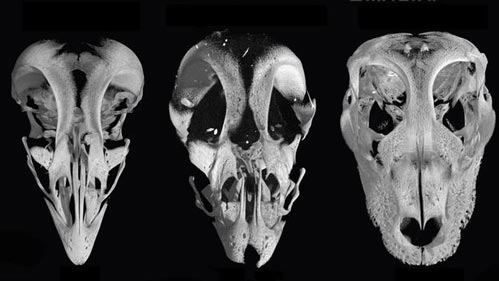
Michael Crichton might have used this idea of genetic manipulation to create dinosaurs, but this technology does not permit you to build a dinosaur. However, by manipulating the DNA of a chicken embryo it is possible to reveal in that embryo some dormant characteristics and traits that reveal the bird’s dinosaurian ancestry. For example, researchers have been able to produce an extended pygostyle, turning on those genes once responsible for the formation of the dinosaur tail. In addition, manipulating the genetic information with the cells of a chicken embryo has led to the development of teeth in the jaws, a trait possessed by dinosaurs but lost by their avian descendants.
Skulls Showing How Genetic Information Can Be Manipulated Between Archosaurs
Normal chick (left), modified chicken embryo (centre), alligator embryo (right), numerous research projects have been undertaken to map the avian genome and to examine the close relationship between living archosaurs and their extinct relatives.
To read an article from 2009, that looks at attempts to reverse engineer the DNA of chicken embryos to create dinosaur characteristics: The “Dinochicken” Project.
Tracing How Chromosomes Have Changed Over Deep Time
The research team’s paper which is currently being commented upon by numerous media outlets (published in Nature Communications, May 2018), used sophisticated mathematical models to map how chromosomes changed over millions of years from a common reptile ancestor to the present day.
Commenting on the significance of this study, Dr Becky O’Connor, (University of Kent) stated:
“The technique used in this study allowed us to determine the genome structure of the turtle-bird ancestor. Turtles are one of the very few species that have similar looking chromosomes to birds. Until now, the tools required to compare their chromosomes were not available. In our study, we added fluorescent labels, called “DNA probes”, to the chromosomes of birds and turtles so that we could locate the stretches of DNA that match in the two species.”
Fluorescent DNA Probes
One of the key pieces of biotechnology that made this study possible was the development of a set of fluorescent DNA probes derived from birds that worked well on the chromosomes of turtles. Using these probes to identify similarities and differences in the genetic make-up of different, albeit related species, the scientists were able to trace the changes that took place in the DNA of the bird/turtle ancestor and plot the evolutionary path through the theropod lineage to the modern descendants of long extinct dinosaurs.
Dr O’Connor added:
“The process then involved tracing the changes that occurred from the bird-turtle ancestor. The evolutionary path examined the point when dinosaurs first emerged, through the theropod dinosaur line, and beyond several mass extinction events, including the most recent one 66 million years ago.”
The team found that, although the individual chromosomes rearranged their genes internally, this did not occur much at all between the chromosomes, what the scientists describe as “a significant discovery”.
A Dinosaur Production Line As Imagined in the Famous Movies
Scientists will not be scientifically engineering dinosaurs anytime soon.
Picture credit: Masrani
Lots of Chromosomes Probably Equals Lots of Diversity
Living avian dinosaurs (birds) have a lot of chromosomes, most birds have around 80 chromosomes (40 pairs), compare this to our own species Homo sapiens which as 46 chromosomes (23 pairs). Having a lot of chromosomes may help to explain why the 10,000 species of birds around today are so diverse. The pattern of chromosomes (karyotype), in birds may therefore provide clues as to the huge variety of different dinosaurs (non-avian dinosaurs) that once existed.
If early dinosaurs and later theropods had similar numbers of chromosomes, then this genetic “richness” might explain why non-avian dinosaurs evolved into a myriad of different forms.
This research suggests that, if scientists could take DNA from a theropod dinosaur such as Velociraptor or even a Tyrannosaurus rex, the chromosomes might look very similar to that of a modern-day bird, remarkably similar in fact to that of a chicken or a turkey.
Buy Why Turtles When Studying Dinosaur DNA?
Testudines (turtles, tortoises and terrapins), are not that closely related to dinosaurs. In fact whether turtles are diapsids and therefore distantly related to dinosaurs and birds, or whether they are anapsids and only very remotely related to dinosaurs and birds is an area of debate. Most scientists agree that crocodiles are the closet living relatives to dinosaurs (crocodiles are diapsids and also archosaurs, just like dinosaurs). However, crocodilian DNA was not used in this research as the team found too many inconsistencies and a lack of success in using the fluorescent DNA probes with crocodilian genetic material.
Furthermore, the crocodilian species studied seemed to show an atypical archosaur karyotype with no microchromosome clusters mostly brought about by fusion.
In a press release from the Natural History Museum, Dr Paul Barrett explained:
“Turtles aren’t closely related to dinosaurs, but they are one of the living groups of reptiles that can be used to study the relationships of dinosaurs and some of the features that they would have possessed. Birds are living dinosaurs and crocodiles are their next nearest relatives, followed by turtles, lizards and snakes.”
One thing the researchers are all agreed upon, this study reinforces the idea that birds are essentially living theropod dinosaurs and despite significant breakthroughs in our understanding of how genetic material might change over deep geological time, no-one is going to be genetically engineering dinosaurs any time soon.
There is Not Going to be a Real Life “Jurassic World” Anytime Soon
Jurassic World poster.
Picture credit: Universal Studios
The scientific paper:
“Reconstruction of the Diapsid Ancestral Genome Permits Chromosome Evolution Tracing in Avian and Non-avian Dinosaurs” by Rebecca E. O’Connor, Michael N. Romanov, Lucas G. Kiazim, Paul M. Barrett, Marta Farré, Joana Damas, Malcolm Ferguson-Smith, Nicole Valenzuela, Denis M. Larkin and Darren K. Griffin published in Nature Communications.
Lots of Rebor Models Back in Stock at Everything Dinosaur
So many Rebor replicas have come back into stock at Everything Dinosaur, that we dedicated an entire customer newsletter to this popular brand of prehistoric animal figures. Recently arrived at our warehouse is a “pack” of “raptors”. The Rebor 1/18th scale figures “Winston”, “Pete” and “Alex Delarge” have arrived. There are enough Velociraptor figures in stock to keep even the most ardent Jurassic Park fan happy. Also, just in, the new Rebor “Sweeney” Velociraptor figure.
The Rebor Velociraptor Figure “Winston” is Back in Stock at Everything Dinosaur
Celebrating the return of “Winston” the original 1:18 scale “Raptor” figure from Rebor. Picture credit: Everything Dinosaur.
Picture credit: Everything Dinosaur
Rebor 1:18 Scale Velociraptor Figures
The Velociraptor figure called “Winston” was the first 1:18 scale Velociraptor model to be produced by Rebor, it is great to see this favourite back in stock. In addition, our latest Rebor shipment contained two other, previously stocked Rebor “raptor” figures, namely, “Pete” and “Alex Delarge”. The original Velociraptor figure “Winston” was named in honour of Stan Winston, the American film and television special effects creator who worked on the first three films in the Jurassic Park film franchise.
“Alex Delarge” and “Pete” are members of a violent gang (the droogs), in Anthony Burgess’s novel of 1962 “A Clockwork Orange”, which was later made into a film directed by Stanley Kubrick.
The Leaping Velociraptor Figure – Alex Delarge is in Stock
Rebor Alex Delarge returns to stock. Picture credit: Everything Dinosaur.
Picture credit: Everything Dinosaur
Rebor Models – Bigger Theropods and Smaller Theropods
Joining the “Raptors” in Everything Dinosaur’s website is the “Cerberus Clan”, three scale models of the larger dromaeosaurid Deinonychus (D. antirrhopus). In addition and sharing the billing with the Rebor “Cerberus Clan” is another Velociraptor figure that is back in stock, the popular Velociraptor “Pete”.
The Rebor Deinonychus Figures “Cerberus Clan” and the Rebor 1:18 scale Velociraptor “Pete” Back in Stock at Everything Dinosaur
Rebor “Pete” and the “Cerberus Clan” in stock at Everything Dinosaur. Picture credit: Everything Dinosaur.
Picture credit: Everything Dinosaur
To view the range of Rebor prehistoric animal figures in stock at Everything Dinosaur, including all the 1:18 scale “raptors”: Rebor Prehistoric Animal Models.
Rebor Carnotaurus “Crimson King” and the Newly Arrived “Sweeney”
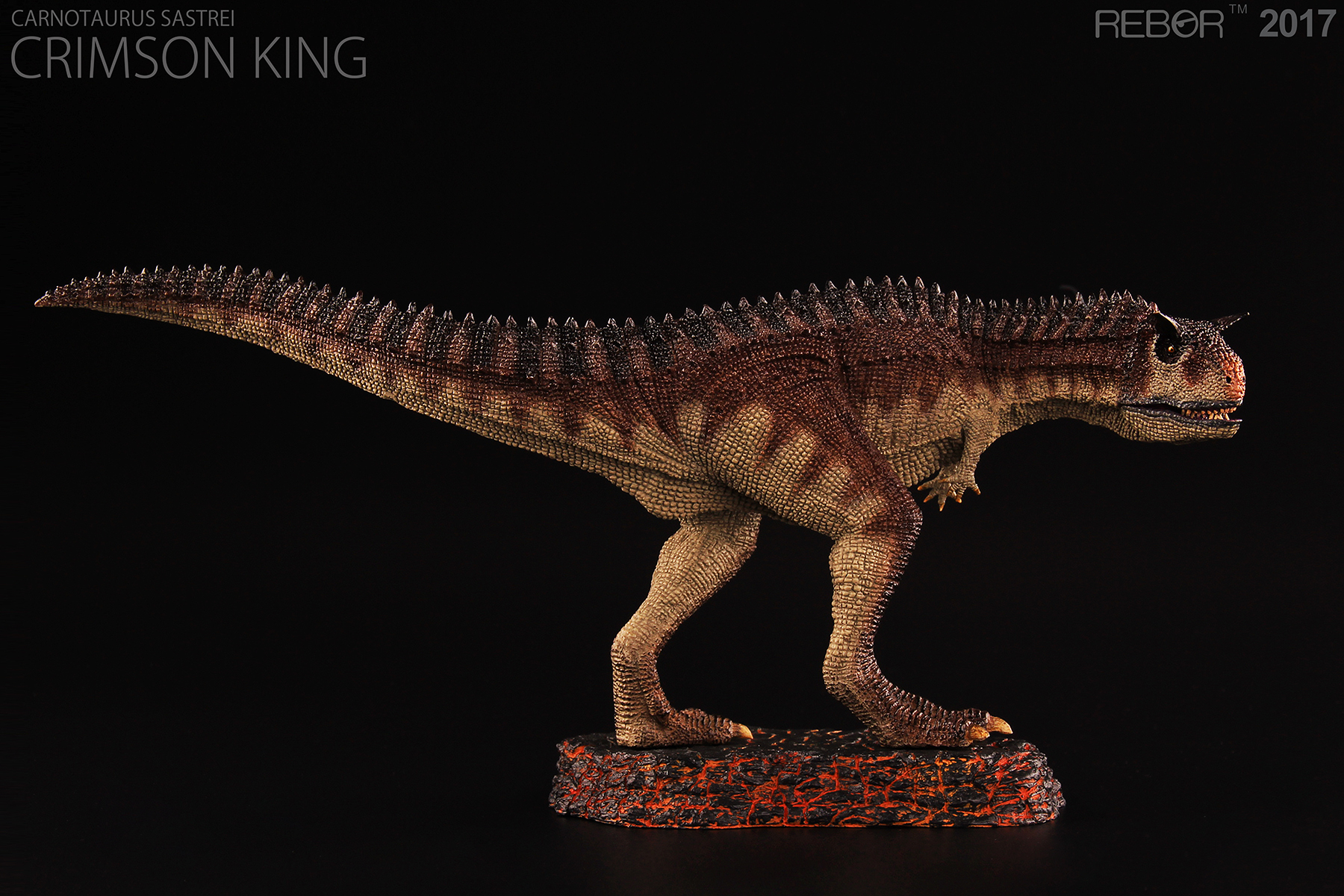
As well as the various dromaeosaurids that have arrived, more stocks of the popular 1:35 scale Carnotaurus figure (C. sastrei) have become available too. Saving the last to the last, Everything Dinosaur has received stocks of the Rebor “Sweeney” Velociraptor model, the last “raptor “for the time being to be introduced by Rebor.
The Rebor “Crimson King” Carnotaurus Replica
Rebor “Crimson King” Carnotaurus dinosaur model.
Rebor “Sweeney” the Latest 1:18 Scale Velociraptor Figure
“Sweeney” a 1/18th scale Velociraptor figure by Rebor.
A spokesperson from Everything Dinosaur, who had helped unpack all the Rebor replicas at the company’s warehouse stated:
“It is great to see more stocks of Rebor models coming into our warehouse. Collectors are spoilt for choice when it comes to selecting Rebor Velociraptors, there are just so many high quality figures to choose from. Furthermore, joining the Velociraptors is the Cerberus Clan and the Rebor Carnotaurus figure known as the Crimson King.”
Look out for more updates and information from Everything Dinosaur. Rebor are planning to introduce some new models before Christmas and as always, Everything Dinosaur team members will be doing their very best to make sure that dinosaur model fans and prehistoric animal figure collectors are kept informed and up to date.
Subscribing to Everything Dinosaur’s Newsletter
Subscribing to the Everything Dinosaur newsletter is very simple and it’s free! The Everything Dinosaur newsletter provides lots of updates and information on new model releases, company production updates and figure retirements. We post out these emails from time to time, helping to keep our dedicated and enthusiastic customers informed.
To request a subscription to Everything Dinosaur’s regular newsletter, simply email: Email Everything Dinosaur.
The Dinosaur Park Formation (DPF) and the Hell Creek Formation (HCF)
We have been asked to give a brief explanation of the different dinosaurs associated with two famous North America rock formations. A comment on the different dinosaur faunas associated with the Dinosaur Park Formation (DPF) of southern Alberta and the Hell Creek Formation (HCF), which is mostly associated with the state of Montana but also outcrops in North and South Dakota as well as Wyoming.
The Badlands of the Dinosaur Park Formation (DPF) – Hunting for Dinosaur Fossils
A typical view of the “Badlands” of the Dinosaur Park Formation. The red arrow in the picture highlights the layer in which the fossils of a new type of horned dinosaur were discovered.
The Badlands
Both the Hell Creek Formation and the Dinosaur Park Formation are referred to as “Badlands”, this term is derived from the French phrase “les mauvaises terres” and dates back to the early years of exploration of these vast tracts of land. The term describes an area largely devoid of vegetation that is subjected to rapid erosion caused by wind, rain and running water.
The DPF is older, the strata were laid down between 76.5 and 75 million years ago in the Late Cretaceous (Campanian faunal stage). In contrast, the Hell Creek Formation is younger. The rocks were formed at the very end of the Cretaceous (Maastrichtian faunal stage) and the strata records the transition from the end of the Cretaceous into the Palaeocene, the first Epoch of the Cenozoic. The HCF spans approximately 66.8 to 66 million years ago and documents evidence of an extra-terrestrial impact event preserved as a thin clay layer that contains large quantities of the rare Earth element iridium, marking the Cretaceous-Palaeogene boundary, representing an extinction event denoting the end of the age of the dinosaurs and the start of the Cenozoic.
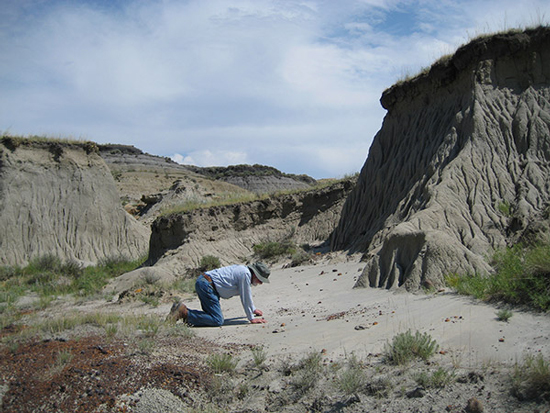
Looking for Fossils – Hell Creek Formation
Prospecting for fossils – Hell Creek Formation (Montana).
Picture credit: University of California Museum of Palaeontology
The Ancient Environments – Dinosaur Park Formation and Hell Creek Formation
The strata that forms the DPF represents a coastal plain environment, crossed by numerous large rivers. The majority of the rocks are sandstones and mudstones, although there are layers of volcanic ash (bentonite), which resulted from the sporadic eruptions of volcanoes in the region. In the upper part of the DPF, coal deposits can be found (Lethbridge coal zone), representing deposition in a swampy environment.
The sea gradually encroached onto this coastal plain and the area was eventually flooded, resulting in the deposition of the marine shales that represent the Bearpaw Formation that overlies the DPF.
The Hell Creek Formation was created under similar circumstances. It too represents clays, mudstones and sandstones deposited on a delta, a low-lying flood plain crossed by many rivers. The HCF also has peaty, coal-like deposits (lignite), representing deposition in coastal swampy environments.
The Palaeoenvironment of the Dinosaur Park Formation
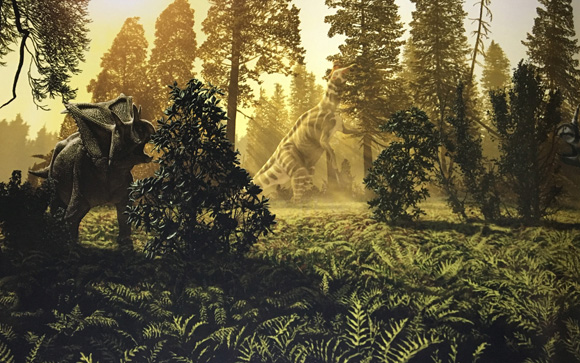
Alberta around 75 million years ago (Dinosaur Park Formation).
Picture credit: Julius Csotonyi
A Chasmosaurus and a Lambeosaurus feeding during the late evening, a typical scene representing the biota associated with the DPF.
The Palaeoenvironment of the Hell Creek Formation
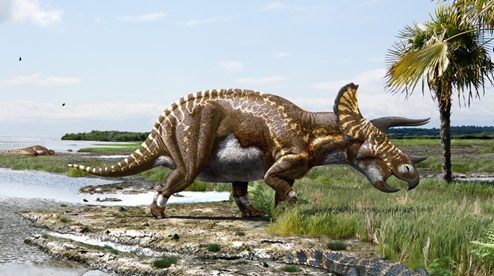
Triceratops was one of the last dinosaurs to evolve. A resident of the Hell Creek Formation.
Picture credit: Julius Csotonyi
A Triceratops grazes next to a palm tree on the coastal plain that is represented by deposits that help to make up the Hell Creek Formation of Montana.
Different Time Periods – Different Dinosaurs
Both the HCF and the DPF are famous for extensive dinosaur fossils. It is worth remembering that numerous other kinds of animal (and plants) are represented in the fossil record of these two formations. Although, the dinosaur fauna is similar between the DPF and the HCF, for example the terrestrial large herbivores are dominated by duck-billed dinosaurs and ceratopsians, the genera represented are very different.
In simple terms, the stage scenery might be similar and the cast of characters reminiscent but the actors on the stage are different.
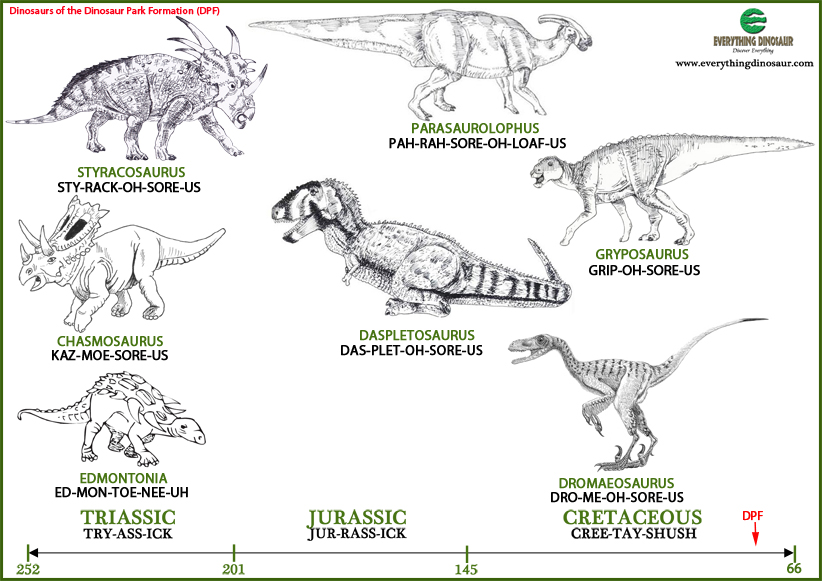
Typical Dinosaurs from the Dinosaur Park Formation (Campanian Faunal Stage of the Cretaceous)
Typical dinosaur fauna of the Dinosaur Park Formation (Alberta, Canada). Picture credit: Everything Dinosaur.
Picture credit: Everything Dinosaur
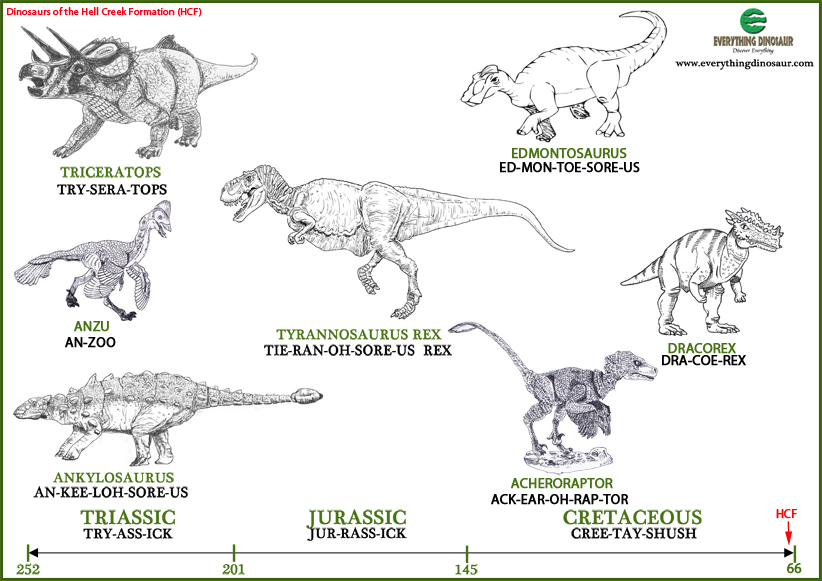
Typical Dinosaurs from the Hell Creek Formation (Maastrichtian Faunal Stage of the Cretaceous)
Typical dinosaurs of the Hell Creek Formation. Picture credit: Everything Dinosaur.
Picture credit: Everything Dinosaur
The images in the pictures (above) are based on various dinosaur models sold by Everything Dinosaur. To view the range of models available: Prehistoric Animal Models and Replicas.
We are looking forward to our visit to the Beacon Museum at Whitehaven (Cumbria). Everything Dinosaur will be taking visitors on a fossil hunt and we hope to be able to give away real dinosaur bones.
The latest prehistoric animal scale models from CollectA along with information about the new Rebor Velociraptor “Sweeney” and the Eofauna Straight-tusked elephant figure are all included in Everything Dinosaur’s latest customer newsletter (early July 2018). Four new CollectA scale models are in stock, plus the Rebor Velociraptor “Sweeney” reserve list is now open and the Eofauna Straight-tusked elephant model (Palaeoloxodon antiquus) is due to arrive very shortly.
Everything Dinosaur’s Newsletter (Early July 2018) Features the New for 2018 CollectA Scale Models
Two new Permian prehistoric animal figure models have arrived in stock at Everything Dinosaur – CollectA Dimetrodon and the CollectA Estemmenosuchus.Picture credit: Everything Dinosaur.
Picture credit: Everything Dinosaur
Four New CollectA Scale Models
The latest CollectA scale models have arrived at Everything Dinosaur and feature in the company’s latest newsletter. Fans of CollectA have requested that more Palaeozoic figures be added to the range. Earlier this year, a 1:20 scale Dunkleosteus was added and now joining this Devonian placoderm are two Permian figures, representing Dimetrodon and the dinocephalian Estemmenosuchus. Both these figures are also in 1:20 scale.
To view the new CollectA Deluxe scale models and the rest of the CollectA scale model range: CollectA Deluxe Models.
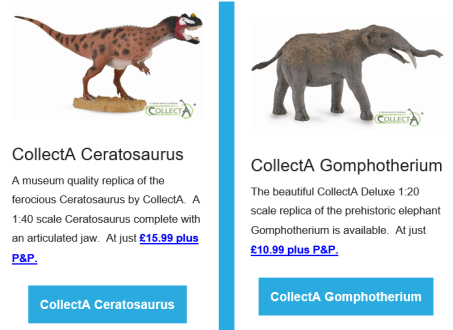
The 1:40 Scale CollectA Deluxe Ceratosaurus and the CollectA 1:20 Scale Gomphotherium Figure
The CollectA Ceratosaurus and the CollectA Gomphotherium models.Picture credit: Everything Dinosaur.
Picture credit: Everything Dinosaur
In addition to the CollectA Dimetrodon and the CollectA Estemmenosuchus, also just in are the 1:40 scale Ceratosaurus dinosaur model and the prehistoric elephant Gomphotherium. Like the CollectA Dimetrodon figure, the 1:40 scale Ceratosaurus dinosaur model has an articulated lower jaw.
The Reserve List for the New Rebor Velociraptor “Sweeney” Has Opened
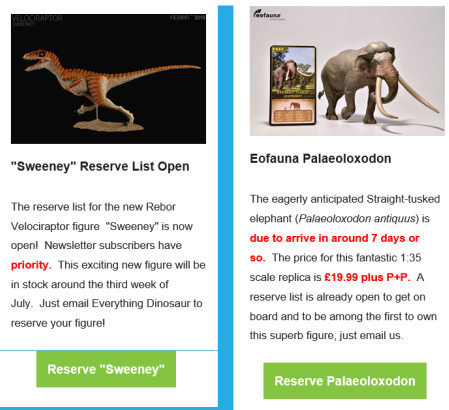
Newsletter subscribers are among the first to learn that another Rebor 1:18 scale Velociraptor replica is on the way. A reserve list has been opened for Rebor “Sweeney”, subscribers can ensure that they are able to purchase this new theropod figure when it arrives at Everything Dinosaur’s warehouse later this month.
To reserve a new Rebor Velociraptor figure “Sweeney” or to request a subscription to Everything Dinosaur’s regular company newsletter, simply drop us an email: Email Everything Dinosaur.
The New Rebor Velociraptor “Sweeney” and the Eofauna Straight-tusked Elephant
The new Velociraptor figure from Rebor “Sweeney” and the Eofauna Palaeoloxodon antiquus.Picture credit: Everything Dinosaur.
Picture credit: Everything Dinosaur
The Everything Dinosaur newsletter is a great way for subscribers to keep up with new model introductions, information about figure retirements and other news about collecting dinosaurs and prehistoric animal figures.
The New Eofauna Straight-tusked Elephant (Palaeoloxodon antiquus)
Readers of our latest newsletter were also provided with an update on the progress being made with the eagerly awaited Eofauna Straight-tusked elephant figure (Palaeoloxodon antiquus). This new prehistoric animal replica, the second in the exciting Eofauna range, is due to arrive at Everything Dinosaur’s warehouse in just a few days.
A reserve list has been opened for this popular 1:35 scale model, collectors don’t need to tie a knot in their trunks to remember, let Everything Dinosaur take care of reserving a model for you. When the stock arrives, we will set a figure aside for you and even drop you an email to let you know that this model is available to purchase.
Newsletter subscribers can look out for more updates about other new for 2018 figures shortly. At Everything Dinosaur, we do all we can to keep our readers and subscribers informed.
The Rebor War Pig Ankylosaurus, new Schleich models, Mojo dinosaurs, the Beasts of the Mesozoic range and Kaiyodo Tyrannosaurus rex figures all feature in Everything Dinosaur’s latest customer newsletter (end June 2018). Every once in a while, we send our subscribers an email newsletter that helps to keep them informed about developments at Everything Dinosaur and new model ranges.
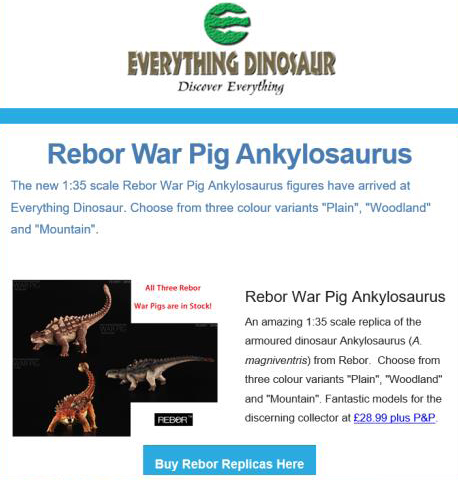
Everything Dinosaur’s Newsletter (June 2018) Features the Rebor War Pig Ankylosaurus
Rebor War Pig Ankylosaurus models are in stock at Everything Dinosaur. Picture credit: Everything Dinosaur.
Picture credit: Everything Dinosaur
Rebor War Pig Ankylosaurus Figures Feature in Customer Newsletter
The new Rebor War Pig figures (Ankylosaurus), make the headlines in our latest newsletter. There are three colour variants of the War Pig Ankylosaurus, each variant represents a habitat in which this Late Cretaceous armoured dinosaur could have lived – “Plain”, “Woodland” and “Mountain”. All three of the models have been beautifully crafted and there is quite a debate amongst model collectors and dinosaur fans as to which colour scheme is favourite.
Beasts of the Mesozoic Saurornitholestes sullivani and New Mojo Models
Beasts of the Mesozoic Saurornitholestes and new Mojo models for 2018. Picture credit: Everything Dinosaur.
Picture credit: Everything Dinosaur
Beasts of the Mesozoic and Four New Mojo Models
Newsletter subscribers were the first to learn that another shipment of the very popular Beasts of the Mesozoic 1:6 scale “raptor” figures is on the way. This shipment will also include two new additions to the range that Everything Dinosaur stocks. In addition, the latest information on the new for 2018 Mojo dinosaur models was also provided. Four new models are being introduced by Mojo and a number of existing replicas have been given new paint schemes. To find out more, we recommend subscribing to our newsletter.
To request a subscription to Everything Dinosaur’s regular newsletter, simply drop us an email: Email Everything Dinosaur.
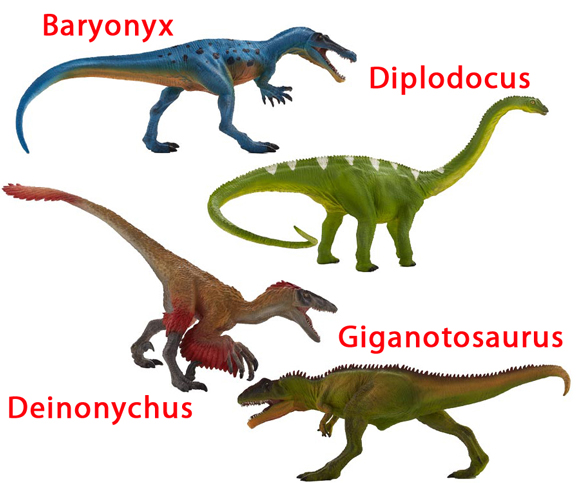
The Four New for 2018 Dinosaur Models from Mojo
Four new Mojo models.Picture credit: Everything Dinosaur.
Picture credit: Everything Dinosaur
All four of the new for 2018 Mojo models are lizard-hipped dinosaurs – Saurischia. The models represent Baryonyx, Deinonychus, Diplodocus and the giant carnivore Giganotosaurus.
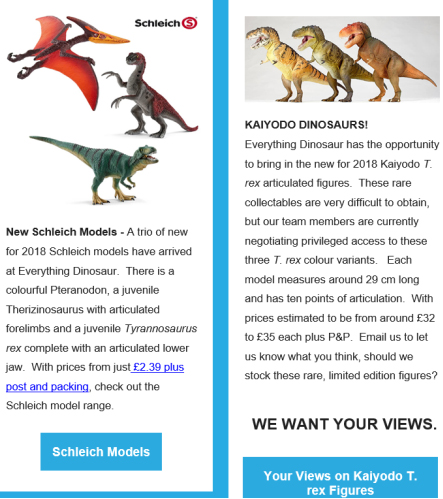
Our latest newsletter includes information on three, recently introduced Schleich figures, the last replicas to be added to their “Conquering the Earth” range for this year. The models are a very colourful Pteranodon, plus a juvenile T. rex and a juvenile Therizinosaurus. The Schleich juvenile T. rex has an articulated lower jaw, whereas, the Schleich juvenile Therizinosaurus has moveable forelimbs.
Three New Schleich Figures Plus Kaiyodo Market Research
New Schleich replicas and looking at the prospect of adding Kaiyodo figures into the Everything Dinosaur product portfolio.Picture credit: Everything Dinosaur.
Picture credit: Everything Dinosaur
Everything Dinosaur and Kaiyodo in the Customer Newsletter
In the newsletter, we explain that Everything Dinosaur has the opportunity to bring in some limited edition and quite rare Kaiyodo Tyrannosaurus rex collectables. Aimed at model collectors aged 15 and above (15+), Everything Dinosaur is considering bringing in three, articulated T. rex models. Each model measures around 29 cm long and it can be put into multiple poses (ten points of articulation on each figure).
Everything Dinosaur newsletter subscribers are asked for their comments and feedback about this exciting new range from the talented model makers at Kaiyodo.
Three New Schleich Conquering the Earth Prehistoric Animal Models
Three new for 2018, prehistoric animal models have arrived at Everything Dinosaur. The Schleich Therizinosaurus (juvenile), Schleich Pteranodon and the juvenile Tyrannosaurus rex figures are now in stock. Everything Dinosaur team members were given a “sneaky peek” of these three “Conquering the Earth” models several months ago and we did post up a number of photographs that we had taken onto our social media pages. We are very excited to be able to add these three archosaurs to our Schleich portfolio.
Just Arrived at Everything Dinosaur – New for 2018 Prehistoric Animal Models
Three new additions to Everything Dinosaur’s Schleich model range.
Picture credit: Everything Dinosaur/Schleich
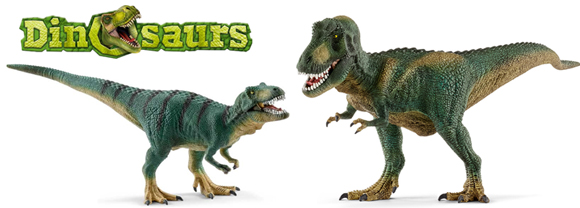
The Schleich Tyrannosaurus rex Juvenile
Over the years, Schleich have produced several T. rex dinosaur models. This latest edition to the “Conquering the Earth” range measures a little over twenty-three centimetres in length from the tip of that articulated lower jaw to the end of the tail. The model is well balanced and shows lots of detail, the painting on the inside of the mouth is particularly well done. It makes a striking companion piece to the Tyrannosaurus rex model introduced by Schleich in the summer of 2017.
The Schleich Adult and Juvenile T. rex Models
The Schleich juvenile T. rex and the 2017 Schleich T. rex model.
Schleich have also introduced a juvenile Therizinosaurus dinosaur replica to go along with their repainted Therizinosaurus figure that came out earlier this year. This model measures a fraction under sixteen centimetres high and is around twenty centimetres in length.
Schleich Therizinosaurs (Adult and Juvenile)
Schleich therizinosaur dinosaur models.
Picture credit: Everything Dinosaur/Schleich
The Schleich juvenile Therizinosaurus dinosaur model has a pair of articulated front arms, just like the adult version of this Late Cretaceous theropod.
The last model to be added to Everything Dinosaur’s range is not a dinosaur, but a member of the Pterosauria, arguably one of the most famous of all the flying reptiles – Pteranodon. Schleich have made Pteranodon models in the past, there was a Pteranodon included in the now retired “Saurus” range of prehistoric animal figures, but this new figure is much more brightly painted.
The New for 2018 Schleich Pteranodon Flying Reptile Model
New for 2018, a Schleich Pteranodon model.
Picture credit: Everything Dinosaur/Schleich
The Pteranodon model is a representation of Pteranodon longiceps, the type species, first named and described in 1876 by the famous American palaeontologist Othniel Charles Marsh. The wingspan of the model measures approximately twenty-two centimetres. It is a very colourful flying reptile and we note the texture of the model’s skin, giving the impression of a covering of pycnofibres (hair-like filaments) on the body. It is likely that these pterosaurs were endothermic (warm-blooded), these fibres would have helped to retain body heat and to insulate the animal.
A spokesperson for Everything Dinosaur commented:
“These three new figures are welcome additions to the Schleich Conquering the Earth model range. Two of the new models represent juvenile theropods. The long crest of the colourful Pteranodon probably played a role in display.”
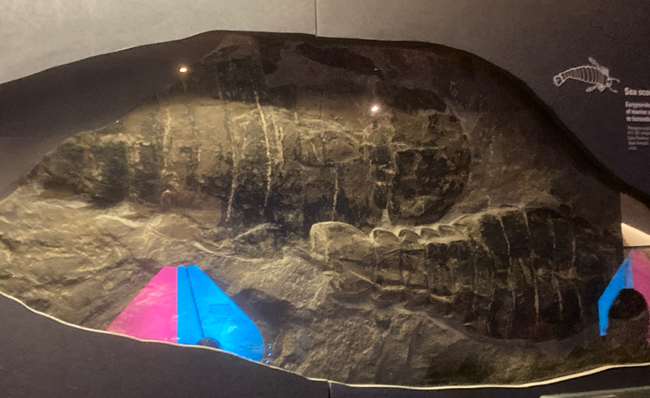
A fabulous pair of eurypterid fossils photographed in the London Natural History Museum.
Spotted in the British Museum (London), two beautifully preserved sea scorpion fossils. The picture (below) shows a wonderful example of what looks like a fossilised, giant woodlice. However, all is not as it seems.
Sea Scorpion Fossil Specimens
A pair of eurypterid fossil specimens on display at the London Natural History Museum. Picture credit: Everything Dinosaur.
Picture credit: Everything Dinosaur
Woodlice are isopods and members of the Arthropoda Phylum. Eurypterids are arthropods too. Both have segmented bodies and share several anatomical characteristics, but they are only distantly related.
Probably originating during the Ordovician, eurypterids persisted until the Permian. Both marine and freshwater forms evolved. Some marine eurypterids represent the largest arthropods known to science. The largest described to date is Jaekelopterus rhenaniae. Based on a forty-six-centimetre claw fossil, palaeontologists have suggested that J. rhenaniae reached a length of 2.5 metres or more.
Although the eurypterid fossils on display are not as large as the biggest species of Jaekelopterus (pronounced Yay-kel-op-ter-us), they are still impressive.
A spokesperson from Everything Dinosaur commented on the details preserved within the fossil specimens and stated:
“When you see up close stunning eurypterid fossils, you gain an appreciation of the diversity and variety of life on Earth. It is hard to believe, but for more than 150 million years these amazing arthropods thrived, outcompeting vertebrates. Many forms evolved to become apex predators.”