All about dinosaurs, fossils and prehistoric animals by Everything Dinosaur team members.
4 09, 2014

Spectacular Prehistoric Animal Tycoon Simulator Starts to Stir

By |2024-05-02T10:44:02+01:00September 4th, 2014|Categories: Dinosaur Fans, Everything Dinosaur News and Updates, Main Page|0 Comments

 The Ultimate Tycoon Building Experience

The gaming world might be dominated by some industrial giants, but just as in the Jurassic, when the slow-moving sauropods would have been occasionally startled by much smaller, more agile dinosaurs, the gaming leviathans can find themselves up against faster, sleeker and speedier developers.  Everything Dinosaur’s team members have been informed that an independent studio (Underdog Interactive), are working on a new simulator that intends to deliver the ultimate in tycoon building experiences.  The working title for this new prehistoric animal simulator is “Jurassic Planet”, but a new name is due to be announced shortly.

Prehistoric Animal

Gaming Thrills with Prehistoric Tycoon Simulator

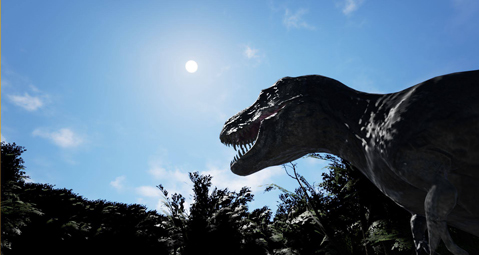
One of the backgrounds for the game.

One of the backgrounds for the game.

Picture credit: Max Wood

The project is being developed on the Unreal Engine 4 platform which boasts stunning graphics and powerful visuals.  Underdog Interactive, have big plans and they intend to make a mark on the game development environment about as big as the Chicxulub impact crater.  Currently the team is focusing on bringing the best possible graphics together with the most up to date fossil discoveries so that a spectacular and accurately depicted menagerie of prehistoric animals can feature.

A Fast-moving Project

Commenting on this fast-moving project, insider Max Wood stated:

“With the versatility of Unreal Engine 4, the team are looking to wow players with realistic graphics and to include game enhancing features such as Co-op missions and even the “dinosaur capture feature” inspired directly by the scene from the second Jurassic Park move – Lost World.”

Other projects such as Prehistoric Kingdom have been largely fan based projects, the difference here is that Jurassic Planet is a game development project and the talented team are working around the clock on making this game a reality.

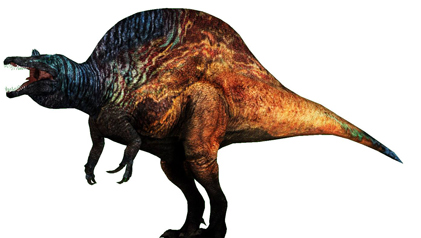
Spinosaurid Rendering by Underdog Interactive

spinosaurid.

Spinosaurid ad depicted by Underdog Interactive.

Picture credit: Max Wood

For models and replicas of spinosaurids and other dinosaurs: CollectA Deluxe Prehistoric Animal Models.

4 09, 2014

Teaching Support and Free Downloads of Resources

By |2023-03-16T12:51:18+00:00September 4th, 2014|Categories: General Teaching|Comments Off on Teaching Support and Free Downloads of Resources

Everything Dinosaur’s School Website

It has been just over a week since the new teaching website managed by Everything Dinosaur was launched and already there has been a high demand for the free downloads of teaching resources.  Teachers and home educators from as far away as the western United States and Australia have taken advantage of the helpful teaching articles and downloads.

A New Website

The web site was set up to help educationalists find reliable dinosaur and fossil themed teaching resources, to assist in schemes of work involving teaching about the Earth sciences such as geology and palaeontology.

Successful Launch of Everything Dinosaur’s Teaching Website

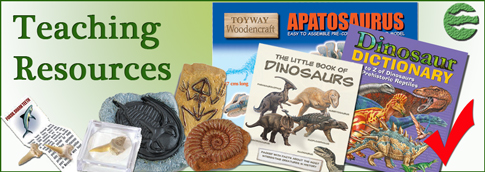
Everything Dinosaur dinosaur themed educational resources.

Teaching tips, articles, resources and free downloads, plus lots of prehistoric animal and dinosaur toys that can be found at Everything Dinosaur’s website.  Picture credit: Everything Dinosaur.

Picture credit: Everything Dinosaur

Everything Dinosaur

A spokesperson for the Cheshire based company stated:

“We are delighted with the uptake, our dedicated team are being kept very busy dealing with teaching enquiries, advising on lesson plans and sending out resources to support extension activities.”

With the new curriculum in England being introduced this month, with an emphasis on “working scientifically”, it seems that this new website dedicated to dinosaur themed teaching resources has been very well received.

Visit Everything Dinosaur’s website: Everything Dinosaur.

3 09, 2014

Dinosaurs and Extinction Providing Helpful Information and a Free Lesson Plan

By |2024-05-02T12:07:58+01:00September 3rd, 2014|Categories: Key Stage 1/2|Comments Off on Dinosaurs and Extinction Providing Helpful Information and a Free Lesson Plan

How and Why Did the Dinosaurs Go Extinct?

Teachers and learning support providers undertaking a term topic or science week with dinosaurs as the subject matter are going to have to explore the concept of extinction.  Most people are aware that the dinosaurs died out approximately sixty-five million years ago.  During our dinosaur workshops with primary school children we get asked a lot about the extinction of the dinosaurs.  Indeed, Key Stage 1 and Key Stage 2 children are keen to demonstrate their knowledge by telling us how they think the dinosaurs died out.  For children at Key Stage 3 and beyond, evolution and genetics now make up a component of the science curriculum.

Answering Questions about Dinosaur Extinction

The Everything Dinosaur team members try to answer all the questions they get asked during their school visits to talk about fossils and prehistoric animals.  Sometimes we can build into our lesson plan an investigation to deal with a specific enquiry.  In this way we can demonstrate to the children (and to their teachers for that matter), the concept of scientific working.

We also follow up any extension work and send out further information, fact sheets and activity ideas to help the teachers and their support staff.  Taking dinosaurs into a school gets the children enthused, motivated and excited and they enjoy exploring the ideas and theories behind the extinction of the dinosaurs as a result.

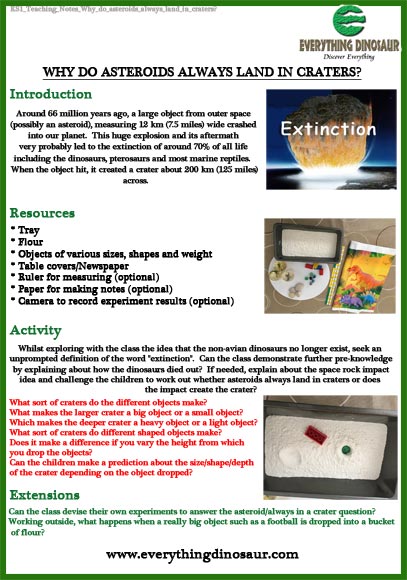
The Late Cretaceous Extinction (Demise of the Dinosauria) – Dinosaur Extinction Lesson Plan

Why do asteroids....? Lesson plan and teaching notes.

PDF download of teaching notes/lesson plan is available from Everything Dinosaur.

Picture credit: Everything Dinosaur

How and Why Did the Dinosaurs go Extinct?

With the new curriculum (September 2014), children are being encouraged to work scientifically and to develop an appropriate knowledge of scientific principles and methodology.  To assist teachers with the inevitable question that will be asked – “How and why did the dinosaurs die out?” our dedicated team of dinosaur experts have posted up an article on the Everything Dinosaur main blog that provides a teaching guide to answering this question and challenges the pupils to think like scientists and to explore theories.

To view the weblog article: Providing Information for Schools on the Extinction of the Dinosaurs.

The blog article sets out the background to the mass extinction event that took place at the end of the Cretaceous, explains the scale of the extinction and discusses the types of animals that died out.  The two main theories which scientists have proposed are explored and the evidence for each is examined.

  1. Death from Outer Space (asteroid or comet impact)
  2. Global Climate Change

Dinosaur Extinction

Other ideas and theories are briefly discussed and the article guides teachers and learning support providers through the main topic areas and suggests questions that the teaching team might want to explore with the class.  The aim of this article is provide a teaching resource on the Cretaceous extinction event, helping school children to explore scientific methods and work scientifically.  The students have the opportunity to weigh up the evidence and decide which theory best fits the evidence.

Your Turn to be a Scientist!  What do you Think Happened?

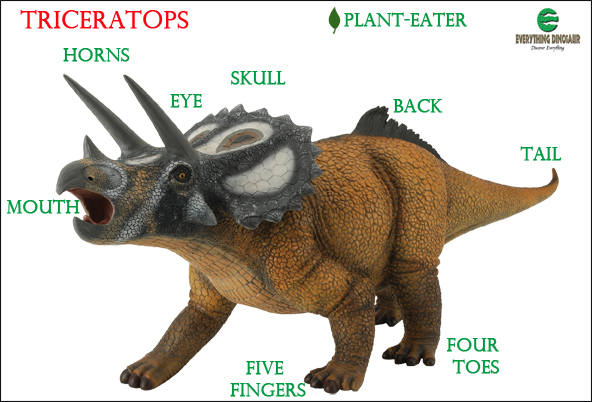
Triceratops One of the Last of the Non-Avian Dinosaurs

Labelling a Triceratops.

Can you label a dinosaur?  Triceratops one of the last non-avian dinosaurs.

Picture credit: Everything Dinosaur

The dinosaur experts at Everything Dinosaur have utilised some of the topic areas covered in a typical dinosaur themed workshop by providing the information that lets the students weigh up the evidence.  This article is just one of hundreds to be found on the company’s award winning blog site, providing free resources and teaching support materials to educationalists.

Visit Everything Dinosaur’s website: Visit Everything Dinosaur.

3 09, 2014

Fresh Rockfalls at Monmouth Beach (Lyme Regis Provides an Important Update)

By |2024-05-02T10:44:44+01:00September 3rd, 2014|Categories: Dinosaur and Prehistoric Animal News Stories, Dinosaur Fans, Geology, Photos/Pictures of Fossils|0 Comments

Warnings for Fossil Hunters at Lyme Regis

The cliffs that surround the picturesque town of Lyme Regis in Dorset on England’s famous “Jurassic Coast” are very treacherous.  Rockfalls and landslips are a relatively common occurrence and team members at Everything Dinosaur, have done much to help inform and to warn visitors to the area of the potential hazards.  Fossil collecting or simply exploring the beaches can be a lot of fun, but the recent cliff fortification and shore stability measures put in place by the local council will not solve the problem of the unstable geology of the area.

Fresh Rockfalls

The cliffs are composed of relatively loose sediment, that when saturated after heavy rain or somewhat dried out after a prolonged spell without too much precipitation, are prone to rockfalls.  It is always advisable to stay well away from the base of the cliffs, fossil collecting on a falling tide helps, as this gives an increasing distance between the sea and the cliffs.

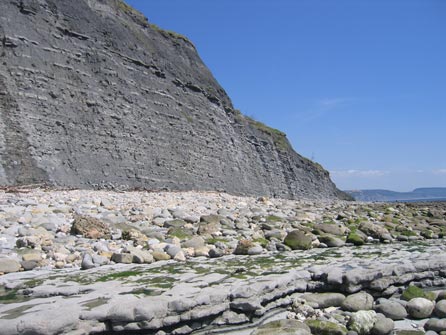
Dangerous Cliffs at Lyme Regis

Good idea to go fossil collecting on a falling tide and to keep away from the steep cliffs.

Good idea to go fossil collecting on a falling tide and to keep away from the steep cliffs. Picture credit: Everything Dinosaur.

Picture credit: Everything Dinosaur

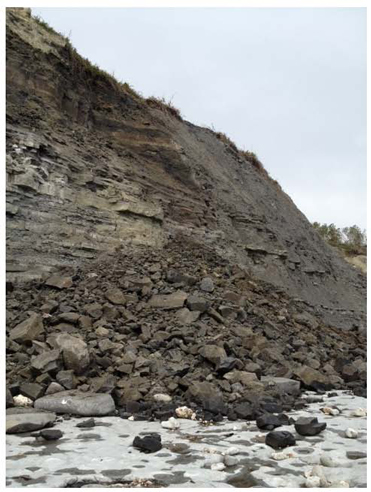
Recently, we were sent some photographs by Lyme Regis fossil expert, Brandon Lennon.  The photographs showed fresh rockfalls that had taken place on Monmouth beach (to the west of Lyme Regis).  Brandon explained that he had observed a number of cliff falls this year and that he expected more to occur as the autumn weather sets in.   This particular rockfall had occurred on that area of the beach famous for its extensive ammonite and nautiloid fossils preserved within the blue lias limestones – an area known as the “Ammonite Pavement” or the “Ammonite Graveyard”.

Recent Rockfall at Monmouth Beach

Rockfall onto the Ammonite Pavement on Monmouth Beach.

Rockfall onto the Ammonite Pavement on Monmouth Beach.

Picture credit: Everything Dinosaur

A supervised, fossil collecting walk is one of the best ways to explore the beaches around Lyme Regis, for further information on such tours: Fossil Walks in the Lyme Regis Area.

Perhaps if you are lucky enough to go on a field trip with Brandon to Monmouth beach, you might be able to hear the theories that have been proposed to help explain why so many large ammonite fossils are found together at this spot.

Everything Dinosaur was sent a beautiful piece of fossilised wood from nearby Portland.  The specimen still had the bark preserved on it and when polished in section, growth rings could still be made out. We think that the fossil represents an Araucaria spp. (monkey puzzle tree).  This fossilised wood dates from the Upper Jurassic.  Fossil wood can occasionally be found on the beaches of Lyme Regis and nearby Charmouth, but this is usually much older dating mainly from the Lower Jurassic.

A Polished Section of Fossilised Wood

A polished section of fossilised wood.

A polished section of fossilised wood.  Picture credit: Everything Dinosaur.

Picture credit: Everything Dinosaur

Remember if fossil collecting, be careful out there.

For replicas of iconic animals from the “Dorset Coast”: Models of Fossils and Learning Materials.

2 09, 2014

New Term and a New Curriculum (Part 2)

By |2023-03-16T12:43:35+00:00September 2nd, 2014|Categories: General Teaching|Comments Off on New Term and a New Curriculum (Part 2)

New Teaching Curriculum in England

The new national curriculum for England will present some exciting opportunities and challenges.  A “rigorous” curriculum is being introduced with Mathematics, English and Science regarded as core subjects with pupils at Key Stage 1 (from five to seven years of age), being introduced to computer algorithms and fractions.  The new curriculum is being rolled out across all state-funded primary and secondary schools.  As with all changes in this field, the aim is to improve educational standards.  Academies will not be required to follow the new curriculum.  State funded schools in Northern Ireland, Wales and Scotland are managed differently but current practices and guidelines are being reviewed in many areas of the United Kingdom.

New Teaching Curriculum

A New Curriculum in English State Schools – Everything Dinosaur Supplies Teaching Resources

Everything Dinosaur teaching resources

Fossils, books, puzzles and games for schools.

Picture credit: Everything Dinosaur

Visit Everything Dinosaur’s website: Everything Dinosaur.

Why the Changes to the Curriculum?

Falling standards in schools and demands from universities and employers are the reasons cited by the Dept. of Education for the changes.  When results in subjects like science and maths are compared to the results achieved by students in other countries, there is a fear that students in England might be falling behind.

Everything Dinosaur’s team members will continue to assist learning support providers, the company’s highly regarded dinosaur and fossil workshops in schools already build in a lot of the new curriculum’s aims and objectives.

“Working Scientifically”

The concept of “working scientifically” is at the centre of Everything Dinosaur’s teaching work.  Two years ago, Everything Dinosaur team members reported on the biannual study undertaken by researchers at Boston College (United States of America), which covers the results from two internationally important teaching studies, the Progress in International Reading Literacy Study (PIRLS) and the trends in International Mathematics and Science Study (TIMSS).  In general terms, the United Kingdom had shown good progress in mathematics but standards seemed to be in decline when it came to studying the sciences.

To contact Everything Dinosaur about educational resources in schools: Email Everything Dinosaur.

We would like to wish all the students starting the new curriculum (and their teachers) every success.

2 09, 2014

Dinosaurs Provide Rapid Dispatch for Customers (Urgent Deliveries Catered For)

By |2024-05-02T10:45:41+01:00September 2nd, 2014|Categories: Dinosaur Fans, Everything Dinosaur News and Updates, Press Releases|0 Comments

Everything Dinosaur Promotes Rapid Dispatch

Our customers know all about our rapid dispatch of parcels, our speedy service has been commented upon over 1,000 times on Everything Dinosaur’s website but we ourselves don’t very often mention it.  It’s not that we are hiding our light under a bushel, but for Everything Dinosaur’s team members, we are just so used to getting things packed and dispatched as quickly as we can.

Everything Dinosaur

We appreciate that once an order has been placed, customer communication does not end there.  We always contact customers to let them know that their order has been received and when it is going to be dispatched, we like to give these assurances.  As many of us shop on line as well we know how important it is to be kept informed.

Same Day Dispatch Monday to Friday with Everything Dinosaur

Prompt service and rapid dispatch of orders from Everything Dinosaur.

Prompt service and rapid dispatch of orders from Everything Dinosaur.

Picture credit: Everything Dinosaur

Whilst writing this article, we were interrupted by a phone call from a customer (other team members were grabbing lunch at the time).  The customer had telephoned as they were planning a party for their little boy, but they had been let down over deliveries from some mail order companies in the past.

Let Down By Other Suppliers

We are always saddened to hear things like this, however, within a few minutes, the customer’s party order had been packed and prepared for dispatch.  It will be on its way this afternoon and the customer should receive her party favours and dinosaur items tomorrow.  An email was sent just to reassure the customer that her order had been prepared and that it was ready to go out.

Everything Dinosaur team members do try their best.  Very occasionally a parcel can be lost in the delivery networks that we use, this can be frustrating but at least our customers know that once having placed an order with us, parcels are rapidly prepared and made ready for dispatch.  Speedy dinosaurs whatever next!

Try us for yourselves visit: Everything Dinosaur for all your dinosaur and prehistoric animal product needs.

1 09, 2014

New Term, New Curriculum

By |2023-03-16T12:40:53+00:00September 1st, 2014|Categories: General Teaching|Comments Off on New Term, New Curriculum

September 2014 New Term, New Curriculum

The new curriculum for England starts this week and Everything Dinosaur team members would like to wish all the teachers, learning support providers and administration staff every success with the curriculum which has been described by the Prime Minister as “tough and rigorous”.  Our focus remains on providing assistance and support to schools, especially those state funded institutions that are rolling out the new schemes of work.

A Teaching Website

The launch of Everything Dinosaur’s new teaching website is timely and apposite, the new website is aimed at supporting teaching work and our experts have produced a website that provides free downloadable dinosaur and fossil themed teaching resources, lesson plan guides, links to teaching aids, helpful articles plus hints and tips on science teaching from Early Years up to Key Stage 4 (evolution and genetics).

A Brand New Curriculum – A Brand New Teaching Website

Everything Dinosaur dinosaur themed educational resources.

Teaching tips, articles, resources and free downloads.

Picture credit: Everything Dinosaur

New Curriculum

A spokesperson for the company stated:

“The new curriculum for England places a focus on working scientifically and building up scientific knowledge.  With fossils, evolution and climate change in the curriculum, there are lots of opportunities to utilise the free teaching resources and Everything Dinosaur’s highly respected workshops in schools.”

The company intends to add more downloads to its current portfolio, as well as providing fact sheets, art materials and other items all with a prehistoric theme.  A number of downloads have already been requested and Everything Dinosaur team members have been fielding enquiries from as far away as California.

The spokesperson went onto add:

“One of the problems teachers face is having to rely on general education websites and resource providers who lack the up-to-date subject knowledge related to palaeontology.  As we are specialists in this area, Everything Dinosaur can provide more accurate information and tailor made teaching resources in support of those curriculum areas that involve rocks, fossils, habitats, life on Earth, genetics, evolution and of course, dinosaurs.”

 Inaccurate Information Being Provided to Schools

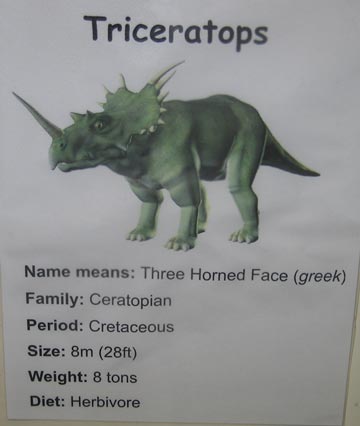
Triceratops mistakes!

Triceratops? Not very good quality teaching resources.

Inaccurate Teaching Resources

The picture above shows a typically inaccurate teaching resource used in Key Stage 1 and 2.  The dinosaur is not a Triceratops, team members at Everything Dinosaur are not sure whether the image represents a member of the Dinosauria.  Inadvertent use of such inaccurate teaching resources could confuse and mislead pupils.

Visit Everything Dinosaur’s website: Visit Everything Dinosaur.

1 09, 2014

New School Curriculum With Rocks, Fossils and Dinosaurs

By |2023-03-16T12:35:59+00:00September 1st, 2014|Categories: Educational Activities, Main Page, Teaching|0 Comments

New Curriculum – New Challenges For Teaching Teams

This week sees the introduction of the new national curriculum for school children in England.  A more “rigorous” curriculum with English, Mathematics and Science as core subjects with pupils at Key Stage 1 (five to seven years old) being introduced to simple fractions and even computer programming.  The aim of this new curriculum which is being rolled out across all state-funded primary and secondary schools, is to improve standards.

A New Curriculum

However, academies, which now form the majority of secondary schools, will not be required to follow the new curriculum.  State funded schools in Scotland, Wales and Northern Ireland are managed differently but current policies and practices are being reviewed in many parts of the British Isles.

Why the Changes?

The Department for Education, responsible for children’s’ services and education in England, cites falling academic standards when students in England are compared to students from other countries, particular countries such as Singapore, South Korea and China.  From Everything Dinosaur’s perspective, our teaching work aims to help promote the concept of working scientifically and we deal with classes ranging from EYFS (Early Years Foundation Stage) right up to Key Stage 4 (students from fourteen to sixteen years).

A number of comparative studies have been undertaken and just like schools themselves, the results vary.  For example, back in 2012 Everything Dinosaur team members reported on the biannual comparative study carried out by researchers at Boston College (USA), which covers the results from two very important international teaching studies, the Progress in International Reading Literacy Study (PIRLS) and the trends in International Mathematics and Science Study (TIMSS).  Broadly, the United Kingdom had shown good progress when it came to mathematics but standards seemed to be slipping when it came to the sciences.

Teaching about Dinosaurs and Fossils in School – Working Scientifically
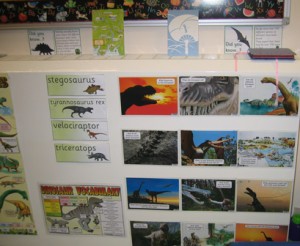
Lots of facts about dinosaurs.

Lots of facts about dinosaurs. Picture credit: Everything Dinosaur.

Picture credit: Everything Dinosaur

Rocks, Fossils and Dinosaurs

A topic all about dinosaurs, fossils and extinction helps to bring together core teaching subjects such as science, English and mathematics.

To read more about the study: Mixed Results for Science and Maths in English Schools.

Where Does Everything Dinosaur Come In?

With the emphasis on scientific knowledge, conceptual understanding and learning about scientific methods, dinosaurs as a term topic or part of a special science themed teaching week is a great way to engage young minds at Key Stage 1 and earlier.  As children tend to have a fascination with prehistoric animals, our dinosaur workshops help to introduce and reinforce learning objectives as outlined by the new curriculum.  Lower Key Stage 2 have to learn about fossils, how they are formed and what they tell us about the once living things that they represent.   As one of our colleagues declared “Mary Anning is on the curriculum” – great to see a female role model in science.

Studying Genetics and Evolution

Older students  in Key Stage 3 and heading up to Key Stage 4 are being given the opportunity to study genetics, evolution and the work of such notable scientists as Darwin and Wallace.

Teachers and their support providers have been working hard to get to grips with this new “rigorous” curriculum.  We are aware that some of the teaching resources related to dinosaurs and fossils used in the past are in some cases out of date, or worse still inaccurate. Everything Dinosaur offers lots of free, downloadable prehistoric animal themed teaching resources from its bespoke teaching website, as well as helpful articles, tips, advice and the opportunity to invite our dinosaur experts into school.

To visit Everything Dinosaur’s website: Everything Dinosaur’s Website.

A Teaching Exercise – Our Hands versus the Hands of a Dinosaur

Examining Dinosaur Hands (Key Stage 2/3)

Examining Dinosaur Hands (Key Stage 2/3).  Picture credit: Everything Dinosaur.

Picture credit: Everything Dinosaur

Supplying Teaching Resources

In terms of teaching resources, Everything Dinosaur team members have been advising learning support providers about all sorts of prehistoric animal related merchandise – from finger puppets to science kits.  All the resources we supply have been tested and reviewed by our own teaching team, there’s even free dinosaur fact sheets included as well.

Resources for schools: Dinosaur Themed Educational Products.

Here’s to that dedicated group of professionals who serve our school children so well and we wish all the students starting the new curriculum every success with their studies.


31 08, 2014

Explaining Some Terms in Palaeontology and Providing Helpful Advice

By |2024-05-02T10:47:19+01:00August 31st, 2014|Categories: General Teaching, Key Stage 3/4|Comments Off on Explaining Some Terms in Palaeontology and Providing Helpful Advice

Paleontology versus Palaeontology

When Everything Dinosaur team members are working in schools delivering workshops about evolution, fossils and dinosaurs we are happy to advise and assist teaching teams where we can.  Although we send out lots of free teaching resources, lesson plans, activity ideas and extensions, we do see a lot of other teaching materials, some of which have been downloaded from educational company websites, that are inaccurate. Some of these teaching resources are purchased, sadly, teachers might be unwittingly misleading students as well as wasting the precious school budget.

Teaching about Palaeontology

Our team members try to help where we can.  For instance, whilst working with a Key Stage 3 class we were asked to explain how come the word palaeontologist can have two different spellings.

Palaeontology – It is Global!

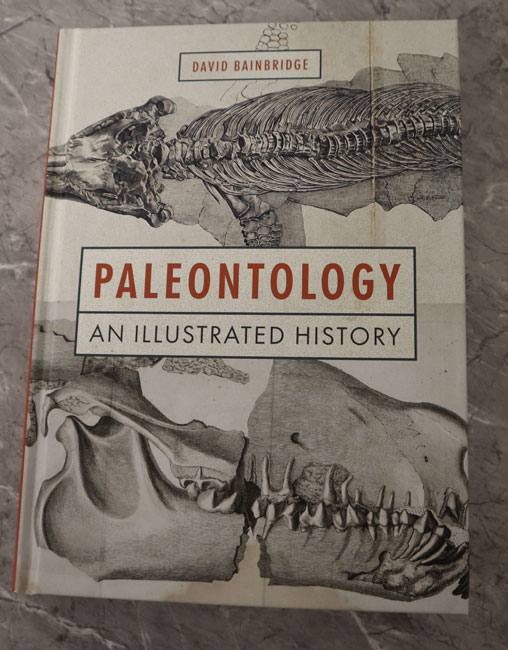
"Palaeontology an Illustrated History"

The front cover of “Palaeontology an Illustrated History” by David Bainbridge a comparative anatomist in the Department of Physiology, Development and Neuroscience at the University of Cambridge. The book has used the American spelling of the word “paleontology”.

The term “paleontology”, note the second “a” is missing is the American form of the term palaeontology.  We at Everything Dinosaur tend to use the non-Americanised version of the word to describe the study of ancient creatures and their fossils.

Helpful Terms and Explanations

Palaeontology (UK) Paleontology (USA) – The study of extinct organisms and their fossils.
Palaeontologist (UK) Paleontologist (USA) – A person who studies extinct organisms and their fossils.
Vertebrate Palaeontologist (UK) Vertebrate Paleontologist (USA)  – The branch of palaeontology that studies animals with back bones.
Invertebrate Palaeontologist (UK) Invertebrate Paleontologist (USA) – The branch of palaeontology that studies animals without back bones.
Micropalaeontology (UK) Micropaleontology (USA) – The study of microscopic fossils (micro-fossils).
Palaeobotany (UK) Paleobotany (USA) – fossil plants; traditionally includes the study of fossil algae and fungi in addition to land plants.
Human Palaeontology (UK) Human Paleontology (USA) –  The study of prehistoric human and proto-human fossils.
Palaeoanthropology (UK) Paleoanthropology (USA) – As above (prehistoric human and proto-human fossils).
Palaeoecology (UK) Paleoecology (USA) – Ecology of extinct and prehistoric organisms.
Palaeoclimatology (UK) Paleoclimatology (USA) – The study of past climates.
Palaeogeography (UK) Paleogeography (USA) – Study of geographical features of the past.
Palaeomagnetism (UK) Paleomagnetism (USA) – Study of the magnetism remaining in rocks and related magnetic fields.

 Credit: Everything Dinosaur

Visit Everything Dinosaur’s website to view replicas of iconic prehistoric animal fossils and other educational products: Educational Products and Replicas of Iconic Fossil Animals.

31 08, 2014

Palaeontologist versus Paleontologist Providing a Helpful Explanation

By |2024-05-02T10:46:22+01:00August 31st, 2014|Categories: Educational Activities, Main Page, Teaching|1 Comment

Palaeontologist v Paleontologist – What’s the Difference?

During our school visits to carry out dinosaur and fossil themed workshops we often get asked to help with various aspects of the teaching scheme of work.  Everything Dinosaur’s team members are happy to provide advice and to assist where they can.  We even send out lots of free teaching resources, lesson plans, activity ideas and learning aids related to fossils and prehistoric animals.

Supporting Teachers

However, we do see a lot of other teaching resources, many of which have been downloaded from education company websites, that are inaccurate.  Some of these resources have cost money, thus depleting an already stretched teaching budget.  We try to do what we can to help out.

Everything Dinosaur Provides a Lot of Teaching Resources to Schools

So many events, so many activities, so many photographs.

So many events, so many activities, so many photographs.

Picture credit: Everything Dinosaur

Palaeontologist v Paleontologist

Today we will deal with a very simple point, the difference between “palaeontology” and “paleontology”.  We know that a number of the resources used by teachers and learning support providers (home educators too for that matter), are sourced from other countries, such as America.  Herein lies the confusion.   The word palaeontology is often seen in these resources (and elsewhere) with an “a” missing.  We have the term “palaeontologist” and also “paleontologist”.

So let’s start at the beginning – what is palaeontology or paleontology?

Providing Explanations

Palaeontology or paleontology mean the same thing.  These words describe the branch of science that deals with the study of extinct animals and plants and their fossilised remains.  The word is derived from the Greek palaios which means “ancient”, a reference to prehistoric times.  Palaeontology (with an extra “a” added) is the term used in Britain and elsewhere in the world, whilst paleontology is the Americanised version of the word and it is customarily used in the USA.  Both words are interchangeable but most institutions tend to use one word rather than the other.

For example, Everything Dinosaur uses the term palaeontology, whilst the Chicago Field Museum (Illinois, USA) uses the word paleontology.  The dropping the “a” convention applies to all the sub-disciplines in this broad area of scientific study.

Common Terms in Palaeontology and Related Subjects

Palaeontology (UK) Paleontology (USA) – The study of extinct organisms and their fossils.
Palaeontologist (UK) Paleontologist (USA) – A person who studies extinct organisms and their fossils.
Vertebrate Palaeontologist (UK) Vertebrate Paleontologist (USA)  – The branch of palaeontology that studies animals with back bones.
Invertebrate Palaeontologist (UK) Invertebrate Paleontologist (USA) – The branch of palaeontology that studies animals without back bones.
Micropalaeontology (UK) Micropaleontology (USA) – The study of microscopic fossils (micro-fossils).
Palaeobotany (UK) Paleobotany (USA) – fossil plants; traditionally includes the study of fossil algae and fungi in addition to land plants.
Human Palaeontology (UK) Human Paleontology (USA) –  The study of prehistoric human and proto-human fossils.
Palaeoanthropology (UK) Paleoanthropology (USA) – As above (prehistoric human and proto-human fossils).
Palaeoecology (UK) Paleoecology (USA) – Ecology of extinct and prehistoric organisms.
Palaeoclimatology (UK) Paleoclimatology (USA) – The study of past climates.
Palaeogeography (UK) Paleogeography (USA) – Study of geographical features of the past.
Palaeomagnetism (UK) Paleomagnetism (USA) – Study of the magnetism remaining in rocks and related magnetic fields.

 Credit: Everything Dinosaur

So the terms palaeontology and paleontology are equally valid, but whilst working in schools and UK based museums we tend to use the terms with an extra “a”.

To learn more about Everything Dinosaur’s extensive product range: Everything Dinosaur.

Go to Top