All about dinosaurs, fossils and prehistoric animals by Everything Dinosaur team members.
12 09, 2014

Spinosaurus “Four Legs are Better than Two”?

By |2023-03-16T13:58:25+00:00September 12th, 2014|Categories: Dinosaur and Prehistoric Animal News Stories, Dinosaur Fans, Main Page, Palaeontological articles|3 Comments

Spinosaurus – Steps into the Spotlight (Once Again)

And so, the long awaited paper that re-evaluates the fossil data on the Spinosaurus genus and specifically S. aegyptiacus was published in the academic journal “Science” yesterday.  Time to open a new chapter on this, one of the most enigmatic, mysterious and bizarre of all the known Theropoda.  Since the paper’s submission in the summer, there has been a lot of debate in scientific circles with regards to what this new study will show.  The paper’s title “Semi-aquatic Adaptations in a Giant Predatory Dinosaur”, is almost an understatement, when this is contrasted with the lurid headlines we have seen from a large number of media outlets.

Re-examining What We Thought We Knew About Spinosaurus

In very brief summary, the dedicated team of international researchers have re-assessed the known fossil material on Spinosaurus.  They have been able to track down the location in Morocco from which a number of Spinosaurus bones were excavated and sold via a fossil dealer.  The team have then re-examined this site and found further material.  Their efforts has led to a considerable re-think in terms of what this animal looked like and how it moved.  This new study interprets Spinosaurus as a sixteen-metre- plus dinosaur, that considered itself more at home in the water than on land.  Although capable of terrestrial locomotion, unlike every other large theropod, a new rendering sees Spinosaurus as an obligate quadruped.  Here is a meat-eating dinosaur that walked on all fours.

A Semi-Aquatic Obligate Quadruped – Spinosaurus
Very much at home in the water.

Very much at home in the water.

Picture credit: Davide Bonadonna, Nizar Ibrahim, Simone Maganuco

Spinosaurus

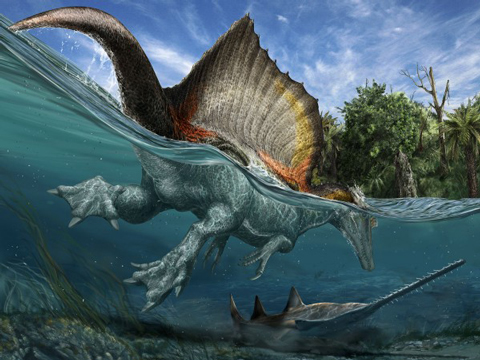
In the picture above, a web-footed Spinosaurus pursues a prehistoric swordfish, known as Onchopristis.  Earlier studies and research based on other members of the Spinosauridae suggest that fish may have made up a substantial proportion of their diet.  Instead of perching on the river bank, attempting to claw fish out of the water like some form of giant, prehistoric Grizzly bear, an ecological niche trumpeted by ourselves to the CGI team helping with the rendering of Spinosaurus for an episode of the BBC television series “Planet Dinosaur” back in 2011, this latest interpretation goes a lot further.

Beyond “Planet Dinosaur” – The Transformation of Spinosaurus aegyptiacus
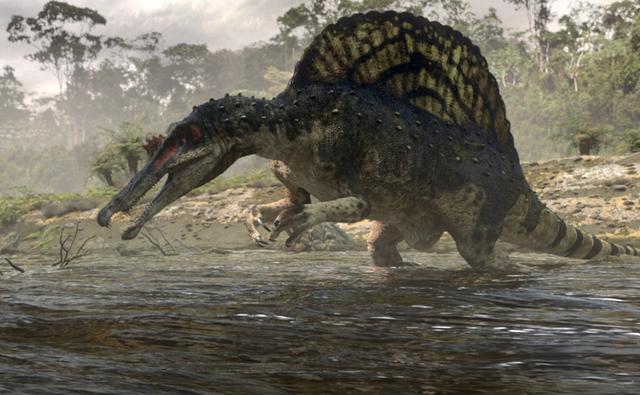
From paddler to swimming the "evolving" image of Spinosaurus.

From paddler to swimming the “evolving” image of Spinosaurus.

Picture credit: BBC

Building Up a New Picture

Having re-visited what records and remaining photographs that exist of the original Stromer material excavated from the Western desert of Egypt around a 100 years ago, the dedicated research team then set about mapping previously known Moroccan finds including jaw bone fossils that had been discovered in the mid 1970s.  To this eclectic mix they added information obtained from the fossils from the newly “rediscovered” Moroccan site, which itself makes up what is now known as the neotype for Spinosaurus aegyptiacus.

A neotype is a specimen that is deemed to represent a species in the absence of the holotype material that has either been lost or destroyed.  Add a pinch of material not known from the Spinosaurus genus but described from related animals baryonychids, spinosaurids and so forth, combined with a soupcon of inferred parts of the anatomy as the bones are not known at all in the fossil record and you have a “composite” view of the animal.

The Latest Interpretation of Spinosaurus (S. aegyptiacus)
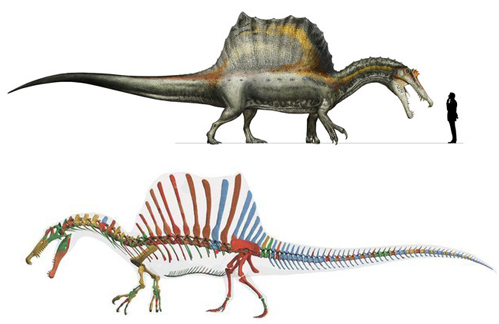
Life-size reconstruction and supplemental figure

Life-size reconstruction and supplemental figure.

Picture credit: Davide Bonadonna (top) Ibrahim et al (bottom)

The illustration (top), depicts Spinosaurus as a dinosaur that walked on four legs, in this new study the centre of gravity is positioned further forward, the pelvic girdle is estimated to have been much smaller and the hind limbs with their robust but very short femur  reflect the adaptations of a paddler more than that of a bipedal walker.

The picture below, referred to by a colleague as the “Spinosaurus colour chart” is a figure from the scientific paper’s supplementary data.  The colour coded bones illustrate the composite nature of this digital reconstruction.

The “Spinosaurus Colour Chart” Key

RED = the neotype fossils (FSAC-KK 11888)

ORANGE = the original bones from Stromer’s expeditions

YELLOW = isolated fossil material ascribed to Spinosaurus spp. from the same geological Formation as the neotype (Kem Kem Formation)

GREEN = scaled up bones derived from better known spinosaurids

BLUE = additions to help complete the skeleton based on no known fossils but derived from adjacent bones in the digital restoration

Applauding the Efforts of an International Research Team

We at Everything Dinosaur applaud the efforts of the international team responsible for this new reconstruction.  A revaluation of the known Spinosaurus fossil material has been long overdue and this is the first time that palaeontologists have been able to relocate the bones from a private fossil collection to the actual site where they were excavated.  We commend the team for their perseverance.

Taking a Different Perspective

However, as with all good science, a number of counterpoints have already been made.

Scott Hartman, addresses these concerns in his web log: There’s Something Fishy About Spinosaurus.

Scott, with a background in anatomy, and an expert in skeletal reconstructions, makes a number of excellent points in his article.

Spinosaurus

The dinosaur referred to as Spinosaurus aegyptiacus was one of the last of the Spinosauridae.  There is a British connection to this story.  One of the spinosaurids used in the comparative study was Baryonyx (B. walkeri).  When this dinosaur, whose bones were found in a Surrey clay pit, was formally described back in 1986 it was depicted as a semi-aquatic dinosaur, fish scales found in the body cavity suggested that fish made up at least a portion of its diet.

Commenting on the New Research

Commenting on this new research, Dean Lomax, (Honorary Visiting Scientist: School of Earth, Atmospheric and Environmental Sciences, The University of Manchester) and author of the recently published “Dinosaurs of the British Isles” which includes extensive information on the Baryonyx fossil finds, stated:

“The new discovery is very interesting as it potentially confirms what had been suspected for quite some time, that Spinosaurus lived a semi-aquatic lifestyle.”

For further information on the book “Dinosaurs of the British Isles” by Dean Lomax and Nobumichi Tamura, which includes some fantastic skeletal drawings by Scott Hartman visit: Siri Scientific Press.

This new paper, marks a new chapter in the story of Spinosaurus, but it’s not the end of the story that’s for sure.  Ironically, although Stromer originally depicted S. aegypticacus as a biped, we recall that in the distant past (the 1970s), Spinosaurus had previously been thought of as a dinosaur that walked on all fours.

An Illustration of Spinosaurus from 1976

Spinosaurus as a terrestrial quadruped.

Spinosaurus as a terrestrial quadruped.

Picture credit: Giovanni Caselli (from the book “The Evolution and the Ecology of the Dinosaurs” by L. B. Halstead)

We suspect there are going to be a few more twists and turns in the Spinosaurus story.
11 09, 2014

What Happens when an Ichthyosaur Dies?

By |2023-03-16T13:53:49+00:00September 11th, 2014|Categories: Dinosaur and Prehistoric Animal News Stories, Dinosaur Fans, Main Page|0 Comments

Scientists Explore the Miniature Ecosystem Created by an Ichthyosaur Carcase

It has been known for some time that when cetaceans (whales and dolphins) die and their corpses settle on the seabed, the carcase can sustain a diverse ecosystem for many years, even decades with the largest individuals.  Palaeontologists had long suspected that the corpses of marine reptiles that patrolled the seas of the world long before the whales evolved, would have played a similar role, but until now this area of marine reptile research had not been that thoroughly investigated.

Studying Decay

Stepping up to this challenge, scientists from the Natural History Museum (London) and the Centre for Research in Earth Sciences (Plymouth University) set about mapping the evidence preserved on the fossilised bones and surrounding matrix of an ichthyosaur skeleton found in southern England.

The team concluded that although there was evidence for a succession of community feeding phases, phases which are very similar to those found in association with cetacean remains deposited in shallow water, the fossilised communities differed from those associated with whale carcases deposited in deep water environments.  One phase, consisting of the establishment of a community feeding on inorganic compounds such as methane and sulphides (known as the “sulphophilic phase”) seemed to be absent according to this fossil study.

Exploring the “After Life” of an Ichthyosaur

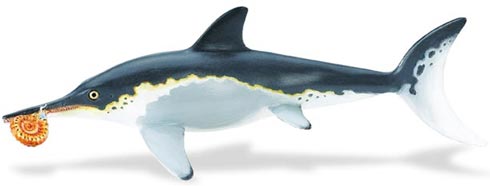
Ichthyosaurus Model (Carnegie Collectibles)

Ichthyosaurus model (Carnegie Collectibles).

Picture credit: Everything Dinosaur/Safari Ltd

Ichthyosaur

Ichthyosaurs were a very diverse group of marine reptiles that evolved in the Early Triassic and survived up until the Late Cretaceous (Olenikian faunal stage of the Early Triassic to Turonian faunal stage of the Late Cretaceous).  Although, ichthyosaurs had the same basic, streamlined body plan, a number of families are now recognised and these reptiles, only distantly related to the Dinosauria are regarded by many palaeontologists as amongst the best adapted of all the reptiles to a marine existence.

The specimen studied was a highly disarticulated Ophthalmosaurus fossil, from Dorset.  The fossil represents a three-metre-long individual from the upper part of the Ringstead Clay Member of the Sandsfoot Formation, Late Oxfordian faunal stage.  We estimate that this specimen is approximately 157-156 million years old (Jurassic).  The carcase came to rest on a shallow sea bed, the bones became scattered over an area of several square metres before final burial.  The break-up of the skeleton was probably caused by a combination of scavenging and the action of currents, possibly high energy water flows as a result of storm activity.

Trace Fossil Evidence

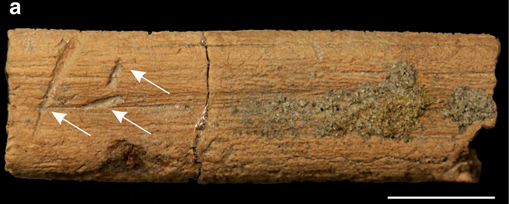
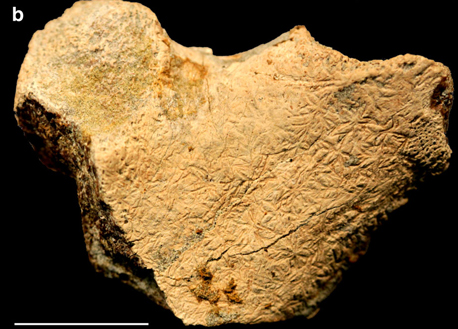
The researchers identified a wealth of trace fossil evidence indicating feeding on the carcase by scavengers as well as evidence of organisms grazing on the bones themselves.  Marks made by the teeth of fish were identified and the “star-shaped” feeding scratches from the ichnospecies Gnathichnus pentax were found.

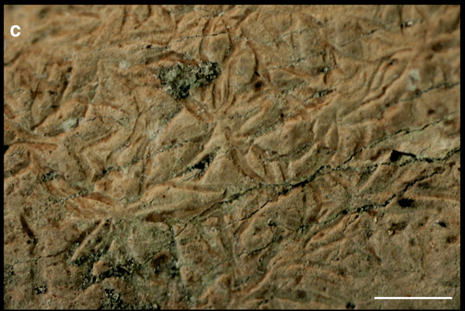
An ichnospecies is an organism only known from trace fossil evidence. The strange five-pointed, star shapes etched over many of the fossilised reptile bones are very similar to the patterns made by living sea urchins with their five-toothed feeding apparatus.  Scientists have interpreted these star-shaped patterns on the bones as evidence of grazing by a prehistoric sea-urchin (echinoid), G. pentax. It would have been feeding on mats of algae that had formed.

Trace Fossil Evidence on the Ophthalmosaurus Bones

Rib showing sharp, narrow grooves (white arrows) probably left by the scavenging action of small fishes.

Rib showing sharp, narrow grooves (white arrows) probably left by the scavenging action of small fishes.

Picture credit: Nature Communications

The picture above shows a close up of an Ophthalmosaurus rib bone showing signs of having been scavenged by small fish. The arrows indicate potential bite mark evidence (scale bar = 0.5cm).

Evidence of Grazing on the Fossilised Bones by Echinoids (Sea Urchins)

G. pentax ichnospecies on a fragment of fossil rib.

G. pentax ichnospecies on a fragment of fossil rib.

Picture credit: Nature Communications

The photograph above (b) shows the tell-tale grazing pattern of the ichnospecies Gnathichnus pentax on one of the fossilised bones (scale bar = 1cm).

A Close up of the Star-Shaped Feeding Pattern

Scale bar = 0.2cm.

Scale bar = 0.2cm.

Picture credit: Nature Communications

The Mesozoic Equivalent of a Whale Fall Incident

Commenting on the study, Richard Twitchett (Natural History Museum), one of the research paper’s co-authors stated:

“This is the first time anybody has described the ecological succession in the Mesozoic equivalent of a whale fall in detail.”

When an extant whale dies and its body sinks to the seabed,  scientists have identified a number of distinct and sometimes overlapping ecological phases.  First, scavengers remove the flesh and other soft tissues from the carcase.  Then snails and the charmingly named bone-eating, snot-flower worms (Osedax genus) feast on the blood and the fluids from the decomposing remains.

The last phase sees the hard parts such as the bones themselves being digested by microbes which feed on the fats (lipids) stored in the bones.  Tube worms live off the microbes and the likes of the bone-eating snot-flower worms persist.

Feeding by Scavengers

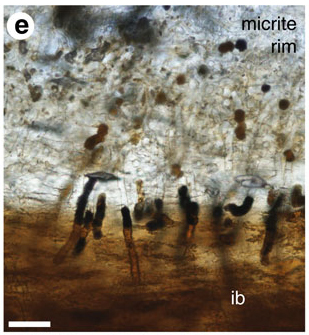
When the insides of the Ophthalmosaurus’s bones were examined under powerful microscopes further evidence of feeding by scavengers was found.  A number of tiny, fossilised molluscs were discovered.  These are associated with the same ecological community phase now associated with the bone-eating, snot-flower worms.  However, there was no sign of the “sulphophilic stage”, in which oxidised inorganic compounds such as sulphides and methane, derived from microbial activity as the fats inside the bones are broken down are consumed by a chemosynthetic community.  The chemosynthetic community found on the carcases of whales in deep water (greater than two hundred metres) consists of free-living bacteria and bivalves (for example, the genus Beggiatoa).

Evidence of Microscopic Scavenging Activity within the Fossilised Bone

Close-up of the bioeroded area where microborings are perpendicular to the external bone surface

Close-up of the bioeroded area where microborings are perpendicular to the external bone surface

Picture credit: Nature Communications

The picture above (e) shows a highly magnified section of ichthyosaur bone (ib) and the adjacent micrite rim represents a fine-grained calcite layer formed by the action of microbes boring into the substrate.

Mats of Microbes

Instead, the ichthyosaur’s bones were colonised by mats of microbes which attracted sea urchins and other grazing invertebrates.  The bones also became the home for a number suspension feeders, such as oysters that cemented themselves to the remains of the skeleton, forming a miniature “reef phase” as described by the scientists.  The remains were eventually buried entombing the remnants of the ecosystem that had been established to exploit the last resources from the dead animal.

When large cetaceans perish, a reef phase is less likely to occur as most carcases settle in deeper water and the ubiquitous bone-eating snot-flowers rapidly destroy the skeleton.  The researchers conclude that shallow-water ichthyosaur falls do provide a range of ecosystem opportunities to other organisms similar to the ones seen in studies of dead whales and dolphins.  However, it seems such shallow water corpses do not support any specialised chemosynthetic communities.

10 09, 2014

School Site Updates and Important News for Teachers

By |2024-05-02T10:23:07+01:00September 10th, 2014|Categories: Educational Activities, Press Releases, Teaching|0 Comments

Everything Dinosaur’s School Site Updates

Busy days at Everything Dinosaur, not only are team members starting the first of the autumn term’s teaching assignments this morning, but there are further updates being added to the company’s bespoke teaching website.  Everything Dinosaur provides a lot of educational resources and support to schools, home educators, teaching assistants and museums.  The teaching website was set up so as to provide a dedicated support site about dinosaurs and fossils to assist those involved in education.

Everything Dinosaur

Teaching tips, articles, resources and free downloads.

Teaching tips, articles, resources and free downloads.  Everything Dinosaur supplies lots of dinosaur themed educational resources.

Picture credit: Everything Dinosaur

Helping Teachers

Amongst the free downloads, teaching plans, schemes of work and other resources, Everything Dinosaur team members have been busy writing bespoke articles about how dinosaurs and fossils can help in education on the site’s teaching blog.  Trouble is, we have hundreds of articles and even more ideas for new articles so this task is monumental.  Still we shall persevere and new articles are being posted up all the time.

To visit Everything Dinosaur’s extensive range of dinosaur themed educational resources: Dinosaur Themed Educational Resources.

9 09, 2014

New Species of Titanosaur Named – Rukwatitan bisepultus

By |2023-03-16T13:45:00+00:00September 9th, 2014|Categories: Dinosaur and Prehistoric Animal News Stories, Dinosaur Fans, Main Page|0 Comments

Rukwatitan bisepultus – A Rare African Giant

Titanosaurs are a bit like buses, you wait for ages and then two of them come along together.  No sooner did we complete our synopsis on the research on the colossal Dreadnoughtus schrani, a newly described titanosaur from south-western Patagonia, then we have the opportunity to discuss another new species, this time from Africa.  This new titanosaur, named Rukwatitan bisepultus may not be quite as big as the newly described Dreadnoughtus but we at Everything Dinosaur estimate that fossils excavated from a hazardous cliff face in a steep quarry represent a dinosaur that was around ten metres long, or possibly much bigger.

Comparisons with the fossil bones from the Malawisaurus indicate that this titanosaur could have exceeded sixteen metres in length.  This herbivore would have been able to survey its floodplain home from a height of approximately four metres.

Rukwatitan bisepultus

An Artist’s Impression of the New Titanosaur (Rukwatitan bisepultus)

New genus of Titanosaur described from Tanzania.

New genus of titanosaur described from Tanzania.

Picture credit: Mark Witton

Studying Titanosaurs

But with titanosaurs, size isn’t everything.  Rukwatitan may not be a record breaker in terms of its body mass but its discovery is perhaps more significant than the fossils of the South American giants.  This is only the fourth genus of titanosaur discovered in Africa* and the palaeontologists at the University of Ohio, who excavated the fossils out of the cliff over two field seasons, are confident that their find will help scientists to understand more about the global distribution and the diversity of the titanosaurids as well as helping to piece together more data on the evolution of sub-Saharan dinosaurs.

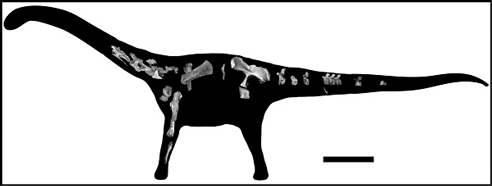
A Silhouette of Rukwatitan bisepulutus Showing Fossils Found

Scale bar = 1 metre

Scale bar = 1 metre

Picture credit: Eric Gorscak (Ohio University)

The picture above shows a bauplan of the new titanosaur and the position of the fossil bones that were found in relation to the body plan.

Titanosaurs are wide-bodied sauropods that probably evolved sometime in the Late Jurassic and survived until the Cretaceous mass extinction event.  They are the only sauropods known to have survived into the Late Cretaceous, but only in South America did these animals make up a significant proportion of the herbivorous megafauna, elsewhere, the ornithopods dominated.  When compared to other types of Sauropoda, titanosaurs tended to have wider bodies, due to the more robust and larger pectoral area (chest).  The limbs were strong and stocky, often the front limbs were longer than the hind limbs.

The spinal column was more flexible than in diplodocids, perhaps helping them to rear up more easily.  The heads were small, proportionately smaller than other types of sauropod.  Titanosaurs were geologically widespread and their fossils have been found on all the continents including Antarctica.  A number of sub-families have been identified and some of the titanosaurids are amongst the largest, terrestrial vertebrates known to science.

To read about the Antarctica fossil find (2011): Titanosaurs of the Antarctic.

The fossils were found in the Rukwa Rift Basin area of south-western Tanzania (hence the genus name).  Scientists from Ohio University in collaboration with several other universities have carried out a number of excavations from the Red Sandstone Group deposits, that form part of the Galula Formation.  Fossils of turtles, crocodilians and primitive mammals have also been found in the formation, as well as dinosaur remains.  The fossil bearing strata is believed to have been laid down approximately 100 million years ago (Late Albian faunal stage of the Cretaceous).

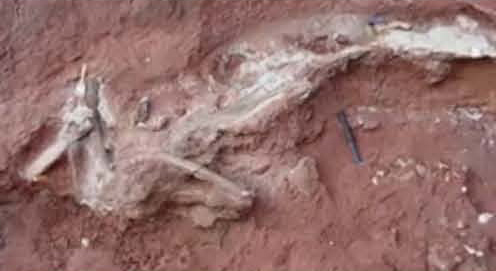
The Fossils were Excavated from a Steep Cliff Face

The fossils were excavated from a steep cliff.

The fossils were excavated from a steep cliff.

Picture credit: Patrick O’Connor (Ohio University)

The vertebrates associated with the Galula Formation have shown some unique anatomical features indicating that the floodplain environment which is represented by these sandstone deposits may have been separated from other parts of Gondwana, permitting a unique fauna to evolve.  Last year, scientists from Ohio University reported the discovery of a new type of crocodilian (Rukwasuchus yajabalijekundu) that was different from other crocodilians found in deposits of the same geological age but from further north.

Some of the Fossils Exposed after Excavation

Fossil material exposed.

Fossil material exposed.

Picture credit: Ohio University

One of the authors of the scientific paper, published in the “Journal of Vertebrate Palaeontology”, Patrick O’Connor (Professor of Anatomy at Ohio University) stated:

“There may have been certain environmental features, such as deserts, large waterways and/or mountain ranges that would have limited the movement of animals and promoted the evolution of regionally distinct faunas.  Only additional data on the faunas and the palaeo-environments from around the continent will let us further test such hypotheses.”

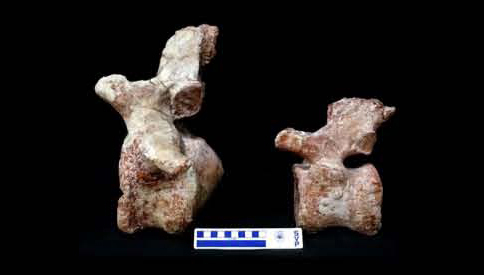
Two Caudal Vertebrae (Tail bones) from the Site

A number of caudal vertebrae including several articulated vertebrae have been found.

A number of caudal vertebrae including several articulated vertebrae have been found.

Picture credit: Ohio University

* Team members have had a go at naming the four genera of African titanosaurs currently described, here we go:

  1. The basal titanosaur from Tanzania (Upper Tendaguru Formation) – Janenschia robusta (Late Jurassic)
  2. The Lithostrotian titanosaur from Malawi (unknown formation) Malawisaurus dixeyi (Cretaceous)
  3. The basal Lithostorian titanosaur? Rukwatitan bisepulutus (described above)
  4. The Lithostrotian titanosaur from Egypt (Bahariya Formation) Paralititan stromeri (Late Cretaceous)

To read the acclaimed article written by Everything Dinosaur on the newly discovered titanosaur Dreadnoughtus: New Titanosaur from South-Western Patagonia.

8 09, 2014

Time Running Out To Enter Dinosaur T-shirt Contest

By |2023-03-16T13:40:31+00:00September 8th, 2014|Categories: Dinosaur Fans, Everything Dinosaur News and Updates, Main Page, Press Releases|1 Comment

Name the Dinosaur Competition

As we celebrate the introduction of Everything Dinosaur’s range of childrens’ dinosaur themed T-shirts, our competition to think of a suitable name for one of the dinosaurs featured in the new designs, really seems to have taken off.  We have lots of entries so far, but there is still time to enter (competition closes on Friday 19th September).  Please note this competition is now closed.

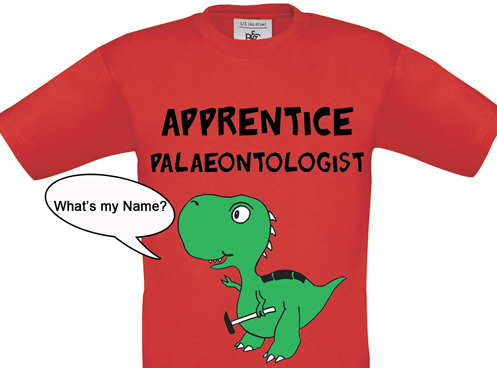
One of the designs on our dinosaur T-shirts features a baby T. rex.  He (or she), looks very cute and the competition is simple – come up with a name for this little critter.

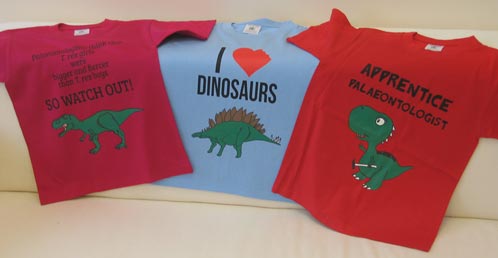
The Range of Exclusive Everything Dinosaur T-shirts

The first of the dinosaur themed T-shirts from Everything Dinosaur.

The first of the dinosaur themed T-shirts from Everything Dinosaur.

Picture credit: Everything Dinosaur

Give a name to our baby dinosaur and we will send one lucky winner a dinosaur T-shirt from our new range* for their junior palaeontologist to wear!

Think of a name for me to win a T-shirt!

Think of a name for me to win a T-shirt!

To enter the contest for a chance to win a dinosaur themed T-shirt for your own young dinosaur fan, all you have to do is “Like” Everything Dinosaur’s FACEBOOK page, then comment on the picture of the baby dinosaur design on the red T-shirt (pictured above).  Our friendly baby dinosaur needs a name, what can you come up with?

To enter, just visit Everything Dinosaur on FACEBOOK  and “like” our page and remember to leave a suggested name by making a comment under the “apprentice dinosaur” image.

Everything Dinosaur on Facebook

Click the logo to visit our Facebook page and to give our page a "like".

Click the logo to visit our Facebook page and to give our page a “like”.

Everything Dinosaur on FACEBOOK: “LIKE” Our Facebook Page and Enter Competition

We will draw the lucky winner at random and the name caption competition closes on Friday 19th September 2014.  Good luck!

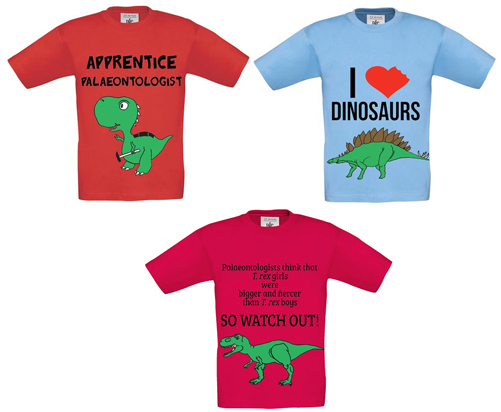
To view Everything Dinosaur’s range of dinosaur and prehistoric animal themed clothing click on the picture below:

Dinosaur and Prehistoric Animal Pjs, T-shirts, Sweatshirts etc.

Exclusive to Everything Dinosaur

Exclusive to Everything Dinosaur.

Picture credit: Everything Dinosaur

To view the range of dinosaur T-shirts and other dinosaur themed clothing for children: Dinosaur Themed Clothes and Dinosaur T-shirts.

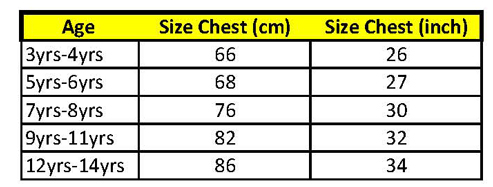
*The range of T-shirt sizes available to the prize winner

Competition Winner can choose from these sizes.

Competition winner can choose from these sizes.

* please note the red “Appentice Palaeontologist T-shirt is only available in sizes up to 9 yrs-11 yrs, chest size 82 cm.

Terms and Conditions of Name Our Baby Dinosaur Competition

Automated entries are not permitted and will be excluded from the draw.

Only one entry per person.

The prize is non-transferable and no cash alternative will be offered.

The Everything Dinosaur name a baby dinosaur caption competition runs until Friday 19th September 2014.

Winner will be notified by private message on Facebook or email.

Prize includes postage and packing.

For full terms and conditions email: Contact Everything Dinosaur.

PLEASE NOTE THIS COMPETITION IS NOW CLOSED.

8 09, 2014

Rare Ancient Fossil Helps Decode Horse Evolution

By |2024-05-02T10:21:53+01:00September 8th, 2014|Categories: Key Stage 3/4|Comments Off on Rare Ancient Fossil Helps Decode Horse Evolution

Oldest DNA Sequence Known to Science from Horse Fossils

An international research team have been able to retrieve a substantial portion of the genome of an ancestral horse that roamed northern Canada nearly three quarters of a million years ago.  This study will help scientists to understand more about Equine evolution and dramatically extends the known limit of DNA survival in the fossil record.  Genetic material, DNA fragments has been recovered from the frozen bodies of long extinct animals before.

Ancient Fossil

DNA has been recovered from Siberian Woolly Mammoths (Mammuthus primigenius) and those of Cave Bears (Ursus spelaeus).  These fossils too, date from the Pleistocene Epoch, however, the horse DNA has been recovered from fossils more than half a million years older than other material successfully studied to date.

What is DNA?

DNA (deoxyribonucleic acid) is a complex chemical molecule that carries the genetic information for an organism.  It contains the information required for the development and functioning for all known types of living organism and many types of viruses.  This hereditary information consists of a code made up of four chemical bases, these bases are A (adenine), G (guanine), C (cytosine) and T (thymine).  These DNA chemical bases join up with each other, adenine always with thymine (A with T) and guanine with cytosine (G with C), these are called base pairs.

The order, or sequence of these base pairs determines the information available for the development and functioning of the organism, this is often referred to as the genetic code.  The genome is the term used to describe the coding and non-coding material of an organism.

The Structure of DNA (The Double Helix)

The double helix of DNA.

Rosalind Franklin helped to unravel the structure of the double helix of DNA.  Here is an illustration of the double helix.

Picture credit: U.S. National Library of Medicine (additional labelling by Everything Dinosaur)

The fossil used in the DNA study was a fifteen centimetre long leg bone, excavated from permafrost at a location in the western part of the Yukon (Canada).  The bone is estimated to be around 735,000 years of age.  Limb bones, as they are more robust and thicker than other bones, have a greater likelihood of preserving organic material.

To read more about this research: Ancient Fossil Horse Helps Decode Equine Evolution.

7 09, 2014

Everything Dinosaur’s New School Site Goes from Strength to Strength

By |2023-03-16T13:35:13+00:00September 7th, 2014|Categories: Educational Activities, Teaching|0 Comments

Teachers Getting Access to Free Downloads

The new school website from Everything Dinosaur has only been “live” for a little over a week but already teachers and learning support providers from as far away as Australia and California have been taking the opportunity to download the free teaching resources.  With the new curriculum being rolled out in England, there is a strong emphasis on “working scientifically” and our trained teachers and academics have been enthusiastically offering support and teaching advice.

Everything Dinosaur

New Schools and Educational Website From Everything Dinosaur

Teaching tips, articles, resources and free downloads.

Teaching tips, articles, resources and free downloads.  Everything Dinosaur educational products for schools.

Picture credit: Everything Dinosaur

Science Curriculum

In the science curriculum, rocks and fossils are an integral part of Key Stage 2 and dinosaurs make a fantastic term topic subject for Early Years Foundation Stage (EYFS) and Reception.  Everything Dinosaur’s school visits start in earnest next week, but our teaching team hope to post up some more, free dinosaur and fossil themed teaching resources before the teaching schedule and dinosaur workshops get into full swing.

A spokesperson for Everything Dinosaur commented:

“We have been very pleased with the take up, lots and lots of free dinosaur and fossil themed teaching resources have already been downloaded by teachers, teaching assistants and home educators.”

To visit Everything Dinosaur’s website, a website aimed at helping teachers and other educationalists with the delivery of Earth science based teaching schemes and lesson plans: Visit Everything Dinosaur.

6 09, 2014

Rare Dinosaur Fossil Damaged at Dinosaur National Monument (Utah)

By |2024-05-02T10:22:28+01:00September 6th, 2014|Categories: Dinosaur and Prehistoric Animal News Stories, Main Page, Palaeontological articles|0 Comments

Dinosaur Fossil Damaged and a Piece Stolen from Dinosaur National Monument

It once was a near perfect fossil of the upper arm bone of a sauropod dinosaur, now it is broken and damaged with a fist-sized chunk missing.  Rangers at the Dinosaur National Monument in Utah have reported the vandalism and theft of part of a humerus.  It is extremely sad to have to report on yet another theft of a dinosaur fossil, officials at the Monument are appealing to members of the public to help them trace the culprit(s).

The Damaged Portion of the Dinosaur Fossilised Bone

The damaged dinosaur bone.

The damaged dinosaur bone.

Picture credit: National Parks Service

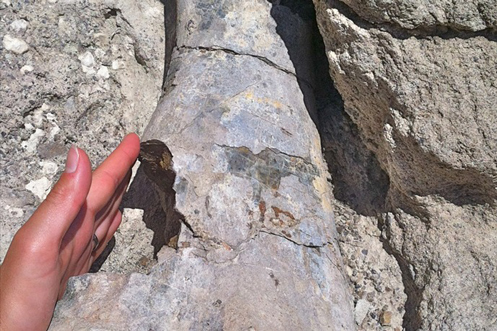
The picture above shows the missing section of the dinosaur bone, the bone seems to have been deliberately smashed.

Dinosaur National Monument

The Dinosaur National Monument is well-named.  Managed by the United States Department of the Interior National Parks Service, the park covers some 85,000 hectares and overlies the border between the states of Colorado and Utah (although the main dinosaur quarry site is in Utah, close to the town of Jenson).  The Monument is world famous for its amazing collection of dinosaur and other vertebrate fossils which date from the Upper Jurassic.

At least ten different types of dinosaur genera are known from the Morrison Formation exposures.  The Utah sequence represents high energy riverine deposits and on show at the visitor centre is a sandstone “wall” that reveals some 1,500 dinosaur bones.  Dinosaurs were probably swept away and drowned during floods.  At bends in the river as the current slowed down, so debris, including the carcases of dinosaurs was deposited.  The Dinosaur National Monument preserves these “log jams” of dinosaur bones.  Genera associated with the Monument include Camarasaurus, Allosaurus, Stegosaurus, Apatosaurus, Diplodocus and Dryosaurus.

The Fossil Discovery Trail

On Tuesday, September 2nd , a park ranger was leading a tour party along the Fossil Discovery Trail when the damaged bone was noticed.  The vandalism and theft probably took place sometime between the Monday guided walk along the Fossil Discovery Trial and Tuesday morning.  The Fossil Discovery Trail is a 1.2 mile trail that runs between the Quarry Visitor Centre and the Quarry Exhibit Hall where the famous sandstone “wall” of dinosaur bones that we described above, is located.

The trail is unique as it is one of the few places where visitors can hike to see and touch dinosaur fossils and fragments in situ.  It allows visitors to experience what it may have been like for palaeontologist Earl Douglass (Carnegie Museum of Natural History), when he discovered the first fossils in what is now the Monument.

A spokesperson from Everything Dinosaur commented:

“This is such a shame as the Dinosaur National Monument is going to celebrate its centenary next year and to have fossils damaged and stolen is deeply upsetting.  Although the fossils along the trail are of limited scientific value they provide a wonderful opportunity for members of the public to get up close to real dinosaur fossils.”

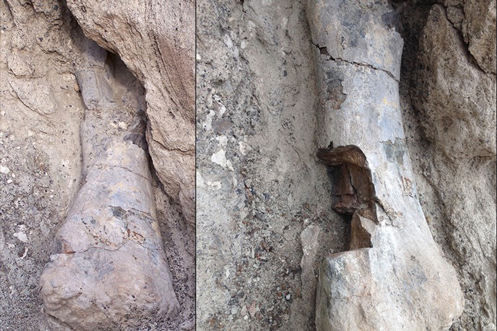
The Sauropod Humerus (before and after) Photographs

Two photographs showing the fossil before and after the theft.

Two photographs showing the fossil before and after the theft.

Picture credit: National Parks Service

The picture above shows two photographs, the picture of the humerus without the damage (left) and a close up showing the damaged portion (right).  Although our dinosaur experts cannot be certain, the bone portion in question looks like the distal end of a left humerus, probably part of a Camarasaurus.  Park officials are seeking help from the public and anyone with information regarding this theft are invited to contact staff on (435) 781-7715.  A reward of $750 USD has been put up by the Intermountain Natural History Association for information that leads to a conviction.

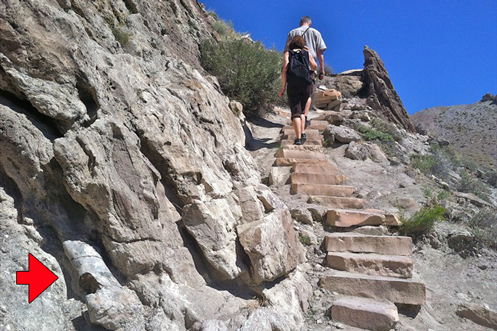
The Part of the Fossil Discovery Trail where the Bone was Situated

The arrow shows the position of the damaged dinosaur bone.

The arrow shows the position of the damaged dinosaur bone.

Picture credit: National Parks Service

Not to Collect or Damage Fossils

Everything Dinosaur would like to take this opportunity to stress that visitors to the Dinosaur National Monument are not allowed to collect/damage any fossils or rocks.  Under Federal law, all features, artefacts and resources are protected. No collection of park geological resources for commercial sale, private collections or for classroom educational purposes is permitted.  We advise all visitors to National State Parks of America to familiarise themselves with the various protection laws and polices that relate to that particular location.

5 09, 2014

A Little Detail on a Great Big Dinosaur – Dreadnoughtus

By |2023-11-13T21:35:10+00:00September 5th, 2014|Categories: Dinosaur and Prehistoric Animal News Stories, Dinosaur Fans, Palaeontological articles|2 Comments

Dreadnoughtus schrani – A Dinosaur on a Massive Scale

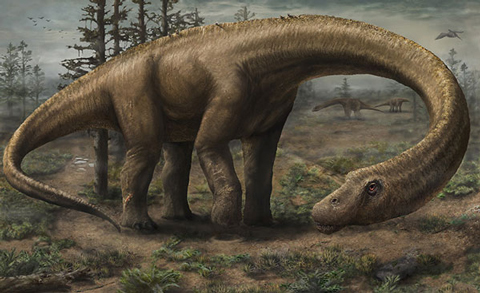
And so the announcement came this week about the discovery of a super-sized, South American dinosaur that weighed as much as thirteen, bull African elephants.  Dreadnoughtus was so named as the huge bones (and for a change when it comes to the Titanosauria, there are quite a lot of them), reminded the scientists of the impervious super-structure of turn-of-the-century battleships.  This was a plant-eating dinosaur that was simply too big to be vulnerable to attack from predators.  Invulnerability would have been very handy for this immense creature as this dinosaur would have been preoccupied with eating, trying to cram enough calories into its enormous digestive system to keep its house-sized body functioning.

A Dinosaur on a Massive Scale – Dreadnoughtus schrani

Huge dinosaur from southern Patagonia.

Picture credit: Jennifer Hall

Dreadnoughtus schrani

Many articles have already been written about this new titanosaur, the scientific paper was published by the Nature Publishing Group on the 4th September, this paper has already received more than 20,000 page views and the story has been picked up by dozens of news outlets.  We at Everything Dinosaur, had known about this research for some time, there are more exciting titanosaurid discoveries from South America still to be announced, so this blog article hopes to recap the main points about the significance of this study and to focus on a couple of areas that may not have been covered by other media outlets.

The “Elephant in the Room”

Firstly let’s deal with the size – this is a real “elephant in the room” moment, as with all large dinosaur fossils, this seems to be the most prominent and frequently asked question – just how big was this dinosaur?

The Size and Scale of the Dinosaur Discovery

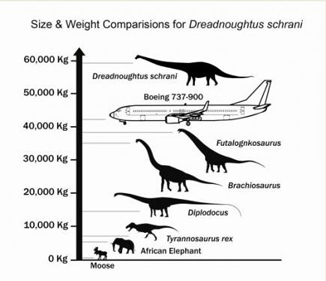
Heavier than a 737 Jet.

Picture credit: Dr Ken Lacovara

Although D. schrani may not be the very biggest of all the dinosaurs that ever existed.  It is certainly right up there, with an estimated body mass of 59,300 kilogrammes (the actual measurement was 59,291 kilogrammes but some rounding has taken place in the media).

How Do Scientists Estimate the Body Mass?

This leads us to one the most important points to note about this discovery.  The international research team led by Drexel University’s Dr Kenneth Lacovara was able to recover around 45% of the total skeleton of a single individual specimen, including cranial material (skull bones).  Most of the rear portion of the animal was excavated including a left humerus (upper arm bone) and femur (thigh bone).  These limb bones hold the key to estimating body size.  Earlier studies have shown that an analysis of the these limb bones and measurements of their circumference, corresponds to relative body mass in terrestrial quadrupeds.

Put simply, imagine weighing several different herds of cows before they are slaughtered for meat.  The cows would be of different sizes and therefore there would be some variance in total body weights.  Once the cows had met their demise, the upper arm bones and thigh bones could be collected for each animal.  The mid shaft circumference for these bones would then be measured and recorded.  A correlation would most likely be found between the mid shaft circumference measurements and the body weight recorded earlier.  For instance, bigger circumference equals a heavier animal.

This correlation provides accurate data on the body mass estimates of four-limbed, terrestrial animals that are alive today.  So the theory goes, that if it works for animals that are extant (living today), then it should also work for extinct animals such as the Dinosauria.  This correlation is extremely useful as the sauropods and the later titanosaurs are so different from living creatures that anatomical comparisons are just not relevant.

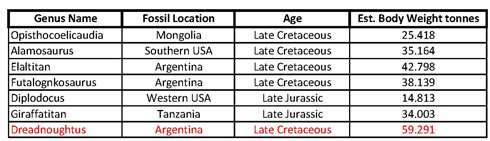
The preservation of these limb bones which have been found to scale with body mass, permits the scientists to make an estimate of the body mass of Dreadnoughtus schrani.  The same equation has been used to estimate the body masses of a number of other substantial dinosaurs, but none of them quite match the bulk of Dreadnoughtus.  It therefore suggests that the Dreadnoughtus schrani holotype material represents an individual titanosaurid that was much heavier than other titanosaurs and indeed much more massive than most other sauropods.

Dreadnoughtus Compared to Other Sauropoda (Limb Circumference Analysis)

Dreadnoughtus - the most complete skeleton of a giant titanosaurid dinosaur discovered to date.
Dreadnoughtus – the most complete skeleton of a giant titanosaurid dinosaur discovered to date.

Table credit: Everything Dinosaur, data compiled from Nature Publishing Group and Benson et al.

Still Growing?

Astonishingly, of the two specimens found together, the largest one, the Dreadnoughtus that was estimated to be heavier than a Boeing 737 aircraft was probably not yet fully grown.  Identifying when a dinosaur reached its maximum size is a complicated business (related to indeterminate growth), however, the research team found that it was likely that this super-sized dinosaur was still growing at the time of its death.  The scapula (shoulder blade) had not fused completely to the coracoid bone.

The posteromedial margin of the coracoid foramen (small opening, located in the middle of the coracoid), was butted up against the distal portion of the shoulder blade.  Palaeontologists have cited these conditions as indicating that the individual was still growing.  A study of the humerus supports this hypothesis, the lack of lines of arrested growth indicate that this dinosaur was immature at the time of death.  Although some scientists have questioned the validity of these indicators, whatever the outcome, the larger individual of the two Dreadnoughtus specimens found to date, represents the biggest dinosaur known to science for which a robust body mass has been calculated.

Not reported by many media sources but for the record the femur length is in excess of 1.9 metres and the humerus is 1.6 metres long.

Dinosaur Fossils Found in Southern Patagonia

Another, significant point we wanted to make concerns the location of the dinosaur fossils.  Whilst Patagonia may now be synonymous with dinosaur discoveries, Argentinosaurus, Giganotosaurus et al, many of these fossils come form the northern and central parts of this vast region.  These fossils come from a relatively unexplored part of south-western Patagonia.  The fossil material was excavated from the Cerro Fortaleza Formation, an exposure on the eastern bank of the Río La Leona, (Santa Cruz Province), this is more than 750 miles (1,200 kilometres) away from the location of other major Cretaceous-aged dinosaur fossil finds.

We at Everything Dinosaur are unaware of any radiometric dating and although Campanian-aged biostratigraphical material is associated with some horizons of the Cerro Fortaleza Formation, the precise age of these fossils remains unclear.  They are between 83 million and 66 million years old, with some sources stating 77 million years of age (Campanian to Maastrichtian faunal stages).

Location of the Dreadnoughtus Quarry

The site of the fossil discovery.

Picture credit: Map de la provincia de Santa Cruz

A Team Effort

Last but not least, the 116 fossils, some of which do show potential evidence of scavenging by theropod dinosaurs, have been excavated, prepared and digitally mapped by a dedicated team of researchers.  This has certainly been a colossal undertaking, yes, we know the tail itself measures some thirty feet in length, (the total length of Dreadnoughtus schrani has been estimated at 26 metres) and the skull (only one fragment of which has been found) was around eighty-eight centimetres in length.  It is quite right to focus on the huge size of this member of the titanosaur family, but we at Everything Dinosaur would like to take this opportunity to thank all the researchers for their hard work.

The first fossil was spotted during a expedition back in 2005, the femur we think. From 2005 to 2009 a series of field trips took place to excavate the two individual specimens, since then a great deal of preparatory work and fossil prep has been carried out by scientists from Drexel University, a number of graduates from this institution but also with the aid and support of the likes of the Carnegie Museum of Natural History,  the Museo Argentino de Ciencias Naturales, Argentina and Laboratorio de Paleovertebrados, Universidad Nacional de la Patagonia (also Argentina).

Even a scientist from the University of Manchester (Dr Victoria Egerton), a lecturer in Applied Palaeontology, was involved.   Our congratulations to everyone who has participated in this amazing study, an exceedingly rare opportunity to learn about one of the largest terrestrial vertebrates that is known to science.

For models and replicas of titanosaurs and other prehistoric animals: CollectA Deluxe Prehistoric Animal Models and Figures.

5 09, 2014

Everything Dinosaur is Safariologist Accredited

By |2023-03-16T12:57:05+00:00September 5th, 2014|Categories: General Teaching|Comments Off on Everything Dinosaur is Safariologist Accredited

Major Educational Model Manufacturer Acknowledges the Work of Everything Dinosaur

Safari Ltd of the United States of America, the business behind the Carnegie Collectibles range of scale model dinosaurs has acknowledged Everything Dinosaur’s educational role.  Safari Ltd, who also make the Wild Safari Dinos range of prehistoric animal replicas, has awarded Everything Dinosaur “Safariologist” status.

“Safariologist” Status

Everything Dinosaur Receives Recognition

Everything Dinosaur gains accreditation.

Everything Dinosaur is accredited by Safari Ltd.

Picture credit: Safari Ltd

Safari Ltd Dinosaur Models

Florida based Safari Ltd, introduced the “Safariologist” concept to highlight some of the educational websites that use the company’s products to help promote creative, imaginative play as well as to educate and inform. Everything Dinosaur is the first specialist dinosaur company to be inducted into the “Safariologist” programme (or program as our American chums call it).

To view the huge range of Safari Ltd prehistoric animals available from Everything Dinosaur: Safari Ltd. Wild Safari Prehistoric World.

Everything Dinosaur

Everything Dinosaur, uses a lot of the Safari Ltd products to help educate young children about fossils.  For example, a Wild Safari Dinos ammonite model is used to illustrate what palaeontologists believe Ammonites actually looked like, when we explore fossils with children in Key Stage 1 and 2.

A spokesperson from Everything Dinosaur explained:

“We are very proud to have received this honour from Safari Ltd.  We use a lot of their models and replicas in our teaching work.  The extensive Safari Ltd catalogue has also proved very useful to us when we come to illustrate articles we write for teachers and home educators about new dinosaur discoveries. We have been delighted to have been able to stock Safari Ltd. Wild Safari Prehistoric World models”

Go to Top