All about dinosaurs, fossils and prehistoric animals by Everything Dinosaur team members.

Everything Dinosaur team members working in schools, helping museums and other educational bodies. Our work with and in schools.

16 03, 2009

Teaching Exercise – You have to hand it to Dinosaurs

By |2023-02-28T15:38:05+00:00March 16th, 2009|Categories: Educational Activities, Everything Dinosaur News and Updates, Main Page, Teaching|0 Comments

Novel Teaching Exercise (Key Stage 2)

With the announcement of the discovery of clearly preserved theropod hand prints, our innovative teaching team have come up with an exciting class room activity involving the very latest scientific thinking about dinosaurs fore-limbs and hands.

Theropods, are a diverse group of lizard-hipped (saurischian) dinosaurs.  They walked on their hind-limbs, trace fossils of their footprints and trackways are quite well researched but evidence of the posture adopted by their hands and fore-limbs, well that is a different matter.

Thanks to some new fossil data from a site in Utah, USA, scientists have gained further insight into the posture and position of these bipedal dinosaur’s fore-limbs.  Interpretation of trace fossils from the site indicate that one particular dinosaur left resting hand prints in the Early Jurassic mud next to a lake, some 198 million years ago (Sinemurian faunal stage).  The prints made in the sediment indicate that these dinosaurs may have held their hands differently to ours, the prints demonstrate a link to the evolution of the wings of birds.

To read the article about this discovery: Dinosaur Hand prints Reveal Link to Birds.

It is from theropod dinosaurs that birds (Aves) are believed to have evolved.  Although much is known about the anatomy of theropod arms due to the fossil bones found, this new evidence indicates that they held their fore-limbs very differently to ours.  Being humans, we have very sophisticated arms and hands, long since adapted to other tasks rather than locomotion.  For example, we are able to pronate (twist) our arms very effectively and we have much more mobility in our arms and hands in general, when compared to a bipedal dinosaur.

It is not known for sure which type of dinosaur left the prints, but scientists suspect that this 4.5-metre-long animal was some sort of dilophosaur.  This new research has enabled us to develop a lesson plan in which we can carry out simple experiments to prove that the “bunny” position for theropod fore-limbs, seen on many models and even in museum exhibits could be wrong.

An Illustration of A Dilophosaur

Picture credit: Everything Dinosaur

To view a model of a Dilophosaurus along with figures and replicas of other theropod dinosaurs: Dinosaur and Prehistoric Animal Models.

Yet another teaching activity to add to our repertoire.

8 02, 2009

Dinosaurs and the Water Cycle a Helpful Explanation

By |2024-04-15T13:50:08+01:00February 8th, 2009|Categories: Main Page, Teaching|0 Comments

Dinosaurs and the Water Cycle

What is it with the English and their weather?  The UK is essentially a “maritime climate”, this is what comes from being a small island at one side of the Atlantic ocean with a large continent (Europe) adjacent to us.  We do seem to get some very peculiar weather and June was no exception.  With the cricket season in full swing and Wimbledon tennis underway, last month proved to be one of the wettest on record, July has not started too well either.  Many parts of the UK have suffered from flash floods.  South Yorkshire seems to have been hit the worst with many villages and towns still underwater.

Dinosaurs and the Water Cycle

With all this rain everywhere, you might think that planet Earth has suddenly started to produce more water, but this is not the case.  The amount of water we have on this planet is just about fixed, water may change its state but this planet only has a finite amount.  If you pour yourself a glass of water and sit it on the table in front of you, that water in your glass could have been part of an ocean a little over a week ago.  It may have fallen as rain, just a couple of days before it found its way into your glass, but the water itself is virtually as old as the planet.

The same water that you see before you could have made up part of a shallow rock pool that stranded trilobites in the Ordovician 500 mya.  It may have formed part of a thunderstorm that caused a herd of plateosaurs to stampede in the Late Triassic, it might even have been drunk by a Tyrannosaurus rex.

The water we have gets recycled, this is what we call the “Water Cycle”, water is evaporated (or transpirated by plants as they lose water) and forms water vapour.  The water vapour in the air gets cold and forms clouds – this is called condensation.  You can see condensation on windows in the morning when the water vapour hits the cold window glass and turns back into liquid.

The clouds become saturated with water, so that they cannot hold any more and the water falls out back down to earth as rain, sleet, hail of snow.  The water may fall into or run off into oceans, lakes or rivers or get absorbed by the land into the “groundwater”, to be drunk by plants and trees or it will eventually under several natural processes, mainly gravity, find its way back to the sea – and the process starts all over again.

Visit Everything Dinosaur’s award-winning website: Everything Dinosaur.

24 11, 2008

Studying the Jaws of Plant-Eating Dinosaurs

By |2024-04-15T13:35:53+01:00November 24th, 2008|Categories: Dinosaur Fans, Teaching|0 Comments

Evolution of the Ornithischian Jaw

The earliest plant-eating dinosaurs from the Triassic geological period had thick teeth covered with enamel.  More advanced herbivores that evolved in the Jurassic and the Cretaceous had enamel on one side of the tooth only.  As the teeth from the upper and lower jaws ground up the tough plant material, the softer side of each tooth wore down more quickly.  This made the teeth, effectively, self-sharpening.  The teeth were also ever-growing and ever-replacing.  Mammals such as ourselves only have a few sets of teeth in lifetime, dinosaurs were able to constantly replace teeth that had been broken and shed from the jaw.

A Tooth from a Triceratops (Late Cretaceous Plant-Eating Dinosaur)

A typical tooth of a Ceratopsian with its two distinct dental roots.

A typical tooth of a ceratopsian with its two distinct dental roots.

Picture credit: Everything Dinosaur

The strongly rooted teeth of ceratopsian dinosaurs were very efficient teeth for grinding up plant material.  The beak on the front of the jaw grabbed the plant material and the teeth towards the back of the jaw ground down the tough plant material.

Everything Dinosaur stocks a wide range of plant-eating dinosaur models, including horned dinosaurs (ceratopsians).

Visit the models section of the company’s award-winning website: Models of Plant-eating Dinosaurs.

17 11, 2008

Mary Anning a Famous Formal Portrait

By |2024-04-15T13:25:17+01:00November 17th, 2008|Categories: Famous Figures, Geology, Teaching|0 Comments

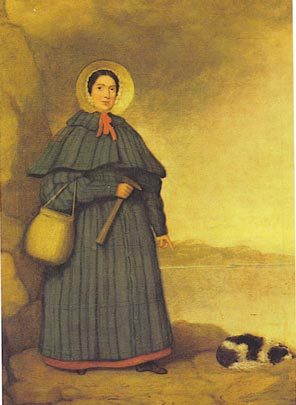
Mary Anning a Formal Portrait

Pioneering fossil collector Mary Anning was famous for finding fossils along the coast of the Lyme Regis area in Dorset (southern England).  With her little dog to keep her company (dog sadly killed in a landslide), Mary spent many hours each day between the tides exploring the cliffs and foreshore looking for fossils from the Lower Lias sediments.

Mary Anning 1799-1847

Mary Anning 1799-1847.

Mary came from a family of professional fossil collectors.  The family excavated fossils of many marine reptiles such as ichthyosaurs and plesiosaurs along with a number of prehistoric fish.  She helped discover the first pterosaur fossils to be formally studied in England and she was pivotal in helping to build up the fossil record of Lower Jurassic specimens.

14 11, 2008

Dinosaur Plant-Eaters and Meat-Eaters a Helpful Guide

By |2024-04-15T13:27:08+01:00November 14th, 2008|Categories: Dinosaur Fans, Teaching|0 Comments

What Proportion of the Dinosauria were Meat-Eaters?

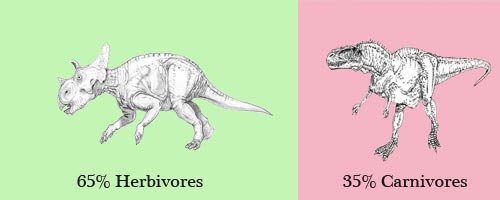
By studying the fossilised teeth associated with any skull material of a member of the Dinosauria, palaeontologists can have a good idea of the potential diet of that particular dinosaur, was the dinosaur a plant-eater or meat-eater.  Occasionally, stomach contents are preserved and this evidence too, can assist in determining whether the dinosaur was a carnivore or herbivore.  The boundaries become a little blurred when a potential omnivorous diet is considered but to date, with around 1,200 dinosaur genera known approximately sixty-five percent are plant-eaters.

The Proportion of Plant-eating Dinosaurs to Meat-Eating Dinosaurs

Proportion of plant-eaters to meat-eaters in the Dinosauria.

Proportion of plant-eaters to meat-eaters in the Dinosauria.

Picture credit: Everything Dinosaur

Scientists believe that if they were able to identify and describe every type of dinosaur that has ever existed, the proportion of herbivorous dinosaurs to carnivorous dinosaurs would be even greater, upwards of perhaps eighty percent or more.

Everything Dinosaur stocks an extensive range of both meat-eating and plant-eating dinosaur models.

To view the models section of the company’s award-winning website: Dinosaur and Prehistoric Animal Models.

10 11, 2008

Teaching about Dinosaurs and Fossils in School

By |2022-12-09T13:36:36+00:00November 10th, 2008|Categories: Educational Activities, Everything Dinosaur News and Updates, Teaching|0 Comments

Dinosaur Workshops in School

Schools may be preparing for the culmination of the Autumn term ending in the Christmas festivities but team members at Everything Dinosaur are busy keeping up their appearances in schools to undertake dinosaur themed workshops and to help children learn all about dinosaurs and fossils.

As a term topic, something like “dinosaurs” or ” the Jurassic forest” lend themselves to a vast array of extension activities.  These activities encompass numeracy, literacy, creative writing, ICT as well as art and dance.  One of our dinosaur experts visiting a school to conduct a dinosaur workshop was treated to a dance by primary school children that helped explain the extinction of the Dinosauria.  On display in the classroom were lots of artwork as well as examples of prehistoric animal themed stories written by the children.

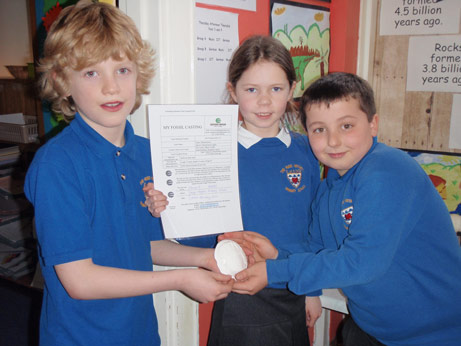
Primary School Children Participate in a Dinosaur Workshop in School

Everything Dinosaur's visit to a school.

Everything Dinosaur’s visit to a school. Picture credit: Everything Dinosaur.

Picture credit: Everything Dinosaur

The children were keen to show off their fossil casts of specimens from the Everything Dinosaur collection and they also were keen to ask our dinosaur expert lots of questions and to demonstrate their subject knowledge acquired through independent learning.

To learn more about the educational, dinosaur themed toys and games provided by Everything Dinosaur visit the company’s website: Everything Dinosaur.

The children had constructed a number of bar charts and pie diagrams as they classified dinosaurs in different ways.  This ties in very effectively to Key Stage 1 teaching objectives that involve how to express data and how to demonstrate the plotting and recording of figures.

9 09, 2008

A Wonderful Thank you Letter from Becky

By |2024-04-15T12:20:22+01:00September 9th, 2008|Categories: Educational Activities, Teaching|0 Comments

School Pupil Writes Thank you Letter to Everything Dinosaur on Behalf of Her Class

After another visit to a primary school to teach about dinosaurs and fossils, this time one in Lancashire, our dinosaur expert was asked by the school teacher for a small favour.

Would it be all right with you,  if the children composed a thank you letter?

Fine by us, in fact we actively encourage creative writing in schools and we get asked for lots of ideas and advice when it comes to motivating young people at Key Stage 1 with creative writing tasks.

The teacher concerned (Miss O’ Hara), supported by her teaching assistant (TA) organised a brief session with the children in which they recalled and recounted some of the things they had done and what they had learned after the dinosaur workshop in school.  Flip chart paper was used by the children to list facts about dinosaurs that they had learned and from these sheets, what was going to be said in the actual letter was determined.  Then it was simply a question of briefing the children in what is expected when it comes to the layout of a letter.  For instance, the correct starting phrase, appropriate use of punctuation, connectives and so on.  I number of children wrote letters, and the teacher selected one to be sent on to the Everything Dinosaur offices.

Everything Dinosaur

It was Becky’s letter that was selected:

Young Becky (aged 6), wrote:

“Dear Everything Dinosaur,

Thank you for visiting our school this week, it was lovely to meet you.  Please, please come back to us as we all had such fun learning about dinosaurs.  We had fun with you and I liked making the fossil casts best.  We all laughed when Miss O’ Hara got to hold he dinosaur dung, we said she should wash her hands before she has her dinner.  I learned a lot and it helped me with my own dinosaur work.

From

Becky

(Class 1)”

Our team members get a lot of similar correspondence, however, we always acknowledge receipt of any such letters and email a reply to the school teacher responsible for the class. Glad we were able to make teaching about dinosaurs so much fun.

To learn more about Everything Dinosaur’s product range: Visit Everything Dinosaur’s Website.

20 08, 2008

Preparing Lesson Plans for the Next School Year

By |2023-02-25T18:01:01+00:00August 20th, 2008|Categories: Educational Activities, Teaching|0 Comments

Mary Anning, Evolution Preparations in Place for Dinosaur Workshops in School

Plans are well advanced at Everything Dinosaur to roll out new lesson plans for the company’s highly successful dinosaur workshops in school programme.  With the new school  year approaching, team members have been updating schemes of work and writing notes on extension activities to assist teachers and teaching assistants as they deliver dinosaur and fossil themed teaching topics.

We do a lot of work with schools and a visit from Everything Dinosaur certainly has a big wow factor.  Everything Dinosaur team members carry out a lot of work with schools and the pupil premium and our workshops are built around national curriculum aims and objectives including developing writing skills, aiding literacy and encouraging an understanding of simple scientific principles, relating to the National Curriculum.  Dinosaurs as a teaching theme lends itself to all sorts of ideas and extension activities and can really help enthuse young people to learn.

To learn more about Everything Dinosaur’s products and merchandise: Dinosaur Toys, Games and Models.

Everything Dinosaur is staffed by teachers and real dinosaur experts and we visit schools to conduct dinosaur themed teaching sessions whilst working with National Curriculum learning objectives and intended outcomes.  We build in real aspects of palaeontology into our teaching work, enabling students to experience some of the science behind the study of dinosaurs and other prehistoric creatures. Our costs are made up of a subsidised amount for the teacher/palaeontologist’s time, plus travelling expenses and a small charge to cover the packing of fossils and any materials used in experiments that we conduct.

Topics covered include Mary Anning, fossils and fossil formation plus the basic principles of natural selection and evolution.

30 07, 2008

Thank you from Year 1 School Children

By |2023-02-25T17:15:11+00:00July 30th, 2008|Categories: Educational Activities, Teaching|0 Comments

Thank you Letters Received After Dinosaur Workshop in School

At the end of the Summer Term, Everything Dinosaur visited a primary school in Staffordshire (English midlands) to help with the Year 1 term topic of dinosaurs and the “Jurassic Forest”.  The children, aged between six and seven years of age had lots of questions for our dinosaur expert and they were keen to show off their dinosaur themed artwork.  This morning, the postman arrived with a big envelope with thirty thank  you letters that had been written by the children, one of the last things they did before the end of their school term.

After a school visit to teach about dinosaurs in schools, it is always a pleasure to receive letters from young dinosaur fans.  It is also a good way to get budding young palaeontologists to practice their writing skills.

Young Ryan wrote:

“I had a great time, my favourite part was when you showed me the dinosaur teeth.”

Everything Dinosaur Receives a Thank You

School chum Imogen said that she had lots of fun and that she enjoyed learning all about dinosaurs, her favourite exercise was the casting of the fossil dinosaur teeth.  Destiny really enjoyed the dinosaur workshop and she stated that when she gets older she wants to be go and dig up dinosaurs too.  Destiny also remembered the name of some of the fossilised remains that we had looked at, which was very clever of her.  Rhys on the other hand, explained that his favourite meat-eating dinosaur was Tyrannosaurus rex and that is favourite plant-eating dinosaur was the plated Stegosaurus.

Dinosaur workshop thank you letter

Polly says thanks. A dinosaur workshop thank you letter. Picture credit: Everything Dinosaur.

Picture credit: Everything Dinosaur

Thank You Letters

It seems that all the children enjoyed the dinosaur workshop and the standard of letter writing was very good.  All the letters stated with “dear” and there was lots of evidence of correct spelling and appropriate use of connectives and punctuation.  We shall pin the letters up onto one of our big message boards in our warehouse.

To visit Everything Dinosaur’s website: Everything Dinosaur.

13 07, 2008

Summer Holiday Activities – Exciting Baking with Dinosaurs

By |2024-04-13T08:15:10+01:00July 13th, 2008|Categories: Educational Activities, Everything Dinosaur News and Updates, Main Page, Teaching|1 Comment

Summer Holiday Activities – Baking with Dinosaurs

A little summer holiday fun – baking with dinosaurs.

I am sure many young Dinosaur fans would have watched the ground breaking BBC Television series “Walking with Dinosaurs” first aired on BBC1 in 1999.  This ground-breaking television series used CGI imagery and animatronics coupled with the latest scientific research to bring back to life dinosaurs and other prehistoric creatures.

In total, six episodes were made, starting with “New Blood” which depicted the Late Triassic and showed the rise of the dinosaurs to “Death of a Dynasty” which covered the extra-terrestrial impact that marked the end of the Cretaceous.  This work was a collaboration between a number of universities, museums and designers to recreate as accurately as possible the world as it was during the Mesozoic.

The subsequent TV rights, merchandise, video and DVD sales have helped to swell the coffers of the BBC to a considerable extent.  The “Walking with” programmes have provided the BBC with very welcome revenue, these programmes have been some of the best-selling of all the BBC’s output.

Unfortunately, even the most avid home movie fan is unlikely to be able to recreate the BBC TV series, at least we at Everything Dinosaur can offer an alternative that might keep your little ones occupied for a part of the long summer holiday – Baking with Dinosaurs.

Baking with Dinosaurs

Our team has carried out a great deal of research and testing of home baking products in the late winter and early spring and they recommended several types of dinosaur shaped cookie cutters – ideal for making simple dinosaur shaped snacks or biscuits.

As well as testing the cookie cutters and such like, the team have published a number of recipes for making dinosaur themed biscuits.  This blog has published lots of recipe ideas including making dinosaur gingerbread and birthday cakes.  All the recipes have been tried out by our team members and our weblog provides pictures of the finished biscuits along with ingredients and instructions.

The recipes are simple to follow and are ideal to help pass a little bit of the summer holiday time, with a grown up supervising the cooking activities.  The biscuits are a great addition to any dinosaur party food and they are fun and easy to make.

We have also used dinosaur shaped cutters for modelling work using clay and other materials, the cutters work equally well whether making food or simply having fun with plasticine or other materials.

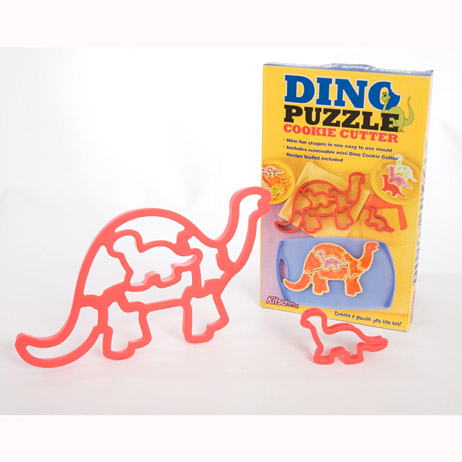
The dinosaur puzzle cookie cutter is a particularly clever product.  Made from robust, sturdy plastic, it consists of several pieces that fit together to make a large motif for a long-necked dinosaur (Sauropod).  You can make your own edible dinosaur puzzle.  The set even comes with a smaller long-necked dinosaur biscuit cutter that allows you to make smaller, dinosaur shaped biscuits and snacks.

The Dinosaur Puzzle Cookie Cutter

Picture credit: Everything Dinosaur

When some of our team members organised tests with this particular product, shortbread biscuits were made.  The young children we were working with found the cutters easy to use and had great fun decorating the biscuits once we had allowed them to cool.

As I recall, we simply made up some small amounts of icing sugar in several pots, a few drops of food colouring enabled our young chefs to colour the icing sugar and we had red, green, yellow and even pink dinosaurs.  These biscuits were then decorated in a variety of ways.  It was certainly a fun way to spend an afternoon, and once washed the biscuit cutters were ready to use again.  There were plenty of recipes for us to try in the little recipe book that was provided in the box.

Some of the Results of our Labours

Baking with dinosaurs, a fun activity for the summer holidays.

Picture credit: Everything Dinosaur

Everything Dinosaur is a UK-based supplier of dinosaur and prehistoric animal themed models, toys and merchandise, check-out our website: Everything Dinosaur.

Go to Top