
All about dinosaurs, fossils and prehistoric animals by Everything Dinosaur team members.

Everything Dinosaur team members working in schools, helping museums and other educational bodies. Our work with and in schools.

21 03, 2014

Art and Science Combine in School During Fossil Study

By |2023-03-11T15:17:12+00:00March 21st, 2014|Categories: Educational Activities, Teaching|0 Comments

School Children Make Models of Fossils as they Study Dinosaurs

Year 1 and Year 2 children at Hoylandswaine Primary School showcased their dinosaur and prehistoric animal knowledge this week during a school visit from a dinosaur expert at Everything Dinosaur.  Under the tutelage of Miss Birkinshaw, the class teacher, the children had been studying dinosaurs and fossils with a special emphasis on food chains and the role of carnivores/herbivores in ecosystems.

Dig Site in the Classroom

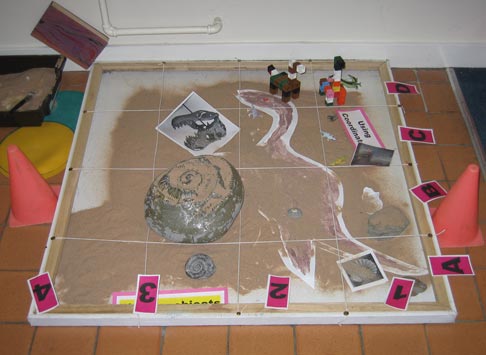
A dig site had been created in the classroom, with Miss Birkinshaw and the children providing fossils for the budding young palaeontologists to excavate.  A grid system had been overlaid and the children had been set a number challenges to identify and describe the objects located on various parts of the dig site.  This reflects what we actually do when it comes to mapping an actual fossil excavation.

Primary School Children Map Out Their Own Fossil Excavations
Palaeontology in schools

Palaeontology in schools – a wonderful exercise to help children learn more about fossils. Picture credit: Everything Dinosaur.

Picture credit: Everything Dinosaur

Some super ammonite fossils can be seen in the picture.

As part of the morning’s activities the children examined a variety of fossils including teeth from a giant prehistoric shark (O. megalodon) and with Harry’s help the size of the backbone of a Stegosaurus was compared to our own vertebrae.  Mrs Burr (Teaching Assistant) and Miss Burkinshaw were appointed team captains as one half of the class were given the task of casting a replica shark fossil tooth, whilst the other half were challenged with casting a dinosaur toe bone which had come from a huge and very old duck-billed dinosaur, a specimen of a dinosaur called Edmontosaurus.

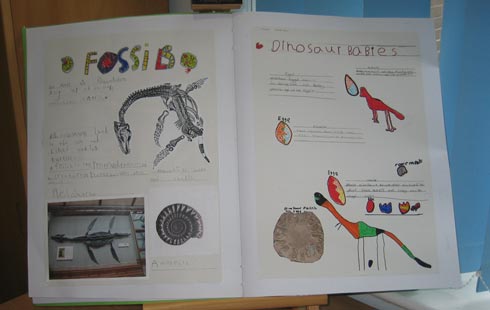
The children asked lots of questions and they learned some facts about Tyrannosaurus rex which meant that their poster display on the “King of the Tyrant Lizards” would have to be altered in the light of the information that they had been provided with.  Lots of artwork and creative writing was on display and in the corridor close to the school office there was was a display that had been populated by various dinosaur themed objects and a special workbook that showed some of the areas of study that the children had been looking at.

School Dinosaur Project Book on Display
Children write about fossils and fossil discoveries

Children write about fossils and fossil discoveries in a superbly illustrated book all about prehistoric animals. Picture credit: Everything Dinosaur.

Picture credit: Everything Dinosaur

On the left-hand side of the book shows pictures of plesiosaur fossils (a marine reptile), fortunately, our expert had a piece of a plesiosaur vertebrae on hand to show some of the children who had stayed behind during lunch to ask further questions.  Young Jack had brought in some of his own fossils.  His fossil collection proved very handy when Harriet exhibited the fossil model she had made out of clay.  Our expert was able to talk about the lines of symmetry in Harriet’s colourful model and then compare the clay fossil to a real “sand dollar” fossil in Jack’s fossil collection.

Comparing a Clay Model to a Fossil “Sand Dollar”

Sand dollar fossil compared to a clay model.

Sand dollar fossil compared to a clay model. Picture credit: Everything Dinosaur.

Picture credit: Everything Dinosaur

Models of Fossils

Harriet had done a wonderful job of making and painting her fossil.  The lines radiating out from the centre reminded our dinosaur expert of the fossilised calcite plates associated with a type of sea urchin (Echinoids – pronounced “eck-in-oids”), often referred to as a “sand dollar”.  “Sand dollars” fossils are relatively common, these animals are part of a group of sea creatures that originated around 480 million years ago (Ordovician), but most of the “sand dollar” fossils seen today are much more recent.  Still, Jack’s fossil could be over twenty million years old.

The rigid external skeleton of a “sand dollar” is called a “test”.  On the top surface, is a five pointed star-like structure, these are five paired rows of pores, like look a little like the petals on a flower.  These pores can seen on Jack’s fossil.  When the sea urchin was alive, tube feet projected through theses pores and these feet were multi-purpose, they helped the little animal to burrow into soft sediment,  to move about and they also helped the animal breathe and to gather food.

Sand Dollars

“Sand dollars” are around today and often tests are washed up onto the beaches of the Western United States.  These tests look like coins hence their common name, but they are also sometimes called “Mermaid coins”, in the past sailors used to believe that if they found one it would bring them good fortune on their next voyage.

Note for Harriet

Lots of different types of “sand dollar” sea urchins are alive today, and some are indeed coloured green and blue.

To conclude the visit, our dinosaur expert set the class a challenge.  The children could write a thank you letter but they must use capital letters and connectives correctly.  Perhaps they could write about their favourite dinosaur or indeed, include a special dinosaur fact in their letter.

We shall see what the budding young palaeontologists from Hoylandswaine Primary School come up with…

For further information on Everything Dinosaur’s range of toys, models and gifts: Dinosaur Toys, Gifts and Models.

21 03, 2014

Art and Science Combined in Dinosaur Study

By |2023-03-11T15:13:15+00:00March 21st, 2014|Categories: Key Stage 1/2|Comments Off on Art and Science Combined in Dinosaur Study

Key Stage 1 Pupils Show Off their Own Fossil Dig Site

Pupils at Hoylandswaine Primary School (Yorkshire), showed off their dinosaur and fossil knowledge this week during a dinosaur workshop in school organised by Everything Dinosaur.  Miss Birkinshaw, the class teacher (mixed Year 1 and Year 2 class), had been helping the children study prehistoric animals and famous fossil collectors like Mary Anning.  Our dinosaur expert showed the children the typical fossils that Mary found on the Dorset coast and explained where some of her fossils could be seen in museum collections.

Dinosaurs and Mary Anning

Food chains and food webs were explored and how fossils are formed were discussed. The school children had even created their own fossil dig site complete with a mapping grid.

Classroom Fossil Dig Site at Hoylandswaine Primary

Palaeontology in schools.

Palaeontology in schools. Picture credit: Everything Dinosaur.

Picture credit: Everything Dinosaur

Studying Palaeontology

The grid system permitted the teachers to set out a number of challenges to the class.  Could they identify the objects by grid reference?  More capable learners were challenged to create their own dig sites using graph paper and to plot their fossil discoveries.  The Everything Dinosaur export suggested this classroom exercise reflects what happens at real fossil sites when an important task of the field team is to map the site accurately.

Questions Associated with the Dig Site Activity

Children write about fossil discoveries.

Children write about fossils and fossil discoveries. Picture credit: Everything Dinosaur.

Picture credit: Everything Dinosaur

Dinosaur Workshop

The Everything Dinosaur team member suggested that this fossil dig site exercise could be extended by getting the children to create their own fossil grid “battleships game”.  Our dinosaur experts provide lots of extension ideas and activities and often are able to send over free downloadable resources to assist the teaching team.  The term topic of dinosaurs and fossils combined art skills as well as subjects from the science element of the curriculum very effectively.

Visit Everything Dinosaur’s award-winning website: Visit Everything Dinosaur.

19 03, 2014

Lovely Thank you letter from a School

By |2024-05-02T07:09:15+01:00March 19th, 2014|Categories: Educational Activities, Teaching|0 Comments

Primary Schoolchildren Write Thank you Letters to Everything Dinosaur

After a busy few weeks with Everything Dinosaur team members carrying out a lot of dinosaur workshops in schools, team members are busy preparing free downloads for the company’s new “dinosaurs for school” website.  As well as all this teaching activity we have also been keeping up with the huge volume of correspondence that we receive.  Amongst all the drawings, pictures, feedback forms, information requests and such like we get letters from schoolchildren who have been involved with our dinosaur teaching in schools.  One such letter was sent from Holly from Yorkshire, we were so impressed that we thought we would post Holly’s excellent letter on our blog site.

Everything Dinosaur

Holly Says Thank You to Everything Dinosaur

School children thank Everything Dinosau

Schoolchildren thank Everything Dinosaur after team members from the UK-based dinosaur company visited their school.

Picture credit: Everything Dinosaur/Holly

Thank You Letter

Naturally, our team members respond to all those letters, enquiries and contacts that require a reply.

We wrote to Holly saying:

“We are glad that you like dinosaurs and we were very impressed with your writing skills, your letter was very well laid out, the first word that you wrote started with a capital letter and you remembered to use full stops.  You also remembered to put your name on the letter at the bottom, well done Holly!”

We look forward to working with Holly and her classmates in the future and undertaking more dinosaur teaching in schools.

Visit Everything Dinosaur’s website to see the huge range of soft toys available: Prehistoric Plush – Dinosaur Soft Toys.

19 03, 2014

A Lovely and Thoughtful Thank You Letter (Primary School)

By |2024-05-02T10:10:25+01:00March 19th, 2014|Categories: Key Stage 1/2|Comments Off on A Lovely and Thoughtful Thank You Letter (Primary School)

Holly Says Thank You

With a busy few weeks behind us and even more dinosaur and fossil themed workshops planned for April, Everything Dinosaur’s team members are taking a welcome break in which to catch up with all their “dinosaurs for schools” correspondence.  With all the teaching work that we do it is inevitable that we get lots of letters, posters and drawings sent into our offices.  Often these items are part of extension activities designed to reinforce learning and demonstrate appropriate vocabulary.

Everything Dinosaur

Here is a letter from Holly (Key Stage 1) who, along with the rest of her class had written in to Everything Dinosaur to say thank you for our visit and to say how much she enjoyed working with us.

A Thank You Letter from Holly

Thank you letter received by Everything Dinosaur.

School children thank Everything Dinosaur after a school visit.

Picture credit: Holly (Key Stage 1)

Learning About Dinosaurs

Glad we were able to help out Holly, have fun learning all about dinosaurs, fossils and other prehistoric animals with your classmates.

A spokesperson from UK-based Everything Dinosaur commented that they were delighted to receive the letters from the Key Stage 1 children and that team members enjoyed reading them all.

To view the range of prehistoric animal toys and games in stock at Everything Dinosaur: Dinosaur Gifts and Toys.

17 03, 2014

Nursery School Children Build an Amazing Dinosaur

By |2024-05-02T10:10:56+01:00March 17th, 2014|Categories: Early Years Foundation Reception|Comments Off on Nursery School Children Build an Amazing Dinosaur

Early Years Learn All About Dinosaurs

When a team member from Everything Dinosaur visited a Yorkshire school, he got the chance to work with the teaching team over at the nursery. The enthusiastic nursery children loved showing our dinosaur expert their drawings and talking about their favourite dinosaur.  In return, we conducted a short workshop with the class all about how dinosaurs moved and what fossils feel like.  The children and the teaching team were so inspired by what they had done, that in the afternoon the children went into the playground and built their own dinosaur.

Everything Dinosaur

Nursery School Children Construct their own Dinosaur

Nursery school children construct a dinosaur in the playground.

Picture credit: Everything Dinosaur

Dinosaur

We had been working with Year 2 and Year 3 children but we were delighted to assist the EYFS teaching team and we were happy to provide lots of exciting extension activities and ideas for them to use with the nursery children.  The dinosaur topic worked well and it was great to see the sensory play area turned into a dinosaur theme park for the day.

To view the range of prehistoric animal themed items available from Everything Dinosaur: Dinosaur Gifts and Prehistoric Animal Toys.

17 03, 2014

Nursery School Children Construct a Unique Dinosaur

By |2024-05-02T10:11:22+01:00March 17th, 2014|Categories: Educational Activities, Teaching|0 Comments

Nursery Children Build their own Dinosaur

Whilst on a visit to teach about dinosaurs in school in Yorkshire, one of the Everything Dinosaur team members took a picture of a dinosaur that the nursery class had built as they too studied dinosaurs for the day.  As part of the dinosaur workshop, we were working with Year 2 and Year 3 children, but the nursery children also joined in the day of dinosaur themed activities with some colouring in of pictures of prehistoric animals and an exploration of dinosaurs using the sensory play area.

Dinosaur

Nursery School Children Build a Dinosaur

Nursery school children construct a dinosaur in the playground.

Nursery school children construct a dinosaur in the playground.

Picture credit: Everything Dinosaur

Using the tyres and building blocks from the outside play area along with some crates that the class had borrowed the children were able to build their very own dinosaur.  One of the little palaeontologists pointed out the yellow feet, whilst another explained that they had put building blocks on the tail just like the plates on a Stegosaurus.

The Everything Dinosaur team member was not quite sure what name the children had come up with, but one of the nursery school children said that their dinosaur was “definitely a plant-eater”.

We suggested that this dinosaur should be called “Nurseryosaurus”.

To read more about Everything Dinosaur’s huge range of dinosaur themed toys and games: Everything Dinosaur – Toys, Models and Gifts.

14 03, 2014

The Ultimate Beginners’ Guide to Dinosaurs

By |2023-03-11T14:33:59+00:00March 14th, 2014|Categories: Dinosaur Fans, Educational Activities, Teaching|0 Comments

 The Ultimate Beginners’ Guide to Dinosaurs – Kickstarter Campaign

Every once in a while, we at Everything Dinosaur come across a really good idea.  As dinosaur enthusiasts who spend a great deal of our time writing lesson plans for teachers working in Foundation stage and Key Stage 1, we are aware of the limited amount of really good, fact-based reading resources aimed at this particular age group.

Dinosaurs

Whilst working in schools we are all too frequently approached by a teacher or a member of the learning support team to ask our advice about how to motivate and help enthuse young children who love dinosaurs, but are not that keen on reading.  Talented writer Nicky Allison, might just have the answer…

London-based Nicky, has written seventeen books under the umbrella title of “The Ultimate Beginners’ Guide to Dinosaurs”, each book will be aimed at children from four years to seven years of age and combines a fascination for dinosaurs with a desire to help encourage and motivate children with their reading.   To get this exciting project up and running some more funding is required, and a “Kickstarter” campaign has been set up.

Nicky explains about the project and how the books have been designed with the needs of young readers in mind in a short video.

Video credit: Nicky Allison

Dinosaurs an Ultimate Guide

A spokes person from Everything Dinosaur commented:

“Children from four years of age, seem to act like sponges when it comes to absorbing information about prehistoric animals.  Books such as these tick all the right boxes when it comes to reflecting the national curriculum and they should provide a valuable resource for use in schools and for home educators.”

We wish Nicky well in her endeavours and we can’t wait to hear more about her ambitions to enthuse the next generation of palaeontologists.

Visit Everything Dinosaur’s award-winning website: Everything Dinosaur.

7 03, 2014

Young Dinosaur Fans Impress with their Dinosaur Knowledge

By |2023-03-11T11:56:08+00:00March 7th, 2014|Categories: Educational Activities, Teaching|0 Comments

Springbrook Pupils Discuss Dinosaurs

This morning a team member from Everything Dinosaur visited Springbrook Primary school and met some of the young dinosaur fans who had been learning all about dinosaurs and fossils with their teacher.  Together we looked at just how big some dinosaurs were and the rib bone that we showed the class reminded Liam of a “golf club”.  Abu and Ethan were very good at pronouncing the name of dinosaurs and Miss Foxcroft joined in too.

Young Dinosaur Fans

Luke remembered what needed to be done when it came to pouring the casting mixture into the moulds and he was able to guide his chums as they cast their replica fossil.  Kyle said that his favourite dinosaur was Tyrannosaurus rex and he explained that T. rex was a carnivore and that it ate other dinosaurs.  Kyle had even made a model of this fearsome meat-eater and our dinosaur expert took a picture of it.

Model of a Tyrannosaurus rex

Tyrannosaurus rex dinosaur model.

Tyrannosaurus rex dinosaur model.

Picture credit: Kyle/Everything Dinosaur

Kyle then went on to explain that although Tyrannosaurus rex had short arms they were very strong.

With the enthusiastic Miss Caines and Mrs Makin helping, one of the walls in the classroom had been decorated with a colourful T. rex and a brown painted Triceratops, lots of words had been stuck up onto the dinosaur scene so that the children could refer to the wall poster when writing about dinosaurs in their work books.  The wall poster is a great way to help with the teaching about dinosaurs in school.

Big Dinosaurs Feature on a Big Wall Poster in the Classroom

Colourful dinosaurs lurking behind a tree.

Colourful dinosaurs lurking behind a tree.

Picture credit: Abu, Ethan, Liam, Luke and Kyle

T. rex Teeth

Abu, Liam and Luke said that the teeth of T. rex were the size of a banana, what a wonderful description. Perhaps the teaching team could help the children measure some bananas so the fruit can be compared to a dinosaur’s tooth.

When it comes to measuring, the dinosaur footprint diagrams that Everything Dinosaur sent over as part of the follow up from the dinosaur workshop in the school, might help the children too.  They could measure the footprints and then compare the footprint’s made by a dinosaur to the size of their own feet.  Perhaps if the teaching team could find a tape measure, then maybe Ethan could measure around his chest to see if  his rib bones are bigger or smaller than the “golf club” shaped dinosaur rib bone he saw earlier.

To view the range of prehistoric animal toys and gifts available from Everything Dinosaur: Dinosaur Toys, Models and Gifts.

7 03, 2014

Students at Springbrook School Study Amazing Dinosaurs

By |2024-05-02T09:43:53+01:00March 7th, 2014|Categories: General Teaching|Comments Off on Students at Springbrook School Study Amazing Dinosaurs

Dinosaurs Help with Writing and Phonics

Class 5 at Springbrook Primary School in Lancashire were visited by Everything Dinosaur as the children had been studying dinosaurs and fossils with their teacher Miss Foxcroft.  We looked at how big some dinosaurs were and examined the rib bones from a dinosaur and compared them to our own ribs.  Kyle, Abu and Ethan helped make a cast of a dinosaur fossil which could be put on display in the classroom along with all the other fact sheets, posters and examples of creative writing that the children had produced.

Dinosaurs Help Schoolchildren

Luke and Liam enjoyed learning all about Tyrannosaurus rex and the keen dinosaur fans had even made a model of this famous Late Cretaceous dinosaur.

T. rex at Springbrook Primary School

T. rex model.

Tyrannosaurus rex dinosaur model.

Picture credit: Springbrook Primary/Everything Dinosaur

A spokesperson for the school stated:

“Class 5 are learning all about dinosaurs this term and they are very excited by this.  The children are working hard to develop their reading skills and they are making great progress with their phonics.”

Dinosaur Posters Helping with Phonics

Dinosaur posters spotted in school.

Colourful dinosaurs lurking behind a tree.

Picture credit: Springbrook Primary/Everything Dinosaur

Everything Dinosaur

A spokesperson from Everything Dinosaur explained:

“Springbrook School is a Special School for pupils with social, emotional and behavioural needs.  It was a pleasure seeing how enthusiastically the children got involved with the dinosaur themed workshop.”

To view the range of educational, dinosaur themed toys and gifts including replicas of iconic fossil animals available from Everything Dinosaur: Dinosaur Gifts, Games and Toys.

25 02, 2014

And the Earth Cooled According to New Research

By |2024-05-02T09:21:23+01:00February 25th, 2014|Categories: Key Stage 3/4|Comments Off on And the Earth Cooled According to New Research

New Study Suggests the Early Earth Cooled Much Earlier Than Previously Thought

Analysis of a microscopic fragment of the mineral zircon, part of a collection of minerals excavated from a remote outcrop of rock in Australia is helping scientists to understand how our planet became cooler and able to support simple chemistry that would ultimately lead to the evolution of life.  The research published this month, suggests that the Earth may have been able to support simple life forms about 4.4 billion years ago, less than 200 million years after the planet first formed.

The Age of Planet Earth

The research team, led by Professor John Valley from the University of Wisconsin-Madison) have produced evidence to suggest our planet was able to sustain life earlier than previously thought.  The solar system that contains our planet is believed to have formed around 4.56 billion years ago.  An enormous cloud of gas and dust (a solar nebula), formed after the extinction of a previous celestial body began to collapse in on itself under the influence of gravity.

The mass of dust and gas became flatter and formed a rapidly turning, spinning disc.

At the centre, it became extremely hot and the sun was formed.  Debris orbiting this embryonic sun began to separate out with the less dense elements moving to the outer rings.  The inner rings formed the rocky planets, the outer rings formed the gas giant planets like Saturn, Jupiter and the “ice giants” Uranus and Neptune.  Remaining debris formed the asteroid belt between Mars and Jupiter as well as a number of other satellites and mini planets (Pluto).

Working with previous lead isotope analysis and data that proved the zircons extracted from rocky exposures in Western Australia’s Jack Hills region were the most ancient parts of the Earth’s crust, the zircon used in this new study has been confirmed as the oldest known material of any kind known on Earth.

Placing the Zircon Mineral within the Concept of Deep Time

4.4 billion-year-old zircon crystals provide evidence of Earth cooling.

Picture credit: Andree Valley

The Earth Cooled

Commenting on the significance of this new zircon study, Professor Valley explained:

“This strengthens the theory of a cool early Earth, where temperatures were low enough for liquid water, oceans and a hydrosphere to form not long after the planet’s crust congealed from a sea of molten rock  This study reinforces our conclusion that Earth had a hydrosphere before 4.3 billion years ago and possibly life not long after.”

New Method of Study

A brand new method was used in the study and analysis of the zircon sample.  This new technique is called atom-probe tomography and when this method is used in conjunction with ion mass spectrometry it gives scientists the opportunity to establish with astonishing accuracy the age and thermal history of the material.

The mass of individual lead atoms was calculated and analysis of these “clusters” of lead atoms suggests that these groups of lead formed around one billion years after the zircon first formed.  Using measurements of radioactive decay the team established the history of the zircon through deep time, calculating that the age of the mineral studied.

Go to Top