Our thanks to Dionne in Year 5 who sent Everything Dinosaur a lovely thank you letter accompanied by a dinosaur drawing after we visited her school recently. Dionne wrote to say that “today was extraordinary” and she really enjoyed holding all the fossils.
Drawing and Thank You Letter Received by Everything Dinosaur
Dinosaur letter and drawing sent in by Dionne in Year 5.
Everything Dinosaur had been invited into Dionne’s school to work with the class of Year 5 children for a morning delivering a dinosaur workshop in school. One of a number of extension activities that arose over the course of the morning was to have the children write thank you letters to us. We duly received an amazing bundle of letters from the children, lots of them had dinosaur drawings too.
Our thanks to all the children who sent letters into our offices, we have enjoyed reading them and we have even posted up some of the pictures on the wall of our warehouse.
By Mike|2024-05-10T06:58:39+01:00December 6th, 2017|Categories: General Teaching|Comments Off on A Beautiful Plesiosaur Picture
Plesiosaurus Picture
Our thanks to the young marine reptile fan who sent us a lovely thank you letter with a picture of a plesiosaur (Elasmosaurus). Everything Dinosaur had recently a school to spend a morning with the Year 5 children as the class was learning all about fossils and life in the past.
Plesiosaur Drawing
Thanks and Here is a Picture of a Plesiosaur (Elasmosaurus)
Reece and his Elasmosaur drawing. Our thanks to Reece for his plesiosaur drawing.
During the dinosaur workshop, we discussed the work of Mary Anning and we examined some of the fossils similar to those found by Mary on the beaches of Dorset. Mary Anning famously discovered marine reptile fossils. She did much to help Georgian and later, Victorian academics to understand the anatomy of these long extinct creatures.
By Mike|2023-08-25T14:03:14+01:00November 20th, 2017|Categories: Early Years Foundation Reception|Comments Off on Developing Fine Motor Skills in Your Child
Helping to Develop Fine Motor Skills in Young Children
One of our Everything Dinosaur teaching team members was asked the other day by an anxious mother of a three-year-old about the best way to develop fine motor skills in her child. Fine motor control is certainly a key skill that will stand your child in good stead when it comes to school, especially when you consider the dexterity required to hold a writing implement and to form letters. However, the use of pens and pencils are not necessarily required to help your child develop fine motor control.
As a child explores everyday objects and learns about their properties, then motor control will be improved. Simply playing with small objects or even rolling out modelling clay will help your child gain confidence and improve their dexterity.
Fine Motor Skills Are an Essential Key Life Skill
Long-necked dinosaur by a Reception-aged child.
Picture credit: Everything Dinosaur
Fine Motor Skills Defined
Fine motor skills or fine motor control as it is sometimes referred to as, involves a coordinated and confident use of small muscles to enable delicate tasks to be completed successfully. Developing the ability to manipulate and control small objects with the fingers and thumb will be vital as the child begins the process of learning to write. Motor skills develop over time and effective motor control will help the child with numerous activities, not just those involving academic achievement but tasks that help the child gain more independence and self-confidence, tasks such as dressing and feeding oneself.
Parents wanting to help their toddler with their fine motor control, such as the mother of the three-year-old, can simply encourage the child through creative play at home. Activities in which the child has to manipulate small objects are very useful, forming letters using modelling clay, playing with small building bricks, tracing shapes in a sand tray, all these activities can help a child build strength in their fingers and dexterity.
Playing with Plastic Dinosaurs Can Help Build Fine Motor Skills
The PNSO Domingo the Carnotaurus and A-Shu dinosaur models. Playing with dinosaur models can help develop fine motor skills.
Picture credit: Everything Dinosaur
The two theropod dinosaur figures shown above come from the PNSO model range.
Everything Dinosaur and Developing Fine Motor Skills
Everything Dinosaur’s set of plastic dinosaur skeletons make a great set of resources to help develop fine motor skills. Our skeleton set features twelve different prehistoric animal models and these little plastic dinosaurs have been used in all sorts of activities to help encourage fine motor control. From making casts in modelling clay to pretending to excavate a fossil in the sand pit, these sturdy figures are great for imaginative, creative play and just the right size for little hands to manipulate.
To view the skeleton set and the extensive range of learning orientated dinosaur-themed resources available: Everything Dinosaur.
Points to Remember – Top Tips
When it comes to handwriting, some children are going to be able to develop the appropriate skill set more quickly than others, but don’t worry – practice makes perfect. Children develop at different rates, one sibling may develop more quickly than another. Many children will need to work on their fine motor skills for some time in order to build up the strength and coordination required to tackle writing. Parents, guardians and grandparents can assist in his process by encouraging the child through creative, imaginative play with small objects that require manipulation.
By Mike|2024-05-10T09:55:31+01:00November 16th, 2017|Categories: General Teaching, Key Stage 1/2|Comments Off on Special Workshop Inspires a Special Dinosaur Poster
Dinosaur Poster Created After Dinosaur Workshop
Our thanks to the pupils in Year 5 and Year 6 at Streethouse Primary (West Yorkshire), who sent into Everything Dinosaur’s office a wonderful set of posters and thank you letters after our recent dinosaur and fossil workshop at the school. There were some wonderful examples of cursive hand-writing amongst the letters and some stencil inspired prehistoric animal drawings.
Year 5 and Year 6 Pupils Inspired by Dinosaur Workshop
Everything Dinosaur was invited into the school to work with the Key Stage 2 class for a morning. The workshop provided a provocation for the term topic and during the morning, we challenged the children to have a go at a variety of extension activities. It seems that our workshop was a great success, earning 5* stars from the teaching team and a comment on the poster, says it all, “it was awesome!” The prehistoric animal stencils have helped produce a variety of posters and some stencils were even used to illustrate the thank you letters we received.
Examples of Posters and Letters Sent into Everything Dinosaur
A collection of correspondence from Year 5/6 pupils.
Picture credit: Streethouse Primary School
The photograph above shows just some of the fantastic collection of letters and posters created by pupils in Year 5/6.
We are glad to have helped inspire the children and we wish them and their dedicated teachers every success with the term topic.
Visit the award-winning and user-friendly Everything Dinosaur website: Everything Dinosaur.
Our thanks to the Year 5/6 class at Streethouse Junior, Infants and Nursery School (West Yorkshire), for sending in some super dinosaur letters and some amazingly colourful prehistoric animal posters. We set this Key Stage 2 class a series of extension exercises (hope the children have enjoyed researching the Coelacanth), one of the extensions involved writing a thank you letter and sending them into our office. We have received a collection of wonderful dinosaur-themed correspondence.
Dinosaur Letters Sent by Schoolchildren
A collection of correspondence from Year 5/6 pupils.
Picture credit: Streethouse Junior, Infants and Nursery School
Answering Questions About Dinosaurs
Violet wanted to know if we could name a dinosaur, what would we call it? That is a very good question, given that Violet lives in Yorkshire and that numerous dinosaur fossils have been found in that part of the world, if we were lucky enough to find a new dinosaur in northern England, we might have to name it “Yorkshiresaurus”.
Violet’s Letter
A thank you letter from Violet.
Picture credit: Streethouse Junior, Infants and Nursery School
Jack explained in his letter that Tyrannosaurus rex could have been a hunter as well as a scavenger. Kelsey asked if drift wood was a fossil? Drift wood that you find on the beach is not a fossil, but if it gets buried in the sand then it can be fossilised. At Everything Dinosaur, we have lots of fossils of plants and trees, the oldest of which are around 360 million years old. Laura wrote to say that she enjoyed holding the fossils and learning about bones.
Archie’s Very Colourful Prehistoric Animal Drawings
We received lots of colourful dinosaurs from Year 5/6.
Picture credit: Streethouse Junior, Infants and Nursery School
Dinosaur Letters
Kai wanted to know what was the fiercest dinosaur? That, is quite a difficult question to answer. The meat-eating dinosaurs belong to a group called the Theropoda, the big carnivores were very dangerous, but some of the smaller, carnivorous dinosaurs, if they were around today, would probably have wanted to add Year 5/6 pupils to their diet.
Perhaps the children can look up dinosaurs such as Saurornitholestes and Atrociraptor and produce a poster with lots of dinosaur facts. Our thanks to Kaya for including a picture of a marine reptile in the thank you letter that we received. Charlie sent us a beautiful spotted long-necked dinosaur and described the morning of activities as “awesome”, whilst Cameron enjoyed learning about Megalodon and Evie wanted us to come back and visit the class again.
Tyler and His Thank You Letter
Stegosaurus featured in a number of the children’s letters.
Picture credit: Streethouse Junior, Infants and Nursery School
Amazing Posters and Letters Sent in by Year 5/6
Amazing dinosaur posters from Year 5/6.
Picture credit: Streethouse Junior, Infants and Nursery School
What is our Favourite Dinosaur?
A number of the children asked what was our favourite dinosaur? We have been recently working on a really odd dinosaur called Sciurumimus, which means “squirrel mimic” as when this dinosaur was young, it had a bushy tail just like a squirrel.
Great Writing from the Children Including this Example from Jayden
A thank you letter from Jayden.
Picture credit: Streethouse Junior, Infants and Nursery School
Picture credit: Streethouse Junior, Infants and Nursery School
“Dinosaur Mike” who had visited the school to conduct the morning workshop with the class, commented:
“I want to say a big thank you to all the children in Year 5/6 at Streethouse Primary. My colleagues and I enjoyed looking at the posters and reading the letters that were sent in. Some wonderful hand-writing and great grammar. Congratulations to you all!”
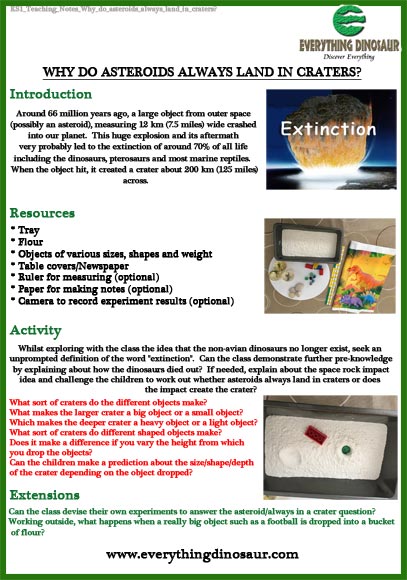
Why Do Asteroids Always Land in Craters? A Lesson Plan
Team members at Everything Dinosaur have been busy preparing another lesson plan idea linked to the concept of “working scientifically” when it comes to delivering teaching outcomes related to the science elements of the national curriculum for England. The lesson is aimed at both Key Stage 1 and Key Stage 2 students and asks the question “Why do asteroids always land in craters”?
The Lesson Plan with Teaching Notes for Key Stage 1
PDF download of teaching notes/lesson plan is available from Everything Dinosaur.
Picture credit: Everything Dinosaur
Linking to the Dinosaur Extinction Event as well as Space Modules
The dinosaur extinction is linked to a large impact event, in this lesson plan our aim is to encourage the children to work scientifically, experience and observe phenomena, devise and complete simple comparative tests, communicate ideas, observe closely and to use simple equipment to find answers. This lesson plan relates to both the “dinosaurs” and the “space” term topic. It should also help young minds to explore everyday materials and describe the simple physical properties of those materials.
One of the factors involved in the extinction event at the end of the Age of Dinosaurs involved an extra-terrestrial object crashing into our planet, so teachers can tie in extinction and the causes of extinction to an extension activity involving the class having to work scientifically to explore what happens when objects fall to Earth.
Two types of lesson plans have been developed, the lesson plan with accompanying teaching notes aimed at Upper Key Stage 2 deals with issues such as animals and their habitats, natural selection, evolution and introduces the idea of the force of gravity.
Essentially, to test this idea of asteroids always landing in craters, the children would have to develop an experiment whereby they drop objects into a substrate and record what happens.
Suggested Resources to be Used to Test the Hypothesis
Resources suggested for the “why do asteroids always land in craters?” A lesson plan.
Picture credit: Everything Dinosaur
Suggested Resources for the Key Stage 1 Lesson Plan
Here is a list of typical resources suggested to test the idea of asteroids always landing in craters with a Key Stage 1 class. Essentially, the children need to consider a suitable substrate and to test what happens when objects are dropped into the substrate.
* Tray * Flour or sand (substrate) * Objects of various sizes, shapes and weight * Table covers/newspaper * Ruler for measuring (optional) * Paper for making notes (optional) * Camera to record experiment results (optional)
Whilst exploring with the class the idea that the non-avian dinosaurs no longer exist, seek an unprompted definition of the word “extinction”. Can the class demonstrate further pre-knowledge by explaining about how the dinosaurs died out? If needed, explain about the space rock impact idea and challenge the children to work out whether asteroids always land in craters or does the impact create the crater?
Can the Children Create Simple Comparative Tests?
Different objects landing in flour, modelling asteroid impacts.
What sort of craters do the different objects make? What makes the larger crater a big object or a small object? Which makes the deeper crater a heavy object or a light object? What sort of craters do different shaped objects make? Does it make a difference if you vary the height from which you drop the objects? Can the children make a prediction about the size/shape/depth of the crater depending on the object dropped?
In addition, the Key Stage 2 lesson plan and teaching notes asks the class to devise their own experiments to answer the asteroid/always in a crater question.
As a “wow” moment to conclude the lesson plan, try this idea. Working outside, what happens when a really big object such as a football is dropped into a bucket of flour? The spraying of flour should provide a suitable memorable moment to help the class remember the key learning points from this simple experiment.
For further advice and ideas about science teaching in school, simply email our team members at Everything Dinosaur: Email Everything Dinosaur.
By Mike|2024-05-10T09:58:19+01:00November 9th, 2017|Categories: Key Stage 1/2|Comments Off on Streethouse School – Dinosaurs and a Special Workshop
Barbara Hepworth Class Study Dinosaurs and Fossils
Children in Barbara Hepworth class (Year 5/6), at Streethouse Junior, Infant and Nursery have been studying dinosaurs, fossils and prehistoric animals this term. As well as a challenging and enriching scheme of work built around English, maths and science, the teaching team have been inspired by Dame Hepworth and introduced a dinosaur sculpting challenge for the children.
Barbara Hepworth was a celebrated English, 20th century, artist and sculptress who was one of the leading lights of modernism. I am sure Dame Hepworth would have been most impressed with the clay models that the children produced.
Our dinosaur and fossil expert, who had visited the school to deliver a morning of teaching activities with the class, was given a guided tour of the clay model exhibits. The budding artists were keen to demonstrate their knowledge by explaining what inspired them when it came to prehistoric animal model making. The clay models make a fine display amongst all the excellent examples of handwriting that were pinned up onto the spacious classroom walls.
Barbara Hepworth Class (Year 5/6) Focus on Dinosaurs
Another busy week at Everything Dinosaur, with several school visits and projects successfully completed. Take for example, a recent visit to Year 5/6 at Streethouse Primary in Yorkshire, to provide a provocation for this Key Stage 2 class as they begin their dinosaur and fossil themed topic. The varied and enriched scheme of work devised by the enthusiastic teaching team will run until the end of this term and Everything Dinosaur was invited to the school to provide a morning of dinosaur and fossil themed activities for the class.
The walls of the tidy and well-organised classroom already featured a number of dinosaur and prehistoric animal themed displays.
Posting Up Information About Life in the Past (Upper Key Stage 2)
Year 5/6 at Streethouse Primary are in Barbara Hepworth class, we are confident that this English 20th century sculptress would be most impressed with the clay prehistoric animal models the children had created. One of the benefits of a dinosaur themed topic is that it lends itself to all sorts of cross-curricular activities, the children eagerly discussed their models and there were certainly some skilfully crafted replicas on display, even winged dinosaurs!
Barbara Hepworth Class Produce Prehistoric Animal Clay Models
Year 5/6 children make clay model dinosaurs.
Picture credit: Everything Dinosaur
Answering Questions About Dinosaurs
Prior to the workshop, the children had prepared several questions about prehistoric animals, some of these questions along with answers researched by the children had been posted up around the classroom. The Everything Dinosaur workshop leader incorporated a number of questions into the morning of activities helping to support the children’s learning.
Year 5/6 Compile Questions About Life in the Past
How did birds evolve if the dinosaurs all got wiped out?
Picture credit: Everything Dinosaur
The above question links in nicely to some of the science curriculum areas associated with Year 6, fortunately, our dinosaur expert had brought plenty of resources with him to help the class explore in a little more detail the evolutionary relationship between avian and non-avian dinosaurs (birds and dinosaurs).
Why Does Tyrannosaurus rex Have Tiny Arms?
Another question, this time, raised by the class teacher, asked why does T. rex have tiny arms compared to the rest of its body? That’s a very challenging question, that ironically had just been covered in a recent presentation delivered to the annual conference of the Geological Society of America. A cast of a T. rex manual ungual (claw bone) came in handy to help explain that this latest theory suggests that the short arms of Tyrannosaurus rex were very effective weapons for slashing prey at close quarters.
Why does T. rex have tiny arms compared to the rest of his body?
All to soon, our morning of dinosaur and fossil themed activities came to an end. However, there was still time to set a couple of extension exercises for the class and to admire the partially complete “Jurassic landscape” that the children had been making. The class will be using ModRoc (plaster of Paris modelling materials), to create a prehistoric scene, all helping to reinforce learning about animals and their habitats. We use similar materials when protecting fossils in the field prior to their full removal. We look forward to seeing the finished dinosaur diorama.
Barbara Hepworth Class are Creating a Prehistoric Landscape
Making a prehistoric landscape.
Picture credit: Everything Dinosaur
To the conclude the morning, the children sang a song all about being a palaeontologist, they even managed to pronounce the word “Pachycephalosaurus” correctly – well done to all!
By Mike|2024-05-10T06:54:29+01:00November 6th, 2017|Categories: General Teaching, Key Stage 1/2|Comments Off on Why Do Asteroids Always Land in Craters? That’s a Great Question!
Why Do Asteroids Always Land in Craters?
With the need to work scientifically being emphasised in the national curriculum for England (science syllabus), Everything Dinosaur team members have been busy supporting teaching teams with their schemes of work. As well as providing all the usual assistance and support, staff at the Cheshire based company have just introduced a new pair of primary school lesson plan downloads to help support a dinosaur or space themed term topic. The lesson plan is entitled “Why do asteroids always land in craters?” The aim of this lesson plan is to challenge the Key Stage 1 children to create an experiment to test ideas about what happens when a space rock crashes.
Why Do Asteroids Always Land in Craters?
Resources suggested for the “why do asteroids always land in craters?” A lesson plan.
Picture credit: Everything Dinosaur
A Simple Experiment to Encourage Working Scientifically
Two downloads have been created, one aimed at KS1, the second targeted at KS2. Both these lesson plans challenge children to work scientifically. For example, the Key Stage 1 download focuses on exploring the physical properties of materials and encourages the use of simple, comparative tests, whilst the Key Stage 2 download challenges older children to devise a suitable experiment to test this idea about asteroid impacts. A list of suggested resources is provided in both downloads and the photographs and bullet points provided help with tailoring the exercise to meet the specific learning needs of the class.
Free Download Linked to Space and Dinosaur Term Topics
PDF download of teaching notes/lesson plan is available from Everything Dinosaur.
Picture credit: Everything Dinosaur
Teaching Notes and Extension Activities
The downloads are available free from Everything Dinosaur. These downloads are amongst a huge range of free dinosaur, fossil and prehistoric themed teaching resources available. All these materials have been checked, tested and approved by our own teaching team.
The “why do asteroids…” lesson plan includes helpful teaching notes with suggestions as to how to deliver this exercise. In addition, a series of extension ideas are listed, all designed to help teaching professionals differentiate and challenge more capable learners.
It seems when it comes to exploring how the dinosaurs died out, or learning about outer space, these handy downloads from Everything Dinosaur are going to have a big impact”.
Year 1 Learn About Dinosaurs, Fossils and Mary Anning
It was a busy morning for the Year 1 children in Squirrels and Hedgehogs classes at Stanwell Fields C of E Primary as they explored dinosaurs and fossils as part of a term topic all about prehistoric animals and life in the past. The dedicated and enthusiastic teaching team had put together a challenging and varied scheme of work and a visit from Everything Dinosaur was included to provide a provocation and help kick-start the learning by having a special “wow day” for the children.
The classes had covered simple food webs in a previous topic and the teachers and the Learning Support Assistants were keen to reinforce learning about the differences between carnivores, herbivores and omnivores. In the colourful classroom, a three-dimensional dinosaur had been made, providing an appropriate centrepiece for the children’s work as they explored “Planet Dinosaur”.
A Carnivorous Dinosaur on Display
A three-dimensional dinosaur on display in the Year 1 classroom.
Picture credit: Year 1 Stanwell Fields C of E Primary and Everything Dinosaur
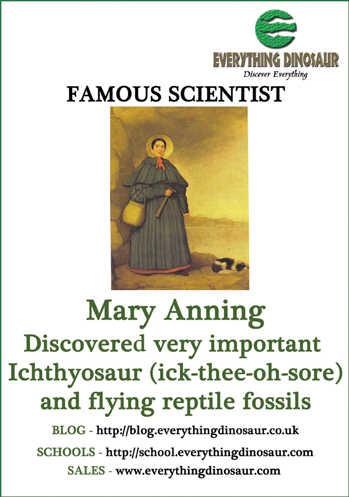
Within the history area of the national curriculum, (programmes of study for Key Stages 1 and 2), pupils are encouraged to learn about the lives of significant individuals in the past who have contributed to national and international achievements. Mary Anning, provides a very good role model, especially for girls, when it comes to learning about pioneering fossil hunters. The story of Mary Anning and the “sea shells on the sea shore”, provides lots of cross-curricular links and one of the teaching team at Stanwell Fields C of E Primary, even dressed up as Mary Anning at the start of the term topic.
During our workshop, we discussed this famous Dorset fossil hunter and the children were keen to demonstrate their knowledge. The various fossils we spotted in the rocks and minerals box in the well-maintained and orderly resources room will provide extra stimulus for the eager young palaeontologists. The Everything Dinosaur team member supplied lots of additional learning materials and we have produced a number of lesson plans and data sheets for teachers that feature Mary Anning.
Famous Fossil Hunter Mary Anning
Helping Year 4 to learn all about scientists. Picture credit: Everything Dinosaur.
Picture credit: Everything Dinosaur
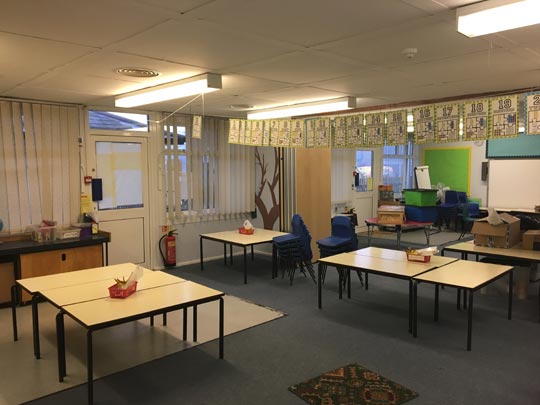
With the school hall occupied, the dinosaurs and fossils were confined to a classroom for the duration of the morning. However, with the partition doors open, there was plenty of space and this gave our team member the opportunity to admire the various displays on the walls and hanging from the ceiling. The well-appointed and tidy classroom was a credit to the school.
Ready to Start Moving Tables Prior to the Dinosaur and Fossil Workshop
Spacious classroom being made ready for a dinosaur workshop. Picture credit: Everything Dinosaur.
Picture credit: Year 1 Stanwell Fields C of E Primary and Everything Dinosaur
Synonyms and Antonyms
As part of the children’s vocabulary development, the teaching staff had been covering the use of synonyms (words that have the same meaning) and antonyms (words that have the opposite meaning). When it came to challenging the children to describe the ammonite fossils, our workshop leader encouraged the children to provide a synonym for the word “big”. There were lots of suggestions, “huge”, “massive” and “gigantic” being readily offered up by the eager, young palaeontologists.
All too soon, the morning of activities with the two classes had to be concluded as it was time for lunch. However, once the tables had been put back in their place there was still time to hear about the lesson plan for the afternoon that had been prepared – making salt dough fossils. Our dinosaur expert suggested that the children could roll up the dough creating spirals and make their own ammonites.
One thing is for sure, the children in Year 1 at Stanwell Fields C of E Primary have an exciting and enriching term topic to look forward to completing.