All about dinosaurs, fossils and prehistoric animals by Everything Dinosaur team members.

Everything Dinosaur’s press releases and other information.

22 08, 2011

Evolution of the Biggest Mouths in the Natural World

By |2023-01-20T17:34:31+00:00August 22nd, 2011|Categories: Main Page, Palaeontological articles, Press Releases|0 Comments

Tiny Whale Fossil Indicates Evolution of Baleen Whales from Toothed Cetaceans

The Baleen Whales, huge creatures such as the Blue Whale (Balaenoptera musculus) and the Grey Whale (Eschrichtius robustus) feed by gulping in huge amounts of water, and straining out small sea creatures such as krill through their plates of bristle-like baleen that hang from the upper jaws.  However, these leviathans may have evolved from huge marine predators that specialised in eating much larger prey.

Museum Victoria palaeontologist Dr Erich Fitzgerald has made ground-breaking discoveries on the evolution of the world’s largest whales, the Baleen Whales, based on 25 million-year-old fossil jaws found near Torquay in Victoria (Australia).

The Evolution of Baleen Whales

Published today in the Royal Society’s journal Biology Letters, this important discovery challenges earlier scientific notions by suggesting that  Baleen Whales (e.g. Blue Whales), which feed on small organisms, first evolved their huge mouths for capturing large individual prey animals.

The new fossil evidence comes in the form of the lower jaw bones of Janjucetus,  (Janjucetus hunderi) a 3-metre-long early relative of today’s toothless baleen whales.

Dr Fitzgerald commented:

“Janjucetus had tightly connected lower jaws and lacked the elastic lower jaw joint that makes it possible for the mouths of modern Baleen Whales to greatly expand and swallow vast volumes of plankton-rich seawater.  What this amounts to is vivid evidence that Janjucetus and the earliest baleen whales could not filter feed.”

Dr Fitzgerald’s research challenges the belief that the earliest Baleen Whales had the same jaw structure as their modern day relatives.  The newly uncovered fossils suggest that early Baleen Whales had bizarrely shaped skulls structured for sucking prey into their mouths.

Whale Fossils

Dr Erich Fitzgerald cradles the fossil jaws of the tiny extinct whale (Janjucetus hunderi).  With a total body length of only three metres, this Oligocene marine mammal would have been dwarfed by its present day relative, the Blue Whale, a skeleton of which looms in the background.

Dr Fitzgerald added:

“Their skull, mouth and lips may have acted like vacuum cleaners, hoovering up larger animals, like fishes or octopuses.”

Although this fossil discovery shows Janjucetus had a rigid lower jaw joint, their upper jaws were expansive – a key feature of all Baleen Whales.

According to Dr Fitzgerald:

“The characteristic large mouth of today’s Baleen Whales is first seen in the upper jaws of non-filter feeding early species, suggesting that the wide upper jaws originally evolved as a specialisation for suction feeding.”

Although the steps by which Baleen Whales evolved from suction feeders into filter feeders remains unclear, this research demonstrates the first evolutionary step towards what are now the biggest mouths in the history of life on Earth.

Janjucetus hunderi

Images released show Janjucetus hunderi attacking a school of fish in the seas off the coast of south-east of Australia, twenty-five million years ago.

Describing just how big the mouth of a  Blue Whale (Balaenoptera musculus) is, Dr Fitzgerald stated:

“When fully expanded, a blue whale’s mouth could park a Kombi van.”

Janjucetus hunderi lived about 25 million years ago in coastal seas off south-east Australia.  The fossil jaws of Janjucetus were found near the Victorian township of Torquay in the 1970s by a dedicated amateur palaeontologist. Little had been established about the whale remains until Dr Erich Fitzgerald started his long-term research on the fossils in 2009.

Dr Fitzgerald is a palaeontologist specialising in the evolution of marine mammals.  He held a Post-doctoral Fellowship at the Smithsonian Institution and is currently the Harold Mitchell Fellow at Museum Victoria.  Erich also holds an honorary appointment at the Smithsonian Institution in Washington, DC.  This research is a result of two years of study at Museum Victoria and the Smithsonian Institution.

Museum Victoria houses the largest collection of fossil marine mammals in Australia and hosts the country’s only whale evolution research program. The paper published in the scientific journal “Biology Letters” is entitled “Archaeocete-like jaws in a Baleen Whale.”

Everything Dinosaur is grateful to Melbourne Museum and Museum Victoria for their help in the compilation of this article.

Some Toothed Whales were Giant Apex Predators (Livyatan)

PNSO Requena the Livyatan model

PNSO Requena the Livyatan prehistoric whale model anterior view.

The picture (above), shows the PNSO Requena the Livyatan model. To view the prehistoric animals in the PNSO model range: PNSO Prehistoric Figures and Replicas.

5 08, 2011

The Exclusive Everything Dinosaur Blog – The Story Continues

By |2024-04-22T11:58:39+01:00August 5th, 2011|Categories: Main Page, Press Releases|0 Comments

Everything Dinosaur Blog to be Transferred to New Platform

Having written an article, put up a picture, posted information and such like everyday since late May 2007, the Everything Dinosaur blog consists of nearly 1,500 articles and our readership grows from strength to strength (big thank you to all our readers).  However, we are planning changes to the blog, its format and layout which will be taking effect within the next ten weeks.  The platform on which the blog is currently being hosted – Blogware provided by Tucows is being closed on October 3rd this year and we are already planning to migrate the blog to another platform – WordPress.

Everything Dinosaur Blog

When the move happens, readers will notice a new format and one or two other changes but in essence the blog will remain the same with all the articles, pictures and such like transferred over.  According to the notes that we have on the transfer process, it is relatively straight forward, after all, every blog on the Tucows platform will have to migrate.  We will lose the identifiers on the comments made on the blog, they will all become anonymous, our apologies for this but there is nothing we can do it, just one of the drawbacks of the transfer process that we have to contend with.

Anyway, here’s to a different, updated blog in the very near future.

For fans of dinosaur and prehistoric animal toys, clothing and models, take a look at Everything Dinosaur’s user-friendly website: Prehistoric Animal Toys and Dinosaur Themed Clothing.

3 08, 2011

In Praise of the Marvellous Amebelodon

By |2024-04-22T12:19:27+01:00August 3rd, 2011|Categories: Dinosaur Fans, Everything Dinosaur News and Updates, Main Page, Press Releases|0 Comments

A Pleasure to see Prehistoric Animal Models

These days with a number of model retirements from the mainstream manufacturers it is always a pleasure to recall that Safari of the United States, although having cut down on their Prehistoric Life range still market a Gomphotheres, a beautiful model of an ancient, prehistoric elephant known as Amebelodon.

Amebelodon

Amebelodon was a Perissodactyl (odd-toed hoofed mammal) and a primitive member of the Gomphotheres, a group of elephant-like animals that originated in Africa but spread worldwide during the early Cenozoic.  These animals are distantly related to the modern African and Asian elephant.  The model from Safari, we think represents and American member of this diverse group (Amebelodon fricki).  This particular family member was named and described by the eminent American palaeontologist and geologist Erwin Hinckly Barbour in 1927, following the discovery of a mandible with tusks and skull material in the U.S. state of Nebraska.

The species name honours Childs Frick, a trustee of the American Museum of Natural History.  Hard to imagine Childs Frick thinking about this animal being represented as a prehistoric animal model.

The Safari Prehistoric Life Amebelodon Model

Safari Prehistoric Life models. Amebelodon.

Amebelodon prehistoric elephant model.

Picture credit: Everything Dinosaur

To see the Carnegie models on offer from Everything Dinosaur and other dinosaur toys: Safari Ltd Prehistoric Mammals Models and Figures.

This Amebelodon model is typical of the quality from Safari, it is very well made and accurately painted from the tip of its shovel-like tusks (after which this animal was named) to the black tufts of hair at the end of its tail.  It is always a pleasure to see models of some of the more unusual prehistoric animals remaining in manufacture.  How long the Amebelodon remains around is open to question, let’s hope it is a while before Safari Ltd make this particular prehistoric mammal model extinct after all, it is a fine example of the company’s Wild Safari Dinos models.

2 08, 2011

Back to School with Everything Dinosaur

By |2023-01-20T13:37:36+00:00August 2nd, 2011|Categories: Dinosaur Fans, Everything Dinosaur News and Updates, Main Page, Press Releases|0 Comments

Great Dinosaur Themed Back to School Items from Everything Dinosaur

The summer holidays seem to have hardly got started but no doubt the thoughts of parents will be turning to September and the time when the children have to go back to school.  Kit out your young palaeontologists in these fantastic dinosaur themed school items – everything from lunchboxes, and backpacks to pencils – Everything Dinosaur has getting back to school covered.

Everything Dinosaur

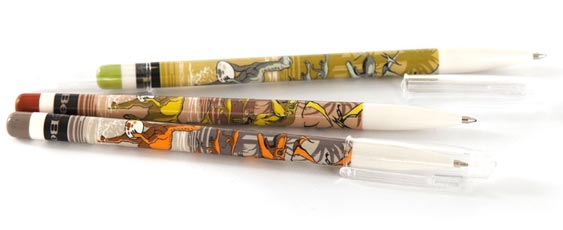
Whether you are looking an eraser with a picture of a dinosaur on it (to make your mistakes extinct), or pens and pencils so young dinosaur hunters can jot down their discoveries Everything Dinosaur is the place to go to find back to school prehistoric animal themed school sets and stationery.

Everything Dinosaur: Dinosaur Craft Ideas and Learning.

See the keen, eager dinosaur fans swish their tails in excitement with this extensive range of back to school accessories.  We even supply a matching lunch box and stainless steel drinks bottle – just like what we use when we go digging up dinosaurs.

The Young Palaeontologists Drinks Bottle

Picture credit: Everything Dinosaur

There are school kits, dinosaur stationery sets, soft and cuddly back packs, pencil cases, key rings, notebooks, notepads and a whole range of other items, a list as long as a sauropod’s neck – plenty to choose from enough to make even the most reluctant school pupil roar in approval like a T. rex.

Back to School with Everything Dinosaur

Dinosaur pens. Picture credit: Everything Dinosaur.

Picture credit: Everything Dinosaur

25 06, 2011

Everything Dinosaur Helps Out Open University

By |2023-01-19T15:30:04+00:00June 25th, 2011|Categories: Everything Dinosaur News and Updates, Main Page, Press Releases|0 Comments

Discover a New Age of Learning with the Open University

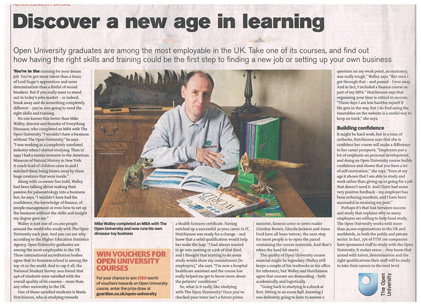
At Everything Dinosaur, we take very seriously our Open University (OU) studies, over the years a number of team members have taken courses with the OU and without the business qualifications team members have gained through their OU studies, we would not have the business we have today.  Recently, Everything Dinosaur was contacted by the Open University with a request to help them promote their work as part of a national advertising campaign for the university.

Everything Dinosaur

Having the right skills and training has never been so important, the jobs market is increasingly difficult and being able to offer an existing employer or indeed a potential employer the right skill set can help you to retain employment or indeed, move up the career ladder.  The very fact that you commit to a rigorous and demanding Open University course is proof of your willingness to work hard and to learn new skills.

Everything Dinosaur Featured in the Guardian Newspaper

Picture permission:  OU/Guardian

OU courses are hard work, but the standard of teaching and learning materials is extremely high and our team members have found their studies immensely rewarding and helpful in their business careers.

Visit Everything Dinosaur’s award-winning website: Everything Dinosaur.

24 06, 2011

Walking with Beasts Unleashed in Coventry

By |2023-01-19T15:27:57+00:00June 24th, 2011|Categories: Dinosaur Fans, Everything Dinosaur News and Updates, Main Page, Press Releases|1 Comment

Award Winning Coventry Museum gets “Beastly” for the Summer

Coventry’s Herbert Art Gallery and Museum is taking visitors back in time to meet huge prehistoric beasts such as Woolly Mammoths and fierce Sabre-toothed cats as the BBC “Walking with Beasts” exhibition takes up residence for the Summer.

So its back to the Ice Age and beyond at this award winning Coventry venue with the exhibition running from July 2nd to the 30th October giving visitors to chance to go on a prehistoric safari to meet some of the fearsome animals that our ancestors had to contend with.  It is hard to imagine  when looking at the huge, gaping jaws of a Smilodon or the immense bulk of an Coelodonta (that’s a Woolly Rhino), that these types of creature roamed around the east midlands – so if you fancy meeting some of Coventry’s earliest inhabitants – now’s your chance!

This family friendly exhibition includes original scale models and the life-size polyurethane heads of the prehistoric animals featured in the six part BBC documentary, as well as full-sized replicas of some of the most amazing creatures to ever walk the planet.  There are real fossils to see, plus the chance to get involved in touch screen interactive activities to build your own digital fossils, learn about animal camouflage and to get to grips with the topic of climate change.

Everything Dinosaur team members have had the opportunity to work with these exhibits on a number of occasions, look out for the Neanderthals – a species of human that we shared planet Earth with until about 28,000 years ago and don’t forget to try out the blue screen area, it’s great fun seeing the young, enthusiastic palaeontologists of the future putting themselves in the picture amongst all these amazing prehistoric mammals.

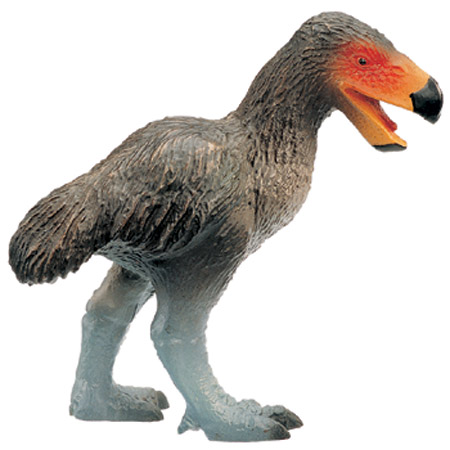
Our feathered friends get in on the act as well, it is not just the mammals that diversified after the demise of the dinosaurs.  For a time, giant birds as tall as a man and with vicious, hatchet shaped jaws ruled the world.  Visitors to the Herbert Art Gallery and Museum will get the chance to meet them – that’s if you are feeling brave enough to go eyeball to eyeball with a “Terror Bird” (phorusrhacids) – we promise you will never look at garden birds in the same way again.

Look out for the “Terror Birds” but Don’t get too Close to their Talons

Watch out for the talons.

Picture credit: Everything Dinosaur

The picture (above), shows a typical “Terror Bird” from the Cenozoic, these animals were fast enough and strong enough to catch and eat horses. This figure was part of the Bullyland range.

To view the Bullyland range of prehistoric animal models: Bullyland Prehistoric Animal Models.

This astounding exhibition lifts the lid on the technology behind the series and examines these fantastic creatures and the times in which they lived.

Exhibition Officer Dominic Bubb commented about the exhibition stating:

“As a museum we obviously showcase history but Walking with Beasts brings a whole new level to discovering the past.  With our natural history collections visitors have always had the chance explore the natural world, but now they get to see so much more thanks to this incredible exhibition.”

To learn more about the exhibition and the other exciting events taking place at the Herbert Art Gallery and Museum over the next few months: Herbert Art Gallery and Museum.

A spokesperson for Everything Dinosaur stated:

“Walking with Beasts at the Herbert Art Gallery and Museum provides visitors with a unique opportunity to learn about prehistoric animals and so gain an insight into how these creatures were brought back live and kicking onto our television screens.”

Tickets to the exhibition are £4.95 for adults, £3.95 for children over 5, FREE for under 5s and £14.00 for a family ticket that gives entry to either 1 adult and 3 children or 2 adults and 2 children. Concessions are available, for more information and to book tickets online visit the Herbert Art Gallery and Museum website.

22 06, 2011

T. rex Roamed in Packs – Fact or Fiction? It is a Great Question!

By |2024-04-19T06:16:22+01:00June 22nd, 2011|Categories: Dinosaur and Prehistoric Animal News Stories, Dinosaur Fans, Main Page, Press Releases|4 Comments

Did Tyrannosaurus rex Live in Packs?

One of the most intriguing questions about tyrannosaurs has raised its head again.  Did these large theropods such as Tyrannosaurus rex roam the Cretaceous in packs or were they solitary hunters?  That is the question that is being tackled in a new Discovery Channel documentary being shown next Sunday evening.  It is also the topic under discussion in a live web chat with Dr Phil Currie, a famous Canadian palaeontologist, who is taking a break from his research at the Dept. of Biological Sciences at the University of Alberta to talk about the study of dinosaur bone bed evidence discovered in Mongolia.

Tyrannosaurus rex

On Sunday (26th June), The Discovery Channel UK broadcasts an exciting new documentary called “Dino Gangs” which reveals new evidence from Dr Phillip J Currie which suggests that Tyrannosaurus rex and other tyrannosaurs were not dull witted, solitary creatures but in fact deadly pack hunters.  Behaviour is an aspect of animal activity that is hard to decipher from the fossil record, but Professor Currie and his fellow researchers first postulated that tyrannosaurs may have been pack animals after the discovery of fossils of a relative of T. rex called Albertosaurus.  Several individual Albertosaurus fossil remains were found together in the same bone bed – was this evidence of a pack of these meat-eating hunters dying together?  The argument over whether tyrannosaurids were pack animals living and hunting together has raged in palaeontological circles for many years, now the Discovery Channel is showing a documentary that brings together the latest findings, one T. rex on its own would have been formidable, but a pack of these 14 metre long giants, would have been truly awesome.

Today (Wednesday, 22nd June 2011) at 1pm (UK, BST), there will be a live web chat with Dr Currie where he will talk in-depth about his findings with Discovery viewers and Dinosaur enthusiasts.  Dr Currie will also be joined by two, well respected and expert Dinosaur bloggers, Brian Switek (the WIRED Science blog Laelaps, The Guardian, The Times) and David Orr (Love in the Time of Chasmosaurs).  We at Everything Dinosaur, know these two bloggers well and we are sure it is going to be a fascinating web cast.

The chat should be particularly eye-opening as it will not only reveal more about Dr Currie’s discoveries in Mongolia but also debate whether his findings are fact, or fiction.  If tyrannosaurs lived in packs, this has implications for their hunting behaviour, breeding activity and social interaction.  For example, if these dinosaurs were pack animals would there be a dominant breeding pair and the pack made up of different genders as with packs of wolves, or perhaps sub-adult, immature males roamed around in groups to protect themselves from attacks from the larger females.

A Model of a Tyrannosaurus rex

Rebor Kiss Mountain Tyrannosaurus rex model

A dinosaur model with lips. The new for 2022 Rebor T. rex Kiss Mountain model in 1:35 scale. A wonderful model of a Tyrannosaurus rex. Picture credit: Everything Dinosaur.

Picture credit: Everything Dinosaur

The picture (above) shows a Tyrannosaurus rex model in the Rebor range. To view the range of dinosaurs and prehistoric animals from Rebor: Rebor Prehistoric Animal Models.

Dino Gangs – The Evidence

Dr Philip J Currie, Professor and Canada Research Chair in Dinosaur Palaeobiology in the Department of Biological Sciences at the University of Alberta, has long believed that tyannosaurids were co-operative pack animals, and he now has further evidence to support the theory.   As a world-renowned palaeontologist who has been part of a five-year dig in the Gobi Desert (Mongolia), he believes that new evidence is set to prove his controversial theory that tyrannosaurid dinosaurs lived and worked in gangs.

Ever since they were discovered, humanity has thought of tyrannosaurids as the most ferocious predators ever to walk the Earth. They’re the one group of dinosaurs that everyone knows, with the most famous, Tyrannosaurus rex, being one of the few species familiar in popular culture by its scientific name.

Philip Currie’s theory is ground-breaking because tyrannosaurids have long been perceived as rather stupid solitary creatures.  For years, scientists concluded that they were solitary because their skeletons were found alone.  Dr Currie is convinced that tyrannosaurids were more intelligent than previously imagined – and as complex pack animals who lived and hunted in gangs, far more dangerous predators than we thought.

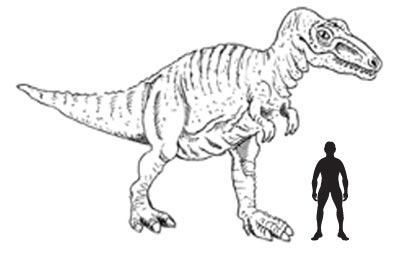
The Korea-Mongolia International Dinosaur Project has visited ninety sites where skeletons of Tarbosaurus bataar, a dinosaur related to T. rex, were found. Tarbosaurus bataar was an enormous predator – up to 12 metres long, 3 metres tall, and thought to weigh in at 5 tonnes.  While it is unlikely that all the animals lived together all year, Dr Currie believes that half a dozen of the dinosaurs, including both adult and juvenile specimens, were part of a single social group that died together.  The Korea-Mongolia International Dinosaur Project was a five-year expedition, carrying out fieldwork at Bugin Tsav and other sites in the Gobi Desert from 2006 to 2010.

An Illustration of T. bataar (Alarming Reptile)

Picture credit: Everything Dinosaur

The idea that some carnivorous dinosaurs were pack hunters is ground-breaking because it is generally thought that pack hunting evolved with the rise of mammals, as it was thought that only mammals were capable of forming the social bonds required to live in a pack.  However, many scientists do believe that some types of dinosaurs lived in herds, the sauropods for example.  So why not meat-eaters such as dromaeosaurids and tyrannosaurids living in packs?

About a dozen near complete specimens of the fast running, theropod Deinonychus (D. antirrhopus) have been discovered, including remains of Deinonychus individuals next to a Tenontosaurus (a large, herbivorous dinosaur), a rare example of predator and prey being found together.  Did these meat-eaters get killed as a pack of them mobbed the larger Tenontosaurus?  This raises some fascinating questions with regards to the behaviour of carnivorous dinosaurs.

Dinosaurs and other animals are seldom given credit for having enough intelligence to be capable of the co-operative behaviour found in many mammals. This new research, based on the finds in the Gobi Desert and elsewhere, demonstrates that tyrannosaurids had the build and speed for pack hunting, the highly developed senses to be effective predators, and the brain capacity for co-operative behaviour.  There is now compelling evidence to support the theory that millions of years before mammals evolved to become organised hunters, tyrannosaurids may have been working together and hunting in teams – a very frightening prospect for any unwary herbivore around at the end of the Cretaceous.

A team of internationally renowned palaeontologists will take part in a live webchat at 1pm BST today, this is a great opportunity to get involved in some new dinosaur research and to hear about some work on T. rex that has not been published in any scientific journals yet.

21 06, 2011

Winner of the Beacon Museum’s Dino Draw Competition Announced

By |2023-01-19T12:09:19+00:00June 21st, 2011|Categories: Dinosaur Fans, Everything Dinosaur News and Updates, Main Page, Press Releases|4 Comments

Beacon Museum Announces the Winner of their Dinosaur Competition

The dinosaurs and other prehistoric animals from the award winning television documentary “Walking with Dinosaurs” have taken up residence at the Beacon Museum at Whitehaven.  This exciting exhibition is open throughout the summer and is already wowing dinosaur fans, old and young alike.

As part of the promotional activities surrounding this dinosaur themed tourist attraction, those clever people at the Beacon organised a dinosaur drawing competition, Cumbria’s very own “Dino Draw”, a chance for young people to get creative and to come up with their very own dinosaur design.

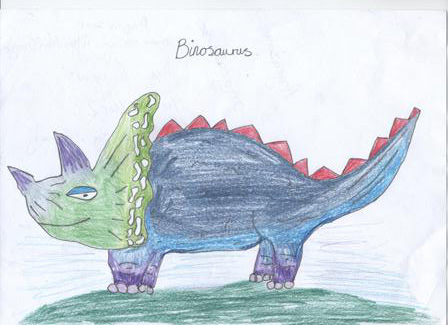
The winner has just been announced and it is Kian Hilton, aged six of Lowca Community School.  Kian’s picture appears on a banner outside Beacon Museum and also in the market place in Whitehaven’s town centre.  Lucky Kian also wins a free trip for his class to the BBC Walking with Dinosaurs Exhibition, a chance to get up close to the likes of Triceratops, Diplodocus and of course, the fearsome Tyrannosaurus rex.

Kian’s Winning Entry

Picture Courtesy of The Beacon Museum

Kian’s drawing of a “Binosaurus” is certainly very colourful.  We at Everything Dinosaur are most impressed by his efforts, we love the enigmatic smile, perhaps not quite the way a palaeontologist would depict a dinosaur but the light coloured underside contrasting with the dark body colour, the blue flash over the eyes and the bright red dermal armour running along the back does make quite a lot of sense from a palaeontological perspective.

Well done Kian, a worthy winner – have a great day at the Beacon Museum with your class mates.

For further information about the Walking with Dinosaurs Exhibition visit the Beacon Museum’s website.

For dinosaur toys and games visit: Everything Dinosaur.

16 06, 2011

Important Advice Provided as Industrial Action Hits Canadian Mail

By |2024-04-19T06:17:32+01:00June 16th, 2011|Categories: Everything Dinosaur News and Updates, Main Page, Press Releases|0 Comments

Strikes Halt Mail to and from Canada

The Canadian Union of Postal Workers has been carrying out industrial action across some parts of the Canadian postal network.  As a result, UK Royal Mail has decided not to despatch parcels destined to Canada via Airmail and Surface mail, these will lead to delays in the post.  In addition, as the strike action has been going on since June 10th, no mail is being despatched from Canada  bound for the UK and elsewhere overseas.  No mail handled by Canada Post bound for the UK will be sent out at present.  Everything Dinosaur team members are doing their best to make other arrangements for Canadian customers.

Everything Dinosaur

Royal Mail has stopped accepting mail for Canada with immediate effect, customers are advised that Royal Mail is not able to accept any mail for Canada and there may be delays if they are waiting for mail from Canada to arrive.  International Parcel Force operations are not affected at this time and this service can still be used.  Check the Everything Dinosaur blog for further updates.

For updates and further information about how Everything Dinosaur is coping with this issue: Email Everything Dinosaur.

22 05, 2011

Everything Dinosaur Notches up An Amazing 350 Online Reviews

By |2024-04-13T08:49:28+01:00May 22nd, 2011|Categories: Everything Dinosaur News and Updates, Main Page, Press Releases|0 Comments

Everything Dinosaur’s 350th Product Review

With its 5 star reviews on Google’s shopping network, the team members at Everything Dinosaur,  must be doing something right when it comes to customer service.  In recognition of the company’s excellent service record the 350th customer comment has just been put up on the company’s dinosaur toy website: Everything Dinosaur.

Customers are encouraged to leave product reviews, comments and feedback about the company’s service.  The dedicated staff take great care to deal with all the product enquiries and provide advice on anything and everything to do with dinosaurs.  The support and care shown has led to a total of 350 reviews being put online by customers who feel satisfied enough with the way Everything Dinosaur has looked after them to put their views up for public viewing.

Everything Dinosaur

All this has been achieved in little over twelve months, since the review and feedback module went live on the Everything Dinosaur website.  A special thanks to everyone who has posted up Everything Dinosaur customer reviews.

Examples, of some of the now hundreds of reviews include:

Angie: posted up with regards to a bendable Diplodocus soft toy purchased at Everything Dinosaur:

“I WAS AMAZED AT THE SERVICE, SPEED AND EFFICIENCY OF THIS COMPANY,  PRODUCT EXCEEDED  EXPECTATIONS  FABULOUS.”

Here’s one from Steven, the first one we received after Christmas, he is referring to the Safari Feathered Dinosaur tube of models that we sell:

Steven: “This is a lovely set, covering a wide range of raptors & therezinosaurs, however, confused as to why there is an apatosaurus, either way though, my 4 yo loved the variety and has played with them daily since Christmas.”

Here is one of the first reviews we logged under our new review system, it is from a J. Shebden:

“Great choice of products, thought your delivery time was excellent – really fast.”

A spokesperson for Everything Dinosaur commented:

“It is always a pleasure to hear from our customers and we genuinely try our very best to find top quality products that represent good value for money and then we do all we can to pack and despatch them as fast as we can – it is this attention to detail that helps our company stand out”.

Although, only a recent convert to Facebook the company has already attracted 155 “likes” on the firm’s website wall on this medium.  With the staff continuing to work as hard as they can to keep dinosaur fans and enthusiasts happy it is likely that many more “likes” and favourable reviews will come their way.

The Everything Dinosaur Logo

Everything Dinosaur

Everything Dinosaur logo.

Picture credit: Everything Dinosaur

Our thanks to all those people who have taken the time and trouble to contact us, to put product reviews online and such like – we are eternally grateful.

Go to Top