All about dinosaurs, fossils and prehistoric animals by Everything Dinosaur team members.

Pictures of fossils, fossil hunting trips, fossil sites and photographs relating to fossil hunting and fossil finds.

7 10, 2016

Graduate Student Unlocks the Secrets of Sea Turtle Evolution

By |2023-07-22T07:44:50+01:00October 7th, 2016|Categories: Dinosaur and Prehistoric Animal News Stories, Main Page, Photos/Pictures of Fossils|0 Comments

Ctenochelys acris Comes Out of its Shell

Palaeontologists have long puzzled over the origins of today’s extant species of sea turtle.  Thanks to the efforts of a post-doctoral student at the University of Alabama (Birmingham, Alabama, USA), scientists have been able to confirm the existence of a marine adapted turtle representing the oldest known member of the lineage that gave rise to modern sea turtles.

In a paper published in the academic publication “The Journal of Systematic Palaeontology”, lead author Drew Gentry, has been able to identify several 80-million-year-old fossils as Ctenochelys (tee-no-key-lees) acris, thus helping to piece together the evolutionary history of sea turtles.

For models and replicas of sea monsters and marine reptiles: PNSO Prehistoric Animal Models.

Sea Turtle Evolution

Researchers from the College of Arts and Sciences’ Department of Biology worked with two relatively complete turtle skeletons, along with several smaller pieces, that are housed at Birmingham’s McWane Science Centre, the study confirms the existence of Ctenochelys acris, previously known only from a few isolated fragments.

A Scale Drawing of Ctenochelys acris Showing Some of the Fossils Used in the Research

Scale drawing of Ctenochelys.

A silhouette showing the proposed outline of Ctenochelys with a frogman providing scale.

Picture credit: University of Alabama

The McWane fossils help solve a long-standing debate as to whether this animal was a unique species.

They also provide insights into the evolutionary history of living species of sea turtles, animals such as the Ridley, the Leatherback, the Green and the Loggerhead, all of which are, sadly, classified as vulnerable or endangered or critically endangered according to the IUCN Red List of Threatened Species.

Alabama During the Late Cretaceous

The area of the south-western United States was covered by a shallow, tropical sea for much of the Late Cretaceous.  The fossils ascribed to C. acris have been excavated from marine strata dated to around 80 million years ago (Campanian faunal stage), a time when sea levels were much higher than today and the Western Interior Seaway covered most of the United States.  During this time sea turtle diversity was very high and lead researcher on the project Drew Gentry explained:

“Climatic warming during the mid-Cretaceous resulted in elevated sea levels and temperatures that, in turn, provided an abundance of new niches for marine turtles to invade.  Represented today by only seven living species, sea turtles were once one of the most diverse lineages of marine reptiles.  Before the cataclysm that claimed the dinosaurs, there may have been dozens of specialised species of sea turtle living in different oceanic habitats around the world.”

A Diagram Showing North America Approximately 75 million years ago

The Western Interior Seaway.

A map showing the Western Interior Seaway of North America circa 75 mya.

Picture credit: Everything Dinosaur

Not Sure of the Validity of Ctenochelys acris

Prior to the assessment of the McWane fossil specimens, palaeontologists were unsure as to the validity of Ctenochelys acris.  Not only do the newly discovered fossils prove C. acris existed, they may also be a critical piece in a much larger puzzle of sea turtle evolution.

Drew Gentry added:

“There is strong evidence which indicates freshwater turtles may have evolved to occupy marine environments at several points in the past.  But most of those lineages went extinct, making the exact origins of living or ‘true’ sea turtles somewhat of a mystery.”

The study suggests that the earliest ancestors of today’s sea turtles may have originated from waters covering the south-western United States.  By comparing the skeleton of C. acris with those of both extinct and living species of turtles, Gentry discovered that C. acris possessed traits of both sea turtles and their closest living turtle relatives, snapping turtles.

A Bottom-dwelling Turtle

“This animal was a bottom-dwelling sea turtle that fed primarily on molluscs and small invertebrates.  Unlike the ‘rudder-like’ hind-limbs of today’s sea turtles, C. acris had large, powerful hind-limbs to help push it through the water, a lot like a modern-day snapping turtle.”

Scientists are hopeful that by learning more about the origins of sea turtles, this may lead to better protection for those species still found today.  Studying the diversity and evolutionary history of marine turtles during previous periods of climate change can provide meaningful insights into what effects climate and environmental changes might have on modern marine turtle populations.

The fossils that led to this research were discovered in 1986 and contributed to what was then the Red Mountain Museum.  The McWane Science Centre was founded in 1998 by the merger of the Red Mountain Museum and a nearby children’s museum, Discovery Place.

The palaeontological and archaeological collection at McWane is one of the largest in the south-eastern United States and houses a number of significant finds from across Alabama, including the recently announced Eotrachodon, a type of duck-billed dinosaur.

To read an article about Alabama’s very own duck-billed dinosaur: Duck-billed Dinosaurs – Sweet Home Alabama!

Everything Dinosaur acknowledges the assistance of the University of Alabama in the compilation of this article.

Visit Everything Dinosaur’s website: Everything Dinosaur.
21 09, 2016

A Photograph of a Remarkable Trilobite Fossil

By |2024-05-06T08:58:22+01:00September 21st, 2016|Categories: Main Page, Photos/Pictures of Fossils, Teaching|0 Comments

A Trilobite Fossil

We were contacted by a teacher to help explain how trilobite fossils formed, how old they were and what trilobites actually looked like.  We were happy to email over a fact sheet all about the Trilobita and to send over some pictures of trilobite reconstructions along with some photographs of fossils.

A Trilobite Fossil

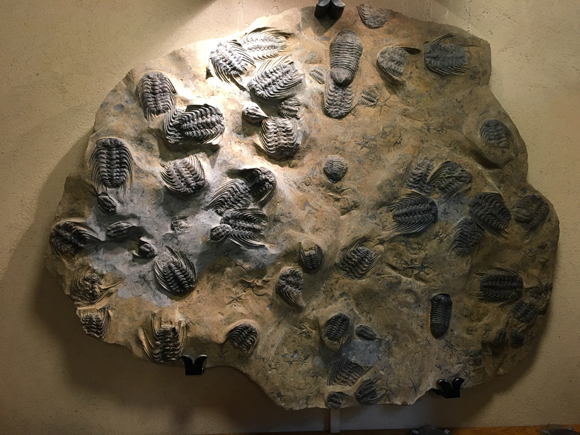
A Photograph of Trilobite Fossils

Trilobite fossils - the Selenopeltis slab.

Trilobites galore – the Selenopeltis slab.

We received a lovely email in return thanking us for providing such a lot of useful teaching material and for being so responsive.  The picture (above) shows an assemblage of fossil trilobites. At least three species are preserved in the specimen. The fossils are on display at the Oxford University Museum of Natural History.  The photograph was taken by an Everything Dinosaur team member.

Visit Everything Dinosaur’s website: Everything Dinosaur.
Trilobites

As trilobites shed their exoskeletons in order to grow (moulting), most trilobite fossils are actually shed shells, rather than the corpses of dead animals.  Whatever the species, we are always keen to see pictures of trilobites and we were happy to help out the teacher.

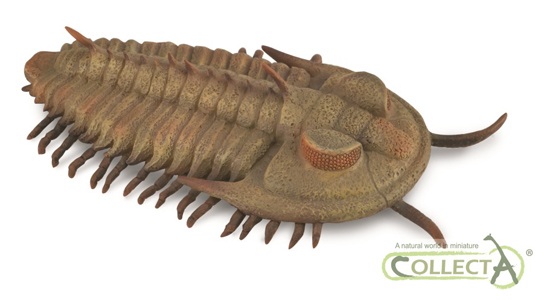
A CollectA Prehistoric Life Trilobite Model (Other Prehistoric Animals)

CollectA Redlichia rex trilobite. "First Life"

CollectA Redlichia rex trilobite model.

To view the CollectA trilobite and other prehistoric animal figures and models: CollectA Other Prehistoric Animal Models.

19 09, 2016

The Food Chains of Messel Explored in New Study

By |2024-05-06T08:57:23+01:00September 19th, 2016|Categories: Dinosaur and Prehistoric Animal News Stories, Main Page, Photos/Pictures of Fossils|0 Comments

Fossil Preserves Snake ate Lizard, Lizard ate Beetle

Scientists from the Senckenberg Museum of Natural History have published a paper on a spectacular fossil from the famous Messel oil shales that shows evidence of a food chain preserved from the Eocene.  A fossil snake contains the preserved remains of its last meal, a lizard inside its stomach, astonishingly the exquisite fossil has also preserved evidence of the unfortunate lizard’s last supper too – a beetle.  The discovery of a tripartite fossil food chain is unique for this UNESCO World Heritage site and the only other tripartite food chain known in the fossil record dates from the Early Permian*, coincidentally, it also was found in Germany.

Who’s Eating Who?  Remarkable Three Party Trophic Chain (Food Web)

The Messel Tripartite Food Chain fossil.

The snake fossil which contains a lizard fossil which contains a fossilised beetle.

Picture credit: Dr. Krister Smith (Senckenberg Museum of Natural History)

A Remarkable Fossil Specimen

Scientists from the Senckenberg Museum of Natural History in collaboration with colleagues from Argentina were able to study this “Russian Doll” of a fossil, that dates from around 48 million years ago and gain new information about the diets of these ancient creatures.  For example, the twenty-centimetre-long lizard, identified as Geiseltaliellus maarius, is only known from the Messel shales.  Specimens found to date with preserved stomach contents, only had plant remains within the body cavity, this new research indicates that G. maarius was not entirely herbivorous, insects such as beetles were also on the menu.

Commenting on the study, published in the Museum’s scientific journal, Doctor Krister Smith, one of the authors of the paper stated:

“In the year 2009, we were able to recover a plate from the pit that shows an almost fully preserved snake. As if this was not enough, we discovered a fossilised lizard inside the snake, which in turn contained a fossilised beetle in its innards!”

A Magnified View of the Snake Gut with Line Drawings Indicating the Presence of Other Fossil Specimens

Tripartite food chain in Messel fossil.

The orange represents the lizard fossil, the blue the beetle remains.

Picture credit: Dr. Krister Smith (Senckenberg Museum of Natural History)

The picture above shows the bones of the snake outlined with the lizard shown in orange (skull to the left of the picture), the blue shape in the lizard gut indicates the fossilised remains of the lizard’s last meal- a small beetle.  Unfortunately, the scientists were not able to identify the beetle genus.  The way in which the lizard remains were overlapped by the ribs of the snake prove that the body of the little reptile was definitely inside the snake when the snake, identified as a type of early constrictor (Palaeopython fischeri), met its own demise.

Visit Everything Dinosaur’s website: Everything Dinosaur.

There was an Old Lady who Swallowed a Fly…

This beautifully preserved fossil specimen reminds team members at Everything Dinosaur of the song “there was an old lady who swallowed a fly”.  For the scientists, the Palaeopython specimen provides a new insight into the feeding habits of these Eocene snakes.

The snake fossil measures around 89 centimetres in length, but adult Palaeopythons exceeded two metres in size and they were amongst the largest terrestrial predators known from the Messel shale biota.  Just like modern constrictors and pythons, the authors suggest that the diet of these snakes changed as the animals got bigger.  The juvenile Palaeopython represented here (specimen number SMF ME 11332), may have fed on small rodents and lizards, whilst the adult snakes may have taken larger vertebrates such as young Propalaeotherium (an ancestral horse).

Based on an assessment of the degree of preservation of the lizard’s remains when compared to digestive speeds in extant snakes, the researchers conclude that the snake died within 48-hours of consuming the lizard.  That’s a remarkable insight considering the age of the fossil itself (approximately 48 million-years-old).

The scientific paper: “Fossil Snake Preserving Three Trophic Levels and Evidence for an Ontogenetic Dietary Shift”.

Early Permian Trophic Chains

* The first direct evidence of a three-level vertebrate trophic chain was published in the “Proceedings of the Royal Society Biology” in January 2008.  The fossilised remains of a species of Xenacanthiformes freshwater shark (Triodus sessilis) contained the remains of two ancient amphibians (Archegosaurus decheni and Cheliderpeton latirostre) preserved within its gut.  The C. latirostre specimen contained the remains of a small fish, inside its digestive tract.  The small fish was identified as a juvenile Acanthodes bronni.

Xenacanthiform (T. sessilis) with Ingested Prey Items

Xenacanthiform ate amphibians which ate fish.

Three trophic levels in Early Permian fossil.

Picture credit: Proceedings of the Royal Society Biology

Fossil Secrets of a Siderite Concretion

The picture above shows the siderite concretion that preserves the remains of the freshwater shark and evidence of a three-level food chain from the Early Permian of south-western Germany.  Below the fossil specimen photograph is a line drawing that highlights the material representing the shark as well as the fossils of two ingested temnospondyl larvae.  One of the amphibian fossils contains the preserved remains of its last meal, a small fish (acanthodian).

Illustrating an Early Permian Food Chain

Fish east amphibians which ate fish.

Xenacanthiform eats amphibians which in turn consumed fish.

Picture credit: Proceedings of the Royal Society Biology

The illustration above depicts the three level trophic food chain.  Its a question of fish eats amphibian which ate fish!

For models and replicas of Permian creatures as wall as prehistoric animals from the Eocene Epoch: CollectA Age of Dinosaurs Popular Models.

19 08, 2016

Rare T. rex Skull Goes on Display

By |2024-05-06T08:41:28+01:00August 19th, 2016|Categories: Dinosaur and Prehistoric Animal News Stories, Dinosaur Fans, Main Page, Photos/Pictures of Fossils|0 Comments

Burke Museum Hopes T. rex Skull Gives New Museum a “Head Start”

The partially prepared, jacketed skull of an adult Tyrannosaurus rex which wandered the plains of Montana some 66.3 million years ago has gone on public display at the Burke Museum (Seattle, Washington State).  One of only fifteen T. rex skulls known, the Hell Creek Formation specimen is described as “pristine” and is part of the fossilised remains of an individual animal, representing some 20% of the entire skeleton which was discovered on Bureau of Land Management land by two Burke Museum volunteers – Jason Love and Luke Tufts.  As a result, this Tyrannosaurus rex has been nicknamed “Tufts-Love Rex”.

Tyrannosaurus rex Fossils

The Burke Museum Will Erect A Fantastic T. rex Exhibit

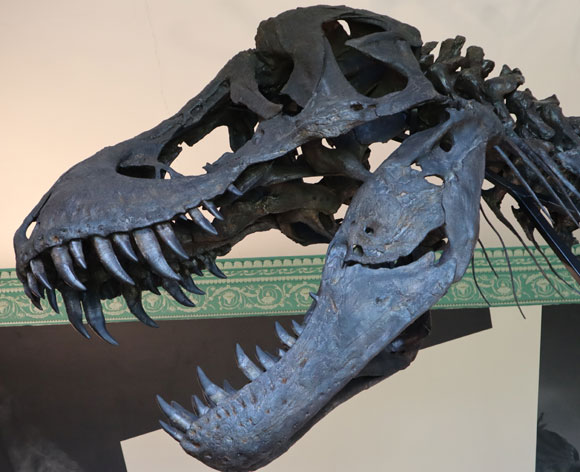
Titus the T. rex Skull and Jaws. Dinosaur extinction.

The skull of the T. rex exhibit on display at Wollaton Hall until August 2022.  The Burke Museum hopes to exhibit a T. rex skull.

Picture credit: Everything Dinosaur

The Fossil Find of a Lifetime

The volunteers were exploring a sandstone ridge in northern Montana when they spotted several fragments of bone on the surface.  They followed the trail of tiny fossil bones until they came across a partly exposed vertebrae.  The size of the fossils and their honeycomb texture indicated to Jason and Luke that they had found the remains of a theropod dinosaur.  The pair alerted their colleagues and what could be the most important excavation in the Museum’s one hundred and seventeen year history, began.

Some twenty tonnes of rock has had to be removed to expose the disarticulated skeleton.  So far, teeth, ribs, vertebrae and that beautifully preserved skull have been identified.  The skull was removed in a single block, which in itself weighed more than a tonne.  A local farmer was called in to help provide the lifting gear to remove the plaster jacketed fossil.  The skull has gone on display at the Burke Museum and it is hoped that the Tyrannosaurus rex specimen will form the centrepiece of a new dinosaur exhibit when the refurbished museum fully opens in 2019.

For scale models of Tyrannosaurus rex and other prehistoric animals: CollectA Deluxe Scale Models of Prehistoric Animals.

Tyrannosaurus rex on Display

Titus the T.rex exhibit. A T. rex skeleton on display.

The spectacular Titus the T. rex exhibit at Wollaton Hall.

Picture credit: Everything Dinosaur

A Partially Prepared Skull

For the time being, visitors will have to content themselves with looking at the partially prepared skull fossil.  Dr Greg Wilson (Burke Museum Adjunct Curator of Vertebrate Palaeontology and University of Washington associate biology professor), helped with the first phase of the excavation and he is very excited about this meat-eating dinosaur fossil discovery.

Dr Wilson stated:

“When we started to see those teeth with the skull, we knew we had a fantastic specimen.  Not only is it a fantastic specimen, it is incredibly rare.  Although arguably the most iconic and well-known species of dinosaur, the T. rex skull is one of only about fifteen reasonably complete ones known to exist in the world.”

An Average-sized Skull for a Tyrannosaurus rex

Although the exact dimensions of the skull have yet to be calculated, this can wait until the rock matrix has been removed, researchers estimate that the skull measures about 1.2 metres long by about a metre wide.  The bones represent an adult animal, one that may have been around fifteen to twenty years of age and with an estimated length of more than ten metres, the fossils represent a sizeable beast.  The strata represent deposits laid down in an ancient riverbed.  The dinosaur might have drowned in the river, or more likely the corpse of the T. rex was washed downstream and buried before it could be scavenged by other predators.

Given the excellent state of preservation of the bones discovered so far, the scientists involved with the “Tufts-Love Rex” are confident that they will be able to learn much more about this particular dinosaur, perhaps even if the fossils represent a male or a female “Tyrant Lizard King”.

Visit Everything Dinosaur’s website: Everything Dinosaur.

18 07, 2016

The Turtle Shell Evolved to Help with Burrowing

By |2023-05-03T21:09:24+01:00July 18th, 2016|Categories: Dinosaur and Prehistoric Animal News Stories, Dinosaur Fans, Main Page, Photos/Pictures of Fossils|0 Comments

Fossorial Origins of the Turtle Shell – Eunotosaurus africanus

Writing in the “Current Biology” a team of international scientists, led by Dr Tyler Lyson (Denver Museum of Nature and Science), have concluded that the “shell” of turtles, terrapins and tortoises evolved not for protection but as an adaptation for burrowing and living underground.  As the feather did not evolve for flight, so then the carapace (top) and plastron (underneath) of the SuperOrder Chelonia, may not have evolved as a shield.  Like flight feathers, the shell of a tortoise and its use in defence was a secondary outcome of an evolutionary process.

The Origins of the Turtle Shell

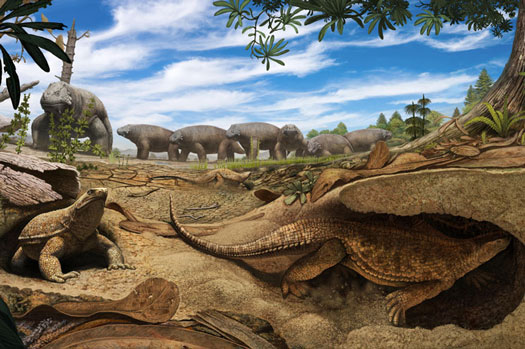
Fossils excavated from the famous Permian-aged deposits of the Karoo Basin (South Africa) suggest that the earliest evolutionary beginnings of the turtle’s shell resulted from adaptations to accommodate a burrowing or fossorial (digging) lifestyle.

Karoo Basin Fossils of the Proto-Turtle Eunotosaurus Indicate Fossorial Adaptations

Eunotosaurus adapted to a burrowing lifestyle.

The proto-turtle Eunotosaurus burrows into the banks of a dried up pond to survive in the harsh, arid South African environment about 260 million years ago. In the background, a herd of Bradysaurus, a type of reptile, crowds around some muddy water.

Picture credit: Audrey Atuchin

A Widening of the Ribs

Dr Lyson had the opportunity to learn more about chelonian evolution when he, along with collaborators form the Smithsonian Institute studied the fossilised remains of a highly specialised parareptile, Eunotosaurus africanus, back in 2013.  These fossils, which also came from Late Permian aged deposits in South Africa, indicated that a widening of the ribs was the first stage in the evolution of the shell.

To read more about the origins of the shell in turtles: How the Turtle Got Its Shell.

Tyler Lyson explained:  “We knew from both the fossil record and observing how the turtle shell develops in modern turtles that one of the first major changes toward a shell was the broadening of the ribs.”

An Effect on Mobility

However, for a quadruped, the widening of the ribs has a very serious effect on mobility.  Breathing is restricted and movement becomes more difficult.  Ribs are primarily used to support the torso during locomotion and they play a vital role in lung function.  Broader ribs, means a stiffer body which will lead to a shortening of stride length and less efficient breathing.  In the harsh and dangerous world of the Permian, these modifications would have seriously disadvantaged any tetrapod.

Rib bones in vertebrates show hardly any variation, team members at Everything Dinosaur have recently been examining the rib bones of a prehistoric elephant, these ribs are very similar to the ribs of a large dinosaur such as a Stegosaurus.  The Chelonia are an exception, their ribs are highly modified as they form the majority of the shell.

A Significant Fossil Discovery

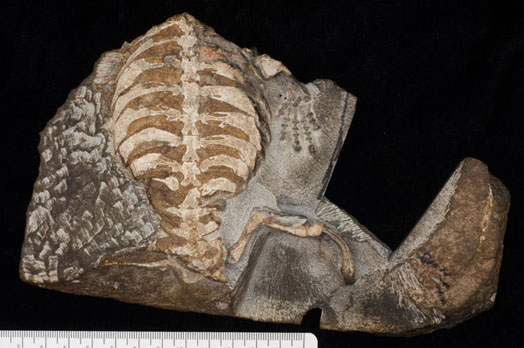
The discovery of several, exceptionally well-preserved specimens of Eunotosaurus africanus allowed the team to examine shell evolution in much more detail than before.  A number of the fossils were found by the study’s co-authors, doctors Roger Smith and Bruce Rubidge (University of Witwatersrand, Johannesburg).  However, the most important specimen used in this study was found by a young boy on his father’s farm in the Western Cape.  Eight-year old Kobus Snyman, took the fossil that he found to his local museum, the Fransie Pienaar Museum in Prince Albert (Western Cape).  The articulated fossil measures around fifteen centimetres in length, the body (and those all important ribs) are preserved along with the hands and feet but the skull is missing.

Praising Observational Skills

Dr Lyson praised young Kobus for his observational skills and for taking his find to the local museum, he stated:

“I want to thank Kobus Snyman and shake his hand because without Kobus both finding the specimen and taking it to his local museum, this study would not have been possible.”

The Eunotosaurus Fossil Found by Kobus Snyman

Fossil of Eunotosaurous found by an 8-year-old.

The fossil of Eunotosaurus found by eight-year-old Kobus Snyman.

Picture credit: Dr. Tyler Lyson

Extant turtles, terrapins and tortoises have shells that serve mainly as protective devices.  These armoured animals are notoriously slow.  However, in this new study, developmental evidence from embryos combined with these newly described Karoo Basin fossils suggest that one of the first steps towards the shelled body-plan was a widening of the ribs.  Eunotosaurus africanus is thought to be a basal member of the Chelonia and the broad ribs of this animal have been proposed as support and stabilising mechanisms to help support a powerful forelimb digging action.  The adaptations for a fossorial lifestyle would have facilitated the movement of stem turtles into aquatic environments early in the group’s evolutionary history.

In the scientific paper, entitled “Fossorial Origin of the Turtle Shell”, the researchers propose that adaptations related to digging provided the initial impetus for shell development and that the fosssorial lifestyle may explain why basal turtles survived the catastrophe that marked the end of the Palaeozoic (End Permian mass extinction event).

To read an article from Everything Dinosaur that suggest that turtles and their kind evolved from diapsid reptiles: Study Suggests Chelonia Evolved from Diapsids.

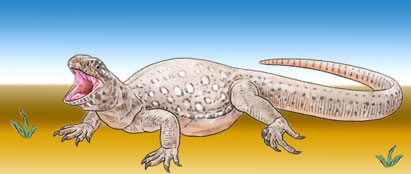
An Illustration of Eunotosaurus africanus 

A drawing of Eunotosaurus.

An illustration of the stem turtle Eunotosaurus.

Picture credit: Everything Dinosaur

An article on a Mid Jurassic turtle discovery: The Grandfather of All Tortoises and Turtles.

28 06, 2016

Bird Wing Preserved in Amber

By |2023-05-01T16:50:46+01:00June 28th, 2016|Categories: Dinosaur and Prehistoric Animal News Stories, Dinosaur Fans, Main Page, Photos/Pictures of Fossils|0 Comments

Early Bird Wings Preserved in Amber from Myanmar

A team of international scientists including researchers from Bristol University, have published research on two specimens of 99-million-year-old amber from Myanmar (called burmite), which have revealed the preserved remains of two tiny, baby birds.  The scientists conclude that these birds were active shortly after hatching (precocial).   Sadly they met their demise when they became trapped in sticky tree resin.

Fossilised Bird Wings

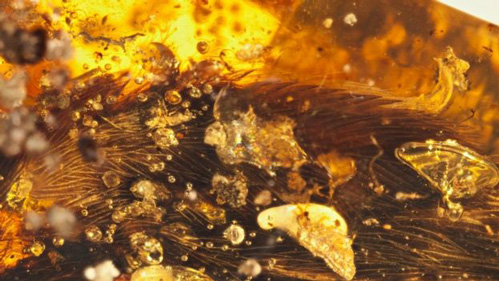
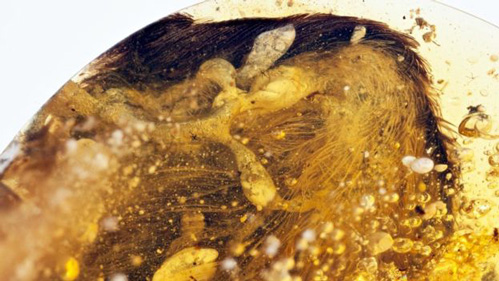
The Amber Has Preserved the Feathers in Exquisite Detail

Preserved in amber, the remains of a bird's wing.

The remains of the wing can be clearly made out trapped in the amber.

Picture credit: Royal Saskatchewan Museum (R.C. McKellar)

The photograph above shows a close up of the feathers preserved in one of the burmite specimens.  The researchers led by Dr Xing Lida (China University of Geosciences), along with colleagues from the USA, Canada and Professor Mike Benton from the School of Earth Sciences (Bristol University), have identified three long fingers, each tipped by a sharp and strongly curved claw, one of which can be seen in the top right of the picture above.

Amber Fossils from Myanmar

Amber fossils from Myanmar (formerly called Burma), have provided palaeontologists with a fascinating insight into life in the primordial forests of the Cretaceous.  In the spring, Everything Dinosaur published two articles regarding remarkable fossil discoveries which had only been possible due to fossil finds within burmite.  In one article, we reported on the potential origins of the malaria parasite, in the second we provided information regarding the discovery of the fossilised remains of tiny lizards.

To read about the evolutionary origins of the malaria: The Origins of Malaria Traced Back 100 Million Years.

To read more about the lizard fossil discovery: Lizards Preserved in Amber.

Although Burmese amber has produced fossils of isolated feathers, this is the first time in which portions of birds have been discovered.

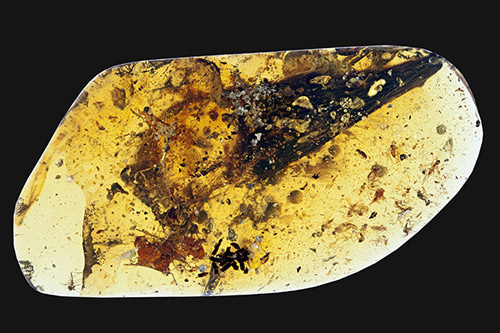
One of the Fossil Specimens Has Been Nicknamed “Rose”

Enantiornithes wing and skin sections encased in amber.

Pieces of skin and parts of an ancient wing preserved in amber.

Picture credit: Royal Saskatchewan Museum (R.C. McKellar)

Tiny Fossil Wings

The fossil wings are very small, between two and three centimetres long. the long, bony fingers can be made out along with the three digits on each wing.  The anatomy of the hand has allowed the scientists to identify these as members of the Enantiornithines (Enantiornithes), group of birds, a diverse clade of toothed birds that possessed prominent wing claws.  The Enantiornithines, thrived during the Cretaceous and some eighty species have been named, although a number are only known from single bones.  These birds became extinct at the end of the Cretaceous and they are thought not to have been very closely related to modern Aves (Neornithes).

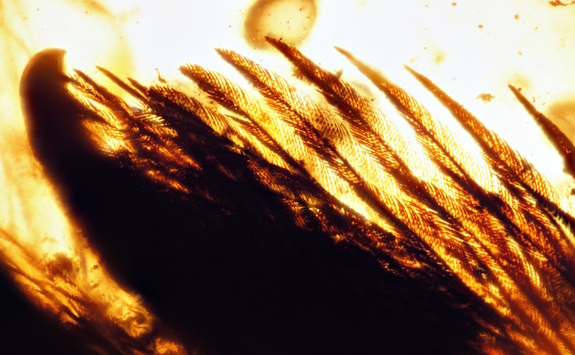
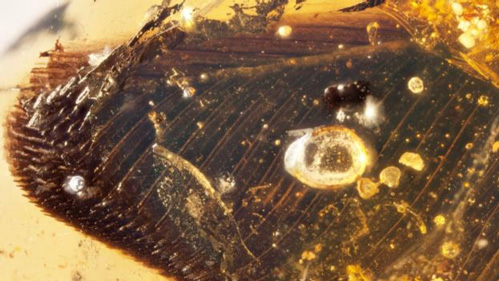
Under High Magnification the Fine Details of the Feathers Can Be Clearly Made Out

Minute details on the feathers were preserved.

Tiny details on the feathers have been preserved. Ultraviolet light and X-rays were used to analyse the fossil material.

Evidence of Precocial Behaviour in Enantiornithes

Evidence of Precocial Behaviour in Enantiornithes

The two specimens have been nicknamed “Rose” and “Angel Wings”.  After careful polishing, the fossils were analysed using white light, UV light and powerful X-rays.

Commenting on the research, one of the authors of the paper published in the academic journal “Nature Communications”, Professor Mike Benton stated:

“These fossil wings show amazing detail.  The individual feathers show every filament and whisker, whether they are flight feathers or down feathers, and there are even traces of colour – spots and stripes.”

The scientists conclude that the birds, although babies were highly mobile.  This indicates that these birds were very well developed when they hatched and capable of being independent from their parents.  Sadly, their mobility seems to have been their downfall.   As the clambered around the branches and trunks of trees they became trapped in sticky tree resin.  Larger animals would have had the strength to pull free, but these youngsters were doomed.  The amber even preserves claw marks and scratches as the birds tried to pull themselves free.

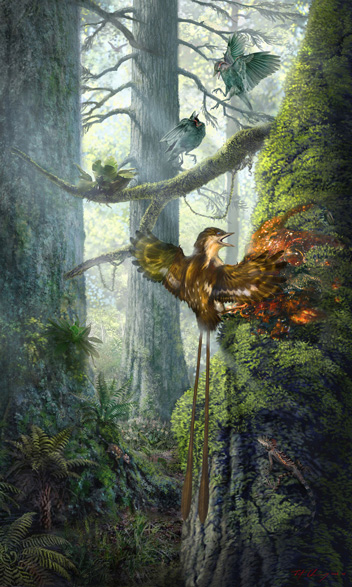
A Desperate but Ultimately Doomed Struggle

Fossils from Myanmar show bird's wing.

Preserved in amber the wings of baby birds that once became trapped in tree resin.

Picture credit: Chung-tat Cheung

Young Birds Trapped in Tree Resin

The beautiful illustration above shows an imagined scene in which one of these young birds find itself trapped and unable to break free of the glue-like tree resin.

Lead author of the study, Dr Xing Lida added:

“The fact that the tiny birds were clambering about in the trees suggests that they had advanced development, meaning they were ready for action as soon as they hatched [precocial].  These birds did not hang about in the nest waiting to be fed, but set off looking for food, and sadly died perhaps because of their small size and lack of experience.  Isolated feathers in other amber samples show that adult birds might have avoided the sticky sap, or pulled themselves free.”

Scientists Can Identify Different Pigments in the Fossilised Remains of the Feathers

Feathers preserved in Burmese amber.

Different pigments in the feathers can be made out quite clearly in this feather preserved in Burmese amber.

Picture credit: Royal Saskatchewan Museum (R.C. McKellar)

For models and replicas of ancient prehistoric animals: PNSO Models and Figures.

Researchers Hope to Learn More About Aves/Dinosaur Evolution

Exquisite details on the fossilised feathers can be made out.

Fine details of the fossilised feather can be clearly seen in the amber.

Picture credit: Royal Saskatchewan Museum (R.C. McKellar)

Everything Dinosaur acknowledges the help of Bristol University in the compilation of this article.

The scientific paper from which this article is drawn: “Mummified precocial bird wings in mid-Cretaceous Burmese amber” by Lida Xing, Ryan C. McKellar, Min Wang, Ming Bai, Jingmai K. O’Connor, Michael J. Benton, Jianping Zhang, Yan Wang, Kuowei Tseng, Martin G. Lockley, Gang Li, Weiwei Zhang and Xing Xu.

Visit Everything Dinosaur’s website: Everything Dinosaur.

26 05, 2016

Bizarre Ant “Unicorn” From Burmese Amber Described in New Paper

By |2024-05-06T06:35:25+01:00May 26th, 2016|Categories: Dinosaur and Prehistoric Animal News Stories, Main Page, Photos/Pictures of Fossils|0 Comments

Amber Provides Insight into Ant Evolution

Burmese amber has provided scientists with some remarkable evidence of some of the smaller creatures that co-existed alongside the dinosaurs during the Cretaceous.  Trapped in, what was once tree resin, insects, mites, seeds, spiders, pollen grains and such like have enabled scientists to build up a fascinating picture of life in miniature at a time when the Earth was dominated by huge reptiles.  Writing in the academic journal “Current Biology” a team of scientists including researchers from Rennes University, Kansas University and the Nanjing Institute of Geology and Palaeontology (Chinese Academy of Sciences), have shed light on the evolution of the humble ant.  Preserved in a piece of amber is a unicorn ant!

Preserved in 99-Million-Year-Old Amber

Ceratomyrmex ant fossil in amber

The preserved remains of a new species of basal ant (Ceratomyrmex) in Burmese amber.

Picture credit: Wang Bo/Nanjing Institute of Geology and Palaeontology

The Unicorn Ant

Measuring around one centimetre in length, the ant possessed a bizarre horn-like structure on the head and super-sized mandibles that probably evolved to tackle prey at least as large as the ant itself.  The new species of Cretaceous insect has been named Ceratomyrmex ellenbergeri (pronounced Sera-to-my-ah-mex) and the genus name is from the Greek for “ant with a horn”.  Most ants today live in colonies and are eusocial, that is, the colony exhibits a great deal of co-operative behaviour and organisation.  However, not all extinct ants were likely to be colonial, just like a few specialist genera around today, some were probably solitary hunters and the researchers suggest that Ceratomyrmex was a solitary, specialist hunter preying on arthropods.

Specimens Preserved in Amber

The evolutionary history of the ant family is not well known, however, specimens preserved in amber, have, over last two decades, been extensively studied and it is now believed that the first ants evolved from wasps sometime between 110 and 130 million years ago.

Described as a stem group ant and assigned to the Haidomyrmecini clade, Ceratomyrmex demonstrates that relatively early on in their evolutionary history ants evolved into highly specialised forms.  The presence of such a bizarre horn-like structure and the oversized mandibles that actually extended over the animal’s head, features unseen in extant or any other extinct ant species known, provides evidence for more complex and highly diversified Cretaceous ant genera than previously thought.

An Illustration of Ceratomyrmex ellenbergeri 

A drawing of the Cretaceous ant Ceratomyrmex.

An illustration of the basal Cretaceous ant Ceratomyrmex.

Image credit: Yang Dinghua

Ceratomyrmex ellenbergeri

Commenting on the discovery of a new species, Vincent Perrichot (University of Rennes), a specialist in ant evolution and one of the authors of the scientific paper stated:

“The horn is covered with long bristles along its anterior surface, plus a brush with short spines on the end part spatula.  In insects, such bristles or thorns always have a sensory function, we then deduce that this sensory system needed to properly assess the size and position of the object seized between the jaws and the horn or even stabilise the friction with thorns.”

A Big Game Hunter

It is not known whether Ceratomyrmex was an arboreal hunter or whether it lived amongst the leaf litter.  With such large jaws it probably was a formidable hunter, but what did it eat?  For Vincent Perrichot, a specialist in the study of ancient insects, the answer is quite clear, the presence of the bizarre horn and the huge jaws had a macabre not mundane purpose.

He added:

“These structures were used for predatory purposes, rather than to manipulate twigs or eggs and larvae of the colony.  The additional presence of two pairs of very long bristles projecting forward, the mandibles, similar in every way to those observed in trap-jawed, modern ants that hunt alone, indicates a mechanism for the fast-closing of the jaws.  This ant could not catch small prey as it would have escaped, it probably preyed on all kinds of crawling arthropods at least equal in size to itself – millipedes, arachnids, cockroaches and why not other ants.”

21 05, 2016

Machairoceratops Plugs a Four-Million-Year Gap

By |2023-04-29T08:49:56+01:00May 21st, 2016|Categories: Dinosaur and Prehistoric Animal News Stories, Dinosaur Fans, Main Page, Photos/Pictures of Fossils|0 Comments

Machairoceratops cronusi – “Bent Sword Horned Face”

The discovery of skull bones that have proved to represent a new species of Late Cretaceous horned dinosaur has helped palaeontologists to plug a four-million-year gap in the Ceratopsidae fossil record.  Researchers, writing in the on line, open access journal PLOS One, describe Machairoceratops cronusi, believed to be relatively basal member of the centrosaurine group of horned dinosaurs.  The fossils, from Utah, help to fill an evolutionary gap in the horned dinosaur fauna known from southern Laramidia, with Machairoceratops fitting in between the earlier centrosaurine Diabloceratops and the later centrosaurine Nasutoceratops.

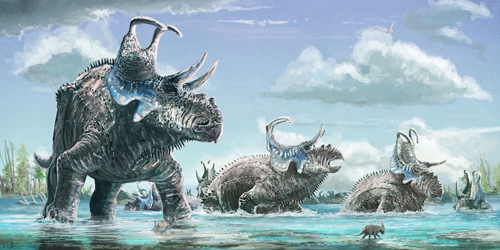
An Illustration of the Bizarre Bent-Horned Centrosaurine Machairoceratops cronusi

An illustration of a small herd of Machairoceratops dinosaurs by Mark Witton.

An illustration of a small herd of Machairoceratops dinosaurs by Mark Witton.

Picture credit: Mark Witton

Machairoceratops cronusi

A wide variety of North American ceratopsid dinosaurs have been described over the last decade or so.  Last week for example, Everything Dinosaur reported on the discovery of a new species of horned dinosaur from the Judith River Formation of Montana – Spiclypeus shipporum.  To read an article about this dinosaur: New Horned Dinosaur from the Late Cretaceous of Montana.

A field team first unearthed fragments that represented elements of the skull in 2006 at the famous Grand Staircase-Escalante National Monument, in southern Utah.  A further three seasons in the field were required to complete the exploration, sadly no post cranial material could be found.  However, from the configuration of the epiparietals and the horn cores the scientists were soon convinced that they had found a new species.

The Fossils of Machairoceratops cronusi and a Ghost Outline of the Complete Skull

Machairoceratops fossils

A right lateral view of the fossil material associated with Machairoceratops.

Picture credit: Lund et al (PLOS One)

The picture above shows (A) a right lateral view of the fossil material associated with Machairoceratops cronusi mapped against a ghosted outline of the inferred skull.  To the left of the picture the braincase (BC) is shown.  Diagram B shows the skull in dorsal view, whilst diagram C shows a complete reconstruction of the entire skull, note the curvature of the central parietals (p1 left and p1 right), it is these curved elements that gave this dinosaur its name.

Head Spikes More than a Metre Long

Each curved head spike (represented by p1 left and p1 right in diagram A above), would have measured around 1.2 metres in length, that’s slightly longer than a driver in a set of golf clubs used by a professional, male golfer.  However, despite this impressive headgear, the researchers estimate that Machairoceratops was not huge by horned dinosaur standards.  Based on skull comparisons with more complete specimens, palaeontologists have suggested that this dinosaur would have been around six metres in length and would have weighed around two tonnes.

Lead author of the scientific paper, graduate student Eric Lund (Ohio University Heritage College of Osteopathic Medicine), suggests that the head crest ornamentation may have had a role in visual signalling, such as selecting mates and establishing a social position within the herd.

Stratigraphic Assessment of the Position of Machairoceratops in Relation to Other Horned Dinosaur Fossils

A stratigraphic profile of the Wahweap and the Kaiparowits Formation.

A stratigraphic profile of the Wahweap and the Kaiparowits Formation.

Picture credit: Lund et al (PLOS One) with additional notation by Everything Dinosaur

Filling a Four-million-year Gap in the Centrosaurinae

The discovery of M. cronusi in strata that was laid down some 77 million years ago has helped to plug a four-million-year gap in the centrosaurine fossil record from the Grand Staircase-Escalante National Monument.  Fossils of an earlier centrosaurine called Diabloceratops eatoni have been found in rocks that date to around 80 million years ago.  The fossil material related to Machairoceratops fills the gap between Diabloceratops and the later, almost equally bizarrely horned centrosaurine Nasutoceratops titusi, whose fossils are associated with the overlying Kaiparowits Formation and date to around 75-76 million years ago.

Commenting on the naming of this new type of Late Cretaceous herbivorous dinosaur, Eric Lund stated:

“The  finding fills in an important gap in the fossil record of southern Laramidia, an area that included Utah, Colorado, New Mexico, Texas and Mexico during the Late Cretaceous period.  The discovery of Machairoceratops not only increases the known diversity of ceratopsians from southern Laramidia, it also narrows an evolutionary information gap that spans nearly 4 million years between Diabloceratops eatoni from the lower middle Wahweap Formation and Nasutoceratops titusi.”

A Model of a Machairoceratops (PNSO)

Measurements of the PNSO Machairoceratops dinosaur model.

PNSO Machairoceratops measurements.  PNSO introduced a Machairoceratops dinosaur model.

The Chinese model manufacturing company PNSO have introduced a replica of Machairoceratops.

To view this range: PNSO Age of Dinosaurs.

Once again, palaeontologists have gained fresh insight to the amazing diversity and variety of horned dinosaurs from North America.  The genus name is from “ceratops”, meaning horned face and the Greek “machairis” for bent sword, in deference to those curved central parietals.  The species name is from the mythical Greek titan (Cronus, also known as Kronos), whose symbol is a scythe or curved sword.

18 05, 2016

Life “Loomed Large” 1.56 Billion Years Ago

By |2023-04-29T06:47:37+01:00May 18th, 2016|Categories: Dinosaur and Prehistoric Animal News Stories, Main Page, Palaeontological articles, Photos/Pictures of Fossils|0 Comments

Multicellular Eukaryotes from  1.56 billion-year-old Rocks (Gaoyuzhuang Formation)

A team of Chinese and American scientists have confirmed the presence of large (several centimetres long in some cases), communities of eukaryotic cells preserved as impressions within rocks laid down in a shallow marine environment some 1.56 billion years ago.  This suggests that organisms had begun to form such structures during the Mesoproterozoic, some five hundred million years or so after the very first eukaryote cells evolved.

Macro-Fossils Preserved in the Mudstones of the Gaoyuzhuang Formation (Northern China)

Examples of various eukaryotic communities preserved in the mudstones of the Gaoyuzhuang Formation.

Examples of various eukaryotic communities preserved in the mudstones of the Gaoyuzhuang Formation.

Picture credit: Nature Communications/Nanjing Institute of Geology and Palaeontology

Scale bar information for the picture (above) 5 cm (in a,b,g), 20 mm (in c), 40 mm (in d) and 5 mm (in e,f).

Multicellular Eukaryotes

The scientists, which included Professor Andrew Knoll (Harvard University), a co-author of the academic paper published in the journal “Nature Communications”, identified a variety of different shaped fossils, some were linear, others wedge-shaped, whilst some were oblong and yet another group were described as tongue-shaped.  In total, fifty-three fossil communities were identified.  Although it is difficult to assign these structures to a place in standard Linnaean classification, a spokesperson from Everything Dinosaur suggested that these ancient life forms could be linked to the Kingdom Protoctista, a biological kingdom which includes certain large, multicellular eukaryotes, such as red algae and kelp.

What is a Eukaryotic Cell?

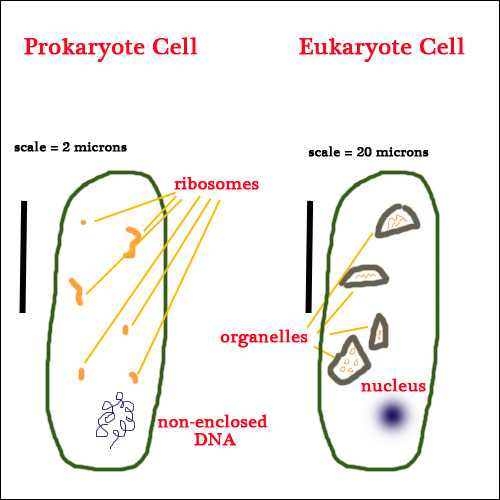
Eukaryotes have their genetic material enclosed within a nucleus, this is a distinct area within the confines of the cell where the genetic instructions and information can be found.  They also have organelles which are specialised structures within the cell that are responsible for specific areas of activity such as mitochondria for energy production or chloroplasts that convert sunlight energy into sugars (photosynthesis).  The first cells to form lacked a nucleus and specialised structures (organelles), these cells are referred to as prokaryotes (from the Greek which means “before the nucleus”), the DNA of prokaryotic cells is held in the cytoplasm of the cell.

Prokaryote Cells Compared to Eukaryote Cells

Simple diagram showing differences in Eukaryote cells and Prokaryote cells.

Simple diagram showing differences in eukaryote cells and prokaryote cells.

Picture credit: Everything Dinosaur

The diagram above shows the basic differences between prokaryotic and eukaryotic cells.  Note the different scales, due to their unstructured form, prokaryotic cells are much smaller than eukaryotic cells.  Fossil evidence for cyanobacteria (prokaryotes) suggest that these cells first formed some 3.5 billion years ago (Archean Eon)*.  The first eukaryotic cells may have formed around 2.1 billion years ago**.

Visit Everything Dinosaur’s website: Everything Dinosaur.

Eukaryote Cells

Eukaryote cells most likely evolved from prokaryote cells at some point in the Paleoproterozoic.  How this came about is a subject of much debate.  One theory proposes predatory prokaryotes engulfed other smaller prokaryote cells.  Instead of these cells being consumed, a symbiotic relationship resulted with the smaller cells becoming the specialised elements of the larger cell.  Another theory suggests that more complex cells came about due to mutations during cellular division.  The presence of DNA strands in mitochondria which are not exactly the same as the DNA found within the host cell nucleus suggests that the mitochondria were once single-celled organisms in their own right.

The Significance of the Gaoyuzhuang Formation

Fossils described as macro-fossils are exceedingly rare in rocks older than the Late Neoproterozoic Era, but uranium – lead (U to Pb) radiometric dating suggests that the biota identified from the mudstones from the Gaoyuzhuang Formation (Yanshan area in the Hebei Province of northern China) are around 1.56 billion years old.  Other geological formations dated to over a billion years old which contain macro-fossils have been identified before, but it is the number and variety of the different types of fossil that marks out this strata as being something special.

Researchers Exploring the Exposed Mudstones Looking for Evidence of Ancient Life

Researchers examine the fine-grained mudstones which form part of the Gaoyuzhuang Formation.

Researchers examine the fine-grained mudstones which form part of the Gaoyuzhuang Formation.

Picture credit: Nature Communications

Exhibiting Multicellular Structures

Some of the fossilised structures measure up to thirty centimetres in length and eight centimetres wide.  The researchers conclude that the specimens may not represent the oldest know eukaryotes but they are the oldest eukaryotes that exhibit multicellular structures.  These organisms lived in a shallow marine environment and they were probably benthic (lived on the sea floor).  Analysis of the cells indicates that they may have been capable of photosynthesis and although large by Precambrian standards these organisms cannot be described as complex life.

Explaining the difference between complex life and these large multicellular structures, Professor Knoll stated that the Chinese fossils were:

“Large but I doubt that they were complicated – it’s an important distinction.”

Eukaryotic cells are capable of becoming specialised with different cells being responsible for different systems, functions and processes, a vital step on the path to complex life forms.  These cells, preserved as carbonaceous impressions in the rock show no signs of fundamental differentiation at the cellular level.

The Best Evidence Yet

These fossils provide the best evidence to date that multicellular eukaryotes of large size (greater than a centimetre in length), with a regular shape existed in marine environments at least a billion years prior to the Cambrian explosion.  They are multicellular but they are not the complex, more specialised and differentiated cells associated with more advanced organisms.

Treated Sections of the Fossils Showing the Cell Structure

Treated sections of the Gaoyuzhuang Formation fossils showing cellular structures.

Treated sections of the Gaoyuzhuang Formation fossils showing cellular structures.

Picture credit: Nature Communications

The picture above shows various views of the cell structure.  Pictures b and d show organic fragments with preserved cellular structure, the scale bar representing 100 μm (microns).  Pictures c and e show polygonal cells forming a multi-layered network (scale bar 20 μm).

The existence of these structures provides further evidence of the diversity of life during the Proterozoic, it also suggests that an increase in oxygen levels in conjunction with the establishment of a protective ozone layer in the Earth’s upper atmosphere may have permitted these multicellular organisms to form.

*/**The dates given for the first fossil evidence of prokaryotes and eukaryotic cells are speculative.

5 05, 2016

Ancient Multi-cellular Fossils from New Burgess Shale Type Deposit

By |2023-04-19T10:04:14+01:00May 5th, 2016|Categories: Dinosaur and Prehistoric Animal News Stories, Main Page, Photos/Pictures of Fossils|0 Comments

Ancient Seaweed Fossils from Mongolia

Research conducted by a team of international scientists from Mongolia, Japan and the University of Wisconsin-Milwaukee (United States), have identified two new species of ancient multi-cellular marine algae from a newly discovered Burgess Shale Type deposit located in the Zavkhan Basin of Zavkhan Province (western Mongolia).

Fossils of Ediacaran Algae

The fossils are exceptionally rare and date from approximately 555 million years ago (Ediacaran geological period), they are helping researchers to pinpoint the development of complex lifeforms from the Kingdom Plantae, the ancestors of all plants that exist today.   A paper on the research into the thin shale beds (representing the  Zuun-Arts biota), has been published in the online, open access journal “Scientific Reports”.

Lead Author of the Study Associate Professor Stephen Dornbos Holds One of the Fossil Specimens

Ediacaran fossil specimen held by palaeontologist Stephen Dornbos.

Ediacaran fossil specimen held by palaeontologist Stephen Dornbos.

Picture credit: University of Wisconsin-Milwaukee

Exceptionally Rare Fossils

The preservation of soft-bodied organisms such as these remains of algae are exceptionally rare in the fossil record.  One such method of preservation is carbonisation in fine-grained strata.  These deposits of exceptional preservation are referred to as Burgess Shale Type deposits, after the famous Cambrian site in British Columbia.

For fossils and replicas of Burgess Shale animals such as Anomalocaris and trilobites (whilst stocks last): CollectA Age of Dinosaurs Popular Figures.

Burgess Shale Type deposits preserving the remains of organisms that lived before the Burgess Shales themselves were formed, can provide scientists with a tantalising glimpse into marine life prior to the evolution of animals with hard bodies such as exoskeletons and shells, but only a handful of pre-Cambrian (Ediacaran) Burgess Shale Type deposits are known.  The research team were exploring ancient marine rocks in western Mongolia when the thin black shales containing carbonised remnants of the prehistoric seaweeds were discovered.

Chinggiskhaania bifurcata and Zuunartsphyton delicatum

Two species of multi-cellular marine algae have been identified, the most common fossils representing the newly described Chinggiskhaania bifurcata.  The other species, known from just three fossil specimens has been named Zuunartsphyton delicatum.

A Cross Polarised Light Image of C. bifurcata

Chinggiskhaania bifurcata fossil (scale bar = 5mm)

Chinggiskhaania bifurcata fossil (scale bar = 5 mm).

Picture credit:  University of Wisconsin-Milwaukee

Under polarised light the structure of the fine filaments of the ancient seaweed can be clearly seen.

Contrast this picture with the photograph of Stephen Dornbos holding a specimen.  The fossils consist of aluminosilicate clay minerals and some carbon, just like the Burgess Shale fossils, and as such, spotting fossils is a very difficult task.  Natural light has to strike the fossil at the correct angle, otherwise the specimen cannot be distinguished from the surrounding matrix.

Commenting on the discovery of the Zuun-Arts biota, Associate Professor Stephen Dornbos stated:

“This discovery helps tell us more about life in a period that is relatively undocumented.  It can help us correlate the changes in life forms with what we know about the Earth’s ancient environments.  It is a major evolutionary step toward life as we know it today.”

Extremely Hard to Classify

Burgess Shale Type fossils dating from the Proterozoic Eon usually are classified as one of two categories, algae, like seaweed, which is the case of the  Zuun-Arts biota, or the remains of extinct types of organisms so unlike living organisms today, that identifying what they might have been like is very difficult to do.  As a result, interpretation of Ediacaran fossil material is a very controversial area of palaeontology.

Explaining this problem, Stephen Dornbos commented:

“If you find a fossil from this time frame, you really need strong support for your interpretation of what it was.   The further back you go in geologic time, the more contested the fossil interpretations are.”

Visit Everything Dinosaur’s website: Everything Dinosaur.
Go to Top