All about dinosaurs, fossils and prehistoric animals by Everything Dinosaur team members.

Pictures of fossils, fossil hunting trips, fossil sites and photographs relating to fossil hunting and fossil finds.

13 03, 2016

Amazing Megaloceros Fossil Exhibit

By |2024-05-05T21:31:57+01:00March 13th, 2016|Categories: Main Page, Photos/Pictures of Fossils|0 Comments

Megaloceros (Irish Elk)

One of the best exhibits in the walkway between the galleries at the National Museum of Scotland (Edinburgh), is this magnificent Megaloceros fossil skeleton.  The name of this extinct member of the deer family (Cervidae), means “great horn” and although antlers are not technically horns, it is not hard to see why this Ice Age herbivore got its moniker.  The fossils were found in the Isle of Man and we think this was one of the first if not the very first specimens to be scientifically studied.  Although a number of species have now been assigned to the Megaloceros genus, this is the largest of the species M. giganteus.

Megaloceros giganteus

The Magnificent Megaloceros on Display at the Museum of Scotland (Edinburgh)

A Megaloceros skeleton on display.

A Megaloceros skeleton on display.

Picture credit: Everything Dinosaur

Visit Everything Dinosaur’s award-winning website: Everything Dinosaur.

The impressive antlers grew each year and a large pair could measure more than three and a half metres wide.  The weight of the antlers was considerable putting tremendous pressure on those cervical bones and the muscles in the neck.  It has been estimated that a pair of antlers could weigh as much as forty kilogrammes.  That is heavier than the young girl in the pink coat in the picture.  Although also known as the “Irish Elk”, Megaloceros was not restricted to Ireland.  It had a very wide distribution, fossils having been found all over northern Europe and Asia.

Megaloceros Fossil Finds

Fossils of Megaloceros have even been found in China.  It was also not very closely related to the extant Elk, but more closely related to modern Fallow Deer.  Standing more than two metres high at the shoulders, it is one of the largest members of the Cervidae family known.  Note the elongated skull, the strong neck and the strong legs.   Sadly, this magnificent beast became extinct at the end of the last Ice Age, however, a dwarf species is believed to have survived on the Mediterranean islands of Corsica and Sardinia until about 5,000 B.C.

It is always a pleasure to find a Megaloceros exhibit on display so prominently in a museum.

Papo Megaloceros Model

Papo have introduced a replica of a Megaloceros.  To view the Papo range of prehistoric animal models: Papo Prehistoric Animal Models.

12 03, 2016

Oldest Pine Fossils Reveal Link with Firestorms as New Paper is Published

By |2024-05-05T21:32:32+01:00March 12th, 2016|Categories: Dinosaur and Prehistoric Animal News Stories, Main Page, Photos/Pictures of Fossils|0 Comments

Oldest Pine Tree Fossils Described

A pine tree is such a familiar object that it hardly deserves a second glance.  Walking in the park, driving into work, many people will pass these ubiquitous trees without giving them a thought.  Pine trees are also found in gardens, if you are mowing the lawn this weekend, stop for a moment and nod your head towards your pine as these types of tree originated at least 140 million years ago.  In addition, pine trees that dominate much of the Northern Hemisphere today might owe their success, if not their very existence to a fiery past.

Oldest Pine Fossils

Pine Trees Once Overlooked Dinosaurs

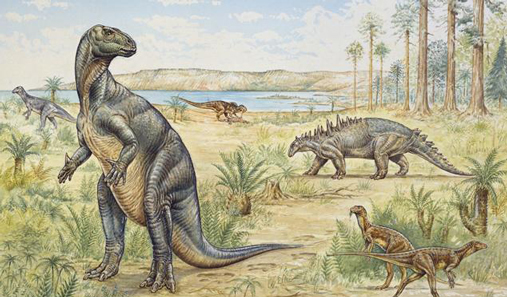
Dinosaurs once roamed Surrey (England).

Pine trees part of the faunal landscape of the Cretaceous.

Picture credit: Natural History Museum (London)

The pine trees (Pinaceae) are a very diverse conifer genus these days, there are something like 115 species known today.  They are renowned for their ability to retain water thanks to their tough needles and their adaptations that help them withstand forest fires.  They contain highly flammable deadwood that burns very easily.

Pine Trees are Inflammable

Conifers produce terpenes, which are highly combustible organic compounds, it is these compounds that make pine trees so inflammable.  They also produce cones that will only germinate in many cases after being scorched by fire.  A new generation of pine trees can then emerge, using the nutrient rich ash left by a forest fire to sustain them and without much competition from other plants as these would have been destroyed by the conflagration.

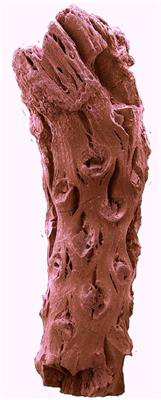
A team of scientists from the Department of Earth Sciences at Royal Holloway (University of London), have found the oldest fossil evidence of pine trees.  The discovery was due to serendipity almost as much as hard work and dedicated research.  Dr  Howard Falcon-Lang discovered the fossils preserved as charcoal in a rock layer dated to the Valanginian faunal stage of the Cretaceous, approximately 133 to 140 million years ago.  The tiny fragments of pine tree suggest that conifers co-evolved with fire at a time when atmospheric oxygen levels were much higher than today, making forest fires much more likely and intense.

A False Colour Image of a Pine Tree Fragment Preserved as Charcoal

Fossilised pine tree fragment preserved as charcoal.

Fossilised pine tree fragment preserved as charcoal.

Picture credit: Royal Holloway, University of London.

A Significant Discovery

Commenting on the significance of the fossil find, Dr Falcon-Lang stated:

“Pines are well adapted to fire today.  The fossils show that wildfires raged through the earliest pine forests and probably shaped the evolution of this important tree.  Modern pines store flammable resin-rich deadwood on the tree making them prone to lethal fires.  However, they also produce huge numbers of cones that will only germinate after a fire, ensuring a new cohort of trees is seeded after the fire has passed by.”

A paper detailing the research has been published in the journal of the Geological Society of America.  The fossils had been gathered several years ago and lay unexamined in a cupboard.  It was only when the rock samples were subjected to acidification to digest the matrix material that the tiny fragments of tell-tale pine tree were revealed.  Although each specimen is only a few millimetres in length they have been interpreted as being the remains of an evergreen two-needle pine.

The research is published in the journal Geological Society of America.

9 12, 2015

Big-eyed Mosasaur from Japan – A Night Time Hunter?

By |2023-04-09T16:58:32+01:00December 9th, 2015|Categories: Dinosaur and Prehistoric Animal News Stories, Dinosaur Fans, Main Page, Photos/Pictures of Fossils|0 Comments

Phosphorosaurus ponpetelegans – New Species of Mosasaur Announced

An international team of researchers, including scientists from the Royal Tyrrell Museum, the University of Alberta (Canada), the University of Cincinnati (USA), Hobetsu Museum and Fukuoka University (Japan), have announced the discovery of a new species of mosasaur found in Upper Cretaceous rocks in Japan.  This three-metre-long predator may have specialised in hunting in deep water or perhaps it evolved to fill a specific ecological niche, that of a night hunter preying on bioluminescent fish and squid.

The Newly Described Phosphorosaurus ponpetelegans
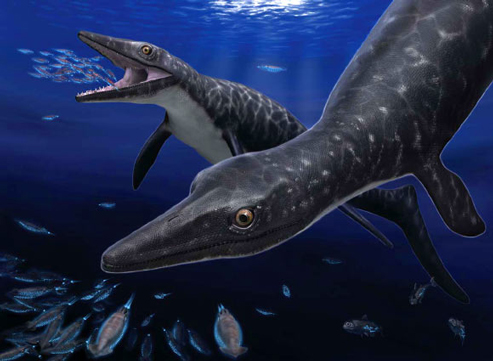
The first Japanese Mosasaur to be identified.

Rare Japanese mosasaur identified.

Picture credit: Tatsuya Shinmura / Ashoro Museum of Palaeontology / Trustees of the Natural History Museum, (London).

A Large-eyed Mosasaur

Growing to around the size of an extant American Alligator (C. mississippiensis), this large-eyed mosasaur from the island of Hokkaido (northern Japan), was probably most closely related to another species of Late Cretaceous mosasaur, but one from Belgium thousands of miles away (P. ortliebi).  This fossil find, consisting of beautifully preserved cranial material plus some post cranial elements, will help palaeontologists to build a better understanding of the biogeographical distribution of certain types of mosasaur towards the end of the Mesozoic.

In 2009, scientist Tomohiro Nishimura (Hobetsu Museum), recovered a calcareous nodule from one of the tributaries of the Pankerusano-sawa Creek, about 3 miles east of the town of Hobetsu.  The rivers in this part of Hokkaido cut through sandstones which were laid down at the very end of the Age of Dinosaurs (Hakobuchi Formation of the uppermost Yezo Group), the fossil is believed to have come from the lowermost strata representing the early part of the Maastrichtian age, approximately 71 million years ago.

Mosasaur Creek!  The Rivers Cut Through the Loosely Compacted Sandstones
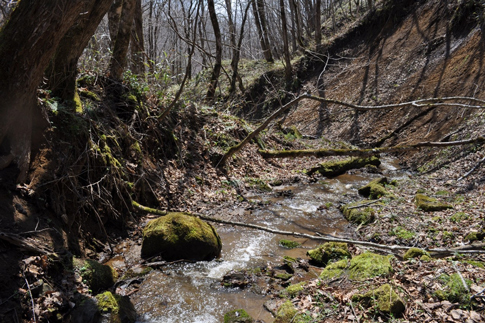
Small rivers cut deep channels in the sandstone.

Small rivers cut deep channels in the sandstone.

Picture credit: University of Cincinnati

Rivers Cutting Through Loosely Compacted Sandstones

The picture above shows the topography of the area.  Shallow soils overlie sandstones.  The action of rivers results in deep channels being cut in the rock.  This erosion can expose fossils such as ammonites and occasionally the fossilised bones of marine vertebrates.

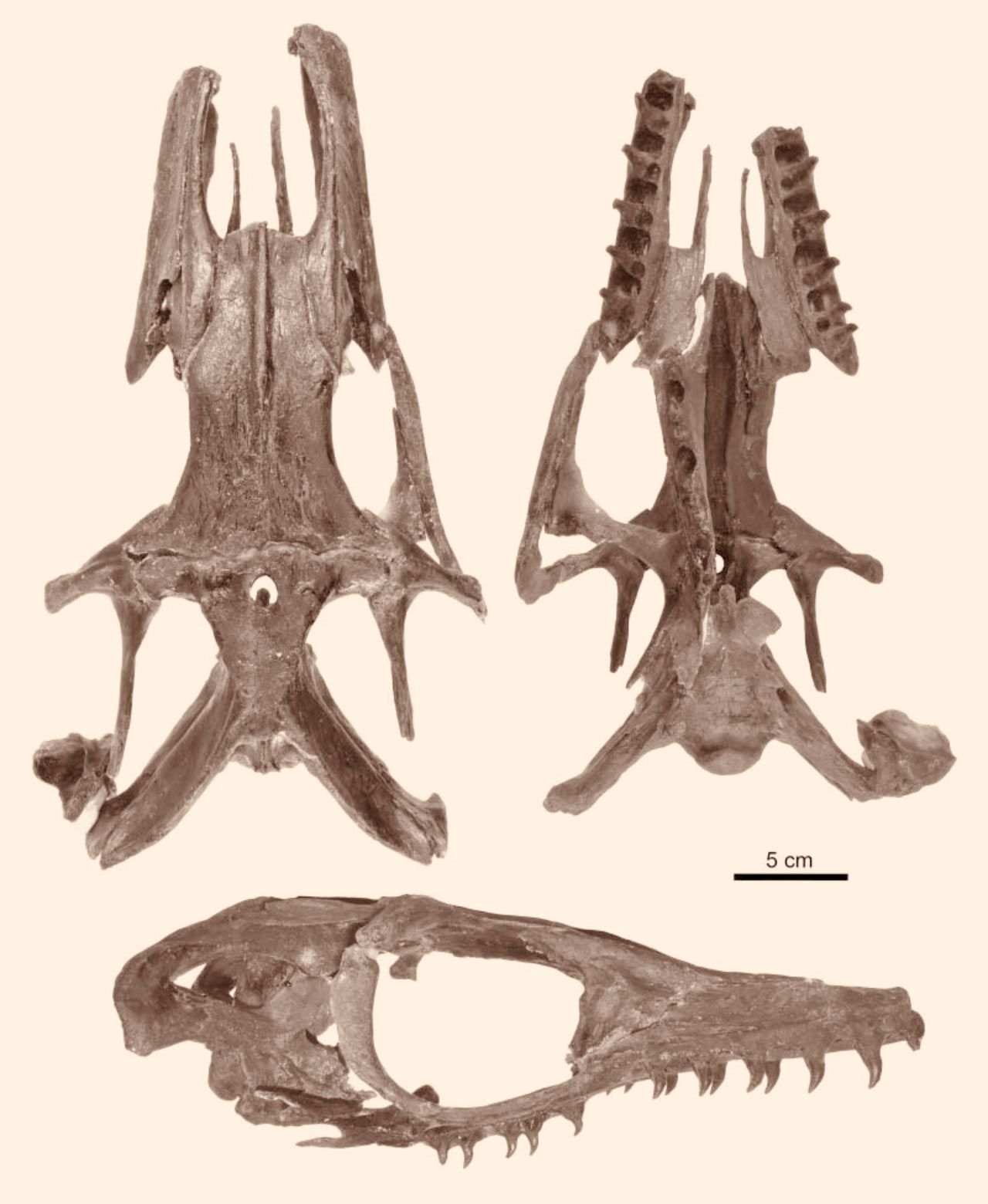
Views of the Remarkably Well-Preserved Skull
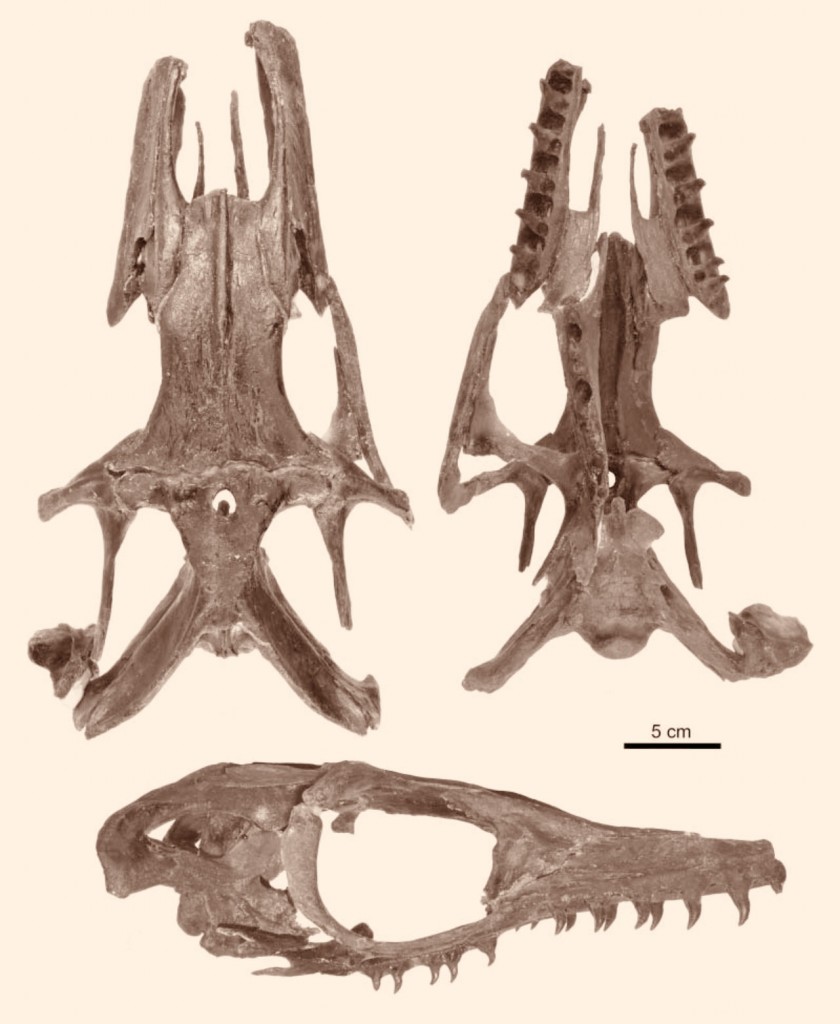
Dorsal view (left), ventral view (right), lateral view (bottom). Scale bar = 5cm.

Dorsal view (left), ventral view (right), lateral view (bottom).
Scale bar = 5 cm.

Picture credit: Takuya Konishi et al.

Phosphorosaurus ponpetelegans

Phosphorosaurus ponpetelegans means “phosphorus lizard from an elegant creek”,  co-existed with much larger mosasaurs, ten-metre plus monsters that were the apex predators.  The scientists propose that P. ponpetelegans adapted to an ecological niche, that of a night time predator or perhaps a deep water hunter.  The almost complete skull was slowly removed from its rocky matrix by being placed in a bath of dilute acid each night.  Once the skull bones had been freed from the rock, the researchers set about piecing the skull together.

Huge Eyes

This marine reptile had huge eye sockets and a reduced snout when compared to other mosasaurs.  As the fossil skull was so well preserved the scientists have been able to determine that Phosphorosaurus ponpetelegans had binocular vision, its eyes were located on the front of its face, providing depth perception.  Most other mosasaurs have eyes towards the side of their heads.  This gives them a large, all round field of view but they lack the depth perception to the extent demonstrated by a study of Phosphorosaurus cranial material.

The Huge Orbit (Eye Socket) of P. ponpetelegans
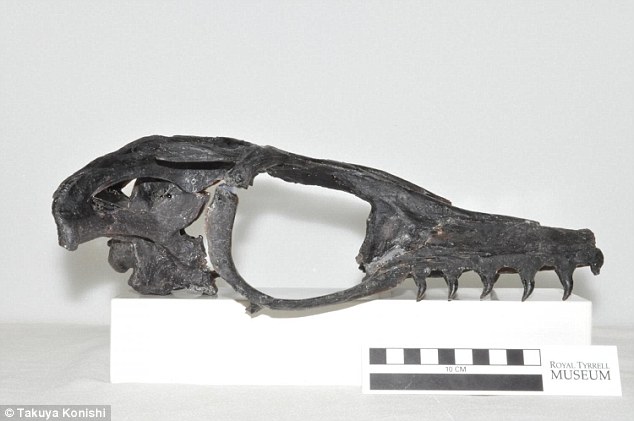
The skull in lateral view showing the huge eye-socket.

The skull in lateral view showing the huge eye-socket.

Picture credit: Takuya Konishi et al.

Commenting on the significance of the size and position of the eyes, lead author Takuya Konishi explained:

“The forward-facing eyes on Phosphorosaurus provide depth perception to vision, and it’s common in birds of prey and other predatory mammals that dwell among us today.  But we knew already that most mosasaurs were pursuit predators based on what we know they preyed upon — swimming animals.  Paradoxically, these small mosasaurs like Phosphorosaurus were not as adept swimmers as their larger contemporaries because their flippers and tail fins were not as well developed.”

A Nocturnal Hunter?

The researchers depict Phosphorosaurus has a nocturnal hunter.  Although the pursuit of prey in deeper water cannot be ruled out.  Phosphorosaurus could be thought of as an owl, whereas the diurnal, larger, more streamlined mosasaurs in the ecosystem were the equivalent of day time hunters such as hawks and eagles.  The binocular vision in nocturnal animals doubles the number of photoreceptors to detect light.  Just like an extant owl, this small mosasaur had very large eye sockets.

A Comparison of the Binocular Vision Potential of Different Mosasaurs
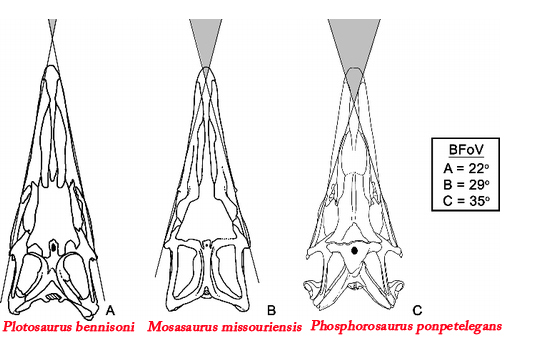
The forward facing vision of Mosasaurs are compared.

The forward facing vision of mosasaurs are compared.

Picture credit: The Journal of Systematic Palaeontology with additional notation by Everything Dinosaur

Key

BFoV = Binocular Field of Vision

A Binocular Field of Vision

In the line drawing above, the field of vision of Phosphorosaurus ponpetelegans (c) is compared to two other mosasaurs.  The skulls are drawn not to scale.  Plotosaurus bennisoni (a) was a much larger, more streamlined mosasaur.  Its fossils come from Upper Cretaceous rocks found in California.  It grew to lengths in excess of twelve metres and it was very probably an open ocean predator relying on its pursuit speed to catch its prey, which probably included other mosasaurs and marine reptiles.  The binocular field of vision for the long-snouted Plotosaurus bennisoni has been calculated to around 22 degrees.  Mosasaurus missouriensis (b)was also a large, apex predator.

Size estimates vary, but this mosasaur, whose fossils come from North America, could have been four times the size of Phosphorosaurus.  It too, was an ocean going predator, but it is depicted as being more bulky and therefore less streamlined than Plotosaurus.  Its binocular field of vision has been calculated at around 29 degrees.  In contrast, the much smaller, shorter snouted Phosphorosaurus with its forward facing and proportionately much larger eyes had a binocular field of vision of around 35 degrees.

What Did Phosphorosaurus Hunt?

Numerous fossils of cephalopods such as squid and ammonites have been recovered from the same strata as the Phosphorosaurus fossil remains.  In addition, fossils of ancient lantern fish have also been found.  The scientists speculate that this mosasaur may have hunted the bioluminescent fish and squid at night.  Larger mosasaurs in the area hunted during the day.

Discussing the potential ecological niche of Phosphorosaurus ponpetelegans Takuya Konishi stated:

“If this new mosasaur was a sit-and-wait hunter in the darkness of the sea and able to detect the light of these other animals, that would have been the perfect niche to co-exist with the more established mosasaurs.” 

Exquisitely Preserved Skull of Phosphorosaurus ponpetelegans

Such is the exquisite quality of the preserved skull, that the researchers hope to be able to piece together more details concerning the evolution and radiation of the mosasaur group as a whole.  Phosphorosaurus has been assigned to the Halisaurinae subfamily of mosasaurs.  Its discovery will help to fill the gap between similar types of mosasaur fossils found in Europe and the Middle East and those from the Eastern Pacific.

Biogeographical Distribution of Late Cretaceous Halisaurine Mosasaurs
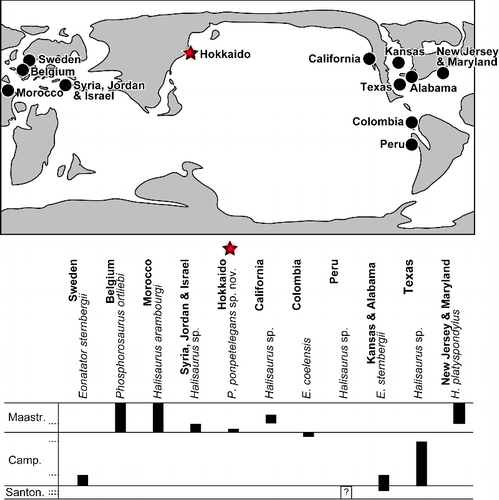
The distribution of the Halisaurine Mosasaurs (Late Cretaceous).

The distribution of the Halisaurine mosasaurs (Late Cretaceous).

Picture credit: Journal of Systematic Palaeontology with additional notation by Everything Dinosaur

The red mark indicates the Phosphorosaurus ponpetelegans fossil location.  It is the most northerly Halisaurine mosasaur discovered to date.

The Teeth of Phosphorosaurus ponpetelegans
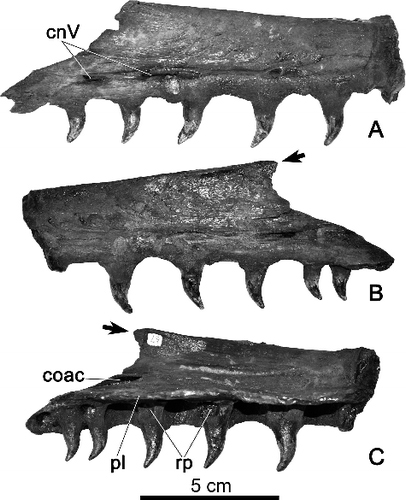
The curved and widely spaced teeth support the idea that this Mosasaur hunted squid.

The curved and widely spaced teeth support the idea that this mosasaur hunted squid.

Picture credit:  Takuya Konishi et al.

PNSO of China have created a range of mid-sized prehistoric animal figures including a Mosasaurus.  To view this range: PNSO Age of Dinosaurs Figures.

10 10, 2015

Unborn Foal Identified from Remarkable Ancient Horse Fossil

By |2024-05-05T18:11:25+01:00October 10th, 2015|Categories: Dinosaur and Prehistoric Animal News Stories, Main Page, Photos/Pictures of Fossils|0 Comments

Eurohippus messelensis – Fossil Reveals Ancient Foetus

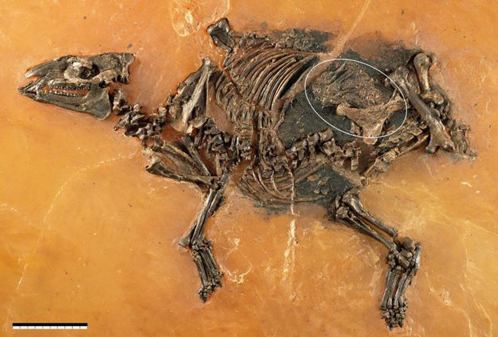
The fossilised remains of an ancient, prehistoric horse that once roamed southern Germany has revealed the presence of an unborn foal.  Scanning electron microscopy of the beautifully preserved fossil has revealed the bones of a foetus, this is the oldest fossilised equine foetus discovered to date and reveals that the horse reproductive system was already highly developed by the early Middle Eocene.

Ancient Horse – Eurohippus messelensis

Ancient Horse Fossil Reveals Unborn Foal

Eurohippus foetus fossil from the Messel Shale.

Eurohippus foetus fossil from the Messel Shale.

Picture credit: Senckenberg Research Institute

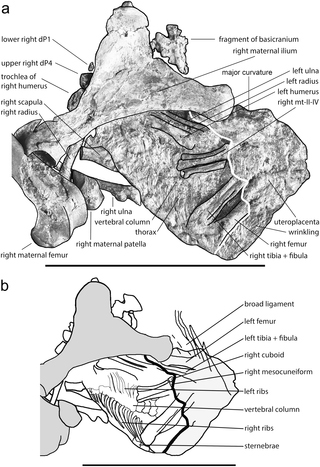
The position of the foetus in the mare is marked by the white ellipse in the picture above.  Scale bar equals 10 centimetres.  The fossil has been set in resin, this is a standard procedure to help preserve the fossils from the Messel oil shales.

An Ancient Horse

Details of the research, conducted by scientists from the Senckenberg Research Institute (Frankfurt) and the University of Veterinary Medicine (Vienna), have been published in the academic journal PloS One.  The fossil, an early horse called Eurohippus messelensis, was excavated from the Messel Shales near Darmstadt (Germany) in 2000 but it was only after recent high resolution micro-X-ray studies in combination with the scanning electron microscopy that the 12.5 centimetre long foetus was found.

Most of the skeleton is intact (post cranial material) and elements of the placenta can be determined.  Based on a comparison with modern horses, the position of the foetus, which was near full term at the time of death, is almost identical to that seen in today’s mares which are at roughly the same stage of pregnancy.

Death of the Mare

The death of the potential mother-to-be and the unborn foal are not related to any potential complications that arose during parturition.  It seems that this little, ancestral horse that was just thirty centimetres high at the shoulder, ended up in a large, deep lake and was quickly buried in the oxygen depleted sediments at the bottom.  These sediments eventually became the oil shales which make this part of southern Germany so famous.

A Line Drawing of the Exposed Side of the Foetus

Scale bar 10 cm (A and B)

Scale bar 10 cm (A and B)

Picture credit: Senckenberg Research Institute, Jörg Habersetzer; line drawing (b) by  Jens Lorenz Franzen.

The picture above (a) shows the foetus position in relation to the bones of the adult and maps out the position of the placenta (line drawing b).

How did the Ancient Horse Die?

The oil shales of Messel contain a huge amount of fossils, both aquatic and terrestrial species, but how did this rich fossil assemblage come about?  This part of Germany was located ten degrees further south during the early Middle Eocene than it is today.  It is believed to have been a very geologically active area and infrequent releases of large concentrations of poisonous gases from the deep lakes in the area could have devastated the local ecosystem.

Deadly releases of carbon dioxide mixed with hydrogen sulphide would have quickly suffocated animals in the water and once these gases had reached land they would quickly overcome any animal in close proximity to the shore.  Corpses would have been washed into the lake by rains and eventually they would have drifted down to the bottom, where the lack of oxygen and bacteria would have facilitated their excellent preservation.  This theory also accounts for the number of bird and bat fossils found in these oil shale deposits.

Any animal flying over the lake and encountering the gas cloud would be affected and fall into the water.  Bat fossils are amongst the most numerous of all the terrestrial vertebrate fossils found at the Messel quarry site.

Such a scenario was depicted in the “Walking with Beasts” episode “New Dawn” made by the BBC.

Eurohippus (E. messelensis) is one of a number of early ungulates known from the Messel shales of Germany.

Everything Dinosaur stocks a range of prehistoric mammal models and replicas: Models of Prehistoric Mammals.

18 09, 2015

Notes on Lyme Regis Fossil Walks Provide Excellent Value

By |2024-05-05T17:08:15+01:00September 18th, 2015|Categories: Educational Activities, Geology, Main Page, Photos/Pictures of Fossils|0 Comments

A Private Fossil Walk Represents Good Value

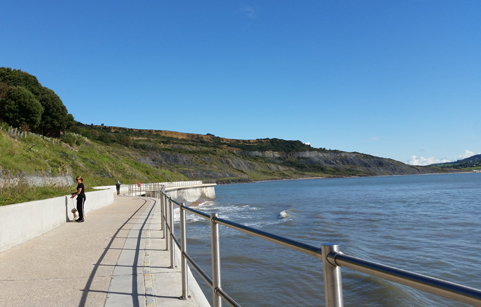
With the completion of the eastern sea wall at Lyme Regis last year the access to the beach between the town and Charmouth has certainly got easier.  No more climbing over the slippery rocks and the groynes that laid between the end of the beach front and the Church Cliffs.  That might sound like good news and it certainly is, especially for families trying to access the beach.  There is a downside to the new sea defences though, greater access has meant that over the summer months there have been more people than ever scouring the beach between Charmouth and Lyme Regis looking for fossils.  Pickings can be somewhat slim as a result.

Charmouth and Lyme Regis

The Newly Completed Magnificent Sea Wall at Lyme Regis

Part of the coastal defences at Lyme Regis

Part of the coastal defences at Lyme Regis.

Picture credit: Everything Dinosaur

Visit Everything Dinosaur’s website: Everything Dinosaur.

Sea Defences

The sea wall is part of an extensive array of features to help secure the cliffs and the land immediately behind them in a bid to protect the area from further land slips.  Eventually, these defences will give way but the engineering works has probably given the many houses on the cliffs another fifty years of life or so.

Whether or not the sea wall and other defences such as the remodelled beach area close to the famous Cobb has had an impact on the way in which the waves scour the beaches remains uncertain, time will tell, although we have heard from one reliable source that there seems to be a greater amount of sediment deposited out into Lyme Bay.  To help stabilise the cliffs, the slopes have been planted with thousands of small bushes and other plants to help anchor the soil.

The Cliffs have been Planted to Help Prevent Further Land Slides

Stonebarrow and Golden Cap can be seen in the background.

Stonebarrow and Golden Cap can be seen in the background.

Picture credit: Everything Dinosaur

What Do the Changes Mean for Fossil Hunters?

Lyme Regis has always been a popular destination for would-be fossil hunters. With easier access to the beaches to the east of the town, there is a feeling amongst locals that finding fossils along the shoreline is getting harder.

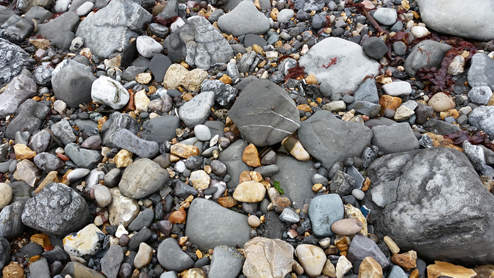
There are certainly lots of fossils to be found, but large pieces of ammonite and any ichthyosaur vertebrae are increasingly rare.  For example, during a recent trip to Lyme Regis, we spent a morning on the beach walking slowly up to Charmouth and we were surprised by the lack of fossils.  Belemnite guards were still plentiful, especially as we approached the “Belemnite Beds” but we found no fossils of Promicroceras, which surprised us somewhat.

This small ammonite used to be a relatively common fossil find, there was also a lack of nodules on the beach, although from the scattered shards of split rock there was plenty of evidence of previous visitors having hammered away quite happily at any stone bigger than a house brick, whether or not it was likely to contain a specimen inside.

Not a Very Successful Fossil Hunt

Fossils are becoming more difficult to find at Lyme Regis.

Fossils are becoming more difficult to find at Lyme Regis.

Picture credit: Everything Dinosaur

Advice for Visitors to Lyme Regis

With the popularity of fossil collecting on the increase and with the easier access to the beach, visitors to Lyme Regis might be disappointed by their lack of fossil discoveries.  One way of helping to get the most out of a visit is to book yourself onto an organised public walk.  There are a number of professional fossil hunters and guides who offer public walks.  These are a very good idea, especially when one considers the risk of getting cut off by an incoming tide or the hazards of rocks falling from the cliffs.

On a public walk your knowledgeable guide should be able to provide you with a very informative tour of the geology and help you to find a few fossils along the way.

Private Fossil Walks are Best

However, if you really want to make the best use of your time, try booking a private walk.  On some public walks that we have observed there can be as many as fifty people in the party.  Simply, getting a question answered amongst a throng of eager fossil hunters that size can be quite an ordeal, even the most dedicated guide can struggle to accommodate everybody’s needs.  Public walks tend to take place on the weekend, a time when the beaches are likely to be congested.  Private walks can be booked at a time to suit you (tides permitting) and you can be assured that your party will be very well looked after by the guide.

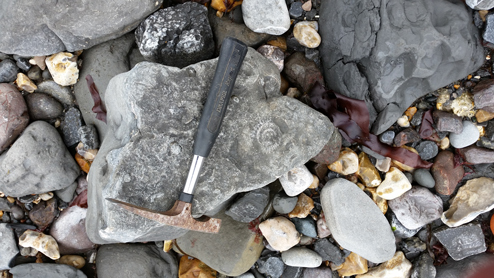
You are also more likely to be directed to the best fossil hunting locations, local knowledge wins out every time.  For example, for that beautiful Promicroceras ammonite, your best chance might be to sieve for fossils.  On a private walk, the guide can provide suitable sieves and show you the best technique to help you make your very own fossil discovery.  Knowing exactly where to start sieving on the beach is half the battle.

Still Fossils to be Found but Local Knowledge is Key

Fossils can still be found on the shore.

Fossils can still be found on the shore.

Picture credit: Everything Dinosaur

Private walks book up very quickly in advance, if you are thinking of visiting the Dorset coast next year, now is an ideal time to get yourself and your family booked on one.  Fossil walks are arranged around safe tide times so be aware that some preferred days may not be suitable.  Most organisers of private fossil walks ask for children to be at least five years old.

Guided Fossil Walks

Walks take around three to four hours, advice can be provided on where to park any vehicles and as for what you should bring here is a quick check list:

  • Suitable clothing, wellington boots or other stout footwear.  Warm clothing especially in the winter and early spring, having  a waterproof jacket on hand is very sensible, gloves in cold weather too.
  • Bring a snack and a drink although remember to take your rubbish home with you.
  • Bathroom breaks – there are no toilet facilities on the beaches, although most walks commence from the town centre and there are toilet facilities here at the start of the walk.
  • Tools to bring – most guides will be happy to break any nodules open for you, hammers are not usually supplied.  If you do bring your own hammer (please make sure it is a geological hammer), then remember the safety specs and tough gardening gloves.  For advice on the difference between geological hammers and tool box hammers: Geological Hammers What’s So Special About Them?

Finding Fossils

The fossil walk guide will be able to provide you with the very best chance of finding a top quality fossil and also be able to point out the best places to look.  You will learn a lot more about the history of the local area as well as having the opportunity to get one to one assistance and support.  Private fossil walks really do offer excellent value and they usually cost less than a family three-course meal in a pub.

For further information on private walks (public walks as well), Everything Dinosaur recommends: Lyme Regis Fossil Walks.

Private fossil hunting walks at Lyme Regis can prove to be a very worthwhile investment and provide visitors to the Jurassic Coast with an excellent opportunity to learn more about this fascinating area of Britain.

1 09, 2015

The Oldest Known Eurypterid is Described from Remarkable Fossil

By |2024-05-05T14:46:19+01:00September 1st, 2015|Categories: Dinosaur and Prehistoric Animal News Stories, Photos/Pictures of Fossils|0 Comments

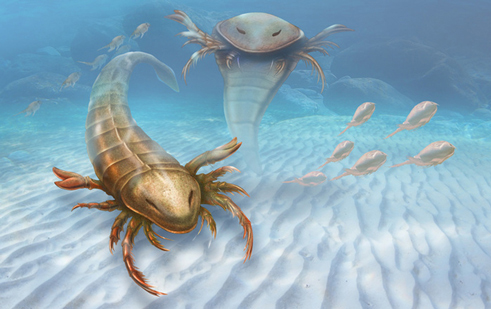
Not Jaws but Claws Pentecopterus decorahensis

Named after an ancient Greek ship (penteconter) which was renowned for its speed and agility, a new and somewhat surprising addition to the mega-fauna of the Middle Ordovician has been described in a paper published in the academic journal “BMC Evolutionary Biology – Bio Med Centre”.  Enter Pentecopterus decorahensis (pent-tee-kop-ter-rus dek-kor-rah-en-sis), which at around 1.7 metres in length suggests that this was an apex predator of the brackish, shallow marine environment represented by shale deposits located in north-east Iowa (United States).

A Very Fearsome Arthropod – P. decorahensis

Ancient predator of the Middle Ordovician.

Ancient predator of the Middle Ordovician.

Picture credit: Patrick Lynch/Yale University

Pentecopterus decorahensis

This armour-plated, marine predator is a member of the Order Eurypterida, an extinct group of arthropods distantly related to spiders and lobsters.  These creatures are often referred to as sea scorpions as they are distantly related to modern-day scorpions too.  With its streamlined body, grasping limbs for trapping prey and large, well-protected head this formidable carnivore would have dined on a variety of invertebrates as well as jawless fishes.

Winneshiek Lagerstätte

The fossils are part of the extraordinary Winneshiek Lagerstätte fauna (Iowa) and have been dated to around 467 million years ago (Darriwilian faunal stage of the Middle Ordovician).  Something in excess of 250 different eurypterid species have been described, but only eleven species have been documented from the Ordovician (488-443 million years ago) to date.  P. decorahensis is the oldest known, extending the documented range of the eurypterids by more than nine million years.

Commenting on the fossils, James Lamsdell of Yale University and the lead author of the study stated:

“This shows that eurypterids evolved some ten million years earlier than we thought and the relationship of the new animal to other eurypterids shows that they must have been very diverse during this early time of their evolution, even though they are very rare in the fossil record.”

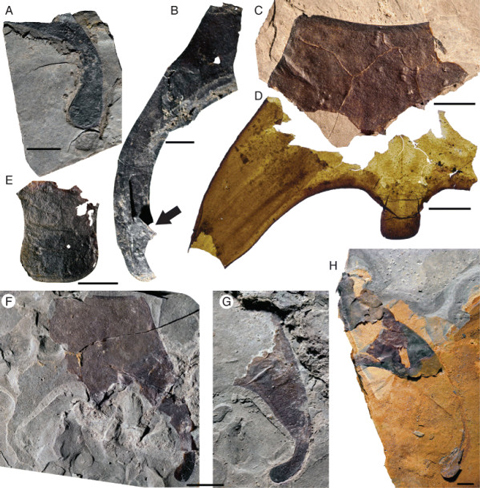
Some of the Fossil Specimens that have been Found

Examples of fossil specimens.

Examples of fossil specimens, scale bars = 10 mm.

Picture credit: Lamsdell et al

Highly Fossiliferous Strata

The highly fossiliferous strata was discovered by an Iowa Geological Survey team (University of Iowa), close to the Upper Iowa River.  A temporary dam had to be constructed to allow the fossil site to be excavated. More than 150 fossils of Pentecopterus have been found, many of them representing juveniles.

University of Yale palaeontologist Derek Briggs, a co-author of the study explained that the shale deposits represent an ecosystem that became established when the sea flooded a meteorite impact crater some three miles across.  The weak currents coupled with the oxygen depleted bottom contributed to the remarkable state of preservation of the fossil material.  Even tiny hairs on the limbs can still be seen.

An Enormous Arthropod (Pentecopterus decorahensis)

Although, enormous for an arthropod, it is not the biggest eurypterid known, Everything Dinosaur has reported on a number of very large fossil sea scorpions

To read more about giant eurypterids: Giant Eurypterid Tracks Discovered in Scotland.

Giant Devonian Sea Scorpion: Claws! of the Devonian.

The largest living member of this Phylum today is the Japanese spider crab (Macrocheira kaempferi), the diameter of the legs of the largest males can be in excess of 3.5 metres and some specimens have weighed more than fifteen kilogrammes.

Everything Dinosaur Comments

A spokesperson from Everything Dinosaur stated:

“Thanks to the remarkable Winneshiek Lagerstätte scientists have been able to look into a window of marine life from some 467 million years ago.  Anyone taking a dip in the brackish waters that linked this part of Iowa to the seas surrounding the ancient land mass of Laurentia had better watch out.  This was one arthropod capable of giving you more than just a “nip” with its claws.”

CollectA have created a range of replicas that represent significant ancient invertebrates from the fossil record: Replicas of Iconic Fossil Invertebrates (CollectA).

26 08, 2015

Cave in the Urals Reveals Haul of Cave Lion Bones

By |2023-04-05T12:19:19+01:00August 26th, 2015|Categories: Dinosaur and Prehistoric Animal News Stories, Main Page, Photos/Pictures of Fossils|0 Comments

Imanai Cave – Strange Significance to Stone Age People

A team of Russian archaeologists have been putting on display some of the huge collection of prehistoric cave lion bones and other artefacts recovered from a cave in the Russian republic of Bashkiria close to the Ural mountains.  The small cave has yielded some five hundred cave lion bones so far, plus a number of flint spearheads and a cave bear skull that shows evidence of having been pierced by a spear.  The cave, known locally as the Imanai cave, shows no signs of sustained hominin habitation and it has been suggested that prehistoric people considered part of the cave to have some special, perhaps even religious significance and these items were brought into the cave deliberately.

Five Hundred Cave Lion Bones

Scientists Show some of the Flint Tools and Cave Lion Skulls

Imanai cave lion skulls on display.

Imanai cave lion skulls on display.

Picture credit: Pavel Kosintsev

A Unique Concentration

Such a concentration of cave lion bones in the cave is unique, nowhere else in the world has such a mass concentration of cave lion bones been discovered.  The bone assemblage probably represents six individual animals.

Pavel Kosintsev, a senior researcher at the regional Institute of Plant and Animal Ecology (Urals Branch of the Russian Academy of Science) stated:

“We found about five hundred bones and fragments of bones of the giant cave lion, but there could be more, after we finish with sorting the collection.  Such a large quantity of giant cave lion bones at one site is really unique, the only one in the world so far discovered.”

Giant Cave Lions

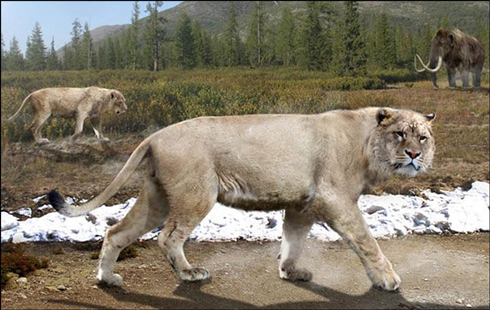
The cave lion (Panthera leo) shares the same scientific name of the modern African lion of the savannah.  Although some scientists believe that it is sufficiently different from its African relative to be classified as a sub-species (P. leo spelaea) It may be classified as the same species, by many academics, but the cave lion looked very different from its modern African counterpart.  Panthero (leo) spelaea was around 15-20% bigger and it had longer legs.

It also possessed a thick, shaggy coat which during the winter months, when snow covered a large part of this animal’s range, that coat might well have turned white to help camouflage this large predator.  It seems that in the past, the lion as we know it today lived over a much wider area of the Northern Hemisphere.  Its range extended out of Africa and into Europe, indeed cave lion fossils have been found in the UK, most notably Kents Cavern near Torquay (Devon).

Despite their name, cave lions were not adapted to a life in caves, they were creatures of the open tundra, forests and plains.  Their bones may have been washed into caves or brought into cave dens by scavenging animals and as a result, since the bones of these large cats are associated with caves and rock overhangs the term cave lion was adopted to distinguish them from extant species.

An Illustration of a Cave Lion (note the light coloured coat)

An illustration of a cave lion.

An illustration of a cave lion.

Picture Credit: Russian Academy of Science/Pavel Kosintsev

Cave Lion Bones

Earlier excavations had found isolated bones deep inside the caves, but these were interpreted as having been sick or injured lions, or lost cubs.  The researchers believe that the cave may have been an ancient sanctuary and that these sick and injured animals could have been brought to the cave by ancient people.  This suggests that the Imanai cave had some significance to the ancient humans that inhabited this part of the Urals, perhaps it was a place of worship.  A number of other such sites were bone deposits have been made are known, the scientists hope to compare their cave data with similar sites from Austria and the Czech Republic.

The human relics found include ten stone spearheads, identified as being from the Mousterian culture, previously only two such spearheads had been found in the entire Urals region of Russia.

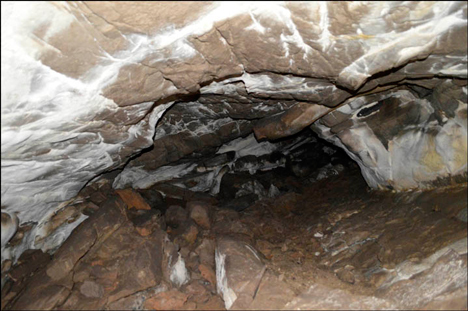
Inside the Cave (Imanai Cave Ural Mountains)

Going down to the bone deposit site.

Going down to the bone deposit site.

Picture credit: Pavel Kosintsev

The Mousterian Culture

The Mousterian culture is defined by the style of stone tools associated with European hominins.  It relates to the Old Stone Age and dates from around 600,000 years ago with the youngest tools associated with this culture dating to around 30-40 thousand years ago.  This technology has been found in sites across southern Europe, Turkey and parts of the Middle East.  Mousterian flint tools have been discovered as far west as Wales and the Imanai cave represents one of the eastern margins for this stone tool culture.  During the Mousterian, Europe was populated by a range of hominin species, including Homo heidelbergensis, Homo neanderthalensis and latterly our own species which migrated into this part of the world from Africa – H. sapiens.

Spearheads the Only Sign of Human Activity

The spearheads and the cave bear skull with its spear hole are the only signs of human activity.  If ancient hominins had lived in this cave, even for a short period, the archaeologists would have expected to find a lot more evidence of human habitation.  For example, signs of fire having been used, animal bones with cut marks from being butchered and other stone tools.  The lack of other human artefacts supports the hypothesis that this site might have been a sanctuary of some sort or perhaps a shrine.

The latest finds have not been dated, but the upper layers of the cave floor mapped during an earlier reconnaissance are believed to be around 30,000 years old.  The lower layers are much older, how much older will have a significant bearing on the study, as the scientists cannot be sure what species of people (indeed, the cave could have been an important location to more than one type of hominin) they are dealing with.  Preliminary estimates place the lower, bone yielding layers at around 60,0000 years ago, so this site could be very significant in terms of Neanderthal research.

Different Populations of Humans

However, different populations of humans occupied different parts of Europe as the climate swung dramatically from very cold periods to much warmer inter-glacial periods during this part of the Pleistocene Epoch.  Further dating of material is currently being undertaken by scientists from the University of St Petersburg.

Archaeologists Working in the Cave at the Bone Deposit Site

Scientists carefully examining in situ evidence.

Scientists carefully examining in situ evidence.

Picture credit: Pavel Kosintsev

Explaining the team’s future plans Pavel stated:

“We plan to continue the excavations next year, but the amount of finds we made this year is very large.  There are about twenty sacks with ground and small fragments and about twenty to twenty-five boxes with bones.  We need to examine all this and I think that some significant updates may appear as soon as this year.”

All the bone and tool finds come from an area of just six square metres in the cave, which has been excavated to a depth of around sixty centimetres.  The research team are excited at the prospect of exploring other parts of the cave and finding many more artefacts.  The greater the number of artefacts, then more information can be obtained which should help the scientists to understand more about the cave, its occupants and how it fitted into ancient human cultures.

Everything Dinosaur stocks a wide range of prehistoric mammal figures and models: Models of Prehistoric Mammals.

17 07, 2015

Fossilised spermatozoa preserved in Annelid Cocoon from the Eocene

By |2023-04-01T14:30:20+01:00July 17th, 2015|Categories: Dinosaur and Prehistoric Animal News Stories, Main Page, Photos/Pictures of Fossils|0 Comments

Fossilised Spermatozoa from Ancient Annelid

Dinosaurs and other large vertebrates might grab all the headlines when it comes to fossil discoveries but share a thought for those parts of the Kingdom Animalia which do not readily fossilise.  Invertebrate palaeontologists working on the Annelida (segmented worms and leeches), soft bodied creatures, have very few body fossils to study.  As a result, the dedicated scientists which work on them don’t have anything like a complete fossil record of these extremely important creatures.

Trace fossils, such as preserved burrows can help, but the evolutionary history of these ancient animals remains poorly understood.

Cocoon Fossils

In contrast, the distinctive egg cases, often referred to as cocoons of the worms that make up the Class Clitellata, are relatively common in the fossil record.  Everything Dinosaur team members have read published papers that explore the fossilised remains of the cocoons from worms that once lived in freshwater environments back in the Triassic.  These preserved cocoons provide valuable additional information as to the diversity of micro-faunas within ancient biotas.  Unfortunately, little work has been carried out so far on the possibility of using such fossils to establish phylogenetic relationships between families and genera.

Class Clitellata

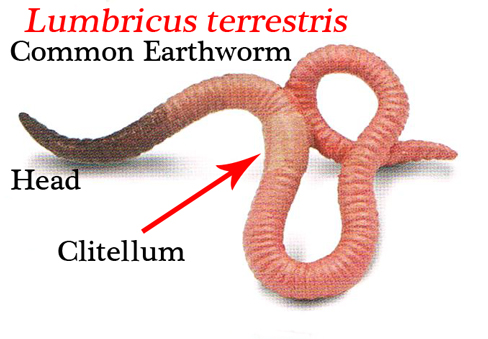
The worms that make up the Class Clitellata are distinguished from other types of segmented worm, in that they have a “collar”.  It is this “collar”, called the clitellum that gives this Class its name and it is from the Clitellum that the reproductive cocoon is formed.

A Diagram of a Common Earthworm Showing the Clitellum

The Clitellum is marked by an arrow.

The clitellum is marked by an arrow.

Picture credit: Everything Dinosaur

Fossilised Spermatozoa

A team of scientists from the University of Milan, the Swedish Natural History Museum and the Museo de la Plata (Argentina) have published a paper in the academic journal “Biology Letters” that details the discovery of fossilised spermatozoa (sperm) preserved within the secreted wall layers of a fifty-million- year-old clitellate cocoon found in Antarctica.  This material represents the oldest fossil animal spermatozoa yet described.

The specimen was collected during a field expedition to the remote Seymour Island, one of a group of small islands at the tip of the Antarctic Peninsula.  The Island is extremely significant to palaeontologists as the strata exposed dates from the Late Cretaceous, the Palaeogene and into the early part of the Neogene (Eocene Epoch).  Fossils found on Seymour Island include marsupials, proving that in the past terrestrial mammals lived on Antarctica, but the rocks have proved most useful in helping scientists to plot climate change, including the global cooling during the Eocene that led to the glaciation of the Poles.

Fossil is Approximately 50 Million Years Old

Strontium isotope dating gives an age of approximately fifty million years for the fossilised spermatozoa (Ypresian faunal stage of the Eocene), the fossil find was made by chance as a single worm fragment just 0.8 mm wide was studied using a scanning electron microscope.  A three-dimensional model was then created using sections of the fragment that had been examined under X-ray microscopy.

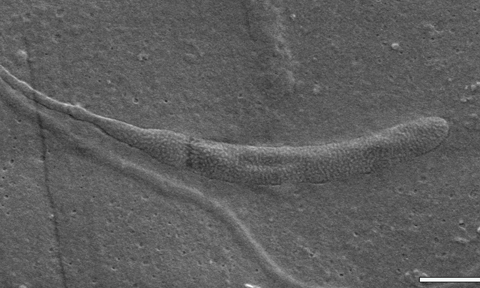
A Fragment of the Fossilised Worm Spermatozoa

Ancient remains - scale bar = 1 micron.

Ancient remains – scale bar = 1 micron.

Picture credit: Swedish Museum of Natural History (Department of Palaeobiology)

When closely examined, the clitellate was found to consist of a solid inner wall, just one fortieth of a millimetre thick.  In addition, there was a spongy, outer layer of loosely interwoven cables between 100th and 200th of a millimetre in thickness.  The scientists were able to observe images of the microscopic cells embedded in the cocoon wall, including rod-shaped structures with a whip-like tail.

Modestly commenting on the discovery, Benjamin Bomfleur, a palaeobotanist at the Swedish Natural History Museum remarked:

“It was an accidental find.  We were analysing the fragments to get a better idea of the structure of the cocoon.  When we zoomed into the images, we started noticing these tiny biological structures that look like sperm.”

A Worm Mystery

Working with biologists the team were able to conclude that the fossils resemble the sperm of extant freshwater crayfish worms (Branchiobdellida), although since these worms are only found in the Northern Hemisphere it remains a mystery as to whether or not the Antarctic fossil specimen is closely related.  How the fossils came to form in the first place is a little bit of a puzzle too.

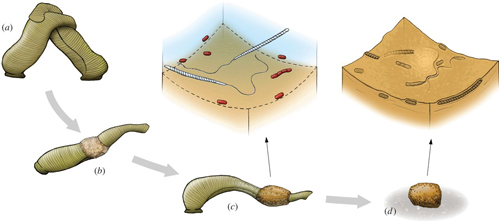
Diagram Illustrating the Inferred Method of Fossilisation of Microorganism (Clitellate Cocoons)

Inferred fossilisation process.

Inferred fossilisation process.

Picture credit: Biology Letters

In the diagram above, the common medicinal leech is used to illustrate a potential theory of how the fossil preservation occurred.  Two leeches mate (a), a cocoon is secreted from the clitellum (b), then eggs and sperm are released into the cocoon before the animal retracts and eventually deposits the sealed cocoon on a suitable substrate.  Spermatozoa and microbes become encased in the solidifying inner cocoon wall (d).

The scientists anticipate that this accidental discovery will permit systematic surveys of cocoon fossils coupled with advances in non-destructive analytical techniques that will open up new opportunities to explore the evolutionary relationships of minute, soft-bodied animals that are otherwise so rarely found in the fossil record.

Visit Everything Dinosaur’s award-winning website: Everything Dinosaur.

13 07, 2015

Dinosaur Chemical Ghosts (New Study)

By |2024-04-11T10:16:49+01:00July 13th, 2015|Categories: Dinosaur Fans, Palaeontological articles, Photos/Pictures of Fossils|0 Comments

Manchester University Leads the Way With Mapping Elements (Dinosaur Chemical Ghosts)

Studying fossils has changed radically over the last two decades.  More and more tools are being added to the palaeontologist’s armoury, many of these tools are drawn from a variety of other scientific disciplines, engineering, materials science and medicine for example.  Manchester University has been pioneering the mapping of elements including metals in fossil material.  Once an understanding of a fossil in terms of the elements preserved has been achieved, researchers can begin to piece together clues about the biology of the organism and the burial history.

Dinosaur Chemical Ghosts

Using a sophisticated piece of technology (synchrotron-based X-ray imaging), scientists can explore the composition of scales, teeth, skin and feathers from long extinct creatures.  Elements such as zinc (Zn) and Calcium (Ca) can be plotted on the fossil, providing details on features that would not be visible under normal light or ultra-violet lighting conditions.

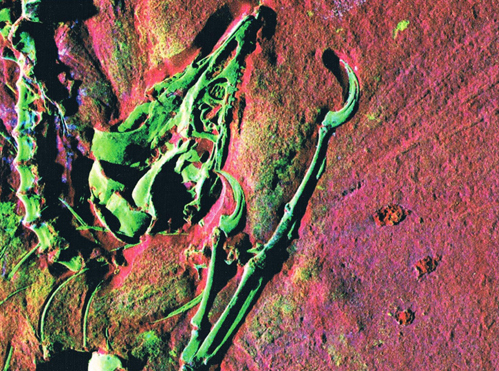
A False Colour SRS-XRF map of an Archaeopteryx Fossil

Looking at the individual elements of a fossil specimen.

Looking at the individual elements of a fossil specimen.

Picture credit: Manchester University

The picture above shows a close up of the skull, cervical vertebrae (neck bones) ribs and the wings of Archaeopteryx (Archaeopteryx lithographica).

Key

red = Ca (calcium, the matrix is limestone, hence, high levels of calcium surrounds the fossil)

green – Zn (zinc)

blue = Mn (manganese)

The brighter and more intense the colour the higher concentration of that element.

Mapping Elements in Fossils

Blue flecks of colour on the surface of the fossil are the result or the presence of tiny precipitates of manganese minerals, which has probably been deposited by ground water.  There is some zinc associated with mineral precipitates too, but virtually all of the zinc in this image is associated with the fossil bone material.  This suggests that zinc was present in large quantities in the original bone (as found in many types of organism today).  The zinc has been locked within the bones for over 150 million years, as Archaeopteryx (A. lithographica) lived during the Late Jurassic.

 It is the application of new technologies that is opening up a whole world of new possibilities when it comes to investigating creatures that lived in the past.

Back in January, 2015 Everything Dinosaur team members made a number of predictions as to what might happen in the palaeontology over the next twelve months.  One of our “palaeontology predictions” was that there would be more research undertaken into biometals preserved as fossils, there would be more work on the metallome.

A metallome is the presence of metallic elements in relation to organic matter.  From analysis of this data, scientists will be able to learn more about the type of biological processes that once were carried out by long dead organisms.

To read more about Everything Dinosaur’s palaeontology predictions for 2015: Palaeontology and Fossil Predictions for the Next Twelve Months (2015).

For an article published in May 2014 that explains in a little more detail some of the research currently being undertaken into biometals and their presence in the fossil record: Palaeontology Enters the Metal Age.

Visit Everything Dinosaur’s award-winning website: Everything Dinosaur.

22 05, 2015

Rare Fossil Site Threatened (Hall Dale Quarry)

By |2024-05-05T13:41:31+01:00May 22nd, 2015|Categories: Geology, Main Page, Palaeontological articles, Photos/Pictures of Fossils|0 Comments

Former Quarry Could be Transformed into Housing and Commercial Development

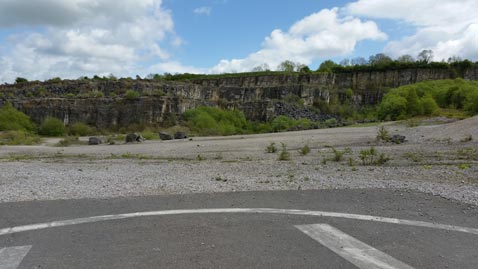
The huge Hall Dale Quarry near Matlock, Derbyshire, could be transformed, with the potential loss of an amazing fossil location, if the local authority grants permission for a mixed residential and commercial development on the site.  Hall Dale Quarry is a disused limestone quarry.  We at Everything Dinosaur, don’t know when the quarrying of limestone blocks ceased, what we do know is that the rocks exposed at this location contain a huge diversity of Carboniferous invertebrate fossils.

Fossil Finds are Extremely Common

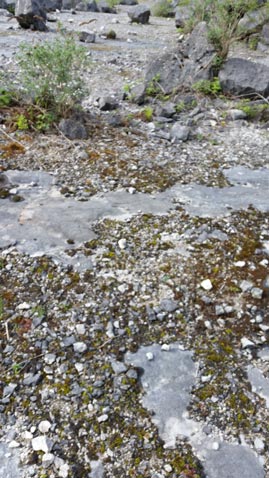
Fossils are extremely common at the quarry, whilst many amateur collectors split the boulders with heavy-duty chisels to access the fossil material, just a few minutes exploring the scree on the quarry floor will yield plenty of specimens.  Fossils of a variety of Brachiopods, Crinoid stems and large Corals litter the site and with careful searching some nice examples of marine Gastropods (mainly internal moulds), can be discovered too.

The strata represents a shallow, marine environment and the rocks at the quarry are part of the Eyam limestone formation.  They date from the Early Carboniferous (Visean faunal stage of the Middle Mississippian Epoch [345-328 mya]).  The site is hidden from the road and is approached via a small path leading through a wooded area, although it is just a few minutes’ drive from the bustling centre of the Derbyshire market town of Matlock, once at the quarry face, it’s a different world.  On the day Everything Dinosaur visited, the quarry was deserted, we did not see a single person for the best part of three hours.

A View from the Helicopter Pad at Hall Dale Quarry

Hall Dale Quarry (Derbyshire)

Hall Dale Quarry (Derbyshire).

Picture credit: Everything Dinosaur

Hall Dale Quarry

The rock strata forms a series of platforms (three in total), Hall Dale Quarry is a popular location with climbing clubs, the sheer rock faces and huge piles of stone provide plenty of different climbing routes to explore.  We would advise that fossil collectors stay on the ground level, there are plenty of fossils to be found and there is no need to climb the boulders.

Enormous Boulders at Hall Dale Quarry

Huge boulders - can you see our rucksack?

Huge boulders – can you see our rucksack?

Picture credit: Everything Dinosaur

During our research, prior to our fossil hunting trip, we visited the excellent website of UK Fossils: UK Fossils.  As we prepared for our visit, we came across a news article from November 2014 that outlined plans for the development of this rural space, what is termed a brownfield site.  4M Property Partners had submitted plans to convert the quarry into a development consisting of mixed residential and commercial properties.

Plans to Develop the Quarry Site

Plans had been submitted to the council to build some 220 houses, and to convert 400 square metres into a restaurant and a café.  In addition, the planning proposal contained details of some 6400 square metres of office space.  We at Everything Dinosaur are not sure exactly how fossil collecting would be affected by these developments, we are also unsure as to how the planning application has progressed.  However, we would like to express our concern that such an amazing place might be lost forever.

Whilst we can appreciate that Matlock, like many towns in the UK, may have a need for more houses and that such a development might boost the local economy, as we stood in the quarry, totally in awe of the spectacular scenery and surrounded by evidence of a tropical, marine environment that existed some 340 million years ago, it seemed such a shame that this location might soon be unrecognisable.

Many Different Types of Invertebrate Fossil can Be Found in the Scree

Fossils can be found in the scree.

Fossils can be found in the scree.

Picture credit: Everything Dinosaur

A Remarkable Fossil Heritage

There may be an urgent need for more local housing.  The town of Matlock might desperately require additional commercial properties.  We feel that we are unable to comment with regards to these development plans, but we sincerely hope that the developers have at least considered the need to preserve some part of this remarkable location’s fossil heritage.  There are fewer and fewer places in this country, where people can simply stop and stare and admire rock formations and the fossil treasures they contain within.  These special sites demonstrate the rich geology of our landscape and allow visitors to explore life in the past.  We hope that any development is undertaken in sympathy with the astonishing geology of this location.

A Few Minutes Collecting and So Many Fossils

A multitude of fossils can be picked out from the scree.

A multitude of fossils can be picked out from the scree.

Picture credit: Everything Dinosaur

For models and replicas of Palaeozoic creatures and other prehistoric animals: CollectA Age of Dinosaurs Popular Figures.
Wishing to express our concerns, the team member who visited the site contacted the planning department of Derbyshire Dales District Council.  A very helpful person in the department explained that the planning team could be emailed, allowing concerns about the need to develop the location in sympathy with the geology of the area to be put on record.  Everything Dinosaur subsequently did this and in addition, emailed Natural England to raise awareness of the development of this brownfield site with that organisation.

Raising Awareness About the Potential Loss of the Quarry

If you have collected fossils at Hall Dale Quarry and wish to make a point with reference to the re-development of this site and the potential loss of this fossil collecting location, then we would urge you to do so.

Planning application reference: 14/00541/OUT (please quote this reference when emailing the planning department or Natural England).

Email: [email protected] to contact Derbyshire Dales District Council (we would advise that you include a contact telephone number in your email, so that a planning team member can get in touch)

Email: [email protected] (again quoting planning reference: 14/00541/OUT) to get in contact with Natural England

Whilst we do understand the difficult and often challenging job of district councils and we aware of the potential economic benefits to the local community this project may bring.  We at Everything Dinosaur feel that it is important, to at least place on record a desire to consider the development of Hall Dale Quarry which takes into account the remarkable fossil bearing strata to be found at this location.

Please share.

Visit Everything Dinosaur’s award-winning website: Everything Dinosaur.

Go to Top