

Have you ever wondered what dinosaurs ate? It is one of the most common questions we at Everything Dinosaur get asked. The answer is surprisingly varied. Some dinosaurs were fierce meat-eaters, while others fed on plants. Others were omnivores (eating both plants and meat).
Scientists study fossil teeth, jaw bones, stomach contents and even fossilised droppings to understand dinosaur diets. As a result, palaeontologists have built a detailed picture of how different dinosaurs fed.
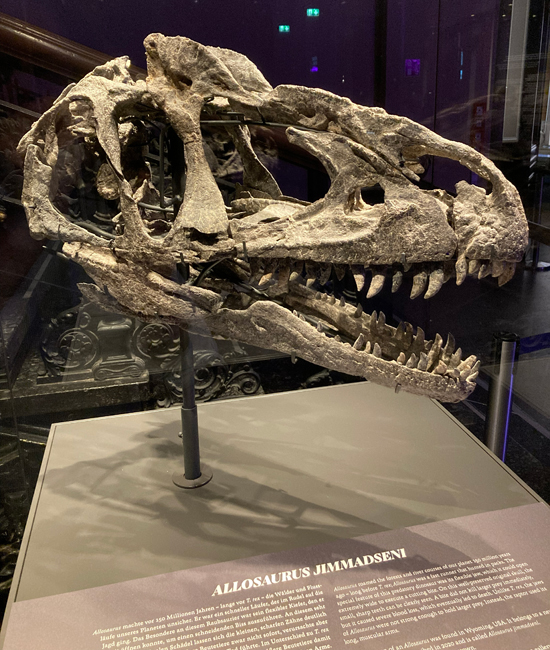
The skull of the carnivorous Allosaurus jimmadseni. Picture credit: Everything Dinosaur.
Picture credit: Everything Dinosaur
Meat-Eating Dinosaurs (Carnivores)
Carnivorous dinosaurs hunted other animals or scavenged carcasses. Many had long, sharp teeth designed for gripping and tearing flesh. The image (above) shows the skull of the Late Jurassic apex predator Allosaurus (A. jimmadseni). The sharp, curved teeth indicate the diet.
Carnivorous dinosaurs came in many different shapes and sizes. Some were enormous apex predators, while others were small, agile hunters. Their teeth, jaws and limbs evolved to suit a wide range of hunting strategies. For example, some species relied on speed and sharp claws, whereas others used powerful jaws to overpower large prey. This remarkable diversity allowed meat-eating dinosaurs to occupy many ecological niches throughout the Mesozoic.
Plant-Eating Dinosaurs (Herbivores)
Most dinosaur species were herbivores. These animals fed on leaves, ferns, conifers, cycads and, later in the Cretaceous, flowering plants. In addition, some herbivores evolved into the largest terrestrial animals known to science. For example, the image (below) shows a replica of the skull of the giant, plant-eating sauropod Patagotitan.
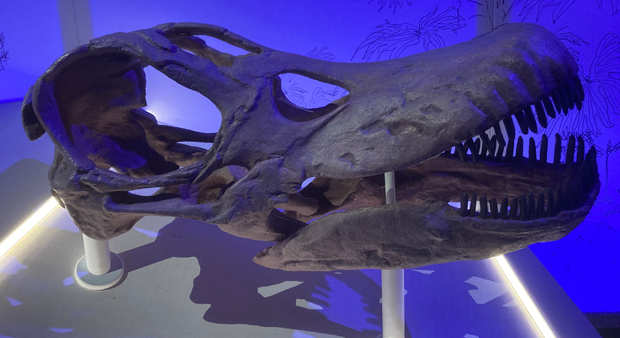
A replica of the skull of Patagotitan on display. Picture credit: Everything Dinosaur.
Picture credit: Everything Dinosaur
Long-necked sauropods such as Patagotitan browsed high vegetation. Meanwhile, horned dinosaurs like Triceratops used powerful beaks to crop tough plants closer to the ground.
Duck-billed dinosaurs had hundreds of teeth that formed dental batteries. These allowed them to grind coarse vegetation efficiently before swallowing it.
Did Any Dinosaurs Eat Both Plants and Meat?
Some dinosaurs probably had an omnivorous diet. Early dinosaurs and several other taxa may have eaten insects, eggs, small vertebrates as well as plants. For example, many scientists think that some primitive dinosaurs were opportunistic feeders. They likely consumed whatever food was available during changing seasons.
Researchers examine the dentition of early dinosaurs: Tooth Shape and Dinosaur Diet.
Modern birds, the closest living relatives of dinosaurs, also show a wide range of diets. Therefore, it is reasonable to suggest that dinosaurs displayed similar flexibility.

A Gallimimus scale drawing. Ornithomimids like Gallimimus could have been omnivorous. Picture credit: Everything Dinosaur.
Picture credit: Everything Dinosaur
How Do Scientists Know What Dinosaurs Ate?
Palaeontologists use several lines of evidence to reconstruct dinosaur diets.
These include:
- Tooth shape and wear patterns.
- Skull and jaw anatomy.
- Fossilised stomach contents.
- Bite marks on fossil bones.
- Fossilised droppings (coprolites).
- Computer models that estimate bite force and kinetic studies.
Together, these clues help scientists understand how dinosaurs fed and interacted with their environment.
Did Dinosaurs Chew Their Food?
Most carnivorous dinosaurs swallowed large chunks of meat. However, many herbivorous dinosaurs processed food more thoroughly.
For example, hadrosaurs possessed complex dental batteries that continually replaced worn teeth. In contrast, sauropods probably swallowed vegetation with little chewing. They may have relied on gastroliths, or stomach stones, to help grind food during digestion.
Understanding dinosaur diets helps scientists reconstruct ancient ecosystems. Every new fossil discovery adds another piece to the puzzle.
If you would like to explore dinosaurs in greater detail, visit the Everything Dinosaur Website. Our range includes scientifically accurate prehistoric animal models representing carnivores, herbivores and omnivores from throughout the Mesozoic.

Leave A Comment