

Tracking Down an Elusive Allosaurus Species
Allosaurus has become a bit of a taxonomic waste basket. This term relates to fossil material from theropods being assigned to the genus. However, some of the evidence for assigning the material is tentative. For example, theropod bones from southeastern Tanzania (Tendaguru Formation) had been assigned to an allosaur species named Allosaurus tendagurensis. In 1925, when A. tendagurensis was erected (Janensch), Allosaurus was the best-known large Upper Jurassic carnivorous dinosaur. These days, palaeontologists have a better understanding of Late Jurassic meat-eating dinosaurs. These fossils are now described as “Tetanurae indet.”
Allosaurus tendagurensis
Whilst on a visit to the Museum für Naturkunde Berlin, we tracked down some of the Allosaurus tendagurensis fossils. In a display case in the dinosaur gallery, we found a large tibia (lower leg bone), two teeth and a caudal vertebra. The fossils had their original labels on them and were perhaps some of the material cited by the German palaeontologist Werner Janensch in the paper “Die Coelurosaurier und Theropoden der Tendaguru-Schichten Deutsch-Ostafrikas” published in 1925.

Originally described as Allosaurus tendagurensis by the German palaeontologist Werner Janensch (1925), these fossils are not associated with any specific theropod taxon but rather referred to as possible megalosauroid or carcharodontosaurid material. Picture credit: Everything Dinosaur.
Picture credit: Everything Dinosaur
The remains of several large predatory dinosaurs were found in the Upper Jurassic deposits of Tendaguru. From these remains two teeth, a lower leg bone (tibia) and a tail vertebra (caudal vertebra) are shown in the photograph. Although the material is incomplete, scientists can narrow down the group that the animal belonged to. It was probably a member of the carcharodontosaurid. However, as a more definite identification cannot be made, the fossil material is described generally as “Tetanurae indet.”
The Tetanurae Clade of Theropod Dinosaurs
The Tetanurae is a clade of theropod dinosaurs. It contains all the theropods more closely related to birds than to Ceratosaurus. Constituents include coelurosaurs, megalosauroids and allosauroids. Intriguingly, the Tendaguru bones tend to be larger than those associated with most allosaurids. Therefore, palaeontologists have concluded that theropods comparable in size to T. rex were present in the ecosystem. The fossils originally referred to Allosaurus tendagurensis could represent a carcharodontosaurid or possibly a megalosauroid.
Several Species of Allosaurus
Over a hundred years after Janensch described the Tendaguru theropod fossils, palaeontologists have a much better understanding of the composition of the Allosaurus genus. For example, several species are now recognised:
- Allosaurus fragilis – named by Othniel Charles Marsh in 1877 (North American species).
- Allosaurus europaeus – from the Upper Jurassic strata of Portugal associated with the Lourinhã, Bombarral, and Alcobaça geological formations (Mateus et al 2006).
- A. jimmadseni – another North America species erected after a reassessment of fossil material formerly assigned to A. fragilis (Chure and Loewen, 2020).
- Allosaurus anax – erected following a reappraisal of fossil material formerly assigned to Saurophaganax (Danison et al, 2024).
New research suggests that Allosaurus europaeus is not a valid taxon: Research Undermines an Allosaurus Species.
The naming of Allosaurus jimmadseni: A New Species of Allosaurus is Erected.
The demise of Saurophaganax: New Study Suggests Saurophaganax is Not a Valid Taxon.
Unfortunately, species assignment and potential synonyms are complicated by the type specimen of Allosaurus fragilis (YPM 1930) being extremely fragmentary. This has led to difficulties ascribing fossils found in North America, Europe and elsewhere in the world to Allosaurus.
Most dinosaur models probably represent Allosaurus fragilis, or possibly Allosaurus jimmadseni.
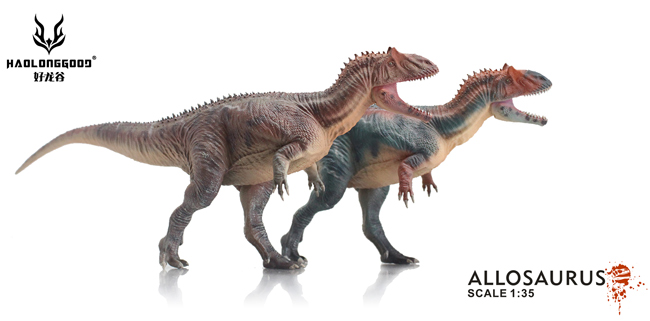
The Haolonggood Allosaurus dinosaur models (Allosaurus Yangzhi and Suochao). These are typical of the high quality of Allosaurus models available. Although Haolonggood do not declare a genus, the crests above the eyes suggest Allosaurus fragilis.
To view the extensive range of Haolonggood figures in stock: Haolonggood Dinosaur Toys.
Mike from Everything Dinosaur commented:
“Considerable work has been undertaken leading to a revision of the Allosaurus genus. Several species have been erected. However, some taxonomy remains controversial. Moreover, it is likely that fossils associated with this famous dinosaur will be revised further in the future.”
Allosaurus roaming Australia: Highlighting Australian Dinosaurs.
The multi-award-winning Everything Dinosaur website: Prehistoric Animal Models and Dinosaur Toys.