

There are many details to admire in the new Wild Safari Prehistoric World Mosasaurus model. For example, there are pterygoid teeth on the roof of the mouth. The best prehistoric animal figures feature anatomical details that elevate them above other figures. The inclusion of the remarkable Mosasaurus pterygoid teeth is a sure sign that a great deal of care and attention was involved in the design process.

A photograph of the roof of the mouth of the new for 2026 Wild Safari Prehistoric World Mosasaurus model. The pterygoid teeth and the choanae (internal nostrils) are clearly visible. The choanae are paired openings on the roof of the mouth (the palate) that connect the oral cavity to the nasal passages. The pterygoid teeth help to grip slippery prey and manoeuvre food items down the gullet. Picture credit: Everything Dinosaur.
Picture credit: Everything Dinosaur
Prehistoric animal models capture our imagination. They can have striking colour schemes and dramatic poses. However, the very best models also include substantial anatomical details. These details help to bring the animal to life and can inspire a collector to ask questions about that long extinct creature. Furthermore, accurate prehistoric animal figures encourage collectors and young dinosaur fans to look more closely at prehistoric life.
Mosasaurus Pterygoid Teeth
Most reptiles have teeth attached to their upper and lower jaws. Mosasaurs, however, possessed an additional set of teeth on bones known as the pterygoids, located on the roof of the mouth. These Mosasaurus pterygoid teeth acted like a second row of backwards-pointing hooks. Once prey had been seized by the jaws, the pterygoid teeth helped grip and push the prey item down the gullet. When tackling slippery fish or a struggling marine reptile, a second set of teeth on the palate came in handy.
Many lizards and snakes living today have pterygoid teeth. This shared anatomical trait helps to demonstrate that the Mosasauridae family are members of the Squamata.
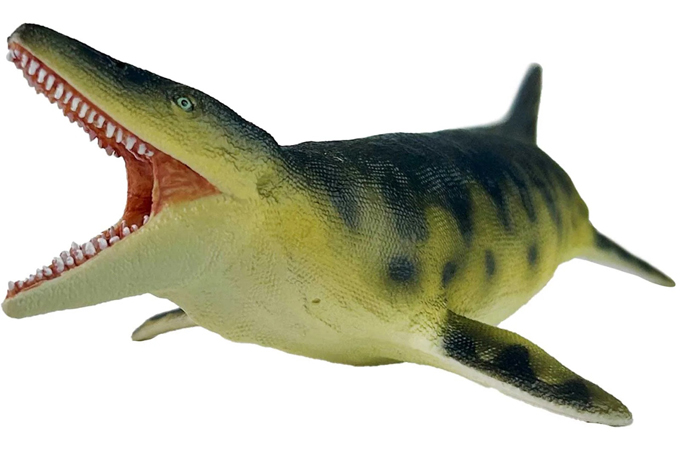
The model has a forked tongue and pterygoid teeth. In addition, the skin texture reflects current scientific understanding. Furthermore, the model has an asymmetrical (hypocercal) tail.
To view the range of Wild Safari Prehistoric World models in stock: Wild Safari Prehistoric World Marine Reptiles and Dinosaurs.
Hidden Details Rewarding Curious Minds
Many collectors may never notice the pterygoid teeth unless they look inside the model’s open mouth. Nevertheless, including them demonstrates a commitment to scientific accuracy that deserves recognition. Observant collectors might spot the forked tongue too.
It is often these small anatomical features that transform a model from a simple toy into an educational resource. A single question can lead to discussions about anatomy, adaptation, evolution and fossil evidence. In our view, inspiring curiosity is one of the greatest strengths of well-designed prehistoric animal figures.
At Everything Dinosaur, we have always believed that scientifically accurate models can play an important role in science education. Young fossil enthusiasts frequently learn about extinct animals through books and museum visits, but handling a detailed model provides another valuable way to explore prehistoric life. The new Wild Safari Prehistoric World Mosasaurus is an excellent reminder that attention to detail matters. Every carefully sculpted anatomical trait helps tell the story of an animal that ruled the world’s oceans during the Late Cretaceous.
Mike from Everything Dinosaur commented:
“Sometimes, the most fascinating feature of a prehistoric animal model is hidden in plain sight. In this case, it is the remarkable Mosasaurus pterygoid teeth, a small detail that makes a very big impression”.
For detailed prehistoric animal models: Detailed Dinosaur and Prehistoric Animal Figures.

Leave A Comment