

Ground-breaking Study Strengthens the Case for Lips in Dinosaurs
The debate about lips in dinosaurs continues. Whether dinosaurs possessed extraoral tissue remains controversial. However, a remarkable new study has added substantial support to the idea that most dinosaurs possessed extraoral tissues that covered and protected their teeth. A new study, published in the journal “Palaeontology” provides compelling evidence that lips were the ancestral condition in dinosaurs and many other reptiles.
Researchers led by Rafael Terras (Programa de Pós-Graduação em Ciências Ambientais, Universidade Comunitária da Região de Chapecó, Chapecó, Brazil), have examined Triassic archosaurs from Brazil. Their findings suggest that lips in dinosaurs were not an unusual feature. Instead, they may represent the ancestral condition for the entire Sauropsida, the group that includes reptiles and birds.
Importantly, this study does not stand alone. Rather, it builds upon previous work by researchers such as Robert Bakker, Thomas Paul, Casey Holliday, Mark Witton and Thomas Cullen. Consequently, the scientific case for lips in dinosaurs continues to grow.
A Debate That Goes Back More Than a Century
The idea of lips in dinosaurs is not new. In the 1920s, palaeontologist Charles Gilmore suggested that openings in the jaw of Ceratosaurus transmitted nerves and blood vessels to the lips. Later, Robert Bakker proposed that many dinosaurs possessed thin, immobile lips similar to those seen in living lizards. Ironically, the advent of cinema and the need to make dinosaurs scary by showing their teeth could have popularised non-lipped dinosaurs with the public.
More recently, the landmark 2023 study by Cullen and colleagues demonstrated that theropod teeth show little evidence of the wear expected if they had remained permanently exposed. Their work also highlighted similarities between theropod skull anatomy and living squamates.
To read more about the 2023 study: New Paper Suggests Dinosaurs Had Lips.
Now, this new study extends these observations far beyond the Theropoda.
Studying Triassic Archosauromorphs from Brazil
The researchers examined numerous Triassic archosaurs from southern Brazil. These included early dinosaurs and several crocodile-line relatives.
They found several features associated with covered teeth. For example, the team examined the location of foramina (tiny openings in the skull bones which are location points for nerves).
The researchers identified the following, consistent characteristics:
- rows of horizontally arranged facial foramina.
- fewer than one hundred foramina per rostral bone.
- vertically orientated teeth.
- a lack of interlocking teeth.
- uniform enamel thickness.
- no evidence of exposed dentine.
- a positive relationship between skull length and tooth crown height.
These characteristics closely resemble those seen in living lizards (lepidosaurs) rather than modern crocodilians. As a result, the authors concluded that labial scales and extensive gingiva (soft tissue that supports the teeth – gums) probably enclosed the teeth.
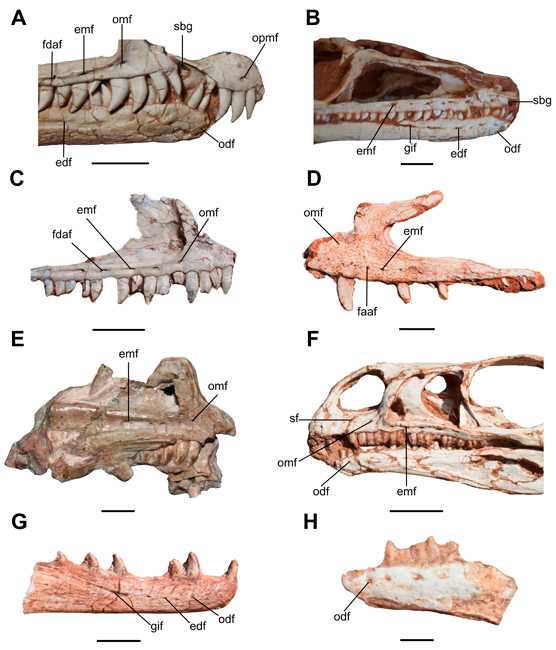
Foramina in selected Triassic saurischians. A, Buriolestes (ULBRA PVT 280). B, Buriolestes (CAPPA/UFSM 0035). C, Pampadromaeus (ULBRA PVT 016). D, Gnathovorax (CAPPA/UFSM 0009). E, Unaysaurus (UFSM 11069). F, Macrocollum (CAPPA/UFSM 0001a). G, Gnathovorax (CAPPA/UFSM 0009). H, Macrocollum (CAPPA/UFSM 0001d). Abbreviations: edf, ellipsoid dentary foramen; emf, ellipsoid maxillary foramen; faaf, foramen anterior to the maxillary fenestra; fdaf, foramen dorsal to the antorbital fenestra; gif, groove-inserted foramen; odf, oval dentary foramen; omf, oval maxillary foramen; opmf, oval premaxillary foramen; sbg, subnarial gap; sf, subnarial foramen. Scale bars represent: 10 mm (A–C, E, H); 25 mm (D, F, G). Picture credit: Terras et al.
Picture credit: Terras et al
Tooth Histology Provides Important Clues for Lips in Dinosaurs
The researchers also examined thin sections of fossil teeth. They discovered that enamel thickness remained consistent around the crowns. Furthermore, the dentine showed no signs of wear. This condition contrasts strongly with crocodilians, whose exposed teeth experience significant abrasion. Therefore, the teeth of these Triassic archosaurs appear to have remained hydrated and protected.
This conclusion mirrors the findings published by Cullen and colleagues in the 2023 paper. Consequently, independent lines of evidence are converging on the same answer.
Studying the Pseudosuchian Prestosuchus
One of the most intriguing aspects of the study concerns the giant pseudosuchian Prestosuchus. This large, terrestrial predator possessed a distinctive gap between the upper and lower jaws. At first glance, this arrangement might suggest permanently exposed teeth. However, the researchers argue otherwise. They propose that a mandibular gap existed between the jaws. Soft tissues and gingiva would have occupied this space and maintained a complete oral seal. In effect, the teeth remained covered despite the unusual skull shape.
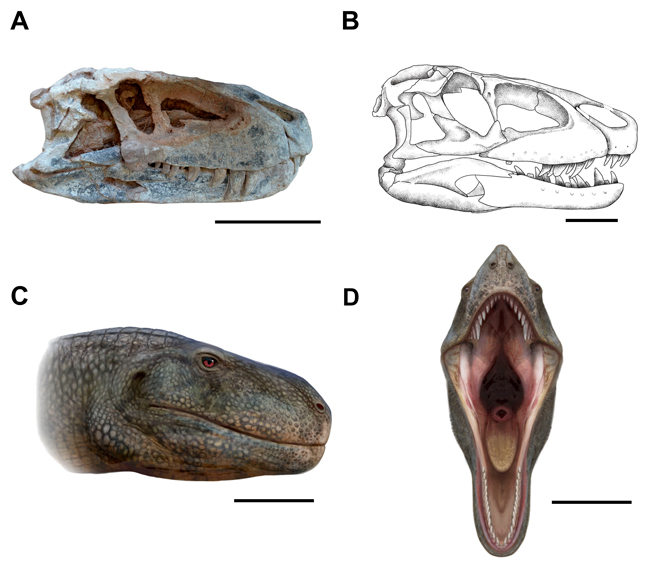
Prestosuchus skulls and reconstructions. A, ULBRA PVT 281 crushed skull in right lateral view. B, reconstruction of UFRGS PV 0629 T in right lateral view (mirrored) with a mandibular gap; modified from Mastrantonio et al. (2019). C–D, life reconstructions of ULBRA PVT 281: C, in right lateral view with a closed mouth displaying the oral seal; D, in frontal view with an open mouth displaying the oral rim; artwork by Matheus F. Gadelha used with permission. Scale bars represent: 300 mm (A, C, D); 100 mm (B). Picture credit: Terras et al with illustrations by Matheus F. Gadelha.
Picture credit: Terras et al with illustrations by Matheus F. Gadelha
This interpretation is significant. It demonstrates that specialised skull anatomy does not necessarily imply exposed teeth. Moreover, it suggests that lips could be retained even in large-bodied predators with unusual cranial morphology.
Prestosuchus (P. chiniquensis) is an extinct archosaur more closely related to extant crocodilians than to the Dinosauria. Size estimates vary but it could have reached a length of five metres or more. It was one of the largest Triassic pseudosuchians and an apex predator.
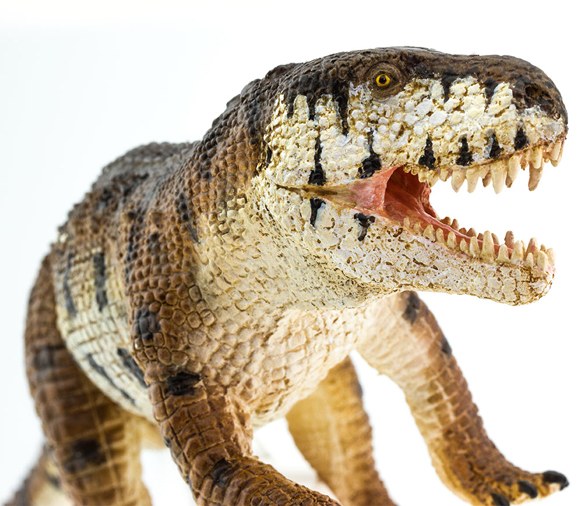
The Wild Safari Prehistoric World Prestosuchus model.
The image (above) shows a model of the Triassic predator Prestosuchus. This model was introduced in 2019. The model has exposed teeth and no extraoral tissue. It was made prior to the recent research suggesting the presence of lips in dinosaurs and other archosaurs. The Prestosuchus model is from the Wild Safari Prehistoric World range of figures.
Wild Safari Prehistoric World: Prehistoric Animal Models and Figures.
Lips in Specialised Archosauromorphs
The authors also considered a number of highly specialised forms. They concluded that lips probably occurred in a wide variety of archosaurs. For example, the researchers suggest that Triassic theropods had lips, along with sauropodomorph dinosaurs. In addition, they propose that ornithosuchids (pseudosuchian archosaurs – crocodilian lineage) had lips. Furthermore, the researchers propose that proterosuchids (basal archosaurs) also had extraoral tissue. It is suggested that phytosaurs had lips too. Some archosauromorphs evolved additional keratinous coverings. These structures formed primitive beaks (rhamphothecae).
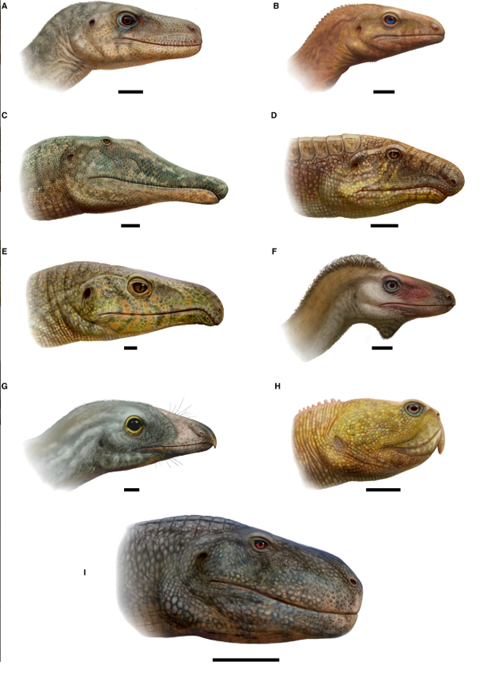
Triassic archosauromorphs reconstructed with labial scales and the oral seal in lateral view. A, Gnathovorax (CAPPA/UFSM 0009; Herrerasauria). B, Pampadromaeus (ULBRA PTV 016; Sauropodomorpha). C, Machaeroprosopus (NMMNH P-4983; Phytosauria). D, Riojasuchus (PVL 3827; Ornithosuchidae). E, Proterosuchus (NMQR 880; Proterosuchidae). F, Silesaurus (ZPAL Ab III/361; Silesauridae). G, Venetoraptor (CAPPA/UFSM 0356; Lagerptidae). H, ‘Hyperodapedon’ (ULBRA PVT 053; Rhynchosauria). I, Prestosuchus (ULBRA PTV 281; Loricata). Artwork by Matheus F. Gadelha used with permission. Scale bars represent: 50 mm (A, D); 20 mm (B, F); 100 mm (C, H); 30 mm (E); 10 mm (G); 300 mm (I). Picture credit: Terras et al with illustrations by Matheus F. Gadelha.
Picture credit: Terras et al with illustrations by Matheus F. Gadelha
A Complex Picture
The evolution of facial tissues in archosaurs appears to have been far more complex than previously thought. However, extraoral soft tissues such as lips were probably the ancestral condition. According to the authors of the study, lips represent the primitive condition for the Sauropsida. Therefore, the common ancestor of reptiles and birds likely possessed covered teeth.
If correct, exposed teeth evolved later. Extant crocodilians would represent a more derived branch of the Archosauria. Their exposed dentition and highly sensitive facial skin appear to be derived adaptations rather than the ancestral state. This finding reverses a common assumption. However, the debate about lips in dinosaurs and their near relatives is likely to continue.
Instead of asking why dinosaurs had lips, researchers may need to explain why crocodilians lost them.
A Growing Scientific Consensus
No single paper or study can settle such a complex question. Nevertheless, the evidence continues to accumulate. Studies of facial foramina, tooth wear, enamel thickness and skull proportions increasingly point in the same direction. Taken together, they indicate that most dinosaurs probably possessed extraoral tissues covering their teeth. As a result, reconstructions showing permanently exposed teeth may eventually become less common.
This study is significant because it suggests origins for this condition originated much earlier in archosaur evolution. Consequently, it provides fresh evidence that covered teeth were widespread among early members of the Archosauria. Furthermore, it strengthens the idea that the familiar crocodilian condition evolved later.
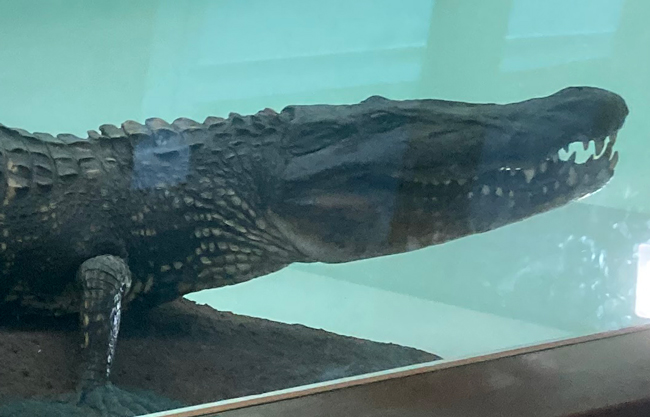
The head of a stuffed crocodile specimen (Nile crocodile) on display at the London Natural History Museum. The lack of extraoral tissue (lips) in this archosaur might be a derived condition. Picture credit: Everything Dinosaur.
Picture credit: Everything Dinosaur
Mike from Everything Dinosaur commented:
“This exciting new research adds another important piece to the puzzle. Evidence supporting lips in dinosaurs has been steadily accumulating for many years. The research team have shown that these soft tissues probably have much deeper evolutionary roots than previously thought. Their work strengthens the view that covered teeth represented the ancestral condition in dinosaurs and many of their close relatives. As a result, palaeoartists and scientists are gaining an increasingly detailed picture of how these remarkable animals actually looked.”
Everything Dinosaur acknowledges the assistance of the study’s corresponding author in the compilation of this article.
The scientific paper: “Inferred presence of extraoral tissues in Triassic archosauromorphs and the evolutionary implications for the clade Sauropsida” by Rafael Terras, Jaqueline Borger, Manuelle O. P. Almeida, Silvia Bettin, Owen A. Higgins, Giulia Marciani, Stefano Benazzi, Rodrigo T. Müller, Leonardo Kerber and Mirian Carbonera published in Palaeontology.
The Everything Dinosaur website: Museum Quality Models of Archosaurs.