

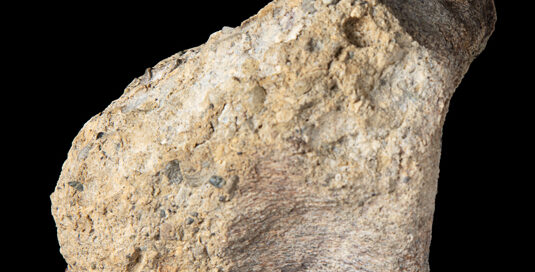
Scientists Formally Describe the First Dinosaur Fossil Found in Antarctica
Scientists have formally described the first dinosaur fossil found in Antarctica. The remarkable discovery is a single vertebra from a Late Cretaceous titanosaur. Although the fossil was collected more than forty years ago, researchers have only recently confirmed its identity. The first dinosaur fossil found in Antarctica described in the journal Acta Palaeontologica Polonica.
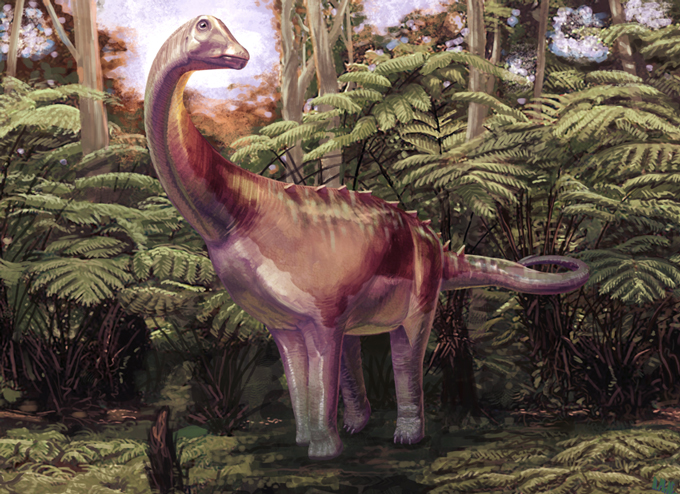
A life reconstruction of the titanosaur. The single caudal vertebra may have come from a dwarf titanosaur species or perhaps a titanosaur that was not fully grown. Picture credit: Andrew McAfee, Carnegie Museum of Natural History.
Picture credit: Andrew McAfee, Carnegie Museum of Natural History
The First Dinosaur Fossil Found in Antarctica Described
The fossil was discovered in 1985 by British Antarctic Survey geologist Dr Mike Thomson during an expedition Ross Island. At the time, the team focused on finding marine fossils such as ammonites. These fossils help scientists date ancient rock layers. However, one unusual bone collected during the expedition has now proved to be Antarctica’s first recognised dinosaur fossil.
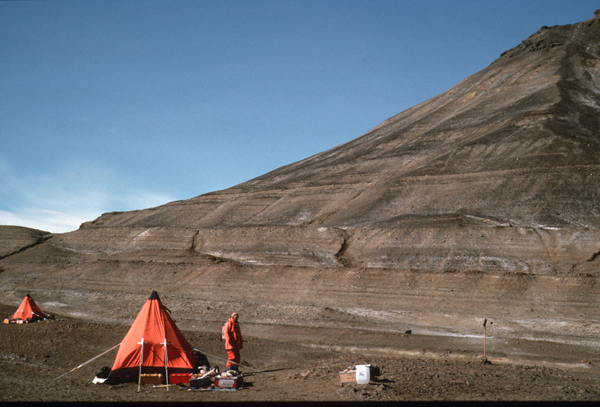
A photograph of the geology field camp on James Ross Island taken in 1985. Picture credit: Mike Thomson (British Antarctic Survey).
Picture credit: Mike Thomson (British Antarctic Survey)
Researchers identified the specimen as a tail vertebra from a titanosaur. Titanosaurs belonged to a diverse and geographically widespread group of sauropod dinosaurs. These plant-eating giants had long necks, long tails and pillar-like limbs. Some species ranked among the largest land animals ever to walk the Earth. The Antarctic animal, however, measured only around six to seven metres long. It was either a juvenile, or it possibly represented a relatively small species.
The Santa Marta Formation
The fossil came from the Santa Marta Formation, a sequence of Late Cretaceous rocks dating to approximately 82 million years ago (Campanian faunal stage). At that time, Antarctica looked very different. Instead of being buried beneath thick ice, much of the continent supported lush temperate forests. Dinosaurs, alongside a wide variety of other animals and plants, thrived in this much warmer environment.
Eutitanosauria indet. (BAS D.8621.25) from the Upper Cretaceous (lower Campanian) Beta Member (≈ upper Lachman Crags Member) of the Santa Marta Formation of James Ross Island, Antarctica. Fossil is shown in anterior view. Picture credit: The Trustees of the Natural History Museum, London.
Picture credit: The Trustees of the Natural History Museum, London
Interestingly, the vertebra was preserved in marine sediments. Scientists think the dinosaur died on land before its body drifted out to sea. Eventually, the remains settled onto the seabed where they became buried and fossilised.
Commenting on the significance of this single fossil bone, Dr Mark Evans (British Antarctic Survey) stated:
“This fossil was found by Dr Mike Thomson, one of the true pioneers of Antarctic geology, whose work helps us date all fossil finds across the Antarctic Peninsula today. When I first spotted this bone in our collections a few years ago, I suspected it was a dinosaur. After looking at it properly, I thought it was probably a titanosaur tail vertebra. Looking back at Mike’s notebooks, he knew it was a large reptile – so it’s very special to confirm his find forty years later. We’ve also been able to compare it against dinosaur fossils that have been found since.”
Antarctica preserves very few dinosaur fossils. Today, almost the entire continent lies beneath a vast ice sheet. As a result, very little fossil-bearing rock remains exposed. Most discoveries come from isolated coastal outcrops and mountain ranges where ancient rocks reach the surface. Consequently, every new specimen provides valuable information about Antarctica’s prehistoric ecosystems.
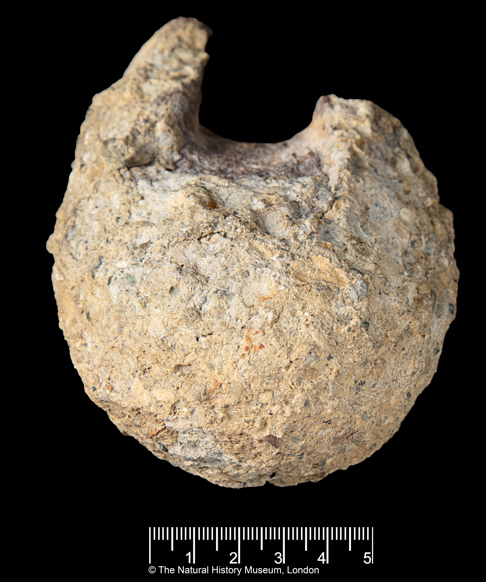
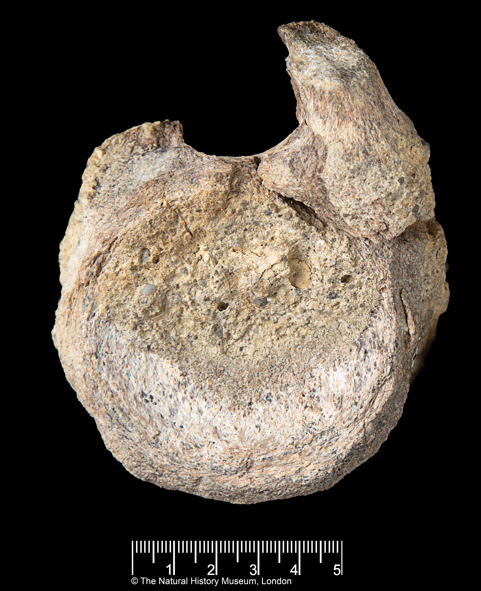
First ever dinosaur remains found in Antarctica described. A photograph of the single, caudal vertebra (BAS D.8621.25) shown in posterior view. Picture credit: The Trustees of the Natural History Museum, London.
Picture credit: The Trustees of the Natural History Museum, London
By comparing the vertebra with more recently discovered sauropod fossils, researchers confirmed that the bone belonged to a titanosaur.
An Important Milestone in Antarctic Exploration
Professor Paul Barrett of the Natural History Museum explained that the fossil represents an important milestone in Antarctic exploration. Furthermore, he suggested that many more dinosaur discoveries could await scientists as additional fossil-bearing rocks become exposed.
This discovery also improves our understanding of dinosaur evolution across the southern continents. During the Late Cretaceous, Antarctica formed part of the southern supercontinent Gondwana. Land connections linked Antarctica with South America and Australasia. Therefore, fossils such as this provide important evidence for the movement and distribution of dinosaurs across these ancient landmasses.
The first dinosaur fossil found in Antarctica may consist of only a single vertebra. Nevertheless, it represents a landmark discovery. Moreover, it highlights how museum collections continue to yield important scientific discoveries decades after fossils were first collected.
Everything Dinosaur acknowledges the assistance of a media release from the London Natural History Museum in the compilation of this article.
The scientific paper: “A titanosaurian sauropod dinosaur from the Upper Cretaceous of Antarctica” by Paul M. Barrett, Philip D. Mannion, Samantha L. Beeston, Matthew C. Lamanna, Brett Clark, Alejandro Otero, José P. O’gorman and Mark Evans published in Acta Palaeontologica Polonica.
For museum quality models of titanosaurs and other sauropods: Dinosaur and Prehistoric Animal Models.