All about dinosaurs, fossils and prehistoric animals by Everything Dinosaur team members.

Pictures of fossils, fossil hunting trips, fossil sites and photographs relating to fossil hunting and fossil finds.

7 08, 2017

The “Jaws” of the Early Triassic

By |2023-08-09T07:35:08+01:00August 7th, 2017|Categories: Dinosaur and Prehistoric Animal News Stories, Main Page, Photos/Pictures of Fossils|0 Comments

Birgeria americana – Big Mouthed Fish of the Early Triassic

Birgeria americana – the jaws of the Early Triassic.

The end-Permian mass extinction event is widely regarded as the most devastating extinction known from the Phanerozoic Eon.  An estimated 57% of all marine families died out, virtually all the corals became extinct and ecosystems were effectively destroyed.  Notable casualties were the Trilobita, sea-scorpions (eurypterids) and many kinds of fish.  Life on land did not fare any better with many groups of amphibians and reptiles perishing.

Recently, some evidence has emerged that ecosystems bounced back remarkably quickly after this catastrophic event.  Further evidence of a speedy recovery comes in the form of a large fossilised skull from a new species of predatory marine fish discovered by palaeontologists from the University of Zurich during field work in Nevada.

Birgeria americana –A Top Marine Predator of the Early Triassic
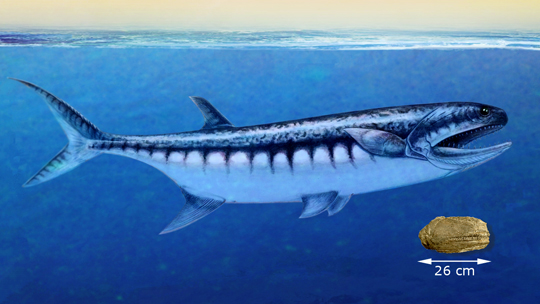
Birgeria americana illustration.

A reconstruction of Birgeria americana with the fossil skull (bottom right).

Picture credit: Nadine Bösch

The new species has been named Birgeria americana, a member of the ray-finned fishes (Actinopterygii) and fossils of this genus are mostly associated with Middle Triassic, much younger rocks, but the lineage can be traced back into the Late Permian.  Intriguingly, most species are much smaller, less than a metre in length, Birgeria americana in contrast, was a relatively giant, measuring around 1.72 to 1.85 metres long.

The “Jaws” of the Early Triassic

Recovered from rocks that have been dated to less than one million years after the end Permian extinction event, the discovery of such a large, voracious predator came as something of a surprise to the researchers.

Lead author of the study, recently published in the “Journal of Paleontology”, Dr Carlo Romano (Palaeontological Institute and Museum, University of Zurich) stated:

“The surprising find from Elko County in north-eastern Nevada is one of the most completely preserved vertebrate remains from this time period ever discovered in the United States.”

The new species has been described on the basis of a twenty-six-centimetre-long partial skull and jaws.  The jaws contain three parallel rows of robust, sharp teeth, the largest of which were up to two centimetres long.  This formidable dentition was further reinforced by several small teeth inside the mouth.

The Fossil Skull of B. americana
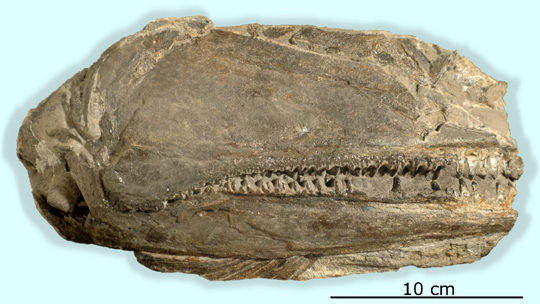
Birgeria americana fossilised skull and jaws.

The fossilised skull of Birgeria americana.

Picture credit: University of Zurich

Hunting Like a Great White Shark

The research team postulate that this species of super-sized Birgeria hunted in a similar fashion to the extant Great White Shark (Carcharodon carcharias).  Prey fish were pursued and then bitten, resulting in massive blood loss for the victim.  The unfortunate prey was then swallowed whole.  The partial skull, preserved in a limestone nodule, was excavated from Lower Triassic beds close to Winecup  Ranch in Elko County (Nevada).  The area is famous for its Triassic vertebrate fossils including early ichthyosaurs.

Prior to this discovery, researchers had assumed that ancient equatorial regions were too hot for vertebrates to survive during the Early Triassic (Nevada was close to the equator during the Early Triassic), the discovery of such a large, obvious predator suggests a rich and diverse food chain existed even at low latitudes.

Finds such as the newly discovered Birgeria species and the fossils of other vertebrates now show that marine hypercarnivores existed shortly after the end-Permian mass extinction.  The existence of bony fish close to the equator, where Nevada was located some 250 million years ago, indicates that the temperature of the sea was a maximum of 36°C.  The eggs of today’s bony fish cannot develop normally at constant temperatures above 36°Celsius.

Ecosystems Recovering After a Mass Extinction Event

Dr Romano added:

“The vertebrates from Nevada show that previous interpretations of past biotic crises and associated global changes were too simplistic.  Despite the severity of the extinctions of that time and intense climatic changes, the food webs were able to redevelop faster than previously assumed.”

For an article on fossil finds from China, providing further evidence of marine biota recovery following the end-Permian mass extinction: Window into an Ancient Marine Ecosystem.

The scientific paper: “Marine Early Triassic Actinopterygii from Elko County (Nevada, USA): Implications for the Smithian Equatorial Vertebrate Eclipse” by Carlo Romano, James F. Jenks, Romain Jattiot, Torsten M. Scheyer, Kevin G. Bylund, and Hugo Bucher published in the Journal of Paleontology.

Visit the Everything Dinosaur website: Everything Dinosaur.

6 08, 2017

The Armour of Borealopelta markmitchelli

By |2023-08-09T07:27:42+01:00August 6th, 2017|Categories: Dinosaur and Prehistoric Animal News Stories, Dinosaur Fans, Main Page, Photos/Pictures of Fossils|0 Comments

The Armour of Borealopelta markmitchelli

With the publishing of the formal description of the nodosaurid Borealopelta markmitchelli in the academic journal “Current Biology” this week, Everything Dinosaur has received a number of emails concerning this amazing fossil discovery.  The specimen, was lovingly prepared by museum technician Mark Mitchell who worked on the fossil for five and a half years, a total of something like 7,000 hours, as the dinosaur was exposed from its matrix one grain at a time.

Borealopelta markmitchelli

The holotype (TMP 2011.033.0001), is currently on display at the Royal Tyrrell Museum, part of an exhibition entitled “Grounds for Discovery”.  This exhibition highlights the personal stories and amazing fossils that have been discovered as a result of the Museum’s collaboration with numerous industries such as road construction, house building, mining, and oil and gas extraction.

The emails we received concerned aspects such as the animal’s size (5.5 metres long and weighing around 1.3 tonnes) and from which part of Alberta did the fossil come from (north-eastern Alberta).  However, most of the emails were enquiring about the preservation of the armour.

The diagram below should help.

A Schematic Drawing of the Borealopelta markmitchelli Holotype Specimen

Dermal armour of Borealopelta.

Schematic line drawing of the dermal armour of Borealopelta.

Picture credit: Current Biology

Studying the Armour of a Dinosaur

The picture above shows a schematic drawing of Borealopelta (A), with line drawings (B) and (C) showing the skull in dorsal and lateral views.  The different colours illustrate the preservation of different tissue types and the photographs (D to G) with accompanying line drawings show the range of dermal armour including osteoderms and scutes.  A close-up view of the neck (D), shows alternating cervical osteoderm bands (and preserved keratinous sheaths) and polygonal scales.

Photograph (E) shows a close-up view of the flank illustrating lateral thoracic osteoderms (with keratinous coverings) and polygonal scutes (scales).  A close view of the sacral shield area (F) showing more elements that make up the dermal armour and (G) shows a view of the forearm of Borealopelta (antebrachium) showing the amour (osteoderms and scales).

Note

Scale bar = 1 metre (A) and scale bar = 10 cm (B to G).

Body Armour in Life Position

The wonderful thing about this particular armoured dinosaur is that the osteoderms and scales that make up the body armour have been preserved in the position they were in when this dinosaur roamed Alberta during the Early Cretaceous.  The three-dimensional nature of the fossil has really helped the research team to understand how the mosaic of scutes, scales and osteoderms combined to provide the dermal armour.  The remains of the keratin sheaths and overlying skin was also preserved in some areas, melanosomes identified provide evidence of this dinosaur’s colouration.

To read an article about Borealopelta markmitchelli: Amazing Armoured Dinosaur Fossil Reveals Countershading.

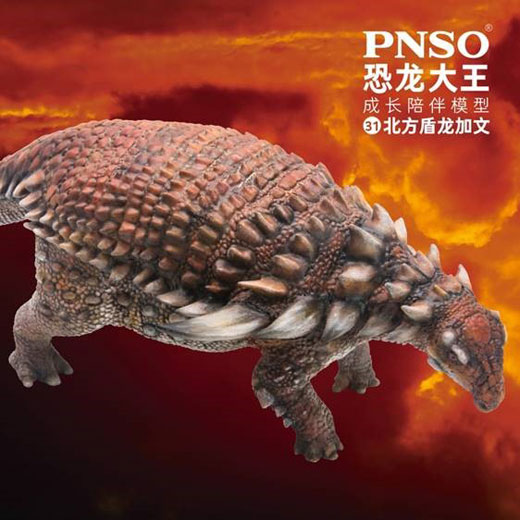
PNSO Gavin the Borealopelta armoured dinosaur model.
The PNSO Borealopelta dinosaur model.

The picture (above) shows a PNSO Borealopelta dinosaur model.

To view this range: PNSO Age of Dinosaurs Models.

Visit the award-winning Everything Dinosaur website: Everything Dinosaur.
1 08, 2017

Dinosaur Fossils on Mars – Not Quite but a New Fossil Discovery

By |2024-05-09T08:35:26+01:00August 1st, 2017|Categories: Dinosaur and Prehistoric Animal News Stories, Dinosaur Fans, Main Page, Photos/Pictures of Fossils|0 Comments

Students Looking to Test Mars Rovers Discover Dinosaur Fossils

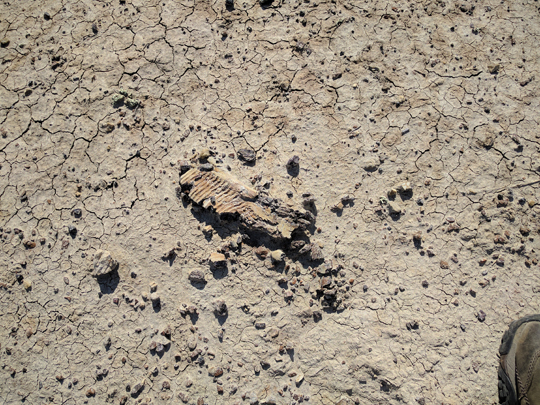
University students looking for a suitable landscape to test robots to take part in the exploration of Mars, have stumbled across the remains of a duck-billed dinosaur eroding out of the landscape.  Dinosaur bone discovery made by students.

Members of the University of Saskatchewan Space Design Team (USST), were visiting Midland Provincial Park in southern Alberta (Canada), in early June, scouting for suitable sites for an upcoming robotics contest.  The team were looking to identify terrain that resembled that found on the surface of Mars, the object of the competition being to test designs for Mars Rovers – robotic vehicles that could help with further exploration of the red planet.  What the team did not anticipate, was that their search would lead to the discovery of several fossilised bones from a Late Cretaceous hadrosaurid.

Duck-billed Dinosaur Bones Discovered

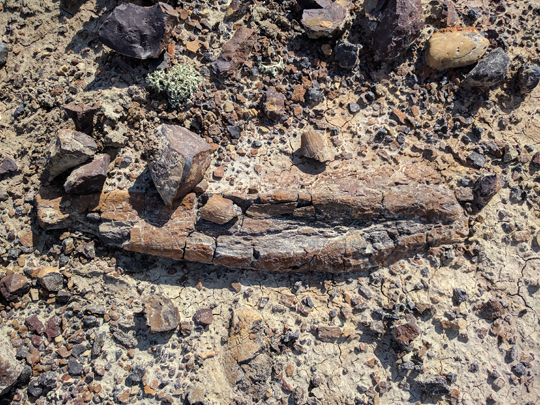
Dinosaur bone discovery.

Duck-billed dinosaur bone discovered by University of Saskatchewan students.

Picture credit: Adam McInnes

Dinosaur Bone Discovery

The students were exploring the area around Drumheller in a bid to identify sites suitable for hosting the first Canadian International Rover Challenge, a globally significant event, with a number of universities and institutions showcasing their robotics and automated vehicles that could help future scientific missions to Mars.  The team were looking for locations which were very dry, with lots of rocky terrain, plenty of sand and a mixture of different stone sizes coupled with a minimal of vegetation.  For a palaeontologist, areas with lots of rocky exposures, very few plants and which are subject to high levels of erosion, can also be great places to find fossils, especially if the rock is sedimentary in nature.  This part of Alberta is famous for its extensive exposures of Upper Cretaceous strata and numerous dinosaurs have been identified from their fossilised remains.

An Eroded Hadrosaurid Jaw Bone from the Site

Hadrosaurid jaw bone.

Partial jaw bone from a duck-billed dinosaur.

Picture credit: Adam McInnes

The picture above shows a very weathered portion of a jaw bone from a duck-billed dinosaur.  The grooves seen in the fossil equate to locations in the jaw for the dental battery, the rows of tightly packed teeth that helped this herbivore process the coarse plant-material such as pine needles that this type of dinosaur consumed.  Hadrosaurid fossils are probably the most common large dinosaur fossils to be found in this part of Canada, team members at Everything Dinosaur, whilst working with Royal Tyrrell Museum staff have come across several specimens themselves. Often the fossils are too weathered and fragmentary to permit extraction and formal identification down to the species level.

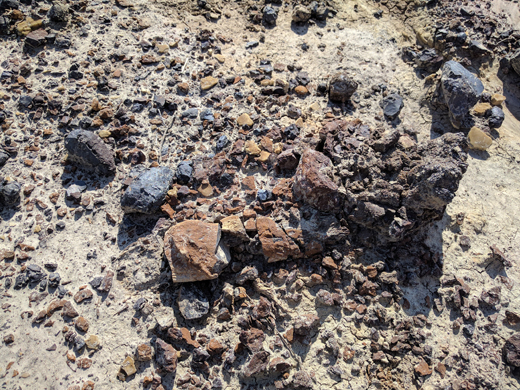
Severely Weathered Dinosaur Bones

A Severely Weathered Dinosaur Fossil Bone

Severely weathered dinosaur fossil bone.

It may look like a jumble of “weird-looking” rock but that is a dinosaur bone.

Picture credit: Adam McInnes

Conservation officials from the Alberta Parks Department and staff from the Royal Tyrrell Museum (Drumheller), were able to assist the USST members and helped them to identify suitable venues for the robotic vehicle tests.  The locations chosen were well away from sites of significant geological interest, after all, it is hardly a valid test for a potential Mars Rover to be able to ascend and descend a dinosaur bone, that is one object that these machines are not going to encounter on Mars.

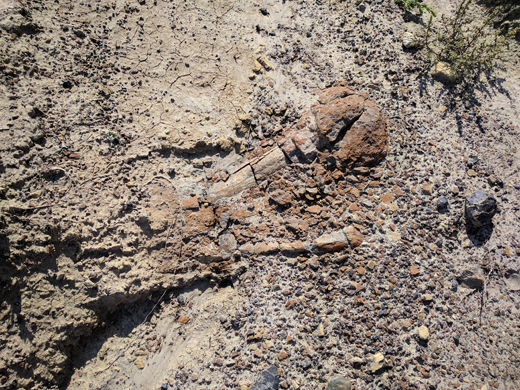
A Femur (Thigh Bone) from a Hadrosaurid

Duck-billed dinosaur leg bone.

Hadrosaurid leg bone.

Picture credit: Adam McInnes

USST President, Danno Peters explained that whilst discovery dinosaur bones certainly generated a degree of excitement amongst the group, none of the USST members were thinking of changing their careers and becoming palaeontologists.  Plans are already well underway for the 2018 Mars Rover competition and the USST team were looking forward to pushing their designs to the limit in even more challenging terrain.

Everything Dinosaur acknowledges the help of the media team at the University of Saskatchewan for their help in the compilation of this article.

Visit the award-winning Everything Dinosaur website: Everything Dinosaur.
28 07, 2017

Yet Another New Ganzhou Oviraptorid

By |2024-05-09T08:36:30+01:00July 28th, 2017|Categories: Dinosaur and Prehistoric Animal News Stories, Dinosaur Fans, Main Page, Photos/Pictures of Fossils|3 Comments

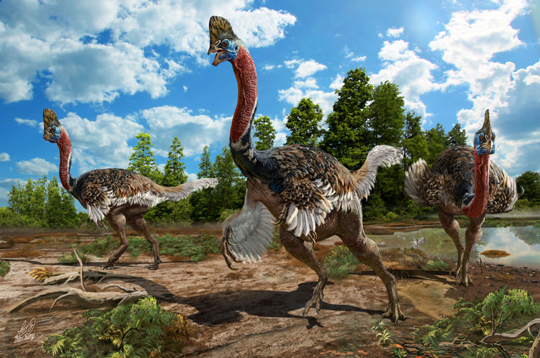
Corythoraptor jacobsi – Built Like an Ostrich with the Crest of a Cassowary

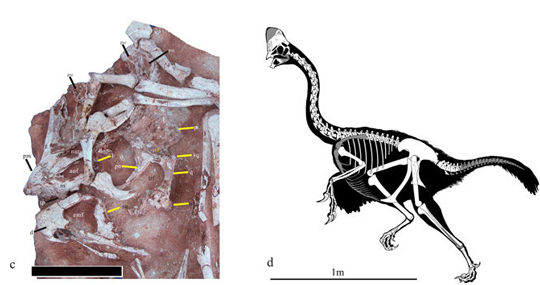
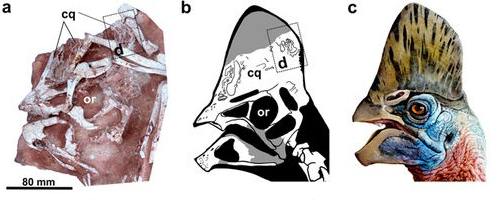
Yet another new species of oviraptorid has been named from fossils found in Ganzhou, Jiangxi Province (southern China).  This new dinosaur, which was probably feathered, had a longer neck than its oviraptorid contemporaries making it resemble an ostrich.  It also possessed a crest on top of its skull, called a casque, which was very similar to that seen in the extant, Australian flightless bird, the Cassowary.  This could be a case of convergent evolution between a dinosaur and a non-avian dinosaur.

This new dinosaur has been named Corythoraptor jacobsi, the genus name translates as “helmet speedy thief”, whilst the trivial name honours Professor Louis L. Jacobs of the Southern Methodist University, (Dallas, Texas, USA), who acted as a mentor to three of the authors of the scientific paper, published in the journal “Scientific Reports”.

An Illustration of the Newly Described Oviraptorid from Southern China (Corythoraptor jacobsi)

A flock of crested Corythoraptors.

Corythoraptor jacobsi illustration.

Picture credit: Zhao Chuang

The Magnificent Seven

The naming of Corythoraptor brings the total of Late Cretaceous oviraptorids known from this part of China to seven.  All seven oviraptorids come from the Nanxiong Formation which relates to the Late Campanian/Early Maastrichtian faunal stages of the Late Cretaceous, around 73 – 71 million years ago.

Palaeontologists are uncertain as to why this part of China seems to have been a “hot spot” for oviraptorosaurs, the palaeoenvironment might have favoured these cursorial theropods, which are believed to have been omnivorous, or this type of dinosaur may simply be under represented in other Upper Cretaceous deposits elsewhere in the world.

Intriguingly, of the seven oviraptorid dinosaurs named to date some are known to have been crested and different shaped crests have been identified.  All these dinosaurs are approximately the same size, around two metres in length and all of them were probably feathered.  The long neck (twice as long as the dorsal vertebral column), of Corythoraptor might have evolved to permit this dinosaur to exploit a food source that its contemporaries could not, in the same way that many modern-day antelopes on the African savannah have different neck lengths to help them browse on different plants – an example of niche partitioning.

The Crest of Corythoraptor

The crest of Corythoraptor jacobsi.

The cranial casque of Corythoraptor. Fossil material (a), line drawing (b) and colour restoration (c).

Picture credit: Scientific Reports

The Seven Oviraptorids from the Nanxiong Formation (to date)

The Seven Oviraptorids from the Nanxiong Formation (so far) – green text indicates information on crests (casques)

  • Banji long (named and described in 2010) small, flat crest.
  • Ganzhousaurus nankangensis (named and described in 2013) with a potentially, slightly raised crest.
  • Jiangxisaurus ganzhouensis (named and described in 2013) potentially crested – small crest.
  • Nankangia jiangxiensis (named and described in 2013) insufficient fossil material to establish a crest being present.
  • Huanansaurus ganzhouensis (named and described in 2015), potentially crested (top part of the skull is missing, but in a phylogenetic analysis carried out by the authors, Huanansaurus was found to be the sister taxon to the newly described Corythoraptor jacobsi.  H. ganzhouensis skull material is insufficient to conclusively prove the presence of a crest although the thickened naris and parietal indicate that a crest is likely.
  • Tongtianlong limosus (named and described in 2016), it possessed a small crest.

To read a previous article on the discovery of an oviraptorid Huanansaurus (Huanansaurus ganzhouensis), which is believed to be very closely related to Corythoraptor: 2015 – New Oviraptorid Dinosaur from the Late Cretaceous of Southern China.

A Close View of the Skull and Jaws with a Line Drawing of Corythoraptor

Corythoraptor skull and line drawing of the dinosaur.

A close up of the skull, jaws and the head crest of Corythoraptor with a line drawing showing body plan.

Picture credit: Scientific Reports

The picture above shows a close-up of the skull, crest and jaws of the holotype material, accompanied by a line drawing showing the estimated size and Corythoraptor and what it probably looked like.

The scale bar in (c) is 8 centimetres and the scale bar in (d) is 1 metre.   Note that the shape of the crest is inferred, as the actual portion of the skull that represents the majority of the proposed crest is not present, only the lower portion of the bony core of the casque (crest) is preserved.  The preserved portion of the nasals exhibits highly pneumatised bone structure.  The suture between the parietal and frontal is not clear, but it seems the bones project dorsally and formed a distinct crest together with the nasals, very reminiscent of the crest shape seen in living, non-avian dinosaurs, the Cassowaries.

What were the Crests (Casques) used for?

Lead author of the study,  Junchang Lü (Chinese Academy of Geological Sciences), proposes studying the living Cassowary to help shed light on the functional role played by the casque.  This could represent an example of convergent evolution, where a similar physical character has evolved independently in two, unrelated species.  A study of the fossilised bones suggest that this specimen represents an immature individual, a sub-adult Corythoraptor that may have been around eight years of age when it met its demise.  The casque may not have been fully formed when it died, but its function remains a mystery.  However, such a prominent casque could have served a multitude of purposes, just like the crest of the Cassowary.

Crest (Casque) Function

  • With lots of different oviraptorids living in the same habitat, the crest could have played a role in species recognition (interspecific recognition).
  • The crest could have been used in visual communication, in displays to determine social hierarchy or perhaps in ritualised displays over mate selection (intraspecific combat).
  • Crest shape could have indicated maturity, with crest shape changing as the animal became older.
  • The crest (or casque) could have indicated fitness for breeding during the mating season.
  • This structure could have played a role in helping to differentiate between males and females (sexual dimorphism).
  • The crest (or casque) shape in oviraptorids could represent the evolution of character as part of sexual selection.

For an article describing the discovery of T. limosus: Stuck in the Mud Dinosaur and Oviraptorosaur Diversity.

Links to the Dinosaurs of China Exhibition at Wollaton Hall (Nottinghamshire)

Readers in the UK, have the opportunity to get up close to a number of Chinese feathered dinosaurs including a specimen of Oviraptor (O. philoceratops) and a giant relation of the oviraptorids, the giraffe-sized Gigantoraptor, at the Dinosaurs of China exhibition in Nottingham.  In addition, the superb illustrations found throughout this exhibition and seen at the nearby Nottingham Lakeside Arts Centre, were created by Zhao Chuang, who was responsible for illustrating Corythoraptor in the scientific paper (illustration is seen at the top of this article).

For figures and replicas of feathered theropods: Dinosaur and Prehistoric Animal Models.

26 07, 2017

Unravelling the Mysteries of Complex Life

By |2023-08-08T09:33:09+01:00July 26th, 2017|Categories: Dinosaur and Prehistoric Animal News Stories, Main Page, Photos/Pictures of Fossils|0 Comments

First Non-Destructive Internal Images of Rangea

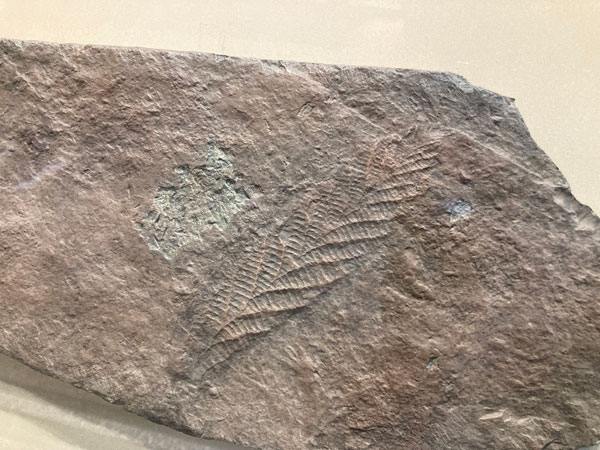
Travel back in time far enough and the distinction between what is a plant and what is an animal becomes blurred.  For a palaeontologist, unravelling the mysteries of the origins of multi-cellular life is daunting.  Firstly, when examining the few fossils of multi-cellular organisms known from rocks laid down in the Proterozoic Eon, what strikes you is the paucity of the fossil record, in essence there is very little fossil evidence to study. Secondly, some of the lifeforms represented are so bizarre that there is nothing alive today that can begin to provide scientists with any hints as to structure, form, lifestyle or behaviour.

However, an international team of scientists, writing in the journal of “Precambian Research”, have conducted a remarkable assessment on three-dimensionally preserved Ediacaran fossils and they have shed light on the evolution of complex life.  The organism in question is Rangea, a bizarre fern-like animal/plant/? that did not possess bilateral symmetry like us, or indeed radial symmetry like starfish and sea urchins, but a fractal structure, like nothing alive today.

The Fossil and Internal/External Scans of a Three-dimensionally Preserved Rangea Specimen

Fossil and scans of bizarre Precambrian life form.

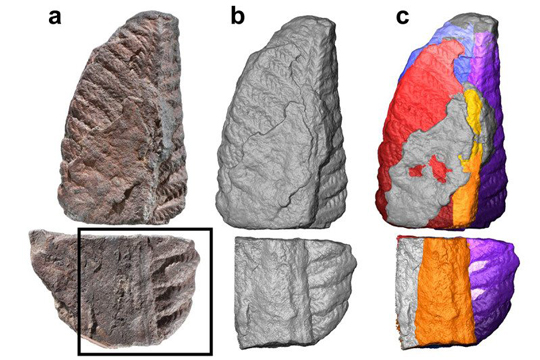
The fossil (a), an external scan (b) and an internal scan (c) of the Ediacaran organism Rangea.

Picture credit: Precambrian Research

The picture above shows the fossil (a), a computer-generated model of the external structure (b) and a computer-generated model of the internal structure of Rangea (c).

High Resolution X-ray Micro-computed Tomography

At Everything Dinosaur, we suspect that the fossil specimens come from rocks laid down in shallow, marine sediments that make up the Nama Group in southern Namibia.  Rangea is known from this location and has also been reported from other Ediacaran-aged sites in Australia and Russia.  The Namibian material is remarkable as the fossils are typically moulds and casts of the fern-like structures, preserved in ironstone nodules, which despite representing lifeforms that existed somewhere between 540 and 580 million years ago, have not been squished and deformed to a huge extent as a result of the fossilisation process and the enormous time these fossils have existed in the strata.

The scientists used high resolution X-ray micro-computed tomography (microCT) to investigate the 3-D internal morphology of these exceptional fossils.  This is the first non-destructive internal imaging of Rangea.  Ranging from a few centimetres to tens of centimetres in length, the soft-bodied Rangeomorphs (a natural taxon, established to help classify these frond-like, fractal organisms), are perhaps best known to fossil fans in the UK as organisms similar in structure to Charnia, named and described from a single fossil specimen found in Charnwood Forest, Leicestershire by a school boy in 1957.

A Specimen of a Fern-like, Soft-bodied Charnia

Pre-Cambrian life form Charnia.

A Charnia fossil on display at the Manchester Museum. Picture credit: Everything Dinosaur.

Picture credit: Everything Dinosaur

Analysing the Results of the Pre-Cambrian Fossil Study

Lead author of the study, Dr Alana Sharp (School of Science and Technology, University of New England, New South Wales, Australia) and her colleagues think that all six fronds may have been inflated like long balloons, they may have touched each other creating a large surface area for the passive absorption of nutrients which sustained the organism.  It had been thought that these fronds, regarded as some form of feeding structure, were flat.

Dr Sharp commented:

“Our work supports a lifestyle of absorption of nutrients through membranes inflated to the maximum, increasing the surface area across which these organisms seemed to feed.”

Soft Bodies but Stone Hearts

The CT scans also revealed something else about Rangea.  It had a cone-shaped channel running vertically up its central trunk.  The lower part of this channel seems to have been filled with sediment that has a different composition from that seen in the rest of the fossil.  The researchers have concluded that this was probably present in the organism when it was alive, helping to prevent it from buckling or being compressed.  The sediment acted like internal scaffolding for Rangea, a sort of primitive skeleton.  These findings support the idea that Rangea was benthic (lived on the sea floor) and that it was probably sessile (attached to the sea floor and immobile).

Despite these remarkable computer-generated images, one big mystery remains, as Dr Sharp explains.

“They may or may not be animals, we can’t say from this study.  But they are the first of the truly large, multi-cellular organisms that radiated broadly before the first true animals evolved.”

The Scientific Paper: “First non-destructive Internal Imaging of Rangea, an Icon of Complex Ediacaran Life” by Alana C. Sharp, Alistair R. Evans, Siobhan A. Wilson and Patricia Vickers-Rich, published in the journal “Precambrian Research”.

Visit the Everything Dinosaur website: Everything Dinosaur.
25 07, 2017

Eureka! We Have a New Fossil Spider

By |2024-04-22T11:49:01+01:00July 25th, 2017|Categories: Dinosaur and Prehistoric Animal News Stories, Main Page, Photos/Pictures of Fossils|0 Comments

Maevia eureka – Miocene Spider

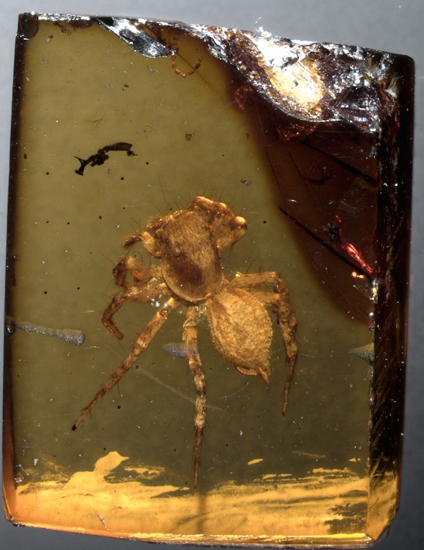
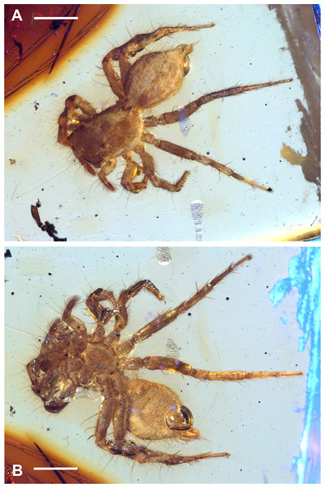
Researchers have described a new fossil species of jumping spider found embedded in a piece of amber that dates from the early-mid Miocene.  The beautifully preserved specimen was collected from lignite-sandstone sediments that date from between 23 and 15 million years ago.  The little spider has been assigned to the Salticidae (jumping spiders) and it close resembles living species of jumping spider such as Maevia poultoni which is also found in the New World.

The Newly Described Miocene Spider M. eureka Preserved in Amber

Maevia eureka specimen.

Preserved in amber M. eureka.

Picture credit: PeerJ

The First Jumping Spider Species Described from Chiapas Amber

The specimen was found near to the town of Totolapa in Chiapas, south-western Mexico.  Writing in the academic, peer-reviewed journal “PeerJ”, the authors Francisco Riquelme​, (Universidad Autónoma del Estado de Morelos, Jojutla, Morelos, Mexico) and Miguel Menéndez-Acuña (Universidad Autónoma del Estado de Morelos, Cuernavaca, Morelos, Mexico), conclude that this fossil represents the first jumping spider species to be described from Chiapas amber.

Dorsal and Ventral Views of Maevia eureka

Maevia eureka fossil.

Preserved in amber M. eureka.

Picture credit: PeerJ

The picture above shows two views of the fossil spider (A) dorsal view, seen from the top down and (B) ventral view, seen from underneath.  The scale bar equals 1 mm.  The fossil marks the southernmost record of the Maevia genus in North America.  The story of its discovery explains the trivial name “eureka”.  The amber piece containing the fossil was found by chance as field team members were digging a latrine.

Visit the Everything Dinosaur website: Everything Dinosaur.
21 06, 2017

Tyrannosaur Skull from British Columbia

By |2023-07-27T09:41:57+01:00June 21st, 2017|Categories: Dinosaur and Prehistoric Animal News Stories, Dinosaur Fans, Main Page, Photos/Pictures of Fossils|0 Comments

Hiker Finds Part of a Tyrannosaur Skull Near Tumbler Ridge

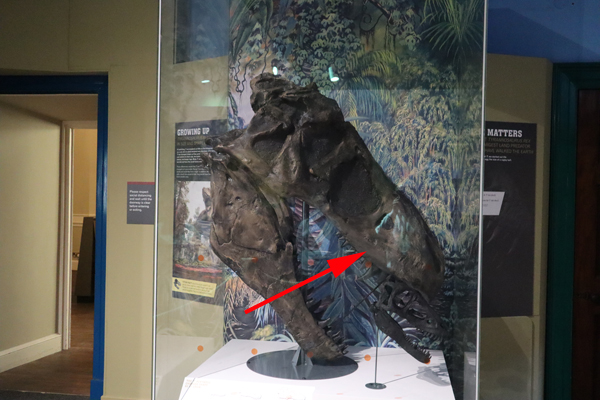
Fossil hunter Rick Lambert was hiking in the Tumbler Ridge area of British Columbia when he spotted an unusual object partially exposed in a large rock.  It turns out the eagle-eyed chiropractor from Vancouver Island had found the maxilla bone from a tyrannosaur skull.    The maxilla is part of the upper jaw, this fossil and the teeth/teeth sockets that it contains, can help palaeontologists to identify the type of dinosaur down to genus level.

Tyrannosaur Skull Bone

This is the first dinosaur skull fossil material to have been found in this area and although the one-hundred-kilogram rock containing the fossil is not part of the local strata, it was probably moved to the site as part of a landscaping project, it’s discovery could help scientists to better understand the geographic distribution of a genus of tyrannosaur from the Late Cretaceous.

The Tumbler Ridge Tyrannosaur Skull Fossil (Maxilla)

Adult and juvenile T. rex fossil casts.

An adult T. rex and a juvenile T. rex skull cast on display. The maxilla bone has been highlighted in the adult skull fossil cast. Picture credit: Everything Dinosaur.

Picture credit: Everything Dinosaur

A Significant Tyrannosaur Fossil Find

Large theropod footprints have been found in the Tumbler Ridge area in the past, indeed, this location has provided the palaeontologists based at the Peace Region Palaeontology Research Centre, which was established back in 2003 to study the fossils, with hundreds of dinosaur teeth, fragmentary bones as well as the remarkable trace fossils, but this upper jaw bone could be a real game changer for the region.

The director of the Peace Region Palaeontology Research Centre, Richard McCrea commented:

“We are in a frontier in British Columbia because there’s been no research in this area.  This is quite a jump for us.”

Having studied and worked in geology, Rick Lambert knew he had found something significant, but he had no idea how important his fossil find could prove to be.  Rick was used to finding fossils in the area, but he wasn’t expecting to find a bone from the skull of a theropod dinosaur, a skull that would have measured more than a metre in length.

Rick explained:

“I never expected to find something like that.  It’s not anything I actually kept my eye out for.  I thought at least they would have four or five of those in a drawer somewhere.”

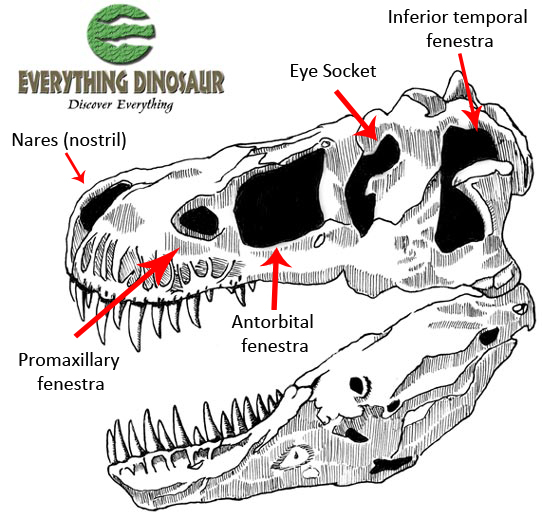
An Illustration of a Typical Tyrannosaur Skull

T. rex skull labelled.

A diagram of a T. rex skull with the fenestrae in the top half of the skull labelled. Picture credit: Everything Dinosaur.

Picture credit: Everything Dinosaur

For models and replicas of tyrannosaurs and other theropod dinosaurs: Theropod and Other Prehistoric Animal Models.

Identifying the Genus and Possibly the Species

McCrea said finding this specific piece of bone is significant because it can be used to determine the type of tyrannosaur it originated from.  Elements from the skull can be very helpful when it comes to identifying dinosaurs, however, the sandstone rock in which the fossil was found rules out a Tyrannosaurus rex.

A spokesperson from Everything Dinosaur explained:

“The Cretaceous-aged exposures in this area, mostly date from the Upper Cretaceous but they are nowhere near young enough to permit the preservation of a T. rex or any close relative of that iconic dinosaur.  The sandstone block containing the fossil material is very similar in composition to nearby deposits that are around 74-75 million years old, many millions of  years younger than the Cenomanian/Turonian strata from this locality.  The sandstone dates from the Campanian, so the maxilla very probably comes from a member of the Tyrannosauridae family that lived during that time – something like an Albertosaurus or perhaps a large Gorgosaurus.”

From a Large Tyrannosaur

Roughly shaped like a reversed capital “C”, the fossil measures between 30 to 40 centimetres in length and is around 25 centimetres wide.  It is a sizeable bone, indicating that this belonged to a very large tyrannosaur, something in excess of eight metres in length.  Local palaeontologists calculate that the entire skull of this theropod, if it could be found, would measure over a metre.

The curator and collections manager at the Peace Region Palaeontology Research Centre, Dr Lisa Buckley commented:

“The exposed maxilla and teeth are eroded, but their shape is perfectly preserved, including fine details of the delicate serrations that form the cutting edge of the teeth. The specimen has twelve teeth evident, with the potential to expose more.  The tooth count and tooth shape make it likely that this is part of the skull of a tyrannosaurid like Albertosaurus, and is probably around 75 million years old.  We aim to establish the point of origin of this rock.”

The forested terrain, steep gullies and lack of roads in this part of British Columbia makes prospecting for fossils quite challenging, however, field team members and volunteers can study the sandstone formation from which the block came from in the hope of finding more elements from the skull.

An Illustration of a Typical Tyrannosaurid (Albertosaurus)

Albertosaurus illustrated.

May have been bigger, slightly heavier, with a stronger bite.  Picture credit: Everything Dinosaur.

Picture credit: Everything Dinosaur

To read an article about theropod dinosaur prints found in the Tumbler Ridge area: Dinosaur Footprint Discovered in British Columbia.

Visit the award-winning Everything Dinosaur website: Everything Dinosaur.
15 06, 2017

Curious African Cynodont Turns up in Brazil

By |2023-07-26T10:43:25+01:00June 15th, 2017|Categories: Dinosaur and Prehistoric Animal News Stories, Main Page, Photos/Pictures of Fossils|0 Comments

Aleodon from Africa Present in Brazilian Triassic Rocks

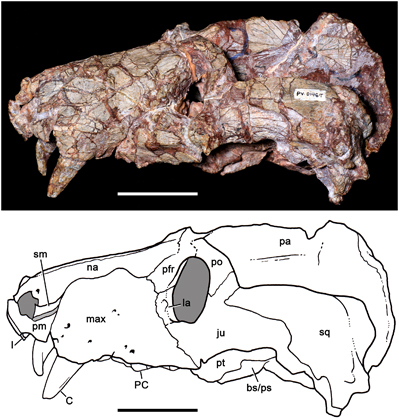
A team of international researchers have reported the discovery of fossils attributed to the African cynodont Aleodon in Middle-early Late Triassic rocks from several locations in the state of Rio Grande do Sul (southern Brazil).  Prior to these fossil finds, this protomammal (a member of the Probainognathidae family), a distant ancestor of modern mammals, was only known from Africa.

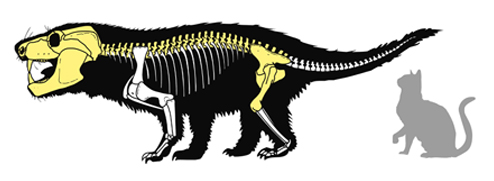
A Scale Drawing of the Skeleton of Aleodon (A. cromptoni)

Aleodon scale drawing. A curious cynodont from Brazil.

The known bones of Aleodon are shown in yellow.

Picture credit: PLOS ONE

In the picture above the known bones attributed to Aleodon (A. cromptoni) are shown in yellow and a cat provides a scale comparison.

A Curious Cynodont Living Alongside Dinosaur Precursors

Writing in the on-line academic journal “PLOS ONE”, the researchers, which include Agustín Martinelli (Universidade Federal of Rio Grande do Sul, Brazil), conclude that fossils previously thought to represent another cynodont – Chiniquodon actually are Aleodon specimens, as such they are the first of this genus to be found outside of Africa.  The carnivorous Aleodon lived alongside basal members of the Dinosauria and other types of archosaur, as well as numerous mammal-like reptiles, including the giant herbivore Dinodontosaurus.  The fossils of Dinodontosaurus are so numerous that they are used to date the relative age of the strata in this part of southern Brazil.  All the fossils ascribed to Aleodon, including cranial material and teeth come from the Dinodontosaurus Assemblage Zone.

Aleodon Skull Material and Line Drawing (Aleodon cromptoni)

Aleodon skull and line drawing.

Skull in left lateral view with accompanying line drawing. Scale bar = 50 mm.

Picture credit: PLOS ONE

Namibian and Tanzanian Fossils

The Aleodon genus was first erected based on fossil material discovered in Tanzania and Namibia.  The South American material was compared to the African specimens and a new species of Aleodon, a sister taxon to the African species was named.  The new Aleodon species honours Dr Alfred “Fuzz” Crompton, who established the genus in 1955 with the naming of A. brachyrhamphus.

In a reassessment of the African fossil material, a specimen form Namibia which was thought to represent a member of the related family, the Chiniquodontidae or possibly a member of the Traversodontidae may actually be an Aleodon.  The scientists also identified as Aleodon a total of seven specimens from the Rio Grande do Sul region.  Phylogenetic analysis indicated that Aleodon cromptoni may be, as suspected, a species in the Chiniquodontidae family.

Whilst the research work was hampered due to the incomplete and partial specimens, the authors note that the identification of these Late Triassic Aleodon fossils in Brazil strengthens the correlation between probainognathians from this epoch in South America and in Africa.

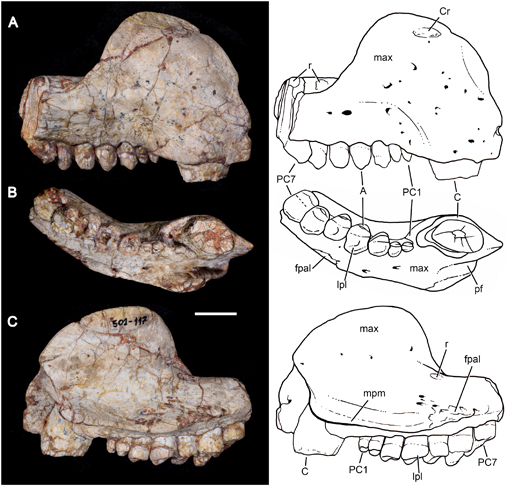
Part of the Upper Jaw of A. cromptoni with Line Drawing

Upper jaw fossil material (Aleodon cromptoni).

Photographs and accompanying drawings of right maxilla MPDC-501-117 in lateral (A), ventral (B), and medial views (C). Scale bar equals 10 mm

Picture credit: PLOS ONE

For Triassic prehistoric animal models and figures: Prehistoric Animal Models and Figures.

11 06, 2017

How Did the Cleveland-Lloyd Dinosaur Quarry Get Its Name?

By |2023-07-26T09:59:06+01:00June 11th, 2017|Categories: Dinosaur Fans, Geology, Main Page, Photos/Pictures of Fossils|0 Comments

How Did the Cleveland-Lloyd Dinosaur Quarry Get Its Name?

After having published an article on a new theory explaining the mass death dinosaur assemblage preserved at the Cleveland-Lloyd fossil site in the Morrison Formation (Brushy Basin Member), we were sent an email asking how the Cleveland-Lloyd Dinosaur Quarry got its name if the site is a long way from Cleveland, Ohio?

The Cleveland-Lloyd Dinosaur Quarry

It is true, the fossil site, which represents the greatest concentration of Jurassic dinosaur fossils known to science, is a very long way from the city of Cleveland, but it is near the small town of Cleveland, Emery County, in Utah.  This famous fossil site was named in part, as it was close to the town of Cleveland.  The second part of the hyphenated name “Lloyd” is all to do with funding,

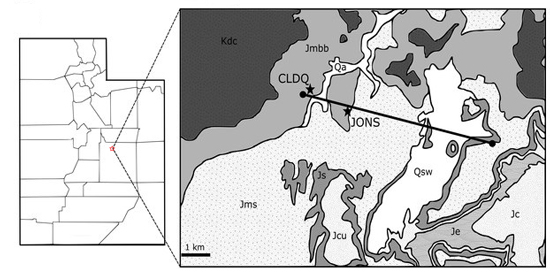
Map Showing Sites, Stratigraphic Section Line, and Regional Stratigraphy in Context of the San Rafael Swell

Location of the Cleveland-Lloyd Dinosaur Quarry.

Map showing sites, stratigraphic section line, and regional stratigraphy in context of the San Rafael Swell.

Picture credit: PeerJ

In the picture above CLDQ marks the location of the Cleveland-Lloyd Dinosaur Quarry and JONS indicates the location of the nearby Johnsonville fossil site in Utah.  The inset map shows the location of the Cleveland-Lloyd Dinosaur Quarry in relation to the rest of the state of Utah.

To read the article: The Mystery of the Cleveland-Lloyd Dinosaur Quarry.

Where Did the Lloyd Part of the Name Come From?

The site was first discovered in 1927, the first extensive excavations commenced in 1929, (University of Utah).  The siltstones were deposited in the Late Jurassic and the strata makes up part of the Brushy Basin Member at the northern end of the San Rafael Swell.  For the next decade, regular expeditions to the site were undertaken and these were funded, in the most part, by a lawyer from Philadelphia called Malcolm Lloyd.  This is how the famous dinosaur dig site came to be named.

The quarry is world-famous for its very high concentration of dinosaur bones.  The scattered remains of over seventy dinosaurs are believed to be present, representing nine dinosaur genera.  However, around two-thirds of all the bones are attributable to a single dinosaur taxon Allosaurus fragilis.  Most of the other bonebeds associated with the Morrison Formation contain a higher proportion of herbivorous dinosaurs. Furthermore, when the A. fragilis material is assessed over 85% of the fossils represent juveniles or sub-adults of the species.

Further exploration of this extremely fossil rich location is planned.

So, the site with the greatest concentration of Jurassic dinosaur bones known to science was named after a lawyer from Philadelphia and the nearest township.

Allosaurus

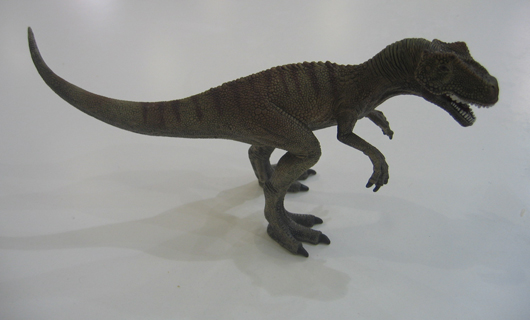
A Model of Allosaurus a Dinosaur Associated with the Cleveland Lloyd Dinosaur Quarry

Schleich Allosaurus (2017).

The new for 2017 Schleich Allosaurus dinosaur model.  Picture credit: Everything Dinosaur.

Picture credit: Everything Dinosaur

Visit the Schleich section of the Everything Dinosaur website: Schleich Dinosaur Toys.

The picture shows a Schleich Allosaurus model (2017).

To visit the award-winning Everything Dinosaur website: Everything Dinosaur.
30 05, 2017

Digging It Up in the City

By |2023-07-23T08:41:45+01:00May 30th, 2017|Categories: Dinosaur and Prehistoric Animal News Stories, Dinosaur Fans, Main Page, Photos/Pictures of Fossils|0 Comments

Dinosaur Excavation Work Starts in Yanji City

Palaeontologists at the Chinese Academy of Sciences (CAS), are used to working in all sorts of environments as they strive to excavate the wealth of dinosaur fossils to be found at key locations in China.  This week, a field team will be starting work at a new dig site, one with all the conveniences of a modern city, as the excavation work will be taking place in Yanji City, (Jilin Province, north-eastern China), with an approximate population of 400,000 people, the scientists will not be short of company.

Chinese Dinosaur Fossils

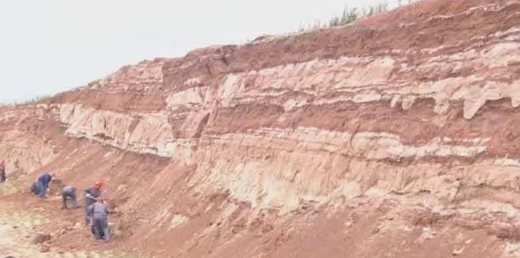
Field Team Members Begin Exploring the Cretaceous Strata

Yanji City dinosaur excavations.

Field team workers exploring the Cretaceous sediments in Yanji City.

Picture credit: Chinese Academy of Sciences

In a press release from the CAS, it is stated that the dinosaur fossil excavation will cover an area of approximately ten square kilometres and this is the first excavation of its kind to be carried out in a modern urban area.  Although the strata in the Yanji Basin is known for its substantial plant fossil remains, including flowering plants (angiosperms), this is the first time that dinosaur fossils have been discovered in Yanji City.  Experts state that the different coloured bands of strata represent non-marine sediments that were laid down when this area was experiencing climate change.

Zhang Lizhao, a researcher at the Institute of Vertebrate Palaeontology and Palaeoanthropology (IVPP) commented:

“We can see that the geological layers show different colours including red, purplish red and light colours.  The geological layer with the colour of purplish red means that, when the layer was formed, the dinosaurs lived in a hot and humid climate.  The layers with the light colours were formed during periods with dry and cold weather. We are basically sure that the geologic body here was formed between the late Early Cretaceous and the very early Late Cretaceous.”

Dinosaur Fossil Discoveries

The rocks being explored are around 100 million years of age, they represent sediments laid down between the Albian faunal stage (the last faunal stage of the Lower Cretaceous) and the Cenomanian stage, the first faunal stage of the Upper Cretaceous, a time when global sea levels were extremely high and many terrestrial animal populations were consequently isolated.  Dinosaur fossils from the Lower Cretaceous to the Upper Cretaceous transition are relatively rare and these excavations could perhaps provide new information on the evolution of different types of dinosaur especially the Titanosauriformes, Ceratopsia and theropods.

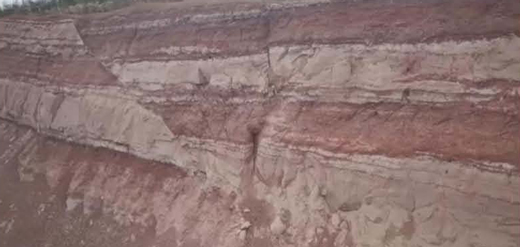
The Very Distinct and Striking Bands of Strata at the Dig Site

Rock formations of Yanji City (north-eastern China).

Yanji City rock formations.

Picture credit: Chinese Academy of Sciences

The picture above shows the clearly defined bands of strata.  Observers can see a defined fault line in the photograph.  Jilin Province is prone to earthquakes and other seismic activity.

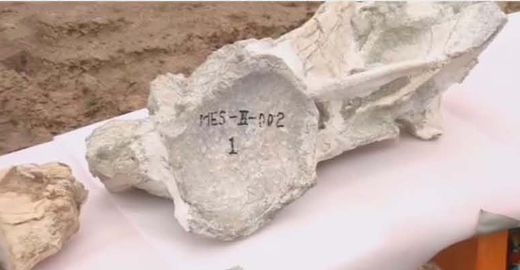
A Large Dinosaur Dorsal Vertebra (right) Partial view of Articulated Caudal Vertebrae (left)

Yanji City dinosaur fossils (vertebrae).

Isolated dorsal vertebrae (potential titanosauriform) right with partial view of two articulated caudal vertebrae on the left.

Picture credit: Chinese Academy of Sciences

The picture above shows some of the fossil found, the centrum of the dorsal vertebra has been labelled for identification purposes.  Everything Dinosaur team members have identified these bones as from probable titanosauriforms.

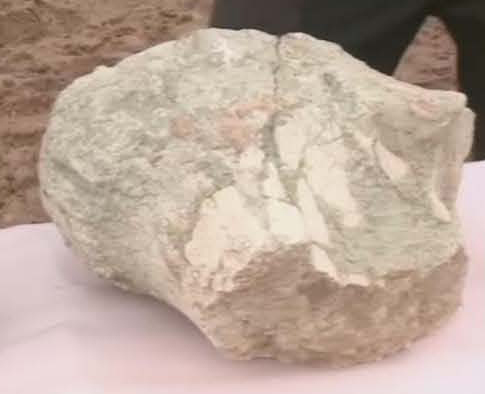
Fossil Material Uncovered at the Dig Site

Partial dinosaur limb bone.

Dinosaur limb bone (partial).

Picture credit: Chinese Academy of Sciences

Six Different Types of Dinosaur

Researchers have commented that at least six different types of dinosaur may have inhabited this part of China around 100 million years ago. They are confident that much more fossil material will be found helping palaeontologists to better understand the biota of this part of the world during a time of climate change.

A spokesperson from Everything Dinosaur commented:

“The fossils found at this extensive site in Yanji City, will add to our knowledge of terrestrial faunas during the Albian to Cenomanian transition.  It is likely that a number of new dinosaur species will be identified.”

The Everything Dinosaur website: Everything Dinosaur.
Go to Top