All about dinosaurs, fossils and prehistoric animals by Everything Dinosaur team members.

Pictures of fossils, fossil hunting trips, fossil sites and photographs relating to fossil hunting and fossil finds.

11 05, 2017

“Baby Louie” Dinosaur Fossil Identified as New Species

By |2023-07-22T17:08:52+01:00May 11th, 2017|Categories: Dinosaur and Prehistoric Animal News Stories, Dinosaur Fans, Main Page, Photos/Pictures of Fossils|0 Comments

A New Species of Giant Oviraptorosaur – Beibeilong sinensis

The mystery of the world’s largest dinosaur eggs has been solved, and an infamous baby dinosaur fossil once the property of the Indianapolis Children’s Museum, now has a family.  In 1993, a fossilised clutch of giant dinosaur eggs and an associated embryo dinosaur skeleton was discovered east of the small village of Zhaoying, close to the township of Yangcheng, Xixia County, in western Henan Province.  Like many thousands of dinosaur egg fossils found in this part of central China, the specimen was illegally sold overseas to a buyer in America.

A Baby Dinosaur Fossil

The fossil was then sold to the Indianapolis Children’s Museum in 2001.  Subsequently, the partial nest with the small, articulated dinosaur skeleton, nick-named “Baby Louie”, was repatriated to China and it is currently housed in the Henan Geological Museum.

In a paper this week in “Nature Communications”, researchers which include Darla Zelenitsky (University of Calgary) and Professor Phil Currie (University of Alberta), have identified a new species of giant Oviraptorosaur – “Baby Louie” represents potentially one of the largest feathered creatures known to science.

The dinosaur has been named Beibeilong sinensis, the name means “baby dragon from China”.

Photographs of the Holotype Fossil Material (Beibeilong sinensis)
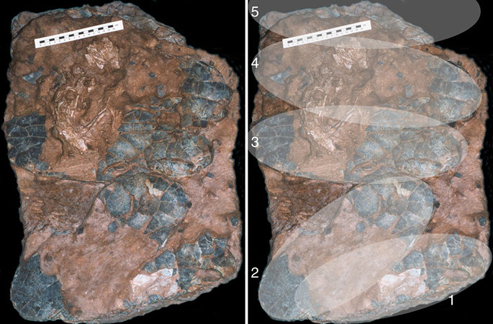
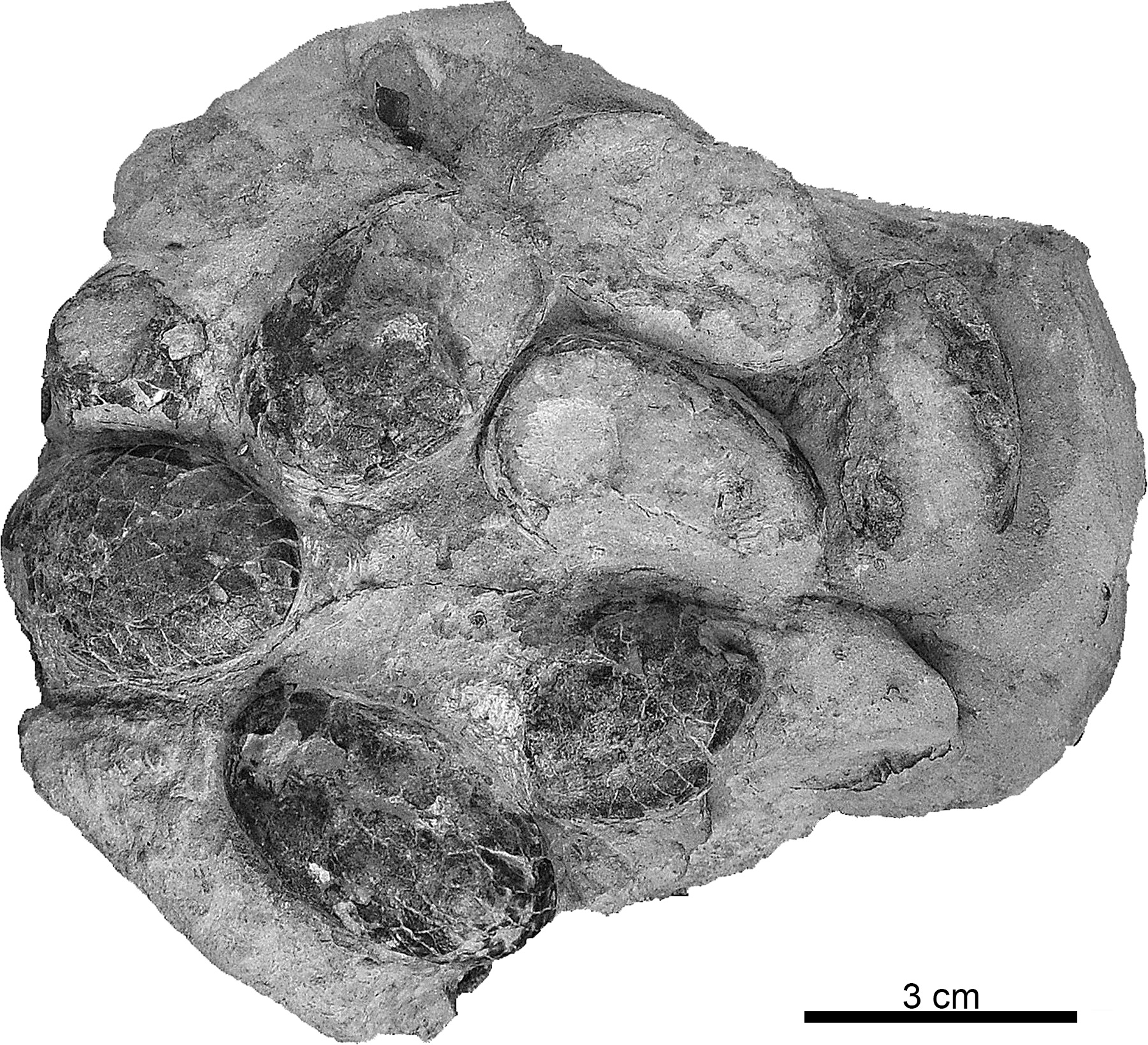
Beibeilong sinensis egg fossils with impression of egg size and position overlaid.  The story of a baby dinosaur fossil.

Right image shows schematic overlay of approximate locations of individual eggs. Eggs 1 through 4 are in an upper layer just beneath the skeleton, whereas egg 5 is in a lower layer of the block. Scale bar is in centimetres.

Picture credit: Nature Communications/Darla Zelenitsky

The picture above shows two images of the holotype nest fossil from which the new species of dinosaur, B. sinensis was described.  The picture on the left shows the fossil material with the embryo fossil located just below the scale bar.  On the second photograph, the location of five of the eggs making up the clutch have been superimposed on the fossil to give an indication of their position.

Giant Dinosaur Eggs

The eggs were given their own oogenus, Macroelongatoolithus (the name means “large elongate stone eggs”).  These are the largest-known type of dinosaur eggs with some fossils measuring around sixty centimetres in length.  The eggs associated with the Beibeilong embryo measure about forty-five centimetres long.   That’s about three times as long as a typical Ostrich egg (Struthio camelus), although Ostrich eggs are more ovoid in shape.  The research team suggest that the dinosaurs which laid these eggs, giant caenagnathid Oviraptorosaurs, created nests that may have been around three metres in diameter.

An Artist’s Illustration of the Giant Oviraptorosaur Beibeilong sinensis
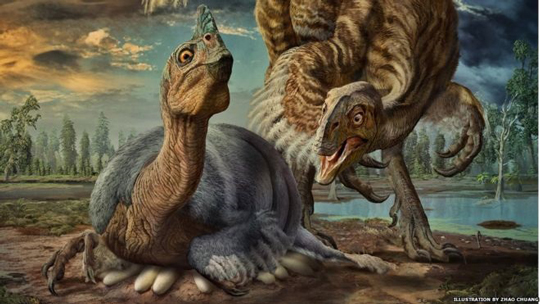
Beibeilong nesting scene.

A breeding pair of Beibeilong dinosaurs and their nest of giant dinosaur eggs.

 Picture credit: Zhao Chuang

The Gigantoraptor Effect

The discovery of the giant fragmentary fossils of a strange theropod (Gigantoraptor erlianensis) in 2005 changed views on the Oviraptorosauria clade forever.  When formally described in 2007, Gigantoraptor was at least five times bigger than any other known oviraptorid.  Palaeontologists had proof that giant, beaked dinosaurs existed.

To read about the discovery of Gigantoraptor: New Giant Member of the Oviraptorosauria – Gigantoraptor.

Beibeilong becomes the second genus of giant members of the Oviraptorosauria.  If “Baby Louie” had lived, then this dinosaur might have reached a length of eight metres or more and it would have easily weighed more than a tonne.  Beibeilong has been assigned to the Caenagnathidae, an enigmatic group of beaked theropods closely related to the Oviraptoridae and nested with them into the Oviraptorosauria clade.

A Scale Drawing of a Giant Caenagnathid Oviraptorosaur (G. erlianensis)
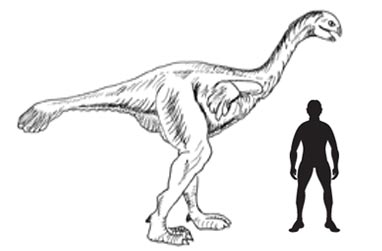
Gigantoraptor scale drawing.

The largest feathered animal known to science (Gigantoraptor).  Picture credit: Everything Dinosaur.

Picture credit: Everything Dinosaur

Originally, the Caenagnathidae family was erected to describe, what was thought at the time, a lineage of extinct birds.  Over the last thirty years or so, more fossil discoveries have been made in North America and Asia.  When first described Gigantoraptor was thought to be a member of the Oviraptoridae, however, Gigantoraptor is now joined in the Caenagnathidae by perhaps, the equally large Beibeilong.

An Abundance of Giant Dinosaur Egg Fossils

The Beibeilong material was excavated from strata from the Gaogou Formation (Upper Cretaceous, Cenomanian to Turonian faunal stages).  The research team suggest that Beibeilong roamed central China some ninety million years ago, twenty million years earlier than Gigantoraptor.

An abundance of Macroelongatoolithus eggs reported from Asia and North America is in stark contrast to the very few bones found of giant caenagnathids.  Thanks to the association between “Baby Louie” and the giant eggs, the first known association between skeletal remains and eggs of caenagnathids, palaeontologists are confident that these giant, beaked dinosaurs may have been relatively common throughout the Northern Hemisphere during the Late Cretaceous.

A View of the Dinosaur Embryo Skeleton (Beibeilong sinensis) and Accompanying Line Drawing
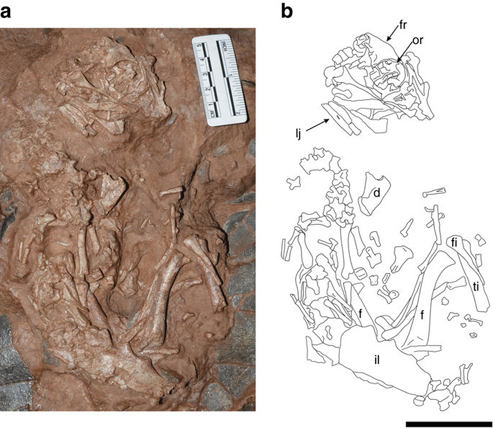
Beibeilong fossil and line drawing.

“Baby Louie” fossil (Beibeilong sinensis) and line drawing – scale bar = 5 cm.

Picture credit: Nature Communications/Darla Zelenitsky

The picture above shows a close view of the embryo skeleton (left) and a simplified line drawing highlighting important bones.

Key

fr = frontal bone (skull), or = orbit (skull), lj = lower jaw, d = dentary, fi = fibula, ti – tibia, il= ilium, f = femur.

Visit the Everything Dinosaur website: Everything Dinosaur.

10 05, 2017

Amazing Ammonite “Tool Mark” Fossil

By |2023-07-22T16:59:06+01:00May 10th, 2017|Categories: Dinosaur and Prehistoric Animal News Stories, Main Page, Photos/Pictures of Fossils|0 Comments

Ammonite Fossil Captures Brief Moment in Deep Time

Every once in a while, a fossil is found that provides a remarkable insight into life in the past.  An example of this is an Ammonite fossil that dates from the Late Jurassic.  The shell of the dead ammonite was rolled along the floor of a shallow lagoon, before it finally came to rest on the finely grained sediment.  An event that lasted for perhaps just a few seconds has been preserved within the fossil record, it has persisted for over 150 million years.

An Artist’s Illustration of the Ammonite Shell Drag

Ammonite shell drag.

Capturing a moment in the Late Jurassic (cephalopod shell trackway).

Picture credit: Manchester University

The Solnhofen Plattenkalk (Solnhofen limestone)

Located in the southern German State of Bavaria, the world-famous limestone beds that form the Solnhofen Lagerstätte, preserve, in exquisite detail, a remarkable fossil record of animals and plants including soft-bodied creatures such as jelly fish and delicate insects such as dragonflies.  Many vertebrate fossils have also been excavated, perhaps the most famous of which are the fossils of the theropod Archaeopteryx, referred to as “Urvogel”, German for “first bird”.

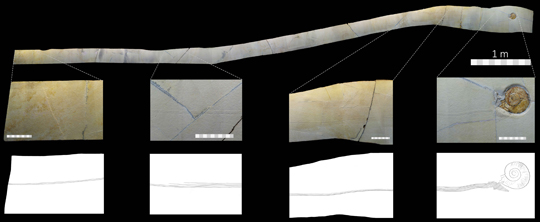
The international team of scientists, which includes palaeontologist Dean Lomax (Manchester University), have been studying the 8.5-metre-long trackway a fossil of an ammonite shell as it was rolled along the soft, carbonate mud by the lagoonal currents.  At the end of the track, the cricket ball-sized ammonite (Subplanites rueppellianus) came to rest.

The Team of Scientists Mapped the Progress of the Ammonite Shell Across the Bed of the Lagoon

Ammonite body and trace fossil.

Mapping the path of the Ammonite shell across the floor of the lagoon.

Picture credit: Manchester University

The picture above shows the track of the ammonite (left to right), with line drawings of each element of the highlighted “tool mark” fossil shown below.  The ammonite itself can be found at the end of the track (extreme right).  The ammonite, a specimen of S. rueppellianus was already dead when the track was made, although fossils such as this have been found before, it is an extremely rare find.  Technically, although the shell left a drag mark in the sediment and the body fossil is preserved, the track itself can’t really be regarded as a trace fossil.

Studying Ammonite Trace Fossils

Trace fossils such as trails, footprints, burrows and borings preserve evidence of the activity of animals.  As the ammonite was dead when the track was created, it should not really be referred to as a trace fossil.  A more accurate term might be “tool mark” to describe the fossilised movement of the shell across the lagoon floor.

Dean, lead author of the scientific paper published in the on-line academic journal PLOS One, commented:

“With fossils, we usually find body fossils, such as bones, teeth or shells, or trace fossils, such as tracks and burrows.  However, the drag mark has not been made by the ammonite in life and does not reflect behaviour.  Instead, the drag mark was created by the lake’s current moving the ammonite shell.  It is easy to understand why such fossils have been misinterpreted as the traces of living organisms.”

Visit the website of Dr Dean Lomax: British Palaeontologist Dr Dean Lomax.

A Spectacular Record of a Late Jurassic Ecosystem

During the Late Jurassic, much of western Europe was covered by a warm, tropical sea.  There were islands and these were home to an array of dinosaurs and other exotic creatures.  The landscape included stagnant lagoons that had limited access to the open sea.  These shallow bodies of water were extremely saline and very few organisms could tolerate the harsh conditions.

As a result, if animal or plant remains were washed into the lagoon from the land, or if, in this case, an ammonite was washed into the lagoon from the sea, there were very few scavengers or micro-organisms around to ingest the organic material.  The still waters, devoid of life, helped the preservation of these animal and plant remains. Slowly, they would have become buried in the soft, finely grained mud at the bottom of the lagoon, or in this case a rare current had disturbed the rotting ammonite and rolled the shell along the lagoonal floor, before the shell finally fell over and came to rest.

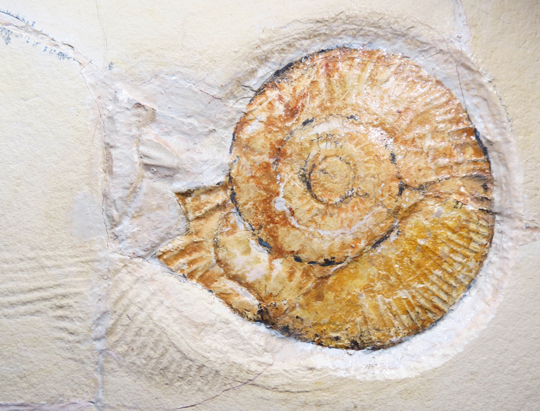
Subplanites rueppellianus Fossil Preserved at the End of the Trackway

Subplanites rueppellianus fossil.

Subplanites rueppellianus preserved at the end of the track.

Picture credit: Manchester University

Plotting the Movement of the Ammonite

How exactly did the fossil move after it had already died?  Ammonites had gas chambers, which they used to control their buoyancy and movement, similar to a submarine.  However, the shell of the ammonite was probably empty and the authors of the study speculate that some of the gas remained present in the shell.  This meant the ammonite did not sink straight to the bottom and fall over.  Instead, the S. rueppellianus shell was dragged along the bottom of the tropical lagoon by what must have been a calm and steady current.

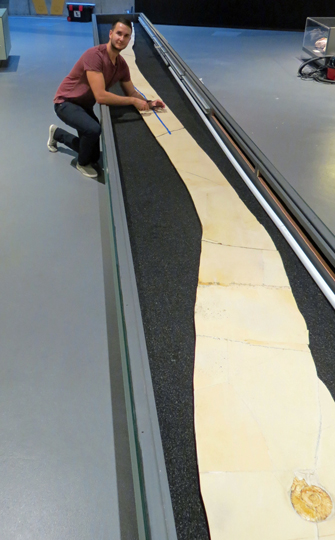
Dean Lomax Provides a Scale for the 8.5-metre-long Fossil Drag Mark

Examining the ammonite trace fossil.

Dean Lomax (University of Manchester) examines the trace fossil.

Picture credit: Manchester University

The start of the drag mark is not preserved, so the shell may have been rolling for much longer.  The mark was created by contact of the ammonite’s ribs (ridges on the shell), with the lagoon floor.  The mark begins with just two lines, suggesting only two of the ammonite’s ribs were in contact with the bottom of the lagoon.  The number of ribs increases along the drag marks length.

Dean Lomax added:

“Fossils such as this are super rare and provide a snapshot of an unusual moment in deep time.”

Revolutionising the Way Palaeontologists Can Showcase Fossil Material

Intricate digital photogrammetry and three-dimensional modelling was used by the research team to create a detailed video of the fossil, showing the progression of the ammonite until its final resting place.

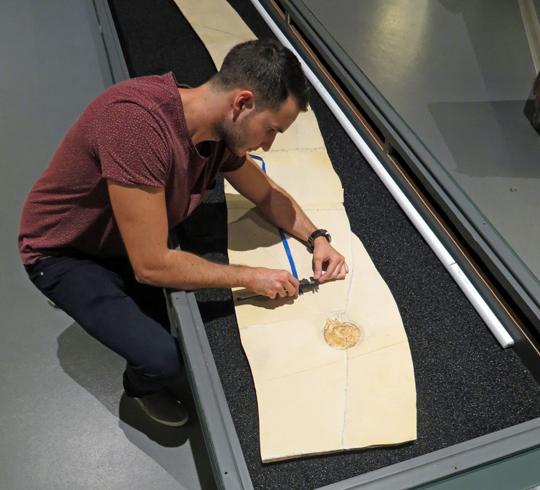
Dean Lomax Carefully Maps the Final Movements of the Ammonite Shell

Mapping an ammonite trace fossil.

Analysing the final movements of the ammonite shell.

Picture credit: Manchester University

Palaeontologist Peter Falkingham, (Liverpool John Moores University) and one of the co-authors of the study explained:

“We created a virtual model of the fossil by compiling over 600 photographs of the specimen.  We then created a video, which shows the drag mark and the preserved Ammonite.  Such modern techniques, like the photogrammetry method we used, have really revolutionised the way palaeontologists can study fossils.”

Everything Dinosaur acknowledges the help of the University of Manchester Press Team for their help in the compilation of this article.

Visit the Everything Dinosaur website: The Everything Dinosaur Website.

28 04, 2017

Remarkable Fossil with “Can-opener” Claws – Tokummia katalepsis

By |2024-05-08T20:07:20+01:00April 28th, 2017|Categories: Dinosaur and Prehistoric Animal News Stories, Dinosaur Fans, Main Page, Photos/Pictures of Fossils|0 Comments

The Origins of the Mandibulate Body Plan

Scientists at the University of Toronto in collaboration with colleagues at the Royal Ontario Museum, have published this week a scientific paper describing Tokummia katalepsis, a predator from the Cambrian, one that has provided palaeontologists with a better understanding of the evolution of one of the most numerous and diverse group of animals on Earth.

Tokummia katalepsis

The fossils, collected during extensive field work exploring 508-million-year-old sedimentary rocks near Marble Canyon in Kootenay National Park, (British Columbia), shed light on the origin of a group of arthropods collectively known as the Mandibulata.  The Mandibulata is a clade of the phylum Arthropoda that consists of millipedes, centipedes, the crustacea and insects.  Mandibulates are united by having a pair of specialised jaws “mandibles”, which can be used for a variety of purposes such as hunting, biting, cutting food into smaller pieces, digging, carrying items and constructing nests.

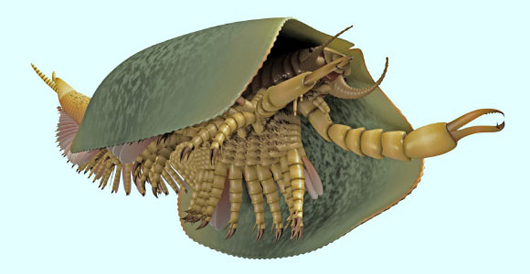
A Computer-Generated Image of Tokummia katalepsis

Tokummia katalepsis computer generated image.

A three-dimensional computer generated image of Tokummia katalepsis showing serrated pincers and the pair of mandibles.

Picture credit: Royal Ontario Museum

Studying the Arthropoda

The mandibulates constitute the largest, most speciose and most varied clade within the Arthropoda, but their evolutionary origins are poorly understood.  The discovery of several well-preserved specimens of T. katalepsis documents, for the first time, the anatomy of an early member of the Mandibulata.

Commenting on the significance of this research, Cédric Aria (University of Toronto) and lead author of the paper published in the journal “Nature” stated:

“In spite of their colossal diversity today, the origin of mandibulates had largely remained a mystery.  Before now we’ve had only sparse hints at what the first arthropods with mandibles could have looked like and no idea of what could have been other key characteristics that triggered the unrivalled diversification of that group.”

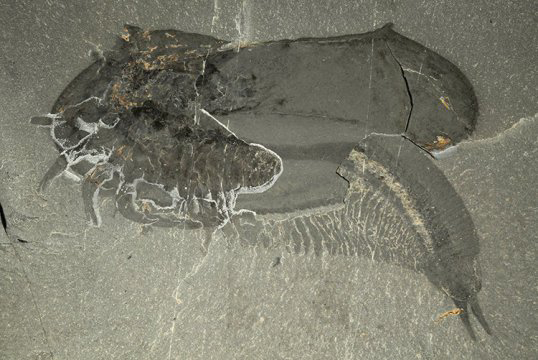
One of the T. katalepsis Fossils Used in the Study

Tokummia fossil material.

The flattened fossil of Tokummia showing numerous legs, the dorsal carapace and the specialised pincers.

Picture credit: Jean-Bernard Caron (Royal Ontario Museum)

The photograph above shows one of the beautifully preserved fossils found in 2014.  This specimen of Tokummia katalepsis shows a number of strong legs on the left partially protruding from the body, the shape of the bivalved carapace and dozens of small paddle-like limbs below the trunk at the lower right.

A Cross Between a Crab, a Centipede and a Can-opener

Described by some observers as looking like a cross between a crab, a centipede and a can-opener, Tokummia lived in a tropical sea that teemed with early marine life-forms including the ancestors of vertebrates.  At around ten centimetres in length, T. katalepsis was one of the largest predators in the ecosystem.  It had large pincers which the researchers thought would have been too delicate to tackle shelled animals like brachiopods and bivalves.

The research team postulate that Tokummia was primarily benthic (living on the sea floor), where it scuttled about digging into the sediment to catch soft bodied creatures such as worms.  The claws reminded the scientists of a can-opener, once grasped, any unfortunate prey would have been cut up into more easily digestible pieces by those revolutionary, broad, serrated mandibles.

The genus name honours Tokumm Creek, a small river that runs through Marble Canyon, the location of the fossil finds.  The species or trivial name is derived from the ancient Greek for “grasping”.

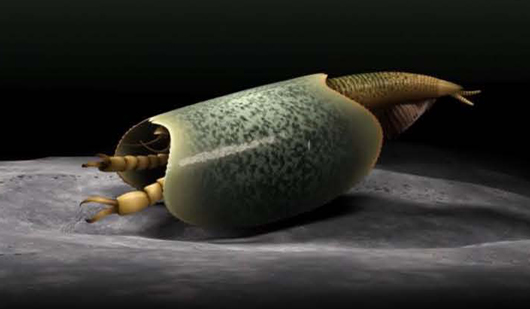
A Computer-Generated Image from a Video that Demonstrates Tokummia Locomotion

Tokummia katalepsis - computer generated image.

A computer animated image showing the basic body plan of Tokummia katalepsis.

Picture credit: Royal Ontario Museum

Co-author of the scientific paper and an expert on the Burgess Shale biota, Jean-Bernard Caron (Royal Ontario Museum and an Associate Professor at the University of Toronto), stated:

“This spectacular new predator, one of the largest and best preserved soft-bodied arthropods from Marble Canyon, joins the ranks of the many unusual marine creatures that lived during the Cambrian Explosion, a period of rapid evolutionary charge starting about half a billion years ago when most major animal groups first emerged in the fossil record.”

Numerous Fossil Specimens Studied

Careful mechanical preparation of the numerous specimens coupled with photographic work carried out under differing wavelengths of light, revealed the details of the Tokummia body plan.  The segmented trunk of Tokummia consisted of fifty small segments covered by a wide, two-piece carapace.  The delicate fossils show evidence of the pair of broad, notched mandibles as well as the large but quite delicate-looking front claws (maxillipeds), which are typical features of extant mandibulates.

Importantly, the animal bears subdivided limb bases with tiny projections called endites, which can be found in the larvae of certain crustaceans alive today and are now thought to have been critical innovations for the evolution of the various legs of mandibulates, and even for the mandibles themselves.

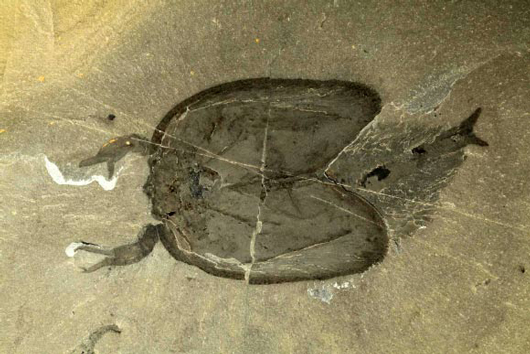
Fossils Providing an Insight into the Evolution of the Mandibulata

Tokummia katalepsis fossil.

Dorsal/ventral view of Tokummia katalepsis fossil material.

Picture credit: Royal Ontario Museum

Tokummia katalepsis Similar to Living Members of the Myriapoda

Graduate student Cédric Aria added that the many segments that make up the body are very reminiscent of living Myriapoda, the sub-phylum of Arthropoda that includes centipedes, millipedes and their relatives.

He went onto state:

“Tokummia also lacks the typical second antenna found in crustaceans, which illustrates a very surprising convergence with such terrestrial mandibulates.”

The study also resolves the affinities of other emblematic fossils excavated from Canada’s famous Burgess Shale deposits, more than a hundred years after their initial discovery.  Burgess Shale fossils such as Branchiocaris, Canadaspis and Odaraia form with Tokummia, a group of crustacean-like arthropods that can now be placed at the base of all mandibulates, they can be regarded as basal members of the Mandibulata.

The scientific paper: “Burgess Shale Fossils Illustrate the Origin of the Mandibulate Body Plan”: by Cédric Aria and Jean-Bernard Caron, published in the journal “Nature”.

Visit Everything Dinosaur’s website: Everything Dinosaur.

26 04, 2017

A Remarkable Headless Duck-Billed Dinosaur is Reunited with Skull

By |2024-05-07T15:32:42+01:00April 26th, 2017|Categories: Dinosaur and Prehistoric Animal News Stories, Dinosaur Fans, Main Page, Photos/Pictures of Fossils|0 Comments

Corythosaurus Fossil Gets its Head Back

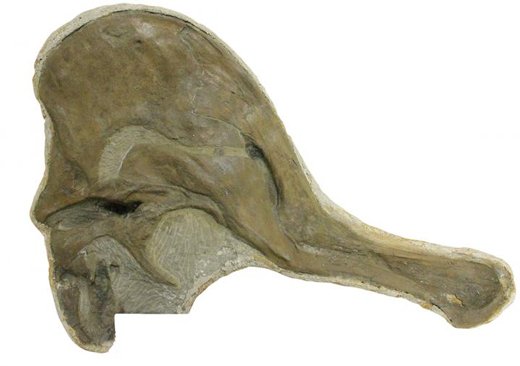
Scientists from the University of Alberta have been able to reunite the fossilised body of a Corythosaurus to its head, nearly one hundred years after the skull fossil was removed from the dig site.

Researchers have matched the headless skeleton to a Corythosaurus skull (C. excavatus) from the university’s Palaeontology Museum that had been collected in 1920 by the eminent George Sternberg during field work in what is now called the Dinosaur Provincial Park (southern Alberta).

Graduate Katherine Bramble, a co-author of the scientific paper that appears in the latest issue of “Cretaceous Research” commented:

“Based on our results, we believed there was potential that the skull and this specimen belonged together.”

The Corythosaurus (C. excavatus) Skull Collected by George Sternberg in 1920

Corythosaurus fossil skull.

The Corythosaurus skull collected by George Sternberg in 1920.

Picture credit: The University of Alberta

Trophy Hunting When it Came to Dinosaur Fossils

The Corythosaurus skull shown in lateral view (above) was collected in 1920 and designated the holotype fossil for a new hadrosaurid (Corythosaurus excavatus) by C. W. Gilmore in 1923.  The skull, (UALVP 13) became part of the University’s vertebrate fossil collection.  In 1992, a previously uncovered, weathered, Corythosaurus skeleton was found.  A field team from the University of Alberta collected the specimen in 2012 and research undertaken by Darren Tanke (a technician at the Royal Tyrrell Museum), a co-author of the paper indicated that the body remains could be associated with the already known skull material.

In the 19th and early 20th century, palaeontologists in North America were almost faced with an embarrassment of riches when it came to dinosaur fossils.  The extensive fossil deposits in Utah, Montana and southern Alberta led to many field teams simply “cherry picking” and only collecting the most spectacular of fossils, items such as claws, skulls, dermal armour, horns and teeth.  It is relatively common for a field team working in the Dinosaur Provincial Park to come across specimens missing skull material.

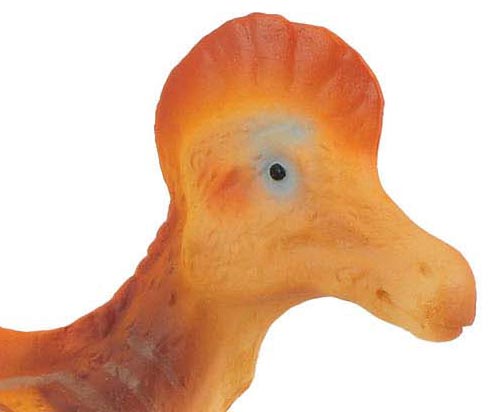
A Close-Up View of a Corythosaurus Dinosaur Model

CollectA Corythosaurus dinosaur model.

A close up of the head of Corythosaurus.

Picture credit: Everything Dinosaur

To view the CollectA series of prehistoric animal models: CollectA Age of Dinosaurs Figures.

Corythosaurus Lower Jaw (Dentary) Found

In addition, an isolated hadrosaur dentary (lower jaw bone), found in 1992, close to the articulated, postcranial skeleton may be one of the missing jaw fossils from the holotype skull.  The idea that this postcranial material be the skeleton of the holotype of Corythosaurus excavatus was tested using anatomical information and statistical analyses.  Statistical comparisons suggest that it is possible that the skull and dentary belong to the same individual.  Furthermore, the researchers postulate that the postcranial material could belong to the UALVP 13 skull.

Katherine Bramble explained:

“Using anatomical measurements of the skull and the skeleton, we conducted a statistical analysis.  Based on these results, we believed there was potential that the skull and this specimen belonged together.”

Matching Disparate Fossils to Individual Dinosaurs

This discovery highlights a growing field of study in palaeontology, wherein, scientists try to develop new ways of determining whether various parts of a skeleton, often located in different museum collections, belong to the same individual.  For this paper, the team used anatomical measurements, but there are several other ways of matching up fossil bones, such as conducting a chemical analysis on the surrounding matrix to identify the rocks from which the fossils were found.

The scientific paper, “Reuniting the ‘head hunted’ Corythosaurus excavatus (Dinosauria: Hadrosauridae) holotype skull with its dentary and postcranium,” published in the journal of “Cretaceous Research.”

The Everything Dinosaur website: Everything Dinosaur.
21 04, 2017

New Species of Hyaenodont from Egypt Described

By |2023-06-17T10:44:37+01:00April 21st, 2017|Categories: Dinosaur and Prehistoric Animal News Stories, Main Page, Photos/Pictures of Fossils|0 Comments

Masrasector nananubis – From the Late Eocene of Egypt

Everything Dinosaur highlights the discovery of a new species of hyaenodont from Egypt (Masrasector nananubis).

If people are asked to name a meat-eating mammal, you can expect to get answers such as tiger, bear or lion.  Those of us with more of a domestic outlook on life might mention cats and dogs, but for a significant portion of the Cenozoic, sometimes referred to as the “Age of Mammals”, the Carnivora, the Order to which bears, cats and dogs belong, did not get a look in.  Prior to the evolution of many types of recognisable carnivorous mammal alive today, other types of mammals filled the role of hypercarnivores*.

The Hyaenodonta

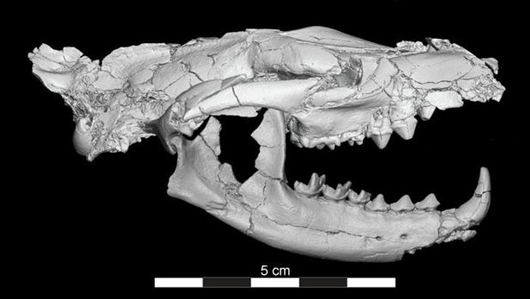
One such group was the Hyaenodonta.  A diverse clade of carnivorous mammals that filled a variety of roles in terrestrial ecosystems in both the New and the Old World.  Writing in the on-line academic journal PLOS One, scientists from Ohio University and the University of Southern California have published details of a new species of Yorkshire terrier-sized hyaenodont, the beautifully preserved skull and jaws are helping palaeontologists to understand more about the evolution and phylogeny of this extinct group, a group that has no close relatives alive today.

The Skull and Jaws of a Newly Identified Species of Hyaenodont

Skull and jaws of Masrasector nananubis.

Computer generated image showing the skull and jaws of Masrasector nananubis (right lateral view).

Picture credit: PLOS One

Masrasector nananubis – Named after a God of Ancient Egypt

The Late Eocene deposits of the Fayum Depression (Egypt), have provided scientists with a substantial number of mammal fossils, including a number of hyaenodonts, the latest to be added to this list is Masrasector nananubis.  It has been classified as member of the Hyaenodontidae, specifically part of the teratodontine clade, a poorly known group which are distinguished from other hyaenodonts by subtle differences in the shape of their skulls, jaws and teeth.

Masrasector translates as “the Egyptian slicer”, a reference to the large molars (carnassials).  The species or trivial name honours Anubis, the jackal-faced Egyptian god of mummification.  The premolars and molars of Masrasector have larger grinding surfaces when compared to other hyaenodonts.  The researchers have speculated that Masrasector nananubis may have supplemented its diet of small mammals, amphibians, reptiles and insects by feeding on fruit and nuts.  This suggests that, like other members of the Teratodontinae clade, it may not have relied on meat consumption as much as other hyaenodonts that were hypercarnivorous.  It has been suggested that M. nananubis may have been mesocarnivorous*.

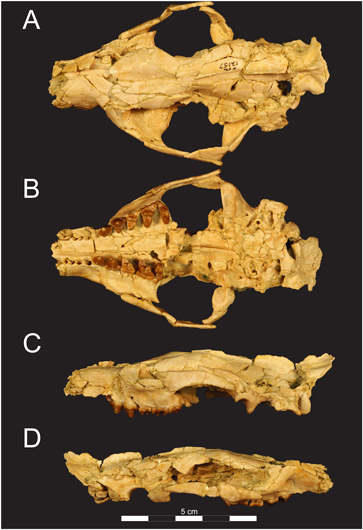
Views of the Skull of Masrasector nananubis

Cranium material of Masrasector.

Views of the skull of Masrasector (hyaenodont).

Picture credit: PLOS One

An Important Fossil Discovery

It may be true that hyaenodont fossils are known from Africa, North America, Asia and Europe and that the genus Hyaenodon survived for around twenty-six million years, the longest temporal spam known for a fossil mammal, but the discovery of these Masrasector fossils is still very significant.  The fossils comprise largely complete skulls, jaws, and parts of the skeleton, making them one of the most complete known African hyaenodonts from the Paleogene found to date.  Previously, researchers only had isolated bones and teeth fragments to work with, frustrating palaeontologists as they attempt to piece together the family tree representing the Hyaenodontidae.

The fossils come from a dig site (locality 41) in the Fayum Depression, the well-consolidated clays have been dated to the Late Priabonian of the Eocene (approximately 34 million years ago).  The Masrasector material represents some of the oldest fossils known for this type of hyaenodont.

Important Fossils (Masrasector nananubis)

Commenting on the importance of the fossils, corresponding author for the study, Matthew R. Borths (Department of Biomedical Sciences, Heritage College of Osteopathic Medicine, Ohio University), stated:

“These fossils might be the oldest and most complete ever discovered, but there is still much that remains to be discovered as the fossils of other members of this group are fragmentary.  Masrasector can be used as a cornerstone of character development for exploring the evolution and diversity of other hyaenodontids.”

An Illustration of the Giant Hyaenodont (H. gigas)

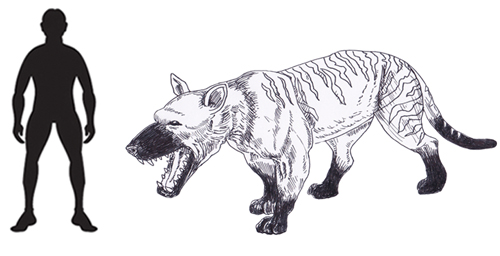
Hyaenodon gigas scale drawing.

A scale drawing of the giant Hyaenodon gigas.  Picture credit: Everything Dinosaur.

Picture credit: Everything Dinosaur

To view models and replicas of hyaeonodonts (whilst stocks last) and other prehistoric creatures: Wild Safari Figures and Models.

Matthew went onto add:

“Hyaenodonts were the top predators in Africa after the extinction of the dinosaurs.  This new species is associated with a dozen specimens, including skulls and arm bones, which means we can explore what it ate, how it moved, and consider why these carnivorous mammals died off as the relatives of dogs, cats, and hyenas moved into Africa.”

Explaining Terms

Hypercarnivore* an animal which has at least 70% of its diet made up of meat.

Mesocarnivore* an animal which has around 50% to 70% of its diet made up of meat.

The scientific paper: “Craniodental and Humeral Morphology of a New Species of Masrasector (Teratodontinae, Hyaenodonta, Placentalia) from the Late Eocene of Egypt and Locomotor Diversity in Hyaenodonts” by Matthew R. Borths and Erik R Seiffert published in PLOS One.

Visit Everything Dinosaur’s website: Everything Dinosaur.

18 04, 2017

New Species of Arowana Fish from the Eocene of China

By |2023-06-16T07:27:29+01:00April 18th, 2017|Categories: Dinosaur and Prehistoric Animal News Stories, Main Page, Photos/Pictures of Fossils|0 Comments

The Origins of the Dragon Fish (Scleropages)

Scientists from the Institute of Vertebrate Palaeontology and Palaeoanthropology (IVPP) have published details of the discovery of beautifully preserved fish fossils from China that have helped map the origins of one of the most valuable and sought after aquarium fishes in the world.  Scleropages formosus, the Asian Arowana, otherwise known as the Dragon Fish from south-eastern Asia, quite rare in the wild these days, but it is highly regarded amongst freshwater aquarium owners, who can splash out thousands of dollars to acquire particularly colourful specimens.

Scleropages sinensis

In a scientific paper published in the journal “Vertebrata PalAsiatica”, Dr Zhang Jiangyong (IVPP) in collaboration with Dr Mark Wilson (University of Alberta), report on the discovery of a new species of osteoglossid fish from the Early Eocene Xiwanpu Formation in Hunan and the Yangxi Formation in Hubei, (China).  The prehistoric fish is remarkable similar to the extant species and it has been named Scleropages sinensis (the name translates as “hard scaled leaves from China”, a reference to the robust tough body scales that characterises these fish).

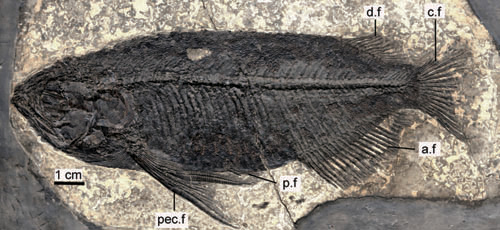
The Holotype Fossil Material of Scleropages sinensis

The holotype fossil material of S. sinensis.

Holotype of Scleropages sinensis.

Picture credit: Zhang Jiangyong (IVPP)

The picture above shows the beautifully preserved holotype specimen of S. sinensis.  The fins are labelled (df) = dorsal fin, (cf) = caudal fin, (af) = anal fin, (pf and pec f) = pectoral fins, scale bar 1 centimetre.

An Almost Complete Body Fossil

This is the first time a nearly complete body fossil of this genus has been described.  Previously, the fossil record only consisted of individual scales, otoliths (calcified structures from the inner ear) and isolated fragmentary bones.  The discovery of Scleropages sinensis dates the divergence of Scleropages from the closely related Osteoglossum to at least as far back as the Early Eocene.  The fish fossils represent a number of different ontogenetic (growth stages). The largest specimens are 17.5 centimetres in length, the smallest under 8 centimetres long.

Fossil Scleropages are known from the Maastrichtian of India, the Maastrichtian/Late Palaeocene of Africa, the Palaeocene of Europe, the Eocene of Sumatra, and the Oligocene of Australia.   All of these earlier records are scales, otoliths and isolated bone fragments. Therefore, these newly described Chinese fossils are the first skeletons of fossil Scleropages ever unearthed in the world.

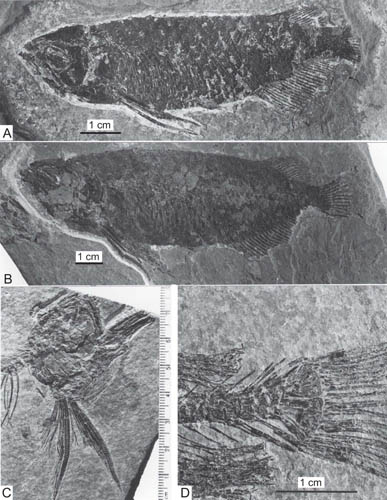
Views of the Scleropages Fossil Material

Views of Scleropages sinensis fossil material.

Scleropages sinensis fossil material (various views).

Picture credit: Zhang Jiangyong (IVPP)

Dr Zhang stated:

“This new fish resembles Scleropages in skull bones, caudal skeleton, the shape and position of fins, and reticulate scales.  Therefore, it must belong to the genus.”

Studying Extant Species

The extant species of Scleropages inhabits lakes, swamps and flooded forests as well as slowly meandering rivers. It is a carnivorous fish preying on insects, worms, small amphibians, other fish, small mammals and even birds.  The fish is renowned for its jumping, the researchers propose that Scleropages sinensis may have filled a similar niche in the Eocene ecosystem, but being smaller it probably had a more restricted diet than its extant relative.  Analysis of the fossil material suggests that sexual dimorphism may have existed in S. sinensis.

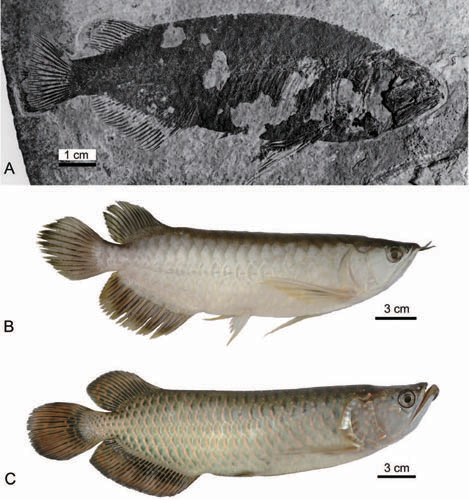
Comparing the Extinct Species with Living Species

Living species of Scleropages compared to the fossil material.

Comparison between Scleropages sinensis (A) and the living species S. formosus (B), S. leichardti.

Picture credit: Zhang Jiangyong (IVPP)

The Everything Dinosaur website: Everything Dinosaur.
13 04, 2017

The Dinosaurian Body Plan and Wonderful Alan Charig Remembered

By |2024-05-07T15:33:07+01:00April 13th, 2017|Categories: Dinosaur and Prehistoric Animal News Stories, Dinosaur Fans, Main Page, Photos/Pictures of Fossils|2 Comments

Teleocrater rhadinus and Dr Alan Charig

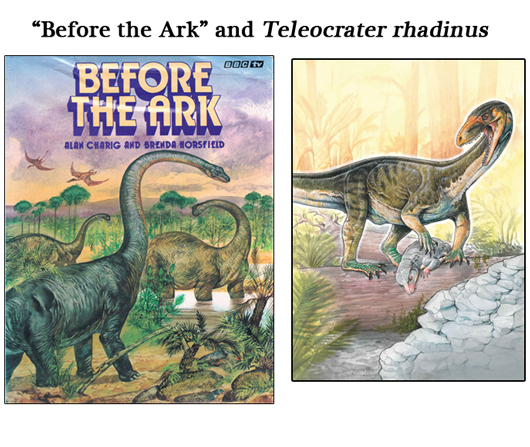
There’s a book on our office shelves, its dust jacket is faded and torn and the pages are yellowed with age, not surprising really as it was printed in 1973.  Although many of the passages, diagrams and ideas contained within it, have long since been superseded, it is treated with great reverence as it is one of the first dinosaur books I ever owned.  Entitled “Before the Ark” it accompanied a ten-part television series on vertebrate palaeontology produced by the BBC.

Written by Alan Charig and Brenda Horsfield, (Dr Charig wrote and presented the television series too), it remains a treasured possession and today, with the publication of a scientific paper in the journal “Nature”, we remember Dr Charig, a man who is still having an influence on science, even though he passed away some twenty years ago.

“Before the Ark” and Teleocrater – Tribute to Dr Alan Charig

"Before the Ark" and Teleocrater.

“Before the Ark” and Teleocrater (before the dinosaurs).

Picture credit: BBC with T. rhadinus artwork by Gabriel Lio (Museo Argentino de Ciencias Naturales)

Early Dinosaur Counsin with “Crocodile-like” Appearance

Writing in the journal “Nature”, the researchers which include Sterling Nesbitt, assistant professor of geosciences at Virginia Tech, Roger Smith (University of Witwatersrand) and Paul Barrett of the Natural History Museum (London), describe more complete fossil material relating to Teleocrater rhadinus and formally establish this genus which helps to fill a critical gap in the fossil record leading to the evolution of the dinosaurs.

Teleocrater (the name means “slender complete basin” in reference to the reptile’s light build and the fully closed hip socket), was first proposed by Alan Charig back in the 1950s.  He was a PhD student at Cambridge University writing a doctoral thesis on Triassic reptiles of Tanganyika (now Tanzania).  Alan was being supervised by Francis Rex Parrington, a vertebrate palaeontologist who had uncovered the very first fossils of what we now refer to as Teleocrater rhadinus, during fieldwork in Tanganyika in 1933.

Fieldwork undertaken in 2015, led to the discovery of more fossil material and crucially limb elements and ankle bones which have helped determine where amongst the Archosaurs Teleocrater should be placed.

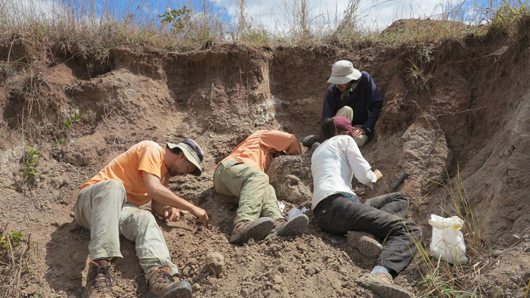
Team Members Extracting Fossil Material

Excavating the fossils of Teleocrater and other Triassic animals.

Excavating the remains of Teleocrater rhadinus and other animals in southern Tanzania in 2015.

Picture credit: Roger Smith

Published photographs show authors Christian Sidor (left), Sterling Nesbitt, Kenneth Angielczyk (in the purple top and white floppy hat), along with Michelle Stocker (right), looking for Triassic vertebrates in exposures of the Manda Beds (Anisian faunal stage of the Middle Triassic) of southern Tanzania.

All Fossil Material from the Manda Beds

Francis R. Parrington collected the first fossil specimens from the Manda Beds in the Ruhuhu Basin of southern Tanzania.  These fossils were studied by Alan Charig for his doctorate, but much of Alan’s work on Teleocrater was never published.  Dr Charig went to Tanzania to search for more fossils in 1963, but it was not until the expedition of 2015, that the crucially important limb and ankle bones were recovered that demonstrated where on the Archosauria family tree Teleocrater should sit.

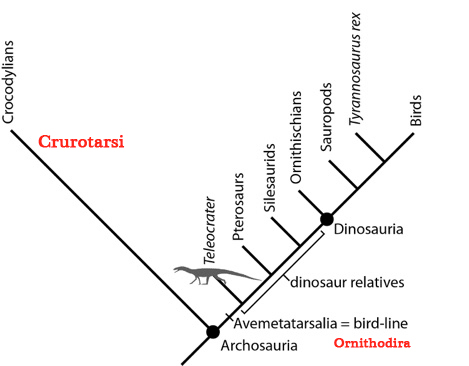
The ankle bones and other skeletal elements demonstrate that Teleocrater is more closely related to dinosaurs and birds than it is to crocodiles. It sits on the family tree of the archosaurs at the base of the Avemetatarsalian branch, the “bird-line Archosaurs”, sometimes also referred to as the Ornithodira.  The researchers conclude that Teleocrater and its near relatives split off from other avemetatarsalians before the evolutionary split between the Pterosauria (flying reptiles) and the dinosaurs.

Establishing T. rhadinus on the Archosauria Family Tree

The phylogeny of Teleocrater.

Teleocrater is more closely related to pterosaurs and dinosaurs (including birds) than to crocodilians.

Picture credit: Sterling Nesbitt of Virginia Tech with additional annotation by Everything Dinosaur

The Big Two Branches of the Archosauria

The Archosauria clade consists of birds and crocodiles plus an array of extinct creatures which include the dinosaurs, silesaurids and the flying reptiles (pterosaurs).  This huge group of reptiles can be generally divided up into two distinct branches, based on the anatomy of the ankle bones.  On one branch, we have the crocodiles and their relatives (Crurotarsi), which tend to have a sprawling gait, whilst on the other branch we have the Avemetatarsalia, otherwise referred to as the ornithodirans, which tend to have their limbs directly under their hips and have a more upright gait, similar to mammals.

Dr Charig never got the opportunity to study fossils of the ankle bone, he passed away in 1997, without being able to complete his assessment of this reptile.  The researchers have honoured the contribution made by Alan Charig by naming him as an author on the 2017 paper and formally recognising the name Teleocrater, that he was the first to use.

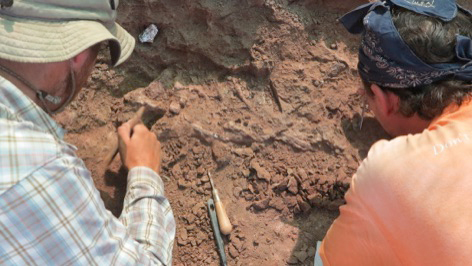
Excavating the Fossils of Teleocrater

Excavating the fossils of Teleocrater and other Triassic animals.

Excavating the remains of Teleocrater rhadinus and other animals in southern Tanzania in 2015.

Picture credit: Roger Smith

Uniting the Aphanosauria Clade – Dinosaur Ancestors on All Fours

Teleocrater helps to cement the establishment of the Aphanosauria clade, a group of long-necked, slender-limbed, carnivores that lived in the Middle Triassic and were geographically widespread across Pangaea.  The Crurotarsi archosaurs, those crocodile-like creatures were thought to be highly diversified and geographically widespread across the super-continent Pangaea.  It now seems that the other branch of the Archosauria, the Avemetatarsalia, may have been equally as diverse and as widespread as their crocodile-like cousins.

Previously, palaeontologists have postulated that the earliest dinosaur relatives were chicken-sized and bipedal.  Thanks to the 2015 fossil discoveries and the work first undertaken by F. R. Parrington and Alan Charig, scientists have a different body plan to consider.  T. rhadinus which roamed the area that was to become Tanzania some 245 million-years-ago, was much larger at around three metres long and it was a quadruped.

An Illustration of the Early Avemetatarsalian Teleocrater rhadinus

T. rhadinus illustration.

A life reconstruction of Teleocrater rhadinus.

Picture credit:  Gabriel Lio (Museo Argentino de Ciencias Naturales)

Remembering Dr Alan Charig

Alan Charig studied the fossils of what we now know as Teleocrater rhadinus.  Twenty years after his death, scientists can place this enigmatic reptile and its relatives within the avemetatarsalian branch of the Archosauria, Teleocrater represents one of the earliest members of this sub-branch, a lineage that eventually led to the dinosaurs and the birds.

In addition, with a more complete picture of Teleocrater, palaeontologists have another puzzle to ponder.  If the early branch members of the Avemetatarsalia were more species-rich and more widely geographically distributed than previously thought, then several early dinosauromorphs used to help scientists to understand how the body plan of the Dinosauria evolved, may represent specialised forms rather than the typical ancestral avemetatarsalian body plan.

Today, we reflect on the work of Dr Alan Charig and his mentor Francis Rex Parrington.  The researchers writing in the journal “Nature” have helped to put flesh onto those bones first examined all those years ago.  For my part, my thanks to Alan Charig for helping to write such a beautiful book and for inspiring a generation of science writers and enthusiasts.

The scientific paper: “The Earliest Bird-line Archosaurs and he Assembly of the Dinosaur Body Plan” by Sterling J. Nesbitt, Richard J. Butler, Martín D. Ezcurra, Paul M. Barrett, Michelle R. Stocker, Kenneth D. Angielczyk, Roger M. H. Smith, Christian A. Sidor, Grzegorz Niedźwiedzki, Andrey G. Sennikov & Alan J. Charig published in the journal “Nature”.

Everything Dinosaur acknowledges the help of Virginia Tech in the compilation of this article.

Visit the Everything Dinosaur website: Everything Dinosaur.
12 04, 2017

Chinese Fossil Sites Under Threat

By |2023-06-15T07:31:08+01:00April 12th, 2017|Categories: Dinosaur and Prehistoric Animal News Stories, Main Page, Photos/Pictures of Fossils|0 Comments

Mining Operations Damage Famous Fossil Site

An article in the South China Morning Post highlights the growing concern expressed by the scientific community over damage to a globally important fossil site in Guizhou Province (south-western China).  Phosphorous mining operations are wiping away fossil evidence of some of the earliest organisms classified as animals known to science.  The tiny micro-fossils preserved in strata exposed in Weng’an county, represent the remains of multi-cellular organisms, marine sponges that once thrived in an ancient sea some 600 million years ago.

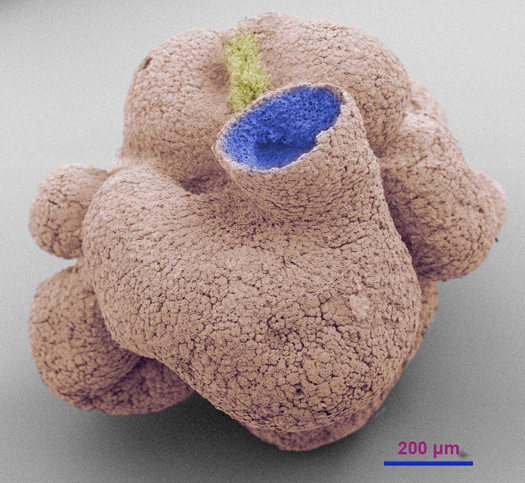
A False Colour Image Showing One of the Sponge-Like Micro-fossils (Doushantuo Formation)

Sponge-like Ediacaran micro-fossil.

A scanning electron microscope image of the 600 million-year-old sponge-like animal fossil (false colour image).

Picture credit: NIGPAS (Chinese Academy of Sciences)

Fossil Site Under Threat

Professor Zhu Maoyan and his colleagues at the Nanjing Institute of Geology and Palaeontology have called for urgent measures to be taken to help protect the Weng’an biota.  The world-renowned fossil site, one of the few places that preserves traces of Ediacaran fauna, is threatened as hundreds of mining trucks are transporting rocks from the area every day.  Weng’an county has one of Asia’s largest phosphorus reserves.  The mining business contributes more than sixty per cent of the county government’s annual tax income.  Intensive mining in the area has led to cases of massive subsidence.

The professor, who has led a number of field teams to explore the fossiliferous sediments, that first came to the attention of palaeontologists less than twenty years ago, stated:

“Six hundred million years of life’s evolutionary history is being traded to help produce a bowl of rice.”

The demand for phosphorous to make fertiliser is increasing, unfortunately, the rocks that form the Doushantuo Formation of Guizhou Province are a rich source of this important element.  However, local officials in Weng’an county have promised action after a fossil site covering about three square kilometres was nearly destroyed and buried under huge heaps of debris caused by subsidence.

The Doushantuo Formation

The micro-fossils preserved in the phosphorite rocks of the Doushantuo Formation, preserve the remains of 600 million-year-old, sponge-like organisms.  Professor Zhu commented that the Weng’an biota was remarkable because of the abundance of fossils and their fine state of preservation, with details shown down to a cellular level.

The professor added:

“There may not be another place like it in the whole world.”

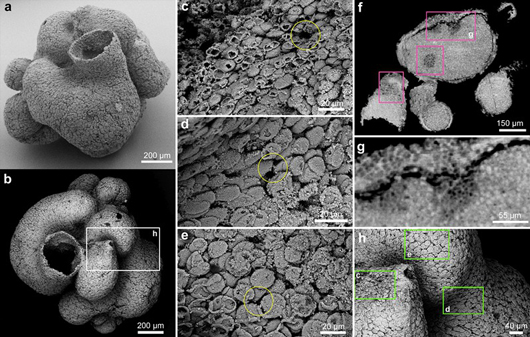
Features of the Fossils are Similar to Extant Sponge Anatomy

Precambrian sponge-like fossils.

Views of the sponge-like fossils from south-western China.

Picture credit: NIGPAS (Chinese Academy of Sciences)

The picture above shows various views of micro-fossils from the Weng’an county location including highly magnified views of what be a holdfast structure (c, d, e, f, g and h).

Professor Zhu stressed that both local government and the public had failed to realise that the exposures in Weng’an county are unique and very valuable to science.  It was suggested that a “core area” be chosen and then this site given protection.

To read an article featuring research by Virginia Tech College of Science and the Chinese Academy of Sciences which looks at the fossil evidence from the Doushantuo Formation: New Research Suggests Multicellular Life Started Earlier Than Previously Thought.

Visit the Everything Dinosaur website: Everything Dinosaur.
9 04, 2017

Chicxulub Impact Event Not Responsible for Dinosaur Extinction

By |2023-06-14T06:22:16+01:00April 9th, 2017|Categories: Dinosaur and Prehistoric Animal News Stories, Dinosaur Fans, Main Page, Photos/Pictures of Fossils|0 Comments

Mexican Tracksites Indicate Decline of Dinosaurs Prior to Impact Event

A team of scientists based in Germany and Mexico have published a paper that challenges the commonly held belief that the extraterrestrial impact event marked by the Chicxulub crater resulted in the extinction of the dinosaurs and their flying cousins the pterosaurs.  In addition, studies of marine sediments indicate that at least one species of ammonite Sphenodiscus pleurisepta may have survived into the Palaeogene.

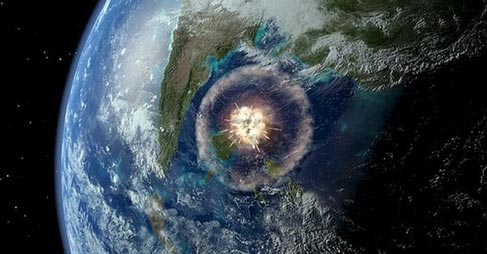
Chicxulub Extraterrestrial Impact Not the Cause of Global Mass Extinctions

Chicxulub impact event.

An artists’s impression of the impact event.

Exploring the Fossil Assemblage of the Cretaceous/Palaeogene Boundary

Writing in the journal of the “Geological Society of America Bulletin”, the researchers which include lead author Professor Wolfgang Stinnesbeck of Heidelberg University, Professor Eberhard Frey (State Museum of Natural History, Karlsruhe) and scientists from the Museo del Desierto, Coahuila, (Mexico), postulate that the dinosaurs and the flying reptiles were in long-term decline before the Chicxulub impact and the global mass extinction that marked the end of the Mesozoic.

The scientists also postulate that Aves (birds), had spread and diversified at the same time as the Dinosauria was in decline.  Furthermore, based on fossil evidence, the team contend that at least one type of ammonite, Sphenodiscus pleurisepta persisted into the Cenozoic.

These conclusions were drawn from a comprehensive study of upper Cretaceous sedimentary sandstone rocks, laid down at the very end of the “Age of Dinosaurs”.  The tracks and body fossils found at two localities in the Mexican state of Coahuila, depict life on the shore and the surrounding waters of a shrinking inland sea.  Both sites represent sandstones within the Las Encinas Formation of north-eastern Mexico.

Remote Fossil Site in North-eastern Mexico (Las Encinas Formation)

Fossil site in north-eastern Mexico

One of the remote and isolated sites where the fossils were found.

Picture credit: Professor Stinnesbeck/Heidelberg University

The trackway assemblages at Amargos and Rancho San Francisco respectively, were produced by at least six different types of birds, while trackways of azhdarchoid pterosaurs are rare.  Only a single footprint made by a dinosaur (Theropod) was recorded.

Professor Stinnesbeck commented:

“Dinosaur tracks, however, are rare.  Only a single footprint comes from a predatory dinosaur.”

Lack of Pterosaur Fossil Evidence

The scarcity of pterosaur fossils was also noted.  The scientists state that azhdarchoid pterosaur fossils are rare.  Azhdarchids include some of the most famous and largest pterosaurs of all – Quetzalcoatlus Hatzegopteryx and Arambourgiania.  Most of the Pterosauria had become extinct by the Maastrichtian faunal stage of the Late Cretaceous.  From their heyday in the Early Cretaceous when at least ten pterosaur families existed, by the very end of the Cretaceous only two families of pterosaur are known in the fossil record.

Pterosaur Fossils Such as These Tracks are Very Rare

Pterosaur fossil tracks.

Pterosaur fossil tracks (north-eastern Mexico).

Picture credit: Professor Stinnesbeck/Heidelberg University

The photograph above shows prints of Azhdharchidea pterosaurs in a sandstone of the Upper Cretaceous, location – Rancho San Francisco near Paredon, north-eastern Mexico.

Research into the two locations Amargos and Rancho San Francisco, indicate a gradual decline of the dinosaurs with a simultaneous increase in the diversity of birds even before the end of the Cretaceous.

Professor Stinnesbeck added:

“Until now, it was generally assumed that the dinosaurs died out first and bird species diversified afterwards.  Our data, however, substantiate the theory that birds ascended before dinosaurs became extinct.”

The team postulate that the extraterrestrial impact event was not the cause of the dinosaur and pterosaur extinction, these reptiles were already on their way out, long before that event took place.  This idea of only a few dinosaur species persisting until the very end of the Mesozoic has been proposed before.  A count of dinosaur fossils found in the famous Hell Creek Formation of Montana supported the theory that the Dinosauria were already in decline by the end of the Cretaceous, the fossil assemblage in the very youngest rocks was dominated by just a handful of species.

Ammonites Survived into the Cenozoic

In the scientific paper, the researchers comment that the ammonites were not wiped out by the asteroid/comet/meteor strike.  Professor Stinnesbeck and his colleagues suggest that the species Sphenodiscus pleurisepta, a type of ammonite known from the United States and Mexico, survived, albeit in a declining state into the Palaeogene.

The geology professor stated:

“The effects of the Chicxulub impact were therefore not the cause of a global mass extinction, which probably came about considerably less catastrophically than previously assumed.”

Studying the Chicxulub Impact Event

The power of the extraterrestrial impact is evidenced by the abundance of crystalline clay minerals that are rounded in shape (smectite spherules), within a two-and-a-half metre-thick layer of strata.

The Last Ammonite (Sphenodiscus pleurisepta)?

Sphenodiscus pleurisepta fossil ammonite.

Sphenodiscus pleurisepta ammonite fossil.

Picture credit: Conrad

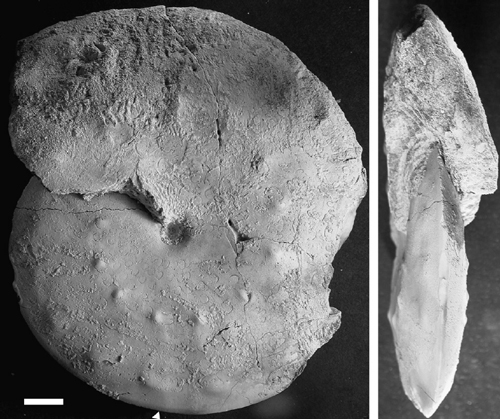
The picture above shows a typical fossil of S. pleurisepta (picture of the holotype fossil), scale bar equals 1 cm.

For models and replicas of ammonites and other prehistoric animals: CollectA Prehistoric Life Figures.

The fifty million year decline of the Dinosauria: Bayesian Analysis Sheds New Light on Dinosaur Decline.

To read about other ammonites that may have persisted into the Cenozoic: Unravelling an Ammonite Mystery.

10 03, 2017

Amazing Late Jurassic Crocodile Eggs and Meat-Eating Dinosaurs

By |2024-05-07T15:29:15+01:00March 10th, 2017|Categories: Dinosaur and Prehistoric Animal News Stories, Dinosaur Fans, Main Page, Palaeontological articles, Photos/Pictures of Fossils|0 Comments

Crocodylomorph Ootaxa and the Theropod Connection

A number of media outlets have reported upon a paper published in the on line journal PLOS One which describes two new ootaxa (the name given to a species described just from egg fossils), of crocodilians from the Upper Jurassic rocks of western Portugal.  The focus on many of these reports has been on the age of the fossilised crocodile eggs.  Having been laid more than 150 million years ago, they are the oldest crocodilian eggs described to date.  However, the research paper itself, hints at a remarkable potential relationship between these ancient reptiles and their close cousins, theropod dinosaurs.

A Clutch of Unhatched Late Jurassic Crocodylomorph Eggs (Lourinhã Formation)

Suchoolithus portucalensis fossil eggs.

The unhatched crocodylomorph eggs (Cambelas) ascribed to Suchoolithus portucalensis.

The Famous Lourinhã Formation

The first crocodylomorph eggs were found in 1987 and over the years a number of egg and eggshell fragment discoveries have been made.  The eggs are very similar to the eggs of extant crocodiles but the scientists have been able to identity distinctions between the fossil specimens (not least the size).  This has led to the erection of two new ootaxa.  The eggs of the smaller of the two crocodylomorphs – Suchoolithus portucalensis are shown in the photograph above.  The eggs are quite small and the researchers estimate that the adult female that laid these eggs would have been around seventy centimetres in length.

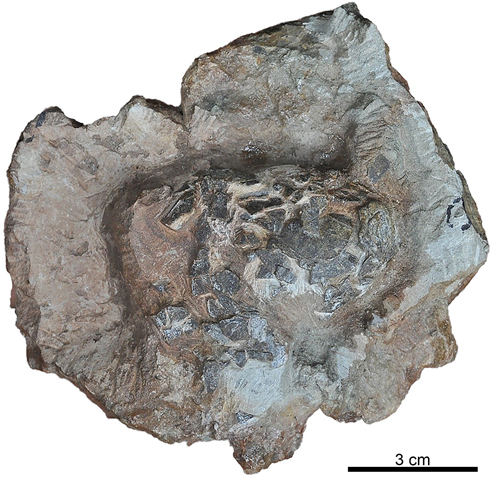
The second ootaxa to be named – Krokolithes dinophilus, which is known from a number of fossil specimens collected from four locations, is represented by larger but broken eggs and shell fragments.  The research team estimate that the female croc that laid these eggs would have been around the size of a female American Alligator (A. mississippiensis), probably more than two metres long.

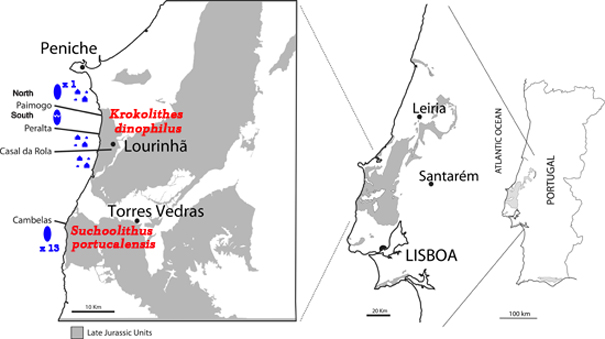
Location of the Egg Fossil Finds Referred to in the New Study

Map showing the location of the fossil finds.

A map showing the location of the crocodylomorph eggfossil sites.

Picture credit: PLOS One with additional annotation from Everything Dinosaur

Key

The picture above shows the five fossil locations that are covered in the scientific paper as well as indicating the position of the Lourinhã Formation in relation to the rest of Portugal.  A total of thirteen fossilised eggs collected at the Cambelas site have been ascribed to the ootaxa Suchoolithus portucalensis (the name translates from Latin as “egg stone crocodile from Portugal”), the fossils represent a clutch of unhatched eggs.

Larger Crocodylomorph Eggs

Eggs laid by a much larger crocodylomorph are associated with the other four locations, namely North and South Paimogo, Casal da Rola and Peralta.  These fossils comprise broken eggs and numerous shell fragments, they have been ascribed to the ootaxa Krokolithes dinophilus (which is from the Greek and means “crocodile eggs found in association with dinosaurs”).

Holotype of Krokolithes dinophilus (Specimen Number ML760 from Paimogo N, Praia da Amoreira-Porto Novo Member, Lourinhã Formation)

Krokolithes dinophilus fossil material.

Holotype of the oospecies Krokolithes dinophilus.

Found in Association with Theropod Dinosaur Nests

All the egg fossils (except for the Cambelas site fossils), were found in association with theropod dinosaur nests and eggs.  So in essence, the palaeontologists, which included João Russo and Octávio Mateus (Museu da Lourinhã, Portugal), have identified four occurrences where the fossils of the large crocodylomorph K. dinophilus are found in the same place as the eggs and nests of large, meat-eating dinosaurs.  This could suggest some sort of biological relationship between the crocodiles and the theropods.

Theropod Dinosaurs and Crocodilians – A Symbiotic Relationship?

This is certainly an intriguing thought and there are no parallels that can be drawn between this idea and the behaviour of modern crocodiles.  Extant crocodilians tend to lay eggs in relatively secluded places and a parent (usually the female), will stand guard helping to protect the nest and the subsequent hatchlings from predators.

It can be speculated that these prehistoric crocodiles preferred to nest in close proximity to large meat-eating dinosaurs as perhaps the presence of two different types of large predator helped to protect all the nests from potential danger.  With so many threats to eggs and recently hatched animals around in the Late Jurassic, it could be suggested that there was a degree of mutual benefit between various species – a symbiotic relationship with both the theropods and the crocodilians gaining an advantage.

Lourinhanosaurus antunesi

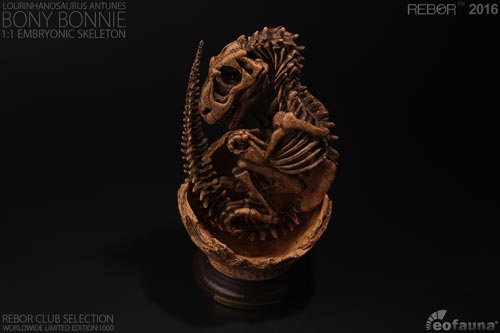
Some of the K. dinophilus egg fossils come from sites associated with the nests of Lourinhanosaurus (Lourinhanosaurus antunesi), a formidable Late Jurassic hunter, which may have reached lengths of eight metres or more.  The beautifully preserved theropod embryos were the inspiration behind the limited edition “Baby Bonnie” 1:1 scale replicas created by Rebor.

The Rebor “Baby Bonnie” Scale Model of a Lourinhanosaurus antunesi Embryo

"Bony Bonnie" from Rebor.

The Rebor Club Selection Lourinhanosaurus replica.

To view the range of Rebor prehistoric animal figures and replicas: Rebor Dinosaur and Prehistoric Animal Replicas.

Other Krokolithes dinophilus fossils have been found in proximity to the nests and eggs of the ootaxon Preprismatoolithus coloradensis (which could represent the eggs of a large Allosaurus).  We expect palaeoartists to have a field day illustrating nesting site scenes featuring a mix of large predators together.

The Theory has Drawbacks

The absence of any modern parallels and the incomplete fossil record provides considerable drawbacks when it comes to the plausibility of crocodiles nesting alongside meat-eating dinosaurs.  Some of the fossil eggs shell fragments from the Paimogo locations might have been transported and deposited close to the theropod nests, therefore their placement in the strata is not necessarily their original nesting context.  We at Everything Dinosaur have proposed that it is possible that crocodiles and theropod dinosaurs preferred to use the same nesting locations, but they may not have bred at the same time.  After all, using an already dug out nest, one that had been used recently by a large, carnivorous dinosaur might prove advantageous for a wily crocodile.

The scientists conclude that this potential egg-laying symbiosis is a mystery and that going forward, further findings and studies are needed to ascertain if there was indeed some kind of reproductive relationship between crocodylomorphs and theropods in the Late Jurassic of Portugal.

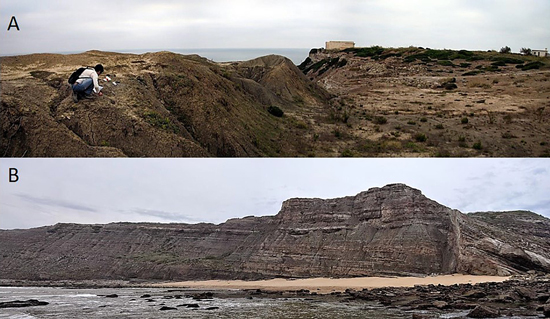
Views of the Lourinhã Formation

Views of the Lourinha Formation.

(A), location of Paimogo, Northern Lourinhã Formation, Praia da Amoreira-Porto Novo and Praia Azul Members. (B), location of Cambelas, Southern Lourinhã Formation, Assenta Member.

Picture credit: PLOS One

Go to Top