All about dinosaurs, fossils and prehistoric animals by Everything Dinosaur team members.

Pictures of fossils, fossil hunting trips, fossil sites and photographs relating to fossil hunting and fossil finds.

24 02, 2017

Penguins Lived Alongside Dinosaurs (Probably) According to New Study

By |2024-05-07T13:45:21+01:00February 24th, 2017|Categories: Dinosaur and Prehistoric Animal News Stories, Main Page, Photos/Pictures of Fossils|0 Comments

Giant Prehistoric Penguin 1.5 metres Tall

Ancient leg bones, found in Palaeocene-aged deposits located on the shoreline of Pegasus Bay near the city of Christchurch (New Zealand), has led scientists to propose that dinosaurs would have been familiar with penguins.  Penguins and dinosaurs could have co-existed.  In addition, the leg bone fossils indicate that after the dinosaurs died out, some penguins became super-sized, standing around 1.5 metres tall.  The avian fossil material was excavated from sediments along the Waipara River, close to where this river meets the sea (Pegasus Bay).  It has been estimated that this giant, primitive penguin lived in a coastal environment some 61 million years ago.

Penguins and Dinosaurs

Researchers from the Senckenberg Society for Natural Research (Frankfurt, Germany), have concluded that the penguin lineage is much older than previously thought, suggesting that these marine birds very probably evolved during the Late Cretaceous and the first kinds of penguins would have been very familiar to dinosaurs that wandered the remnants of the southern continent Gondwana.

A Super-sized Palaeocene Penguin
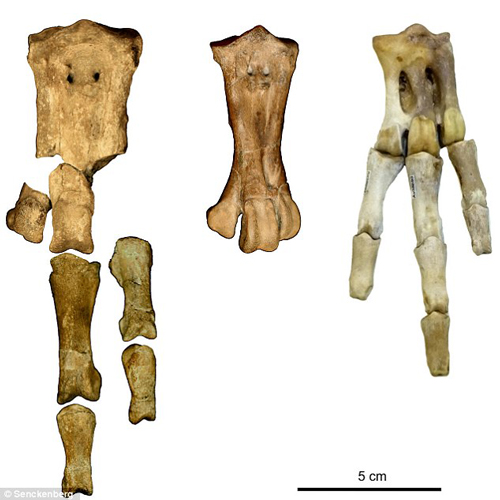
Penguin fossil comparison.

New specimen (left) compared to W. manneringi and an extant Emperor Penguin (Aptenodytes forsteri) on the right.

Picture credit: Senckenberg Society for Natural Research

The picture above compares the fossil leg bones of the newly discovered penguin species, with that of another, smaller Palaeocene penguin found in the same area Waimanu manneringi, which was formally described in 2006.  The bones on the right are from the largest living species of penguin, the Emperor penguin (A. forsteri).   This fossil supports the theory that the ancestors of modern Aves rapidly diversified after the end Cretaceous extinction event occupying a number of niches that had previously been occupied by other types of bird and theropod dinosaurs.

An Illustration of Waimanu manneringi
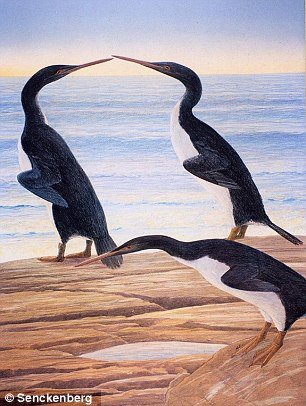
Waddling with dinosaurs.

Penguins probably waddled next to dinosaurs.

Picture credit: Senckenberg Society for Natural Research

When Did Penguins Evolve?

Although, Waimanu manneringi was a contemporary of the giant penguin, it had a different body plan, resembling a cormorant.  The two types of penguin were very different, this suggests that basal penguins probably evolved prior to the end of the Cretaceous.

Co-author of the scientific paper, Dr Paul Scofield (Canterbury Museum, New Zealand), explained:

“We believed up until this specimen was discovered that there was very little variation amongst these Palaeocene penguins.  We are now starting to understand that shortly after the extinction of the dinosaurs there were in fact two quite different groups of penguin.”

No Scientific Name as Yet

The lack of autapomorphies (distinctive features) and the fragmentary nature of the fossils has deterred the researchers from seeking to name their new prehistoric bird.

A spokesperson from Everything Dinosaur stated:

“The fossils probably represent a new species, however, with so few fossils to go on and with a lack of distinctive characteristics in the bones, it is not possible to erect a new species at the moment.  Should more fossil material be found, especially skull material, then a new prehistoric bird species could come about.”

The Prehistoric Penguin Compared in Size with a Modern Human
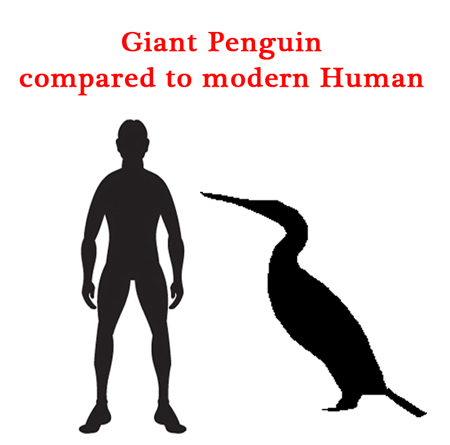
New Zealand giant penguin size comparison.

South Island giant penguin compared to modern human.

Picture credit: Everything Dinosaur

For replicas and models of prehistoric animals: Eofauna Scientific Research Models.

The orientation of the leg bones suggests that, just like modern penguins, this ancient feathered friend probably waddled, walking in the same manner as its extant, smaller cousins.  The fossil discovery is highly significant as it will likely be used as an “anchor point” to determine how the penguin family evolved.  It is also very likely that other penguin species existed during the Palaeocene Epoch in this part of the world, but their fossilised remains have not yet been discovered.

Will More Fossils be Found?

The scientists are optimistic that the fossil site, just twenty miles north of the city of Christchurch, will yield further evidence of ancient sea birds.  Although, around twenty-five percent bigger than the largest penguin species around today (Emperor penguin), these fossils do not represent the largest penguin known to science.

To read more about one of the largest known penguin species: Picking up a Giant Prehistoric Penguin.

Penguins were not the only creatures around today, that would have been familiar to the dinosaurs.  Everything Dinosaur wrote an article after research had been published back in 2008 that suggested the bizarre duck-billed platypus co-existed with duck-billed dinosaurs.

To read the article: Duck-billed Platypus and the Duck-billed Dinosaurs.

Visit the Everything Dinosaur, user-friendly website: Everything Dinosaur.
13 02, 2017

Spiny, Armoured Slug Provides Best Evidence for the Ancestry of Molluscs

By |2023-05-17T22:00:57+01:00February 13th, 2017|Categories: Dinosaur and Prehistoric Animal News Stories, Main Page, Palaeontological articles, Photos/Pictures of Fossils|0 Comments

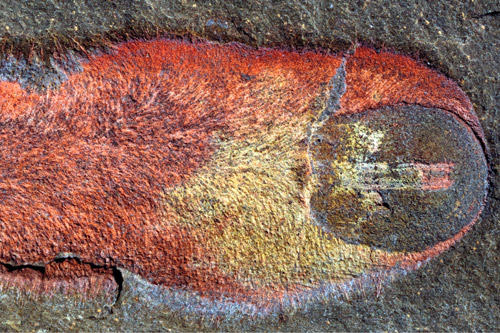
Spiny but Slimy and with a Radula – Calvapilosa kroegeri

Scientists from the University of Bristol have uncovered a 480-million-year-old slug-like fossil in Morocco which sheds new light on the evolution of molluscs, a diverse group of invertebrates that includes clams, snails and cephalopods like squid and cuttlefish.

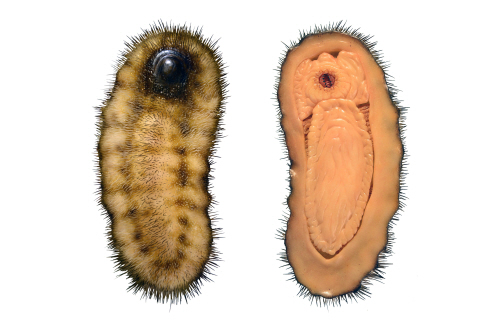
A Model of the Newly Described Calvapilosa kroegeri

Viewed from the top (left) and the bottom (right) - Calvapilosa kroegeri.

Calvapilosa kroegeri dorsal and ventral views.

Picture credit: Dr Jakob Vinther

Calvapilosa kroegeri

One of the defining characteristics of the molluscs is the possession of a radula, a kind of toothed-tongue which is used to rake up or rasp food.  The radula houses hundreds of teeth, the patterns of which can be used to determine diet and identify species.  Whilst not all molluscs have a radula, a radula cannot be found in any other group of animals.  It is a characteristic of the Mollusca Phylum.

Dr Jakob Vinther, from the Schools of Biological Sciences and Earth Sciences, is lead author of the study, which is published today in the academic journal Nature.

Dr Vinther stated:

“The molluscs are amongst the earliest animals identifiable in the fossil record, however determining what their ancestor looked like is difficult since many of the groups appear within a small window of time, making the sequence of evolutionary events difficult to piece together.”

The Evolution of Molluscs

The recent discovery of a new species of mollusc in the Anti-Atlas region in Morocco has enabled palaeontologists to revisit this problem and infer the appearance of the ancestor of all molluscs.  The new species discovered, Calvapilosa kroegeri, is part of the Fezouata Biota, a group of organisms from the Early Ordovician period (485-470 million years ago), which are found in rocks in south-eastern Morocco.

The Fezouata Biota is famed for its exceptional preservation, allowing palaeontologists to identify details not preserved from any other fossil site.

Co-author of the scientific paper, Luke Parry, a PhD student at the University of Bristol, added:

“Calvapilosa kroegeri resembles a slug covered with short spines all over its upper body and with a large ‘fingernail-like shell’ over its head.  In the centre of the head of this species are two rows of teeth which we demonstrate is a radula.”

Discovery of a Radula

The discovery of this feeding structure firmly identifies Calvapilosa kroegeri as a mollusc.  Additionally, it suggests that similar fossil forms, such as Halkieria, a two-plated slug-like fossil, are also molluscs and possessed a radula.  Following an analysis to determine the family tree of molluscs, Calvapilosa kroegeri was revealed to be the most primitive member of the lineage leading to chitons.  Chitons can still be found today and are characterised by their possession of eight shell plates and spines around their margin, similar to what is seen covering the body of Calvapilosa.

Looking Like a Hairy Fingernail Calvapilosa kroegeri Fossil

Calvapilosa looks like a "hairy fingernail".

The fossil of Calvapilosa kroegeri, preserving the feeding apparatus (radula) and all the spines that covered the body.

Picture credit: Peter Van Roy

Dr Vinther concluded:

“If we trace back the evolution of chitons, we can see that the number of their shells has increased with time.  It is therefore likely that the ancestor to all molluscs was single-shelled and covered in bristle-like spines, not dissimilar to Calvapilosa kroegeri.”

The Scientific Paper: “Ancestral Morphology of Crown-group Molluscs Revealed by a New Ordovician Stem Aculiferan” by J. Vinther, L. Parry, D. Briggs and P. Van Roy, published in Nature.

Everything Dinosaur acknowledges the help of a press release from Bristol University in the compilation of this article.

Visit the Everything Dinosaur website: Everything Dinosaur.
6 02, 2017

Fossil Hunting for Rare Specimens at Nuremberg Airport

By |2024-05-07T13:36:16+01:00February 6th, 2017|Categories: Dinosaur and Prehistoric Animal News Stories, Dinosaur Fans, Educational Activities, Geology, Main Page, Photos/Pictures of Fossils|2 Comments

Fossil Hunting at the Airport

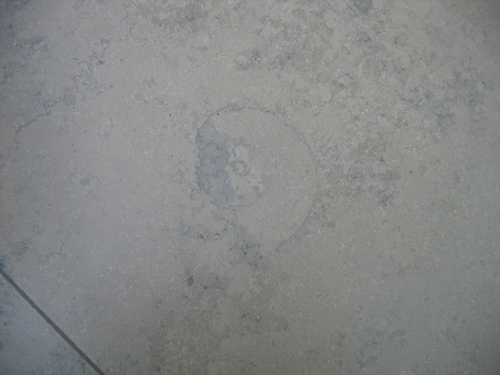
Waiting at an airport can be quite boring.  Once check in and the security searches have been completed, then there is not much more to do prior to boarding your flight.  However, for Everything Dinosaur team members returning from Germany, one airport provided them with the opportunity to go on an unexpected fossil hunt.  The polished limestone floors at Nuremberg Airport (southern Germany), are full of Jurassic marine invertebrate fossils.

A Fossil Spotted at the Airport (Nuremberg Airport)

The stone floors at Nuremberg airport are full of fossils.

A cephalopod fossil (ammonite) on the airport stone floor.

Picture credit: Everything Dinosaur

The Jurassic of Germany

In southern Germany, particularly the state of Bavaria, in the region from Nuremberg in the north to Munich in the south, there are many limestone exposures and limestone quarries to be found.  Formed from carbonate rich muds that once existed at the bottom of salty lagoons and shallow coastal margins, the rocks are famous for their fine-grained structure and flat cleaving.  These properties help to make this limestone ideal building material and the stone in this part of Germany (known as Plattenkalk), has been quarried for thousands of years.

Most of the limestone represents sediments laid down in the Middle and Late Jurassic and large areas are highly fossiliferous.  Travellers at Nuremberg Airport were quite surprised to see members of Everything Dinosaur on their hands and knees, examining and photographing various floor tiles.

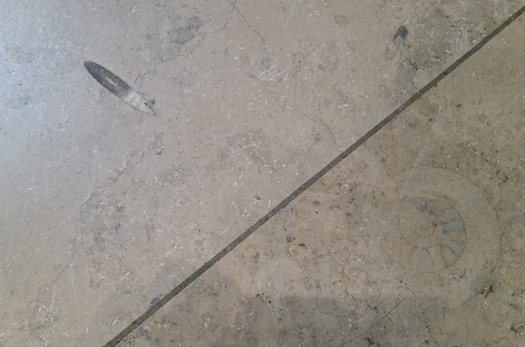
Jurassic Invertebrate Fossils in Abundance at Nuremberg Airport

Jurassic fossils at Nuremberg Airport.

An ammonite fossil with the cross section of a belemnite guard.

Picture credit: Everything Dinosaur

In the picture above, the cross section of a belemnite guard can be clearly seen on one tile, abutted up against it is another tile that shows the cross-sectional outline of an ammonite.  There are also numerous bivalve and brachiopod fossils preserved in the stone floor.  Thousands of people visit Nuremberg Airport every week, but we wonder how many of them actually notice what they are walking on!

An Innovative Fossil Hunt

Ten years ago, Everything Dinosaur blogged about an innovative fossil hunting tour that could be undertaken by travellers at John Lennon Airport (Liverpool).  The ancient remains of long extinct sea creatures can be seen in the stone of the walls and floors of the concourse.  John Lennon Airport introduced the “JLA Fossil Mystery Tour” in collaboration with the Liverpool Geological Society.

To read more about the John Lennon Airport Fossil Hunting Tour: Why Not go on a Fossil Hunt Whilst Waiting at the Airport?

Perhaps the Nuremberg Airport authorities have missed a trick, with such a wonderful stone floor, travellers could be encouraged to have a go at finding fossils for themselves.  There are certainly many hundreds of fossils to see, perhaps if a tour could not be organised, then it might be a good idea to put up some information boards and displays.  You never know, it might encourage more tourists to visit the museums in the area such as the Naturhistorisches Museum of Nuremberg.

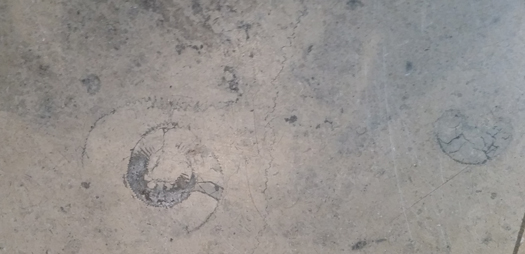
Ancient Traces Preserved in the Limestone Floor

Two fossils in the airport.

Fossils at Nuremberg airport.

Picture credit: Everything Dinosaur

Spotting Ammonite Remains During the Fossil Hunt

The picture above shows two more ammonite fossils, although it is difficult to identify genera, the larger specimen (bottom left), still shows its fine, straight ribs that would have adorned the outside of the shell.  The smaller ammonite cross section (right), shows some preservation of internal structure, could those be suture lines we are seeing?

What an Ammonite Actually Looked Like

A model of an Ammonite.

A great ammonite model for use in schools, museums and for model collectors.

Picture credit: Everything Dinosaur

The picture above shows the excellent Wild Safari Prehistoric World ammonite model.  If you look carefully at the stone floors at Nuremberg Airport you can spot the preserved remains of Jurassic ammonites and other extinct marine creatures.

To view the range of prehistoric animal models including the Wild Safari Prehistoric World ammonite available from Everything Dinosaur: Safari Ltd Prehistoric Animal Models and Figures.

27 01, 2017

The Oldest, Most Complete Iguanian of the Americas

By |2023-05-14T21:11:49+01:00January 27th, 2017|Categories: Dinosaur and Prehistoric Animal News Stories, Dinosaur Fans, Main Page, Photos/Pictures of Fossils|0 Comments

Magnuviator ovimonsensis from Egg Mountain

Palaeontologists picking through a bounty of fossils from Montana have discovered something very unexpected, a new species of lizard from that lived near to the end of the Age of Dinosaurs, whose closest relatives roamed in faraway Asia.

Magnuviator ovimonsensis

This ancient lizard, which lived 75 million years ago in a dinosaur nesting ground, is described in a paper published this week in the academic journal “The Proceedings of the Royal Society B”.  Named Magnuviator ovimonsensis, the new species fills in significant gaps in our understanding of how lizards evolved and spread during the Mesozoic, according to palaeontologists at the University of Washington and the Burke Museum of Natural History and Culture who led the research.

Postdoctoral research associate, David DeMar, lead author of the paper stated:

“It is incredibly rare to find one complete fossil skeleton from a relatively small creature like this lizard.  But, in fact, we had two specimens, both from the same site at Egg Mountain in Montana.”

Magnuviator is reshaping how scientists view lizards, their biodiversity and their role in complex ecosystems during the Cretaceous some seventy-five million-years-ago.

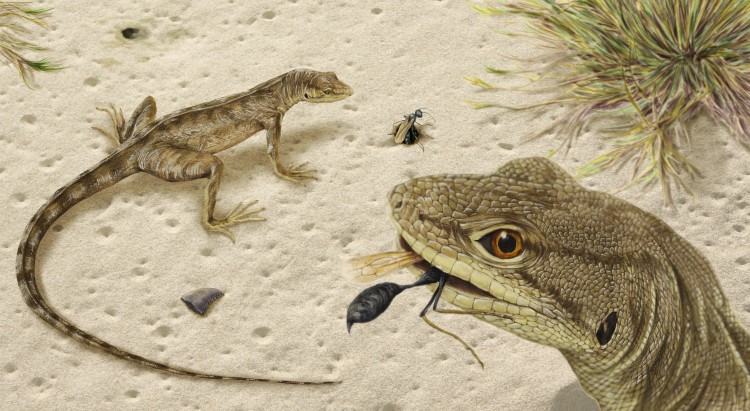
An Illustration of Magnuviator ovimonsensis

Magnuviator ovimonsensis illustrated.

An illustrated life reconstruction of Magnuviator ovimonsensis at the Egg Mountain site.

Picture credit: Misaki Ouchida

The picture above shows a pair of Magnuviator lizards at the Egg Mountain fossil site.   One Magnuviator eats a wasp, on the ground is a tooth from the bird-like, theropod dinosaur Troodon.  The arid-adapted plant is based on fossil pollen found near Egg Mountain.

An Ancient Lineage of Iguanian Lizards

Based on analyses of the nearly complete fossil skeletons, Magnuviator was an ancient offshoot of iguanian lizards.  The fossils are the oldest, most complete iguanian fossils from the Americas.  Today, iguanians include chameleons of the Old World, iguanas and anoles in the American tropics.  Based on its anatomy, Magnuviator was at best a distant relative of these modern lizard families, most of which did not arise until after the non-avian dinosaurs and quite a few lizards and other creatures became extinct some sixty-six million years ago.

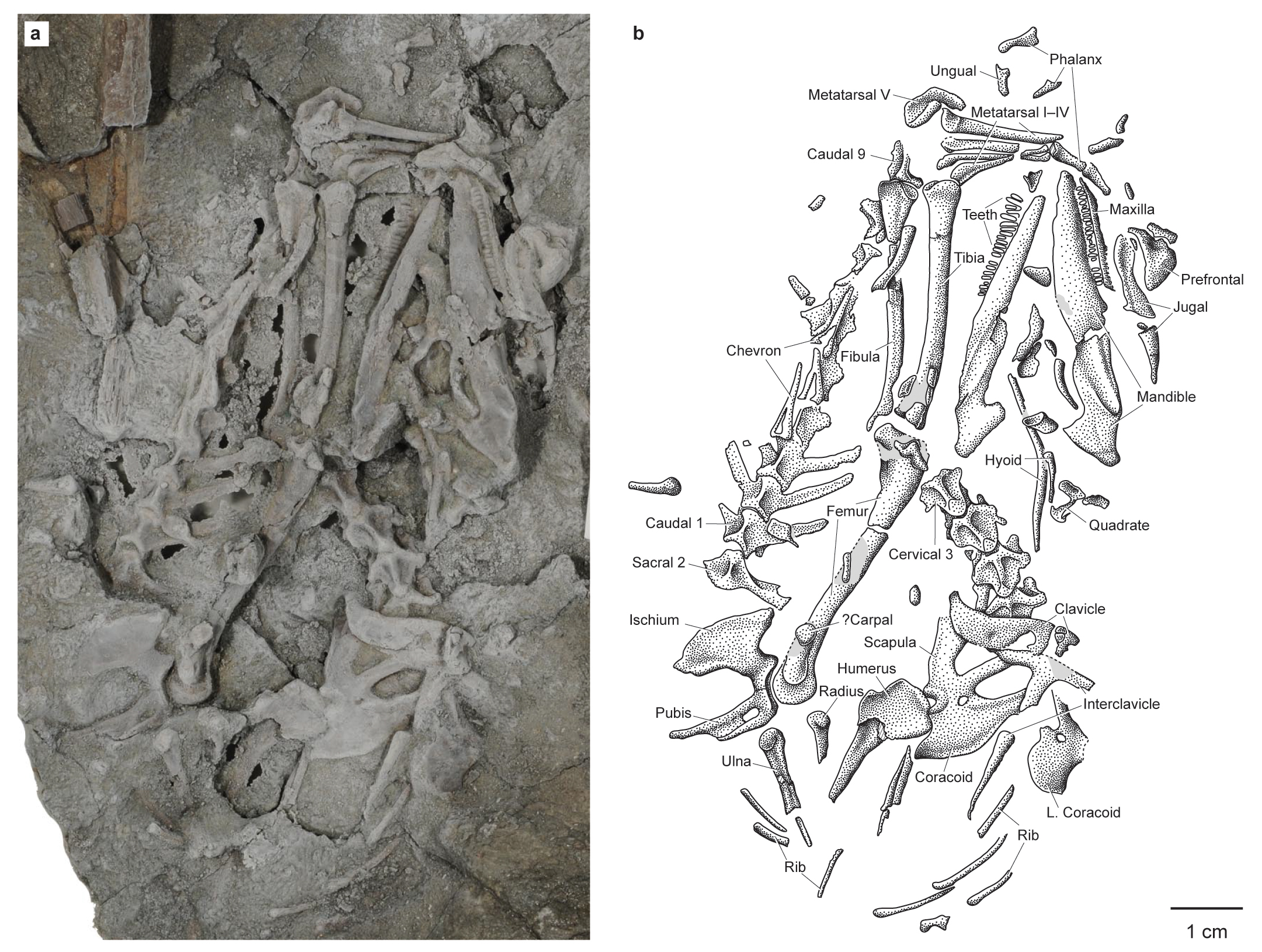
The Holotype Fossil Material (M. ovimonsensis)

Magnuviator holotype fossil and line drawing.

Holotype fossil (A) with interpretative line drawing (B).

Picture credit: David DeMar and Morgan Turner

A Meticulous Study

The researchers came to these conclusions after a meticulous study of both Egg Mountain specimens over a period of four years.  This included a round of CT scans at Seattle Children’s Hospital to narrow down the fossil’s location within a larger section of rock and a second round at the American Museum of Natural History to digitally reconstruct the skull anatomy.

The fact that both skeletons were nearly complete allowed the team to determine not only that Magnuviator represented an entirely new species, but also that its closest kin weren’t other fossil lizards from the Americas.  Instead, it showed striking similarities to other Cretaceous iguanians from Mongolia.

The Second Magnuviator Fossil Specimen

Second Magnuviator ovimonsensis specimen.

The second Magnuviator ovimonsensis fossil specimen.

Picture credit: Burke Museum of Natural History and Culture

DeMar commented:

“These ancient lineages are not the iguanian lizards which dominate parts of the Americas today, such as anoles and horned lizards.  So, discoveries like Magnuviator give us a rare glimpse into the types of ‘stem’ lizards that were present before the extinction of the dinosaurs.”

A Resident of Egg Mountain

But Magnuviator’s surprises don’t end with the Mongolian connection.  The site of its discovery is also astonishing.  Egg Mountain is already famous among fossil hunters.  Over thirty years ago, palaeontologists discovered the first fossil remains of dinosaur babies there, and it is also one of the first sites in North America where dinosaur eggs were discovered.

Senior author Greg Wilson (University of Washington, associate professor of biology), stated:

“We now recognise Egg Mountain as a unique site for understanding Cretaceous Period ecosystems in North America.  We believe both carnivorous and herbivorous dinosaurs came to this site repeatedly to nest, and in the process of excavating this site we are learning more and more about other creatures who lived and died there.”

The team even named their new find as homage to its famous home and its close lizard relatives in Asia.  Magnuviator ovimonsensis means “mighty traveller from Egg Mountain.”

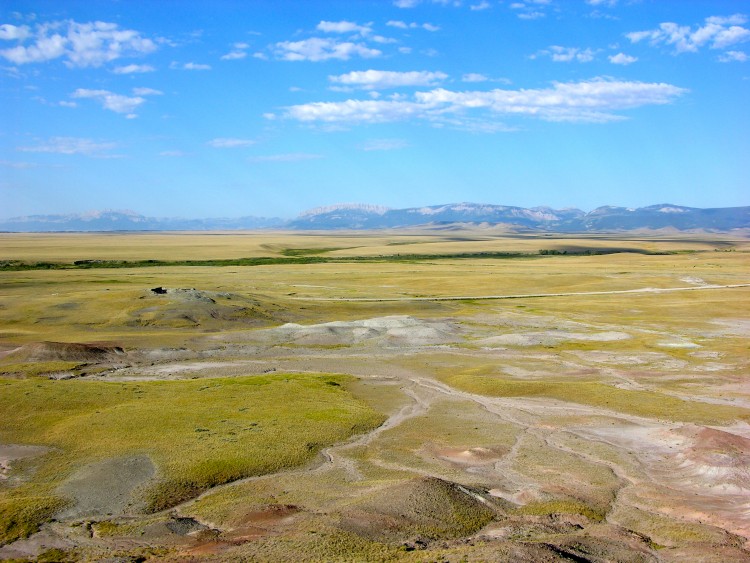
A View of the Famous Fossil Location in Montana – Egg Mountain

The famous Egg Mountain fossil site.

A distant view of Egg Mountain and the basin in which it lies.

Picture credit: David Varricchio

A distant view of Egg Mountain and the basin in which it lies.  Egg Mountain is in the centre-left of this image, within the basin.  Clearly visible at its top are black rectangular shapes, which are tarps erected near the excavation site

The Spectacular Egg Mountain Fossil Site

Through excavations at Egg Mountain led by co-author David Varricchio at Montana State University and meticulous analysis of fossils at partner institutions like the University Washington and the Burke Museum, scientists are piecing together the Egg Mountain ecosystem of around seventy-five million years ago.   In those days, Egg Mountain was a semi-arid environment, with little or no water at the surface. Dinosaurs like the duck-billed hadrosaurs such as Maiasaura and the bird-like, carnivorous Troodon nested there.

To read about a study mapping the lives of a population of Maiasaura: Mapping the Lives of a Population of Plant-eating Dinosaurs.

The Egg Mountain Ecosystem

Researchers have also unearthed fossilised mammals at Egg Mountain, which are being studied by Wilson’s group, as well as wasp pupae cases and pollen grains from plants adapted for dry environments.  Based on the structure of Magnuviator’s teeth, as well as the eating habits of some lizards today, the researchers believe that it could have feasted on wasps at the Egg Mountain site.  Though based on its relatively large size for a lizard, in excess of thirty centimetres long, Magnuviator could have also eaten something entirely different.  It might have been a herbivore.

Whatever its diet, Magnuviator and its relatives in Mongolia did not make it into the modern era.  DeMar and co-authors hypothesise that these stem lineages of lizards may have gone extinct along with the non-avian dinosaurs.  But given the spotty record for lizards in the fossil record, it will take more Magnuviator-level discoveries to resolve this debate, and, unfortunately, part of the excitement surrounding Magnuviator is that it is a very rare find.

Everything Dinosaur acknowledges the assistance of the University of Washington in the compilation of this article.

Visit the Everything Dinosaur website: Everything Dinosaur.
24 01, 2017

Super-sized Otter as Big as a Wolf

By |2023-05-14T18:45:20+01:00January 24th, 2017|Categories: Dinosaur and Prehistoric Animal News Stories, Dinosaur Fans, Main Page, Photos/Pictures of Fossils|0 Comments

Ancient Otter Species Amongst Largest Known to Science

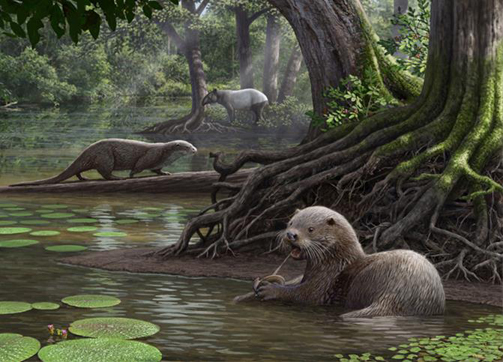
South-western China some 6.25 million years ago (Late Miocene Epoch), was home to a giant river otter that grew to the size of a Grey Wolf.

That is the conclusion of a team of researchers which includes Dr Denise Su (curator and head of palaeobotany and palaeoecology at the Cleveland Museum of Natural History).  The new species, named Siamogale melilutra would have weighed around fifty kilogrammes, making it one of the largest otter species known to science.  The largest extant otter species is the South American Giant Otter (Pteronura brasiliensis), it can reach a similar size, but it is much more lightly built, weighing around two-thirds as much as the Late Miocene species.

An Illustration of the Giant River Otter Siamogale melilutra

Siamogale illustration.

Yunnan Province (south-western China), in the Late Miocene was home to a giant otter (S. melilutra).

Picture credit: Mauricio Antón

Mustelidae Fossil Record

Otters are members of the Mustelidae family (weasels and their kin).  These agile, aquatic predators are grouped into a sub-family, the Lutrinae.  There are around a dozen or so species alive today.  The fossil record for the Mustelidae (weasels, ferrets, stoats, polecats, minks, martens, badgers, honey-badgers, wolverines and otters), is relatively poor.  Siamogale melilutra belongs to an ancient lineage of extinct otters that was previously known only from isolated teeth from a different, much older species that was recovered in Thailand (Siamogale thailandica from the middle Miocene basin of Mae Moh in northern Thailand).

What’s so special about this new discovery is that researchers were able to recover a complete cranium, mandible, teeth and various post-cranial skeletal elements, providing a wealth of insight into the taxonomy, evolutionary history and functional morphology of this new species.

Dr Su, co-author of the paper published in “The Journal of Systematic Palaeontology”, explained:

“While the cranium is incredibly complete, it was flattened during the fossilisation process.  The bones were so delicate that we could not physically restore the cranium.  Instead, we CT-scanned the specimen and virtually reconstructed it in a computer.”

The Holotype Fossil Material of S. melilutra Cranium in Right Lateral and Dorsal Views with the Digital Reconstruction

Fossil reconstruction and digital images (Siamogale).

Siamogale fossil reconstruction (digital images).

Picture credit: The Journal of Systematic Palaeontology

The scale bar in the above image is 30 millimetres.  The fossil skull is shown on the left (right lateral view top and dorsal view bottom), with the digital reconstruction of the fossil generated from the CT-scans.

The Phylogeny of the Mustelidae

Where the otters sit on the Mustelidae family tree has long been debated.  Since most of the Mustelidae fossil record is very poor, palaeontologists have struggled to assess taxonomic relationships.  The digital reconstruction of the crushed and flattened skull revealed that Siamogale melilutra had a combination of otter-like and badger-like characteristics, hence the species name “melilutra” which is derived from the Latin for otters (lutra) and the Latin for badgers (meles).

Siamogale melilutra had a large, powerful jaw with the enlarged, bunodont (rounded-cusped) teeth typical of many otter lineages.   It has been suggested that this giant otter specialised in eating freshwater mussels and clams, using its strong jaws to crack open the shells.

The discovery of this fossil material raises the question of whether these bunodont teeth were inherited by all otters from a common ancestor, or evolved independently in different otter lineages over time because of the evolution of similar adaptations to thrive in similar environments, an example of convergent evolution.

Dr Su and her co-workers which included Dr Xiaoming Wang (Dept. of Palaeontology at the Natural History Museum of Los Angeles County), through their analysis, found that bunodont teeth independently appeared at least three times over the evolutionary history of otters, suggesting convergent evolution to be the cause.

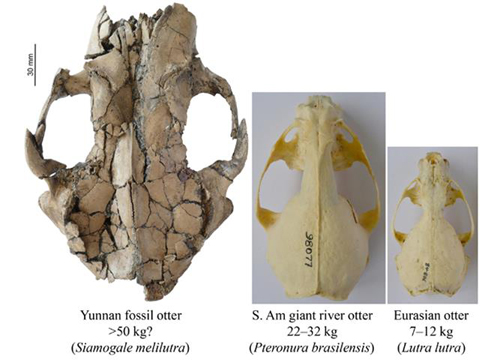
A Skull Size Comparison Between S. melilutra and P. brasiliensis and Lutra lutra

Otter skull comparisons.

Siamogale skull size comparison with South American giant river otter (middle) and European otter (right).

Picture credit: The Journal of Systematic Palaeontology

Siamogale melilutra Raises Further Questions

The completeness of Yunnan province specimen allows researchers to better understand the evolutionary history of otters, however, lots of questions about this super-sized river otter remain.

Dr Su summed up the questions that the researchers would like to answer:

“Why did this species grow so large?  How did its size affect its movement on land and in water? And most importantly, what types of advantages did its size give?”

The “Bear Otter” Enhydriodon dikikae

Although, much larger than modern-day otters, Siamogale melilutra is not the largest otter known from the fossil record.  Fossils of a much bigger “bear-otter” have been recovered from the Hadar Formation of Ethiopia.  The enormous Enhydriodon dikikae, would have been familiar to our hominin ancestors and it is estimated to have reached a total length in excess of two metres and weighed perhaps as much as 180 kilogrammes.

Otter Size Comparisons (Extinct versus Extant)

Otter Size Comparisons

Otter size comparisons (extinct species compared to living species).

Picture credit: Everything Dinosaur

The grey silhouettes represent living species, whilst the black silhouettes represent extinct species, two of the largest species of otter known from the fossil record.

Everything Dinosaur acknowledges the help of the Cleveland Museum of Natural History in the compilation of this article.

The scientific paper: “A New Otter of Giant Size Siamogale melilutra sp. nov. (Lutrinae: Mustelidae: Carnivora), from the latest Miocene Shiutangba site in north-eastern Yunnan, south-western China, and a total-evidence of phylogeny of Lutrines.” published in “The Journal of Systematic Palaeontology”.

Visit the Everything Dinosaur website: Everything Dinosaur.

11 01, 2017

Hyoliths Find a New Home

By |2024-05-07T12:57:21+01:00January 11th, 2017|Categories: Dinosaur and Prehistoric Animal News Stories, Main Page, Photos/Pictures of Fossils|0 Comments

Ancient, Long Extinct Animal Finds Place on Tree of Life

A bizarre shelled marine creature’s place in the Animal Kingdom has finally been resolved thanks to the efforts of a remarkable student at the University of Toronto.  Undergraduate student Joseph Moysiuk has identified Hyoliths, not as members of the Mollusca, which many palaeontologists had previously believed, but as lophophores and as such, they are closely related to brachiopods.

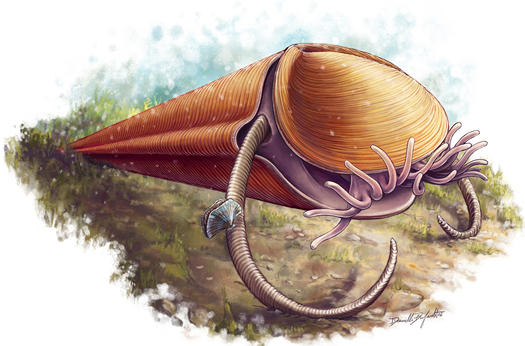
An Illustration of the Hyolith Haplophrentis

The Hyolith Haplophrentis.

An illustration of the Hyolith Haplophrentis.

Picture credit: Royal Ontario Museum/Danielle Dufault

In the Hyolith illustration above, a tiny brachiopod can be seen attached to the nearest appendage of Haplophrentis.

Studying Hyoliths

The distinctive appearance and structure of the Hyolith skeleton has obstructed previous attempts to classify these animals.  All Hyoliths had an elongated, bilaterally symmetrical cone-shaped shell and a smaller cap-like shell that covered the opening of the conical shell (known as an operculum).  Some species also bore a pair of rigid, curved spines (helens) that protruded from between the conical shell and operculum (the shell cap), structures with no equivalents in any other group of animals.

An Extensive Fossil Record

The mineralised external skeletons (argonite) and their sessile/semi-sessile habit (living on the seabed), gives these animals, which range in size from 1 cm to around 5 cm in length, a good fossil preservation potential.

The earliest fossil evidence for this type of creature occurs in rocks dating from around 540 million years ago (Cambrian).  These filter feeders seem to have persisted throughout the Palaeozoic and the Hyolith fossil record is relatively abundant and geographically widespread.

The Hyolitha were very diverse during the Cambrian and the subsequent Ordovician geological period, before their fossil record and their presence as an important member of marine benthos communities (animals and plants living on the sea floor) declines.  Hyoliths are one of many types of marine invertebrate that failed to survive into the Mesozoic.

The Cambrian Hyolith Haplophrentis

Burgess Shale Hyolith fossil.

Soft tissue of a Cambrian Hyolith (Haplophrentis) has been preserved.

Picture credit:  Royal Ontario Museum

Diverse in the Palaeozoic

In the picture of a Hyolith fossil above, (genus Haplophrentis – H. carinatus), the conical shape of the shell can be clearly made out and the partially extended lophophore (feeding organ) can be seen.  The lophophore consisting of numerous, blackened, thin, finger-like extensions is highlighted against the operculum.  The curved spines are the helens.

Writing in the academic journal “Nature”, student Joseph Moysiuk and his fellow authors, Durham University’s Martin Smith and Burgess Shale fossil expert Jean-Bernard Caron, studied over 1,500 fossil specimens from the mid-Cambrian strata that represent elements of the Burgess Shale (British Columbia) and the Spence Shale Formations (Idaho and Utah).  The Hyolith material (Haplophrentis) and its exceptional state of preservation permitted the team to assess the soft tissue structures and from this information the team were able to deduce their taxonomic affinities.

Dr Caron explained:

“Burgess Shale fossils are exceptional because they show preservation of soft tissues which are not usually preserved in normal conditions.”

Not Closely Related to Snails, Cephalopods and Other Molluscs

The analysis showed that Hyoliths are not closely related to snails, squid or other members of the Mollusca.  They are instead, more closely related to the Brachiopoda, a group of animals with a rich fossil record but with few extant representatives.  Brachiopods have a soft body enclosed between upper and lower shells (valves), unlike the left and right arrangement of valves in bivalve molluscs.  Brachiopods open their valves at the front when feeding but otherwise keep them closed to protect their feeding apparatus and other body parts.

Student Moysiuk commented:

“Our most important and surprising discovery is the Hyolith feeding structure, which is a row of flexible tentacles extending away from the mouth, contained within the cavity between the lower conical shell and upper cap-like shell.  Only one group of living animals – the brachiopods, has a comparable feeding structure enclosed by a pair of valves.  This finding demonstrates that brachiopods, and not molluscs, are the closest surviving relatives of Hyoliths.”

The undergraduate added:

“It suggests that these Hyoliths fed on organic material suspended in water as living brachiopods do today, sweeping food into their mouths with their tentacles,”

A Diagram Showing the Proposed Anatomy of a Hyolith

Haplophrentis anatomy.

Diagrams showing the anatomy of the Cambrian Hyolith Haplophrentis.

Picture credit: Royal Ontario Museum/Danielle Dufault

The Function of the Helens

Examination of the orientation of the helens in multiple Hyolith specimens from the Burgess Shale suggests that these spines may have been used like stilts to lift the body of the animal above the sediment, elevating the feeding apparatus to enhance feeding.

Dr Caron led recent field exhibitions to the Burgess Shale.  This resulted in the discovery of many specimens that form the basis of this research.  The key specimens came from recently discovered deposits near Stanley Glacier and Marble Canyon in Kootenay National Park, about twenty miles south-east of the original Burgess Shale site in Yoho National Park.

Exploring the Burgess Shale

Exploring the Burgess Shales.

Student Joseph Moysiuk (left) in the field with Dr Jean-Bernard Caron.

Picture credit: Joseph Moysiuk

Solving a Puzzle

Palaeontology lecturer Martin Smith expressed his delight at being able to help solve a 175-year-old palaeontological puzzle.  Hyolith fossils have been included in a number of fossil studies previously, but until now, where these creatures featured in the tree of life remained open to speculation.

Dr Smith stated:

“Resolving the debate over the Hyoliths adds to our understanding of the Cambrian Explosion, the period of rapid evolutionary development when most major animal groups emerge in the fossil record.  Our study reiterates the importance of soft tissue preservation from Burgess Shale-type deposits in illuminating the evolutionary history of creatures about which we still know very little.”

Everything Dinosaur acknowledges the assistance of the University of Toronto in the compilation of this article.

Visit the Everything Dinosaur website: Everything Dinosaur.
19 12, 2016

Mapping the Microscopic Life Preserved in Rhynie Chert

By |2023-05-13T08:18:27+01:00December 19th, 2016|Categories: Dinosaur and Prehistoric Animal News Stories, Main Page, Photos/Pictures of Fossils|1 Comment

Exploring a Microscopic World 407 Million Years Old

Very often, it is the news about giant prehistoric animals that grab all the attention from the media.  Dinosaurs, Woolly Mammoths, pterosaurs and monstrous fish such as prehistoric sharks, get all the headlines, but today, we want to highlight a new paper published in the online, open access journal PLoS One, a paper that looks at the discovery of an exquisitely preserved fungus found in association with the minute eggs of a prehistoric freshwater crustacean.

The Rhynie Chert Lagerstätte

This freshwater fungus, lived far earlier in the history of our planet than any hominin, Woolly Mammoth, pterosaur or member of the Dinosauria for that matter.  In fact, this newly discovered species of fungus, a fungus that helped to breakdown freshwater plant matter, thrived at around the same time as the very first sharks.

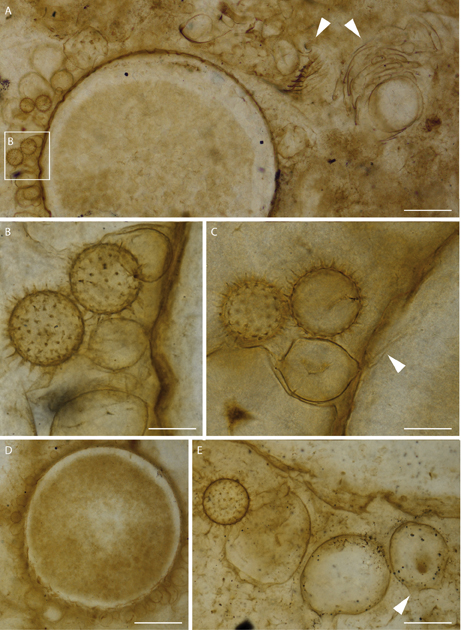
A High Magnification View of the New Species of Fungus

A highly magnified view of the Devonian fungus.

Cultoraquaticus trewini, a new Early Devonian Chytridiomycota.

Picture credit: PLoS One

The fossils were discovered by a team of international scientists which included researchers from the Natural History Museum (London), the University of Copenhagen and the University of Maine.  The team analysed microscopic slices of Rhynie Chert from Aberdeenshire, Scotland.  The chert represents sedimentary deposits formed when volcanic material from hydrothermal vents periodically erupted and covered an area that featured a braided river channel and an alluvial flood plain.  These hot, viscose fluids preserved both primitive terrestrial and freshwater ecosystems, providing a window into the life that existed in both these types of habitat in the Early Devonian.

Various types of fungi have been identified in the Rhynie Chert, this Lagerstätte has provided palaeontologists with evidence of fungal parasitism and symbiosis with early land plants and algae.

Fossils of the earliest freshwater branchiopod crustaceans (fairy shrimps and their close relatives), have also been discovered.

Cultoraquaticus trewini

The new species has been named Cultoraquaticus trewini, the genus name refers to the aquatic habitat of the fungus.  The specific epithet honours Professor Nigel Trewin (University of Aberdeen), for his contribution to the understanding of the geology of the Rhynie Chert.

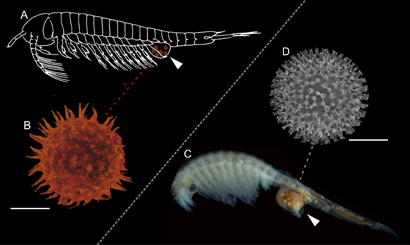
The fungus has been attributed to the Phylum Chytridiomycota, based on its internal structure, the associated papillae and its size.  The exquisite preservation of this 407-million-year-old fossil has enabled scientists to assess this ancient species’ resemblance to extant fungi.  It seems that these fungi were a parasite of algae and primitive prehistoric freshwater plants.  The tiny, spiked structures seen in the photograph above (B, C and E) are (most likely), the eggs of the Early Devonian freshwater shrimp Lepidocaris rhyniensis.

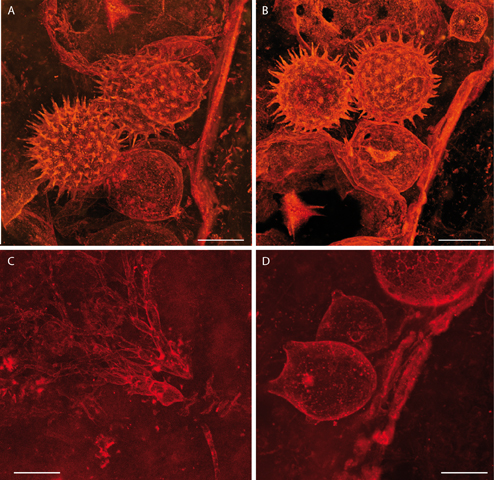
Laser Scans Show the Fungus and the Eggs of the Early Devonian Crustacean (L. rhyniensis)

Crustacean eggs and the fungus revealed by laser scanning.

Confocal laser scanning images of resting eggs of Lepidocaris and of the fungus Cultoraquaticus trewini.

Picture credit: PLoS One

The tiny, rounded and very spiky eggs of Lepidocaris reaffirm the idea that ancient branchiopods adapted to freshwater environments early in the Devonian.

Comparison Between Lepidocaris (Extinct) and Linderiella (Extant)

Ancient freshwater crustacean compared to an extant freshwater form.

Lepidocaris rhyniensis (A) and its resting egg (B) compared to modern anostracean Linderiella occidentalis (C) and resting egg of Linderiella santarosae (D). Brood pouch is indicated by an arrow. Scale bars represent 20 μm in (B) and 95 μm in (D).

Picture credit: PLoS One

The Earliest Eggs of the Branchiopoda

Although the research team cannot be one hundred percent certain that the tiny, spiky shapes are the eggs of Lepidocaris, they have made this conclusion based on the fact that L. rhyniensis fossil remains, including individuals at various growth stages, are relatively abundant in the Rhynie Chert deposits.  The fossils closely resembles the egg cysts of various members of Anostraca (fairy shrimps) and they, most probably, represent the earliest eggs of freshwater branchiopods discovered to date.

Sometimes, micro-fossils are not given the prominence they deserve in the mainstream media.  We praise the efforts of the research team for providing more information on the remarkable Rhynie Chert Lagerstätte and for identifying a new fungal/plant matter interaction that helped in the breakdown and mobilisation of nutrients in early freshwater food webs.

The scientific paper: “A New Chytridiomycete Fungus Intermixed with Crustacean Resting Eggs in a 407-Million-Year-Old Continental Freshwater Environment” published in PLoS One.

The Everything Dinosaur website: The Everything Dinosaur Website.

17 12, 2016

A Moroccan Fossil Safari – Rare and Beautiful Fossils

By |2024-02-25T08:01:13+00:00December 17th, 2016|Categories: Dinosaur Fans, Geology, Main Page, Photos/Pictures of Fossils|1 Comment

Amazing Trilobite Fossils from Morocco

Morocco is a very beautiful country.  Tourists might be attracted to its wonderful beaches as well as the bustling bazaars and souks but there is much more to this part of north Africa, especially if you are a keen fossil hunter.  Take for example, the fossil hunting trips organised by young geologist Mohamed Koumali, he and his enthusiastic team give clients the opportunity to explore the amazing and highly fossiliferous deposits of Tinghir Province, a part of the world famous for its trilobite fossils.

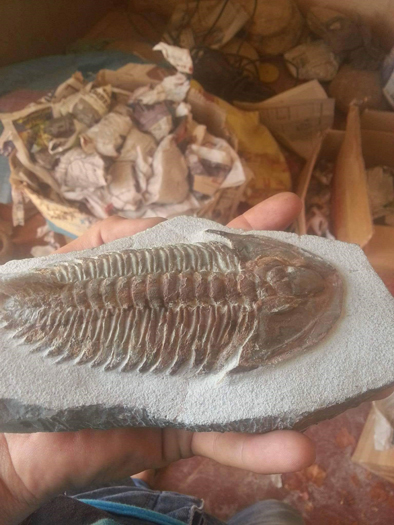
A Wonderful Example of a Moroccan Trilobite

A prepared fossil Trilobite.

A fantastic Moroccan trilobite fossil.

Picture credit: Koumali Trilobites

The picture above shows one of the amazing trilobite fossils from south-eastern Morocco.  The specimen has been carefully prepared and fine details of the exoskeleton have been revealed.

For prehistoric animal toys and gifts including trilobite models: Visit Everything Dinosaur.

Trilobita from Morocco

Team members from Everything Dinosaur have been lucky enough to visit Morocco on numerous occasions.  The geology of the country is truly remarkable and fans of the Trilobita can acquire specimens that represent at least nine Orders of trilobites, and we thought Wales was at the heart of trilobite fossil hunting adventures!

Morocco has a number of advantages over Wales when it comes to going on a trilobite hunt.  For a start, the weather tends to be warmer, sun protection is definitely recommended, as is cool clothing and a hat.  The hot, dry winds have removed what soil there was exposing, great rocky pavements, although some of the fossil bearing strata is as hard as concrete and expert guides are required to help give visitors the best chance of finding a prize fossil specimen.

A Chance to Explore the Palaeozoic Past of Morocco

A Moroccan Trilobite hunting trip.

Spectacular views are guaranteed on a Moroccan trilobite hunt.

Picture credit: Koumali Trilobites

Depending upon which part of the country you visit, tourists can search for some of the best examples of Late Cambrian trilobite specimens, but there are also great swathes of Ordovcian and Devonian-aged strata to explore.

Trilobite Fossils

The range of trilobite specimens associated with rocks of Devonian age is particularly diverse, Mohamed’s home time of Alnif is regarded by many invertebrate palaeontologists as the best place in the world to find complete fossils of the spiny, thumb-sized trilobite Dicranurus monstrosus.  This part of Morocco has yielded much larger examples of Devonian trilobite fauna.  The Bou Dîb Formation exposures have provided scientists with some wonderful examples of the hand-sized Drotops megalomanicus, complete with huge, compound eyes.  The team at Koumali trilobites take parties out to explore the remarkable rock formations and with a little luck, they too, can uncover an amazing trilobite fossil.

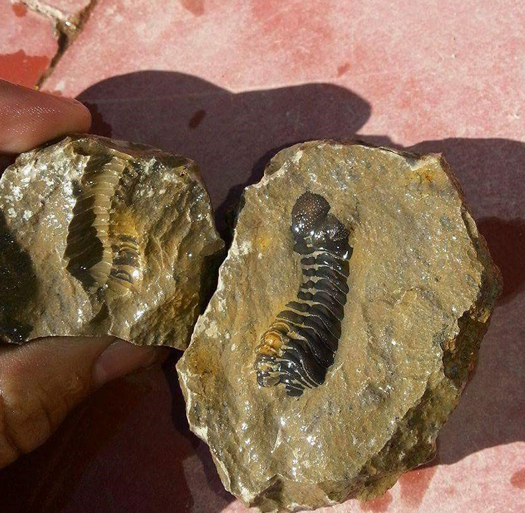
Cracking Open a Nodule to Reveal the Fossil Treasure Within

A Moroccan Trilobite fossil.

The slab and counter slab of a trilobite fossil.

Picture credit: Koumali Trilobites

Fluent in both English and French, Mohamed enjoys taking visitors out on fossil hunting trips, helping to educate and to inform people about the rich fossil heritage of his home.  He has also had the opportunity to exhibit at several European fossil trade shows, including the prestigious Saint Marie-Aux-Mines Mineral and Gem show in France.

To enquire about tours, email: [email protected] for information.  Or why not check out Mohamed’s Facebook page for further details.

An Amazing Day Exploring the Geology of South-eastern Morocco

Hunting for Moroccan Trilobites.

Out on a trilobite hunt.

Picture credit: Koumali Trilobites

A guided tour, a fossil walk through the beautiful Moroccan landscape with an expert guide, is one of the best ways for amateur fossil hunters to explore the geology of North Africa.

For replicas of iconic fossil animals including trilobites: Replica Fossils, Toys and Gifts.

15 12, 2016

Studying the Growth Stages of Parareptiles

By |2023-05-13T06:41:43+01:00December 15th, 2016|Categories: Dinosaur and Prehistoric Animal News Stories, Dinosaur Fans, Main Page, Photos/Pictures of Fossils|0 Comments

Juvenile Skull Specimen of Delorhynchus cifellii Helps in Growth Study

A team of scientists from the University of Toronto Mississauga (Canada), have analysed a total of seven different skulls of the parareptile Delorhynchus cifellii collected from the Early Permian fissure-fill deposits of Richard Spur, Oklahoma.   This research, looking at the skulls which represent different growth stages of this primitive reptile, is helping palaeontologists to learn more about how the skulls of early tetrapods changed as they grew.  It may also provide a valuable insight into how temporal fenestrae (holes in the skull), of other types of vertebrate evolved.

Delorhynchus cifellii

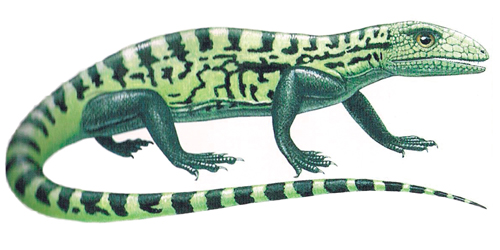
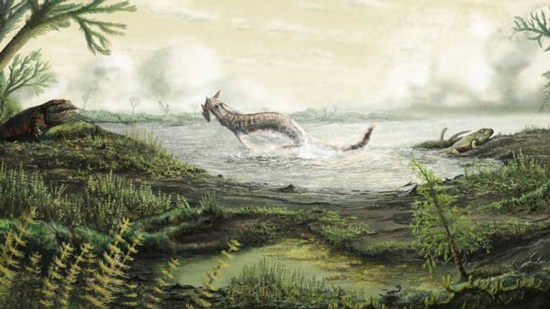
An Illustration of a Typical Early Reptile

The parareptile Delorhynchus.

Everything Dinosaur’s illustration of the Early Permian parareptile Delorhynchus.

Picture credit: Everything Dinosaur

For models and replicas of ancient Palaeozoic creatures: Prehistoric Animal Models.

Detailed Study of Cranial Ontogeny

Two species have been assigned to the genus Delorhynchu.  The first D. priscus was named and described in 1962.  In 2014, a second species was described D. cifellii, from a series of fossilised remains, including cranial (skull) material excavated from strata estimated to be around 275 million-years-old.

The researchers, which included Yara Haridy (Dept. of Biology, University of Toronto Mississauga), examined the partially articulated skull and jaw of a Delorhynchus cifellii believed to represent a juvenile (based on the size of the skull compared to other specimens and the lack of fully fused skull bones).  This specimen probably represents an earlier growth stage (ontogenetic stage) of all the other known Delorhynchus skull material and as such, it helps provide a basis for a better understanding of how these ancient reptiles changed as they matured.

Views of the Delorhynchus cifellii Juvenile Skull Material Used in the Study

Delorhynchus fossil.

The cranial fossil material of a juvenile Delorhynchus.

Picture credit: University of Toronto Mississauga

Analysing the Fossil Material

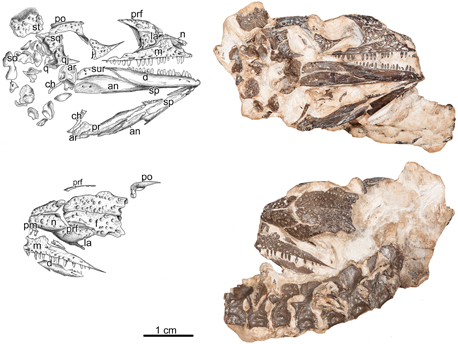
The photograph shows (above) a line drawing and image of the fossil material (right lateral view) and (below), a line drawing and image of the fossil material seen from above (dorsal view).  The line of articulated vertebrae shown in the dorsal view do not belong to this individual.  Scale bar = 1 centimetre.

Key

an, angular; ar, articular; ch, ceratohyal; d, dentary; f, frontal; j, jugal; la, lacrimal; m, maxilla; n, nasal; pal, palatine; pf, postfrontal; pm, premaxilla; po, postorbital; prf, prefrontal; q, quadrate; qj, quadratojugal; so, supraorbital; sp, splenial; sq, squamosal; st, supratemporal.

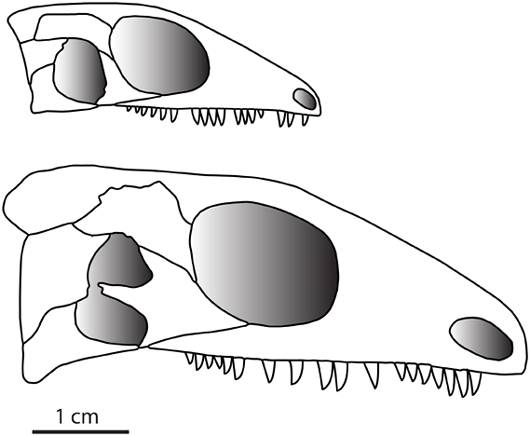
Comparisons between this juvenile and previously described specimens indicate that the size and shape of the temporal fenestra in Delorhynchus vary as the animal ages.  These changes occur as the skull bones bordering the fenestra change shape.  The growth series available for study, show that the jugal (cheek bone) becomes more robust as the reptile gets older and the proportionate size of the temporal fenestra is reduced.  The scientists discovered that as Delorhynchus grew, the single, large fenestra seen in the skull of juveniles was gradually sub-divided into two smaller holes in more mature individuals.

Line Drawings Showing a Comparison between a Juvenile Delorhynchus Skull (Top) with a Mature Adult Delorhynchus (Bottom)

Delorhynchus skull comparisons.

A comparison between the composite reconstructions of the youngest and most mature individuals in the Delorhynchus growth series.

Picture credit: University of Toronto Mississauga

The Fossil Record of Delorhynchus

The research team highlight the fact that the fossil record showing the growth of Delorhynchus is far from complete.  They also point out that the largest specimen is not a fully mature individual.  However, the data suggests that as the skull changed so the fenestra became much smaller and it would eventually be split into two small holes, due to the extension of the jugal bone.

The complete closure of the temporal fenestra may have occurred in very old animals, this cannot be ruled out, but the available skulls have provided a valuable insight into the possible growth trajectory of the fenestra of parareptiles.   The scientists also speculate that the research on this anapsid (likely to have no fenestra in the skull when an adult), may help them to better understand the evolution of skulls in other anapsids, as well as diapsids (one pair of holes) and the synapsids (two pairs of holes).

The scientific paper: “Ontogenetic Change in the Temporal Region of the Early Permian Parareptile Delorhynchus cifellii and the Implications for Closure of the Temporal Fenestra in Amniotes” published in the on line academic journal PLoS One.

Visit Everything Dinosaur’s website: Everything Dinosaur.

5 12, 2016

Bridging Romer’s Gap – Early Scottish Tetrapods Described in New Scientific Paper

By |2024-05-06T15:34:12+01:00December 5th, 2016|Categories: Dinosaur and Prehistoric Animal News Stories, Main Page, Photos/Pictures of Fossils|0 Comments

New Tetrapods from the Lower Carboniferous

Last spring Everything Dinosaur team members had the opportunity to travel to Edinburgh (Scotland), to view several early tetrapod fossils that had been excavated from a number of remarkable fossil sites located in the Scottish Borders.  This week sees the publication of a scientific paper that describes five new tetrapods, helping to greater enrich our understanding with regards to the evolution and diversity of some of the very first vertebrates to adapt to terrestrial environments.

Scotland 355 Million Years Ago

Scotland 355 million years ago.

Scotland in the Early Carboniferous.

Picture credit: Mark Witton/National Museums of Scotland

Scotland and Romer’s Gap

During the Late Devonian and into the Carboniferous, the area of land that makes up much of Scotland today was part of a giant super-continent called Laurentia.  The Scottish Borders were located almost on the equator and the low-lying land was covered with some of the first large forests to evolve on Earth.

The climate was hot, humid and steamy, with seasonal flooding and also periods of intense drought.  A team of scientists, that includes leading early tetrapod specialist Professor Jennifer Clack (Cambridge University), reporting in the academic journal “Nature Ecology & Evolution” describe five new Early Carboniferous tetrapods, helping to narrow a fifteen-million-year hole in the fossil record known as Romer’s Gap.

Fossils of Late Devonian tetrapods have been found, an example of which is Acanthostega, a stem tetrapod, fossils of Acanthostega have been found in Greenland, including fossil material found by Jennifer Clack.  Acanthostega dates from around 365 million-years-ago, however, the next type of fossils found, date from rocks approximately 350 million-years-old and reveal animals with strong rib cages to support lungs and long, slender limbs – adaptations for a life on land.  Harvard professor Alfred Sherwood Romer, was one of the first scientists to research early tetrapods and to identify this hole in the fossil record.

This fifteen-million-year interval became known as “Romer’s Gap”.

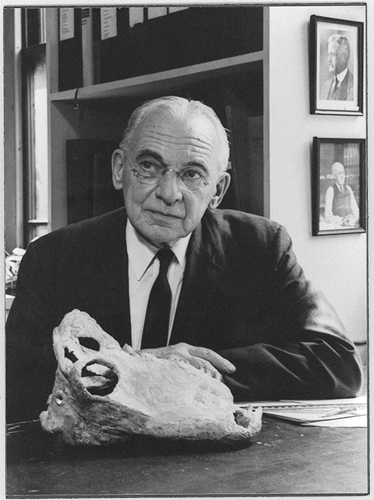
Professor Alfred Sherwood Romer (1894-1973)

Alfred Romer (courtesy of Harvard University archives)

Harvard Professor Alfred Sherwood Romer.

Picture credit: Harvard University Archives

Five Almost Complete Fossils Plus Many Fragments of Bone

Building upon the early work of renowned Scottish palaeontologist Stan Wood and his co-worker Tim Smithson (Cambridge University), who, coincidentally, is also an author of this new paper, these researchers have identified a total of five new tetrapods from rocks laid down in the very Early Carboniferous (Tournaisian stage).

Although, isolated tetrapod limb bones dating from the Tournaisian faunal stage have been found outside of Scotland, most notably from the Horton Bluff Formation at Blue Beach, Nova Scotia (Canada), collecting from five Scottish locations has identified five new animals with at least seven other new taxa, that have yet to be fully studied.

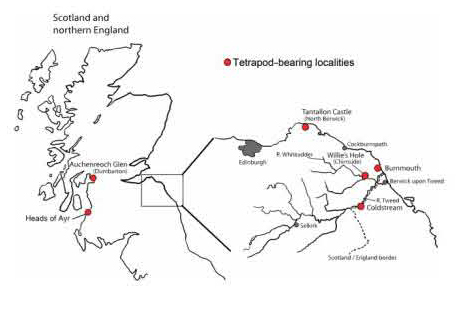
Tournaisian Tetrapod Fossil Collecting Locations (Scotland)

Fossil locations (early Tetrapods) Scotland.

Scottish tetrapod fossil locations.

Picture credit: Nature Ecology & Evolution

This new research, which included exploring strata that today forms the bed of the River Whiteadder, a tributary of the River Tweed, has provided scientists with much more information about the diversity of early tetrapods and given them an insight into the fauna and flora that existed in some of the world’s first forests.

Bridging Romer’s Gap

The five new Tournaisian tetrapods named are:

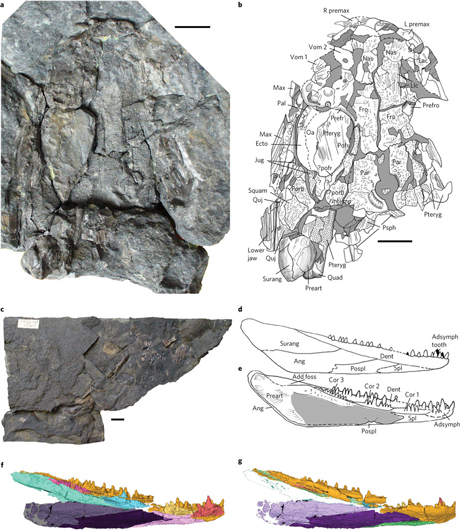
  1. Perittodus apsconditus “concealed odd tooth”, known from the cheek region of the skull, lower jaw bones and postcranial elements found at Willie’s Hole on the River Whiteadder (Chirnside).  The lower jaw measures a fraction under seven centimetres in length.
  2. Koilops herma “hollow-faced boundary marker”, the fossils consist of a natural mould of an isolated skull found at Willie’s Hole (River Whiteadder, Chirnside).  The skull measures 8 centimetres long.

Two of the New Early Carboniferous Tetrapods (Perittodus apsconditus and Koilops herma)

Tetrapod fossils helping to close "Romer's Gap".

New tetrapod tax identified from fossils found on the Scottish borders – Perittodus apsconditus and Koilops herma.

Picture credit: Nature Evolution & Ecology

The photograph above shows (a) a photograph of the natural mould of the skull of K. herma with interpretative line drawing (b).  Photograph of the main specimen block of Perittodus apsconditus (c), with reconstructions of the lower jaw (d-g).

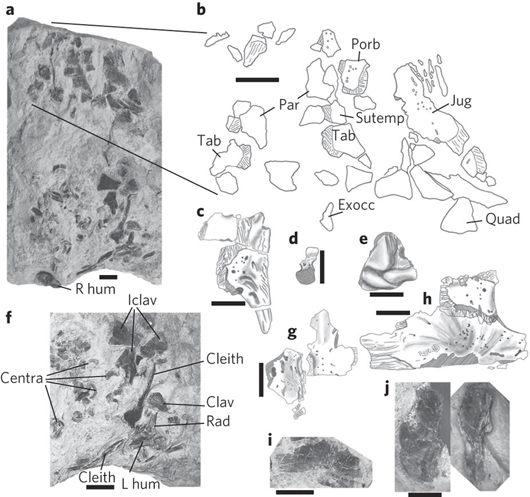
Fossils and Line Drawings of Ossirarus kierani

Ossirarus fossils and illustrations.

Photographs of Ossirarus fossils with accompanying line drawings.

Picture credit: Nature Evolution & Ecology

Professor Clack et al Bridging Romer’s Gap

3.  Ossirarus kierani “Kieran’s scattered bones” from Burnmouth Ross end cliffs (see picture above which shows photographs of the fossil material and line drawings).  The species name honours the Kieran family who have done much to protect the natural habitat on this part of the Scottish coast.  The taxon has been described from a single block of stone with preserved skull elements and postcranial bones.  Ossirarus may have been a basal amniote, whilst the other four taxa named are classed as basal tetrapods.

4.  Diploradus austiumensis “double row of teeth from the mouth of the river”, a reference to the strange configuration of the teeth in the lower jaw and the fact that the specimen, consisting of a single block of bones, was found at Burnmouth Ross end cliffs.

5.  Aytonerpeton microps “small faced crawler from Ayton”, in reference to the size of the skull and the fossil find location (foreshore of Burnmouth Ross end cliffs heading towards the small village of Ayton).

Commenting on the significance of these new Scottish fossils, Professor Clack stated:

“We’re lifting the lid on a key part of the evolutionary story of life on land.  What happened then affects everything that happens subsequently, so it affects the fact that we are here and which other animals live with us today.”

Charcoal Analysis

Sedimentary evidence analysis indicates that these early land animals lived on the low-lying land that was heavily forested, a sort of primeval, prehistoric swamp.  This region was subject to frequent flooding, the fossils of various plants and invertebrates in conjunction with these exceedingly rare vertebrae specimens from locations such as Willie’s Hole are helping scientists to build up a picture of an Early Carboniferous palaeoenvironment – one of Scotland’s first wetlands.

It had been thought that atmospheric oxygen levels crashed during the Late Devonian/Early Carboniferous that inhibited the evolution of land-based vertebrates.  A study of fusinite (fossil charcoal) collected from Willie’s Hole and the Burnmouth locations not only indicated that wildfires did occur, devastating local habitats, but chemical analysis revealed that oxygen levels did not drop below a level of around 16% in the atmosphere during the Tournaisian.

The scientists compared these results to fusinite samples taken from both younger and slightly older strata and they concluded that atmospheric oxygen levels were stable across the Devonian/Carboniferous boundary and therefore, probably did not inhibit the evolution of terrestrial vertebrates.

Everything Dinosaur Comments

A spokesperson from Everything Dinosaur commented:

“It’s great to see more research being carried out in these Scottish locations, building on the work of field palaeontologists such as Stan Wood and we recognise the important role of the Natural Environment and Research Council for funding the study.  The number of potential new taxa identified from the Scottish Borders raises the tantalising possibility that there are a lot more discoveries likely to be made in sedimentary rocks of a similar age.”

The scientific paper: “Phylogenetic and Environmental Context of a Tournaisian Tetrapod Fauna” published in the journal “Nature Ecology & Evolution”.

Visit the Everything Dinosaur website: Everything Dinosaur.
Go to Top