All about dinosaurs, fossils and prehistoric animals by Everything Dinosaur team members.

Pictures of fossils, fossil hunting trips, fossil sites and photographs relating to fossil hunting and fossil finds.

30 09, 2017

Strong-armed Sabre-Tooth Kittens Identified in New Research

By |2024-05-09T14:36:20+01:00September 30th, 2017|Categories: Dinosaur and Prehistoric Animal News Stories, Main Page, Photos/Pictures of Fossils|2 Comments

Sabre-Toothed Kittens and Their Strong Arms

A new study undertaken by scientists from California State Polytechnic University, the University of Wisconsin and colleagues at Bristol University, has concluded that Smilodon (S. fatalis), kittens were born with strong arms, stronger than similarly-sized modern big cats.  However, their pattern of bone development was congruent to other members of the Felidae.

Strong Kittens Grew up to be Strong Cats
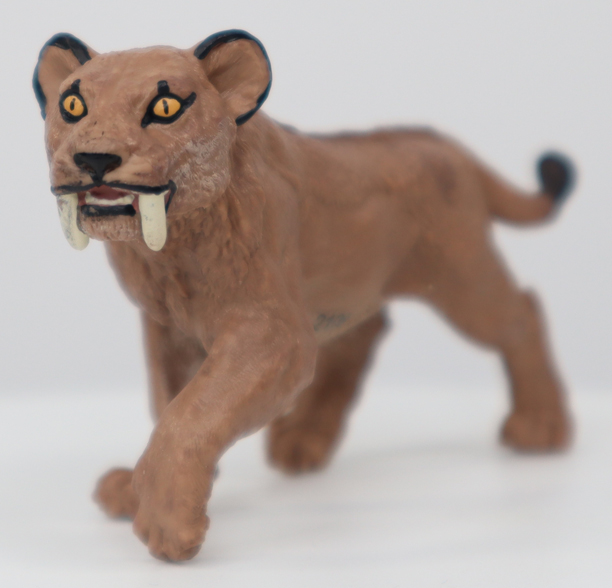
Papo young Smilodon model.

Running towards you! The Papo young Smilodon. Picture credit: Everything Dinosaur.

Picture credit: Everything Dinosaur

The picture (above) shows the Papo young Smilodon model.

To view the Papo model range: Papo Dinosaur and Prehistoric Animal Figures.

The Treasure Trove of Smilodon Fossils at La Brea

Using the extensive Smilodon fossil record preserved at the La Brea Tar Pits (Los Angeles, California), the researchers measured the limb bones of these big cats.  Only unbroken limb bones were included in the growth analysis.  Fortunately, given the huge number of Smilodon fossil specimens associated with this natural predator trap, the researchers, which included Donald Prothero, the author of “The Princeton Field Guide to Prehistoric Mammals”, that Everything Dinosaur was invited to review earlier this year* had a substantial data set to study.

For example, the scientists included thirty, Smilodon upper arm bones (humeri) representing cats at various growth stages in this study.  Their ontogenic analysis revealed that young animals had thicker and more robust bones than other members of the cat family (Felidae).  The bones did not become more robust as the cats grew, it seems Sabre-Tooths were born with big, strong arms.

Comparing the Upper Arm Bones of Big Cats Extant and Extinct 
Sabre-Toothed Cats were born with strong arms.

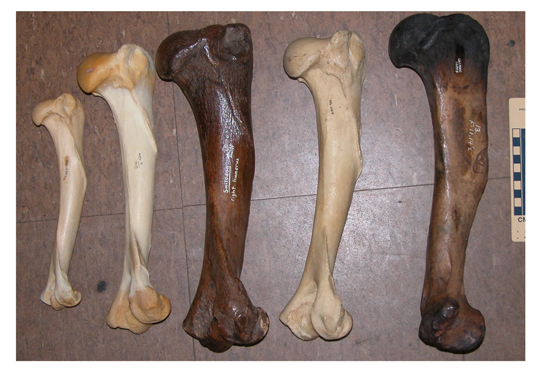
Comparing the humeri of extinct and extant big cats.

Picture credit: PLOS One/DRP

The photograph shows a comparison of five big cat upper arm bones (the humerus).   The bones come from adult animals and provide a visual guide to the forelimb size of large felids.

From the left – the first, whitish bone is the humerus of a Mountain Lion (Cougar) – Puma concolor.  The second, whitish bone is the humerus from a Tiger, Panthera tigris.  The Tiger is a much bigger and heavier than the Mountain Lion.  The bone in the middle is the humerus of Smilodon fatalis, it is much thicker and more substantial.  The third whitish bone comes from a Lion Panthera leo.  The dark bone on the far right, comes from an extinct species that was contemporaneous with Smilodon.  This is the humerus of an American Cave Lion (Panthera atrox), the P. atrox bones used in the study also came from La Brea Tar Pits.

How Did the Limb Bones of Smilodon fatalis Change as the Cats Aged?

The research team discovered that whilst the arm bones of Smilodon, were more robust than those or extant big cats, they did not become more robust as the cats got older.  Smilodon kittens had big limb bones to begin with.

Mapping the bone growth (ontogeny), using the many specimens representing animals of different ages from the La Brea fossil collection, the team found that Smilodon grew in a similar way to other, primitive members of the Felidae and in the same way that many living cat species do today.  The bones lengthen and become more slender before they thicken.  This study, published in the on-line, open access journal PLOS One suggests that Felidae growth and development is much more constrained than previously thought, even in genera with very different morphotypes and bone structures.

Comparing the Radii of Big Cats (Living and Extinct)
Smilodon Limb Growth Study.

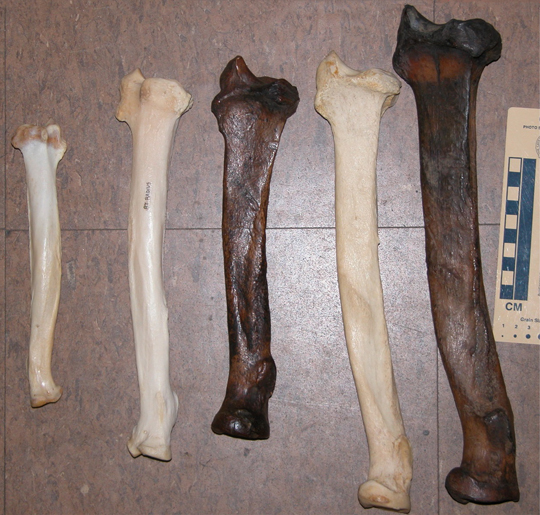
Comparing the radius of extinct and extant cat species.

Picture credit: PLOS One/DRP

The photograph (above) shows the radii of the five species of big cat, laid out in the same order as the photograph which showed the humeri.  The radius is one of a pair of bones found in the forearm, it is the bone that is lateral to the body (facing the outside).

Left to Right:

  • Mountain Lion (Puma concolor)
  • Tiger (Panthera tigris)
  • Sabre-Toothed Cat (Smilodon fatalis)
  • African Lion (Panthera leo)
  • American Cave Lion (Panthera atrox)

Professor Prothero stated:

“Sabre-Tooth cats have extraordinarily strong front limbs for tackling and subduing prey before they slashed their throats or bellies with their sabre-like canine teeth.  Using the extraordinary collection of limb bones of Sabre-tooth kittens at La Brea, we found that their limbs don’t become more robust as they grew up, but instead retain the stereotypical growth pattern where the limbs grow longer more quickly than they grow thick.  To compensate, Sabre-tooth kittens were born with unusually robust limbs and retained that pattern as they grew.”

Analysing Felidae Limb Measurements

The limb measurements demonstrated that Smilodon fatalis kittens had the same growth curve graph as those of Tiger or Mountain Lion kittens, but they tended to be thicker from the outset.  For the same length of bone, the Sabre-Tooth kitten forelimb element (radius or humerus) always had a larger circumference than a comparably sized Mountain Lion or Tiger.

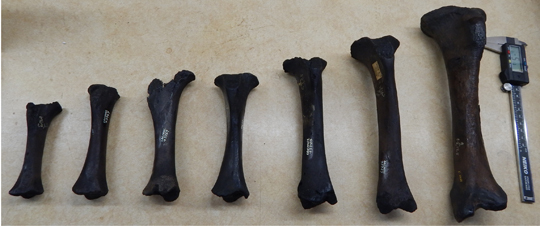
A Comparative Analysis of the Tibia of Smilodon (S. fatalis) Different Growth Stages
Smilodon tibia comparison.

Comparing the size of Smilodon leg bones (tibia).

Picture credit: PLOS One/DRP

* Everything Dinosaur’s review of “The Princeton Field Guide to Prehistoric Mammals” by Donald R. Prothero: Field Guide to Prehistoric Mammals – Book Review.

The scientific paper: “Did saber-tooth kittens grow up musclebound?  A study of postnatal limb bone allometry in felids from the Pleistocene of Rancho La Brea” by Katherine Long, Donald Prothero , Meena Madan, Valerie J. P. Syverson published in PLOS One.

Visit the Everything Dinosaur website: Everything Dinosaur.
28 09, 2017

New Basal European Ornithopod Described

By |2023-08-15T13:50:51+01:00September 28th, 2017|Categories: Dinosaur and Prehistoric Animal News Stories, Dinosaur Fans, Main Page, Photos/Pictures of Fossils|0 Comments

Burianosaurus augustai  – Unappreciated Ornithopods

A new basal ornithopod has been named in honour of Zdeněk Burian.  The dinosaur has ben named Burianosaurus augustai.

If you were able to book yourself onto a time-travelling safari to the Cretaceous, before journeying into the long distant past, you might explain to the travel guide that you would be hoping to spot a tyrannosaur, get up close to a browsing armoured dinosaur or possibly take some photos of Triceratops.  However, we suspect, that even if such a venture was possible, few tourists would spare a thought for one group of dinosaurs, that ironically, you would be much more likely to encounter.  These are the ornithopods, that diverse and extremely successful group of bird-hipped dinosaurs, that are often overlooked.

A new basal ornithopod has been named and described this week – Burianosaurus augustai.  A plant-eating dinosaur named after the palaeoartist Zdeněk Burian, who, in his lifetime did much to raise the profile of the Dinosauria.

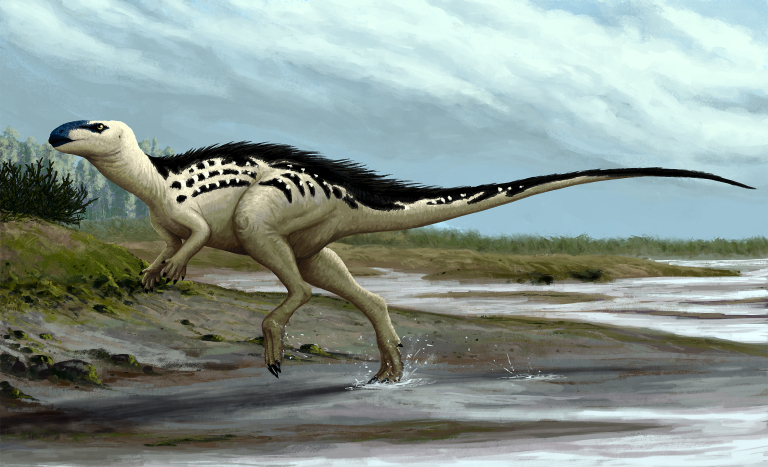
An Illustration of Burianosaurus (B. augustai)

Burianosaurus augustai illustrated.

An illustration of the basal ornithopod from the Czech Republic Burianosaurus augustai.

Picture credit: Edyta Felcyn

The Dinosaur Equivalent of Antelopes

They lacked horns, body armour and for the majority, they did not reach huge sizes, but these herbivores would have made up a significant component of the dinosaur fauna in most Cretaceous ecosystems.  If you were to go on a safari to the Maasai Mara of Kenya or the Serengeti of Tanzania, tourists might be keen to spot lions, leopards and elephants but in all likelihood, you would encounter a great many different types of antelope.   Dinosaurs like the newly described Burianosaurus can be considered as being the dinosaur equivalent of today’s antelopes.

Described from a single, well-preserved, left femur (thigh bone), Burianosaurus is the first dinosaur to be named from fossils found in the Czech Republic.  It is not the first dinosaur fossil from the Czech Republic to be scientifically described, that honour goes to a single, broken tooth from an indeterminate theropod from Upper Jurassic sediments that was described in 2014, coincidentally by the lead author of the paper describing Burianosaurus, Daniel Madzia (Polish Academy of Sciences).

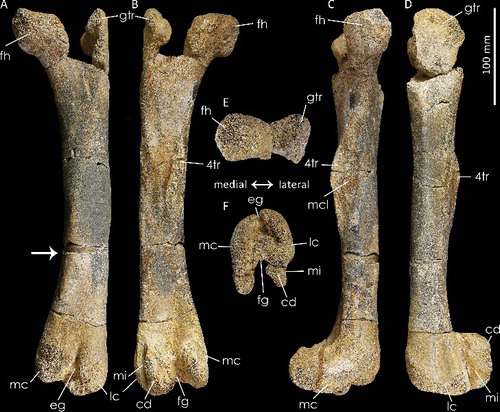
The Fossilised Thigh Bone of Burianosaurus (Various Views)

Specimen number NBP oB 203 (Burianosaurus left femur)

Views of the left femur, the only fossil from which the basal Ornithopod Burianosaurus augustai has been described.

Picture credit: The Journal of Systematic Palaeontology

The photograph (above), shows various views of the left femur of Burianosaurus.  This is the holotype fossil (NMP Ob 203), from which this genus was described.

Described from a Single Fossil Bone

It is not common these days, to have a new dinosaur genus erected on the description of a single bone.  When this fossil was first studied back in 2005, it was assigned to the iguanodontids.  However, over recent years the Iguanodontia and their relatives have been subject to phylogenetic reassessment and many of the taxonomic relationships between different components of the Ornithopoda have been revised.  The single bone was preserved in such fantastic condition, that its shape and muscle scars proved crucial in assigning a new dinosaur genus.

The views of the femur are (A) a view from the front, (B) viewed from the back, (C) a medial view (the bone viewed from the side closest to the body, think of it as the “inside leg view”) and (D) a lateral view, the bone viewed from the side of the bone towards the outside of the body.  Photographs (E) and (F) are views of the bone from the top looking down (proximal) and from the bottom of the bone looking up (distal).

The scale bar is 10 centimetres and the white arrow in (A) indicates the site from which a small sample of fossil bone was taken to permit an internal examination of bone structure to take place.  This histology helped the research team, writing in the Journal of Systematic Palaeontology, to identify this specimen as coming from a young, adult animal.

Burianosaurus augusta was Bigger than Hypsilophodon (H. foxii)

A lot of work has recently been undertaken in a bid to better understand how different ornithopods were related to each other.  These dinosaurs are characterised by their small, quite triangular heads, large orbits (eye sockets) and relatively primitive dentition (at least when compared to their relatives that comprise the Ankylopollexia clade – more derived iguanodonts, camptosaurs and the duck-billed dinosaurs).  Their front limbs tended to be much shorter than their hind limbs, so these dinosaurs were probably bipedal, although capable of dropping onto all fours if needed.

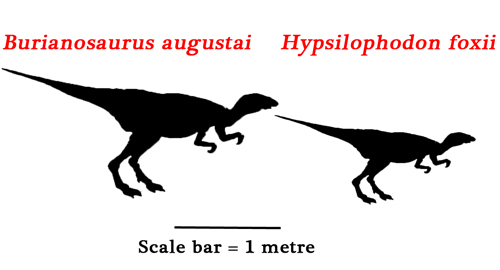
Burianosaurus has been depicted as being very similar to Hypsilophodon (H. foxii), to which it was related.  However, the largest H. foxii thigh bone that we at Everything Dinosaur are aware of, is only about half the size of the holotype of B. augustai.  Based on this we estimate that Burianosaurus was around four metres long.

Size Estimate Burianosaurus Compared to Hypsilophodon

Hypsilophodon and Burianosaurus size comparison.

An approximate size comparison between Burianosaurus and Hypsilophodon (H. foxii).  Picture credit: Everything Dinosaur.

Picture credit: Everything Dinosaur

Honouring Burian and Augusta

The genus name honours the famous palaeoartist Zdeněk Burian (1905–1981), whilst the species name refers to the influential palaeontologist and author Josef Augusta (1903 – 1968), who between them, did much to popularise the study of prehistoric animals.  Like Burianosaurus, both Burian and Professor Augusta came from the Czech Republic.

The single fossil bone that represents this new genus (the thigh bone), was found in the Korycany Beds of the Peruc-Korycany Formation.  These are a series of marine deposits laid down in a shallow sea, close to land during the Cenomanian faunal stage of the Late Cretaceous.  Team members at Everything Dinosaur estimate that Burianosaurus lived around 95 million years ago.

For models and replicas of ornithopods like Burianosaurus augustaCollectA Age of Dinosaurs Popular Range.

Burianosaurus augusta

In the scientific paper, the researchers carry out  a series of phylogenetic analyses of ornithopod data and as a result, B. augustai is classified as a basal ornithopod, however, quite how the Ornithopoda is configured remains open to debate.  If you do ever get the chance to participate in a time-travelling safari to the Cretaceous, look out for these fast-running, bipeds, fossils of which are just as valuable to science as that of any other dinosaur.

The scientific paper: “A Basal Ornithopod Dinosaur from the Cenomanian of the Czech Republic” by Daniel Madzia, Clint A. Boyd and Martin Mazuch published in the Journal of Systematic Palaeontology.

Visit the Everything Dinosaur website: Everything Dinosaur.
12 09, 2017

Europe’s Newest Brachiosaur is Described in a New Paper

By |2024-05-08T20:41:00+01:00September 12th, 2017|Categories: Dinosaur and Prehistoric Animal News Stories, Dinosaur Fans, Main Page, Photos/Pictures of Fossils|0 Comments

Soriatitan golmayensis of the Lower Cretaceous of Spain

Say hello to Europe’s newest member of the Brachiosauridae family – Soriatitan golmayensis, a sauropod estimated to have been longer than a badminton court!  This new species of herbivorous dinosaur has been described in a scientific paper published in the journal “Cretaceous Research”.  The fossil material, consisting of a single tooth, elements from the hips, limb bones including a partial femur and fragmentary tail bones were excavated over several years from the turn of the century.  The study of the fossil material finally culminating in the establishment of a new species of brachiosaurid.

Soriatitan golmayensis

The genus name means “Soria Titan”, a reference to Soria Province in central Spain where the fossils come from.  The species name honours the Lower Cretaceous Golmayo Formation (upper Hauterivian-lower Barremian), from which the fossil material was extracted.

An Illustration of the Newly Described Early Cretaceous Sauropod Soriatitan golmayensis

Soriatitan golmayensis illustrated.

An illustration of the brachiosaurid Soriatitan golmayensis.

Picture credit: Fundación Conjunto Paleontológico de Teruel-Dinópolis

Approximately Fourteen Metres Long

With less than 15% of the skeleton to work with, the researchers, which included lead author of the paper, Rafael Royo-Torres (Fundación Conjunto Paleontológico de Teruel-Dinópolis/Museo Aragonés de Paleontología, Spain), were able to identify this dinosaur as a brachiosaur by comparing the bones to better-known species.  To estimate the size, the scientists scaled up the dinosaur based on the dimensions of the 1.25-metre-long humerus (upper arm bone).  When this bone was compared to the humeri of other brachiosaurids the team concluded that their specimen represented a fourteen-metre-long individual.

The Size of Soriatitan Was Calculated Using the Humerus

Fossil humerus (Soriatitan golmayensis).

The humerus from Soriatitan which was used to estimate the animal’s size.

Picture credit: Fundación Conjunto Paleontológico de Teruel-Dinópolis

The Brachiosauridae Family

Brachiosaurs probably originated in the late Middle Jurassic and survived the break-up of Pangaea before finally becoming extinct in the Early Cretaceous.  Fossils of these long-necked, heavy-limbed plant-eaters are known from North America, Africa, Europe and southern England.  The Brachiosauridae is one of the three groups that make up the larger clade the Titanosauriformes.

The research team estimate that Soriatitan roamed the Iberian Peninsula some 132 million years ago.  Although, other fragmentary fossils notably those of Pelorosaurus conybeari from the Grinstead Clay Formation (West Sussex, England), have been tentatively assigned to the Brachiosauridae, the discovery of Soriatitan is extremely significant.  Dinosaurs such as the similar sized P. conybeari have been found in slightly older strata (Valangian faunal stage of the Early Cretaceous), Soriatitan provides evidence that brachiosaurids persisted in the Early Cretaceous of Europe for longer than previously thought.

Palaeontologist Rafael Royo-Torres explained:

“Until now it was believed that brachiosaurids had become extinct in Europe around 130 million years ago, the discovery of Soriatitan changes our perception of the European Early Cretaceous biota.”

The Break-up of Pangaea

The single, spoon-shaped tooth is typical of a brachiosaurid.  This tooth and the shape of a number of bones such as the presence of middle caudal neural spines helped the researchers to assign this dinosaur to the Brachiosauridae family.  In addition, the team deduced that Soriatitan may have been closely related to Abydosaurus, Cedarosaurus and Venenosaurus, which are all known from Lower Cretaceous-aged strata from Utah (United States).

The presence of Early Cretaceous brachiosaurids in both North America and Europe, give support to the hypothesis of a connection between the tectonic plates of these continents at some point during the Early Cretaceous.  A land connection between Europe and North America must have been present to enable closely related dinosaurs to be found in both Spain and the western United States.

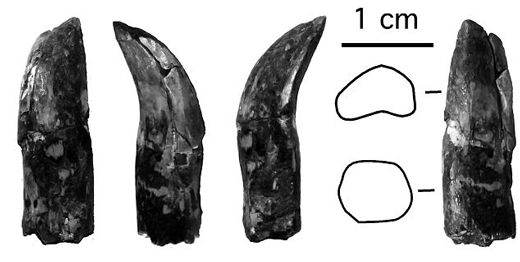
Views of the Single Tooth of Soriatitan golmayensis

Soriatitan fossil tooth.

Views of the single tooth of Soriatitan from the Lower Cretaceous of Spain.

Picture credit: Fundación Conjunto Paleontológico de Teruel-Dinópolis

The Evolution of the Titanosauriformes in Europe

The discovery of Soriatitan, may help palaeontologists to better understand the evolution of the Titanosauriformes in Europe.  Rafael Royo-Torres was part of the research team that described the non-brachiosaurid titanosauriform Tastavinsaurus sanzi recovered from a dig site in Peñarroya de Tastavins (Teruel) at the base of the marine Xert Formation in 2008.  It is one of the most complete and best-preserved sauropod dinosaur skeletons from the European Early Cretaceous.  Tastavinsaurus roamed Spain some 125 million years ago.  The discovery of Soriatitan may help fill the evolutionary gap between Late Jurassic brachiosaurs and the European titanosaurs of the Early Cretaceous.

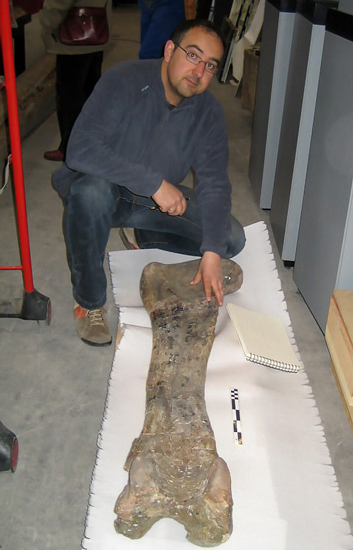
Rafael Royo-Torres Photographed Next to the Partial Femur (Thigh Bone)

The femur (thigh bone) of Soriatitan golmayensis

Palaeontologist Rafael Royo , lead author of the scientific paper examines a Soriatitan golmayensis femur.

Picture credit: Fundación Conjunto Paleontológico de Teruel-Dinópolis

6 09, 2017

Evidence for Communal Roosting in Oviraptorids

By |2023-08-13T17:18:36+01:00September 6th, 2017|Categories: Dinosaur and Prehistoric Animal News Stories, Dinosaur Fans, Main Page, Photos/Pictures of Fossils|0 Comments

Communal Roosting in the Dinosauria

Attendees at the annual meeting of the Society of Vertebrate Palaeontology (SVP) in Calgary (Alberta, Canada), were treated to a presentation outlining the discovery of a trio of young oviraptorid dinosaurs that may have been preserved sleeping as a group.  This might provide the first evidence of communal roosting, a practice seen in many extant animals today, where members of the same species sleep together for mutual protection and to help keep themselves warm.  Communal roosting is seen in many species of birds, notable examples being starlings and rooks.  Communal roosting is also known amongst primates, bats and butterflies.

Although, it is easy to misinterpret fossils of this nature, oviraptorids, members of the Maniraptora clade of dinosaurs which are closely related to Aves (birds), are believed to have been social animals and a spokesperson for Everything Dinosaur stated that behaviour of this nature is within the “realms of expectation for these dinosaurs”.

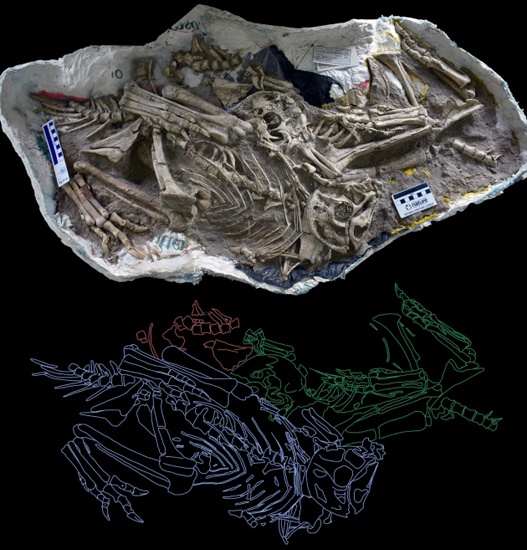
The Fossilised Remains of Three Oviraptorid Dinosaurs – Is this Evidence of Communal Roosting?

Block containing three oviraptorid fossils.

The three oviraptorid fossil skeletons within the single block.

Picture credit: Gregory F. Funston

The picture above shows the plaster-jacketed block containing the three individuals and a line drawing showing the location of each skeleton and the layout of the bones.  Greg Funston (University of Alberta), who led the fossil study explained that the three sleeping dinosaurs were probably relatives, perhaps from the same brood.  The fossil material first came to the attention of academics when Mongolian customs officials seized the specimen at an airport in 2006.  The stone block was being illegally smuggled out of the country, sadly, there is a thriving black market in illicit fossils from Mongolia and China, despite the very best attempts of the authorities to stop this trade.

Identifying the source of such illegally acquired fossils is always tricky, but a geochemical analysis of the surrounding matrix by scientists from the University of Bologna (Italy), led by Federico Fanti, suggested that the fossil came from the Bugiin Tsav area of the Gobi Desert (Upper Cretaceous sediments associated with the Nemegt Formation – Maastrichtian faunal stage).  Dr Fanti has also presented his findings at the SVP.

Sleeping Oviraptorids

Oviraptorids were extremely bird-like, feathered dinosaurs, with short skulls, beaks and deep lower jaws which were largely edentulous (lacking teeth).  Several genera have been named and these dinosaurs lived in the northern hemisphere during the Late Cretaceous.  Most of these dinosaurs were relatively small, around two-three metres in length (Gigantoraptor being an exception) and they were particularly abundant in Asia.  Fossils of their nests have been found, along with adults incubating eggs.  Most palaeontologists believe that these dinosaurs were social animals with similar behaviours to those seen in extant birds.  The diet of oviraptorids is uncertain, these bipeds could have been mainly herbivorous, but omnivory and durophagy (eating hard-shelled items like nuts, seeds and molluscs) is not ruled out.

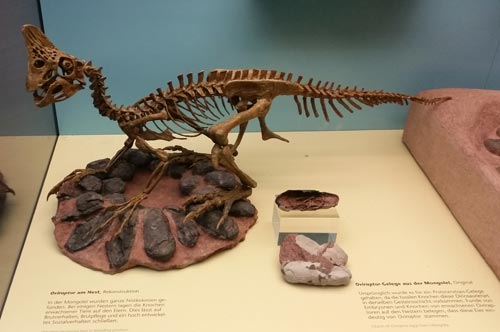
An Oviraptor Exhibit at a Museum (Frankfurt Natural History Museum)

An Oviraptor and dinosaur eggs exhibit.

An Oviraptor and its nest. Picture credit: Everything Dinosaur.

Picture credit: Everything Dinosaur

The three individuals are from the same species, which is new to science, these oviraptorids have yet to be formally named.  Like several other oviraptorids, a prominent, domed skull crest has been identified.  These types of dinosaurs seem to have been highly successful, the vertebrate biota of some Upper Cretaceous deposits of China are dominated by oviraptorids, for a case in point: Not Another Ganzhou Oviraptorid.

Juveniles Huddling Together

Two of the dinosaurs have been preserved crouched down on their stomachs, these two specimens, which are more complete than the third, have their necks curled back towards their bodies, whilst their arms cradle their heads, this is very reminiscent of a sleeping posture adopted by many types of living bird.

The fossilised remains of allegedly sleeping dinosaurs have been found before, perhaps most notably Mei long from the Liaoning Formation of north-eastern China.  M. long was named in 2004 after a spectacular fossil showing a head tucked under an arm and a tail curled round the body was discovered.  This little troodontid was either resting or sleeping when it was smothered by a layer of volcanic ash.

An Illustration of the “Sleeping Dragon” Mei long

Paleo-Creatures Mei long.

A Mei long dinosaur figure.

Dinosaurs Roosting Together

This is the first fossil evidence to support the idea that some kinds of dinosaurs roosted together (communal roosting).  Bone histology indicates that these animals were juveniles and roughly the same age when they died, it has been speculated that this fossil represents a “teenage gang” of sub-adult dinosaurs that died in their sleep.

If the layout of the fossils reflects their true posture and the bone position has not been affected by the fossilisation process, then the position of the three dinosaurs implies they were touching each other.  The researchers think the youngsters were probably huddling for warmth.  That suggests that the animals had tried to maintain a constant body temperature, or perhaps they were frightened and huddling together for protection and comfort.  David Varricchio (Associate Professor at Montana State University), has commented that he wondered whether these dinosaurs were resting or taking shelter from harsh weather rather than sleeping.

Communal Roosting in Oviraptorids

Funston argues that modern animals that roost together don’t usually make direct contact except for warmth.  Animals that died in events such as floods are preserved in very different positions from that of the oviraptorid trio, making it unlikely that the young dinosaurs were awake when they met their demise.

An Illustration of Roosting Oviraptorids

Communal roosting in oviraptorids.

Roosting oviraptorids.

Picture credit: Mike Skrepnick

Fossils that are Difficult to Interpret

The three dinosaurs do seem to have perished together, their body positions indicate that the carcasses were unlikely to have been transported far before accumulating and forming this assemblage, but interpreting the fossil is difficult.  Other researchers have expressed reservations about the communal resting hypothesis.  For example, biologist John Grady (Bryn Mawr College, Pennsylvania), has stated that the dinosaurs may have huddled together to hide or merely because the location was “a great place to sleep.” 

However, this fossil material is interpreted, it adds to the growing body of evidence that many types of dinosaurs, including Maniraptorans were highly social creatures and capable of exhibiting quite complex behaviours.

For a 2013 article that looks at evidence for oviraptorid courtship displays: Dinosaurs Shaking Tail Feathers and Strutting.

Canadian dinosaur helps to prove dinosaurs were show-offs: Fossil Discovery Reinforces Idea of Dinosaurs Displaying.

Visit the Everything Dinosaur website: Everything Dinosaur.
1 09, 2017

A New Silky Dinosaur Ruffles Feathers

By |2024-05-09T08:42:52+01:00September 1st, 2017|Categories: Dinosaur and Prehistoric Animal News Stories, Dinosaur Fans, Main Page, Photos/Pictures of Fossils|0 Comments

Serikornis sungei – Feathered but a Terrestrial Dinosaur

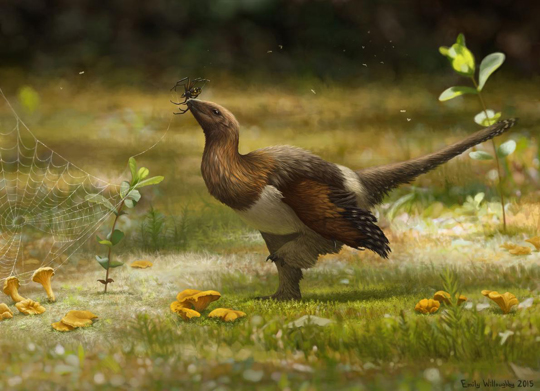
A team of international scientists have ruffled a few feathers amongst their fellow palaeontologists.  A new species of feathered, four-winged dinosaur from north-eastern China has been described.  Despite its heavily feathered forelimbs and legs, this forty-eight-centimetre-long theropod may have been permanently grounded.  Writing in the journal “The Science of Nature”, the scientists, which include lead author Ulysse Lefèvre (Royal Belgian Institute of Natural Sciences in Brussels), describe a basal paravian (member of the Paraves clade of theropods), it has been named Serikornis sungei.

Potentially a Very Down to Earth Feathered Dinosaur – Serikornis sungei

Serikornis sungei catches a spider.

Serikornis catches a spider.

Picture credit: Emily Willoughby

Puzzling Paravians and Their Kin

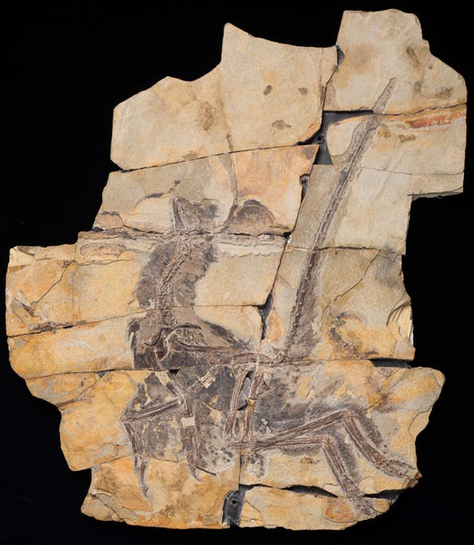
The single, beautifully-preserved and nearly complete fossil specimen of this dinosaur was discovered in 2014.  It comes from the Tiaojishan Formation (Late Jurassic), of Liaoning Province, China, from the same strata that previously yielded another four-winged theropod Anchiornis (A. huxleyi), which was named and scientifically described in 2009.    These sediments, which are approximately 160 million-years-old (Oxfordian faunal stage), may also have yielded another four-winged, terrestrial theropod – Aurornis (A. xui).  However, Aurornis poses a problem for palaeontologist as they try to unravel the evolution of feathered flight.

The holotype fossil material of Aurornis was acquired from a fossil dealer, who claimed the fossil came from the Upper Jurassic deposits of Western Liaoning.  However, Pascal Godefroit, a colleague of Ulysse Lefèvre at the Royal Belgian Institute of Natural Sciences, who was the lead author of the scientific paper that described Aurornis, has expressed doubts on the provenance of the original fossil material.  The holotype could have come from the much younger Yixian Formation of Liaoning Province.  Aurornis could have lived at least thirty million years after Anchiornis and Serikornis.  The lack of appropriate and validated fossil documentation is adding to the difficulties faced by scientists as they try and unravel the evolution of flight.

The Beautifully-Preserved Fossil Skeleton of Serikornis sungei

Beautifully preserved Serikornis sungei fossil showing feathers.

Serikornis sungei fossil showing the preserved plumage.

Picture credit: Ulysse Lefèvre/Royal Belgian Institute of Natural Sciences

“Silky Dinosaur”

The little dinosaur, nick-named “Silky”, because of the silky texture of its integument (covering of feathers), has a skeleton that suggests a terrestrial existence to the researchers.  They propose that Serikornis was a ground-dwelling dinosaur with no adaptations for flight, despite having feathers on its arms and legs.  Yet, feathery legs have been associated with the evolution of flight in the Dinosauria.

A hypothesis has been proposed that one dinosaur lineage went through a four-winged, gliding phase on the way to powered flight.  An example, of which would be the likes of Microraptor, known from Lower Cretaceous-aged deposits from Liaoning.  If a terrestrial dinosaur, such as Serikornis had long feathers on its legs, this suggests that such structures evolved in ground-dwelling dinosaurs and a flight function came secondary.

Such feathery legs might have evolved initially for a different reason, perhaps as a result of sexual selection or as a result of an evolutionary drive to produce even more elaborate and visually stunning displays.  These feathery legs were then inherited by increasingly aerodynamic and arboreal dinosaurs leading eventually to powered flight amongst the Dinosauria.

Palaeontologist Ulysse Lefèvre Examining the Serikornis Fossil Material

Examining the fossilised remains of Serikornis sungei.

Palaeontologist Ulysse Lefèvre views the fossil of Serikornis.

Picture credit: Ulysse Lefèvre/Royal Belgian Institute of Natural Sciences

Lefèvre and his team named the new species in honour of Sun Ge, the scientist at the Palaeontological Museum of Liaoning who made the fossil available for study, and for the presumed silky texture of its body covering. Serikos means “silk” in ancient Greek.

Contentious Fossil Interpretation

Commenting on one of the reasons for the team’s terrestrial diagnosis for Serikornis, Ulysse Lefèvre stated:

“The feathering of Serikornis shows for the first time a complete absence of barbules—that is, the microstructures that allow feathers to resist air pressure during wing beats.  The plumage is composed of four wings, as with many theropod dinosaurs from China, but it did not allow “Silky” to take off from the ground or from a tree.”

In the phylogenetic analysis undertaken by the research team, Serikornis is classified as a basal paravian, outside the Eumaniraptora clade, the clade that includes the Deinonychosauria (troodontids and dromaeosaurids), as well as birds.  Whilst these scientists propose a terrestrial habit for Serikornis, some palaeontologists disagree.  For example, Professor Mike Benton (Bristol University), thinks that presence of hind wings would have made life difficult for this little dinosaur.

Professor Benton explained:

“The hind wings would be inconvenient for a ground-runner.  The long feathers on the thigh and calf would be like very elaborate bell-bottomed trousers, rubbing and catching as the animal walked or ran.”

Professor Benton and many other leading academics support the idea that the anatomical arrangement of four wings is a good contender as a transitional stage between gliding and the evolution of powered flight.  The professor added that in his opinion the body plan of Serikornis was:

“A model for the origin of flight, in which little dinosaurs such as Serikornis clambered into trees, perhaps chasing insects and other small tree-dwellers for food.  To escape predators or to get around, they would glide from bough to bough.”

A Close-up of the Feathers on the Hind Legs of Serikornis sungei

The feathers on the hind limbs of Serikornis sungei.

A close-up view of the feathers on the hind legs of Serikornis sungei.

Picture credit: Ulysse Lefèvre/Royal Belgian Institute of Natural Sciences

A spokesperson from Everything Dinosaur commented:

“The discovery of another Late Jurassic four-winged dinosaur helps to increase our knowledge as to the diversity of the feathered theropods, it is very likely that feathers first evolved for other purposes, for example, as insulation, for display.   Flight was a secondary function.  However, where Serikornis sungei fits into the bigger picture regarding the evolutionary line that led to direct ancestors of today’s birds is open to debate.”

Lefèvre and his co-authors concede it may have been possible for these light, small dinosaurs to parachute from the trees to the ground.  The plumage of Serikornis could have slowed its descent, but “controlled falling” is a still a long way from flight.  Serikornis had enlarged claws that may have allowed it to climb trees, so this feathered dinosaur could have been at home in arboreal habitats.

To read Everything Dinosaur’s 2009 article on Anchiornis huxleyiOlder than Archaeopteryx! New Evidence of the Dinosaur/Aves Family Tree.

To read Everything Dinosaur’s 2013 article on the discovery of Aurornis: A New Contender for the Title of “First Bird”?

Visit the Everything Dinosaur website: Everything Dinosaur.
23 08, 2017

New Long-Necked and Horned Stem Archosaur from India

By |2023-08-11T10:16:55+01:00August 23rd, 2017|Categories: Dinosaur and Prehistoric Animal News Stories, Dinosaur Fans, Main Page, Photos/Pictures of Fossils|0 Comments

The Weird and Wonderful Shringasaurus indicus

The Triassic had some very weird and wonderful animals.  Fantastic phytosaurs, the first pterosaurs, evolving and radiating members of the Dinosauria and joining this menagerie is the newly described Shringasaurus indicus, a large, herbivorous, horned plant-eater that superficially resembled a horned dinosaur.

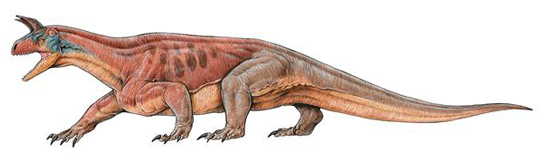
An Illustration of the Newly Described Basal Archosaur S. indicus

The Triassic stem Archosaur Shringasaurus indicus.

An illustration of the newly described Triassic stem archosaur Shringasaurus indicus.

Picture credit: Conicet

A Pair of Large Supraorbital Horns

The most surprising feature of this reptile is the pair of large, forward pointing horns located on the top of the animal’s skull.  These horns resemble those of some Cretaceous ceratopsian dinosaurs, famous beasties from the fossil record such as Triceratops, Torosaurus and Chasmosaurus.  The fossilised remains of Shringasaurus indicus were recovered from a red mudstone in the upper part of the Denwa Formation (north, central India).  At least seven individuals of different growth stages were excavated from an area of approximately twenty-five square metres.

Most of the specimens were disarticulated, with the exception of one partially articulated skeleton.  Back in the early Middle Triassic, when Shringasaurus roamed, India was located in the Southern Hemisphere, part of a super-continent called Pangaea.

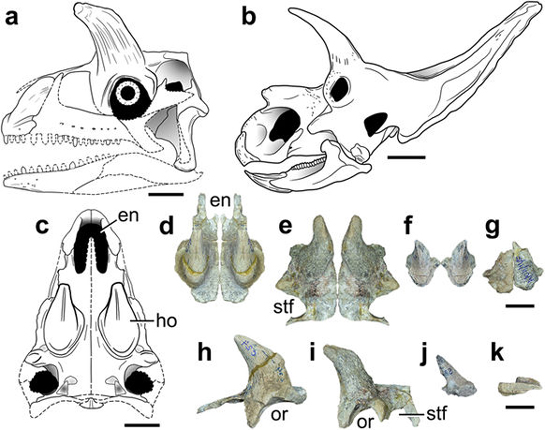
The Horns of Shringasaurus are Similar to Those of a Horned Dinosaur

Shringasaurus skull material compared to a horned dinosaur.

Cranial anatomy of Shringasaurus indicus compared to a Ceratopsian.

Picture credit: Scientific Reports

The picture above shows a line drawing (lateral view) of the skull of an adult S. indicus (a) compared to a lateral view of the skull of the Canadian, chasmosaurine dinosaur Arrhinoceratops brachyops, (b) which was distantly related to Triceratops.  The line drawing (c) shows the skull of S. indicus in dorsal view, (looking down onto the skull).  Photographs d-g show dorsal views of several individuals at different growth stages.  To produce a complete dorsal view of the skull, missing fossils have been reconstructed by digitally mirroring their preserved counterpart.

As these reptiles grew, so the horns became larger and more prominent.  Photographs h-j show lateral views of the bony horns.  Specimens d to f and h-j possess horns and the two smallest specimens, representing the youngest individual (g and k) lack horns.

Scale bar = 4 cm for (a) and (c to k), the scale bar for the ceratopsian skull is 20 cm (b)

Key

en = external naris

ho = horn

or = orbit

stf = supratemporal fenestra

The researchers conclude that these horns were probably used in intraspecific combats, perhaps over mates, or to decide the hierarchy of the herd.  This new study supports the idea of sexual selection pressure leading to the evolution of bizarre ornamentation within the Archosauria.

Recently, Safari Ltd introduced a replica of Shringasaurus.

To view this range of models and figures: Wild Safari Prehistoric World Figures.

Shringasaurus is Remarkable For its Horns

Commenting on the significance of this discovery, one of the authors of the scientific paper, Martín D. Ezcurra (CONICET–Museo Argentino de Ciencias Naturales, Buenos Aires, Argentina), stated:

“An animal like Shringasaurus is remarkable for its horns, a completely unexpected feature in this group of reptiles.  It shows that sexual selection led to the development of strange anatomical structures in the early evolutionary history of the arcosauromorphs, a group that includes dinosaurs, crocodiles and birds.”

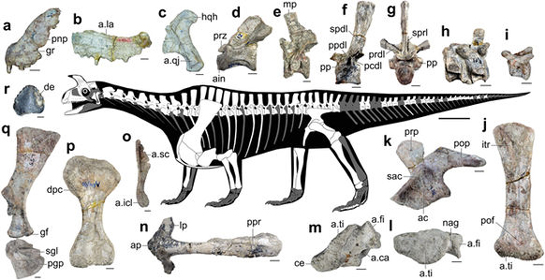
The Fossil Material Associated with Shringasaurus

Shringasaurus indicus fossil material.

Shringasaurus indicus fossils.

Picture credit: Scientific Reports

The genus name is a combination of Greek and ancient Sanskrit, it means “horned reptile”.  This unusual reptile with its pair of horns has provided an insight to the diverse range of reptiles that occupied this part of Pangaea during the Anisian faunal stage of the Middle Triassic some 245 to 243 million years ago.

Visit the Everything Dinosaur website: Everything Dinosaur.

16 08, 2017

New Damselfly Species Honours Sir David Attenborough

By |2024-05-06T16:16:24+01:00August 16th, 2017|Categories: Dinosaur and Prehistoric Animal News Stories, Main Page, Photos/Pictures of Fossils|0 Comments

Mesosticta davidattenboroughi – Sir David’s Cretaceous Damselfly

Broadcaster, naturalist and all-round good guy, Sir David Attenborough has been honoured yet again by having a newly described species named after him.  This time, it is a new species of Cretaceous damselfly discovered in a piece of Burmese amber (burmite).  Fossils of insects are extremely rare and the fossil record for this extremely important Class of arthropods has been significantly enriched thanks to the preserved insect remains found in fossilised tree resin.

A Picture of the Holotype Specimen – Mesosticta davidattenboroughi

Mesosticta davidattenboroughi Cretaceous damselfly in amber.

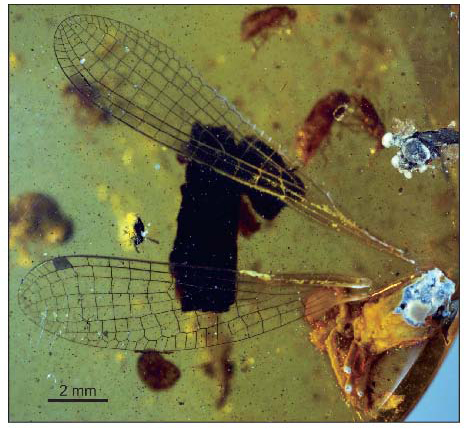
Mesosticta davidattenboroughi sp. nov., holotype, NIGP164541, photograph of specimen.

Picture credit: Journal of Systematic Palaeontology

Sir David Attenborough is Honoured

The remains of this winged insect were discovered in the Hukawng Valley of Kachin Province, northern Myanmar, an area famed for its amber deposits.  Details of some remarkable fossils have recently been published, for example, back in 2016 Everything Dinosaur blogged about the discovery of a partial tail from a feathered dinosaur in burmite.  As recently as June (June 2017), we wrote about the finding of the remains of a primitive bird, a hatchling that had become entombed and preserved.

To read the article about the discovery of the dinosaur tail: The Tale of a Dinosaur Tail.

For the article on the baby bird fossil: Watch the Birdie! Enantiornithine in Amber.

Mesosticta davidattenboroughi

The full, binomial scientific name for the new species, belonging to a group more commonly known as shadowdamsels, is Mesosticta davidattenboroughi.  The researchers decided to name the new species after David Attenborough because of his long-standing appreciation of dragonflies, and to celebrate his recent 90th birthday, which he celebrated in May 2016.

Co-author of the scientific paper, Professor Edmund A. Jarzembowski commented:

“Dragonflies in amber are extremely rare and the recent discoveries by my Chinese colleagues are a new window on the past.  It is tradition in taxonomy [the naming of a new species] to contact the person concerned.  Sir David was delighted because he is not only interested in the story of amber, but also a president of the British Dragonfly Society.”

The fossil itself is extremely well preserved as it is encased in yellow transparent amber and includes a complete set of wings.  With the aid of photo technology, the scientists were able to digitally enhance and build a clear three-dimensional image of the new species, showing that it differed from previously described fossils, Mesosticta had quite stubby, short wings when compared to other Mesozoic species.

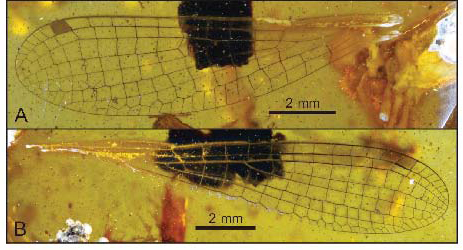
Images of the Forewings of Mesosticta davidattenboroughi

Mesosticta davidattenboroughi forewing images.

Mesosticta davidattenboroughi sp. nov., holotype, NIGP164541. A, photograph of left forewing; B, photograph of right forewing.

Picture credit: Journal of Systematic Palaeontology

Lead author of the scientific paper, Daran Zheng (Nanjing Institute of Geology and Palaeontology, Chinese Academy of Sciences), stated:

“Mesosticta davidattenboroughi is quite unique because we have uncovered a new species and it confirms the previous attribution of Mesosticta to the Platystictidae.  It is the first fossil group of modern platystictid damselflies and documents the appearance of Platystictidae as early as middle Cretaceous.”

A Poor Fossil Record

Finding insect remains in amber is not unusual, however, this family of damselflies are very poorly recorded in the fossil record and as a result this discovery from northern Myanmar is especially significant.

Mesosticta davidattenboroughi is just the latest in a long line of animals which have been named in honour of Sir David Attenborough:

Silurian Arthropod honours Sir David Attenborough: Fossil Named after Sir David Attenborough.

Kitten-sized marsupial lion named after Sir David Attenborough: Attenborough’s New Kitty.

The scientific paper: “Mesostictinae subfam. nov., an archaic group of platystictid damselflies (Odonata: Zygoptera) from mid-Cretaceous Burmese amber” by Daran Zheng, Bo Wang, André Nel, Edmund A. Jarzembowski, Haichun Zhang & Su-Chin Chang published in the Journal of Systematic Palaeontology.

Read the full article online: Scientific Paper.

Visit the Everything Dinosaur website: Everything Dinosaur.
7 08, 2017

The “Jaws” of the Early Triassic

By |2023-08-09T07:35:08+01:00August 7th, 2017|Categories: Dinosaur and Prehistoric Animal News Stories, Main Page, Photos/Pictures of Fossils|0 Comments

Birgeria americana – Big Mouthed Fish of the Early Triassic

Birgeria americana – the jaws of the Early Triassic.

The end-Permian mass extinction event is widely regarded as the most devastating extinction known from the Phanerozoic Eon.  An estimated 57% of all marine families died out, virtually all the corals became extinct and ecosystems were effectively destroyed.  Notable casualties were the Trilobita, sea-scorpions (eurypterids) and many kinds of fish.  Life on land did not fare any better with many groups of amphibians and reptiles perishing.

Recently, some evidence has emerged that ecosystems bounced back remarkably quickly after this catastrophic event.  Further evidence of a speedy recovery comes in the form of a large fossilised skull from a new species of predatory marine fish discovered by palaeontologists from the University of Zurich during field work in Nevada.

Birgeria americana –A Top Marine Predator of the Early Triassic

Birgeria americana illustration.

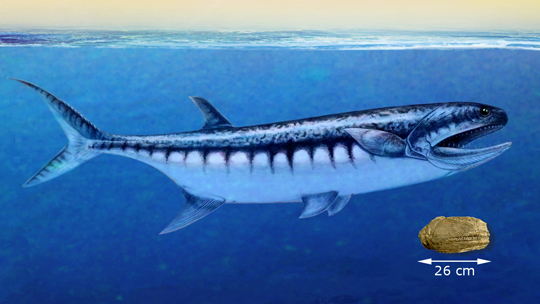
A reconstruction of Birgeria americana with the fossil skull (bottom right).

Picture credit: Nadine Bösch

The new species has been named Birgeria americana, a member of the ray-finned fishes (Actinopterygii) and fossils of this genus are mostly associated with Middle Triassic, much younger rocks, but the lineage can be traced back into the Late Permian.  Intriguingly, most species are much smaller, less than a metre in length, Birgeria americana in contrast, was a relatively giant, measuring around 1.72 to 1.85 metres long.

The “Jaws” of the Early Triassic

Recovered from rocks that have been dated to less than one million years after the end Permian extinction event, the discovery of such a large, voracious predator came as something of a surprise to the researchers.

Lead author of the study, recently published in the “Journal of Paleontology”, Dr Carlo Romano (Palaeontological Institute and Museum, University of Zurich) stated:

“The surprising find from Elko County in north-eastern Nevada is one of the most completely preserved vertebrate remains from this time period ever discovered in the United States.”

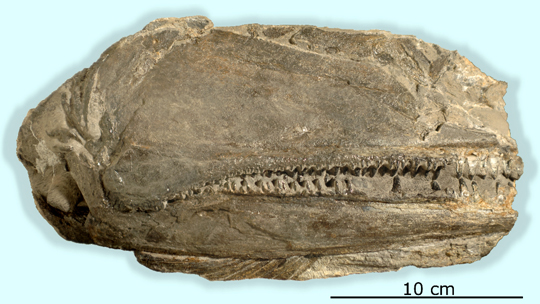
The new species has been described on the basis of a twenty-six-centimetre-long partial skull and jaws.  The jaws contain three parallel rows of robust, sharp teeth, the largest of which were up to two centimetres long.  This formidable dentition was further reinforced by several small teeth inside the mouth.

The Fossil Skull of B. americana

Birgeria americana fossilised skull and jaws.

The fossilised skull of Birgeria americana.

Picture credit: University of Zurich

Hunting Like a Great White Shark

The research team postulate that this species of super-sized Birgeria hunted in a similar fashion to the extant Great White Shark (Carcharodon carcharias).  Prey fish were pursued and then bitten, resulting in massive blood loss for the victim.  The unfortunate prey was then swallowed whole.  The partial skull, preserved in a limestone nodule, was excavated from Lower Triassic beds close to Winecup  Ranch in Elko County (Nevada).  The area is famous for its Triassic vertebrate fossils including early ichthyosaurs.

Prior to this discovery, researchers had assumed that ancient equatorial regions were too hot for vertebrates to survive during the Early Triassic (Nevada was close to the equator during the Early Triassic), the discovery of such a large, obvious predator suggests a rich and diverse food chain existed even at low latitudes.

Finds such as the newly discovered Birgeria species and the fossils of other vertebrates now show that marine hypercarnivores existed shortly after the end-Permian mass extinction.  The existence of bony fish close to the equator, where Nevada was located some 250 million years ago, indicates that the temperature of the sea was a maximum of 36°C.  The eggs of today’s bony fish cannot develop normally at constant temperatures above 36°Celsius.

Ecosystems Recovering After a Mass Extinction Event

Dr Romano added:

“The vertebrates from Nevada show that previous interpretations of past biotic crises and associated global changes were too simplistic.  Despite the severity of the extinctions of that time and intense climatic changes, the food webs were able to redevelop faster than previously assumed.”

For an article on fossil finds from China, providing further evidence of marine biota recovery following the end-Permian mass extinction: Window into an Ancient Marine Ecosystem.

The scientific paper: “Marine Early Triassic Actinopterygii from Elko County (Nevada, USA): Implications for the Smithian Equatorial Vertebrate Eclipse” by Carlo Romano, James F. Jenks, Romain Jattiot, Torsten M. Scheyer, Kevin G. Bylund, and Hugo Bucher published in the Journal of Paleontology.

Visit the Everything Dinosaur website: Everything Dinosaur.
6 08, 2017

The Armour of Borealopelta markmitchelli

By |2023-08-09T07:27:42+01:00August 6th, 2017|Categories: Dinosaur and Prehistoric Animal News Stories, Dinosaur Fans, Main Page, Photos/Pictures of Fossils|0 Comments

The Armour of Borealopelta markmitchelli

With the publishing of the formal description of the nodosaurid Borealopelta markmitchelli in the academic journal “Current Biology” this week, Everything Dinosaur has received a number of emails concerning this amazing fossil discovery.  The specimen, was lovingly prepared by museum technician Mark Mitchell who worked on the fossil for five and a half years, a total of something like 7,000 hours, as the dinosaur was exposed from its matrix one grain at a time.

Borealopelta markmitchelli

The holotype (TMP 2011.033.0001), is currently on display at the Royal Tyrrell Museum, part of an exhibition entitled “Grounds for Discovery”.  This exhibition highlights the personal stories and amazing fossils that have been discovered as a result of the Museum’s collaboration with numerous industries such as road construction, house building, mining, and oil and gas extraction.

The emails we received concerned aspects such as the animal’s size (5.5 metres long and weighing around 1.3 tonnes) and from which part of Alberta did the fossil come from (north-eastern Alberta).  However, most of the emails were enquiring about the preservation of the armour.

The diagram below should help.

A Schematic Drawing of the Borealopelta markmitchelli Holotype Specimen

Dermal armour of Borealopelta.

Schematic line drawing of the dermal armour of Borealopelta.

Picture credit: Current Biology

Studying the Armour of a Dinosaur

The picture above shows a schematic drawing of Borealopelta (A), with line drawings (B) and (C) showing the skull in dorsal and lateral views.  The different colours illustrate the preservation of different tissue types and the photographs (D to G) with accompanying line drawings show the range of dermal armour including osteoderms and scutes.  A close-up view of the neck (D), shows alternating cervical osteoderm bands (and preserved keratinous sheaths) and polygonal scales.

Photograph (E) shows a close-up view of the flank illustrating lateral thoracic osteoderms (with keratinous coverings) and polygonal scutes (scales).  A close view of the sacral shield area (F) showing more elements that make up the dermal armour and (G) shows a view of the forearm of Borealopelta (antebrachium) showing the amour (osteoderms and scales).

Note

Scale bar = 1 metre (A) and scale bar = 10 cm (B to G).

Body Armour in Life Position

The wonderful thing about this particular armoured dinosaur is that the osteoderms and scales that make up the body armour have been preserved in the position they were in when this dinosaur roamed Alberta during the Early Cretaceous.  The three-dimensional nature of the fossil has really helped the research team to understand how the mosaic of scutes, scales and osteoderms combined to provide the dermal armour.  The remains of the keratin sheaths and overlying skin was also preserved in some areas, melanosomes identified provide evidence of this dinosaur’s colouration.

To read an article about Borealopelta markmitchelliAmazing Armoured Dinosaur Fossil Reveals Countershading.

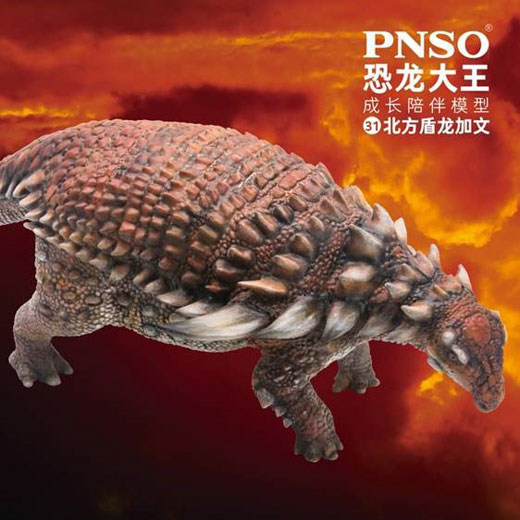
PNSO Gavin the Borealopelta armoured dinosaur model.
The PNSO Borealopelta dinosaur model.

The picture (above) shows a PNSO Borealopelta dinosaur model.

To view this range: PNSO Age of Dinosaurs Models.

Visit the award-winning Everything Dinosaur website: Everything Dinosaur.
1 08, 2017

Dinosaur Fossils on Mars – Not Quite but a New Fossil Discovery

By |2024-05-09T08:35:26+01:00August 1st, 2017|Categories: Dinosaur and Prehistoric Animal News Stories, Dinosaur Fans, Main Page, Photos/Pictures of Fossils|0 Comments

Students Looking to Test Mars Rovers Discover Dinosaur Fossils

University students looking for a suitable landscape to test robots to take part in the exploration of Mars, have stumbled across the remains of a duck-billed dinosaur eroding out of the landscape.  Dinosaur bone discovery made by students.

Members of the University of Saskatchewan Space Design Team (USST), were visiting Midland Provincial Park in southern Alberta (Canada), in early June, scouting for suitable sites for an upcoming robotics contest.  The team were looking to identify terrain that resembled that found on the surface of Mars, the object of the competition being to test designs for Mars Rovers – robotic vehicles that could help with further exploration of the red planet.  What the team did not anticipate, was that their search would lead to the discovery of several fossilised bones from a Late Cretaceous hadrosaurid.

Duck-billed Dinosaur Bones Discovered

Dinosaur bone discovery.

Duck-billed dinosaur bone discovered by University of Saskatchewan students.

Picture credit: Adam McInnes

Dinosaur Bone Discovery

The students were exploring the area around Drumheller in a bid to identify sites suitable for hosting the first Canadian International Rover Challenge, a globally significant event, with a number of universities and institutions showcasing their robotics and automated vehicles that could help future scientific missions to Mars.  The team were looking for locations which were very dry, with lots of rocky terrain, plenty of sand and a mixture of different stone sizes coupled with a minimal of vegetation.  For a palaeontologist, areas with lots of rocky exposures, very few plants and which are subject to high levels of erosion, can also be great places to find fossils, especially if the rock is sedimentary in nature.  This part of Alberta is famous for its extensive exposures of Upper Cretaceous strata and numerous dinosaurs have been identified from their fossilised remains.

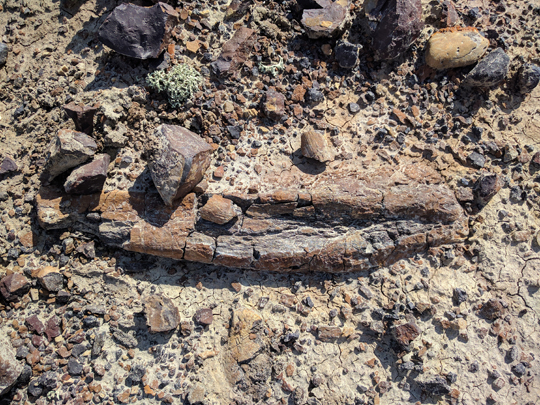
An Eroded Hadrosaurid Jaw Bone from the Site

Hadrosaurid jaw bone.

Partial jaw bone from a duck-billed dinosaur.

Picture credit: Adam McInnes

The picture above shows a very weathered portion of a jaw bone from a duck-billed dinosaur.  The grooves seen in the fossil equate to locations in the jaw for the dental battery, the rows of tightly packed teeth that helped this herbivore process the coarse plant-material such as pine needles that this type of dinosaur consumed.  Hadrosaurid fossils are probably the most common large dinosaur fossils to be found in this part of Canada, team members at Everything Dinosaur, whilst working with Royal Tyrrell Museum staff have come across several specimens themselves. Often the fossils are too weathered and fragmentary to permit extraction and formal identification down to the species level.

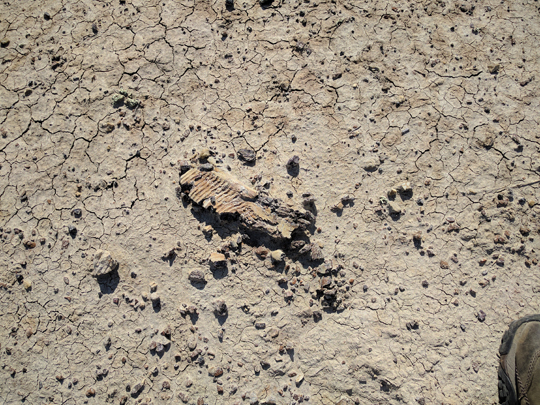
Severely Weathered Dinosaur Bones

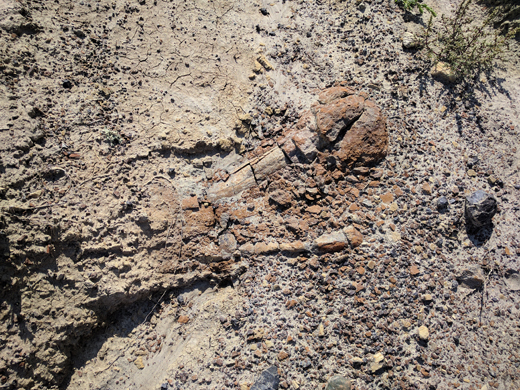
A Severely Weathered Dinosaur Fossil Bone

Severely weathered dinosaur fossil bone.

It may look like a jumble of “weird-looking” rock but that is a dinosaur bone.

Picture credit: Adam McInnes

Conservation officials from the Alberta Parks Department and staff from the Royal Tyrrell Museum (Drumheller), were able to assist the USST members and helped them to identify suitable venues for the robotic vehicle tests.  The locations chosen were well away from sites of significant geological interest, after all, it is hardly a valid test for a potential Mars Rover to be able to ascend and descend a dinosaur bone, that is one object that these machines are not going to encounter on Mars.

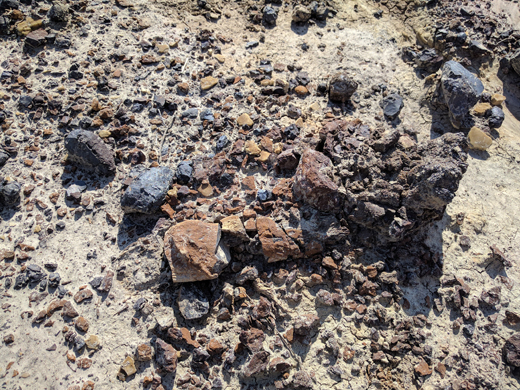
A Femur (Thigh Bone) from a Hadrosaurid

Duck-billed dinosaur leg bone.

Hadrosaurid leg bone.

Picture credit: Adam McInnes

USST President, Danno Peters explained that whilst discovery dinosaur bones certainly generated a degree of excitement amongst the group, none of the USST members were thinking of changing their careers and becoming palaeontologists.  Plans are already well underway for the 2018 Mars Rover competition and the USST team were looking forward to pushing their designs to the limit in even more challenging terrain.

Everything Dinosaur acknowledges the help of the media team at the University of Saskatchewan for their help in the compilation of this article.

Visit the award-winning Everything Dinosaur website: Everything Dinosaur.
Go to Top