All about dinosaurs, fossils and prehistoric animals by Everything Dinosaur team members.

Pictures of fossils, fossil hunting trips, fossil sites and photographs relating to fossil hunting and fossil finds.

2 12, 2017

Amazing Hamipterus Nesting Ground Discovery

By |2024-05-10T09:44:10+01:00December 2nd, 2017|Categories: Dinosaur and Prehistoric Animal News Stories, Dinosaur Fans, Main Page, Photos/Pictures of Fossils|0 Comments

Pterosaurs Even More Like Birds

Pterosaurs like birds, were capable of powered flight.  It seems that command of the skies is not the only thing that these two types of vertebrate had in common.  Thanks to a remarkable series of discoveries from the remote Turpan-Hami Basin located in the Xinjiang Uygur Autonomous Region (north-western China), palaeontologists have learned that pterosaurs, like many living birds nested in colonies, that they had preferred nesting sites and when young, pterosaurs needed a degree of parental care, just like many species of birds today.

Pterosaur Nesting Colony (Hamipterus tianshanensis)
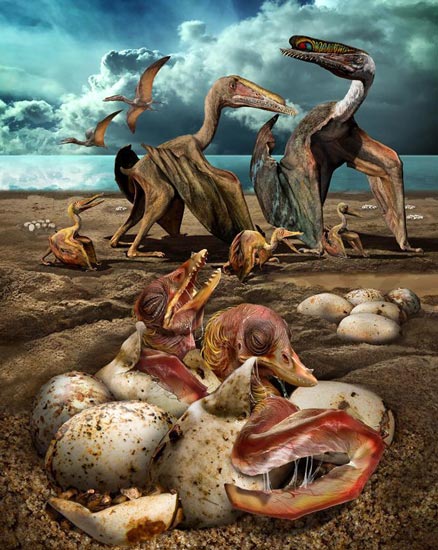
Hamipterus tianshanensis nesting ground.
Male (right) and female Hamipterus tianshanensis looking after their brood, whilst more pterosaur chicks hatch in the foreground.

Picture credit: Zhao Chuang

Hundreds of Pterosaur Eggs Discovered

Writing in the journal “Science”, researchers from the Chinese Academy of Sciences along with collaborators from a number of research institutions in Brazil have published a paper describing the discovery of 215 pterosaur eggs, 16 of which contain the remains of embryos.  The eggs and the numerous fossil bones associated with the site have been attributed to Hamipterus tianshanensis, a flying reptile first named and described in 2014 whose exact taxonomic position in the pterosaur family tree remains open to debate.

That point notwithstanding, H. tianshanensis has been propelled to super-stardom, like a Pteranodon taking to the air, representing one of the most significant Pterosauria discoveries made to date.

An Assemblage of Pterosaur Fossils
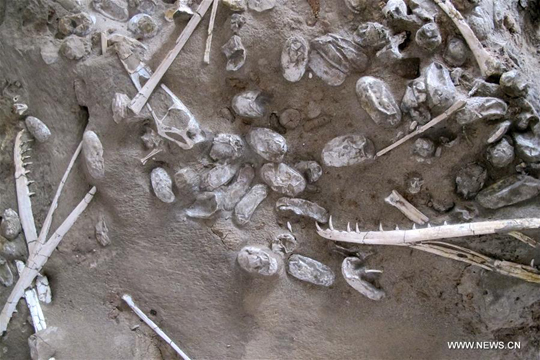
Hamipterus tianshanensis fossils including eggs and embryos.
Pterosaur fossil eggs and bones representing individuals of various ages.

Picture credit: Xinhua/Wang Xiaolin

Pterosaur Nesting Grounds

Significantly, the number of eggs discovered are far too many to have been laid by a single female.  This suggests that these flying reptiles nested in colonies and furthermore, the overlaying of multiple clutches of eggs indicates that pterosaurs, like many birds today, returned to the same nesting sites each year.  As the authors conclude, “the similarity between these groups goes beyond wings”.

The Remains of Numerous Individuals at the Site
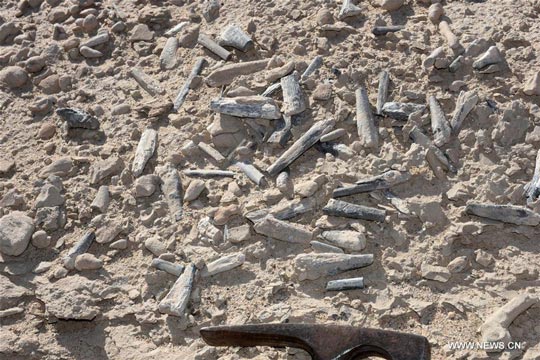
Hamipterus fossil remains.
Hundreds of pterosaur bones lying on the surface.  Note the tip of a geological hammer providing a scale.

Picture credit: Xinhua/Alexander Kellner

Three-Dimensional Fossil Egg Preservation

The eggs were not laid at the location where they were discovered.  This exceptional Lagerstätte preserves a series of tragic events, it seems that periodically, the nesting area was subjected to flooding as a result of seasonal storms.  Many of the eggs have been preserved in three dimensions, caused by the encroachment of sediment.

Computed tomography scans have revealed minute details of some of the embryos preserved within the eggs.  For example, an almost complete skeleton of a hatchling shows that bones related to flight were less developed than bones of the hind limb, indicating that new-borns might have been able to walk but not fly.

The front limb bones lack ossification and had yet to fully form, whilst the leg bones such as the femora are well developed.  This suggests that the young pterosaurs were unable to fly, but not completely helpless, their strong legs would have meant that they would not have been stuck in the nest but quite capable of locomotion.  However, these new insights have led the palaeontologists to conclude that, in the case of Hamipterus at least, the offspring were less precocious than previously assumed.

In short, mum and dad (coming to that bit next), had to take care of their young, bring food to them and protect them from predators.

Evidence Suggests that Pterosaurs Cared for their Young
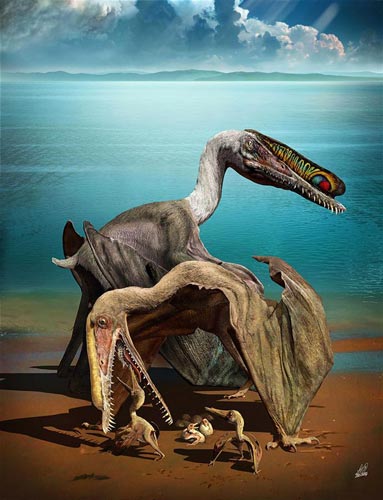
Hamipterus feeding their young.
The male Hamipterus (background) stands guard whilst the female regurgitates food to her offspring (altricial behaviours in Pterosaurs).

Picture credit: Zhao Chuang

The Significance of Dad

Hamipterus tianshanensis was named and described three years ago.  This fossil location had been discovered several years before, but the pterosaur body fossils and the associated pterosaur egg material (forty specimens and five eggs), were not scientifically described until 2014.

In the 2014 paper (Wang et al), which was written by many of the scientists involved in this latest study, it was postulated that differences in head crest shape or size helped to distinguish males from females.

It was proposed that specimens with larger skull crests were males.  This suggests sexual dimorphism in this species and, if this idea is taken a little further, it implies that the males may have played a role in helping to bring up the next generation. After all, fossilised remains of what might represent adult males have been swept together with the nest site fossils.  Many male birds share parental responsibilities and lots of extant Aves such as the Wandering Albatross (Diomedea exulans) for instance, pair for life.  Perhaps, adult pterosaurs also had monogamous behaviour.

A Close-up View of the Preserved Leathery Egg of Hamipterus
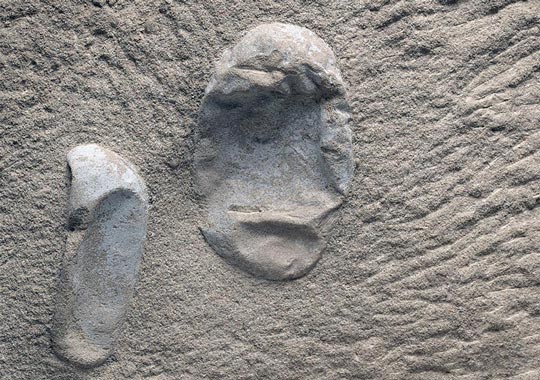
Egg fossils (Pterosaur).
Pterosaur egg fossils (Hamipterus tianshanensis).

Picture credit: Xinhua/Wang Xiaolin

Inferring Behaviours

To what degree the Pterosauria and Aves share behaviours remains a controversial area.  Further research into the remarkable Hamipterus Lagerstätte has greatly increased our knowledge about flying reptiles but we must be careful not to infer or imply too much from the fossil evidence.  The scientists conclude that the discovery of all these bones and fossilised eggs supports the idea that these pterosaurs nested in colonies and that they returned to a favoured nesting site to breed.

Two of the Authors of the Scientific Paper Inspect Part of the Remote Dig Site
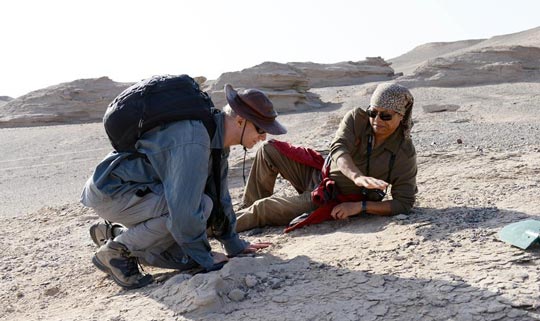
Collecting egg fossil specimens (Pterosaur).
Palaeontologists Wang Xiaolin (right) and Alexander Kellner collect specimens in a desert in Hami, northwest China’s Xinjiang Uygur Autonomous Region.

Picture credit: Xinhua

The scientific paper: “Egg Accumulation with 3D Embryos Provides Insight into the Life History of a Pterosaur” by Xiaolin Wang, Alexander W. A. Kellner, Shunxing Jiang, Xin Cheng, Qiang Wang, Yingxia Ma, Yahefujiang Paidoula, Taissa Rodrigues, He Chen, Juliana M. Sayão, Ning Li, Jialiang Zhang, Renan A. M. Bantim, Xi Meng, Xinjun Zhang, Rui Qiu and Zhonghe Zhou published in the journal “Science”.

Visit the Everything Dinosaur website: Visit Everything Dinosaur.
28 11, 2017

Sauropod Feet Had Plenty of Traction According to New Study

By |2024-05-10T07:30:54+01:00November 28th, 2017|Categories: Dinosaur and Prehistoric Animal News Stories, Dinosaur Fans, Main Page, Photos/Pictures of Fossils|0 Comments

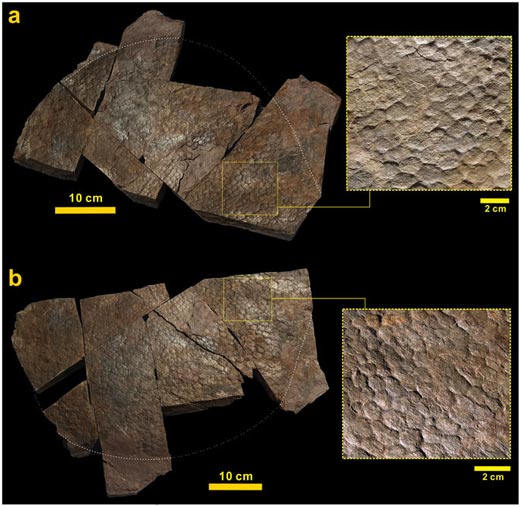
Sauropod Print from South Korea Reveals Polygonal Scales

A team of scientists based in South Korea have published a paper in the academic journal “Nature” that reports on the discovery of a sauropod dinosaur footprint that has preserved the impression of the underside of the foot. The polygon-shaped scales on the underside of the long-necked dinosaur’s feet (plantar surface), would have provided grip and traction, helping these large creatures to traverse soft mud and slippery ground.

Sauropod Foot Impression Fossil (South Korea)

The preserved impression of the underside of a Sauropod's foot.
Distinct skin impressions in a sauropod footprint (a) and on its cast (b) described in the study published in the journal “Nature”.

Picture credit: Nature

Largest Sauropod Print with Underside Surface Preserved

The very distinctive foot impression and its cast, reported upon in this study, represent the largest known sauropod footprint with skin details found to date.  The single print measures more than fifty centimetres across.  The footprint impression was left in silty mudstone as a large sauropod crossed a mudflat in the late Early Cretaceous (Albian faunal stage of the Early Cretaceous).

The researchers from Pukyong National University, Busan (South Korea) and Seoul National University (Seoul), describe a single footprint from the Lower Cretaceous Haman Formation discovered in south-eastern South Korea, they suggest that the floodplain sediments were formed by sheetflood processes, where shallow water moves relatively slowly across slightly sloping ground.  The palaeoenvironment is interpreted as being a semi-arid area with lakes and ponds which was occasionally subjected to wetter weather, resulting in some flooding.

Microbial mats formed across the low-lying ground, adjacent to the water sources and the presence of these microbial mats may have helped with the preservation of the foot details.

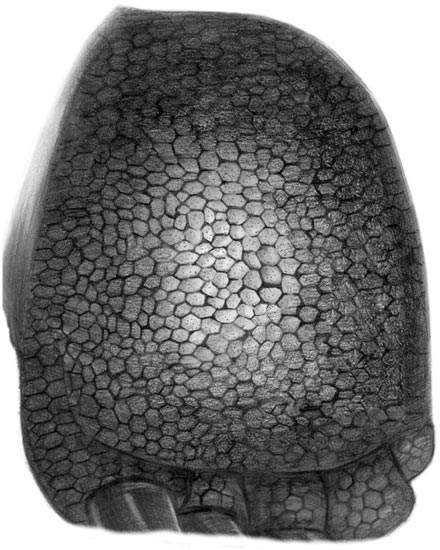
A Reconstruction of the Sauropod Foot (Underside)

Illustration of the underside surface of the Sauropod foot.
Reconstruction of the plantar surface (underside) of a sauropod foot with polygonal skin.

Picture credit: Hyun Jeong Yoo

The researchers conclude that some sauropods by the late Early Cretaceous had a well-developed polygonal skin texture covering nearly the whole of their foot pads.  This foot pattern is reminiscent to that found on the pads of extant elephants.  These scales would have helped increase stability when these large and heavy animals crossed wet ground.

Visit the Everything Dinosaur website: Everything Dinosaur.

16 11, 2017

Cataloguing the Ancient Forests of Antarctica

By |2023-08-25T09:21:23+01:00November 16th, 2017|Categories: Dinosaur and Prehistoric Animal News Stories, Geology, Main Page, Palaeontological articles, Photos/Pictures of Fossils|0 Comments

Permian, Triassic and Jurassic-aged Forests Explored on the Coldest Continent

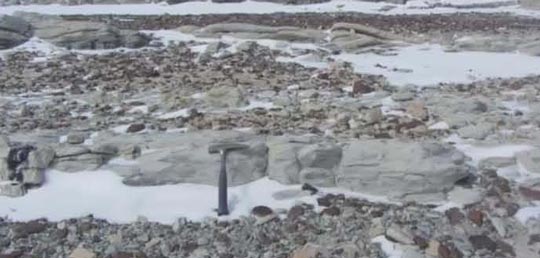
Over the next few months, a team of intrepid scientists will be hoping to continue their exploration of some of the most remote fossil locations in the world.  Researchers from the University of Wisconsin-Milwaukee have been mapping the sedimentary deposits at McIntyre Promontory, at the head of the Ramsey Glacier in Antarctica.  To date, the team have recorded an extensive series of strata ranging in ages from the Late Permian to the Jurassic, the numerous plant fossils found are helping the scientists to better understand the evolution of ancient forests and their flora over the southernmost portions of Gondwana.

Remains of Prehistoric Forests Uncovered in Antarctica

Prehistoric tree trunk (geology hammer provides scale).
An ancient tree trunk discovered in Antarctica.

Picture credit: University of Wisconsin-Milwaukee

Antarctica in the Late Permian Period

A total of thirteen trees have been found with numerous fragmentary fossils of other plants, including Ginkgos and Glossopteris.  The oldest plants described by this research team, date from the Late Permian of around 260 million years ago.  Some of the fossils have stems and roots attached and have been preserved “in situ”.  No transport of fossil material is involved, the fossils are preserved where the plants grew.  The flora of this southerly habitat has been preserved thanks to occasional volcanic events that buried the primitive forests in ash.

Commenting on the significance of the Antarctic ancient flora, palaeoecologist and visiting assistant professor at the University of Wisconsin-Milwaukee Department of Geosciences, Erik Gulbranson stated:

“People have known about the fossils in Antarctica since the 1910-12 Robert Falcon Scott expedition.  However, most of Antarctica is still unexplored.  Sometimes, you might be the first person to ever climb a particular mountain.”

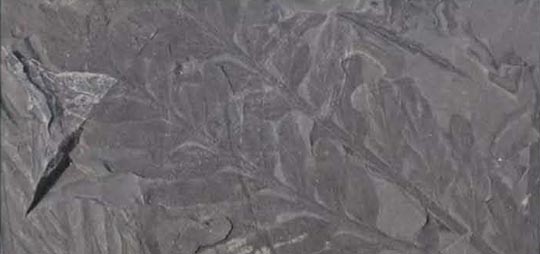
Beautifully Preserved Plant Fossils

Ancient plant fossils from Antarctica.
Ancient plant fossil remains.

Picture credit: University of Wisconsin-Milwaukee

Late Permian Forests

The Late Permian forests preceded the most extensive mass extinction event in the Phanerozoic (end Permian mass extinction event),  the scientists are hoping to use their growing knowledge of the ancient Antarctic forests to look at the possible impact on global warming on extant plant communities.  In addition, as the Antarctic forests grew at polar latitudes where plants can’t grow today, Gulbranson believes that the trees were an extremely hardy species and he and his colleagues are trying to determine why they died out.

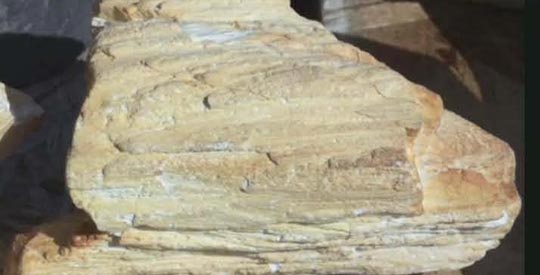
Just like their modern counterparts, prehistoric tree fossils can reveal seasonal growth rings.  These rings when examined in microscopic detail can reveal patterns of seasonal growth.  Antarctica during the Late Permian was further north than it is today, even so, despite the milder climate, the forests would have had to endure prolonged periods of darkness, when the sun never emerged above the horizon.  The research team hopes to use the ancient growth rings to learn more about how these forests coped with such extremes.

Ancient Tree Trunks Can Help Decipher Seasonal Growth Patterns

Antarctic prehistoric plant life.
Ancient trees can reveal evidence of seasonal growth.

Picture credit: University of Wisconsin-Milwaukee

Climate Change and the End Permian Mass Extinction Event

The cause or causes of the end Permian extinction event remain an area of controversy within palaeontology, although many scientists now believe that a huge increase in atmospheric greenhouse gases such as methane and CO2 which resulted from extensive global volcanic activity led to world-wide climate change.  John Isbell (University of Wisconsin-Milwaukee), has visited Antarctica before, on this expedition he examined the matrix and other sediments surrounding the in situ fossils to determine how these plant remains fitted into the geology of Antarctica.

To read an article written by Everything Dinosaur in 2015, that explains how rocks from South Africa are helping scientists to unravel global extinction events: Karoo Rocks Provide a Fresh Insight into Extinction Events.

The Plant Fossils Might Represent New Species

The prehistoric forests of Antarctica.
Delicate plant fronds have been preserved.

Picture credit: University of Wisconsin-Milwaukee

Extensive Ancient Forests

The extensive forests may have stretched across the whole of the super-continent Gondwana.  Evidence of Glossopteris fossils and other plant remains have been used to help substantiate the theory of continental drift.  These Permian forests would have looked very different from today’s temperate woodlands, the flora would have been dominated by mosses, ferns, pteridosperms (seed ferns) and conifers.

Erik Gulbranson explained that the Antarctic fossils have provided important information about plant diversity at higher latitudes. During the Permian, forests were a potentially low diversity assemblage of different plant types with specific functions that affected how the entire forest responded to environmental change.  This is in direct contrast to today’s high-latitude forests that display greater plant diversity.

Gulbranson added:

“This plant group must have been capable of surviving and thriving in a variety of environments.  It’s extremely rare, even today, for a group to appear across nearly an entire hemisphere of the globe.”

Tough Forests Failed to Survive Climate Change

The researchers conclude that these tough trees and plants did not survive the climate change that marked the end of the Permian.  Younger plant fossils from Triassic and Jurassic sediments provide evidence of the changing Antarctic flora over time, but many of the types of plants found in the Permian forests, despite their resilience, died out.

Erik Gulbranson Can Study the Permian Plant Fossils in the University Laboratory

Plant fossils being examined.
Examining the Permian plant fossils (Erik Gulbranson – University of Wisconsin-Milwaukee).

Picture credit: University of Wisconsin-Milwaukee/Troye Fox

By analysing the preserved tree growth rings, the scientists have found that these trees transitioned from summer activity to winter dormancy very rapidly, perhaps within a few weeks.  Extant plants make the same transition over the course of several months and also conserve water by making food during the day and resting at night.  Scientists don’t yet know how months of perpetual light would have affected the plants’ day-and-night cycles.

The team hope to return to the various Antarctic dig sites in the early part of 2018.  They hope to learn more about the annual growth cycles of the trees and to determine how the forests coped with rising levels of greenhouse gases and a warming climate.  It is hoped that by studying the Permian flora of Antarctica, models looking at how living plants will cope with climate change can be developed.

For models of prehistoric plants and creatures from the Permian: CollectA Age of Dinosaurs Popular Models.

14 11, 2017

Evidence of Placental Mammals – Early Cretaceous Purbeck Revealed by New Research

By |2024-05-10T09:56:08+01:00November 14th, 2017|Categories: Dinosaur and Prehistoric Animal News Stories, Dinosaur Fans, Main Page, Photos/Pictures of Fossils|1 Comment

Durlstotherium newmani and Durlstodon ensomi

Finally got round to reading the paper on the discovery of evidence of Eutherian (placental) mammals in Early Cretaceous deposits on, ironically, “the Jurassic Coast”.  The two teeth found during sieving of material collected on the Dorset coast by University of Portsmouth undergraduate student Grant Smith, has led to the erection of two new mammal species.

These fossils represent the earliest, undisputed fossils of mammals that belong to that same group of mammals – the placentals, as we do.  It is wonderful to think that the Dorset coast can still provide amazing fossil discoveries and secondly, it is great that such an important discovery can be made by a relative newcomer to the science of palaeontology.  Well done to all involved in the research and the writing of the academic paper, published in the journal “Acta Palaeontologica Polonica”.

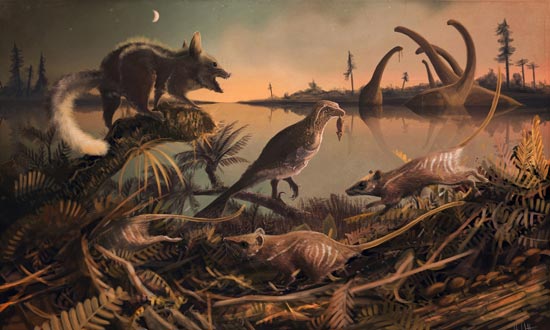
It also gives us an excuse to include the amazing image created by Dr Mark Witton that illustrates the Purbeck palaeoenvironment around the beginning of the Cretaceous.

Dorset Around 145 Million Years Ago

Purbeck Lagoon 145 mya as darkness falls Durlstodon (top left) looks on whilst two Durlstotherium scurry through the undergrowth. In the centre a Durlstotherium has been caught by Nuthetes destructor.

Picture credit: Mark Witton

The two teeth, found at Durlston Bay near Swanage, represent two rat-like Eutherian mammals.  These creatures have been named Durlstotherium newmani and Durlstodon ensomi.  In Dr Witton’s remarkable illustration (above), a scene at dusk is depicted.  It is most likely that these early placentals were nocturnal, even so, as darkness fell there were still plenty of dangers lurking.

The sauropods in the background might not pose much of a threat to our distant ancestors but in the centre of the image, a Durlstotherium has been caught by a two-metre-long theropod dinosaur Nuthetes destructor.  This dinosaur is mainly known from isolated teeth and based on such fragmentary evidence it is difficult to place Nuthetes within the dinosaur family tree, however, it has been suggested that it was a dromaeosaurid.  Thus, the Purbeck area of southern England during the Early Cretaceous was not only home to placental mammals but, potentially, also the residence of the earliest known member of the Dromaeosauridae.

Evidence of Placental Mammals

One of the authors of the paper on the two new mammals, Dr Steve Sweetman (Research Fellow at the University of Portsmouth), concluded that the fossilised teeth and jaw fragment ascribed to N. destructor indicate a taxonomic affinity with the Velociraptor branch of the Dromaeosauridae family.

Various Views of the Two Fossil Teeth (Durlstotherium and Durlstodon)

Purbeck Mesozoic mammal teeth.
Two fossil teeth of the Purbeck Mesozoic mammals, Durlstotherium (A1-4) and Durlstodon (B1-4) , named after Durlston Bay in Dorset.

Picture credit: Portsmouth University

Dr Sweetman, an expert in the dentition of small vertebrates explained how Grant Smith discovered the fossil teeth:

“Grant was sifting through small samples of earliest Cretaceous rocks collected on the coast of Dorset as part of his undergraduate dissertation project in the hope of finding some interesting remains.  Quite unexpectedly he found not one but two quite remarkable teeth of a type never before seen from rocks of this age.  I was asked to look at them and give an opinion and even at first glance my jaw dropped!”

With Mammal Fossils It’s All About the Teeth

While these Dorset fossils may seem a little underwhelming, comprising only two molar teeth with no roots, that measure just a few millimetres across, the unique specialisations of mammal teeth for processing food result in complex tooth shapes.  These shapes evolve in patterns that allow palaeontologists to identify what group a mammal belongs to, meaning that even a single tooth can permit palaeontologists to gather a great deal of information.

The wonderful thing about mammal teeth is that they are very distinctive.  Every type of mammal has a different set of teeth.  The teeth vary in shape from the back to the front of the jaw and you can tell from a single tooth fossil exactly where in the jaw it was located, whether it came from the upper or lower jaw, whether it was on the right side of the skull of the left side.  The pattern on the crowns of the teeth (molars and premolars) provides information on the type of diet the animal had.

These fossil teeth from the Early Cretaceous of Dorset, might be extremely small, but they can tell us a great deal about the animals which had the teeth and provide information on the evolutionary relationship between these animals and other members of the Mammalia.

Dr Sweetman added:

“The teeth are of a type so highly evolved that I realised straight away I was looking at remains of Early Cretaceous mammals that more closely resembled those that lived during the latest Cretaceous, some 60 million years later in geological history.  In the world of palaeontology, there has been a lot of debate around a specimen found in China*, which is approximately 160 million years old.  This was originally said to be of the same type as ours but recent studies have ruled this out.  That being the case, our 145 million year old teeth are undoubtedly the earliest yet known from the line of mammals that lead to our own species.”

* The fossil from China that Dr Sweetman is referring to Juramaia sinensis a tiny, shrew-like mammal, fossils of which come from 160 million-year-old deposits from the Tiaojishan Formation of Liaoning Province.  Juramaia was named in 2011, it has been controversially described as a basal Eutherian mammal and it suggests that the very earliest placentals were probably arboreal.

To read Everything Dinosaur’s article about this fossil discovery: The “Mother” of all Placental Mammals.

If Juramaia is proved to be an Eutherian, then this indicates that placental mammals had their origins in Asia in the Jurassic and that they had spread across Asia to Europe (Laurasia) by the Early Cretaceous.

Scanning Electron Microscope Images of the Tiny Purbeck Teeth

Early Cretaceous mammal teeth from Swanage (Dorset).
Purbeck Mesozoic mammal teeth under the electron microscope.

Picture credit: Portsmouth University

Very Worn Molars

The crowns of the teeth are very worn, this suggests that despite the threat of being eaten by predatory dinosaurs, both mammals lived a long time.

Professor David Martill, who supervised the research project and is a co-author of the scientific paper stated:

“What I’m most pleased about is that a student [David Grant] who is a complete beginner, was able to make a remarkable scientific discovery in palaeontology and see his discovery and his name published in a scientific paper.  The Jurassic Coast is always unveiling fresh secrets and I’d like to think that similar discoveries will continue to be made right on our doorstep.”

One of the new species has been named Durlstotherium newmani, honouring Charlie Newman, a keen, amateur fossil hunter and the landlord of the Square and Compass pub in the village of Worth Matravers, near to where the fossils were discovered.  The trivial name of the second species, Durlstodon ensomi honours Paul Ensom, a palaeontologist who did much to improve our understanding of the palaeoenvironments represented by the geology of Dorset.

For dinosaur and prehistoric animal models: Prehistoric Animal Models.

12 11, 2017

Giant Otter with a Bite Like No Other Otter

By |2023-08-25T08:59:29+01:00November 12th, 2017|Categories: Dinosaur and Prehistoric Animal News Stories, Main Page, Photos/Pictures of Fossils|0 Comments

The Very Powerful Bite of Siamogale melilutra

Back in January, Everything Dinosaur reported upon the scientific description of a new species of giant otter from the Late Miocene of south-west China.  At around fifty kilogrammes in weight, the new species Siamogale melilutra, is a much more heavy-set and robust animal compared to extant otter species.  At the time, the scientists responsible for studying the fossil material, which included an almost complete but crushed cranium, speculated on what this super-sized member of the weasel family would have fed on.

Siamogale melilutra Jaw Study

Writing in the journal “Scientific Reports”, some of the scientists involved in the original description have followed up this research by publishing a new paper on the feeding capabilities of such a powerful carnivore.

This wolf-sized, aquatic predator had a surprisingly strong bite that might have made S. melilutra an apex predator.

A Digitally Reconstructed View of the Skull and Jaws of Siamogale melilutra

Digitally restored cranium of S. melilutra right lateral view.
A digitally reconstructed cranium of S. melilutra .

Picture credit: Scientific Reports

Comparing Otter Skulls and Jaws

The researchers digitally recreated jaw models of extinct otters as well as ten extant species (living species of otters) and then subjected these models to engineering stress tests.  The researchers discovered that the jaw of Siamogale melilutra was six times stronger than expected.

Although, the teeth morphology and biting efficiency was found to be very similar to living otters, these very strong jaws open up the possibility that Siamogale melilutra fed on a range of animals that its modern-day contemporaries could not.  Sea Otters (Enhydra lutris) and the African Cape Clawless Otter (Aonyx capensis), specialise in feeding upon shellfish and have a durophagous diet.  Even accounting for the size difference between the Miocene giant Siamogale melilutra and these living otter species, the jaws of S. melilutra are much stronger.

Comparing the Stress on Jaws on Living and Extinct Species of Otter

Calculating the bite of Siamogale melilutra.
Stress during biting (otter jaw comparison).

Picture credit: Scientific Reports

The picture above shows the results of computer modelling to indicate potential bite force stresses in a number of otter species.  Warmer colours depict high levels of bite stress, whilst cooler colours depict areas of lower stress.

(a) Pteronura brasiliensis (Giant South-American Otter)

(b) Lontra canadensis (North American River Otter)

(c) Lontra longicaudis (Neotropical Otter of Central America)

(d) Lontra felina (South American Marine Otter)

(e) Enhydra lutris (Sea or Marine Otter)

(f) Hydrictis maculicollis (Spotted-necked Otter)

(g) Siamogale melilutra – extinct Miocene species

(h) Lutra lutra (European Otter)

(I) Aonyx capensis (African Cape Clawless Otter)

(j) Aonyx cinerea (Asian Small-clawed Otter)

(k) Lutrogale perspicillata (Indian Smooth-coated Otter)

The research team conclude that S. melilutra has no living analog.  Its huge size and powerful jaws could have enabled this otter to exploit an environmental niche not found in living otter species.  It might even have been an apex predator.

To read Everything Dinosaur’s article on the scientific description of Siamogale melilutra: Super-sized Otter as Big as a Wolf.

The scientific paper: “Feeding Capability in the Extinct Giant Siamogale melilutra and Comparative Mandibular Biomechanics of Living Lutrinae” by Z. Jack Tseng, Denise F. Su, Xiaoming Wang, Stuart C. White and Xueping Ji published in the journal “Scientific Reports”.

Visit the Everything Dinosaur website: Everything Dinosaur.

2 11, 2017

Our Favourite, Amazing Prehistoric Plants

By |2024-01-02T06:56:14+00:00November 2nd, 2017|Categories: Main Page, Photos/Pictures of Fossils|0 Comments

Frankfurt Natural History Museum Display Carboniferous Treasures

If the fossils are too large to display inside your museum, put them on display outside the museum.  That seems to be the philosophy adopted by the dedicated team behind the Frankfurt Natural History Museum (Senckenberg Naturmuseum, Frankfurt), in Germany.  Amongst the many outdoor exhibits, our team members spotted a magnificent reminder of the giant plant life of the Carboniferous.

Prehistoric Plants on Display Outside the Museum (Frankfurt)

Giant prehistoric plant fossils.
Prehistoric plant fossils outside the Frankfurt Natural History Museum.  Picture credit: Everything Dinosaur.

Picture credit: Everything Dinosaur

Prehistoric Plants

Other Carboniferous giants on show include a life-size Sigillaria which, along with the other exhibits forms the “Senckenberganlage”.  A series of open-air displays that encourages visitors to explore the diverse history of life on our planet.

A Giant Replica of a Carboniferous Lycopsid (Sigillaria)

Sigillaria model tree.
Sigillaria model (lycopsid) in Frankfurt.

Picture credit: Everything Dinosaur

These huge horsetails and giant lycopsids are a welcome site for a visiting Earth science fan and amateur fossil collector.

Visit the Everything Dinosaur website: Everything Dinosaur.

1 11, 2017

“Big Foot” from the Early Jurassic of Africa

By |2023-07-22T21:19:26+01:00November 1st, 2017|Categories: Dinosaur and Prehistoric Animal News Stories, Dinosaur Fans, Main Page, Photos/Pictures of Fossils|0 Comments

Kayentapus ambrokholohali – Taking Giant Dinosaurs in our Stride

A team of international scientists, including researchers from Manchester University, have published a paper in the academic journal PLOS One that reports on the discovery of giant, three-toed dinosaur tracks in the Maseru district of Lesotho, southern Africa.  These tracks, some of which measure 57 centimetres long, are the first evidence of the existence of huge, apex theropods in the Early Jurassic of southern Gondwana.  The prints have been assigned to the ichnogenus Kayentapus and a new species – Kayentapus ambrokholohali has been erected.

University of Manchester Senior Research Fellow Dr Fabien Knoll Reclines Next to the Giant Dinosaur Tracks

Dr Fabien Knoll provides a scale for the dinosaur footprints.

Dr Fabien Knoll (Manchester University) poses next to the dinosaur trace fossils.

Picture credit: Manchester University

The Largest Known Theropod Tracks in Africa (Kayentapus ambrokholohali)

The tracks were found in fine-grained sandstone, that was laid down some 200 million years ago, the surface (palaeosurface), shows current-ripple marks and desiccation marks indicating that the surface represents an environment close to a river or lake (fluvio-lacustrine environment).  The tracks indicate that a large, three-toed dinosaur with a pace length in excess of 1.3 metres walked across the wet sand, perhaps it had come to the area to get a drink or perhaps to find prey.  The scientists which include Dr Fabien Knoll (Manchester University) and Dr Lara Sciscio, (postdoctoral Research Fellow at the University of Cape Town), state that the trace fossils come from deposits representing the Upper Elliot Formation, a formation that is synonymous with abundant vertebrate trackways but very few body fossils.  The tracks are the largest theropod dinosaur footprints to have been described from African rocks to date.

An Apex Predator

The tracks suggest an apex predator (Megatheropod), a dinosaur which would have been around 8-9 metres in length, much larger than many of the contemporary theropods known from the Early Jurassic.  The prints don’t give any idea of the dinosaur’s age, unlike histological analysis of fossil bone, this giant, might not have been fully grown!  The dinosaur has been named Kayentapus ambrokholohali as the long-toed prints resemble those from the ichnogenus Kayentapus, a widely distributed ichnogenus with a substantial chronological and geological time span.

A Scale Drawing of the Theropod Dinosaur (Track Maker)

A scale drawing showing the estimated size of the Lesotho dinosaur.

A scale drawing based on the Lesotho tridactyl dinosaur prints.

Picture credit: University of Manchester/Press Association

Dr Sciscio commented:

“This discovery marks the first occurrence of very large carnivorous dinosaurs in the Early Jurassic of Gondwana, the prehistoric continent which would later break up and become Africa and other landmasses.  This makes it a significant find.  Globally, these large tracks are very rare.  There is only one other known site similar in age and sized tracks, which is in Poland”.

Comparative Line Drawings of Lower Jurassic Track D1 from Lesotho and Other Large Theropod Tracks from the Jurassic and Cretaceous

Analysing Dinosaur Footprints.

Comparative dinosaur tracks (line drawings).

Picture credit: PLOS One

Studying the Tracks

A comparative analysis of three-toed dinosaur tracks from various locations (Jurassic and Cretaceous trackways).

The line drawings above show (A) Kayentapus hopii, Kayenta Formation (Early Jurassic), (B) a 35 cm long Eubrontes isp.  (C) a 39 cm long Kayentapus minor print, whilst (D–E) represent Megalosauripus and a large Polish theropod track from the Sołtyków site, Poland.  Drawings (F–G) represent Eubrontes cf., from the Middle Jurassic of Australia and (H) has been tentatively assigned to the ichnogenus Eubrontes glenrosensis, from the Lower Cretaceous Glen Rose Formation (United States). (I) represents Irenesauripus whilst (J) is a line drawing of  Irenesauripus mclearni.  Drawing (K)  is Irenesauripus acutus, I, J and K are all from within the Albian Gething Formation of Canada.  Track (L) in red, is print reference D1 (Kayentapus ambrokholohali) from the newly described Lesotho tracks.

All images have been redrawn and scaled to 15 cm.

Dr Knoll added:

“In South Africa, Lesotho, Zimbabwe and Namibia, there is good record of theropod footprints from the Late Triassic and Early Jurassic epochs.  In fact, there are numerous palaeosurfaces where footprints and even tail and body impressions of these, and other animals, can be found.  But now we have evidence this region of Africa was also home to a mega-carnivore.”

The scientific paper: “The First Megatheropod Tracks from the Lower Jurassic Upper Elliot Formation, Karoo Basin, Lesotho” by L. Sciscio , E. M. Bordy, M. Abrahams, F. Knoll, B. W. McPhee and published in the journal PLOS One.

Everything Dinosaur acknowledges the help of a press release from Manchester University in the compilation of this article.

Visit the Everything Dinosaur website: Everything Dinosaur.

12 10, 2017

Reaffirming Protoichthyosaurus as a Valid Genus

By |2023-08-17T09:37:39+01:00October 12th, 2017|Categories: Dinosaur and Prehistoric Animal News Stories, Dinosaur Fans, Main Page, Photos/Pictures of Fossils|0 Comments

The Muddy Water Surrounding Protoichthyosaurus and Ichthyosaurus Just Got a Little Clearer

A type of British Ichthyosaur, first identified nearly forty years ago, but then dismissed as a distinct genus, has been re-examined and found to be a new type of marine reptile after all.  British palaeontologist Dr Robert Appleby, in 1979, conducted a review of ichthyosaur fossil material found around the UK and announced a news species which he named Protoichthyosaurus.

Two separate species were assigned to this genus P. prostaxalis and P. prosostealis.  Erecting this genus with its two component species proved controversial and a number of other scientists have dismissed this assessment, reassigning the fossil material to the Ichthyosaurus genus.

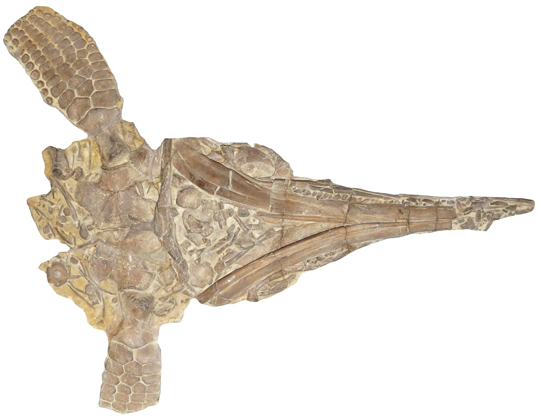
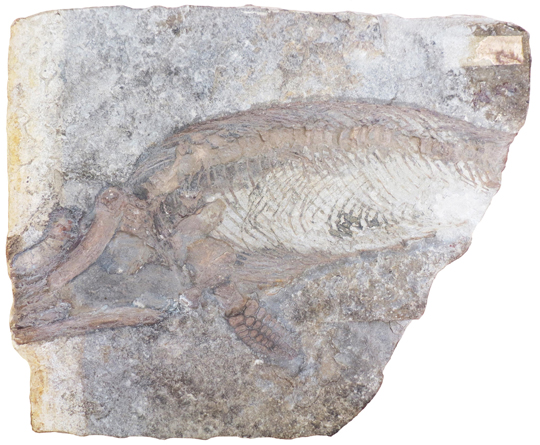
One of the Fossil Specimens from the 1979 Marine Reptile Study

Protoichthyosaurus fossil material.

One of the original skeletons of Protoichthyosaurus described by Robert Appleby in 1979

Picture credit: National Museum of Wales/Dean Lomax

A Detailed Study of Protoichthyosaurus Fossils

A detailed study which involved making comparisons between Protoichthyosaurus and Ichthyosaurus by Dean Lomax, (Manchester University), Rashmi Mistry (University of Reading) and Professor Judy Massare (State University of New York), published in the “Journal of Vertebrate Paleontology” has established Protoichthyosaurus as a separate genus once again.

The researchers found major differences in the number of bones in the front fin, or forefin, of both species.  The team posit that this fundamental difference in anatomy probably reflects the way both species used their forefins to manoeuvre whilst swimming.  Differences were also found in the skulls.

Scientists Studying the Fossil Material

A Protoichthyosaurus fossil is studied by palaeontologists.

Bill Wahl, Prof. Judy Massare, Dr David Large and Dean Lomax study the fossil.

Picture credit: University of Nottingham

Fin Grabs Attention

During this research, another discovery about the fins was made, palaeontologist Dean Lomax explained:

“This unusual forefin structure was originally identified by Robert Appleby in 1979, but some of the historic specimens he examined had been ‘faked’, and this fakery had been missed until now.  In some instances, an isolated fin of an Ichthyosaurus had been added to a Protoichthyosaurus skeleton to make it appear more complete, which led to the genuine differences being missed.  This has been a major problem because it stopped science from progressing.  We also found some pathological fins, including Ichthyosaurus fins with pathologies that mimic the Protoichthyosaurus forefin structure”.

To visit the website of Dr Dean Lomax: British Palaeontologist Dr Dean Lomax.

Dean and Judy teamed up with former undergraduate student Rashmi Mistry, who had been studying an unusual ichthyosaur in the collections of the Cole Museum of Zoology, (University of Reading), as she prepared her undergraduate dissertation.

Rashmi added:

“Whilst doing my dissertation in 2016, I studied several ichthyosaurs in the collections, including a very small skeleton.  It had an unusual forefin that matched Protoichthyosaurus, which I understood to be a widely unrecognised genus.  However, when I contacted Dean, he was very excited.  He told me that this little skeleton is the only known small juvenile Protoichthyosaurus.”

The Juvenile Protoichthyosaurus Specimen

Protoichthyosaurus (juvenile).

The juvenile Protoichthyosaurus fossil.

Picture credit: University of Reading

More Than Twenty Specimens of Protoichthyosaurus Identified

As a result of this extensive study, more than twenty specimens of Protoichthyosaurus have been identified.  This is highly significant as each specimen (with a forefin) has the same structure.  The specimens all date from the early Jurassic geological period (200-190 million years ago) and they are geographically dispersed with specimens reported from Dorset, Somerset, Leicestershire, Nottinghamshire, Warwickshire and Glamorgan (Wales)

Links with the Dinosaurs of China Exhibition

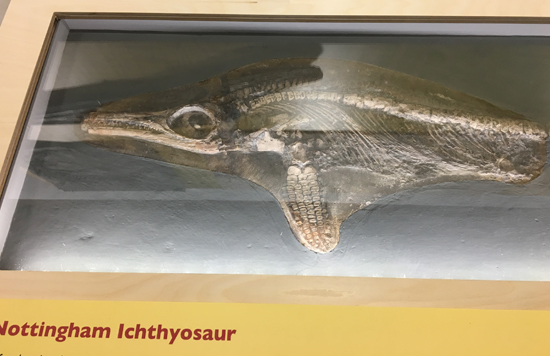
As part of his research, Dean examined a nearly complete skeleton which is part of the vertebrate collection at the museum of Nottingham.  This specimen turned out to be different from all the other known examples of Protoichthyosaurus (autapomorphies concerning the cranium and the shape of the humeri).  A new species of Protoichthyosaurus has been erected, it has been named  Protoichthyosaurus applebyi, in honour of Dr Appleby and in recognition of his work some forty years ago that established the Protoichthyosaurus genus in the first place.

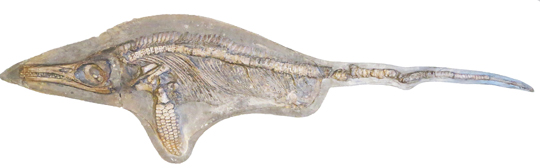
The Protoichthyosaurus applebyi Specimen

Protoichthyosaurus applebyi fossil specimen.

Protoichthyosaurus applebyi fossil.

The fossil specimen is currently on display at the Nottingham Lakeside Arts centre, as part of the “Dinosaurs of China” exhibition.  If you want to catch this marine reptile and take in all the beautiful feathered dinosaurs in this exhibition, you had better hurry, “Dinosaurs of China” closes at the end of the month.

Everything Dinosaur Team Members Viewed the Specimen at the “Dinosaurs of China” Exhibition

Protoichthyosaurus applebyi

The Nottingham ichthyosaur (P. applebyi).  Picture credit: Everything Dinosaur.

Picture credit: Everything Dinosaur

For models and replicas of marine reptiles including ichthyosaurs: PNSO Age of Dinosaurs.

The scientific paper: “The Taxonomic Utility of Forefin Morphology in Lower Jurassic Ichthyosaurs: Protoichthyosaurus and Ichthyosaurus” by Lomax, D. R., Massare, J. A. and Mistry, R.  Published in the Journal of Vertebrate Paleontology.

Visit the Everything Dinosaur website: Visit Everything Dinosaur.
10 10, 2017

Fused Bones in Primitive Birds Earlier than Previously Thought as New, Innovative Research is Published

By |2024-05-09T14:47:22+01:00October 10th, 2017|Categories: Dinosaur and Prehistoric Animal News Stories, Dinosaur Fans, Main Page, Photos/Pictures of Fossils|0 Comments

The Evolution of the Light but Strong Skeleton for Powered Flight

It is widely accepted that birds evolved from dinosaurs.  The Order Dinosauria is now classified into two parts, the non-avian dinosaurs, which are extinct and the avian dinosaurs (the birds), which are very much still with us.  However, the evolution of the specialised anatomy that enables powered flight is not well understood.

Birds have several skeletal modifications that greatly assist them when it comes to their aerial abilities.  Any aeronautical engineer will expound the virtues of a light but strong frame for an aircraft, birds have a light but strong skeleton with many elements fused for greater rigidity.  A team of scientists writing in the “Proceedings of the National Academy of Sciences”, have provided new evidence to help explain how these remarkable anatomical modifications came about.  This evolutionary story is likely to be much more complicated than previously thought.

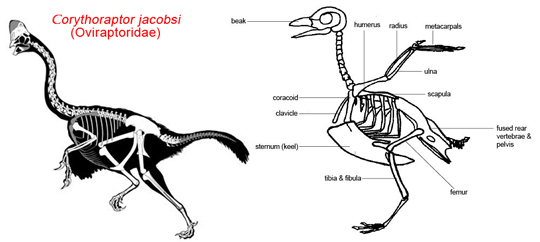
Some Theropod Dinosaurs Evolved into Birds Skeletal Similarities and Differences

Bird skeleton compared to ground dwelling dinosaur skeleton

A skeleton of the theropod dinosaur compared with a simplified skeleton of a modern bird.

Picture credit: Everything Dinosaur

The picture above shows the skeleton of the recently described oviraptorid Corythoraptor jacobsi compared to that of a modern bird.  The bird skeleton shows a number of adaptations for powered flight, such as fused hand and foot bones and an enlarged sternum but the ground-dwelling Oviraptor possesses number of anatomical characteristics which show its affinity to modern birds.  Both Aves and the Oviraptoridae are included together in the clade Maniraptora which consists of modern birds and their closest extinct relatives from the coelurosaurian theropods.

Pterygornis dapingfangensis – Fused Bones

A second, beautifully-preserved specimen of the Early Cretaceous enantiornithine bird Pterygornis dapingfangensis has fully fused hands (carpometacarpus bones) as well as a fused pelvic girdle.  Dating from around 120 million years ago, this specimen is the oldest known bird fossil which shows these modifications for powered flight.  The fossil comes from the Jiufotang Formation of Liaoning Province (north-eastern China).  This sparrow-sized creature is one of several genera known from these Lower Cretaceous deposits, only the Solnhofen deposits of Germany are older in terms of the bird fossils they contain.

The exquisite specimen shows that the carpometacarpus and the pelvis are completely fused, it had been thought that these traits did not appear in Aves until the Late Cretaceous.   The fossil record had shown that all bird fossils associated with Upper Cretaceous deposits have a completely fused hand and pelvis.  Thanks to this newly published scientific paper, the historical origin of these avian bone fusions has been pushed back some forty million years.

The Second Specimen of Pterygornis dapingfangensis

Pterygornis dapingfangensi helps scientists to better understand bird evolution.

Pterygornis dapingfangensi fossil.

Picture credit: W. GAO (Chinese Academy of Sciences)

Great Fossils but Squashed Flat!

Named in 2015 from a single, disarticulated specimen, discovered near the town of Dapingfang, Chaoyang County in Liaoning Province, Pterygornis shows a number of unique autapomorphies that distinguishes it from other enantiornithines and the second fossil has shown that the body plan for a rigid, fused skeleton was present in at least one species of bird from the Early Cretaceous.

Dr Steve Brusatte (University of Edinburgh), who reviewed the scientific paper, commented:

“These [fused bones] are fundamental features of the modern bird blueprint, and are integral to giving birds the strength and rigidity needed to fly.  There seems to have been a lot of experimentation among early birds, with different species trying out different ways of making their skeletons stronger and better able to withstand the rigours of flight.”

Sadly, many of the fossils from the Jiufotang Formation have been compressed and distorted as a result of the fossilisation process.  However, despite the taphonomy that ends with a lot of the fossils from these rocks being squashed flat, the researchers from the Chinese Academy of Sciences were able to identify that the fused bones in the second known specimen of Pterygornis were not a result of pathology or the fossilisation process.

The Disarticulated Holotype Specimen of Pterygornis dapingfangensis

Pterygornis dapingfangensi holotype material.

The scattered and disarticulated fossil remains of Pterygornis dapingfangensi.

Picture credit: Wang Min

The Search for Transitional Fossils (Birds Evolved from Dinosaurs)

The lack of transitional fossils has hindered the process of identifying the evolutionary process towards the modern bird skeleton.  More fossils would help to demonstrate how birds evolved from dinosaurs.  However, in this research paper the authors outline how the fusion of pelvic bones and those in the hands and feet may have evolved independently in non-avian dinosaurs, primitive and more advanced birds.

The scientists speculate that varying degrees of bone fusion were likely to have evolved in basal birds, perhaps as a result of environmental pressures or related to a refinement of flight capability.  It seems that the developmental pathway from ground-dwelling dinosaur to the skeletal shape of living birds has a few more surprises to spring before it is more fully understood.

Visit the Everything Dinosaur website: Everything Dinosaur.

6 10, 2017

New Prehistoric Crocodile with a Tough Skull

By |2023-08-16T22:16:56+01:00October 6th, 2017|Categories: Dinosaur and Prehistoric Animal News Stories, Dinosaur Fans, Main Page, Photos/Pictures of Fossils|0 Comments

Ieldraan melkshamensis – The Monster of Melksham

A new species of prehistoric marine crocodile has been described after an amazing effort by the preparators at the Natural History Museum (London), to separate this crocodile’s partial skull and fragmentary jaw bones from an extremely hard concretion, in which the fossils were entombed.  Although in very poor condition, the research team from the University of Edinburgh as well as the Natural History Museum, were able to identify enough unique anatomical traits (autapomorphies), to allow a new species to be erected.

The new marine crocodile (metriorhynchid) has been named Ieldraan melkshamensis, the species name honouring the town of Melksham in Wiltshire where the fossil material was unearthed.

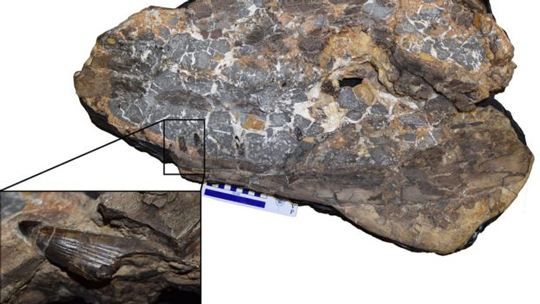
Ieldraan melkshamensis – One Tough Crocodylomorph with a Very Tough Skull

Ieldraan melkshamensis fossil material.

Ieldraan melkshamensis fossil.

Picture credit: University of Edinburgh/Davide Foffa

Prehistoric Marine Crocodile

The specimen was acquired by the Natural History Museum in 1875, but because of its poor condition it did not attract a lot of scientific attention.  The fossil being entombed within an extremely hard concretion (septarian concretion), meant any form of scientific study was extremely limited.

Mark Graham, Senior Fossil Preparator at the Natural History Museum explained the problem:

“The specimen was completely enclosed in a super-hard rock nodule with veins of calcite running through, which had formed around it during the process of fossilisation.  The work took many hours over a period of weeks, and great care had to be taken to avoid damaging the skull and teeth as they became exposed.”

Ieldraan melkshamensis – Newest member of the Metriorhynchidae

Measuring more than three metres in length, Ieldraan melkshamensis was one of the most powerful and dangerous marine predators in the warm, shallow seas of western Europe some 163 million years ago (Callovian faunal stage of the late Middle Jurassic).  The teeth with their distinctive striations (series of ridges running down the length of the teeth) indicate that this large crocodylomorph, which was very distantly related to today’s crocodilians, fed on large prey items.  It might have hunted other marine reptiles as well as preying on squid and fish.

It has been classified as member of the Metriorhynchidae family, specifically assigned to the sub-family Geosaurinae and a phylogenetic analysis places Ieldraan as the sister taxon of Geosaurus, perhaps the best-known of all the metriorhynchids, having been named and described over 100 years ago.

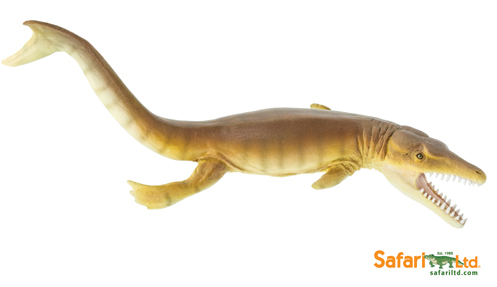
A Model of a Typical Metriorhynchid Crocodylomorph (Plesiosuchus)

Plesiosuchus a prehistoric marine crocodile model.

Prehistoric marine crocodile – Plesiosuchus.

The Plesiosuchus model shown above is part of the Wild Safari Prehistoric World model collection, replicas of marine crocodiles are quite rare, to learn more about this model series and to view the range at Everything Dinosaur: Safari Ltd: Wild Safari Prehistoric World”.

A Sister Taxon to Geosaurus

The authors of the scientific paper, published in the “Journal of Systematic Palaeontology” conclude that if this new species is a sister taxon to Geosaurus, this places it in the Geosaurini clade and this data suggests that the major Geosaurini lineages originated millions of years earlier than previously thought.

Lead author Davide Foffa (School of GeoSciences at the University of Edinburgh), stated:

“It’s not the prettiest fossil in the world, but the Melksham Monster tells us a very important story about the evolution of these ancient crocodiles and how they became the apex predators in their ecosystem.  Without the amazing preparation work done by our collaborators at the Natural History Museum, it would not have been possible to work out the anatomy of this challenging specimen.”

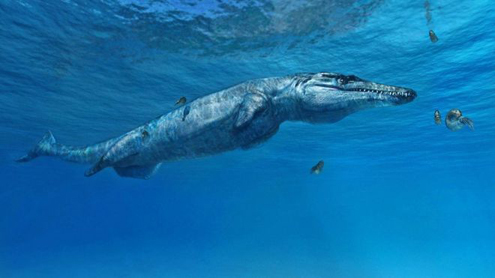
Prehistoric Marine Crocodile on Patrol – Plesiosuchus manselii

Marine crocodile (Plesiosuchus).

Plesiosuchus manselii illustrated.

Picture credit: Fabio Manucci/University of Edinburgh

Visit the Everything Dinosaur website: Everything Dinosaur.
Go to Top