All about dinosaurs, fossils and prehistoric animals by Everything Dinosaur team members.

Pictures of fossils, fossil hunting trips, fossil sites and photographs relating to fossil hunting and fossil finds.

31 12, 2017

Gigantism in Penguins Identified by New Study

By |2024-05-10T18:13:16+01:00December 31st, 2017|Categories: Dinosaur and Prehistoric Animal News Stories, Dinosaur Fans, Main Page, Photos/Pictures of Fossils|0 Comments

Giant Prehistoric Penguins Not Just Once But Several Times

A team of scientists writing in the academic journal “Nature Communications” have identified a new species of giant, prehistoric penguin.  This new species, named Kumimanu biceae is not closely related to previously described giant penguins and this suggests that gigantism in penguins evolved several times in the evolution of these birds.

K. biceae was described based on a partial skeleton excavated from the Palaeocene Moeraki Formation at Hampden Beach in the Otago region in New Zealand’s South Island.  An accurate size is difficult to establish based on the fragmentary fossil remains, but when swimming with its long beak and flippers extended, this bird could have measured more than two metres in length.

When on the shore, it would have stood around 1.7 metres tall.   The new fossil is one of the oldest giant penguins found so far and is clearly outside a clade including the giant Eocene and Oligocene Sphenisciformes, substantiating multiple origins of gigantism in fossil penguins.

Kumimanu biceae Size Comparison
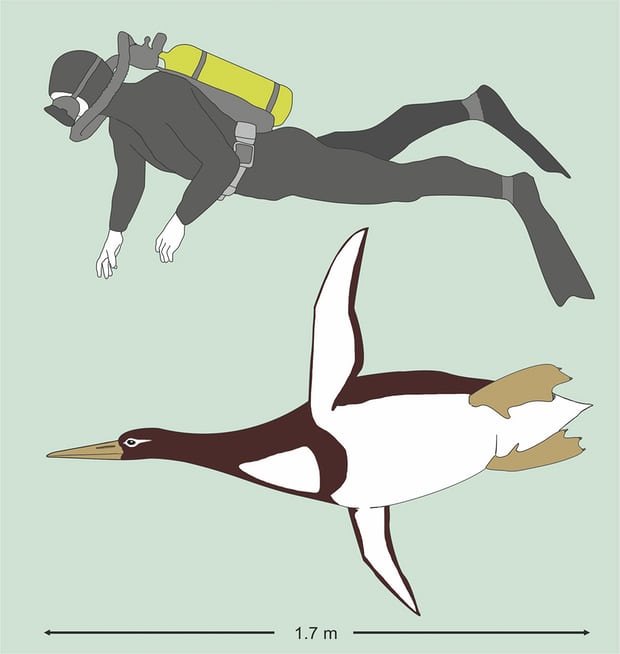
Kumimanu biceae size comparison.
Kumimanu biceae stood around 1.7 metres tall and weighed over 100 kilos.

Fragmentary Fossil Material

The partial skeleton represents a single individual and the fossil material consists of a fragment of a left scapula, an incomplete right coracoid, a portion of the sternum, a partial left humerus, incomplete proximal end of left ulna, a right femur, a right tibiotarsus lacking proximal end, a partial synsacrum, three vertebrae and various bone fragments.

The giant penguin’s name comes from Maori myth, kumi was a large, mythical monster and manu means bird.  The species or trivial epithet honours Beatrice (Bice) A. Tennyson, the mother of one of the paper’s authors, Alan Tennyson of the Museum of New Zealand Te Papa Tongarewa.  It was Alan’s mother who first inspired  him to take an interest in natural history.  The fossil material is believed to be somewhere between 59.5 and 55.5 million years old.

Comparing Kumimanu biceae with other penguins.
Kumimanu biceae fossils compared to other penguins.

Picture credit: Nature Communications

Giant Penguin Fossils

The picture above shows the wing and pectoral girdle bones of the new giant penguin.  (a) shows the partially prepared concretion with bones in situ, whilst (b) shows the partial right coracoid, the dotted lines indicate the reconstructed outline of the bone.  The left coracoid of the prehistoric penguin species Waimanu tuatahi (c) is shown for a size comparison.  Pictures (d-f) show the fragmentary end of the left ulna of K. biceae in various views, whilst pictures (g-h) depict a left ulna of an as yet, undescribed new species of penguin from the Waipara Greensand.

A CT image of the surface of the partial left humerus of K. biceae is shown in (i) whilst (j) shows the exposed surface of the bone.  Pictures (k-l) show the humerus with minimum (k) and maximum (l) size estimates for the bone based on the partial fossil material.  The left humerus of the Palaeocene penguin Crossvallia unienwillia is shown (m).  C. unienwillia was one of the largest known prehistoric penguins.  The left humerus of another giant penguin, Pachydyptes ponderous from the late Eocene of New Zealand (n) is provided for further comparison.  The scale bars in the picture above equate to 5 cm.

The research team conclude that based on the fragmentary fossils, Kumimanu biceae is amongst the largest of the fossil penguins reported so far and since it seems more basal to the family than other giant forms, this suggests that gigantism evolved several times over the long history of penguin evolution.

Visit the Everything Dinosaur website: Everything Dinosaur.
27 12, 2017

Christmas Present for Chinese Palaeontologists

By |2023-08-27T10:31:09+01:00December 27th, 2017|Categories: Dinosaur and Prehistoric Animal News Stories, Dinosaur Fans, Main Page, Photos/Pictures of Fossils|0 Comments

Clutch of Chinese Dinosaur Eggs for Christmas

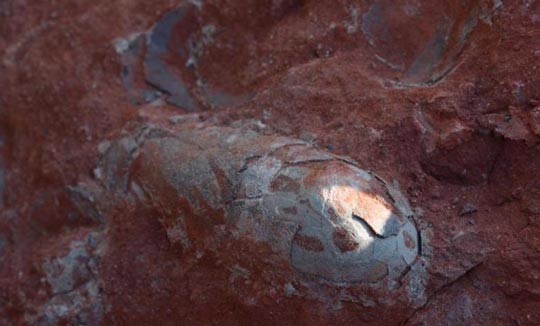
News agencies from China are reporting that Chinese palaeontologists have been given a special Christmas present with the discovery of the fossilised remains of a clutch of dinosaur eggs that date from the Early Cretaceous.  Construction workers were examining large boulders that had been blasted away as part of the preparations for a building project in Dayu County (Jiangxi Province, south-eastern China), when they noticed the series of white, semi-circular marks in the sandstone rocks, along with a number of almost complete oval-shaped eggs.

A Close View of One of the Better Preserved Chinese Dinosaur Egg Fossils

A fossilised dinosaur egg.
A close view of one of the fossilised dinosaur eggs from the Dayu County construction site (Jiangxi Province).

Picture credit: Ming Kangping/China News Service

December 25th Discovery

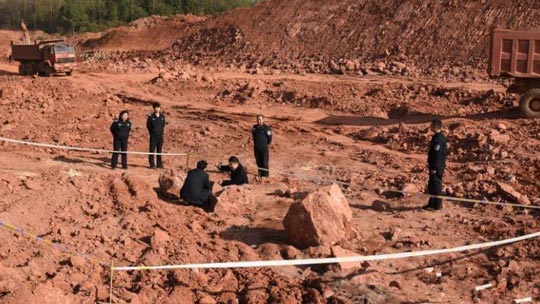
The clutch of eggs was found on December 25th.  Excavation work in the immediate vicinity was suspended and the area cordoned off to prevent any further damage to the fossil find.  The fossils were inspected by local scientists under the supervision of the authorities with strict security in order to deter any would-be egg fossil thieves.

Scientists Examine the Fossil Finds in the Company of Officials

The site of the dinosaur egg discovery (Dayu County).
Officials look on whilst local scientists examine the dinosaur eggs.

Picture credit: Ming Kangping/China News Service

Despite the removal and sale of such ancient artefacts having been made illegal in China, unfortunately, there is still a thriving black market in fossils, especially fossils of dinosaurs.  Everything Dinosaur has reported on several fossil theft cases from China.  For example, earlier this year, Everything Dinosaur reported on the arrest of a Chinese man from Zhejiang Province over the alleged theft of more than eighty dinosaur egg fossils.

To read the story: Dinosaur Egg Thief Suspect Arrested in China.

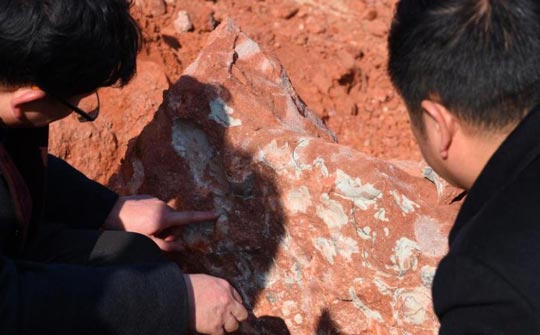
Examining the Fossil Material

Chinese dinosaur egg fossils.
Local scientists examine the dinosaur egg fossils.

Picture credit: Ming Kangping/China News Service

The Remains of at Least Twenty Dinosaur Eggs

The fossils of more than twenty dinosaur eggs have been taken away to a local museum for further study and preparation.  The site, which is a construction project for a new school, will be inspected closely before further building work takes place in case more fossils are at this location.  A spokesperson for the local museum stated that the fossils are around 130 million years old (Early Cretaceous).

17 12, 2017

New Troodontid Dinosaur Described

By |2023-08-26T20:33:33+01:00December 17th, 2017|Categories: Dinosaur and Prehistoric Animal News Stories, Dinosaur Fans, Main Page, Photos/Pictures of Fossils|2 Comments

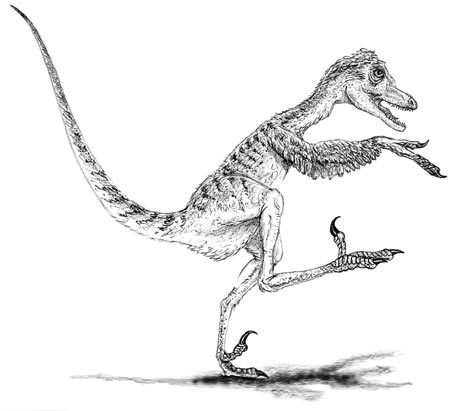
Almas ukhaa – Named after the Legendary Asian Bigfoot

A team of international scientists, including Dr Mark Norell (Curator of Palaeontology at the American Museum of Natural History, New York) and Professor Xing Xu (Chinese Academy of Sciences), have announced the discovery of a new species of Late Cretaceous troodontid dinosaur from Mongolia.  This small, carnivorous dinosaur (it was probably less than a metre long), has been named Almas ukhaa, after the mythical Bigfoot-type ape that, according to some cryptozoologists, is believed to roam the more remote parts of Central Asia.

An Illustration of the New Troodontid Dinosaur A. ukhaa

Almas ukhaa illustrated.
An illustration of the newly described (2017) troodontid Almas ukhaa. Picture credit: Everything Dinosaur.

Picture credit: Everything Dinosaur

From the Famous Djadokhta Formation

The fossil material which consists of an almost complete and articulated skull with an associated lower jaw and a substantial part of the postcranial skeleton, comes from the Ukhaa Tolgod region of the Gobi Desert, an area regarded as one of the richest concentrations of Cretaceous fossil vertebrates known to science.   Since this location was first mapped in 1993, numerous dinosaur skeletons have been found, including a nesting Oviraptor as well as several examples of Late Cretaceous mammals.  The rocks in this area form part of the Djadokhta Formation.

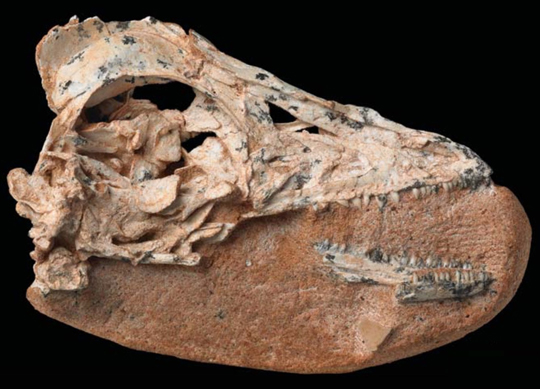
The Skull and Jaws of the Newly Described Late Cretaceous Troodontid Almas ukhaa

Almas ukhaa fossil skull and jaws.
Almas ukhaa cranial material (right lateral view).

Picture credit: The American Museum of Natural History

Compared to other troodontids from Asia and North America, A. ukhaa had a relatively short snout.  The orbit is quite large, and these fossils could represent a juvenile, but if this turns out to be the remains of an adult animal, then this large eye-socket could indicate an adaptation to hunting in low light, perhaps Almas ukhaa was an elusive animal rarely seen in daylight, similar to the legendary Alma after which, this troodontid dinosaur is named.

Ukhaa Tolgod Sandstone Deposits

The sandstone deposits of Ukhaa Tolgod date from approximately 80 million years ago, (Campanian faunal stage of the Late Cretaceous).  The highly fossiliferous site was discovered by a joint American/Mongolian expedition in 1993.  Almas ukhaa (pronounced Al-mass ook-uh) is unlikely to be the last dinosaur found in this area.  The fossils show a number of autapomorphies (unique characteristics), that distinguish this southern Mongolian troodontid from other Asian members of the Troodontidae.  For example, the ischium (part of the hip girdle), has a distinct spike-like process and unlike other troodontids, the front part of the lower jaw lacks a lateral groove.

The scientific paper: “Osteology of a New Late Cretaceous Troodontid Specimen from Ukhaa Tolgod, Ömnögovi Aimag, Mongolia.”

Visit the Everything Dinosaur website: Everything Dinosaur.
13 12, 2017

The First Triassic Plesiosaur

By |2023-08-26T17:27:44+01:00December 13th, 2017|Categories: Dinosaur and Prehistoric Animal News Stories, Dinosaur Fans, Main Page, Photos/Pictures of Fossils|0 Comments

The Oldest Plesiosaur in Town – Rhaeticosaurus mertensi

The fossilised remains of the world’s oldest plesiosaur described to date are reported in the journal “Science Advances”. The animal has been named Rhaeticosaurus mertensi.

Following the end-Permian mass extinction event, the world’s ecosystems took several million years to recover.  In marine environments, just as on land, the mass extinction event led to devastating losses, it has been estimated that 57% of marine families died out.  However, as the Triassic progressed, a number of terrestrial reptiles adapted to marine habitats and new, diverse ecosystems evolved.

It had long been suspected that the Plesiosauria (the long-necked plesiosaurs and the big-headed pliosaurs), the most diverse and longest-lived of all the extinct marine reptile groups, had their origins in the Triassic, but the fossil evidence for basal plesiosaurs was somewhat lacking.  However, the discovery of a partially articulated fossil in a clay pit, close to the village of Bonenburg in North Rhine-Westphalia (Germany), has helped to plug a gap in the fossil record.

The Fossilised Remains of the World’s Oldest Plesiosaur

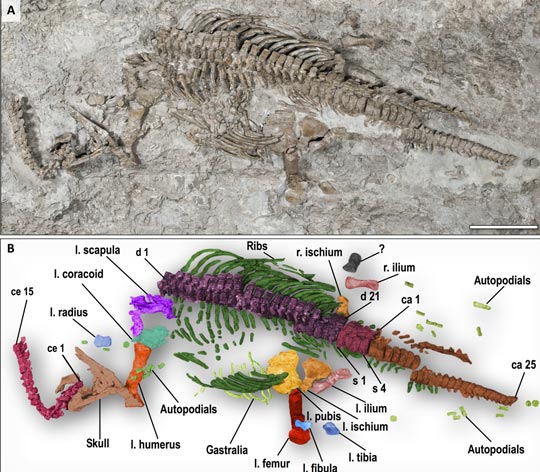
Rhaeticosaurus fossil (A) with line drawing below (B).
Rhaeticosaurus fossil (A) with line drawing (B).

Picture credit: Georg Oleschinski

Rhaeticosaurus mertensi

The fossil discovery marks the first plesiosaur specimen to be recovered from Triassic-aged rocks.  It is the oldest plesiosaur to be found to date, the only one which dates from the Triassic Period.

Intriguingly, a study of cross-sections of some of the larger fossilised bones in the 2.37-metre-long skeleton, support previous research that suggests these marine reptiles grew rapidly and were (most likely), warm-blooded.  The new species has been named Rhaeticosaurus mertensi, (ree-ti-co-sore-us mur-ten-see), the genus name comes from the last faunal stage of the Triassic (the Rhaetian), the trivial name honours  private collector Michael Mertens, who made the initial fossil discovery.

201-million-year-old Fossil

Michael Mertens discovered the specimen in 2013, some of the neck bones had been lost but the majority of the skeleton was in situ.  The resulting excavation, study and publication in the academic journal “Science Advances”, is a credit to the parties involved, namely Herr Mertens, the natural heritage protection agency, the Münster museum, and scientists from various institutes including Bonn University, the Osaka Museum of Natural History, the University of Tokyo and the Natural History Museum of Los Angeles County, amongst others.

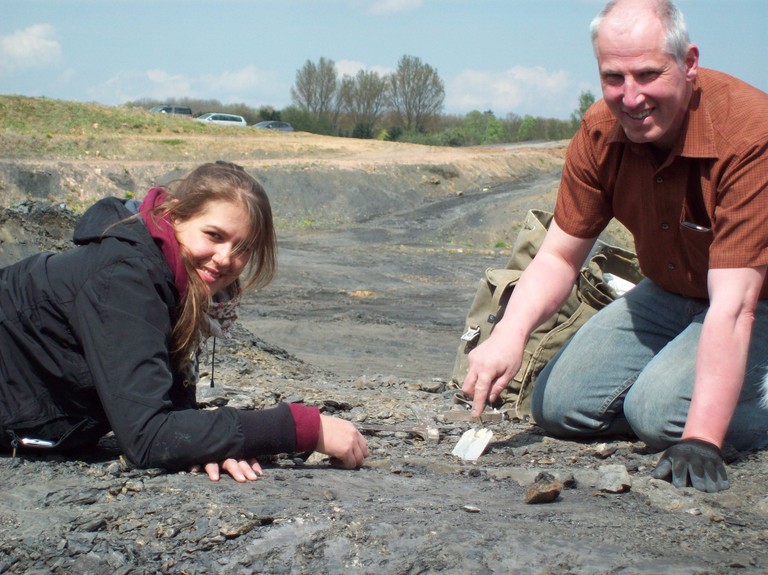
Co-author of the Scientific Paper Tanja Wintrich with the Fossil Finder Michael Mertens

Rhaeticosaurus fossil discovery.
PhD student Tanja Wintrich with Michael Mertens show where the fossil was found.

Picture credit: Professor Martin Sander (University of Bonn)

The Long-lived and Diverse Plesiosauria

In a press release from Bonn University, plesiosaurs are described as especially effective swimmers.  They evolved a unique, four-limbed propulsion using broad flippers, in essence, “flying underwater”.

One of the authors of the scientific paper Professor Martin Sander explained:

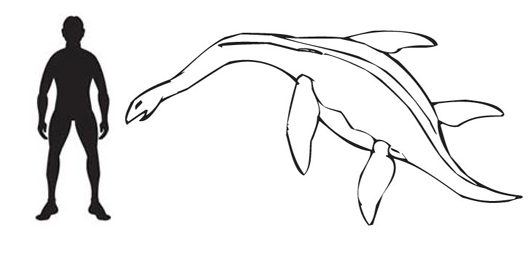
“Instead of laboriously pushing the water out of the way with their paddles, plesiosaurs were gliding elegantly along with limbs modified to underwater wings.  Their small head was placed on a long, streamlined neck.  The stout body contained strong muscles keeping those wings in motion.  Compared to the other marine reptiles, the tail was short because it was only used for steering.  This evolutionary design was very successful, but curiously it did not evolve again after the extinction of the plesiosaurs.”

An Illustration of a Typical Long-necked Plesiosaur

Plesiosaurus drawing.
Plesiosaurus – a drawing. Picture credit: Everything Dinosaur.

Picture credit: Everything Dinosaur

Bone Histology Suggests Rapid Growth and Potential Endothermy

The Triassic plesiosaur already has the typical long-necked plesiosaur bauplan and it was, like most of its descendants, a pelagic piscivore (an active swimmer, hunting fish).  Analysis of the bone structure indicates that the specimen represents a juvenile, one that was growing rapidly.  Thin cross-sections of fossil bone were compared to Jurassic and Cretaceous specimens and the team’s findings support the hypothesis that to grow this quickly, these reptiles needed to be warm-blooded.

Professor Sander stated:

“Plesiosaurs apparently grew extremely fast before reaching maturity.  Since plesiosaurs spread quickly all over the world, they must have been able to regulate their body temperature to be able to invade cooler parts of the ocean.”

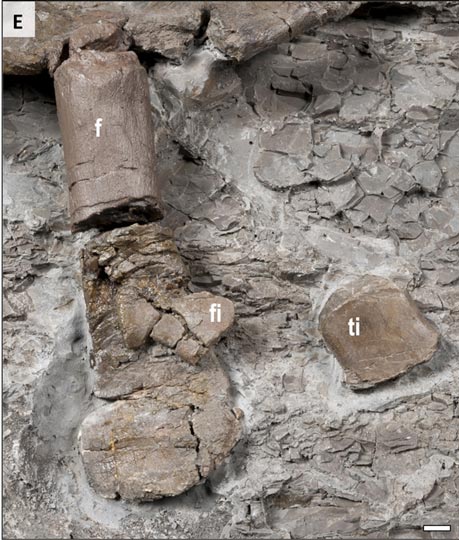
The Hind Leg Bones of Rhaeticosaurus mertensi

Hind leg bones of Rhaeticosaurus.
Left femur (f), tibia (ti) and fibula (fi). The proximal femur is a cast because the original was sectioned for histology (scale bar = 1 cm).

Picture credit: Science Advances

In the photograph (above), the part of the femur (f) is a cast as this bone was cross-sectioned as part of the bone study.

Rhaeticosaurus mertensi – Filling a Gap in the Fossil Record

The evolution of the Plesiosauria is poorly understood.  They are probably descended from a group of long-necked, marine reptiles known as pistosaurs, fossils of which are associated with Middle to Late Triassic deposits.

An example of a pistosaur is Bobosaurus (B. forojuliensis) from the Rio del Lago Formation of Italy (Carnian faunal stage of the Triassic).  However, Bobosaurus lived some thirty million years before Rhaeticosaurus evolved.  This German fossil discovery helps to fill in a little of the temporal gap in the fossil record of this successful lineage.

Rhaeticosaurus has been assigned to a basal position within the Pliosauridae family and its discovery reveals that the diversification of the Plesiosauria was a Triassic event and a number of genera survived the end Triassic extinction into the Jurassic.  The researchers conclude that the bone histology of this Late Triassic marine reptile suggests that the evolution of fast growth and an elevated metabolic rate were adaptations to an active, pelagic life-style foraging in open water.

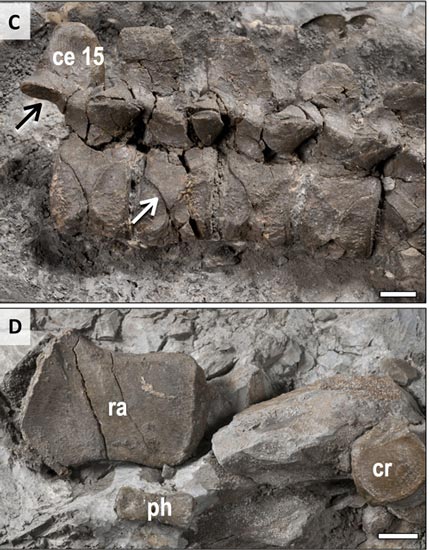
Articulated Cervical Vertebrae (C) and Elements from the Left Front Limb (D)

Neck bones (c) and forearm, hand bones of Rhaeticosaurus.
Cervical vertebrae (C) and the left radius (ra), a phalanx (ph) and a (cr) carpal element (D).

Picture credit: Science Advances

The new specimen corroborates the hypothesis that the open ocean life of plesiosaurians facilitated their survival of the end-Triassic extinction.

The scientific paper: “A Triassic Plesiosaurian Skeleton and Bone Histology Inform on Evolution of a Unique Body Plan” by Tanja Wintrich, Shoji Hayashi, Alexandra Houssaye, Yasuhisa Nakajima and P. Martin Sander published in the journal “Science Advances”.

The award-winning Everything Dinosaur website: Everything Dinosaur.
11 12, 2017

Looking at the World’s Oldest Eye after Remarkable, New Research is Published

By |2024-05-10T09:53:44+01:00December 11th, 2017|Categories: Dinosaur and Prehistoric Animal News Stories, Main Page, Photos/Pictures of Fossils|0 Comments

Insight into Evolution of the Compound Eye

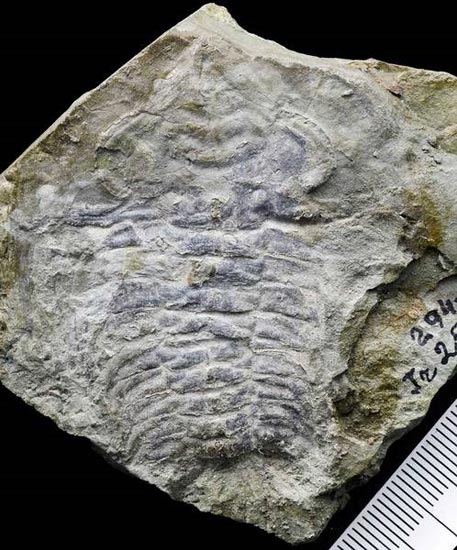
A team of international scientists including researchers from Cologne University, Estonia and the University of Edinburgh have been looking into the evolution of the first eyes by studying the remarkably well-preserved remains of an eye from a trilobite that lived in the sea more than half a billion years ago.  The trilobite to which it belongs (Schmidtiellus reetae), comes from a fossiliferous zone where the first complete, large organisms appear in the fossil record.  As a consequence of this, it is probably the oldest record of an ophthalmic system likely to be discovered.

Unlike modern compound eyes, the eye of this trilobite had no lens.  The fossil is estimated to be around 530 million years old.

The Trilobite Fossil Providing an Insight into the Evolution of Eyesight

Schmidtiellus reetae fossil.
Schmidtiellus reetae fossil showing details of the eyes.

Picture credit: G. Baranov (University of Cologne)

Schmidtiellus reetae – Trilobite Fossil from Estonia

The research team, which included Dr Brigitte Schoenemann (University of Cologne) and her colleagues Helje Pärnaste (Tallinn, Estonia) and Euan Clarkson (Edinburgh University), examined the specimen (S. reetae) and examined the cellular structure of the compound eye.

The CollectA Prehistoric Life model range contains replicas of prehistoric invertebrates including a trilobite.

To view this range: CollectA Age of Dinosaurs Popular Prehistoric Life Models.

This remarkable fossil shows how the eye was constructed and from this the team could infer what level of vision the arthropod had.  As well as looking at similarities with extant arthropods, the researchers were keen to see how the trilobite eye differed in structure and complexity.  The results show that modern compound eyes work in ways strikingly similar to those of half a billion years ago.  They are very conservative in their structure – and quite successfully so.

Dr Schoenemann commented:

“The principle of the modern compound eye most likely goes back to before the times of our first fossil records.  Half a billion years ago, it was in the early stage of its development, and with our work we have succeeded in uncovering the first visible steps of this extremely successful visual principle”.

Trilobite from Estonia

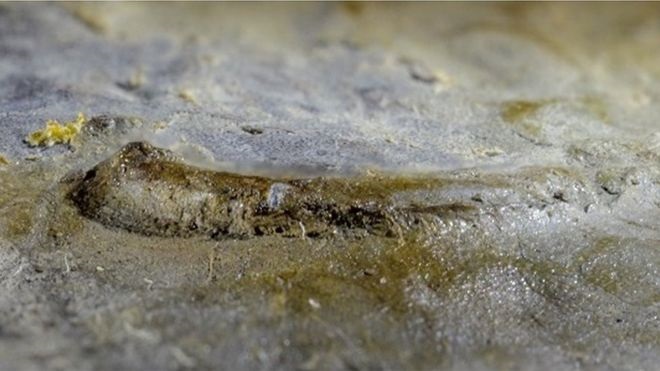
The fossil comes from Lower Cambrian sediments located in Estonia.  The bedding planes at this location reveal some of the very first fossils of complex animals with an exoskeleton.  The right eye of the trilobite is slightly abraded, allowing for a view into its interior.

It is a typical compound eye consisting of approximately 100 sub-units placed relatively far apart compared to modern forms of compound eyes.  The authors were able to show that each of these sub-units (ommatidia) consists of about eight sensory cells, just like modern compound eyes, grouped around a central rhabdom, a light-guiding receptive structure.  The rhabdom contains the visual pigments and conveys the brightness of the surrounding environment to the animal’s central nervous system.

The Right Eye of Schmidtiellus reetae from the Study

A view of the trilobite eye.
A lateral view of the right eye of the trilobite.

Picture credit: G. Baranov (University of Cologne)

Dr Schoenemann explained:

“In contrast to the modern compound eyes of bees, dragonflies, and many crabs, this very old compound eye does not have a lens.  This is likely due to the fact that these rather soft-shelled arthropods lacked the necessary layer in their shell responsible for lens formation.”

What Could the Trilobite See?

The physical features of the central rhabdom ensures that each element of the compound eye has a limited field of vision and that the animal’s overall visual impression already has the mosaic-like character of a modern compound eye.  The precision of such an eye can be determined by the number of its elements, just like the number of pixels determines the precision and detail within a computer image.  The eye was capable of detecting movement and it could roughly discern the distribution of light in its environment to help it avoid obstacles in its path.

The University of Cologne biologist and her team were also able to show that only a few million years after Schmidtiellus lived, new and improved compound eyes with higher resolution developed in another trilobite from the Baltic region called Holmia kjerulfi.  The performance of this species’ eyes even approximated to that seen in modern dragonflies.  A physical analysis of the compound eyes of both trilobites showed that the organism inhabited bright waters, most likely coastal shelf regions.

Looking at the evolution of the arthropod brain: Arthropod Brain and Nervous System Studied.

Visit the Everything Dinosaur website: Everything Dinosaur.
6 12, 2017

Thornton Triceratops is Actually Torosaurus

By |2023-08-30T20:28:59+01:00December 6th, 2017|Categories: Dinosaur and Prehistoric Animal News Stories, Dinosaur Fans, Main Page, Photos/Pictures of Fossils|2 Comments

Triceratops Skeleton Turns Out to be Torosaurus

A partial, horned dinosaur skeleton, initially thought to represent a young adult Triceratops has been reassessed following a month of preparation and cleaning and identified as a Torosaurus (T. latus).  It was back in September that Everything Dinosaur first reported on the dinosaur fossil discovery in Thornton, Colorado (USA).  Sadly, the highly respected Denver Museum of Nature and Science palaeontologist, Mike Getty was taken ill at the dig site and passed away shortly afterwards.

Turns out, what was initially identified as a Triceratops has proved incorrect.  As the Denver Museum of Nature and Science preparators have worked on the fossil bones, they have uncovered enough material to confidently ascribe the fossils to the closely related, but much rarer Torosaurus latus.

An Illustration of the Horned Dinosaur Torosaurus latus

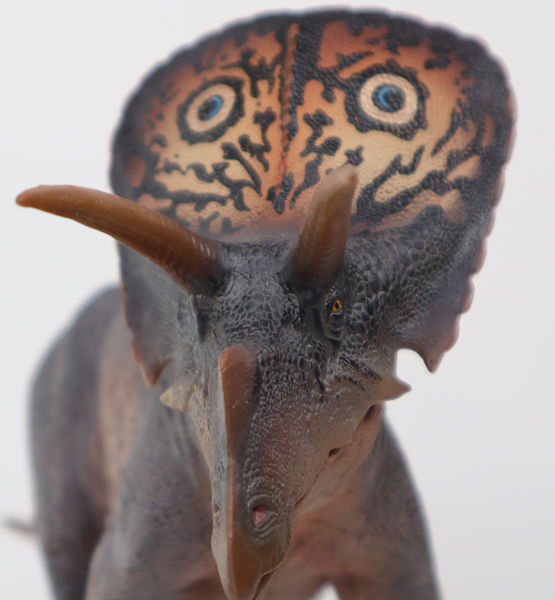
PNSO Aubrey the Torosaurus model.
The PNSO Torosaurus 1:35 scale dinosaur model (Aubrey) shown in anterior view. The headshield eyespots and spectacular colouration of this figure are highlighted. Picture credit: Everything Dinosaur.

Picture credit: Everything Dinosaur

The picture (above) shows a PNSO Torosaurus dinosaur model.

To view the range of PNSO models and figures: PNSO Age of Dinosaurs Models.

Triceratops and Torosaurus

Analysis of the large head shield that projects backwards from the skull has shown the frill of bone to be quite thin, with two distinct large holes (fenestrae), anatomical traits that are associated with Torosaurus and not Triceratops.  The new diagnosis was made after a careful comparative study using Triceratops specimens already within the Museum’s vertebrate fossil collection.  Torosaurus fossils are exceptionally scarce.  There are several thousand Triceratops (T. horridus and T. prorsus) fossils, representing something like 2,000 individuals.  In contrast, there are approximately 7 partial skulls of Torosaurus known.

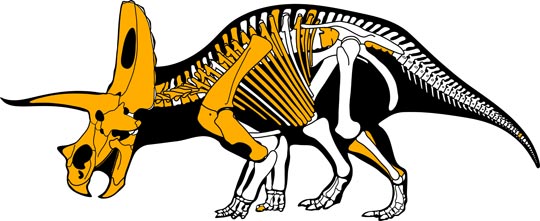
A Skeletal Drawing Showing the Extent of the Fossil Material Found at the Thornton Site

Thornton Triceratops turns out to be a Torosaurus.
The yellow parts of the skeleton represent those elements of the Torosaurus found.

Picture credit: Denver Museum of Nature and Science

A spokesperson for Everything Dinosaur commented:

“The fossil find at Thornton is highly significant.  The majority of the front-end of the individual has been excavated including an almost complete skull.  This specimen may provide palaeontologists with valuable information on how Torosaurus changed as it grew up.  In addition, these fossils could help to identify other Torosaurus specimens in museums that have been misidentified and labelled as Triceratops.”

Is Torosaurus Just a Very Old Triceratops?

The lack of Torosaurus fossil material compared to other horned dinosaurs from North America, led to speculation that Torosaurus was not a valid genus, that the fossil material ascribed to Torosaurus actually represented very old, very mature examples of Triceratops.  The Thornton specimen seems to represent a young adult animal, this may help to clarify the Torosaurus versus Triceratops debate.

To read an article published in 2010, that details an American study that suggested that Torosaurus fossils were actually Triceratops: The Extinction of Torosaurus – Second Time Around.

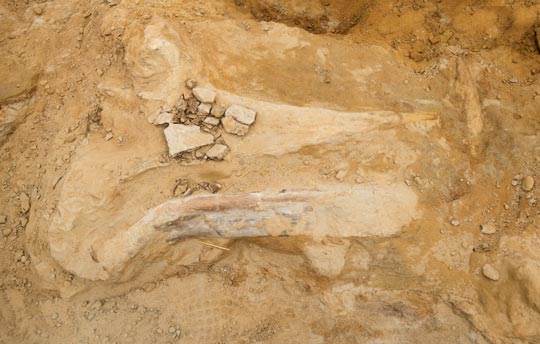
Fossilised Bones Being Exposed at the Thornton Dig Site

The fossils of Torosaurus (T. latus).
Parts of the skeleton are exposed (Torosaurus latus).

Picture credit: Denver Museum of Nature and Science

An Extremely Rare Fossil

Joe Sertich (Curator of Dinosaurs at the Denver Museum of Nature and Science), stated:

“Not only is the fossil more complete and better preserved than I imagined, but it has also revealed itself to be something extremely rare.  The Thornton beast is by far the most complete, and best preserved, ever found.”

Nicknamed “Tiny”

The specimen has been nicknamed “Tiny”, but the work of preparing and studying these fossils is no small task.  The material was unearthed at a Saunders Construction site for a new Public Safety Facility.  Cleaning efforts have also revealed several more skull bones and a complete tibia (lower leg bone).  An estimated 95 percent of the skull and at least 20 percent of the skeleton have now been identified, making this the most complete Cretaceous-aged fossil discovered in Colorado.

Visitors to the Museum can observe the fossil preparation process in the Fossil Prep Laboratory, cleaning and preparing is estimated to take several more months.

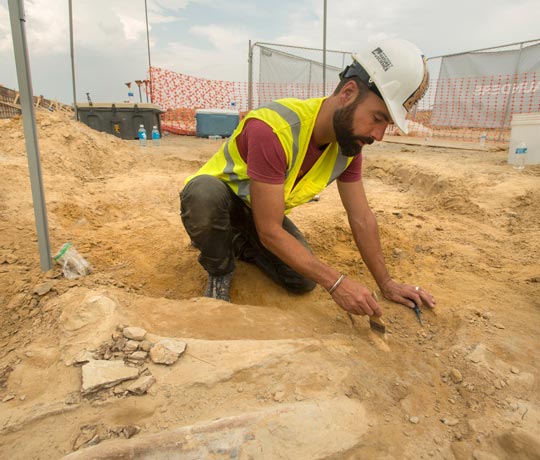
Joe Sertich at the Dig Site Working on “Tiny” the Torosaurus

Excavating an Torosaurus.
Joe Sertich, curator of dinosaurs, (Denver Museum of Nature and Science) at the dig site (Thornton, Colorado).

Picture credit: Denver Museum of Nature and Science

We wonder what Mike Getty would have made of it all?

To read more about the sad death of renowned scientist Mike Getty: Highly Respected Palaeontologist Dies at Dig Site.

Everything Dinosaur acknowledges the assistance of the press team at the Denver Museum of Nature and Science in the compilation of this article.

5 12, 2017

The Archaeopteryx That Wasn’t a New Research Solves Mystery

By |2024-05-10T09:43:40+01:00December 5th, 2017|Categories: Dinosaur and Prehistoric Animal News Stories, Dinosaur Fans, Main Page, Photos/Pictures of Fossils|0 Comments

Ostromia crassipes – The First European Member of the Anchiornithidae

The first fossil of Archaeopteryx to have been discovered, turns out not to represent the “Urvogel” at all.  In a reassessment of the fossil, known as the Haarlem specimen, as it is part of the vertebrate collection housed at the Teylers Museum in Haarlem (Holland), it has been re-described as a small predatory dinosaur belonging to the anchiornithid family.  The dinosaur has been named Ostromia crassipes, the genus name honours the late John Ostrom, who identified the Haarlem specimen as a theropod and was instrumental in the work that led to the definition of dinosaurs as dynamic, active reptiles.

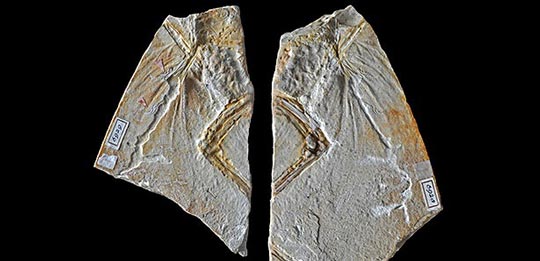
The Haarlem Specimen – the Holotype of Ostromia crassipes

Ostromia crassipes holotype fossil.
The holotype fossil of Ostromia crassipes, previously thought to represent Archaeopteryx.

Picture credit: Oliver Rauhut/Ludwig-Maximilians-University (Munich, Germany)

The fossil studied, actually consists of two parts, the counterslab TM 6929 (left) and the main slab (right) TM 6928.

Ostromia crassipes

Archaeopteryx was named in 1861, however, the Haarlem specimen was found four years earlier.  To date, around a dozen specimens have been assigned to the Archaeopteryx genus, including a single, fossilised feather.  The discovery of Archaeopteryx supported the theory of natural selection proposed by Darwin and Wallace as it represented a transitional form between reptiles and birds.  Archaeopteryx fossils support the idea that modern birds are descendants of carnivorous dinosaurs.

Writing in the academic journal “BMC Evolutionary Biology”, palaeontologists Oliver Rauhut and Christian Foth from the Staatliches Museum für Naturkunde in Stuttgart have re-examined the Haarlem specimen.  They conclude that this fossil differs in several important respects from the other known representatives of the genus Archaeopteryx.  The researchers conclude that the fossil is not an Archaeopteryx at all, but a representative of the very bird-like maniraptoran dinosaurs known as anchiornithids.

These crow-sized, predatory dinosaurs possessed feathers on all four limbs, and they predate the appearance of Archaeopteryx by several million years.

Commenting on their study, Dr Oliver Rauhut stated:

“The Haarlem fossil is the first member of this group found outside China and together with Archaeopteryx, it is only the second species of bird-like dinosaur from the Jurassic discovered outside eastern Asia.  This makes it [the Haarlem specimen] even more of a rarity than the true specimens of Archaeopteryx.”

Subtle Anatomical Differences and Bone Osteology

The scientists looked at the relative proportions of limb, toe and finger bones and noted that the Haarlem material (TM 6929 and TM 6928), was different from other Archaeopteryx specimens.  In addition, it had affinities with the fossilised remains of Anchiornis from China.  Furthermore, differences in bone osteology were observed.  For example, the Haarlem fossil specimen has a regular, well-developed longitudinal furrow on the exposed medial side of the preserved manual phalanx, this furrow is not present on any of the finger bones ascribed to Archaeopteryx.

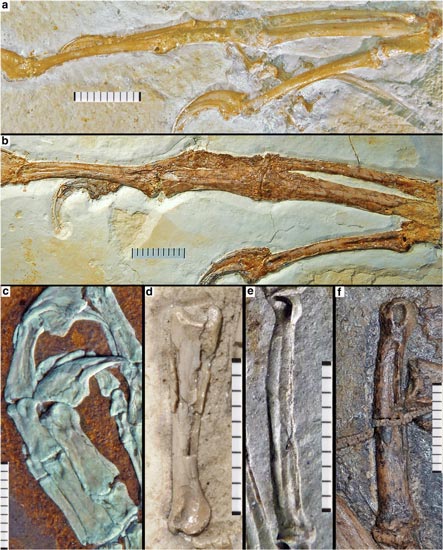
Comparing the Finger Bones (Manual Phalanges) of Various Theropods

Theropod manual phalanges comparison.
Comparison of theropod finger bones in highly compacted sediments.  Scale bar in mm.

Picture credit: BMC Evolutionary Biology

The photograph (above) shows close-up views of the finger bones (manual phalanges) of several theropods, analysis of the shape of the bones, their features and their proportions led the researchers to conclude that the Haarlem specimen was not Archaeopteryx.

(a). a right manus (hand) of the Thermopolis specimen of Archaeopteryx

(b). the right manus of the Solnhofen specimen of Archaeopteryx

(c). the left manus of the juvenile theropod from Germany Sciurumimus albersdoerferi (image resolved under UV light)

(d). second finger of the small Late Jurassic Theropod Compsognathus longipes

(e).  the impression from the first finger of the anchiornithid Anchiornis huxleyi

(f). the first finger of Caudipteryx, a feathered theropod from the Early Cretaceous of China

Learning About Fauna of the Solnhofen Archipelago

Discovered in 1857, the Haarlem fossil specimen was found about 6 miles (10 kilometres), to the north-east of the closest Archaeopteryx locality known (Schamhaupten) which is near the town of Altmannstein in southern Bavaria.

The Jurassic-aged rocks in this area were laid down in a shallow sea, in which were scattered numerous small islands, an archipelago, that provided an environment, superficially similar to that of the Caribbean today.  These islands that once covered southern Bavaria, are known as the Solnhofen archipelago, the region from which all known specimens of the genus Archaeopteryx come from.

The taxonomic reassignment of the Haarlem specimen to the feathered Anchiornithidae has provided a fresh insight into the evolution of the Avialae and indicates that the first bird-like dinosaurs originated in Asia.  During the Middle to the Late Jurassic these creatures migrated westwards, reaching the Solnhofen archipelago of Western Europe some 150 million years ago.

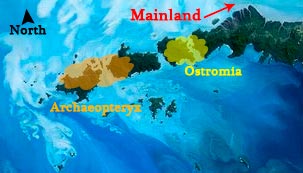
The Haarlem fossil was originally recovered from what was then the eastern end of the archipelago, quite close to the mainland.  Unlike Archaeopteryx, anchiornithids were (most likely), unable to fly, and might not have been able to reach the more remote islands offshore.   All true fossils of Archaeopteryx found to date were recovered from the lithographic limestone strata further to the west, closer to the open sea.  This implies that dinosaurs like Ostromia may have been limited in their distribution, compared to the volant Archaeopteryx.

Faunal Distribution in the Solnhofen Archipelago (Late Jurassic)

The Solnhofen archipelago and Ostromia/Archaeopteryx distribution.
The researchers speculate that the flightless Ostromia could not have reached the islands furthermost from the mainland whilst Archaeopteryx with its powered flight capability was able to reach outlying islands.

Picture credit: Everything Dinosaur

In the diagram above, Ostromia may have been unable to reach the more remote parts of the island chain whilst Archaeopteryx, which was capable of powered flight (its aerial abilities are still debated), would have been more able to “island hop”.

Based on these new findings, the researchers postulate that other known Archaeopteryx fossils may need reassessment.

Dr Rauhut suggests:

“Not every bird-like fossil that turns up in the fine-grained limestones around Solnhofen need necessarily be a specimen of Archaeopteryx,”

The scientific paper: “Re-evaluation of the Haarlem Archaeopteryx and the Radiation of Maniraptoran Theropod Dinosaurs” by Christian Foth and Oliver W. M. Rauhut published in BMC Evolutionary Biology.

An article on Archaeopteryx research: Archaeopteryx Had Feathered “Trousers”.

The oldest Archaeopteryx fossil: The Oldest Archaeopteryx in Town?

Visit the Everything Dinosaur website: Everything Dinosaur.
2 12, 2017

Amazing Hamipterus Nesting Ground Discovery

By |2024-05-10T09:44:10+01:00December 2nd, 2017|Categories: Dinosaur and Prehistoric Animal News Stories, Dinosaur Fans, Main Page, Photos/Pictures of Fossils|0 Comments

Pterosaurs Even More Like Birds

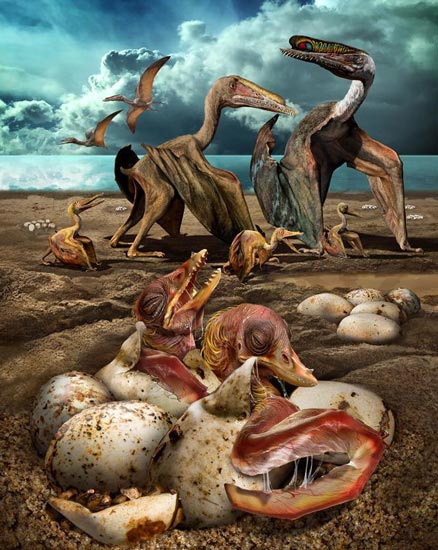
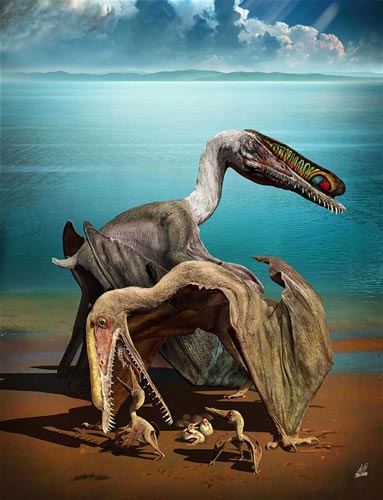
Pterosaurs like birds, were capable of powered flight.  It seems that command of the skies is not the only thing that these two types of vertebrate had in common.  Thanks to a remarkable series of discoveries from the remote Turpan-Hami Basin located in the Xinjiang Uygur Autonomous Region (north-western China), palaeontologists have learned that pterosaurs, like many living birds nested in colonies, that they had preferred nesting sites and when young, pterosaurs needed a degree of parental care, just like many species of birds today.

Pterosaur Nesting Colony (Hamipterus tianshanensis)

Hamipterus tianshanensis nesting ground.
Male (right) and female Hamipterus tianshanensis looking after their brood, whilst more pterosaur chicks hatch in the foreground.

Picture credit: Zhao Chuang

Hundreds of Pterosaur Eggs Discovered

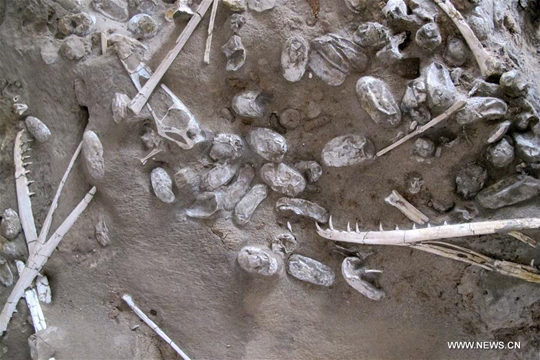
Writing in the journal “Science”, researchers from the Chinese Academy of Sciences along with collaborators from a number of research institutions in Brazil have published a paper describing the discovery of 215 pterosaur eggs, 16 of which contain the remains of embryos.  The eggs and the numerous fossil bones associated with the site have been attributed to Hamipterus tianshanensis, a flying reptile first named and described in 2014 whose exact taxonomic position in the pterosaur family tree remains open to debate.

That point notwithstanding, H. tianshanensis has been propelled to super-stardom, like a Pteranodon taking to the air, representing one of the most significant Pterosauria discoveries made to date.

An Assemblage of Pterosaur Fossils

Hamipterus tianshanensis fossils including eggs and embryos.
Pterosaur fossil eggs and bones representing individuals of various ages.

Picture credit: Xinhua/Wang Xiaolin

Pterosaur Nesting Grounds

Significantly, the number of eggs discovered are far too many to have been laid by a single female.  This suggests that these flying reptiles nested in colonies and furthermore, the overlaying of multiple clutches of eggs indicates that pterosaurs, like many birds today, returned to the same nesting sites each year.  As the authors conclude, “the similarity between these groups goes beyond wings”.

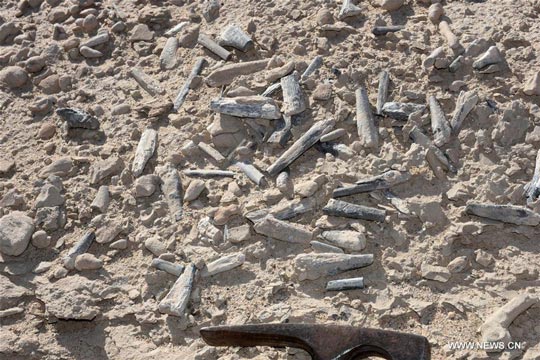
The Remains of Numerous Individuals at the Site

Hamipterus fossil remains.
Hundreds of pterosaur bones lying on the surface.  Note the tip of a geological hammer providing a scale.

Picture credit: Xinhua/Alexander Kellner

Three-Dimensional Fossil Egg Preservation

The eggs were not laid at the location where they were discovered.  This exceptional Lagerstätte preserves a series of tragic events, it seems that periodically, the nesting area was subjected to flooding as a result of seasonal storms.  Many of the eggs have been preserved in three dimensions, caused by the encroachment of sediment.

Computed tomography scans have revealed minute details of some of the embryos preserved within the eggs.  For example, an almost complete skeleton of a hatchling shows that bones related to flight were less developed than bones of the hind limb, indicating that new-borns might have been able to walk but not fly.

The front limb bones lack ossification and had yet to fully form, whilst the leg bones such as the femora are well developed.  This suggests that the young pterosaurs were unable to fly, but not completely helpless, their strong legs would have meant that they would not have been stuck in the nest but quite capable of locomotion.  However, these new insights have led the palaeontologists to conclude that, in the case of Hamipterus at least, the offspring were less precocious than previously assumed.

In short, mum and dad (coming to that bit next), had to take care of their young, bring food to them and protect them from predators.

Evidence Suggests that Pterosaurs Cared for their Young

Hamipterus feeding their young.
The male Hamipterus (background) stands guard whilst the female regurgitates food to her offspring (altricial behaviours in Pterosaurs).

Picture credit: Zhao Chuang

The Significance of Dad

Hamipterus tianshanensis was named and described three years ago.  This fossil location had been discovered several years before, but the pterosaur body fossils and the associated pterosaur egg material (forty specimens and five eggs), were not scientifically described until 2014.

In the 2014 paper (Wang et al), which was written by many of the scientists involved in this latest study, it was postulated that differences in head crest shape or size helped to distinguish males from females.

It was proposed that specimens with larger skull crests were males.  This suggests sexual dimorphism in this species and, if this idea is taken a little further, it implies that the males may have played a role in helping to bring up the next generation. After all, fossilised remains of what might represent adult males have been swept together with the nest site fossils.  Many male birds share parental responsibilities and lots of extant Aves such as the Wandering Albatross (Diomedea exulans) for instance, pair for life.  Perhaps, adult pterosaurs also had monogamous behaviour.

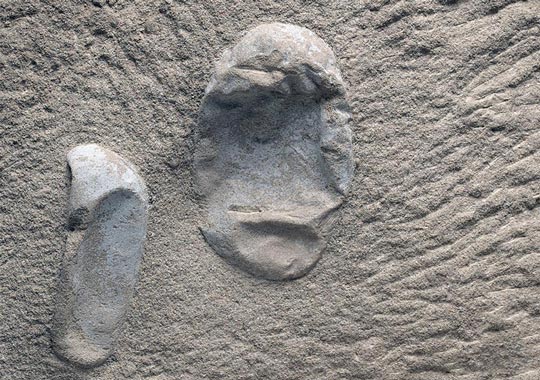
A Close-up View of the Preserved Leathery Egg of Hamipterus

Egg fossils (Pterosaur).
Pterosaur egg fossils (Hamipterus tianshanensis).

Picture credit: Xinhua/Wang Xiaolin

Inferring Behaviours

To what degree the Pterosauria and Aves share behaviours remains a controversial area.  Further research into the remarkable Hamipterus Lagerstätte has greatly increased our knowledge about flying reptiles but we must be careful not to infer or imply too much from the fossil evidence.  The scientists conclude that the discovery of all these bones and fossilised eggs supports the idea that these pterosaurs nested in colonies and that they returned to a favoured nesting site to breed.

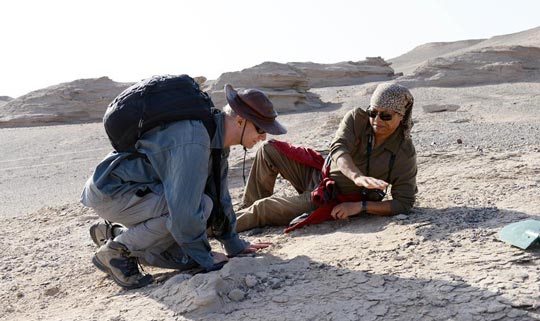
Two of the Authors of the Scientific Paper Inspect Part of the Remote Dig Site

Collecting egg fossil specimens (Pterosaur).
Palaeontologists Wang Xiaolin (right) and Alexander Kellner collect specimens in a desert in Hami, northwest China’s Xinjiang Uygur Autonomous Region.

Picture credit: Xinhua

The scientific paper: “Egg Accumulation with 3D Embryos Provides Insight into the Life History of a Pterosaur” by Xiaolin Wang, Alexander W. A. Kellner, Shunxing Jiang, Xin Cheng, Qiang Wang, Yingxia Ma, Yahefujiang Paidoula, Taissa Rodrigues, He Chen, Juliana M. Sayão, Ning Li, Jialiang Zhang, Renan A. M. Bantim, Xi Meng, Xinjun Zhang, Rui Qiu and Zhonghe Zhou published in the journal “Science”.

Visit the Everything Dinosaur website: Visit Everything Dinosaur.

28 11, 2017

Sauropod Feet Had Plenty of Traction According to New Study

By |2024-05-10T07:30:54+01:00November 28th, 2017|Categories: Dinosaur and Prehistoric Animal News Stories, Dinosaur Fans, Main Page, Photos/Pictures of Fossils|0 Comments

Sauropod Print from South Korea Reveals Polygonal Scales

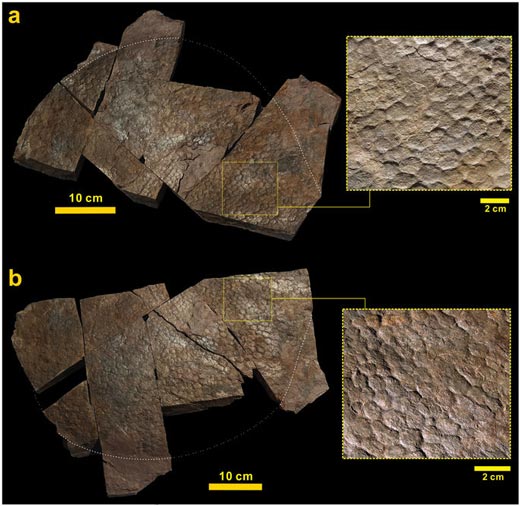
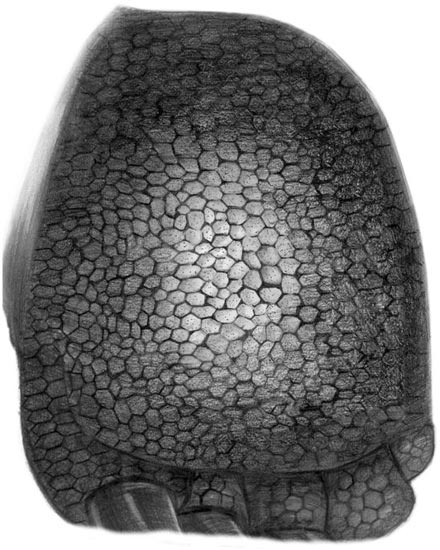
A team of scientists based in South Korea have published a paper in the academic journal “Nature” that reports on the discovery of a sauropod dinosaur footprint that has preserved the impression of the underside of the foot. The polygon-shaped scales on the underside of the long-necked dinosaur’s feet (plantar surface), would have provided grip and traction, helping these large creatures to traverse soft mud and slippery ground.

Sauropod Foot Impression Fossil (South Korea)

The preserved impression of the underside of a Sauropod's foot.
Distinct skin impressions in a sauropod footprint (a) and on its cast (b) described in the study published in the journal “Nature”.

Picture credit: Nature

Largest Sauropod Print with Underside Surface Preserved

The very distinctive foot impression and its cast, reported upon in this study, represent the largest known sauropod footprint with skin details found to date.  The single print measures more than fifty centimetres across.  The footprint impression was left in silty mudstone as a large sauropod crossed a mudflat in the late Early Cretaceous (Albian faunal stage of the Early Cretaceous).

The researchers from Pukyong National University, Busan (South Korea) and Seoul National University (Seoul), describe a single footprint from the Lower Cretaceous Haman Formation discovered in south-eastern South Korea, they suggest that the floodplain sediments were formed by sheetflood processes, where shallow water moves relatively slowly across slightly sloping ground.  The palaeoenvironment is interpreted as being a semi-arid area with lakes and ponds which was occasionally subjected to wetter weather, resulting in some flooding.

Microbial mats formed across the low-lying ground, adjacent to the water sources and the presence of these microbial mats may have helped with the preservation of the foot details.

A Reconstruction of the Sauropod Foot (Underside)

Illustration of the underside surface of the Sauropod foot.
Reconstruction of the plantar surface (underside) of a sauropod foot with polygonal skin.

Picture credit: Hyun Jeong Yoo

The researchers conclude that some sauropods by the late Early Cretaceous had a well-developed polygonal skin texture covering nearly the whole of their foot pads.  This foot pattern is reminiscent to that found on the pads of extant elephants.  These scales would have helped increase stability when these large and heavy animals crossed wet ground.

Visit the Everything Dinosaur website: Everything Dinosaur.
16 11, 2017

Cataloguing the Ancient Forests of Antarctica

By |2023-08-25T09:21:23+01:00November 16th, 2017|Categories: Dinosaur and Prehistoric Animal News Stories, Geology, Main Page, Palaeontological articles, Photos/Pictures of Fossils|0 Comments

Permian, Triassic and Jurassic-aged Forests Explored on the Coldest Continent

Over the next few months, a team of intrepid scientists will be hoping to continue their exploration of some of the most remote fossil locations in the world.  Researchers from the University of Wisconsin-Milwaukee have been mapping the sedimentary deposits at McIntyre Promontory, at the head of the Ramsey Glacier in Antarctica.  To date, the team have recorded an extensive series of strata ranging in ages from the Late Permian to the Jurassic, the numerous plant fossils found are helping the scientists to better understand the evolution of ancient forests and their flora over the southernmost portions of Gondwana.

Remains of Prehistoric Forests Uncovered in Antarctica

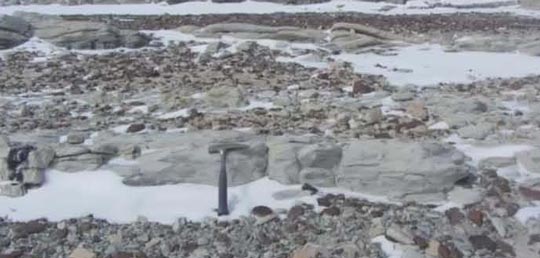
Prehistoric tree trunk (geology hammer provides scale).
An ancient tree trunk discovered in Antarctica.

Picture credit: University of Wisconsin-Milwaukee

Antarctica in the Late Permian Period

A total of thirteen trees have been found with numerous fragmentary fossils of other plants, including Ginkgos and Glossopteris.  The oldest plants described by this research team, date from the Late Permian of around 260 million years ago.  Some of the fossils have stems and roots attached and have been preserved “in situ”.  No transport of fossil material is involved, the fossils are preserved where the plants grew.  The flora of this southerly habitat has been preserved thanks to occasional volcanic events that buried the primitive forests in ash.

Commenting on the significance of the Antarctic ancient flora, palaeoecologist and visiting assistant professor at the University of Wisconsin-Milwaukee Department of Geosciences, Erik Gulbranson stated:

“People have known about the fossils in Antarctica since the 1910-12 Robert Falcon Scott expedition.  However, most of Antarctica is still unexplored.  Sometimes, you might be the first person to ever climb a particular mountain.”

Beautifully Preserved Plant Fossils

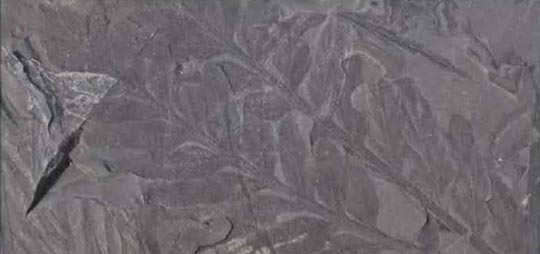
Ancient plant fossils from Antarctica.
Ancient plant fossil remains.

Picture credit: University of Wisconsin-Milwaukee

Late Permian Forests

The Late Permian forests preceded the most extensive mass extinction event in the Phanerozoic (end Permian mass extinction event),  the scientists are hoping to use their growing knowledge of the ancient Antarctic forests to look at the possible impact on global warming on extant plant communities.  In addition, as the Antarctic forests grew at polar latitudes where plants can’t grow today, Gulbranson believes that the trees were an extremely hardy species and he and his colleagues are trying to determine why they died out.

Just like their modern counterparts, prehistoric tree fossils can reveal seasonal growth rings.  These rings when examined in microscopic detail can reveal patterns of seasonal growth.  Antarctica during the Late Permian was further north than it is today, even so, despite the milder climate, the forests would have had to endure prolonged periods of darkness, when the sun never emerged above the horizon.  The research team hopes to use the ancient growth rings to learn more about how these forests coped with such extremes.

Ancient Tree Trunks Can Help Decipher Seasonal Growth Patterns

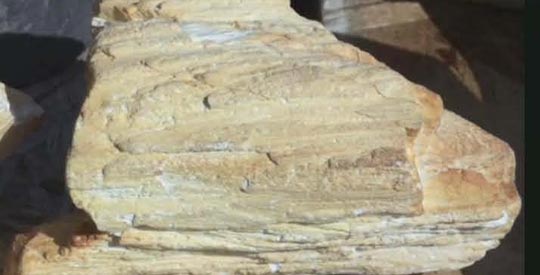
Antarctic prehistoric plant life.
Ancient trees can reveal evidence of seasonal growth.

Picture credit: University of Wisconsin-Milwaukee

Climate Change and the End Permian Mass Extinction Event

The cause or causes of the end Permian extinction event remain an area of controversy within palaeontology, although many scientists now believe that a huge increase in atmospheric greenhouse gases such as methane and CO2 which resulted from extensive global volcanic activity led to world-wide climate change.  John Isbell (University of Wisconsin-Milwaukee), has visited Antarctica before, on this expedition he examined the matrix and other sediments surrounding the in situ fossils to determine how these plant remains fitted into the geology of Antarctica.

To read an article written by Everything Dinosaur in 2015, that explains how rocks from South Africa are helping scientists to unravel global extinction events: Karoo Rocks Provide a Fresh Insight into Extinction Events.

The Plant Fossils Might Represent New Species

The prehistoric forests of Antarctica.
Delicate plant fronds have been preserved.

Picture credit: University of Wisconsin-Milwaukee

Extensive Ancient Forests

The extensive forests may have stretched across the whole of the super-continent Gondwana.  Evidence of Glossopteris fossils and other plant remains have been used to help substantiate the theory of continental drift.  These Permian forests would have looked very different from today’s temperate woodlands, the flora would have been dominated by mosses, ferns, pteridosperms (seed ferns) and conifers.

Erik Gulbranson explained that the Antarctic fossils have provided important information about plant diversity at higher latitudes. During the Permian, forests were a potentially low diversity assemblage of different plant types with specific functions that affected how the entire forest responded to environmental change.  This is in direct contrast to today’s high-latitude forests that display greater plant diversity.

Gulbranson added:

“This plant group must have been capable of surviving and thriving in a variety of environments.  It’s extremely rare, even today, for a group to appear across nearly an entire hemisphere of the globe.”

Tough Forests Failed to Survive Climate Change

The researchers conclude that these tough trees and plants did not survive the climate change that marked the end of the Permian.  Younger plant fossils from Triassic and Jurassic sediments provide evidence of the changing Antarctic flora over time, but many of the types of plants found in the Permian forests, despite their resilience, died out.

Erik Gulbranson Can Study the Permian Plant Fossils in the University Laboratory

Plant fossils being examined.
Examining the Permian plant fossils (Erik Gulbranson – University of Wisconsin-Milwaukee).

Picture credit: University of Wisconsin-Milwaukee/Troye Fox

By analysing the preserved tree growth rings, the scientists have found that these trees transitioned from summer activity to winter dormancy very rapidly, perhaps within a few weeks.  Extant plants make the same transition over the course of several months and also conserve water by making food during the day and resting at night.  Scientists don’t yet know how months of perpetual light would have affected the plants’ day-and-night cycles.

The team hope to return to the various Antarctic dig sites in the early part of 2018.  They hope to learn more about the annual growth cycles of the trees and to determine how the forests coped with rising levels of greenhouse gases and a warming climate.  It is hoped that by studying the Permian flora of Antarctica, models looking at how living plants will cope with climate change can be developed.

For models of prehistoric plants and creatures from the Permian: CollectA Age of Dinosaurs Popular Models.

Go to Top