All about dinosaurs, fossils and prehistoric animals by Everything Dinosaur team members.

Pictures of fossils, fossil hunting trips, fossil sites and photographs relating to fossil hunting and fossil finds.

21 02, 2018

Plants May Have Originated 100 Million Years Earlier

By |2023-09-16T16:09:55+01:00February 21st, 2018|Categories: Dinosaur and Prehistoric Animal News Stories, Main Page, Photos/Pictures of Fossils|0 Comments

Pushing Back the Origins of Plants by 100 Million Years

An analysis of the genes of living plants has revealed that the very first plants may have evolved 100 million years earlier than the fossil record suggests.  Writing in the academic journal “Proceedings of the National Academy of Sciences (USA)”, researchers conclude that the first plants to colonise the Earth evolved around 500 million years ago, whereas, the current known fossil record provides evidence of plant spores from Ordovician-aged rocks and the first Rhyniophytes, Bryophytes and Lycophytes originated in the Silurian approximately 420 to 400 million years ago.

The Research Team Examined the Origins of Early Land Plants
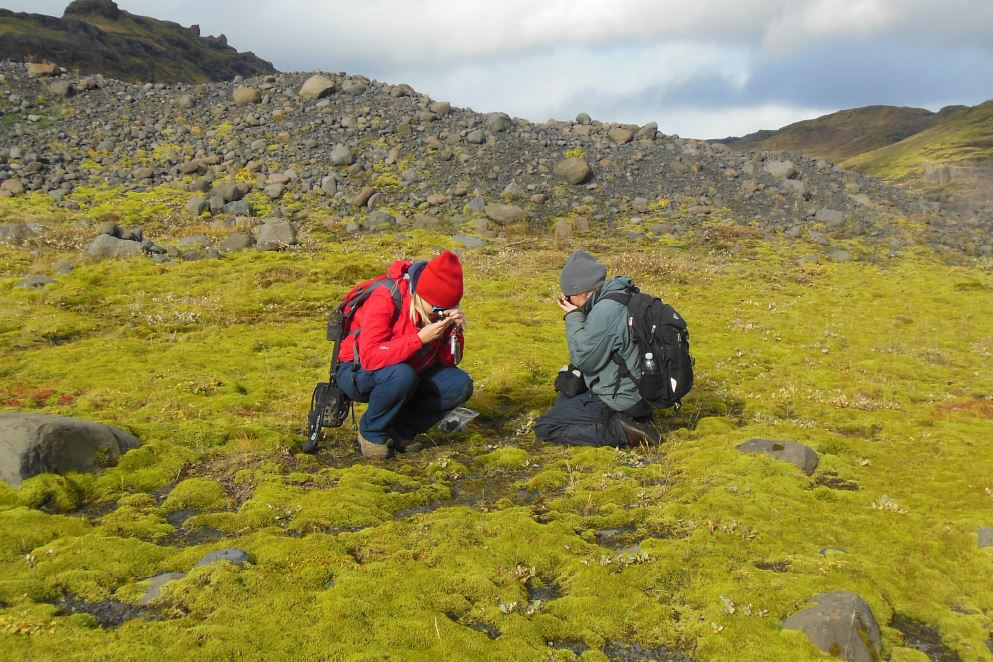
Researching into the origins of early land plants.
Early land plants would have resembled the flora found in this Icelandic lava field.

Picture credit: Paul Kenrick (Natural History Museum, London)

Lead author of the study, Dr Philip Donoghue (Department of Earth Sciences, Bristol University) commented:

“Land plants emerged on land half a billion years ago, tens of millions of years older than the fossil record alone suggests.”

Evolved from Pond Scum

The current theory is that true plants, capable of surviving in a terrestrial environment evolved from “pond scum”.  Plants play a hugely important role in shaping the climate of our planet through photosynthesis and respiration.  The greening of the Earth permitted terrestrial environments to be opened up for exploitation by the first land animals.  Plants can help to establish and maintain soils and the roots of plants play a vital role in the physical and chemical weathering of rocks.  The breaking down of rocks is a key process in the carbon cycle that regulates the Earth’s atmosphere and climate.

Tracing Evolution Using a Molecular Clock

The scientists, which included Dr Mark Puttick from the Natural History Museum (London), used a molecular clock which analysed the combined evidence of genetic differences between related living species and the fossils of ancient ancestors.   The concept of a molecular clock works on the assumption that evolutionary changes occur at regular time intervals.  If the rate of genetic change (mutation), in the DNA of an organism can be compared to the genome of a closely related species then their relationship can be tracked back through time, identifying the characteristics of a common ancestor.  Tracking back using this methodology, the team concluded that the first plants evolved much earlier than previously thought.

Co-lead author of the research, Dr Jennifer Morris (Bristol University), explained:

“The global spread of plants and their adaptations to life on land, led to an increase in continental weathering rates that ultimately resulted in a dramatic decrease the levels of the “greenhouse gas” carbon dioxide in the atmosphere and global cooling.  Previous attempts to model these changes in the atmosphere have accepted the plant fossil record at face value, our research shows that these fossil ages underestimate the origins of land plants and so these models need to be revised.”

An Incomplete and Sparse Fossil Record

The fossil record of early plants is particularly poor.  It is far too incomplete to act as a reliable guide to the evolution and origin of land plants.  The molecular clock allowed the team to compare differences in the genetic make-up of extant plant species, these relative genetic differences were then converted into geological ages using the sparse fossil record as a loose framework.  This work suggests that the ancestor of land plants was living in the middle of the Cambrian and it is similar in age as the first known terrestrial animals.

A Cross Section of the Devonian Land Plant Rhynia gwynne-vaughanii from Scotland
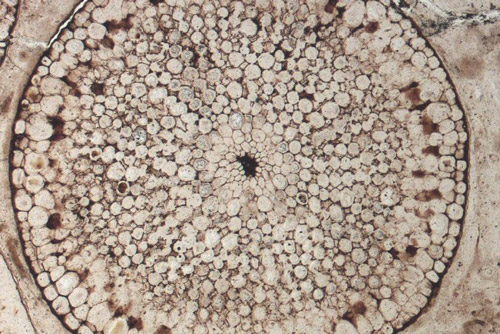
An image of the early vascular plant Rhynia gwynne-vaughanii (Devonian).
A cross section of the early vascular plant – Rhynia gwynne-vaughanii.

Picture credit: Natural History Museum, London

A Taxonomic Conundrum

The research into the origins of land plants has been complicated as the taxonomic relationships between the earliest land plants are not clear and distinct.  Using similarities in the shape and structure of land plants, scientists have mapped a number of conflicting outcomes for a cladistic analysis of early plant relationships between the most primitive groups such as the Bryophytes (liverworts and mosses) and the vascular plants (Tracheophytes) and a primitive sub-group of vascular plants, the Lycophytes.  Using the molecular clock model to map phylogenetic relationships the team identified several evolutionary family trees for the early plants.  The liverworts could be a sister clade to all other land plants, with either mosses, hornworts or a moss-hornwort grouping as the sister group to the Tracheophytes.

Seven Alternative Cladistic Relationships for Early Plants were Considered in the Study
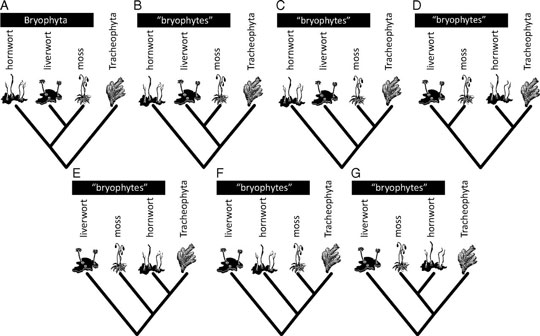
The possible cladistic relationships between early land plants.

Picture credit: Proceedings of the National Academy of Sciences

However, when each of these phylogenetic relationships was tested in turn, against the molecular clock model, the end result still indicated an origin of land plants some 100 million years earlier than previously thought.  The researchers conclude that the first land plants may therefore have originated during the Late Cambrian or at the latest during the Early Ordovician.

The scientific paper: “Timescale of Early Land Plant Evolution” by J. L. Morris, M. N. Puttick, J. Clark, D. Edwards, P. Kenrick, S. Pressel, C. H. Wellman, Z. Yang, H. Schneider and P. C. J. Donoghue, published in the Proceedings of the National Academy of Sciences (USA).

Visit the Everything Dinosaur website: Everything Dinosaur.
16 02, 2018

Lizards Up on Two Feet in the Early Cretaceous

By |2023-09-16T15:04:03+01:00February 16th, 2018|Categories: Dinosaur and Prehistoric Animal News Stories, Dinosaur Fans, Main Page, Photos/Pictures of Fossils|0 Comments

Lizards Sprinted to Safety to Avoid Predation

A team of international scientists writing in the journal “Scientific Reports”, have described the oldest lizard trackways known to science that record bipedal behaviour.  The little lizards lived around 110 million years ago, in what is now South Korea, it has been speculated that just like extant lizards, they took to their hind legs to avoid being eaten.

Lizard Trackways

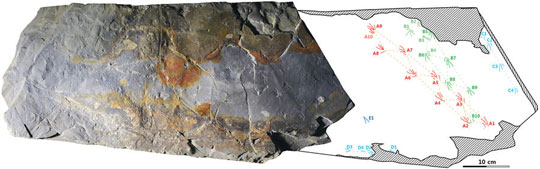
The mudstone slab preserves a total of twenty-nine prints, representing four trackways made by lizards.  The lizard trackways occur in the same horizon as the pterosaur ichnotaxon, Pteraichnus koreanensis, it has been speculated that these small animals were taking to their hind legs and sprinting away to avoid the attention of marauding flying reptiles.

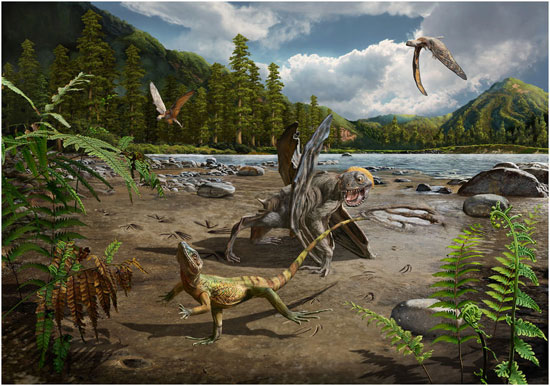
A Lizard Escapes from a Pterosaur (Early Cretaceous of South Korea)

A lizard takes to its hind legs to avoid the attentions of a Pterosaur.
A lizard sprints away from an attacking Pterosaur (Pteraichnus koreanensis).

Picture credit: Zhao Chuang

Rare Lizard Trace Fossils from the Hasandong Formation

The researchers from the Chinese Academy of Sciences, Seoul National University, the Korea Institute of Geoscience and Mineral Resources along with Anthony Fiorillo of the Perot Museum of Nature and Science (Dallas, Texas) studied the mudstone slab, which measures approximately seventy centimetres by thirty centimetres in size and identified the tiny tracks, as that of a basal member of the Iguania Infraorder of lizards.

The team came to this conclusion as living iguanians, such as those in the Basiliscus genus (basilisk lizards), have strong hind legs and are facultative bipeds, that is, capable of running on their back legs when the need arises.  The fossil record also shows that these types of lizards were present in Asia during the Early Cretaceous.

The Mudstone Slab with Trace Fossils and Accompanying Line Drawing

Fossilised lizard tracks and line drawing.
Photograph of the fossil slab with accompanying line drawing.

Picture credit: Scientific Reports

The trace fossils were excavated from an old quarry adjacent to Hadong power station in Hadong County, in south-central South Korea.  It is believed that the strata in this area (Hasandong Formation) was laid down around 112 to 110  million years ago (Aptian/Albian faunal stages of the Early Cretaceous).  The well-preserved lizard trackways have allowed the scientists to examine in detail the hand (manus) and foot (pes) anatomy of the ancient lizard.

When Did Lizards Develop Bipedal Capabilities?

Although, bipedal locomotion is known today and the Squamata (lizards and snakes), are the most specious of all the living reptile types, the fossil record for these creatures is particularly sparse.  Palaeontologists, remain uncertain as to when bipedal locomotion in lizards arose, although it has been inferred based on the relative proportions of front and hind limbs as seen in Tijubina pontei, an Early Cretaceous lizard, whose fossils are associated with the Crato Formation of Brazil.

The lizard trackways discovered in South Korea suggest that bipedal locomotion in ancient lizards is deeply rooted in the phylogeny of lizard evolution.

Hand and Foot Tracks (Manus and Pes)

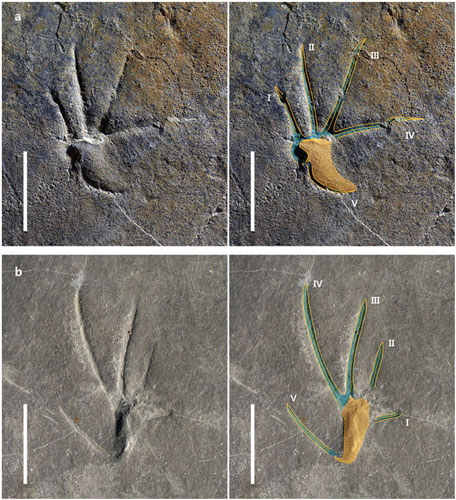
Hand and foot prints Sauripes hadongensis.
Manus and pes tracks of Sauripes hadongensis, (a) Enlarged photograph and drawing of a manus imprint (B1). (b) A pes imprint (A6).

Picture credit: Scientific Reports

Sauripes hadongensis

The foot prints (pes) are plantigrade, indicating that this lizard walked on its toes and heels, just like us and all lizards today, as opposed to the digitigrade locomotion of the Dinosauria.  Although the individual prints are very small, around two centimetres in length, the five toes (pentadactyl), are clearly defined. 

The lizard tracks appear in the same horizon as the pterosaur ichnotaxon Pteraichnus koreanensis and it has been speculated that the lizards could have been escaping from a flying reptile.  Behaving as a facultative biped, would also have elevated the head and this would have permitted the lizards to keep a better look out for aerial predators.

The scientists have estimated the ancient lizard’s body length by comparing the trackways to the extant lizard Tropidurus torquatus, a living member of the Infraorder Iguania.  The ichnotaxon has been named Sauripes hadongensis which translates as “lizard foot from Hadong County”.

An Illustration of the Bipedal Locomotion of the Ancient Lizard

An illustration of the running lizard (bipedal running).
An illustration showing the bipedal interpretation of the lizard trackway (SVL – snout to vent length and PL – pes length).

Picture credit: Scientific Reports

The Palaeoenvironment of Lower Cretaceous South Korea

The mudstone strata has produced tridactyl (three-toed) dinosaur tracks as well as trace fossils representing the tracks of small pterosaurs.  Fossilised plants are also associated with these layers of rock.  It is suggested that the mudstone represents deposits from a swampy area or possibly the margins of a lake. 

The Hasandong Formation has yielded numerous body fossils including several different types of vertebrate (turtles, pterosaurs, crocodilians and dinosaurs).  These fossilised bones are isolated, broken and highly fragmentary, indicating that they may have been exposed on the surface for some considerable time prior to subsequent burial.  They also may have been transported for some distance before deposition.  This taphonomy suggests that large rivers crossed this location, the mudstone slab may have been sited in an area away from a main river channel, that was subjected to periodic flooding by water with low energy, otherwise the delicate prints may not have been preserved.

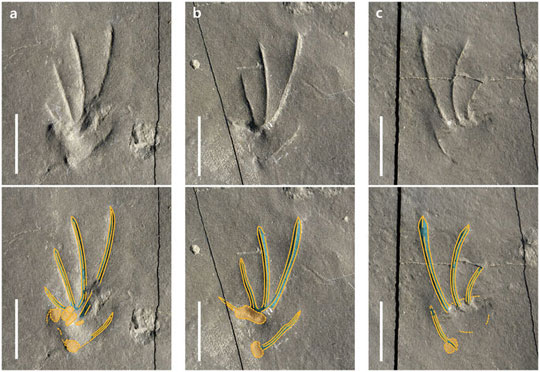
Photographs of Individual Hind Foot Prints (Pes) with Digits Highlighted

Pes tracks of Sauripes hadongensis.
Photographs of the foot prints of Sauripes hadongensis with the digits highlighted.

Picture credit: Scientific Reports

To read Everything Dinosaur’s 2014 article about the discovery of a tiny Theropod dinosaur from South Korea: Tiny Terror from South Korea.

The scientific paper: “Lizards Ran Bipedally 110 Million Years Ago” by Hang-Jae Lee, Yuong-Nam Lee, Anthony R. Fiorillo and Junchang Lü published in Scientific Reports.

Visit the Everything Dinosaur website: Everything Dinosaur.
12 02, 2018

Stepping into the Lower Cretaceous of Maryland

By |2023-09-16T13:09:42+01:00February 12th, 2018|Categories: Dinosaur and Prehistoric Animal News Stories, Dinosaur Fans, Main Page, Photos/Pictures of Fossils|0 Comments

Diverse Footprint Assemblage Reveals Early Cretaceous Biota

Back in 2012, Everything Dinosaur reported upon the discovery of a partial nodosaurid dinosaur footprint found at NASA’s Goddard Space Flight Centre in Greenbelt, Maryland (USA).  Subsequent excavations have revealed a diverse trace fossil assemblage, preserving footprints of dinosaurs, mammals and flying reptiles (Pterosauria) located in a single slab of sandstone.  This remarkable fossil records a snapshot in deep geological time and shows how different types of animals interacted in a wetland environment.

Studying Trace Fossils (Dinosaur Footprint)

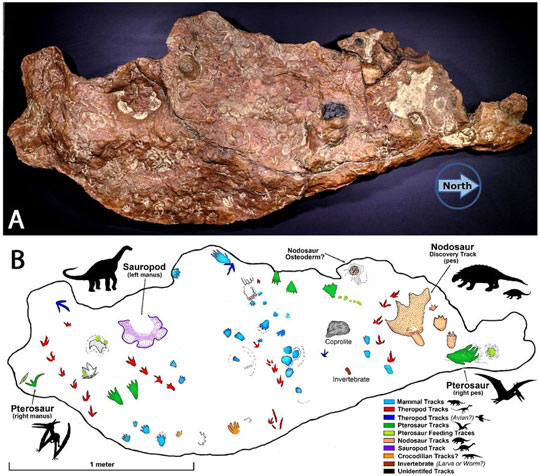
A View of the Cast of the Actual Fossil that Records the Entire Track Bearing Surface

Goddard Space Centre (NASA) trackways.
The cast of the track bearing surface reveals over 70 trace fossils.

Picture credit: Scientific Reports

Co-corresponding author of the scientific paper, published in the journal “Scientific Reports”, Ray Stanford (NASA, Goddard Space Flight Centre), the scientist who first discovered trace fossil evidence at the Goddard site, commented:

“It’s a time machine.  We can look across a few days of activity of these animals and we can picture it.  We see the interaction of how they pass in relation to each other.  This enables us to look deeply into ancient times on Earth.  It’s just tremendously exciting.”

Natural Impressions

The single slab of iron-rich sandstone measures over two metres in length and the cast of the fossil (see above), represents at least eight different track types denoting dinosaurs, crocodilians, pterosaurs and mammals.  All the tracks are preserved as natural impressions (concave epireliefs) and at least twenty-six mammalian tracks have been identified.  Analysis of the fossil material suggests that all the impressions were made within a relatively short time of each other, the fossil (GSFC-VP1) can be interpreted as snapshot recording the activities of a diverse biota around a wetland area during the Early Cretaceous (Albian/Aptian faunal stages).

A Schematic Showing the Extant of the Trace and Body Fossils Preserved

Trackways represent a diverse biota.
Goddard Space Flight Centre (NASA) tracks – schematic drawing.

Picture credit: Scientific Reports with additional annotations by Everything Dinosaur

Tracking the Dinosaurs

The track that first highlighted the potential of the site “the discovery track”, which is coloured light brown in the drawing above, and situated in the north-eastern corner of the sandstone slab, has been identified as a nodosaurid print.  This single print measures around 29 centimetres in diameter.  The posterior (heel) region is obscured by a smaller track of uncertain providence.  The small track could represent a print made by a juvenile nodosaur.  If this is the case, then this section of the fossil could show the tracks made by an adult and juvenile armoured dinosaur as they walked together (see silhouettes adjacent to the track illustration).

Potential Nodosaurid Scute

A single, black object with a raised ridge is also preserved.  This has been interpreted as an individual scute from a nodosaurid.  Measuring five centimetres across, the fossil is surrounded by a polygonal pattern consistent with the surrounding integument associated with nodosaurid skin impressions.  The unique taphonomy of the Patuxent Formation that is exposed at the Goddard Space Flight Centre and other locations in Maryland has already provided palaeontologists with the beautifully-preserved impression of the rear half of an articulated baby nodosaurid.  This dinosaur was named Propanoplosaurus marylandicus by Stanford et al in 2011.

The Object Identified as a Nodosaurid Scute (Dermal Armour)

Potential Nodosaurid Scute
(A) photograph of nodosaurid scute and associated polygonal pattern of surrounding integument, (B) simplified outline of polygonal pattern.

Picture credit: Scientific Reports

The large nodosaurid print along with the track made by the left front foot of a sauropod (see single print outlined in light purple and the silhouette on the schematic), confirms the presence of large dinosaurs in the area.

Small Theropod Dinosaurs Systematically Searching for Food

Four parallel trackway patterns made by crow-sized theropod dinosaurs have been identified.  The outermost tracks of the group have been labelled in the schematic T1 and T4.  This parallel pattern and the short distance between individual footprints suggest that these small meat-eaters were moving slowly and working together to systematically comb the area for food.

Martin Lockley (University of Colorado, Denver) and co-corresponding author with Ray Stanford explained:

“It looks as if they were making a sweep across the area.”

Theropod Trackways T1 and T4 Illustrated

Theropod tracks.
Goddard Space Flight Centre (theropod tracks).

Picture credit: Scientific Reports

The picture above shows drawings of various theropod tracks,  T1 consists of six footprints, whilst T4 is comprised of five individual prints (diagrams A and B).  The short stride length indicates very short steps, consistent with the idea that these little meat-eating dinosaurs were carefully scrutinising the area, probably hunting for food.  Diagrams C and D represent isolated tracks with toe digits widely separated (divarication) – note the scale bar = 20 cm.

Marvellous Mammalian Tracks

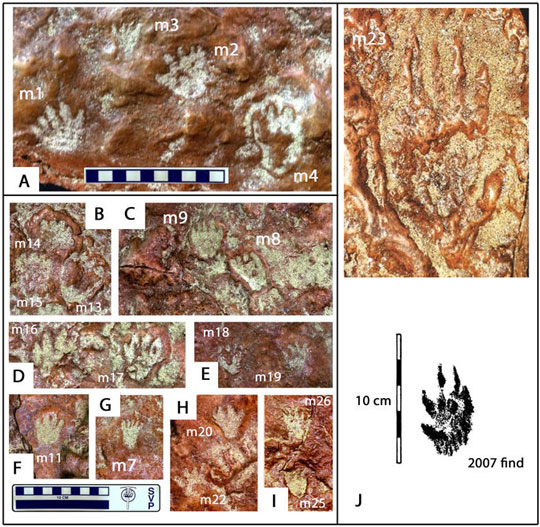
The dinosaur tracks might first catch the eye, but the real stars of this Early Cretaceous “dance floor” are the collection of mammalian prints.  At least twenty-six mammal tracks have been identified.  The largest print, covering around twenty-five square centimetres is the largest mammal footprint ever discovered from the Cretaceous.  This suggests that there were plenty of mammals about and some of them were quite big, about the size of a Highland terrier or a raccoon.

The researchers conclude that most of the mammalian prints represent small squirrel-sized animals and the study has resulted in the erection of a new ichnotaxon Sederipes goddardensis.  The genus name roughly translates from the Latin as “sitting foot” as some of these impressions indicate that the small mammals sat up in a similar way to extant prairie dogs.  The trivial name honours the Goddard Space Flight Centre.

Mammal Tracks as Identified on the GSFC-VP1 Specimen

Examples of mammal tracks.
Early Cretaceous mammal tracks (GSFC-VP1).

Picture credit: Scientific Reports

A Dinosaur Footprint and Diverse Mammal Tracks

The photograph (above), shows examples of the diverse mammal tracks.  Tracks m1-m4 include the holotype ichnofossils of the new ichnotaxon Sederipes goddardensis.  Note scale bar and (J) which denotes a large, five-toed track with an image of a similar track described in 2007.

The authors believe the wide diversity and number of tracks show many of the animals were in the area actively feeding at the same time.  It has been proposed that the mammals may have been feeding on worms and grubs, the small carnivorous theropods were after the mammals, and the pterosaur tracks found in situ could suggest that flying reptiles were hunting in the vicinity too, perhaps after both the mammals and their reptile contemporaries.

The scientific paper: “A Diverse Mammal-dominated, Footprint Assemblage from Wetland Deposits in the Lower Cretaceous of Maryland” by Ray Stanford, Martin G. Lockley, Compton Tucker, Stephen Godfrey and Sheila M. Stanford published in Scientific Reports.

To read Everything Dinosaur’s 2012 article about the initial footprint discovery: Space Age Meets Dinosaur Age.

Photograph of the Cast and Schematic Drawing

Schematic drawing and fossil cast (GSFC-VP1)
GSFC-VP1 cast and schematic drawing. The diagram shows the variety of trace fossils including a large, potential sauropod dinosaur footprint.

Picture credit: Scientific Reports

Visit the Everything Dinosaur website: Everything Dinosaur.
9 02, 2018

Out of Africa – Much Earlier Than Expected

By |2023-09-16T12:17:25+01:00February 9th, 2018|Categories: Dinosaur and Prehistoric Animal News Stories, Main Page, Photos/Pictures of Fossils|0 Comments

Human Jawbone Fossil Rewrites our History

The discovery of a fossilised upper jawbone, complete with teeth, has rewritten the history of our own species and supports the theory as proposed by genetic studies that H. sapiens migrated out of Africa much earlier than previously thought.

Human Jawbone Fossil

Most palaeoanthropologists contend that our species Homo sapiens originated in Africa and then at some point in the distant past migrated out of Africa spreading into the Middle East, Asia and Europe before colonising the rest of the world.  Human fossils found outside Africa have been dated to 120,000 to 90,000 years ago (Tarantian faunal stage of the Late Pleistocene), the discovery of a human jawbone fossil at Misliya Cave on the western slopes of Mount Carmel, Israel, demonstrates that modern humans were already present in northern Israel at least 55,000 years earlier.

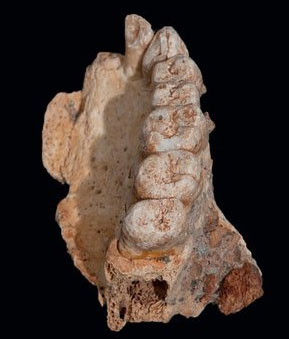
The Fossil Jawbone that Reinforces the Idea that Modern Humans Migrated Out of Africa Much Earlier

Modern human jawbone fossil.
The left maxilla from a modern human found in northern Israel.

Picture credit:  Israel Hershkovitz Tel Aviv University

Levallois Technology

The international team of scientists, including  Israel Hershkovitz (Tel Aviv University) and Rolf Quam from the Department of Anthropology at Binghamton University, examined the sediments in the cave associated with the human jawbone fossil find.

There has been a research project associated with the Misliya Cave site for several years.  This new research builds upon previous studies and it supports the idea that the people at this location were making and using a range of sophisticated stone tools reminiscent of the tools associated with the earliest modern humans in Africa (Levallois technology).  The sediments reveal a series of well-defined hearths as well as numerous animal remains and stone tools.  An analysis of the human remains, dating the sediments and the fossil itself, suggests an approximate age range of between 177,000 and 194,000 years old, making this jawbone the oldest member of the Homo sapiens species to have been found outside of Africa.

The research team conclude, that the fossil, known as the “Misliya maxilla” along with the abundant stone tools, indicates that the emergence of this technology is linked to the appearance of our species in this region of the Middle East.

For an article that summarises research from 2016 that questions the relatively late migration of modern humans out of Africa: Out of Africa Earlier than Thought?

Another 2016 article that looks at the evidence in support of a theory that suggests modern humans evolved independently in Asia: Did Humans Evolve Independently in Asia?

Visit the Everything Dinosaur website: Everything Dinosaur.

5 02, 2018

The Tale of the Spiders with Tails

By |2023-09-16T10:58:57+01:00February 5th, 2018|Categories: Dinosaur and Prehistoric Animal News Stories, Main Page, Photos/Pictures of Fossils|1 Comment

Prehistoric Spiders Had Tails

A team of international scientists, including researchers from the University of Manchester, have announced the discovery of a new species of Cretaceous-aged spider.  The arachnid (Class Arachnida), which was preserved in amber from Myanmar (burmite), is helping palaeontologists to better understand the evolution of these very successful and diverse, eight-legged invertebrates.  This new spider species, named Chimerarachne yingi possessed a whip-like tail, a characteristic associated with ancestral forms and the most primitive types of extant spider, but the burmite has preserved a spider with this characteristic, that lived at least 250 million years after the first spiders evolved.

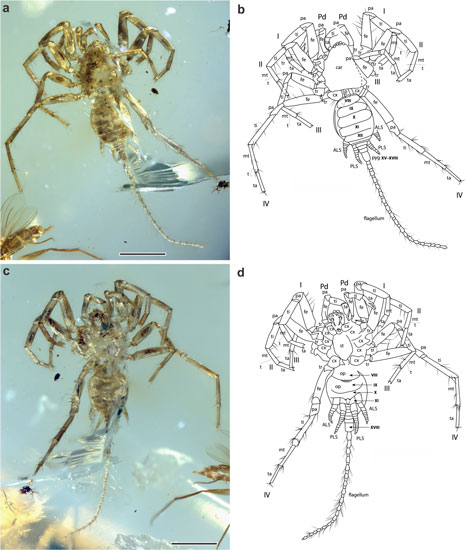
Photographs of the Spider Fossil with Accompanying Line Drawings

Chimerarachne yingi fossil and line drawings (dorsal and ventral views).
Chimerarachne yingi dorsal view (a) with accompanying line drawing and (b) ventral view with accompanying line drawing.

Picture credit: The University of Manchester

Chimerarachne yingi – Potentially a Transitional Fossil

The characteristics of today’s spiders are very well known.  These creatures have eight legs, several eyes and can spin silk, often to create cobwebs.  A “whip-like tail” is one feature that you would not normally associate with these particular creepy-crawlies.  The researchers, writing in the academic journal “Nature Ecology and Evolution”, conclude that the specimen might represent a transitional fossil, it possesses a tail (flagellum) and as such, the fossil may help scientists to better understand how the Arachnida evolved and diversified.

What is a Transitional Fossil?

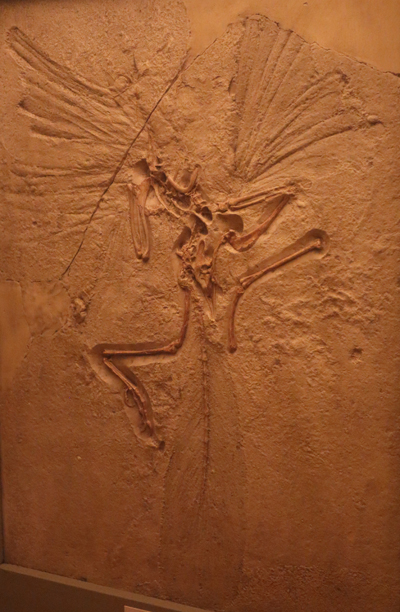
Transitional fossils are defined as any fossil that demonstrates traits that are common to both an ancestral group and descendants.  Perhaps the best-known example is Archaeopteryx lithographica from the Late Jurassic of southern Germany.  The “Urvogel” shows both reptilian traits and characteristics of a bird, so it is regarded as a transitional fossil highlighting the evolution of one part of the Theropoda into modern Aves (birds).

A Fossil of the “Urvogel” Archaeopteryx Regarded as a Transitional Form

Archaeopteryx fossil cast
Archaeopteryx fossil cast. Picture credit: Everything Dinosaur.

Picture credit: Everything Dinosaur

Chimerarachne yingi

The genus name comes from the Greek chimera – a mythical beast that was made up of parts from numerous animals.  The research team conclude that this new species belongs to an extinct group of spiders which were very closely related to true spiders.  What makes the fossil so unique, and different to spiders of today, is the fact it has a tail.  The discovery sheds important light on where modern spiders may have evolved from.

The Arachnida is an extremely successful class of invertebrates.  Spiders are the most diverse and numerous of all the arachnids, together spiders are grouped into the Order Aranae, some 47,000 living species have been documented.  Their evolutionary origins are obscure, but the first spiders may have evolved in the Late Devonian.  Over hundreds of millions of years, they have evolved several key innovations found only in this group.  These include spinnerets for producing silk for webs (as well as for other purposes like egg-wrapping), modified male mouthparts (pedipalps), unique to each species, which are used to transfer sperm to the female during mating, and venom for paralysing prey.

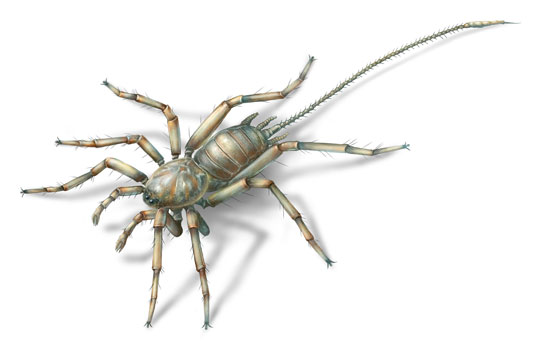
An Illustration of the Newly Described Cretaceous Arachnid Chimerarachne yingi

Cretaceous spider illustrated (Chimerarachne yingi).
Chimerarachne yingi illustrated (note the whip-like tail, the flagellum).

Picture credit: The University of Manchester

The researchers, led by Bo Wang from the Chinese Academy of Sciences and including Dr Russell Garwood (University of Manchester), state that Chimerarachne yingi closely resembles a member of the most primitive group of modern living spiders – the mesotheles.  These spiders have a segmented abdomen unlike other groups found today, such as the mygalomorphs (Mygalomorphae), which include well-known spider species like tarantulas and funnel-webs.  Mesothelae spiders are restricted to south-east Asia, China and Japan today, but in the past they probably had a world-wide distribution (across the ancient super-continent of Pangaea).

Several Important Spider Characteristics

Chimerarachne yingi has several important spider features such as the spinnerets and a modified male pedipalp, but, outside of the obvious tail, it also demonstrates some anatomical differences. For instance, the male pedipalp organ of Chimerarachne appears quite simple, more like that of a mygalomorph spider than a mesothele spider.

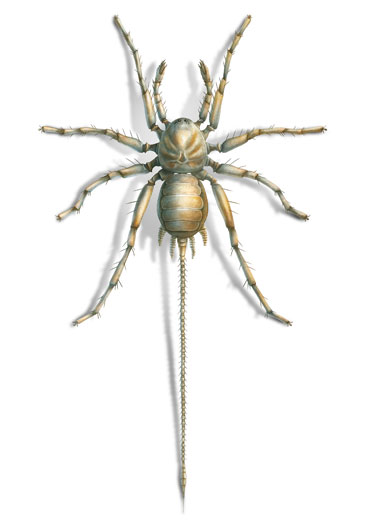
Note the Long “Whip-like Tail” (Flagellum)

Ancient spider illustrated - Chimerarachne yingi.
Chimerarachne yingi illustrated (dorsal view).

Picture credit: The University of Manchester

Dr Garwood explained:

“Based on what we see in mesotheles, we also would have expected the common ancestor of spiders alive today to have had four pairs of spinnerets, all positioned in the middle of the underside of the abdomen.  Chimerarachne only has two pairs of well-developed spinnerets, towards the back of the animal, and another pair that is apparently in the process of formation.”

Working Out the Evolutionary Tree of the Arachnida

The team studied the fossil using a range of different techniques.  One of Dr Garwood’s roles in the study was to help work out where this fossil sits in the evolutionary tree of the Arachnida.

Dr Garwood added:

“Perhaps the most interesting aspect of the new fossil is the fact that more than 200 million years after spiders originated, close relatives, quite unlike arachnids alive today, were still living alongside true spiders.”

Despite the beautiful state of preservation, the scientists are unable to state what function the tail might have had, or indeed, if this spider had a venomous bite.

Co-author of the study, published today, Dr Jason Dunlop (Museum Für Naturkunde in Berlin) stated:

“We don’t know whether Chimerarachne was venomous.  We do know that the arachnid ancestor probably had a tail and living groups like whip scorpions also have a whip-like tail. Chimerarachne appears to have retained this primitive feature.  Taken together, Chimerarachne has a unique body plan among the arachnids and raises important questions about what an early spider looked like, and how the spinnerets and pedipalp organ may have evolved.”

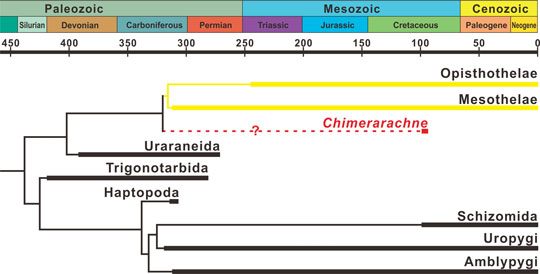
A Timescale Outlining the Proposed Evolution of the Chimerarachne

A timescale of Chimerarachne evolution.
A timescale showing the proposed evolutionary time scale for the Chimerarachne.

Picture credit: The University of Manchester

Despite its appearance, the research team have concluded that C. yingi is not a direct ancestor of modern day spiders.  Spider fossils, although very rare, go back a long way into deep geological time.  Instead Chimerarachne belongs to an extinct lineage of spider-like arachnids which shared a common ancestor with the spiders, some of whom survived into the mid-Cretaceous of Southeast Asia.

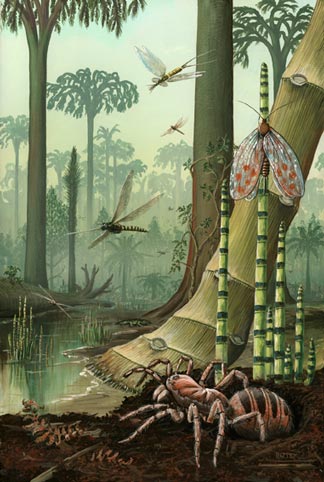
By the Late Carboniferous Arachnids Represented a Diverse and Important Group of Terrestrial Predators

A carboniferous scene.
By the Carboniferous the insects and the mostly predatory arachnids were already highly diversified.

Picture credit: Richard Bizley

The scientific paper: “Cretaceous Arachnid Chimerarachne yingi et sp. nov. Illuminates Spider Origins”, by Wang, B., Dunlop, J. A., Selden, P. A., Garwood, R. J., Shear, W. A., Müller, P. & Lei, X published in the journal Nature Ecology and Evolution.

Everything Dinosaur acknowledges the assistance of the University of Manchester in the compilation of this article.

Visit the Everything Dinosaur website: Everything Dinosaur.
1 02, 2018

Rare Ichthyosaur Specimen Only the Second to be Described

By |2023-09-16T06:02:09+01:00February 1st, 2018|Categories: Dinosaur and Prehistoric Animal News Stories, Dinosaur Fans, Main Page, Photos/Pictures of Fossils|0 Comments

Second Specimen of Wahlisaurus massarae to be Described

A rare 200 million-year-old specimen of a “fish lizard” has been discovered in a private collection twenty-two years after it was originally found.  The fossil is only the second example of Wahlisaurus massarae, a species of ichthyosaur, to have been described.  The new species was established in 2016, by University of Manchester palaeontologist, Dean Lomax following his detailed assessment of a fossil specimen that had been found in Nottinghamshire many decades ago.

Wahlisaurus massarae

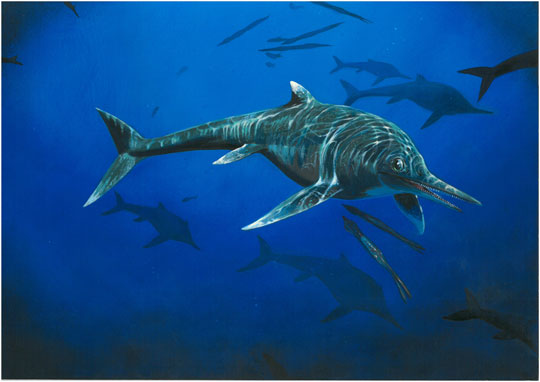
An Illustration of Wahlisaurus massarae

Wahlisaurus massarae illustrated
An illustration of the ichthyosaur known as Wahlisaurus massarae.

Picture credit: James McKay

To read Everything Dinosaur’s 2016 article on the discovery of W. massaraeNew Species of British Marine Reptile Surfaces.

This second example of Wahlisaurus was originally found in 1996.  It has now been donated to the Bristol Museum and Art Gallery, an institution that houses several examples of marine reptiles, including a specimen of Excalibosaurus, which, until the naming of Wahlisaurus two years ago had been the most recent species of ichthyosaur from the British Isles to have been scientifically described.

Ichthyosaurs in the Limelight

The Ichthyosauria clade has been much in the news of late.  For example, earlier this month the discovery of a large ichthyosaur fossil in the cliffs close to Lyme Regis in Dorset, was the subject of a BBC television documentary, narrated by Sir David Attenborough.

To read Everything Dinosaur’s article on “Attenborough and the Sea Dragon”: Attenborough and the Sea Dragon (BBC).

Dean Lomax named W. massarae in honour of two vertebrate palaeontologists who had spent much of their lives studying marine reptiles (Professor Judy Massare and Bill Wahl).

Dean commented:

“When Wahlisaurus was announced, I was a little nervous about what other palaeontologists would make of it, considering the new species was known only from a single specimen.  As a scientist you learn to question almost everything and be as critical as you can be.  My analysis suggested it was something new, but some palaeontologists questioned this and said it was just variation of an existing species.”

Visit the website of Dr Dean Lomax: British Palaeontologist Dr Dean Lomax.

Clues in the Shape of the Coracoid Bone

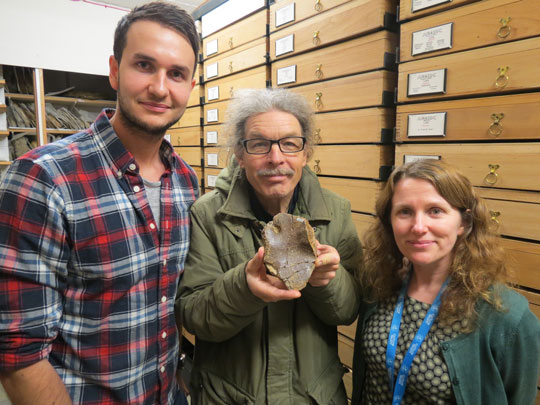
In this new research, Dean teamed up with Dr Mark Evans, palaeontologist and curator at the New Walk Museum, Leicester, and fossil collector, Simon Carpenter from Somerset.  The study focused on a specimen Dean identified in Simon’s personal collection, which is an almost complete coracoid bone (part of the shoulder girdle, otherwise referred to as the pectoral girdle).  This bone had exactly the same unique features of the equivalent bone in the holotype of Wahlisaurus described in 2016.  Simon’s fossil specimen was originally collected twenty years ago, from a quarry in northern Somerset.  Once the specimen’s rarity was realised, Simon immediately donated it to Bristol Museum and Art Gallery.

Dean Lomax, Simon Carpenter and Deborah Hutchinson with the Coracoid Specimen

Dean Lomax with Simon Carpenter and Deborah Hutchinson pose with the M. massarae coracoid.
Dean Lomax, (left), Simon Carpenter (centre) and Deborah Hutchinson from the Bristol Museum and Art Gallery (right) with the coracoid specimen.

Picture credit: Manchester University

Dean added:

“You can only imagine my sheer excitement to find a specimen of Wahlisaurus in Simon’s collection.  It was such a wonderful moment.  When you have just one specimen, “variation” can be called upon, but when you double the number of specimens you have it gives even more credibility to your research.”

The new discovery is from a time known as the Triassic-Jurassic boundary, right after a world-wide mass extinction.  For these reasons, the team have been unable to determine exactly whether the ichthyosaur was Late Triassic or Early Jurassic in age, although it is roughly 200 million-years-old.

A Better Understanding of the Skull Structure

As part of the research, Dr Evans cleaned the bones and removed additional rock from the first specimen.  This assisted in a detailed re-examination of the original skull, which led to the discovery of additional bones helping scientists to better understand the morphology of the skull of this British marine reptile.

Finding evidence to help confirm the validity of a genus within a private fossil collection helps to demonstrate the important contribution that can be made to science by dedicated and responsible fossil collectors.

The scientific paper: “An Ichthyosaur from the UK Triassic–Jurassic boundary: A second specimen of the Leptonectid Ichthyosaur Wahlisaurus massarae Lomax 2016” by Lomax, D. R., Evans, M. and Carpenter S., published in the Geological Journal.

For models and replicas of ichthyosaurs and other marine reptile figures: Prehistoric Animal Models and Figures Including Marine Reptiles.

15 01, 2018

Rainbow Feathered Jurassic Dinosaur Described in New Research

By |2024-05-10T18:26:47+01:00January 15th, 2018|Categories: Dinosaur and Prehistoric Animal News Stories, Dinosaur Fans, Main Page, Photos/Pictures of Fossils|0 Comments

Caihong juji – A Very Flashy Dinosaur

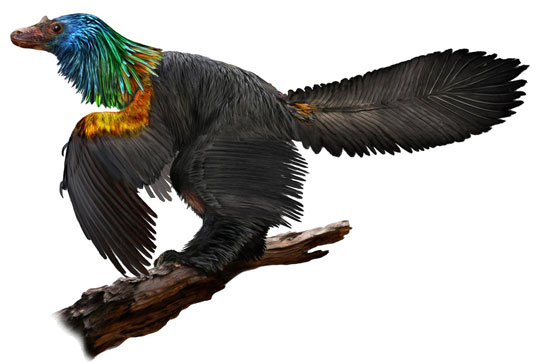
A team of scientists, writing in the journal “Nature Communications”, have described a new species of feathered dinosaur from Jurassic-aged rocks in China.  The dinosaur has been named Caihong juji, which means “rainbow with the big crest” in Mandarin.  This duck-sized dinosaur sported a bony crest on the top of its snout and its neck feathers may have been iridescent, as brightly coloured as feathers seen on humming birds today.

An Illustration of the Newly Described Feathered Dinosaur Caihong juji

Caihong juji illustrated.
An illustration of the Jurassic feathered dinosaur Caihong juji.

Picture credit: Velizar Simeonovski

Caihong juji A Bird-like Dinosaur

Caihong has been assigned a basal position in the Deinonychosauria, a clade of theropod dinosaurs that includes the dromaeosaurids and the troodontids and it roamed the forests of northern China some 161 million years ago (Oxfordian faunal stage of the Jurassic).  Although it was very bird-like, it was very different from its contemporary Anchiornis (A. huxleyi), as it lacked the bird-like triangular skull, however, it did possess proportionately long forearms.  C. juji had a long, narrow skull, superficially similar to the skulls of the much later Velociraptorinae.

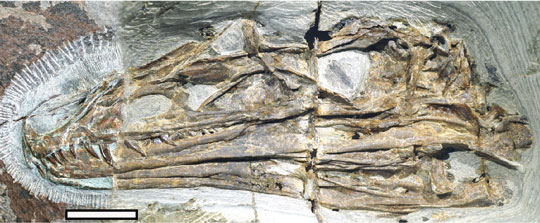
The Fossilised Skull of the Newly Described Basal Deinonychosaur Caihong juji

Skull of the newly described Caihong juji (left lateral view).
The skull of the newly described Caihong juji.  White scale bar = 1 cm.

Picture credit: Hu et al

A Shaggy Ruff of Rainbow Feathers

Lead author of the study, Professor Dongyu Hu (Shenyang Normal University), in collaboration with scientists from the University of Ghent, the Chinese Academy of Sciences, the University of Texas at Austin and the University of Geosciences (Beijing), subjected the fossil specimen to scanning electron microscope analysis to characterise 2,460 structures associated with the feathers.

Cross-sectional focused ion beam imaging revealed the presence of melanosomes, which are responsible for pigmentation and colouration.  When these fossil structures were compared to extant birds, the scientists were able to determine that Caihong had a shaggy ruff of iridescent, brightly-coloured feathers.

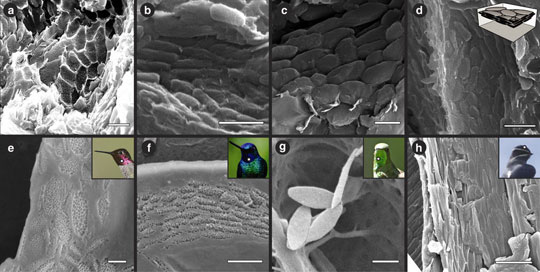
Platelet-like Nanostructures Indicate Iridescent Feathers (Caihong juji)

Nanostructures in Caihong juji compared to melanosomes in living birds.
Comparing melanosomes found in the fossil material to extant Aves.  All scale bars = 1,000 nm.

Picture credit: Nature Communications/Chao P.C.

The scanning electron microscope images above show platelet-like nanostructures on the fossilised feathers of C. juji (a-d).  These structures are then compared with melanosomes found in living birds, (e) Anna’s humming bird (Calypte anna), (f) a white tailed starfrontlet (Coeligena phalerata), a black-tailed trainbearer (Lesbia victoriae) and a moustached treeswift (Hemiprocne mystacea), picture (h).

Commenting on the significance of the discovery, Professor Julia Clarke (University of Texas at Austin) stated:

“Iridescent colouration is well known to be linked to sexual selection and signalling and we report its earliest evidence in dinosaurs.  The dinosaur may have a cute nickname in English, Rainbow, but it has serious scientific implications.”

A Combination of Ancient and More Modern Features

The fossil material, consisting of a slab and its counter slab was discovered by a farmer in 2014 at Gangou, Qinglong, (northern Hebei Province).  The rocks in this area are associated with the Tiaojishan Formation and exposures are also found in the neighbouring province of Liaoning.  Numerous feathered theropods have been found in the compressed volcanic ash layers and other sedimentary rocks associated with this region of northern China.

Caihong possessed a bony crest, a feature associated with earlier theropods from the Triassic and the Early Jurassic, the crest may have played a role in display or perhaps helping to distinguish males from females.  The bony crest could have evolved as a result of sexual selection pressure.  This ancient theropod feature contrasts with the identification of feathers with iridescence, this is the first time that such a feature has been identified in a non-avian dinosaur.

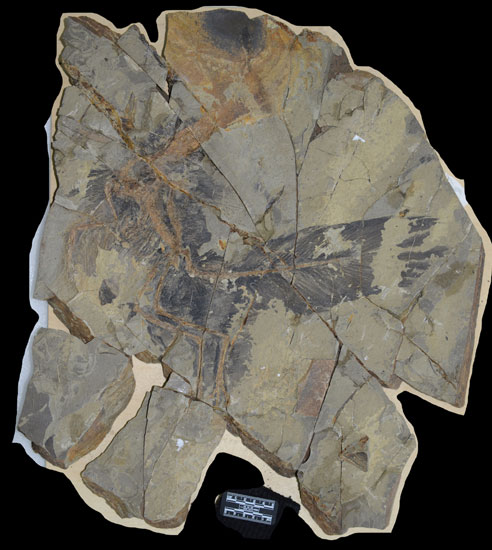
Caihong juji Fossil Material

Caihong juji holotype.
The crushed and flattened remains of Caihong juji (holotype specimen). The bones are coloured brown, whilst the feather impressions are black.

Picture credit: Nature Communications

For dinosaur and prehistoric animal models: Prehistoric Animal and Dinosaur Figures.

Asymmetrical Feathers

Caihong is also the earliest known dinosaur to have had asymmetrical feathers, similar in shape and structure to those feathers found on the wings of modern birds that help to control flight.  However, unlike extant birds, Caihong’s asymmetrical feathers were on its tail, not its short forelimbs, a discovery that suggests that early birds may have used their tails to help steer or to assist with lift.

Co-author of the research, Xing Xu (Chinese Academy of Sciences) explained:

“The tail feathers are asymmetrical but wing feathers are not, a bizarre feature previously unknown among dinosaurs including birds.  This suggests that controlling [flight] might have first evolved with tail feathers during some kind of aerial locomotion.”

Professor Clarke added:

“This combination of traits is unusual.  It has a rather Velociraptor-looking low and long skull with this fully feathered, shaggy kind of plumage and a big fan tail.  It is really cool… or maybe creepy looking depending on your perspective.”

An examination of the tail feathers associated with the 40 centimetre-long Caihong specimen suggests that the tail feathers would have provided a larger surface area than the famous Archaeopteryx, a theropod capable of powered flight, that lived a few million years later.  A spokesperson from Everything Dinosaur explained, that although Caihong could have been arboreal and it may have hopped from branch to branch, it was probably not volant (capable of powered flight).

Evidence of Mosaic Evolution

The combination of ancient and more modern anatomical traits in this basal deinonychosaur is an example of mosaic evolution, whereby, several different traits evolve independently.  The team hope to continue their research in a bid to understand how Caihong juji fits into the story of the evolution of flight in the Dinosauria.

The scientific paper: “A Bony-crested Jurassic Dinosaur with Evidence of Iridescent Plumage Highlights Complexity in Early Paravian Evolution” by Dongyu Hu, Julia A. Clarke, Chad M. Eliason, Rui Qiu, Quanguo Li, Matthew D. Shawkey, Cuilin Zhao, Liliana D’Alba, Jinkai Jiang and Xing Xu published in the journal “Nature Communications.”

Everything Dinosaur acknowledges the assistance of a press release from the University of Texas at Austin in the compilation of this article.

Everything Dinosaur website: Everything Dinosaur.

11 01, 2018

Ancient Butterflies, Flutter By as New Research is Published

By |2024-05-10T18:10:17+01:00January 11th, 2018|Categories: Dinosaur and Prehistoric Animal News Stories, Main Page, Photos/Pictures of Fossils|0 Comments

Fossilised Wing Scales Provide Evidence of Triassic Moths and Butterflies

Butterflies and moths might be regarded as delicate creatures, what with the diaphanous wings and light-weight bodies, but a new study published in the journal “Science Advances” suggests that the Lepidoptera have been around for many millions of years longer than previously thought.  The new fossil discoveries, made by an international team of scientists led by Timo van Eldijk and Bas van de Schootbrugge (Utrecht University), have also challenged the presumed co-evolution between flowering plants (angiosperms) and pollinating insects.

Triassic Moths and Butterflies

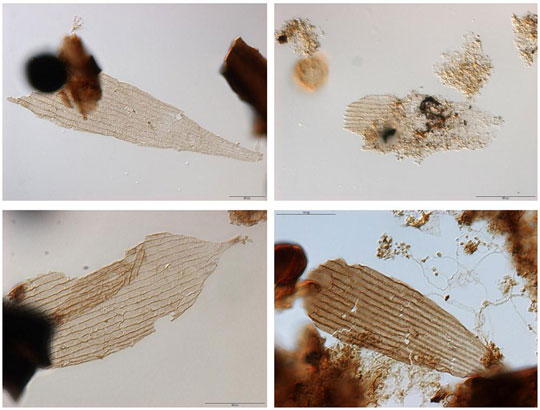
Fossil Evidence for Ancient Moths and Butterflies

Fossil scales of moths and butterflies.
Fossil scales of moths and butterflies as found in the drill cores from Schandelah, Lower Saxony (Germany).

Picture credit: University of Utrecht

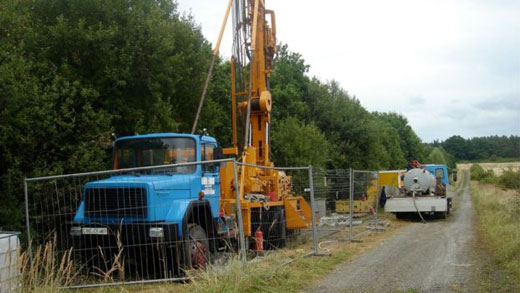
A core drilled into sediments in Schandelah, Lower Saxony (northern Germany), revealed microscopic wing scales some 70 million years older than the oldest, confirmed fossils of flowering plants.  The team’s findings suggest that wing and body scales found in rocks some 201 million years old, provide evidence that the Lepidoptera survived the end-Triassic mass extinction event.  Indeed, like the Dinosauria, moths and butterflies may have benefited from the extinction event, being able to exploit environmental niches vacated by extinct species.

Drilling into Ancient Rocks Triassic/Jurassic Strata

Drill cores reveal evidence of prehistoric moths and butterflies.
Drilling to produce the cores (northern Germany).

Picture credit: University of Utrecht/Dr Bas van de Schootbrugge

Commenting on the significance of the core drill study, Utrecht University student Timo van Eldijk explained:

“The mass extinction event occurred at the end of the Triassic and was associated with massive volcanism as the super continent Pangaea started to break apart.  As a result, biodiversity on land and in the oceans suffered a setback with many key Triassic species going extinct, including many primitive reptiles.  However, one major group of insects, the Lepidoptera, moths and butterflies, appeared unaffected.  Instead, this group diversified during a period of ecological turnover.”

The Moth and Butterfly “Tongue”

Extant butterflies and moths have a well-known association with flowering plants.  As they feed on the nectar with their long proboscis (an elongated, sucking mouthpart), they pick up pollen and therefore play an important role in angiosperm reproduction.

Dr Bas van de Schootbrugge (Department of Earth Sciences, Utrecht University) stated:

“The fossil remains contain distinctive hollow scales and provide clear evidence for a group of moths with sucking mouthparts, which is related to the vast majority of living moths and butterflies.”

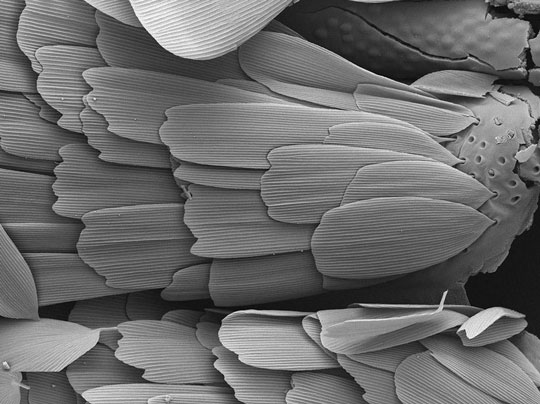
A Scanning Electron Microscope Image of the Wing Scales on an Extant Moth Species

A scanning electron microscope image of Glossata wing scales.
A scanning electron microscope image showing the wing scales on a modern-day Glossata moth.

Picture credit: University of Utrecht

What Did the Triassic Lepidoptera Feed On?

If there were moths and butterflies about some 201 million years ago, some 70 million years before the first flowering plants, then what were the adult animal’s feeding on?  The researchers conclude that the first lepidopterans were feeding on non-flowering seed plants (gymnosperms), one of the most successful plant groups of the early Mesozoic.  The earliest proboscid moths (Glossata), likely used their long, sucking mouthparts to feast on the sugary pollination beads secreted by several groups of gymnosperms.

There is another tantalising and very controversial aspect that is worth considering.  What if the flowering plants evolved much earlier than previously thought?

In 2013, Everything Dinosaur published an article providing information on some intriguing research that suggested flowering plants originated more than 240 million years ago, in the Early Triassic.  If flowering plants were around over 100 million years earlier than previously thought than a symbiotic relationship between early Lepidoptera and early angiosperms could have already been in place.

To read the article about evidence for Lower Triassic flowering plant fossils: Saying it with Flowers 100 Million Years Before Anyone Expected.

On the basis of the fossilised wing and body scales recovered from Upper Triassic and Lower Jurassic sediments, the scientists have provided the earliest evidence to date for moths and butterflies.  The diversity of the scales found confirm a Late Triassic radiation of lepidopteran forms, including the divergence of the Glossata, a clade that consists of the living butterflies and moths with a sucking proboscis.   The team conclude that the early evolution of the Lepidoptera was probably not severely interrupted by the end-Triassic mass extinction event.

Providing an Insight into Today’s Climate Change

MSc student Timo Van Eldijk stated:

“This evidence has transformed our understanding of the evolutionary history of moths and butterflies as well as their resilience to extinction.  By studying how insects and their evolution was affected by dramatic greenhouse warming at the start of the Jurassic, we hope to provide insight into how insects might respond to the human-induced climate change challenges we face today.”

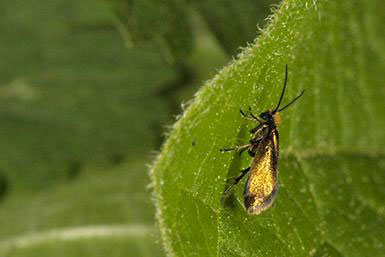
An Example of an Extant Member of the Glossata Clade

A living member of the Glossata clade.
An extant Glossata moth with similar wing scales to those found in the Upper Triassic/Lower Jurassic drill cores.

Picture credit: Hossein Rajaei/Staatliches Museum für Naturkunde Stuttgart (Stuttgart, Germany)

The scientific paper: “A Triassic-Jurassic Window into the Evolution of Lepidoptera” by Timo van Eldijk, Torsten Wappler, Paul Strother, Carolien van der Weijst, Hossein Rajaei, Henk Visscher and Bas van de Schootbrugge, published in the journal “Science Advances”.

Everything Dinosaur acknowledges the assistance of a press release from the University of Utrecht in the compilation of this article.

Visit the Everything Dinosaur website: Everything Dinosaur.

10 01, 2018

Fossils of Folkestone, Kent by Philip Hadland

By |2023-08-28T08:43:49+01:00January 10th, 2018|Categories: Book Reviews, Dinosaur Fans, Educational Activities, Geology, Main Page, Photos/Pictures of Fossils, Press Releases|0 Comments

A Review of the Fossils of Folkestone, Kent

Fossil collecting is a popular hobby and there are a number of excellent general guide books available.  However, the newly published “Fossils of Folkestone, Kent” by geologist and museum curator Philip Hadland, takes a slightly different perspective.  Instead of focusing on lots of fossil collecting locations, Philip provides a comprehensive overview of just one area of the Kent coast, the beaches and cliffs surrounding the port of Folkestone.

Here is a book that delivers what its title implies, if you want to explore the Gault Clay, Lower Greensand and Chalks around Folkestone then this is the book for you.

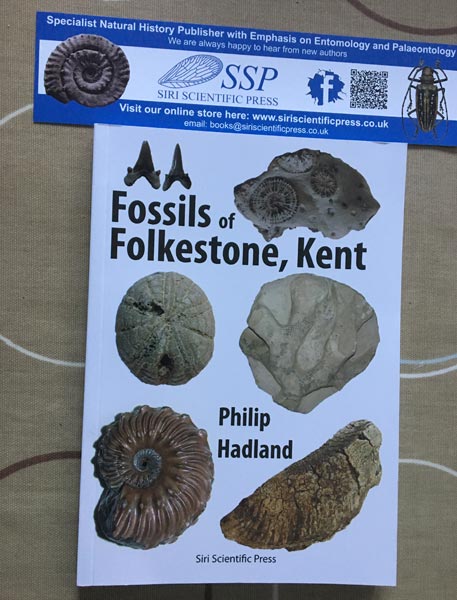
The Fossils of Folkestone, Kent by Philip Hadland – A Comprehensive Guide

Fossil collecting guide to the Folkestone area.
Fossils of Folkestone, Kent by Philip Hadland and published by Siri Scientific Press and priced at £12.99 plus postage.

Picture credit: Everything Dinosaur

A Comprehensive Overview of the Geology and the Palaeoenvironment of the Folkestone Area

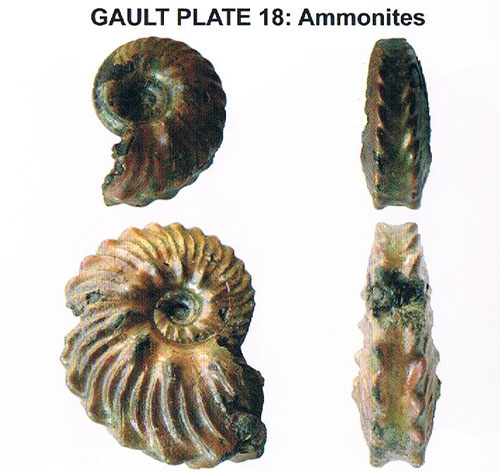
The author clearly has a tremendous affection for this part of the Kent coast.  His enthusiasm is infectious and the reader is soon dipping into the various chapters, dedicated to the rock formations exposed along the cliffs and the fossil delights to be found within them.  Folkestone is probably most famous for its beautiful Gault Clay ammonites, the clay being deposited around 100 million years ago and a wide variety of these cephalopods can be found preserved in the rocks.  The book contains more than 100 full colour plates, so even the beginner fossil hunter can have a go at identifying their fossil discoveries.

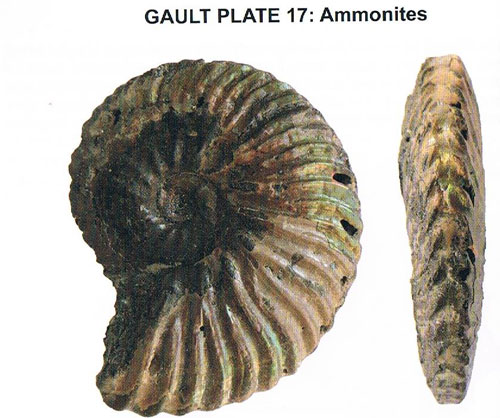
Clear Colour Photographs Help with Fossil Identification

Ammonite fossils from Folkestone (Anahoplites praecox).
Anahoplites praecox fossil from Folkestone.

Picture credit: Siri Scientific Press

Surprises on the Shoreline

The book begins by explaining some of the pleasures of fossil hunting, before briefly outlining a history of fossil collecting in the Folkestone area and introducing some of the colourful characters who were prominent fossil collectors in their day.  The geology of the area is explored using terminology that the general reader can understand and follow, but academics too, will no doubt gain a lot from this publication.

Intriguingly, the Cretaceous-aged sediments were thought to have been deposited in a marine environment, however, the Lower Greensand beds have produced evidence of dinosaur footprints.  The palaeoenvironment seems to have been somewhat more complex than previously thought, the Lower Greensand preserving evidence of inter-tidal mudflats, that were once crossed by dinosaurs.  Isolated dinosaur bones have also been found in the area and the book contains some fantastic photographs of these exceptionally rare fossil discoveries.

Helping to Identify Fossil Finds

Folkestone fossils - ammonites.
Folkestone fossils – ammonites.

Picture credit: Siri Scientific Press

Prehistoric Mammals

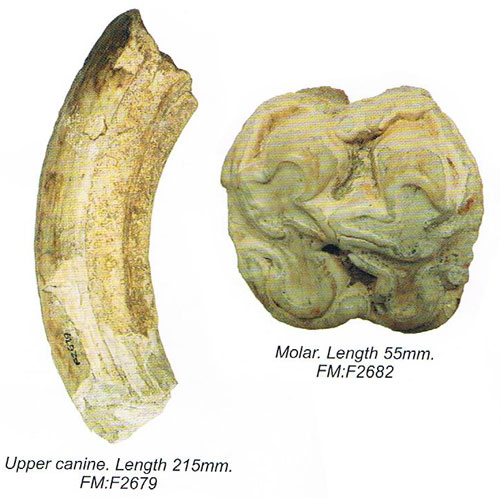
To help with identification, the colour plates and accompanying text are organised by main animal groups.  There are detailed sections on bivalves, brachiopods, corals, crustaceans, gastropods, belemnites and ammonites.  There are plenty of photographs of vertebrate fossils too and not just fish and reptiles associated with the Mesozoic.  Pleistocene-aged deposits are found in this area and these preserve the remains of numerous exotic prehistoric animals that once called this part of Kent home.

Fossil Teeth from a Hippopotamus Which Lived in the Folkestone Area During a Warmer Inter-glacial Period

Folkestone fossils - Teeth from a Hippopotamus.
Pleistocene mammal fossils from Folkestone (Hippopotamus upper canine and molar).

Picture credit: Siri Scientific Press

“Fossils of Folkestone, Kent”

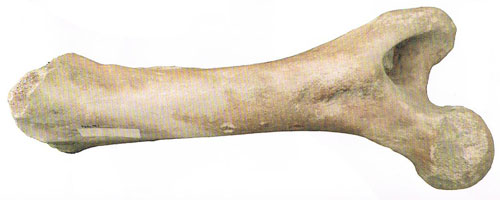
The author comments that the presence of hippos, along with other large mammals such as elephants as proved by fossil finds, demonstrates how very different Folkestone was just 120,000 years ago.  It is likely that humans were present in the area, evidence of hominins have been found elsewhere in England and in nearby France, but as yet, no indications of human activity or a human presence in this area have been found.  Perhaps, an enthusiastic fossil hunter armed with this guide, will one day discover the fossils or archaeology that demonstrates that people were living in the area and exploiting the abundant food resources that existed.

A Partial Femur from a Large Hippopotamus Provides Testament to the Exotic Pleistocene Fauna

Folkestone fossils - partial femur from a Hippopotamus.
A partial femur (thigh bone) from a Hippopotamus.

Picture credit: Siri Scientific Press

With a foreword by renowned palaeontologist Dean Lomax, “Fossils of Folkestone, Kent” is an essential read for anyone with aspirations regarding collecting fossils on this part of the English coast.  The book, with its weather-proof cover, fits snugly into a backpack and the excellent photographs and text make fossil identification in the field really easy.

If your New Year’s resolution is to get out more to enjoy the wonders of the British countryside, to start fossil hunting, or to visit more fossil collecting locations, then the “Fossils of Folkestone, Kent” by Philip Hadland would be a worthy addition to your book collection.

For further information on this book and to order a copy: Siri Scientific Press On-line.

Visit the award-winning Everything Dinosaur website: Everything Dinosaur.

9 01, 2018

On the Trail of Megalodon Ancestors

By |2023-08-28T08:37:18+01:00January 9th, 2018|Categories: Dinosaur and Prehistoric Animal News Stories, Main Page, Photos/Pictures of Fossils|0 Comments

Scientists in Alabama Solve Forty-Year Shark Puzzle

A team of scientists from the University of Alabama and the McWane Science Centre (Birmingham, Alabama), have solved a four-decade-long prehistoric shark mystery, naming a new species of Late Cretaceous marine predator, one that might possibly have been an ancestor of the mighty Megalodon (Carcharocles megalodon), the largest carnivorous shark known to science.  The new species of shark has been named Cretalamna bryanti, the species name honours the Bryant family, committed supporters of the University of Alabama, the McWane Science Centre and the Alabama Museum of Natural History.

These institutions have all been directly involved in the study and subsequent paper publication in the academic journal PeerJ.

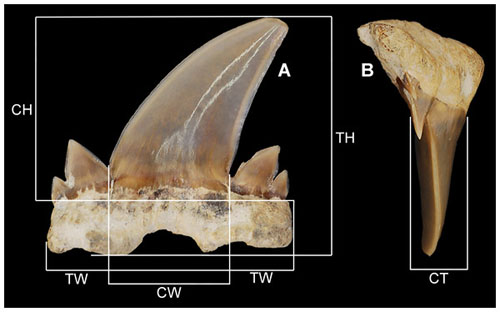
Cretalamna bryanti – Solving a Prehistoric Shark Puzzle

Views of the Holotype Tooth Helping to Define a New Species

Cretalamna fossil tooth.
Views of one of the fossil shark teeth helping to define a new Cretaceous shark species.

Picture credit: PeerJ

The picture shows the holotype fossil tooth (MSC 2984.1) in two views (A) labial view – a view of the tooth showing the side which would have faced the lips (if the fish had them), the side of the tooth facing the outside of the mouth and (B), mesial view, (directed to the middle of the body).  The scientists were able to establish a new species of a Cretalamna shark based on precise measurements of the features of the teeth within the study.

Key

(CH) = crown height.

(CT) = crown thickness.

(CW) = main cusp width.

(TH) = total height.

(TW) = total width

Thirty-Three Prehistoric Shark Teeth Collected

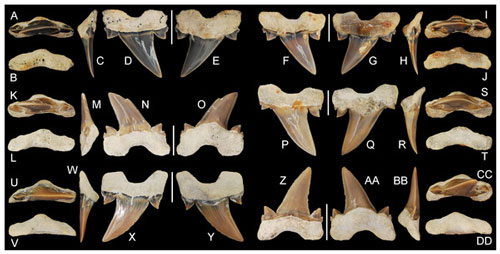
The shark has been described based on thirty-three teeth collected from four locations within Alabama over the best part of forty years.  The teeth all between two and two and three-quarters centimetres high, represent a shark known as an otodontid or “mega-tooth” shark.  As the skeletons of sharks are made from cartilage, they rarely fossilise but their teeth do survive the fossilisation process and as an individual shark may have hundreds or even thousands of teeth in its life, shark tooth fossils are relatively common.

Previously, the teeth had been assigned to the Cretalamna species C. appendiculatai, but these teeth are mostly associated with much older Cretaceous deposits found in Europe.  The Alabama shark teeth were collected from rocks representing two geological formations, the Tombigbee Sand Member and the slightly younger Lower Mooreville Chalk.  The fossils have been dated to 84 million to 82 million years ago, a time when this part of south-eastern America was covered by a shallow sea known as the Late Cretaceous Mississippi Embayment (part of the Western Interior Seaway).

Some of the Individual Teeth Examined in the Study

Cretalamna bryanti shark fossil teeth.
Cretalamna bryanti fossil teeth.

Picture credit: PeerJ

Explaining the postulated ancestry of the Megalodon sharks, lead author of the research Jun Ebersole (McWane Science Centre), stated:

“Over time, the sharks in the Megalodon line acquire [tooth] serrations, lose their cusplets (the little “fangs” on the sides of the main cusp) and grow to enormous sizes.   The newly described shark is an early member of this family, so its teeth are small and unserrated, with up to two pairs of cusplets.”

“Hell’s Aquarium”

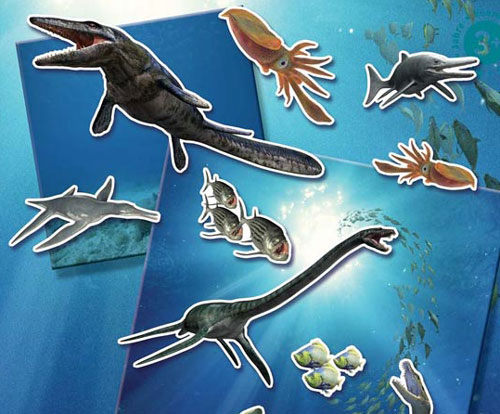
The establishment of this new species adds to the database regarding megafauna and hypercarnivores within the Western Interior Seaway.   This new otodontid would have co-existed with other large predatory sharks, along with elasmosaurids, huge meat-eating fish and members of the Mosasauridae.  Such was the number of large carnivores, that the Western Interior Seaway has been nicknamed “Hell’s Aquarium”!

Marine Life in the Western Interior Seaway (Late Cretaceous North America)

Western Interior Seaway.
Typical Western Interior Seaway marine life.

Picture credit: Everything Dinosaur

Note

The prehistoric shark referred to as “Megalodon” has recently been reclassified and named Otodus megalodon.

Visit the Everything Dinosaur website: Everything Dinosaur.

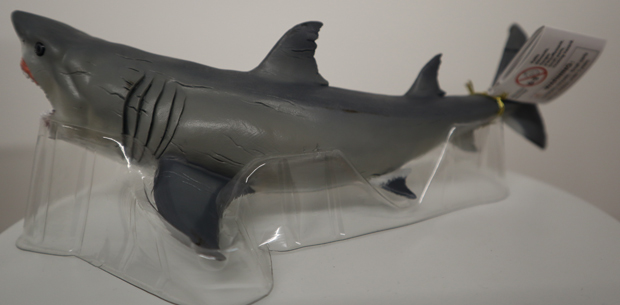
Papo Otodus megalodon model
The Papo Otodus megalodon model (lateral view). Picture credit: Everything Dinosaur.
Picture credit: Everything Dinosaur

To view the Papo model range: Papo Prehistoric Animal Models.

Go to Top