All about dinosaurs, fossils and prehistoric animals by Everything Dinosaur team members.

Pictures of fossils, fossil hunting trips, fossil sites and photographs relating to fossil hunting and fossil finds.

3 04, 2018

Isle of Skye Steps into the Jurassic Spotlight

By |2023-10-09T07:23:38+01:00April 3rd, 2018|Categories: Dinosaur and Prehistoric Animal News Stories, Dinosaur Fans, Main Page, Photos/Pictures of Fossils|0 Comments

Middle Jurassic Dinosaur Tracks Put Skye Firmly on the Map

More evidence of Middle Jurassic dinosaurs on the Isle of Skye has emerged.  In a paper published in the Scottish Journal of Geology, a team of international scientists including researchers from the University of Edinburgh and the Chinese Academy of Sciences, report on a series of dinosaur prints and tracks from the Lealt Shale Formation (Bathonian faunal stage) of the Great Estuarine Group at Rubha nam Brathairean (Brothers’ Point), on the Trotternish peninsula (Isle of Skye).

Middle Jurassic Dinosaurs

Evidence of Middle Jurassic dinosaurs is globally rare, there are just a few fossil sites that provide information about terrestrial fauna that existed around 168 million years ago.  Trace fossils from the Isle of Skye are playing an increasingly significant role as palaeontologists seek to better understand the evolution and distribution of different types of dinosaur.

One of the Sauropod Prints at Rubha nam Brathairean

Sauropod track on the foreshore (Isle of Skye).
Sauropod track from the Isle of Skye.

Picture credit: Jon Hoad

In 2015, Everything Dinosaur published an article featuring the discovery of a series of sauropod prints and tracks found on northern Skye, at a locality close to Duntulm Castle (Duntulm Formation).

To read this article: Isle of Skye Sauropods and their Water World.

Although, the Duntulm Castle site is just a few miles from the newly described trace fossils at Brothers’ Point and the strata in which the footprints and tracks were found are part of the Great Estuarine Group sequence of Middle Jurassic rocks, the two fossil sites represent different sub-units of strata.  The Lealt Shale Formation is geologically older than the fossiliferous rocks found at the Duntulm Castle site (Duntulm Formation).

Brackish, Lagoonal Environments Occupied by Middle Jurassic Dinosaurs

Both locations represent a sequence of deposits made in brackish, lagoonal environments.  The fact that a second series of sauropod tracks and prints have been found preserved in rocks laid down in a lagoon, strengthens the idea that Middle Jurassic sauropods habitually spent time in these environments.  Could this indicate that at least some Middle Jurassic sauropods were semi aquatic?

Did Middle Jurassic Sauropods Habitually Hang Out in Lagoons?
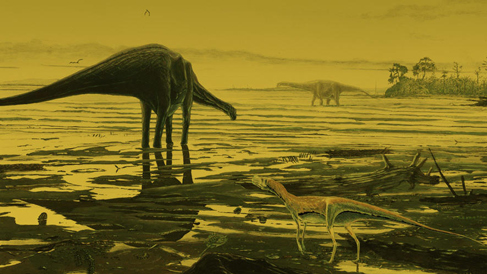
Isle of Skye Sauropods.
The Isle of Skye (Bathonian faunal stage).

Picture credit: Jon Hoad

Around Fifty Footprints Measured and Studied

The researchers measured, photographed and analysed around fifty footprints in a tidal area.  Working conditions on the rugged headland were difficult, due to the tidal environment and the often, inclement weather for which, the Trotternish peninsula is famed.  Despite the harsh conditions, the scientists were able to identify two trackways and many examples of isolated prints.

The location preserves numerous small sauropod manus (hand) and pes (foot) prints along with several isolated and broken medium-to-large tridactyl prints.  The three-toed (tridactyl) prints indicate the presence of theropods (most probably carnivorous dinosaurs).  Measurements of the sauropod tracks and stride lengths indicate that these trace fossils were made by relatively small members of the Sauropoda, the tracks indicate individuals around two metres high at the shoulders.

The sauropod tracks, with their characteristic narrow gauge and toe morphology, have been tentatively assigned to the ichnotaxon Breviparopus.  The theropod trackmaker remains equally enigmatic, however, some of the three-toed prints are reminiscent of the tracks associated with the ichnotaxon Eubrontes.

One of the Sauropod prints from the Lealt Shale Formation
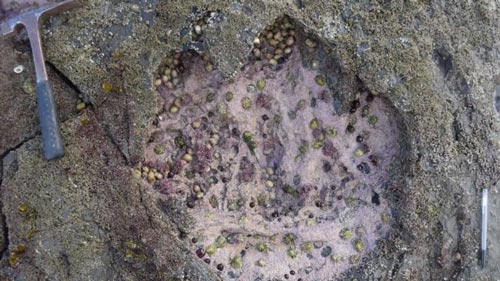
Isle of Skye Sauropod footprint.
Sauropod footprint from the Isle of Skye.  The geological hammer and the pen provide scale (as do the copious gastropods).

Picture credit: Paige dePolo (University of Edinburgh)

Commenting on the Discovery

Commenting on the significance of this discovery, one of the authors of the scientific paper, Paige E. dePolo (University of Edinburgh) stated:

“This tracksite is the second discovery of sauropod footprints on Skye.  It was found in rocks that were slightly older than those previously found at Duntulm on the island and demonstrates the presence of sauropods in this part of the world through a longer timescale than previously known.  This site is a useful building block for us to continue fleshing out a picture of what dinosaurs were like on Skye in the Middle Jurassic.”

Co-author Dr Stephen Brusatte (University of Edinburgh), added:

“The more we look on the Isle of Skye, the more dinosaur footprints we find.  This new site records two different types of dinosaurs — long-necked cousins of Brontosaurus and sharp-toothed cousins of T. rex — hanging around a shallow lagoon, back when Scotland was much warmer and dinosaurs were beginning their march to global dominance.”

A Fossil Bias?

Although the discovery of a second site, demonstrating sauropod tracks in a lagoonal depositional environment, raises the intriguing idea that these large, long-necked herbivores spent time in such environments, palaeontologists have to be careful what they infer from such data.  Sauropods may have spent much of their time in different habitats, such as forests, or perhaps, in more open environments such as fern prairies, however, in such environments the fossil preservation potential for things like tracks and footprints are that much lower.  Hence, the evidence for such behaviour may not exist, there could be a preservational bias in favour of recording sauropod activity in brackish lagoons.

Thanks to this dedicated research team, more information has been obtained with regards to the Middle Jurassic palaeofauna of Scotland.  We look forward to future discoveries and fossil finds that will continue to inform the debate.

For models and replicas of sauropods and other dinosaurs: Wild Safari Ltd Prehistoric World Dinosaurs.

The scientific paper: “A Sauropod-dominated Tracksite from Rubha nam Brathairean (Brothers’ Point), Isle of Skye, Scotland” by Paige E. dePolo, Stephen L. Brusatte, Thomas J. Challands, Davide Foffa, Dugald A. Ross, Mark Wilkinson and Hong-yu Yi published in the Scottish Journal of Geology

“The Rise and Fall of the Dinosaurs” by Dr Steve Brusatte

One of the authors of this scientific paper (indeed one of the authors of the 2015, Duntulm Formation tracks research), Dr Steve Brusatte (School of Geosciences at Edinburgh University), has a new dinosaur book out next month.  Look out for the excellent “The Rise and Fall of the Dinosaurs” coming into shops in May.

New Dinosaur Book Out Very Soon

"The Rise and Fall of the Dinosaurs"
“The Rise and Fall of the Dinosaurs” by Steve Brusatte.

Picture credit: Pan Macmillan

To read Everything Dinosaur’s recent book review: A Review of “The Rise and Fall of the Dinosaurs”.

Visit the Everything Dinosaur website: Everything Dinosaur.
2 04, 2018

An Astonishing Edmontosaurus Exhibit

By |2024-05-10T07:35:25+01:00April 2nd, 2018|Categories: Dinosaur Fans, Main Page, Photos/Pictures of Fossils|0 Comments

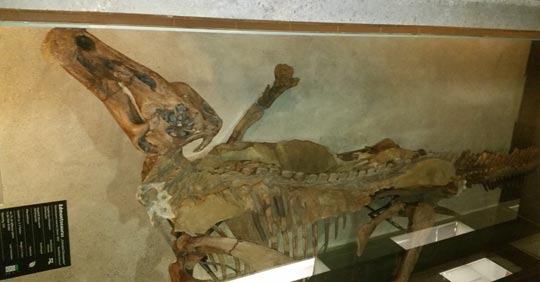
Edmontosaurus Exhibit (Senckenberg Naturmuseum, Frankfurt)

The Natural History Museum of Frankfurt (Senckenberg Naturmuseum), houses one of the largest vertebrate fossil collections in the whole of Germany.  It may be undergoing extensive refurbishment at the moment, but team members at Everything Dinosaur were still able to tour the museum galleries and look at the amazing fossil displays.

The Senckenberg Naturmuseum

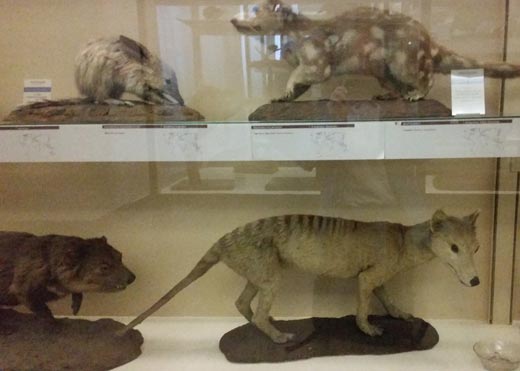
This museum documents the biodiversity of life and has an extensive display of stuffed animals including several Australian marsupials, with amongst them a Thylacine.  Naturally, most of our time was spent exploring the large number of exhibits that demonstrate the evolution of life on Earth, one of favourite parts of the museum had a display featuring a partial skeleton of an Edmontosaurus.

The Mummified Edmontosaurus Exhibit on Display at the Senckenberg Naturmuseum, Frankfurt

Edmontosaurus fossil exhibit.
The Edmontosaurus exhibit at the Frankfurt Natural History Museum. Picture credit: Everything Dinosaur.

Picture credit: Everything Dinosaur

The fossil specimen, which includes a complete skull also has sections of preserved skin.

For dinosaur models, including replicas of hadrosaurs including Edmontosaurus: Prehistoric Animal Models and Figures.

Marsupials on Display

The Thylacine Exhibit at the Frankfurt Natural History Museum

A Tasmanian tiger exhibit.
Stuffed Thylacine (Tasmanian tiger). Picture credit: Everything Dinosaur.

Picture credit: Everything Dinosaur

Visit the award-winning Everything Dinosaur website: Everything Dinosaur.
1 04, 2018

Updating Arkansaurus after New Research is Published

By |2024-05-10T18:30:54+01:00April 1st, 2018|Categories: Dinosaur and Prehistoric Animal News Stories, Dinosaur Fans, Main Page, Photos/Pictures of Fossils|0 Comments

Updating Arkansaurus fridayi

A few days ago, Everything Dinosaur published an article about the newly described basal ornithomimosaur called Arkansaurus fridayi.  Although the fossil bones were found nearly fifty years ago, the scientific paper describing the fossils and officially naming this dinosaur has only just been published (Journal of Vertebrate Palaeontology).  Lead author of the paper, ReBecca Hunt-Foster of the Bureau of Land Management, emailed us so that we could post up more images of this significant fossil discovery.

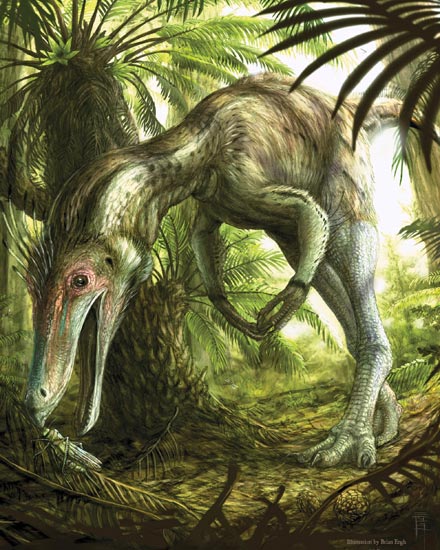
A Life Restoration of the Basal Ornithomimosaur Arkansaurus fridayi

A life restoration of Arkansaurus.
Arkansaurus fridayi life restoration.

Picture credit: Brian Engh

To read Everything Dinosaur’s earlier article on the formal description of Arkansaurus: “Arkansas Reptile” – A Rare Insight into Appalachian Dinosaurs.

More Primitive Than Asian Ornithomimosaurs That Lived at the Same Time

Ornithomimosaurs (the ostrich-mimic dinosaurs) are quite well known from the Early Cretaceous of Asia, however, very little is known about North American ornithomimosaurs from this time in Earth’s history, hence the importance of the Arkansaurus fossils.  The dinosaur has been named from a single, partial right foot, recovered from the Lower Cretaceous (Albian to Aptian faunal stages) of the Trinity Group of Arkansas.

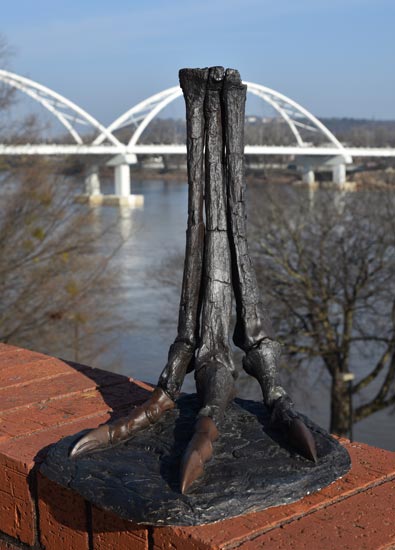
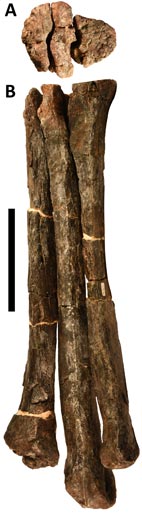
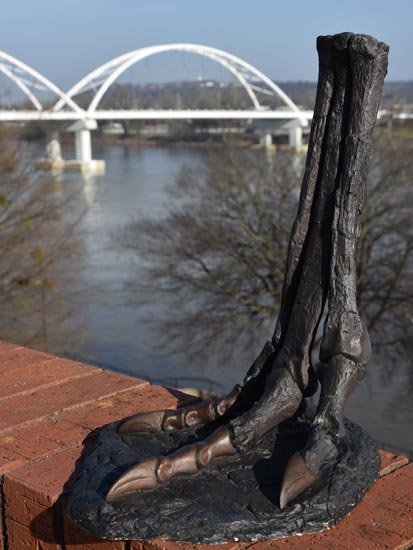
A Cast of the Fossil Foot Bones (Anterior View)

Foot bones (Arkansaurus fridayi).
Arkansaurus fridayi foot bones (cast).

Picture credit: R. Hunt-Foster

Studying Arkansaurus fridayi

Contemporaneous with the likes of Beishanlong (B. grandis) from Gansu Province (north-west China), living around 113 million years ago, Arkansaurus fridayi can be distinguished from other ornithomimosaurs based on differences in the toe claws (pedal unguals) and the presence of a laterally compressed third metatarsal (toe bone) that is ovoid in shape when looked at in proximal view.  Other anatomical differences are cited by the researchers including a distal ungual with a very weak flexor tubercle, lacking spurs.

Two Views of the Metatarsal Bones of Arkansaurus

Fossil foot bones of Arkansaurus.
Views of the metatarsals of Arkansaurus.

Picture credit: R. Hunt-Foster

The picture above shows two views of the toe bones (metatarsals)  of Arkansaurus (a) in proximal view, that is viewed from the top of the bone closest to the ankle looking down onto the bones and (b) anterior view, viewed from the front.  The third metatarsal is actually the bone in the middle.  The scientists conclude that the condition of the third toe bone suggests that Arkansaurus fridayi is more basal than Asian ornithomimosaurs of similar age, but consistent with older North American forms.

A Cast of the Fossil Toe and Claw Bones

Arkansaurus fridayi foot bones (a cast).
A view of a cast of the foot bones of Arkansaurus fridayi.

Picture credit: R. Hunt-Foster

The Radiation of the Ornithomimosaurs

This specimen provides knowledge of a poorly understood radiation of ornithomimosaurs in the Cretaceous landmass known as Appalachia and is the only known saurischian dinosaur fossil found to date in the state of Arkansas.

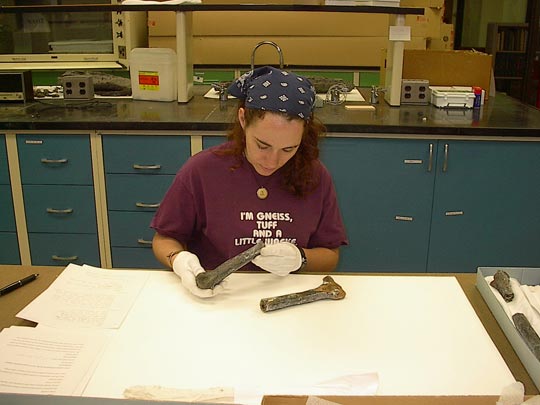
ReBecca Hunt-Foster Has Worked on These Fossils for Several Years

ReBecca Hunt Foster studying fossil bones
ReBecca Hunt-Foster examining limb bones (2003).

Picture credit: R. Hunt-Foster

Our thanks to Rebecca Hunt-Foster for her assistance with this article.

Visit the Everything Dinosaur website: Everything Dinosaur.
31 03, 2018

Extinction and Extirpation a Helpful Explanation

By |2024-05-10T07:58:22+01:00March 31st, 2018|Categories: Dinosaur Fans, Geology, Main Page, Palaeontological articles, Photos/Pictures of Fossils|0 Comments

Defining Extirpation

The fossil record, despite its extremely fragmentary nature remains the best scientific tool available for learning about life in the past.  It is far from complete and it can only provide a limited amount of information about organisms, ecosystems and palaeoenvironments, but it has provided evidence of extinctions and five major mass extinction events have been identified in the immense time period known as the Phanerozoic.

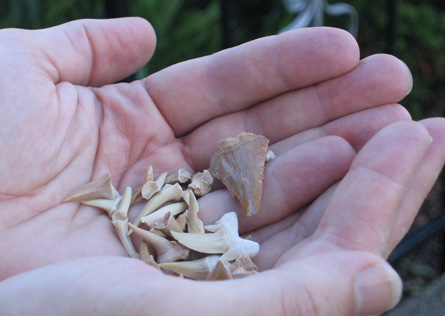
A Selection of Shark Teeth Fossils

fossilised shark teeth.

A successful fossil hunt, but many organisms are only known from fragmentary fossil material.

Picture credit: Everything Dinosaur

An Extinction is Forever

Notwithstanding the technological developments heralded by advances in genetics, an extinction is finite.  Extinctions represent the complete, world-wide end of the line for a species.  There are no individuals representing that species to be found anywhere.  Non-avian representatives of the Dinosauria, the long-necked sauropods for example, are extinct, the very last of these animals, collectively termed titanosaurs, died out at the end of the Cretaceous, some 66 million years ago.

However, it is important to distinguish local extinctions, whereby an organism becomes extinct in a region or area, from true, global extinction.  A species or genus may die out in one part of the area where it is distributed, but it might be thriving, or at least surviving everywhere else.  Identifying local extinctions, especially in an incomplete fossil record, where many of the fossils have been transported long distances and with a record of moving continents (tectonic plate theory), is extremely challenging.

Extirpation

The correct scientific term for a local or regional extinction is “extirpation”, an organism may cease to exist in one area but could still be found in other areas.  Palaeontologists usually use the term extinction in its correct sense, noting the complete disappearance of an organism.  Thanks to the vagaries of the fossil record, identifying extirpation events in deep time is extremely difficult.

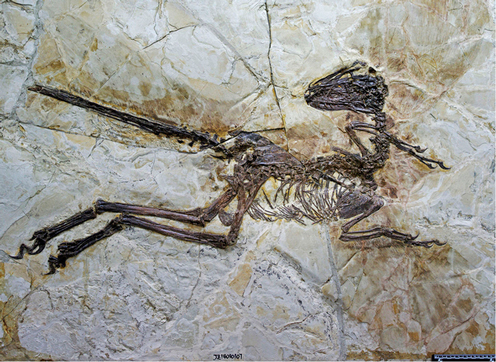
The Liaoning Province of northern China has provided scientists with numerous examples of feathered dinosaurs.  Their remains are often beautifully preserved, a result of the way in which these animals may have died .  Corpses were deposited in lakes and sank to the muddy, still bottom before being rapidly buried by fine ash deposited over the region by the nearby volcanoes.  Whether some of these animals drowned, or whether their deaths were directly attributable to the volcanism is difficult to say for certain in most cases.

Zhenyuanlong Fossil (Zhenyuanlong suni) from Liaoning Province

Zhenyuanlong fossil.

Large-bodied, short-armed Liaoning dromaeosaurid described in 2015 (Zhenyuanlong suni).

Picture credit: Chinese Academy of Geological Science

The Beasts of the Mesozoic series includes a number of dromaeosaurid figures including Zhenyuanlong suni.

To view this series: Beasts of the Mesozoic Articulated Dinosaur Figures.

Extinction Events Associated with Liaoning Fossils

Unfortunately, whilst a devastating deposit of volcanic ash, perhaps a pyroclastic cloud or the release of toxic carbon monoxide fumes could have led to the deaths of many animals within a habitat, it is very difficult to determine whether such events led to a local extinction (extirpation).  In the case of the Liaoning fossils, the stratigraphic record would indicate numerous volcanic episodes but whether a single episode or a series of catastrophic events led to the demise of an entire taxon in the region it is impossible to say.  However, the forest ecosystem with its large lakes would have suffered a loss of individuals and probably a reduction in diversity over time.

Visit Everything Dinosaur’s website: Everything Dinosaur.

28 03, 2018

A New Megaraptoran Theropod – Tratayenia rosalesi

By |2023-10-06T09:00:20+01:00March 28th, 2018|Categories: Dinosaur and Prehistoric Animal News Stories, Dinosaur Fans, Main Page, Photos/Pictures of Fossils|0 Comments

After the Carcharodontosaurids Tratayenia rosalesi Ruled

Scientists have described a new type of megaraptoran theropod dinosaur from Upper Cretaceous strata in north-western Patagonia (Argentina).  Although, less than five percent of the skeleton has been discovered, the fossil bones are similar to other megaraptorids such as Aerosteon (A. riocoloradense) and Megaraptor (M. namunhuaiquii).  This has enabled the researchers, that include Juan Porfiri from the Museo de Ciencias Naturales (Buenos Aires), and Matthew Lamanna of the Carnegie Museum of Natural History (Pittsburgh), to confidently assign these fossils to the Megaraptora clade, the clade of “giant thieves”!

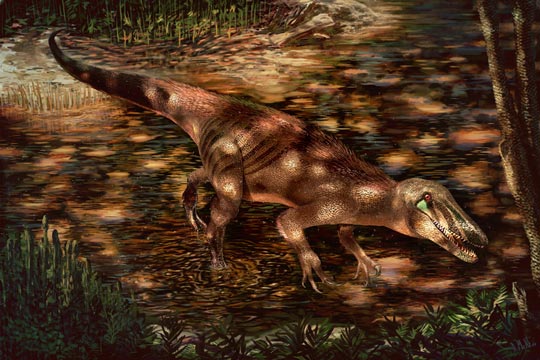
A Scientific Illustration of the New South American Megaraptoran T. rosalesi

Tratayenia stalking prey.
An illustration of the new Late Cretaceous megaraptoran dinosaur Tratayenia.

Picture credit: Andrew McAfee (Carnegie Museum of Natural History)

Tratayenia rosalesi

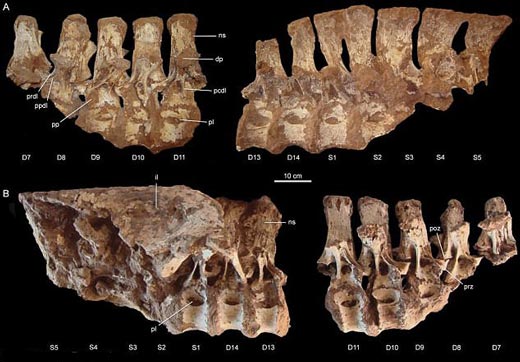
Described from a series of articulated dorsal and sacral vertebrae, along with two ribs and elements of the hips, the dinosaur named Tratayenia rosalesi is estimated to have been around eight to nine metres in length, possibly even bigger.  Tratayenia is the geologically youngest of the Megaraptora known to science and it is the first megaraptoran that preserves the complete sequence of sacral vertebrae (fused back bones located over the hips).

Its discovery has helped palaeontologists to learn more about the hips and pelvic region of these Late Cretaceous meat-eaters.  The genus name is from Tratayén, the area in the eastern part of Neuquén Province from where the fossils come from.  The trivial name honours Diego Rosales who made the initial fossil discovery.  Tratayenia rosalesi is pronounced tra-ta-yen-nee-ah rose-ah-less-eye.

View of the Articulated Dorsal and Sacral Vertebrae (Tratayenia rosalesi)

Tratayenia, dorsal and sacral vertebrae.
Views of the articulated dorsal and sacral vertebrae (Tratayenia rosalesi).

Picture credit: Cretaceous Research

Santonian Faunal Stage

The fossil material comes from a horizon of Upper Cretaceous-aged deposits (Santonian faunal stage), in the Bajo de la Carpa Formation of the Neuquén Group (Neuquén Basin), exposed close to the small town of Añelo.  Notwithstanding the fact that the age of the fossil material representing the megaraptorids Aerosteon and Orkoraptor (O. burkei) remains uncertain, these fossils could describe the geologically youngest megaraptoran to date, thus extending their temporal range.  In addition, it is the largest carnivorous vertebrate to have been found in the Bajo de la Carpa Formation, as such, the researchers speculate that this fearsome, long-jawed, long-clawed dinosaur was an apex predator.

Based on comparisons with close relatives like Megaraptor, palaeontologists estimate that this carnivorous dinosaur sported two, forty-centimetre-long talons on the innermost fingers of each hand.  The discovery of Tratayenia adds weight to the hypothesis that the megaraptorids became the top predators in the southern parts of Gondwana following the extinction of the carcharodontosaurids.

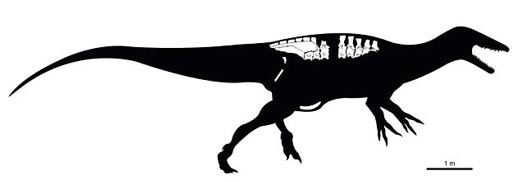
An Illustration of Tratayenia rosalesi Showing Known Fossil Material

Tratayenia silhouette, known bones in white.
The bones in white indicate the known fossil material (holotype) of Tratayenia.

Picture credit: Cretaceous Research

Megaraptoran Dinosaurs

An article that explains more about the megaraptoran dinosaurs including Murusraptor: Getting Our Claws into the Megaraptora.

For an article that outlines the potential origins of the Megaraptora: “Lightning Claw” – A Deadly Predator.

The scientific paper: “A New Megaraptoran Theropod Dinosaur from the Upper Cretaceous Bajo de la Carpa Formation of North-western Patagonia” by Juan D. Porfiri, Rubén D.Juárez Valieri, Domenica D.D.Santos and Matthew C. Lamanna published in the journal “Cretaceous Research”.

Visit the award-winning Everything Dinosaur website: Everything Dinosaur.
17 03, 2018

“Attenborough’s Sea Dragon” on Display

By |2023-10-07T06:29:53+01:00March 17th, 2018|Categories: Dinosaur and Prehistoric Animal News Stories, Main Page, Photos/Pictures of Fossils|0 Comments

Ichthyosaur Specimen on Display at Charmouth Heritage Coast Centre

The fossilised remains of a new species of ichthyosaur are on display at the Charmouth Heritage Coast Centre for the rest of this year.  The Centre, based on the famous Jurassic coast of Dorset, will be home to the partial skeleton of a four-metre-long, new species of “fish lizard”, it’s discovery and excavation was documented in a BBC television programme shown back in January.

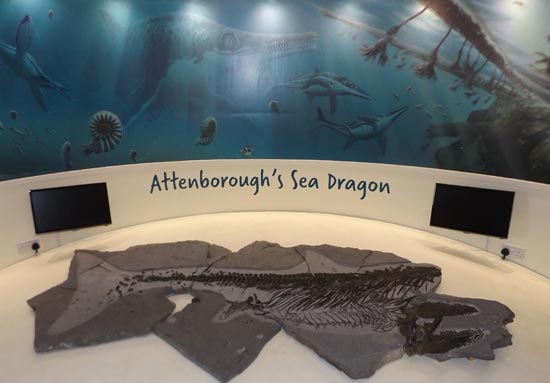
The New Ichthyosaur Display at the Charmouth Heritage Coast Centre

Ichthyosaur specimen on display.
The “Sea Dragon” fossil on display.  The head of the specimen has been lost, it probably was eroded out of the cliff face prior to Chris Moore’s discovery.

Picture credit: Charmouth Heritage Coast Centre

The Tale of a Sea Dragon

Narrated by Sir David Attenborough, the programme told the story of the fossil’s discovery by experienced local collector Chris Moore.  Chris along with a team of climbing experts and geologists spent weeks excavating the rock containing the creature by hand from a Dorset cliff.  The headless skeleton, that even retained evidence of ichthyosaur skin, was transported by boat back to Lyme Regis so that the matrix covering the bones could slowly be removed and full details of the 200-million-year-old specimen revealed.

To read Everything Dinosaur’s article about the BBC documentary: Attenborough and the Sea Dragon.

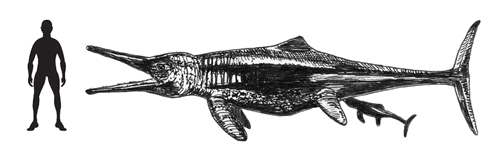
Experts from Southampton and Bristol Universities studied and analysed the skeleton as well as the exceptionally well-preserved skin still on the bones.  They identified it as a new species of ichthyosaur, probably an animal of the open ocean that for some reason had come closer to the shore, where, in the coastal waters, it was attacked and killed by a much larger animal.  The palaeontologists, preparators and researchers had a murder scene on their hands.  In the television programme, a CGI version of the unfortunate marine reptile was created and its final moments re-enacted, an attack by a super predator, one of the most dangerous animals on the planet during the Early Jurassic – a ferocious Temnodontosaurus.

Everything Dinosaur’s Illustration of Temnodontosaurus

Scale drawing of Temnodontosaurus.
Temnodontosaurus scale drawing (T. platyodon) shown giving birth. Picture credit: Everything Dinosaur.

Picture credit: Everything Dinosaur

For models and replicas of ichthyosaurs and other marine reptiles: CollectA Prehistoric Life Models.

Attacked by a Much Larger Ichthyosaur

As the fossilised skeleton was slowly but surely revealed, damaged vertebrae and broken ribs provided evidence of an attack by a much bigger marine reptile.  The assailant was probably a Temnodontosaurus, one of the largest of the Ichthyosauria, capable of growing to around ten metres in length with a body mass estimated at approximately two tonnes.  The attacker did not get its prize, the researchers speculated that the initial bite on the unfortunate victim, punctured the animal’s body cavity releasing air from the lungs and the ichthyosaur’s body descended into the deep.

The body of the ichthyosaur descended rapidly and it was soon out of the diving range of the attacker, coming to rest on the seabed.  The corpse was rapidly covered by fine sediment and fossilisation eventually took place, two hundred million years later, fossil hunter Chris Moore spotted part of the skeleton eroding out of a cliff and the process of excavating the specimen was begun.

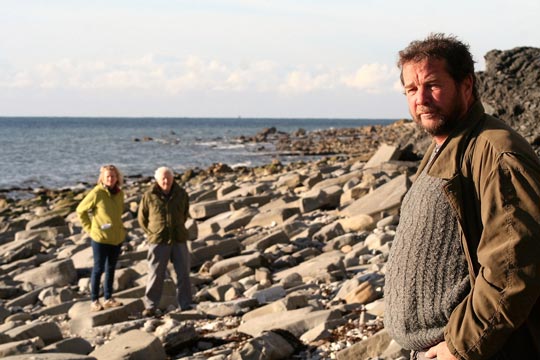
Chris Moore (Foreground) with Sir David Attenborough and Sally Thompson (Producer/Director of the Television Documentary)

Chris Moore on the Dorset Coast
Chris Moore (foreground) with television programme director/producer Sally Thompson and Sir David Attenborough (background).

Picture credit: Charmouth Heritage Coast Centre

Sea Dragon Tale Narrated by Sir David Attenborough

Veteran naturalist, life-long fossil collector and highly esteemed broadcaster, Sir David Attenborough explained in the hour-long programme:

“It’s been a fascinating journey of discovery, but for me the real wonder is the bones themselves.  It is a long time spent just revealing the body of this creature, but it’s also revealed this extraordinary story of life and death, predator and prey fighting it out in the seas 200 million years ago, just down there (at the beach).”

Team members from Everything Dinosaur are hoping to visit the exhibit at the Charmouth Heritage Coast Centre when they will be working on the Dorset coast in the autumn.

As the BBC television programme drew to a close, Sir David Attenborough remarked:

“For Chris [Chris Moore], this has been a labour of love and its filled in another gap in the palaeontological jigsaw.  A story that all started with an odd-looking boulder on a Dorset beach.  It’s extraordinary to think that some 200 million years ago exactly here, the greatest predator of its time was swimming around in the sea, and that’s what I love about fossils and fossil hunting, it gives you an extraordinarily vivid insight into what the world was like millions of years before human beings even appeared on this planet.”

Attenborough’s Sea Dragon is on display at Charmouth Heritage Coast Centre throughout 2018.

For further information on the Charmouth Heritage Coast Centre: Charmouth Heritage Coast Centre.

Visit the award-winning Everything Dinosaur website: Everything Dinosaur.
16 03, 2018

“Beast from the East” Does Not Stop Dedicated Fossil Hunters

By |2023-10-07T06:37:03+01:00March 16th, 2018|Categories: Dinosaur Fans, Main Page, Photos/Pictures of Fossils|0 Comments

Irregular Sea Urchins in Unseasonable Weather

The area of the Dorset coast around Lyme Regis and Charmouth is often said by locals to experience its very own microclimate.  Everything Dinosaur team members have experienced this phenomenon for themselves, it can be raining very heavily inland at Axminster but on the coast, it can be a dry and sunny.  However, when the “Beast from the East” affected most parts of the UK recently, the Lyme Regis area had its fair share of bad weather.

Cold Snap Does Not Deter Fossil Hunters

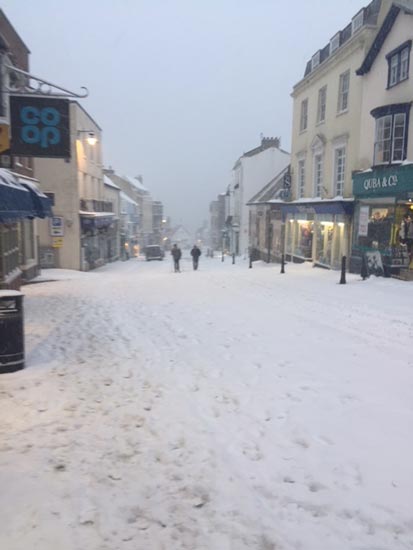
Our fossil hunting chum, Brandon Lennon took a photograph of Lyme Regis high street as the cold snap hit.  Brandon commented that shoppers were taking to skis to ensure that they could traverse the steeply sloping terrain.

The “Beast from the East” Made Its Presence Felt on the Dorset Coast

Snowy conditions in Lyme Regis
Lyme Regis high street covered in snow.

Picture credit: Brandon Lennon

Fossil Collecting in the Snow

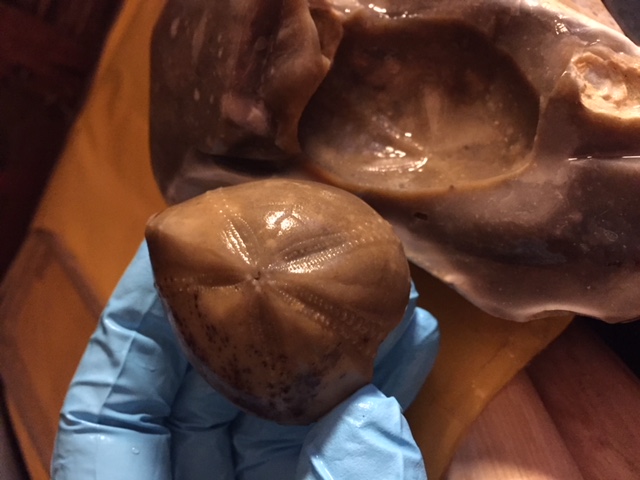
Fossil hunting in the snow is difficult but not impossible.  With the treacherous road conditions, most fossil collectors who would have had to travel into the Lyme Regis area by car, sensibly postponed their journeys.  This meant that local fossil hunters had the beaches to themselves for as long as the inclement weather persisted.  Several calcite ammonites were collected from the East Cliff Beach (heading towards the small village of Charmouth).  Brandon found some beautiful fossil sea urchins (irregular echinoderms) whilst exploring Monmouth Beach, to the west of the Cobb.  It may have been cold and the beaches were almost deserted but some exciting fossil discoveries could still be made.

A Beautiful Cretaceous Echinoderm Fossil Extracted from a Flint Nodule

Echinoderm fossil (Lyme Regis).
A sea urchin fossil extracted from a flint nodule.

Picture credit: Brandon Lennon

For replicas of fossils: Everything Dinosaur Learning Section of our Website.

A Mini “Beast from the East”

The weekend promises a “mini Beast from the East” to hit the UK.  More snow could fall in the Lyme Regis area, however, we don’t think it will be enough to dissuade the dedicated fossil hunters of Dorset from visiting the beaches to see what they can find.

Everything Dinosaur recommends that visitors to the Lyme Regis area interested in collecting fossils, go on an organised fossil walk.  This is the safest way to explore the beaches around the town of Lyme Regis, as the sea can cut-off unwary beachcombers and cliff falls are common in the area.

For information about organised fossil walks: Brandon Lennon Fossil Walks.

Visit the Everything Dinosaur website: Everything Dinosaur.
15 03, 2018

New Study Suggests Pterosaurs More Diverse at the End of the Cretaceous than Previously Thought

By |2024-02-25T07:59:51+00:00March 15th, 2018|Categories: Dinosaur and Prehistoric Animal News Stories, Dinosaur Fans, Main Page, Photos/Pictures of Fossils|1 Comment

Getting to Grips with Six New Species of Pterosaurs

The Pterosauria, that Order of winged reptiles that thrived alongside the dinosaurs were thought to have had their heyday in the Early Cretaceous. Only a single family, the Azhdarchidae (several of whom were giants), was known from the very end of the Cretaceous (Maastrichtian faunal stage).  Many palaeontologists had thought that these flying reptiles, the first vertebrates to evolve powered flight, had gone into gradual decline, slowly but surely displaced by those rapidly evolving new masters of the air, the birds.

The Diversity of the Pterosaurs in the Late Cretaceous

However, a scientific paper, published this week in the academic journal “PLOS Biology”, challenges this view.  A total of six new species, representing three families of pterosaurs have been discovered in Late Cretaceous (Maastrichtian) rocks in Morocco.  This new discovery, the most diverse Late Cretaceous pterosaur fossil assemblage found to date, suggests that the Pterosauria may not have gradually faded away, as previously thought.  Their long lineage probably ended abruptly, in essence, the Pterosauria met the same fate at the end of the Cretaceous as their archosaur cousins the Dinosauria.

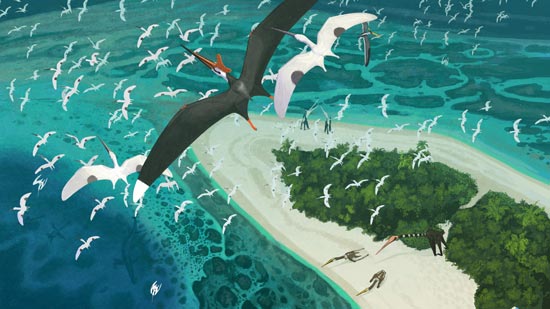
A Diverse Assemblage of Pterosaurs – Late Cretaceous Morocco

Pterosaurs of the Late Cretaceous (Morocco).
Six new species of pterosaur have been identified from Morocco.  This suggests that the Pterosauria were far more diverse and speciose at the end of the Cretaceous than previously thought.

Picture credit: John Conway

A Treasure Trove of Ancient Vertebrate Fossils

Writing in the journal PLOS Biology, the researchers from the University of Bath, Portsmouth University and the University of Texas at Austin, identified a total of seven species of flying reptile from fragmentary and largely isolated fossils found in marine rocks from phosphate mines in northern Morocco (Ouled Abdoun Basin).  Working in conjunction with local fossil hunters, the scientists were able to build up a collection of around two hundred pterosaur bones.

Over the years, commercial mining has revealed large numbers of marine vertebrates dating from the end of the Cretaceous and into the Palaeogene.  Cretaceous fauna associated with these deposits include turtles, plesiosaurs, mosasaurs, sharks and lots of different types of teleost (bony fish).  Occasionally the remains of terrestrial animals are preserved in such deposits, including the bones of Late Cretaceous dinosaurs, representing some of the youngest dinosaur fossils found.

To read our 2017 article about the discovery of an abelisaurid dinosaur: The Last Dinosaur in Africa.

Some of the Last Pterosaurs

The pterosaurs identified by the researchers range in size with the smallest found having a wingspan equivalent to that of an extant Golden Eagle (Aquila chrysaetos), to giants with wingspans approaching ten metres, three times bigger than the wingspan of the largest volant birds alive today.  The fossil material has been dated to just over 66 million years ago, making these pterosaurs amongst the very last of their kind on Earth.

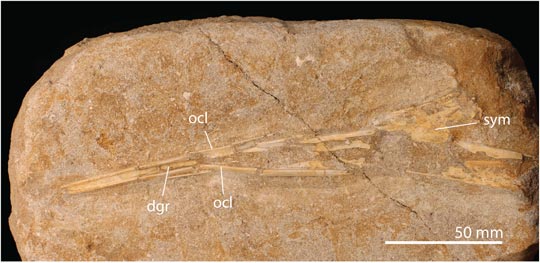
The Mandible of the Newly Described Nyctosaurid Alcione elainus

Pterosaur fossil mandible Alcione elainus.
The mandible of the newly described Moroccan pterosaur A. elainus.

Picture credit: PLOS Biology

Key

dgr = dorsal groove, ocl = occlusal ridge,  sym = symphysis.

Lead author of the study, Dr Nicholas Longrich, (Milner Centre for Evolution and the Department of Biology and Biochemistry, Bath University) stated:

“To be able to grow so large and still be able to fly, pterosaurs evolved incredibly lightweight skeletons, with the bones reduced to thin-walled, hollow tubes like the frame of a carbon-fibre racing bike.  Unfortunately, that means these bones are fragile and so almost none survive as fossils.”

Six New Species of Pterosaur

The researchers were able to identify six new species of pterosaur, representing three different families:

  1. Tethydraco regalis (Pteranodontidae) – the youngest member of the Pteranodontidae family described to date.  Estimated wingspan around 5 metres.
  2. Alcione elainus (Nyctosauridae) – wingspan estimated at about 2 metres.
  3. Simurghia robusta (Nyctosauridae) – a large pterosaur with a wingspan of around 4 metres.
  4. Barbaridactylus grandis (Nyctosauridae) – an even bigger pterosaur with a wingspan estimated to be about 5.2 metres.
  5. Quetzalcoatlus spp. (Azhdarchidae) – described from a single neck bone (cervical vertebra) which resembles the cervical vertebrae of Quetzalcoatlus (Q. northropi).  Size estimates for this flying reptile are very speculative, however, it could have had a wingspan of around 4 metres based on comparisons with better known azhdarchid pterosaurs.
  6. Sidi Chennane specimen (Azhdarchidae) – not scientifically named as yet, known from a single, partial ulna (arm bone), measuring 362 mm long, but when complete it would have been around 600 to 700 mm in length.  This suggests a giant azhdarchid pterosaur with a wingspan of approximately 9 metres.  This specimen has been named after the phosphate mine where it was found, formal scientific description will depend on the discovery of more fossil material.  The researchers conclude that this animal was probably related to the giant azhdarchid Arambourgiania philadelphiae, which is known from the Late Cretaceous of Jordan and the United States.

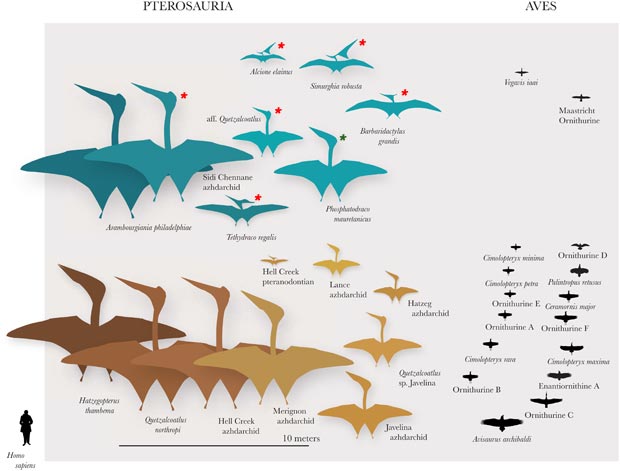
Late Cretaceous Pterosaur Faunas (Marine and Terrestrial) Compared to Late Cretaceous Birds

Late Cretaceous birds compared to Late Cretaceous Pteosaurs
Size disparity between Late Cretaceous pterosaurs and Late Cretaceous birds.

Picture credit: PLOS Biology with additional annotation by Everything Dinosaur

The diagram above compares the size disparity between Late Cretaceous pterosaurs with those of contemporaneous birds (coeval Aves – birds that lived at the same time as these flying reptiles).  Pterosaurs shaded blue are associated with marine environments, pterosaurs shaded in brown are associated with terrestrial habitats.  The six new species from the Ouled Abdoun Basin identified in the scientific paper have been given a red star.  The one species from the Ouled Abdoun Basin that had been previously described (2003), has been labelled with a green star (the azhdarchid Phosphatodraco mauritanicus).

A Giant Pterosaur

The giant pterosaur referred to as the Sidi Chennane specimen is estimated to have approached Quetzalcoatlus in size, but it was much more lightly built and therefore, presumably weighed less.  These proportions indicate a distinct flight mode and ecological niche, suggesting that giant pterosaurs occupied a range of niches in Late Cretaceous habitats.  In addition, the researchers conclude that this flying reptile fossil assemblage demonstrates that the Maastrichtian pterosaurs show increased ecological niche occupation when compared to earlier Late Cretaceous pterosaurs (Santonian to Campanian faunas).  This study also indicates that when it came to developing large body forms, the Pterosauria were able to outcompete coeval birds.

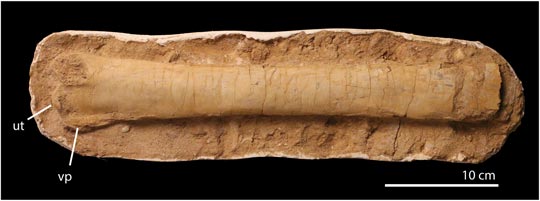
The Fossilised Partial Ulna of the Sidi Chennane Specimen

Fossil ulna of a giant azhdarchid pterosaur.
The ulna of the Sidi Chennane specimen.

Picture credit: PLOS Biology

Key

ut = ulna tubercle, vp = ventral process

A 5% Increase in Known Pterosaur Species

Co-author of the study, Dr Brian Andres, from the Jackson School of Geosciences at The University of Texas at Austin, commented:

“The Moroccan fossils tell the last chapter of the pterosaurs’ story – and they tell us pterosaurs dominated the skies over the land and sea, as they had for the previous 150 million years.”

With around 130 pterosaur species described to date, these fossils from Morocco have led to a 5 percent increase in the known number of flying reptile species.  This diversity of pterosaur species from Upper Maastrichtian deposits in Morocco suggest an abrupt mass extinction of the Pterosauria at the Cretaceous-Palaeogene boundary.

The scientific paper: “Late Maastrichtian Pterosaurs from North Africa and Mass Extinction of Pterosauria at the Cretaceous-Paleogene boundary” by Nicholas R. Longrich, David M. Martill and Brian Andres published in PLOS Biology.

Everything Dinosaur acknowledges the help of a press release from the University of Bath in the compilation of this article.

Visit the award-winning Everything Dinosaur website: Everything Dinosaur.
6 03, 2018

The Remarkable Jinyunpelta sinensis – Oldest Swinger in Town

By |2024-05-04T18:01:24+01:00March 6th, 2018|Categories: Dinosaur and Prehistoric Animal News Stories, Dinosaur Fans, Main Page, Photos/Pictures of Fossils|0 Comments

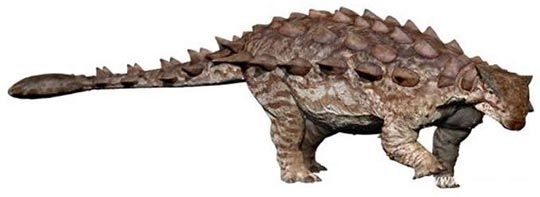
Basal Ankylosaurine Dinosaur Jinyunpelta is Described

Scientists, including researchers from the Chinese Academy of Sciences have published details of a new genus of club-tailed, armoured dinosaur that roamed China around 100 million years ago.  The dinosaur has been named Jinyunpelta sinensis, it represents the first definitive ankylosaurid dinosaur from southern China.

An Illustration of the Basal Ankylosaurine Jinyunpelta sinensis

Jinyunpelta sinensis illustrated.
An illustration of Jinyunpelta sinensis.

Picture credit: The Chinese Academy of Sciences

Two Fossil Specimens of Jinyunpelta sinensis

This new dinosaur, very distantly related to Late Cretaceous ankylosaurs like Euoplocephalus and Ankylosaurus (from which the group is named), has been described based on two fossil specimens.  The fossils come from Jinyun County, Zhejiang Province, China and have been excavated from rocks which form part of the Liangtoutang Formation, which covers the important boundary between Lower and Upper Cretaceous sediments (Albian faunal stage to the Cenomanian faunal stage of the Cretaceous).

The fossil material consists of an almost complete skull, parts of the jaw and postcranial remains including a beautifully-preserved tail club.

The Skull and Jaw of Jinyunpelta sinensis

The skull and mandible of Jinyunpelta sinensis.
Skull and jaw of Jinyunpelta (a) dorsal view, (b) ventral view and (c) anterior view, with accompanying line drawings.

Picture credit: The Chinese Academy of Sciences/Scientific Reports

The generic name derives from “Jinyun” (Mandarin) honouring Jinyun County where the fossils were found and “pelta” (Latin), a small shield, in reference to the osteoderms found on all ankylosaurians.  The root of the specific name “sin” (Greek) refers to China, the country of origin.

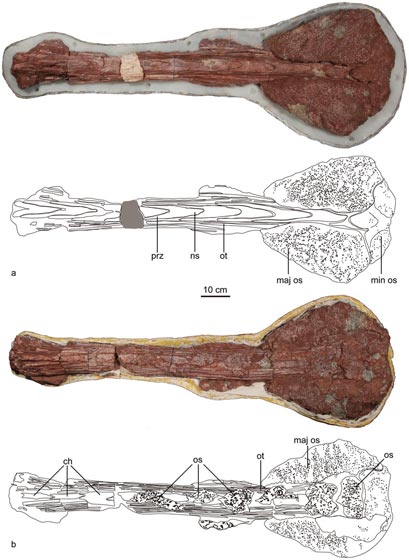
Photographs and Line Drawings of the Spectacular Tail Club

The Tail Club of Jinyunpelta sinensis.
The tail club Jinyunpelta sinensis paratype ZMNH M8963 in dorsal (a) and ventral (b) views.

Picture credit: The Chinese Academy of Sciences/Scientific Reports

The Oldest Swinger in Town

J. sinensis is described as a basal ankylosaurine dinosaur and it represents the oldest and the most basal ankylosaurian known to have a well-developed tail club knob.  It is quite a sizeable bony club too, getting on for nearly half a metre across at its widest part.  The researchers conclude that large and highly modified tail clubs evolved at the base of the ankylosaurine at least about 100 million years ago.

Jinyunpelta possesses unique cranial features which differentiates this Chinese dinosaur from other armoured dinosaurs known from the northern hemisphere, these autapomorphies support the establishment of a new genus.  Several other types of ornithischian dinosaur have been reported from this part of China, including another armoured dinosaur – a  nodosaur and basal ornithopod that was named and described in 2012 (Yueosaurus tiantaiensis)

The discovery of Jinyunpelta expands the known diversity and palaeogeographical distribution of ankylosaurians in Asia.

The scientific paper: “The Most Basal Ankylosaurine Dinosaur from the Albian–Cenomanian of China, with Implications for the Evolution of the Tail Club” by Wenjie Zheng, Xingsheng Jin, Yoichi Azuma, Qiongying Wang, Kazunori Miyata & Xing Xu published in the open access journal “Scientific Reports”.

Visit the Everything Dinosaur website: Everything Dinosaur.
5 03, 2018

Watching the Beautiful Birdie – Early Cretaceous

By |2024-05-04T17:53:36+01:00March 5th, 2018|Categories: Dinosaur and Prehistoric Animal News Stories, Dinosaur Fans, Main Page, Palaeontological articles, Photos/Pictures of Fossils|0 Comments

Early Cretaceous Enantiornithine Shines Light on Early Bird Evolution

A tiny, beautifully preserved fossil of a baby bird is helping scientists to shine a light on the early evolution of some of the first birds.  The fossil represents an enantiornithine bird and researchers, including Dr Fabien Knoll (Manchester University), have used synchrotron radiation to analyse the microscopic structure of the bird’s skeleton in order to assess at what stage of development the poor creature was at when it met its demise.

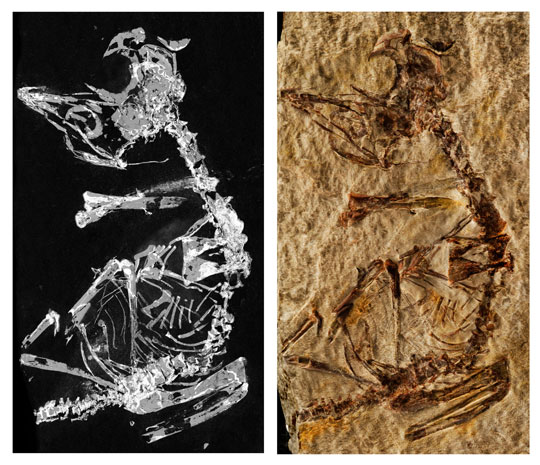
An Elemental Map of the Fossilised Skeleton was Created using Synchrotron Radiation

The enantiornithine bird fossil (elemental mapping).
Elemental mapping of the tiny bird fossil.  Mapping the slab and the counter slab of the fossil to determine the chemical composition of the skeleton.

Picture credit: Manchester University

The Enantiornithes – Early Birds

The Enantiornithes were a clade of diverse Cretaceous birds that possessed several characteristics of modern birds (Neornithines) but were also anatomically different in a number of respects.  They retained claws on their wings and most species had teeth, in contrast to all modern Aves which are edentulous.  Despite having an almost global distribution and being regarded as the most specious and successful birds of the Cretaceous, the Enantiornithes are thought to have become extinct at the same time as the last of the non-avian dinosaurs.

A study published in 2016 proposed that the evolution of a toothless beak may have helped some types of birds to survive the end Cretaceous mass extinction event.  To read an article summarising the study’s findings: Seed Eating May Have Helped Some Birds Survive the End Cretaceous Extinction Event.

The Enantiornithine Bird – One of the Smallest Mesozoic Avian Fossils Described

The specimen preserved on a slab and counter slab is one of the smallest Mesozoic bird fossils to have been found to date.  The specimen measures less than five centimetres in length and the baby bird would have been able to sit in an egg-cup.  However, it is remarkably well-preserved and the skeleton is virtually complete and what makes this fossil so significant is the fact that the baby bird died shortly after emerging from its egg.

The poor, unfortunate bird might have had an extremely short life, but it has given researchers a rare opportunity to analyse a baby bird’s bone structure and assess its skeletal development.

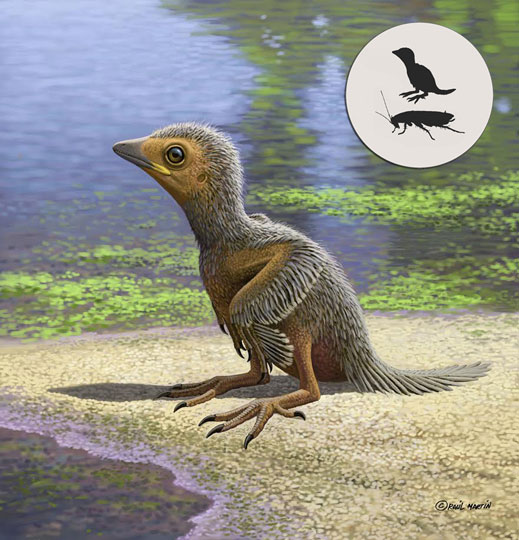
A Reconstruction of the Cretaceous Bird

A reconstruction of the baby Cretaceous bird.f
A reconstruction of the enantiornithine baby bird with insert showing scale.

Picture credit: Raul Martin

Assessing Bone Structure and Development

The scientists have been able to study the ossification of the bones, how they were growing and developing.  A better understanding of the skeleton of the very young bird will help researchers to better understand whether this bird species was capable of flight soon after birth and how independent it was.

Lead author of the study, Dr Fabien Knoll (Interdisciplinary Centre for Ancient Life [ICAL] at the School of Earth and Environmental Sciences, Manchester University) and the ARAID Dinopolis in Spain stated:

“The evolutionary diversification of birds has resulted in a wide range of hatchling developmental strategies and important differences in their growth rates.  By analysing bone development, we can look at a whole host of evolutionary traits.”

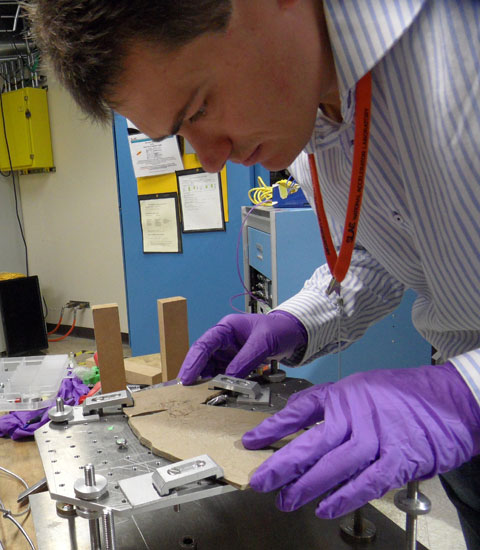
Lead Author of the Study Dr Fabien Knoll Prepares the Specimen for Analysis

Dr Knoll (Manchester University) studying the enantiornithine bird fossil.
Dr Fabien Knoll studying the slab and counter slab of the bird fossil.

Picture credit: Manchester University

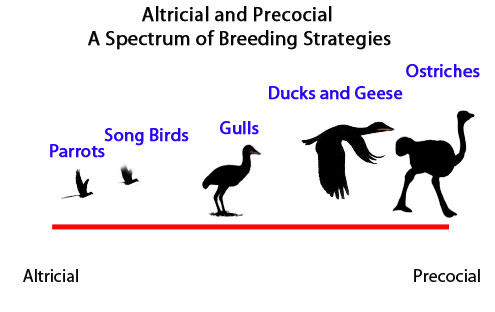
Altricial, Precocial or Somewhere in Between

As the fossil was so small, being less than the length of the average person’s little finger, the team used synchrotron radiation to analyse the specimen at a “submicron” level.  The skeleton could be assessed in extreme detail and the microstructures of the bones observed.

Dr Knoll explained:

“New technologies are offering palaeontologists unprecedented capacities to investigate provocative fossils.  Here we made the most of state-of-the-art facilities worldwide including three different synchrotrons in France, the UK and the United States.”

New Technology Helps to Map the Elemental Composition of an Ancient Bird Fossil

Phosphorous mapping and a photograph of the fossil.
A phosphorous map of the bird skeleton and photograph of the fossil.  The fossil is around 127 million years old (Early Cretaceous).

Picture credit: Manchester University

Synchrotron Analysis

The synchrotron analysis determined that the baby bird’s sternum (breastplate bone) was largely composed of cartilage and had not completely ossified.  The absence of hard bone in the sternum suggests that this bird could not fly.  The patterns of ossification observed in this and the other few, very young enantiornithine birds known to date also suggest that the developmental strategies of this particular group of ancient avians may have been more diverse than previously thought.

The researchers remain cautious and don’t wish to definitively come down on one side of the argument in terms of how dependent/independent this baby bird could have been.  The lack of bone development does not necessarily prove that the hatchling was reliant on its parents for feeding and care (altricial trait).

Bird Evolution

Modern birds demonstrate a variety of behavioural responses when it comes to bringing up babies.  Some bird species like chickens and ostriches have highly precocial young.  The babies are able to leave the nest and feed themselves within hours of hatching.  In contrast, most of the passerines (song birds) such as robins, blackbirds and thrushes are helpless when they hatch and rely on their parents to feed them and to keep them warm.

Altricial and precocial behaviours tend to be at opposite ends of a spectrum, the breeding strategy employed by this enantiornithine remains obscure.  As extant Aves exhibit a variety of breeding strategies from totally altricial through to super precocial (such as the megapodes, an example being the Australian brush turkey), it is difficult to clarify the development strategy of any extinct species.

Altricial and Precocial Behaviours can be Viewed as Opposite Ends of a Spectrum

Birds - altricial and precocial behaviours.
Altricial and precocial behaviours in Aves – a spectrum. Picture credit: Everything Dinosaur.

Picture credit: Everything Dinosaur

Co-author of the study, Luis Chiappe (Los Angeles Museum of Natural History) added:

“This new discovery, together with others from around the world, allows us to peek into the world of ancient birds that lived during the age of dinosaurs.  It is amazing to realise how many of the features we see among living birds had already been developed more than 100 million years ago.”

Everything Dinosaur acknowledges the assistance of a press release from Manchester University in the compilation of this article.

Visit the Everything Dinosaur website: Everything Dinosaur.
Go to Top