All about dinosaurs, fossils and prehistoric animals by Everything Dinosaur team members.

Pictures of fossils, fossil hunting trips, fossil sites and photographs relating to fossil hunting and fossil finds.

3 05, 2018

The First Beak Under the Noses of Scientists

By |2023-10-13T21:10:49+01:00May 3rd, 2018|Categories: Dinosaur and Prehistoric Animal News Stories, Dinosaur Fans, Main Page, Palaeontological articles, Photos/Pictures of Fossils|0 Comments

Inspiring Ichthyornis – Top of the Pecking Order

As a very young boy, I remember eagerly striving to complete my Brooke Bond “Prehistoric Animals” card collection.  This was a set of fifty cards to collect,  given away free with packets of tea.   One of the cards featured a pair of toothed, prehistoric birds, a large, reddish coloured Hesperornis which was being mobbed by a couple of tern-like birds, this was my first introduction to Ichthyornis.  Perhaps, the first time that I realised that birds (at least primitive, toothed birds), lived alongside dinosaurs.

How wonderful to read this week that Ichthyornis, thanks to a pieced together three-dimensional skull, may be providing palaeontologists with fresh insights into avian evolution.  The Hesperornis/Ichthyornis picture card may have been burned into my conscience long ago, but it is refreshing to think that this ancient bird may represent a pivotal moment in the transition from dinosaurs to modern-day birds and its significance has only just come to light.  A team of international scientists have published a paper proposing that Ichthyornis may have had one of the first, true bird-like beaks.

The Brooke Bond Picture Card
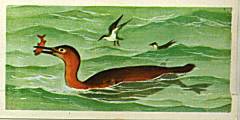
Hesperornis and Ichthyornis
Hesperornis catching a fish, with Ichthyornis in close attention.

Picture credit: Everything Dinosaur/Brooke Bond

Toothy Bird with the Beginnings of a Beak

Writing in the journal “Nature”, researchers report on the analysis of beautifully preserved three-dimensional Ichthyornis (I. dispar) fossil skull that is providing new evidence on the evolution of the avian head and how the skull and beaks of birds evolved from their dinosaurian ancestors.

A Three-Dimensional Image of Ichthyornis Skull Material Indicates the Tip of the Premaxillary Formed the First Beak
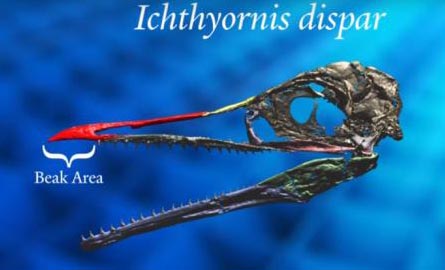
The tip of the premaxillary forms the first beak.
A computer generated image showing the life position of the fossil bones in the three-dimensional Ichthyornis skull.

Picture credit: Yale Office of Public Affairs and Communications

Ichthyornis dispar

Known from fragmentary fossils from Kansas and named back in 1872 by Yale University’s Othniel Charles Marsh, it seems fitting that this new study into one of the first toothed birds described, has been led by scientists from Yale University.  Working in conjunction with colleagues from the University of Kansas, Fort Hays State University, Alabama Museum of Natural History and the McWane Science Centre (Alabama), the team report on new specimens with three-dimensional cranial remains, including one example of a complete skull and two previously overlooked cranial elements that were part of the original Yale specimen examined by Marsh.

Using CT scans and sophisticated computer modelling, individual skull and jaw bones were scanned and reproduced in three-dimensions.  This allowed a complete skull to be constructed revealing new details about the transition from dinosaur skull to a more modern bird skull.

The Transition from Dinosaur Skull to Bird Skull

Yale University palaeontologist and lead author of the study Bhart-Anjan Bhullar commented:

“Right under our noses this whole time was an amazing, transitional bird.  It has a modern-looking brain along with a remarkably dinosaurian jaw muscle configuration.”

Ichthyornis is part of the biota of the Western Interior Seaway, a shallow sea that split North America in two during the Late Cretaceous.  It has been regarded as an early version of a tern or gull, but its size is unknown as the few fossils found represent individuals of different sizes, however, it probably had a wingspan of no more than sixty centimetres, making Ichthyornis slightly smaller than today’s Common Tern (Sterna hirundo), a bird which fills the same ecological niche as the Mesozoic Ichthyornis.

Using the Latest Research, a New Reconstruction of Ichthyornis dispar was Produced
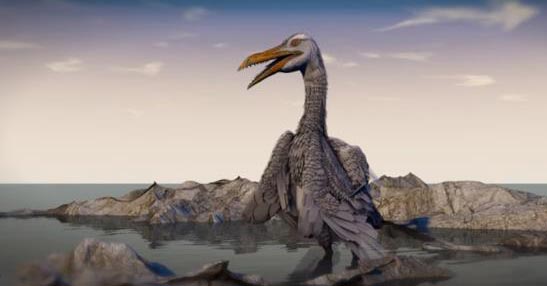
Ichthyornis life reconstruction.
A life reconstruction of Ichthyornis.

Picture credit: Yale Office of Public Affairs and Communications

Ichthyornis – The Evolution of a Beak

Having built a three-dimensional model of the skull and jaw bones, the researchers were able to note that the premaxillary bone in the upper jaw had become elongated and this, working in conjunction with a keratinous tip on the lower jaw formed the first “proto-beak”.  Ichthyornis dispar shows scientists what the first type of bird beak looked like.  This beak may have evolved as the function of the hands was increasingly limited as they were adapted to form a more effective wing.

The grasping hands of the maniraptoran dinosaurs were no longer able to grasp and manipulate objects so the jaws had to take on an additional function, secondary to their main function – dispatching and consuming prey.

The Beak of Ichthyornis
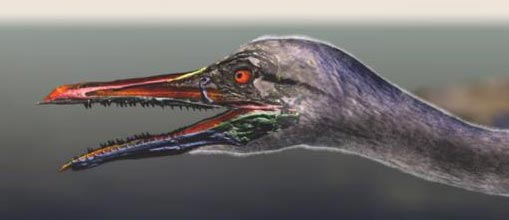
The beak of Ichthyornis.
The beak of Ichthyornis evolving to replace grasping, functional hands and fingers.

Picture credit: Yale Office of Public Affairs and Communications

Although maniraptoran dinosaurs may not have been able to pronate their hands like us and they lacked an opposable thumb, as forelimbs and hands evolved into wings, so the jaws took over the function of the digits and manus.

Bhart-Anjan Bhullar stated:

“The first beak was a horn-covered pincer tip at the end of the jaw.  The remainder of the jaw was filled with teeth.  At its origin, the beak was a precision grasping mechanism that served as a surrogate hand as the hands transformed into wings.”

The research team conducted its analysis using CT-scan technology, combined with specimens from the Yale Peabody Museum of Natural History; the Sternberg Museum of Natural History in Hays, Kansas, the Alabama Museum of Natural History; the University of Kansas Biodiversity Institute and the Black Hills Institute of Geological Research (South Dakota).

Bird Beaks versus Bird-hipped Dinosaur Beaks

The modern bird beak is a unique organ amongst vertebrates, although notably most derived ornithischian (bird-hipped) dinosaurs possessed a beak, formed from the unique predentary bone in the lower jaw and a roughened, extension of the premaxilla (or the rostral in the case of ceratopsians), in the upper jaw, which allowed the attachment of a keratinous tip which in conjunction formed the beak-like structure – believed to be an adaptation to assist with cropping vegetation.

This study of Ichthyornis suggests that the first bird beak was not the long organ seen in modern birds, but a little pincer tip to grasp and manipulate objects.

A Chasmosaurine Ceratopsian with the Roughened Rostral and the Predentary Forming a Plant-cropping Beak
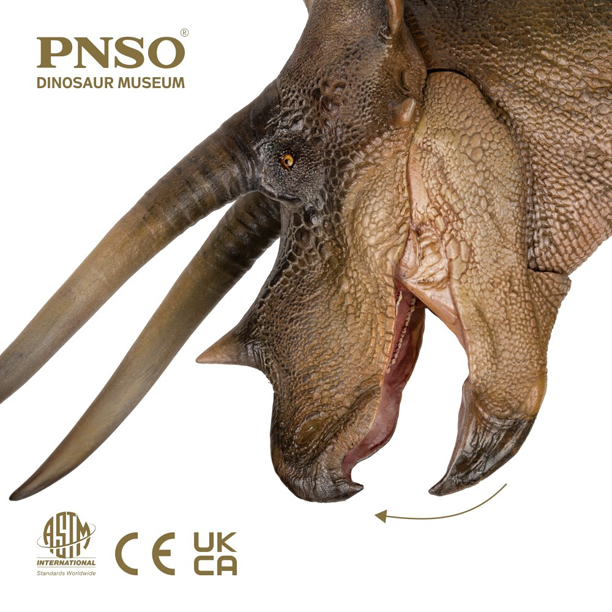
PNSO Doyle the Triceratops model has an articlated lower jaw
The PNSO Doyle the Triceratops model has an articulated jaw.

The picture (above) shows a ceratopsian figure from the PNSO model range.

To view these figures: PNSO Age of Dinosaurs Models.

Fresh Insight into the Evolution of Extant Bird Skulls

The scientists conclude that their study offers new insights into how modern birds’ skulls formed.  Along with its transitional beak, Ichthyornis dispar had a brain similar to that seen in extant birds but a temporal region of the skull that was reminiscent of a dinosaur.  This suggests that during the evolution of Aves, the brain transformed first, possibly to adapt to a volant (aerial) lifestyle, whilst the remainder of the skull retained the ancestral features associated with the Dinosauria.

Ichthyornis retained a large adductor chamber bounded at the top by substantial bony remnants of the ancestral reptilian upper temporal fenestra (hole in the skull).  This combination of features indicates that important attributes of the avian brain and palate evolved before the reduction of jaw musculature and the full transformation of the beak.

The Beak of Ichthyornis Grasping a Mollusc
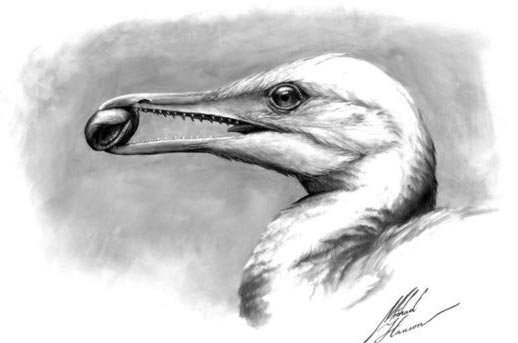
Holding a mollusc in its beak.
An illustration of an Ichthyornis holding a mollusc in its beak.

Picture credit: Michael Hanson/Bhart-Anjan Bhullar

I may never have completed my Brooke Bond card collection, but at least, thanks to this new Ichthyornis study, our understanding of the evolution of the beak in birds is more complete.

Visit the Everything Dinosaur website: Everything Dinosaur.
26 04, 2018

Clever Cretaceous Lacewings Identified in New Research

By |2024-05-10T21:39:00+01:00April 26th, 2018|Categories: Dinosaur and Prehistoric Animal News Stories, Main Page, Photos/Pictures of Fossils|0 Comments

Evidence of Insect Mimicry and Camouflage in Burmese Amber

Researchers from the China Agricultural University, the Nanjing Institute of Geology and Palaeontology and the Chinese Academy of Sciences, have discovered a new species of Cretaceous lacewing preserved in 100-million-year-old Burmese amber (burmite).  The scientists have identified two lacewing larvae that show adaptations for mimicking liverwort plants.  Mimicry and camouflage is relatively commonplace in the natural world, but evidence of this within the fossil record is extremely rare.

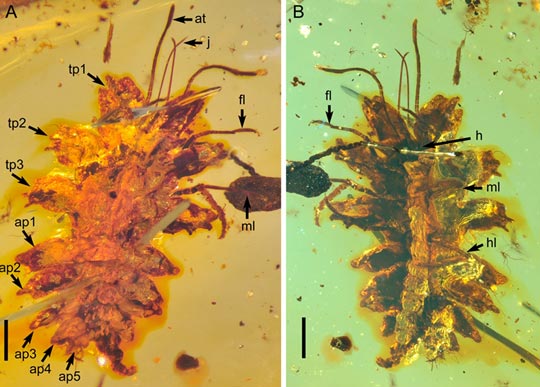
Two views (Dorsal and Ventral) of a Preserved Lacewing Larva Camouflaged to Look Like a Liverwort

Fossil lacewing larva preserved in amber from Myanmar. Scale bar - 1 mm.
New green lacewing larva Phyllochrysa huangi in (A) dorsal view and (B) ventral view.

Picture credit: the Nanjing Institute of Geology and Palaeontology

Lacewings and Liverworts

Lacewings are insects which are characterised by their very fine, reticulated wings.  They are globally widespread and something like 2,000 living species have been described to date.

As larvae and adults, they are voracious hunters and are popular with farmers and growers as they eat lots of pests, such as aphids.  Fossils of these delicate insects are rare but specimens are known that date from the Jurassic.  Liverworts are much older, they lack a vascular system and true roots tending to grow very close to the ground.  Liverworts are thought to be similar to the very first land plants that evolved in the Silurian geological period.

Despite liverworts having existed since the Palaeozoic, mimicry between insects and liverworts is extremely rare in both modern and fossil ecosystems.  This discovery, reported in the academic journal “Current Biology” represents the first record of liverwort mimicry by fossil insects and brings to light an evolutionary novelty, both in terms of morphological specialisation as well as plant-insect interaction.

Lacewing Larvae and Liverworts Preserved in Amber

Liverworts and lacewing larvae preserved in amber.
New green lacewing larva and potential model plants from Burmese amber. (B, E, G are larvae, the others are liverworts)

Picture credit: the Nanjing Institute of Geology and Palaeontology

Camouflaged to Look Like Liverworts

The larvae have broad flanges on their abdomen and thorax that resemble the fleshy, ribbon-like fronds of liverworts.  The insect which has been named Phyllochrysa huangi, is the only known species of lacewing with distinctive foliate lobes on the larval body.  These newly described insects are the first evidence of direct mimicry in lacewing larvae.  This camouflage may have helped the vulnerable larvae to avoid detection by predators, or they might have used this body bauplan to help ambush potential prey.

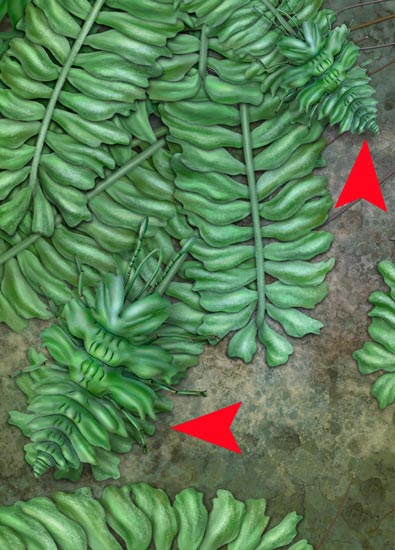
Two Phyllochrysa huangi Larvae Hide Out Amongst the Liverworts

Phyllochrysa huangi camouflaged on the liverworts (highlighted by arrows).
A life reconstruction of two Phyllochrysa huangi hiding amongst liverworts.  The larvae are highlighted by red arrows.

Picture credit: Yang Dinghua

The researchers conclude that these fossils preserved in amber demonstrate a hitherto unknown life-history strategy amongst these types of insect, a strategy that apparently evolved from a camouflaging ancestor but did not persist into modern times with this lineage.

A Hot and Humid Cretaceous Jungle

The amber from Burma (Myanmar) has provided palaeontologists with an astonishing insight into life in a Cretaceous tropical rainforest.  Numerous types of invertebrate have been named, including damselflies, spiders and blood-sucking ticks that may have fed on the blood of dinosaurs.  The remains of larger creatures have been found preserved in amber too, including the feathered tail of a dinosaur and a baby enantiornithine bird.

To read about the blood-sucking Cretaceous parasites: Blood-sucking Dinosaur Parasites.

Fossilised baby bird preserved in amber: Watch the Birdie!

Prehistoric spiders with whip-like tails: Spiders with Tails.

Dinosaur tail trapped in tree resin: The Tale of a Dinosaur Tail.

The globally widespread extant liverworts consist of over 9,000 named species.  Although, like the lacewings, their fossil record is very poor, it seems likely that they began to become much more diverse during the Cretaceous as the rapidly evolving angiosperm trees provided new habitats for them.  Just like their modern counterparts, Cretaceous liverworts grew on the leaves and bark of trees as well as on other plant surfaces.  It is logical to assume that the camouflaged lacewing larvae also probably lived on trees which were densely covered by liverworts, with the lacewing’s liverwort mimicry aiding their survival.

Visit the award-winning Everything Dinosaur website: Everything Dinosaur.

22 04, 2018

The Sensational Ancient Whales Gallery

By |2024-05-10T19:02:40+01:00April 22nd, 2018|Categories: Main Page, Photos/Pictures of Fossils|0 Comments

Ancient Cetaceans – Frankfurt Natural History Museum

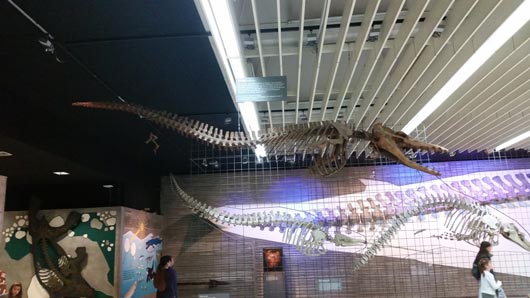
There are some very impressive prehistoric whale exhibits in the ancient whales gallery at the Frankfurt Natural History Museum (Frankfurt, Germany).  The Frankfurt Museum, also known as the Senckenberg Museum, houses one of the largest natural history collections in the whole of western Europe.  The extensive galleries highlight biodiversity and tell the story of the evolution of life on Earth.  One of the highlights of the entire collection is the substantial cetacean gallery that includes a number of mounted exhibits of ancient prehistoric whales.

The Ancient Whales Gallery (Senckenberg Museum)

Ancient whale fossils.
The magnificent ancient whales gallery at the Frankfurt Natural History Museum (Germany).  Picture credit: Everything Dinosaur.

Picture credit: Everything Dinosaur

Basilosaurus on Display at the Senckenberg Museum

A team member from Everything Dinosaur spotted a glass case that contained the fossil skull and jaws of the Late Eocene whale Basilosaurus, fossils of which are known from New Zealand, North Africa, the United States and Europe.  This early toothed whale was an apex predator, reaching lengths in excess of twenty metres and perhaps weighing more than 10,000 kilograms.

The Skull and Jaws of the Fearsome Basilosaurus

Basilosaurus fossil jaws (Frankfurt Natural History Museum)
Basilosaurus fossil jaws. Picture credit: Everything Dinosaur.

Picture credit: Everything Dinosaur

Visit the Everything Dinosaur website: Everything Dinosaur.
Basilosaurus was popularised after it appeared in the BBC television series “Walking with Beasts”, a sequel to the famous “Walking with Dinosaurs” television series that was first aired in 1999.   Episode two of “Walking with Beasts” entitled “Whale Killer” told the story of a pregnant Basilosaurus and her search for enough food to sustain herself and her unborn calf as the world entered a period of climate change that would lead to a significant extinction event.

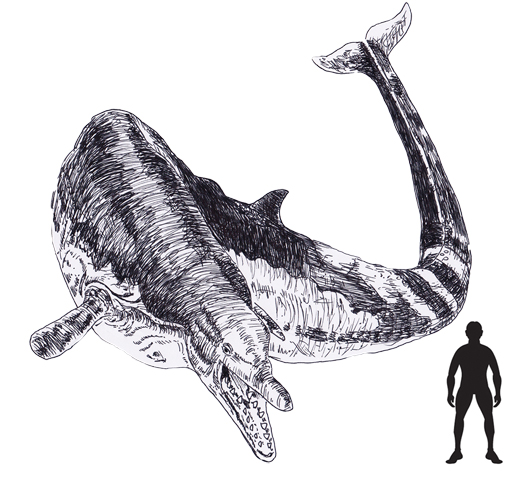
An Illustration of Basilosaurus

PNSO Basilosaurus illustration.
An illustration of Basilosaurus.  A Basilosaurus scale drawing. Picture credit: Everything Dinosaur.

Picture credit: Everything Dinosaur

The Basilosaurus Prehistoric Animal Figure

The image (above) shows the PNSO scientific art Basilosaurus figure. This spectacular model has earned praise from dinosaur fans and model collectors.

To view the PNSO model range: PNSO Age of Dinosaurs.

20 04, 2018

University of California Berkeley Researchers Have a “Whale” of a Time after Remarkable Discovery

By |2024-05-10T19:00:49+01:00April 20th, 2018|Categories: Dinosaur and Prehistoric Animal News Stories, Main Page, Photos/Pictures of Fossils|2 Comments

Miocene Fossil Treasure Trove at Californian Dam Site

Construction workers building a new dam on the Calaveras reservoir in California have uncovered a treasure trove of more than 1,500 fossils that depict marine life in the Miocene Epoch.  The fossils include numerous whale skulls, around twenty in total, University of California Berkeley scientists supervising the preservation of the 20 to 15 million-year-old specimens are confident that the material found to date represents at least one new species of Baleen whale.

Miocene Fossil Treasure Trove

The large Calaveras reservoir lies to the north-east of the city of San Jose in the “Golden State”, the original dam was constructed in 1925, but concerns over the risk of earthquakes has led to the commencement of a second dam several hundred metres downstream.  The first fossils were found in 2013 and brought to the attention of the University.

The fossilised remains include whales, sharks, such as Megalodon teeth, ancient seals, other vertebrates and a wealth of invertebrate fossils including gastropods, bivalves and crustaceans.  In addition, the distinctive fossil teeth of a Desmostylus have been found.  The Desmostylians are an extinct Order of hippo-like, prehistoric mammals that are distantly related to today’s sea cows.

Part of the Skull of an Ancient Baleen Whale from the Calaveras Reservoir Site

Baleen fossil material from California

Fossil skull and jaw material representing a type of baleen whale from the dam site.

Picture Credit: University of California Berkeley/Sara Yogi

A Miocene Coastal Palaeofauna

The discovery of preserved palm fronds and pine cones in the marine sediments suggest that the coastline was close by.  Desmostylus is believed to have favoured freshwater or estuarine environments, the Desmostylus fossil teeth found at the construction site adds further weight to the idea that the strata were laid down in shallow water close to land.

Commenting on the significance of the fossils, Cristina Robins, a senior scientist at the Museum of Palaeontology (University of California, Berkeley) and the person responsible for cataloguing all the fossil finds stated:

“Fossils are found all the time in the Bay Area, but the concentration of unique and varied specimens is what makes this special.”

Numerous Invertebrate Fossils Have Been Found

Shell fossils from California.

Examples of shell fossils from the Calaveras Dam site.

Picture Credit: University of California Berkeley/Sara Yogi

Providing Public Access to an Important Fossil Collection

University of California Berkeley laboratory staff are being assisted by graduate and undergraduate students.  The work of cleaning, identifying and labelling all the fossils is quite laborious, but eventually, the scientists hope to make all the fossil material digitally available via the University’s website.

A spokesperson from Everything Dinosaur commented:

“It is very likely that a number of new species might be identified from this fossil deposit.  This collection is helping palaeontologists to piece together an ancient environment, a lush tropical coastal ecosystem dominated by large, prehistoric mammals with an exotic marine fauna consisting of several different types of cetacean, some of which may have  the prey of the giant shark Megalodon”.

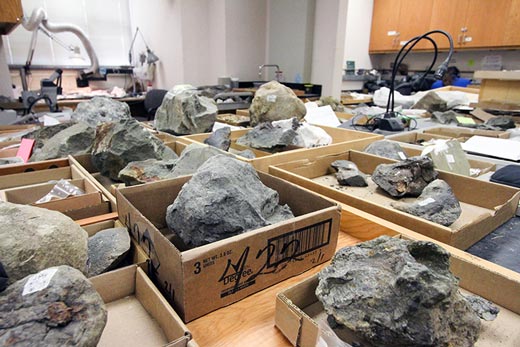
So Many Fossils Have Been Found that an Entire Research Laboratory has been Taken Over

Fossils from the Calaveras Reservoir.

The extensive fossil collection from the Calaveras Dam site.

Picture Credit: University of California Berkeley/Sara Yogi

Ironically, the word “Calaveras” is Spanish for skulls, considering the amount of whale skull material found at the site, this is a very appropriate name for the dam and the reservoir.

19 04, 2018

Carboniferous Shark Brain Case Study Outlined in New Research Paper

By |2024-05-10T18:41:57+01:00April 19th, 2018|Categories: Dinosaur and Prehistoric Animal News Stories, Main Page, Palaeontological articles, Photos/Pictures of Fossils|0 Comments

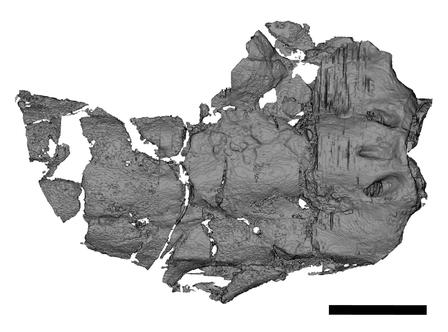
Brain Case of Carcharopsis wortheni Described

Research led by American Museum of Natural History scientists has provided a fresh perspective on a shark that might have been the “Jaws” of the Carboniferous.  The Carboniferous shark, Carcharopsis wortheni was first scientifically described in the mid-19th century and was previously known only from its characteristic serrated teeth and fragments of jaw.  A fossilised brain case identified as C. wortheni was excavated in 2007 from Upper Mississippian aged rocks in Arkansas (Fayetteville Shale).  The fossil was found by Royal Mapes, a retired Ohio University professor and a research associate at the Museum.  State-of-the-art imaging techniques were used to provide a unique insight into this important apex predator that lived some 320 million years ago.

The Fossil Cranium (Brain Case) of Carcharopsis wortheni

The fossilised brain case of C. wortheni.
The brain case of Carcharopsis wortheni. A Carboniferous shark study.

Picture credit: American Museum of Natural History/Allison Bronson

Insight into Shark Evolution

The shark lived at a critical point in the evolutionary history of our planet, part of a marine fauna that survived the end Devonian mass extinction event which decimated vertebrate species.  This ancient Palaeozoic shark,  was originally described in 1843 based on its distinctive serrated teeth, a feature that is common in extant sharks such as the formidable Great White (Carcharodon carcharias), an apex marine predator with a frightening reputation, thanks in the main to the film “Jaws” directed by Steven Spielberg, which was based on Peter Benchley’s book.  However, serrated teeth are rarely found in Palaeozoic sharks.

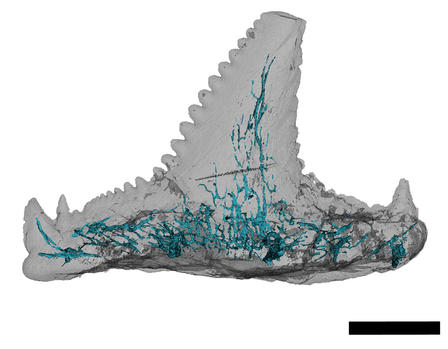
A CT Scan Showing the Unique Serrations on a Tooth from Carcharopsis (C. wortheni)

Shark fossil tooth C. wortheni.
Carcharopsis fossil tooth.  Scale bar = 1 mm.

Picture credit: American Museum of Natural History/Allison Bronson

The picture above shows a computer tomography generated image of a Carcharopsis tooth, measuring around five millimetres in length.  The blue lines are canals identified within the tooth.

Commenting on the fossil, lead author of the study Allison Bronson, a PhD student at the American Museum of Natural History stated:

“They [the teeth] look a little like what you’d see in a Great White, but are 320 million years old and with different enamel.  This is really early to see serrated teeth.”

Carboniferous Shark Fossil Study

Royal Mapes donated the brain case specimen to the New York-based natural history museum, along with a remarkable 540,000 other fossils.  Mapes co-authored the Carcharopsis study, which has been published in the journal “Papers in Palaeontology”, American Museum of Natural History curator John Maisey also contributed to the paper.

The scientists used high-resolution computed tomography (CT) imaging to examine the cranium, a tooth, and an isolated portion of a tooth base.  Using the scans, they were able to reconstruct the internal canals of the teeth for the first time and found that these are similar to the canals found in today’s sharks.

The arrangement of the shark’s blood vessels—also revealed through CT scans—suggests that Carcharopsis was probably closely related to the group of ancient cartilaginous fish from which today’s sharks and rays evolved.  However, more complete fossils are needed to firmly position it in the tree of life.

Everything Dinosaur acknowledges the help of the American Museum of Natural History in the compilation of this article.

Visit the Everything Dinosaur website: Everything Dinosaur.
18 04, 2018

A New Early Cretaceous Amphibian from Japan

By |2023-10-10T09:32:33+01:00April 18th, 2018|Categories: Dinosaur and Prehistoric Animal News Stories, Dinosaur Fans, Main Page, Photos/Pictures of Fossils|0 Comments

Under the Noses of Dinosaurs, a New Species of Early Cretaceous Amphibian is Described

A small, fragmentary fossil found in an outcrop of the Kuwajima Formation, in western Central Japan has been identified as a new species of albanerpetontid amphibian.  This tiny animal, measuring just six centimetres in length inhabited a wide floodplain, that was crossed by meandering rivers in a humid environment some 130 million years ago.  The fossils represent the oldest example of this type of tetrapod found in Asia, they predate the only other specimens known from Asia (Uzbekistan), by tens of millions of years.

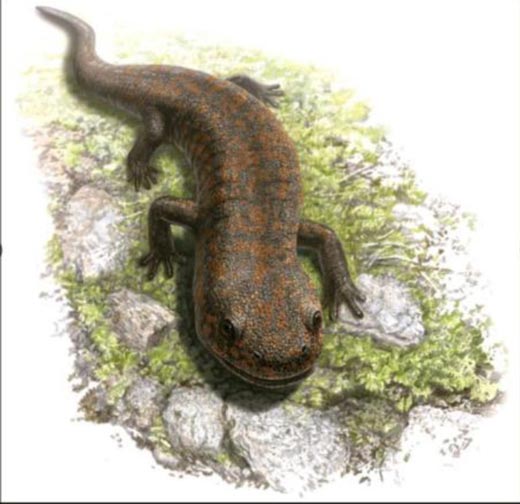
An Early Cretaceous Amphibian

A Life Reconstruction of the Little Albanerpetontid Amphibian (S. isajii)

Shirerpeton life reconstruction.
An illustration of Shirerpeton – an Early Cretaceous amphibian.

Picture credit: Takumi Yamamoto

The Ancient Albanerpetontidae Family

Superficially resembling modern-day Salamanders, these ancient amphibians are only distantly related to their modern counterparts.  They evolved in the Middle Jurassic and persisted until very recently, finally becoming extinct during the Pleistocene Epoch.  Several genera are known and they are characterised by their unique skulls and the presence of bony scales on their skin.  The tiny specimen consists of a partial skull, vertebrae and elements from a hind limb, a total of forty-three bones.  The only Asian examples of this clade of amphibian have been found in Uzbekistan.  These fossils date from the very end of the Cretaceous, so the Japanese specimen is some sixty million years older.

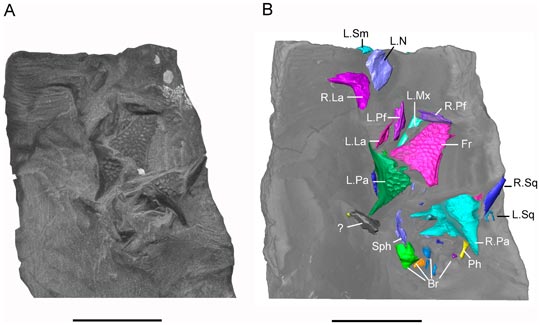
High resolution X-ray computed microtomography was used to identify the shape of the bones which remain partially buried in the part-prepared fossil.

The Rock Containing the Partially Exposed Fossil Bones Along with a Computer Image Tracing the Outline of the Individual Bones

Fossils and computer enhanced image showing holotype of Shirerpeton.
A new Early Cretaceous amphibian from Japan (Shirerpeton).

Picture credit: The Education Board of the city of Hakusan, (Ishikawa Prefecture, Japan)

A Tiny Fossil

The picture (above) shows the holotype fossil of the new albanerpetontid amphibian, which has been named Shirerpeton isajii.  Image (A) shows the fossils in the 2.5 by 1.5 cm square slab of rock, whilst image (B), is a digital photograph with various bones from the skull highlighted.  Abbreviations: Br, braincase elements; Fr, frontal; L.La, left lacrimal; L.Mx, left maxilla; L.N, left nasal; L.Pa, left parietal; LPf, left prefrontal; L.Sm, left septomaxilla; L.Sq, left squamosal; R.La, right lacrimal; R.Pa, right parietal; R.Pf, right prefrontal; R.Sq, right squamosal; ?, unidentified element. Scale bars in both images = 5 mm.

Writing in the open-access academic journal PLOS One, the researchers, Susan Evans, a professor of vertebrate morphology and palaeontology (University College London) and Ryoko Matsumoto, a curator with the Kanagawa Prefectural Museum of Natural History were able to identify the specimen as a member of the Albanerpetontidae from the shape of the lower jaw.  The distinctive frontal bone of the skull, along with several other identified autapomorphies (unique traits), enabled the scientists to erect a new species.

Shirerpeton isajii

The scientists named the species in honour of Shinji Isaji, the head of the Tetori Group fossil investigation commission, a body under the Hakusan city government in charge of studying the Kuwajima fossil location where the fossil was found.

A spokesperson from Everything Dinosaur commented:

“There are about twenty of these amphibians known in the fossil record, currently assigned to five genera.  They were globally widespread during the Mesozoic, but this is the first time an albanerpetontid has been recorded from East Asia.  Their fragmentary record makes understanding their evolution and their phylogeny very difficult, scientists are not even sure how closely related these ancient lissamphibians are to extant amphibians.”

The spokesperson continued:

“Small animals like Shirerpeton are just as important as larger animals like dinosaurs when it comes to considering ancient environments and habitats.  In fact, this amphibian is probably more important than larger vertebrates in helping scientists to understand the localised climate in the Barremian of Japan.”

Visit the Everything Dinosaur website: Everything Dinosaur.

15 04, 2018

The Lufengosaurus That Got Away a Remarkable Fossil Discovery

By |2024-05-10T18:59:20+01:00April 15th, 2018|Categories: Dinosaur and Prehistoric Animal News Stories, Dinosaur Fans, Main Page, Palaeontological articles, Photos/Pictures of Fossils|0 Comments

Pathology Identified in Lufengosaurus Specimen

An analysis of a 200 million-year-old bite-mark has provided scientists with a detailed picture of a dinosaur’s life.  The bite-mark, preserved on the fossilised rib of a Lufengosaurus (L. huenei) may also provide a clue to how this member of the Sauropodomorpha met its end.  The specimen preserves evidence of an attack on a plant-eating dinosaur, probably from a theropod and although the attack initially was not fatal, the resulting infection that occurred in the bone may have contributed to the unfortunate dinosaur’s death.

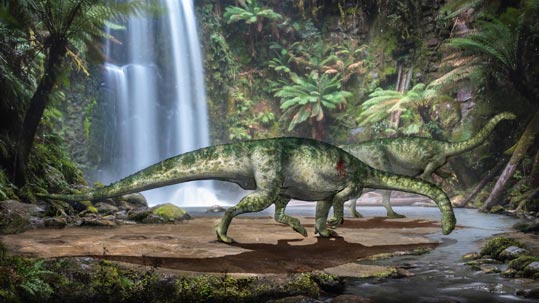
A Life Reconstruction of the Lufengosaurus Showing the Bitemark

Lufengosaurus with bite-mark (life reconstruction).
A life reconstruction of L. huenei in its natural environment and demonstrating the bite wound affecting the shoulder of the herbivorous dinosaur.

Picture credit: Zongda Zhang

Studying Lufengosaurus

Employing an advanced X-ray technique, an international team of scientists from the UK, China, the United States and South Africa, have published evidence for an unsuccessful attack on a Jurassic dinosaur, a member of the Suborder Sauropodomorpha from China known as Lufengosaurus (L. huenei).  Everything Dinosaur was contacted by one of the authors of the scientific paper, published in the academic journal “Nature Scientific Reports”, a PNSO Lufengosaurus replica was purchased so that the model could be used to help explain the pathology and inferred animal behaviour from the scientific research.

The study provides a detailed report of the first recognised case of an abscess in a long-necked dinosaur from the Lower Jurassic of China, (Yunnan Province), which was caused by infection brought on from the bite of a large predatory dinosaur.  The infection may have weakened the animal, ultimately resulting in its death.

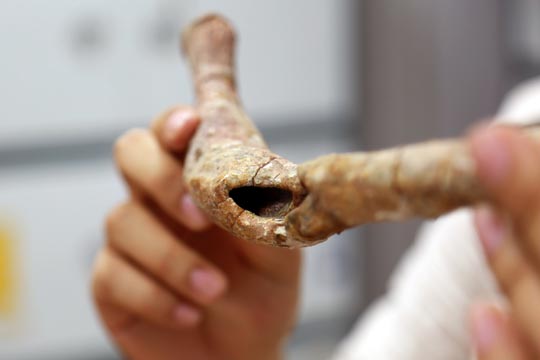
Scientist Lida Xing Holding the Damaged Rib Bone

Rib bone of Lufengosaurus showing pathology.
The pathological fossilised rib of Lufengosaurus huenei.

Picture credit: Lida Xing

Micro-computed X-ray Tomography

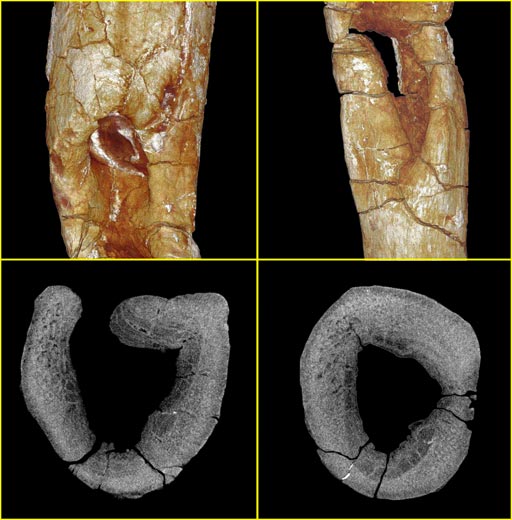
The pathology, was discovered in the skeleton of a L. huenei, which is part of the vertebrate fossil collection at the Yuxi Museum (Yunnan Province).  The fossil rib bone was subjected to micro-computed x-ray tomography (micro-CT).   This permits high-resolution slices and three-dimensional images to be built up of internal structures of bone without damaging the fossil material.

It is a non-destructive research technique.  As well as providing detailed evidence of interactions between big, herbivorous dinosaurs and carnivorous theropods, the successful identification of this abscess using this technique could point to a new understanding of where certain species lived, and the impact of the diseases that they suffered from.

Studying Fossil Rib Pathology

Commenting on the significance of the research, one of the authors of the scientific paper, Dr Patrick Randolph-Quinney (University of Central Lancashire in the UK and the University of the Witwatersrand in South Africa), stated:

“We were able to use micro-CT to look deep inside the structure of the rib and visualise the precise changes that bacterial infection had caused, as well as to see the region of bone that had been bitten out of the rib.  What micro-CT is allowing us to do is understand processes such as trauma and infection in the fossil record at the cellular level, as well as looking at the whole bone.” 

Dr Randolph-Quinney continued:

“This gives us advantages over traditional histology – which slices up bone for magnification under a microscope – in that it doesn’t require us to damage precious fossils and it also allows us to build 3-D reconstructions of the whole region of disease.  In this case, this has allowed us to model and study the whole wound track, not just a single portion of it.”

Images of the Rib Pathology

Lufengosaurus rib pathology caused by a bite.
A 3-D and 3-D slice reconstruction of the Lufengosaurus rib pathology.

Picture credit: Patrick Randolph-Quinney (University of Central Lancashire)

The picture (above), shows a 3-D and 3-D slice reconstruction of the Lufengosaurus rib pathology.  Micro-computed tomography allowed the scientists to produce surface renderings of the fossil in 3-D (top row) and 2-D X-ray slices through the rib (bottom row).  These images show areas of cellular reorganisation, bone destruction and bone formation indicative of ostemyelitis (bone infection).

Lufengosaurus (L. huenei)

Lufengosaurus grew to about six metres in length.  It is estimated to have weighed around two tonnes.  More than two dozen specimens of this prosauropod have been discovered to date, adults as well as fossil material from juveniles.  All the fossils ascribed to this genus have been discovered in the Lufeng Formation of south-western China (Yunnan Province).  Yang Zhongjian, known in western literature as Chung Chien Young, formally named and described Lufengosaurus in 1941.  Lufengosaurus was the first dinosaur from China to have been discovered, studied and displayed by Chinese scientists.

The PNSO Lufengosaurus Dinosaur Model Supplied to the Researchers by Everything Dinosaur

PNSO Lufengosaurus replica.
The PNSO Lufengosaurus dinosaur model.

Picture credit: Everything Dinosaur

The image (above) shows a PNSO Lufengosaurus dinosaur model.

To view the PNSO range of prehistoric animals: PNSO Age of Dinosaurs.

Lead author of the study, Dr Lida Xing (China University of Geosciences) added:

“This case is really exciting as it gives us evidence of interactions between large plant-eating dinosaur species and one of the large aggressive predators preying on them at that time.  Using the latest X-ray imaging we were able to track the changes in the bone caused by an infected bite on the Lufengosaurus, probably from a big carnivorous dinosaur.  We don’t just have evidence of disease but of behaviour between animals – between predator and prey at this deep period in prehistory.”

An International Team of Researchers

This study was carried out by researchers at the University of Central Lancashire (UCLan), China University of Geosciences, the University of the Witwatersrand in South Africa, the Carnegie Museum of Natural History in the USA, the State Key Laboratory of Genetic Resources and Evolution, Kunming Institute of Zoology, and the Yuxi Museum, Yunnan, China.

The team were able to identify an infection in the bone called osteomyelitis which produces a pus-filled abscess inside the bone.  This is only the second time that a case of osteomyelitis has been recorded in the Sauropodomorpha, the other instance came from a giant titanosaur from Argentina, the Lufengosaurus example pre-dates the Argentinian example by tens of millions of years.  It is the earliest recorded case of a bony abscess caused by osteomyelitis disease in the fossil  record.

Views of the Damaged Lufengosaurus Rib Bone

A damaged rib of a Lufengosaurus.
The pathological fossil rib (two views).

Picture credit: Lida Xing

Clinical Science and Palaeontology

Hao Ran from the Kunming Institute of Zoology, Chinese Academy of Sciences, commented:

“This is a great example of how the clinical sciences and the science of palaeontology are working together with fossils from the Chinese fossil record.  Together with international collaborators we are able to advance our understanding of diseases in both the past and the present.  We don’t know which predator caused the bite, but we do have a smoking gun of the attack with the bite wound it left.”

The scientific paper: “Possible Bite-induced Abscess and Osteomyelitis in Lufengosaurus (Dinosauria: Sauropodomorph) from the Lower Jurassic of the Yimen Basin, China” by Lida Xing, Bruce M. Rothschild, Patrick S. Randolph-Quinney, Yi Wang, Alexander H. Parkinson and Hao Ran published in Nature Scientific Reports.

Visit the Everything Dinosaur website: Everything Dinosaur.
13 04, 2018

Fossils to Explore with Year 2

By |2023-10-10T08:34:56+01:00April 13th, 2018|Categories: Educational Activities, Photos/Pictures of Fossils, Teaching|0 Comments

Ready to Explore Fossils with Year 2

Whilst on one of our many visits to schools to deliver a workshop to Key Stage 2, we discussed with the teaching team how to add more tactile elements to the school’s scheme of work.  We suggested a number of dinosaur and prehistoric animal themed exercises including dedicating a table to create a work station so that fossils could be examined by the children.  With some magnifying glasses borrowed from the science cupboard and some scraps of paper on stand-by so that the budding palaeontologists could take notes, it only needed a handful of fossils to complete the fossil study area.

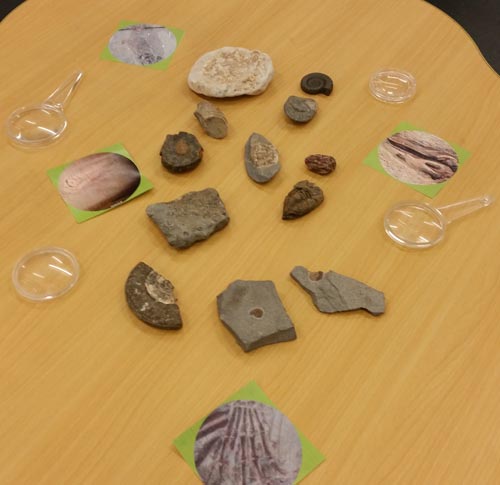
A Fossil Work Station in the Classroom

Learning about fossils.
Ready to study fossils.  Picture credit: Everything Dinosaur

Picture credit: Everything Dinosaur

Fossils on the Display Table

The fossils consisted of fragments of large ammonites, a complete Promiceras (P. planicosta), some Promicroceras ammonites, along with Arnioceras and Asteroceras pieces, all of which come from Dorset (Jurassic Coast).  To this mix of cephalopods, we added crinoids, fossilised seed cones, examples of fossil coral and some pieces representing various trilobites including a large and rather beautiful Calymene trilobite that dates from the Silurian.

For replicas of fossils and models of iconic animals from the fossil record: Fossil Replicas and Dinosaur Teaching Resources.

Being able to handle fossils provides kinaesthetic learners with lots of stimulation, could the children find similar fossils in the text books that they found in library?  Could the work out what sort of creature/plant the fossil might represent.  Can they describe the fossil?  Can they produce an accurate drawing of the object?  We even suggested a measuring exercise to help the children gain confidence using rulers.

Happy fossil hunting!

Visit the Everything Dinosaur website: Everything Dinosaur.
10 04, 2018

Rare Bone Explains Early Human Migration According to New Research

By |2024-05-10T18:41:11+01:00April 10th, 2018|Categories: Dinosaur and Prehistoric Animal News Stories, Main Page, Photos/Pictures of Fossils|0 Comments

Homo sapiens Spread Further Than Previously Thought – More Evidence

A single finger bone, measuring just 3.3 centimetres in length, indicates that modern humans were living in Saudi Arabia around 88,000 years ago.  The ancient digit, is the oldest human (H. sapiens), fossil to have been found to date outside of the cradle of humanity (Africa).  Its discovery suggests that early, modern humans travelled further than initially thought during the first reported human migration into Eurasia.  This fossil discovery adds to the evidence from Israel, China and Australia that Homo sapiens was widely dispersed outside of Africa as early as 180,000 years ago.

Views of the Ancient Human Finger Bone

Ancient human finger bone from Saudi Arabia.
Various views of the fossil intermediate phalanx from Saudi Arabia.

Picture credit: Ian Cartwright

Excavating an Ancient Freshwater Lake Bed

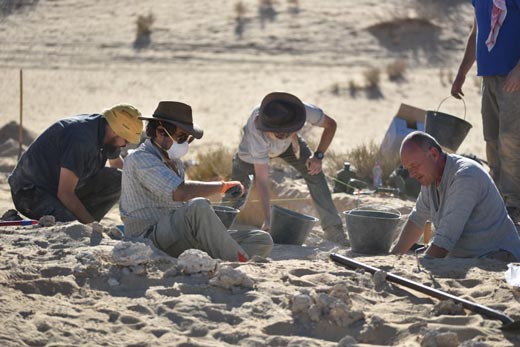
Writing in the academic journal “Nature Ecology and Evolution”, the international team of researchers including scientists from the Max Planck Institute for the Science of Human History, the Saudi Commission for Tourism and National Heritage and Oxford University, report on the excavations of an ancient freshwater lake bed preserved in the Nefud Desert.  Prior to this and other recent discoveries, most palaeoanthropologists believed that early migrations out of Africa into Eurasia by H. sapiens had largely been unsuccessful, with early humans only reaching the relatively nearby Mediterranean forests of the Levant.

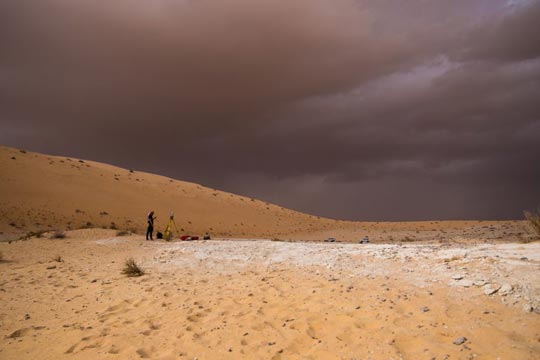
Fieldwork at the Al Wusta Site (Saudi Arabia)

Excavating the ancient lake bed in the Nefud Desert.
The Al Wusta excavation site, in the Nefud Desert (Saudi Arabia).

Picture credit: Michael Petraglia/Max Planck Institute for the Science of Human History

A Fossil Discovery – A Single Human Bone

The single human bone was subjected to CT scans to build up a three-dimensional image of the fossil.  It resembled a modern human finger bone, Neanderthal finger bones being shorter and squatter.  The fossil is described as an “intermediate phalanx”, it is the second furthest finger bone from the wrist.  In addition to the human fossil, the field team found evidence of the lush palaeoenvironment of the area including bones from a hippopotamus and the fossil shells of freshwater snails.  The scientists uncovered a large number of stone tools too.

Around 88,000 Years Old

A dating technique called uranium series dating was used to estimate the age of the fossil.  A laser was employed to bore microscopic holes into the fossil bone and record the ratio between minute traces of radioactive elements.  Having compared the fossil to the digits of ancient hominins and primates, the scientists reported that this was conclusively a finger bone and it belonged to a member of our own species – Homo sapiens.

Lead author of the paper, Dr Huw Groucutt (Oxford University and the Max Planck Institute for the Science of Human History), stated:

“This discovery for the first time conclusively shows that early members of our species colonised an expansive region of southwest Asia and were not just restricted to the Levant.  The ability of these early people to widely colonise this region casts doubt on long held views that early dispersals out of Africa were localised and unsuccessful.”

An Important Fossil Discovery

Other dates obtained from associated fossil material and analysis of the ancient lake sediments corroborate the team’s findings.  The dates are focused on or around 90,000 years ago.  During this time the Al Wusta location looked very different than it does today.  The area was lush and green and the large lake was surrounded by a grassland ecosystem.

Co-author of the scientific paper, Professor Michael Petraglia (Max Planck Institute for the Science of Human History), added:

“The Arabian Peninsula has long been considered to be far from the main stage of human evolution.  This discovery firmly puts Arabia on the map as a key region for understanding our origins and expansion to the rest of the world.   As fieldwork carries on, we continue to make remarkable discoveries in Saudi Arabia.”

The Ancient Lake Bed (White) Surrounded by the Sand of the Nefud Desert

The prehistoric lake bed in the Nefud Desert.
Once this region was verdant with many lakes thanks to the monsoon rains.

Picture credit: Michael Petraglia/Max Planck Institute for the Science of Human History

The scientific paper: “Homo sapiens in Arabia by 85,000 Years Ago” by Huw S. Groucutt, Rainer Grün, Michael D. Petraglia et al, published in the journal “Nature Ecology and Evolution”.

Visit the Everything Dinosaur website: Everything Dinosaur Website.

9 04, 2018

Late Triassic Giant Ichthyosaurs – A Fascinating Discovery!

By |2024-04-17T15:17:12+01:00April 9th, 2018|Categories: Adobe CS5, Dinosaur and Prehistoric Animal News Stories, Dinosaur Fans, Main Page, Palaeontological articles, Photos/Pictures of Fossils|0 Comments

Scientists Identify Giant Triassic Ichthyosaur Jaw Bone and Help Solve 19th Century Fossil Mystery

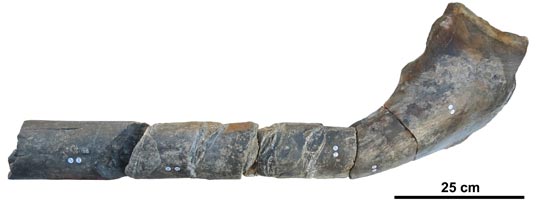
Scientists have identified a jaw bone of a giant marine reptile, that could represent one of the largest animals that ever lived.  The newly described fossil bones, representing a portion of an enormous lower jaw, may also have shed light on a mystery that dates back to the middle of the 19th century.  The fossilised jaw, which consists of several, broken, individual pieces, is thought to be an incomplete surangular (bone from the rear of the lower jaw), from a shastasaurid ichthyosaur, a clade of enigmatic, giant marine reptiles that were geographically widespread during the Late Triassic.

The fossil material was found on the beach at the small village of Lilstock in (west Somerset), the specimen is approximately 205 million years old.

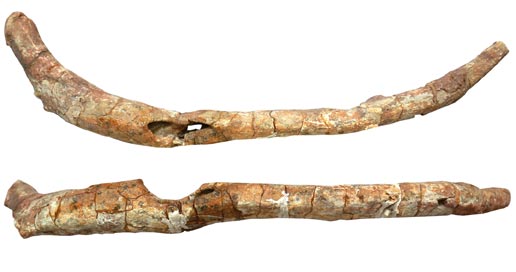
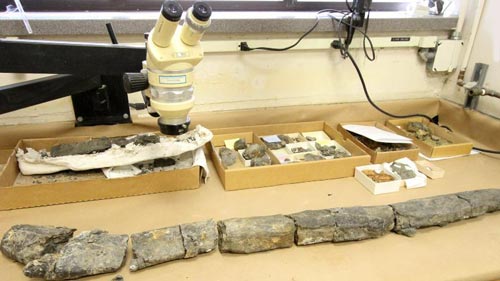
A Lateral View of the Fossil Material – A Giant Ichthyosaur from Somerset!

Incomplete surangular from a giant Triassic Ichthyosaur.
The incomplete surangular jaw bone from Lilstock (Somerset).

Picture credit: Manchester University

Ichthyosaur Fossil Found on a Somerset Beach

Fossil collector and co-author of the study, published in the scientific journal PLOS One, Paul de la Salle, found a portion of the specimen in May 2016.  He later returned to the beach and found more pieces, that together form a partial surangular more than a metre in length (see photograph above).

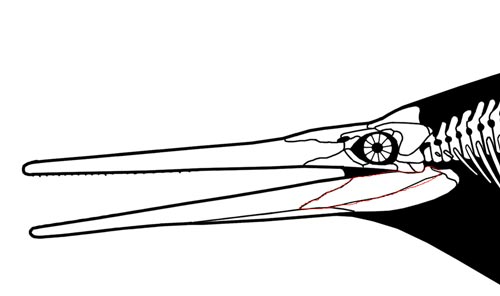
An Approximate Representation of the Location of Surangular on the Skull of Shonisaurus

The surangular bone of Shonisaurus is highlighted.
A close-up of the skull of Shonisaurus, the surangular bone is outlined in red.

Picture credit: Scott Hartman with additional annotation by Everything Dinosaur

Commenting on his fossil find Paul stated:

“Initially, the bone just looked like a piece of rock but, after recognising a groove and bone structure, I thought it might be part of a jaw from an ichthyosaur and immediately contacted ichthyosaur experts Dean Lomax (Manchester University) and Professor Judy Massare (SUNY College at Brockport, New York, USA), who expressed interest in studying the specimen.  I also contacted Dr Ramues Gallois, a geologist who visited the site and determined the age of the specimen stratigraphically.”

Comparisons with Shonisaurus sikanniensis

Dean Lomax and Judy Massare made the surangular identification and visited the Royal Tyrrell Museum of Palaeontology in Drumheller, southern Alberta (Canada), to view skull material from the largest ichthyosaur yet described, the monstrous shastasaurid Shonisaurus sikanniensis.  S. sikanniensis fossils come from Upper Triassic rocks found in British Columbia and the Royal Tyrrell material indicates a marine reptile around 21 metres in length.  The researchers found similarities between the new Somerset specimen and Shonisaurus sikanniensis, which suggests that the Lilstock fossils represent a giant shastasaurid too.

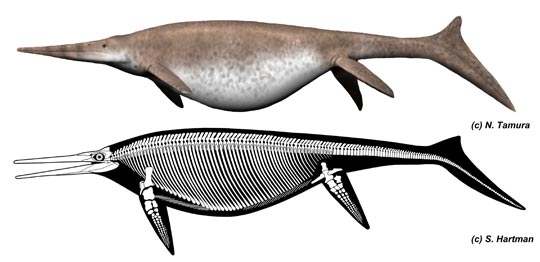
A Life Restoration and Skeletal Drawing of the Giant Ichthyosaur Shonisaurus

Shonisaurus life and skeletal reconstruction.
Shonisaurus life restoration and skeletal reconstruction (N. Tamura and S. Hartman).

Picture credit: Nobumichi Tamura and Scott Hartman

Ichthyosaur as Big as a Blue Whale?

Commenting on the approximate size of the Somerset specimen, Dean Lomax said:

“As the specimen is represented only by a large piece of jaw, it is difficult to provide a size estimate, but by using a simple scaling factor and comparing the same bone in S. sikanniensis, the Lilstock specimen is about 25% larger.  Other comparisons suggest that the Lilstock ichthyosaur was at least 20 to 25 metres.  Of course, such estimates are not entirely realistic because of the differences between species.  Nonetheless, simple scaling is commonly used to estimate size, especially when comparative material is scarce.”

When compared to giant marine vertebrates today, the upper end of the size estimate for the Lilstock specimen would indicate a creature longer than the largest toothed whale, the Sperm whale (Physeter macrocephalus), indeed, at around 25 metres long, it would rival in size the largest cetaceans of all, adult Blue whales (Balaenoptera musculus).

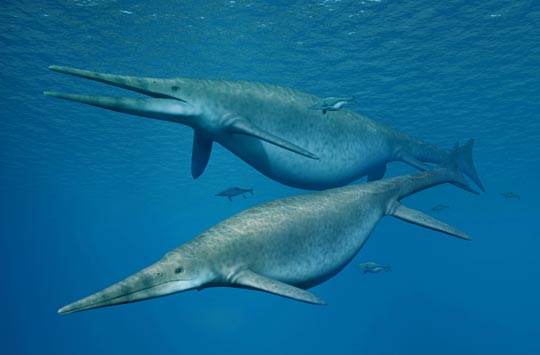
A Pair of Giant Shastasaurid Ichthyosaurs Cruise the Late Triassic Ocean with a Pod of Smaller Ichthyosaurs for Company

Shonisaurus illustrated.
A pair of Shonisaurus – giant marine reptiles of the Late Triassic.

Picture credit: Nobumichi Tamura

Solving a Mystery That Dates Back to 1850

In 1850, a large bone was described from the Upper Triassic sediments of Aust Cliff in Gloucestershire (UK).  Four other fragmentary bone elements were subsequently found and described.  Sadly, two of these fossils are missing and presumed destroyed.  These bone shafts have been assigned to limb bones of herbivorous dinosaurs.  Two of the fossils were thought to resemble the limbs of stegosaurs, but if that was the case, it would push back the evolutionary origins of stegosaurs into the Norian faunal stage of the Late Triassic.  Other scientists have speculated that the fossil material might not be dinosaurian at all, but fossils of a related archosaur from the pseudosuchian lineage.

However, with the discovery of the Lilstock specimen, another possibility has come to light.  These fossils could represent jaw fragments of giant, previously unrecognised ichthyosaurs, after all, the Aust Cliff location has already yielded a number of marine reptile fossils including ichthyosaurs.

Dean Lomax added:

“One of the Aust bones might also be an ichthyosaur surangular.  If it is, by comparison with the Lilstock specimen, it might represent a much larger animal.  To verify these findings, we need a complete giant Triassic ichthyosaur from the UK – a lot easier said than done!”

Visit the website of Dr Dean Lomax: Palaeontologist Dr Dean Lomax.

The scientific paper: “A Giant Late Triassic Ichthyosaur from the UK and a Reinterpretation of the Aust Cliff “Dinosaurian” Bones by Lomax, D. R., De la Salle, P., Massare, J. A. and Gallois, R. (2018) published in PLOS One.

Visit the award-winning Everything Dinosaur website: Everything Dinosaur.
Go to Top