All about dinosaurs, fossils and prehistoric animals by Everything Dinosaur team members.

Pictures of fossils, fossil hunting trips, fossil sites and photographs relating to fossil hunting and fossil finds.

17 06, 2018

Tiny Frogs Preserved in Cretaceous Amber Described in New Research

By |2024-05-08T20:36:36+01:00June 17th, 2018|Categories: Dinosaur and Prehistoric Animal News Stories, Dinosaur Fans, Main Page, Photos/Pictures of Fossils|0 Comments

Amber Fossils Provide Evidence of Cretaceous Frogs Inhabiting Wet, Tropical Environments

The remains of four tiny frogs preserved in Cretaceous-aged amber from northern Myanmar have provided palaeontologists with the first definitive evidence showing frogs 99 million years ago were inhabiting wet, tropical environments. Cretaceous amber reveals its secrets.

Preserved in Cretaceous Amber – A Window into an Ancient Terrestrial Ecosystem
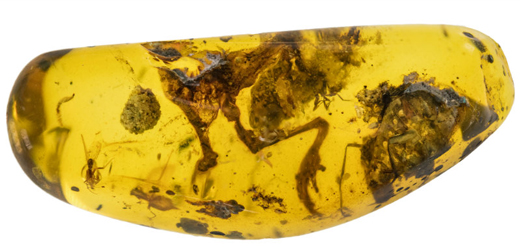
Prehistoric frog preserved in amber.
A polished amber nodule from Myanmar showing substantial organic remains including the remains of a frog.

Picture credit: University of Florida

Electrorana limoae

The new species of Cretaceous amphibian has been named Electrorana limoae.  It was small, a juvenile, measuring around twenty millimetres in length, but this frog and other amazing fossil finds from Myanmar amber (burmite), some of which have been documented on this blog, provide scientists with an improved understanding of the micro-flora and micro-fauna of a tropical forest ecosystem that existed some ninety-nine million years ago.

The frog fossils provide the earliest irrefutable evidence of these types of amphibian living in wet, tropical forests.  They are the oldest-known examples of frogs preserved in amber.

Co-author of the study, published earlier this week in Nature’s “Scientific Reports”, David Blackburn (Florida Museum of Natural History) stated:

“It’s almost unheard of to get a fossil frog from this time period that is small, has preservation of small bones and is mostly three-dimensional.  This is pretty special, but what’s most exciting about this animal is its context.  These frogs were part of a tropical ecosystem that, in some ways, might not have been that different to what we find today – minus the dinosaurs.”

A Life Reconstruction of Electrorana limoae
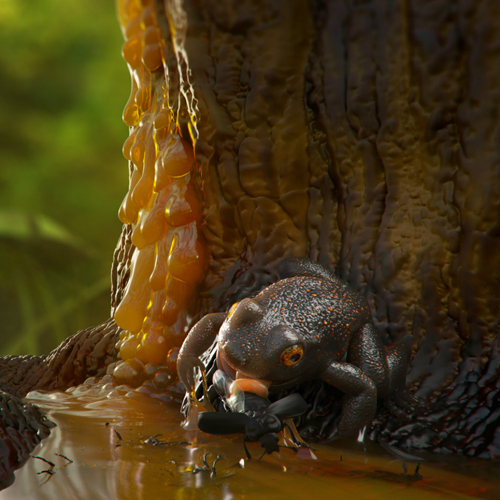
A life reconstruction of Electrorana limoae.
Electrorana limoae – a life reconstruction.

Picture credit: Damir G Martin

Frogs – Probably Very Numerous But a Shockingly Poor Fossil Record

The fossil record for the Class Amphibia is extremely poor, it is believed that frogs may have evolved during the Triassic, although the fossils of an ancient frog/salamander ancestor discovered in Texas in 1995 might indicate that frogs were around many millions of years earlier.

To read Everything Dinosaur’s article about the discovery of a potential ancestral link between frogs and salamanders: Amphibian Ancestry a Little Clearer Thanks to New Discovery.

Frogs tend to be small, as a result their light, often tiny bones are not likely to preserve well so they are very probably underrepresented in the fossil record.  What fossils we do have of frogs tend to be biased towards more robust species from arid, seasonal environments, although, if we consider today’s frogs, the bulk of frog diversity can be found in tropical rainforests.

Dr Blackburn added:

“Ask any kid what lives in a rainforest and frogs are on the list, but surprisingly, we have almost nothing from the fossil record to say that’s a longstanding association.”

A Computer-generated Model Showing Frog Bones (white) and the Remains of a Beetle (Orange)
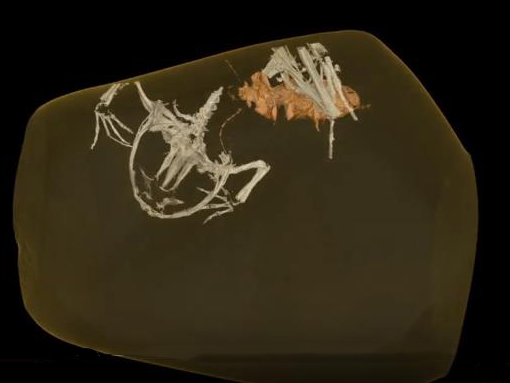
Computer generated three-dimensional image of the bones of Electrorana limoae and the yet to be described beetle.
Computer generated three-dimensional image of the bones of Electrorana limoae and the yet to be described beetle in the amber nodule.

Picture credit: University of Florida

The Burmite Deposits of Myanmar

The Cretaceous amber deposits of northern Myanmar (referred to as burmite), have provided palaeontologists with a unique record of an ancient Cretaceous tropical forest ecosystem. with fossil evidence of mosses, bamboo-like plants, aquatic spiders and velvet worms.  The discovery of Electrorana and the other fossils, the first frogs to have been found in burmite, will add to our understanding of frogs in the Cretaceous.  These fossils demonstrate that frogs have inhabited wet, tropical forests for at least 99 million years.  Frog fossils preserved in amber are exceptionally rare, previous examples have come from the Dominican Republic and Mexico and date back only to about 40 million and 25 million years, respectively.

A View of the Skeletal Remains Preserved in the Burmite
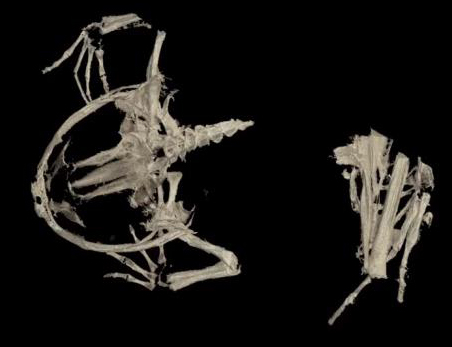
Computer generated images of Electrorana limoae.
Three-dimensional images of the skeletal remains of Electrorana limoae.

Picture credit: University of Florida

Electrorana is the most well-preserved of the four frog fossils.  Clearly visible in the amber are the frog’s skull, its forelimbs, part of its backbone, a partial hind limb.  The other amber fossils contain two hands and an imprint of a frog that likely decayed inside the resin.

Answering Some Questions but Raising Many More

Many characteristics herpetologists use to discern details of a frog’s life history and determine how it’s related to other frogs, the wrist bones, the pelvis, hip bones, the inner ear, the top of the backbone, are either missing or were not yet fully developed in the juvenile frog.

The researchers, which include lead author Lida Xing (China University of Geosciences), have postulated that Electrorana limoae had similar features to extant Midwife toads and Fire-bellied toads, Eurasian species associated with temperate ecosystems.  Further CT scans and more fossil discoveries could help illuminate ancient evolutionary relationships, possibly clarifying how Electrorana fits into the frog family.

A Computer-generated Image of the Fossils of Electrorana limoae (note the presence of a beetle)
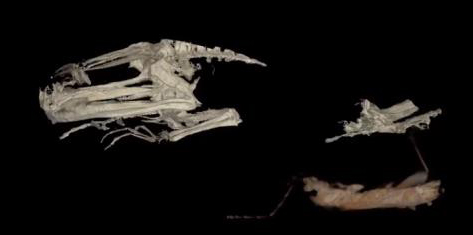
Computer generated image of Electrorana limoe and undescribed beetle.
Computer generated three-dimensional image of the bones of Electrorana limoae and the yet to be described beetle.

Picture credit: University of Florida

If ecosystems of today are anything to go by, it seems likely that there may be numerous frog fossils awaiting discovery, locked away in burmite.  We do not have a lot of single-species frog communities in tropical forest environments in the modern world, so it does seem likely that more frog fossils will be found in northern Myanmar.

Everything Dinosaur acknowledges the help of a press release from the University of Florida in the compilation of this article.

For further news stories about fossil discoveries from Myanmar burmite:

Evidence of insect mimicry preserved in amber: Those Clever Cretaceous Lacewings.

A blood-sucking story: A Blood-sucking Story – Dinosaur Parasites.

The tale of the spiders with tails: A Tale of the Spiders with Tails.

Enantiornithine bird preserved in amber: Watch the Birdie!

Visit the Everything Dinosaur website: Everything Dinosaur.
15 06, 2018

Mexico’s Oldest Member of the Ankylosauria

By |2023-10-14T19:49:13+01:00June 15th, 2018|Categories: Dinosaur and Prehistoric Animal News Stories, Dinosaur Fans, Main Page, Photos/Pictures of Fossils|0 Comments

Acantholipan gonzalezi – Coahuila’s Oldest Dinosaur

A new genus of armoured dinosaur has been described.  This dinosaur roamed northern Mexico around 85 million years ago (the Santonian faunal stage of the Late Cretaceous).  Described as a nodosaurid, the dinosaur has been named Acantholipan gonzalezi and it is the oldest dinosaur described to date from the Coahuila region of Mexico.

Acantholipan gonzalezi

Its discovery is no real surprise, some osteoderms (dermal armour), associated with ankylosaurids have been described from the geologically younger (Campanian), Cerro del Pueblo Formation exposed in the Coahuila region.  In addition, a single tooth identified as nodosaurid, has been discovered in the Mexican state of Baja California.  This fossil tooth was found in Campanian-aged deposits.  Palaeontologists had expected that armoured dinosaur fossils would be found elsewhere in Mexico, extending their known range further south.

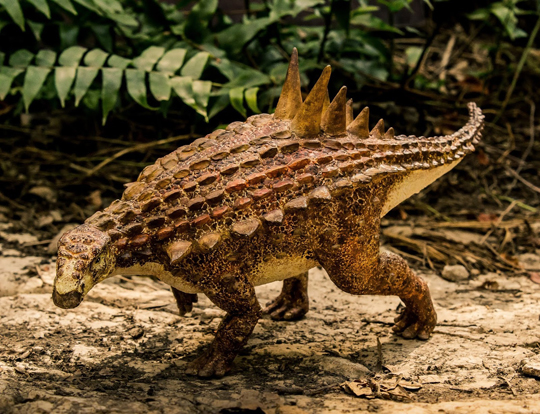
The Southernmost Nodosaurid from North America – Acantholipan gonzalezi

A life reconstruction of Acantholipan gonzalezi.
A model of the Mexican nodosaurid Acantholipan gonzalezi.

Picture credit: Museo del Desierto (Mexico)

Identified from Fragments of Bone

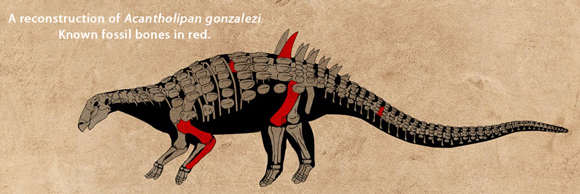
Fragmentary fossils found near to the city of Ocampo in northern Mexico, back in 2011, suggested that nodosaurids roamed this part of North America during the Late Cretaceous, but it was thought that the fossil material was not sufficient to support the establishment of a new species.  The fossils consist of a single dorsal vertebra, a tail bone (caudal vertebra), a partial ulna, a fragment of rib, one large spike (osteodermal spine) along with a portion of an upper arm bone (distal end of a humerus).

The Fragmentary Fossil Material (CPC 272)

Acantholipan fossil material.
Fossil fragments representing a nodosaurid from Coahuila, Mexico (Acantholipan gonzalezi).

Picture credit: Museo del Desierto (Mexico)

The photograph (above), shows the nodosaurid fossil material from Coahuila.  Although very fragmentary, subsequent comparative analysis with younger North American nodosaurids has permitted the establishment of a new species.

Key

Distal end of right humerus in (a) dorsal, (b) ventral, (c) anterior, and (d) posterior views.
Dorsal vertebra in (e) cranial, (f) caudal, and (g-h) lateral views.
Right ulna in (i) dorsal, (j) ventral, and (k-l) lateral views.
Osteodermal spine (m-p).

Note: Scale bar = 5 centimetres

A Skeletal Reconstructioni of Acantholipan gonzalezi

A Skeletal Illustration of A. gonzalezi – Known Fossil Material Outlined in Red

Acantholipan gonzalezi skeletal drawing.
The known bones of A. gonzalezi are shown in red.

Picture credit: Museo del Desierto (Mexico)

An Armoured Dinosaur from Marine Shales

The fossil material was discovered in marine shales associated with the Pen Formation.  The research team studying this material have concluded that the carcass of the dinosaur, a juvenile approximately 3.5 metres long, had been swept out to sea, before sinking to the seafloor and becoming buried by sediment.  If this dinosaur had reached maturity, the scientists estimate that it could have reached a length of about six metres and weighed several thousand kilograms.

With the naming of Acantholipan gonzalezi, this dinosaur becomes the oldest member of the Dinosauria described from the Coahuila region, and the first member of the Ankylosauria clade to have been named from Mexican fossils.

Commenting on the new species of armoured dinosaur, José Rubén Guzmán Gutiérrez of the Museo del Desierto and one of the co-authors of the scientific paper describing the dinosaur in the Swiss Journal of Palaeontology, stated:

“Here in Mexico, we have a significant palaeontological wealth, specifically in the state of Coahuila.  We have this palaeontological richness and it is worthwhile for the population to get involved in getting to know this heritage that belongs to all Mexicans.”

The name of this new species of armoured dinosaur honours its Mexican roots.  The genus name comes from the Greek “akanthos”, which means spine, combined with the name of the native Indians which inhabited this part of northern Mexico.  The species name honours Arturo González-González, the director of the Museo del Desierto.

To read an article from 2017 reporting on the discovery of a new species of horned dinosaur from the Coahuila region of Mexico: Yehuecauhceratops – A New Horned Dinosaur from Northern Mexico.

14 06, 2018

Everything Dinosaur to Conduct Exclusive Dinosaur and Fossil Workshops at The Beacon Museum

By |2024-05-08T20:37:08+01:00June 14th, 2018|Categories: Dinosaur Fans, Everything Dinosaur News and Updates, Main Page, Photos/Pictures of Fossils, Press Releases|0 Comments

Everything Dinosaur at the Beacon Museum

As part of The Beacon Museum’s summer exhibition “Brick Dinos”, team members from Everything Dinosaur will be conducting a weekend of dinosaur and fossil themed workshops.  Join Mike and Sue from Everything Dinosaur from Friday afternoon 27th July and throughout that weekend and help them hunt for fossils including dinosaur bones!

Everything Dinosaur at the Beacon Museum

Team members from Everything Dinosaur will be conducting a series of workshops at the Beacon Museum, giving participants the chance to be a palaeontologist and cast museum quality fossil replicas.  Turn dinosaur detective and get up close to some amazing fossils and learn how to find evidence of ancient life. Best of all, what you find on the fossil dig, you can keep!

Join Everything Dinosaur Team Members over the Weekend of July 27th to July 29th

Everything Dinosaur at the Beacon Museum
Everything Dinosaur will be conducting a series of family friendly dinosaur and fossil themed workshops from July 27th – July 29th.

Picture credit: Everything Dinosaur

Dinosaur Detectives and Perceptive Palaeontologists

The “Brick Dinos” event allows visitors to travel back in time and to interact with a series of prehistoric animal exhibits that have been created by the famous plastic bricks (Lego®).  Everything Dinosaur will be conducting a series of 2-hour-long, family friendly, dinosaur and fossil themed workshops, utilising the ground floor of the Beacon Portal.  Numbers are limited so booking is essential.

Dinosaur and Dino Pro combination tickets available please ring 01946 592302 for details, or alternatively, you can contact the Beacon Museum for tickets and further information.

Mike from Everything Dinosaur commented:

“We are going to be bringing lots of different fossils which have been collected from various dig sites, sharks teeth, corals, ammonites, crocodile armour and of course, real dinosaur bone.  Visitors to the Beacon will have the opportunity to hunt for fossils and you can take home what you find, starting your own fossil collection.”

Everything Dinosaur at the Beacon Museum Friday July 27th to Sunday July 29th

Everything Dinosaur and fossil workshops.
Everything Dinosaur at the Beacon Museum 27th July to 29th July.

Picture credit: Everything Dinosaur

The Proposed Itinerary*

Everything Dinosaur team members are going to be very busy over that weekend.   The team intend to conduct a 2-hour dinosaur and fossil workshop on Friday afternoon (starting 2pm) and to delivery two further workshops on Saturday and Sunday morning.  On Saturday and Sunday afternoon, Everything Dinosaur will be laying out their fossil trays and inviting visitors to join them on a fossil hunt, looking for fossils which will include teeth from prehistoric sharks, belemnite guards and dinosaur bones.

Friday 27th July
• 2pm to 4pm – Dinosaurs and Fossils Workshop

Saturday 28th July
• 9.30am to 11.30am – Dinosaurs and Fossils Workshop

• 1pm – Fossil Trays and Finding Fossils

• 2pm – Fossil Trays and Finding Fossils

• 3pm – Fossil Trays and Finding Fossils

• 4pm – Fossil Trays and Finding Fossils

Sunday 29th July
• 9.30am to 11.30am – Dinosaurs and Fossils Workshop

• 1pm – Fossil Trays and Finding Fossils

• 2pm – Fossil Trays and Finding Fossils

• 3pm – Fossil Trays and Finding Fossils

• 4pm – Fossil Trays and Finding Fossils

Proposed itinerary* potentially subject to change contact The Beacon Museum for further information.

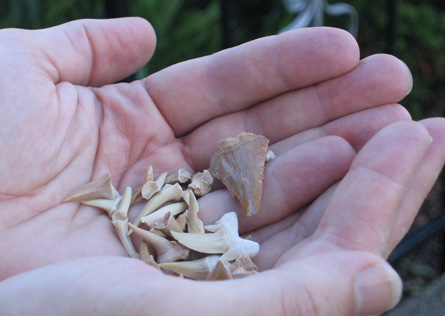
Finding Fossils Including Shark Teeth

fossilised shark teeth.
A successful fossil hunt. Picture credit: Everything Dinosaur.

Picture credit: Everything Dinosaur

Further information about Everything Dinosaur: Everything Dinosaur.

12 06, 2018

The Pneumatic Bones of Theropods

By |2023-10-14T18:44:50+01:00June 12th, 2018|Categories: Dinosaur Fans, Main Page, Photos/Pictures of Fossils|0 Comments

The Pneumatic Bones of Theropods (Living and Extinct)

Air-filled (pneumatic), bones are unique to birds amongst living terrestrial vertebrates.  However, it is known that many different types of archosaurs as well as the birds had post-cranial bones with lots of air sacs.  Non-avian dinosaurs in the form of the Theropoda had them to.  Whilst visiting the Grant Museum of Zoology and Comparative Anatomy in London, this shared anatomical trait was beautifully demonstrated when viewing a number of avian exhibits.

Studying Theropods (Living and Extinct)

An Ostrich Femur (Thigh Bone) Showing Pneumaticity

An ostrich femur showing extensive pneumaticity.
A cross-section of an ostrich femur showing the extensive air sacs. Picture credit: Everything Dinosaur.

Picture credit: Everything Dinosaur

The caption in the display case reads:

“OSTRICH FEMUR – Birds have honeycomb bones to reduce weight for flight.  Flightless ostriches evolved from flying birds and retain this feature”.

The above statement is true, but technically (most probably), pneumatic, post-cranial bones have been inherited from the Dinosauria.

A Fragment of Theropod Bone Showing the Highly Pneumatised Internal Structure

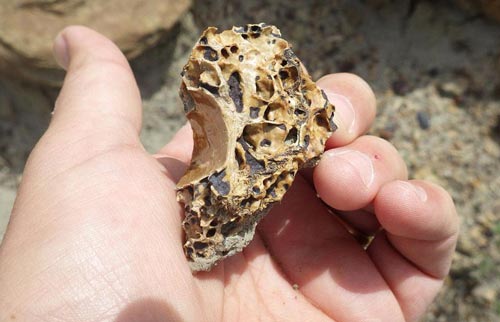
The tell-tale honeycomb structure of fossil bone indicates Theropod dinosaur.
A close up of the fossil bone shows the typical honeycomb structure indicative of a theropod dinosaur.

Picture credit: Jason Love/Burke Museum

Air-filled Bones Evolved Independently in Several Groups Avemetatarsalia

The fossil record has provided evidence of pneumaticity in Late Triassic archosaurs (at least 210 million years ago), it is very likely that air-filled bones evolved much earlier in the branch of the archosaurs (Avemetatarsalia), that includes the dinosaurs, pterosaurs and birds.  Bones with air sacs are also associated with derived members of the Sauropodomorpha.  It has been postulated that this characteristic evolved independently in several groups and that pneumaticity did not occur amongst these different archosaurs as a result of sharing a common ancestor.

The evolution of light, but strong air-filled bones can be explained for the birds, as such bones would help reduce weight and make flying easier.   As for the other, extinct archosaurs, this characteristic evolved in the Pterosauria (flying reptiles) for very probably the same reason – to reduce weight to make flying easier.  As for the dinosaurs and other largely non-volant archosaurs that had this feature, pneumatisation might have evolved to reduce energy expenditure as these animals moved about.  After all, if you weigh several tonnes, as in the case of a basal sauropod, if you could evolve a more efficient method of locomotion, than this makes a lot of evolutionary sense.

Visit the Everything Dinosaur website: Everything Dinosaur.

6 06, 2018

Rare Three-toed Dinosaurs from the Tatras

By |2024-05-11T05:59:18+01:00June 6th, 2018|Categories: Dinosaur and Prehistoric Animal News Stories, Dinosaur Fans, Main Page, Photos/Pictures of Fossils|0 Comments

Scientists Discover Dinosaur Footprints in the Tatra Mountains

The beautiful and rugged Tatra mountain range forms a natural border between Poland and Slovakia, but during the Late Triassic, the sediments that formed part of these peaks were sandy shores close to large rivers where many different types of dinosaur wandered.  Dinosaurs left their footprints in these soft sands, and remarkably some of these trace fossils have survived more than 200 million years and they are helping palaeontologists to better understand the composition of Late Triassic vertebrate faunas.

Media reports from the Centre of Interdisciplinary Biosciences of Pavol Jozef Šafárik University in Košice, Slovakia, confirm the discovery of yet more three-toed theropod dinosaur footprints, although most are badly eroded, these trace fossils indicate the presence of a sizeable predator, one that may have exceeded five metres in length.

The fossils come from the Tomanová Formation and although dating the strata is challenging, the rocks are thought to have been laid down during the Late Norian to the Rhaetian faunal stage of the Triassic (215 – 202 million years ago approximately).

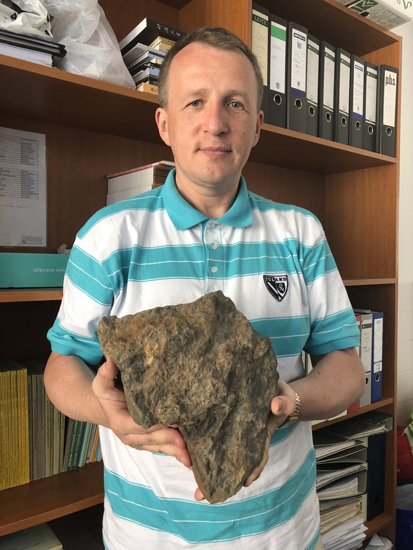
Palaeontologist Martin Kundrát with a Cast of a Dinosaur Footprint

Dinosaur Footprint cast (Tatra Mountains).
Martin Kundrát holding a cast of the dinosaur trace fossil he discovered in the Tatras.

Picture credit: Jana Otriová

Recording the Activity of Dinosaurs from the Late Triassic

The first dinosaur fossil footprints found in the High Tatras were described in 1976.  These fossils and subsequent footprint discoveries led to the establishment of a new ichnospecies – Coelurosaurichnus tatricus.  However, these new finds, ten dinosaur trace fossils, have helped shed further light on vertebrate fauna at an important time in our planet’s history.  At around this time, a mass extinction event occurred and a number of terrestrial vertebrates (and other types of animal) became extinct, providing the Dinosauria with even greater opportunities to diversify and produce new species.

Commenting on these fossils, one of the palaeontologists who discovered them, Martin Kundrát (Centre of Interdisciplinary Biosciences of Pavol Jozef Šafárik University), stated:

“The locality is extremely rare for Slovak dinosaurology.  It is located at high altitude.  This does not mean, however, that dinosaurs have been hiking.  The truth is that the sediments in which the traces were preserved were created hundreds of kilometres from Slovakia almost at the level of the then advancing sea.  The layers of the tracks were later transported to the territory of Slovakia and raised to the stars.  This is our modest dinosaur association.  Two of them are complete, the rest are only fragments.”

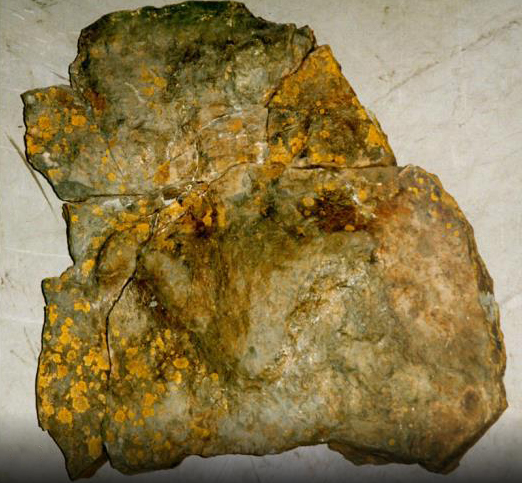
One of the More Complete Footprint Fossils

Dinosaur footprint fossil from Slovakia.
Coelurosaurichnus tatricus?  Footprints previously ascribed to the ichnospecies C. tatricus may have to be redefined in the light of these new fossil discoveries.

Picture credit: Martin Kundrát

Important Fossils Although Fragmentary Fossils

The fossil record for dinosaurs from Europe during the Late Triassic is relatively poor, so even these fragments are very helpful to palaeontologists as they attempt to piece together the biota of Pangaea.  The trace fossils, although quite indistinct, help scientists to gain an understanding of the various types of dinosaur that roamed this part of the world more than 200 million years ago.  Moreover, these new discoveries allow palaeontologists to revise their knowledge about an ancient ecosystem.   Based on studies of similar imprints from South Korea, the United States, Iran and China, scientists have been able to make two important deductions.

First, the researchers have concluded that the former ichnotaxonomy (classification of an animal based on its footprints, burrows, or other traces) of Coelurosaurichnus tatricus is not valid.

Secondly, the number of imprints confined to a small area indicates that it was a very often frequented locality.

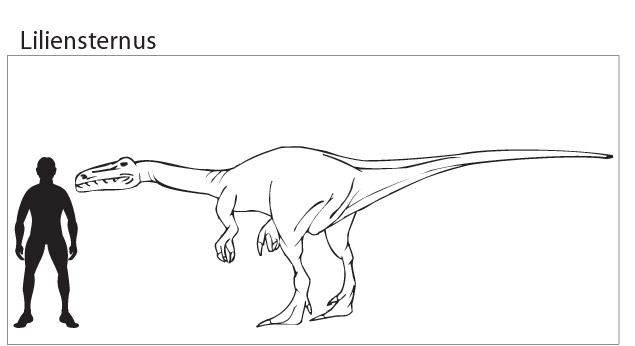
The Dinosaur Footprints Indicate a Theropod Around Five Metres in Length

Liliensternus drawing.
Liliensternus dinosaur drawing,  It is probable that the Slovakian theropod looked like Liliensternus from the Late Triassic of Germany. Picture credit: Everything Dinosaur.

Picture credit: Everything Dinosaur

In total, this part of the High Tatras has yielded several different types of dinosaur footprint.  Several papers have been published previously describing ornithischian prints and the large, rounded tracks of what are assumed to be Sauropodomorpha, as well as numerous types of three-toed (tridactyl) prints assigned to the theropoda.

For dinosaur and prehistoric animal models: Dinosaur and Prehistoric Animal Models.

2 06, 2018

The Mother of All Dragons – Megachirella

By |2023-10-14T10:10:45+01:00June 2nd, 2018|Categories: Dinosaur and Prehistoric Animal News Stories, Dinosaur Fans, Main Page, Palaeontological articles, Photos/Pictures of Fossils|0 Comments

The Mother of All Dragons – Megachirella wachtleri

A team of international scientists, including palaeontologists from Bristol University, Midwestern University (Arizona) and the University of Alberta, have identified the world’s oldest lizard fossil (Megachirella wachtleri), permitting fresh insight into the evolution of extant snakes and lizards (Squamata).  Writing in the journal “Nature”, the researchers, including co-author Dr Massimo Bernardi from MUSE – Science Museum, Italy and University of Bristol’s School of Earth Sciences, built the largest dataset of reptiles ever assembled in order to assess where in the evolutionary tree of the Reptilia a fossil from the Dolomites of Italy should be placed.

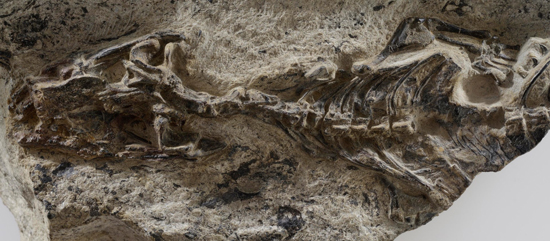
The Holotype Specimen of Megachirella wachtleri

The origins of the Squamata - The holotype of Megachirella wachtleri.
The holotype of Megachirella wachtleri.

Picture credit:  MUSE – Science Museum

Megachirella wachtleri

The fossil, consisting of an articulated partial specimen was discovered in marine sediments in the Dolomites of Italy and named Megachirella wachtleri in 2003.  Although, found in marine sediment, the fossil, which represented the front portion of the animal, showed no adaptations to an aquatic existence.  On the contrary, it had strong legs with claws and although small at around twenty centimetres in length, it was probably a capable climber.  It was concluded that the carcass of this reptile had been washed out to sea following a storm.

An analysis in 2013 concluded that Megachirella wachtleri was a member of the Lepidosauromorpha, a group of diapsid reptiles defined as being closer to Squamata than to the Archosauria.

Lepidosaurs include modern snakes and lizards, many extinct forms of reptile and the Order Rhynchocephalia, once very diverse, but now only represented by the tuatara of New Zealand.  This new research, which drew upon an enormous database of skeletal and molecular information about 129 different types of reptile, revealed that Megachirella had characteristics that are only found in the Squamata.  It was concluded that M. wachtleri was a stem squamate – think of it as being the “the mother of all dragons”.

Co-author Dr Randall Nydam of the Midwestern University in Arizona stated:

“At first I did not think Megachirella was a true lizard, but the empirical evidence uncovered in this study is substantial and can lead to no other conclusion.”

The 240-million-year-old fossil, Megachirella wachtleri, is the most ancient ancestor of all modern lizards and snakes discovered to date.  The study also found that geckoes are the earliest crown group squamates not iguanians as previously thought.

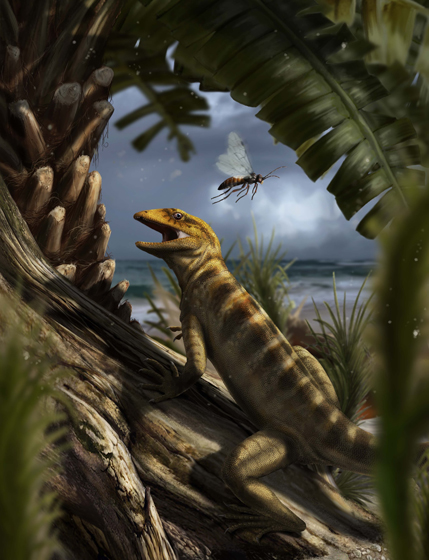
A Life Reconstruction of  Megachirella wachtleri

Megachirella wachtleri in the Dolomites 240 million years ago.
A life reconstruction of Megachirella wachtleri.

Picture credit: Davide Bonadonna

Megachirella wachtleri on the Front Cover of “Nature”

The beautiful illustration of M. wachtleri produced by Davide Bonadonna is featured on the front cover of the journal Nature, which provides details of this scientific study.

The research team conclude that the Squamata probably evolved in the Late Permian and therefore, the ancestors of today’s snakes and lizards survived the most devastating mass extinction event known to science – the end Permian extinction.

Tiago Simões, lead author of the scientific paper and a PhD student at the University of Alberta (Canada), explained:

“The specimen is 75 million years older than what we thought were the oldest fossil lizards in the entire world and provides valuable information for understanding the evolution of both living and extinct squamates.”

10,000 Squamate Species

It has been estimated that there are around 10,000 species of lizards and snakes living today, twice as many different species as mammals.  Despite this modern diversity, scientists did not know much about the early stages of their evolution.

Student Tiago Simões added:

“It is extraordinary when you realise you are answering long-standing questions about the origin of one of the largest groups of vertebrates on Earth.”

Co-author of the study, Dr Michael Caldwell from the University of Alberta, explained that fossils represent the only accurate window into the ancient story of life on our planet.  The new understanding about Megachirella and its significance is but a point in deep geological time, it does tell us things about the evolution of lizards that we simply cannot learn from any of the extant species today.

Co-author Dr Massimo Bernardi from MUSE – Science Museum, Italy and University of Bristol’s School of Earth Sciences, commented upon the importance of such fossil specimens, stating:

“This is the story of the re-discovery of a specimen and highlights the importance of preserving naturalistic specimens in well maintained, publicly accessible collections.”

The scientific paper:

“The Origin of Squamates Revealed by a Middle Triassic Lizard from the Italian Alps” by T. Simões, M. Caldwell, M. Tałanda, M. Bernardi, A. Palci, O. Vernygora, F. Bernardini, L. Mancini and R. Nydam published in the journal Nature.

Everything Dinosaur acknowledges the help of a press release from Bristol University in the compilation of this article.

Visit the Everything Dinosaur website: Everything Dinosaur.
31 05, 2018

A Fabulous and Rare Fossil

By |2024-05-11T06:06:35+01:00May 31st, 2018|Categories: Adobe CS5, General Teaching, Main Page, Photos/Pictures of Fossils|Comments Off on A Fabulous and Rare Fossil

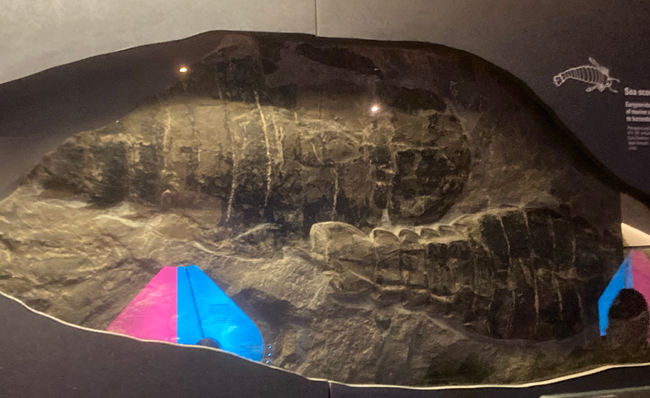
A fabulous pair of eurypterid fossils photographed in the London Natural History Museum.

Spotted in the British Museum (London), two beautifully preserved sea scorpion fossils.  The picture (below) shows a wonderful example of what looks like a fossilised, giant woodlice.  However, all is not as it seems.

Sea Scorpion Fossil Specimens

A splendid pair of sea scorpion fossils on display.  Museum fossil on display.
A pair of eurypterid fossil specimens on display at the London Natural History Museum. Picture credit: Everything Dinosaur.

Picture credit: Everything Dinosaur

Woodlice are isopods and members of the Arthropoda Phylum. Eurypterids are arthropods too. Both have segmented bodies and share several anatomical characteristics, but they are only distantly related.

Probably originating during the Ordovician, eurypterids persisted until the Permian. Both marine and freshwater forms evolved. Some marine eurypterids represent the largest arthropods known to science. The largest described to date is Jaekelopterus rhenaniae. Based on a forty-six-centimetre claw fossil, palaeontologists have suggested that J. rhenaniae reached a length of 2.5 metres or more.

To read an article about this giant, Devonian sea scorpion: Claws! The Giant Jaekelopterus rhenaniae.

Eurypterid Fossil Specimens

Although the eurypterid fossils on display are not as large as the biggest species of Jaekelopterus (pronounced Yay-kel-op-ter-us), they are still impressive.

A spokesperson from Everything Dinosaur commented on the details preserved within the fossil specimens and stated:

“When you see up close stunning eurypterid fossils, you gain an appreciation of the diversity and variety of life on Earth. It is hard to believe, but for more than 150 million years these amazing arthropods thrived, outcompeting vertebrates. Many forms evolved to become apex predators.”

Visit the award-winning Everything Dinosaur website: Everything Dinosaur.

31 05, 2018

Uruguay’s First Pterosaur is Described in New Paper

By |2024-05-11T06:07:06+01:00May 31st, 2018|Categories: Dinosaur and Prehistoric Animal News Stories, Dinosaur Fans, Main Page, Photos/Pictures of Fossils|0 Comments

Uruguay’s First Pterosaur

A team of international scientists writing in the academic publication “The Journal of South American Earth Sciences”, have reported the discovery of the first pterosaur fossils known from Uruguay.  The fossil material representing a fragment of jaw with associated teeth, is believed to represent a new species of Ctenochasmatidae pterosaur.  Ctenochasmatids are geographically widespread with fossils reported from the United States, China, southern Germany, Argentina and England.  The fossils ascribed to this family of short-tailed pterosaurs have a large temporal range, from the Late Jurassic transitioning through to the Early Cretaceous.

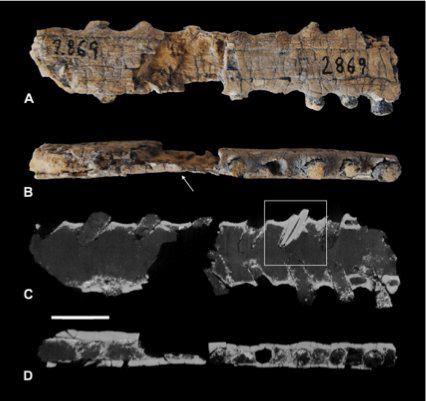
Views of the Fragmentary Fossil Material (Rostrum)

Ctenochasmatid rostrum from Uruguay.
The first pterosaur fossils from Uruguay.

Picture credit: The Journal of South American Earth Sciences

Buck-Toothed Pterosaur

The fossil comes from the Tacuarembó Formation, which is believed to represent deposits laid down as the early Atlantic Ocean opened up.  The strata largely consists of  sediments deposited in a terrestrial, near-shore environment.  The orientation of the tooth sockets and the preserved tooth base suggests that the conical teeth were pointed out sideways and forwards.  This may have been an adaptation for capturing slippery prey such as small fish.  This family of small pterosaurs exhibit a variety of different shaped mandibles, although fragmentary, the researchers have identified that the fossil jaw widens towards the tip (anterior portion), the shape of the jaw and its size corresponds to jaws of known ctenochasmatids, specifically the subfamily Gnathosaurinae.

Different Jaw Types within the Ctenochasmatidae

Ctenochasmatid mandible variation.
Ctenochasmatid mandibles.

Picture credit: Wellnhofer, Howse et al from Witton

The picture shows mandible variation within the Ctenochasmatidae (A) Ctenochasma elegans seen from below, (B) Plataleorhynchus streptorophodon as viewed from below and (C), the skull of Gnathosaurus subulatus (viewed from underneath).  The dentition and the shape of the mandibles suggest adaptations for catching and consuming different types of prey.

Dating the Geological Formation Thanks to a Shark

The Tacuarembó Formation has proved very difficult to date, as the fossils found in the strata were not that easy to compare to fossils found in other rocks.  Despite, an abundance of bone fragments representing a range of creatures, including theropod dinosaurs, the Tacuarembó Formation lacked helpful biostratigraphic indicator fossils to assist with relative dating.  This changed with the discovery of numerous teeth and a single dorsal spine which was assigned to the Hybodont shark Priohybodus arambourgui.

Fossils of this primitive shark are known from the Arabian Peninsula as well as Africa and the strata associated with these fossils has permitted more accurate dating to occur.  Thanks to this shark, the authors of this new paper can state that the pterosaur fossil material comes from a fossiliferous horizon no older than the Late Jurassic.  As such, the Uruguayan pterosaur remains represent the oldest ctenochasmatid found in South America known to science.

For replicas of pterosaurs and other prehistoric animals: Prehistoric Animal Figures Including Pterosaur Models.

12 05, 2018

Saurornitholestes from Appalachia? Could be as Rare Fossil Discovered

By |2024-05-10T22:18:05+01:00May 12th, 2018|Categories: Dinosaur Fans, Main Page, Photos/Pictures of Fossils|0 Comments

Saurornitholestes from the South-eastern United States

Whilst in the course of writing the fact sheets for all the new dromaeosaurid models that are due to arrive when the “Beasts of the Mesozoic” stock comes in, team members have come across some fascinating information relating to Saurornitholestes langstoni.  This member of the Dromaeosauridae, which was similar to Velociraptor, was originally described in 1978 from fossil material found in southern Alberta.   Dromaeosaurids such as Saurornitholestes, or at least related species, may have roamed the south-east of the United States as well as the western USA and Canada.

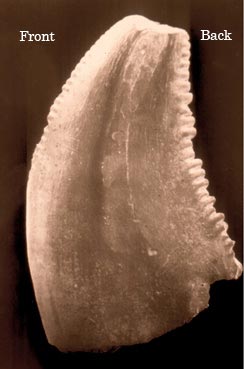
A Single Tooth from Alabama (Saurornitholestine dromaeosaurids)

Dromaeosaurid tooth from Alabama.
The isolated dromaeosaurid teeth with very different sized denticles (anterior and posterior).

Picture credit: David R. Schwimmer

Isolated Dromaeosaurid Dinosaur Teeth

Isolated teeth have been found in North and South Carolina and assigned to the Saurornitholestes genus, or at least described as having come from Saurornitholestine dromaeosaurids.  The picture above shows a tooth assigned to  Saurornitholestes langstoni that was found in Greene County (Alabama), from exposures representing the Upper Cretaceous (Mooreville Formation).  The tooth measures about 4.6 mm long and it shows the distinctive serrations (denticles) associated with the Saurornitholestes genus.

The denticles on the posterior (back) edge of the teeth are much more prominent and larger than those denticles found on the anterior (front) edge of the tooth.  This extreme disparity is regarded as a unique feature of Saurornitholestine dromaeosaurids.

Saurornitholestes

During the Late Cretaceous, North America was split into two landmasses by the Western Interior Seaway.  To the west was Laramidia and to the east, the far larger landmass of Appalachia, although much more is known about the Cretaceous biota of Laramidia.

A far larger tooth, one that measures more than 20 mm in length was found in North Carolina.  This tooth also showed the characteristic disparity in denticle size between the anterior and posterior carinae (the sharp edges of the teeth).  This fossil find suggests that dromaeosaurids of different sizes roamed Appalachia during the Late Cretaceous.

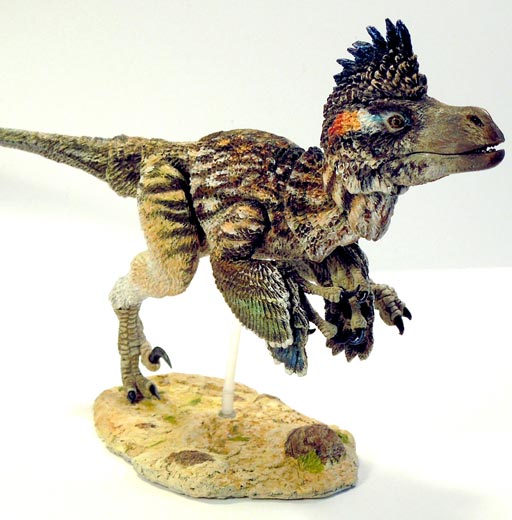
The Beasts of the Mesozoic Saurornitholestes langstoni Figure

Beasts of the Mesozoic Saurornitholestes langstoni.
The Beasts of the Mesozoic Saurornitholestes langstoni “raptor” figure.

To view the Beasts of the Mesozoic figures: Beasts of the Mesozoic Models and Figures.

Beasts of the Mesozoic Figures

When it comes to the Saurornitholestes genus in particular, these types of characteristic teeth are known from numerous sites across North America and from rock formations that vary in age by millions of years.  Either Saurornitholestes langstoni and Saurornitholestes sullivani, the two species currently assigned to this genus, were geographically and temporally widespread, or there are a lot more dromaeosaurid species, including quite large ones, if the North Carolina tooth is anything to go by, awaiting discovery.

The Everything Dinosaur website: Everything Dinosaur.

9 05, 2018

A Remarkable Weather Forecast from the Cambrian

By |2024-05-10T19:04:08+01:00May 9th, 2018|Categories: Dinosaur and Prehistoric Animal News Stories, Geology, Main Page, Palaeontological articles, Photos/Pictures of Fossils|0 Comments

Tiny Fossils Provide Clues to Earth’s Climate 500 Million Years Ago

A joint team of scientists from France and the UK, have plotted the temperature of our planet’s oceans over half a billion years ago using a combination of fossil data and computer-based climate models.  Think of it as a sort of weather forecast from the Cambrian.

A Cambrian Climate Study

This newly published research suggests that the first hard-bodied animals diversified in warms seas, heated by a greenhouse world.  The team’s findings help to expand our knowledge of the environment at the time of the Cambrian explosion, a period in Earth’s history that saw a huge increase in the number and type of marine animal forms.

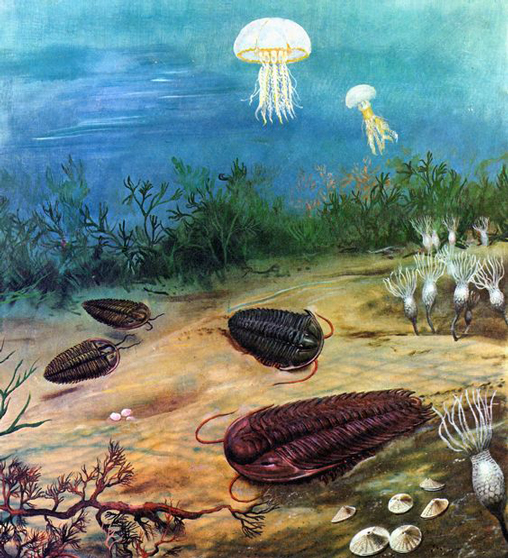
Life in the Late Cambrian Period

Cambrian life.
Life in the Late Cambrian by Zdeněk Burian.

Picture credit: Zdeněk Burian

Writing in the academic journal “Science Advances”, the scientists, led by researchers from the University of Leicester, used climate models and the chemical analysis of tiny, shelly fossils preserved in limestone from Shropshire (central England), to calculate the sea temperature during a time of rapid diversity of animal life in the Palaeozoic.

From around 540 to 510 million years ago, the fossil record shows a marked change, as during this period of Earth’s history, virtually all of the animal phyla (including the Chordata – our phylum) appeared.  The idea of a “Cambrian explosion” is a little misleading, the appearance of many new forms of complex animal life may have been gradual, but in terms of the fossil record, sites such as the famous Burgess Shale of British Columbia and Yunnan Province (southern China), have revealed extensive and varied marine ecosystems with large numbers of new types of animal being recorded in the strata.

Analysis of Some of the First Shelly Fossils

Scientists had thought that for much of the Cambrian, our planet was warmer that it is today with no polar ice caps present.  A study of tiny 1 mm long fossils of some of the first animals to produce a hard, shelly exoskeleton has confirmed this hypothesis.  Analysis of isotopes from the tiny shells in combination with the climate models show that at high latitudes (around 65 degrees south), sea temperatures were in excess of 20 degrees Celsius.

This might seem very warm, especially when you consider that this is an evaluation of sea temperatures at approximately 65 degrees south, today, travelling to that latitude would put you on the southernmost fringes of the Southern Ocean and close to Antarctica.  However, the data generated is similar to more recent, better understood, greenhouse climates such as that of the Late Cretaceous.

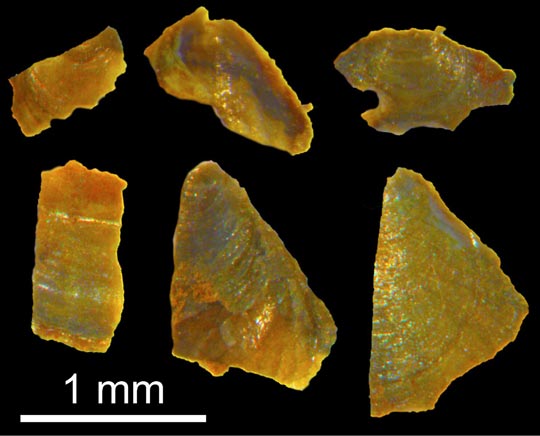
Reflected Light Microscopy – Brachiopod Fossils Used in the Study

Reflected light microscope images of Cambrian brachiopods.
Reflected light microscope images of some of the brachiopod fossils (phosphatic microfossils), used in this study.

Picture credit: Leicester University

Analysing Isotopes

Co-author of the open access paper, PhD student Thomas Hearing (University of Leicester’s School of Geography, Geology and the Environment), explained:

“Because scientists cannot directly measure sea temperatures from half a billion years ago, they have to use proxy data, these are measurable quantities that respond in a predictable way to changing climate variables like temperature.  In this study, we used oxygen isotope ratios, which is a commonly used palaeothermometer.  We then used acid to extract fossils about 1 mm long from blocks of limestone from Shropshire, UK, dated to between 515 – 510 million years old.  Careful examination of these tiny fossils revealed that some of them have exceptionally well-preserved shell chemistry which has not changed since they grew on the Cambrian sea floor.” 

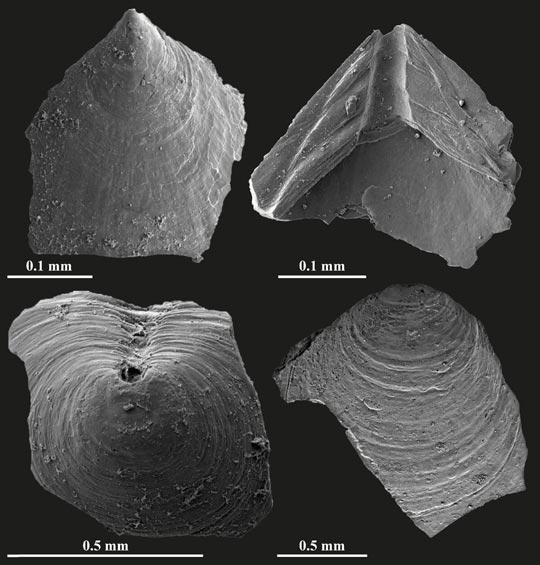
High Resolution Scanning Electron Microscope (SEM) Images of Brachiopod Fossils Used in the Study

SEM images of brachiopods.
Electron microscope images of some of the brachiopod fossils used in this study. Electron microscopy allows much higher resolution imaging of small structures than normal light microscopy.

Picture credit: Leicester University

For models and replicas of invertebrates, including trilobites and other Cambrian animals: CollectA Prehistoric Life Models and Figures.

Identifying Chemical Signatures in Cambrian Fossils

Dr Tom Harvey (University of Leicester) added:

“Many marine animals incorporate chemical traces of seawater into their shells as they grow.  That chemical signature is often lost over geological time, so it’s remarkable that we can identify it in such ancient fossils.” 

Analyses of the oxygen isotopes of these fossils suggested very warm temperatures for high latitude seas (~65 °S), probably between 20 °C to 25 °C.  To see if these were feasible sea temperatures, the researchers carried out climate model simulations for the Cambrian.  The climate model scenarios suggest that the Earth’s climate was in a “typical” greenhouse state, with temperatures similar to more recent and better understood greenhouse intervals known from the Mesozoic and the Cenozoic eras.  Ultimately, this study will help to expand our knowledge of the ecosystem that existed during the Cambrian.

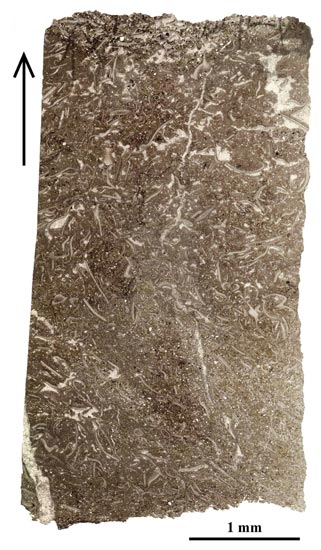
The Highly Fossiliferous Comley Limestones (Shropshire, UK)

A thin section of highly fossiliferous rock of Cambrian age.
A thin section slice through the trilobite-rich Comley Limestones (Shropshire, UK).

The curves and white wavy lines in the photograph (above), are preserved exoskeletons of numerous trilobites.

Thomas Hearing concluded:

“We hope that this approach can be used by other researchers to build up a clearer picture of ancient climates where conventional climate proxy data are not available.”

The research was carried out as an international collaboration involving scientists from the University of Leicester (UK), British Geological Survey (BGS; UK), and CEREGE (France).

Everything Dinosaur acknowledges the help of Leicester University in the compilation of this article.

Visit the Everything Dinosaur website: Everything Dinosaur.
Go to Top