All about dinosaurs, fossils and prehistoric animals by Everything Dinosaur team members.

Articles, features and information which have slightly more scientific content with an emphasis on palaeontology, such as updates on academic papers, published papers etc.

3 09, 2018

Marine Reptile Teeth Tell the Tale of Changing Seas

By |2023-10-28T18:23:56+01:00September 3rd, 2018|Categories: Dinosaur and Prehistoric Animal News Stories, Dinosaur Fans, Main Page, Palaeontological articles|0 Comments

Study of Marine Reptile Teeth Hints at Faunal Turnover as Sea Levels Changed

New research undertaken by scientists at Edinburgh University in collaboration with colleagues at the University of Bristol, analysing marine reptile teeth, has revealed that marine faunal turnover during the Jurassic could well reflect what is likely to happen to apex marine predators today, as sea levels rise.

With global warming, so sea levels are likely to rise as ice sheets and glaciers melt.  This will have a significant impact on our planet, not least of all for our own species, but scientists are trying to predict the extent of the impact on changing sea levels on marine food chains and ecosystems.  Computer modelling can help, but surprisingly, so can studying the fossils of long extinct sea creatures.

Studying Marine Reptile Teeth

Sea levels have risen and fallen on numerous occasions throughout deep geological time.  It really is a question of history repeating itself and the scientists writing in the academic journal “Nature: Ecology & Evolution”, report on the study of marine reptile teeth fossils from the Jurassic, which shed light on how reptiles adapted to major environmental changes and how these adaptations might provide a useful metaphor for extant marine life.

The researchers conclude that marine predators that lived in deep waters during the Jurassic Period, thrived as sea levels rose, whilst in contrast, those species that lived in shallower environments, such as near-coastal areas, became extinct.

A Jurassic Marine Ecosystem (Jurassic Sub-Boreal Seaway)
Life in the Jurassic seas.
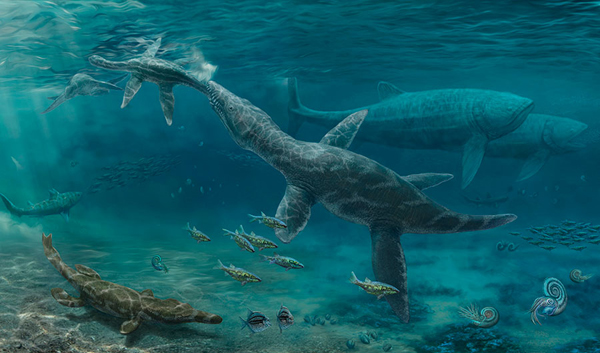
A Jurassic marine ecosystem.  A life reconstruction based on fossils found in the Oxford Clay Formation (England).

Picture credit: Nikolay Zverkov

The picture (above) depicts a marine ecosystem from the late Middle Jurassic (Callovian faunal stage).  A marine crocodile (metriorhynchid crocodyliform) avoids the attention of a large pliosaur attacking a plesiosaur, whilst sharks and a pair of giant, filter feeding Leedsichthys swim nearby.  A trio of ammonites can be seen (bottom right).

Marine Food Chains Unchanged for 150 Million Years

The study also indicates that the broad structure of food chains in today’s oceans have remained largely unchanged since the Middle Jurassic.  Naturally, the species are very different with mammals taking over the role once occupied by many types of extinct marine reptile, but the underlying structure of the food chain remains similar to what you would have seen had you been scuba diving in the shallow, tropical Jurassic Sub-Boreal Seaway some 160 million years ago.

For more than 18 million years, a very diverse, reptile-dominated megafauna co-existed in the Jurassic Sub-Boreal Seaway, a stretch of shallow water that covered present-day northern France to Yorkshire on England’s north-east coast.  By examining the shape and size of teeth spanning this 18-million-year period when sea levels fluctuated, the researchers found that species belonged to one of five groups based on their teeth, diet and which part of the ocean they inhabited.

Five Feeding Groups Identified Based on the Shape of Fossil Teeth

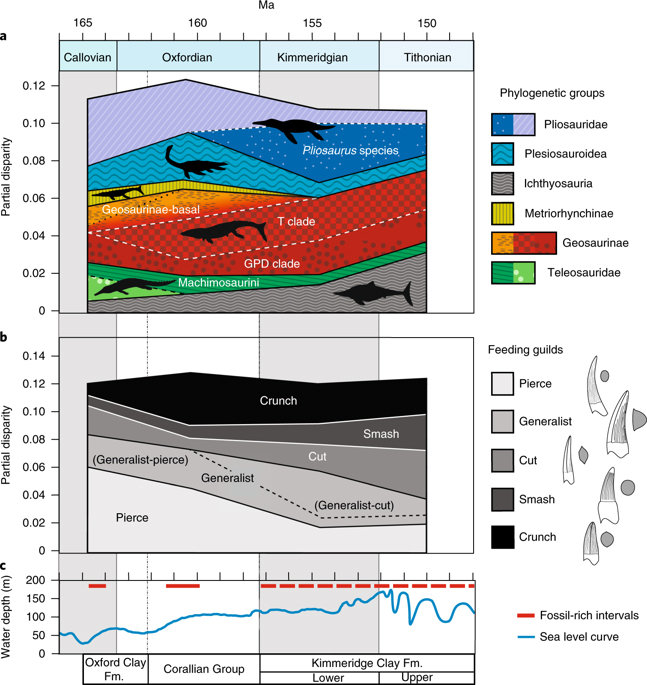
The fossil teeth were placed into one of five groups depending on their shape.  The shape of the tooth provides a guide to the feeding strategy of the animal and using this data plotted against rising and falling sea levels, the researchers were able to plot how the marine animal populations changed over time as sea levels fluctuated.

The five groups (referred to as feeding guilds), identified were:

  1. Pierce
  2. Generalist
  3. Cut
  4. Smash
  5. Crunch

One of the key findings of the study, was that those predators with fine, piercing teeth useful for grabbing fast-moving, slippery prey such as small fish and squid made up a substantial portion of the marine predator population around 165 million years ago (Callovian faunal stage), when sea levels were low and the water relatively shallow.  However, as sea levels rose and the sea became much deeper, the teeth of these types of predators were less common in younger rocks dating from around 150 million years ago (Tithonian faunal stage of the Late Jurassic).

Using Fossil Teeth to Map How Marine Apex Predator Populations Changed Over Time
Jurassic Sub-Boreal Seaway feeding guilds.
A study of fossil teeth identified five types of feeding guild in Jurassic seas.  The fossil finds were then plotted against data for changing sea levels to map how animal populations changed as the environment changed.

Picture credit: Nature: Ecology & Evolution

The scientists concluded that the pattern that was identified is very similar to the food chain structure of modern oceans, where many different species are able to co-exist in the same area because they do not compete for the same resources.  Species used the resources in the environment differently and this permitted them to live together, this is termed niche partitioning.

Niche Partitioning

This niche partitioning enabled many species to co-exist.  Although a highly diverse fauna was present throughout the history of the Jurassic Sub-Boreal Seaway, as the scientists studied the teeth found at different stratigraphic levels they found that fish and squid eaters with piercing teeth declined over time while hard-object and large-prey specialists diversified, in concert with rising sea levels.

Larger species that inhabited deeper, open waters began to thrive.  These reptiles had broader teeth for crunching and cutting prey.  Deep-water species may have flourished as a result of major changes in ocean temperature and chemical make-up that also took place during the period, the researchers postulate.  This could have increased levels of nutrients and prey in deep waters, helping the species that lived there.  This research provides an analogy for modern ocean environments providing an insight into how species at the top of the marine food chain might respond to rising sea levels brought on by global climate change.

The Fate of Jurassic Predators May Well Provide an Analogy for Modern Marine Ecosystems
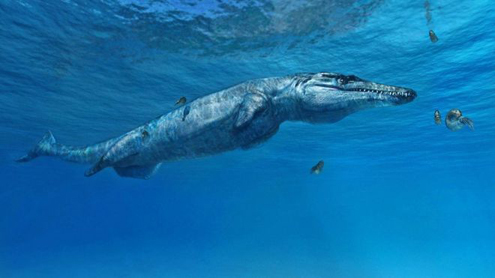
Marine crocodile (Plesiosuchus).
Marine crocodiles such as the large, broad-snouted Plesiosuchus manselii were apex predators specialising in hunting other marine reptiles.  These types of predator may have thrived as water depth increased, whereas, other smaller fish-eating marine crocodiles declined along with the long-necked plesiosaurs.

Picture credit: Fabio Manucci/University of Edinburgh

The scientific paper: “The Long-term Ecology and Evolution of Marine Reptiles in a Jurassic Seaway” by Davide Foffa, Mark T. Young, Thomas L. Stubbs, Kyle G. Dexter  and Stephen L. Brusatte published in the journal Nature: Ecology and Evolution.

The Everything Dinosaur website: Everything Dinosaur.
2 09, 2018

Jurassic Stem Mammal Bred Like a Reptile

By |2023-10-28T18:15:21+01:00September 2nd, 2018|Categories: Dinosaur and Prehistoric Animal News Stories, Dinosaur Fans, Main Page, Palaeontological articles, Photos/Pictures of Fossils|0 Comments

Scientists find Kayentatherium wellesi Fossil Along with Young

The Order Mammalia has a number of distinguishing characteristics when compared to the other vertebrates.  For example, mammals tend to have bigger brains and tend to produce some of the smallest numbers of offspring per litter.  Mammals evolved from reptiles and at some point in their evolutionary history, larger brains developed and smaller broods became the norm.  Scientists writing in the academic journal “Nature”, have published details of the discovery of the fossilised remains of a Jurassic stem mammal, one that was found in association with thirty-eight babies.

The fossilised specimens might help palaeontologists to work out how mammals developed a different approach to reproduction when compared to their reptilian ancestors.

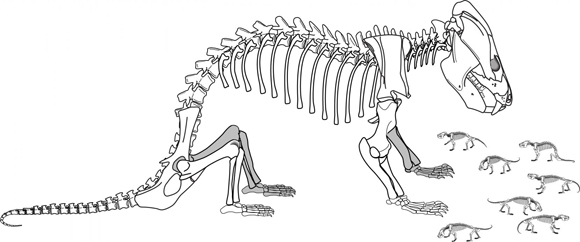
A Skeletal Reconstruction of the Probable Mother (Kayentatherium wellesi) and Offspring

Kayentatherium wellesi skeletal reconstruction (mother and offspring).
Offspring and a probable mother found in association (Kayentatherium wellesi).

Picture credit: Eva Hoffman/The University of Texas at Austin

Jurassic Stem Mammal Kayentatherium wellesi

The fossils represent Kayentatherium wellesi, a cynodont, it was only as the specimen was being prepared that the researchers realised that this was an exceptional fossil.  The find of a 185-million-year-old K. wellesi with offspring are the only known fossils of baby stem mammals with what is believed to the mother.

The presence of so many offspring, probably only recently hatched from their eggs when they died, indicates that these types of stem mammal had litters more than twice the size of any living member of the Mammalia.  The size of the brood is akin to the breeding strategy of extant reptiles

Lead author of the study, Eva Hoffman (who studied the fossils whilst a graduate student at the University of Texas at Austin), commented:

“These babies are from a really important point in the evolutionary tree.  They had a lot of features similar to modern mammals, features that are relevant in understanding mammalian evolution.”

The Kayenta Formation of Arizona

Hoffman co-authored the study with her graduate adviser, Jackson School Professor Timothy Rowe, who collected the specimen during fieldwork exploring the Early Jurassic sediments of the Kayenta Formation in Arizona, more than eighteen years ago.

Computerised tomography was used to reveal the bones inside the matrix back in 2011.  However, advances in CT-scanning finally permitted researchers at the University of Texas at Austin to reveal the babies, including complete skulls and partial postcranial material.

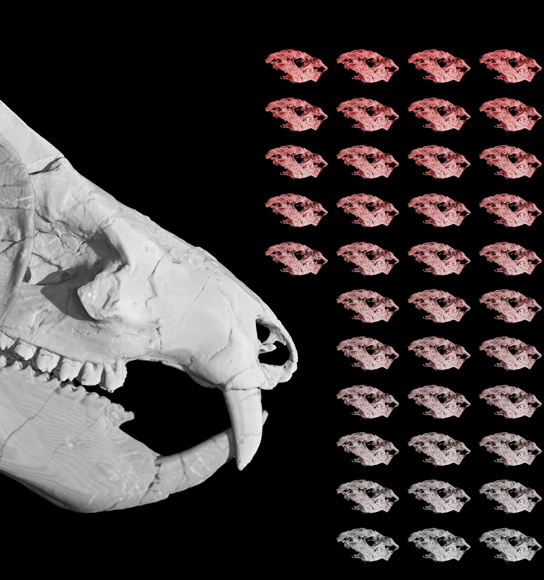
Advances in Computerised Technology Over the Last Seven Years Permitted the Fine Details of the Babies to be Discerned

Adult Kayentatherium skull with probable offspring.
Kayentatherium skull and images of the baby’s skulls indicating brood size.

Picture credit: Eva Hoffman/The University of Texas at Austin

The Skulls of the Babies – The Same as the Adult’s Only Smaller

The highly detailed computer-generated images permitted the researchers to verify that the tiny bones were Kayentatherium wellesi, the same as the adult.  The analysis revealed that the skulls were scaled-down replicas of the adult, only ten percent the size of an adult skull, but otherwise proportional.  This contrasts with extant mammals, as their babies are born with shortened faces and large skulls to accommodate a big brain.  The brain of mammals is a very energy demanding organ, for example, in humans the brain needs more energy than any other organ of the body.

It has been estimated that the brains of human beings require around 20% of the total energy needed by our bodies each day.  Breeding and producing offspring also requires a lot of energy.  The discovery that Kayentatherium, a stem mammal, had a tiny brain and many babies, despite otherwise having much in common with extant mammals, suggests that a critical step in the evolution of the Mammalia was trading large litters for large brains.  This evolutionary change is therefore likely to have taken place more recently than 185 million-years-ago.

Professor Rowe explained:

“Just a few million years later, in mammals, they unquestionably had big brains and they unquestionably had a small litter size.”

Where does the Jurassic Stem Mammal Kayentatherium Sit on the Mammalian Evolutionary Tree?

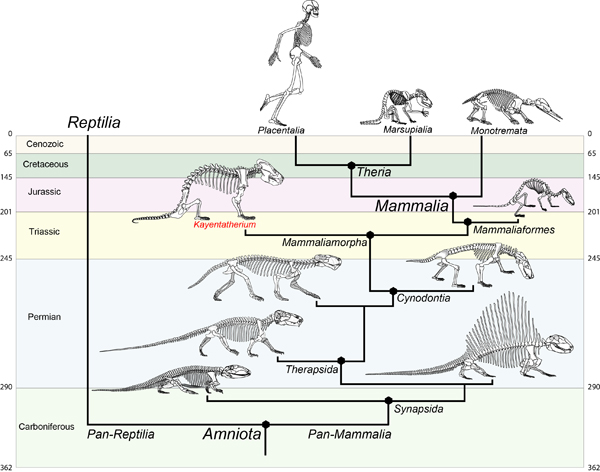
Kayentatherium was very probably endothermic (warm-blooded) and the skeleton shows a number of anatomical traits associated with modern mammals.

The Place of Kayentatherium on the Mammalian Family Tree

The evolution of modern mammals.
A simplified family tree showing mammalian evolution, the placement of Kayentatherium is shown in red.

Picture credit: Eva Hoffman/The University of Texas at Austin

The mammalian approach to reproduction directly relates to our own species development (Homo sapiens), including the development of our own brains.  By looking back at our early mammalian ancestors, we can learn more about the evolutionary process that helped shaped the development of humans.

Professor Rowe added:

“There are additional deep stories on the evolution of development and the evolution of mammalian intelligence and behaviour and physiology that can be squeezed out of a remarkable fossil like this now that we have the technology to study it.”

The scientific paper: “Jurassic Stem Mammal Perinates and the Origin of Mammalian Reproduction and Growth” by Eva A. Hoffman and Timothy B. Rowe published in Nature.

Everything Dinosaur acknowledges the assistance of a press release from the University of Texas at Austin in the compilation of this article.

The Everything Dinosaur website: Everything Dinosaur.
1 09, 2018

Remarkable Devon Fossil Links England with Russia

By |2024-05-11T08:09:41+01:00September 1st, 2018|Categories: Dinosaur and Prehistoric Animal News Stories, Dinosaur Fans, Main Page, Palaeontological articles, Photos/Pictures of Fossils|0 Comments

Kapes bentoni Saved by a Scan

The fossilised remains of a little reptile that roamed the land we now know as Devon has helped make links with the prehistoric vertebrate fauna of the Middle Triassic of Russia.  Thanks to the use of computerised tomography (CT) scans, palaeontologists have had the rare opportunity to study the skull and postcranial elements of a procolophonid reptile.  The fossil was found by co-author of the scientific paper, Dr Rob Coram of Swanage in November 2014, from a foreshore exposure of the Pennington Point Member of the Otter Sandstone Formation located close to the town of Sidmouth on the south Devon coast.

The Triassic sandstone deposits in these cliffs, which ironically form part of the famous UNESCO World Heritage site the “Jurassic Coast” contain vertebrate remains, but they are quite rare and often show signs of extensive weathering and transportation prior to burial and fossilisation.

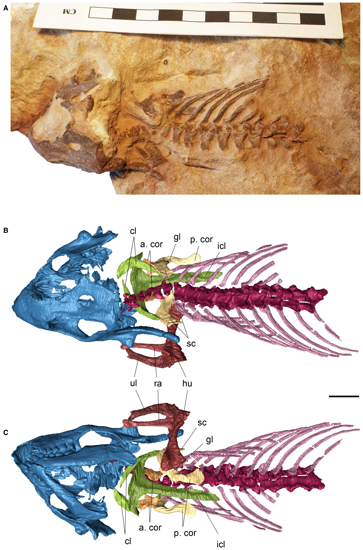
The Fossil Specimen (BRSUG 29950-13) and Two Computer Generated Images

Kapes bentoni fossil and images of the fossil specimen.
Kapes bentoni fossil (top) and two images generated from the CT scans (BRSUG 29950-13).

Picture credit: Bristol University/Papers in Palaeontology

Procolophonid Reptiles (Procolophonidae)

The reptile has been identified as an example of Kapes bentoni, several species are included in this genus, all of which, including the type species K. amaenus, which was named in 1975, come from Russia.  Procolophonids looked superficially like lizards, but they are not closely related to the Squamata.  They are parareptiles, which evolved in the Permian and had a wide distribution during the Triassic, before becoming extinct shortly before the Triassic came to an end.  When Dr Coram tried to clean and prepare the fossil, he found that the fossil material was too fragile and conventional preparation techniques would have resulted in permanent damage to the fossil bones.

Dr Coram commented:

“I tried everything I could.  I have had a lot of experience of removing rock from fossils using a fine needle and working under the microscope, but this was a nightmare.  When I touched it with a needle, small pieces of bone fell off.”

CT Scanning the Devon Fossil

In order to allow the fossil to be studied, Dr Coram contacted colleagues at Bristol University and a CT scan of the small fossil was organised.  The job of interpreting the scans and the resulting computer generated images was given to PhD student Marta Zaher, who was at the Bristol University for a few months, normally she is based in Zagreb (Croatia).  The three-dimensional scans of the skull and postcranial material turned out to be far better than the scientists had hoped.  Even wear facets on the tiny teeth of the Kapes specimen could be discerned and studied.

Once all the scans had been compiled the researchers could examine the procolophonid fossil in great detail.  Most of the procolophonid fossils from England are highly fragmentary, but the scans revealed the presence of a skull, cervical vertebrae, the shoulder girdle, forelimbs and the front half of the torso.

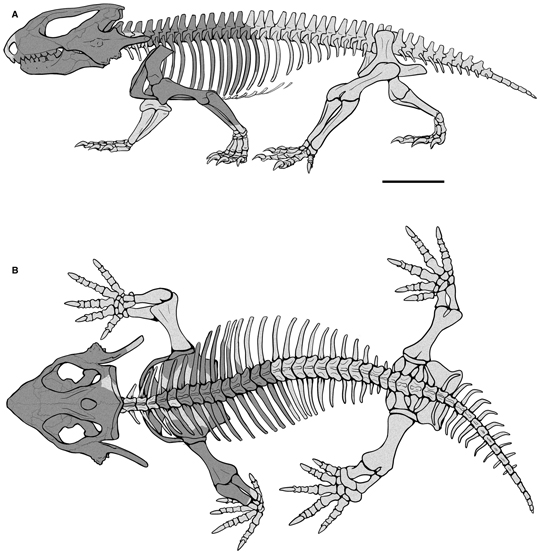
An Illustration of the Skeleton of Kapes bentoni (Lateral and Dorsal Views)

Kapes bentoni skeletal reconstruction.
A skeletal reconstruction of Kapes bentoni. Fossil material from the Sidmouth specimen (BRSUG 29950-13) is shown in grey. Lateral view (A) and dorsal view (B).  Scale bar = 10 mm.

Picture credit: Bristol University/Papers in Palaeontology

Spectacular CT Scans of a Triassic Specimen

Student Marta explained:

“The scans are amazing.  They show every detail of the tiny, five-centimetre (two inch) long skull.  You can see each tooth, and even the wear patterns.  Almost all the tiny bones of the palate and braincase are there.”

She added:

“This identifies the animal without question as a procolophonid.  These lived worldwide at the time, and they were important plant-eaters, with broad teeth fused to their jaws, and which wore down under grinding from the tough plant food.”

Several years ago, less complete specimens of the procolophonid had been found in the Devon rocks, and two academics then at the University of Bristol, Patrick Spencer and Glenn Storrs, had suggested the Devon animal was the same as Kapes from central Russia.

A spokesperson from Everything Dinosaur commented:

“Thanks to the use of computerised tomography, the researchers were able to get an unprecedented insight into the anatomy of an anapsid.  This non-destructive technique has helped scientists to identify that this Devon specimen is very closely related to other reptiles, fossils of which come from the terrestrial red beds of Russia.”

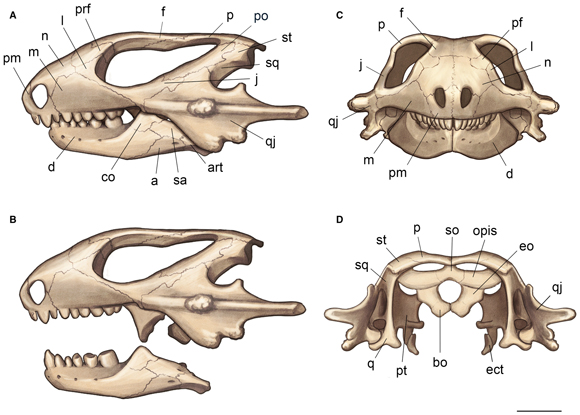
A Diagram of the Skull Produced from the CT Scan Data

Kapes bentoni skull illustration.
An illustration of the skull of Kapes bentoni recreated from the CT scans.  Scale bar = 10 mm.

Picture credit: Bristol University/Papers in Palaeontology

Co-author of the scientific paper published in “Papers in Palaeontology”, Professor Mike Benton (Bristol University) stated:

“The new study confirms that the two animals are very close relatives, two species of the genus Kapes.  This is most unusual, to have evidence of a biogeographic connection over thousands of kilometres.  In the Middle Triassic, there was dry land in the UK and in Russia, but the area in between was filled with the Muschelkalk Sea, covering Germany and much of central Europe.”

Kapes bentoni

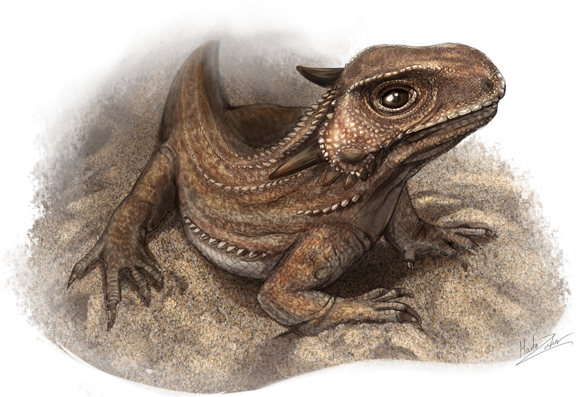
Many of the early procolophonids were insectivorous, however, Kapes bentoni was a plant-eater.  This idea is reinforced by the heavy wear on the teeth as observed in the CT scans from this study.  K. bentoni had a short, stocky body and it may have been fossorial (lived in a burrow).  The spines on the skull have provided the scientists with a bit of a puzzle.  It has been suggested that these spines had a defensive function, making the reptile seem bigger and more intimidating to a potential predator.  The spines would also have obstructed any predator attempting to swallow Kapes head-first.

A Life Reconstruction of the Procolophonid Kapes bentoni

Kapes bentoni illustrated.
An illustration of the procolophonid K. bentoni.

Picture credit: Marta Zaher

The scientific paper: “The Middle Triassic Procolophonid Kapes bentoni: Computed Tomography of the Skull and Skeleton” by Marta Zaher, Robert A. Coram and Michael J. Benton published by Papers in Palaeontology.

Everything Dinosaur acknowledges the assistance of a press release from Bristol University in the compilation of this article.

The award-winning Everything Dinosaur website: Everything Dinosaur.
25 08, 2018

Two New Chinese Dinosaurs Prove Handy

By |2023-10-28T11:35:52+01:00August 25th, 2018|Categories: Dinosaur and Prehistoric Animal News Stories, Dinosaur Fans, Main Page, Palaeontological articles, Photos/Pictures of Fossils|0 Comments

Plotting the Evolution of the Alvarezsauridae with Bannykus and Xiyunykus

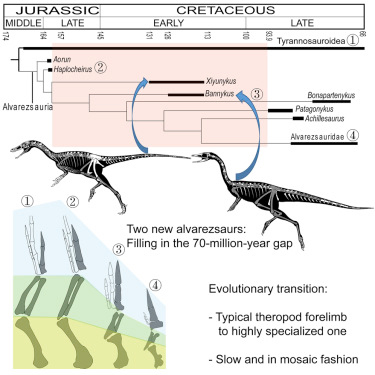
A team of international scientists writing in the journal “Current Biology” have published details of two new Chinese alvarezsaurid dinosaurs that will help palaeontologists to better understand the evolution of this group of bizarre theropods.  Some later genera becoming the  prehistoric equivalents of today’s aardvarks and anteaters.  The dinosaurs have been named Bannykus and Xiyunykus and their fossilised bones are proving handy, as palaeontologists seek to understand how the alvarezsaurian dinosaurs reduced and lost most of their digits, except the thumb, which became very large and robust.  These sleek, fast-running and very bird-like dinosaurs seemed to have become very specialised over some ninety million years.

Two Newly Described Chinese Dinosaurs Help to Plug an Evolutionary Gap in the Alvarezsauridae

Chinese fossils shed light on the evolution of the specialised Alvarezsaurian monodactyl hand.
New alvarezsaurid fossils help to shed light on the evolution of the specialised alvarezsaurid hand.  Over millions of years the long forelimbs and three fingered hands evolved into the much reduced limbs with a single digit.

Picture credit: Viktor Radermacher

Chinese Alvarezsaurid Dinosaurs

The Alvarezsauroidea have a long history, basal forms such as Haplocheirus lived in Asia around 160 million years ago and the very last members of the Alvarezsauridae family were present in the Late Cretaceous, a temporal range of at least ninety million years.

The last of these bizarre, very bird-like dinosaurs have been classified into the sub-clade Parvicursorinae and these animals seem to have been very specialised insect eaters, with a strong single thumb digit with an oversized claw, powerful arm and chest muscles (although the length of the arm was much reduced), long snouts, with thin narrow jaws.  It has been speculated that these dinosaurs could rip apart the nests of termites or dig into logs to find insects.  It has even been suggested that they evolved a long tongue to help them lap up their prey in the same way that an extant anteater does.

The earliest alvarezsaurids were not insectivores, dinosaurs like Haplocheirus were probably hunters of small vertebrates.  Haplocheirus (H. sollers), had the teeth of a typical meat-eating theropod and grasping hands to catch prey.  Only later alvarezsaurids had much reduced teeth and evolved a hand with a single, large curved thumb claw.

Digit Reduction in Tetrapods

The loss of fingers and toes has occurred numerous times amongst tetrapods.  Perhaps the most famous example of all, is the evolution of the foot of the horse.  It was the notable American palaeontologist Charles Othniel Marsh, who plotted the evolution of equines by studying the toe bones of ancient horses.  Marsh was able to demonstrate how primitive horses gradually lost their toes evolving into the single-toed, fast running animal we know today.

To read more about the contribution of Marsh and the evolution of horses: The Contribution of Othniel Charles Marsh.

Both Bannykus and the slightly smaller Xiyunykus are important because they show transitional steps in the process of alvarezsaurs adapting to new diets.

Mapping the Evolutionary History of the Alvarezsauroidea

Alvarezsaurid evolution.
The discovery of two new Chinese alvarezsaurid dinosaurs helps to plug a seventy million year gap in the evolutionary history of the Alvarezsauroidea.

Picture credit: Current Biology

The image (above) shows the temporal position of the two, newly described species.  Both Xiyunykus and Bannykus lived during the Early Cretaceous, their fossils are helping to bridge a seventy million year gap between Late Jurassic basal forms and the advanced and highly specialised Late Cretaceous forms.

Xiyunykus pengi

Xiyunykus was the first of these new dinosaurs to be discovered.  Its fossils were found in 2005, by an international expedition to the Junggar Basin (Xinjiang Uyghur Autonomous Region of north-western China).  The fossil remains consist of a partial, disarticulated skeleton and the material has been dated to the Barremian-Aptian faunal stages of the Early Cretaceous.  The researchers, including Xu Xing from the Institute of Vertebrate Palaeontology and Palaeoanthropology (IVPP) have estimated that this dinosaur weighed around fifteen kilograms.

Skeletal Remains of Xiyunykus pengi

Xiyunykus pengi fossils.
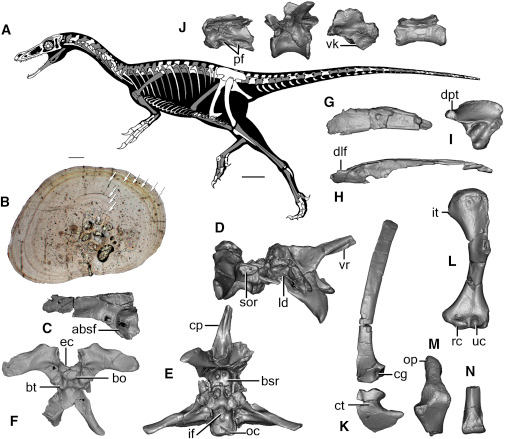
Xiyunykus pengi fossil material.  Picture A shows a skeletal outline (scale bar 10 cm), the known fossil material is shaded grey, whilst B, shows a cross-section through the fibula used to give an approximate age for the specimen.  Images C-N show various fossil elements used to identify and define the species.

Picture credit: Current Biology

A cross-sectional analysis of lower leg bone (B) in the image above, indicates that this dinosaur was around nine years of age when it died and probably a sub-adult.  The genus name is from “Xiyu”, the Mandarin for denoting the western regions of Central Asia and from the Greek “onyx” meaning claw.  The trivial name honours Professor Peng Xiling, who has played a significant role in the study of the geology of this region.

 Bannykus wulatensis

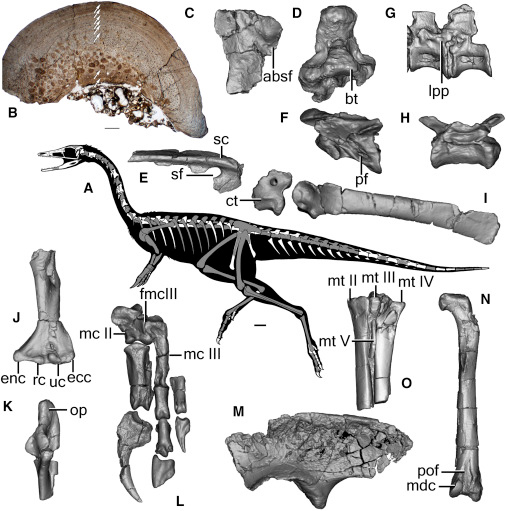
The second alvarezsaurid was discovered in 2009 in western Inner Mongolia.  The fossils come from the Bayingobi Formation  (Aptian faunal stage of the Early Cretaceous).  Histological analysis of a cross-section of bone taken from the fibula indicates that this dinosaur was around eight years of age when it died. It, like the Xiyunykus specimen, was probably a sub-adult.

Skeletal Remains of Bannykus wulatensis

Bannykus wulatensis fossil material and skeletal drawing.
Skeletal remains and a limb bone cross-section with an accompanying line drawing of Bannykus (known fossils shaded grey).  Bannykus wulatensis shown as a skeletal drawing (A), note scale bar equals 10 cm, with (B) showing the cross-section of the fibula.  Images C-O represent elements of the fossil material.

Picture credit: Current Biology

The genus name comes from the Mandarin “Ban” meaning half, a reference to the transitional anatomical features seen in this dinosaur and “onyx”, from the Greek for claw.  The trivial name refers to Wulatehouqi (Wulate Rear Banner), the county-level administrative division in which the type locality is situated.

Long Arms and Grasping Hands to Reduced Arms and Digits

These two newly described Alvarezsaurian dinosaurs have helped to determine that these peculiar Theropods very probably originated in Asia, before migrating to other parts of the world such as North and South America over their long evolutionary history. Bannykus and Xiyunykus are important because they show transitional steps in the process of alvarezsaurs adapting to new ecological niches, Bannykus, which may have lived slightly later than Xiyunykus, is showing signs of that mechanically efficient forearm, a more robust and powerful upper arm and an enlarged thumb.

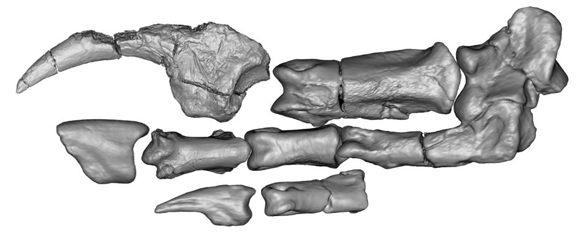
The Manus (Hand) of Bannykus Showing a Transitional Stage in Alvarezsaurid Evolution

Image of the fossil bones comprising the Bannykus hand.
A digital image of the fossil hand of Bannykus.  Note the larger thumb with proportionally bigger bones and a big claw (hypertrophied first digit).

Picture credit: Current Biology

Still a Puzzling Group of Bird-like Dinosaurs

The discovery and scientific description of these new members of the Alvarezsauridae is very significant.  These fossils will help scientists to better understand the evolution of the specialised hand of alvarezsaurids and provide assistance when it comes to phylogenetic placement for group members.

Lead author of the scientific paper, Xu Xing commented on the evolutionary changes that had been highlighted stating:

“This transition plays out in an incremental fashion over more than 50 million years.  It could one day potentially serve as a classic example of macroevolution akin to the ‘horse series’ of North America.”

These dinosaurs are some of the more bizarre and peculiar forms of theropod.  Ancestral forms seemed to have anatomical features quite typical of carnivorous dinosaurs, before evolving much more specialised forms, probably in response to exploiting a particular ecological niche.

Co-author James Clarke (George Washington University), added:

“The fossil record is the best source of information about how anatomical features evolve and like other classic examples of evolution such as the “horse series,” these dinosaurs show us how a lineage can make a major shift in its ecology over time.”

Chinese Alvarezsaurid Dinosaurs – A Puzzle

The alvarezsaurian dinosaurs remain a puzzle.  They may have evolved into specialist insectivores, but they retained their long legs and the ability to run fast throughout their evolutionary history.  The forelimbs, hands and digits may have undergone a radical change, but these dinosaurs always seem to have remained quite graceful and agile animals.

Why these animals retained their ability to run very quickly when their prey was to be found in a termite mound or a rotting log is not clear.  However, it is likely, that the ability to run fast was continued to be selected for in this group as an adaptation to avoiding being eaten by larger predatory dinosaurs.

Palaeontologists Xu Xing and James Clarke Searching for Dinosaur Fossils

Scientists looking for alvarezsaurid fossils.
Xu Xing (IVPP) collecting fossils with James Clark (George Washington University).

Picture credit: Xu Xing

The scientific paper: “Two Early Cretaceous Fossils Document Transitional Stages in Alvarezsaurian Dinosaur Evolution” by Xing Xu, Jonah Choiniere, Qingwei Tan, Roger B.J. Benson, James Clark, Corwin Sullivan, Qi Zhao, Shuo Wang, Hai Xing and Lin Tan published in Current Biology.

Visit the Everything Dinosaur website: Everything Dinosaur.
23 08, 2018

Turtle Evolution Complicated by New Fossil Discovery

By |2024-05-11T08:15:08+01:00August 23rd, 2018|Categories: Dinosaur and Prehistoric Animal News Stories, Dinosaur Fans, Main Page, Palaeontological articles, Photos/Pictures of Fossils|0 Comments

Oldest Turtle with a Beak but No Shell – Eorhynchochelys sinensis

A beautifully preserved and very nearly complete fossilised skeleton of a turtle is helping scientists to unravel the evolutionary story of these ancient reptiles.  Slowly but surely scientists are learning more about turtle evolution.

However, it seems that the evolution of turtles, tortoises and terrapins (the Order Testudines, sometimes referred to as the Chelonii), may be even more complicated than previously thought, just like a large terrapin in a small aquarium, the discovery of this new fossil, might just have muddied the water somewhat.

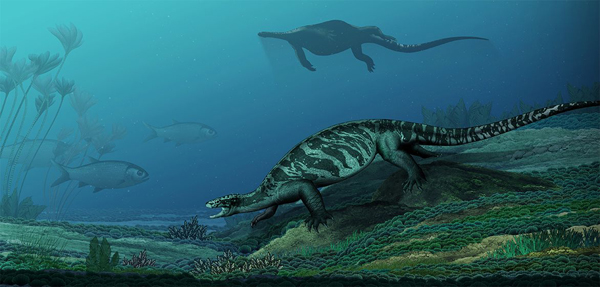
A Life Reconstruction of the Newly Described Late Triassic Turtle Eorhynchochelys sinensis

Eorhynchochelys sinensis life reconstruction.
A life reconstruction of Eorhynchochelys sinensis.

Picture credit: Yu Chen (Institute of Vertebrate Palaeontology and Palaeoanthropology)

Early Turtle From the Late Triassic

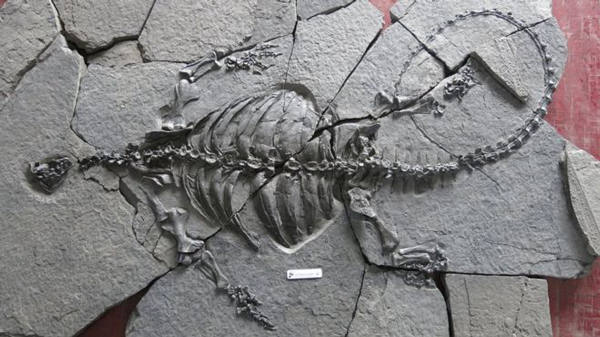
The skeleton was excavated from Upper Triassic rocks in Guanling County, (Guizhou Province, south-west China).  It has been named Eorhynchochelys sinensis, the name means “dawn turtle with a beak from China”.  As the scientific name suggests, this is the oldest turtle ever found with a toothless beak.

Its discovery might help to close a gap in the evolutionary history of the Chelonii, as although it did not have a shell (the fossil lacks a carapace or plastron), the skull is very similar to the skull of extant turtles, but the rest of the animal’s skeleton resembles that of an earlier basal turtle that lived some ten million years previously.  Eorhynchochelys was over two metres long and it lived in an estuarine environment, it was most likely amphibious and the presence of strong claws and well-developed forelimbs suggests that this ancient animal may have lived in a burrow.

A View of the Fossil Material E. sinensis

Eorhynchochelys sinensis fossil - an early turtle without a shell.
Eorhynchochelys sinensis fossil (dorsal view).

Picture credit: National Museums of Scotland

Mosaic Evolution

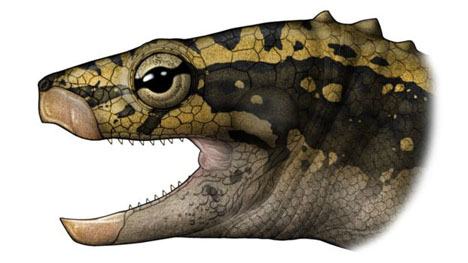
The researchers, which included scientists from the National Museums of Scotland, the Chicago Field Museum, the Canadian Museum of Nature and the Institute of Vertebrate Palaeontology and Palaeoanthropology in Beijing, were intrigued by the modern-looking turtle skull with its characteristic edentulous (toothless) beak.

This feature had not been seen in early fossil turtles before and the dating of  Eorhynchochelys indicates that this trait seems to have disappeared in some lineages and reappeared millions of years later.  This suggests that the evolutionary development of the Chelonii was much more complicated, after all, here was a Late Triassic ancestral turtle with a modern-looking skull but lacking a shell, although the broad, enlarged ribs and other anatomical features of the skeleton indicated that this type of reptile was on the way to evolving such a feature.

The fact that Eorhynchochelys developed a beak before other early turtles but didn’t have a shell is evidence of mosaic evolution, the idea that characteristics can evolve independently from each other and at a different rate and that not every ancestral species has the same combination of these traits.  All living turtles have both shells and toothless beaks, the evolutionary path that led to these traits was not a simple linear progression.

Turtle Evolution

Some ancient turtles evolved partial shells, whilst others evolved beaks, eventually the genetic mutations and natural selection that allowed these traits to develop became unifying characteristics of the group as a whole.

A Life Reconstruction of the Head of Eorhynchochelys

Eorhynchochelys sinensis with its beak.
An illustration showing the head of Eorhynchochelys sinensis with its beak.

Picture credit: Institute of Vertebrate Palaeontology and Palaeoanthropology

Family Links

Although the discovery of Eorhynchochelys sinensis helps to provide further information on the evolution of turtle traits, it does not resolve a long-standing argument about where in the Class Reptilia the Testudines (Chelonii), should be placed.  However and whenever these reptiles evolved their characteristic features might be complicated, but it seems that by around 210 million years ago, the turtle body plan with its carapace, plastron and beak had come about and this group have remained relatively unchanged since.

The Testudines seem to lack a feature that is common in most other reptiles, a pair of holes (fenestrae), in their skulls behind the eyes.  For many years, turtles were thought to be anapsids (members of the  Anapsidae), a very primitive subclass of the Reptilia.  Genetic studies have suggested that turtles, tortoises and terrapins are closely related to diapsid reptiles and their close relatives, archosaurs such as crocodilians, dinosaurs and birds.  However, other studies have concluded that turtles and their kind might actually, be more closely related to snakes and lizards (Squamata).

Eorhynchochelys had a single pair of holes behind its eye sockets, this might suggest an anapsid origin or it might indicate that Eorhynchochelys is a transitional form that evolved from diapsid ancestors.

Chinese Fossil Discovery

Commenting on the taxonomic position of the Chelonii in the light of this new Chinese fossil discovery, co-author of the research, Xiao-Chun Wu (Canadian Museum of Nature), explained that when the physical characteristics of Eorhynchochelys were considered in an analysis with other fossilised reptiles, it is likely that turtles are not closely related to either the Archosauria or the Squamata, but it is more likely that they are an offshoot from earlier, more primitive reptiles.

In the absence of more fossils, this debate is not going to be resolved anytime soon.

To read an article from 2013 looking at research into the evolution of Chelonians: How the Turtle Got Its Shell.

For an article that discusses the discovery of Pappochelys rosinae a basal turtle that lived some 20 million years earlier than Eorhynchochelys, that has been classified as a diapsid but had the beginnings of a plastron: Pappochelys – The Grandfather of the Chelonii.

Visit the Everything Dinosaur website: Everything Dinosaur.
22 08, 2018

A Challenge to the Aquatic Spinosaurus Theory

By |2023-10-28T09:01:25+01:00August 22nd, 2018|Categories: Dinosaur and Prehistoric Animal News Stories, Dinosaur Fans, Main Page, Palaeontological articles|3 Comments

Was Spinosaurus aegyptiacus at Home in the Water?

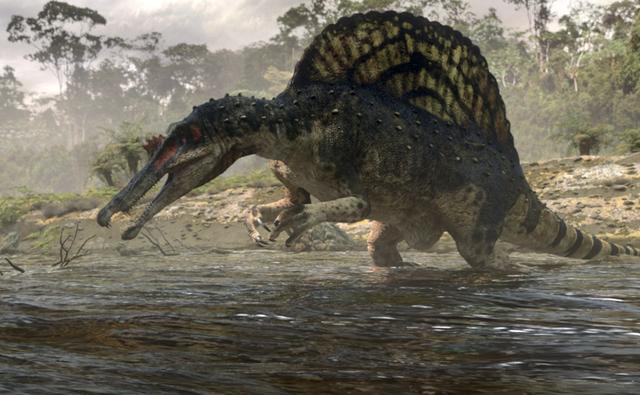
New research utilising computer modelling to study the buoyancy of Spinosaurus (S. aegyptiacus) by Dr Donald Henderson of the Royal Tyrrell Museum (Alberta, Canada), challenges the idea that this sail-backed theropod was adapted for a semi-aquatic way of life.

The research suggests that Spinosaurus could float and keep its head clear of the water to enable it to breathe, but other theropods could also float in positions that enabled them to breathe freely, but with its pneumatised skeleton and system of air sacs, diving for food was probably beyond Spinosaurus, thus hindering its ability to be an effective semi-aquatic, pursuit predator.  Dr Henderson concludes that Spinosaurus may have been more at home wading through water, specialising in hunting along the shoreline or in shallow water, but still remaining a competent terrestrial predator.

Spinosaurus May Have Been a Shallow Water or Shoreline Predator

Spinosaurus
From paddler to swimming the “evolving” image of Spinosaurus.  New research proposes that Spinosaurus aegyptiacus was a shallow water predator and not capable of diving for its dinner.

Picture credit: BBC

Challenging the 2014 Scientific Paper

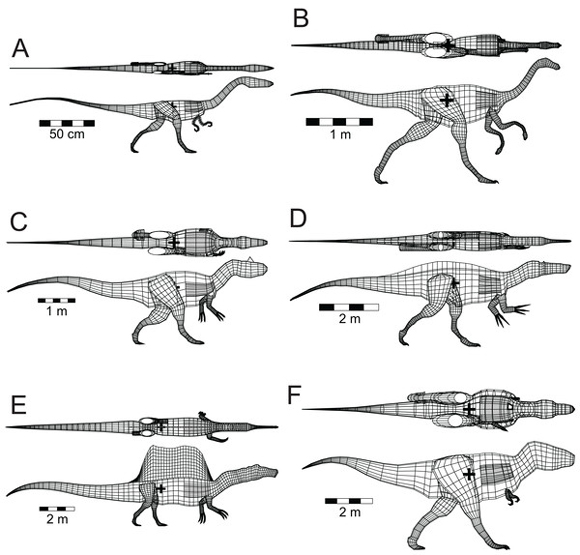
Dr Henderson set about creating three-dimensional computer models of Spinosaurus and several other theropods including Allosaurus, Coelophysis, the ornithomimid Struthiomimus, Tyrannosaurus rex and another member of the Spinosauridae family – Suchomimus tenerensis.  Dr Henderson, who is the Curator of Dinosaurs at the Royal Tyrrell Museum of Palaeontology, located in Drumheller, southern Alberta, wanted to test the hypothesis proposed by Dr Nizar Ibrahim and colleagues published in September 2014, that hypothesised that S. aegyptiacus was quadrupedal and a semi-aquatic dinosaur, a first for a member of the Theropoda.

To read Everything Dinosaur’s article about the 2014 scientific paper: Spinosaurus – Four Legs are Better than Two.

Intriguingly, the interpretation of Spinosaurus, as proposed by Ibrahim et al, was used as the basis for the digital Spinosaurus model by the Royal Tyrrell Museum researcher.

Views of the Theropod Body Plans Used to Test Buoyancy

Digital models of Theropods used in floatation tests.
Theropod body plans used in the floatation tests, dorsal and lateral views.

Picture credit: PeerJ/Dr Henderson (Royal Tyrrell Museum)

The picture above shows the digital body plans used to test the theoretical buoyancy of different types of theropod dinosaur.

Key

A).  Coelophysis bauri

B).  Struthiomimus altus

C).  Allosaurus fragilis 

D).  Suchomimus tenerensis (Baryonyx tenerensis) – it has been suggested that Suchomimus and Baryonyx fossil material might represent the same genus (Holtz, 2012; Sues et al., 2002), this conclusion was used in this study.

E).  Spinosaurus aegyptiacus – the body plan based on the body shape proposed by Ibrahim et al in the 2014 paper.

F). Tyrannosaurus rex

Testing Buoyancy in Freshwater

To ensure that the digital models were able to replicate the orientation and depth of immersion in freshwater, Dr Henderson tested the software using a model of an alligator (A. mississippiensis).  Furthermore, he assessed the buoyancy of a computer generated model of an emperor penguin (Aptenodytes forsteri), which is also a member of the theropoda.

Dr Henderson explained:

“Science is self-correcting.  Research is a competitive scientific process that continually generates new information and ideas, so here’s some of the self-correcting in action.”

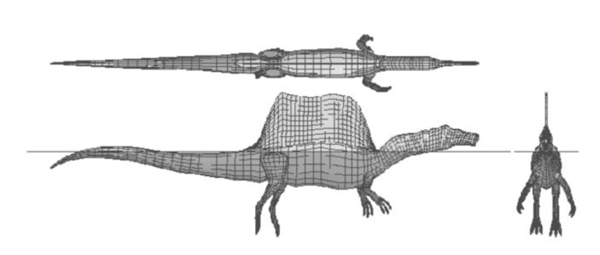
Testing the Stability and Buoyancy of Spinosaurus (S. aegyptiacus)

Testing the buoyancy and stability of Spinosaurus.
Testing the stability and buoyancy of Spinosaurus in freshwater.

Picture credit: PeerJ/Dr Henderson (Royal Tyrrell Museum)

Spinosaurus Could Float But So Could Other Theropods

Dr Henderson’s digital models demonstrated that Spinosaurus could indeed float with its head above water, enabling it to breathe freely.  However, the models of other theropod dinosaurs demonstrated similar results.  This was not unexpected as most tetrapods can successfully float and swim, the shape of Spinosaurus did not necessarily give it an advantage over the body shape of other dinosaurs when it came to stability in water.

Alligators Much Better Suited to Water Than Spinosaurus

The stability of a Spinosaurus in freshwater was also compared to the digital alligator. When tipped to the side, the alligator model returned to its original topside position.  Such behaviour is seen in semi-aquatic animals, they have the ability to right themselves when floating.  The Spinosaurus model did not perform well in the same tests.  When tilted, the model rolled over onto its side, demonstrating very little lateral stability in water.  The research implies that Spinosaurus would have easily tipped over and would have had to use its limbs constantly to maintain an upright posture in the water.

Assessing the Centre of Mass

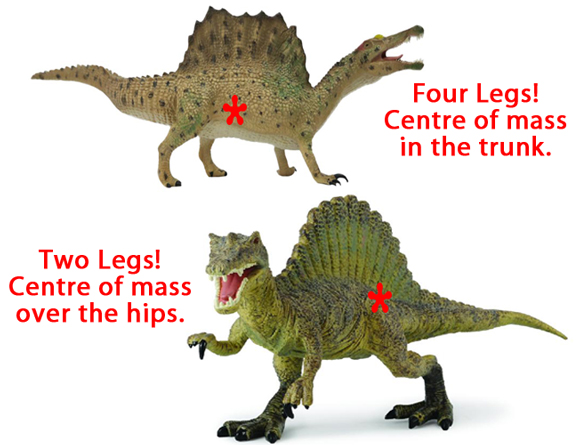
One of the key points of the 2014 paper, was that an anatomical study based on the known Spinosaurus fossil material (which represented numerous individuals of different sizes), indicated that this dinosaur walked on all fours.

In this new research, the centre of mass of the digital model of Spinosaurus was found to be close to the hips, similar to what is seen in other theropods.  This contradicts the 2014 research, as Dr Ibrahim and his colleagues proposed that S. aegyptiacus had a centre of mass located towards the centre of the torso.  With the centre of mass located further forward, it suggests a quadrupedal form of locomotion, however, Dr Henderson’s research indicating a centre of mass positioned over the hips suggests that Spinosaurus could have walked around on land quite happily on just its hind legs (bipedal).

The Position of the Centre of Mass Would Affect Locomotion on Land

Different interpretations of Spinosaurus fossil material.
Different interpretations of the body plan of Spinosaurus.  The red asterisk suggests the centre of mass for each figure. Picture credit: Everything Dinosaur.

Picture credit: Everything Dinosaur

The models featured in the image above are from the CollectA Deluxe range.

To view this range of prehistoric animal models: CollectA Deluxe Prehistoric Life Models.

Spinosaurus Probably Couldn’t Dive

Dr Henderson’s models also found Spinosaurus to be unsinkable.  Living aquatic birds, reptiles, and mammals all have the ability to submerge themselves to pursue their prey underwater. Although the bones of Spinosaurus might be more dense than other carnivorous dinosaurs, they still were substantially pneumatised.  This anatomical feature in conjunction with the air sac breathing system found in living theropods (birds), probably made it very difficult, if not impossible, for this dinosaur to dive underwater in search of prey.

Dr Henderson concludes that this inability to dive, combined with a centre of mass close to the hips and a tendency to roll onto its side, suggests that Spinosaurus was not a specialised semi-aquatic predator after all.

He added:

“Spinosaurus may have been specialised for a shoreline or shallow water mode of life, but it would have still have been a competent terrestrial animal.”

Few Spinosaurus Bones to Study

However, as there are so very few Spinosaurus fossil bones to study, it is possible that this dinosaur lacked a significant number of avian style air sacs and pneumatised bones.  Even with an increased mass offered by a denser skeleton the digital model when “tweaked” in this way, still suggested that being able to submerge and go underwater would have been a considerable challenge.  Dr Henderson does concede that if it could be shown that the mass deficit represented by the lungs and air sacs was offset by the increased mass of a denser skeleton that might help the claim of a semi-aquatic Spinosaurus.

This is essentially, the central point of the Spinosaurus controversy.  This dinosaur did live in a habitat dominated by large bodies of water.  There were plenty of large fish around for an aquatic predator to eat, but in the absence of fossil evidence, the actual role of Spinosaurus in the North African Cretaceous ecosystem and its habits remain very much open to debate.

The scientific paper: “A Buoyancy, Balance and Stability Challenge to the Hypothesis of a Semi-aquatic Spinosaurus Stromer, 1915 (Dinosauria: Theropoda)” by Donald M. Henderson and published in the academic on-line journal PeerJ.

Visit the Everything Dinosaur website: Everything Dinosaur.
14 08, 2018

Toothy, Pterosaur Terror from the Saints and Sinners Quarry

By |2023-10-27T13:18:12+01:00August 14th, 2018|Categories: Dinosaur and Prehistoric Animal News Stories, Dinosaur Fans, Main Page, Palaeontological articles|2 Comments

Caelestiventus hanseni – Rare Pterosaur Fossil Sheds Light on Triassic Pterosaur Diversity

A team of scientists have published a paper in the journal “Nature Ecology & Evolution”, detailing the discovery of a new type of Triassic pterosaur.  The exquisitely preserved fossils, including skull and jaw material excavated from strata laid down at a desert oasis that existed around 210 million years ago, has got vertebrate palaeontologists in a flap.

Caelestiventus hanseni

Firstly, only around thirty fossils of Triassic pterosaurs are known, most of these from only fragmentary remains and secondly, as this flying reptile fossil is associated with a desert environment, it suggests that by the Late Triassic the Pterosauria were very specious and had already adapted to a variety of different habitats.  If all this wasn’t enough to get scientists excited, the exceptional state of preservation has revealed anatomical features previously obscured in other early pterosaurs and shows that this new flying reptile from Utah, was closely related to Dimorphodon macronyx which is known from Lower Jurassic rocks from Dorset (southern England).

The flying reptile was large, very large for a Triassic pterosaur, it had an estimated wingspan of 1.5 metres.  It has been named Caelestiventus hanseni (pronounced Sel-less-tees-vent-us han-son-eye).

A Life Restoration of the Newly Described Late Triassic Pterosaur Caelestiventus hanseni

Caelestiventus hanseni illustration.
Caelestiventus hanseni illustration. Study of the fossil bones suggests the presence of a throat pouch.

Picture credit: Michael Skrepnick

From Saints and Sinners Quarry (Utah)

The fossils come from a vertebrate bone bed located in the Saints and Sinners Quarry, within sandstone deposits in north-eastern Utah.  Numerous vertebrate fossils have been associated with this locality including crocodylomorphs and theropod dinosaur material.

The bones come from silty, fine-grained sandstones laid down in near-shore waters of an oasis, that was surrounded by arid desert.  More than 18,000 individual bones representing a total of nine tetrapod taxa (including two theropod dinosaurs), have been found.  The flying reptile bones described in the scientific paper are the only ones known from this deposit and Caelestiventus hanseni is the first Triassic pterosaur from the western hemisphere from outside Greenland.

Whether this flying reptile was a resident of the oasis is unclear, but it is possible that this individual was an occasional visitor, to what would have been, an isolated oasis surrounded by extensive dune fields.

One of the Delicate Skull and Jaw Fossils Held by Professor Brooks Britt (Brigham Young University)

Holding fossils of Caelestiventus hanseni.
Professor Brooks Britt (Brigham Young University) holds one of the pterosaur fossils (jaw and skull fossils). His finger is pointing to roughly where the eye socket would have been.

Picture credit: Brigham Young University

The picture above, shows a prepared piece of the fossilised skull of C. hanseni (maxilla and other elements from the jaws and skull), the specimen is held by Professor Brooks Britt of Brigham Young University and the lead author of the scientific paper.  It is not possible to remove the delicate, three-dimensional fossils from the matrix, the fossils would collapse under their own weight, but CT scans in conjunction with computer modelling enabled the production of precise plastic replicas of the fossil pieces, that gave the researchers the opportunity to reconstruct the skull.

Related to Dimorphodon (D. macronyx)

The beautiful state of preservation enabled the research team to gain fresh insights into the morphology of skull and jaws of Late Triassic pterosaurs.  The reconstructed brain case reveals that those parts of the brain responsible for processing vision were particularly well-developed, reinforcing the theory that flying reptiles had very keen eyesight.

A phylogenetic analysis undertaken by the researchers reveals that Caelestiventus is a sister taxon of Dimorphodon macronyx, which is known from Lower Jurassic rocks from Dorset.

A Three-Dimensionally Printed Skull of Caelestiventus hanseni

Line drawings and three dimensional model.
C. hanseni model skull and line drawing comparisons between C. hanseni and D. macronyx.

Picture credit: Brigham Young University with additional annotation by Everything Dinosaur

The use of CT scans and computer software to digitally remove the fossils from their matrix without damaging them has enabled the scientists to produce extremely accurate three-dimensional images of the specimen, these data files can then be shared with other vertebrate specialists across the world.

A spokesperson from Everything Dinosaur commented:

“The scans permitted the production of finely detailed and extremely accurate three-dimensional models of the individual bones.  When these were fitted together this gave the scientists the opportunity to study the entire skull and to share this information very easily with other palaeontologists.  The use of technology is now helping scientists to gain much easier access to important fossil finds.”

The Geographical Significance of Caelestiventus hanseni

Not only is Caelestiventus hanseni the first record of a Triassic pterosaur from North America, the discovery suggests that by the Late Triassic, flying reptiles were not only quite large but also that they may have already adapted to a wide variety of habitats.  Similarly aged fossils from Greenland and Europe indicate pterosaurs living in forested areas and coastal environments on the super- continent of Pangaea. 

This fossil discovery demonstrates that early pterosaurs were geographically widely distributed and ecologically diverse, even living in harsh desert environments.  C. hanseni is the only record of a desert-dwelling, non-pterodactyloid pterosaur and predates all known desert living pterosaurs by more than sixty-five million years.

The Geographical Significance of the Utah Pterosaur Fossil Discovery

The geographical location of the pterosaur find.
The location of the Triassic pterosaur find from Utah plotted against a map of Pangaea during the Late Triassic and other pterosaur fossil discoveries from Triassic strata.

Picture credit: Brigham Young University

The picture above shows (top left), the location of Utah in the United States and (insert), the geological formations associated with north-western Utah.  The world map shows the location of Triassic pterosaur fossil discoveries superimposed on an illustration of Pangaea with a colour key to indicate different habitats.  Caelestiventus is the first Triassic pterosaur identified from a desert environment.

For flying reptile models and prehistoric animal figures: Everything Dinosaur Prehistoric Animal Figures.

The genus name is from the Latin for “heavenly wind”, in recognition of the volant capabilities of this reptile.  The trivial name honours geologist Robin L. Hanson of the Bureau of Land Management, who has played a crucial role in the excavation of the Saints and Sinners Quarry material.

Photographs Showing Some of the Fossil Material Associated with the Caelestiventus Genus

Caelestiventus hanseni fossil material.
Views of the pterosaur fossil material – Caelestiventus hanseni.

Picture credit: Brigham Young University

To read Everything Dinosaur’s 2015 article that first broke the news of this pterosaur fossil discovery: Fearsomely-fanged Triassic Pterosaur from Utah.

13 08, 2018

Rare Silurian Fossil “Worm” from a Herefordshire Hotspot

By |2023-10-27T10:25:37+01:00August 13th, 2018|Categories: Dinosaur and Prehistoric Animal News Stories, Main Page, Palaeontological articles, Photos/Pictures of Fossils|0 Comments

A New Species of Lobopodian from Herefordshire

Fossil worm excites palaeontologists. Three-dimensionally preserved lobopodian from Herefordshire.

A team of international researchers including scientists from the Oxford University Natural History Museum, Imperial College London, Manchester and Leicester Universities and the Yale Peabody Museum of Natural History, have identified a new species of lobopodian, a bizarre segmented worm-like creature, in 430 million-year-old rocks in Herefordshire (England).  Digital technology has been utilised to reconstruct a three-dimensional model of this exceptional fossil, an ancient ancestor of the modern, enigmatic Velvet worm.

The Research Team Produced Three-dimensional Images of the Fossil Lobopodian

Thanahita distos - digital reconstruction.
Three-dimensional digital images of the fossil lobopodian from Herefordshire.

Picture credit: University of Leicester

Soft-bodied, Worm-like Creatures with Legs

Lead author of the study, Derek Siveter, (Professor Emeritus of Earth Sciences at Oxford University and Honorary Research Associate at Oxford University Museum of Natural History), commented:

“Lobopodians are extremely rare in the fossil record, except in the Cambrian Period.  Worm-like creatures with legs, they are an ancestral marine relative of modern-day velvet worms, or onychophorans – predators that live in vegetation, mainly in southern latitudes.”

The Velvet Worm (Peripatus Genus)

Velvet worm - Peripatus.
Peripatus a genus within the  Onychophora – creatures like this may have been the first to walk on land.

Picture credit: BBC

The Evolution of the Arthropods

Palaeontologists have puzzled for decades over the evolution of groups of modern animals such as the Arthropoda, the largest phylum of animals which includes the trilobites, insects, crustaceans, spiders, scorpions, mites and so forth.  Studies of the exotic Ediacaran and Cambrian biota has helped scientists to better understand the evolutionary relationships between living groups of animals today and their ancient invertebrate ancestors, but many soft-bodied groups are severely underrepresented in the fossil record.

Thanahita distos

It is still extremely difficult to pin down which type of organism preserved within the remarkable Cambrian-aged Burgess Shale deposits for example, is an ancestor of modern groups of animals alive today.  This newly described fossil specimen, named Thanahita distos represents an example of a member of the Lobopodia, an extremely ancient group of invertebrates that might be a basal member of the panarthropods – a clade that includes today’s arthropods, as well as Velvet Worms (Onychophora) and the Water Bears (tardigrades).

The Silurian-aged deposits in Herefordshire, consist of finely grained volcanic ash layers that settled on a seabed some 430 to 425 million years ago.  These sediments have preserved in exquisite detail many of the marine organisms that roamed across the sea floor.  Writing in the Royal Society Open Science journal, the researchers describe T. distos and note that it is the first lobopodian to be formally described from rocks from the Silurian and it is one of only eight known three-dimensionally preserved lobopodian or onychophoran fossil specimens known to science.

Professor Siveter explained how the team were able to build up a picture of the ancient sea creature:

“We have been able to digitally reconstruct the creature using a technique called physical-optical tomography.  This involves taking images of the fossil at a fraction of a millimetre apart, then “stitching” together the images to form a “virtual fossil” that can be investigated on screen.”

Herefordshire Lagerstätte

The Herefordshire Lagerstätte has provided scientists with numerous exceptionally preserved invertebrate fossils.   Everything Dinosaur has reported on several of these, very significant fossil discoveries on this blog, including one Herefordshire fossil which was named in honour of Sir David Attenborough:

Silurian Fossil Discovery Honours Sir David Attenborough.

Professor Siveter outlined how delicate creatures like Thanahita distos became preserved, he stated:

“Thanahita distos and the other animals that became fossilised here likely lived 100 to 200 metres down, possibly below the depth to which much light penetrates.  We deduce this because we found no vestiges of photosynthetic algae, which are common in contemporaneous rocks laid down at shallower points on the seafloor to the east.“

Professor Siveter added:

“Some special circumstances allowed for their remarkable preservation.  The first was the immediate precipitation of clay minerals around the dead organisms, which decayed over time, leaving empty spaces behind.  The mineral calcite – a form of calcium carbonate – then filled these natural moulds, replicating the shape of the animals.  Almost at the same time, hard concretions began to form, being cemented by calcite.  Thanks to the early hardening of these Silurian time capsules in this way, the fossils were not squashed as the ash layer slowly compacted.”

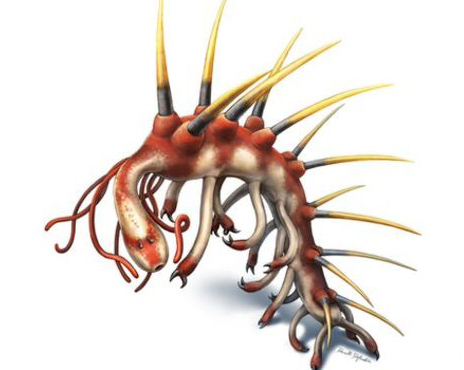
Fossil Worm Related to the Enigmatic Hallucigenia

A phylogenetic analysis undertaken by the researchers placed T. distos, together with all the described Hallucigenia species, in a sister-clade to crown-group the panarthropods.  Its placement in a redefined Hallucigeniidae, an iconic Cambrian clade, indicates the survival of these types of creatures into Silurian times.

The Newly Described Thanahita distos is Placed Within the Enigmatic Hallucigeniidae

An illustration of Hallucigenia.
Scientists have classified the newly described T. distos as a relative of the bizarre Cambrian Hallucigenia from the Burgess Shale of British Columbia.

Picture credit: Danielle Dufault

The professor stated:

“Some lobopodians lie in a position on the tree of life which foreshadows that of the terrestrial velvet worms, while others are precursors of the arthropods: the “king crabs”, spiders, crustaceans and related forms.  Since its discovery, the Herefordshire Lagerstätte has yielded a diversity of arthropods that have contributed much to our understanding of the palaeobiology and early history of this very important invertebrate group.  The lobopodian Thanahita distos belongs to an extended, panarthropod grouping.”

A Spectacular Herefordshire Specimen (Fossil Worm)

The discovery of the Herefordshire specimen and its subsequent phylogenetic analysis indicates that the lobopodian group, which is associated with Late Cambrian strata, persisted into the Silurian, thus demonstrating that these creatures survived for at least 100 million years.

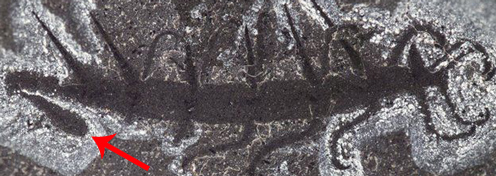
A Fossil of Hallucigenia Specimen from the Late Cambrian Rocks of British Columbia

A Hallucigenia specimen (Burgess Shale).
A Hallucigenia specimen (Royal Ontario Museum) from the Late Cambrian deposits of British Columbia.  The red arrow is highlighting a droplet-like structure, once thought to represent the head but now regarded as probable gut contents.

Picture credit: Royal Ontario Museum/Dr Jean Bernard Caron

The scientific paper: “A Three-dimensionally Preserved Lobopodian from the Herefordshire (Silurian) Lagerstätte, UK” by Derek J. Siveter, Derek E. G. Briggs, David J. Siveter, Mark D. Sutton and David Legg published by the Royal Society Open Science

Visit the award-winning Everything Dinosaur website: Everything Dinosaur.
2 08, 2018

Do It Yourself Taphonomy Some New Research

By |2024-02-22T12:42:40+00:00August 2nd, 2018|Categories: Dinosaur and Prehistoric Animal News Stories, Dinosaur Fans, Main Page, Palaeontological articles|0 Comments

Scientists Learn to Make Fossils in 24-hours

Fossils help us to learn about life in the past and palaeontologists study fossils.  Fossils can form in a variety of conditions, but scientists have discovered a new way to mimic key fossilisation processes in the laboratory.  What might have taken tens of thousands, or even millions of years can be replicated in around twenty-four hours.

Explaining Taphonomy

Taphonomy is the branch of palaeontology that deals with the fossilisation process.  Taphonomy involves studying how organisms become fossilised.  Scientists have been  able to build up a better picture about how the fossilisation process works.  Perhaps, more importantly, this new research paints a picture about what kinds of materials can become fossils, from feathers and scales to tiny molecules like proteins and which materials can’t.

Writing in the journal of the Palaeontological Association “Palaeontology”, the researchers, which include scientists from the Field Museum of Chicago and Bristol University, found a way to improve simulations of the fossilisation process with modern-day animal and plant specimens.

The Scientists Mimicked the Fossilisation Process

A "baked" lizard foot fossil produced in a laboratory.
A laboratory made fossil of a lizard’s foot.

Picture credit: The Field Museum (Chicago)

Lead author, Evan Saitta, a PhD student at the Field Museum, explained:

“Palaeontologists study fossils.  We interpret them to learn about the evolution and biology of extinct animals,  but the fossil record yields data that can be hard to interpret.  For us to answer our questions, we need to understand how fossils form.  The approach we use to simulate fossilisation saves us from having to run a seventy-million-year-long experiment.”

Working Backwards

Palaeontologists can learn about the fossilisation process by finding fossils and then chemically analysing them.  However, these researchers worked backwards, finding a way to simulate the fossilisation process and then studying the materials that survived the heat and pressure used to create the fossil in the first place.

Bird feathers, lizard limbs and leaves were put into a hydraulic press to pack them into clay tablets, just a few millimetres in diameter.  These tablets were baked in a sealed metal tube inside a laboratory oven heated to over 400 degrees Fahrenheit and at 3,500 psi pressure.  After a day, the tablets were examined and they produced specimens that are reminiscent of fossils that take millennia to make.

Student, Evan Saitta stated:

“We kept arguing over who would get to split open the tablets to reveal the specimens.  They looked like real fossils, there were dark films of skin and scales, the bones became browned.  Even by eye, they looked right.”

At the Start of the Fossilisation Process

A Saurophaganax has killed a Stegosaurus.
Food for a dinosaur? The remains of the Stegosaurus could become fossilised. Picture credit: Everything Dinosaur.

Picture credit: Everything Dinosaur

The picture above shows a Saurophaganax and a Stegosaurus corpse model in the CollectA Prehistoric Life model range.

To view this range of prehistoric animal figures: CollectA Prehistoric Life Models.

Easy Bake Fossils

The laboratory-made “fossils” were examined under a scanning electron microscope.  The researchers could identify exposed melanosomes, the structures that contain the biomolecule melanin that gives feathers and skin their colour.  Less stable materials such as proteins and fatty tissues did not show up in the laboratory specimens, these materials are usually absent from fossils found in the field too.

Evan Saitta added:

“Our experimental method is like a cheat sheet.  If we use this to find out what kinds of biomolecules can withstand the pressure and heat of fossilisation, then we know what to look for in real fossils.”

This is not the first attempt to mimic the fossilisation process under artificial conditions, but as one of the authors of the scientific paper explained “I think we are the first ones to get it pretty darn close”.

Previous experimental attempts to cook up fossils in sealed tubes didn’t work because the unstable biomolecules that naturally break down, leak out, and disappear during fossilisation, but in these experiments, these materials stayed trapped.  With this new method, the breakdown products remain entombed within the artificial sediment.

The Implications for the Study of Dinosaurs

The researchers are excited by the possibilities that their new experimental method unlocks.  Exceptional dinosaur fossils don’t just contain hard materials like bones and teeth, soft tissues can be preserved too.  These often carbonaceous films provide important data, so it is important to understand how these materials are preserved.

Learning How to Simulate Fossil Production Can Improve Our Understanding of Taphonomy

Melanosome fossils study.
This new study can help with interpreting soft tissue preservation in feathered dinosaur fossils.

Picture credit: Li et al

Everything Dinosaur recognises the contribution of a press release from the Field Museum (Chicago) in the compilation of this article.

Visit the Everything Dinosaur website for models of iconic fossil animals: Learning – Everything Dinosaur Fossil Replicas

24 07, 2018

Lingwulong New Dinosaur Discovery from Northern China

By |2023-10-20T15:38:04+01:00July 24th, 2018|Categories: Dinosaur and Prehistoric Animal News Stories, Dinosaur Fans, Main Page, Palaeontological articles, Photos/Pictures of Fossils|0 Comments

Lingwulong shenqi – The Dinosaur That’s Not Supposed to be There

Dinosaurs, so often regarded in the past as epitomising animals that were too slow and stupid to survive, are demonstrating that they were one of the most successful groups of terrestrial vertebrates to have evolved.  A newly described, long-necked dinosaur from the Middle Jurassic of northern China suggests that sauropods dispersed and diversified much earlier than palaeontologists had previously thought.  The new dinosaur has been named Lingwulong shenqi and it is the earliest known diplodocoid.

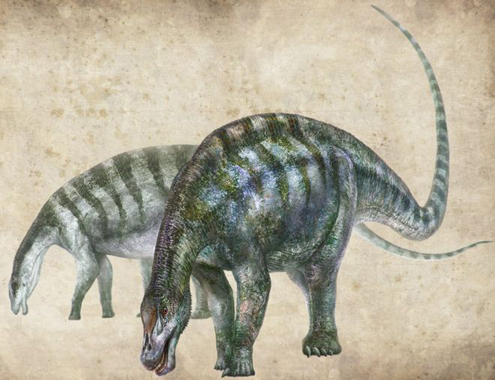
A Life Reconstruction of the Newly Described Lingwulong shenqi

Lingwulong shenqi illustrated.
A life reconstruction of Lingwulong shenqi, the earliest known diplodocoid.

Picture credit: Zhang Zongda

Subgroups of Sauropods with Restricted Geographical Ranges

Although the sauropods dominated terrestrial faunas for much of the Mesozoic and their fossils are globally distributed, scientists had been aware that several subgroups demonstrated restricted geographical ranges.  For example, the sauropod superfamily Diplodocoidea, which is part of a huge clade of long-necked dinosaurs called the Neosauropoda, was believed to have never existed in eastern Asia.  This permitted a unique range of long-necked dinosaurs to evolve and thrive in this part of the world, the Mamenchisauridae.  In essence, the isolation of eastern Asia permitted to evolution of the region’s very own endemic range of dinosaurs.

Lingwulong shenqi – The Implications for Dinosaur Distribution

The Neosauropoda consists of two distinct groups of sauropod, firstly there is the Diplodocoidea, this includes some of the most famous dinosaurs of all, animals such as Brontosaurus, Apatosaurus, Diplodocus and Amargasaurus.  The second type of sauropod within the Neosauropoda are the Macronaria, which consists of equally famous dinosaurs such as Brachiosaurus and Camarasaurus.  It had been thought that once eastern Asia became isolated, the neosauropods were unable to spread to this part of the world.

Their absence had been explained by the break-up of the super-continent Pangaea.  A seaway was formed cutting off and isolating this part of Asia during the Jurassic.  In the case of the Diplodocoidea, these types of long-necked dinosaur evolved and dispersed but they never reached northern China.  By the time sea levels had changed and land connections were once again formed linking northern China to other land masses in the Early Cretaceous, the diplodocoids were in decline and their numbers and geographic range had been greatly reduced since their Late Jurassic heyday.

The discovery of Lingwulong shenqi changes all this.  Diplodocoids were present in eastern Asia, so they must have evolved and diversified into this region earlier than previously thought, or land bridges may have existed linking this part of Asia to the rest of Pangaea for longer.

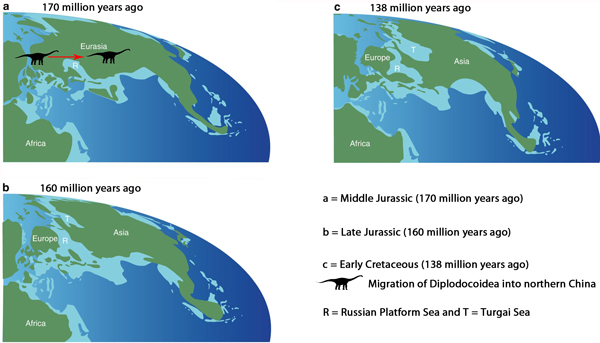
Mapping the Distribution of the Diplodocoidea

Mapping Diplodocoidea distribution.
An epicontinental sea formed during the Jurassic which isolated northern Asia from Europe. This restricted the spread of certain types of dinosaur. Diplodocoid dinosaurs had already evolved and spread before northern Asia was cut off.

Picture credit: Nature Communications with additional annotation by Everything Dinosaur

Co-author of the open access paper published in “Nature Communications”, Dr Philip Mannion (Imperial College London), explained the significance of this dinosaur discovery:

“Not only is it [Lingwulong] the oldest member [of the Diplodocoidea], but it’s the first ever from Asia.  For a long time it was thought that neosauropods didn’t get into Asia during the Jurassic.  This suggests that firstly [neosauropods] got in before any kind of barrier came up, but increasingly the geological evidence suggests maybe this barrier was quite ephemeral”

The Formation of the Russian Platform Sea and the Turgai Sea

Tectonic forces led to the formation of an epicontinental seaway during the Middle to Late Jurassic and this isolated northern Asia from the rest of Pangaea.  The fossils of Lingwulong come from the Yanan Formation in the Ningxia Hui Autonomous Region of China, the strata are estimated to be around 175 to 168 million years old (late Toarcian to Bajocian faunal stages).  The discovery of Lingwulong indicates that many advanced kinds of sauropod originated at least 15 million years earlier than previously realised.  The Diplodocoidea achieved a global distribution whilst Pangaea was still a single, coherent landmass.

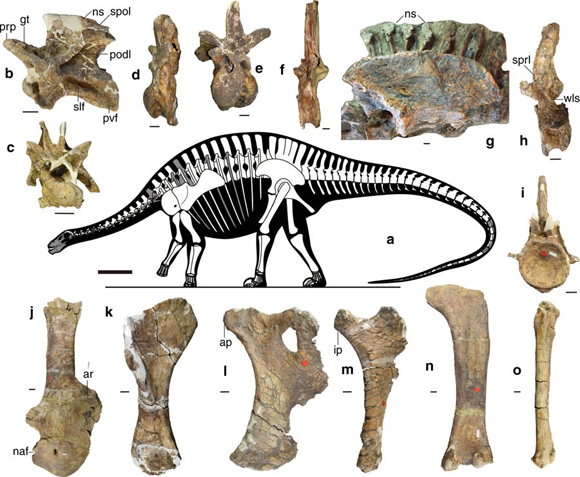
A Reconstruction of the Skeleton of L. shenqi and Examples of Some of the Fossil Bones

Skeleton reconstruction and some fossil bones of Lingwulong.
A skeletal reconstruction of Lingwulong shenqi and examples of fossil bones.  In the skeleton drawing, the bones in white represent fossils associated with this taxon.

Picture credit: Nature Communications

Lingwulong shenqi – “Lingwu’s Amazing Dragon”

The dinosaur has been named after Lingwu, the region in which the fossils were found and the Mandarin Chinese “long” which means dragon.  The trivial name – shenqi, comes from the Mandarin for “amazing”, reflecting the unexpected discovery of this type of dinosaur in the Middle Jurassic of China.  Excavations originally commenced in 2005 led to the discovery of between 7 and 10 individuals, including two specimens with associated skull material.  The fossils represent a range of animal sizes, representing juveniles as well as adults.

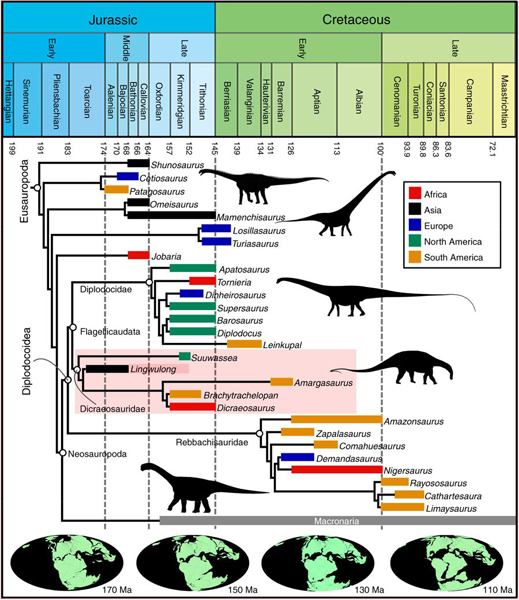
With so much fossil material to study, the researchers were able to assign this new genus to a specific place within the broad Superfamily of the Diplodocoidea.  They conclude that Lingwulong is a basal member of the Dicraeosauridae.

The Dicraeosauridae includes species such as Suuwassea from the Late Jurassic of Montana, Brachytrachelopan from the Late Jurassic of Argentina and Amargasaurus from the Early Cretaceous of Argentina.

The Position of Lingwulong shenqi Within the Neosauropoda

The taxonomic position of Lingwulong.
Plotting the taxonomic position of Lingwulong within the Diplodocoidea.

Picture credit: Nature Communications

The Bigger Picture

The idea that the eastern parts of Asia were cut off from other landmasses during the Jurassic has been put forward to explain the substantial differences between the Jurassic (and sometimes Early Cretaceous), terrestrial biotas between this part of the world and the rest of Pangaea.  It is likely that a seaway formed to the west of the Ural Mountains (the Russian Platform Sea), this seaway in conjunction with an ingress of water from the north (the Turgai Sea), isolated the land to the northeast.

This isolation has been used to explain the evolution of a number of new types of prehistoric animal  in eastern Asia, such as:

  • Mamenchisaurid sauropods
  • Oviraptorosaurs
  • Therizinosaurs
  • Marginocephalians

In addition, this sea barrier has been used to explain the absence of many groups that were present elsewhere in Pangaea during the Jurassic, such as:

  • Diplodocoid sauropods (now debunked by Lingwulong)
  • Early titanosauriform sauropods
  • Dromaeosaurids
  • Nodosaurids
  • The lineage leading to the iguanodontian ornithopods

The scientific paper: “A New Middle Jurassic Diplodocoid Suggests an Earlier Dispersal and Diversification of Sauropod Dinosaurs” by Xing Xu, Paul Upchurch, Philip D. Mannion, Paul M. Barrett, Omar R. Regalado-Fernandez, Jinyou Mo, Jinfu Ma and Hongan Liu, published in Nature Communications.

Visit the Everything Dinosaur website: Everything Dinosaur.
Go to Top