All about dinosaurs, fossils and prehistoric animals by Everything Dinosaur team members.

Articles, features and information which have slightly more scientific content with an emphasis on palaeontology, such as updates on academic papers, published papers etc.

3 06, 2022

What Drove the Giraffes to Evolve Long Necks?

By |2025-01-05T20:53:51+00:00June 3rd, 2022|Categories: Adobe CS5, Animal News Stories, Dinosaur and Prehistoric Animal News Stories, Main Page, Palaeontological articles|0 Comments

The long neck of the giraffe has often been cited as a classic example of adaptive evolution. Long necks evolved to permit them to access food that other animals could not reach. However, a newly described early giraffe with a toughened skull adapted for head-butting contests suggests that intensive sexual competition may have led to the extremely long neck found in modern giraffes.

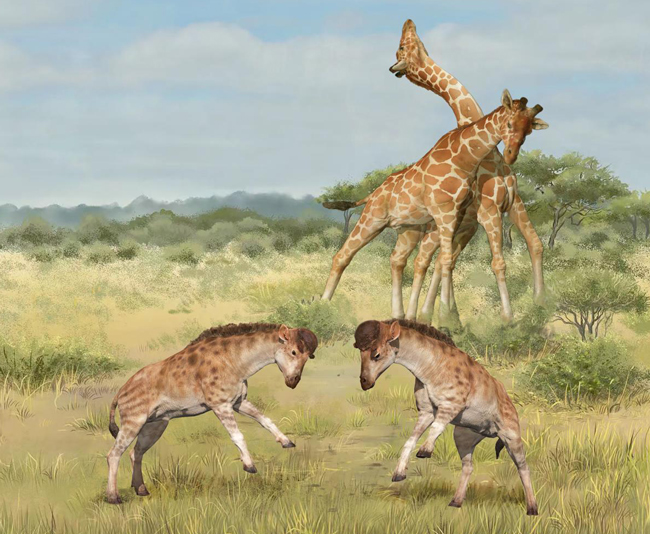
Intra-specific combat in giraffoids.
Intraspecific combat in giraffoids. Foreground two male Discokeryx xiezhi indulge in a head-butting context whilst in the background two male extant giraffes (Giraffa camelopardalis) fight each other by banging necks. Picture credit: Wang Yu and Guo Xiaocong.

Discokeryx xiezhi from the Early Miocene (Junggar Basin)

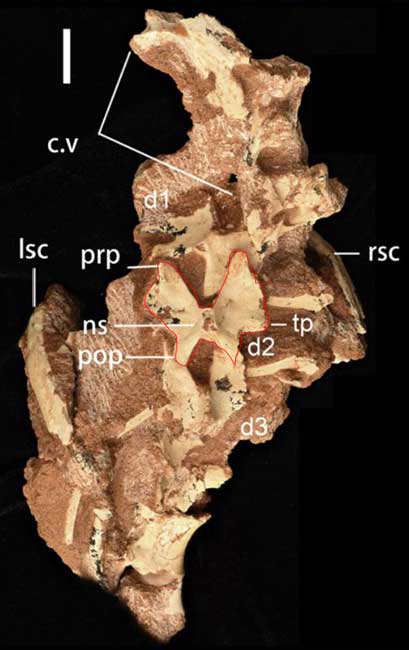
Scientists led by researchers from the Chinese Academy of Sciences have described a new species of ancient giraffe from the northern margins of the Junggar Basin in north-western China (Xinjiang Uygur Autonomous Region). The early giraffoid named Discokeryx xiezhi did not have a very long neck, instead, based on the analysis of an almost complete skull and four cervical vertebrae, this herbivore had a neck and head adapted to absorbing the immense stresses of head-butting combat.

Writing in the academic journal “Science”, the researchers conclude that the neck bones of Discokeryx xiezhi were extremely stout and had the most complex joints between the head and the neck and between the cervical vertebrae of any mammal. The team demonstrated that the complex articulations between the skull and cervical vertebrae of Discokeryx xiezhi were particularly adapted to high-speed head-to-head impact. They found this structure was far more effective than that of extant animals, such as musk oxen, that are adapted for head butting intraspecific combat. The scientists postulate that D. xiezhi may have been the vertebrate best adapted to head impact known to science.

Lead author of the study, Shi-qi Wang of the Chinese Academy of Sciences explained:

“Both living giraffes and Discokeryx xiezhi belong to the Giraffoidea, a superfamily. Although their skull and neck morphologies differ greatly, both are associated with male courtship struggles and both have evolved in an extreme direction.”

Climate Change Driving Morphological Changes

Tooth isotope analysis of fossil teeth indicate that Discokeryx lived in a dry, grassland environment. The habitat was more barren and less rich than forest environments and this may have resulted in increased stress on animal populations and greater competition within species for limited resources. Around 7 million years ago, the environment on the East African Plateau was broadly similar with forests being replaced by savannah. The direct ancestors of extant giraffes had to adapt and it is possible that during this period mating males developed a way of attacking their competitors by swinging their necks and heads. This extreme struggle, supported by sexual selection, thus led to the rapid elongation of the giraffe’s neck over a period of two million years to become the extant genus, Giraffa.

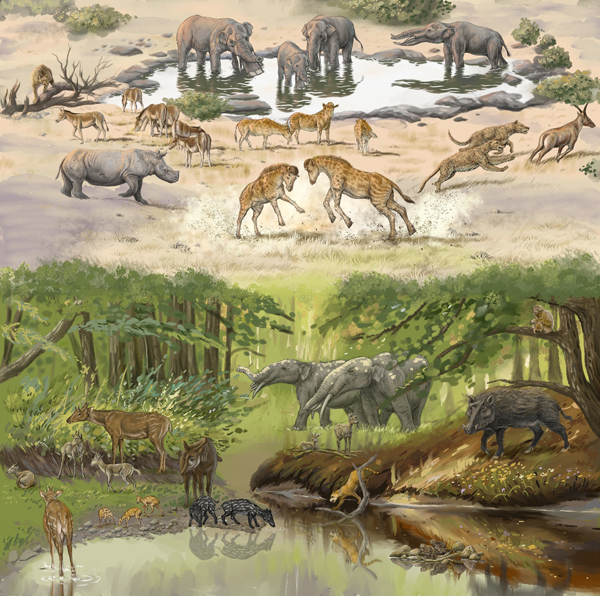
Mammalian Fauna of the Junggar Basin (Miocene)
Typical large vertebrate fauna associated with the early Miocene of the Junggar Basin approximately 17 mya. Forests were replaced by barren, open grasslands and this may have been a driver for intraspecific competition amongst early giraffes which led to the evolution of a range of specialist heads and necks and resulted in the extremely long neck associated with extant species. Picture credit: Guo Xiaocong.

Comparing Horn Morphology

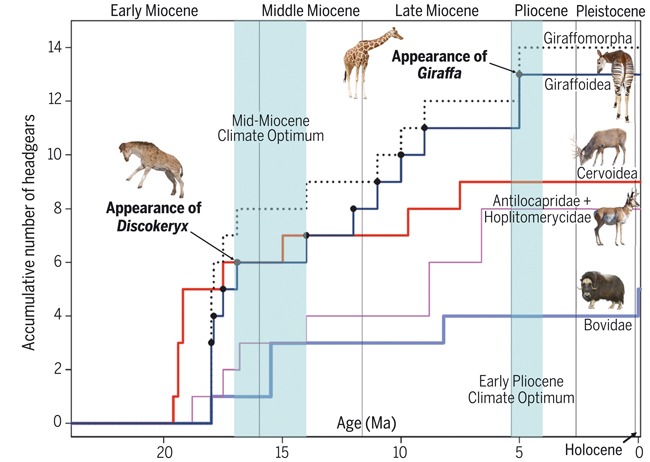
The research team compared the horn morphology of several groups of ruminants, including giraffoids, cattle, sheep, deer and pronghorns. They found that horn diversity in giraffes is much greater than in other groups, with a tendency toward extreme differences in morphology. This suggests that courtship struggles (intraspecific combat) are more intense and diverse in giraffes than in other ruminants.

The evolution of complex head ornamentation in giraffomorphs.
The accumulative number of headgears in various pecoran groups during their evolution. Note that giraffomorphs had evolved more types of headgear than other pecoran groups, which may be partly attributable to their various combat styles. Picture credit: Wang Yu and Guo Xiaocong.

The research team conclude that the primary driving force for extreme body shape in giraffes was not the benefit of being able to browse on parts of the canopy other herbivores could not reach, but it was the intensive sexual competition that fostered extreme morphologies.

Everything Dinosaur acknowledges the assistance of a media release from the Chinese Academy of Sciences in the compilation of this article.

The scientific paper: “Sexual selection promotes giraffoid head-neck evolution and ecological adaptation” by Shi-qi Wang, Jie Ye, Jin Meng, Chunxiao Li, Loic Costeur, Bastien Mennecart, Chi Zhang, Ji Zhang, Manuela Aiglstorfer, Yang Wang, Yan Wu, Wen-yu Wu and Tao Deng published in the journal Science.

The award-winning Everything Dinosaur website: Prehistoric Animal Models.

25 05, 2022

Argentina’s Amazing “Dragon of Death” is Described

By |2024-12-31T10:19:52+00:00May 25th, 2022|Categories: Adobe CS5, Dinosaur and Prehistoric Animal News Stories, Dinosaur Fans, Main Page, Palaeontological articles, Photos/Pictures of Fossils|0 Comments

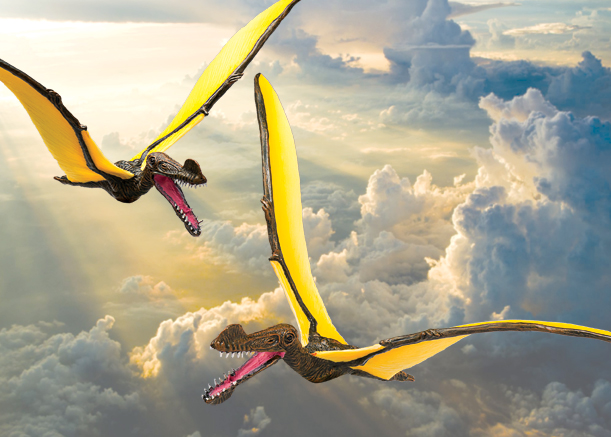
Researchers have named the largest pterosaur found to date in South America. The giant Thanatosdrakon (T. amaru) is estimated to have had a wingspan of around nine metres and it would have stood as tall as a giraffe.

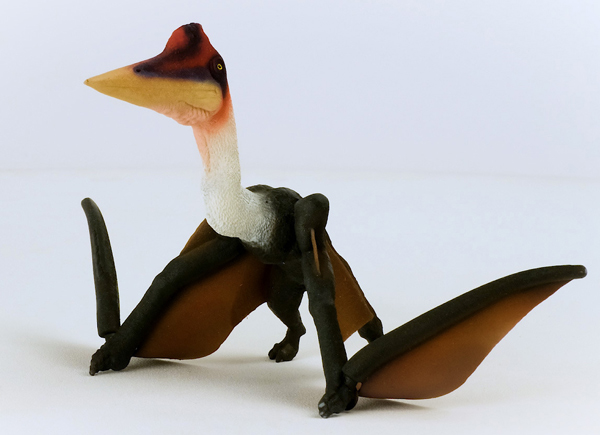
Writing in the academic journal “Cretaceous Research”, the scientists, have assigned Thanatosdrakon to the Azhdarchidae family of pterosaurs and postulate that it was closely related to the slightly larger and geologically younger Quetzalcoatlus, fossils of which are known from North America.

Left humerus of Thanatosdrakon

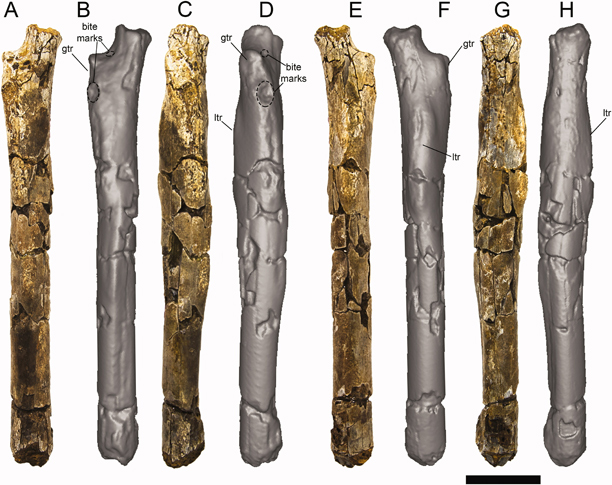
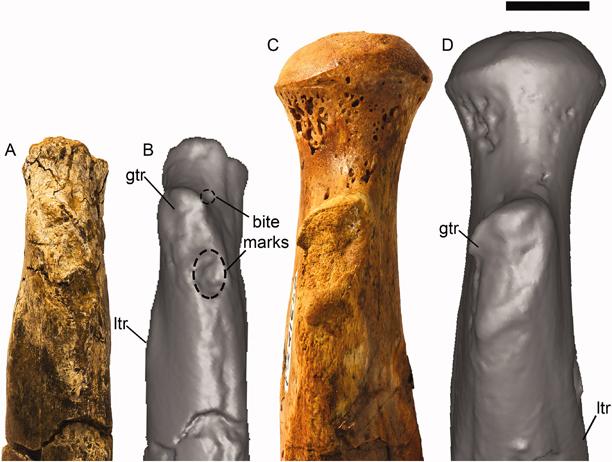
The paratype fossil a giant left humerus (UNCUYO-LD 350) is carefully cleaned at the dig site. Picture credit: Reuters/ICB-CONICET/UNCUYO.

Picture credit: Reuters/ICB-CONICET/UNCUYO

One of the Largest Flying Vertebrates Known

The fossil material, thought to represent two individual pterosaurs was found in the upper-most levels of the Plottier Formation (upper Coniacian–lower Santonian, Neuquén Basin), Mendoza, western Argentina. The researchers, who include CONICET* researcher Dr Leonardo Ortiz David, Dr Bernardo González Riga, director of the Laboratory and Museum of Dinosaurs of the Faculty of Exact and Natural Sciences and world-renowned pterosaur expert Dr Alexander Kellner (Director of the National Museum of Rio de Janeiro, Brazil), estimate that Thanatosdrakon lived around 86 million years ago. Based on the single, huge left humerus of the paratype (UNCUYO-LD 350), a wingspan of around 9 metres is proposed, making Thanatosdrakon amaru one of the largest flying vertebrates known to science.

Thanatosdrakon Size Comparison

Comparing the estimated wingspans of the paratype and holotype fossil material associated with Thanatosdrakon amaru with large, extant birds. Picture credit: ICB-CONICET/UNCUYO.

Picture credit: Reuters/ICB-CONICET/UNCUYO

Exceptionally Preserved Fossils

A civil construction project had uncovered some of the fossils. A field team was despatched to map the site and to recover the exceptionally well-preserved bones. The fossil material consists of vertebrae and bones from the limbs. As the larger humerus was found in close proximity to the other fossils, the scientists have speculated that this huge animal was social and probably lived in flocks.

Thanatosdrakon is the oldest taxon of the clade Quetzalcoatlinae so far described. As the strata containing the fossil bones represent deposition in a floodplain environment with ephemeral meandering streams and rivers, the researchers conclude that like the much later Quetzalcoatlus, Thanatosdrakon inhabited continental, inland areas.

Thanatosdrakon skeletal material.

Skeletal reconstructions of Thanatosdrakon amaru. The holotype fossil material (UNCUYO-LD 307) and the left humerus paratype (UNCUYO-LD 350). Picture credit: ICB-CONICET/UNCUYO.

Picture credit: Reuters/ICB-CONICET/UNCUYO

Important Information on Azhdarchid Anatomy

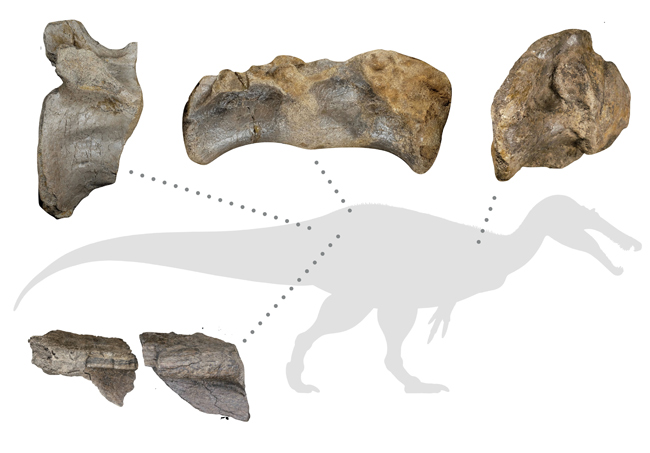
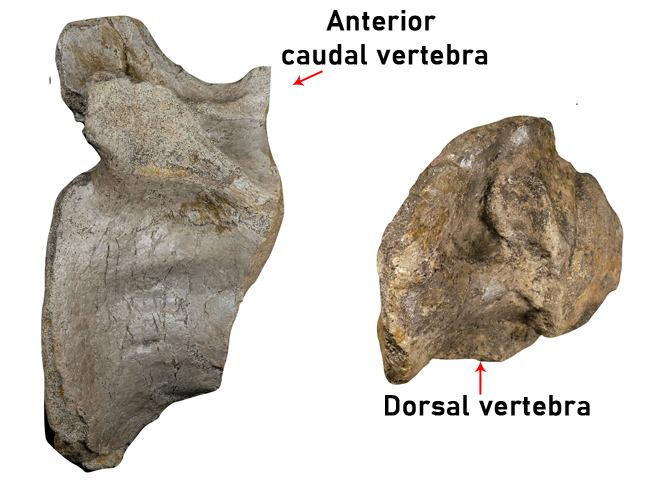
The fossils are not distorted or flattened to any great degree. Their three-dimensional preservation will help the researchers to learn more about the anatomy of giant pterosaurs. In addition, some of the fossil bones such as the dorsosacral vertebrae and caudal vertebra along with the notarium (the structure formed by fusion of the dorsal vertebrae, seen in pterosaurs and birds), have never been described in giant azhdarchids. The researchers expect that further study of these bones will provide important information on azhdarchid anatomy.  Hopefully, new fossil finds will provide more information on the Azhdarchidae.

The “Dragon of Death”

This large pterosaur probably hunted on the ground, perhaps stalking prey in a similar manner to the marabou stork (Leptoptilos crumenifer) which is found in sub-Saharan Africa. The genus name is derived from the Greek words thanatos which means death and drakon (dragon). The species name honours the Inca winged serpent (Amaru).

CONICET* (Consejo Nacional de Investigaciones Científicas y Técnicas [National Council for Scientific and Technical Research of Argentina]).

The scientific paper: “Thanatosdrakon amaru, gen. et sp. nov., a giant azhdarchid pterosaur from the Upper Cretaceous of Argentina” by Leonardo D. Ortiz David, Bernardo J. González Riga and Alexander W. A. Kellner published in the journal Cretaceous Research.

22 05, 2022

The Remarkable Dzharaonyx eski – “Old Dzharakuduk Claw”

By |2024-12-31T09:51:14+00:00May 22nd, 2022|Categories: Dinosaur and Prehistoric Animal News Stories, Dinosaur Fans, Main Page, Palaeontological articles, Photos/Pictures of Fossils|0 Comments

Earlier this spring, a new taxon of alvarezsaurid theropod was described from well-preserved, postcranial remains found in Uzbekistan. The little dinosaur, measuring less than half a metre long, has been named Dzharaonyx eski, which translates as “old Dzharakuduk claw”.

Dzharaonyx eski scale drawing.

The cat-sized alvarezsaurid theropod Dzharaonyx eski from the Late Cretaceous of Uzbekistan. It is regarded as the geologically oldest member of the Parvicursorinae.

From the Bissekty Formation

Writing in the academic “Journal of Vertebrate Paleontology”, the researchers, including Hans-Dieter Sues (Department of Paleobiology, National Museum of Natural History, Smithsonian Institution, Washington, D.C.), describe this cat-sized theropod based on bones from the spine including dorsal and caudal vertebrae, limb bones, parts of the pelvis and bones from the hand including the iconic, robust alvarezsaurid claws.

Dzharaonyx claw fossils.

Dzharaonyx eski a new taxon of alvarezsaurid from the Late Cretaceous of Uzbekistan. Picture credit: Averianov and Sues.

Picture credit: Averianov and Sues

The fossils come from the Bissekty Formation (Upper Cretaceous, Turonian faunal stage) and D. eski is estimated to have lived around 91-92 million years ago. The dinosaur was named after the type locality (Dzharakuduk in south-central Uzbekistan). The species name “eski” is derived from the Uzbek word for “old”.

Pronounced Zar-ah-ra-on-niks es-key, a phylogenetic analysis of this newly described taxon places it within the alvarezsaurid subfamily the Parvicursorinae alongside other Asian members of the Alvarezsauridae such as Parvicursor (P. remotus) and Qiupanykus (Q. zhangi). Dzharaonyx eski is the oldest member of the Parvicursorinae known to science, it having lived at least 10 million years earlier than related species, fossils of which are confined to the Campanian and Maastrichtian faunal stages of the Late Cretaceous.

Remarkable Alvarezsaurids

Alvarezsaurids were highly specialised theropods, with a single, powerful hand claw adapted for tearing and digging. It is thought that these small maniraptoran dinosaurs fed on colonial insects such as termites.

The Alvarezsauridae family was erected in 1991 (Bonaparte). These long-legged theropods were once thought to be a lineage of flightless birds. Most palaeontologists consider them to be an early diverging branch of the Maniraptora. These dinosaurs tend to be both geographically and temporally widespread.

To read a blog post from 2021 about research into the evolution of the Alvarezsauridae: Miniature Alvarezsauroids Under the Spotlight.

Recently, another Asian member of the Parvicursorinae was described from partial, postcranial material from the Upper Cretaceous (Campanian) Barungoyot Formation in Mongolia. The alvarezsaurid has been named Ondogurvel alifanovi.

Mike from Everything Dinosaur commented:

“Dzharaonyx is a remarkable fossil discovery. It lived during the Turonian faunal stage of the Cretaceous. We look forward to more dinosaur discoveries from the famous Bissekty Formation.”

The scientific paper: “New material and diagnosis of a new taxon of alvarezsaurid (Dinosauria, Theropoda) from the Upper Cretaceous Bissekty Formation of Uzbekistan” by Alexander O. Averianov and Hans-Dieter Sues published in the Journal of Vertebrate Paleontology.

The award-wining Everything Dinosaur website: Prehistoric Animal Models and Toys.

6 05, 2022

New Species of Long-tailed Marine Reptile Described

By |2024-12-30T14:30:27+00:00May 6th, 2022|Categories: Adobe CS5, Dinosaur and Prehistoric Animal News Stories, Main Page, Palaeontological articles, Photos/Pictures of Fossils|0 Comments

A new species of Triassic marine reptile has been described following the discovery of superbly preserved fossils in Yunnan Province (south-western China). Named Honghesaurus longicaudalis it is a member of the Pachypleurosauroidea and it possessed the longest tail of any known pachypleurosaur.

Honghesaurus longicaudalis

The holotype fossil (IVPP V30380) of the newly described Honghesaurus longicaudalis. Photo (a) and line-drawing (b) of whole specimen. c, cervical vertebra; ca, caudal vertebra; d, dorsal vertebra; s, sacral vertebra. Picture credit: Xu et al.

Picture credit: Xu et al

Writing in the academic journal “Scientific Reports”, the researchers from the Chinese Academy of Sciences, in collaboration with colleagues from the Zhejiang Museum of Natural History and Guizhou University, describe a complete skeleton in the collection of the Institute of Vertebrate Palaeontology and Palaeoanthropology, Chinese Academy of Sciences (specimen number IVPP V30380). The stunning fossil material comes from marine deposits associated with the Guanling Formation and it is estimated to be around 244 million years of age (Anisian stage of the Middle Triassic).

The Tale of a Very Long Tail

Remarkably, the tail of H. longicaudalis contains 69 caudal vertebrae, far more than any other known pachypleurosaur, other pachypleurosaurs commonly have no more than 58 caudal vertebrae. Humans in comparison have just 33 vertebrae in their skeleton. The researchers conclude that this extremely long tail (making up more than fifty percent of the entire body length), in combination with the animal’s long trunk made Honghesaurus extremely manoeuvrable in water. The scientists also speculate that the exceptionally long tail and body helped this marine reptile to conserve energy as it swam.

Skull and mandible of Honghesaurus longicaudalis.

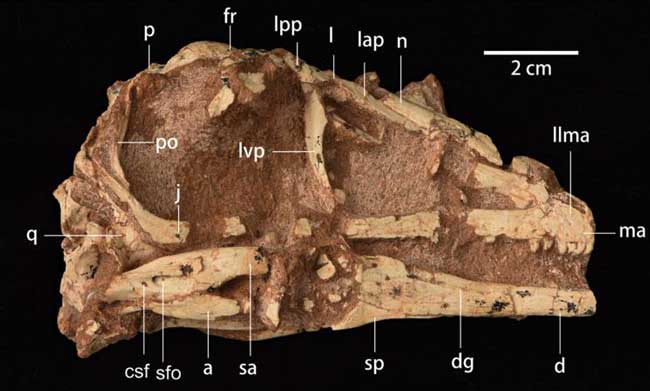
Skull and mandible of Honghesaurus longicaudalis (IVPP V30380). Photo before (a) and after (b) dusted with ammonium chloride. (c) Line- drawing. (d) Reconstruction in dorsal view. an, angular; ar, articular; at, atlas; ax, axis; c, cervical vertebra; den, dentary; en, external naris; eo, exoccipital; f, frontal; j, jugal; m, maxilla; n, nasal; op, opisthotic; p, parietal; pat, proatlas; pm, premaxilla; po, postorbital; pof, postfrontal; prf, prefrontal; pt, pterygoid; q, quadrate; sa, surangular; so, supraoccipital; sq, squamosal; stf, supratemporal fossa. Picture credit: Xu et al.

Picture credit: Xu et al

The Dispersal of the Pachypleurosaurs

The holotype and currently only known specimen of H. longicaudalis (IVPP V30380) measures 47.1 cm in length. Most pachypleurosaurs were of a similar size although phylogenetic analysis suggests that Honghesaurus was closely related to the much larger Wumengosaurus delicatomandibularis, which had an estimated body length of 1.3 metres.

Pachypleurosaurs are regarded as basal members of the Superorder Sauropterygia, which includes placodonts and the plesiosaurs. The research team postulate that the discovery of Honghesaurus demonstrates the diverse morphology of the Pachypleurosauridae and lends weight to the idea that these marine reptiles originated in Europe and dispersed along the Tethys Ocean in a westerly direction giving rise to new forms in the eastern Tethys Ocean.

Keichousaurus life reconstruction.

The best-known of all the pachypleurosaurs is Keichousaurus.  It is also known from south-western China although from geologically younger deposits than the strata that yielded the single specimen of Honghesaurus.

The picture (above) shows a PNSO Keichousaurus model.  To view the range of PNSO prehistoric animal models: PNSO Age of Dinosaurs Figures.

The scientific paper: “A long-tailed marine reptile from China provides new insights into the Middle Triassic pachypleurosaur radiation” by Guang-Hui Xu, Yi Ren, Li-Jun Zhao, Jun-Ling Liao and Dong-Hao Feng published in Scientific Reports.

3 05, 2022

Getting your Claws into Therizinosaurs

By |2023-03-07T21:59:30+00:00May 3rd, 2022|Categories: Adobe CS5, Dinosaur and Prehistoric Animal News Stories, Dinosaur Fans, Main Page, Palaeontological articles, Photos/Pictures of Fossils|0 Comments

Scientists have named a new species of therizinosaur based on fragmentary remains found on the Japanese island of Hokkaido. The dinosaur has been named Paralitherizinosaurus japonicus, it is the first recovered from Asian marine deposits and the third example of a therizinosaur to be found in Japan.

The fossil material, recovered from the lower Campanian Osoushinai Formation near to the town of Nakagawa in the Hokkaido Prefecture, was previously identified as a maniraptoran theropod dinosaur, possibly therizinosaur, but its taxonomic status remained uncertain. A group of scientists including Yoshitsugu Kobayashi and Anthony R. Fiorillo from the Hokkaido University Museum re-examined the fossils and erected a new taxon confirming the fossil material did represent a Late Cretaceous member of the Therizinosauridae.

Paralitherizinosaurus japonicus life reconstruction
A life reconstruction of the Late Cretaceous, Japanese therizinosaur Paralitherizinosaurus japonicus. Picture credit: Masato Hattori.

Evolution of Claw Shape in the Therizinosauridae

Writing in the academic journal “Scientific Reports”, the researchers reassessed the fossil material consisting of a single vertebra plus bones and claws (unguals) from the right hand. As well as concluding that the fossils represent a therizinosaur, they confirmed that it is the geologically youngest therizinosaur known from Japan described to date.

Paralitherizinosaurus silhouette
Paralitherizinosaurus japonicus silhouette showing estimate of body size and position of known skeletal elements. The fossilised claw elements shown in close view with known material in white. Picture credit: Genya Masukawa.

Important Implications for Claw (Ungual) Evolution in the Therizinosauridae

The scientists compared the shape of the hand claws from Paralitherizinosaurus japonicus with the claws from geologically older therizinosaurs and they postulated that that primitive therizinosaurs had claws with generalist functionalities and that the claws of more derived, later therizinosaurs such as P. japonicus were more suited to the hook-and-pull feeding function. Hook-and-pull feeding involves the use of the claws to help gather vegetation and bring it closer to the mouth.

What’s in a Name?

The fossils were found in a concretion associated with the Campanian-aged Osoushinai Formation of the Yezo Group on Hokkaido Island. The Yezo Group mostly consists of marine deposits and many vertebrate fossils such as plesiosaurs, sharks, mosasaurs and turtles have been discovered. Fragmentary dinosaur fossils are also associated with these strata including hadrosaurids, an armoured dinosaur (nodosaurid) and a potential tyrannosaur. A therizinosaur taxon can now be added to this Late Cretaceous dinosaur biota.

PNSO Qingge the Therizinosaurus
A typical therizinosaur dinosaur model (PNSO).

To view replicas of feathered theropods including therizinosaurus (whilst stocks last): PNSO Age of Dinosaurs Figures.

The discovery of the bones and claw elements in marine deposits helped to inspire this dinosaur’s scientific name. The genus name translates as “scythe reptile by the sea”, whilst the species name honours Japan.

Paralitherizinosaurus japonicus fossils.
The concretion that contained the fragmentary therizinosaur fossil material prior to preparation. Picture credit: Kobayashi et al.

The scientific paper: “New therizinosaurid dinosaur from the marine Osoushinai Formation (Upper Cretaceous, Japan) provides insight for function and evolution of therizinosaur claws” by Yoshitsugu Kobayashi, Ryuji Takasaki, Anthony R. Fiorillo, Tsogtbaatar Chinzorig and Yoshinori Hikida published in Scientific Reports.

28 04, 2022

A New, Giant Megaraptorid from South America is Described

By |2024-12-30T10:01:11+00:00April 28th, 2022|Categories: Adobe CS5, Dinosaur and Prehistoric Animal News Stories, Dinosaur Fans, Main Page, Palaeontological articles, Photos/Pictures of Fossils|0 Comments

Fragmentary bones excavated from Santa Cruz Province, Patagonia (Argentina), have revealed the presence of a super-sized megaraptorid theropod in the Late Cretaceous (Maastrichtian faunal stage). The new dinosaur, named Maip macrothorax is estimated to have been at least 9.5 metres long. It represents the biggest member of the Megaraptoridae described to date and its discovery lends support to the theory that these types of dinosaurs were not members of the Allosauria clade, but they were coelurosaurs and therefore related to the dinosaur lineage that gave rise to the birds.

Maip macrothorax.

Silhouette of Maip macrothorax showing the preserved bones in white (A). Reconstruction of the thoracic cavity of Maip (B) at the level of dorsal vertebra 6 (D6). Drawing of the excavation of Maip showing the original disposition of the bones (C). Abbreviations: a, axis; c, coracoid; ind, indeterminate bone; g, gastralia; r, rib; v, vertebrae. Picture credit: Rolando et al. Note scale bar in (A) = 1 metre, and (B,C) 50 cm.

Picture credit: Rolando et al

The fossil material was collected from exposures of the Chorrillo Formation approximately eighteen miles southwest of the city of El Calafate (southwestern Santa Cruz Province, Patagonia, Argentina).

The “Shadow of the Death” which “Kills with Cold Wind”

The Megaraptora clade are mostly known from fragmentary and very incomplete specimens. The fossils of Maip macrothorax (pronounced my-eep mac-row-thor-ax), although representing only a small portion of the overall skeleton, consist of a single cervical vertebra (C2 the axis), several dorsal vertebrae, ribs, the left coracoid, a partial toe bone, fragments of the scapula and caudal vertebrae.

By studying these bones the researchers, that included Alexis M. Aranciaga Rolando from the Museo Argentino de Ciencias Naturales “Bernardino Rivadavia” (Buenos Aires, Argentina) and Makoto Manabe from the National Museum of Nature and Science (Japan), postulate that the Megaraptora are not archaic members of the Allosauroidea but members of the Coelurosauria clade, that group of theropods more closely related to birds than they are to other members of the Avetheropoda lineage.

Maip macrothorax

The genus name is from the native Aónikenk people of Patagonia (known as the Tehuelche in western culture). Maip is an evil spirit said to roam the Andes and its name means “the shadow of death” which “kills with cold wind”. The specific name derives from the Latin for big thorax. The rib bones indicate that this dinosaur was deep chested with a large thoracic cavity more than 1.2 metres in width.

Maip macrothorax axis bone (C2)

The second neck bone of Maip macrothorax (axis – C2) shown in lateral (A), anterior (B), posterior (C) and dorsal (D) with accompanying line drawings. Note scale bar = 5 cm. Picture credit: Rolando et al.

Picture credit: Rolando et al

The researchers propose that with the extinction of the carcharodontosaurids, many of which were apex predators on the southern continents, the megaraptorids evolved becoming larger, heavier and more robust, eventually filling the niche of top predator in many parts of the Southern Hemisphere during the Late Cretaceous.

Evolutionary trends of the Megaraptora.

Evolutionary trends of the Megaraptora. Evolutionary trends of Megaraptora. Temporal scale and bars depicting currently known temporal distributions of Megaraptora and Carcharodontosauridae (A). Time-calibrated phylogeny of megaraptoran taxa (B), showing most relevant genera from Asia (black bars), Australia (red bars) and South America (blue bars). Main synapomorphies supporting each node are indicated by arrows. Tree topology follows the results of the present work. Curve showing the increasing in average body size of megaraptorans during Barremian faunal stage through to the Maastrichtian (C). Picture credit: Rolando et al.

Picture credit: Rolando et al

The Rise of the Megaraptorids

Around 94 million years ago (Cenomanian faunal stage of the Late Cretaceous), there was a global extinction event which led to the demise of the Carcharodontosauridae. As far as Everything Dinosaur team members are aware, there are no reliable fossil records for the presence of carcharodontosaurids in South America beyond the Turonian faunal stage (the stage that followed the Cenomanian). An absence of apex predators permitted the megaraptorids and the abelisaurids to evolve to fill this niche in the Southern Hemisphere, whilst the tyrannosaurids become bigger and occupied the apex predator role in Asia and North America.

Maip macrothorax estimated at around 9.5 metres in length, lived some sixteen million years after the next largest megaraptorid (Aerosteon – A. riocoloradense). The body size of megaraptorids during the Early Cretaceous when the carcharodontosaurids still roamed seems to have been limited to around six metres in length, suggesting that these theropods were secondary predators. However, with the extinction of the carcharodontosaurids, body size in the Megaraptoridae increased and by the very end of the Cretaceous (Maastrichtian faunal stage), a body length in excess of ten metres seems plausible.

To read the Everything Dinosaur blog post that reported the discovery of these bones in 2020: Scientists Discover Giant Megaraptor.

Helping to Resolve the Phylogeny of these Enigmatic Theropods

Although the bones only represent a small part of the total skeleton and no cranial material has been identified, Maip macrothorax is the most informative megaraptoran known from the Maastrichtian stage. Phylogenetic analysis has placed this new taxon together with other South American megaraptorans in a monophyletic clade (they shared a single, common ancestor), whereas Australian and Asian members constitute successive stem groups.

Roaming Patagonia 80 million years ago

A leggy, Late Cretaceous carnivore (Murusraptor).  Picture credit: Jan Slovak (University of Alberta).

Picture credit: Jan Sovak (University of Alberta).

For models and replicas of theropods and other prehistoric animals: Wild Safari Prehistoric World Models and Figures.

The researchers propose that the South American megaraptorids differ from more basal megaraptorans such as Fukuiraptor from Japan and Australovenator from Queensland, Australia in several anatomical features and the South American lineage evolved into much bigger, more robust and powerful predators.

The scientific paper: “A large Megaraptoridae (Theropoda: Coelurosauria) from Upper Cretaceous (Maastrichtian) of Patagonia, Argentina” by Alexis M. Aranciaga Rolando, Matias J. Motta, Federico L. Agnolín, Makoto Manabe, Takanobu Tsuihiji and Fernando E. Novas published in Scientific Reports.

The Everything Dinosaur website: Dinosaur Toys.

21 04, 2022

The Oldest Mineralised Bryozoan? A New Scientific Paper

By |2024-12-30T08:24:49+00:00April 21st, 2022|Categories: Adobe CS5, Dinosaur and Prehistoric Animal News Stories, Main Page, Palaeontological articles, Photos/Pictures of Fossils|0 Comments

Scientists from John Hopkins University (Baltimore, Maryland), Smith College (Northampton, Massachusetts) along with bryozoan expert Paul Taylor of the London Natural History Museum and another collaborator have published a paper in “Science Advances” reporting a possible earliest occurrence of palaeostomate bryozoans.

Cut slabs of bryomorph fossils from the Harkless Formation

Cut slabs of bryomorph fossils from the Harkless Formation (Gold Point, Nevada). Cross-sectional view showing round individual tubes (A). Longitudinal cut through organism showing growth form (B). Picture credit: Note scale equals 1,000 microns. Pruss et al.

Picture credit: Pruss et al

Fossils from the Harkless Formation (Nevada) – A Mineralised Bryozoan

Recently, Everything Dinosaur published a blog post about a scientific paper that came out late last year (October 2021), the study reported upon the identification a soft-bodied bryozoan Protomelission gatehousei from Early Cambrian strata: Early Cambrian Origin for the Bryozoa. The oldest previously accepted skeletal bryozoans occur in Lower Ordovician deposits, however, these researchers suggest that fossils found in strata from the Harkless Formation (Nevada, USA) are also bryozoans. The fossils show a radiating form preserved in limestone deposited during the Cambrian. If these fossils also represent bryozoans, they have a hard, mineralised skeleton.

Thin section images of a single bryomorph organism from the Harkless Formation (Nevada).

Thin section images of a single bryomorph organism from the Harkless Formation (Nevada). General fossil view (A). Sketches of the branching of daughter tubes from parent tubes (B). Note the formation of distinct skeletal walls from the parent during budding. Note scale bar equals 1 mm. Picture credit: Pruss et al.

Picture credit: Pruss et al

All Skeletal Marine Invertebrate Phyla Appeared During the Cambrian Explosion

Previously, it had been thought that all skeletal marine invertebrate phyla appeared during the Cambrian explosion, except for Bryozoa with mineralised skeletons which were known from fossils dating from the Early Ordovician. If the small fossils identified in thin cross sections of Harkless Formation limestone are examples of bryozoans with a hard skeleton, then this evidence, in addition to the recent paper on the soft-bodied Cambrian bryozoan Protomelission (P. gatehousei), suggests an Early Cambrian origin for the Bryozoa and provides evidence to support the hypothesis that all types of skeletal marine invertebrate phyla evolved during the Cambrian.

If the Nevada fossils are confirmed as bryozoans, the appearance of a mineralised skeleton in this phylum would be pushed back by some 30 million years.

The scientific paper: “The oldest mineralized bryozoan? A possible palaeostomate in the lower Cambrian of Nevada, USA” by Sara B. Pruss, Lexie Leeser, Emily F. Smith, Andrey Yu. Zhuravlev and Paul D. Taylor published in Science Advances.

The Everything Dinosaur website:Prehistoric Animal Figures and Models.

20 04, 2022

Branching Feathers and Melanosomes Identified in Pterosaur Fossil

By |2024-12-30T08:05:02+00:00April 20th, 2022|Categories: Adobe CS5, Dinosaur and Prehistoric Animal News Stories, Dinosaur Fans, Main Page, Palaeontological articles|0 Comments

A remarkably well-preserved cranial crest from a pterosaur has provided more evidence that pterosaurs were feathered. Furthermore, analysis of the Tupandactylus specimen (MCT.R.1884), indicates that their bodies were covered with different types of feathers, including branching feathers. The researchers report the presence of different shaped melanosomes associated with the skin and the flying reptile’s feathers. This suggests that pterosaur feathers were not just for thermoregulation, that colouration could be manipulated genetically.

In simple terms, pterosaur feathers probably played a role in visual communication and therefore, visual signalling.

New evidence of branched feathers in pterosaurs.

New evidence of branched feathers in discovered in a Tupandactylus specimen suggests that feathers originated in the avemetatarsalian ancestor of pterosaurs and dinosaurs in the Early Triassic. Picture credit: Bob Nicholls.

Picture credit: Bob Nicholls

Perhaps feathers evolved independently in the Theropoda and Pterosauria (convergent evolution), if this is not the case, then integumentary coverings originated in the avemetatarsalian ancestor of the pterosaurs and dinosaurs.

Marvellous Melanosomes

Writing in the academic journal “Nature”, the researchers that include University College Cork palaeontologists Dr Aude Cincotta, Professor Maria McNamara and Dr Pascal Godefroit from the Royal Belgian Institute of Natural Sciences, conclude that pterosaurs were able to control the colour of their feathers using melanin pigments.

A partial cranium from a Tupandactylus imperator preserved on five limestone slabs from the Lower Cretaceous Crato Formation (Brazil), estimated to be around 115 million years old, was analysed in detail. The scientists discovered that the bottom of the spectacular head crest had a rim of fuzzy feathers, with short wiry hair-like feathers and fluffy branched feathers.

Different types of feathers in pterosaur fossil

Details of the cranial crest of a new specimen of Tupandactylus cf. imperator (MCT.R.1884) from the Lower Cretaceous Crato Formation, Brazil. Incomplete skull showing soft crest preserved (a). Details of the intgumentary structures associated with the back of the skull (b-f). Monofilaments (b), branched feathers (c) and in close view (d). A straight branched feather (e) with close view (f). The white arrow in (e) highlights the basal calamus (hollow base of the feather that attaches to the skin). Scanning Electron Microscope images (g-i) of melanosomes in MCT.R.1884. Scale bars, 50 mm (a); 5 mm (b); 2 mm (c); 250 μm (d–f); 2 μm (g–i). Picture credit: Cincotta et al.

Picture credit: Cincotta et al

Pterosaur Feather Controversies

Several papers have been published examining integumentary coverings in members of the Pterosauria. It had been established (Yang et al 2018), that flying reptiles had feathery, branched feathers: Are the Feathers About to Fly in the Pterosauria? However, the debate regarding integumentary coverings in pterosaurs is not without controversy.

In 2020, a paper was published that challenged these findings casting doubt on the idea that pterosaurs had an integumentary covering of insulating protofeathers: Naked Pterosaurs – No Feathers Here (Unwin and Martill).

Scanning Electron Microscopes

Soft tissue samples from the cranial crest, simple feathers (monofilaments) and the branching feathers were taken and subjected to scanning electron microscopy. All the samples were found to contain abundant oval-shaped or elongate structures that were interpreted to represent melanosomes. Unexpectedly, the new study shows that the melanosomes in different feather types have different shapes.

Commenting on the significance of this discovery, co-author of the paper, Professor McNamara stated:

“In birds today, feather colour is strongly linked to melanosome shape. Since the pterosaur feather types had different melanosome shapes, these animals must have had the genetic machinery to control the colours of their feathers. This feature is essential for colour patterning and shows that colouration was a critical feature of even the very earliest feathers”.

Tupandactylus illustration.

A scale drawing of the tapejarid pterosaur Tupandactylus imperator. A new study suggests that flying reptiles had a variety of feathers and that the presence of different shaped melanosomes in different types of feathers indicates that they possessed the genetic machinery to control the colours of their feathers. Picture credit: Everything Dinosaur.
Picture credit: Everything Dinosaur

For models and replicas of pterosaurs and other prehistoric animals: PNSO Museum Quality Prehistoric Animal Models.

Feathers Use in Visual Signalling has Deep Evolutionary Origins

The Pterosauria and the Dinosauria are members of the Avemetatarsalia, a branch of the Archosauria that includes all archosaurs more closely related to birds than to crocodilians. However, the lineage that led to the flying reptiles diverged from the dinosaurs millions of years before birds and feathered dinosaurs evolved. This study also suggests that the function of feathers in visual communication has deep evolutionary origins.

Fossil Repatriated to Brazil

It is also pleasing to note, that thanks to the efforts of the research team, the authorities and other collaborators, this amazing pterosaur fossil that had been in private ownership has been repatriated to Brazil.

Dr Pascal Godefroit (Royal Belgian Institute of Natural Sciences), explained:

“It is so important that scientifically important fossils such as this are returned to their countries of origin and safely conserved for posterity. These fossils can then be made available to scientists for further study and can inspire future generations of scientists through public exhibitions that celebrate our natural heritage”.

Everything Dinosaur acknowledges the assistance of a press release from the University College Cork in the compilation of this article.

The scientific paper: “Pterosaur melanosomes support signalling functions for early feathers” by Aude Cincotta, Michaël Nicolaï, Hebert Bruno Nascimento Campos, Maria McNamara, Liliana D’Alba, Matthew D. Shawkey, Edio-Ernst Kischlat, Johan Yans, Robert Carleer, François Escuillié and Pascal Godefroit published in the journal Nature.

Visit Everything Dinosaur’s website: Everything Dinosaur.
17 04, 2022

Early Cambrian Origin for the Bryozoa According to New Study

By |2024-12-30T06:35:27+00:00April 17th, 2022|Categories: Adobe CS5, Dinosaur and Prehistoric Animal News Stories, Main Page, Palaeontological articles, Photos/Pictures of Fossils|0 Comments

Bryozoans, also referred to as the Polyzoa, are an ancient phylum of tiny aquatic invertebrate animals that mostly live in colonies. Normally marine, but some species do live in freshwater, they have a protective exoskeleton made from calcium carbonate. They have a special feeding appendage called a lophophore, which resembles a crown of tentacles used for filter feeding.

Bryozoan fossils are abundant and geographically widespread and the presence of six major orders of bryozoans in Lower Ordovician strata strongly indicated that these organisms evolved during the Cambrian, however, fossil evidence was lacking. Late last year (2021), a team of researchers published a paper in the academic journal “Nature” describing a new genus of soft-bodied bryozoan from the Early Cambrian of Australia and southern China. Named Protomelission gatehousei, its fossils confirm a Cambrian origin for these important aquatic organisms.

Bryozoan fossil from the Early Cambrian.

Protomelission gatehousei from the Cambrian Wirrealpa Limestone, South Australia. Picture credit: Zhang et al.

Picture credit: Zhang et al

A Basal Member of the Bryozoa

The researchers from Macquarie University (Sydney, Australia), the Northwest University (Xi’an, China), the London Natural History Museum, the University of Missouri, the Nanjing Institute of Geology and Palaeontology (Nanjing, China) as well as the Swedish Museum of Natural History (Stockholm, Sweden), describe this new genus as a basal member of the order.

The discovery of a stem bryozoan from rocks dating from the Cambrian narrows the origination gap that previously existed between the known fossil record and independent molecular clock estimates. The researchers state that this fossil discovery pushes back the fossil record of the Bryozoa by approximately thirty-five million years.

Protomelission gatehousei confirms that the colonial body plan of the Bryozoa originated in the Early Cambrian. It also reconciles the fossil record with molecular clock estimations of an Early Cambrian origination and subsequent Ordovician radiation of Bryozoa following the acquisition of a carbonate skeleton.

Bryozoan fossil from the Ordovician.

Fossils of a branching bryozoan colony from the Ordovician. The presence of six major orders of bryozoans in lower Ordovician rocks strongly suggests a Cambrian origin for the largest and most diverse lophophorate phylum but the fossil evidence had been lacking. A newly published paper describes Protomelission gatehousei from the Early Cambrian of Australia and southern China and confirms a Cambrian origin for these important aquatic organisms.

Whilst the Cambrian and Ordovician forms are extinct, modern bryozoans are an important constituent of modern-day marine fauna.

The scientific paper: “Fossil evidence unveils an early Cambrian origin for Bryozoa” by Zhiliang Zhang, Zhifei Zhang, Junye Ma, Paul D. Taylor, Luke C. Strotz, Sarah M. Jacquet, Christian B. Skovsted, Feiyang Chen, Jian Han and Glenn A. Brock published in Nature.

16 04, 2022

A Juvenile Diamantinasaurus – Australia’s Smallest Sauropod Found to Date

By |2023-07-04T07:21:38+01:00April 16th, 2022|Categories: Adobe CS5, Dinosaur and Prehistoric Animal News Stories, Dinosaur Fans, Main Page, Palaeontological articles, Photos/Pictures of Fossils|0 Comments

A scientific paper has just been published describing the fossilised remains of a juvenile titanosaur from the Winton Formation of Queensland, Australia. The specimen has been assigned to the Diamantinasaurus taxon (D. matildae) and it represents the smallest sauropod described from fossils found in Australia to date.

Reconstructed skeleton of the juvenile Diamantinasaurus (D. matildae) compared to a human skeleton.
A model of the reconstructed skeleton of the juvenile Diamantinasaurus (D. matildae) compared to a human skeleton. The young dinosaur is estimated to have weighed around 4.2 Tonnes. Picture credit: Australian Age of Dinosaurs Museum.

About Ten Percent of the Skeleton Recovered

The fossils were discovered on Elderslie Station land which lies some 35 miles northwest of the town of Winton (Queensland). Landowners noticed fragments of a femur and dorsal ribs exposed on the surface (2012). Staff from the Australian Age of Dinosaurs Museum along with volunteers excavated the site and found the remainder of the fossil material representing about 10% of the total skeleton about a metre below the surface.

The postcranial material consists of cervical ribs, three incomplete dorsal vertebrae, sacral vertebrae and limb bones.

Views of the juvenile Diamantinasaurus fossils (AODF 663) a right humerus and right manual ungual with accompanying digital models.
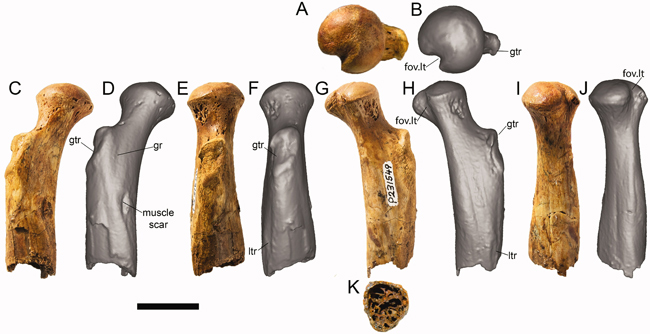
Views of the juvenile Diamantinasaurus fossils (AODF 663) a right humerus and right manual ungual with accompanying digital models. Right humerus photographs in A, dorsal, B, anterior, C, ventral, D, medial, E, posterior, F, lateral views. Right humerus digital models in G, dorsal, H, anterior, I, ventral, J, medial, K, posterior, L, lateral views. The right manual ungual in M, proximal, N, dorsal, O, anterior, P, ventral, Q, posterior views. Right manual ungual digital models in R, proximal, S, dorsal, T, anterior, U, ventral, and V, posterior views. Note scale bar for humerus equals 10 cm and for the manual ungual 5 cm. Picture credit: Rigby et al.

A Young Titanosaur from the Late Cretaceous

Although age estimates for the Winton Formation vary, it has been informally divided into lower and upper members, with the Diamantinasaurus material coming from the “upper” portion which is regarded as Cenomanian to potentially the lowermost Turonian stages of the Late Cretaceous (approximately 95-89 million years ago).

The study of the juvenile titanosaur was led by Museum Research Associate Samantha Rigby who is undertaking a Master of Science (Research) at Swinburne University of Technology (Victoria, Australia), under the supervision of Dr Stephen Poropat who was one of the co-authors of the scientific paper published in the Journal of Vertebrate Palaeontology. Each bone from the specimen was scanned to create three-dimensional models to digitally compare them with other sauropod remains.

This comparison suggests the small specimen belongs to the Diamantinasaurus taxon though with juvenile characteristics, vertebrae which are unfused, minimal muscle scarring on the bones, smooth bone texture and marked proportional bone size differences when compared to adult titanosaur material.

Diamantinasaurus dorsal vertebrae and digital models.
Diamantinasaurus juvenile dorsal vertebrae with digital models. Dorsal vertebra photographs in A, dorsal, B, right lateral, C, anterior, D, left lateral, E, posterior views. Dorsal vertebra digital models in F, dorsal, G, right lateral, H, anterior, I, left lateral, J, posterior views. Note scale bar equals 10 cm. Picture credit: Rigby et al.

Allometric Growth

The fossil specimen (AODF 663) nicknamed “Oliver” is only the third specimen to be referred to the taxon Diamantinasaurus matildae. D. matildae was formally named and described in 2009: A Trio of New Dinosaurs from Down Under. The research team found that the bones of this small titanosaur grew allometrically, meaning that its bones changed shape and different parts of its body grew at different rates.

The limb bones are also narrower in width when compared to other Diamantinasaurus limb bones from older individuals. This suggests that as this titanosaur grew its limb bones became thicker and more robust to help support its enormous bulk.

A Juvenile Diamantinasaurus

Fossils of juvenile titanosaurs are rare and it is hoped that “Oliver” will provide important insights into the ontogeny of titanosaurs.

Everything Dinosaur acknowledges the assistance of a media release from the Australian Age of Dinosaurs Museum in the compilation of this article.

The scientific paper: “A juvenile Diamantinasaurus matildae (Dinosauria: Titanosauria) from the Upper Cretaceous Winton Formation of Queensland, Australia, with implications for sauropod ontogeny” by Samantha L. Rigby, Stephen F. Poropat, Philip D. Mannion, Adele H. Pentland, Trish Sloan, Steven J. Rumbold, Carlin B. Webster and David A. Elliott published in the Journal of Vertebrate Paleontology.

Visit the Everything Dinosaur website: Everything Dinosaur.
Go to Top